EP2472811A1 - Procédé et système de mise en uvre d'interconnexion entre un réseau de protocole internet version 4 et un nouveau réseau - Google Patents
Procédé et système de mise en uvre d'interconnexion entre un réseau de protocole internet version 4 et un nouveau réseau Download PDFInfo
- Publication number
- EP2472811A1 EP2472811A1 EP09846078A EP09846078A EP2472811A1 EP 2472811 A1 EP2472811 A1 EP 2472811A1 EP 09846078 A EP09846078 A EP 09846078A EP 09846078 A EP09846078 A EP 09846078A EP 2472811 A1 EP2472811 A1 EP 2472811A1
- Authority
- EP
- European Patent Office
- Prior art keywords
- intercommunication
- address
- message
- new network
- network
- Prior art date
- Legal status (The legal status is an assumption and is not a legal conclusion. Google has not performed a legal analysis and makes no representation as to the accuracy of the status listed.)
- Ceased
Links
Images


Classifications
-
- H—ELECTRICITY
- H04—ELECTRIC COMMUNICATION TECHNIQUE
- H04L—TRANSMISSION OF DIGITAL INFORMATION, e.g. TELEGRAPHIC COMMUNICATION
- H04L12/00—Data switching networks
- H04L12/28—Data switching networks characterised by path configuration, e.g. LAN [Local Area Networks] or WAN [Wide Area Networks]
- H04L12/46—Interconnection of networks
-
- H—ELECTRICITY
- H04—ELECTRIC COMMUNICATION TECHNIQUE
- H04L—TRANSMISSION OF DIGITAL INFORMATION, e.g. TELEGRAPHIC COMMUNICATION
- H04L45/00—Routing or path finding of packets in data switching networks
- H04L45/74—Address processing for routing
- H04L45/741—Routing in networks with a plurality of addressing schemes, e.g. with both IPv4 and IPv6
-
- H—ELECTRICITY
- H04—ELECTRIC COMMUNICATION TECHNIQUE
- H04L—TRANSMISSION OF DIGITAL INFORMATION, e.g. TELEGRAPHIC COMMUNICATION
- H04L12/00—Data switching networks
- H04L12/66—Arrangements for connecting between networks having differing types of switching systems, e.g. gateways
-
- H—ELECTRICITY
- H04—ELECTRIC COMMUNICATION TECHNIQUE
- H04L—TRANSMISSION OF DIGITAL INFORMATION, e.g. TELEGRAPHIC COMMUNICATION
- H04L61/00—Network arrangements, protocols or services for addressing or naming
- H04L61/09—Mapping addresses
- H04L61/25—Mapping addresses of the same type
- H04L61/2503—Translation of Internet protocol [IP] addresses
- H04L61/251—Translation of Internet protocol [IP] addresses between different IP versions
-
- H—ELECTRICITY
- H04—ELECTRIC COMMUNICATION TECHNIQUE
- H04L—TRANSMISSION OF DIGITAL INFORMATION, e.g. TELEGRAPHIC COMMUNICATION
- H04L61/00—Network arrangements, protocols or services for addressing or naming
- H04L61/09—Mapping addresses
- H04L61/25—Mapping addresses of the same type
- H04L61/2503—Translation of Internet protocol [IP] addresses
- H04L61/2521—Translation architectures other than single NAT servers
- H04L61/2528—Translation at a proxy
-
- H—ELECTRICITY
- H04—ELECTRIC COMMUNICATION TECHNIQUE
- H04L—TRANSMISSION OF DIGITAL INFORMATION, e.g. TELEGRAPHIC COMMUNICATION
- H04L61/00—Network arrangements, protocols or services for addressing or naming
- H04L61/50—Address allocation
- H04L61/5076—Update or notification mechanisms, e.g. DynDNS
-
- H—ELECTRICITY
- H04—ELECTRIC COMMUNICATION TECHNIQUE
- H04L—TRANSMISSION OF DIGITAL INFORMATION, e.g. TELEGRAPHIC COMMUNICATION
- H04L61/00—Network arrangements, protocols or services for addressing or naming
- H04L61/09—Mapping addresses
- H04L61/25—Mapping addresses of the same type
- H04L61/2503—Translation of Internet protocol [IP] addresses
- H04L61/2517—Translation of Internet protocol [IP] addresses using port numbers
-
- H—ELECTRICITY
- H04—ELECTRIC COMMUNICATION TECHNIQUE
- H04L—TRANSMISSION OF DIGITAL INFORMATION, e.g. TELEGRAPHIC COMMUNICATION
- H04L61/00—Network arrangements, protocols or services for addressing or naming
- H04L61/09—Mapping addresses
- H04L61/25—Mapping addresses of the same type
- H04L61/2503—Translation of Internet protocol [IP] addresses
- H04L61/2592—Translation of Internet protocol [IP] addresses using tunnelling or encapsulation
-
- H—ELECTRICITY
- H04—ELECTRIC COMMUNICATION TECHNIQUE
- H04L—TRANSMISSION OF DIGITAL INFORMATION, e.g. TELEGRAPHIC COMMUNICATION
- H04L61/00—Network arrangements, protocols or services for addressing or naming
- H04L61/45—Network directories; Name-to-address mapping
- H04L61/4505—Network directories; Name-to-address mapping using standardised directories; using standardised directory access protocols
- H04L61/4511—Network directories; Name-to-address mapping using standardised directories; using standardised directory access protocols using domain name system [DNS]
Definitions
- the present invention relates to the field of communication, and in particular, to a method and system for implementing intercommunication between an IPV4 (Internet Protocol Version 4) network and a new network, and a method for intercommunication between networks with different addressing formats.
- IPV4 Internet Protocol Version 4
- IPV4 public network addresses are almost exhausted, and it is predicted in the industry that they will be completely exhausted in a few years, so migration to IPV6 is inevitable.
- IPV6 is inevitable.
- NAT Network Address Translation
- 6 to 4 are generally adopted in the industry to solve the intercommunication between IPV4 host and IPV6 host.
- each IPV4 address needs to be mapped to a unique IPV6 address
- the IANA Internet Assigned Numbers Authority
- the IANA Internet Assigned Numbers Authority
- IPV6 host participating in intercommunication also must occupy an IPV4 public network address and always occupies the address during the whole process of migration from the IPV4 to the IPV6, this migration process seems to be very long at present, and since the IPV4 address space is rather rare, the number of addresses required in this intercommunication scheme cannot be supported.
- this intercommunication problem does not only lie between the IPV4 and IPV6 networks, but also lie in the intercommunication between a network with novel addressing provided by IETF (Internet Engineering Task Force) and the IPV4, for example, the representatives of identity/location separation technology, LISP (Locator/Identifier Separation Protocol) and HIP (Host Identity Protocol), both define a new identifier format, which will also be regarded as an IP address with a new format by the network and host of the IPV4 when the network with novel addressing communicates with the IPV4 network, so the new network has the same problem in intercommunication with the IPV4 network as the IPV6 network.
- IETF Internet Engineering Task Force
- Another problem of intercommunication lies in the support of traditional applications for a new IP (Internet Protocol) address format.
- IP Internet Protocol
- network upgrading, host operation system/protocol stack upgrading are relatively easy, but applications can hardly be synchronous with the network upgrading due to their diversity, so compatibility with the old applications is also one of the crucial problems in the period of network transition.
- the technical problem to be solved in the present invention is to provide a method and system for implementing intercommunication between networks with different addressing formats, and to achieve network intercommunication and application compatibility by way of address multiplexing.
- the present invention provides a method for implementing intercommunication between an Internet Protocol Version 4 (IPV4) network and a new network, wherein, the new network adopts an addressing format different from that of the IPV4 network, and the method comprises:
- IPV4 Internet Protocol Version 4
- the intercommunication functional unit comprises an intercommunication gateway and an intercommunication mapping server, and before the step A1, the method further comprises:
- step A2 is:
- step A2 is:
- the method further comprises:
- the method further comprises: the intercommunication gateway firstly inquiring whether there is information of the compatible format address of the new network host in a local cache; executing step a22 when no corresponding new network address is inquired.
- the new network is an Internet Protocol Version 6 (IPV6) network or an identity/location separation architecture network
- IPV6 Internet Protocol Version 6
- identity/location separation architecture an identity/location separation architecture network
- the present invention further provides an intercommunication functional unit supporting a system for implementing intercommunication between an Internet Protocol Version 4 (IPV4) network and a new network, wherein the intercommunication functional unit is connected with an IPV4 network host via the IPV4 network, and the intercommunication functional unit is configured to:
- IPV4 Internet Protocol Version 4
- the intercommunication functional unit comprises an intercommunication gateway and an intercommunication mapping server that are connected with each other, wherein, the intercommunication mapping server is configured to distribute a compatible format address to the new network host according to a request of the new network host, and store a corresponding relationship between the new network address of the new network host and the compatible format address; the intercommunication gateway is configured to:
- the intercommunication functional unit comprises an intercommunication gateway and an intercommunication mapping server that are connected with each other, wherein, the intercommunication mapping server is configured to:
- the present invention further provides a system for implementing intercommunication between an Internet Protocol Version 4 (IPV4) network and a new network.
- the system comprises an IPV4 network host, the intercommunication functional unit described above, and a new network host, wherein, the IPV4 network host is located in the IPV4 network and has an IPV4 address, and the IPV4 network host is configured to: send and receive a first intercommunication message through the IPV4 network, wherein, a source address and a destination address of the sent first intercommunication message are the IPV4 address of the IPV4 network host and the compatible format address of the new network host respectively, a source address and a destination address of the received first intercommunication message are the compatible format address of the new network host and the IPV4 address of the IPV4 network host respectively, and the compatible format address comprises an IPV4 format address and a port number; the intercommunication functional unit is connected with the IPV4 network host through the IPV4 network, and the intercommunication functional unit is configured to:
- the intercommunication functional unit comprises an intercommunication gateway and an intercommunication mapping server that are connected with each other, wherein, the intercommunication mapping server is configured to distribute a compatible format address to the new network host according to a request of the new network host, and store a corresponding relationship between the new network address of the new network host and the compatible format address; the intercommunication gateway is configured to:
- the intercommunication functional unit comprises an intercommunication gateway and an intercommunication mapping server that are connected with each other, wherein, the intercommunication mapping server is configured to:
- system further comprises a domain name server connected with the IPV4 network host and the new network host, and the domain name server is configured to:
- the new network is an Internet Protocol Version 6 (IPV6) network or an identity/location separation architecture network
- IPV6 Internet Protocol Version 6
- the new network address refers to an IPV6 address or an identity identifier for indicating an identity
- the present invention further provides a method for implementing intercommunication between a first network and a second network, wherein, the first and second networks adopt different addressing formats, and the method comprises:
- the intercommunication functional unit comprises an intercommunication gateway and an intercommunication mapping server, before the step of generating and transmitting the intercommunication message, the method further comprises:
- the intercommunication gateway when the second node is the intercommunication functional unit, the intercommunication gateway locally caches the corresponding relationship; in the step of encapsulating and transmitting the intercommunication message, after the intercommunication gateway receiving the first intercommunication message and before encapsulating the first intercommunication message into the second intercommunication message and sending the second intercommunication message, the step further comprises obtaining the network address of the new network host from a local cache or the intercommunication mapping server according to the compatible format address, the source address of the first intercommunication message is a second network address of the intercommunication gateway.
- the intercommunication gateway when the second node is the intercommunication functional unit, the intercommunication gateway locally caches the corresponding relationship; in the step of encapsulating and transmitting the intercommunication message, after the intercommunication gateway receiving the first intercommunication message and before encapsulating the received first intercommunication message into the second intercommunication message, the step further comprises inquiring in a local cache according to the compatible format address; in the step of encapsulating the received first intercommunication message into the second intercommunication message, the intercommunication gateway encapsulates the received first intercommunication message into the second intercommunication message when the new network address of the new network host is inquired; or when the new network address of the new network host is not inquired, the step further comprises:
- the first network is an Internet Protocol Version 4 (IPV4) network
- the first network addressing format address is an IPV4 address
- the second network is an Internet Protocol Version 6 (IPV6) network or an identity/location separation architecture network
- the second network addressing format address is an IPV6 address or an identity identifier for indicating an identity.
- the main conception of the method and system for implementing intercommunication according to the present invention is to adopt a mode of IPV4 address multiplexing and distribute a compatible format address to the new network host for intercommunicating with the IPV4 network, wherein the compatible format address comprises an IPV4 format address and a port number, this IPV4 address can be routed in the IPV4 network, thereby solving the problem of lack of IPV4 addresses and simultaneously implementing intercommunication; in addition, for a new network host, compatibility with the original IPV4 application program in the new network host can be achieved as long as the protocol stack of the new network host is upgraded.
- a network using a new addressing format is called as a new network, its addressing format is different from that of the IPV4 network, and the new network may be an IPV6 network or an identity/location separation architecture network.
- the main conception of the method and system for implementing intercommunication according to the present invention is to adopt a mode of IPV4 address multiplexing and distribute a compatible format address to the new network host for intercommunicating with the IPV4 network, wherein the compatible format address comprises an IPV4 format address and a port number, this IPV4 address can be routed in the IPV4 network, thereby solving the problem of lack of IPV4 addresses and simultaneously implementing intercommunication; in addition, for a net network host, compatibility with the original IPV4 application program in the new network host can be achieved as long as the protocol stack of the new network host is upgraded.
- FIG. 1 The architecture of the system for implementing intercommunication between an IPV4 network and a new network according to the present invention is as shown in FIG. 1 , wherein, 101 is an IPV4 network host Host1; 102 is a new network host Host2, for example, a host using IPV6 or LISP EID (Endpoint IDentifier) format addressing; 103 is an IPV4 network; 104 is a Domain Name Server (DNS); 105 is an intercommunication gateway for connecting the IPV4 network with the new network; 106 is a new network; 107 is an intercommunication mapping server for distributing the compatible format address of the new network host and addressing.
- 101 is an IPV4 network host Host1
- 102 is a new network host Host2, for example, a host using IPV6 or LISP EID (Endpoint IDentifier) format addressing
- 103 is an IPV4 network
- 104 is a Domain Name Server (DNS)
- DNS Domain Name Server
- 105 is
- the new network host uses the new network format address distributed in a normal flow, and in addition, one or more addresses jointly identified with an IPV4 address + Port, which is called as a compatible format address, is also distributed to each application.
- This IPV4 address may be routed in the IPV4 network, and the routing is directed to the intercommunication gateway on the edge of the new network. Routing is always implemented using the addresses with the new network format in the new network.
- a small IPV4 public network address segment is distributed as an intercommunication address, which is then added with a port number of 16 bits to jointly serve as the compatible format address of the new network host. That is, the intercommunication address space is expanded by multiples of 2 16 , thereby solving the problem of lack of public network IP addresses.
- a class B of IPV4 public network address (with a mask code 16 bits, and the number of available host IP addresses being 2 16 -1) is distributed to the whole new network, and with the addition of a port number, 2 32 -2 16 intercommunication hosts at most can be supported.
- the number of compatible hosts that are actually supported is smaller, but is still far larger than the number of IPV4 addresses that can be directly distributed to the new network.
- the TCP/IP protocol stack of the operation system adapts to the old application software that only supports the IPV4 address format.
- all applications use Socket interfaces to implement invoking of IP communication function, so the protocol stack at the new network host side in the present invention needs to implement processing of compatibility of different address formats in the Socket interface layer.
- the protocol stack generally refers to a TCP/IP protocol software module of the operation system, including a Socket interface module.
- IP addresses in the compatible format addresses are shared by multiple hosts, they can not participate in the common ARP (Address Resolution Protocol) process, otherwise, chaos will be caused.
- ARP Address Resolution Protocol
- FIG. 2 shows the flow of a new network host applying for a compatible format address according to the present invention, which comprises the following steps.
- step 201 the new network host registers in the new network according to the flow of the original network and obtains a new network address; in step 202, the new network host protocol stack sends a compatible format address applying request at least carrying the new network address of the present host to an intercommunication mapping server; in step 203, the intercommunication mapping server distributes a compatible format address, the format of which is an IPV4 public network address plus a port number, to the new network host, and records the corresponding relationship between the new network address of the new network host and the compatible format address; in step 204, the intercommunication mapping server returns an address application success response to the new network host; in step 205, the new network host registers its applied compatible format address to the DNS system using a dynamic DNS request by adopting the existing dynamic DNS regulations (see RFC2136); and in step 206, the DNS system returns a success response, and the flow ends.
- the new network host registers in the new network according to the flow of the original network and obtains a new network address; in step 202, the new network host protocol
- the process of the new network host applying for registration to the DNS system may be also implemented in the following way: in step 205, the compatible format address applying request also carries the domain name of the new network host, and the intercommunication mapping server, in place of the new network host, registers its domain name and the compatible format address in the DNS system; the new network host may also apply for the compatible format address to the intercommunication mapping server using the protocol stack when an upper-layer IPV4 application invokes a Socket interface for binding the local address.
- FIG. 3 shows the implementation flowchart of an IPV4 network host accessing a new network host, which comprises the following steps.
- the IPV4 network host Host1 needs to establish communication with the new network host Host2, wherein the host Host2 has applied for its compatible IPV4 address and port number to the intercommunication mapping server by adopting the above flow, and has registered to DNS system; in step 302, the host Host1 initiates DNS inquiry to inquire the address corresponding to the domain name of the host Host2, wherein the inquiry is implemented using DNS SRV (which is a type of DNS inquiry and recording, see RFC2782); in step 303, the DNS system returns the IPV4 address IPV4_B and port number P2 registered by the host Host2; in step 304, the host Host1 sends an IP message to the host Host2, and the source address of the IP message is IPV4_A, and its destination IP address and port number are IPV4_B and P2 respectively; in step 305, the above message will reach an intercommunication gateway having an IPV4 addressing format address according to the routing rules, the intercommunication gateway encapsulates
- the new network addressing format form of IPV4_B herein refers to the IPV6 form of the IPV4_B, since a fixed prefix has been distributed to the V6 format of the IPV4 address for intercommunication in the IPV6 protocol; if the new network is a network of an identity/location separation architecture, the same mode can be adopted, and a special prefix is distributed to the V4 address for intercommunication.
- the intercommunication mapping server inquires of the database according to the destination address IPV4_B and the port number P2 to obtain the new network address registered by the host Host2; in step 307, the intercommunication mapping server modifies the externally encapsulated destination address of the message to be the new network address of the host Host2, and then forwards it to the host Host2, and after the protocol stack of the host Host2 receives the message, it strips out the external encapsulation and reports the internal message (i.e., the IP message in step 304) to the upper-layer application for processing.
- the intercommunication mapping server modifies the externally encapsulated destination address of the message to be the new network address of the host Host2, and then forwards it to the host Host2, and after the protocol stack of the host Host2 receives the message, it strips out the external encapsulation and reports the internal message (i.e., the IP message in step 304) to the upper-layer application for processing.
- the internal destination address is the compatible format address of the new network host (an IPV4 address + a port number), while the external destination address is the new network address of the new network host (for example an IPV6 address or an identity identifier of an identity/location separation architecture network).
- the new network is an identity/location separation architecture network
- the message needs to be further encapsulated with the routing identifier of the new network host, and the format of the message is as follows:
- the intercommunication mapping server can implement caching of the corresponding relationship in the following two modes:
- step 305 if the intercommunication gateway has the caching function of caching the corresponding relationship between the compatible format address of the host Host2 and the new network address, the intercommunication gateway can firstly search the local cache, and if information of the compatible format address of the host Host2 is not found, the intercommunication gateway encapsulates the message and then forwards to the intercommunication mapping server, otherwise, the message is directly encapsulated and forwarded to the host Host2.
- step 305 the intercommunication gateway does not directly forward the message, but inquires of the intercommunication mapping server the new network address corresponding to the compatible format address, obtains the result and records the result locally, and simultaneously encapsulates the message by using the new network address as the externally encapsulated destination address, directly forwards the encapsulated message to the host Host2 without the need of forwarding of the intercommunication mapping server.
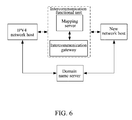
- FIG. 4 shows a flowchart of an example of a new network host accessing an IPV4 network host, which comprises the following steps.
- step 401 the host Host2 located in the new network has distributed a compatible format address IPV4_A, P1 through a registration flow; in step 402, an address IPV4_B and a port number P2 have been bound to the upper-layer IPV4 application of the host Host2 in step 401, the upper-layer IPV4 application sends out a message, whose source address is IPV4_B, port number is P2, and destination address is IPV4_A, and the protocol stack encapsulates the message after receiving a message transmitting request, the encapsulated external source address is modified to be the new network address Addr_New of the host Host2, and the external destination address is the new network address of the intercommunication gateway or the new network addressing format form of IPV4_A; in step 403, after receiving the message, the intercommunication gateway records a corresponding relationship between the source address, the new network address Addr_New of the message, and the compatible format address IPV4_B, P2 for use in the subsequent forwarding of subsequent messages
- the intercommunication gateway and the intercommunication mapping server can also be combined into one intercommunication functional unit, and the process (1) of the IPV4 network host sending a message to the new network host can be summarized as follows:
- both process (1) and process (2) involve the process of encapsulating the first intercommunication message into the second intercommunication message and then de-encapsulating the second intercommunication message into the first intercommunication message.
- the method for intercommunication between a first network and a second network with different addressing formats comprises the following steps:
- the present invention further provides a system for implementing intercommunication between an Internet Protocol Version 4 (IPV4) network and a new network.
- the system comprises an IPV4 network host, an intercommunication functional unit, a new network host, and a domain name server connected with the IPV4 network host and the new network host, wherein, the IPV4 network host is located in the IPV4 network and has an IPV4 address, and the IPV4 network host is used to send and receive a first intercommunication message through the IPV4 network, wherein, a source address and a destination address of the first intercommunication message are the IPV4 address of the IPV4 network host or the compatible format address of the new network host, and the compatible format address comprises an IPV4 format address and a port number;
- the intercommunication functional unit is connected with the IPV4 network host through the IPV4 network, has an IPV4 address and a new network address used for routing of messages in the two networks respectively, and the intercommunication functional unit is used to receive the first intercommunication message, encapsulate
- the intercommunication functional unit comprises an intercommunication gateway and an intercommunication mapping server that are connected with each other.
- the intercommunication mapping server and the intercommunication gateway have the following functions:
- the intercommunication mapping server and the intercommunication gateway have the following functions:
- the new network host is located in the new network, and has the new network address different from an IPV4 addressing format and at least on IPv4 compatible format address, and is connected with the intercommunication functional unit through the new network, and the new network host comprises a protocol stack and an upper-layer IPV4 application, wherein, the upper-layer IPV4 application does not support a new network coding format, and is used to generate and process the first intercommunication message; the protocol stack supports the new network coding format, and is used to encapsulate the first intercommunication message generated by the upper-layer IPV4 application into the second intercommunication message and send the second intercommunication message; and receive the second intercommunication message, de- encapsulate the second intercommunication message into the first intercommunication message and send the first intercommunication message.
- the domain name server is used to implement domain name registration according to registration requests of the IPV4 network host and the new network host, and return the IPV4 address of the IPV4 network host and the compatible format address of the new network host according to an inquiry request.
- the new network in the present invention is an Internet Protocol Version 6 (IPV6) network or an identity/location separation architecture network or other networks adopting addressing formats different from the IPV4 addressing formats, and the new network address refers to an IPV6 address or an identity identifier for indicating an identity.
- IPV6 Internet Protocol Version 6
- the main conception of the method and system for implementing intercommunication according to the present invention is to adopt a mode of IPV4 address multiplexing and distribute a compatible format address to the new network host for intercommunicating with the IPV4 network, wherein the compatible format address comprises an IPV4 format address and a port number, this IPV4 address can be routed in the IPV4 network, thereby solving the problem of lack of IPV4 addresses and simultaneously implementing intercommunication; in addition, for a net network host, compatibility with the original IPV4 application program in the new network host can be achieved as long as the protocol stack of the new network host is upgraded.
- the main conception of the method and system for implementing intercommunication according to the present invention is to adopt a mode of IPV4 address multiplexing and distribute a compatible format address to the new network host for intercommunicating with the IPV4 network, wherein the compatible format address comprises an IPV4 format address and a port number, this IPV4 address can be routed in the IPV4 network, thereby solving the problem of lack of IPV4 addresses and simultaneously implementing intercommunication; in addition, for a net network host, compatibility with the original IPV4 application program in the new network host can be achieved as long as the protocol stack of the new network host is upgraded.
Landscapes
- Engineering & Computer Science (AREA)
- Computer Networks & Wireless Communication (AREA)
- Signal Processing (AREA)
- Data Exchanges In Wide-Area Networks (AREA)
- Small-Scale Networks (AREA)
Applications Claiming Priority (2)
| Application Number | Priority Date | Filing Date | Title |
|---|---|---|---|
| CN2009101811296A CN102045244A (zh) | 2009-10-10 | 2009-10-10 | Ipv4网络与新网互通的实现方法和系统 |
| PCT/CN2009/075938 WO2010145164A1 (fr) | 2009-10-10 | 2009-12-24 | Procédé et système de mise en uvre d'interconnexion entre un réseau de protocole internet version 4 et un nouveau réseau |
Publications (2)
| Publication Number | Publication Date |
|---|---|
| EP2472811A1 true EP2472811A1 (fr) | 2012-07-04 |
| EP2472811A4 EP2472811A4 (fr) | 2013-11-20 |
Family
ID=43355714
Family Applications (1)
| Application Number | Title | Priority Date | Filing Date |
|---|---|---|---|
| EP09846078.5A Ceased EP2472811A4 (fr) | 2009-10-10 | 2009-12-24 | Procédé et système de mise en uvre d'interconnexion entre un réseau de protocole internet version 4 et un nouveau réseau |
Country Status (6)
| Country | Link |
|---|---|
| US (1) | US9191317B2 (fr) |
| EP (1) | EP2472811A4 (fr) |
| JP (1) | JP5640092B2 (fr) |
| KR (1) | KR101501963B1 (fr) |
| CN (1) | CN102045244A (fr) |
| WO (1) | WO2010145164A1 (fr) |
Cited By (1)
| Publication number | Priority date | Publication date | Assignee | Title |
|---|---|---|---|---|
| WO2017111677A1 (fr) * | 2015-12-22 | 2017-06-29 | Telefonaktiebolaget Lm Ericsson (Publ) | Routeur et procédé pour connecter un réseau ipv4 et un réseau ipv6 |
Families Citing this family (13)
| Publication number | Priority date | Publication date | Assignee | Title |
|---|---|---|---|---|
| CN102571999B (zh) * | 2010-12-31 | 2016-03-30 | 中兴通讯股份有限公司 | 一种数据传输方法、系统及接入网关 |
| CN102238187B (zh) * | 2011-07-26 | 2014-07-02 | 东念(杭州)科技有限公司 | 基于tcp/ip协议的通信协议的系统及其实现方法 |
| CN102957756B (zh) * | 2011-08-23 | 2017-10-17 | 中兴通讯股份有限公司 | 数据报文的处理方法及接入服务路由器 |
| US8954964B2 (en) * | 2012-02-27 | 2015-02-10 | Ca, Inc. | System and method for isolated virtual image and appliance communication within a cloud environment |
| US9210079B2 (en) | 2012-08-14 | 2015-12-08 | Vmware, Inc. | Method and system for virtual and physical network integration |
| US10037623B2 (en) | 2013-03-15 | 2018-07-31 | Bwise B.V. | Dynamic risk structure creation systems and/or methods of making the same |
| CN105376126B (zh) * | 2014-07-16 | 2019-10-11 | 比亚迪股份有限公司 | Can总线网关及涉及can总线网关的通信方法和系统 |
| US9894031B2 (en) | 2014-08-27 | 2018-02-13 | Cisco Technology, Inc. | Source-aware technique for facilitating LISP host mobility |
| US20160315858A1 (en) * | 2015-04-24 | 2016-10-27 | Cisco Technology, Inc. | Load balancing of ipv6 traffic in an ipv4 environment |
| CN113708984B (zh) * | 2020-05-20 | 2023-10-27 | 中国移动通信集团浙江有限公司 | 网络质量的检测方法、装置、计算设备及计算机存储介质 |
| US11689493B2 (en) * | 2020-07-02 | 2023-06-27 | Vmware, Inc. | Connection tracking records for a very large scale NAT engine |
| KR102510259B1 (ko) | 2023-01-11 | 2023-03-15 | (주)제이피이엔씨 | 터널의 경량 내화풍도 시스템 |
| US12457191B2 (en) | 2023-03-06 | 2025-10-28 | T-Mobile Usa, Inc. | User plane function configured to prioritize using a preferred internet protocol to establish a connection between user device and host server |
Family Cites Families (17)
| Publication number | Priority date | Publication date | Assignee | Title |
|---|---|---|---|---|
| DE69737645T2 (de) * | 1996-11-01 | 2007-11-22 | Hitachi, Ltd. | Kommunikationsverfahren zwischen einem IPv4-Endgerät und einem IPv6-Endgerät und IPv4-IPv6-Umwandlungsvorrichtung |
| JP2004221745A (ja) * | 2003-01-10 | 2004-08-05 | Fujitsu Ltd | アドレス変換装置 |
| CN100334858C (zh) * | 2003-07-14 | 2007-08-29 | 中国科学院计算技术研究所 | 一种利用双重隧道机制穿透nat的方法 |
| EP1709779A1 (fr) * | 2004-01-15 | 2006-10-11 | Interactive People Unplugged AB | Procede pour mobilite ipv4 a partir de reseaux ipv6 |
| CN1564542A (zh) * | 2004-04-20 | 2005-01-12 | 清华大学 | 在IPv6网络上实现IPv4网络互联的隧道建立方法 |
| CN100525295C (zh) * | 2004-04-21 | 2009-08-05 | 华为技术有限公司 | 一种IPv4网络与IPv6网络通信的实现方法 |
| CN100490445C (zh) * | 2004-04-21 | 2009-05-20 | 华为技术有限公司 | Nat-pt网关中pat模式下icmp差错报文的转换方法 |
| US7437470B2 (en) * | 2004-11-18 | 2008-10-14 | International Business Machines Corporation | Tunneling IPv6 packets |
| US20070115942A1 (en) * | 2005-09-07 | 2007-05-24 | Money James K | DEPLOYABLE VOICE OVER INTERNET PROTOCOL (VoIP) COMMUNICATION SYSTEM |
| JP4558674B2 (ja) * | 2006-05-02 | 2010-10-06 | 日本電信電話株式会社 | Sip通信システム、sip通信制御装置、sip通信制御方法、及び、コンピュータプログラム |
| KR100758971B1 (ko) | 2006-05-09 | 2007-09-14 | 주식회사 케이티프리텔 | 스턴 바인딩 프로토콜을 확장한 스턴 바인딩 메시지를이용하여 서로 다른 ip 도메인 간의 연동을 위한 통신시스템, 응용 계층 게이트웨이 장치, 스턴 서버 및 통신방법 |
| IL177084A0 (en) * | 2006-07-25 | 2007-09-20 | Paz Itzhaki Weinberger | Internet Data Transmission Mediator |
| KR100882355B1 (ko) | 2006-12-01 | 2009-02-12 | 한국전자통신연구원 | 제어 서버의 성능 향상을 위한 IPv6-IPv4 전환방법 및 시스템 |
| KR100849494B1 (ko) * | 2006-12-08 | 2008-07-31 | 한국전자통신연구원 | IPv6 터널링 장치 및 그 방법 |
| CN100534218C (zh) * | 2007-01-15 | 2009-08-26 | 中山大学 | 一种实现移动IPv4节点与IPv6通信节点通信的方法 |
| US20080186203A1 (en) * | 2007-02-02 | 2008-08-07 | Raj Vaswani | Method and system for packet transit through IPV4 networks connecting IPV6 nodes and LANs in a utility grid using tunneling technique |
| CN101316272A (zh) * | 2008-07-09 | 2008-12-03 | 南京邮电大学 | 构建因特网协议版本4和6混合网络的多协议层翻译方法 |
-
2009
- 2009-10-10 CN CN2009101811296A patent/CN102045244A/zh active Pending
- 2009-12-24 WO PCT/CN2009/075938 patent/WO2010145164A1/fr not_active Ceased
- 2009-12-24 EP EP09846078.5A patent/EP2472811A4/fr not_active Ceased
- 2009-12-24 KR KR1020127009210A patent/KR101501963B1/ko not_active Expired - Fee Related
- 2009-12-24 US US13/500,940 patent/US9191317B2/en not_active Expired - Fee Related
- 2009-12-24 JP JP2012532441A patent/JP5640092B2/ja not_active Expired - Fee Related
Non-Patent Citations (5)
| Title |
|---|
| JIM BOUND COMPAQ LAURENT TOUTAIN OCTAVIO MEDINA FRANCIS DUPONT ENST BRETAGNE HOSSAM AFIFI INT ALAIN DURAND SUN MICROSYSTEMS: "Dual Stack Transition Mechanism (DSTM); draft-ietf-ngtrans-dstm-07.txt", 20020201, vol. ngtrans, no. 7, 1 February 2002 (2002-02-01), XP015024258, ISSN: 0000-0004 * |
| MYUNG-KI SHIN ET AL: "Ports option support in dual stack transition mechanism (DSTM)", ADVANCED COMMUNICATION TECHNOLOGY, 2004. THE 6TH INTERNATIONAL CONFERE NCE ON PHOENIX PARK, KOREA FEB. 9-11, 2004, PISCATAWAY, NJ, USA,IEEE, vol. 1, 9 February 2004 (2004-02-09), pages 225-228, XP010701165, DOI: 10.1109/ICACT.2004.1292863 ISBN: 978-89-5519-119-6 * |
| MYUNG-KI SHIN YONG-JIN KIM ETRI ALAIN DURAND SUN MICROSYSTEMS: "Using a Single IPv4 Global Address in DSTM; draft-shin-dstm-single-ipv4-00.txt", 20010201, 1 February 2001 (2001-02-01), XP015035262, ISSN: 0000-0004 * |
| RATTANANON S ET AL: "Extending REBEKAH-IP with central port allocations for un-ambiguous IPv4 address expansion", NETWORKS, 2003. ICON2003. THE 11TH IEEE INTERNATIONAL CONFERENCE ON SEPT. 28-OCT. 1, 2003, PISCATAWAY, NJ, USA,IEEE, 28 September 2003 (2003-09-28), pages 211-216, XP010683527, DOI: 10.1109/ICON.2003.1266192 ISBN: 978-0-7803-7788-2 * |
| See also references of WO2010145164A1 * |
Cited By (2)
| Publication number | Priority date | Publication date | Assignee | Title |
|---|---|---|---|---|
| WO2017111677A1 (fr) * | 2015-12-22 | 2017-06-29 | Telefonaktiebolaget Lm Ericsson (Publ) | Routeur et procédé pour connecter un réseau ipv4 et un réseau ipv6 |
| US10637825B2 (en) | 2015-12-22 | 2020-04-28 | Telefonaktiebolaget Lm Ericsson (Publ) | Router and method for connecting an IPv4 network and an IPv6 network |
Also Published As
| Publication number | Publication date |
|---|---|
| JP2013507801A (ja) | 2013-03-04 |
| KR101501963B1 (ko) | 2015-03-12 |
| JP5640092B2 (ja) | 2014-12-10 |
| WO2010145164A1 (fr) | 2010-12-23 |
| US9191317B2 (en) | 2015-11-17 |
| CN102045244A (zh) | 2011-05-04 |
| EP2472811A4 (fr) | 2013-11-20 |
| KR20120051767A (ko) | 2012-05-22 |
| US20120198025A1 (en) | 2012-08-02 |
Similar Documents
| Publication | Publication Date | Title |
|---|---|---|
| US9191317B2 (en) | Method and system for implementing interconnection between internet protocol version 4 network and new network | |
| US7158526B2 (en) | Packet communication method and apparatus and a recording medium storing a packet communication program | |
| US7162529B2 (en) | System using mobile proxy for intercepting mobile IP message and performing protocol translation to support multiple communication protocols between mobile networks | |
| US7701952B2 (en) | Packet communication method and apparatus and a recording medium storing a packet communication program | |
| US7639686B2 (en) | Access network clusterhead for providing local mobility management of a roaming IPv4 node | |
| US20040240468A1 (en) | Inter private newtwork communications between IPv4 hosts using IPv6 | |
| EP2360879A1 (fr) | Procédé, système et dispositif de réacheminement de paquets de données | |
| CN103338151B (zh) | 公网客户端访问私网服务器的方法及路由器 | |
| JP2003087336A (ja) | アドレス変換方法 | |
| US20060146870A1 (en) | Transparent communication with IPv4 private address spaces using IPv6 | |
| JP2003218953A (ja) | インターネットプロトコルアドレス変換装置、これを用いた通信ネットワークシステム及び通信方法 | |
| TW200924462A (en) | System and method for connection of hosts behind NATs | |
| KR100666987B1 (ko) | 이중스택 전환 메커니즘을 이용한 IPv4-IPv6 전환시스템 및 그 방법 | |
| CN103119903A (zh) | 网络服务器之间的负载平衡 | |
| CN101931658A (zh) | 具有IPv4应用的IPv6主机进行通信的方法与装置 | |
| CN102546407A (zh) | 报文发送方法及装置 | |
| JP2007526689A (ja) | 第1のコンピュータ・ネットワークから第2のコンピュータ・ネットワークへの通信セッションの起動 | |
| JP3915230B2 (ja) | パケット生成方法およびその機能を有する情報処理装置並びにパケット生成プログラムを記録した記録媒体 | |
| JP5385269B2 (ja) | 制御サーバの性能を向上させるためのIPv6−IPv4転換方法及び装置 | |
| JP2008172816A (ja) | アドレス変換方法 | |
| KR20070003890A (ko) | 적어도 두 대의 계산장치 사이에서의 연결설정시 주소와포트번호의 요약 | |
| CN102104634B (zh) | 非lisp站点与lisp站点通信的方法、装置及系统 | |
| CN104935677B (zh) | 一种nat64资源获取方法及获取/分配装置 | |
| JP4670979B2 (ja) | パケット生成方法およびその機能を有する情報処理装置並びにパケット生成プログラムを記録した記録媒体 | |
| CN100550826C (zh) | 一种穿越IPv6网络地址翻译建立虚拟隧道的方法 |
Legal Events
| Date | Code | Title | Description |
|---|---|---|---|
| PUAI | Public reference made under article 153(3) epc to a published international application that has entered the european phase |
Free format text: ORIGINAL CODE: 0009012 |
|
| 17P | Request for examination filed |
Effective date: 20120326 |
|
| AK | Designated contracting states |
Kind code of ref document: A1 Designated state(s): AT BE BG CH CY CZ DE DK EE ES FI FR GB GR HR HU IE IS IT LI LT LU LV MC MK MT NL NO PL PT RO SE SI SK SM TR |
|
| DAX | Request for extension of the european patent (deleted) | ||
| A4 | Supplementary search report drawn up and despatched |
Effective date: 20131022 |
|
| RIC1 | Information provided on ipc code assigned before grant |
Ipc: H04L 29/06 20060101AFI20131016BHEP Ipc: H04L 29/12 20060101ALI20131016BHEP |
|
| 17Q | First examination report despatched |
Effective date: 20140616 |
|
| REG | Reference to a national code |
Ref country code: DE Ref legal event code: R003 |
|
| STAA | Information on the status of an ep patent application or granted ep patent |
Free format text: STATUS: THE APPLICATION HAS BEEN REFUSED |
|
| 18R | Application refused |
Effective date: 20160921 |