EP2472879B1 - Procédé et système pour déterminer un type de cadre vidéo - Google Patents
Procédé et système pour déterminer un type de cadre vidéo Download PDFInfo
- Publication number
- EP2472879B1 EP2472879B1 EP10016232.0A EP10016232A EP2472879B1 EP 2472879 B1 EP2472879 B1 EP 2472879B1 EP 10016232 A EP10016232 A EP 10016232A EP 2472879 B1 EP2472879 B1 EP 2472879B1
- Authority
- EP
- European Patent Office
- Prior art keywords
- frame
- lines
- type
- line
- coefficients
- Prior art date
- Legal status (The legal status is an assumption and is not a legal conclusion. Google has not performed a legal analysis and makes no representation as to the accuracy of the status listed.)
- Active
Links
- 238000000034 method Methods 0.000 title claims description 33
- 230000006870 function Effects 0.000 claims description 20
- 238000004590 computer program Methods 0.000 claims description 6
- 238000001514 detection method Methods 0.000 description 4
- 230000015654 memory Effects 0.000 description 4
- 238000004422 calculation algorithm Methods 0.000 description 3
- 238000004364 calculation method Methods 0.000 description 2
- 230000001413 cellular effect Effects 0.000 description 1
- 238000010219 correlation analysis Methods 0.000 description 1
- 238000012986 modification Methods 0.000 description 1
- 230000004048 modification Effects 0.000 description 1
Images


Classifications
-
- H—ELECTRICITY
- H04—ELECTRIC COMMUNICATION TECHNIQUE
- H04N—PICTORIAL COMMUNICATION, e.g. TELEVISION
- H04N17/00—Diagnosis, testing or measuring for television systems or their details
-
- H—ELECTRICITY
- H04—ELECTRIC COMMUNICATION TECHNIQUE
- H04N—PICTORIAL COMMUNICATION, e.g. TELEVISION
- H04N13/00—Stereoscopic video systems; Multi-view video systems; Details thereof
- H04N13/10—Processing, recording or transmission of stereoscopic or multi-view image signals
- H04N13/106—Processing image signals
- H04N13/161—Encoding, multiplexing or demultiplexing different image signal components
-
- H—ELECTRICITY
- H04—ELECTRIC COMMUNICATION TECHNIQUE
- H04N—PICTORIAL COMMUNICATION, e.g. TELEVISION
- H04N2213/00—Details of stereoscopic systems
- H04N2213/007—Aspects relating to detection of stereoscopic image format, e.g. for adaptation to the display format
Definitions
- the present invention relates to determining video frame type, in particular distinguishing between a two-dimensional (2D) and three-dimensional (3D) video frames.
- Stereoscopic video displays can be used to display both 2D and 3D video signals, by processing the frames of the signals depending on the type of signal.
- the type of the signal can be specified manually by the user, which can be troublesome for inexperienced users.
- the type of signal can be also specified by supplementary data included in the signal itself or by a supplementary signal, which requires the video display unit to be able to decode and recognize the supplementary data or the supplementary signal.
- a US patent application US2009/0009508 presents an apparatus and a method for driving a 2D/3D switchable display, which includes an image mode determination unit determining whether input image signals of continuous frames are in a 2D mode or 3D mode.
- the 3D mode is recognized by determining a syntax indicating a stereo or a multiview image included in the header information of the input image signal.
- the image mode can be determined based on the presence of a stereo sync signal. Therefore, the mode determination requires data or signals supplementary to the basic image data.
- a PCT patent application W02010/014973 presents a method and an apparatus for encoding or tagging a video frame which provide a way to indicate, to a receiver, whether the video content is 3-D content or 2-D content, by replacing lines of at least one video frame in a 3-D content with a specific color or pattern. Therefore, the method is useful only for receivers, which are able to recognize the specific color or patterns as an indication of a 3-D content.
- a US patent application US2010/182404 presents a 3D video reproduction apparatus, system and method, wherein a input video frame type is detected.
- the detection is performed by carried out by analyzing difference signals, one difference signal indicating the difference between the left and right side of the image and another difference signal indicating the difference between the top and bottom side of the image. If one of the difference signals is lower than a predetermined value, this indicates a particular type of a 3D frame. If both difference signals are higher than a predetermined value, this indicates a 2D frame. Therefore, the 3D and 2D frame type is determined according to the same type of difference signals.
- a US patent application US2009/195774 presents an image analyzed, wherein a parallax is calculated the calculation involves phase correlation analysis between image parts. However, the process is not related to detection whether the frame is of a 3D or 2D type.
- the display lacks the functionality of decoding supplementary data included in the signal or is not able to decode supplementary signals describing the video type, or the video signal contains only basic image contents without the image type indicated, the signal must be recognized in an alternative way.
- the aim of the present invention is to provide a method for determining the video frame type by analyzing video signals having no or unknown indication of video frame type.
- the object of the invention is a computer-implemented method as set out in independent claim 1 for determining a video frame type, characterized in that it comprises the steps of receiving a video frame and analyzing the contents of consecutive lines of the video frame in frequency domain by detecting a number of LR-type lines ( ⁇ LR ) of the video frame for which the left half of the line is phase-correlated with the right half of the line, detecting an LR mean error ( ⁇ LR ) as a function of the difference between the values of Fourier transform coefficients for the left half of the line and the right half of the line, detecting a number of TB lines ( ⁇ TB ) of a top half of the frame which are phase-correlated with lines of a bottom half of the frame and detecting a TB mean error ( ⁇ TB ) as a function of the difference between the values of Fourier transform coefficients for the lines of the top half of the frame and the lines of the bottom half of the frame.
- the method further comprises the steps of calculating probability coefficients specifying that the frame type is a TB-type (p TB ) or LR-type (p LR ) 3D frame as a function of the LR mean error ( ⁇ LR ) and the TB mean error ( ⁇ TB ) and calculating a probability coefficient specifying that the frame type is a 2D frame as a function of the number of LR-type lines ( ⁇ LR ) and the number of TB lines ( ⁇ TB ).
- the LR-type lines can be defined as lines for which the peak coefficient is in the first or the last quarter of the total set of coefficients and the TB-type lines can be defined as lines for which the peak coefficient is in the first or the last quarter of the total set of coefficients.
- the object of the invention is also a computer program comprising program code means for performing all the steps of the computer-implemented method according to the invention when said program is run on a computer, as well as a computer readable medium storing computer-executable instructions performing all the steps of the computer-implemented method according to the invention when executed on a computer.
- Another object of the invention is a system as set out in independent claim 8 for determining a video frame type, which comprises a frame reader configured to receive a video frame. It further comprises an LR type detector configured to analyze the contents of consecutive lines of the video frame in frequency domain by detecting a number of LR-type lines ( ⁇ LR ) of the video frame for which the left half of the line is phase-correlated with the right half of the line and detecting an LR mean error ( ⁇ LR ) as a function of the difference between the values of Fourier transform coefficients for the left half of the line and the right half of the line.
- ⁇ LR LR-type lines
- ⁇ LR LR mean error
- a TB type detector is configured to analyze the contents of consecutive lines of the video frame in frequency domain by detecting a number of TB lines ( ⁇ TB ) of a top half of the frame which are phase-correlated with lines of a bottom half of the frame and detecting a TB mean error ( ⁇ TB ) as a function of the difference between the values of Fourier transform coefficients for the lines of the top half of the frame and the lines of the bottom half of the frame.
- a probability calculator is configured to calculate probability coefficients specifying that the frame type is a TB-type (p TB ) or LR-type (p LR ) 3D frame as a function of the LR mean error ( ⁇ LR ) and the TB mean error ( ⁇ TB ) and calculate a probability coefficient specifying that the frame type is a 2D frame as a function of the number of LR-type lines ( ⁇ LR ) and the number of TB lines ( ⁇ TB ).
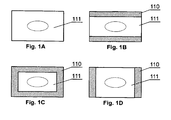
- Figs. 1A-1D show examples of typical 2D video frames.
- the frame may comprise only an active image region 111 as shown in Fig. 1A .
- the 2D frame may further comprise a non-active image region 110, such as bars of a uniform color, e.g. black, at the top and bottom edges of the frame as shown in Fig. 1B or bars at the top, bottom, left and right edges of the frame as shown in Fig. 1C or bars at the left and right edges of the frame as shown in Fig. 1D .
- a uniform color e.g. black
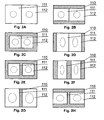
- Figs. 2A-2H show examples of typical 3D video frames of a Left-Right (LR) type.
- Such frame as shown in Fig. 2A , comprises two active image regions 111, 112, which define the content to be displayed for the left and right eye.
- the active regions 111, 112 may be scaled-down in the horizontal direction in order to fit into dimensions of a standardized 2D frame.
- a 3D frame may also contain non-active image regions 110, such as bars of a uniform color, e.g. black, at the top and bottom edges of the frame as shown in Fig. 2B , at the top, bottom, left and right edges of the frame as shown in Fig. 2C , at the left and right edges of the frame as shown in Fig.
- Figs. 3A-3H show examples of typical 3D video frames of a Top-Bottom (TB) type.
- Such frame as shown in Fig. 3A , comprises two active image regions 111, 112, which define the content to be displayed for the left (e.g. the top region) and the right (e.g. the bottom region) eye.
- the active regions 111, 112 may be scaled-down in the vertical direction in order to fit into dimensions of a standard 2D frame.
- a 3D frame may also contain non-active image regions 110, such as: bars of a uniform color, e.g. black, at the left and right edges of the frame as shown in Fig. 3B , at the top, bottom, left and right edges of the frame as shown in Fig.
- the most probable non-active regions 110 may form bars at the top, bottom, left, right, horizontal centre and vertical centre of the frame, as shown in Fig. 4 .
- Fig. 5 shows the structure of a system for determining video frame type according to the invention.
- the system comprises a frame compactor 201 configured to extract from the input video frames data representing an active region and discard the data representing the non-active region of the frame, according to the procedure shown in Fig. 6 , and possibly to reduce the amount of data by scaling-down and/or discarding the color information.
- the reduced frame representation is passed to a buffer 202, from which it is collected by a frame type detector 203 operating according to the procedure shown in Fig.
- the frame type detector 203 provides an output in form of coefficients p , indicative of a probability that the frame is a 2D ( p 2D ) or a 3D frame, wherein for 3D frames the detector may indicate the type of frame: an LR frame ( p LR ) or a TB frame ( p TB ).
- Fig. 6 shows the procedure of operation of the frame compactor 201.
- the received input frame may be reduced for easier analysis, by scaling it down, i.e. reducing the size of the frame.
- the color information can be discarded, either by converting the frame contents into a grayscale or selecting contents of only one color channel.
- the frame is analyzed to detect the non-active regions, preferably in areas indicated in Fig. 4 , namely in the bars located at the top, bottom, left, right, horizontal centre and vertical centre of the frame. The contents of the detected non-active regions are discarded in step 304 so as to generate a frame containing only data of active regions, as shown in Fig. 1A , 2A or 3A .
- the processing of a frame by the frame compactor 201 may be initiated after a change of the video input signal, for example a change of a channel in a television decoder, in order to determine the type of the new signal.
- the frame compactor 201 may be operated continuously, in order to detect change of type of the received signal, for example to detect a 2D commercial break in a 3D video film.
- the frame compactor 201 may receive the frames with a specific frequency, preferably lower than the frame display rate, such as 2 frames per second, in order to minimize the computational load of the signal receiver.
- Fig. 7 shows the procedure of operation of the frame type detector 203.
- a compacted frame is collected from the buffer 202 in step 401.
- the frame is processed in two parallel or subsequent sequences of steps, one for detecting whether the frame is of a LR type and the other for detecting whether the frame is of a TB type.
- the frame is divided into lines and the lines are processed consecutively by comparing a left half of the line with a right half of the line.
- a Fourier transform such as a Discrete Fourier Transform (DFT) or a Fast Fourier Transform (FFT) is calculated for the L and R half of the first line.
- DFT Discrete Fourier Transform
- FFT Fast Fourier Transform
- step 403 the frame is divided into a top and bottom halves and the lines of the halves are processed consecutively by comparing a line of the top half with a line of the bottom half.
- a Fourier transform such as a Discrete Fourier Transform (DFT) or a Fast Fourier Transform (FFT) is calculated for the first line of the top half and for the first line of the bottom half.
- DFT Discrete Fourier Transform
- FFT Fast Fourier Transform
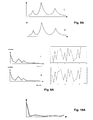
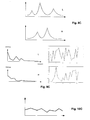
- Fig. 8A presents a plot of values of pixels of an exemplary left and right half of a line of an LR-type image, wherein the L and R halves are the same, i.e. in phase.
- Fig. 8B presents a plot of values of pixels of an exemplary left and right half of a line of an LR-type image, which are slightly phase-shifted.
- Fig. 8C presents a plot of values of pixels of an exemplary left and right half of a line of a mono image, which contain unrelated data.
- Figs. 9A-9C presents corresponding amplitudes and phases of F 0...N and G 0...N Fourier coefficients for the images of Figs. 8A-8C .
- the above step may be performed only for non-empty lines, for which the DC coefficient is larger than the number of all coefficients, i.e. the average value of each coefficient is at least 1, as given by a condition: if F 0 > N ⁇ and G 0 > N
- the number of discarded lines is counted as ⁇ LR and ⁇ TB .
- Figs. 10A-10C present exemplary plots of ( real (DFT -1 ( F ⁇ G* )) for the lines presented in Figs. 8A-8C .
- steps 406, 407 it is determined whether there is a phase correlation between the two analyzed lines, by detecting whether the peak coefficient is in the first or the last quarter of the total set of coefficients, according to a condition: if ⁇ p > N - N / 4 and p ⁇ N / 4
- the quarter (4) has been selected experimentally as a best match to detect coefficients, but other ranges are possible as well.
- the algorithm may count the number of matched lines as ⁇ LR for LR-type lines and ⁇ TB for TB-type lines.
- the mean error is small, if the compared lines are similar, but shifted in phase, as in case of Fig. 8B .
- the mean error is large, if the compared lines are different, as in case of Fig. 9B .
- the calculations are performed for all lines of the frame.
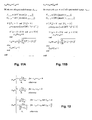
- step 410 the probabilities of frame type are calculated according to the equations shown in Fig. 12 .
- the probability that the frame is of a LR-type (p LR ) or a TB-type (p TB ) is calculated on the basis of the mean errors ⁇ LR and ⁇ TB .
- the probabilities sum up to 1.
- the probability that the frame is a 2D-type frame is calculated on the basis of the number of matched lines.
- the frame is a 3D frame of LR or TB type. If the values of the coefficients p LR and p TB do not differ much from each other, this indicates that the frame is a 2D frame and the probability is best estimated by p 2D coefficient.
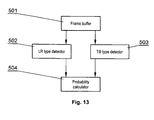
- Fig. 13 presents a structure of the frame type detector according to the invention. It comprises a frame reader 501 configured to receive a video frame. The video frame is input to an LR type detector 502 configured to analyze the contents of consecutive lines of the video frame in frequency domain according to steps 402, 404, 406, 408 of the method of Fig. 7 , by detecting a number of LR-type lines ( ⁇ LR ) of the video frame for which the left half of the line is phase-correlated with the right half of the line and detecting an LR mean error ( ⁇ LR ) as a function of the difference between the values of Fourier transform coefficients for the left half of the line and the right half of the line.
- ⁇ LR number of LR-type lines
- ⁇ LR LR mean error
- the video frame is also input to a TB type detector 503 configured to analyze the contents of consecutive lines of the video frame in frequency domain according to steps 403, 405, 407, 409 of the method of Fig. 7 by detecting a number of TB lines ( ⁇ TB ) of a top half of the frame which are phase-correlated with lines of a bottom half of the frame, detecting a TB mean error ( ⁇ TB ) as a function of the difference between the values of Fourier transform coefficients for the lines of the top half of the frame and the lines of the bottom half of the frame.
- ⁇ TB number of TB lines
- ⁇ TB TB mean error
- a probability calculator 504 receives the outputs of the detectors 502, 503 and is configured to calculate probability coefficients specifying that the frame type is a TB-type (p TB ) or LR-type (p LR ) 3D frame as a function of the LR mean error ( ⁇ LR ) and the TB mean error ( ⁇ TB ) and calculate a probability coefficient specifying that the frame type is a 2D frame as a function of the number of LR-type lines ( ⁇ LR ) and the number of TB lines ( ⁇ TB ), according to step 410 of the method of Fig. 7 .
- the frame type detector 203 can form a part of a multi-component system, in which a plurality of different frame type detectors are used, each configured to analyze the frame using a different algorithm configured to output a type coefficient indicative of a probability that the frame is of a 2D or 3D type, wherein the type coefficients from the frame type detectors are received by a controller configured to generate a predicted frame type indicator based on the received type coefficients.
- the determined frame type can be used to select the method of processing the signal to be displayed.
- the determined frame type can be used to select the method of processing the signal to be passed to a display unit, for example converting a 2D signal to a 3D format in case the display unit is set to receive 3D video signals.
- the aforementioned system and method for determining video frame type may be performed and/or controlled by one or more computer programs.
- Such computer programs are typically executed by utilizing the computing resources of a processing unit which can be embedded within various video signal receivers, such as personal computers, personal digital assistants, cellular telephones, receivers and decoders of digital television, video display units or the like.
- the computer programs can be stored in a non-volatile memory, for example a flash memory or in a volatile memory, for example RAM and are executed by the processing unit.
- These memories are exemplary recording media for storing computer programs comprising computer-executable instructions performing all the steps of the computer-implemented method according the technical concept presented herein.
Landscapes
- Engineering & Computer Science (AREA)
- Multimedia (AREA)
- Signal Processing (AREA)
- Health & Medical Sciences (AREA)
- Biomedical Technology (AREA)
- General Health & Medical Sciences (AREA)
- Testing, Inspecting, Measuring Of Stereoscopic Televisions And Televisions (AREA)
- Compression Or Coding Systems Of Tv Signals (AREA)
Claims (8)
- Procédé implémenté par ordinateur permettant de déterminer un type de trame vidéo, caractérisé en ce qu'il comprend les étapes consistant à :- recevoir une trame vidéo,- analyser les contenus de lignes consécutives de la trame vidéo dans le domaine de fréquence en :○ détectant un nombre de lignes de type LR (µLR) comme le nombre de lignes de la trame vidéo pour lesquelles la moitié gauche de la ligne est corrélée en phase avec la moitié droite de la ligne,○ détectant une erreur moyenne LR (εLR) comme une fonction de la différence entre les valeurs de coefficients de transformée de Fourier pour la moitié gauche de la ligne et la moitié droite de la ligne,○ détectant un nombre de lignes TB (µTB) comme le nombre de lignes d'une moitié haute de la trame qui sont corrélées en phase avec des lignes d'une moitié basse de la trame,○ détectant une erreur moyenne TB (εTB) comme une fonction de la différence entre les valeurs de coefficients de transformée de Fourier pour les lignes de la moitié haute de la trame et les lignes de la moitié basse de la trame,- calculer des coefficients de probabilité pour une trame en 3D de type TB ou de type LR en utilisant les fonctions suivantes de l'erreur moyenne LR (εLR) et l'erreur moyenne TB (εTB) :

 - calculer un coefficient de probabilité pour une trame de type 2D en utilisant la fonction suivante du nombre de lignes de type LR (µLR) et du nombre de lignes TB (µTB) :dans laquelle
m est le nombre total de lignes dans la trame
ζLR et ζTB sont le nombre de lignes vides dans la trame ;
en spécifiant que le type de trame est une trame en 3D de type TB (pTB) ou de type LR (pLR) ou une trame en 2D (p2D) en se basant sur les coefficients de probabilité calculés. - Procédé selon la revendication 1, dans lequel la corrélation de phase entre la moitié gauche de la ligne et la moitié droite de la ligne est déterminée en se basant sur un coefficient de pic donné par l'équation :

- Procédé selon la revendication 1, dans lequel la corrélation de phase entre les lignes de la moitié haute de la trame et les lignes d'une moitié basse de la trame est déterminée en se basant sur un coefficient de pic donné par l'équation :

dans laquelle F, G sont les transformées de Fourier des contenus de lignes de la moitié haute de la trame et les lignes d'une moitié basse de la trame. - Procédé selon la revendication 2 ou 3, dans lequel les lignes de type LR sont définies comme des lignes pour lesquelles le coefficient de pic est dans le premier ou le dernier quart du jeu total de coefficients et dans lequel les lignes de type TB sont définies comme des lignes pour lesquelles le coefficient de pic est dans le premier ou le dernier quart du jeu total des coefficients.
- Procédé selon la revendication 1, dans lequel :- l'erreur moyenne LR (εLR) est calculée pour des lignes consécutives comme :

dans laquelle F, G sont les transformées de Fourier des contenus de la moitié gauche de la ligne et de la moitié droite de la ligne, N est le nombre total de coefficients de Fourier,- l'erreur moyenne TB (εTB) est calculée pour des lignes consécutives comme :
dans laquelle F, G sont les transformées de Fourier des contenus des lignes de la moitié haute de la trame et les lignes d'une moitié basse de la trame, N est le nombre total de coefficients de Fourier. - Programme informatique comprenant un moyen de code de programme permettant de réaliser toutes les étapes du procédé implémenté par ordinateur selon l'une quelconque des revendications 1 à 5 lorsque ledit programme est exécuté sur un ordinateur.
- Support lisible par ordinateur stockant des instructions exécutables par ordinateur réalisant toutes les étapes du procédé implémenté par ordinateur selon l'une quelconque des revendications 1 à 5 lorsqu'il est exécuté sur un ordinateur.
- Système de détermination d'un type de trame vidéo, caractérisé en ce qu'il comprend :- un lecteur de trame (501) configuré pour recevoir une trame vidéo,- un détecteur de type LR (502) configuré pour analyser les contenus de lignes consécutives de la trame vidéo dans le domaine de fréquence en :o détectant un nombre de lignes de type LR (µLR) comme le nombre de lignes de la trame vidéo pour lesquelles la moitié gauche de la ligne est corrélée en phase avec la moitié droite de la ligne,o détectant une erreur moyenne LR (εLR) comme une fonction de la différence entre les valeurs de coefficients de transformée de Fourier pour la moitié gauche de la ligne et la moitié droite de la ligne,- un détecteur de type TB (503) configuré pour analyser les contenus de lignes consécutives de la trame vidéo dans le domaine de fréquence en :o détectant un nombre de lignes TB (µTB) comme le nombre de lignes d'une moitié haute de la trame qui sont corrélées en phase avec des lignes d'une moitié basse de la trame,o détectant une erreur moyenne TB (εTB) comme une fonction de la différence entre les valeurs de coefficients de transformée de Fourier pour les lignes de la moitié haute de la trame et les lignes de la moitié basse de la trame,- un calculateur de probabilité (504) configuré pourdans laquelle :o calculer des coefficients de probabilité pour une trame en 3D de type TB ou de type LR en utilisant les fonctions suivantes de l'erreur moyenne LR (εLR) et l'erreur moyenne TB (εTB) :

 o calculer un coefficient de probabilité pour une trame de type 2D en utilisant la fonction suivante du nombre de lignes de type LR (µLR) et du nombre de lignes TB (µTB)
 m est le nombre total de lignes dans la trame et ζTB sont le nombre de lignes vide dans la trame ;en spécifiant que le type de trame est une trame en 3D de type TB (pTB) ou de type LR (pLR) ou une trame en 2D (p2D) en se basant sur les coefficients de probabilité calculés.
Priority Applications (4)
| Application Number | Priority Date | Filing Date | Title |
|---|---|---|---|
| EP10016232.0A EP2472879B1 (fr) | 2010-12-31 | 2010-12-31 | Procédé et système pour déterminer un type de cadre vidéo |
| PL10016232T PL2472879T3 (pl) | 2010-12-31 | 2010-12-31 | Sposób i system do określania typu ramki wideo |
| PCT/EP2011/074198 WO2012089790A1 (fr) | 2010-12-31 | 2011-12-29 | Procédé et système pour déterminer un type de trame vidéo |
| US13/824,427 US9185400B2 (en) | 2010-12-31 | 2011-12-29 | Method and a system for determining a video frame type |
Applications Claiming Priority (1)
| Application Number | Priority Date | Filing Date | Title |
|---|---|---|---|
| EP10016232.0A EP2472879B1 (fr) | 2010-12-31 | 2010-12-31 | Procédé et système pour déterminer un type de cadre vidéo |
Publications (2)
| Publication Number | Publication Date |
|---|---|
| EP2472879A1 EP2472879A1 (fr) | 2012-07-04 |
| EP2472879B1 true EP2472879B1 (fr) | 2013-06-05 |
Family
ID=44065614
Family Applications (1)
| Application Number | Title | Priority Date | Filing Date |
|---|---|---|---|
| EP10016232.0A Active EP2472879B1 (fr) | 2010-12-31 | 2010-12-31 | Procédé et système pour déterminer un type de cadre vidéo |
Country Status (4)
| Country | Link |
|---|---|
| US (1) | US9185400B2 (fr) |
| EP (1) | EP2472879B1 (fr) |
| PL (1) | PL2472879T3 (fr) |
| WO (1) | WO2012089790A1 (fr) |
Families Citing this family (6)
| Publication number | Priority date | Publication date | Assignee | Title |
|---|---|---|---|---|
| KR101814798B1 (ko) * | 2011-01-26 | 2018-01-04 | 삼성전자주식회사 | 입체영상 처리 장치 및 방법 |
| JP5817639B2 (ja) * | 2012-05-15 | 2015-11-18 | ソニー株式会社 | 映像フォーマット判別装置及び映像フォーマット判別方法、並びに映像表示装置 |
| CN103237108B (zh) * | 2013-05-13 | 2015-11-25 | 百度在线网络技术(北京)有限公司 | 用于移动终端的测试方法和测试终端 |
| US9497358B2 (en) * | 2013-12-19 | 2016-11-15 | Sony Interactive Entertainment America Llc | Video latency reduction |
| US10353633B2 (en) | 2013-12-19 | 2019-07-16 | Sony Interactive Entertainment LLC | Mass storage virtualization for cloud computing |
| JP7820398B2 (ja) | 2021-02-25 | 2026-02-25 | レイア、インコーポレイテッド | マルチビューファイルフォーマットを検出するシステムおよび方法 |
Family Cites Families (7)
| Publication number | Priority date | Publication date | Assignee | Title |
|---|---|---|---|---|
| KR20000075982A (ko) * | 1997-03-07 | 2000-12-26 | 다카노 야스아키 | 디지탈 방송 수신기 및 디스플레이 장치 |
| KR101416228B1 (ko) | 2007-07-06 | 2014-07-08 | 삼성전자주식회사 | 2차원/3차원 영상 호환용 디스플레이 장치의 구동 장치 및그 구동방법 |
| JP5109691B2 (ja) * | 2008-01-31 | 2012-12-26 | コニカミノルタホールディングス株式会社 | 解析装置 |
| US20100026783A1 (en) | 2008-08-01 | 2010-02-04 | Real D | Method and apparatus to encode and decode stereoscopic video data |
| US20100182404A1 (en) * | 2008-12-05 | 2010-07-22 | Panasonic Corporation | Three dimensional video reproduction apparatus, three dimensional video reproduction system, three dimensional video reproduction method, and semiconductor device for three dimensional video reproduction |
| KR20100138806A (ko) * | 2009-06-23 | 2010-12-31 | 삼성전자주식회사 | 자동 3차원 영상 포맷 변환 방법 및 그 장치 |
| JP2013005410A (ja) * | 2011-06-21 | 2013-01-07 | Sony Corp | 画像フォーマット判別装置、画像フォーマット判別方法、画像再生装置および電子機器 |
-
2010
- 2010-12-31 EP EP10016232.0A patent/EP2472879B1/fr active Active
- 2010-12-31 PL PL10016232T patent/PL2472879T3/pl unknown
-
2011
- 2011-12-29 WO PCT/EP2011/074198 patent/WO2012089790A1/fr not_active Ceased
- 2011-12-29 US US13/824,427 patent/US9185400B2/en active Active
Also Published As
| Publication number | Publication date |
|---|---|
| EP2472879A1 (fr) | 2012-07-04 |
| US20130265389A1 (en) | 2013-10-10 |
| PL2472879T3 (pl) | 2014-03-31 |
| US9185400B2 (en) | 2015-11-10 |
| WO2012089790A1 (fr) | 2012-07-05 |
Similar Documents
| Publication | Publication Date | Title |
|---|---|---|
| EP2472879B1 (fr) | Procédé et système pour déterminer un type de cadre vidéo | |
| US8553029B2 (en) | Method and apparatus for determining two- or three-dimensional display mode of image sequence | |
| CN102461185B (zh) | 用于三维视频的自动转换的方法和设备 | |
| RU2469418C2 (ru) | Устройство обработки изображений, способ обработки изображений и программа | |
| EP2887311B1 (fr) | Procédé et appareil permettant d'effectuer une estimation de profondeur | |
| KR20210113678A (ko) | 이미지 처리 방법 및 장치, 전자 기기, 저장 매체 및 컴퓨터 프로그램 | |
| EP2728887B1 (fr) | Appareil de traitement d'image, et procédé de traitement d'image correspondant | |
| US20110164110A1 (en) | Method and system for detecting compressed stereoscopic frames in a digital video signal | |
| TWI469623B (zh) | 用於區別3維影像與2維影像以及藉由特徵對應決定來識別3維影像格式之存在的方法 | |
| EP2506582A1 (fr) | Appareil et procédé pour l'encodage de vidéo multivue au moyen de paramètres de caméra, appareil et procédé pour la génération de vidéo multivue au moyen de paramètres de caméra, et support d'enregistrement stockant un programme pour la mise en oeuvre desdits procédés | |
| CN101990108B (zh) | 影像画面检测装置及其方法 | |
| CN103295212A (zh) | 图像校准方法及图像校准系统 | |
| US20130293673A1 (en) | Method and a system for determining a video frame type | |
| EP2477406B1 (fr) | Procédé et dispositif d'identification de type d'image vidéo | |
| EP2963924B1 (fr) | Procédé et système pour déterminer un type de cadre vidéo | |
| CN104185023A (zh) | 三维视频格式自动检测方法及装置 | |
| EP2477407B1 (fr) | Procédé et système pour déterminer un type de cadre vidéo | |
| WO2017113735A1 (fr) | Procédé et système de distinction de format vidéo | |
| KR100827133B1 (ko) | 이동 통신 단말기에서 3차원 입체 영상을 판별하기 위한방법 및 장치 | |
| US9036005B2 (en) | Measuring apparatus for measuring stereo video format and associated method | |
| WO2014025295A1 (fr) | Détection de format d'image bidimensionnelle (2d)/tridimensionnelle (3d) |
Legal Events
| Date | Code | Title | Description |
|---|---|---|---|
| AK | Designated contracting states |
Kind code of ref document: A1 Designated state(s): AL AT BE BG CH CY CZ DE DK EE ES FI FR GB GR HR HU IE IS IT LI LT LU LV MC MK MT NL NO PL PT RO RS SE SI SK SM TR |
|
| AX | Request for extension of the european patent |
Extension state: BA ME |
|
| PUAI | Public reference made under article 153(3) epc to a published international application that has entered the european phase |
Free format text: ORIGINAL CODE: 0009012 |
|
| 17P | Request for examination filed |
Effective date: 20121113 |
|
| GRAP | Despatch of communication of intention to grant a patent |
Free format text: ORIGINAL CODE: EPIDOSNIGR1 |
|
| GRAS | Grant fee paid |
Free format text: ORIGINAL CODE: EPIDOSNIGR3 |
|
| GRAA | (expected) grant |
Free format text: ORIGINAL CODE: 0009210 |
|
| AK | Designated contracting states |
Kind code of ref document: B1 Designated state(s): AL AT BE BG CH CY CZ DE DK EE ES FI FR GB GR HR HU IE IS IT LI LT LU LV MC MK MT NL NO PL PT RO RS SE SI SK SM TR |
|
| REG | Reference to a national code |
Ref country code: GB Ref legal event code: FG4D |
|
| REG | Reference to a national code |
Ref country code: CH Ref legal event code: EP |
|
| REG | Reference to a national code |
Ref country code: AT Ref legal event code: REF Ref document number: 616262 Country of ref document: AT Kind code of ref document: T Effective date: 20130615 |
|
| REG | Reference to a national code |
Ref country code: IE Ref legal event code: FG4D |
|
| REG | Reference to a national code |
Ref country code: DE Ref legal event code: R096 Ref document number: 602010007471 Country of ref document: DE Effective date: 20130801 |
|
| REG | Reference to a national code |
Ref country code: NL Ref legal event code: T3 |
|
| REG | Reference to a national code |
Ref country code: AT Ref legal event code: MK05 Ref document number: 616262 Country of ref document: AT Kind code of ref document: T Effective date: 20130605 |
|
| PG25 | Lapsed in a contracting state [announced via postgrant information from national office to epo] |
Ref country code: LT Free format text: LAPSE BECAUSE OF FAILURE TO SUBMIT A TRANSLATION OF THE DESCRIPTION OR TO PAY THE FEE WITHIN THE PRESCRIBED TIME-LIMIT Effective date: 20130605 Ref country code: NO Free format text: LAPSE BECAUSE OF FAILURE TO SUBMIT A TRANSLATION OF THE DESCRIPTION OR TO PAY THE FEE WITHIN THE PRESCRIBED TIME-LIMIT Effective date: 20130905 Ref country code: AT Free format text: LAPSE BECAUSE OF FAILURE TO SUBMIT A TRANSLATION OF THE DESCRIPTION OR TO PAY THE FEE WITHIN THE PRESCRIBED TIME-LIMIT Effective date: 20130605 Ref country code: FI Free format text: LAPSE BECAUSE OF FAILURE TO SUBMIT A TRANSLATION OF THE DESCRIPTION OR TO PAY THE FEE WITHIN THE PRESCRIBED TIME-LIMIT Effective date: 20130605 Ref country code: ES Free format text: LAPSE BECAUSE OF FAILURE TO SUBMIT A TRANSLATION OF THE DESCRIPTION OR TO PAY THE FEE WITHIN THE PRESCRIBED TIME-LIMIT Effective date: 20130916 Ref country code: SE Free format text: LAPSE BECAUSE OF FAILURE TO SUBMIT A TRANSLATION OF THE DESCRIPTION OR TO PAY THE FEE WITHIN THE PRESCRIBED TIME-LIMIT Effective date: 20130605 Ref country code: GR Free format text: LAPSE BECAUSE OF FAILURE TO SUBMIT A TRANSLATION OF THE DESCRIPTION OR TO PAY THE FEE WITHIN THE PRESCRIBED TIME-LIMIT Effective date: 20130906 Ref country code: SI Free format text: LAPSE BECAUSE OF FAILURE TO SUBMIT A TRANSLATION OF THE DESCRIPTION OR TO PAY THE FEE WITHIN THE PRESCRIBED TIME-LIMIT Effective date: 20130605 |
|
| REG | Reference to a national code |
Ref country code: LT Ref legal event code: MG4D |
|
| PG25 | Lapsed in a contracting state [announced via postgrant information from national office to epo] |
Ref country code: HR Free format text: LAPSE BECAUSE OF FAILURE TO SUBMIT A TRANSLATION OF THE DESCRIPTION OR TO PAY THE FEE WITHIN THE PRESCRIBED TIME-LIMIT Effective date: 20130605 Ref country code: RS Free format text: LAPSE BECAUSE OF FAILURE TO SUBMIT A TRANSLATION OF THE DESCRIPTION OR TO PAY THE FEE WITHIN THE PRESCRIBED TIME-LIMIT Effective date: 20130605 Ref country code: BG Free format text: LAPSE BECAUSE OF FAILURE TO SUBMIT A TRANSLATION OF THE DESCRIPTION OR TO PAY THE FEE WITHIN THE PRESCRIBED TIME-LIMIT Effective date: 20130905 |
|
| PG25 | Lapsed in a contracting state [announced via postgrant information from national office to epo] |
Ref country code: LV Free format text: LAPSE BECAUSE OF FAILURE TO SUBMIT A TRANSLATION OF THE DESCRIPTION OR TO PAY THE FEE WITHIN THE PRESCRIBED TIME-LIMIT Effective date: 20130605 |
|
| PG25 | Lapsed in a contracting state [announced via postgrant information from national office to epo] |
Ref country code: CZ Free format text: LAPSE BECAUSE OF FAILURE TO SUBMIT A TRANSLATION OF THE DESCRIPTION OR TO PAY THE FEE WITHIN THE PRESCRIBED TIME-LIMIT Effective date: 20130605 Ref country code: PT Free format text: LAPSE BECAUSE OF FAILURE TO SUBMIT A TRANSLATION OF THE DESCRIPTION OR TO PAY THE FEE WITHIN THE PRESCRIBED TIME-LIMIT Effective date: 20131007 Ref country code: IS Free format text: LAPSE BECAUSE OF FAILURE TO SUBMIT A TRANSLATION OF THE DESCRIPTION OR TO PAY THE FEE WITHIN THE PRESCRIBED TIME-LIMIT Effective date: 20131005 Ref country code: SK Free format text: LAPSE BECAUSE OF FAILURE TO SUBMIT A TRANSLATION OF THE DESCRIPTION OR TO PAY THE FEE WITHIN THE PRESCRIBED TIME-LIMIT Effective date: 20130605 Ref country code: EE Free format text: LAPSE BECAUSE OF FAILURE TO SUBMIT A TRANSLATION OF THE DESCRIPTION OR TO PAY THE FEE WITHIN THE PRESCRIBED TIME-LIMIT Effective date: 20130605 |
|
| PG25 | Lapsed in a contracting state [announced via postgrant information from national office to epo] |
Ref country code: RO Free format text: LAPSE BECAUSE OF FAILURE TO SUBMIT A TRANSLATION OF THE DESCRIPTION OR TO PAY THE FEE WITHIN THE PRESCRIBED TIME-LIMIT Effective date: 20130605 |
|
| PLBE | No opposition filed within time limit |
Free format text: ORIGINAL CODE: 0009261 |
|
| STAA | Information on the status of an ep patent application or granted ep patent |
Free format text: STATUS: NO OPPOSITION FILED WITHIN TIME LIMIT |
|
| PG25 | Lapsed in a contracting state [announced via postgrant information from national office to epo] |
Ref country code: DK Free format text: LAPSE BECAUSE OF FAILURE TO SUBMIT A TRANSLATION OF THE DESCRIPTION OR TO PAY THE FEE WITHIN THE PRESCRIBED TIME-LIMIT Effective date: 20130605 |
|
| 26N | No opposition filed |
Effective date: 20140306 |
|
| REG | Reference to a national code |
Ref country code: DE Ref legal event code: R097 Ref document number: 602010007471 Country of ref document: DE Effective date: 20140306 |
|
| BERE | Be: lapsed |
Owner name: ADVANCED DIGITAL BROADCAST S.A. Effective date: 20131231 |
|
| PG25 | Lapsed in a contracting state [announced via postgrant information from national office to epo] |
Ref country code: LU Free format text: LAPSE BECAUSE OF FAILURE TO SUBMIT A TRANSLATION OF THE DESCRIPTION OR TO PAY THE FEE WITHIN THE PRESCRIBED TIME-LIMIT Effective date: 20131231 |
|
| REG | Reference to a national code |
Ref country code: IE Ref legal event code: MM4A |
|
| PG25 | Lapsed in a contracting state [announced via postgrant information from national office to epo] |
Ref country code: BE Free format text: LAPSE BECAUSE OF NON-PAYMENT OF DUE FEES Effective date: 20131231 Ref country code: IE Free format text: LAPSE BECAUSE OF NON-PAYMENT OF DUE FEES Effective date: 20131231 |
|
| PG25 | Lapsed in a contracting state [announced via postgrant information from national office to epo] |
Ref country code: SM Free format text: LAPSE BECAUSE OF FAILURE TO SUBMIT A TRANSLATION OF THE DESCRIPTION OR TO PAY THE FEE WITHIN THE PRESCRIBED TIME-LIMIT Effective date: 20130605 |
|
| PG25 | Lapsed in a contracting state [announced via postgrant information from national office to epo] |
Ref country code: CY Free format text: LAPSE BECAUSE OF FAILURE TO SUBMIT A TRANSLATION OF THE DESCRIPTION OR TO PAY THE FEE WITHIN THE PRESCRIBED TIME-LIMIT Effective date: 20130605 |
|
| PG25 | Lapsed in a contracting state [announced via postgrant information from national office to epo] |
Ref country code: HU Free format text: LAPSE BECAUSE OF FAILURE TO SUBMIT A TRANSLATION OF THE DESCRIPTION OR TO PAY THE FEE WITHIN THE PRESCRIBED TIME-LIMIT; INVALID AB INITIO Effective date: 20101231 Ref country code: MK Free format text: LAPSE BECAUSE OF FAILURE TO SUBMIT A TRANSLATION OF THE DESCRIPTION OR TO PAY THE FEE WITHIN THE PRESCRIBED TIME-LIMIT Effective date: 20130605 Ref country code: MC Free format text: LAPSE BECAUSE OF FAILURE TO SUBMIT A TRANSLATION OF THE DESCRIPTION OR TO PAY THE FEE WITHIN THE PRESCRIBED TIME-LIMIT Effective date: 20130605 |
|
| PG25 | Lapsed in a contracting state [announced via postgrant information from national office to epo] |
Ref country code: MT Free format text: LAPSE BECAUSE OF FAILURE TO SUBMIT A TRANSLATION OF THE DESCRIPTION OR TO PAY THE FEE WITHIN THE PRESCRIBED TIME-LIMIT Effective date: 20130605 |
|
| REG | Reference to a national code |
Ref country code: FR Ref legal event code: PLFP Year of fee payment: 6 |
|
| PG25 | Lapsed in a contracting state [announced via postgrant information from national office to epo] |
Ref country code: TR Free format text: LAPSE BECAUSE OF FAILURE TO SUBMIT A TRANSLATION OF THE DESCRIPTION OR TO PAY THE FEE WITHIN THE PRESCRIBED TIME-LIMIT Effective date: 20130605 |
|
| REG | Reference to a national code |
Ref country code: FR Ref legal event code: PLFP Year of fee payment: 7 |
|
| PG25 | Lapsed in a contracting state [announced via postgrant information from national office to epo] |
Ref country code: IT Free format text: LAPSE BECAUSE OF NON-PAYMENT OF DUE FEES Effective date: 20151231 |
|
| PG25 | Lapsed in a contracting state [announced via postgrant information from national office to epo] |
Ref country code: IT Free format text: LAPSE BECAUSE OF NON-PAYMENT OF DUE FEES Effective date: 20151231 |
|
| PGRI | Patent reinstated in contracting state [announced from national office to epo] |
Ref country code: IT Effective date: 20170710 |
|
| REG | Reference to a national code |
Ref country code: FR Ref legal event code: PLFP Year of fee payment: 8 |
|
| PG25 | Lapsed in a contracting state [announced via postgrant information from national office to epo] |
Ref country code: AL Free format text: LAPSE BECAUSE OF FAILURE TO SUBMIT A TRANSLATION OF THE DESCRIPTION OR TO PAY THE FEE WITHIN THE PRESCRIBED TIME-LIMIT Effective date: 20130605 |
|
| PGFP | Annual fee paid to national office [announced via postgrant information from national office to epo] |
Ref country code: NL Payment date: 20181226 Year of fee payment: 9 Ref country code: CH Payment date: 20190103 Year of fee payment: 9 |
|
| REG | Reference to a national code |
Ref country code: CH Ref legal event code: PL |
|
| REG | Reference to a national code |
Ref country code: NL Ref legal event code: MM Effective date: 20200101 |
|
| PG25 | Lapsed in a contracting state [announced via postgrant information from national office to epo] |
Ref country code: NL Free format text: LAPSE BECAUSE OF NON-PAYMENT OF DUE FEES Effective date: 20200101 |
|
| PG25 | Lapsed in a contracting state [announced via postgrant information from national office to epo] |
Ref country code: LI Free format text: LAPSE BECAUSE OF NON-PAYMENT OF DUE FEES Effective date: 20191231 Ref country code: CH Free format text: LAPSE BECAUSE OF NON-PAYMENT OF DUE FEES Effective date: 20191231 |
|
| PGFP | Annual fee paid to national office [announced via postgrant information from national office to epo] |
Ref country code: PL Payment date: 20201208 Year of fee payment: 11 |
|
| PGFP | Annual fee paid to national office [announced via postgrant information from national office to epo] |
Ref country code: IT Payment date: 20201221 Year of fee payment: 11 |
|
| PG25 | Lapsed in a contracting state [announced via postgrant information from national office to epo] |
Ref country code: IT Free format text: LAPSE BECAUSE OF NON-PAYMENT OF DUE FEES Effective date: 20211231 |
|
| PG25 | Lapsed in a contracting state [announced via postgrant information from national office to epo] |
Ref country code: PL Free format text: LAPSE BECAUSE OF NON-PAYMENT OF DUE FEES Effective date: 20211231 |
|
| PGFP | Annual fee paid to national office [announced via postgrant information from national office to epo] |
Ref country code: GB Payment date: 20241227 Year of fee payment: 15 |
|
| PGFP | Annual fee paid to national office [announced via postgrant information from national office to epo] |
Ref country code: FR Payment date: 20241226 Year of fee payment: 15 |
|
| PGFP | Annual fee paid to national office [announced via postgrant information from national office to epo] |
Ref country code: DE Payment date: 20241227 Year of fee payment: 15 |