EP2472928B1 - Verfahren und vorrichtung zur authentifizierungsverarbeitung - Google Patents
Verfahren und vorrichtung zur authentifizierungsverarbeitung Download PDFInfo
- Publication number
- EP2472928B1 EP2472928B1 EP10816719.8A EP10816719A EP2472928B1 EP 2472928 B1 EP2472928 B1 EP 2472928B1 EP 10816719 A EP10816719 A EP 10816719A EP 2472928 B1 EP2472928 B1 EP 2472928B1
- Authority
- EP
- European Patent Office
- Prior art keywords
- authentication
- service
- current service
- nas
- signaling connection
- Prior art date
- Legal status (The legal status is an assumption and is not a legal conclusion. Google has not performed a legal analysis and makes no representation as to the accuracy of the status listed.)
- Active
Links
- 238000000034 method Methods 0.000 title claims description 181
- 238000012545 processing Methods 0.000 title description 4
- 230000011664 signaling Effects 0.000 claims description 29
- 230000000977 initiatory effect Effects 0.000 claims description 2
- 230000003213 activating effect Effects 0.000 description 15
- 239000002699 waste material Substances 0.000 description 12
- 238000001514 detection method Methods 0.000 description 6
- 230000001960 triggered effect Effects 0.000 description 4
- 238000012795 verification Methods 0.000 description 3
- 238000005516 engineering process Methods 0.000 description 2
- 230000007774 longterm Effects 0.000 description 2
- 238000012986 modification Methods 0.000 description 2
- 230000004048 modification Effects 0.000 description 2
- 238000004891 communication Methods 0.000 description 1
Images



Classifications
-
- H—ELECTRICITY
- H04—ELECTRIC COMMUNICATION TECHNIQUE
- H04L—TRANSMISSION OF DIGITAL INFORMATION, e.g. TELEGRAPHIC COMMUNICATION
- H04L63/00—Network architectures or network communication protocols for network security
- H04L63/20—Network architectures or network communication protocols for network security for managing network security; network security policies in general
-
- H—ELECTRICITY
- H04—ELECTRIC COMMUNICATION TECHNIQUE
- H04L—TRANSMISSION OF DIGITAL INFORMATION, e.g. TELEGRAPHIC COMMUNICATION
- H04L63/00—Network architectures or network communication protocols for network security
- H04L63/06—Network architectures or network communication protocols for network security for supporting key management in a packet data network
- H04L63/061—Network architectures or network communication protocols for network security for supporting key management in a packet data network for key exchange, e.g. in peer-to-peer networks
-
- H—ELECTRICITY
- H04—ELECTRIC COMMUNICATION TECHNIQUE
- H04L—TRANSMISSION OF DIGITAL INFORMATION, e.g. TELEGRAPHIC COMMUNICATION
- H04L63/00—Network architectures or network communication protocols for network security
- H04L63/10—Network architectures or network communication protocols for network security for controlling access to devices or network resources
- H04L63/108—Network architectures or network communication protocols for network security for controlling access to devices or network resources when the policy decisions are valid for a limited amount of time
-
- H—ELECTRICITY
- H04—ELECTRIC COMMUNICATION TECHNIQUE
- H04L—TRANSMISSION OF DIGITAL INFORMATION, e.g. TELEGRAPHIC COMMUNICATION
- H04L9/00—Cryptographic mechanisms or cryptographic arrangements for secret or secure communications; Network security protocols
- H04L9/08—Key distribution or management, e.g. generation, sharing or updating, of cryptographic keys or passwords
- H04L9/0816—Key establishment, i.e. cryptographic processes or cryptographic protocols whereby a shared secret becomes available to two or more parties, for subsequent use
- H04L9/0838—Key agreement, i.e. key establishment technique in which a shared key is derived by parties as a function of information contributed by, or associated with, each of these
- H04L9/0841—Key agreement, i.e. key establishment technique in which a shared key is derived by parties as a function of information contributed by, or associated with, each of these involving Diffie-Hellman or related key agreement protocols
- H04L9/0844—Key agreement, i.e. key establishment technique in which a shared key is derived by parties as a function of information contributed by, or associated with, each of these involving Diffie-Hellman or related key agreement protocols with user authentication or key authentication, e.g. ElGamal, MTI, MQV-Menezes-Qu-Vanstone protocol or Diffie-Hellman protocols using implicitly-certified keys
-
- H—ELECTRICITY
- H04—ELECTRIC COMMUNICATION TECHNIQUE
- H04W—WIRELESS COMMUNICATION NETWORKS
- H04W12/00—Security arrangements; Authentication; Protecting privacy or anonymity
- H04W12/03—Protecting confidentiality, e.g. by encryption
-
- H—ELECTRICITY
- H04—ELECTRIC COMMUNICATION TECHNIQUE
- H04W—WIRELESS COMMUNICATION NETWORKS
- H04W12/00—Security arrangements; Authentication; Protecting privacy or anonymity
- H04W12/04—Key management, e.g. using generic bootstrapping architecture [GBA]
- H04W12/041—Key generation or derivation
-
- H—ELECTRICITY
- H04—ELECTRIC COMMUNICATION TECHNIQUE
- H04W—WIRELESS COMMUNICATION NETWORKS
- H04W12/00—Security arrangements; Authentication; Protecting privacy or anonymity
- H04W12/06—Authentication
- H04W12/062—Pre-authentication
-
- H—ELECTRICITY
- H04—ELECTRIC COMMUNICATION TECHNIQUE
- H04W—WIRELESS COMMUNICATION NETWORKS
- H04W12/00—Security arrangements; Authentication; Protecting privacy or anonymity
- H04W12/06—Authentication
- H04W12/069—Authentication using certificates or pre-shared keys
-
- H—ELECTRICITY
- H04—ELECTRIC COMMUNICATION TECHNIQUE
- H04W—WIRELESS COMMUNICATION NETWORKS
- H04W12/00—Security arrangements; Authentication; Protecting privacy or anonymity
- H04W12/10—Integrity
- H04W12/106—Packet or message integrity
-
- H—ELECTRICITY
- H04—ELECTRIC COMMUNICATION TECHNIQUE
- H04W—WIRELESS COMMUNICATION NETWORKS
- H04W12/00—Security arrangements; Authentication; Protecting privacy or anonymity
- H04W12/60—Context-dependent security
-
- H—ELECTRICITY
- H04—ELECTRIC COMMUNICATION TECHNIQUE
- H04L—TRANSMISSION OF DIGITAL INFORMATION, e.g. TELEGRAPHIC COMMUNICATION
- H04L2209/00—Additional information or applications relating to cryptographic mechanisms or cryptographic arrangements for secret or secure communication H04L9/00
- H04L2209/80—Wireless
-
- H—ELECTRICITY
- H04—ELECTRIC COMMUNICATION TECHNIQUE
- H04W—WIRELESS COMMUNICATION NETWORKS
- H04W36/00—Hand-off or reselection arrangements
- H04W36/0005—Control or signalling for completing the hand-off
- H04W36/0011—Control or signalling for completing the hand-off for data sessions of end-to-end connection
- H04W36/0033—Control or signalling for completing the hand-off for data sessions of end-to-end connection with transfer of context information
- H04W36/0038—Control or signalling for completing the hand-off for data sessions of end-to-end connection with transfer of context information of security context information
-
- H—ELECTRICITY
- H04—ELECTRIC COMMUNICATION TECHNIQUE
- H04W—WIRELESS COMMUNICATION NETWORKS
- H04W4/00—Services specially adapted for wireless communication networks; Facilities therefor
- H04W4/90—Services for handling of emergency or hazardous situations, e.g. earthquake and tsunami warning systems [ETWS]
-
- H—ELECTRICITY
- H04—ELECTRIC COMMUNICATION TECHNIQUE
- H04W—WIRELESS COMMUNICATION NETWORKS
- H04W48/00—Access restriction; Network selection; Access point selection
- H04W48/02—Access restriction performed under specific conditions
-
- H—ELECTRICITY
- H04—ELECTRIC COMMUNICATION TECHNIQUE
- H04W—WIRELESS COMMUNICATION NETWORKS
- H04W48/00—Access restriction; Network selection; Access point selection
- H04W48/08—Access restriction or access information delivery, e.g. discovery data delivery
-
- H—ELECTRICITY
- H04—ELECTRIC COMMUNICATION TECHNIQUE
- H04W—WIRELESS COMMUNICATION NETWORKS
- H04W76/00—Connection management
- H04W76/20—Manipulation of established connections
- H04W76/25—Maintenance of established connections
-
- H—ELECTRICITY
- H04—ELECTRIC COMMUNICATION TECHNIQUE
- H04W—WIRELESS COMMUNICATION NETWORKS
- H04W76/00—Connection management
- H04W76/50—Connection management for emergency connections
-
- H—ELECTRICITY
- H04—ELECTRIC COMMUNICATION TECHNIQUE
- H04W—WIRELESS COMMUNICATION NETWORKS
- H04W80/00—Wireless network protocols or protocol adaptations to wireless operation
- H04W80/02—Data link layer protocols
Definitions
- the present invention relates to communication technologies, and in particular, to a method and an apparatus for authentication.
- the Non-Access Stratum (Non-Access Stratum , abbreviation: NAS) count is part of a security context in a Long Term Evolution (Long Term Evolution, abbreviation: LTE) system.
- LTE Long Term Evolution
- the NAS count may serve as a lifetime of a key to make the key fresh; and the NAS count ensures synchronization of the key between a User Equipment (User Equipment, abbreviation: UE) and a network, and resists replay attacks.
- Each Evolved Packet System (Evolved Packet System, abbreviation: EPS) security context includes two independent NAS count values: an uplink NAS count value, and a downlink NAS count value. The counters of the two NAS count values are maintained independently by the UE and a Mobility Management Entity (MME) respectively.
- MME Mobility Management Entity
- the length of the NAS count is 32 digits, and is composed of two parts: NAS sequence number (SQN), and NAS overflow value (OVERFLOW).
- the NAS sequence number is made up of 8 digits, and the NAS overflow value is made up of 16 digits.
- the NAS sequence number is carried in every NAS message. When a new or retransmitted NAS message under security protection is sent, the sender adds 1 to the NAS sequence number; when the NAS sequence number comes to the maximum value and one cycle is complete, the NAS overflow value increases by 1.
- the MME when the MME detects that the downlink NAS count value is about to wrap around, namely, when the NAS count value closes to the maximum value 2 24 , the MME triggers a new EPS Authentication and Key Agreement (Authentication and Key Agreement, abbreviation: AKA) authentication procedure to set up a new security context.
- AKA Authentication and Key Agreement
- the security context is activated, the NAS count value is initialized to 0.
- the MME detects that the uplink NAS count value of the UE also closes to the maximum value, namely, when it is about to wrap around, the MME triggers an EPS AKA authentication procedure.
- SAE 3GPP System Architecture Evolution
- LSM limited service mode
- MME Mobility Management Entity
- connection will be released if the EPS AKA authentication procedure fails.
- security processing leads to a waste of resources.
- Embodiments of the present invention provide a method and an apparatus for authentication to save resources.
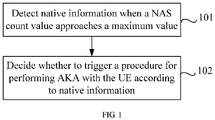
- FIG. 1 is a flowchart of an authentication method in the first example. As shown in FIG. 1 , the method in this example includes the following steps:
- the Authentication and Key Agreement procedure authentication procedure may be an EPS AKA authentication procedure.
- the entity that performs the foregoing two steps may be an MME.
- the MME detects the native information, and decides whether to trigger the EPS AKA authentication procedure according to the detection result.
- the MME receives a NAS message, and the NAS count value increases by 1.
- the MME detects whether the NAS count value comes close to the maximum value in this way:
- the MME checks whether the NAS count value is equal to a preset threshold value which is close to the maximum value; if so, the MME detects the native information, and decides whether to trigger an Authentication and Key Agreement procedure according to the detection result; if not, the MME continues to receive the NAS message.
- the MME does not trigger the EPS AKA authentication procedure as soon as detecting that the NAS count value is about to wrap around, thus reducing the times for triggering the EPS AKA authentication procedures, avoiding the resource waste caused by unnecessary EPS AKA authentication procedures, and saving resources.
- the EPS security contexts are categorized in two modes. From the perspective of the use status, the EPS security contexts are categorized into current EPS security context and non-current EPS security context.
- the current EPS security context refers to the last activated security context, namely, the security context currently in use.
- the current EPS security context and a non-current native EPS security context may coexist.
- EPS security contexts may be categorized into mapped EPS security context and native EPS security context.
- the mapped EPS security context refers to a security context mapped from another system, for example, mapped from a Universal Mobile Telecommunications System (UMTS) to an LTE system.
- UMTS Universal Mobile Telecommunications System
- the native EPS security context refers to a security context generated in an LTE system through EPS AKA.
- the native EPS security contexts are categorized into partial native EPS security context and full native EPS security context. The main difference between them is:
- a partial native EPS security context does not pass through a successful NAS security mode procedure. Therefore, a partial native EPS security context includes a root key K ASME for authentication of the UE accessing an LTE network, a Key Set Identifier (KSI), security capabilities of the UE, and a NAS count value set to 0 only.
- K ASME Key Set Identifier
- a full native EPS security context passes through an EPS AKA authentication procedure and is activated by a successful NAS Security Mode Command (SMC) procedure, and includes a set of full EPS NAS security contexts.
- SMC NAS Security Mode Command
- the full native EPS security context includes an Integrity Key (IK) (K NASint ) and a Cipher Key (CK) (K NASenc ) of the NAS, a selected NAS encryption algorithm, and an integrity algorithm identifier additionally.
- IK Integrity Key
- CK Cipher Key
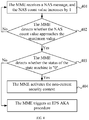
- FIG. 2 is a flowchart of an authentication method in the second example.
- the native information in this example is the security context stored locally.
- the security contexts mentioned below refer to native EPS security contexts.
- the method in this example includes the following steps:
- a value close to the maximum value may be preset as a threshold value.
- the MME checks whether the NAS count value is equal to the maximum value. If so, step 203 occurs; if not, step 201 occurs.
- Step 203 The MME checks whether the native security contexts include any non-current security context in addition to current security contexts. If so, step 204 occurs; if not, the MME triggers an EPS AKA authentication procedure.
- Step 204 The MME activates the non-current security context.
- the MME may activate the non-current security context by running a NAS SMC procedure successfully.
- a successful NAS SMC procedure includes: The MME uses the security context to perform integrity protection for the NAS SMC message. When the UE verifies the integrity of the NAS SMC message successfully, the UE sends a NAS Security Mode Complete message to the MME. The MME decrypts the NAS Security Mode Complete message, and performs integrity verification. Therefore, the MME knows that this security context is shared with the UE and is activated. In this step, the MME activates the non-current security context by executing the NAS SMC procedure successfully.
- the MME triggers an EPS AKA authentication procedure.
- the non-current native security context may be a non-current partial native security context or a non-current full native security context
- step 204 may be:
- the MME activates the non-current partial native security context or the non-current full native security context.
- the non-current native security context shared by the MME and the UE is activated. If the MME receives no NAS Security Mode Complete message from the UE, the MME triggers an EPS AKA authentication procedure.
- the MME does not trigger the EPS AKA authentication procedure immediately, thus avoiding a waste of the non-current partial security context resources, and avoiding the resource waste caused by implementation of unnecessary EPS AKA authentication procedures.
- the MME does not trigger the EPS AKA authentication procedure immediately, thus avoiding a waste of the previously stored non-current full security context resources, and avoiding the resource waste caused by implementation of unnecessary EPS AKA authentication procedures.
- the MME does not trigger the EPS AKA authentication procedure as soon as detecting that the NAS count value is about to wrap around, thus reducing the times for triggering the EPS AKA authentication procedures, avoiding the resource waste caused by unnecessary EPS AKA authentication procedures, and saving resources.
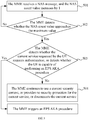
- FIG. 3 is a flowchart of an authentication method in the third example.
- the native information is timer status.
- a timer is preset on the MME.
- the status of the timer is "running” or "stop”.
- the NAS count value reaches the threshold value and the EPS AKA authentication procedure is completed successfully, the status of the timer changes to "running”; when the timing duration of the timer meets the set time threshold value, the status of the timer changes to "stop".
- the method in this example includes the following steps:
- a value close to the maximum value is preset as a threshold value (such as 2 24 -100).
- the MME checks whether the NAS count value is equal to 2 24 -100. If so, step 303 occurs; if not, step 301 occurs.
- Step 303 The MME checks whether the timer is running. If so, step 304 occurs; if not, the MME triggers an EPS AKA authentication procedure.
- Step 304 The MME activates the non-current security context.
- the non-current security context is activated by a successful NAS SMC procedure.
- a successful NAS SMC procedure includes: The MME uses the security context to perform integrity protection for the NAS SMC message. When the UE verifies the integrity of the NAS SMC message successfully, the UE sends a NAS Security Mode Complete message to the MME. The MME decrypts the NAS Security Mode Complete message, and performs integrity verification. Therefore, the MME knows that this security context is shared with the UE and is activated. In step 304, the MME activates the non-current native security context by executing the NAS SMC procedure successfully.
- the MME triggers an EPS AKA authentication procedure.
- the downlink NAS count value is generally close to the uplink NAS count value.
- the MME detects that the downlink NAS count value is about to wrap around, the wrap around of the uplink NAS count value will be detected soon.
- the MME triggers the NAS SMC procedure in a period after triggering the EPS AKA authentication procedure.
- the NAS count value is initialized to 0 through execution of the NAS SMC procedure.
- the MME triggers the EPS AKA authentication procedure hardly when detecting that the downlink NAS count value is about to wrap around, but does not trigger the NAS SMC procedure to activate the newly generated security context before detecting that the uplink NAS count value is about to wrap around, the NAS count value is not initialized, and the prior art triggers the EPS AKA authentication procedure again after detecting that the uplink NAS count value is about to wrap around.
- the timer status is detected to check whether the period starting from completion of the previous successful EPS AKA authentication procedure meets the set time threshold value. This time threshold value is determined according to the duration from completion of the successful EPS AKA authentication procedure to triggering of the NAS SMC procedure.
- this embodiment avoids second triggering of the EPS AKA authentication procedure because no NAS SMC procedure is triggered before detecting that the uplink NAS count value is about to wrap around, thus reducing the EPS AKA authentication procedures implemented, avoiding the resource waste caused by triggering of unnecessary EPS AKA authentication procedures, and saving resources.
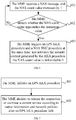
- FIG. 4 is a flowchart of an authentication method in the fourth example.
- the native information is the status of a state machine.
- a state machine is preset on the MME.
- the status of the state machine is "running” or "idle”. Specifically, “0" represents “running", and “1” represents “idle”.
- “Running” indicates that the period starting from completion of the previous successful EPS AKA authentication procedure is less than the set time threshold value; and "idle” indicates that the period starting from completion of the previous successful EPS AKA authentication procedure is greater than or equal to the set time threshold value.
- the state machine may be triggered by the timer.
- the method in this example includes the following steps:
- a value close to the maximum value is preset as a threshold value (such as 2 24 -100).
- the MME checks whether the NAS count value is equal to 2 24 -100. If so, step 403 occurs; if not, the MME triggers the EPS AKA authentication procedure.
- Step 403 The MME checks whether the status of the state machine is "0". If so, step 404 occurs; if not, the MME triggers an EPS AKA authentication procedure.
- Step 404 The MME activates the non-current security context.
- the non-current security context is activated by a successful NAS SMC procedure.
- a successful NAS SMC procedure includes: The MME uses the security context to perform integrity protection for the NAS SMC message. When the UE verifies the integrity of the NAS SMC message successfully, the UE sends a NAS Security Mode Complete message to the MME. The MME decrypts the NAS Security Mode Complete message, and performs integrity verification. Therefore, the MME knows that this security context is shared with the UE and is activated. In step 404, the MME activates the non-current native security context by executing the NAS SMC procedure successfully.
- the MME triggers an EPS AKA authentication procedure.
- the downlink NAS count value is generally close to the uplink NAS count value.
- the MME detects that the downlink NAS count value is about to wrap around, the wrap around of the uplink NAS count value will be detected soon.
- the MME triggers the NAS SMC procedure in a period after triggering the EPS AKA authentication procedure.
- the NAS count value is initialized to 0 through execution of the NAS SMC procedure.
- the MME triggers the EPS AKA authentication procedure hardly when detecting that the downlink NAS count value is about to wrap around, but does not trigger the NAS SMC procedure before detecting that the uplink NAS count value is about to wrap around, the NAS count value is not initialized, and the prior art triggers the EPS AKA authentication procedure again after detecting that the uplink NAS count value is about to wrap around.
- the status of the state machine is detected to check whether the period starting from completion of the previous successful EPS AKA authentication procedure meets the set time threshold value. This time threshold value is determined according to the duration from completion of the successful EPS AKA authentication procedure to triggering of the NAS SMC procedure.
- this embodiment avoids second triggering of the EPS AKA authentication procedure because no NAS SMC procedure is triggered before detecting that the uplink NAS count value is about to wrap around, thus reducing the EPS AKA authentication procedures implemented, avoiding the resource waste caused by triggering of unnecessary EPS AKA authentication procedures, and saving resources.
- FIG. 5 is a flowchart of an authentication method in the fifth example.
- the native information is the current service type, Quality of Service (QoS), or UE capability of performing authentication.
- QoS Quality of Service
- the method in this example includes the following steps:
- a value close to the maximum value may be preset as a threshold value.
- the MME checks whether the NAS count value is equal to the maximum value. If so, step 503 occurs; if not, step 501 occurs.
- Step 503 The MME detects the current service type to know whether the current service, which requested by the UE and corresponding to the current service type, requires authentication; or, the MME detects the QoS to know whether the current service, which requested by the UE and corresponding to the QoS, requires authentication; or, the MME detects the UE capability of performing authentication to know whether the UE is capable of executing the EPS AKA authentication procedure.
- the MME triggers an EPS AKA authentication procedure; if not, step 504 occurs.
- Step 504 The MME continues to use the current security context, or provides no security protection for the current service, or disconnects the current service.
- the MME detects the current service type to know that the service requested by the UE is an Emergency Call (EMC) service, and the EMC service requested by the UE does not require authentication, and the MME triggers no more EPS AKA authentication procedure.
- EMC Emergency Call
- the MME ignores the detection result that the NAS count value closes to the maximum value, and goes on using the current security context, or provides no security protection for the current service, or disconnects the current service.
- the MME When a UE with a Subscriber Identity Module (SIM) hands over from an EMC service in a UMTS network to an LTE network, the MME obtains the security parameter "Kc" from a Serving GPRS Support Node (SGSN) (GPRS is an acronym of General Packet Radio Service), and obtains K ASME according to a CK and an Integrity Key (IK).
- the NAS count value starts from 0.
- the security protection for the UE in the LTE network is provided by the sub-key derived from K ASME .
- the MME may detect that the UE is a SIM user incapable of the EPS AKA authentication procedure according to the Kc. Therefore, the MME triggers no more EPS AKA authentication procedure, and ignores the detection result that the NAS count value comes close to the maximum value.
- the MME goes on using the current security context, or provides no security protection for the current service, or disconnects the current service.
- the MME triggers no EPS AKA authentication procedure, thus reducing the EPS AKA authentication procedures implemented, avoiding the resource waste caused by triggering of unnecessary EPS AKA authentication procedures, and saving resources.
- FIG. 6 is a flowchart of an authentication method in the sixth example. As shown in FIG. 6 , the method in this example includes the following steps:
- a value close to the maximum value may be preset as a threshold value.
- the MME checks whether the NAS count value is equal to the threshold value. If so, step 603 occurs; if not, step 601 occurs.
- Step 603 The MME triggers an EPS AKA authentication procedure and a NAS SMC procedure at the same time, and activates the security context generated by the AKA authentication procedure.
- the NAS count value is initialized to 0.
- the EPS AKA authentication procedure is bound to the NAS SMC procedure, thus avoiding repeated triggering of the EPS AKA authentication procedure in the case of detecting that the NAS count value in different directions (uplink direction and downlink direction) is about to wrap around, reducing the EPS AKA authentication procedures, avoiding the resource waste caused by triggering of unnecessary EPS AKA authentication procedures, and saving resources.
- FIG. 7 is a flowchart of an authentication method in the first embodiment of the present invention. As shown in FIG. 7 , the method in this embodiment includes the following steps:
- the MME in step 801 may initiate the EPS AKA authentication procedure under several conditions. For example, when the NAS count value reaches a count threshold (comes close to the maximum value), the MME initiates the EPS AKA authentication procedure..
- Native information may include at least one of: current service type, QoS, UE capability of performing authentication, network policy, SIM/Universal Subscriber Identity Module (USIM) type, or information about whether a SIM/USIM is inserted in the UE, or any combination thereof.
- the current service type indicates the type of the current service.
- the MME can determine whether the current service needs authentication according to the current service type.
- QoS identifies the service requiring no authentication, and the MME can also determine whether the current service needs authentication according to the QoS.
- the UE capability of performing authentication serves as a basis for the MME to determine whether the UE is capable of performing the EPS AKA authentication procedure.
- the SIM type also indicates whether the UE is capable of performing the EPS AKA authentication procedure, and the MME knows whether the UE is capable of performing the EPS AKA authentication procedure according to the SIM type. Because authentication is practicable only if a SIM/USIM is inserted in the UE, if the EPS AKA authentication procedure fails after a SIM/USIM is inserted in the UE, the NAS signaling connection should be released; if no SIM/USIM is inserted in the UE, the MME decides whether to release the connection according to the network policy.
- the network policy is set by a network device to decide whether to authenticate the current service.
- step 802 may include:
- the MME releases the connection of the current service.
- the MME keeping a connection of the current service if determining that the current service is allowed as an unauthenticated service according to the network policy and determining that any of the following conditions is fulfilled: the current service does not require authentication according to the current service type or the QoS in the native information.
- the MME releases connection of the current service if determining that the network policy allows the current service as an unauthenticated service and determining that any of the following conditions is fulfilled: the current service requires authentication according to the current service type or the QoS in the native information.
- the MME determines that the network policy allows non-authentication of the current service
- the MME detects the current service type to know that the service requested by the UE is an EMC service or a public alarm service. If the EMC service or the public alarm service does not require authentication, and the network policy allows the unauthenticated EMC or public alarm service, the MME and the UE continue the current service.
- the MME may release the connection of the current service by releasing the NAS signaling connection. If the NAS signaling connection bears multiple services, and the current service type indicates that all the multiple current services need authentication, the MME releases the connection of the NAS signaling. If some of the current services need authentication and other current services may need no authentication (such as EMC), the MME releases the EPS bearer corresponding to the service requiring authentication, and retains the EPS bearer (such as the EMC bearer) corresponding to the service requiring no authentication.
- EMC EMC bearer
- the current service can still go on in the case that: the authentication fails; the service requested by the UE does not require authentication or the UE is incapable of performing the EPS AKA authentication procedure or no SIM/USIM is inserted in the UE; and the network policy support non-authentication of the current service. Therefore, interruption of the current service is avoided, and system resources are saved.
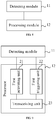
- FIG. 8 shows a structure of an authentication apparatus in the seventh example.
- the authentication apparatus in this example includes a detecting module 11 and a processor 12.
- the detecting module 11 is configured to detect native information when a NAS count value comes close to a maximum value; and the processor 12 is configured to decide whether to trigger a procedure for performing Authentication and Key Agreement procedure with the UE according to a detection result.
- the authentication apparatus in this example may work according to the method provided in the first embodiment above.
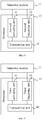
- FIG. 9 shows a structure of an authentication apparatus in the eighth example.
- the native information is security context
- the processor 12 includes a first activating unit 21 and a first triggering unit 22.
- the first activating unit 21 is configured to activate the non-current security context if the detecting module 11 determines that the security contexts include the non-current security context.
- the first triggering unit 22 is configured to trigger an Authentication and Key Agreement procedure if the detecting module 11 determines that the security contexts include no non-current security context.
- the processor 12 in this example may further include: a transceiving unit 23, configured to send a NAS SMC to the UE, receive a NAS Security Mode Complete message, and send information to the first activating unit 21 in the processor 12, where the information triggers the first activating unit 21 to take action.
- the first activating unit 21 activates the non-current security context according to the trigger information.
- the first triggering unit 22 triggers an Authentication and Key Agreement procedure if the transceiving unit 23 receives no NAS Security Mode Complete message from the UE.
- the authentication apparatus in this example may work according to the method provided in the second example above.
- FIG. 10 shows a structure of an authentication apparatus in the ninth example of the present invention.
- the native information is timer status
- the processor 12 includes a second activating unit 31 and a second triggering unit 32.
- the second activating unit 31 is configured to activate the non-current security context if the detecting module 11 detects that the timer status is "running”.
- the second triggering unit 32 is configured to trigger the Authentication and Key Agreement procedure if the detecting module 11 detects that the timer status is "stop".
- the processor 12 in this example may further include: a transceiving unit 33, configured to send a NAS SMC to the UE, receive a NAS Security Mode Complete message, and send information to the second activating unit 31 in the processor 12, where the information triggers the second activating unit 31 to take action.
- the second activating unit 31 activates the non-current security context according to the trigger information.
- the second triggering unit 32 triggers an Authentication and Key Agreement procedure if the transceiving unit 33 receives no NAS Security Mode Complete message from the UE.
- the authentication apparatus in this example may work according to the method provided in the third example above.
- FIG. 11 shows a structure of an authentication apparatus in the tenth example.
- the native information is the status of a state machine
- the processor 12 includes a third activating unit 41 and a third triggering unit 42.
- the third activating unit 41 is configured to activate the non-current security context if the detecting module 11 detects that the status of the state machine is "running”.
- the third triggering unit 42 is configured to trigger an Authentication and Key Agreement procedure if the detecting module 11 detects that the status of the state machine is "idle”.
- the processor 12 in this example may further include: a transceiving unit 43, configured to send a NAS SMC to the UE, receive a NAS Security Mode Complete message, and send information to the third activating unit 41 in the processor 12, where the information triggers the third activating unit 41 to take action.
- the third activating unit 41 activates the non-current security context according to the trigger information.
- the third triggering unit 42 triggers an Authentication and Key Agreement procedure if the transceiving unit 43 receives no NAS Security Mode Complete message from the UE.
- the authentication apparatus in this example may work according to the method provided in the fourth example above.
- FIG. 12 shows a structure of an authentication apparatus in the eleventh example.
- the native information is the current service type, or QoS, or UE capability of performing authentication.
- the processor 12 includes a fourth triggering unit 51 and a processing unit 52.
- the fourth triggering unit 51 is configured to trigger an Authentication and Key Agreement procedure if the detecting module 11 determines that the service corresponding to the current service type needs authentication, or the service corresponding to the QoS needs authentication, or the UE is capable of performing an Authentication and Key Agreement procedure.
- the processing unit 52 is configured to: continue to use the current security context, or provide no security protection for the current service, or disconnect the current service if the detecting module 11 determines that the service corresponding to the current service type needs no authentication, or the service corresponding to the QoS needs no authentication, or the UE is incapable of performing an Authentication and Key Agreement procedure.
- the authentication apparatus in this example may work according to the method provided in the fifth example above.
- the MME does not trigger the EPS AKA authentication procedure as soon as detecting that the NAS count value is about to wrap around, thus reducing the times for triggering the EPS AKA authentication procedures, avoiding the resource waste caused by unnecessary EPS AKA authentication procedures, and saving resources.
- FIG. 13 shows a structure of an authentication apparatus in the second embodiment of the present invention.
- the apparatus in this embodiment includes: an executing module 61, configured to execute an AKA authentication procedure; and a processor 62, configured to decide to release a connection or continue a current service according to native information and network policy after the executing module 61 fails to execute the Authentication and Key Agreement procedure.
- the apparatus in this embodiment may further include: a triggering module 63, configured to trigger the executing module 61 to execute an Authentication and Key Agreement procedure according to the trigger conditions such as the NAS count value closing to the maximum value.
- a triggering module 63 configured to trigger the executing module 61 to execute an Authentication and Key Agreement procedure according to the trigger conditions such as the NAS count value closing to the maximum value.
- the processor 62 may further include: a first judging unit 64, configured to judge whether the network policy support non-authentication of the current service if the executing module 61 fails to execute the Authentication and Key Agreement procedure; a first releasing unit 65, configured to release the connection of the current service if the first judging unit 64 makes a negative judgment; a second judging unit 66, configured to: if the first judging unit 64 makes a positive judgment, judge whether the current service needs authentication according to the current service type or the QoS in the native information, or judge whether the UE is capable of performing the Authentication and Key Agreement procedure; a second releasing unit 67, configured to release the connection of the current service if the second judging unit 66 makes a positive judgment; and an executing unit 68, configured to continue executing the current service if the second judging unit 66 makes a negative judgment.
- a first judging unit 64 configured to judge whether the network policy support non-authentication of the current service if the executing module 61 fails to execute the Authentic
- the authentication apparatus in this embodiment may work according to the method provided in the first embodiment above.
- the current service can still go on in the case that: the authentication fails; the service requested by the UE does not require authentication or the UE is incapable of performing the EPS AKA authentication procedure or no SIM/USIM is inserted in the UE; and the network policy support non-authentication of the current service. Therefore, interruption of the current service is avoided, and system resources are saved.
- the program may be stored in a computer readable storage medium.
- the storage medium may be any medium that is capable of storing program codes, such as a Read Only Memory (ROM), a Random Access Memory (RAM), a magnetic disk, or a Compact Disk-Read Only Memory (CD-ROM).
Landscapes
- Engineering & Computer Science (AREA)
- Computer Security & Cryptography (AREA)
- Computer Networks & Wireless Communication (AREA)
- Signal Processing (AREA)
- Computer Hardware Design (AREA)
- Computing Systems (AREA)
- General Engineering & Computer Science (AREA)
- Mobile Radio Communication Systems (AREA)
- Communication Control (AREA)
- Computer And Data Communications (AREA)
- Telephonic Communication Services (AREA)
- Data Exchanges In Wide-Area Networks (AREA)
Claims (12)
- Authentifizierungsverfahren, das Folgendes umfasst:Initiieren (801) durch eine Mobilitätsmanagemententität einer Authentifizierungs- und Schlüsselvereinbarungsprozedur für einen aktuellen Dienst, der durch eine Nichtzugangsschicht-Signalisierungsverbindung, NAS-Signalisierungsverbindung, getragen ist, falls ein NAS-Zählwert einem Maximalwert nahe kommt;Bestimmen (802) durch die Mobilitätsmanagemententität, ob der aktuelle Dienst als ein nicht authentifizierter Dienst zulässig ist, in Übereinstimmung mit einer Netzstrategie, falls die Authentifizierungs- und Schlüsselvereinbarungsprozedur für den aktuellen Dienst fehlschlägt;Bestimmen (802), ob der aktuelle Dienst Authentifizierung erfordert, in Übereinstimmung mit einem aktuellen Diensttyp oder einer Dienstgüte;Halten (802) der NAS-Signalisierungsverbindung des aktuellen Dienstes, falls der aktuelle Dienst als ein nicht authentifizierter Dienst in Übereinstimmung mit der Netzstrategie zulässig ist und der aktuelle Dienst keine Authentifizierung erfordert.
- Verfahren nach Anspruch 1, das ferner Folgendes umfasst:Freigeben der NAS-Signalisierungsverbindung des aktuellen Dienstes, falls der aktuelle Dienst in Übereinstimmung mit der Netzstrategie nicht als ein nicht authentifizierter Dienst zulässig ist.
- Verfahren nach Anspruch 1 oder Anspruch 2, das ferner Folgendes umfasst:Freigeben der NAS-Signalisierungsverbindung des aktuellen Dienstes, falls der aktuelle Dienst in Übereinstimmung mit der Netzstrategie als ein nicht authentifizierter Dienst zulässig ist und der aktuelle Dienst Authentifizierung erfordert.
- Verfahren nach einem der Ansprüche 1 bis 3, das ferner Folgendes umfasst:Bestimmen, ob das Anwendergerät imstande ist, die Authentifizierungs- und Schlüsselvereinbarungsprozedur auszuführen, in Übereinstimmung mit Anwendergeräteauthentifizierungsfähigkeitsinformationen oder einem Teilnehmeridentitätsmodultyp.
- Verfahren nach einem der Ansprüche 2 bis 4, wobei das Freigeben der NAS-Signalisierungsverbindung des aktuellen Dienstes irgendeines aus dem Folgenden umfasst:falls eine Nichtzugangsschicht-Signalisierungsverbindung einen einzelnen Dienst trägt, Freigeben der Nichtzugangsschicht-Signalisierungsverbindung;falls die Nichtzugangsschicht-Signalisierungsverbindung mehrere Dienste trägt und alle aus den mehreren Diensten Authentifizierung benötigen, Freigeben der Nichtzugangsschicht-Signalisierungsverbindung;falls eine Nichtzugangsschicht-Signalisierungsverbindung mehrere Dienste trägt und einige aus den mehreren Diensten Authentifizierung benötigen und die anderen keine Authentifizierung benötigen, Freigeben eines Trägers des entwickelten Paketsystems, der dem Dienst entspricht, der Authentifizierung erfordert, und Halten des Trägers des entwickelten Paketsystems, der dem Dienst entspricht, der keine Authentifizierung erfordert.
- Verfahren nach einem der Ansprüche 1 bis 5, wobei:der aktuelle Dienst einen Notrufdienst und/oder einen Dienst für öffentlichen Alarm umfasst.
- Vorrichtung, die Folgendes umfasst:ein Anstoßmodul (63), das konfiguriert ist, eine Authentifizierungs- und Schlüsselvereinbarungsprozedur für einen aktuellen Dienst, der durch eine Nichtzugangsschicht-Signalisierungsverbindung, NAS-Signalisierungsverbindung, getragen ist, anzustoßen, falls ein NAS-Zählwert einem Maximalwert nahe kommt; ein Ausführungsmodul (61), das konfiguriert ist, die Authentifizierungs- und Schlüsselvereinbarungsprozedur für den aktuellen Dienst auszuführen; undeinen Prozessor (62), der sich in einer Mobilitätsmanagemententität befindet, der Folgendes umfasst:eine erste Beurteilungseinheit (64), die konfiguriert ist zu bestimmen, ob der aktuelle Dienst als ein nicht authentifizierter Dienst zulässig ist, in Übereinstimmung mit einer Netzstrategie, falls die Authentifizierungs- und Schlüsselvereinbarungsprozedur für den aktuellen Dienst fehlschlägt;eine zweite Beurteilungseinheit (66), die konfiguriert ist zu bestimmen, ob der aktuelle Dienst Authentifizierung erfordert, in Übereinstimmung mit einem aktuellen Diensttyp oder einer Dienstgüte, falls die erste Beurteilungseinheit (64) in Übereinstimmung mit der Netzstrategie bestimmt, dass der aktuelle Dienst als ein nicht authentifizierter Dienst zulässig ist;eine Ausführungseinheit (68), die konfiguriert ist, die NAS-Signalisierungsverbindung des aktuellen Dienstes zu halten, falls die zweite Beurteilungseinheit (67) bestimmt, dass der aktuelle Dienst keine Authentifizierung erfordert.
- Vorrichtung nach Anspruch 7, die ferner Folgendes umfasst:eine erste Freigabeeinheit (65), die konfiguriert ist, die NAS-Signalisierungsverbindung des aktuellen Dienstes freizugeben, falls die erste Beurteilungseinheit (64) in Übereinstimmung mit der Netzstrategie bestimmt, dass der aktuelle Dienst nicht als ein nicht authentifizierter Dienst zulässig ist.
- Vorrichtung nach Anspruch 7 oder Anspruch 8, die ferner Folgendes umfasst:eine zweite Freigabeeinheit (67), die konfiguriert ist, die NAS-Signalisierungsverbindung des aktuellen Dienstes freizugeben, falls die zweite Beurteilungseinheit (66) bestimmt, dass der aktuelle Dienst Authentifizierung erfordert.
- Vorrichtung nach einem der Ansprüche 7 bis 9, wobei die zweite Beurteilungseinheit (67) konfiguriert ist, zu bestimmen, ob der aktuelle Dienst Authentifizierung erfordert, falls die erste Beurteilungseinheit (64) in Übereinstimmung mit der Netzstrategie bestimmt, dass er aktuelle Dienst als ein nicht authentifizierter Dienst zulässig ist.
- Vorrichtung nach einem der Ansprüche 8 bis 10, wobei die erste Freigabeeinheit (65) konfiguriert ist, irgendeines aus dem Folgenden freizugeben:eine Nichtzugangsschicht-Signalisierungsverbindung ("Non Access Stratum"-Signalisierungsverbindung) freizugeben, falls die Nichtzugangsschicht-Signalisierungsverbindung einen einzelnen Dienst trägt;die Nichtzugangsschicht-Signalisierungsverbindung freizugeben, falls die Nichtzugangsschicht-Signalisierungsverbindung mehrere Dienste trägt und alle aus den mehreren Diensten Authentifizierung benötigen;einen Träger eines entwickelten Paketsystems ("Evolved Packet System"-Träger), der dem Dienst entspricht, der Authentifizierung erfordert, freizugeben und den Träger des entwickelten Paketsystems, der dem Dienst entspricht, der keine Authentifizierung erfordert, zu halten, falls eine Nichtzugangsschicht-Signalisierungsverbindung mehrere Dienste trägt und einige der mehreren Dienste Authentifizierung benötigen und die anderen keine Authentifizierung benötigen.
- Vorrichtung nach Anspruch 7, wobei:der aktuelle Dienst einen Notrufdienst und/oder einen Dienst für öffentlichen Alarm umfasst.
Priority Applications (2)
| Application Number | Priority Date | Filing Date | Title |
|---|---|---|---|
| EP18204267.1A EP3531731B1 (de) | 2009-09-21 | 2010-09-19 | Computerlesbares medium und vorrichtung zur authentifizierung |
| EP17151314.6A EP3242498B1 (de) | 2009-09-21 | 2010-09-19 | Verfahren und vorrichtung zur authentifizierung |
Applications Claiming Priority (2)
| Application Number | Priority Date | Filing Date | Title |
|---|---|---|---|
| CN2009100938285A CN102025685B (zh) | 2009-09-21 | 2009-09-21 | 认证处理方法及装置 |
| PCT/CN2010/077085 WO2011032515A1 (zh) | 2009-09-21 | 2010-09-19 | 认证处理方法及装置 |
Related Child Applications (3)
| Application Number | Title | Priority Date | Filing Date |
|---|---|---|---|
| EP18204267.1A Division EP3531731B1 (de) | 2009-09-21 | 2010-09-19 | Computerlesbares medium und vorrichtung zur authentifizierung |
| EP17151314.6A Division EP3242498B1 (de) | 2009-09-21 | 2010-09-19 | Verfahren und vorrichtung zur authentifizierung |
| EP17151314.6A Division-Into EP3242498B1 (de) | 2009-09-21 | 2010-09-19 | Verfahren und vorrichtung zur authentifizierung |
Publications (3)
| Publication Number | Publication Date |
|---|---|
| EP2472928A4 EP2472928A4 (de) | 2012-07-04 |
| EP2472928A1 EP2472928A1 (de) | 2012-07-04 |
| EP2472928B1 true EP2472928B1 (de) | 2017-03-08 |
Family
ID=43757774
Family Applications (3)
| Application Number | Title | Priority Date | Filing Date |
|---|---|---|---|
| EP17151314.6A Active EP3242498B1 (de) | 2009-09-21 | 2010-09-19 | Verfahren und vorrichtung zur authentifizierung |
| EP18204267.1A Active EP3531731B1 (de) | 2009-09-21 | 2010-09-19 | Computerlesbares medium und vorrichtung zur authentifizierung |
| EP10816719.8A Active EP2472928B1 (de) | 2009-09-21 | 2010-09-19 | Verfahren und vorrichtung zur authentifizierungsverarbeitung |
Family Applications Before (2)
| Application Number | Title | Priority Date | Filing Date |
|---|---|---|---|
| EP17151314.6A Active EP3242498B1 (de) | 2009-09-21 | 2010-09-19 | Verfahren und vorrichtung zur authentifizierung |
| EP18204267.1A Active EP3531731B1 (de) | 2009-09-21 | 2010-09-19 | Computerlesbares medium und vorrichtung zur authentifizierung |
Country Status (6)
| Country | Link |
|---|---|
| US (1) | US9088616B2 (de) |
| EP (3) | EP3242498B1 (de) |
| CN (1) | CN102025685B (de) |
| BR (1) | BR112012006409B1 (de) |
| TR (1) | TR201902606T4 (de) |
| WO (1) | WO2011032515A1 (de) |
Cited By (1)
| Publication number | Priority date | Publication date | Assignee | Title |
|---|---|---|---|---|
| US20220159466A1 (en) * | 2019-04-11 | 2022-05-19 | Telefonaktiebolaget Lm Ericsson (Publ) | Methods for handling security of early mobile-terminated data transmissions |
Families Citing this family (24)
| Publication number | Priority date | Publication date | Assignee | Title |
|---|---|---|---|---|
| US9002357B2 (en) * | 2009-06-26 | 2015-04-07 | Qualcomm Incorporated | Systems, apparatus and methods to facilitate handover security |
| EP2695477A1 (de) | 2011-04-01 | 2014-02-12 | InterDigital Patent Holdings, Inc. | Verfahren und vorrichtung zur steuerung der konnektivität zu einem netzwerk |
| CN102595369B (zh) * | 2012-02-29 | 2015-02-25 | 大唐移动通信设备有限公司 | 一种nas算法的传输方法及装置 |
| GB2500720A (en) * | 2012-03-30 | 2013-10-02 | Nec Corp | Providing security information to establish secure communications over a device-to-device (D2D) communication link |
| GB2491047B (en) * | 2012-06-07 | 2013-12-11 | Renesas Mobile Corp | Apparatus and methods for security context selection |
| US20140068098A1 (en) * | 2012-09-04 | 2014-03-06 | Qualcomm Incorporated | Reducing network latency resulting from non-access stratum (nas) authentication for high performance content applications |
| US9519761B2 (en) * | 2012-09-06 | 2016-12-13 | Paypal, Inc. | Systems and methods for authentication using low quality and high quality authentication information |
| CN103686651B (zh) * | 2012-09-12 | 2018-05-11 | 中兴通讯股份有限公司 | 一种基于紧急呼叫的认证方法、设备和系统 |
| CN104662863B (zh) * | 2012-09-24 | 2019-03-01 | 阿尔卡特朗讯公司 | 触发通信网络中的用户认证 |
| CN103906049B (zh) * | 2012-12-28 | 2019-09-24 | 北京三星通信技术研究有限公司 | 一种同步辅小区和ue之间加密信息的方法 |
| US9203835B2 (en) | 2013-03-01 | 2015-12-01 | Paypal, Inc. | Systems and methods for authenticating a user based on a biometric model associated with the user |
| US11570161B2 (en) * | 2013-07-31 | 2023-01-31 | Nec Corporation | Devices and method for MTC group key management |
| CN104270752B (zh) * | 2014-09-30 | 2017-10-27 | 新华三技术有限公司 | 无线网络中的密钥协商方法及装置 |
| KR102213885B1 (ko) * | 2014-11-28 | 2021-02-08 | 삼성전자주식회사 | 무선 통신 시스템에서 보안 모드 제어 장치 및 방법 |
| EP3873122A1 (de) | 2016-01-05 | 2021-09-01 | Huawei Technologies Co., Ltd. | Vermeiden eines man-in-the-middle-angriffs auf eine attach-anfrage-nachricht |
| CN105898894B (zh) * | 2016-05-13 | 2021-08-20 | 华为技术有限公司 | Rrc状态的控制方法和装置 |
| US10462837B2 (en) * | 2016-11-04 | 2019-10-29 | Qualcomm Incorporated | Method, apparatus, and system for reestablishing radio communication links due to radio link failure |
| CN109842881B (zh) * | 2017-09-15 | 2021-08-31 | 华为技术有限公司 | 通信方法、相关设备以及系统 |
| TWI717717B (zh) | 2018-04-10 | 2021-02-01 | 新加坡商 聯發科技(新加坡)私人有限公司 | 行動通訊中錯誤ksi處理的改進方法 |
| US10805792B2 (en) * | 2018-09-07 | 2020-10-13 | Nokia Technologies Oy | Method and apparatus for securing multiple NAS connections over 3GPP and non-3GPP access in 5G |
| CN110913393B (zh) * | 2018-09-15 | 2021-09-07 | 华为技术有限公司 | 切换方法和终端设备 |
| CN109982260B (zh) * | 2019-03-08 | 2021-01-26 | 杭州迪普科技股份有限公司 | 信令的解密方法、装置、电子设备及机器可读存储介质 |
| US11632695B2 (en) | 2019-06-11 | 2023-04-18 | Qualcomm Incorporated | Evolved packet system (EPS) mobility configuration from wireless system |
| US11991525B2 (en) | 2021-12-02 | 2024-05-21 | T-Mobile Usa, Inc. | Wireless device access and subsidy control |
Family Cites Families (18)
| Publication number | Priority date | Publication date | Assignee | Title |
|---|---|---|---|---|
| US6125283A (en) * | 1998-05-18 | 2000-09-26 | Ericsson Inc. | Multi-mode mobile terminal and methods for operating the same |
| US7587598B2 (en) * | 2002-11-19 | 2009-09-08 | Toshiba America Research, Inc. | Interlayer fast authentication or re-authentication for network communication |
| US20050149440A1 (en) | 2003-12-23 | 2005-07-07 | Leslie Michelassi | Systems and methods for routing requests for reconcilement information |
| TWI249316B (en) | 2004-02-10 | 2006-02-11 | Ind Tech Res Inst | SIM-based authentication method for supporting inter-AP fast handover |
| US7372856B2 (en) | 2004-05-27 | 2008-05-13 | Avaya Technology Corp. | Method for real-time transport protocol (RTP) packet authentication |
| JP2005352710A (ja) | 2004-06-10 | 2005-12-22 | Hitachi Ltd | 個人認証装置 |
| US7877787B2 (en) | 2005-02-14 | 2011-01-25 | Nokia Corporation | Method and apparatus for optimal transfer of data in a wireless communications system |
| CN101056171A (zh) | 2006-06-20 | 2007-10-17 | 华为技术有限公司 | 一种加密通信方法和装置 |
| CN101237334A (zh) * | 2007-01-31 | 2008-08-06 | 华为技术有限公司 | 微波接入全球互通系统及提供紧急业务的方法和设备 |
| CN101272251B (zh) * | 2007-03-22 | 2012-04-18 | 华为技术有限公司 | 鉴权和密钥协商方法、认证方法、系统及设备 |
| US8699711B2 (en) | 2007-07-18 | 2014-04-15 | Interdigital Technology Corporation | Method and apparatus to implement security in a long term evolution wireless device |
| CN101119381B (zh) * | 2007-09-07 | 2013-01-16 | 中兴通讯股份有限公司 | 防止重放攻击的方法及系统 |
| CN101400059B (zh) | 2007-09-28 | 2010-12-08 | 华为技术有限公司 | 一种active状态下的密钥更新方法和设备 |
| US8379854B2 (en) * | 2007-10-09 | 2013-02-19 | Alcatel Lucent | Secure wireless communication |
| CN101470794A (zh) | 2007-12-27 | 2009-07-01 | 华为技术有限公司 | 无线射频识别系统中的认证方法、设备和系统 |
| CN101232736B (zh) * | 2008-02-22 | 2012-02-29 | 中兴通讯股份有限公司 | 用于不同接入系统之间密钥生存计数器的初始化设置方法 |
| US8179903B2 (en) * | 2008-03-12 | 2012-05-15 | Qualcomm Incorporated | Providing multiple levels of service for wireless communication devices communicating with a small coverage access point |
| US8693642B2 (en) * | 2009-04-16 | 2014-04-08 | Alcatel Lucent | Emergency call handling in accordance with authentication procedure in communication network |
-
2009
- 2009-09-21 CN CN2009100938285A patent/CN102025685B/zh active Active
-
2010
- 2010-09-19 BR BR112012006409-6A patent/BR112012006409B1/pt active IP Right Grant
- 2010-09-19 EP EP17151314.6A patent/EP3242498B1/de active Active
- 2010-09-19 EP EP18204267.1A patent/EP3531731B1/de active Active
- 2010-09-19 TR TR2019/02606T patent/TR201902606T4/tr unknown
- 2010-09-19 EP EP10816719.8A patent/EP2472928B1/de active Active
- 2010-09-19 WO PCT/CN2010/077085 patent/WO2011032515A1/zh not_active Ceased
- 2010-09-21 US US12/886,949 patent/US9088616B2/en active Active
Non-Patent Citations (1)
| Title |
|---|
| None * |
Cited By (1)
| Publication number | Priority date | Publication date | Assignee | Title |
|---|---|---|---|---|
| US20220159466A1 (en) * | 2019-04-11 | 2022-05-19 | Telefonaktiebolaget Lm Ericsson (Publ) | Methods for handling security of early mobile-terminated data transmissions |
Also Published As
| Publication number | Publication date |
|---|---|
| CN102025685A (zh) | 2011-04-20 |
| WO2011032515A1 (zh) | 2011-03-24 |
| BR112012006409A2 (pt) | 2016-04-12 |
| EP3242498A1 (de) | 2017-11-08 |
| CN102025685B (zh) | 2013-09-11 |
| BR112012006409B1 (pt) | 2021-01-19 |
| EP3531731A1 (de) | 2019-08-28 |
| EP3242498B1 (de) | 2018-12-12 |
| US20110072488A1 (en) | 2011-03-24 |
| EP2472928A4 (de) | 2012-07-04 |
| EP3531731B1 (de) | 2020-08-19 |
| US9088616B2 (en) | 2015-07-21 |
| TR201902606T4 (tr) | 2019-03-21 |
| EP2472928A1 (de) | 2012-07-04 |
Similar Documents
| Publication | Publication Date | Title |
|---|---|---|
| EP2472928B1 (de) | Verfahren und vorrichtung zur authentifizierungsverarbeitung | |
| CN112154624B (zh) | 针对伪基站的用户身份隐私保护 | |
| EP2583497B1 (de) | Verfahren und vorrichtung zur synchronisierung von sicherheitseinstellungen | |
| CN101505479B (zh) | 一种认证过程中安全上下文协商方法和系统 | |
| CN110999523A (zh) | 重新连接与无线接入网节点的无线资源控制连接的方法和用户设备 | |
| WO2009030155A1 (fr) | Procédé, système et appareil pour négocier les capacités de sécurité lors du déplacement d'un terminal | |
| JP2010536283A (ja) | 端末が移動している間の劣化攻撃を防止する方法、システム、及び装置 | |
| WO2009152759A1 (zh) | 防止网络安全失步的方法和装置 | |
| CN116783986A (zh) | 用于数据发射处理的方法及设备 | |
| US7991387B2 (en) | Method for mobile telecommunication security in a mobile communication network and device therefor | |
| Pratas et al. | Massive machine-type communication (mMTC) access with integrated authentication | |
| RU2682849C1 (ru) | Способ обработки для терминального доступа к 3gpp сети и устройству | |
| CN111328112A (zh) | 一种安全上下文隔离的方法、装置及系统 | |
| CN101867931B (zh) | 实现lte系统中的非接入层的装置和方法 | |
| WO2018103655A1 (zh) | 接入网络设备的方法及其终端设备、网络设备 | |
| CN113396637A (zh) | 一种通信的方法、装置及系统 | |
| CN102638793B (zh) | 认证处理方法及装置 | |
| CN109803260B (zh) | 拒绝接入方法、装置及系统 | |
| CN103458410B (zh) | 认证处理方法及装置 | |
| RU2704717C1 (ru) | Способ обработки для терминального доступа к 3gpp сети и устройству | |
| WO2022178727A1 (zh) | 寻呼方法、装置及通信设备 |
Legal Events
| Date | Code | Title | Description |
|---|---|---|---|
| PUAI | Public reference made under article 153(3) epc to a published international application that has entered the european phase |
Free format text: ORIGINAL CODE: 0009012 |
|
| 17P | Request for examination filed |
Effective date: 20120327 |
|
| A4 | Supplementary search report drawn up and despatched |
Effective date: 20120507 |
|
| AK | Designated contracting states |
Kind code of ref document: A1 Designated state(s): AL AT BE BG CH CY CZ DE DK EE ES FI FR GB GR HR HU IE IS IT LI LT LU LV MC MK MT NL NO PL PT RO SE SI SK SM TR |
|
| DAX | Request for extension of the european patent (deleted) | ||
| 17Q | First examination report despatched |
Effective date: 20130306 |
|
| REG | Reference to a national code |
Ref country code: DE Ref legal event code: R079 Ref document number: 602010040649 Country of ref document: DE Free format text: PREVIOUS MAIN CLASS: H04W0012000000 Ipc: H04L0029060000 |
|
| GRAP | Despatch of communication of intention to grant a patent |
Free format text: ORIGINAL CODE: EPIDOSNIGR1 |
|
| RIC1 | Information provided on ipc code assigned before grant |
Ipc: H04W 12/04 20090101ALI20160908BHEP Ipc: H04W 12/06 20090101ALI20160908BHEP Ipc: H04L 29/06 20060101AFI20160908BHEP |
|
| INTG | Intention to grant announced |
Effective date: 20160923 |
|
| GRAS | Grant fee paid |
Free format text: ORIGINAL CODE: EPIDOSNIGR3 |
|
| GRAA | (expected) grant |
Free format text: ORIGINAL CODE: 0009210 |
|
| AK | Designated contracting states |
Kind code of ref document: B1 Designated state(s): AL AT BE BG CH CY CZ DE DK EE ES FI FR GB GR HR HU IE IS IT LI LT LU LV MC MK MT NL NO PL PT RO SE SI SK SM TR |
|
| REG | Reference to a national code |
Ref country code: GB Ref legal event code: FG4D |
|
| REG | Reference to a national code |
Ref country code: CH Ref legal event code: EP Ref country code: AT Ref legal event code: REF Ref document number: 874445 Country of ref document: AT Kind code of ref document: T Effective date: 20170315 |
|
| REG | Reference to a national code |
Ref country code: IE Ref legal event code: FG4D |
|
| REG | Reference to a national code |
Ref country code: DE Ref legal event code: R096 Ref document number: 602010040649 Country of ref document: DE |
|
| REG | Reference to a national code |
Ref country code: LT Ref legal event code: MG4D |
|
| REG | Reference to a national code |
Ref country code: NL Ref legal event code: MP Effective date: 20170308 |
|
| PG25 | Lapsed in a contracting state [announced via postgrant information from national office to epo] |
Ref country code: FI Free format text: LAPSE BECAUSE OF FAILURE TO SUBMIT A TRANSLATION OF THE DESCRIPTION OR TO PAY THE FEE WITHIN THE PRESCRIBED TIME-LIMIT Effective date: 20170308 Ref country code: GR Free format text: LAPSE BECAUSE OF FAILURE TO SUBMIT A TRANSLATION OF THE DESCRIPTION OR TO PAY THE FEE WITHIN THE PRESCRIBED TIME-LIMIT Effective date: 20170609 Ref country code: NO Free format text: LAPSE BECAUSE OF FAILURE TO SUBMIT A TRANSLATION OF THE DESCRIPTION OR TO PAY THE FEE WITHIN THE PRESCRIBED TIME-LIMIT Effective date: 20170608 Ref country code: LT Free format text: LAPSE BECAUSE OF FAILURE TO SUBMIT A TRANSLATION OF THE DESCRIPTION OR TO PAY THE FEE WITHIN THE PRESCRIBED TIME-LIMIT Effective date: 20170308 Ref country code: HR Free format text: LAPSE BECAUSE OF FAILURE TO SUBMIT A TRANSLATION OF THE DESCRIPTION OR TO PAY THE FEE WITHIN THE PRESCRIBED TIME-LIMIT Effective date: 20170308 |
|
| REG | Reference to a national code |
Ref country code: AT Ref legal event code: MK05 Ref document number: 874445 Country of ref document: AT Kind code of ref document: T Effective date: 20170308 |
|
| PG25 | Lapsed in a contracting state [announced via postgrant information from national office to epo] |
Ref country code: SE Free format text: LAPSE BECAUSE OF FAILURE TO SUBMIT A TRANSLATION OF THE DESCRIPTION OR TO PAY THE FEE WITHIN THE PRESCRIBED TIME-LIMIT Effective date: 20170308 Ref country code: LV Free format text: LAPSE BECAUSE OF FAILURE TO SUBMIT A TRANSLATION OF THE DESCRIPTION OR TO PAY THE FEE WITHIN THE PRESCRIBED TIME-LIMIT Effective date: 20170308 Ref country code: ES Free format text: LAPSE BECAUSE OF FAILURE TO SUBMIT A TRANSLATION OF THE DESCRIPTION OR TO PAY THE FEE WITHIN THE PRESCRIBED TIME-LIMIT Effective date: 20170308 Ref country code: BG Free format text: LAPSE BECAUSE OF FAILURE TO SUBMIT A TRANSLATION OF THE DESCRIPTION OR TO PAY THE FEE WITHIN THE PRESCRIBED TIME-LIMIT Effective date: 20170608 |
|
| PG25 | Lapsed in a contracting state [announced via postgrant information from national office to epo] |
Ref country code: NL Free format text: LAPSE BECAUSE OF FAILURE TO SUBMIT A TRANSLATION OF THE DESCRIPTION OR TO PAY THE FEE WITHIN THE PRESCRIBED TIME-LIMIT Effective date: 20170308 |
|
| PG25 | Lapsed in a contracting state [announced via postgrant information from national office to epo] |
Ref country code: CZ Free format text: LAPSE BECAUSE OF FAILURE TO SUBMIT A TRANSLATION OF THE DESCRIPTION OR TO PAY THE FEE WITHIN THE PRESCRIBED TIME-LIMIT Effective date: 20170308 Ref country code: SK Free format text: LAPSE BECAUSE OF FAILURE TO SUBMIT A TRANSLATION OF THE DESCRIPTION OR TO PAY THE FEE WITHIN THE PRESCRIBED TIME-LIMIT Effective date: 20170308 Ref country code: RO Free format text: LAPSE BECAUSE OF FAILURE TO SUBMIT A TRANSLATION OF THE DESCRIPTION OR TO PAY THE FEE WITHIN THE PRESCRIBED TIME-LIMIT Effective date: 20170308 Ref country code: AT Free format text: LAPSE BECAUSE OF FAILURE TO SUBMIT A TRANSLATION OF THE DESCRIPTION OR TO PAY THE FEE WITHIN THE PRESCRIBED TIME-LIMIT Effective date: 20170308 Ref country code: EE Free format text: LAPSE BECAUSE OF FAILURE TO SUBMIT A TRANSLATION OF THE DESCRIPTION OR TO PAY THE FEE WITHIN THE PRESCRIBED TIME-LIMIT Effective date: 20170308 |
|
| PG25 | Lapsed in a contracting state [announced via postgrant information from national office to epo] |
Ref country code: IS Free format text: LAPSE BECAUSE OF FAILURE TO SUBMIT A TRANSLATION OF THE DESCRIPTION OR TO PAY THE FEE WITHIN THE PRESCRIBED TIME-LIMIT Effective date: 20170708 Ref country code: SM Free format text: LAPSE BECAUSE OF FAILURE TO SUBMIT A TRANSLATION OF THE DESCRIPTION OR TO PAY THE FEE WITHIN THE PRESCRIBED TIME-LIMIT Effective date: 20170308 Ref country code: PT Free format text: LAPSE BECAUSE OF FAILURE TO SUBMIT A TRANSLATION OF THE DESCRIPTION OR TO PAY THE FEE WITHIN THE PRESCRIBED TIME-LIMIT Effective date: 20170710 Ref country code: PL Free format text: LAPSE BECAUSE OF FAILURE TO SUBMIT A TRANSLATION OF THE DESCRIPTION OR TO PAY THE FEE WITHIN THE PRESCRIBED TIME-LIMIT Effective date: 20170308 |
|
| REG | Reference to a national code |
Ref country code: DE Ref legal event code: R097 Ref document number: 602010040649 Country of ref document: DE |
|
| PLBE | No opposition filed within time limit |
Free format text: ORIGINAL CODE: 0009261 |
|
| STAA | Information on the status of an ep patent application or granted ep patent |
Free format text: STATUS: NO OPPOSITION FILED WITHIN TIME LIMIT |
|
| PG25 | Lapsed in a contracting state [announced via postgrant information from national office to epo] |
Ref country code: DK Free format text: LAPSE BECAUSE OF FAILURE TO SUBMIT A TRANSLATION OF THE DESCRIPTION OR TO PAY THE FEE WITHIN THE PRESCRIBED TIME-LIMIT Effective date: 20170308 |
|
| 26N | No opposition filed |
Effective date: 20171211 |
|
| PG25 | Lapsed in a contracting state [announced via postgrant information from national office to epo] |
Ref country code: SI Free format text: LAPSE BECAUSE OF FAILURE TO SUBMIT A TRANSLATION OF THE DESCRIPTION OR TO PAY THE FEE WITHIN THE PRESCRIBED TIME-LIMIT Effective date: 20170308 |
|
| REG | Reference to a national code |
Ref country code: CH Ref legal event code: PL |
|
| PG25 | Lapsed in a contracting state [announced via postgrant information from national office to epo] |
Ref country code: MC Free format text: LAPSE BECAUSE OF FAILURE TO SUBMIT A TRANSLATION OF THE DESCRIPTION OR TO PAY THE FEE WITHIN THE PRESCRIBED TIME-LIMIT Effective date: 20170308 |
|
| REG | Reference to a national code |
Ref country code: IE Ref legal event code: MM4A |
|
| REG | Reference to a national code |
Ref country code: BE Ref legal event code: MM Effective date: 20170930 |
|
| PG25 | Lapsed in a contracting state [announced via postgrant information from national office to epo] |
Ref country code: LU Free format text: LAPSE BECAUSE OF NON-PAYMENT OF DUE FEES Effective date: 20170919 |
|
| REG | Reference to a national code |
Ref country code: FR Ref legal event code: ST Effective date: 20180531 |
|
| PG25 | Lapsed in a contracting state [announced via postgrant information from national office to epo] |
Ref country code: IE Free format text: LAPSE BECAUSE OF NON-PAYMENT OF DUE FEES Effective date: 20170919 Ref country code: LI Free format text: LAPSE BECAUSE OF NON-PAYMENT OF DUE FEES Effective date: 20170930 Ref country code: CH Free format text: LAPSE BECAUSE OF NON-PAYMENT OF DUE FEES Effective date: 20170930 |
|
| PG25 | Lapsed in a contracting state [announced via postgrant information from national office to epo] |
Ref country code: FR Free format text: LAPSE BECAUSE OF NON-PAYMENT OF DUE FEES Effective date: 20171002 Ref country code: BE Free format text: LAPSE BECAUSE OF NON-PAYMENT OF DUE FEES Effective date: 20170930 |
|
| PG25 | Lapsed in a contracting state [announced via postgrant information from national office to epo] |
Ref country code: MT Free format text: LAPSE BECAUSE OF NON-PAYMENT OF DUE FEES Effective date: 20170919 |
|
| PG25 | Lapsed in a contracting state [announced via postgrant information from national office to epo] |
Ref country code: HU Free format text: LAPSE BECAUSE OF FAILURE TO SUBMIT A TRANSLATION OF THE DESCRIPTION OR TO PAY THE FEE WITHIN THE PRESCRIBED TIME-LIMIT; INVALID AB INITIO Effective date: 20100919 |
|
| PG25 | Lapsed in a contracting state [announced via postgrant information from national office to epo] |
Ref country code: CY Free format text: LAPSE BECAUSE OF NON-PAYMENT OF DUE FEES Effective date: 20170308 |
|
| PG25 | Lapsed in a contracting state [announced via postgrant information from national office to epo] |
Ref country code: MK Free format text: LAPSE BECAUSE OF FAILURE TO SUBMIT A TRANSLATION OF THE DESCRIPTION OR TO PAY THE FEE WITHIN THE PRESCRIBED TIME-LIMIT Effective date: 20170308 |
|
| PG25 | Lapsed in a contracting state [announced via postgrant information from national office to epo] |
Ref country code: TR Free format text: LAPSE BECAUSE OF FAILURE TO SUBMIT A TRANSLATION OF THE DESCRIPTION OR TO PAY THE FEE WITHIN THE PRESCRIBED TIME-LIMIT Effective date: 20170308 |
|
| PG25 | Lapsed in a contracting state [announced via postgrant information from national office to epo] |
Ref country code: AL Free format text: LAPSE BECAUSE OF FAILURE TO SUBMIT A TRANSLATION OF THE DESCRIPTION OR TO PAY THE FEE WITHIN THE PRESCRIBED TIME-LIMIT Effective date: 20170308 |
|
| REG | Reference to a national code |
Ref country code: DE Ref legal event code: R079 Ref document number: 602010040649 Country of ref document: DE Free format text: PREVIOUS MAIN CLASS: H04L0029060000 Ipc: H04L0065000000 |
|
| PGFP | Annual fee paid to national office [announced via postgrant information from national office to epo] |
Ref country code: DE Payment date: 20240730 Year of fee payment: 15 |
|
| PGFP | Annual fee paid to national office [announced via postgrant information from national office to epo] |
Ref country code: GB Payment date: 20240801 Year of fee payment: 15 |
|
| PGFP | Annual fee paid to national office [announced via postgrant information from national office to epo] |
Ref country code: IT Payment date: 20240812 Year of fee payment: 15 |
|
| P01 | Opt-out of the competence of the unified patent court (upc) registered |
Free format text: CASE NUMBER: UPC_APP_326464/2023 Effective date: 20230524 |