EP2472980A1 - Verfahren und Vorrichtung zu schneller Justierung in bezug auf Störungen anderer Sektoren (OSI) - Google Patents
Verfahren und Vorrichtung zu schneller Justierung in bezug auf Störungen anderer Sektoren (OSI) Download PDFInfo
- Publication number
- EP2472980A1 EP2472980A1 EP20120161453 EP12161453A EP2472980A1 EP 2472980 A1 EP2472980 A1 EP 2472980A1 EP 20120161453 EP20120161453 EP 20120161453 EP 12161453 A EP12161453 A EP 12161453A EP 2472980 A1 EP2472980 A1 EP 2472980A1
- Authority
- EP
- European Patent Office
- Prior art keywords
- interference
- osi
- fast
- slow
- average
- Prior art date
- Legal status (The legal status is an assumption and is not a legal conclusion. Google has not performed a legal analysis and makes no representation as to the accuracy of the status listed.)
- Withdrawn
Links
- 238000000034 method Methods 0.000 title claims abstract description 82
- 238000009826 distribution Methods 0.000 claims description 14
- 238000004891 communication Methods 0.000 abstract description 95
- 230000004044 response Effects 0.000 abstract description 17
- 238000013459 approach Methods 0.000 abstract description 16
- 230000005540 biological transmission Effects 0.000 description 35
- 230000002441 reversible effect Effects 0.000 description 25
- 230000006870 function Effects 0.000 description 24
- 238000010586 diagram Methods 0.000 description 22
- 238000005259 measurement Methods 0.000 description 19
- 230000000875 corresponding effect Effects 0.000 description 14
- 238000007726 management method Methods 0.000 description 12
- 239000011159 matrix material Substances 0.000 description 12
- 230000008569 process Effects 0.000 description 9
- 230000007423 decrease Effects 0.000 description 6
- 238000012935 Averaging Methods 0.000 description 5
- 230000008901 benefit Effects 0.000 description 5
- 230000000717 retained effect Effects 0.000 description 5
- 230000003595 spectral effect Effects 0.000 description 5
- 230000007774 longterm Effects 0.000 description 4
- 238000012545 processing Methods 0.000 description 4
- 238000003860 storage Methods 0.000 description 4
- 239000000969 carrier Substances 0.000 description 3
- 230000001143 conditioned effect Effects 0.000 description 3
- 125000004122 cyclic group Chemical group 0.000 description 3
- 230000000694 effects Effects 0.000 description 3
- 238000012544 monitoring process Methods 0.000 description 3
- 230000010363 phase shift Effects 0.000 description 3
- 238000004458 analytical method Methods 0.000 description 2
- 230000006399 behavior Effects 0.000 description 2
- 230000001413 cellular effect Effects 0.000 description 2
- 230000000670 limiting effect Effects 0.000 description 2
- 238000004519 manufacturing process Methods 0.000 description 2
- 239000002096 quantum dot Substances 0.000 description 2
- 239000000523 sample Substances 0.000 description 2
- 230000001360 synchronised effect Effects 0.000 description 2
- 238000005481 NMR spectroscopy Methods 0.000 description 1
- 239000000654 additive Substances 0.000 description 1
- 230000000996 additive effect Effects 0.000 description 1
- 230000004075 alteration Effects 0.000 description 1
- 230000008859 change Effects 0.000 description 1
- 239000003795 chemical substances by application Substances 0.000 description 1
- 230000000295 complement effect Effects 0.000 description 1
- 230000002596 correlated effect Effects 0.000 description 1
- 230000001186 cumulative effect Effects 0.000 description 1
- 238000013500 data storage Methods 0.000 description 1
- 238000005315 distribution function Methods 0.000 description 1
- 230000005670 electromagnetic radiation Effects 0.000 description 1
- 238000005516 engineering process Methods 0.000 description 1
- 238000011156 evaluation Methods 0.000 description 1
- 230000000977 initiatory effect Effects 0.000 description 1
- 230000003993 interaction Effects 0.000 description 1
- 230000002452 interceptive effect Effects 0.000 description 1
- 238000012423 maintenance Methods 0.000 description 1
- 230000000116 mitigating effect Effects 0.000 description 1
- 238000012986 modification Methods 0.000 description 1
- 230000004048 modification Effects 0.000 description 1
- 238000004651 near-field scanning optical microscopy Methods 0.000 description 1
- 238000005192 partition Methods 0.000 description 1
- 230000009467 reduction Effects 0.000 description 1
- 230000011664 signaling Effects 0.000 description 1
- 230000009897 systematic effect Effects 0.000 description 1
- 230000036962 time dependent Effects 0.000 description 1
- 230000001131 transforming effect Effects 0.000 description 1
Images






Classifications
-
- H—ELECTRICITY
- H04—ELECTRIC COMMUNICATION TECHNIQUE
- H04W—WIRELESS COMMUNICATION NETWORKS
- H04W72/00—Local resource management
- H04W72/50—Allocation or scheduling criteria for wireless resources
- H04W72/54—Allocation or scheduling criteria for wireless resources based on quality criteria
- H04W72/541—Allocation or scheduling criteria for wireless resources based on quality criteria using the level of interference
-
- H—ELECTRICITY
- H04—ELECTRIC COMMUNICATION TECHNIQUE
- H04W—WIRELESS COMMUNICATION NETWORKS
- H04W72/00—Local resource management
- H04W72/04—Wireless resource allocation
- H04W72/044—Wireless resource allocation based on the type of the allocated resource
- H04W72/0446—Resources in time domain, e.g. slots or frames
-
- H—ELECTRICITY
- H04—ELECTRIC COMMUNICATION TECHNIQUE
- H04W—WIRELESS COMMUNICATION NETWORKS
- H04W72/00—Local resource management
- H04W72/04—Wireless resource allocation
- H04W72/044—Wireless resource allocation based on the type of the allocated resource
- H04W72/0453—Resources in frequency domain, e.g. a carrier in FDMA
-
- H—ELECTRICITY
- H04—ELECTRIC COMMUNICATION TECHNIQUE
- H04W—WIRELESS COMMUNICATION NETWORKS
- H04W72/00—Local resource management
- H04W72/20—Control channels or signalling for resource management
- H04W72/23—Control channels or signalling for resource management in the downlink direction of a wireless link, i.e. towards a terminal
Definitions
- the present disclosure relates generally to wireless communications, and more specifically to techniques for fast other sector interference and communication resource adjustment in a wireless communication system.
- Wireless communication has penetrated nearly every aspect of a person's daily routine.
- wireless systems are widely deployed to provide various types of communication content such as voice, data, video, and so on.
- These systems can be multiple-access systems that are capable of supporting communication for multiple terminals by sharing available system resources. Examples of such multiple-access systems include Code Division Multiple Access (CDMA) systems, Time Division Multiple Access (TDMA) systems, Frequency Division Multiple Access (FDMA) systems, and Orthogonal Frequency Division Multiple Access (OFDMA) systems.
- CDMA Code Division Multiple Access
- TDMA Time Division Multiple Access
- FDMA Frequency Division Multiple Access
- OFDMA Orthogonal Frequency Division Multiple Access
- a wireless multiple-access communication system can simultaneously support communication for multiple wireless terminals.
- each terminal can communicate with one or more sectors via transmissions on the forward and reverse links.
- the forward link (or downlink) refers to the communication link from the sectors to the terminals
- the reverse link (or uplink) refers to the communication link from the terminals to the sectors.
- These communication links can be established via a single-input-single-output (SISO), multiple-input-single-output (MISO), and/or multiple-input-multiple-output (MIMO) systems.
- SISO single-input-single-output
- MISO multiple-input-single-output
- MIMO multiple-input-multiple-output
- Multiple terminals can simultaneously transmit on the reverse link by multiplexing their transmissions to be orthogonal to one another in the time, frequency, and/or code domain. If full orthogonality between transmissions is achieved, transmissions from each terminal will not interfere with transmissions from other terminals at a receiving sector. However, complete orthogonality among transmissions from different terminals is often not realized due to channel conditions, receiver imperfections, and other factors. As a result, terminals often cause some amount of interference to other terminals communicating with the same sector. Furthermore, because transmissions from terminals communicating with different sectors are typically not orthogonal to one another, each terminal can also cause interference to terminals communicating with nearby sectors. This interference results in a decrease in performance at each terminal in the system. Accordingly, there is a need in the art for effective techniques to mitigate the effects of interference in a wireless communication system.
- a method for resource management in a wireless system comprising: receiving an indication of other-sector interference (OSI); determining whether a delta value associated with a communication resource should be adjusted in response to the received OSI indication; the determination includes identifying the time-frequency resources corresponding to the OSI indication; and adjusting the delta value associated with the communication resource.
- OSI other-sector interference
- the subject specification discloses a wireless communication apparatus, comprising: an integrated circuit configured to acquire a set of access points, to receive an indication of excessive other-sector interference (OSI) from an access point in a set of acquired access points, to adjust an offset value associated with a communication resource according to the excessive OSI indication, and to retain the adjusted offset value; and a memory coupled to the integrated circuit for storing data.
- OSI other-sector interference
- an apparatus that facilitates managing resources in a wireless communication system, the apparatus comprising: means for establishing a set of non-serving access points (APs) to monitor for other-sector interference indications; means for receiving an other-sector interference (OSI) indication from one or more APs in the monitor set; and means for adjusting an offset value associated with a communication resource according to the received OSI indication.
- APs non-serving access points
- OSI other-sector interference
- a computer-readable mediums comprising: code for causing a computer to receive an indication of excessive other-sector interference from a set of non-serving access points; code for causing a computer to adjust an offset value associated with a communication resource assigned by an access point; and code for causing a computer to communicate the adjusted offset value to an access point to update subsequent resource assignments.
- a method for managing interference in a wireless system comprising: determining an interference level based on an interference metric; generating an indication of other-sector interference (OSI) based on the determined interference level; and transmitting the OSI indication.
- OSI other-sector interference
- an apparatus used in wireless communications comprising: means for determining a fast interference level based on an interference metric; means for generating an indication of fast other-sector interference (OSI) according to the fast interference level; and means for transmitting the generated OSI indication.
- OSI fast other-sector interference
- a computer-readable medium comprising: code for causing a computer to measure interference levels on a frame time scale and a superframe time scale, the time scales dictated by a symbol numerology of a wireless system; code for causing a computer to compute an effective interference level based on the interference level measurements; and code for causing a computer to issue an excess other-sector interference indication according to the computed effective interference level.
- an electronic appliance that operates in a wireless communication environment, the appliance comprising: an integrated circuit configured to facilitate measurements of an interference level in frequency-domain and time-domain, the measurements conducted at disparate time scales, to compute effective interference levels employing results of the measurements in slow and fast time regimes, and to broadcast an indication of excessive other-sector interference; and a memory coupled to the integrated circuit to store measured and computed data.
- an apparatus that facilitates wireless communications, the system comprising: an integrated circuit configured to transmit a resource assignment, and to receive an adjusted offset value associated with an assigned resource; and a memory coupled to the integrated circuit for storing data, the data includes the adjusted value of an offset associated with a communication resource.
- one or more embodiments comprise the features hereinafter fully described and particularly pointed out in the claims.
- the following description and the annexed drawings set forth in detail certain illustrative aspects and are indicative of but a few of the various ways in which the principles of the embodiments may be employed.
- Other advantages and novel features will become apparent from the following detailed description when considered in conjunction with the drawings and the disclosed embodiments are intended to include all such aspects and their equivalents.
- FIG. 1 illustrates a wireless multiple-access communication system in accordance with various aspects set forth herein.
- FIG. 2 illustrates a block diagram of an example system that facilitates interference and communication resource management.
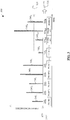
- FIG. 3 is example diagram of interference metric values in a time domain spanning an illustrative superframe.
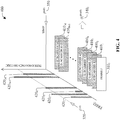
- FIG. 4 is example diagram of interference metric values in frequency domain.
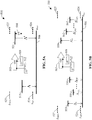
- FIGs. 5A and 5B are example diagrams that represent offset values and their response to an indication of excessive other-sector interference in accordance with an aspect of the subject specification.
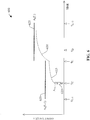
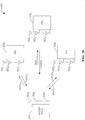
- FIG. 6 illustrates a time evolution of a fast other-sector interference offset value in accordance with one aspect of the subject specification.
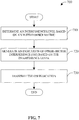
- FIG. 7 presents a flowchart of an example method for producing an indication of other system interference in a wireless system.
- FIG. 8 presents a flowchart of an example method for managing interference and communication resources in a wireless system.
- FIG. 9 is a block diagram of an example multiple-input multiple-output (MIMO) transmitter and a receiver that can exploit interference adjustment.
- MIMO multiple-input multiple-output
- FIG. 10 is a block diagram of an example multiple-user MIMO configuration.
- FIG. 11 is a block diagram of an example system that coordinates interference and resource management in a wireless communication system.
- FIG. 12 is a block diagram of a system that coordinates reverse link resource and interference management in a wireless communication system in accordance with various aspects.
- FIG. 13 illustrates a block diagram of an example system that enables managing resources in a wireless communication in accordance with an aspect of the subject disclosure.
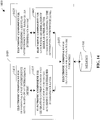
- FIG. 14 illustrates a block diagram of an example system 1300 that enables interference management in a wireless system in accordance with an aspect of the subject disclosure.
- a component may be, but is not limited to being, a process running on a processor, a processor, an object, an executable, a thread of execution, a program, and/or a computer.
- an application running on a computing device and the computing device can be a component.
- One or more components can reside within a process and/or thread of execution and a component may be localized on one computer and/or distributed between two or more computers.
- these components can execute from various computer readable media having various data structures stored thereon.
- the components may communicate by way of local and/or remote processes such as in accordance with a signal having one or more data packets (e.g. , data from one component interacting with another component in a local system, distributed system, and/or across a network such as the Internet with other systems by way of the signal).
- a signal having one or more data packets (e.g. , data from one component interacting with another component in a local system, distributed system, and/or across a network such as the Internet with other systems by way of the signal).
- a mobile device can also be called a system, subscriber unit, subscriber station, mobile station, mobile, remote station, remote terminal, access terminal, user terminal, terminal, wireless communication device, user agent, user device, or user equipment (UE).
- a mobile device may be a cellular telephone, a cordless telephone, a Session Initiation Protocol (SIP) phone, a wireless local loop (WLL) station, a personal digital assistant (PDA), a handheld device having wireless connection capability, computing device, or other processing device connected to a wireless modem.
- SIP Session Initiation Protocol
- WLL wireless local loop
- PDA personal digital assistant
- a base station may be utilized for communicating with mobile device(s) and may also be referred to as an access point, Node B, evolved Node B (eNodeB), or some other terminology.
- FIG. 1 is an illustration of a wireless multiple-access communication system 100 in accordance with various aspects.
- the wireless multiple-access communication system 100 includes multiple base stations 110 and multiple terminals 120. Further, one or more base stations 110 can communicate with one or more terminals 120.
- a base station 110 can be an access point, a Node B, and/or another appropriate network entity.
- Each base station 110 provides communication coverage for a particular geographic area 102a-c.
- the term "cell" can refer to a base station 110 and/or its coverage area 102a-c depending on the context in which the term is used.
- the coverage area 102a, 102b, or 102c corresponding to a base station 110 can be partitioned into multiple smaller areas (e.g., areas 104a, 104b, and 104c). Each of the smaller areas 104a, 104b, and 104c can be served by a respective base transceiver subsystem (BTS, not shown).
- BTS base transceiver subsystem
- the term "sector" can refer to a BTS and/or its coverage area depending on the context in which the term is used.
- sectors 104a, 104b, and 104c in a cell 102a, 102b, or 102c can be formed by groups of antennas (not shown) at base station 110, where each group of antennas is responsible for communication with terminals 120 in a portion of the cell 102a, 102b, or 102c.
- a base station 110 serving cell 102a can have a first antenna group corresponding to sector 104a, a second antenna group corresponding to sector 104b, and a third antenna group corresponding to sector 104c.
- the various aspects disclosed herein can be used in a system having sectorized and/or unsectorized cells.
- the term "base station” as used herein can refer both to a station that serves a sector as well as a station that serves a cell.
- a "serving" access point is one with which a terminal has RL traffic (data) transmissions
- a "neighbor" (non-serving) access point is one with which a terminal can have FL traffic and/or both FL and RL control transmissions but no RL traffic.
- a FL sector in a disjoint link scenario is a neighbor sector. While the following description generally relates to a system in which each terminal communicates with one serving access point for simplicity, it should be appreciated that terminals can communicate with any number of serving access points.
- terminals 120 can be dispersed throughout the system 100. Each terminal 120 can be stationary or mobile.
- a terminal 120 can be an access terminal (AT), a mobile station, user equipment, a subscriber station, and/or another appropriate network entity.
- a terminal 120 can be a wireless device, a cellular phone, a personal digital assistant (PDA), a wireless modem, a handheld device, or another appropriate device.
- a terminal 120 can communicate with any number of base stations 110 or no base stations 110 at any given moment.
- system 100 can utilize a centralized architecture by employing a system controller 130 that can be coupled to one or more base stations 110 and provide coordination and control for the base stations 110.
- system controller 130 can be a single network entity or a collection of network entities.
- the system 100 can utilize a distributed architecture to allow the base stations 110 to communicate with each other as needed.
- system controller 130 can additionally contain one or more connections to multiple networks. These networks can include the Internet, other packet based networks, and/or circuit switched voice networks that can provide information to and/or from terminals 120 in communication with one or more base stations 110 in system 100.
- system controller 130 can include or be coupled with a scheduler (not shown) that can schedule transmissions to and/or from terminals 120. Alternatively, the scheduler can reside in each individual cell 102a-c, each sector 104a-c, or a combination thereof.
- system 100 can utilize one or more multiple-access schemes, such as CDMA, TDMA, FDMA, OFDMA, Single-Carrier FDMA (SC-FDMA), and/or other suitable multiple-access schemes.
- TDMA utilizes time division multiplexing (TDM), wherein transmissions for different terminals 120 are orthogonalized by transmitting in different time intervals.
- FDMA utilizes frequency division multiplexing (FDM), wherein transmissions for different terminals 120 are orthogonalized by transmitting in different frequency subcarriers.
- TDMA and FDMA systems can also use code division multiplexing (CDM), wherein transmissions for multiple terminals can be orthogonalized using different orthogonal codes (e.g.
- OFDMA utilizes Orthogonal Frequency Division Multiplexing (OFDM)
- SC-FDMA utilizes Single-Carrier Frequency Division Multiplexing (SC-FDM).
- OFDM and SC-FDM can partition the system bandwidth into multiple orthogonal subcarriers (e.g. , tones, bins, ...), each of which can be modulated with data.
- modulation symbols are sent in the frequency domain with OFDM and in the time domain with SC-FDM.
- the system bandwidth can be divided into one or more frequency carriers, each of which can contain one or more subcarriers.
- System 100 can also utilize a combination of multiple-access schemes, such as OFDMA and CDMA. While the power control techniques provided herein are generally described for an OFDMA system, it should be appreciated that the techniques described herein can similarly be applied to any wireless communication system.
- base stations 110 and terminals 120 in system 100 can communicate data using one or more data channels and signaling using one or more control channels.
- Data channels utilized by system 100 can be assigned to active terminals 120 such that each data channel is used by only one terminal at any given time.
- data channels can be assigned to multiple terminals 120, which can be superimposed or orthogonally scheduled on a data channel.
- control channels utilized by system 100 can also be shared among multiple terminals 120 using, for example, code division multiplexing.
- data channels orthogonally multiplexed only in frequency and time e.g . , data channels not multiplexed using CDM
- CDM channel modulation multiplexing
- system 100 can employ centralized scheduling via one or more schedulers implemented at, for example, system controller 130 and/or each base station 110.
- scheduler(s) can rely on feedback from terminals 120 to make appropriate scheduling decisions.
- this feedback can include delta offset added to the OSI information for feedback in order to allow the scheduler to estimate a supportable reverse link peak rate for a terminal 120 from which such feedback is received and to allocate system bandwidth accordingly.
- reverse link interference and resources control can result in a guaranteed minimum system stability and quality of service (QoS) parameters for the system.
- QoS quality of service
- decoding error probability of reverse link (RL) acknowledgement messages can result in an error floor for all forward link transmissions.
- tight interference control on the RL system 100 can facilitate power efficient transmission of control and QoS traffic and/or other traffic with stringent error requirements.
- FIG. 2 shows a block diagram of an example system 200 that facilitates interference and communication resource management.
- An access terminal (AT) 220 communicates with a serving access point (AP) 250, which can transmit data and control code symbols to AT 220 over forward link (FL) 265 and can receive data and control through reverse link (RL) 235.
- Serving AP 250 can send a resource assignment to terminal 220.
- resource assignment conveys information on communication resources such as power level and/or power spectral density, packet format, modulation, etc ., that AT 220 can employ to conduct a communication with AP 250.
- Resource assignments can be managed by scheduler 254 which can determine assignments based on feedback information received from AT 220 over RL 235. It is noted that scheduler 254 can be coupled, e.g.
- scheduler 254 can receive an offset ( ⁇ 239) value over RL 235 in connection with a communication resource in order to adjust the resource level and re-assign resources according to ⁇ 239.
- offset ⁇ 239
- Such reassignment can be employed to mitigate interference caused by AT 220 on other-sector, non-serving APs such as AP 280. Interference can be mitigated when AP 250 re-assigns a lower operational power to AT 220 in response to receiving a ⁇ 239 value.
- ⁇ offset
- offset delta
- Access terminal 220 can receive information from non-semice access point 280 over forward link 295. While a single non-serving AP is illustrated in example system 200, it is noted that AT 220 can receive information from a plurality of non-serving APs. Such access points can be acquired at the time serving AP 250 is acquired, and can form an active set for AT 220. (The active set can be stored, for example, in memory 232.) Moreover, AT 220 can refine such active set after acquisition, according to predetermined thresholds in connection with received power of pilots and interference over thermal noise (IoT). Information transmitted/broadcasted by non-serving AP 280 (or another non-serving AP in the refined active set) can be monitored.
- IoT interference over thermal noise
- AT 220 can monitor an indication of other-sector interference (OSI). It is noted that APs outside an active set can also be monitored (see below).
- OSI indications from a given sector can be based on the sector's FL geometry (e.g. , filtered signal-to-interference-and-noise ratio (SINR) of acquisition pilots) in conjunction with predefined thresholds.
- SINR filtered signal-to-interference-and-noise ratio
- Indication of excessive OSI 299 can be transmitted or broadcasted over physical channels of forward link 295.
- the forward OSI channel (F-OSICH) carries the OSI indications.
- a requirement for such channels can be large coverage area, as the channel needs to be decoded at access terminals that are not being served by the transmitting sector (e.g. , sectors 104a-c).
- a channel carrying an OSI indication can have the same coverage as the acquisition pilot channels (e.g. , forward common pilot channel (F-CPICH), forward channel quality indicator pilot channel (F-CQIPICH) in 3G UMB) which penetrate far into the neighboring sectors (e.g.
- a physical channel carrying an OSI 299 indication needs to be decodable without requiring additional information regarding its transmitting sector other than the pilot pseudonoise code sequence.
- Such requirements (i) make a physical control channel carrying OSI indications (such as F-OSICH in 3G UMB) significantly costly in terms of required power and time-frequency resources, as well as (ii) limit the rate at which OSI indications can be transmitted over the channel-typically once every superframe (see below).
- the large coverage of a channel like F-OSICH, in 3G UMB can result in OSI indications transmitted by sectors outside an acquired active set being monitored, e.g. , decoded by an access terminal.
- Non-serving access point 280 can include an OSI generation component 284, which can be coupled to a processor 288 and memory 292.
- Component 284 can generate an OSI 299 indication over long or short periods of time with respect to a transmission time interval (e.g. , a frame, a sub-frame). Such indications are described next.
- (i) Slow OSI. Long periods of time can correspond to one or more superframes or radio frames.
- a superframe encompasses 25 frames and, depending on time guards and cyclic prefixes, it can span nearly 24-28 ms.
- a radio frame in a third generation long-term evolution (3G LTE) system spans 10 ms.
- slow OSI can correspond to an average indication over the probed time interval (e.g. , a superframe) and it can be effective in reflecting the interference observed by a non-serving AP ( e.g., 250) when variations of channel interference are slow.
- slow OSI can be effective in sectors that present a fix pattern of transmission, e.g. , bandwidth (BW) assignments as well as buffer status do not change appreciably over the course of a transmission involving several superframes.
- BW bandwidth
- Slow OSI can also accurately represent interference levels in a sector if there is enough statistical multiplexing in the system, e.g. , terminals increasing BW compensate those wireless devices whose BW decrease, or the network is fully loaded.
- OSI generation component 284 can generate both slow and fast OSI indications per subcarrier or per subband, e.g., a set of subcarriers ( FIG. 4 ).
- fast OSI can become sufficiently granular (in time-frequency resources) so as to being able to distinguish whether a terminal A or B is causing the observed interference.
- a bursty terminal e.g. , access terminal 220
- a terminal causing strong interference at a non-serving sector on the reverse link can most likely observe a strong signal (e.g. , pilot signal) from the non-serving sector on the forward link (e.g. , forward link 295), and can have that sector in its active set.
- a strong signal e.g. , pilot signal
- each access point on non-serving sectors e.g. , access point 280
- can transmit fast OSI indications in addition to transmitting slow OSI indications, to an access terminal via a forward link control channel with lower overhead than that of the slow OSI indication channel.
- the access terminal needs to have the transmitting access points in its active set.
- such channel can be embodied in a forward link fast OSI channel (F-FOSICH) that can transmit in 3G UMB systems.
- F-FOSICH forward link fast OSI channel
- the F-FOSICH mentioned supra can be present in every FL physical layer frame (hence revealing the root of its name), allowing for a non-serving access point (e.g. , 280) to rapidly address/mitigate the interference from a bursty access terminal (e.g. , 220) in a neighboring sector before such a terminal causes packet errors in the sector serviced by the access point.
- FIG. 3 and FIG. 4 are, respectively, an example diagram 300 of an interference metric for a sample superframe consisting of K illustrative RL physical frames 310 1 -310 K , and an example diagram 400 of an interference metric in frequency-domain. It is noted that such frames span a specific amount of time dictated by the specifications of the wireless system in which APs 250 and 280, as well as AT 220, operate. In an aspect, symbol numerology determines the time span.
- a non-serving access point e.g. , non-serving AP 280
- a threshold (or tolerance) interference metric value I TH 320 is employed as reference in order to issue an indication of excess interference.
- I TH can be determined by a service provider: target peak data rate, target spectral efficiency, target latency, complexity and cost of base station/access point, etc .
- interference can be measured in dB with respect to a reference value I (REF) 350 that can be determined by, e.g. , thermal noise in the system, and other sources of systematic noise.
- I (REF) 350 can be determined by, e.g. , thermal noise in the system, and other sources of systematic noise.
- procedures/methods to determine an interference level can be devised, which can include the following four.
- a typical metric can be the average interference for both slow OSI and fast OSI.
- An average over all frequency resources e.g. , subcarriers 410 1 -410 M , FIG. 4
- An average over a number of (recent) reverse link frames e.g. , 310 J -310 K , with J ⁇ K
- an average value can be extracted by passing all frequency, per-frame averages in a recent superframe through an infinite impulse response (IIR) filter of a given constant (e.g.
- IIR infinite impulse response
- the interference frequency averages 340 1 -340 K are indicated for each frame 310 1 -310 K . If average interference ⁇ I ⁇ (SLOW) 330 is above threshold I TH 320, then an indication of excessive OSI is issued by OSI generation component 284. As discussed above, computing an average can capture slowly varying changes in a wireless communication sector.
- a non-serving access point e.g.
- F-OSICH regular OSI channel
- F-OSICH regular OSI channel
- averaging over frequency resources such as subcarriers (e.g. , all or a subset of subcarriers 410 1 -410 M ), or subbands, can result in fast average interference values 340 1 -340 K .
- fast OSI can be determined for each subcarrier in frequency domain: values 420 1 -420 M correspond to observed interference metric values in a specific frame ( FIG. 4 presents frame 310 J ). It is noted that for each frame, e.g. , frame 310 J , interference values 420 1 -420 M can be assigned to a fast OSI, in addition to the average over frequency resources, e.g., ⁇ I ⁇ (FAST) 340 J .
- a processor e.g. , processor 288) can compute the averages, as well as other computations relevant to procedure (1), and results can be stored in a memory ( e.g. , memory 292). Moreover, a processor ( e.g. , processor 288) can facilitate conducting measurement of interference levels in the time-frequency domain; data can be stored in a memory ( e.g., memory 292).
- a method consisting of monitoring high percentiles (e.g. , tails) of cumulative distribution functions (CDF) of interference measurement distributions (e.g. , values 340 1 -340 K represent a distribution over frames 310 1 -310 K ) can be employed by OSI generation component 284 for both slow OSI and fast OSI.
- An interference level extracted with such a method, as described below, is termed herein tail interference.
- Monitoring tail values can be well suited to guarantee minimum performace and/or preserve communications over control channels, which typically avoid repeated requests from a receiver (e.g. , hybrid automated repeat request (HARQ)), and thus can be more susceptible to packet corruption, and information loss, if a sharp rise in the level of interference in the sector takes place during transmission.
- HARQ hybrid automated repeat request
- OSI generation component 284 can generate a distribution of per-frame averages for recent frames in a superframe, e.g. , 340 J -340 K and a corresponding CDF, and then extract a tail interference value I TAIL(S) that corresponds to a specific percentile, e.g. , 90 %; issuing an OSI indication in case I TAIL(S) is above I TH 320.
- OSI generation component 284 can issue an OSI indication when a value I TAIL(F) is above a threshold, e.g.
- I TAIL(F) corresponds to a specific interference value associated with a high percentile of the CDF of a distribution of interference levels for a set of frequency resources (for example, values 420 1 -420 M ).
- a processor e.g. , processor 288) can compute the averages, as well as other computations relevant to the procedure, and results can be stored in a memory ( e.g. , memory 292).
- a processor e.g., processor 288) can facilitate conducting measurement of interference levels in the time-frequency domain; measured data can be stored in a memory ( e.g. , memory 292).
- OSI generation component 284 can employ a hybrid-approach based on (1) and (2): An average interference metric with a threshold ⁇ I ⁇ TH , and a tail interference metric with a threshold I (TAIL) TH are concurrently implemented for either slow OSI or fast OSI. An excessive OSI indication corresponding to either slow or fast OSI is issued by OSI generation component 284 when average and tail interference levels surpass, respectively, ⁇ I ⁇ TH and I (TAIL) TH . It should be appreciated that these thresholds are established for slow OSI or fast OSI, depending on the OSI indication that OSI component generation 284 is generating.
- a processor e.g.
- processor 288) can compute the averages, as well as other computations relevant to the procedure. Data and results can be stored in a memory ( e.g. , memory 292). Moreover, a processor ( e.g. , processor 288) can facilitate conducting measurement of interference levels in the time-frequency domain; data can be stored in a memory ( e.g. , memory 292).
- OSI generation component 284 can determine an effective interference metric and contrast it with I TH in order to generate an indication of excess OSI.
- Employing an effective metric can take advantage of the system diversity, e.g. , if a metric adopts a large value for a specific resource (e.g. , a set of subcarriers) and another instance of the same metric at a different resource ( e.g. , another set of carriers) adopts a small value, computing an effective interference metric incorporates such diversity. It is noted that while effective metrics such as average metrics can smooth out such diversity fluctuations, other effective metrics can enhance extreme values in the diversity profile. Another effective metric, is the one based on the notion of system capacity.
- diverse values of an interference metric computed over a set of time-frequency resources, can be transformed to capacity values.
- the computed capacity values can be averaged, and an effective interference metric extracted from the average.
- Functions of an interference level other that a capacity function can be employed when computing the effective metric.
- An example of such another function is the signal-to-interference ratio.
- a determination of an effective interference metric relies on measured values of interference levels on a set of time-frequency resources (e.g. , frames 310 1 -310 K , subcarriers 410 1 -410 M ). It should be appreciated that the measured values can correspond to measurements on each time-frequency resource ( e.g. , a single frame, a single carrier), or to measurements that probe an average condition of a subset of time-frequency resources, such as a tile ( e.g. , 16 subcarriers in a frame time-span).
- Generation of an effective metric then employs a function ( f ) of an interference level ( I ).
- the effective metric interference is extracted by evaluating the inverse function of f(I) with A as an argument value, e.g.,f 1 (A). It should be appreciated that if all measured values are identical, e.g., I NF corresponding to a scenario where there are no fluctuations in the interference level when probing disparate time-frequency resources, the effective interference metric correspond to said I NF .
- a processor e.g. , processor 288) can compute the averages, as well as other computations relevant to the procedure such as computing capacities and deriving effective values. Data and results can be stored in a memory ( e.g. , memory 292). Moreover, a processor ( e.g. , processor 288) can facilitate conducting measurement of interference levels in the time-frequency domain; data can be stored in a memory ( e.g. , memory 292).
- the subject effective metric approach can be illustrated adopting signal-to-noise (SNR) ratio as the interference metric.
- SNR signal-to-noise
- OSI generation component 284 can compute multiple values of SNR.
- multiple options are available to define an effective SNR and generate an effective interference metric: (a) average SNR, (b) ratio of average signal ((S)) over average interference/noise ⁇ I ⁇ ), and (c) an effective SNR computed with some notion of capacity (e.g.
- (c) Shannon's capacity, for single-input-single-output (SISO) systems, or Telatar-Foschini capacity in multiple-input-multiple-output systems (MIMO)).
- the programmatic implementation of (c) consists of taking each SNR computed value, converting each value to a capacity measure, averaging the computed capacities, and generating an effective SNR through the inverse capacity function.
- OSI generation component 284 can perform the latter acts.
- Option (c) takes advantage of the diversity by capturing in the average those values of SNR that are sensitive to a communication resource, and those SNR values that are independent of or insensitive to said resource.
- an access point e.g.
- AP 280 can measure interference (I) values without access to corresponding signal values (S) values, a nominal S NOM value can be established ( e.g. , received over a reverse link or read from storage such as memory 292) and by measuring interference on different resources, SNR values can be defined and effective SNR values can be computed. Conversely, if S values can be accessed without access to I values, a nominal I NOM value can be determined ( e.g. , received over a reverse link or read from storage such as memory 292) and effective SNR values generated by measuring S, defining SNR values employing the nominal I value, and transforming to capacity. OSI generation component 284 can perform the latter acts related to effective SNR generation.
- Interference metrics can be associated with other performance metrics such as signal-to-interference ratio, signal-to-interference-and-noise ratio. Such performance metrics can also lead to a value of interference that can be utilized by OSI generation component 284 to determine whether issuing an excessive OSI is warranted. It should also be appreciated that each of approaches/procedures (1)-(4) can be more suitable for specific concepts. Approach (1), which relies in determination of average interference metrics can be suitable for systems in which an access terminal (e.g. , access terminal 220) receives a generic resource assignment without prior knowledge or expectation of the assignment details (e.g. , bandwidth, modulation scheme).
- an access terminal e.g. , access terminal 220
- Effective interference approach (4) can be more suitable for large resource assignments in which, for example, a large number of subcarriers is allocated to an access terminal (e.g. , access terminal 220). In such scenario, a mobile station can likely observe several realizations of channel conditions at different resources and, thus, can benefit from an effective determination of the interference level.
- an access terminal 220 can receive an indication of excessive other-sector interference over a forward link 295.
- an access terminal e.g. , 220
- such an indication can correspond to either a slow OSI or a fast OSI.
- FIG. 5A and 5B are diagrams 500 and 550, respectively, which represent offset values ( ⁇ s) and their response to an OSI indication 503.
- a reference level of the assigned resource e.g. , R REF 506 in FIG. 5A and 5B
- a memory e.g. , memory 232
- Such a reference level can be adjusted in terms of offsets ⁇ that respond to slow OSI and fast OSI indications, thus managing the terminal's resource assignment.
- the a terminal e.g.
- AT 220 can determine to respond to an OSI indication 503 if it was originated by interference generated by the terminal's own transmission, or a terminal can determine to respond to any OSI indication 503 that is broadcasted by an access point (e.g. , AP 280)-even though such indication can correspond to time-frequency resources not employed by the terminal. Furthermore, such determination can include identifying the time-frequency resources corresponding to the OSI indication. Offset adjustment can be employed to exploit advantageous channel conditions, such as high CQI, or available antennas at an access point. Thus, a terminal can further employ CQI and other available resources in order to determine whether to adjust the offset value in response to the OSI indication 503. ⁇ 515 can be measured in dBs.
- ⁇ generation component 224 determines the magnitude of the offset value. It is noted that when the managed communication resource is power, or power spectral density, the level of interference inflicted by the access terminal on non-serving sectors can be mitigated.
- access terminal e.g. , terminal 220
- a traffic channel e.g. , in 3G UMB, reverse data channel (R-DCH)
- R-DCH reverse data channel
- an access terminal may maintain only one ⁇ value, which is adjusted based on both a slow (or regular) OSI indication 512 and a fast OSI indication 509.
- FIG. 5A illustrates such scenario: offset ⁇ 51.5 is increased by a value d ⁇ 518 to offset ⁇ ' 521.
- an access terminal e.g. , AT 220
- FIG. 5B slow and fast adjusted offset values are illustrated, respectively, with ⁇ ' S 559 and ⁇ ' F(1) - ⁇ ' F(P) , 562 1 -562 P .
- the adjusted value of the resource is determined jointly based on ⁇ I ⁇ (SLOW) and ⁇ I ⁇ (FAST) -which are determined according to at least one of approaches (1)-(4) discussed above.
- ⁇ I ⁇ SLOW
- ⁇ I ⁇ FAST
- each ⁇ F(J) can correspond to a different reverse link interlace, frame, assignment, etc .
- fast OSI offset values facilitates maintaining a resource level at its current value in those time intervals, e.g. , interlaces, wherein no significant changes on an interference metric is detected. It is noted that such diversity can be further expanded by retaining offset values per subcarrier (see Fig. 4 ).
- access terminal e.g. , AT 220
- access terminal can limit the range of fast offset values from above to the slow OSI ⁇ value ( e.g. , ⁇ S ).
- a resource management e.g.
- power control algorithm can also incorporate requirements on the dynamic range of the received signal, and limit the minimum ( ⁇ MIN , 524 in FIGs. 5A and 5B ) and maximum ( ⁇ MAx , 527 in FIGs. 5A and 5B ) values that offsets can adopt.
- minimum and maximum offset values can, in turn, be adjusted based on information on interference level broadcasted from the serving-sector ( e.g. , 250) of the access terminal.
- an access terminal e.g. , AT 220
- a single offset is retained ( FIG. 5A )
- upon receiving slow and fast OSI indications e.g.
- P P( ⁇ , ⁇ I ⁇ (SLOW) , ⁇ I ⁇ (FAST) , rCQI).
- rCQI CQI (NSS) /CQI (SS) , indicating the channel strength (measured by a channel quality indicator (CQI)) of a non-serving sector (NNS), e.g. , the other sector where a terminal causes interference, relative to the terminal's serving sector (SS).
- NSS non-serving sector
- the magnitude and sign of the issued d ⁇ 518 is such that the adjusted offset, ⁇ ' S 559, resides within the bounds imposed by ⁇ MIN 524 and ⁇ MAX 527.
- the magnitude of d ⁇ 518 can be specified a priori and the probability distribution P employed to establish whether or not to perform an adjustment. It should be appreciated that within such probabilistic approach the response of an access terminal to the excessive OSI indication can be to preserve ( e.g . , not decrease) the available communication resources.
- probabilistic approach (i) can be well suited for a fully loaded system, wherein slow OSI indications fluctuate around a quasiequilibrium value and stochastic responses of several wireless devices to OSI indications average out, resulting in overall reduction of interference via adjustment of communication resources.
- a processor e.g. , processor 228, can contain the probability distribution and issue the stochastic value for the offset adjustment. Values of offsets and OSI indication can be stored in a memory (e.g. , memory 232) for record keeping and analysis of system behavior.
- an access terminal e.g. , 220
- an algorithm determined by a weight function w w ( ⁇ I ⁇ (SLOW) , ⁇ I) (FAST) , rCQI) that sets the magnitude of a specific discrete (step) value d ⁇ 518 for upward or downward offset adjustment.
- w w ( ⁇ I ⁇ (SLOW) , ⁇ I) (FAST) , rCQI) that sets the magnitude of a specific discrete (step) value d ⁇ 518 for upward or downward offset adjustment.
- a processor e.g. , processor 228) in the access terminal.
- values of offsets and OSI indications can be stored in a memory (e.g. , memory 232 or 262) for record keeping and analysis of system behavior.
- ⁇ generation component 224 can employ deterministic approach (i) for adjusting slow OSI and fast OSI offsets, probabilistic approach (ii) can be avoided for fast OSI offset adjustment.
- a fast OSI indication when a fast OSI indication is received it can be desirable to deterministically adjust the communication resources in order to reduce interference in neighboring sectors. In a bursty situation, a stochastic adjustment of the resources level can lead to an increase of the interference inflicted by a bursty access terminal.
- An access terminal e.g. , AT 220
- receives an excessive OSI indication can utilize substantially the same algorithm with substantially the same set of parameters for both slow OSI and fast OSI ⁇ adjustments.
- an access terminal can use different algorithms and/or different sets of parameters to adjust different ⁇ values ( ⁇ S 553, ⁇ F(1) - ⁇ F(P) 556 1 -556 P ).
- parameters that may need to be different for slow and fast delta adjustments are up and down step sizes (e.g. , d ⁇ 518), and different decision thresholds ( e.g. , I TH 320).
- ⁇ generation component 224 can employ values of slow OSI offsets as upper bounds to fast OSI offsets, which are used to generate adjustment to the offsets retained in an access terminal (e.g. , AT 220) that receives an indication of excessive OSI.
- an access terminal can employ a fast OSI indication to adjust offset values.
- a serving access point e.g. , AP 250
- FIG. 6 is a diagram 600 wherein a fast OSI ⁇ value ⁇ F(U) 610 generated at a time ⁇ U is driven (dashed line 615) by, e.g. , serving access point 250 toward the upper bound value given by slow OSI offset ⁇ S(L-1) 620 generated at time ⁇ L-1 .
- a new slow OSI offset ⁇ S(L) 625 is generated, e.g.
- a serving access point can continue driving fast offset ⁇ F(U) 610 until a new bursty transmission takes place in the system and a new fast OSI ⁇ value is generated.
- an access terminal can communicate the values of the updated offsets (e.g. , ⁇ ' 521 in FIG. 5A , and ⁇ ' S 559, ⁇ ' F(1) - ⁇ ' F(P) 562 1 -562 P in FIG. 5B ) to its serving access point (e.g. , AP 250) as suggested values for subsequent resource assignments.
- the serving access point e.g. , AP 250
- FIG. 7 presents a flowchart of an example method 700 for producing an OSI indication, which can be necessary to manage resources and interference in a wireless system.
- an interference level is determined based on an interference metric.
- the selected metric can be a performance metric such as signal-to-interference ratio.
- Determination of an interference level based on the selected interference metric can involve measurement of interference levels on various time-frequency resources. In an aspect, fast short-term assessment as well as slow long-term determination can be conducted. Interference levels can also be determined for specific time-domain resources such as specific frames ( FIG. 3 ) and interlaces, as well as subcarriers in frequency domain ( FIG. 4 ). Such determination can be associated with fast assessments.
- non-serving access point 280 can conduct such interference level determinations, employing an OSI generation component (e.g. , component 284) coupled to a processor ( e.g. , processor 288).
- the processor can facilitate measurements of interference levels, and computation of effective interference metric such as averages and system-capacity-based interference levels.
- an OSI indication is generated based on the determined interference level.
- generating an OSI indication can involve comparing a determined effective interference level to a threshold interference level ( FIGs. 3 and 4 ) that can be established by a service provider of a wireless communication system.
- the OSI indication is transmitted in act 730.
- a non-serving access point e.g.
- AP 280 conveys the OSI indication to an access terminal (e.g. , AT 220) over a dedicated forward link (e.g . , FL 295) physical channel.
- a dedicated forward link e.g . , FL 295
- Such channel can be embodied in a fast OSI control channel.
- FIG. 8 presents a flowchart of an example method 800 for managing communication resources in a wireless system.
- an indication of other-sector interference is received.
- OSI indication is received from a non-serving access point that is in the active set of an access terminal.
- the OSI indication can correspond to an indication determined over a long period of time, involving one or more superframes ( FIG. 3 ), or the indication can correspond to a short-term indication, determined over a single frame ( FIG. 3 ).
- the communication resource can correspond to a transmission power or power spectral density (PSD).
- the communication resource can correspond to a modulation scheme, a bandwidth, a number of subcarriers, cyclic prefix duration, etc.
- the offset associated with the communication resource is adjusted.
- the communication resource is power or PSD
- other-sector interference over the reverse link of a transmitting access terminal can be mitigated by reducing the power level employed by the access terminal (e.g. , AT 220) to communicate.
- adjusting the ⁇ value can be accomplished employing a probabilistic or deterministic algorithm.
- An access terminal e.g. , access terminal 220
- FIG. 9 is a block diagram 900 of an embodiment of a transmitter system 910 (such as base station 140) and a receiver system 950 ( e.g. , access terminal 220) in a multiple-input multiple-output (MIMO) system that can provide for cell/sector communication in a wireless communication environment in accordance with one or more aspects set forth herein.
- traffic data for a number of data streams can be provided from a data source 912 to transmit (TX) data processor 914.
- TX data processor 914 formats, codes, and interleaves the traffic data for each data stream based on a particular coding scheme selected for that data stream to provide coded data.
- the coded data for each data stream may be multiplexed with pilot data using OFDM techniques.
- the pilot data is typically a known data pattern that is processed in a known manner and can be used at the receiver system to estimate the channel response.
- the multiplexed pilot and coded data for each data stream is then modulated (e.g., symbol mapped) based on a particular modulation scheme (e.g. , binary phase-shift keying (BPSK), quadrature phase-shift keying (QPSK), multiple phase-shift keying (M-PSK), or m-order quadrature amplitude modulation (M-QAM)) selected for that data stream to provide modulation symbols.
- BPSK binary phase-shift keying
- QPSK quadrature phase-shift keying
- M-PSK multiple phase-shift keying
- M-QAM m-order quadrature amplitude modulation
- the data rate, coding, and modulation for each data stream may be determined by instructions executed by processor 930, the instructions as well as the data may be stored in memory 932.
- a transmitter can switch modulation schemes depending on a computed delta value in response to an indication of excessive OSI.
- TX MIMO processor 920 may further process the modulation symbols (e.g. , OFDM).
- TX MIMO processor 920 then provides N T modulation symbol streams to N T transceiver (TMTR/RCVR) 922 A through 922 T .
- TX MIMO processor 920 applies beamforming weights (or precoding) to the symbols of the data streams and to the antenna from which the symbol is being transmitted.
- Each transceiver 922 receives and processes a respective symbol stream to provide one or more analog signals, and further conditions (e.g. , amplifies, filters, and upconverts) the analog signals to provide a modulated signal suitable for transmission over the MIMO channel.
- N T modulated signals from transceivers 922 A through 922 T are then transmitted from N T antennas 924 1 through 924 T , respectively.
- the transmitted modulated signals are received by N R antennas 952 1 through 952 R and the received signal from each antenna 952 is provided to a respective transceiver (RCVR/TMTR) 954 A through 954 R .
- Each transceiver 954 1 -954 R conditions (e.g. , filters, amplifies, and downconverts) a respective received signal, digitizes the conditioned signal to provide samples, and further processes the samples to provide a corresponding "received" symbol stream.
- An RX data processor 960 then receives and processes the N R received symbol streams from N R transceivers 954 1 -954 R based on a particular receiver processing technique to provide N T "detected" symbol streams.
- the RX data processor 960 then demodulates, deinterleaves, and decodes each detected symbol stream to recover the traffic data for the data stream.
- the processing by RX data processor 960 is complementary to that performed by TX MIMO processor 920 and TX data processor 914 at transmitter system 910.
- a processor 970 periodically determines which pre-coding matrix to use, such a matrix can be stored in memory 972.
- Processor 970 formulates a reverse link message comprising a matrix index portion and a rank value portion.
- Memory 972 may store instructions that when executed by processor 970 result in formulating the reverse link message.
- the reverse link message may comprise various types of information regarding the communication link or the received data stream, or a combination thereof. As an example, such information can comprise an adjusted communication resource, an offset for adjusting a scheduled resource, and information for decoding a data packet format.
- the reverse link message is then processed by a TX data processor 938, which also receives traffic data for a number of data streams from a data source 936, modulated by a modulator 980, conditioned by transceiver 954 A through 954 R , and transmitted back to transmitter system 910.
- the modulated signals from receiver system 950 are received by antennas 924 1 -924 T , conditioned by transceivers 922 A -922 T , demodulated by a demodulator 940, and processed by a RX data processor 942 to extract the reserve link message transmitted by the receiver system 950.
- Processor 930 determines which pre-coding matrix to use for determining the beamforming weights and processes the extracted message.
- Single-user MIMO mode of operation corresponds to the case in which a single receiver system 950 communicates with transmitter system 910, as illustrated in FIG. 9 and according to the operation described above.
- the N T transmitters 924 1 -924 T also known as TX antennas
- N R receivers 952 1 -952 R also known as RX antennas
- the SU-MIMO channel is described by a N R ⁇ N T matrix of random complex numbers.
- the rank of the channel equals the algebraic rank of the N R ⁇ N T channel.
- the rank equals the number of data streams, or layers, that are sent over the channel. It should be appreciated that the rank is at most equal to min ⁇ N T , N R ⁇ .
- a MIMO channel formed by the N T transmit and N R receive antennas may be decomposed into N V independent channels, which are also referred to as spatial channels, where N V ⁇ min ⁇ N T , NR ⁇ . Each of the N V independent channels corresponds to a dimension.
- transmitted/received symbols with OFDM at tone ⁇
- y ( ⁇ ) is the received data stream and is a N R ⁇ 1 vector
- H ( ⁇ ) is the channel response N R ⁇ N T matrix at tone ⁇ ( e.g. , the Fourier transform of the time-dependent channel response matrix h )
- c ( ⁇ ) is an N T ⁇ 1 output symbol vector
- n ( ⁇ ) is an N R ⁇ 1 noise vector (e.g. , additive white Gaussian noise).
- Precoding can convert a N V ⁇ 1 layer vector to N T ⁇ 1 precoding output vector.
- N V is the actual number of data streams (layers) transmitted by transmitter 910, and N V can be scheduled at the discretion of the transmitter (e.g ., access point 250) based at least in part on channel conditions and the rank reported by the terminal.
- c ( ⁇ ) is the result of at least one multiplexing scheme, and at least one pre-coding (or beamforming) scheme applied by the transmitter. Additionally, c ( ⁇ ) is convoluted with a power gain matrix, which determines the amount of power transmitter 910 allocates to transmit each data stream N V . It should be appreciated that such a power gain matrix can be a resource that is assigned to access terminal 220, and it can be managed through adjustment of offsets as described herein.
- a transmission from MIMO receiver 950 can also be modeled in the fashion of Eq. (1), including substantially the same elements.
- receiver 950 can also apply pre-coding schemes prior to transmitting data in the reverse link.
- SISO single-input single-output
- FIG. 10 illustrates an exemplary multiple-user MIMO system 1000 in which three ATs 220 P , 220 U , and 220s communicate with an access point 250.
- Access point has N T TX antennas 924 1 -924 T , and each of the ATs has multiple RX antennas; namely, AT P has N P antennas 952 1 -952 P , AP U has N U antennas 952 1 -952 U , and AP S has N S antennas 952 1 -9S2 S .
- Communication between terminals and the access point is effected through uplinks 1015 P , 1015 U , and 1015 S .
- downlinks 1010 P , 1010 U , and 1010 S facilitate communication between access point 250 and terminals AT P , AT U , and AT S , respectively.
- a MU-MIMO system can comprise any number of terminals, indicated below with index k.
- Each of the access terminals 220 P , 220 U , and 220 S can respond to indications of excessive other-sector interference, and each can communicate to AT 250 one or more adjusted communication resources, offsets for adjusting a scheduled resource, as well as information for decoding adapted data packet formats employed for transmission in view of the OSI indication.
- AT 250 can reschedule resources for each of the terminals 220 P , 220 U , and 220 S accordingly and independently of each other's resource assignment.
- symbols have the same meaning as in Eq. (1). It should be appreciated that due to multi-user diversity, other-user interference in the signal received by user k is modeled with the second term in the left-hand side of Eq. (2).
- the prime (') symbol indicates that transmitted symbol vector c k is excluded from the summation.
- the terms in the series represent reception by user k (through its channel response H k ) of symbols transmitted by a transmitter ( e.g. , access point 250) to the other users in the cell.
- Fig. 11 is a block diagram of a system 1100 that coordinates reverse link communication resources and interference level maintenance in a wireless communication system in accordance with various aspects described herein.
- system 1100 includes an access terminal 1102.
- access terminal 1102 can receive signal(s) from one or more access points 1104 and transmit to the one or more access points 1104 via an antenna 1108.
- access terminal 1102 can comprise a receiver 1110, or substantially any other electronic appliance, that receives information from antenna 1108.
- receiver 1110 can be operatively associated with a demodulator (Demod) 1112 that demodulates received information. Demodulated symbols can then be analyzed by a processor 1114.
- Demodulator demodulator
- Processor 1114 can be coupled to memory 1116, which can store data and/or program codes related to access terminal 1102. Additionally, access terminal 1102 can employ processor 1114,or substantially any other electronic appliance, to perform methodologies 700, 800, and/or other appropriate methodologies. Access terminal 1102 can also include a modulator 1118 that can multiplex a signal for transmission by a transmitter 1120 via antenna 1108 to one or more access points 1104.
- FIG. 12 is a block diagram of a system 1200 that coordinates reverse link communication resource and interference management in a wireless communication system in accordance with various aspects described herein.
- system 1200 includes a base station or access point 1202.
- access point 1202 can receive signal(s) from one or more access terminals 1204 via a receive (Rx) antenna 1206 and transmit to the one or more access terminals 1204 via a transmit (Tx) antenna 1208.
- Rx receive
- Tx transmit
- access point 1202 can comprise a receiver 1210 that receives information from receive antenna 1206.
- the receiver 1210 can be operatively associated with a demodulator (Demod) 1212, or substantially any other electronic appliance, that demodulates received information. Demodulated symbols can then be analyzed by a processor 1214.
- Processor 1214 can be coupled to memory 1216, which can store information related to code clusters, access terminal assignments, lookup tables related thereto, unique scrambling sequences, and/or other suitable types of information.
- Access point 1202 can also include a modulator 1218 that can multiplex a signal for transmission by a transmitter 1220 through transmit antenna 1208 to one or more access terminals 1204.
- Such systems can include functional blocks, which can be functional blocks that represent functions implemented by a processor or an electronic machine, software, or combination thereof ( e.g. , firmware).
- FIG. 13 illustrates a block diagram of an example system 1300 that enables managing resources in a wireless communication system.
- System 1300 can reside, at least partially, within a wireless terminal (e.g. , access terminal 220).
- System 1300 includes a logical grouping 1310 of electronic components that can act in conjunction.
- logical grouping 1310 includes an electronic component 1315 for establishing a set of non-serving access points (APs) to monitor for other-sector interference indications; an electronic component 1325 for receiving an OSI indication from one or more APs in the monitor set; and an electronic component 1335 for adjusting an offset value associated with a communication resource according to the received OSI indication.
- APs non-serving access points
- System 1300 can also include a memory 1340 that retains instructions for executing functions associated with electrical components 1315 and 1325, as well as measured and computed data that may be generated during executing such functions. While shown as being external to memory 1340, it is to be understood that one or more of electronic components 1315, 1325, and 1335 can exist within memory 1340.
- FIG. 14 illustrates a block diagram of an example system 1400 that enables interference management in a wireless system by generating and issuing an indication of excess other sector interference according to determined interference level.
- System 1400 can reside, at least partially, within a base station ( e.g. , access point 280).
- System 1400 includes a logical grouping 1410 of electronic components that can act in conjunction.
- logical grouping 1410 includes an electronic component 1415 and 1425 for determining, respectively, a fast interference level based on an interference metric and a slow interference level based on an effective interference metric.
- logical grouping 1410 includes component 1435 and 1445 for generating, respectively, an indication of fast other-sector interference (OSI) according to the fast interference level; and an indication of slow other-sector interference according to the slow interference level.
- Electronic component 1455 for transmitting the generated OSI indication can also be included within logical grouping 1410.
- example system 1400 can also include a memory 1460 that retains instructions for executing functions associated with electrical components 1415, 1425, 1435, 1445, and 1455, as well as measured and computed data that may be generated during executing such functions. While shown as being external to memory 1460, it is to be understood that one or more of electronic components 1415, 1425, 1435, 1445, and 1455 can exist within memory 1460.
- the embodiments described herein can be implemented by hardware, software, firmware, middleware, microcode, or any combination thereof.
- systems and/or methods are implemented in software, firmware, middleware or microcode, program code or code segments, they can be stored in a machine-readable medium, such as a storage component.
- a code segment can represent a procedure, a function, a subprogram, a program, a routine, a subroutine, a module, a software package, a class, or any combination of instructions, data structures, or program statements.
- a code segment can be coupled to another code segment or a hardware circuit by passing and/or receiving information, data, arguments, parameters, or memory contents. Information, arguments, parameters, data, etc. can be passed, forwarded, or transmitted using any suitable means including memory sharing, message passing, token passing, network transmission, etc .
- the techniques described herein can be implemented with modules (e.g. , procedures, functions, and so on) that perform the functions described herein.
- the software codes can be stored in memory units and executed by processors.
- the memory unit can be implemented within the processor or external to the processor, in which case it can be communicatively coupled to the processor via various means as is known in the art.
- processor can refer to a classical architecture or a quantum computer.
- Classical architecture comprises, but is not limited to comprising, single-core processors; single-processors with software multithread execution capability; multi-core processors; multi-core processors with software multithread execution capability; multi-core processors with hardware multithread technology; parallel platforms; and parallel platforms with distributed shared memory.
- a processor can refer to an integrated circuit, an application specific integrated circuit (ASIC), a programmable logic controller (PLC), a complex programmable logic device (CPLD), or a field programmable gate array (FPGA).
- ASIC application specific integrated circuit
- PLC programmable logic controller
- CPLD complex programmable logic device
- FPGA field programmable gate array
- Quantum computer architecture may be based on qubits embodied in gated or self-assembled quantum dots, nuclear magnetic resonance platforms, superconducting Josephson junctions, etc.
- Processors can exploit nano-scale architectures such as, but not limited to, molecular and quantum-dot based transistors, switches and gates, in order to optimize space usage or enhance performance of user equipment.
- nonvolatile memory can include read only memory (ROM), programmable ROM (PROM), electrically programmable ROM (EPROM), electrically erasable ROM (EEPROM), or flash memory.
- Volatile memory can include random access memory (RAM), which acts as external cache memory.
- RAM is available in many forms such as synchronous RAM (SRAM), dynamic RAM (DRAM), synchronous DRAM (SDRAM), double data rate SDRAM (DDR SDRAM), enhanced SDRAM (ESDRAM), Synchlink DRAM (SLDRAM), and direct Rambus RAM (DRRAM).
- SRAM synchronous RAM
- DRAM dynamic RAM
- SDRAM synchronous DRAM
- DDR SDRAM double data rate SDRAM
- ESDRAM enhanced SDRAM
- SLDRAM Synchlink DRAM
- DRRAM direct Rambus RAM
- the disclosed memory components of systems and/or methods herein are intended to comprise, without being limited to, these and any other suitable types of memory.
- the term "electronic appliance” refers to an electronic entity that serves a specific purpose; examples of such purpose include, but are not limited to including, transmitting and receiving digital signals; transmitting and receiving radio-frequency electromagnetic radiation; processing digital signals, e.g. , multiplexing/demultiplexing, modulating, and splitting/concatenating digital bits; executing logic via processors as described supra that are part of the appliance or external to the electronic appliance; storing information in a memory as desribed supra that can be part of the electronic appliance or external to the electronic appliance; communicating with computers, either in a network or stand alone; executing code that causes the electronic appliance to perform specific acts; and the like.
Landscapes
- Engineering & Computer Science (AREA)
- Computer Networks & Wireless Communication (AREA)
- Signal Processing (AREA)
- Quality & Reliability (AREA)
- Mobile Radio Communication Systems (AREA)
Applications Claiming Priority (3)
| Application Number | Priority Date | Filing Date | Title |
|---|---|---|---|
| US84329106P | 2006-09-08 | 2006-09-08 | |
| US11/849,595 US8670777B2 (en) | 2006-09-08 | 2007-09-04 | Method and apparatus for fast other sector interference (OSI) adjustment |
| EP07814701A EP2074763B1 (de) | 2006-09-08 | 2007-09-05 | Verfahren und vorrichtung zu schneller justierung in bezug auf störungen anderer sektoren (osi) |
Related Parent Applications (1)
| Application Number | Title | Priority Date | Filing Date |
|---|---|---|---|
| EP07814701.4 Division | 2007-09-05 |
Publications (1)
| Publication Number | Publication Date |
|---|---|
| EP2472980A1 true EP2472980A1 (de) | 2012-07-04 |
Family
ID=38819646
Family Applications (2)
| Application Number | Title | Priority Date | Filing Date |
|---|---|---|---|
| EP07814701A Not-in-force EP2074763B1 (de) | 2006-09-08 | 2007-09-05 | Verfahren und vorrichtung zu schneller justierung in bezug auf störungen anderer sektoren (osi) |
| EP20120161453 Withdrawn EP2472980A1 (de) | 2006-09-08 | 2007-09-05 | Verfahren und Vorrichtung zu schneller Justierung in bezug auf Störungen anderer Sektoren (OSI) |
Family Applications Before (1)
| Application Number | Title | Priority Date | Filing Date |
|---|---|---|---|
| EP07814701A Not-in-force EP2074763B1 (de) | 2006-09-08 | 2007-09-05 | Verfahren und vorrichtung zu schneller justierung in bezug auf störungen anderer sektoren (osi) |
Country Status (11)
| Country | Link |
|---|---|
| US (2) | US8670777B2 (de) |
| EP (2) | EP2074763B1 (de) |
| JP (2) | JP5356232B2 (de) |
| KR (2) | KR101205457B1 (de) |
| CN (1) | CN101512991B (de) |
| BR (1) | BRPI0716510A2 (de) |
| CA (1) | CA2660590C (de) |
| ES (1) | ES2400692T3 (de) |
| RU (1) | RU2439825C2 (de) |
| TW (1) | TWI392287B (de) |
| WO (1) | WO2008030890A1 (de) |
Cited By (1)
| Publication number | Priority date | Publication date | Assignee | Title |
|---|---|---|---|---|
| CN111567120A (zh) * | 2017-10-31 | 2020-08-21 | 新生组织网络有限公司 | 用于点到多点无线网络的频谱管理 |
Families Citing this family (46)
| Publication number | Priority date | Publication date | Assignee | Title |
|---|---|---|---|---|
| US7197692B2 (en) | 2004-06-18 | 2007-03-27 | Qualcomm Incorporated | Robust erasure detection and erasure-rate-based closed loop power control |
| US8452316B2 (en) * | 2004-06-18 | 2013-05-28 | Qualcomm Incorporated | Power control for a wireless communication system utilizing orthogonal multiplexing |
| US8848574B2 (en) * | 2005-03-15 | 2014-09-30 | Qualcomm Incorporated | Interference control in a wireless communication system |
| US8942639B2 (en) | 2005-03-15 | 2015-01-27 | Qualcomm Incorporated | Interference control in a wireless communication system |
| KR101097021B1 (ko) | 2005-10-27 | 2011-12-20 | 콸콤 인코포레이티드 | 무선 통신 시스템에서 역방향 링크 로딩을 추정하기 위한 방법 및 장치 |
| US8700082B2 (en) * | 2006-01-05 | 2014-04-15 | Qualcomm Incorporated | Power control utilizing multiple rate interference indications |
| US20080117849A1 (en) * | 2006-09-08 | 2008-05-22 | Qualcomm Incorporated | Method and apparatus for interaction of fast other sector interference (osi) with slow osi |
| US8670777B2 (en) | 2006-09-08 | 2014-03-11 | Qualcomm Incorporated | Method and apparatus for fast other sector interference (OSI) adjustment |
| US8442572B2 (en) * | 2006-09-08 | 2013-05-14 | Qualcomm Incorporated | Method and apparatus for adjustments for delta-based power control in wireless communication systems |
| WO2008066349A1 (en) * | 2006-12-01 | 2008-06-05 | Electronics And Telecommunications Research Institute | Method and apparatus for transmitting/receiving multiple codewords in sc-fdma system |
| JP4835465B2 (ja) * | 2007-02-26 | 2011-12-14 | 株式会社日立製作所 | 無線通信システムおよび端末 |
| JP2011505742A (ja) * | 2007-12-03 | 2011-02-24 | テレフオンアクチーボラゲット エル エム エリクソン(パブル) | 拡張アップリンクユーザエンティティレート制限シグナリング |
| KR100991792B1 (ko) | 2007-12-31 | 2010-11-04 | 엘지전자 주식회사 | 협력적 다중 입출력 방식 신호 송수신 방법 |
| KR20100019947A (ko) * | 2008-08-11 | 2010-02-19 | 엘지전자 주식회사 | 무선 통신 시스템에서 정보 전송 방법 |
| KR101597573B1 (ko) * | 2008-08-11 | 2016-02-25 | 엘지전자 주식회사 | 제어정보의 상향링크 전송 방법 |
| KR101571566B1 (ko) | 2008-08-11 | 2015-11-25 | 엘지전자 주식회사 | 무선 통신 시스템에서 제어신호 전송 방법 |
| KR101646249B1 (ko) * | 2008-08-11 | 2016-08-16 | 엘지전자 주식회사 | 무선 통신 시스템에서 정보 전송 방법 및 장치 |
| KR101603338B1 (ko) | 2008-08-11 | 2016-03-15 | 엘지전자 주식회사 | 무선 통신 시스템에서 정보 전송 방법 및 장치 |
| KR101243508B1 (ko) | 2008-11-14 | 2013-03-20 | 엘지전자 주식회사 | 무선 통신 시스템에서 신호 전송 방법 및 장치 |
| US8472464B2 (en) * | 2008-11-14 | 2013-06-25 | Lg Electronics Inc. | Method and apparatus for information transmission in wireless transmission system |
| WO2010056078A2 (ko) | 2008-11-14 | 2010-05-20 | 엘지전자주식회사 | 무선 통신 시스템에서 정보 전송 방법 및 장치 |
| EP2377022A4 (de) * | 2008-12-15 | 2014-03-12 | Entropic Communications Inc | Empfängerdefineirte sonde |
| KR20100091876A (ko) | 2009-02-11 | 2010-08-19 | 엘지전자 주식회사 | 다중안테나 전송을 위한 단말 동작 |
| JP5139462B2 (ja) * | 2009-03-16 | 2013-02-06 | アクティックス・ゲゼルシャフト・ミト・べシュレンクテル・ハフツング | セルラー無線ネットワーク内におけるマルチアンテナの配備によって得られる容量および有効範囲の利得を近似し最適化する方法 |
| US8565152B2 (en) * | 2009-05-21 | 2013-10-22 | Lg Electronics Inc. | Dual mode mobile terminal in MIMO wireless communication system and controlling method thereof |
| US8718658B2 (en) * | 2009-06-25 | 2014-05-06 | Samsung Electronics Co., Ltd. | Communication system for distributedly managing interference using feedback message |
| US8411725B2 (en) * | 2009-09-25 | 2013-04-02 | Telefonaktiebolaget Lm Ericsson (Publ) | Channel geometry detector |
| KR20110038585A (ko) | 2009-10-08 | 2011-04-14 | 엘지전자 주식회사 | 다중 안테나 시스템에서 상향링크 전송 방법 및 장치 |
| US8948800B2 (en) | 2010-03-30 | 2015-02-03 | Qualcomm Incorporated | Systems, apparatuses, and methods to facilitate coordinated scheduling in wireless communication systems |
| CN102237991B (zh) * | 2010-04-30 | 2016-08-24 | 北京三星通信技术研究有限公司 | 在tdd系统中发送ack/nack信息的方法 |
| WO2012064100A2 (ko) * | 2010-11-09 | 2012-05-18 | 엘지전자 주식회사 | 무선통신 시스템에서 전력상태보고를 전송하기 위한 방법 및 이를 위한 단말 장치 |
| WO2012067403A2 (ko) * | 2010-11-16 | 2012-05-24 | 엘지전자 주식회사 | 캐리어 병합을 지원하는 무선통신 시스템에서 단말이 간섭 정보를 전송하는 방법과 기지국이 셀간 간섭을 제어하는 방법 및 이를 위한 장치 |
| CN102547997B (zh) * | 2010-12-15 | 2016-01-13 | 上海贝尔股份有限公司 | 在无线通信系统中基于干扰进行自适应调度的方法与设备 |
| US9497765B2 (en) * | 2011-08-17 | 2016-11-15 | Qualcomm Incorporated | Network coordination for improved interference cancellation |
| US9326183B2 (en) * | 2013-03-15 | 2016-04-26 | Wi-Lan Labs, Inc. | Uplink interference resolution in a wireless communication system |
| US9325483B2 (en) * | 2013-03-15 | 2016-04-26 | Wi-Lan Labs, Inc. | Flexible MIMO resource allocation through cross-correlation nulling and frequency domain segmented receiver processing |
| US9326166B2 (en) * | 2013-03-15 | 2016-04-26 | Wi-Lan Labs, Inc. | Uplink interference resolution |
| CN104185188B (zh) * | 2013-05-27 | 2017-11-24 | 华为技术有限公司 | 干扰处理方法及设备 |
| US10069546B2 (en) | 2015-02-13 | 2018-09-04 | Taiwan Semiconductor Manufacturing Co., Ltd. | Enhanced pre-ordered pre-weighted transmission |
| US9780854B2 (en) | 2015-03-30 | 2017-10-03 | Taiwan Semiconductor Manufacturing Co., Ltd. | Multi-layer wireless streaming with adaptive constellation mapping (ACM) |
| US10616865B2 (en) * | 2015-08-14 | 2020-04-07 | Qualcomm Incorporated | Techniques for reporting radio resource management (RRM) measurements for a shared radio frequency spectrum band |
| WO2018063062A1 (en) * | 2016-09-30 | 2018-04-05 | Telefonaktiebolaget Lm Ericsson (Publ) | Methods and apparatuses for adapting serving cell interruption based on numerology |
| US11134474B2 (en) | 2016-10-21 | 2021-09-28 | Qualcomm Incorporated | Multi-user multiple input multiple output operation with heterogeneous numerology systems |
| EP3577867A1 (de) * | 2017-02-03 | 2019-12-11 | Telefonaktiebolaget LM Ericsson (Publ) | Mehrere numerologien in einem drahtloskommunikationssystem |
| CN110582116B (zh) * | 2018-06-08 | 2023-06-20 | 上海华为技术有限公司 | 调度时频资源的方法和装置 |
| US11121302B2 (en) | 2018-10-11 | 2021-09-14 | SeeQC, Inc. | System and method for superconducting multi-chip module |
Citations (2)
| Publication number | Priority date | Publication date | Assignee | Title |
|---|---|---|---|---|
| US20060019694A1 (en) * | 2004-06-18 | 2006-01-26 | Arak Sutivong | Power control for a wireless communication system utilizing orthogonal multiplexing |
| WO2007112141A2 (en) * | 2006-01-05 | 2007-10-04 | Qualcomm Incorporated | Power control using multiple rate interference indications |
Family Cites Families (278)
| Publication number | Priority date | Publication date | Assignee | Title |
|---|---|---|---|---|
| US3577080A (en) | 1968-12-20 | 1971-05-04 | Motorola Inc | Remote control system for operation over same audiochannel providing voice signals between remote station and base station |
| US4225976A (en) | 1978-02-28 | 1980-09-30 | Harris Corporation | Pre-calibration of gain control circuit in spread-spectrum demodulator |
| US4539684A (en) | 1983-01-07 | 1985-09-03 | Motorola, Inc. | Automatic frame synchronization recovery utilizing a sequential decoder |
| FR2556532B1 (fr) | 1983-12-09 | 1986-10-24 | Trt Telecom Radio Electr | Procede de radiocommunication bidirectionnelle entre des stations fixes et des stations mobiles |
| US4901307A (en) | 1986-10-17 | 1990-02-13 | Qualcomm, Inc. | Spread spectrum multiple access communication system using satellite or terrestrial repeaters |
| US4908827A (en) | 1987-07-27 | 1990-03-13 | Tiw Systems, Inc. | Forward error correction system |
| US5301364A (en) | 1988-11-30 | 1994-04-05 | Motorola, Inc. | Method and apparatus for digital automatic gain control in a receiver |
| US5267262A (en) | 1989-11-07 | 1993-11-30 | Qualcomm Incorporated | Transmitter power control system |
| US5103459B1 (en) | 1990-06-25 | 1999-07-06 | Qualcomm Inc | System and method for generating signal waveforms in a cdma cellular telephone system |
| RU2001531C1 (ru) | 1990-09-04 | 1993-10-15 | Воронежский научно-исследовательский институт св зи | Способ радиосв зи |
| WO1994018756A1 (en) | 1993-02-11 | 1994-08-18 | Motorola, Inc. | Method and apparatus for controlling a power level of a subscriber unit of a wireless communication system |
| US5396516A (en) | 1993-02-22 | 1995-03-07 | Qualcomm Incorporated | Method and system for the dynamic modification of control paremeters in a transmitter power control system |
| US5669066A (en) | 1993-05-14 | 1997-09-16 | Telefonaktiebolaget Lm Ericsson | Dynamic control of transmitting power at a transmitter and attenuation at a receiver |
| US5406613A (en) | 1993-06-29 | 1995-04-11 | Pacific Communication Sciences, Inc. | Method and apparatus for reducing power consumption in cellular telephone by adaptively determining the reliability of the reception of a received message block |
| JP3457357B2 (ja) | 1993-07-23 | 2003-10-14 | 株式会社日立製作所 | スペクトル拡散通信システム、送信電力制御方法、移動端末装置及び基地局 |
| KR0164250B1 (ko) | 1993-08-06 | 1999-02-01 | 고지 오보시 | 스펙트럼 확산 통신용 수신기 및 중계기 |
| US5745531A (en) | 1993-08-11 | 1998-04-28 | Ntt Mobile Communications Network, Inc. | Automatic gain control apparatus, communication system, and automatic gain control method |
| FR2709028B1 (fr) | 1993-08-13 | 1995-10-20 | Matra Communication | Procédé de sélection des trajets de propagation retenus pour recevoir des messages transmis par radiocommunication AMRC. |
| SE503548C2 (sv) | 1993-10-01 | 1996-07-01 | Telia Ab | Anordning i OFDM fleranvändarsystem |
| JP2586316B2 (ja) | 1993-12-22 | 1997-02-26 | 日本電気株式会社 | セクタ構成移動通信システム |
| US5469471A (en) | 1994-02-01 | 1995-11-21 | Qualcomm Incorporated | Method and apparatus for providing a communication link quality indication |
| US5548812A (en) | 1994-07-21 | 1996-08-20 | Qualcomm Incorporated | Method and apparatus for balancing the forward link handoff boundary to the reverse link handoff boundary in a cellular communication system |
| US5727033A (en) | 1994-11-30 | 1998-03-10 | Lucent Technologies Inc. | Symbol error based power control for mobile telecommunication system |
| US6226529B1 (en) | 1994-12-08 | 2001-05-01 | Itt Manufacturing Enterprises, Inc. | System for providing a simultaneous data and voice channel within a single channel of a portable cellular telephone to provide position-enhanced cellular services (PECS) |
| US5722063A (en) | 1994-12-16 | 1998-02-24 | Qualcomm Incorporated | Method and apparatus for increasing receiver immunity to interference |
| US5754533A (en) | 1995-08-23 | 1998-05-19 | Qualcomm Incorporated | Method and system for non-orthogonal noise energy based gain control |
| WO1997008847A1 (en) | 1995-08-31 | 1997-03-06 | Nokia Telecommunications Oy | Method and device for controlling transmission power of a radio transmitter in a cellular communication system |
| US5675629A (en) | 1995-09-08 | 1997-10-07 | At&T | Cordless cellular system base station |
| US5734646A (en) | 1995-10-05 | 1998-03-31 | Lucent Technologies Inc. | Code division multiple access system providing load and interference based demand assignment service to users |
| US5961588A (en) | 1996-02-22 | 1999-10-05 | Alcatel Usa Sourcing, L.P. | Handling of commands passed between the server and client stations of a telecommunications system |
| US5815507A (en) | 1996-04-15 | 1998-09-29 | Motorola, Inc. | Error detector circuit for digital receiver using variable threshold based on signal quality |
| JP3173565B2 (ja) | 1996-06-20 | 2001-06-04 | 日本電気株式会社 | Cdmaシステムにおけるアクセス規制装置 |
| US5774785A (en) | 1996-06-20 | 1998-06-30 | Telefonaktiebolaget Lm Ericsson | Adaptive quality adjustment |
| US5996103A (en) | 1996-07-31 | 1999-11-30 | Samsung Information Systems America | Apparatus and method for correcting errors in a communication system |
| US6236365B1 (en) | 1996-09-09 | 2001-05-22 | Tracbeam, Llc | Location of a mobile station using a plurality of commercial wireless infrastructures |
| US5859383A (en) | 1996-09-18 | 1999-01-12 | Davison; David K. | Electrically activated, metal-fueled explosive device |
| US5995488A (en) | 1996-10-08 | 1999-11-30 | Advanced Micro Devices, Inc. | Method and apparatus for regulating data flow in networks |
| US6047189A (en) | 1996-10-11 | 2000-04-04 | Arraycomm, Inc. | Adaptive method for channel assignment in a cellular communication system |
| DE19646371A1 (de) | 1996-11-09 | 1998-05-14 | Bosch Gmbh Robert | Verfahren und Anordnung zum Verbessern der Übertragungsqualität in einem Punkt-zu-Mehrpunkt Funkübertragungssystem |
| US6075974A (en) | 1996-11-20 | 2000-06-13 | Qualcomm Inc. | Method and apparatus for adjusting thresholds and measurements of received signals by anticipating power control commands yet to be executed |
| US5956642A (en) | 1996-11-25 | 1999-09-21 | Telefonaktiebolaget L M Ericsson | Adaptive channel allocation method and apparatus for multi-slot, multi-carrier communication system |
| FI102023B1 (fi) | 1996-11-26 | 1998-09-30 | Nokia Telecommunications Oy | Menetelmä kuormitustavoitteen muodostamiseksi ja radiojärjestelmä |
| US5996110A (en) | 1996-12-16 | 1999-11-30 | Motorola, Inc. | Method and apparatus for decoding a data packet |
| US6801515B1 (en) | 1996-12-27 | 2004-10-05 | Ntt Mobile Communications Network Inc. | Call acceptance control method for CDMA mobile radio communication system and mobile station device |
| US6128339A (en) | 1997-02-13 | 2000-10-03 | Samsung Electronics Co., Ltd. | Apparatus and method for masking video data errors |
| US5933768A (en) | 1997-02-28 | 1999-08-03 | Telefonaktiebolaget L/M Ericsson | Receiver apparatus, and associated method, for receiving a receive signal transmitted upon a channel susceptible to interference |
| JP4279806B2 (ja) | 1997-04-24 | 2009-06-17 | 株式会社エヌ・ティ・ティ・ドコモ | 移動通信方法及び移動通信システム |
| TW454339B (en) | 1997-06-20 | 2001-09-11 | Hitachi Ltd | Semiconductor integrated circuit apparatus and its fabricating method |
| KR100259839B1 (ko) | 1997-06-30 | 2000-06-15 | 윤종용 | 삭제 지시자 비트를 이용한 순방향 전력 제어 방법 |
| US6405043B1 (en) | 1997-07-02 | 2002-06-11 | Scoreboard, Inc. | Method to characterize the prospective or actual level of interference at a point, in a sector, and throughout a cellular system |
| KR100243425B1 (ko) | 1997-07-10 | 2000-02-01 | 곽치영 | 씨디엠에이 무선가입자망 시스템의 순방향 트래픽 채널 전력제어 방법 및 장치 |
| KR19990012755A (ko) | 1997-07-30 | 1999-02-25 | 윤종용 | 간섭을 줄이기 위한 역전력 제어장치 및 방법 |
| US6904110B2 (en) | 1997-07-31 | 2005-06-07 | Francois Trans | Channel equalization system and method |
| US6188678B1 (en) | 1997-08-07 | 2001-02-13 | Qualcomm Inc. | Method and apparatus for adaptive closed loop power control using open loop measurements |
| EP0897225B1 (de) | 1997-08-12 | 2003-09-10 | Nec Corporation | Mobilstation und Verfahren zur Sendeleistungsregelung und Interferenzverminderung in Funkkommunikationssystemen |
| US6101179A (en) | 1997-09-19 | 2000-08-08 | Qualcomm Incorporated | Accurate open loop power control in a code division multiple access communication system |
| US6104936A (en) * | 1997-09-30 | 2000-08-15 | Telefonaktiebolaget Lm Ericsson | Method and apparatus for optimizing antenna tilt |
| US6012160A (en) | 1997-10-03 | 2000-01-04 | Ericsson Inc. | Method for protecting important data bits using less important data bits |
| US6353907B1 (en) | 1997-10-29 | 2002-03-05 | At&T Corp. | Incremental redundancy radio link protocol |
| US6216006B1 (en) | 1997-10-31 | 2001-04-10 | Motorola, Inc. | Method for an admission control function for a wireless data network |
| US6574211B2 (en) | 1997-11-03 | 2003-06-03 | Qualcomm Incorporated | Method and apparatus for high rate packet data transmission |
| CN1130088C (zh) | 1997-12-10 | 2003-12-03 | 西尔可穆无线公司 | 多能力无线中继线寻址的通信系统和方法 |
| US6061339A (en) | 1997-12-10 | 2000-05-09 | L-3 Communications Corporation | Fixed wireless loop system having adaptive system capacity based on estimated signal to noise ratio |
| US6154659A (en) | 1997-12-24 | 2000-11-28 | Nortel Networks Limited | Fast forward link power control in a code division multiple access system |
| US6175587B1 (en) | 1997-12-30 | 2001-01-16 | Motorola, Inc. | Communication device and method for interference suppression in a DS-CDMA system |
| US6175588B1 (en) | 1997-12-30 | 2001-01-16 | Motorola, Inc. | Communication device and method for interference suppression using adaptive equalization in a spread spectrum communication system |
| US6112325A (en) | 1998-01-23 | 2000-08-29 | Dspc Technologies, Ltd. | Method and device for detecting rate |
| US6181738B1 (en) | 1998-02-13 | 2001-01-30 | Northern Telecom Limited | Reverse link power control using a frame quality metric |
| US6233222B1 (en) | 1998-03-06 | 2001-05-15 | Telefonaktiebolaget Lm Ericsson | Telecommunications inter-exchange congestion control |
| US6895245B2 (en) | 1998-03-06 | 2005-05-17 | Telefonaktiebolaget Lm Ericssion(Publ) | Telecommunications interexchange measurement transfer |
| US6144841A (en) | 1998-03-10 | 2000-11-07 | Nortel Networks Corporation | Method and system for managing forward link power control within a code-division multiple access mobile telephone communication network |
| KR19990088052A (ko) | 1998-05-06 | 1999-12-27 | 다니엘 태그리아페리, 라이조 캐르키, 모링 헬레나 | 다중반송파광대역시디엠에이시스템에서의전력제어를제공하는방법및장치 |
| KR20000013025A (ko) | 1998-08-01 | 2000-03-06 | 윤종용 | 이동통신 시스템의 순방향 초기 송신전력 제어장치 및 방법 |
| US6597705B1 (en) * | 1998-09-10 | 2003-07-22 | Qualcomm Incorporated | Method and apparatus for distributed optimal reverse link scheduling of resources, such as a rate and power in a wireless communication system |
| KR100277071B1 (ko) | 1998-09-15 | 2001-01-15 | 윤종용 | 셀룰러시스템의역방향전력제어방법 |
| KR200228664Y1 (ko) | 1998-09-15 | 2001-10-25 | 윤종용 | 공기조화기용실내기 |
| JP2955285B1 (ja) | 1998-09-30 | 1999-10-04 | 松下電器産業株式会社 | デジタルオーディオ受信機 |
| US6449463B1 (en) | 1998-10-29 | 2002-09-10 | Qualcomm, Incorporated | Variable loop gain in double loop power control systems |
| US6757422B1 (en) | 1998-11-12 | 2004-06-29 | Canon Kabushiki Kaisha | Viewpoint position detection apparatus and method, and stereoscopic image display system |
| US6192249B1 (en) | 1998-12-03 | 2001-02-20 | Qualcomm Inc. | Method and apparatus for reverse link loading estimation |
| US6717976B1 (en) | 1998-12-21 | 2004-04-06 | Nortel Networks Ltd. | Method and apparatus for signal to noise power ratio estimation in a multi sub-channel CDMA receiver |
| KR100276814B1 (ko) | 1998-12-31 | 2001-01-15 | 윤종용 | 이동통신시스템에서 구성복호기의 상태값 정규화 장치 및방법 |
| RU2163053C2 (ru) | 1999-01-26 | 2001-02-10 | Государственное унитарное предприятие Воронежский научно-исследовательский институт связи | Линия радиосвязи |
| KR100651457B1 (ko) | 1999-02-13 | 2006-11-28 | 삼성전자주식회사 | 부호분할다중접속 이동통신시스템의 불연속 전송모드에서 연속적인 외부순환 전력제어장치 및 방법 |
| JP3968190B2 (ja) | 1999-03-06 | 2007-08-29 | 松下電器産業株式会社 | 送受信装置 |
| US6628956B2 (en) | 1999-03-15 | 2003-09-30 | Telefonaktiebolaget Lm Ericsson (Publ) | Adaptive power control in a radio communications systems |
| US6334047B1 (en) | 1999-04-09 | 2001-12-25 | Telefonaktiebolaget Lm Ericsson (Publ) | Adaptive power control in a mobile radio communications system |
| FI991127A7 (fi) | 1999-05-18 | 2000-11-19 | Nokia Corp | Vakaa ja tehokas menetelmä mittaustulosten tasoittamiseksi |
| GB9913697D0 (en) | 1999-06-11 | 1999-08-11 | Adaptive Broadband Ltd | Dynamic channel allocation in a wireless network |
| US6603746B1 (en) | 1999-06-18 | 2003-08-05 | Nortel Networks Limited | Method and apparatus for controlling transmitted power in a wireless communications system |
| DE60010633T2 (de) | 1999-06-28 | 2004-09-23 | Samsung Electronics Co., Ltd., Suwon | Gerät und verfahren zur steuerung der stärke einer abwärtsverbindung in einem unterbrochenen übertragungsmodus in einem mobilen kommunikationssystem |
| KR100609128B1 (ko) | 1999-07-12 | 2006-08-04 | 에스케이 텔레콤주식회사 | 이동 통신 시스템의 통화 품질 측정 장치 및 방법 |
| US6397070B1 (en) | 1999-07-21 | 2002-05-28 | Qualcomm Incorporated | Method and apparatus for estimating reverse link loading in a wireless communication system |
| US6611507B1 (en) | 1999-07-30 | 2003-08-26 | Nokia Corporation | System and method for effecting information transmission and soft handoff between frequency division duplex and time division duplex communications systems |
| US6208699B1 (en) | 1999-09-01 | 2001-03-27 | Qualcomm Incorporated | Method and apparatus for detecting zero rate frames in a communications system |
| US6560774B1 (en) | 1999-09-01 | 2003-05-06 | Microsoft Corporation | Verifier to check intermediate language |
| WO2001020808A2 (en) | 1999-09-14 | 2001-03-22 | Telefonaktiebolaget Lm Ericsson (Publ) | Power control in a cdma mobile communication system |
| US6807164B1 (en) | 1999-09-14 | 2004-10-19 | Telefonaktiebolaget Lm Ericsson (Publ) | Power control in a CDMA mobile communication system |
| US6904290B1 (en) | 1999-09-30 | 2005-06-07 | Telefonaktiebolaget L M Ericsson (Publ) | Method and apparatus for transmit power control |
| US6968201B1 (en) | 1999-10-06 | 2005-11-22 | Lucent Technologies, Inc. | Method and apparatus for controlling reverse link interference rise and power control instability in a wireless system |
| US6446236B1 (en) | 1999-10-13 | 2002-09-03 | Maxtor Corporation | Reading encoded information subject to random and transient errors |
| US6519705B1 (en) | 1999-12-15 | 2003-02-11 | At&T Corp. | Method and system for power control in wireless networks using interference prediction with an error margin |
| US6393276B1 (en) | 2000-01-12 | 2002-05-21 | Telefonaktiebolaget Lm Ericsson | Mobile station assisted forward link open loop power and rate control in a CDMA system |
| US7590095B2 (en) | 2000-02-14 | 2009-09-15 | Qualcomm Incorporated | Method and apparatus for power control of multiple channels in a wireless communication system |
| CA2400305A1 (en) | 2000-02-18 | 2001-08-23 | Argose,Inc. | Generation of spatially-averaged excitation-emission map in heterogeneous tissue |
| JP3480710B2 (ja) | 2000-03-28 | 2003-12-22 | 松下電器産業株式会社 | 送信電力制御装置及び送信電力制御方法 |
| JP2001285193A (ja) | 2000-03-29 | 2001-10-12 | Oki Electric Ind Co Ltd | 送信電力制御方式 |
| US6721373B1 (en) | 2000-03-29 | 2004-04-13 | Tioga Technologies Ltd. | Multi-tone receiver and a method for operating the same |
| US6493331B1 (en) | 2000-03-30 | 2002-12-10 | Qualcomm Incorporated | Method and apparatus for controlling transmissions of a communications systems |
| US6711150B1 (en) | 2000-04-07 | 2004-03-23 | Telefonktiebolaget L.M. Ericsson | System and method for data burst communications in a CDMA network |
| SE516727C2 (sv) | 2000-04-11 | 2002-02-19 | Ericsson Telefon Ab L M | Förfarande och anordning för att minska mängden handover- relaterad signaltrafik i ett telekommunikationssystem |
| FR2808158B1 (fr) | 2000-04-19 | 2002-06-07 | Mitsubishi Electric Inf Tech | Methode de controle de puissance dans un systeme de telecommunication |
| US20020036958A1 (en) | 2000-07-24 | 2002-03-28 | Hidenori Wada | Optical element, optical head, optical recording/reproducing apparatus and optical recording/reproducing method |
| US6728551B2 (en) | 2000-04-26 | 2004-04-27 | Samsung Electronics Co., Ltd. | Method of supporting power control on a DCCH in a base station transceiver system and a base station controller |
| CN1327723C (zh) | 2000-05-01 | 2007-07-18 | 交互数字技术公司 | 时分双工通信系统中多下行链路时隙的下行链路功率控制 |
| US6791954B1 (en) | 2000-06-12 | 2004-09-14 | Lucent Technologies Inc. | Method for enhanced power control by adaptively adjusting an amount of change in a target signal-to-noise ratio |
| KR100434459B1 (ko) | 2000-06-27 | 2004-06-05 | 삼성전자주식회사 | 이동통신 시스템에서 패킷의 전송 제어방법 및 장치 |
| KR100387057B1 (ko) | 2000-07-04 | 2003-06-12 | 삼성전자주식회사 | 이동 통신시스템의 역방향 데이터 전송율 결정 방법 및 장치 |
| US6950669B2 (en) | 2000-07-05 | 2005-09-27 | Telefonaktiebolaget Lm Ericsson (Publ) | Power control algorithm for packet data based on queue/channel utilization |
| JP2002026747A (ja) | 2000-07-13 | 2002-01-25 | Matsushita Electric Ind Co Ltd | 無線通信端末装置及び送信電力制御方法 |
| AU7593601A (en) | 2000-07-14 | 2002-01-30 | Atabok Inc | Controlling and managing digital assets |
| DE10040228A1 (de) | 2000-08-17 | 2002-02-28 | Siemens Ag | Verfahren zur Regelung der Sendeleistung in einem Funksystem |
| JP3622649B2 (ja) | 2000-08-29 | 2005-02-23 | Kddi株式会社 | Cdma移動通信システムのセルカバレッジ評価方法 |
| US6801759B1 (en) | 2000-09-25 | 2004-10-05 | Qualcomm, Incorporated | Method and apparatus for power control in a wireless communication system |
| GB0114965D0 (en) | 2001-06-19 | 2001-08-08 | Nokia Corp | Radio resource management |
| EP1325660B1 (de) | 2000-10-09 | 2008-08-27 | Nokia Corporation | Funkressourcenverwaltung |
| US7072315B1 (en) | 2000-10-10 | 2006-07-04 | Adaptix, Inc. | Medium access control for orthogonal frequency-division multiple-access (OFDMA) cellular networks |
| US6597923B1 (en) | 2000-10-23 | 2003-07-22 | Telefonaktiebolaget L.M. Ericsson (Publ.) | Method and apparatus for transmitter power control |
| US6609008B1 (en) | 2000-11-09 | 2003-08-19 | Qualcomm Incoporated | Method and apparatus for controlling signal power level in a communication system |
| US6947748B2 (en) | 2000-12-15 | 2005-09-20 | Adaptix, Inc. | OFDMA with adaptive subcarrier-cluster configuration and selective loading |
| US7324785B2 (en) | 2001-01-11 | 2008-01-29 | Broadcom Corporation | Transmit power control of wireless communication devices |
| KR100433893B1 (ko) | 2001-01-15 | 2004-06-04 | 삼성전자주식회사 | 협대역 시분할 듀플렉싱 부호분할다중접속 통신시스템의전력 제어 방법 및 장치 |
| US7236793B2 (en) | 2001-01-31 | 2007-06-26 | Ipr Licensing, Inc. | Queuing far/far service requests in wireless network |
| US7245922B2 (en) | 2001-02-01 | 2007-07-17 | Telefonaktiebolaget Lm Ericsson (Publ) | Method and apparatus for controlling quality of service for multiple services through power setting |
| KR100797460B1 (ko) | 2001-09-18 | 2008-01-24 | 엘지전자 주식회사 | 역방향 링크 데이터 레이트 제어 방법 |
| DE60219977T2 (de) | 2001-02-12 | 2008-01-17 | Lg Electronics Inc. | Datenübertragungsratensteuerung auf der Aufwärtsstrecke für jede Mobilstation |
| JP4326711B2 (ja) | 2001-02-28 | 2009-09-09 | 富士フイルム株式会社 | カーテン塗布方法 |
| US7151740B2 (en) | 2001-02-28 | 2006-12-19 | Cingular Wireless Ii, Llc | Transmit power control for an OFDM-based wireless communication system |
| US6763244B2 (en) | 2001-03-15 | 2004-07-13 | Qualcomm Incorporated | Method and apparatus for adjusting power control setpoint in a wireless communication system |
| US8199696B2 (en) | 2001-03-29 | 2012-06-12 | Qualcomm Incorporated | Method and apparatus for power control in a wireless communication system |
| US7042856B2 (en) | 2001-05-03 | 2006-05-09 | Qualcomm, Incorporation | Method and apparatus for controlling uplink transmissions of a wireless communication system |
| US6621454B1 (en) | 2001-05-10 | 2003-09-16 | Vectrad Networks Corporation | Adaptive beam pattern antennas system and method for interference mitigation in point to multipoint RF data transmissions |
| US6587697B2 (en) | 2001-05-14 | 2003-07-01 | Interdigital Technology Corporation | Common control channel uplink power control for adaptive modulation and coding techniques |
| US7158504B2 (en) | 2001-05-21 | 2007-01-02 | Lucent Technologies, Inc. | Multiple mode data communication system and method and forward and/or reverse link control channel structure |
| CA2448258A1 (en) | 2001-05-23 | 2002-11-28 | Yury S. Shinakov | Channel estimation in cdma communications systems using both lower power pilot channel and higher power data channel |
| US6983153B2 (en) | 2001-06-07 | 2006-01-03 | Qualcomm Incorporated | Method and apparatus for congestion control in a wireless communication system |
| US6751444B1 (en) | 2001-07-02 | 2004-06-15 | Broadstorm Telecommunications, Inc. | Method and apparatus for adaptive carrier allocation and power control in multi-carrier communication systems |
| JP3730885B2 (ja) | 2001-07-06 | 2006-01-05 | 株式会社日立製作所 | 誤り訂正ターボ符号の復号器 |
| JP3607643B2 (ja) | 2001-07-13 | 2005-01-05 | 松下電器産業株式会社 | マルチキャリア送信装置、マルチキャリア受信装置、およびマルチキャリア無線通信方法 |
| GB2378858B (en) | 2001-08-18 | 2005-07-13 | Motorola Inc | Minimisation of interference in cellular communications systems |
| US7212822B1 (en) | 2001-09-21 | 2007-05-01 | Verizon Laboratories Inc. | Method and techniques for penalty-based channel assignments in a cellular network |
| US20030081538A1 (en) | 2001-10-18 | 2003-05-01 | Walton Jay R. | Multiple-access hybrid OFDM-CDMA system |
| US7349667B2 (en) | 2001-10-19 | 2008-03-25 | Texas Instruments Incorporated | Simplified noise estimation and/or beamforming for wireless communications |
| KR100547847B1 (ko) | 2001-10-26 | 2006-01-31 | 삼성전자주식회사 | 이동통신 시스템에서 역방향 링크의 제어 장치 및 방법 |
| US7164649B2 (en) | 2001-11-02 | 2007-01-16 | Qualcomm, Incorporated | Adaptive rate control for OFDM communication system |
| KR100915275B1 (ko) | 2001-11-05 | 2009-09-03 | 가부시키가이샤 히타치세이사쿠쇼 | 무선 통신 시스템 및 그 통신 제어 방법 및 무선 통신기 |
| US6952591B2 (en) | 2001-11-20 | 2005-10-04 | Lucent Technologies Inc. | Uplink power control algorithm |
| JP3788506B2 (ja) | 2001-11-21 | 2006-06-21 | 日本電気株式会社 | 無線基地局、移動局と無線受信装置およびsir推定方法と送信電力制御方法およびプログラム |
| RU2214690C2 (ru) | 2001-12-26 | 2003-10-20 | Государственное конструкторское бюро аппаратно-программных систем "Связь" Всероссийского НИИ "Градиент" | Способ восстановления переданных информационных сигналов после прохождения их через канал связи |
| KR100747464B1 (ko) | 2002-01-05 | 2007-08-09 | 엘지전자 주식회사 | 고속하향링크패킷접속(hsdpa)시스템을 위한타이머를 이용한 교착상황 회피방법 |
| KR100630128B1 (ko) | 2002-03-23 | 2006-09-27 | 삼성전자주식회사 | 고속 순방향 패킷 접속 방식을 사용하는 이동통신시스템에서 역방향 전력 제어를 위한 파일럿 신호필드 위치정보 결정장치 및 방법 |
| US7012978B2 (en) | 2002-03-26 | 2006-03-14 | Intel Corporation | Robust multiple chain receiver |
| WO2003085878A1 (en) | 2002-04-10 | 2003-10-16 | Koninklijke Philips Electronics N.V. | Communication system using arq |
| JP2003318818A (ja) | 2002-04-23 | 2003-11-07 | Nec Corp | 携帯電話装置とその送信電力制御方法 |
| USRE44553E1 (en) | 2002-06-07 | 2013-10-22 | Nokia Corporation | Apparatus and an associated method for facilitating communications in a radio communication system that provides for data communications at multiple data rates |
| JP2004064142A (ja) | 2002-07-24 | 2004-02-26 | Ntt Docomo Inc | 送信電力制御方法、これに用いて好適な無線通信システム、無線基地局及び移動局 |
| US7418241B2 (en) | 2002-08-09 | 2008-08-26 | Qualcomm Incorporated | System and techniques for enhancing the reliability of feedback in a wireless communications system |
| JP2004080340A (ja) | 2002-08-16 | 2004-03-11 | Nippon Telegr & Teleph Corp <Ntt> | マルチキャリア送受信方法およびその送信機と受信機 |
| US7151755B2 (en) | 2002-08-23 | 2006-12-19 | Navini Networks, Inc. | Method and system for multi-cell interference reduction in a wireless communication system |
| US7388845B2 (en) | 2002-08-26 | 2008-06-17 | Qualcomm Incorporated | Multiple access wireless communications system using a multisector configuration |
| US7366200B2 (en) | 2002-08-26 | 2008-04-29 | Qualcomm Incorporated | Beacon signaling in a wireless system |
| JP4043322B2 (ja) | 2002-09-06 | 2008-02-06 | 三菱電機株式会社 | 再送制御方法および通信装置 |
| US8504054B2 (en) | 2002-09-10 | 2013-08-06 | Qualcomm Incorporated | System and method for multilevel scheduling |
| US7630321B2 (en) | 2002-09-10 | 2009-12-08 | Qualcomm Incorporated | System and method for rate assignment |
| US7426176B2 (en) | 2002-09-30 | 2008-09-16 | Lucent Technologies Inc. | Method of power allocation and rate control in OFDMA systems |
| GB0222999D0 (en) | 2002-10-04 | 2002-11-13 | Ip Access Ltd | Cellular radio telecommunication systems |
| KR100461543B1 (ko) | 2002-10-14 | 2004-12-16 | 한국전자통신연구원 | 다중 안테나 고속패킷전송 시스템에서 신호대 간섭비 측정장치 및 그 방법 |
| TW200733596A (en) | 2002-10-17 | 2007-09-01 | Interdigital Tech Corp | Power control for communications systems utilizing high speed shared channels |
| US7477920B2 (en) | 2002-10-25 | 2009-01-13 | Intel Corporation | System and method for automatically configuring and integrating a radio base station into an existing wireless cellular communication network with full bi-directional roaming and handover capability |
| US7058421B2 (en) | 2002-10-29 | 2006-06-06 | Qualcomm Incorporated | Wireless terminal operating under an aggregate transmit power limit using multiple modems having fixed individual transmit power limits |
| US8107885B2 (en) | 2002-10-30 | 2012-01-31 | Motorola Mobility, Inc. | Method and apparatus for providing a distributed architecture digital wireless communication system |
| JP4102738B2 (ja) | 2002-12-17 | 2008-06-18 | 日本電気株式会社 | 光ディスクの信号品質評価方法、品質評価装置、および、光ディスク装置 |
| JP4083567B2 (ja) | 2002-12-27 | 2008-04-30 | 三菱電機株式会社 | 通信方法および基地局 |
| CN100459755C (zh) | 2002-12-27 | 2009-02-04 | Nxp股份有限公司 | 具有功率控制的移动终端与方法 |
| ITMI20030107A1 (it) | 2003-01-24 | 2004-07-25 | Primm Srl | Peptidi derivati da rantes. |
| US7756002B2 (en) | 2003-01-30 | 2010-07-13 | Texas Instruments Incorporated | Time-frequency interleaved orthogonal frequency division multiplexing ultra wide band physical layer |
| US7269152B2 (en) | 2003-02-14 | 2007-09-11 | Motorola, Inc. | Method and apparatus for transmitting information within a communication system |
| US7493132B2 (en) | 2003-02-14 | 2009-02-17 | Qualcomm Incorporated | System and method for uplink rate selection |
| JP3816450B2 (ja) | 2003-02-18 | 2006-08-30 | Kddi株式会社 | 送信機及び受信機 |
| US9544860B2 (en) | 2003-02-24 | 2017-01-10 | Qualcomm Incorporated | Pilot signals for use in multi-sector cells |
| US7218948B2 (en) | 2003-02-24 | 2007-05-15 | Qualcomm Incorporated | Method of transmitting pilot tones in a multi-sector cell, including null pilot tones, for generating channel quality indicators |
| JP4178055B2 (ja) | 2003-02-25 | 2008-11-12 | 株式会社エヌ・ティ・ティ・ドコモ | 無線パケット通信システム、無線パケット通信方法、基地局及び移動局 |
| WO2004077871A1 (ja) | 2003-02-27 | 2004-09-10 | Mitsubishi Denki Kabushiki Kaisha | 基地局、端末、および通信システム |
| KR20040086490A (ko) | 2003-04-02 | 2004-10-11 | 삼성전자주식회사 | 이동통신 시스템에서 패킷 데이터의 역방향 데이터 전송률제어 장치 및 방법 |
| KR100969777B1 (ko) | 2003-04-14 | 2010-07-13 | 삼성전자주식회사 | 이동통신 시스템에서 순방향 데이터 전송률 제어 방법 |
| US7254158B2 (en) | 2003-05-12 | 2007-08-07 | Qualcomm Incorporated | Soft handoff with interference cancellation in a wireless frequency hopping communication system |
| US8477592B2 (en) | 2003-05-14 | 2013-07-02 | Qualcomm Incorporated | Interference and noise estimation in an OFDM system |
| US7012912B2 (en) | 2003-05-14 | 2006-03-14 | Qualcomm Incorporated | Power control and scheduling in an OFDM system |
| US7224993B2 (en) | 2003-05-15 | 2007-05-29 | Lucent Technologies Inc. | Power control method with DTX frame detection for a communication channel |
| EP2109258B1 (de) | 2003-05-16 | 2014-08-06 | Panasonic Corporation | Medienzugriffskontrolle in Master-Slave Systemen |
| KR200324442Y1 (ko) | 2003-05-23 | 2003-08-25 | 오병석 | 컨트롤판넬용 스위치박스 |
| US7522919B2 (en) | 2003-07-14 | 2009-04-21 | Telefonaktiebolaget Lm Ericsson (Publ) | Enhancements to periodic silences in wireless communication systems |
| US7565152B2 (en) | 2003-07-31 | 2009-07-21 | Alcatel-Lucent Usa Inc. | Method of controlling overload over the reverse link |
| EP1654820A4 (de) | 2003-08-13 | 2011-01-19 | Qualcomm Inc | Verfahren und vorrichtungen zur leistungsregelung in drahtlosen kommunikationssystemen |
| US7346314B2 (en) * | 2003-08-15 | 2008-03-18 | Telefonaktiebolaget Lm Ericsson (Publ) | Forward link transmit power control based on observed command response |
| JP4322593B2 (ja) | 2003-08-20 | 2009-09-02 | Necインフロンティア株式会社 | 無線端末制御方法 |
| US7564819B2 (en) | 2003-09-12 | 2009-07-21 | Alcatel-Lucent Usa Inc. | Method of interlacing frames |
| US7103316B1 (en) | 2003-09-25 | 2006-09-05 | Rfmd Wpan, Inc. | Method and apparatus determining the presence of interference in a wireless communication channel |
| DE60328235D1 (de) | 2003-09-30 | 2009-08-13 | Mitsubishi Electric Corp | System für Mobilkommunikation zur Steuerung des Kommunikationsmodus |
| US9585023B2 (en) | 2003-10-30 | 2017-02-28 | Qualcomm Incorporated | Layered reuse for a wireless communication system |
| US7808895B2 (en) | 2003-10-30 | 2010-10-05 | Intel Corporation | Isochronous device communication management |
| US7302276B2 (en) | 2003-11-25 | 2007-11-27 | Telefonaktiebolaget L M Ericsson (Publ) | Method and system for determining uplink/downlink path-loss difference |
| US7573856B2 (en) | 2003-11-25 | 2009-08-11 | Telefonaktiebolaget Lm Ericsson (Publ) | Power-based rate adaptation of wireless communication channels |
| US7359727B2 (en) | 2003-12-16 | 2008-04-15 | Intel Corporation | Systems and methods for adjusting transmit power in wireless local area networks |
| US20050135457A1 (en) | 2003-12-19 | 2005-06-23 | Molisch Andreas F. | Ultra wide bandwidth transmitter with tone grouping and spreading |
| US7181170B2 (en) | 2003-12-22 | 2007-02-20 | Motorola Inc. | Apparatus and method for adaptive broadcast transmission |
| US7079494B2 (en) | 2004-01-08 | 2006-07-18 | Interdigital Technology Corporation | Wireless communication method and apparatus for determining the minimum power level of access point transmissions |
| MXPA06007826A (es) * | 2004-01-08 | 2006-09-01 | Interdigital Tech Corp | Metodo y aparato de comunicacion inalambrica para optimizar la performance de puntos de acceso. |
| US7493133B2 (en) | 2004-02-05 | 2009-02-17 | Qualcomm, Incorporated | Power control in ad-hoc wireless networks |
| US7310526B2 (en) | 2004-02-06 | 2007-12-18 | Nec Laboratories America, Inc. | Load-aware handoff and site selection scheme |
| US7668561B2 (en) | 2004-02-27 | 2010-02-23 | Qualcomm Incorporated | Apparatus and method for controlling reverse link interference among access terminals in wireless communications |
| US7730381B2 (en) | 2004-06-09 | 2010-06-01 | Qualcomm Incorporated | Erasure detection and power control for a transport channel with unknown format in a wireless communication system |
| US7197692B2 (en) | 2004-06-18 | 2007-03-27 | Qualcomm Incorporated | Robust erasure detection and erasure-rate-based closed loop power control |
| US7594151B2 (en) | 2004-06-18 | 2009-09-22 | Qualcomm, Incorporated | Reverse link power control in an orthogonal system |
| US7536626B2 (en) | 2004-06-18 | 2009-05-19 | Qualcomm Incorporated | Power control using erasure techniques |
| WO2006004968A2 (en) * | 2004-06-30 | 2006-01-12 | Neocific, Inc. | Methods and apparatus for power control in multi-carrier wireless systems |
| US8432803B2 (en) | 2004-07-21 | 2013-04-30 | Qualcomm Incorporated | Method of providing a gap indication during a sticky assignment |
| US8477710B2 (en) | 2004-07-21 | 2013-07-02 | Qualcomm Incorporated | Method of providing a gap indication during a sticky assignment |
| JP4266360B2 (ja) | 2004-07-26 | 2009-05-20 | 株式会社神戸製鋼所 | 半導体装置のCu系配線形成方法 |
| US7252786B2 (en) * | 2004-08-23 | 2007-08-07 | Vistas Group International, Inc. | Long lasting thermoformable phosphorescent acrylic resin for casting, molding, coatings, and adhesives |
| BRPI0515126A (pt) | 2004-08-30 | 2008-07-08 | Matsushita Electric Industrial Co Ltd | aparelho de supressão de potência de crusta e método de supressão de potência de crista |
| CN101031963B (zh) | 2004-09-16 | 2010-09-15 | 法国电信 | 处理有噪声的声音信号的方法以及实现该方法的装置 |
| JP4647612B2 (ja) | 2004-09-17 | 2011-03-09 | パナソニック株式会社 | 送信制御フレーム生成装置および送信制御装置 |
| NZ555079A (en) * | 2004-10-14 | 2010-04-30 | Qualcomm Inc | Methods and apparatus for determining, communicating and using information which can be used for interference control purposes |
| US7233800B2 (en) | 2004-10-14 | 2007-06-19 | Qualcomm, Incorporated | Wireless terminal location using apparatus and methods employing carrier diversity |
| KR100703442B1 (ko) * | 2004-11-12 | 2007-04-03 | 삼성전자주식회사 | 광대역 무선 접속 통신 시스템에서 핸드오버 방법 및 시스템 |
| US7623490B2 (en) | 2004-12-22 | 2009-11-24 | Qualcomm Incorporated | Systems and methods that utilize a capacity-based signal-to-noise ratio to predict and improve mobile communication |
| US7548752B2 (en) | 2004-12-22 | 2009-06-16 | Qualcomm Incorporated | Feedback to support restrictive reuse |
| US8422955B2 (en) | 2004-12-23 | 2013-04-16 | Qualcomm Incorporated | Channel estimation for interference cancellation |
| EP1835647A4 (de) | 2004-12-28 | 2012-08-15 | Sharp Kk | Drahtloser sender, drahtloser empfänger und drahtloses kommunikationssystem |
| US20060171326A1 (en) | 2005-02-03 | 2006-08-03 | Autocell Laboratories, Inc. | Remedial actions for interference in wireless LANs |
| JP2006222560A (ja) * | 2005-02-08 | 2006-08-24 | Ntt Docomo Inc | 呼受付制御装置、呼受付制御方法および無線基地局 |
| EP2144471B1 (de) | 2005-02-09 | 2011-04-13 | NTT DoCoMo, Inc. | Uplink-Funkressourcen-Belegungsverfahren, Funkbasisstation, und Funknetzwerksteuerung |
| EP2547162B1 (de) | 2005-02-18 | 2015-10-28 | Fujitsu Limited | Interferenzreduktionsverfahren in der Basisstation |
| US8085733B2 (en) | 2005-02-23 | 2011-12-27 | Interdigital Technology Corporation | Wireless communication method and apparatus for dynamically adapting packet transmission rates |
| US8942639B2 (en) | 2005-03-15 | 2015-01-27 | Qualcomm Incorporated | Interference control in a wireless communication system |
| US8848574B2 (en) | 2005-03-15 | 2014-09-30 | Qualcomm Incorporated | Interference control in a wireless communication system |
| US7742444B2 (en) | 2005-03-15 | 2010-06-22 | Qualcomm Incorporated | Multiple other sector information combining for power control in a wireless communication system |
| US7512412B2 (en) | 2005-03-15 | 2009-03-31 | Qualcomm, Incorporated | Power control and overlapping control for a quasi-orthogonal communication system |
| US7400887B2 (en) | 2005-03-17 | 2008-07-15 | Lucent Technologies Inc. | Method for estimating the downlink capacity in a spread spectrum wireless communications system |
| US7609789B2 (en) | 2005-05-19 | 2009-10-27 | MetaLink, Ltd. | Phase noise compensation for MIMO WLAN systems |
| US8660095B2 (en) | 2005-07-21 | 2014-02-25 | Qualcomm Incorporated | Reverse link transmit power control in a wireless communication system |
| US7965789B2 (en) | 2005-08-22 | 2011-06-21 | Qualcomm Incorporated | Reverse link power control for an OFDMA system |
| KR100714945B1 (ko) | 2005-10-12 | 2007-05-07 | 엘지노텔 주식회사 | 오에프디엠에이 시스템에서의 부채널 할당 장치 및 방법 |
| KR101097021B1 (ko) | 2005-10-27 | 2011-12-20 | 콸콤 인코포레이티드 | 무선 통신 시스템에서 역방향 링크 로딩을 추정하기 위한 방법 및 장치 |
| EP1941767A1 (de) | 2005-10-27 | 2008-07-09 | QUALCOMM Incorporated | Verfahren und vorrichtung zum versuchen des zugangs in drahtlosen kommunikationssystemen |
| US7783317B2 (en) | 2005-11-04 | 2010-08-24 | M-Stack Limited | Method and apparatus for calculating an initial transmission power in universal mobile telecommunications system user equipment |
| US7639943B1 (en) | 2005-11-15 | 2009-12-29 | Kalajan Kevin E | Computer-implemented system and method for automated image uploading and sharing from camera-enabled mobile devices |
| US7593738B2 (en) | 2005-12-29 | 2009-09-22 | Trueposition, Inc. | GPS synchronization for wireless communications stations |
| CN102638330B (zh) | 2006-04-25 | 2015-05-20 | Lg电子株式会社 | 在无线通信系统中传送信号的方法 |
| US8023574B2 (en) | 2006-05-05 | 2011-09-20 | Intel Corporation | Method and apparatus to support scalability in a multicarrier network |
| CN102970739A (zh) | 2006-06-13 | 2013-03-13 | 高通股份有限公司 | 无线通信系统的功率控制 |
| KR200427165Y1 (ko) | 2006-07-03 | 2006-09-20 | 이영래 | 복층식 화분 정리대 |
| US20080045260A1 (en) | 2006-08-15 | 2008-02-21 | Tarik Muharemovic | Power Settings for the Sounding Reference signal and the Scheduled Transmission in Multi-Channel Scheduled Systems |
| US7885616B2 (en) | 2006-08-16 | 2011-02-08 | Research In Motion Limited | Method and system for coordinating necessary radio transmission events with unrelated opportunistic events to optimize battery life and network resources |
| US8442572B2 (en) | 2006-09-08 | 2013-05-14 | Qualcomm Incorporated | Method and apparatus for adjustments for delta-based power control in wireless communication systems |
| US20080117849A1 (en) | 2006-09-08 | 2008-05-22 | Qualcomm Incorporated | Method and apparatus for interaction of fast other sector interference (osi) with slow osi |
| US8670777B2 (en) | 2006-09-08 | 2014-03-11 | Qualcomm Incorporated | Method and apparatus for fast other sector interference (OSI) adjustment |
| US8159928B2 (en) | 2006-10-03 | 2012-04-17 | Qualcomm Incorporated | Signal transmission in a wireless communication system |
| KR101079002B1 (ko) | 2006-11-30 | 2011-11-01 | 콸콤 인코포레이티드 | Lbc fdd를 위한 역방향 링크 트래픽 전력 제어 |
| US7693031B2 (en) | 2007-01-09 | 2010-04-06 | Futurewei Technologies, Inc. | Method and apparatus for achieving system acquisition and other signaling purposes using the preamble in an OFDM based communications system |
| US7917164B2 (en) | 2007-01-09 | 2011-03-29 | Alcatel-Lucent Usa Inc. | Reverse link power control |
| US8095166B2 (en) | 2007-03-26 | 2012-01-10 | Qualcomm Incorporated | Digital and analog power control for an OFDMA/CDMA access terminal |
| US20080267067A1 (en) | 2007-04-30 | 2008-10-30 | Gabriel Salazar | Controlling the flow of data updates between a receiving station and a sending station |
| US8412255B2 (en) | 2007-09-20 | 2013-04-02 | Qualcomm Incorporated | Reverse link traffic power control |
| US8811198B2 (en) | 2007-10-24 | 2014-08-19 | Qualcomm Incorporated | Pilot report based on interference indications in wireless communication systems |
| US8260341B2 (en) | 2007-11-02 | 2012-09-04 | Interdigital Patent Holdings, Inc. | Power control for combined dynamically and persistently scheduled PUSCH in E-UTRA |
| JP5278806B2 (ja) | 2009-02-25 | 2013-09-04 | 株式会社エネルギア・コミュニケーションズ | 通線装置 |
-
2007
- 2007-09-04 US US11/849,595 patent/US8670777B2/en not_active Expired - Fee Related
- 2007-09-05 ES ES07814701T patent/ES2400692T3/es active Active
- 2007-09-05 CA CA2660590A patent/CA2660590C/en not_active Expired - Fee Related
- 2007-09-05 WO PCT/US2007/077660 patent/WO2008030890A1/en not_active Ceased
- 2007-09-05 KR KR1020117028756A patent/KR101205457B1/ko not_active Expired - Fee Related
- 2007-09-05 BR BRPI0716510-2A2A patent/BRPI0716510A2/pt not_active IP Right Cessation
- 2007-09-05 EP EP07814701A patent/EP2074763B1/de not_active Not-in-force
- 2007-09-05 RU RU2009113015A patent/RU2439825C2/ru not_active IP Right Cessation
- 2007-09-05 CN CN2007800328724A patent/CN101512991B/zh not_active Expired - Fee Related
- 2007-09-05 KR KR1020097007131A patent/KR101228968B1/ko not_active Expired - Fee Related
- 2007-09-05 JP JP2009527545A patent/JP5356232B2/ja not_active Expired - Fee Related
- 2007-09-05 EP EP20120161453 patent/EP2472980A1/de not_active Withdrawn
- 2007-09-07 TW TW096133592A patent/TWI392287B/zh not_active IP Right Cessation
-
2011
- 2011-12-14 US US13/326,062 patent/US8488487B2/en not_active Expired - Fee Related
-
2013
- 2013-01-11 JP JP2013003942A patent/JP5551281B2/ja not_active Expired - Fee Related
Patent Citations (2)
| Publication number | Priority date | Publication date | Assignee | Title |
|---|---|---|---|---|
| US20060019694A1 (en) * | 2004-06-18 | 2006-01-26 | Arak Sutivong | Power control for a wireless communication system utilizing orthogonal multiplexing |
| WO2007112141A2 (en) * | 2006-01-05 | 2007-10-04 | Qualcomm Incorporated | Power control using multiple rate interference indications |
Non-Patent Citations (2)
| Title |
|---|
| QUALCOMM INCORPORATED (JIM TOMCIK): "QFDD Technology Overview Presentation", INTERNET CITATION, 28 October 2005 (2005-10-28), pages 45 - 47, XP002518168, Retrieved from the Internet <URL:http://grouper.ieee.org/groups/802/20/Contributions.html> [retrieved on 20090304] * |
| TOMCIK JIM: "QFDD and QTDD: Technology Overview", INTERNET CITATION, 28 October 2005 (2005-10-28), pages 1,61 - 106, XP002480491, Retrieved from the Internet <URL:http://grouper.ieee.org/groups/802/20/Contributions.html> [retrieved on 20080516] * |
Cited By (2)
| Publication number | Priority date | Publication date | Assignee | Title |
|---|---|---|---|---|
| CN111567120A (zh) * | 2017-10-31 | 2020-08-21 | 新生组织网络有限公司 | 用于点到多点无线网络的频谱管理 |
| CN111567120B (zh) * | 2017-10-31 | 2024-05-28 | 新生组织网络有限公司 | 用于点到多点无线网络的频谱管理 |
Also Published As
| Publication number | Publication date |
|---|---|
| KR101205457B1 (ko) | 2012-11-28 |
| CA2660590C (en) | 2014-05-06 |
| US8488487B2 (en) | 2013-07-16 |
| CA2660590A1 (en) | 2008-03-13 |
| KR20090069285A (ko) | 2009-06-30 |
| CN102958177A (zh) | 2013-03-06 |
| JP2013118667A (ja) | 2013-06-13 |
| WO2008030890A1 (en) | 2008-03-13 |
| RU2439825C2 (ru) | 2012-01-10 |
| EP2074763B1 (de) | 2012-11-28 |
| TWI392287B (zh) | 2013-04-01 |
| KR20110134953A (ko) | 2011-12-15 |
| BRPI0716510A2 (pt) | 2013-10-08 |
| JP5551281B2 (ja) | 2014-07-16 |
| KR101228968B1 (ko) | 2013-02-01 |
| CN101512991B (zh) | 2012-12-12 |
| TW200824476A (en) | 2008-06-01 |
| CN101512991A (zh) | 2009-08-19 |
| RU2009113015A (ru) | 2010-10-20 |
| US20120083302A1 (en) | 2012-04-05 |
| JP5356232B2 (ja) | 2013-12-04 |
| ES2400692T3 (es) | 2013-04-11 |
| US8670777B2 (en) | 2014-03-11 |
| JP2010503339A (ja) | 2010-01-28 |
| EP2074763A1 (de) | 2009-07-01 |
| US20080117833A1 (en) | 2008-05-22 |
Similar Documents
| Publication | Publication Date | Title |
|---|---|---|
| EP2074763B1 (de) | Verfahren und vorrichtung zu schneller justierung in bezug auf störungen anderer sektoren (osi) | |
| US9420603B2 (en) | Recovery from resource mismatch in a wireless communication system | |
| US8675768B2 (en) | Unified design and centralized scheduling for dynamic SIMO, SU-MIMO and MU-MIMO operation for RL transmissions | |
| US20080117849A1 (en) | Method and apparatus for interaction of fast other sector interference (osi) with slow osi | |
| KR20090132625A (ko) | 간섭 관리를 위한 백홀 통신 | |
| EP2140707A2 (de) | Handover-mechanismus, der die aufwärtskanalqualität einer zielzelle ausnutzt |
Legal Events
| Date | Code | Title | Description |
|---|---|---|---|
| 17P | Request for examination filed |
Effective date: 20120327 |
|
| AC | Divisional application: reference to earlier application |
Ref document number: 2074763 Country of ref document: EP Kind code of ref document: P |
|
| AK | Designated contracting states |
Kind code of ref document: A1 Designated state(s): AT BE BG CH CY CZ DE DK EE ES FI FR GB GR HU IE IS IT LI LT LU LV MC MT NL PL PT RO SE SI SK TR |
|
| AX | Request for extension of the european patent |
Extension state: AL BA HR MK RS |
|
| PUAI | Public reference made under article 153(3) epc to a published international application that has entered the european phase |
Free format text: ORIGINAL CODE: 0009012 |
|
| GRAP | Despatch of communication of intention to grant a patent |
Free format text: ORIGINAL CODE: EPIDOSNIGR1 |
|
| RIC1 | Information provided on ipc code assigned before grant |
Ipc: H04W 72/08 20090101AFI20170217BHEP |
|
| RIN1 | Information on inventor provided before grant (corrected) |
Inventor name: JI, TINGFANG Inventor name: BORRAN, MOHAMMAD J. Inventor name: KANNAN, ARU CHENDAMARAI Inventor name: GOROKHOV, ALEXEI Inventor name: KHANDEKAR, AAMOD D. |
|
| INTG | Intention to grant announced |
Effective date: 20170317 |
|
| STAA | Information on the status of an ep patent application or granted ep patent |
Free format text: STATUS: THE APPLICATION IS DEEMED TO BE WITHDRAWN |
|
| 18D | Application deemed to be withdrawn |
Effective date: 20170728 |