EP2473145B1 - Vêtement de compression et procédé - Google Patents
Vêtement de compression et procédé Download PDFInfo
- Publication number
- EP2473145B1 EP2473145B1 EP10812383.7A EP10812383A EP2473145B1 EP 2473145 B1 EP2473145 B1 EP 2473145B1 EP 10812383 A EP10812383 A EP 10812383A EP 2473145 B1 EP2473145 B1 EP 2473145B1
- Authority
- EP
- European Patent Office
- Prior art keywords
- compression
- garment
- fabric layer
- absorbent material
- compression garment
- Prior art date
- Legal status (The legal status is an assumption and is not a legal conclusion. Google has not performed a legal analysis and makes no representation as to the accuracy of the status listed.)
- Active
Links
Images




Classifications
-
- D—TEXTILES; PAPER
- D04—BRAIDING; LACE-MAKING; KNITTING; TRIMMINGS; NON-WOVEN FABRICS
- D04B—KNITTING
- D04B1/00—Weft knitting processes for the production of fabrics or articles not dependent on the use of particular machines; Fabrics or articles defined by such processes
- D04B1/22—Weft knitting processes for the production of fabrics or articles not dependent on the use of particular machines; Fabrics or articles defined by such processes specially adapted for knitting goods of particular configuration
- D04B1/24—Weft knitting processes for the production of fabrics or articles not dependent on the use of particular machines; Fabrics or articles defined by such processes specially adapted for knitting goods of particular configuration wearing apparel
- D04B1/26—Weft knitting processes for the production of fabrics or articles not dependent on the use of particular machines; Fabrics or articles defined by such processes specially adapted for knitting goods of particular configuration wearing apparel stockings
- D04B1/265—Surgical stockings
-
- A—HUMAN NECESSITIES
- A61—MEDICAL OR VETERINARY SCIENCE; HYGIENE
- A61F—FILTERS IMPLANTABLE INTO BLOOD VESSELS; PROSTHESES; DEVICES PROVIDING PATENCY TO, OR PREVENTING COLLAPSING OF, TUBULAR STRUCTURES OF THE BODY, e.g. STENTS; ORTHOPAEDIC, NURSING OR CONTRACEPTIVE DEVICES; FOMENTATION; TREATMENT OR PROTECTION OF EYES OR EARS; BANDAGES, DRESSINGS OR ABSORBENT PADS; FIRST-AID KITS
- A61F13/00—Bandages or dressings; Absorbent pads
- A61F13/06—Bandages or dressings; Absorbent pads specially adapted for feet or legs; Corn-pads; Corn-rings
- A61F13/08—Elastic stockings; for contracting aneurisms
- A61F13/085—Openable readjustable
-
- D—TEXTILES; PAPER
- D10—INDEXING SCHEME ASSOCIATED WITH SUBLASSES OF SECTION D, RELATING TO TEXTILES
- D10B—INDEXING SCHEME ASSOCIATED WITH SUBLASSES OF SECTION D, RELATING TO TEXTILES
- D10B2401/00—Physical properties
- D10B2401/02—Moisture-responsive characteristics
- D10B2401/021—Moisture-responsive characteristics hydrophobic
-
- D—TEXTILES; PAPER
- D10—INDEXING SCHEME ASSOCIATED WITH SUBLASSES OF SECTION D, RELATING TO TEXTILES
- D10B—INDEXING SCHEME ASSOCIATED WITH SUBLASSES OF SECTION D, RELATING TO TEXTILES
- D10B2401/00—Physical properties
- D10B2401/02—Moisture-responsive characteristics
- D10B2401/022—Moisture-responsive characteristics hydrophylic
-
- D—TEXTILES; PAPER
- D10—INDEXING SCHEME ASSOCIATED WITH SUBLASSES OF SECTION D, RELATING TO TEXTILES
- D10B—INDEXING SCHEME ASSOCIATED WITH SUBLASSES OF SECTION D, RELATING TO TEXTILES
- D10B2403/00—Details of fabric structure established in the fabric forming process
- D10B2403/01—Surface features
- D10B2403/011—Dissimilar front and back faces
- D10B2403/0114—Dissimilar front and back faces with one or more yarns appearing predominantly on one face, e.g. plated or paralleled yarns
Definitions
- the invention relates generally to compression garments formed from fabric.
- Compression therapy is used for treatment or preventative therapy associated with circulatory problems, in particular with vascular disorders in the limbs, especially in the legs. Compression can assist with treatment or prevention of venous ulcers, embolism, oedema, thrombosis, deep vein thrombosis, varicose veins and other venous insufficiencies. Compression therapy is often used by older patients, by those with other health problems such as diabetes or with poor venous blood flow for whatever reason.
- Compression is usually measured by pressure applied (in mmHg) or by a class system related to pressure.
- One class system defines: Class A compression as 10 to 15 mmHg; Class 1 compression as 16 to 21 mmHg; Class 2 compression as 22 to 30 mmHg; Class 3 compression as 34 to 46 mmHg and Class 4 compression as more than 46mmHg.
- pressure classes are referred to in this specification it is this system that is referenced.
- Compression may be applied by one or more elastic bandages wrapped tightly around the patient's limb. Applying these bandages is difficult and they are usually applied by a healthcare worker, not by the patient. In addition to the difficulty for older patients in simply applying a bandage, some strength is required to achieve the necessary compression particularly where a higher level of compression is required. This problem is exacerbated by the facts that bandages need to be changed often and when applied to the limb have a tendency to slip or gradually loosen (resulting in lower pressure); and bandages can be applied incorrectly (e.g. too tightly) which can lead to significant health issues.
- Compression stockings are also known. These are usually simply tubular elastic bandages which can be pulled on like a sock. Most provide an undesirable variation in compression, since their diameter is simply uniform along the length of the stocking and this shape does not match the variation in the shape of the limb. Some shaped garments are known, but these are still difficult for patients to apply.
- Compression stockings are typically formed predominantly from a synthetic material and may include an elastic material to provide the necessary compression.
- Existing compression stockings do not provide an optimal environment near the user's skin.
- patients In addition to requiring compression to treat underlying vascular disorders, patients often have wounds in their skin (typically ulcers) which must heal.
- the Applicant has found that existing compression stockings slow or prevent healing, or even contribute to development of further wounds or undesirable skin conditions, by adversely affecting the microenvironment around the wearer's skin. Such adverse effects include promoting excessive moisture or heat as well as physical irritation of the skin.
- Compression bandages or garments must be worn routinely over a long period of time to have any benefit. Compression bandages or garments which are uncomfortable because of poor design, incorrect application or undesirable effects on the user's skin environment are therefore particularly problematic.
- WO2005/094738 discloses a compression sock.
- the sock includes a "material having the ability to wick moisture away from the skin surface.”
- the wicking material is intended to be on the inner surface, adjacent the patient's skin and an absorbent material may be provided on the outer side of the sock away from the patents skin.
- WO2005/094738 discloses wicking liquid moisture to the outside of the sock where it will be absorbed by the absorbent material. That wicking is focused towards areas not covered by any compression sleeve.
- US6308337 discloses an item of apparel being a sock made of a blend of natural mohair wool fibers and acrylic fibers.
- the mohair wool adjacent the wearers foot wicks moisture away, from the foot of a wearer, and hydrophilic acrylic yarn located away from the foot absorbs moisture wicked from the foot by mohair yarn and holds the moisture away from the skin.
- a compression garment formed as a single fabric layer, including: a first moisture absorbent material forming at least predominantly an inner surface of the single fabric layer; and a second wicking material forming at least predominantly an outer surface of the single fabric layer; wherein the single fabric layer is knitted from threads of at least the first and second materials.
- the moisture absorbent material is composed of fibres having a hydrophilic core and a hydrophobic surface.
- the moisture absorbent material is also one or more of a temperature regulating material; an odour-inhibiting material; an anti-microbial material and a natural material.
- the natural material is wool.
- the moisture absorbent material has an average fibre diameter in the range 13 to 23 ⁇ m.
- the moisture absorbent material is configured to regulate the skin environment of a wearer.
- the wicking material is composed of fibres having a hydrophilic surface and low moisture absorption.
- the ratio of absorbent material to wicking material by weight is in the range 1:3 to 3:1.
- the single fabric layer includes an elastic material providing or contributing to a compression force provided by the compression garment in use and wherein the elastic material forms up to 50% of the weight of the single fabric layer.
- the elastic material is contained within the single fabric layer without being exposed on either the inner or outer surface.
- the method comprises forming a compression garment, including: providing: first threads formed of an absorbent material; and second threads formed of a wicking material; and processing the first and second threads to form a compression garment formed as single fabric layer, in which an inner surface is formed at least predominantly by the first threads and an outer surface opposing the inner surface is formed at least predominantly by the second threads.
- Preferably third threads of an elastic material are also provided and the first, second and third threads are processed to form the single fabric layer.
- the method includes shaping and/or varying construction of the single fabric layer such that a compression force provided by the garment in use is graduated along the length of the garment.
- processing means knitting including knitting the single fabric layer as a flat fabric layer or using an integral knitting process, the knitting including forming a
- first set of knit stitches at least predominantly from the moisture absorbent material, the first set of stitches providing the first surface; and forming a second set of knit stitches at least predominantly from the wicking material, the second set of stitches providing the second surface.
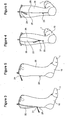
- Figure 1 shows a compression garment 1 in the form of the stocking.
- This garment can be used on its own to provide a level of compression, or may form an inner layer of a multilayer compression garment system, as discussed below.
- the compression garment 1 is dimensioned and shaped to provide a desired level of compression when applied to a wearer's lower leg.
- the garment 1 also preferably provides a desired variation of compression over the garment, with maximum compression around the ankle and the level of pressure gradually reducing over the upper part of the garment 1.
- the level of pressure provided by a graduated pressure garment may be greater towards the extremity.
- the compression garment 1 is selected for or by a wearer based on sizing information or a measurement of a body part. For example, the appropriate size of garment 1 may be selected based on a measurement of the wearer's ankle.
- the compression garment is formed from a fabric body 2.
- the fabric body is preferably formed as a single fabric layer as described below.
- the garment 1 may include a number of handles or loops 3 which help a user to apply the garment 1.
- a loop 3 is positioned at the top of the garment 1 and can be pulled by the wearer to assist in putting on the garment 1.
- the garment may also include a number of touch markers 5, 6. These are markers arranged to be detected by touch. This is particularly advantageous because many wearers requiring compression therapy have failing vision due to age or underlying health problems.
- the touch markers 5, 6 help those wearers to properly align the garment 1.
- the touch markers 5, 6 may be separate components, such as plastic components applied to the fabric body 2, or a fabric solution such as raised stitching may be formed as part of the fabric body.
- the touch markers 5, 6 may provide information in addition to their position. For example, different touch marker patterns could be used for compression garments of different compression classes or sizes, providing a non-visual indication of class or size.
- the touch markers may also be visible markers (for example raised coloured stitching).
- Figures 2A, 2B and 2C show three different compression garments 10, 11, 12. Each compression garment could be applied as a standalone garment, but preferably the garments of Figures 2A to 2C are used as part of a multilayer compression garment system.
- the garment of any one of Figures 2A to 2C is used as an outer compression layer over an inner compression layer formed by the garment of Figure 1 .
- the inner garment 1 may have a low fabric-to-fabric coefficient of friction to ease application of the outer layer over the inner layer.
- each of the garments may be constructed, dimensioned and/or shaped so as to provide a different level of compression.
- a compression garment system may provide the following compression options. Applying the garment of Figure 1 alone provides Class A compression (i.e. 10 to 15 mmHg). Applying the garment of Figure 1 as an inner layer, with the garment of Figure 2A as an outer layer provides Class 1 compression (i.e. 16 to 21 mmHg). Applying the garment of Figure 1 as an inner layer, with the garment of Figure 2B as an outer layer provides Class 2 compression (i.e. 22 to 30 mmHg). Applying the garment of Figure 1 as an inner layer, with the garment of Figure 2C as an outer layer provides Class 3 compression (i.e. 34 to 46 mmHg).
- Class A compression i.e. 10 to 15 mmHg
- the garments of Figures 2A, 2B and 2C are generally of similar configuration, so only Figure 2A will be discussed further.
- the garment 10 includes a lower portion 14 which receives a user's foot and ankle. This portion may have a toe opening 15 and a heel opening 16, which reduces the amount of material around the foot and, for some users, may make it easier to apply the garment.
- the garment 10 also includes an upper portion 17 shaped to fit around a wearer's lower leg or calf region. Again, handles or loops 18 may be provided to help a wearer to pull the garment on. Touch markers 19 help the wearer to correctly align the garment 10.
- the compression garment system including the inner garment 1 and choice of outer garments 10, 11, 12 may be provided in a range of sizes.
- FIGS 3 and 4 show the garment 10 with a zip closure 21 in an open position.
- the garment 10 includes an opening 22 which can be closed by the closure 21.
- the opening may extend all the way to the top edge of the garment 10.
- the opening is shown at the rear of the garment, which may provide easy access to the closure. However, the opening could be positioned at any suitable position around the garment 10.
- a zip closure other suitable closures could be used, including hook and loop fasteners, domes, snap fasteners, buckles and/or releasable adhesive.
- a loop or handle 23 may be positioned below the zip. Pulling on this loop or handle helps to straighten the line of the zip, which makes it easier to do up the zip.
- Figures 5 and 6 show the garment 10 with the zip closure 21 in a closed position. In this position the closure provides a fixed connection between the two sides 25, 26 of the opening 22. In the closed position the shaped fabric body 28 of the garment 10 provides a first predetermined level of compression.
- Figure 7 shows a further embodiment in which a compression garment 30 includes an opening 31 which can be closed by a zip fastener or other closure (not shown in Figure 7 ).
- a panel or band of elastic material 32 extends across the opening, being attached at or near the two sides 33, 34 of the opening 31.
- the elastic material may extend over the entire length of the opening, as shown in Figure 7 , or a band (of e.g. 5 to 10cm in width) could be used near the top of the opening. Alternatively a number of bands of elastic material could be distributed along the length of the opening.
- FIG 8 is a sectional view through the garment 30.
- This structure may be used in the garment of any one of Figures 2A to 6 .
- the garment may be a standalone compression garment or part of a multilayer compression system, as shown in Figure 7 .
- the elastic material 32 tends to draw the two sides 33, 34 of the opening together when the closure is in an open position. This elastic material helps to bring the sides of the closure together, which makes it easier to close the closure. When the closure is closed, the elastic material contracts so as to lie flat under the fabric body of the garment 30. This is important for comfort and safety, since fabric bunching under the fabric body could irritate the skin, cause a pressure point, or even interfere with the circulatory system.
- the elastic material can be used to provide a second predetermined level of compression.
- the compression garment 30 has two alternative, functional configurations. In one configuration the closure is closed and the fabric body of the garment provides a first predetermined level of compression. In a second configuration the closure is open and the elastic material 32 together with the fabric body of the garment 30 provides a second predetermined level of compression. This is particularly advantageous because a wearer can partially release the compression pressure by opening the closure. Wearers are often required to wear compression bandages or garments for a long period of time, and this feature provides for some relief through temporary and partial release of the pressure without removing the garment.
- the second level of pressure is around 4 to 12 mmHg less than the first level of pressure, preferably around 6mmHg less than the first level of pressure.
- the Applicant has developed new fabrics. These fabrics may provide improved performance in compression garments and in multi-layer compression garment systems.
- the new fabrics provide excellent compression properties while also regulating the skin environment of the user.
- This regulation provides an excellent environment for healing of any wounds or lesions on the skin underneath the compression garment.
- the garment may regulate moisture levels and/or temperature of the skin environment.
- This regulated skin environment provides a healthy, natural environment in which the skin can function as well as possible. This provides two important advantages. First, good conditions are provided for healing of existing wounds or lesions. Second, the skin is given the best chance of resisting development of further skin conditions. This is particularly important for patients with poor blood flow because small skin problems can rapidly worsen (especially where skin conditions are poor, as they are beneath many prior compression systems).
- absorbent refers to a material capable of absorbing moisture vapour and subsequently releasing or desorbing that moisture vapour to the surrounding environment.
- wicking refers to a material with low absorption of moisture, but which will transport liquid moisture by capillary action or some other suitable mechanism.
- the absorbent and wicking materials may be processed by knitting or weaving or other suitable process into a single fabric layer including both materials.
- the single fabric layer is formed such that one surface (which will be the inner surface of the compression garment) is formed predominantly by the absorbent material, while the other surface (which will be the outer surface of the compression garment) is formed predominantly from the wicking material. This allows the absorbent material to be in contact with the skin while the wicking material is separated from the skin.
- Moisture vapour e.g. water vapour
- both moisture vapour and liquid moisture are effectively removed from the skin environment.
- moisture vapour is absorbed (into the wool's hydrophilic interior) from the high-humidity skin environment and is released (desorbed, or diffused) to the external environment.
- a porous synthetic outer garment does not prevent this diffusion because it does not interact with moisture vapour and is a porous knit structure.
- Liquid moisture does not readily adhere to the surface of merino wool or similar materials due to the hydrophobic exterior of the wool fibres.
- the wicking material therefore pulls liquid moisture through the fabric to the outside of the garment where it can evaporate.
- the fabric is generally a bi-component fabric constructed from two fibre types having distinct physical and chemical properties.
- the differing moisture absorbency and wicking behaviours of the two fibres means that moisture will be drawn through the structure to the outside where it can evaporate, keeping the skin dry.
- the two fibre types are placed separately in the fabric structure, for example by placing one fibre type exclusively or predominantly on one side of the fabric, and placing the other fibre type exclusively or predominantly on the other side.
- the two fibre types can be combined in an alternating stripe configuration.
- the absorbent material is merino wool.
- Merino wool and its natural thermoregulatory properties provide excellent next-to-skin comfort.
- absorbent material including natural materials, wool, or even synthetics providing the properties required.
- synthetic fibres are being developed to mimic the properties of natural fibres (including wool and merino wool) and such fibres are intended to fall within the scope of the invention.
- the absorbent material may be a hygroscopic material.
- the absorbent material may be composed of fibres having a hydrophilic core and a hydrophobic surface.
- the moisture absorbent material may be a temperature regulating material.
- the moisture absorbent material may also be an odour-inhibiting material. These properties are all provided by wool, and particularly by merino wool.
- the moisture absorbent material may have anti-microbial properties. It is believed that wool, and particularly merino wool, may have anti-microbial properties. Other fabrics may be modified to have anti-microbial properties, for example by the addition of antimicrobial agents.
- Merino wool has been shown to have naturally effective resistance to odour build-up. Merino wool absorbs and traps odours; and has surface properties inhospitable to microbial growth. Other fibres need to be modified (such as by the addition of antimicrobial agents) to be odour retardant.
- the moisture absorbent material may have an average fibre diameter in the range 13 to 23 ⁇ m (provided by most merino wool) but preferably has a diameter less than 19 ⁇ m for excellent next-to-skin comfort.
- the moisture absorbent material may have a standard regain of around 10 to 20%, with merino wool providing a standard regain around 17%.
- Regain is the moisture content as a percentage of the fibre's dry weight.
- Standard regain is measured at 20°C and 65% relative humidity and is an indication of the moisture buffering capability of the fibre, higher standard regain means greater buffering capability.
- the moisture absorbent material may have a saturation regain of around 30 to 40%, with merino wool providing a saturation regain of around 35%. Saturation regain is measured at 100% relative humidity. This is another indication of the moisture buffering capability of the fibre; specifically it indicates how much moisture it can hold before feeling damp.
- the moisture absorbent material may have a thermal conductivity greater than 160 mW/m/K, preferably around 160 to 240 mW/m/K, with merino wool providing a thermal conductivity of around 193 mW/m/K.
- Thermal conductivity is a measure of how easily heat flows through a material. Lower conductivity means better insulation but fibre thermal conductivity is only one factor in overall fabric insulation (trapping air is of greater significance). Wool has lower thermal conductivity than its main hosiery competitors: cotton and nylon (the latter being the usual fibre type used in compression hosiery). The natural crimp of merino wool helps it to trap air.
- the moisture absorbent material may have a limiting oxygen index (LOI) greater than 21, preferably around 24 to 26, with merino wool providing an LOI of around 25.
- LOI is a measure of flammability and is defined as the volume percentage of oxygen in a nitrogen/oxygen mixture that will just permit burning. The volume percentage of oxygen in air is 21%, so materials having an LOI greater than this will not sustain burning in air.
- Merino wool's LOI is > 21, so it will not sustain burning.
- Static electricity build up in apparel situations is usually a minor inconvenience to the wearer.
- Merino wool has inherently low static build up, thought to be due to its relatively high moisture content.
- Synthetic fibres (having low moisture content) are more prone to static build-up, and may need special chemical treatments to reduce this.
- Merino wool has a fibre density within the range of the other commonly-used fibre types.
- the wicking material may be composed of fibres having a hydrophilic surface and low moisture absorption.
- the wicking material may be an abrasion resistant material. Synthetic materials may be suitable for the wicking material, including polyester, nylon or polypropylene.
- the absorbent material and the synthetic material may be combined in any suitable proportion, but generally a ratio of absorbent material to wicking material by weight between 1:3 and 3:1 is expected to provide satisfactory performance.
- the fabric is a knitted fabric, such as a two face, single jersey knitted fabric.
- the fabric may be weft-knitted on a circular knitting machine of gauge greater than 20 needles per inch (double jersey) and 26 needles per inch (single jersey).
- an elastic material such as elastomeric fibre (e.g. elastane or spandex) may be knitted with some or all of the other yarns or otherwise introduced into the fabric layer.
- Elastane is a fibre of greater than 85% polyurethane, with extremely high extension at breaking point (more than 200%) and good elastic recovery.
- the elastane yarn may be positioned such that it lies inside the plane of the fabric, and is not exposed on either face.
- the elastane is knitted in such a way to provide maximum stretch and recovery to the fabric, allowing it to be used in medical or sports applications to provide beneficial levels of mechanical compression to the body of the wearer. While the fabric without elastane provides some compression, the level of this compression would creep over time and the fabric would most likely not recover well after use.
- the elastane also helps to "pull in" the fabric during manufacture so that the finished fabric is capable of a large amount of extension.
- the elastic material may form up to 50%, preferably 20 to 35%, of the weight of the single fabric layer.
- the finished fabric may have a maximum extension between 35 and 55% by length.
- the Applicant's material shows improved recovery properties over prior compression garment materials.
- the Applicant's fabric has a strong tendency to dimensionally recover during laundering, which helps to return the compression garments back to their original size, or close to that size. All compression garments tend to stretch and extend in circumference during use, and if there is insufficient recovery after removal of the garment the unextended size of the garment will gradually increase and the level of compression provided will gradually decrease. In other words, there can be a residual extension when the load is removed.
- the Applicant's garment In contrast to prior garments, when the Applicant's garment is washed, it returns strongly to its original size so the wearer receives the designed level of compression. In other words, the Applicant's garment will function as designed for a greater number of wash cycles, and therefore over a longer useful life, than prior garments.
- the Applicant believes this is at least partly due to the use of wool, particularly merino wool, in the fabrics discussed herein. In particular it is believed that any temporary deformation of fibres (bending or stretching) caused by stretching the fabric is relaxed by wet laundering. This improved recovery means that the garment can provide the intended physiological benefit to the user over a longer period of time.
- Product A is a commercially available sock intended for use on long flights etc and formed from 93% polyamide material with designed compression around 14 to 17 mmHg.
- Product B is a commercially available medical support stocking formed from 69% polyamide material with designed compression around 30 mmHg.
- Product C is a commercially available sports sock formed from 91% polyamide material with designed compression around 18-25 mmHg.
- the basic composition in all cases is nylon with an elastomeric fibre (referred to in this document by the generic term 'elastane') included to provide the compressive force and stretch/recovery behaviour.
- the amount of elastane present is relatively high, as expected for a product offering therapeutic levels of compression.
- This testing involved taking a section from the lower section of each garment. That section was put under load (to a designated size) every day for eight hours. The garment was laundered once a week. The percentages given in the table are calculated as 100(s1-s2)/s1, where s1 is the size of garment before washing and s2 is the size of garment after washing. These figures show that the Applicant's garment recovers strongly on washing over a prolonged period.
- the primary outcome is an improvement in peak venous velocity in the popliteal vein, in participants seated over a 120 minute timeframe, while wearing an Encircle below-knee merino graduated compression stocking, compared with not wearing a stocking.
- the fabric may be processed, e.g. through a scour treatment (textile washing process), in order to remove any residues, such as grease or processing lubricants that are present during the knitting or yarn spinning process and then Santex dried.
- a scour treatment textile washing process
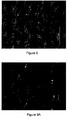
- Figures 9 and 9A show first and second faces of a fabric formed from merino wool and a synthetic wicking material.
- Figure 9 shows one face, formed by stitches of the synthetic wicking material.
- Figure 9B shows the other face, formed by stitches of the merino wool.
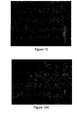
- Figures 10 and 10A show first and second faces of a further fabric.
- a double jersey fabric has been constructed where merino wool yarns (14 tex, 19 ⁇ m mean fibre diameter) are knitted just to one side of the structure (all knit on the dial needles) and a branded polyester multifilament (ADVANSA Thermo°CoolTM, 83 decitex, 72 filaments) is knitted to the other side of the structure (all knit on the cylinder needles).
- the two layers are then linked together to form a single fabric by tucking alternating dial and cylinder needles with additional Thermo°CoolTM yarn.
- a 78 decitex branded elastane (Invista Elaspan®) is knitted on the dial and cylinder stitches (but not the alternating dial and cylinder tuck stitches used to hold together the merino and the Therm°CoolTM layers).
- the inner surface is formed by a first set of knit stitches formed at least predominantly from the moisture absorbent material and the outer surface is formed by a second set of knit stitches formed at least predominantly from the wicking material, with a set of tuck stitches linking the knit stitches.
- Thermo°CoolTM polyester is a multifilament synthetic yarn, which contains both flat channelled fibres and round hollow-core fibres.
- the flat channelled fibres have high relative surface area and wick sweat and moisture away from the skin to the fabric's surface where it can evaporate, while the hollow fibres trap air in the centre of the fibre for improved insulation.
- Performance of the resultant fabric would be described as heavy-weight with maximum stretch and powerful recovery due to it being processed at temperatures below that which would set the elastane (which occurs at 190° and above).
- other forms of fabric may be suitable, including light-weight materials and materials with lower stretch.
- Figures 11 and 11A show the two faces of a further example fabric.
- Figures 12 and 12A show the two faces of yet another example fabric.
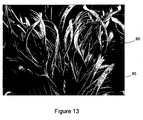
- Figure 13 is a Scanning Electron Microscope image showing the structure of one embodiment of the Applicant's fabric. Here the separate groupings of merino fibres 85 and synthetic fibres 86 can clearly be seen.
- the single fabric layer may either be knitted as a flat fabric layer and then processed to form the finished compression garment, or may be formed by an integral knitting process which essentially results in the finished garment. Any of the compression garments described in this specification could be formed in either of these ways.
- the inner layer is preferably formed from a fabric as described above.
- Outer layers may also be formed from these fabrics, but could be of different fabrics.
- the Applicant's fabrics provide good compression characteristics, with the ability to create compression garments providing specific compression levels.
- the structure of the fabrics and the materials used provide an excellent skin environment, in which moisture and temperature levels are kept at satisfactory levels. This helps with the healing of wounds or lesions and also provides a more comfortable compression garment. Comfort is especially important since these types of garment must be worn for long periods of time.
- both water vapour and liquid moisture can be effectively removed from the skin environment while the wool also assists in regulating the temperature of that environment.
- the Applicant's garments and garment systems are also relatively easy to apply.
- the garments are designed for application by older or weaker patients without professional assistance, at least up to class 2 compression. This is achieved by a layered system in which compression is provided by two or more garments which can be separately applied. Older or weaker patients will find it easier to apply two layers each providing part of the required compression, which builds up the total level of pressure applied, than a single, much firmer, layer providing the entire compression.
- the garments may also be provided with handles or loops to assist with application and with touch markers to assist with alignment.
- compression therapy at higher compression levels is required to be supervised by healthcare professionals.
- the design of the outer garment, with an opening and closure also assists application, since only the lower part of the garment need be pulled forcefully over the patient's foot.
- the upper portion, with the closure in an open position has a large diameter and is relatively easily pulled over the foot and positioned around the calf.
- the elastic material attached across the opening both assists with closing the closure and importantly provides a second designed level of compression. A wearer can temporarily reduce the compression pressure by releasing the closure. A lesser level of compression is applied until the closure is closed again. So there is no need to remove the entire garment in order to obtain some temporary relief.
Landscapes
- Health & Medical Sciences (AREA)
- Engineering & Computer Science (AREA)
- Animal Behavior & Ethology (AREA)
- Heart & Thoracic Surgery (AREA)
- Vascular Medicine (AREA)
- Life Sciences & Earth Sciences (AREA)
- Biomedical Technology (AREA)
- General Health & Medical Sciences (AREA)
- Public Health (AREA)
- Veterinary Medicine (AREA)
- Textile Engineering (AREA)
- Professional, Industrial, Or Sporting Protective Garments (AREA)
- Knitting Of Fabric (AREA)
- Outer Garments And Coats (AREA)
- Details Of Garments (AREA)
Claims (13)
- Vêtement de compression formé sous la forme d'une couche de tissu unique, incluant :un matériau absorbant l'humidité, composé de fibres présentant un noyau hydrophile et une surface hydrophobe, formant au moins principalement une surface intérieure de la couche de tissu unique ; etun matériau à effet de mèche, composé de fibres présentant une surface hydrophile et une faible absorption d'humidité, formant au moins principalement une surface extérieure de la couche de tissu unique ;dans lequel la couche de tissu unique est tricotée à partir de fils d'au moins les premier et second matériaux.
- Vêtement de compression selon la revendication 1, dans lequel le matériau absorbant l'humidité est également un ou plusieurs parmi : un matériau de régulation de température; un matériau inhibant les odeurs; un matériau antimicrobien ; et un matériau naturel.
- Vêtement de compression selon la revendication 1, dans lequel le matériau absorbant l'humidité est de la laine.
- Vêtement de compression selon l'une quelconque des revendications précédentes, dans lequel le matériau absorbant l'humidité présente un diamètre de fibre moyen dans la plage de 13 à 23 µm.
- Vêtement de compression selon l'une quelconque des revendications précédentes, dans lequel le matériau absorbant l'humidité est configuré pour réguler l'environnement cutané d'un utilisateur.
- Vêtement de compression selon l'une quelconque des revendications précédentes, dans lequel le rapport du matériau absorbant sur le matériau à effet de mèche en poids est dans la plage de 1:3 à 3:1.
- Vêtement de compression selon l'une quelconque des revendications précédentes, dans lequel la couche de tissu unique inclut un matériau élastique fournissant ou contribuant à une force de compression fournie par le vêtement de compression en utilisation et dans lequel le matériau élastique forme jusqu'à 50 % du poids de la couche de tissu unique.
- Vêtement de compression selon la revendication 7, dans lequel le matériau élastique est contenu à l'intérieur de la couche de tissu unique sans être exposé sur la surface intérieure ou extérieure.
- Vêtement de compression selon l'une quelconque des revendications précédentes, dans lequel une force de compression fournie par le vêtement en utilisation est graduée sur la longueur du vêtement.
- Procédé de formation d'un vêtement de compression, incluant les étapes consistant à :i. fournir :a. des premiers fils formés d'un matériau absorbant l'humidité, le matériau absorbant l'humidité composé de fibres présentant un noyau hydrophile et une surface hydrophobe ; etb. des deuxièmes fils formés d'un matériau à effet de mèche, le matériau à effet de mèche composé de fibres présentant une surface hydrophile et une faible absorption d'humidité ; etii. traiter les premiers et deuxièmes fils pour former un vêtement de compression formé sous la forme d'une couche de tissu unique, dans lequel une surface intérieure est formée au moins principalement par les premiers fils et une surface extérieure opposée à la surface intérieure est formée au moins principalement par les deuxièmes fils.
- Procédé selon la revendication 10, incluant une fourniture de troisièmes fils d'un matériau élastique et un traitement des premiers, deuxièmes et troisièmes fils pour former la couche de tissu unique.
- Procédé selon la revendication 10 ou 11, incluant une mise en forme et/ou une construction variable de la couche de tissu unique de telle sorte qu'une force de compression fournie par le vêtement en utilisation est graduée sur la longueur du vêtement.
- Procédé selon la revendication 10, 11 ou 12, dans lequel les moyens de traitement tricotent, y compris tricotent la couche de tissu unique sous la forme d'une couche de tissu plate ou utilisent un processus de tricotage intégral, le tricotage incluant une formation d'un premier ensemble de mailles tricotées au moins principalement à partir du matériau absorbant l'humidité, le premier ensemble de mailles fournissant la première surface ; et une formation d'un second ensemble de mailles tricotées au moins principalement à partir du matériau à effet de mèche, le second ensemble de mailles fournissant la seconde surface.
Priority Applications (1)
| Application Number | Priority Date | Filing Date | Title |
|---|---|---|---|
| EP21203303.9A EP3964184B1 (fr) | 2009-08-31 | 2010-08-31 | Vêtements de compression et systèmes de vêtements de compression |
Applications Claiming Priority (2)
| Application Number | Priority Date | Filing Date | Title |
|---|---|---|---|
| NZ57936609 | 2009-08-31 | ||
| PCT/NZ2010/000173 WO2011025396A1 (fr) | 2009-08-31 | 2010-08-31 | Tissus, vêtements de compression et systèmes de vêtements de compression |
Related Child Applications (2)
| Application Number | Title | Priority Date | Filing Date |
|---|---|---|---|
| EP21203303.9A Division EP3964184B1 (fr) | 2009-08-31 | 2010-08-31 | Vêtements de compression et systèmes de vêtements de compression |
| EP21203303.9A Division-Into EP3964184B1 (fr) | 2009-08-31 | 2010-08-31 | Vêtements de compression et systèmes de vêtements de compression |
Publications (3)
| Publication Number | Publication Date |
|---|---|
| EP2473145A1 EP2473145A1 (fr) | 2012-07-11 |
| EP2473145A4 EP2473145A4 (fr) | 2015-05-27 |
| EP2473145B1 true EP2473145B1 (fr) | 2021-11-24 |
Family
ID=43628218
Family Applications (2)
| Application Number | Title | Priority Date | Filing Date |
|---|---|---|---|
| EP10812383.7A Active EP2473145B1 (fr) | 2009-08-31 | 2010-08-31 | Vêtement de compression et procédé |
| EP21203303.9A Active EP3964184B1 (fr) | 2009-08-31 | 2010-08-31 | Vêtements de compression et systèmes de vêtements de compression |
Family Applications After (1)
| Application Number | Title | Priority Date | Filing Date |
|---|---|---|---|
| EP21203303.9A Active EP3964184B1 (fr) | 2009-08-31 | 2010-08-31 | Vêtements de compression et systèmes de vêtements de compression |
Country Status (5)
| Country | Link |
|---|---|
| US (1) | US20120159692A1 (fr) |
| EP (2) | EP2473145B1 (fr) |
| AU (3) | AU2010287071B2 (fr) |
| NZ (1) | NZ598013A (fr) |
| WO (1) | WO2011025396A1 (fr) |
Families Citing this family (16)
| Publication number | Priority date | Publication date | Assignee | Title |
|---|---|---|---|---|
| US8973162B1 (en) * | 2011-09-23 | 2015-03-10 | Joel H. Bretan | Assistive and protective garments |
| WO2013055892A1 (fr) | 2011-10-12 | 2013-04-18 | Roar Consultants | Vêtement formant un pansement |
| NL2010130C2 (nl) * | 2013-01-15 | 2014-07-16 | Frans Brugge | Steunkous met inhaakvoorzieningen. |
| JP6150382B2 (ja) * | 2013-03-26 | 2017-06-21 | 学校法人北里研究所 | 医療用弾性ストッキング |
| US20160081402A1 (en) * | 2014-08-06 | 2016-03-24 | Gregory Anthony Nixon, JR. | Separable compression clothing |
| EP3247318B1 (fr) * | 2015-01-19 | 2021-09-15 | Presscise AB | Vêtement de compression pour la fourniture de pression réglable |
| WO2016164331A1 (fr) * | 2015-04-08 | 2016-10-13 | The Sneeve Llc | Manchon antimicrobien pour le bras |
| US9387125B1 (en) * | 2016-01-26 | 2016-07-12 | Vive Wear Llc | Sock for treatment of foot and leg wounds, methods of use and manufacture |
| WO2017197058A2 (fr) * | 2016-03-24 | 2017-11-16 | Stein Celeste | Chaussette de compression graduée décorative |
| EP3333290B1 (fr) * | 2016-12-09 | 2019-08-07 | medi GmbH & Co. KG | Élément tricoté de compression, vêtement de compression tricoté, procédé de teinture d'un élément de compression tricoté et procédé de fabrication d'un vêtement de compression tricoté et teinté |
| SE1651629A1 (sv) * | 2016-12-12 | 2018-06-13 | Jasa Medical As | Compression garment |
| WO2019139824A1 (fr) * | 2018-01-12 | 2019-07-18 | Nollapelli, Inc. | Tissu de soin de la peau ayant une propriété de frottement hétérogène |
| US20220316109A1 (en) * | 2021-04-01 | 2022-10-06 | Aubrie Slater | Fabric for garments for quick drying of wearer |
| AT524783B1 (de) * | 2021-12-20 | 2022-09-15 | Eisbaer Sportmoden Gmbh | Feuchtigkeitsregulierendes textiles Material |
| USD1076402S1 (en) | 2024-11-12 | 2025-05-27 | Ralph L. Leonard | Loop for compression stocking |
| USD1088485S1 (en) | 2025-01-08 | 2025-08-19 | Ralph L. Leonard | Tab for compression garment |
Family Cites Families (18)
| Publication number | Priority date | Publication date | Assignee | Title |
|---|---|---|---|---|
| US3250095A (en) * | 1964-10-01 | 1966-05-10 | Alamance Ind Inc | Sock for active participator sports |
| US3538914A (en) * | 1967-07-11 | 1970-11-10 | Harvey Lester Myers | Adjustable fastening device |
| US4665909A (en) * | 1985-10-15 | 1987-05-19 | Avcor Health Care Products, Inc. | Bandage |
| US5319807A (en) * | 1993-05-25 | 1994-06-14 | Brier Daniel L | Moisture-management sock and shoe for creating a moisture managing environment for the feet |
| DE4419260C2 (de) * | 1994-06-01 | 1996-09-05 | Bauerfeind Gmbh | Schlauchförmige Bandage für menschliche Körperteile |
| US5711031A (en) * | 1996-04-22 | 1998-01-27 | Lacrosse Footwear, Inc. | Gusseted wader |
| FR2775431B1 (fr) * | 1998-03-02 | 2000-08-04 | Innothera Topic Int | Procede et dispositif pour enfiler sur un membre une orthese compressive tubulaire telle que bas, collant ou chaussette en materiau textile elastique tricote |
| PT1104275E (pt) * | 1999-06-25 | 2003-08-29 | Carolon Company | Metodo e sistema da meia elastica de compressao de multiplas camadas |
| IT1319230B1 (it) * | 2000-10-20 | 2003-09-26 | Gloria Maglieria Elastica S R | Calza elastica compressiva composita a collocazione facilitata. |
| US6725691B2 (en) * | 2000-12-18 | 2004-04-27 | Bsn-Jobst | Therapeutic stockings |
| US6308337B1 (en) * | 2001-03-12 | 2001-10-30 | Neuville Industries, Inc. | Blister protection mohair sock |
| US20050010155A1 (en) * | 2001-05-02 | 2005-01-13 | La Pointique International Ltd. | Elastic material for compression braces and the like |
| GB0407371D0 (en) * | 2004-03-31 | 2004-05-05 | Bristol Myers Squibb Co | Improvements relating to socks |
| US7434423B1 (en) * | 2004-04-30 | 2008-10-14 | Carolon Company | Impact protection and performance garment |
| US20060156456A1 (en) * | 2005-01-14 | 2006-07-20 | David Teixeira | Fastenable and unfastenable athletic sock for fitting over athletic protective equipment |
| WO2007059590A1 (fr) * | 2005-11-25 | 2007-05-31 | Commonwealth Scientific And Industrial Research Organisation | Tissu a effet meche et procede de fabrication correspondant |
| US20080286513A1 (en) * | 2007-05-15 | 2008-11-20 | Invista North America S A R L | Knit fabrics and socks made therefrom incorporating high tensile nylon staple |
| US9994979B2 (en) * | 2008-06-06 | 2018-06-12 | Supreme Corporation | Lightweight, cut and/or abrasion resistant garments, and related protective wear |
-
2009
- 2009-08-31 NZ NZ598013A patent/NZ598013A/en unknown
-
2010
- 2010-08-31 EP EP10812383.7A patent/EP2473145B1/fr active Active
- 2010-08-31 US US13/393,379 patent/US20120159692A1/en not_active Abandoned
- 2010-08-31 AU AU2010287071A patent/AU2010287071B2/en active Active
- 2010-08-31 EP EP21203303.9A patent/EP3964184B1/fr active Active
- 2010-08-31 WO PCT/NZ2010/000173 patent/WO2011025396A1/fr not_active Ceased
-
2016
- 2016-05-26 AU AU2016203458A patent/AU2016203458B2/en active Active
-
2018
- 2018-06-05 AU AU2018203961A patent/AU2018203961B2/en active Active
Non-Patent Citations (1)
| Title |
|---|
| None * |
Also Published As
| Publication number | Publication date |
|---|---|
| AU2010287071A1 (en) | 2012-04-19 |
| EP3964184A1 (fr) | 2022-03-09 |
| NZ598013A (en) | 2014-10-31 |
| AU2018203961B2 (en) | 2020-02-27 |
| EP3964184B1 (fr) | 2024-11-27 |
| AU2016203458A1 (en) | 2016-06-16 |
| EP3964184C0 (fr) | 2024-11-27 |
| AU2016203458B2 (en) | 2018-04-05 |
| WO2011025396A1 (fr) | 2011-03-03 |
| US20120159692A1 (en) | 2012-06-28 |
| AU2018203961A1 (en) | 2018-06-21 |
| EP2473145A4 (fr) | 2015-05-27 |
| EP2473145A1 (fr) | 2012-07-11 |
| AU2010287071B2 (en) | 2016-08-11 |
Similar Documents
| Publication | Publication Date | Title |
|---|---|---|
| AU2018203961B2 (en) | Fabrics, compression garments and compression garment systems | |
| JP5797671B2 (ja) | 耐水性医療包帯製品 | |
| JP4917016B2 (ja) | ソックスを含む用具 | |
| US7007517B2 (en) | Knit sock | |
| AU2010100455A4 (en) | Water resistant undercast liner | |
| JP6754898B2 (ja) | 着圧ストッキング | |
| JP7428373B2 (ja) | 衣類 | |
| US12195893B2 (en) | Fabrics, compression garments and compression garment systems | |
| US20160051413A1 (en) | Wound care foot wrap | |
| CN117580985A (zh) | 用于服装、服装内部和其他物品中的抗微生物抗菌热调节织物 | |
| US8051498B2 (en) | Retention garment or undergarment | |
| CN111588101A (zh) | 衣物 | |
| KR20130027127A (ko) | 당뇨 환자용 양말 | |
| US20160051412A1 (en) | Wound care mask | |
| NZ579366A (en) | Compression garment as single fabric layer with inner absorbent material and outer wicking material with materials knitted or woven from threads | |
| Chattopadhyay | Materials and Structure of Compression Bandages and Stocking Devices | |
| JP2024022336A (ja) | 弾性靴下 | |
| JP2018143555A (ja) | 弾性ストッキング | |
| JP2005273089A (ja) | レッグウェア |
Legal Events
| Date | Code | Title | Description |
|---|---|---|---|
| PUAI | Public reference made under article 153(3) epc to a published international application that has entered the european phase |
Free format text: ORIGINAL CODE: 0009012 |
|
| 17P | Request for examination filed |
Effective date: 20120327 |
|
| AK | Designated contracting states |
Kind code of ref document: A1 Designated state(s): AL AT BE BG CH CY CZ DE DK EE ES FI FR GB GR HR HU IE IS IT LI LT LU LV MC MK MT NL NO PL PT RO SE SI SK SM TR |
|
| DAX | Request for extension of the european patent (deleted) | ||
| RA4 | Supplementary search report drawn up and despatched (corrected) |
Effective date: 20150430 |
|
| RIC1 | Information provided on ipc code assigned before grant |
Ipc: A61F 13/00 20060101AFI20150423BHEP Ipc: D04B 1/00 20060101ALI20150423BHEP |
|
| STAA | Information on the status of an ep patent application or granted ep patent |
Free format text: STATUS: EXAMINATION IS IN PROGRESS |
|
| 17Q | First examination report despatched |
Effective date: 20180809 |
|
| RAP1 | Party data changed (applicant data changed or rights of an application transferred) |
Owner name: THE MERINO COMPANY LIMITED |
|
| GRAP | Despatch of communication of intention to grant a patent |
Free format text: ORIGINAL CODE: EPIDOSNIGR1 |
|
| STAA | Information on the status of an ep patent application or granted ep patent |
Free format text: STATUS: GRANT OF PATENT IS INTENDED |
|
| INTG | Intention to grant announced |
Effective date: 20210126 |
|
| RAP1 | Party data changed (applicant data changed or rights of an application transferred) |
Owner name: THE MERINO COMPANY LIMITED |
|
| GRAJ | Information related to disapproval of communication of intention to grant by the applicant or resumption of examination proceedings by the epo deleted |
Free format text: ORIGINAL CODE: EPIDOSDIGR1 |
|
| STAA | Information on the status of an ep patent application or granted ep patent |
Free format text: STATUS: EXAMINATION IS IN PROGRESS |
|
| GRAP | Despatch of communication of intention to grant a patent |
Free format text: ORIGINAL CODE: EPIDOSNIGR1 |
|
| STAA | Information on the status of an ep patent application or granted ep patent |
Free format text: STATUS: GRANT OF PATENT IS INTENDED |
|
| INTC | Intention to grant announced (deleted) | ||
| INTG | Intention to grant announced |
Effective date: 20210618 |
|
| GRAS | Grant fee paid |
Free format text: ORIGINAL CODE: EPIDOSNIGR3 |
|
| GRAA | (expected) grant |
Free format text: ORIGINAL CODE: 0009210 |
|
| STAA | Information on the status of an ep patent application or granted ep patent |
Free format text: STATUS: THE PATENT HAS BEEN GRANTED |
|
| AK | Designated contracting states |
Kind code of ref document: B1 Designated state(s): AL AT BE BG CH CY CZ DE DK EE ES FI FR GB GR HR HU IE IS IT LI LT LU LV MC MK MT NL NO PL PT RO SE SI SK SM TR |
|
| REG | Reference to a national code |
Ref country code: GB Ref legal event code: FG4D |
|
| REG | Reference to a national code |
Ref country code: AT Ref legal event code: REF Ref document number: 1449290 Country of ref document: AT Kind code of ref document: T Effective date: 20211215 |
|
| REG | Reference to a national code |
Ref country code: DE Ref legal event code: R096 Ref document number: 602010067850 Country of ref document: DE |
|
| REG | Reference to a national code |
Ref country code: IE Ref legal event code: FG4D |
|
| REG | Reference to a national code |
Ref country code: NO Ref legal event code: T2 Effective date: 20211124 |
|
| REG | Reference to a national code |
Ref country code: SE Ref legal event code: TRGR |
|
| REG | Reference to a national code |
Ref country code: LT Ref legal event code: MG9D |
|
| REG | Reference to a national code |
Ref country code: NL Ref legal event code: MP Effective date: 20211124 |
|
| PG25 | Lapsed in a contracting state [announced via postgrant information from national office to epo] |
Ref country code: LT Free format text: LAPSE BECAUSE OF FAILURE TO SUBMIT A TRANSLATION OF THE DESCRIPTION OR TO PAY THE FEE WITHIN THE PRESCRIBED TIME-LIMIT Effective date: 20211124 Ref country code: FI Free format text: LAPSE BECAUSE OF FAILURE TO SUBMIT A TRANSLATION OF THE DESCRIPTION OR TO PAY THE FEE WITHIN THE PRESCRIBED TIME-LIMIT Effective date: 20211124 Ref country code: BG Free format text: LAPSE BECAUSE OF FAILURE TO SUBMIT A TRANSLATION OF THE DESCRIPTION OR TO PAY THE FEE WITHIN THE PRESCRIBED TIME-LIMIT Effective date: 20220224 |
|
| PG25 | Lapsed in a contracting state [announced via postgrant information from national office to epo] |
Ref country code: IS Free format text: LAPSE BECAUSE OF FAILURE TO SUBMIT A TRANSLATION OF THE DESCRIPTION OR TO PAY THE FEE WITHIN THE PRESCRIBED TIME-LIMIT Effective date: 20220324 Ref country code: PT Free format text: LAPSE BECAUSE OF FAILURE TO SUBMIT A TRANSLATION OF THE DESCRIPTION OR TO PAY THE FEE WITHIN THE PRESCRIBED TIME-LIMIT Effective date: 20220324 Ref country code: PL Free format text: LAPSE BECAUSE OF FAILURE TO SUBMIT A TRANSLATION OF THE DESCRIPTION OR TO PAY THE FEE WITHIN THE PRESCRIBED TIME-LIMIT Effective date: 20211124 Ref country code: NL Free format text: LAPSE BECAUSE OF FAILURE TO SUBMIT A TRANSLATION OF THE DESCRIPTION OR TO PAY THE FEE WITHIN THE PRESCRIBED TIME-LIMIT Effective date: 20211124 Ref country code: LV Free format text: LAPSE BECAUSE OF FAILURE TO SUBMIT A TRANSLATION OF THE DESCRIPTION OR TO PAY THE FEE WITHIN THE PRESCRIBED TIME-LIMIT Effective date: 20211124 Ref country code: HR Free format text: LAPSE BECAUSE OF FAILURE TO SUBMIT A TRANSLATION OF THE DESCRIPTION OR TO PAY THE FEE WITHIN THE PRESCRIBED TIME-LIMIT Effective date: 20211124 Ref country code: GR Free format text: LAPSE BECAUSE OF FAILURE TO SUBMIT A TRANSLATION OF THE DESCRIPTION OR TO PAY THE FEE WITHIN THE PRESCRIBED TIME-LIMIT Effective date: 20220225 Ref country code: ES Free format text: LAPSE BECAUSE OF FAILURE TO SUBMIT A TRANSLATION OF THE DESCRIPTION OR TO PAY THE FEE WITHIN THE PRESCRIBED TIME-LIMIT Effective date: 20211124 |
|
| PG25 | Lapsed in a contracting state [announced via postgrant information from national office to epo] |
Ref country code: SM Free format text: LAPSE BECAUSE OF FAILURE TO SUBMIT A TRANSLATION OF THE DESCRIPTION OR TO PAY THE FEE WITHIN THE PRESCRIBED TIME-LIMIT Effective date: 20211124 Ref country code: SK Free format text: LAPSE BECAUSE OF FAILURE TO SUBMIT A TRANSLATION OF THE DESCRIPTION OR TO PAY THE FEE WITHIN THE PRESCRIBED TIME-LIMIT Effective date: 20211124 Ref country code: RO Free format text: LAPSE BECAUSE OF FAILURE TO SUBMIT A TRANSLATION OF THE DESCRIPTION OR TO PAY THE FEE WITHIN THE PRESCRIBED TIME-LIMIT Effective date: 20211124 Ref country code: EE Free format text: LAPSE BECAUSE OF FAILURE TO SUBMIT A TRANSLATION OF THE DESCRIPTION OR TO PAY THE FEE WITHIN THE PRESCRIBED TIME-LIMIT Effective date: 20211124 Ref country code: DK Free format text: LAPSE BECAUSE OF FAILURE TO SUBMIT A TRANSLATION OF THE DESCRIPTION OR TO PAY THE FEE WITHIN THE PRESCRIBED TIME-LIMIT Effective date: 20211124 Ref country code: CZ Free format text: LAPSE BECAUSE OF FAILURE TO SUBMIT A TRANSLATION OF THE DESCRIPTION OR TO PAY THE FEE WITHIN THE PRESCRIBED TIME-LIMIT Effective date: 20211124 |
|
| REG | Reference to a national code |
Ref country code: DE Ref legal event code: R097 Ref document number: 602010067850 Country of ref document: DE |
|
| PLBE | No opposition filed within time limit |
Free format text: ORIGINAL CODE: 0009261 |
|
| STAA | Information on the status of an ep patent application or granted ep patent |
Free format text: STATUS: NO OPPOSITION FILED WITHIN TIME LIMIT |
|
| PG25 | Lapsed in a contracting state [announced via postgrant information from national office to epo] |
Ref country code: AL Free format text: LAPSE BECAUSE OF FAILURE TO SUBMIT A TRANSLATION OF THE DESCRIPTION OR TO PAY THE FEE WITHIN THE PRESCRIBED TIME-LIMIT Effective date: 20211124 |
|
| 26N | No opposition filed |
Effective date: 20220825 |
|
| PG25 | Lapsed in a contracting state [announced via postgrant information from national office to epo] |
Ref country code: SI Free format text: LAPSE BECAUSE OF FAILURE TO SUBMIT A TRANSLATION OF THE DESCRIPTION OR TO PAY THE FEE WITHIN THE PRESCRIBED TIME-LIMIT Effective date: 20211124 |
|
| REG | Reference to a national code |
Ref country code: AT Ref legal event code: UEP Ref document number: 1449290 Country of ref document: AT Kind code of ref document: T Effective date: 20211124 |
|
| PG25 | Lapsed in a contracting state [announced via postgrant information from national office to epo] |
Ref country code: MC Free format text: LAPSE BECAUSE OF FAILURE TO SUBMIT A TRANSLATION OF THE DESCRIPTION OR TO PAY THE FEE WITHIN THE PRESCRIBED TIME-LIMIT Effective date: 20211124 |
|
| PG25 | Lapsed in a contracting state [announced via postgrant information from national office to epo] |
Ref country code: LU Free format text: LAPSE BECAUSE OF NON-PAYMENT OF DUE FEES Effective date: 20220831 |
|
| REG | Reference to a national code |
Ref country code: BE Ref legal event code: MM Effective date: 20220831 |
|
| PG25 | Lapsed in a contracting state [announced via postgrant information from national office to epo] |
Ref country code: IE Free format text: LAPSE BECAUSE OF NON-PAYMENT OF DUE FEES Effective date: 20220831 |
|
| PG25 | Lapsed in a contracting state [announced via postgrant information from national office to epo] |
Ref country code: BE Free format text: LAPSE BECAUSE OF NON-PAYMENT OF DUE FEES Effective date: 20220831 |
|
| PG25 | Lapsed in a contracting state [announced via postgrant information from national office to epo] |
Ref country code: HU Free format text: LAPSE BECAUSE OF FAILURE TO SUBMIT A TRANSLATION OF THE DESCRIPTION OR TO PAY THE FEE WITHIN THE PRESCRIBED TIME-LIMIT; INVALID AB INITIO Effective date: 20100831 |
|
| PG25 | Lapsed in a contracting state [announced via postgrant information from national office to epo] |
Ref country code: CY Free format text: LAPSE BECAUSE OF FAILURE TO SUBMIT A TRANSLATION OF THE DESCRIPTION OR TO PAY THE FEE WITHIN THE PRESCRIBED TIME-LIMIT Effective date: 20211124 |
|
| PG25 | Lapsed in a contracting state [announced via postgrant information from national office to epo] |
Ref country code: MK Free format text: LAPSE BECAUSE OF FAILURE TO SUBMIT A TRANSLATION OF THE DESCRIPTION OR TO PAY THE FEE WITHIN THE PRESCRIBED TIME-LIMIT Effective date: 20211124 |
|
| PG25 | Lapsed in a contracting state [announced via postgrant information from national office to epo] |
Ref country code: TR Free format text: LAPSE BECAUSE OF FAILURE TO SUBMIT A TRANSLATION OF THE DESCRIPTION OR TO PAY THE FEE WITHIN THE PRESCRIBED TIME-LIMIT Effective date: 20211124 |
|
| PG25 | Lapsed in a contracting state [announced via postgrant information from national office to epo] |
Ref country code: MT Free format text: LAPSE BECAUSE OF FAILURE TO SUBMIT A TRANSLATION OF THE DESCRIPTION OR TO PAY THE FEE WITHIN THE PRESCRIBED TIME-LIMIT Effective date: 20211124 |
|
| PGFP | Annual fee paid to national office [announced via postgrant information from national office to epo] |
Ref country code: DE Payment date: 20250820 Year of fee payment: 16 |
|
| PGFP | Annual fee paid to national office [announced via postgrant information from national office to epo] |
Ref country code: NO Payment date: 20250826 Year of fee payment: 16 |
|
| PGFP | Annual fee paid to national office [announced via postgrant information from national office to epo] |
Ref country code: IT Payment date: 20250825 Year of fee payment: 16 |
|
| PGFP | Annual fee paid to national office [announced via postgrant information from national office to epo] |
Ref country code: GB Payment date: 20250824 Year of fee payment: 16 |
|
| PGFP | Annual fee paid to national office [announced via postgrant information from national office to epo] |
Ref country code: FR Payment date: 20250829 Year of fee payment: 16 Ref country code: AT Payment date: 20250821 Year of fee payment: 16 |
|
| PGFP | Annual fee paid to national office [announced via postgrant information from national office to epo] |
Ref country code: CH Payment date: 20250901 Year of fee payment: 16 Ref country code: SE Payment date: 20250820 Year of fee payment: 16 |