EP2473280B1 - Procédé de préparation de caoutchouc au nitrile hydrogéné - Google Patents
Procédé de préparation de caoutchouc au nitrile hydrogéné Download PDFInfo
- Publication number
- EP2473280B1 EP2473280B1 EP20100747037 EP10747037A EP2473280B1 EP 2473280 B1 EP2473280 B1 EP 2473280B1 EP 20100747037 EP20100747037 EP 20100747037 EP 10747037 A EP10747037 A EP 10747037A EP 2473280 B1 EP2473280 B1 EP 2473280B1
- Authority
- EP
- European Patent Office
- Prior art keywords
- alkyl
- aryl
- alkoxy
- ligand
- catalyst
- Prior art date
- Legal status (The legal status is an assumption and is not a legal conclusion. Google has not performed a legal analysis and makes no representation as to the accuracy of the status listed.)
- Not-in-force
Links
- 0 CCCCC(N(C1C)SC)=C(*)N1SC Chemical compound CCCCC(N(C1C)SC)=C(*)N1SC 0.000 description 5
- BTFOHYMUDSJZTJ-UHFFFAOYSA-N CCCCC(C(CCCC)N(C1C)SC)N1SC Chemical compound CCCCC(C(CCCC)N(C1C)SC)N1SC BTFOHYMUDSJZTJ-UHFFFAOYSA-N 0.000 description 1
Classifications
-
- C—CHEMISTRY; METALLURGY
- C08—ORGANIC MACROMOLECULAR COMPOUNDS; THEIR PREPARATION OR CHEMICAL WORKING-UP; COMPOSITIONS BASED THEREON
- C08C—TREATMENT OR CHEMICAL MODIFICATION OF RUBBERS
- C08C19/00—Chemical modification of rubber
- C08C19/02—Hydrogenation
-
- B—PERFORMING OPERATIONS; TRANSPORTING
- B01—PHYSICAL OR CHEMICAL PROCESSES OR APPARATUS IN GENERAL
- B01J—CHEMICAL OR PHYSICAL PROCESSES, e.g. CATALYSIS OR COLLOID CHEMISTRY; THEIR RELEVANT APPARATUS
- B01J31/00—Catalysts comprising hydrides, coordination complexes or organic compounds
- B01J31/16—Catalysts comprising hydrides, coordination complexes or organic compounds containing coordination complexes
- B01J31/18—Catalysts comprising hydrides, coordination complexes or organic compounds containing coordination complexes containing nitrogen, phosphorus, arsenic or antimony as complexing atoms, e.g. in pyridine ligands, or in resonance therewith, e.g. in isocyanide ligands C=N-R or as complexed central atoms
- B01J31/1805—Catalysts comprising hydrides, coordination complexes or organic compounds containing coordination complexes containing nitrogen, phosphorus, arsenic or antimony as complexing atoms, e.g. in pyridine ligands, or in resonance therewith, e.g. in isocyanide ligands C=N-R or as complexed central atoms the ligands containing nitrogen
- B01J31/181—Cyclic ligands, including e.g. non-condensed polycyclic ligands, comprising at least one complexing nitrogen atom as ring member, e.g. pyridine
-
- B—PERFORMING OPERATIONS; TRANSPORTING
- B01—PHYSICAL OR CHEMICAL PROCESSES OR APPARATUS IN GENERAL
- B01J—CHEMICAL OR PHYSICAL PROCESSES, e.g. CATALYSIS OR COLLOID CHEMISTRY; THEIR RELEVANT APPARATUS
- B01J31/00—Catalysts comprising hydrides, coordination complexes or organic compounds
- B01J31/16—Catalysts comprising hydrides, coordination complexes or organic compounds containing coordination complexes
- B01J31/18—Catalysts comprising hydrides, coordination complexes or organic compounds containing coordination complexes containing nitrogen, phosphorus, arsenic or antimony as complexing atoms, e.g. in pyridine ligands, or in resonance therewith, e.g. in isocyanide ligands C=N-R or as complexed central atoms
- B01J31/1805—Catalysts comprising hydrides, coordination complexes or organic compounds containing coordination complexes containing nitrogen, phosphorus, arsenic or antimony as complexing atoms, e.g. in pyridine ligands, or in resonance therewith, e.g. in isocyanide ligands C=N-R or as complexed central atoms the ligands containing nitrogen
- B01J31/181—Cyclic ligands, including e.g. non-condensed polycyclic ligands, comprising at least one complexing nitrogen atom as ring member, e.g. pyridine
- B01J31/1815—Cyclic ligands, including e.g. non-condensed polycyclic ligands, comprising at least one complexing nitrogen atom as ring member, e.g. pyridine with more than one complexing nitrogen atom, e.g. bipyridyl, 2-aminopyridine
-
- B—PERFORMING OPERATIONS; TRANSPORTING
- B01—PHYSICAL OR CHEMICAL PROCESSES OR APPARATUS IN GENERAL
- B01J—CHEMICAL OR PHYSICAL PROCESSES, e.g. CATALYSIS OR COLLOID CHEMISTRY; THEIR RELEVANT APPARATUS
- B01J31/00—Catalysts comprising hydrides, coordination complexes or organic compounds
- B01J31/16—Catalysts comprising hydrides, coordination complexes or organic compounds containing coordination complexes
- B01J31/22—Organic complexes
-
- B—PERFORMING OPERATIONS; TRANSPORTING
- B01—PHYSICAL OR CHEMICAL PROCESSES OR APPARATUS IN GENERAL
- B01J—CHEMICAL OR PHYSICAL PROCESSES, e.g. CATALYSIS OR COLLOID CHEMISTRY; THEIR RELEVANT APPARATUS
- B01J31/00—Catalysts comprising hydrides, coordination complexes or organic compounds
- B01J31/16—Catalysts comprising hydrides, coordination complexes or organic compounds containing coordination complexes
- B01J31/22—Organic complexes
- B01J31/2265—Carbenes or carbynes, i.e.(image)
-
- B—PERFORMING OPERATIONS; TRANSPORTING
- B01—PHYSICAL OR CHEMICAL PROCESSES OR APPARATUS IN GENERAL
- B01J—CHEMICAL OR PHYSICAL PROCESSES, e.g. CATALYSIS OR COLLOID CHEMISTRY; THEIR RELEVANT APPARATUS
- B01J31/00—Catalysts comprising hydrides, coordination complexes or organic compounds
- B01J31/16—Catalysts comprising hydrides, coordination complexes or organic compounds containing coordination complexes
- B01J31/22—Organic complexes
- B01J31/2282—Unsaturated compounds used as ligands
- B01J31/2291—Olefins
-
- C—CHEMISTRY; METALLURGY
- C08—ORGANIC MACROMOLECULAR COMPOUNDS; THEIR PREPARATION OR CHEMICAL WORKING-UP; COMPOSITIONS BASED THEREON
- C08C—TREATMENT OR CHEMICAL MODIFICATION OF RUBBERS
- C08C19/00—Chemical modification of rubber
- C08C19/08—Depolymerisation
-
- C—CHEMISTRY; METALLURGY
- C08—ORGANIC MACROMOLECULAR COMPOUNDS; THEIR PREPARATION OR CHEMICAL WORKING-UP; COMPOSITIONS BASED THEREON
- C08F—MACROMOLECULAR COMPOUNDS OBTAINED BY REACTIONS ONLY INVOLVING CARBON-TO-CARBON UNSATURATED BONDS
- C08F8/00—Chemical modification by after-treatment
- C08F8/04—Reduction, e.g. hydrogenation
-
- C—CHEMISTRY; METALLURGY
- C08—ORGANIC MACROMOLECULAR COMPOUNDS; THEIR PREPARATION OR CHEMICAL WORKING-UP; COMPOSITIONS BASED THEREON
- C08L—COMPOSITIONS OF MACROMOLECULAR COMPOUNDS
- C08L15/00—Compositions of rubber derivatives
-
- C—CHEMISTRY; METALLURGY
- C08—ORGANIC MACROMOLECULAR COMPOUNDS; THEIR PREPARATION OR CHEMICAL WORKING-UP; COMPOSITIONS BASED THEREON
- C08L—COMPOSITIONS OF MACROMOLECULAR COMPOUNDS
- C08L15/00—Compositions of rubber derivatives
- C08L15/005—Hydrogenated nitrile rubber
-
- B—PERFORMING OPERATIONS; TRANSPORTING
- B01—PHYSICAL OR CHEMICAL PROCESSES OR APPARATUS IN GENERAL
- B01J—CHEMICAL OR PHYSICAL PROCESSES, e.g. CATALYSIS OR COLLOID CHEMISTRY; THEIR RELEVANT APPARATUS
- B01J2231/00—Catalytic reactions performed with catalysts classified in B01J31/00
- B01J2231/60—Reduction reactions, e.g. hydrogenation
- B01J2231/64—Reductions in general of organic substrates, e.g. hydride reductions or hydrogenations
- B01J2231/641—Hydrogenation of organic substrates, i.e. H2 or H-transfer hydrogenations, e.g. Fischer-Tropsch processes
-
- B—PERFORMING OPERATIONS; TRANSPORTING
- B01—PHYSICAL OR CHEMICAL PROCESSES OR APPARATUS IN GENERAL
- B01J—CHEMICAL OR PHYSICAL PROCESSES, e.g. CATALYSIS OR COLLOID CHEMISTRY; THEIR RELEVANT APPARATUS
- B01J2531/00—Additional information regarding catalytic systems classified in B01J31/00
- B01J2531/80—Complexes comprising metals of Group VIII as the central metal
- B01J2531/82—Metals of the platinum group
- B01J2531/821—Ruthenium
-
- B—PERFORMING OPERATIONS; TRANSPORTING
- B01—PHYSICAL OR CHEMICAL PROCESSES OR APPARATUS IN GENERAL
- B01J—CHEMICAL OR PHYSICAL PROCESSES, e.g. CATALYSIS OR COLLOID CHEMISTRY; THEIR RELEVANT APPARATUS
- B01J2531/00—Additional information regarding catalytic systems classified in B01J31/00
- B01J2531/80—Complexes comprising metals of Group VIII as the central metal
- B01J2531/82—Metals of the platinum group
- B01J2531/825—Osmium
-
- C—CHEMISTRY; METALLURGY
- C08—ORGANIC MACROMOLECULAR COMPOUNDS; THEIR PREPARATION OR CHEMICAL WORKING-UP; COMPOSITIONS BASED THEREON
- C08C—TREATMENT OR CHEMICAL MODIFICATION OF RUBBERS
- C08C19/00—Chemical modification of rubber
Definitions
- the present invention relates to a process for the production of hydrogenated nitrile rubber polymers having lower molecular weights and narrower molecular weight distributions than those known in the art, wherein the process is carried out in the presence of hydrogen and optionally at least one co-(olefin).
- the present invention further relates to the use of specific metal compounds in a process for the production of a hydrogenated nitrile rubber by simultaneous hydrogenantion and metathesis of a nitrile rubber.
- Hydrogenated nitrile rubber prepared by the selective hydrogenation of acrylonitrile-butadiene rubber (nitrile rubber; NBR, a co-polymer comprising at least one conjugated diene, at least one unsaturated nitrile and optionally further co-monomers), is a specialty rubber which has very good heat resistance, excellent ozone and chemical resistance, and excellent oil resistance.
- HNBR Hydrophilicity-based mechanical property of the rubber
- oil stators, well head seals, valve plates
- electrical cable sheathing
- mechanical engineering wheels, rollers
- shipbuilding pipe seals, couplings
- HNBR has a Mooney viscosity in the range of from 34 to 130, a molecular weight in the range of from 150,000 to 500,000 g/mol, a polydispersity in the range of from 2,0 to 5,0 and a residual double bond (RDB) content in the range of from ⁇ 1 to 18% (by IR spectroscopy).
- ruthenium based catalyst were of the general form RuCl 2 (PPh 3 ) 3 , RuH(O 2 CR)(PPh 3 ) 3 and RuHCl(CO)(PPh 3 ) 3 .
- One negative to the utilization of a ruthenium based catalyst was the unusually high Mooney viscosity for the resulting hydrogenated nitrile rubber due to the reduction of the nitrile groups to secondary amines, resulting in the subsequent crosslinking/gelling of the polymer.
- Rempel does point out that the addition of additives (i.e. CoSO 4 and (NH 4 ) 2 Fe(SO 4 ) 4 ) to react with these amines can minimize the crosslinking/gelling.
- ruthenium catalyst utilized include carbonylchlorohydrido bis(tricyclohexylphosphine) ruthenium II, dichloro tris(triphenylphosphine) ruthenium II, carbonylchlorostyrly bis(tricyclohexylphosphine) ruthenium II and carbonylchlorobezoato bis(tricyclohexylphosphine) ruthenium II.
- WO-A1-03/011455 relates to hexacoordinated metathesis catalysts and to methods of making and using the same.
- the catalysts are of the formula wherein
- the catalysts are useful in metathesis reactions including ring-opening metathesis polymerization, ring-closing metathesis, ADMET, self- and cross-metathesis reactions, alkyne polymerization, carbonyl olefination, depolymerisation of unsaturated polymers, synthesis of telechelic polymers, and olefin synthesis. All examples in WO-A1-03/011455 disclose polymerization reactions.
- WO-A2-03/087167 relates to a method for carrying out cross-metathesis reactions using Group 8 transition metal complexes as catalyst.
- the process according to WO-A2-03/087167 is especially useful for the synthesis of olefins that are directly substituted with an electron withdrawing group via a cross-metathesis reaction.
- the Group 8 transition metal complexes have the following formula (I) in which
- the catalysts mentioned above are not necessarily suitable for carrying out the degradation of nitrile rubber. Further, the catalysts mentioned above have never been used as hydrogenation catalysts in the prior art.
- WO-A-2005/080456 Guerin reports the preparation of hydrogenated nitrile rubber polymers having low molecular weights and narrower molecular weight distributions than those known in the art.
- the preparation process is carried out by simultaneously subjecting the nitrile rubber to a metathesis reaction and a hydrogenation reaction.
- the reaction according to WO 2005/080456 takes place in the presence of a ruthenium based catalyst of the general formula 1,3 bis(2,4,6-trimethylphenyl)-2-imidazolidinylidene) (tricyclohexylphosphine) ruthenium (phenylmethylene) dichloride (Grubbs 2 nd generation catalyst)
- the inventive process is capable of producing a hydrogenated nitrile rubber with low residual double bond contents (RDB) having a molecular weight (M w ) in the range of from 20,000 to 250,000, a Mooney viscosity (ML 1+4 @ 100 deg. C) of in the range of from 1 to 50, and a MWD (or polydispersity index) of less than 2.8 in a single step.
- RDB residual double bond contents
- the present invention therefore relates to a process for the production of a hydrogenated nitrile rubber by simultaneous hydrogenation and metathesis of a nitrile rubber, comprising reacting a nitrile rubber in the presence of hydrogen, optionally at least one co-olefin, and in the presence of at least one catalyst of the general formulae (I), (II) or (III), where
- NBR nitrile rubbers
- the conjugated diene can be of any nature. Preference is given to using (C 4 -C 6 ) conjugated dienes. Particular preference is given to 1,3-butadiene, isoprene, 2,3-dimethylbutadiene, piperylene or mixtures thereof. Very particular preference is given to 1,3-butadiene and isoprene or mixtures thereof. Especial preference is given to 1,3-butadiene.
- ⁇ , ⁇ -unsaturated nitrile it is possible to use any known ⁇ , ⁇ -unsaturated nitrile, preferably a (C 3 -C 5 ) ⁇ , ⁇ -unsaturated nitrile such as acrylonitrile, methacrylonitrile, ethacrylonitrile or mixtures thereof. Particular preference is given to acrylonitrile.
- a particularly preferred nitrile rubber is thus a copolymer of acrylonitrile and 1,3-butadiene.
- conjugated diene and the ⁇ , ⁇ -unsaturated nitrile it is possible to use one or more further copolymerizable monomers known to those skilled in the art, e.g. ⁇ , ⁇ -unsaturated monocarboxylic or dicarboxylic acids, their esters or amides.
- ⁇ , ⁇ -unsaturated monocarboxylic or dicarboxylic acids preference is given to fumaric acid, maleic acid, acrylic acid and methacrylic acid.
- esters of ⁇ , ⁇ -unsaturated carboxylic acids preference is given to using their alkyl esters and alkoxyalkyl esters.
- alkyl esters of ⁇ , ⁇ -unsaturated carboxylic acids are methyl acrylate, ethyl acrylate, butyl acrylate, butyl methacrylate, 2-ethylhexyl acrylate, 2-ethylhexyl methacrylate and octyl acrylate.
- Particularly preferred alkoxyalkyl esters of ⁇ , ⁇ -unsaturated carboxylic acids are methoxyethyl (meth)acrylate, cthoxyethyl (meth)acrylate and methoxymethyl (meth)acrylate. It is also possible to use mixtures of alkyl esters, e.g. those mentioned above, with alkoxyalkyl esters, e.g. in the form of those mentioned above.
- the proportions of conjugated diene and ⁇ , ⁇ -unsaturated nitrile in the NBR polymers to be used can vary within wide ranges.
- the proportion of or of the sum of the conjugated dienes is usually in the range from 40 to 90% by weight, preferably in the range from 55 to 75% by weight, based on the total polymer.
- the proportion of or of the sum of the ⁇ , ⁇ -unsaturated nitriles is usually from 10 to 60% by weight, preferably from 25 to 45% by weight, based on the total polymer.
- the proportions of the monomers in each case add up to 100% by weight.
- the additional monomers can be present in amounts of from 0 to 40% by weight, preferably from 0.1 to 40% by weight, particularly preferably from 1 to 30% by weight, based on the total polymer.
- corresponding proportions of the conjugated diene or dienes and/or of the ⁇ , ⁇ -unsaturated nitrile or nitriles are replaced by the proportions of the additional monomers, with the proportions of all monomers in each case adding up to 100% by weight.
- Nitrile rubbers which can be used for the purposes of the invention are also commercially available, e.g. as products from the product range of the trade names Perbunan ® and Krynac ® from Lanxesstechnik GmbH.
- the nitrile rubbers used for the hydrogenation/metathesis usually have a Mooney viscosity (ML 1+4 at 100°C) in the range from 24 to 70, preferably from 28 to 40. This corresponds to a weight average molecular weight M w in the range 200 000 - 500 000, preferably in the range 200 000 - 400 000.
- the determination of the Mooney viscosity is carried out in accordance with ASTM standard D 1646.
- the substrate is simultaneously subject to a metathesis reaction and a hydrogenation reaction.
- the catalysts of the general formula (I)-(III) are known in principle. Representatives of this class of compounds are the catalysts described by Grubbs et al. in WO 2003/011455 A1 , Grubbs et al. WO 2003/087167 A2 , Organometallics 2001, 20, 5314 and Angew. Chem. Int. Ed. 2002, 41, 4038 . The catalysts are commercially available or can be prepared as described in the references cited.
- substituted used for the purposes of the present patent application means that a hydrogen atom on an indicated radical or atom has been replaced by one of the groups indicated in each case, with the proviso that the valency of the atom indicated is not exceeded and the substitution leads to a stable compound.
- Z 1 and Z 2 in the catalysts of general formulae (I), (II) and (III) are identical or different ligands being neutral electron donor ligands.
- Such ligands are in general weakly coordinating. Typically they represent optionally substituted heterocyclic groups.
- They may represent five- or six-membered monocyclic groups containing 1 to 4, preferably 1 to 3, most preferably 1 or 2 heteroatoms, or bicyclic or polycyclic structures composed of 2, 3, 4 or 5 such five- or six-membered monocyclic groups wherein all aforementioned groups are optionally substituted by one or more alkyl, preferably C 1 -C 10 -alkyl, cycloalkyl, preferably C 3 -C 8 -cycloalkyl, alkoxy, preferably C 1 -C 10 -alkoxy, halogen, preferably chlorine or bromine, aryl, preferably C 6 -C 24 -aryl, or heteroaryl, preferably C 5 -C 23 -heteroaryl radicals where these abovementioned substituents may in turn be substituted by one or more radicals, preferably selected from the group consisting of halogen, in particular chlorine or bromine, C 1 -C 5 -alkyl, C 1 -C 5 -alk
- Z 1 and Z 2 include, without limitation: nitrogen containing heterocycles such as pyridine, pyridazine, bipyridine, pyrimidine, pyrazine, pyrazolidine, pyrrolidine, piperazine, indazole, quinoline, purine, acridine, bisimidazole, picolylimine, imidazolidine and pyrrole, wherein all aforementioned groups are optionally substituted by one or more alkyl, preferably C 1 -C 10 -alkyl, cycloalkyl, preferably C 3 -C 8 -cycloalkyl, alkoxy, preferably C 1 -C 10 -alkoxy, halogen, preferably chlorine or bromine, aryl, preferably C 6 -C 24 -aryl, or heteroaryl, preferably C 5 -C 23 -heteroaryl radicals where these abovementioned substituents may in turn be substituted by one or more radicals, preferably selected from
- Z' and Z 2 together may also represent a bidentate ligand, thereby forming a cyclic structure.
- L is a ligand, usually a ligand having an electron donor function.
- the ligand L can, for example, be a phosphine, sulphonated phosphine, phosphate, phosphinite, phosphonite, arsine, stilbine, ether, amine, amide, sulphoxide, carboxyl, nitrosyl, pyridine, thioether or L can be an unsubstituted or substituted imidazolidine (“Im”) ligand.
- Im imidazolidine
- ligand L being a C 6 -C 24 -arylphosphine, C 1 -C 6 -alkylphosphine or C 3 -C 10 -cycloalkylphosphine ligand, a sulphonated C 6 -C 24 -arylphosphine or a sulphonated C 1 -C 10 -alkylphosphine ligand, a C 6 -C 24 -aryl phosphinite or C 1 -C 10 -alkyl phosphinite ligand, a C 6 -C 24 -aryl phosphonite or C 1 -C 10 -alkyl phosphonite ligand, a C 6 -C 24 -aryl phosphite or C 1 -C 10 -alkylphosphite ligand, a C 6 -C 24 -arylarsine or C 1 -C 10 -allcylarsine
- Aryl encompasses an aromatic radical having from 6 to 24 skeletal carbon atoms (C 6 -C 24 -aryl).
- Preferred monocyclic, bicyclic or tricyclic carbocyclic aromatic radicals having from 6 to 10 skeletal carbon atoms are, for example, phenyl, biphenyl, naphthyl, phenanthrenyl and anthracenyl.
- Alkyl is preferably C 1 -C 12 -alkyl and is, for example, methyl, ethyl, n-propyl, isopropyl, n-butyl, sec-butyl, tert-butyl, n-pentyl, 1-methylbutyl, 2-methylbutyl, 3-methylbutyl, neopentyl, 1-ethylpropyl or n-hexyl, n-heptyl, n-octyl, n-decyl or n-dodecyl.
- Cycloalkyl is preferably C 3 -C 10 -Cycloalkyl and encompasses cyclopropyl, cyclobutyl, cyclopentyl, cyclohexyl, cycloheptyl and cyclooctyl.
- phosphine includes PR 3 structures, wherein R is in each case independently of one another C 1 -C 6 -alkyl, C 3 -C 8 -cycloalkyl or aryl, like for example, PPh 3 , P(p-Tol) 3 , P(o-Tol) 3 , PPh(CH 3 ) 2 , P(CF 3 ) 3 , P(p-FC 6 H 4 ) 3 , P(p-CF 3 C 6 H 4 ) 3 , P(C 6 H 4 -SO 3 Na) 3 , P(CH 2 C 6 -SO 3 Na) 3 , P(iso-Pr) 3 , P(CHCH 3 (CH 2 CH 3 )) 3 , P(cyclopentyl) 3 , P(cyclohexyl) 3 , P(neopentyl) 3 and P(neophenyl) 3 .
- R is in each case independently of one another C 1 -C 6 -alkyl
- Phosphinite includes, for example, triphenyl phosphinite, tricyclohexyl phosphinite, triisopropyl phosphinite and methyl diphenylphosphinite.
- Phosphite includes, for example, triphenyl phosphite, tricyclohexyl phosphite, tri-tert-butyl phosphite, triisopropyl phosphite and methyl diphenyl phosphite.
- Stilbine includes, for example, triphenylstibine, tricyclohexylstibine and trimethylstibene.
- Sulphonate includes, for example, trifluoromethanesulphonate, tosylate and mesylate.
- Thioether includes, for example, CH 3 SCH 3 , C 6 H 5 SCH 3 , CH 3 OCH 2 CH 2 SCH 3 and tetrahydrothiophene.
- the imidazolidine radical (Im) usually has a structure of the general formula (IVa) or (IVb), where
- radicals R 5 , R 6 , R 7 , R 8 may, independently of one another, optionally be substituted by one or more substituents, preferably straight-chain or branched C 1 -C 10 -alkyl, C 3 -C 8 -cycloalkyl C 1 -C 10 -alkoxy or C 6 -C 24 -aryl, where these abovementioned substituents may in turn be substituted by one or more radicals, preferably selected from the group consisting of halogen, in particular chlorine or bromine, C 1 -C 5 -alkyl, C 1 -C 5 -alkoxy and phenyl.
- substituents preferably straight-chain or branched C 1 -C 10 -alkyl, C 3 -C 8 -cycloalkyl C 1 -C 10 -alkoxy or C 6 -C 24 -aryl, where these abovementioned substituents may in turn be substituted by one or more radicals, preferably selected from
- a ligand L is present in which R 5 and R 6 are each, independently of one another, hydrogen, C 6 -C 24 -aryl, particularly preferably phenyl, straight-chain or branched C 1 -C 10 -alkyl, particularly preferably propyl or butyl, or together form, with inclusion of the carbon atoms to which they are bound, a cycloalkyl or aryl radical, where all the abovementioned radicals may in turn be substituted by one or more further radicals selected from the group consisting of straight-chain or branched C 1 -C 10 -alkyl, C 1 -C 10 -alkoxy, C 6 -C 24 -aryl and functional groups selected from the group consisting of hydroxy, thiol, thioether, ketone, aldehyde, ester, ether, amine, imine, amide, nitro, carboxyl
- the radicals R 7 and R 8 in the ligand L of the catalysts of the general formulae (I), (II) or (III) are preferably identical or different and are each straight-chain or branched C 1 -C 10 -alkyl, particularly preferably i-propyl or neopentyl, C 3 -C 10 -cycloalkyl, preferably adamantyl, C 6 -C 24 -aryl, particularly preferably phenyl, C 1 -C 10 -alkylsulphonate, particularly preferably methanesulphonate, C 6 -C 10 -arylsulphonate, particularly preferably p-toluenesulphonate.
- radicals R 7 and R 8 which are mentioned above as being preferred may optionally be substituted by one or more further radicals selected from the group consisting of straight-chain or branched C 1 -C 5 -alkyl, in particular methyl, C 1 -C 5 -alkoxy, aryl and functional groups selected from the group consisting of hydroxy, thiol, thioether, ketone, aldehyde, ester, ether, amine, imine, amide, nitro, carboxyl, disulphide, carbonate, isocyanate, carbodiimide, carboalkoxy, carbamate and halogen.
- further radicals selected from the group consisting of straight-chain or branched C 1 -C 5 -alkyl, in particular methyl, C 1 -C 5 -alkoxy, aryl and functional groups selected from the group consisting of hydroxy, thiol, thioether, ketone, aldehyde, ester, ether, amine, im
- radicals R 7 and R 8 are identical or different and are each i-propyl, neopentyl, adamantyl or mesityl.
- Particularly preferred imidazolidine radicals (Im) have the structures (Va) -(Vf), where Mes is in each case a 2,4,6-trimethylphenyl radical.
- the radicals R 3 and R 4 of the the catalysts of general formulae (I), (II) and (III) used in the process of the present invention are identical or different and are each hydrogen or alkyl, preferably C 1 -C 30 -alkyl, more preferably C 1 -C 20 -alkyl, cycloalkyl, preferably C 3 -C 20 -cycloalkyl, more preferable C 3 -C 8 -cycloalkyl alkenyl, preferably C 2 -C 20 -alkenyl, more preferable C 2 -C 16 -alkenyl, alkynyl, preferably C 2 -C 20 -alkynyl, more preferably C 2 -C 16 -alkynyl, aryl, preferably C 6 -C 24 -aryl, carboxylate, preferably C 1 -C 20 -carboxylate, alkoxy, preferably C 1 -C 20 -alkoxy, alkenyloxy, preferably
- X 1 and X 2 of the the catalysts of general formulae (I), (II) and (III) used in the process of the present invention are identical or different ligands, preferably anionic ligands.
- anionic ligands always refers, in the context of such metathesis catalysts, to ligands which, when they are regarded separately from the metal centre, would be negatively charged for a closed electron shell.
- X 1 and X 2 are identical or different and can be, for eaamnle, hydrogen, halogen, pseudohalogen, straight-chain or branched C 1 -C 30 -alkyl, C 6 -C 24 -aryl, C 1 -C 20 -alkoxy, C 6 -C 24 -aryloxy, C 3 -C 20 -alkyldiketonate, C 6 -C 24 -aryldiketonate, C 1 -C 20 -carboxylate, C 1 -C 20- alkylsulphonate, C 6 -C 24 -arylsulphonate, C 1 -C 20 -alkylthiol, C 6 -C 24 -arylthiol, C 1 -C 20 -alkylsulphonyl or C 1 -C 20 -alkylsulphinyl.
- radicals X 1 and X 2 can also be substituted by one or more further radicals, for example by halogen, preferably fluorine, C 1 -C 10 -alkyl, C 1 -C 10 -alkoxy or C 6 -C 24 -aryl radicals, where the latter radicals may optionally also in turn be substituted by one or more substituents selected from the group consisting of halogen, preferably fluorine, C 1 -C 4 -alkyl, C 1 -C 5 -alkoxy and phenyl.
- halogen preferably fluorine, C 1 -C 10 -alkyl, C 1 -C 10 -alkoxy or C 6 -C 24 -aryl radicals
- substituents selected from the group consisting of halogen, preferably fluorine, C 1 -C 4 -alkyl, C 1 -C 5 -alkoxy and phenyl.
- X 1 and X 2 are identical or different and are each halogen, in particular fluorine, chlorine, bromine or iodine, benzoate, C 1 -C 5 -carboxylate, C 1 -C 5 -alkyl, phenoxy, C 1 -C 5 -alkoxy, C 1 -C 5 -akylthiol, C 6 -C 24 -arylthiol, C 6 -C 24 -aryl or C 1 -C 5 -alkylsulphonate.
- halogen in particular fluorine, chlorine, bromine or iodine
- X 1 and X 2 are identical and are each halogen, in particular chlorine, CF 3 COO, CH 3 COO, CFH 2 COO, (CH 3 ) 3 CO, (CF 3 ) 2 (CH 3 )CO, (CF 3 )(CH 3 ) 2 CO, PhO (phenoxy), MeO (methoxy), EtO (ethoxy), tosylate (p-CH 3 -C 6 H 4 -SO 3 ), mesylate (2,4,6-trimethylphenyl) or CF 3 SO 3 (trifluoromethanesulphonate).
- a particularly preferred catalyst which comes under the general structural formula (I) is that of the formula (VI) where R 9 , R 10 are identical or different and represent halogen, straight-chain or branched C 1 -C 20 alkyl, C 1 -C 20 heteroalkyl, C 1 -C 10 haloalkyl, C 1 -C 10 alkoxy, C 6 -C 24 aryl, preferably phenyl, formyl, nitro, nitrogen heterocycles, preferably pyridine, piperidine and pyrazine, carboxy, alkylcarbonyl, halocarbonyl, carbamoyl, thiocarbomoyl, carbamido, thioformyl, amino, trialkylsilyl und trialkoxysilyl.
- alkyl, heteroalkyl, haloalkyl, alkoxy, phenyl, nitrogen heterocycles, alkylcarbonyl, halocarbonyl, carbamoyl, thiocarbamoyl and amino radicals may optionally also in turn be substituted by one or more substituents selected from the group consisting of halogen, preferably fluorine, chlorine, or bromine, C 1 -C 5 -alkyl, C 1 -C 5 -alkoxy and phenyl.
- the catalyst (VI) has the general structural formula (VIa) or (VIb), wherein R 9 and R 10 have the same meaning as given for structural formula (VI)
- catalyst (VI) is referred to as "Grubbs III catalyst” in the literature.
- All the abovementioned catalysts of the formulae (I)-(III) and (VI)-(XVI) can either be used as such for the simultaneous metathesis and hydrogenation of NBR or can be applied to and immobilized on a solid support.
- solid phases or supports it is possible to use materials which firstly are inert towards the reaction mixture of the metathesis and secondly do not impair the activity of the catalyst. It is possible to use, for example, metals, glass, polymers, ceramic, organic polymer spheres, inorganic sol-gels, silica, silicates, calcium carbonate or barium sulfate for immobilizing the catalyst.
- the catalysts of all the abovementioned general and specific formulae (I)-(III) and (VI)-(XVI) are highly suitable for the simultaneous metathesis and hydrogenation of nitrile rubber.
- the amount of at least one catalyst of the formulae (I), (II), (III) or (VI) to (XVI) used according to the invention for the simultaneous metathesis and hydrogenation depends on the nature and the catalytic activity of the specific catalyst.
- the amount of catalyst used is usually from 5 to 1000 ppm of noble metal, preferably from 5 to 500 ppm, in particular from 5 to 250 ppm, more preferably from 5 to 100 ppm, based on the nitrile rubber used.
- the process of the present invention can optionally be carried out with a coolefin.
- Suitable coolefins are, for example, ethylene, propylene, isobutene, styrene, 1-hexene and 1-octene.
- the process of the present invention can be carried out in a suitable solvent which does not deactivate the catalyst used and also does not adversely affect the reaction in any other way.
- suitable solvents include but are not restricted to dichloromethane, benzene, toluene, methyl ethyl ketone, acetone, tetrahydrofuran, tetrahydropyran, dioxane and cyclohexane.
- the particularly preferred solvent is chlorobenzene.
- the concentration of NBR in the reaction mixture is not critical but, obviously, should be such that the reaction is not hampered if the mixture is too viscous to be stirred efficiently, for example.
- the concentration ofNBR is in the range of from 1 to 40% by weight, most preferably in the range of from 6 to 15 wt.%.
- the concentration of hydrogen is usually between 100 psi and 2000 psi, preferably 800 psi and 1400 psi.
- the process is preferably carried out at a temperature in the range of from 60 to 200°C; preferably in the range of from 100 to 140°C.
- the reaction time will depend upon a number of factors, including cement concentration, amount of catalyst used and the temperature at which the reaction is performed.
- the progress of the reaction may be monitored by standard analytical techniques, for example using GPC or solution viscosity.
- GPC gel permeation chromatography
- Hydrogenation in this invention is understood by preferably more than 50 % of the residual double bonds (RDB) present in the starting nitrile polymer being hydrogenated, preferably more than 90 % of the RDB are hydrogenated, more preferably more than 95 % of the RDB are hydrogenated and most preferably more than 99 % of the RDB are hydrogenated.
- RDB residual double bonds
- the resulting HNBR Due to the low viscosity of the resulting HNBR, it is ideally suited to be processed by but not limited to injection molding technology.
- the polymer can also be useful to transfer molding, to compression molding, or to liquid injection molding.
- the polymer obtained in the process of the present invention is very well suited for the manufacture of a shaped article, such as a seal, hose, bearing pad, stator, well head seal, valve plate, cable sheathing, wheel, roller, pipe seal, in place gaskets or footwear component prepared by injection molding technology.
- the present invention relates to the use of at least one catalyst of the general formulae (I), (II) or (III), where
- Preferred groups M, X 1 , X 2 , Z 1 , Z 2 , R 3 , R 4 and L as well as particularly preferred compounds of the general formulae (I), (II) and (III) are mentioned before.
- NBR nitrile rubber
- the Mooney viscosity (ML 1+4 @100°C) was determined utilizing ASTM standard D 1646.
- M w [kg/mol] weight average molar mass
- M n [kg/mol] number average molar mass
- PDI width of the molar mass distribution (M w /M n )
- Table 1 Comparison of Hydrogenation Parameters HNBR 1 HNBR 2 HNBR 3 HNBR 4 Hydrogenation Catalyst Grubbs III Grubbs III Wilkinson's Grubbs II Catalyst Amount (phr) 0,057 0,080 0,06 0,055 Metal content (ppm) 65,6 91,3 65,6 65,6 Table 2: Comparison of Hydrogenation Profiles HNBR 1 HNBR 2 HNBR 3 HNBR 4 Reaction Time (min) RDB % RDB % RDB % RDB % % 0 100 100 100 100 100 100 60 2,0 0,7 15,4 2,9 120 0,4 0,5 3,1 0,6 180 0,3 0,3 1,3 0,3 240 - - 0,6 - Table 3: Summary of HNBR Properties Mw (g/mol) Mn (g/mol) PDI (Mw/Mn) Mooney Viscosity HNBR 1 191541 68643 2,79 38,2 HNBR 2 135772 58259 2,33
Landscapes
- Chemical & Material Sciences (AREA)
- Organic Chemistry (AREA)
- Chemical Kinetics & Catalysis (AREA)
- Inorganic Chemistry (AREA)
- Engineering & Computer Science (AREA)
- Materials Engineering (AREA)
- Health & Medical Sciences (AREA)
- Medicinal Chemistry (AREA)
- Polymers & Plastics (AREA)
- General Chemical & Material Sciences (AREA)
- Addition Polymer Or Copolymer, Post-Treatments, Or Chemical Modifications (AREA)
- Catalysts (AREA)
- Organic Low-Molecular-Weight Compounds And Preparation Thereof (AREA)
Claims (14)
- Procédé de production d'un caoutchouc nitrile hydrogéné par hydrogénation et métathèse simultanées d'un caoutchouc nitrile, comprenant la réaction d'un caoutchouc nitrile en présence d'hydrogène, éventuellement d'au moins une co-oléfine, et en présence d'au moins un catalyseur de formules générales (I), (II) ou (III),
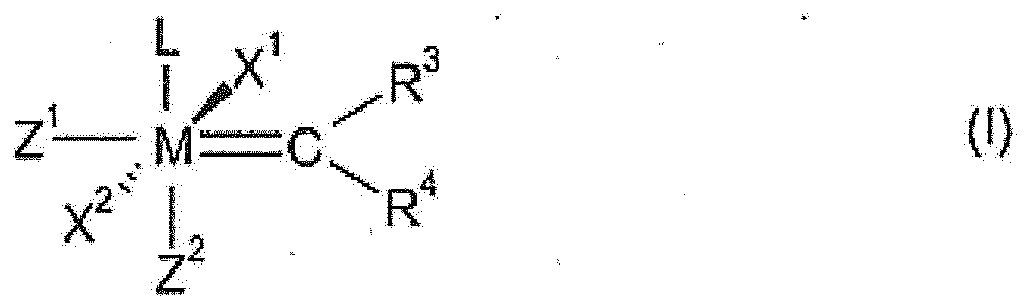

 M est le ruthénium ou l'osmium,X1 et X2 sont des ligands identiques ou différents, de préférence des ligands anioniques,Z1 et Z2 sont des ligands donneurs d'électrons identiques ou différents et neutres,R3 et R4 sont chacun indépendamment un atome d'hydrogène ou un substituant choisi dans le groupe constitué par un radical alkyle, cycloalkyle, alcényle, alcynyle, aryle, carboxylate, alcoxy, alcényloxy, alcynyloxy, aryloxy, alcoxycarbonyle, alkylamino, alkylthio, arylthio, alkylsulfonyle et alkylsulfinyle, chacun d'eux pouvant éventuellement être substitué par un ou plusieurs radicaux alkyle, halogéno, alcoxy, aryle ou hétéroaryle, etL est un ligand.
 - Procédé selon la revendication 1, dans lequel, dans le au moins un catalyseur de formules générales (I), (II) ou (III), Z1 et Z2 sont identiques ou différents et représentent des groupes hétérocycliques éventuellement substitués, de préférence des groupes monocycliques à cinq ou six chaînons contenant 1 à 4, de façon plus préférée 1 à 3, de façon la plus préférée 1 ou 2 hétéroatomes, ou des structures bicycliques ou polycycliques composées de 2, 3, 4 ou 5 de ces groupes monocycliques à cinq ou six chaînons, dans lesquels tous les groupes susmentionnés sont éventuellement substitués par un ou plusieurs radicaux alkyle, de préférence alkyle en C1-C10, cycloalkyle, de préférence cycloalkyle en C3-C8, alcoxy, de préférence alcoxy en C1-C20, halogéno, de préférence chlore ou brome, aryle, de préférence aryle en C6-C24, ou hétéroaryle, de préférence hétéroaryle en C5-C23, dans lesquels ces substituants susmentionnés peuvent à leur tour être substitués par un ou plusieurs radicaux, de préférence choisis dans le groupe constitué par halogéno, en particulier chlore ou brome, alkyle en C1-C5, alcoxy en C1-C5 et phényle, de préférence Z1 et Z2 sont identiques ou différents et représentent des hétérocycles azotés, de préférence pyridine, pyridazine, bipyridine, pyrimidine, pyrazine, pyrazolidine, pyrrolidine, pipérazine, indazole, quinoléine, purine, acridine, bisimidazole, picolylimine, imidazolidine et pyrrole ou dans l'alternative Z1 et Z2 représentent ensemble un ligand bidenté sous-jacent à la formation d'une structure cyclique.
- Procédé selon la revendication 1 ou 2, dans lequel, dans le au moins un catalyseur de formules générales (I), (II) ou (III), le ligand L est un ligand phosphine, phosphine sulfonée, phosphate, phosphinite, phosphonite, arsine, stibine, éther, amine, amide, sulfoxyde, carboxyle, nitrosyle, pyridine, thioéther ou L est un ligand imidazolidine («Im») substitué ou non substitué, de préférence le ligand L est un ligand arylphosphine en C6-C24, alkylphosphine en C1-C6 ou cycloalkylphosphine en C3-C10, un ligand arylphosphine en C6-C24 sulfonée ou un ligand alkylphosphine en C1-C10 sulfonée, un ligand arylphosphinite en C6-C24 ou alkylphosphinite en C1-C10, un ligand arylphosphonite en C6-C24 ou alkylphosphonite en C1-C10, un ligand arylphosphite en C6-C24 ou alkylphosphite en C1-C10, un ligand arylarsine en C6-C24 ou alkylarsine en C1-C10, un ligand arylamine en C6-C24 ou alkylamine en C1-C10, un ligand pyridine, un ligand arylsulfoxyde en C6-C24 ou alkylsulfoxyde en C1-C10, un ligand aryléther en C6-C24 ou alkyléther en C1-C10 ou un ligand arylamide en C6-C24 ou alkylamide en C1-C10, chacun d'eux pouvant être substitué par un groupe phényle qui peut à son tour être substitué par un halogène, un radical alkyle en C1-C5 ou un radical alcoxy en C1-C5, ou L est un ligand imidazolidine («Im») substitué ou non substitué.
- Procédé selon la revendication 3, dans lequel, dans le au moins un catalyseur de formules générales (I), (II) ou (III), L est choisi dans le groupe constitué par PPh3, P(p-Tol)3, P(o-Tol)3, PPh(CH3)2, P(CF3)3, P(p-FC6H4)3, P(p-CF3C6H4)3, P(C6H4-SO3Na)3, P(CH2C6H4-SO3Na)3, P(iso-Pr)3, P(CHCH3(CH2CH3))3, P(cyclopentyle)3, P(cyclohexyle)3, P(néopentyle)3 et P(néophényle)3.
- Procédé selon la revendication 3, dans lequel le radical imidazolidine (Im) possède une structure de formule générale (IVa) ou (IVb),
 R5, R6, R7, R8 sont identiques ou différents et sont chacun un atome d'hydrogène, ou un groupe alkyle en C1-C30 à chaîne linéaire ou ramifié, de préférence alkyle en C1-C20, cycloalkyle en C3-C20, de préférence cycloalkyle en C3-C10, alcényle en C2-C20, de préférence alcényle en C2-C10, alcynyle en C2-C20, de préférence alcynyle en C2-C10, aryle en C6-C24, de préférence aryle en C6-C14, carboxylate en C1-C20, de préférence carboxylate en C1-C10, alcoxy en C1-C20, de préférence alcoxy en C1-C10, alcényloxy en C2-C20, de préférence alcényloxy en C2-C10, alcynyloxy en C2-C20, de préférence alcynyloxy en C2-C20, aryloxy en C6-C24, de préférence aryloxy en C6-C14, alcoxycarbonyle en C2-C20, de préférence alcoxycarbonyle en C2-C10, alkylthio en C1-C20, de préférence alkylthio en C1-C10, arylthio en C6-C24, de préférence arylthio en C6-C14, alkylsulfonyle en C1-C20, de préférence alkylsulfonyle en C1-C10, alkylsulfonate en C1-C20, de préférence alkylsulfonate en C1-C10, arylsulfonate en C6-C24, de préférence arylsulfonate en C6-C14, ou alkylsulfinyle en C1-C20, de préférence alkylsulfinyle en C1-C10, de préférence le radical imidazolidine (Im) possède une structure de formules (Va) - (Vf), dans laquelle Mes est dans chaque cas un radical 2,4,6-triméthylphényle.


- Procédé selon l'une quelconque des revendications 1 à 5, dans lequel, dans le au moins un catalyseur de formules générales (I), (II) ou (III), R3 et R4 sont identiques ou différents et sont chacun un atome d'hydrogène ou un radical alkyle, de préférence alkyle en C1-C30, de façon plus préférée alkyle en C1-C20, cyclo-alkyle, de préférence cycloalkyle en C3-C20, de façon plus préférée cycloalkyle en C3-C8, alcényle, de préférence alcényle en C2-C20, de façon plus préférée alcényle en C2-C16, alcynyle, de préférence alcynyle en C2-C20, de façon plus préférée alcynyle en C2-C16, aryle, de préférence aryle en C6-C24, carboxylate, de préférence carboxylate en C1-C20, alcoxy, de préférence alcoxy en C1-C20, alcényloxy, de préférence alcényloxy en C2-C20, alcényloxy, de préférence alcynyloxy en C2-C20, aryloxy, de préférence aryloxy en C6-C24, alcoxycarbonyle, de préférence alcoxycarbonyle en C2-C20, alkylamino, de préférence alkylamino en C1-C30, alkylthio, de préférence alkylthio en C1-C30, arylthio, de préférence arylthio en C6-C24, alkylsulfonyle, de préférence alkylsulfonyle en C1-C20, ou alkylsulfinyle, de préférence alkylsulfinyle en C1-C20, chacun d'eux pouvant éventuellement être substitué par un ou plusieurs radicaux alkyle, halogéno, alcoxy, aryle ou hétéroaryle.
- Procédé selon l'une quelconque des revendications 1 à 6, dans lequel, dans le au moins un catalyseur de formules générales (I), (II) ou (III), X1 et X2 sont identiques ou différents et représentent un atome d'hydrogène, ou un radical halogéno, pseudohalogéno, alkyle en C1-C30 à chaîne linéaire ou ramifié, aryle en C6-C24, alcoxy en C1-C20, aryloxy en C6-C24, alkyldicétonate en C3-C20, aryldicétonate en C6-C24, carboxylate en C1-C20, alkylsulfonate en C1-C20, arylsulfonate en C6-C24, alkylthio en C1-C20, arylthio en C6-C24, alkylsulfonyle en C1-C20 ou alkylsulfinyle en C1-C20, de préférence X1 et X2 sont identiques ou différents et sont chacun un halogène, en particulier fluor, chlore, brome ou iode, benzoate, carboxylate en C1-C5, alkyle en C1-C5, phénoxy, alcoxy en C1-C5, alkylthio en C1-C5, arylthio en C6-C24, aryle en C6-C24 ou alkylsulfonate en C1-C5, de façon plus préférée X1 et X2 sont chacun un halogène, en particulier un chlore, ou CF3COO, CH3COO, CFH2COO, (CH3)3CO, (CF3)2(CH3)CO, (CF3) (CH3)2CO, PhO (phénoxy), MeO (méthoxy), EtO (éthoxy), tosylate (p-CH3-C6H4-SO3), mésylate (2,4,6-triméthylphényle) ou CF3SO3 (trifluoro-méthanesulfonate).
- Procédé selon l'une quelconque des revendications 1 à 7, dans lequel, dans le au moins un catalyseur de formules générales (I), (II) ou (III),
M est le ruthénium,
X1 et X2 sont tous deux un halogène, en particulier, deux un chlore,
Z1 et Z2 sont identiques ou différents et représentent des groupes monocycliques à cinq ou six chaînons contenant 1 à 4, de préférence 1 à 3, de façon la plus préférée 1 ou 2 hétéroatomes, ou des structures bicycliques ou polycycliques composées de 2, 3, 4 ou 5 de ces groupes monocycliques à cinq ou six chaînons dans lesquels tous les groupes susmentionnés sont éventuellement substitués par un ou plusieurs radicaux alkyle, de préférence alkyle en C1-C10, cycloalkyle, de préférence cycloalkyle en C3-C8, alcoxy, de préférence alcoxy en C1-C10, halogéno, de préférence chlore ou brome, aryle, de préférence aryle en C6-C24, ou hétéroaryle, de préférence hétéroaryle en C5-C23, ou Z1 et Z2 représentent ensemble un ligand bidenté, formant ainsi une structure cyclique,
R3 et R4 sont identiques ou différents et sont chacun un atome d'hydrogène ou un radical alkyle en C1-C30, cycloalkyle en C3-C20, alcényle en C2-C20, alcynyle en C2-C20, aryle en C6-C24, carboxylate en C1-C20, alcoxy en C1-C20, alcényloxy en C2-C20, alcynyloxy en C2-C20, aryloxy en C6-C24, alcoxycarbonyle en C2-C20, alkylamino en C1-C30, alkylthio en C1-C30, arylthio en C6-C24, alkylsulfonyle en C1-C20, alkylsulfinyle en C1-C20, chacun d'eux pouvant éventuellement être substitué par un ou plusieurs radicaux alkyle, halogéno, alcoxy, aryle ou hétéroaryle, et
L possède une structure de formule générale (IVa) ou (IVb),
R5, R6, R7, R8 sont identiques ou différents et sont chacun un atome d'hydrogène, ou un groupe alkyle en C1-C30 à chaîne linéaire ou ramifié, cycloalkyle en C3-C20, alcényle en C2-C20, alcynyle en C2-C20, aryle en C6-C24, carboxylate en C1-C20, alcoxy en C1-C20, alcényloxy en C2-C20, alcynyloxy en C2-C20, aryloxy en C6-C24, alcoxycarbonyle en C2-C20, alkylthio en C1-C20, arylthio en C6-C24, alkylsulfonyle en C1-C20, alkylsulfonate en C1-C20, arylsulfonate en C6-C24 ou alkylsulfinyle en C1-C20. - Procédé selon la revendication 1, dans lequel au moins un catalyseur de formule (I) est au moins un catalyseur de formule (VI),

R9 et R10 sont identiques ou différents et représentent un groupe halogéno, alkyle en C1-C20 à chaîne linéaire ou ramifié, hétéroalkyle en C1-C20, halogénoalkyle en C1-C10, alcoxy en C1-C10, aryle en C6-C24, de préférence phényle, formyle, nitro, des hétérocycles azotés, de préférence pyridine, pipéridine et pyrazine, carboxy, alkylcarbonyle, halogénocarbonyle, carbamoyle, thio-carbamoyle, carbamido, thioformyle, amino, trialkyl-silyle et trialcoxysilyle. - Procédé selon la revendication 1, dans lequel au moins un catalyseur de formules (I), (II) ou (III) est au moins un catalyseur de formules (VII), (VIII), (IX), (X), (XI), (XII), (XIII), (XIV), (XV) ou (XVI), dans lesquelles Mes est dans chaque cas un radical 2,4,6-triméthylphényle.


- Procédé selon l'une quelconque des revendications 1 à 10, dans lequel la quantité de catalyseur est de 5 à 1000 ppm de métal noble, de préférence de 5 à 500 ppm, en particulier de 5 à 250 ppm, par rapport au caoutchouc nitrile utilisé.
- Procédé selon l'une quelconque des revendications 1 à 11 dans lequel le procédé est réalisé avec au moins une co-oléfine, de préférence éthylène, propylène, isobutène, styrène, 1-hexène et/ou 1-octène.
- Procédé selon l'une quelconque des revendications 1 à 12 dans lequel la réaction d'hydrogénation est réalisée dans au moins un solvant convenable qui ne désactive pas le catalyseur utilisé et n'a pas non plus d'effet néfaste sur la réaction d'une autre manière quelconque, de préférence le dichlorométhane, le benzène, le toluène, la méthyléthylcétone, l'acétone, le tétrahydrofurane, le tétrahydropyrane, le dioxane et/ou le cyclohexane, de façon particulièrement préférée le chlorobenzène.
- Utilisation d'au moins un catalyseur de formules générales (I), (II) ou (III),


M est le ruthénium ou l'osmium,
X1 et X2 sont des ligands identiques ou différents, de préférence des ligands anioniques,
Z1 et Z2 sont des ligands donneurs d'électrons identiques ou différents et neutres,
R3 et R4 sont chacun indépendamment un atome d'hydrogène ou un substituant choisi dans le groupe constitué par un radical alkyle, cycloalkyle, alcényle, alcynyle, aryle, carboxylate, alcoxy, alcényloxy, alcényloxy, aryloxy, alcoxycarbonyle, alkylamino, alkylthio, arylthio, alkylsulfonyle et alkylsulfinyle, chacun d'eux pouvant éventuellement être substitué par un ou plusieurs radicaux alkyle, halogéno, alcoxy, aryle ou hétéroaryle, et
L est un ligand
dans un procédé de production d'un caoutchouc nitrile hydrogéné par hydrogénation et métathèse simultanées d'un caoutchouc nitrile.
Priority Applications (1)
| Application Number | Priority Date | Filing Date | Title |
|---|---|---|---|
| EP20100747037 EP2473280B1 (fr) | 2009-08-31 | 2010-08-27 | Procédé de préparation de caoutchouc au nitrile hydrogéné |
Applications Claiming Priority (3)
| Application Number | Priority Date | Filing Date | Title |
|---|---|---|---|
| EP20090169059 EP2289620A1 (fr) | 2009-08-31 | 2009-08-31 | Procédé de préparation de caoutchouc au nitrile hydrogéné |
| EP20100747037 EP2473280B1 (fr) | 2009-08-31 | 2010-08-27 | Procédé de préparation de caoutchouc au nitrile hydrogéné |
| PCT/EP2010/062529 WO2011023788A1 (fr) | 2009-08-31 | 2010-08-27 | Procédé de préparation d'un caoutchouc nitrile hydrogéné |
Publications (2)
| Publication Number | Publication Date |
|---|---|
| EP2473280A1 EP2473280A1 (fr) | 2012-07-11 |
| EP2473280B1 true EP2473280B1 (fr) | 2014-04-02 |
Family
ID=41674180
Family Applications (2)
| Application Number | Title | Priority Date | Filing Date |
|---|---|---|---|
| EP20090169059 Withdrawn EP2289620A1 (fr) | 2009-08-31 | 2009-08-31 | Procédé de préparation de caoutchouc au nitrile hydrogéné |
| EP20100747037 Not-in-force EP2473280B1 (fr) | 2009-08-31 | 2010-08-27 | Procédé de préparation de caoutchouc au nitrile hydrogéné |
Family Applications Before (1)
| Application Number | Title | Priority Date | Filing Date |
|---|---|---|---|
| EP20090169059 Withdrawn EP2289620A1 (fr) | 2009-08-31 | 2009-08-31 | Procédé de préparation de caoutchouc au nitrile hydrogéné |
Country Status (13)
| Country | Link |
|---|---|
| US (1) | US9079979B2 (fr) |
| EP (2) | EP2289620A1 (fr) |
| JP (1) | JP5552536B2 (fr) |
| KR (1) | KR101411751B1 (fr) |
| CN (1) | CN102481559B (fr) |
| BR (1) | BR112012004411A2 (fr) |
| CA (1) | CA2771248A1 (fr) |
| IN (1) | IN2012DN01541A (fr) |
| MX (1) | MX2012002403A (fr) |
| RU (1) | RU2012112350A (fr) |
| SG (1) | SG178431A1 (fr) |
| TW (1) | TWI511786B (fr) |
| WO (1) | WO2011023788A1 (fr) |
Families Citing this family (15)
| Publication number | Priority date | Publication date | Assignee | Title |
|---|---|---|---|---|
| WO2013056400A1 (fr) | 2011-10-21 | 2013-04-25 | Lanxess Deutschland Gmbh | Compositions catalytiques et leur utilisation pour l'hydrogénation d'un caoutchouc de nitrile |
| WO2013056459A1 (fr) * | 2011-10-21 | 2013-04-25 | Lanxess Deutschland Gmbh | Compositions catalytiques et leur utilisation pour l'hydrogénation d'un caoutchouc de nitrile |
| WO2013056463A1 (fr) | 2011-10-21 | 2013-04-25 | Lanxess Deutschland Gmbh | Compositions catalytiques et leur utilisation pour l'hydrogénation de caoutchouc nitrile |
| CN103890012B (zh) * | 2011-10-21 | 2016-12-14 | 朗盛德国有限责任公司 | 催化剂组合物及它们的用于氢化丁腈橡胶的用途 |
| WO2013056461A1 (fr) | 2011-10-21 | 2013-04-25 | Lanxess Deutschland Gmbh | Compositions catalytiques et leur utilisation pour l'hydrogénation d'un caoutchouc de nitrile |
| WO2013159365A1 (fr) | 2012-04-28 | 2013-10-31 | Lanxess Deutschland Gmbh | Hydrogénation d'un caoutchouc nitrile |
| CN104271607B (zh) * | 2012-04-28 | 2017-05-24 | 阿朗新科德国有限责任公司 | 丁腈橡胶的氢化 |
| JP2015017168A (ja) * | 2013-07-10 | 2015-01-29 | 日本ゼオン株式会社 | ホース用高飽和ニトリルゴム組成物およびホース |
| EP3063592B1 (fr) | 2013-10-30 | 2021-04-07 | California Institute of Technology | Formation de motifs par photoexposition directe de matières robustes et diverses |
| CN103980578B (zh) * | 2014-05-06 | 2015-10-14 | 徐州工业职业技术学院 | 一种再生硫化氢化丁腈橡胶及其制备方法 |
| US11225533B2 (en) | 2017-12-18 | 2022-01-18 | Arlanxeo Deutschland Gmbh | Hydrogenation of nitrile butadiene rubber latex |
| US20210340285A1 (en) | 2018-07-23 | 2021-11-04 | Arlanxeo Deutschland Gmbh | Method for producing hydrogenated nitrile rubber and hnbr compositions thereof |
| JP7525485B2 (ja) * | 2018-12-17 | 2024-07-30 | アランセオ・ドイチュランド・ゲーエムベーハー | 代替溶媒を使用してhnbr溶液を調製するための方法 |
| JP2025518057A (ja) * | 2022-08-02 | 2025-06-12 | サビック グローバル テクノロジーズ ベスローテン フェンノートシャップ | 水素化を経た変性スチレン系樹脂 |
| CN119144068B (zh) * | 2023-06-15 | 2026-01-06 | 中国石油化工股份有限公司 | 氢化丁腈橡胶及其组合物、硫化橡胶 |
Family Cites Families (14)
| Publication number | Priority date | Publication date | Assignee | Title |
|---|---|---|---|---|
| US5258647A (en) | 1989-07-03 | 1993-11-02 | General Electric Company | Electronic systems disposed in a high force environment |
| US5208296A (en) | 1992-09-02 | 1993-05-04 | Polysar Rubber Corporation | Nitrile rubber hydrogenation |
| US5210151A (en) | 1992-09-02 | 1993-05-11 | Polysar Rubber Corporation | Hydrogenation of nitrile rubber |
| JP2000119328A (ja) * | 1998-10-16 | 2000-04-25 | Teijin Ltd | 触媒残渣の少ない環状オレフィン系重合体、その用途並びにその製造法 |
| JP2002201180A (ja) * | 2000-10-24 | 2002-07-16 | Nippon Zeon Co Ltd | 新規なルテニウム化合物及びその使用方法 |
| US6838489B2 (en) | 2001-03-23 | 2005-01-04 | Cymetech, Llc | High activity metal carbene metathesis catalysts generated using a thermally activated N-heterocyclic carbene precursor |
| CA2350280A1 (fr) * | 2001-06-12 | 2002-12-12 | Bayer Inc. | Caoutchouc nitrile hydrogene de faible poids moleculaire |
| WO2003011455A1 (fr) | 2001-08-01 | 2003-02-13 | California Institute Of Technology | Catalyseurs de metathese de carbene metallique de ruthenium ou d'osmium hexacoordonnes |
| US7598330B2 (en) | 2002-04-05 | 2009-10-06 | California Institute Of Technology | Cross-metathesis of olefins directly substituted with an electron-withdrawing group using transition metal carbene catalysts |
| CA2462005A1 (fr) | 2004-02-23 | 2005-08-23 | Bayer Inc. | Methode de preparation de caoutchouc nitrile hydrogene de bas poids moleculaire |
| ATE467644T1 (de) * | 2007-08-21 | 2010-05-15 | Lanxess Deutschland Gmbh | Metathese eines nitrilkautschuks in gegenwart von übergangsmetallkomplexkatalysatoren |
| DE102007039525A1 (de) | 2007-08-21 | 2009-02-26 | Lanxess Deutschland Gmbh | Verfahren zum Metathese-Abbau von Nitrilkautschuk |
| EP2027920B1 (fr) | 2007-08-21 | 2014-10-08 | LANXESS Deutschland GmbH | Catalyseurs pour les réactions de metathèses |
| DE102007039526A1 (de) * | 2007-08-21 | 2009-02-26 | Lanxess Deutschland Gmbh | Katalysator-Systeme und deren Verwendung für Metathese-Reaktionen |
-
2009
- 2009-08-31 EP EP20090169059 patent/EP2289620A1/fr not_active Withdrawn
-
2010
- 2010-08-27 KR KR1020127005233A patent/KR101411751B1/ko not_active Expired - Fee Related
- 2010-08-27 WO PCT/EP2010/062529 patent/WO2011023788A1/fr not_active Ceased
- 2010-08-27 RU RU2012112350/04A patent/RU2012112350A/ru not_active Application Discontinuation
- 2010-08-27 JP JP2012526073A patent/JP5552536B2/ja not_active Expired - Fee Related
- 2010-08-27 US US13/391,633 patent/US9079979B2/en active Active
- 2010-08-27 MX MX2012002403A patent/MX2012002403A/es active IP Right Grant
- 2010-08-27 EP EP20100747037 patent/EP2473280B1/fr not_active Not-in-force
- 2010-08-27 CN CN201080037677.2A patent/CN102481559B/zh not_active Expired - Fee Related
- 2010-08-27 IN IN1541DEN2012 patent/IN2012DN01541A/en unknown
- 2010-08-27 CA CA2771248A patent/CA2771248A1/fr not_active Abandoned
- 2010-08-27 BR BR112012004411A patent/BR112012004411A2/pt not_active IP Right Cessation
- 2010-08-27 SG SG2012010567A patent/SG178431A1/en unknown
- 2010-08-30 TW TW099129055A patent/TWI511786B/zh not_active IP Right Cessation
Also Published As
| Publication number | Publication date |
|---|---|
| JP5552536B2 (ja) | 2014-07-16 |
| BR112012004411A2 (pt) | 2016-03-22 |
| TWI511786B (zh) | 2015-12-11 |
| KR101411751B1 (ko) | 2014-06-25 |
| US9079979B2 (en) | 2015-07-14 |
| MX2012002403A (es) | 2012-04-02 |
| EP2289620A1 (fr) | 2011-03-02 |
| KR20120050461A (ko) | 2012-05-18 |
| CA2771248A1 (fr) | 2011-03-03 |
| US20120329954A1 (en) | 2012-12-27 |
| IN2012DN01541A (fr) | 2015-06-05 |
| CN102481559A (zh) | 2012-05-30 |
| WO2011023788A1 (fr) | 2011-03-03 |
| RU2012112350A (ru) | 2013-10-10 |
| CN102481559B (zh) | 2015-09-16 |
| TW201124200A (en) | 2011-07-16 |
| EP2473280A1 (fr) | 2012-07-11 |
| SG178431A1 (en) | 2012-04-27 |
| JP2013503228A (ja) | 2013-01-31 |
Similar Documents
| Publication | Publication Date | Title |
|---|---|---|
| EP2473280B1 (fr) | Procédé de préparation de caoutchouc au nitrile hydrogéné | |
| EP2473281B1 (fr) | Procédé de préparation de caoutchouc au nitrile hydrogéné à faible poids moléculaire | |
| US7662889B2 (en) | Process for the metathetic degradation of nitrile rubbers | |
| US20100093944A1 (en) | Catalyst systems and their use for metathesis reactions | |
| US20090069516A1 (en) | Catalyst systems and their use for metathesis reactions | |
| US10508156B2 (en) | Catalyst compositions and their use for hydrogenation of nitrile rubber | |
| EP2768866B1 (fr) | Compositions de catalyseurs et leur utilisation pour l'hydrogénation du caoutchouc nitrile | |
| US9598506B2 (en) | Catalyst compositions and their use for hydrogenation of nitrile rubber |
Legal Events
| Date | Code | Title | Description |
|---|---|---|---|
| PUAI | Public reference made under article 153(3) epc to a published international application that has entered the european phase |
Free format text: ORIGINAL CODE: 0009012 |
|
| 17P | Request for examination filed |
Effective date: 20120331 |
|
| AK | Designated contracting states |
Kind code of ref document: A1 Designated state(s): AL AT BE BG CH CY CZ DE DK EE ES FI FR GB GR HR HU IE IS IT LI LT LU LV MC MK MT NL NO PL PT RO SE SI SK SM TR |
|
| DAX | Request for extension of the european patent (deleted) | ||
| 17Q | First examination report despatched |
Effective date: 20130320 |
|
| REG | Reference to a national code |
Ref country code: DE Ref legal event code: R079 Ref document number: 602010014839 Country of ref document: DE Free format text: PREVIOUS MAIN CLASS: B01J0031220000 Ipc: B01J0031180000 |
|
| RAP1 | Party data changed (applicant data changed or rights of an application transferred) |
Owner name: LANXESS DEUTSCHLAND GMBH |
|
| RIC1 | Information provided on ipc code assigned before grant |
Ipc: C08L 15/00 20060101ALI20130913BHEP Ipc: C08C 19/08 20060101ALI20130913BHEP Ipc: C08C 19/02 20060101ALI20130913BHEP Ipc: B01J 31/22 20060101ALI20130913BHEP Ipc: B01J 31/18 20060101AFI20130913BHEP |
|
| GRAP | Despatch of communication of intention to grant a patent |
Free format text: ORIGINAL CODE: EPIDOSNIGR1 |
|
| INTG | Intention to grant announced |
Effective date: 20131108 |
|
| GRAS | Grant fee paid |
Free format text: ORIGINAL CODE: EPIDOSNIGR3 |
|
| GRAA | (expected) grant |
Free format text: ORIGINAL CODE: 0009210 |
|
| AK | Designated contracting states |
Kind code of ref document: B1 Designated state(s): AL AT BE BG CH CY CZ DE DK EE ES FI FR GB GR HR HU IE IS IT LI LT LU LV MC MK MT NL NO PL PT RO SE SI SK SM TR |
|
| REG | Reference to a national code |
Ref country code: GB Ref legal event code: FG4D |
|
| REG | Reference to a national code |
Ref country code: AT Ref legal event code: REF Ref document number: 659739 Country of ref document: AT Kind code of ref document: T Effective date: 20140415 Ref country code: CH Ref legal event code: EP |
|
| REG | Reference to a national code |
Ref country code: IE Ref legal event code: FG4D |
|
| REG | Reference to a national code |
Ref country code: DE Ref legal event code: R096 Ref document number: 602010014839 Country of ref document: DE Effective date: 20140508 |
|
| REG | Reference to a national code |
Ref country code: AT Ref legal event code: MK05 Ref document number: 659739 Country of ref document: AT Kind code of ref document: T Effective date: 20140402 |
|
| REG | Reference to a national code |
Ref country code: NL Ref legal event code: VDEP Effective date: 20140402 |
|
| REG | Reference to a national code |
Ref country code: LT Ref legal event code: MG4D |
|
| PG25 | Lapsed in a contracting state [announced via postgrant information from national office to epo] |
Ref country code: NO Free format text: LAPSE BECAUSE OF FAILURE TO SUBMIT A TRANSLATION OF THE DESCRIPTION OR TO PAY THE FEE WITHIN THE PRESCRIBED TIME-LIMIT Effective date: 20140702 Ref country code: BG Free format text: LAPSE BECAUSE OF FAILURE TO SUBMIT A TRANSLATION OF THE DESCRIPTION OR TO PAY THE FEE WITHIN THE PRESCRIBED TIME-LIMIT Effective date: 20140702 Ref country code: NL Free format text: LAPSE BECAUSE OF FAILURE TO SUBMIT A TRANSLATION OF THE DESCRIPTION OR TO PAY THE FEE WITHIN THE PRESCRIBED TIME-LIMIT Effective date: 20140402 Ref country code: IS Free format text: LAPSE BECAUSE OF FAILURE TO SUBMIT A TRANSLATION OF THE DESCRIPTION OR TO PAY THE FEE WITHIN THE PRESCRIBED TIME-LIMIT Effective date: 20140802 Ref country code: CZ Free format text: LAPSE BECAUSE OF FAILURE TO SUBMIT A TRANSLATION OF THE DESCRIPTION OR TO PAY THE FEE WITHIN THE PRESCRIBED TIME-LIMIT Effective date: 20140402 Ref country code: LT Free format text: LAPSE BECAUSE OF FAILURE TO SUBMIT A TRANSLATION OF THE DESCRIPTION OR TO PAY THE FEE WITHIN THE PRESCRIBED TIME-LIMIT Effective date: 20140402 Ref country code: FI Free format text: LAPSE BECAUSE OF FAILURE TO SUBMIT A TRANSLATION OF THE DESCRIPTION OR TO PAY THE FEE WITHIN THE PRESCRIBED TIME-LIMIT Effective date: 20140402 Ref country code: GR Free format text: LAPSE BECAUSE OF FAILURE TO SUBMIT A TRANSLATION OF THE DESCRIPTION OR TO PAY THE FEE WITHIN THE PRESCRIBED TIME-LIMIT Effective date: 20140703 Ref country code: CY Free format text: LAPSE BECAUSE OF FAILURE TO SUBMIT A TRANSLATION OF THE DESCRIPTION OR TO PAY THE FEE WITHIN THE PRESCRIBED TIME-LIMIT Effective date: 20140402 |
|
| PG25 | Lapsed in a contracting state [announced via postgrant information from national office to epo] |
Ref country code: LV Free format text: LAPSE BECAUSE OF FAILURE TO SUBMIT A TRANSLATION OF THE DESCRIPTION OR TO PAY THE FEE WITHIN THE PRESCRIBED TIME-LIMIT Effective date: 20140402 Ref country code: SE Free format text: LAPSE BECAUSE OF FAILURE TO SUBMIT A TRANSLATION OF THE DESCRIPTION OR TO PAY THE FEE WITHIN THE PRESCRIBED TIME-LIMIT Effective date: 20140402 Ref country code: ES Free format text: LAPSE BECAUSE OF FAILURE TO SUBMIT A TRANSLATION OF THE DESCRIPTION OR TO PAY THE FEE WITHIN THE PRESCRIBED TIME-LIMIT Effective date: 20140402 Ref country code: HR Free format text: LAPSE BECAUSE OF FAILURE TO SUBMIT A TRANSLATION OF THE DESCRIPTION OR TO PAY THE FEE WITHIN THE PRESCRIBED TIME-LIMIT Effective date: 20140402 Ref country code: PL Free format text: LAPSE BECAUSE OF FAILURE TO SUBMIT A TRANSLATION OF THE DESCRIPTION OR TO PAY THE FEE WITHIN THE PRESCRIBED TIME-LIMIT Effective date: 20140402 Ref country code: AT Free format text: LAPSE BECAUSE OF FAILURE TO SUBMIT A TRANSLATION OF THE DESCRIPTION OR TO PAY THE FEE WITHIN THE PRESCRIBED TIME-LIMIT Effective date: 20140402 |
|
| PG25 | Lapsed in a contracting state [announced via postgrant information from national office to epo] |
Ref country code: PT Free format text: LAPSE BECAUSE OF FAILURE TO SUBMIT A TRANSLATION OF THE DESCRIPTION OR TO PAY THE FEE WITHIN THE PRESCRIBED TIME-LIMIT Effective date: 20140804 |
|
| REG | Reference to a national code |
Ref country code: DE Ref legal event code: R097 Ref document number: 602010014839 Country of ref document: DE |
|
| PG25 | Lapsed in a contracting state [announced via postgrant information from national office to epo] |
Ref country code: EE Free format text: LAPSE BECAUSE OF FAILURE TO SUBMIT A TRANSLATION OF THE DESCRIPTION OR TO PAY THE FEE WITHIN THE PRESCRIBED TIME-LIMIT Effective date: 20140402 Ref country code: DK Free format text: LAPSE BECAUSE OF FAILURE TO SUBMIT A TRANSLATION OF THE DESCRIPTION OR TO PAY THE FEE WITHIN THE PRESCRIBED TIME-LIMIT Effective date: 20140402 Ref country code: SK Free format text: LAPSE BECAUSE OF FAILURE TO SUBMIT A TRANSLATION OF THE DESCRIPTION OR TO PAY THE FEE WITHIN THE PRESCRIBED TIME-LIMIT Effective date: 20140402 Ref country code: RO Free format text: LAPSE BECAUSE OF FAILURE TO SUBMIT A TRANSLATION OF THE DESCRIPTION OR TO PAY THE FEE WITHIN THE PRESCRIBED TIME-LIMIT Effective date: 20140402 Ref country code: BE Free format text: LAPSE BECAUSE OF FAILURE TO SUBMIT A TRANSLATION OF THE DESCRIPTION OR TO PAY THE FEE WITHIN THE PRESCRIBED TIME-LIMIT Effective date: 20140402 |
|
| PLBE | No opposition filed within time limit |
Free format text: ORIGINAL CODE: 0009261 |
|
| STAA | Information on the status of an ep patent application or granted ep patent |
Free format text: STATUS: NO OPPOSITION FILED WITHIN TIME LIMIT |
|
| 26N | No opposition filed |
Effective date: 20150106 |
|
| PG25 | Lapsed in a contracting state [announced via postgrant information from national office to epo] |
Ref country code: LU Free format text: LAPSE BECAUSE OF FAILURE TO SUBMIT A TRANSLATION OF THE DESCRIPTION OR TO PAY THE FEE WITHIN THE PRESCRIBED TIME-LIMIT Effective date: 20140827 Ref country code: MC Free format text: LAPSE BECAUSE OF FAILURE TO SUBMIT A TRANSLATION OF THE DESCRIPTION OR TO PAY THE FEE WITHIN THE PRESCRIBED TIME-LIMIT Effective date: 20140402 |
|
| REG | Reference to a national code |
Ref country code: CH Ref legal event code: PL |
|
| REG | Reference to a national code |
Ref country code: DE Ref legal event code: R097 Ref document number: 602010014839 Country of ref document: DE Effective date: 20150106 |
|
| PG25 | Lapsed in a contracting state [announced via postgrant information from national office to epo] |
Ref country code: CH Free format text: LAPSE BECAUSE OF NON-PAYMENT OF DUE FEES Effective date: 20140831 Ref country code: LI Free format text: LAPSE BECAUSE OF NON-PAYMENT OF DUE FEES Effective date: 20140831 |
|
| REG | Reference to a national code |
Ref country code: IE Ref legal event code: MM4A |
|
| REG | Reference to a national code |
Ref country code: FR Ref legal event code: PLFP Year of fee payment: 6 |
|
| PG25 | Lapsed in a contracting state [announced via postgrant information from national office to epo] |
Ref country code: SI Free format text: LAPSE BECAUSE OF FAILURE TO SUBMIT A TRANSLATION OF THE DESCRIPTION OR TO PAY THE FEE WITHIN THE PRESCRIBED TIME-LIMIT Effective date: 20140402 |
|
| PG25 | Lapsed in a contracting state [announced via postgrant information from national office to epo] |
Ref country code: IE Free format text: LAPSE BECAUSE OF NON-PAYMENT OF DUE FEES Effective date: 20140827 |
|
| PG25 | Lapsed in a contracting state [announced via postgrant information from national office to epo] |
Ref country code: SM Free format text: LAPSE BECAUSE OF FAILURE TO SUBMIT A TRANSLATION OF THE DESCRIPTION OR TO PAY THE FEE WITHIN THE PRESCRIBED TIME-LIMIT Effective date: 20140402 |
|
| PG25 | Lapsed in a contracting state [announced via postgrant information from national office to epo] |
Ref country code: MT Free format text: LAPSE BECAUSE OF FAILURE TO SUBMIT A TRANSLATION OF THE DESCRIPTION OR TO PAY THE FEE WITHIN THE PRESCRIBED TIME-LIMIT Effective date: 20140402 |
|
| REG | Reference to a national code |
Ref country code: FR Ref legal event code: PLFP Year of fee payment: 7 |
|
| REG | Reference to a national code |
Ref country code: DE Ref legal event code: R081 Ref document number: 602010014839 Country of ref document: DE Owner name: ARLANXEO DEUTSCHLAND GMBH, DE Free format text: FORMER OWNER: LANXESS DEUTSCHLAND GMBH, 50569 KOELN, DE |
|
| PG25 | Lapsed in a contracting state [announced via postgrant information from national office to epo] |
Ref country code: TR Free format text: LAPSE BECAUSE OF FAILURE TO SUBMIT A TRANSLATION OF THE DESCRIPTION OR TO PAY THE FEE WITHIN THE PRESCRIBED TIME-LIMIT Effective date: 20140402 Ref country code: HU Free format text: LAPSE BECAUSE OF FAILURE TO SUBMIT A TRANSLATION OF THE DESCRIPTION OR TO PAY THE FEE WITHIN THE PRESCRIBED TIME-LIMIT; INVALID AB INITIO Effective date: 20100827 |
|
| REG | Reference to a national code |
Ref country code: FR Ref legal event code: TP Owner name: ARLANXEO DEUTSCHLAND GMBH, DE Effective date: 20161110 |
|
| REG | Reference to a national code |
Ref country code: GB Ref legal event code: 732E Free format text: REGISTERED BETWEEN 20170331 AND 20170405 |
|
| REG | Reference to a national code |
Ref country code: FR Ref legal event code: PLFP Year of fee payment: 8 |
|
| PG25 | Lapsed in a contracting state [announced via postgrant information from national office to epo] |
Ref country code: MK Free format text: LAPSE BECAUSE OF FAILURE TO SUBMIT A TRANSLATION OF THE DESCRIPTION OR TO PAY THE FEE WITHIN THE PRESCRIBED TIME-LIMIT Effective date: 20140402 |
|
| REG | Reference to a national code |
Ref country code: FR Ref legal event code: PLFP Year of fee payment: 9 |
|
| PG25 | Lapsed in a contracting state [announced via postgrant information from national office to epo] |
Ref country code: AL Free format text: LAPSE BECAUSE OF FAILURE TO SUBMIT A TRANSLATION OF THE DESCRIPTION OR TO PAY THE FEE WITHIN THE PRESCRIBED TIME-LIMIT Effective date: 20140402 |
|
| REG | Reference to a national code |
Ref country code: DE Ref legal event code: R082 Ref document number: 602010014839 Country of ref document: DE |
|
| PGFP | Annual fee paid to national office [announced via postgrant information from national office to epo] |
Ref country code: GB Payment date: 20220707 Year of fee payment: 13 |
|
| P01 | Opt-out of the competence of the unified patent court (upc) registered |
Effective date: 20230608 |
|
| PGFP | Annual fee paid to national office [announced via postgrant information from national office to epo] |
Ref country code: IT Payment date: 20230711 Year of fee payment: 14 |
|
| PGFP | Annual fee paid to national office [announced via postgrant information from national office to epo] |
Ref country code: FR Payment date: 20230703 Year of fee payment: 14 Ref country code: DE Payment date: 20230703 Year of fee payment: 14 |
|
| GBPC | Gb: european patent ceased through non-payment of renewal fee |
Effective date: 20230827 |
|
| PG25 | Lapsed in a contracting state [announced via postgrant information from national office to epo] |
Ref country code: GB Free format text: LAPSE BECAUSE OF NON-PAYMENT OF DUE FEES Effective date: 20230827 |
|
| PG25 | Lapsed in a contracting state [announced via postgrant information from national office to epo] |
Ref country code: GB Free format text: LAPSE BECAUSE OF NON-PAYMENT OF DUE FEES Effective date: 20230827 |
|
| REG | Reference to a national code |
Ref country code: DE Ref legal event code: R119 Ref document number: 602010014839 Country of ref document: DE |
|
| PG25 | Lapsed in a contracting state [announced via postgrant information from national office to epo] |
Ref country code: DE Free format text: LAPSE BECAUSE OF NON-PAYMENT OF DUE FEES Effective date: 20250301 |
|
| PG25 | Lapsed in a contracting state [announced via postgrant information from national office to epo] |
Ref country code: IT Free format text: LAPSE BECAUSE OF NON-PAYMENT OF DUE FEES Effective date: 20240827 |
|
| PG25 | Lapsed in a contracting state [announced via postgrant information from national office to epo] |
Ref country code: FR Free format text: LAPSE BECAUSE OF NON-PAYMENT OF DUE FEES Effective date: 20240831 |