EP2473360B1 - Rollelement zum allseitigen verfahren eines fahrzeugs sowie fahrzeug mit einem solchen rollelement - Google Patents
Rollelement zum allseitigen verfahren eines fahrzeugs sowie fahrzeug mit einem solchen rollelement Download PDFInfo
- Publication number
- EP2473360B1 EP2473360B1 EP10747058.5A EP10747058A EP2473360B1 EP 2473360 B1 EP2473360 B1 EP 2473360B1 EP 10747058 A EP10747058 A EP 10747058A EP 2473360 B1 EP2473360 B1 EP 2473360B1
- Authority
- EP
- European Patent Office
- Prior art keywords
- vehicle
- rolling element
- permanent magnet
- spherical
- ball
- Prior art date
- Legal status (The legal status is an assumption and is not a legal conclusion. Google has not performed a legal analysis and makes no representation as to the accuracy of the status listed.)
- Not-in-force
Links
Images


Classifications
-
- B—PERFORMING OPERATIONS; TRANSPORTING
- B60—VEHICLES IN GENERAL
- B60B—VEHICLE WHEELS; CASTORS; AXLES FOR WHEELS OR CASTORS; INCREASING WHEEL ADHESION
- B60B33/00—Castors in general ; Anti-clogging castors
- B60B33/08—Ball castors
-
- B—PERFORMING OPERATIONS; TRANSPORTING
- B60—VEHICLES IN GENERAL
- B60B—VEHICLE WHEELS; CASTORS; AXLES FOR WHEELS OR CASTORS; INCREASING WHEEL ADHESION
- B60B19/00—Wheels not otherwise provided for or having characteristics specified in one of the subgroups of this group
- B60B19/14—Ball-type wheels
Definitions
- the present invention relates to the field of vehicles. It relates to a rolling element for the all-round method of a vehicle according to the preamble of claim 1, as well as a vehicle with such a rolling element.
- a serially operating robot is not only expensive in terms of space and equipment, but must also be set to scan for the spatial shape of the object surface. With the scanner, the frame must be adapted to the object geometry from the outset, resulting in very little flexibility in use.
- the publication JP 2000016004 discloses an axleless caster having the features of the preamble of claim 1, which is intended to be used in particular for massage purposes, in which a wheel of spherical shape of iron is used as a magnetic material in an opening of an annular magnet.
- the spherical wheel is held in the magnet (magnetic) and rotates softly without derailing.
- Such a roller is not suitable, however equipped vehicle to keep it magnetically in any position on a magnetizable pad.
- the rolling device for furniture legs of the publication DE 18 16 923 in the lower open end of a furniture leg, a protruding from the tube ball is arranged.
- the ball is stored inside the leg in a socket that is made of a plastic.
- the ball has a steel core, which is covered with a rubber coat. Between the ball and the socket small steel balls are arranged.
- a disc-shaped insert Above the socket is a disc-shaped insert, which serves as an abutment for the socket.
- the insert contains a permanent magnet on its underside. Since the ball core and the balls respond to the magnetic forces of the permanent magnet, the balls can not fall down. Again, the skilled person immediately clear that the permanent magnet is in any way suitable to keep furniture leg in any position on the floor.
- the rolling element comprises a spherical element and at least one permanent magnet, and that the spherical element carries the at least one permanent magnet such that the at least one permanent magnet maintains its spatial orientation when the spherical element rolls on the base, and that the spherical element is held by the magnetic interaction of the at least one permanent magnet on the substrate adjacent.
- An embodiment of the invention is characterized in that the spherical element is a ball and is rotatably mounted on all sides in the interior of the at least one permanent magnet.
- the at least one permanent magnet can be designed as a hollow cylinder surrounding the ball.
- Another embodiment of the invention is characterized in that the spherical element is a spherical shell, and that the at least one permanent magnet is rotatably supported on all sides in the interior of the ball shell.
- the spherical shell is made of a non-ferromagnetic material.
- the at least one permanent magnet can advantageously be embedded in a ball of non-ferromagnetic material, which is rotatably supported on all sides in the ball socket.
- a gap is provided between the spherical shell and the at least one permanent magnet enclosing ball.
- the intermediate space can be filled with a gas, in particular air.
- the space can also be filled with a friction between the ball and ball cup lowering lubricant.
- the at least one permanent magnet may be cylindrical.
- Another embodiment of the invention is characterized in that the rolling element is drivable by a voltage applied to the outer surface of the spherical element drive wheel.
- the inventive vehicle for all-round method on a magnet attracting pad is equipped with at least one rolling element according to the invention.
- the vehicle moves on more of the rolling elements.
- three rolling elements are provided, which are arranged in a triangle.
- At least one of the rolling elements is assigned a drive, by which the rolling element is driven.
- the plurality of rolling elements are connected to each other by a common platform, and if below and / or above the platform means for the use of the vehicle are arranged.
- the means for using the vehicle include a controller for automatically controlling the movement of the vehicle.
- the vehicle is designed as a test robot, in particular for non-destructive testing of a specimen made of ferromagnetic material, in particular a blade of a compressor or a turbine, and carries a corresponding test device.
- the rolling element and the vehicle equipped therewith can also be used for other purposes within the scope of the invention.
- the vehicle In order to move a vehicle in any direction and to be able to turn it around its own axis, it is possible to store the vehicle on balls. Under vehicle is generally understood an object of almost any size, which should be movable on a base.
- the vehicle is an autonomous robot the size of a hand used for nondestructive testing on a loaded component such as a vehicle. a turbine blade is to descend the surface.
- the vehicle Since it often happens that the body forming the pad is made of a ferromagnetic material, the vehicle is to be held by utilizing magnetic forces in the process on the surface. Because the magnetism always occurs in the form of dipoles, uniform magnetization of a sphere is not physically possible, so that balls used to mount the vehicle can not simultaneously provide the attractive effect on the ferromagnetic substrate.
- a rolling element is therefore proposed as a "wheel" of a vehicle which is suitable for all-round movements and effects a magnetic adhesion.
- FIG. 1 shows in section a first embodiment of such a rolling element 10 according to the invention.
- a (preferably cylindrical) permanent magnet 14 is within a ball 13 of non-ferromagnetic material arranged (eg embedded).
- the ball 13 with the permanent magnet 14 therein is arbitrarily rotatably housed in a spherical shell 11 made of non-ferromagnetic material.
- an (approximately spherical shell-shaped) space 12 is provided, which is filled with a gas, in particular air, or else with a lubricant such as oil or the like., To a slight rotation of the ball shell 11th to ensure against the ball 13.
- the rolling element 10 of Fig. 1 can be used as a passive "wheel" of a vehicle to ensure an all-round mobility of the vehicle and a magnetic adhesion to the pad 19. It can also be used as a drive element.
- one or more drive wheels 15 can be provided, which roll by friction on the surface of the spherical shell 11 and move it in one or more directions, like this in Fig. 1 in the case of a single drive wheel 15 is shown schematically.
- a vehicle in the form of an autonomous test robot, appropriate bearings must be provided for this purpose.
- a particularly simple example of such a vehicle in the form of an autonomous test robot is in Fig. 2 reproduced in perspective side view.
- the test robot 20 of the Fig. 2 are three rolling elements 10a, 10b and 10c of in Fig. 1 shown in a triangle arranged to ensure a stable support of the test robot on the surface of the device to be examined.
- Each of the rolling elements 10a, 10b and 10c is mounted with low friction in an associated bearing 16a, 16b and 16c and rotatable on all sides.
- the bearings 16 a, 16 b and 16 c with the associated rolling elements 10 a, 10 b and 10 c are attached to the corners of a triangular platform 17, which receives the necessary for the autonomous operation of the test robot 20 facilities.
- a triangular platform 17 which receives the necessary for the autonomous operation of the test robot 20 facilities.
- the top of the platform 17 is available.
- a further useful space 18 which can be used in particular for accommodating the directed on the pad 19 testing equipment.
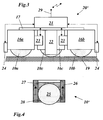
- An example equipped test robot 20 ' is in Fig. 3 shown in side view.
- a controller 21 is arranged, which can communicate via an antenna 29 wirelessly with an external control device and controls both the movement of the vehicle and the flow of the test processes and monitors.
- corresponding (electric) drives 23 are provided, which are connected to the controller 21.
- one or more position sensor 24 are mounted on the vehicle, for example, optically determine the movement relative to the base 19 and deliver to corresponding signals to the controller 21.
- Below the platform 17 is also an ultrasound or electromagnetically operating test device 22 arranged, with which the pad 19 and the device under test can be scanned destructively.
- Such a test robot 20 or 20 ' is placed on the blade airfoil 30 of a turbine blade and travels, following a predetermined pattern of movement, the surface of the airfoil 30 to inspect the blade for cracks or other irregularities.
- Rolling elements 10a, 10b and 10c are used in FIG Fig. 1 shown type with an outer diameter of 20 mm, with which - when using suitable permanent magnets - adhesive forces of up to 30 N can be erected. This force is sufficient to hold the weight of the "bare" 180 g test robot and the 1 kg weight devices mounted thereon.
- Fig. 4 shows construction of the rolling elements to choose a reverse construction in which the permanent magnet surrounds the spherical element outside.
- a ball 25 in a hollow cylindrical permanent magnet 26 by means of suitable bearing elements 27, 28 is rotatably mounted in the rolling element 10 '.
- the ball 25 is down sufficiently far enough to unroll on the base 19 can.
- the position of the permanent magnet 26 is not stable with the free rolling element 10 ', when the rolling element 10' is in the same position, it becomes correspondingly Fig. 2 is installed in a vehicle, fixed by the platform 17.
- the rolling elements according to the invention can also be used in vehicles which are intended to carry out not only tests but also work (cleaning, mending, etc.) in inaccessible places.
Landscapes
- Engineering & Computer Science (AREA)
- Mechanical Engineering (AREA)
- Rolling Contact Bearings (AREA)
- Manipulator (AREA)
Description
- Die vorliegende Erfindung bezieht sich auf das Gebiet der Fahrzeuge. Sie betrifft ein Rollelement zum allseitigen Verfahren eines Fahrzeugs gemäss dem Oberbegriff des Anspruchs 1, sowie ein Fahrzeug mit einem solchen Rollelement.
- Bei der von Hand ausgeführten Standardmethode zur zerstörungsfreien Prüfung von Bauteilen aus dem Kraftwerksbereich, wie beispielsweise Turbinenschaufeln, Turbinengehäuse oder dgl., mittels Ultraschall oder elektromagnetisch arbeitenden Sensoren muss ein vorgegebenes Abtastmuster eingehalten bzw. nachgefahren werden. Die prüfende Person hält den entsprechenden Sensor in der Hand und fährt dann den interessieren Bereich des Bauteils ab. Ein typisches Abtastmuster überstreicht den zu prüfenden Bereich mäanderförmig.
- Soll dieser Prozess mittels eines Roboters oder Scanners automatisiert werden, gibt es derzeit zwei Lösungen: Bei der einen Lösung wird ein seriell arbeitender Roboter, z.B. in Form eines Roboterarms, eingesetzt, an dessen freiem Ende der Sensor angebracht ist. Bei der anderen Lösung wird auf den zu prüfenden Bereich ein Rahmen aufgesetzt, in dem der Sensor nach Art eines X-Y-Schreibers in zwei zueinander orthogonale Richtungen unabhängig verfahrbar ist.
- Ein seriell arbeitender Roboter ist nicht nur vom Platzbedarf und der Ausrüstung her sehr aufwändig, sondern muss auch zum Abtasten auf die räumliche Gestalt der Objektoberfläche eingestellt werden. Beim Scanner muss der Rahmen von vornherein an die Objektgeometrie angepasst sein, was zu einer sehr geringen Flexibilität im Einsatz führt.
- Diese Nachteile könnten durch ein autonomes, kleines Roboterfahrzeug überwunden werden, das allseitig verfahrbar an der Oberfläche des zu untersuchenden Objektes haftet und den für die Prüfung vorgesehenen Sensor entlang einem einprogrammierten Abtastmuster über die Oberfläche führt. Für die allseitige Verfahrbarkeit wird dabei ein kugelartiges Rollelement benötigt, auf welchem das Fahrzeug gelagert ist. Gleichzeitig soll eine anziehende Kraft bereitgestellt werden, die das Fahrzeug an der Objektoberfläche hält. Hierbei könnten Magnetkräfte zum Einsatz kommen, da die zu prüfenden Objekte meist aus ferromagnetischem Material bestehen.
- Die Druckschrift
JP 2000016004 - Dasselbe gilt auch für die Rollvorrichtung für Möbelbeine der Druckschrift
DE 18 16 923 Hier ist im unteren offenen Ende eines Möbelbeines eine aus dem Rohr herausragende Kugel angeordnet. Die Kugel lagert im Inneren des Beines in einer Fassung, die aus einem Kunststoff besteht. Die Kugel hat einen Stahlkern, der mit einem Gummimantel umhüllt ist. Zwischen der Kugel und der Fassung sind kleine Stahlkugeln angeordnet. Oberhalb der Fassung befindet sich ein scheibenförmiger Einsatz, der als Widerlager für die Fassung dient. Der Einsatz enthält an seiner Unterseite einen Permanentmagneten. Da der Kugelkern sowie die Kugeln auf die magnetischen Kräfte des Permanentmagneten ansprechen, können die Kugeln nicht nach unten herausfallen. Auch hier ist dem Fachmann sofort klar, dass der Permanentmagnet in keiner Weise geeignet ist, dass Möbelbein in jeder Lage auf dem Boden zu halten. - Auch die Druckschrift
US 3,456,281 offenbart (Anspruch 8) eine Kugelrolle, bei der die Kugel ein Metall unter ihre Oberfläche umfasst und durch einen Magneten in ihrer Fassung gehalten wird. Auch hier dient der Magnet lediglich dazu, die kugelförmige Rolle am Herausfallen aus ihrer Halterung zu hindern, nicht jedoch dazu, das Rollelement insgesamt auf einer magnetisierbaren Unterlage zu halten. - Die Druckschrift
DE 42 34 727 schliesslich beschäftigt sich allgemein mit dem Antrieb von Kugelrollen. - Es ist daher eine Aufgabe der Erfindung, ein Rollelement zum allseitigen Verfahren eines Fahrzeugs auf einer Magnete anziehenden Unterlage zu schaffen, welches die genannten Bedingungen erfüllt, einfach und kompakt aufgebaut ist und sich aufgrund seiner Robustheit für den Einsatz unter schwierigen Bedingungen eignet.
- Die Aufgabe wird durch die Gesamtheit der Merkmale des Anspruchs 1 gelöst. Wichtig für die Erfindung ist, dass das Rollelement ein kugelförmiges Element und wenigstens einen Permanentmagneten umfasst, und dass das kugelförmige Element den wenigstens einen Permanentmagneten derart trägt, dass der wenigstens eine Permanentmagnet seine räumliche Orientierung beibehält, wenn das kugelförmige Element auf der Unterlage abrollt, und dass das kugelförmige Element durch die magnetische Wechselwirkung des wenigstens einen Permanentmagneten auf der Unterlage anliegend gehalten wird.
- Eine Ausgestaltung der Erfindung ist dadurch gekennzeichnet, dass das kugelförmige Element eine Kugel ist und im Inneren des wenigstens einen Permanentmagneten allseitig drehbar gelagert ist.
- Insbesondere kann dabei der wenigstens eine Permanentmagnet als die Kugel umgebender Hohlzylinder ausgebildet sein.
- Eine andere Ausgestaltung der Erfindung zeichnet sich dadurch aus, dass das kugelförmige Element eine Kugelschale ist, und dass der wenigstens eine Permanentmagnet im Inneren der Kugelschale allseitig drehbar gelagert ist.
- Vorzugsweise besteht die Kugelschale aus einem nicht-ferromagnetischen Material.
- Weiterhin kann mit Vorteil der wenigstens eine Permanentmagnet in einer Kugel aus nicht-ferromagnetischem Material eingebettet sein, welche in der Kugelschale allseitig drehbar gelagert ist.
- Um die notwendige Beweglichkeit zu erreichen, ist zwischen der Kugelschale und der den wenigstens einen Permanentmagneten umschliessenden Kugel ein Zwischenraum vorgesehen.
- Der Zwischenraum kann mit einem Gas, insbesondere Luft, gefüllt sein.
- Der Zwischenraum kann aber auch mit einem die Reibung zwischen Kugel und Kugelschale herabsetzenden Gleitmittel gefüllt sein.
- Des weiteren kann der wenigstens eine Permanentmagnet zylindrisch ausgebildet sein.
- Eine andere Ausgestaltung der Erfindung ist dadurch gekennzeichnet, dass das Rollelement durch ein an der Aussenfläche des kugelförmigen Elements anliegendes Antriebsrad antreibbar ist.
- Das erfindungsgemässe Fahrzeug zum allseitigen Verfahren auf einer Magnete anziehenden Unterlage ist mit wenigstens einem erfindungsgemässen Rollelement ausgerüstet.
- Insbesondere bewegt sich das Fahrzeug auf mehreren der Rollelemente.
- Vorzugsweise sind drei Rollelemente vorgesehen, die in einem Dreieck angeordnet sind.
- Wenigstens einem der Rollelemente ist dabei ein Antrieb zugeordnet, durch welchen das Rollelement antreibbar ist.
- Besonders vorteilhaft ist es, wenn die mehreren Rollelemente durch eine gemeinsame Plattform miteinander verbunden sind, und wenn unterhalb und/oder oberhalb der Plattform Einrichtungen für den Einsatz des Fahrzeugs angeordnet sind.
- Vorzugsweise umfassen die Einrichtungen für den Einsatz des Fahrzeugs eine Steuerung zum selbsttätigen Steuern der Bewegung des Fahrzeugs.
- Gemäss einer bevorzugten Ausgestaltung ist das Fahrzeug als Prüfroboter, insbesondere zur zerstörungsfreien Prüfung eines aus ferromagnetischem Material bestehenden Prüflings, insbesondere eines Schaufelblatts eines Verdichters oder einer Turbine, ausgebildet, und trägt eine entsprechende Prüfeinrichtung.
- Selbstverständlich können das Rollelement und das damit ausgerüstete Fahrzeug im Rahmen der Erfindung auch zu anderen Zwecken eingesetzt werden.
- Die Erfindung soll nachfolgend anhand von Ausführungsbeispielen im Zusammenhang mit der Zeichnung näher erläutert werden. Es zeigen
- Fig. 1
- im Schnitt ein erstes Ausführungsbeispiel eines Rollelements nach der Erfindung, bei dem ein Permanentmagnet im Inneren einer Kugelschale angeordnet ist, und bei dem zusätzlich ein Antrieb schematisch angedeutet ist;
- Fig. 2
- in einer perspektivischen Seitenansicht ein mit drei Rollelementen in Dreiecksanordnung ausgerüstetes autonomes Fahrzeug gemäss einem anderen Ausführungsbeispiel der Erfindung;
- Fig. 3
- in der Seitenansicht das Fahrzeug aus
Fig. 2 mit verschiedenen Einrichtungen zu seinem Betrieb; - Fig. 4
- im Schnitt ein zweites Ausführungsbeispiel eines Rollelements nach der Erfindung, bei dem eine Kugel im Inneren eines Permanentmagneten angeordnet ist; und
- Fig. 5
- die Anwendung eines Fahrzeugs nach
Fig. 3 zur Prüfung eines Schaufelblattes einer Turbinen- oder Verdichterschaufel. - Um ein Fahrzeug in eine beliebige Richtung bewegen zu können und es auch um die eigene Achse drehen zu können, ist es möglich, das Fahrzeug auf Kugeln zu lagern. Unter Fahrzeug wird dabei generell ein Objekt nahezu beliebiger Grösse verstanden, das auf einer Unterlage verfahrbar sein soll. Im nachfolgenden Anwendungsbeispiel ist das Fahrzeug ein autonomer Roboter von der Grösse einer Hand, der zur zerstörungsfreien Prüfung auf einem im Betrieb belasteten Bauteil wie z.B. einer Turbinenschaufel die Oberfläche abfahren soll.
- Da es häufig vorkommt, dass der die Unterlage bildende Körper aus einem ferromagnetischen Material besteht, soll das Fahrzeug unter Ausnutzung magnetischer Kräfte beim Verfahren auf der Oberfläche gehalten werden. Weil der Magnetismus immer in Form von Dipolen auftritt, ist eine gleichförmige Magnetisierung einer Kugel physikalisch nicht möglich, so dass zur Lagerung des Fahrzeugs eingesetzte Kugeln nicht gleichzeitig auch die anziehende Wirkung auf die ferromagnetische Unterlage bereitstellen können.
- Im Rahmen der Erfindung wird daher als für allseitige Bewegungen geeignetes, eine magnetische Haftung bewirkendes "Rad" eines Fahrzeugs ein Rollelement vorgeschlagen.
-
Fig. 1 zeigt im Schnitt ein erstes Ausführungsbeispiel eines solchen Rollelements 10 nach der Erfindung. Ein (vorzugsweise zylindrischer) Permanentmagnet 14 ist innerhalb einer Kugel 13 aus nicht-ferromagnetischem Material angeordnet (z.B. eingebettet). Die Kugel 13 mit dem darin befindlichen Permanentmagneten 14 ist beliebig drehbar in einer Kugelschale 11 aus nicht-ferromagnetischem Material untergebracht. Zwischen der Kugel 13 und der sie umgebenden Kugelschale 11 ist ein (näherungsweise kugelschalenförmiger) Zwischenraum 12 vorgesehen, der mit einem Gas, insbesondere Luft, oder aber auch mit einem Gleitmittel wie z.B. Öl oder dgl. gefüllt ist, um eine leichte Drehbarkeit der Kugelschale 11 gegenüber der Kugel 13 zu gewährleisten. - Wenn das Rollelement 10 - wie in
Fig. 1 gezeigt - auf einer Unterlage 19 aus ferromagnetischem Material (z.B. einer Turbinenwelle, einem Rohr, einer Turbinenschaufel, einem Tank oder dgl. Bauelement aus dem Kraftwerksbereich) aufliegt, halten die vom Permanentmagnet 14 ausgeübten magnetischen Kräfte das Rollelement 10 auf der Oberfläche der Unterlage 19 fest. Die magnetische Anziehung bleicht gleich, auch wenn sich das Rollelement 10 mit der Kugelschale 11 rollend auf der Unterlage 19 fortbewegt, da sich der Permanentmagnet 14 aufgrund der freien Drehbarkeit der Kugel 13 innerhalb der Kugelschale 11 immer wieder mit der Zylinderachse senkrecht zur Oberfläche der Unterlage 19 ausrichte, und der Abstand zur Unterlage 19 gleich bleibt. - Für die Bewegung des Rollelements, 10 auf der Unterlage 19 bestehen drei Freiheitsgrade: Zwei orthogonale (x,y-)Richtungen parallel zur Oberfläche der Unterlage 19, sowie eine Drehung um die Zylinderachse des Permanentmagneten 14.
- Das Rollelement 10 der
Fig. 1 kann als passives "Rad" eines Fahrzeugs eingesetzt werden, um eine allseitige Beweglichkeit des Fahrzeugs und eine magnetische Haftung an der Unterlage 19 zu gewährleisten. Es kann aber auch als Antriebselement eingesetzt werden. In diesem Fall können ein oder mehrere Antriebsräder 15 vorgesehen werden, die per Reibung an der Oberfläche der Kugelschale 11 abrollen und diese in eine oder mehrere Richtungen bewegen, wie dies inFig. 1 für den Fall eines einzelnen Antriebsrads 15 schematisch gezeigt ist. - Wenn ein oder mehrere Rollelemente 10 an einem Fahrzeug angeordnet werden, müssen dafür entsprechende Lager vorgesehen sein. Ein besonders einfaches Beispiel eines solchen Fahrzeugs in Form eines autonomen Prüfroboters ist in
Fig. 2 in perspektivischer Seitenansicht wiedergegeben. Beim Prüfroboter 20 derFig. 2 sind drei Rollelemente 10a, 10b und 10c der inFig. 1 gezeigten Art in einem Dreieck angeordnet, um eine stabile Auflage des Prüfroboters auf der Oberfläche des zu untersuchenden Bauelements sicherzustellen. Jedes der Rollelemente 10a, 10b und 10c ist in einem zugehörigen Lager 16a, 16b und 16c reibungsarm und allseitig drehbar gelagert. Die Lager 16a, 16b und 16c mit den zugehörigen Rollelementen 10a, 10b und 10c sind an den Ecken einer dreieckigen Plattform 17 befestigt, welche die für den autonomen Betrieb des Prüfroboters 20 notwendigen Einrichtungen aufnimmt. Hierfür steht einerseits die Oberseite der Plattform 17 zur Verfügung. Auf der Unterseite der Plattform 17 ergibt sich zwischen den Lagern 16a, 16b und 16c ein weiterer Nutzraum 18, der insbesondere zur Unterbringung der auf die Unterlage 19 gerichteten Prüfeinrichtungen benutzt werden kann. - Ein beispielhaft ausgerüsteter Prüfroboter 20' ist in
Fig. 3 in Seitenansicht gezeigt. Auf der Plattform 17 ist hier eine Steuerung 21 angeordnet, die über eine Antenne 29 drahtlos mit einem externen Steuergerät kommunizieren kann und sowohl die Bewegung des Fahrzeugs als auch den Ablauf der Prüfprozesse steuert und überwacht. Für den Antrieb der Rollelemente 10a, 10b und 10c sind entsprechende (elektrische) Antriebe 23 vorgesehen, die mit der Steuerung 21 verbunden sind. Um die Position des Prüfroboters 20' schlupffrei bestimmen zu können, sind ein oder mehrere Positionsgeber 24 am Fahrzeug angebracht, die beispielsweise optisch die Bewegung relativ zur Unterlage 19 bestimmen und an entsprechende Signale an die Steuerung 21 abgeben. Unterhalb der Plattform 17 ist auch eine mit Ultraschall oder elektromagnetisch arbeitende Prüfeinrichtung 22 angeordnet, mit der die Unterlage 19 bzw. das zu prüfende Bauelement zerstörungsfrei abgetastet werden kann. - Ein solcher Prüfroboter 20 bzw. 20' wird beispielsweise gemäss
Fig. 5 auf das Schaufelblatt 30 einer Turbinenschaufel gesetzt und fährt, einem vorgegebenen Bewegungsmuster folgend, die Oberfläche des Schaufelblattes 30 ab, um die Schaufel auf Risse oder andere Unregelmässigkeiten zu untersuchen. Eingesetzt werden dabei Rollelemente 10a, 10b und 10c der inFig. 1 gezeigten Art mit einem Aussendurchmesser von 20 mm, mit denen - beim Einsatz geeigneter Permanentmagneten - Haftkräfte von bis zu 30 N erricht werden können. Diese Kraft reicht aus, um das Gewicht des "nackten" Prüfroboters von 180 g und die darauf angeordneten Einrichtungen mit einem Gewicht von 1 kg zu halten. - Es ist im Rahmen der Erfindung denkbar, anstelle des in
Fig. 1 gezeigten Aufbaus der Rollelemente einen umgekehrten Aufbau zu wählen, bei der der Permanentmagnet das kugelförmige Element aussen umgibt. Ein solcher alternativer Aufbau ist inFig. 4 gezeigt. Hierbei ist in dem Rollelement 10' eine Kugel 25 in einem hohlzylindrischen Permanentmagneten 26 mittels geeigneter Lagerelemente 27, 28 drehbar gelagert. Die Kugel 25 steht nach unten ausreichend weit vor, um auf der Unterlage 19 frei abrollen zu können. Obgleich die Lage des Permanentmagneten 26 beim freien Rollelement 10' nicht stabil ist, wird sie, wenn das Rollelement 10' entsprechendFig. 2 in ein Fahrzeug eingebaut wird, durch die Plattform 17 fixiert. - Insgesamt ergibt sich mit der Erfindung über das einzelne Rollelement hinaus ein in alle Richtungen beweglicher Prüfroboter, der die folgenden Eigenschaften und Vorteile aufweist:
- Als omnidirektionaler Scanner ist der Prüfroboter eine Voraussetzung für die Automatisierung der bisher manuell erfolgten Inspektionen.
- Die Prüfroboter sind klein, leicht und flexibel und universell, d.h. bei vielen verschiedenen Geometrien, einsetzbar.
- Sie sind leicht transportierbar und erleichtern wesentlich Prüfungen "vor Ort".
- Sie lassen sich in den meisten Fällen einsetzen, da sehr viele Bauteile aus ferromagnetischem Material bestehen
- Die erfindungsgemässen Rollelemente lassen sich aber auch in Fahrzeugen einsetzen, die an unzugänglichen Stellen nicht nur Prüfungen, sondern auch Arbeiten (Reinigung, Ausbessern etc.) durchführen sollen.
-
- 10,10'
- Rollelement
- 11
- Kugelschale
- 12
- Zwischenraum
- 13
- Kugel (nicht-ferromagnetisch)
- 14
- Permanentmagnet (z.B. zylindrisch)
- 15
- Antriebsrad
- 16a,b,c
- Lager (Rollelement)
- 17
- Plattform
- 18
- Nutzraum
- 19
- Unterlage
- 20,20'
- Prüfroboter (allseitig verfahrbar)
- 21
- Steuerung
- 22
- Prüfeinrichtung
- 23
- Antrieb
- 24
- Positionsgeber
- 25
- Kugel
- 26
- Permanentmagnet (z.B. hohlzylindrisch)
- 27,28
- Lagerelement
- 29
- Antenne
- 30
- Schaufelblatt (Turbine)
Claims (18)
- Rollelement (10, 10') zum allseitigen Verfahren eines Fahrzeugs (20, 20') auf einer Magnete anziehenden Unterlage (19), welches Rollelement (10, 10') ein kugelförmiges Element (11, 25) und wenigstens einen Permanentmagneten (14, 26) umfasst, wobei das kugelförmige Element (11, 25) den wenigstens einen Permanentmagneten (14, 26) derart trägt, dass der wenigstens eine Permanentmagnet (14, 26) seine räumliche Orientierung beibehält, wenn das kugelförmige Element (11, 25) auf der Unterlage (19) abrollt, dadurch gekennzeichnet, dass das kugelförmige Element (11, 25) durch die magnetische Wechselwirkung des wenigstens einen Permanentmagneten (14, 26) mit der Unterlage (19) auf der Unterlage (19) anliegend gehalten wird.
- Rollelement nach Anspruch 1, dadurch gekennzeichnet, dass das kugelförmige Element eine Kugel (25) ist und im Inneren des wenigstens einen Permanentmagneten (26) allseitig drehbar gelagert ist.
- Rollelement nach Anspruch 2, dadurch gekennzeichnet, dass der wenigstens eine Permanentmagnet (26) als die Kugel (25) umgebender Hohlzylinder ausgebildet ist.
- Rollelement nach Anspruch 1, dadurch gekennzeichnet, dass das kugelförmige Element eine Kugelschale (11) ist, und dass der wenigstens eine Permanentmagnet (14) im Inneren der Kugelschale (11) allseitig drehbar gelagert ist.
- Rollelement nach Anspruch 4, dadurch gekennzeichnet, dass die Kugelschale (11) aus einem nicht-ferromagnetischen Material besteht.
- Rollelement nach Anspruch 4 oder 5, dadurch gekennzeichnet, dass der wenigstens eine Permanentmagnet (14) in einer Kugel (13) aus nicht-ferromagnetischem Material eingebettet ist, welche in der Kugelschale (11) allseitig drehbar gelagert ist.
- Rollelement nach Anspruch 6, dadurch gekennzeichnet, dass zwischen der Kugelschale (11) und der den wenigstens einen Permanentmagneten (14) umschliessenden Kugel (13) ein Zwischenraum (12) vorgesehen ist.
- Rollelement nach Anspruch 7, dadurch gekennzeichnet, dass der Zwischenraum (12) mit einem Gas, insbesondere Luft, gefüllt ist.
- Rollelement nach Anspruch 7, dadurch gekennzeichnet, dass der Zwischenraum (12) mit einem die Reibung zwischen Kugel (13) und Kugelschale (11) herabsetzenden Gleitmittel gefüllt ist.
- Rollelement nach einem der Ansprüche 6 bis 9, dadurch gekennzeichnet, dass der wenigstens eine Permanentmagnet (14) zylindrisch ausgebildet ist.
- Rollelement nach einem der Ansprüche 1 bis 10, dadurch gekennzeichnet, dass das Rollelement (10) durch ein an der Aussenfläche des kugelförmigen Elements (11) anliegendes Antriebsrad (15) antreibbar ist.
- Fahrzeug (20, 20') zum allseitigen Verfahren auf einer Magnete anziehenden Unterlage (19), dadurch gekennzeichnet, dass das Fahrzeug mit wenigstens einem Rollelement (10, 10') nach einem der Ansprüche 1 bis 11 ausgerüstet ist.
- Fahrzeug nach Anspruch 12, dadurch gekennzeichnet, dass sich das Fahrzeug auf mehreren der Rollelemente (10, 10'; 10a, 10b, 10c) bewegt.
- Fahrzeug nach Anspruch 13, dadurch gekennzeichnet, dass drei Rollelemente (10a, 10b, 10c) vorgesehen sind, und dass die drei Rollelemente (10a, 10b, 10c) in einem Dreieck angeordnet sind.
- Fahrzeug nach Anspruch 13 oder 14, dadurch gekennzeichnet, dass wenigstens einem der Rollelemente (10, 10'; 10a, 10b, 10c) ein Antrieb (23) zugeordnet ist, durch welchen das Rollelement antreibbar ist.
- Fahrzeug nach einem der Ansprüche 13 bis 15, dadurch gekennzeichnet, dass die mehreren Rollelemente (10a, 10b, 10c) durch eine gemeinsame Plattform (17) miteinander verbunden sind, und dass unterhalb und/oder oberhalb der Plattform (17) Einrichtungen (21, 22) für den Einsatz des Fahrzeugs (20, 20') angeordnet sind.
- Fahrzeug nach Anspruch 16, dadurch gekennzeichnet, dass die Einrichtungen für den Einsatz des Fahrzeugs (20, 20') eine Steuerung (21) zum selbsttätigen Steuern der Bewegung des Fahrzeugs (20, 20') umfassen.
- Fahrzeug nach Anspruch 16 oder 17, dadurch gekennzeichnet, dass das Fahrzeug (20') als Prüfroboter, insbesondere zur zerstörungsfreien Prüfung eines aus ferromagnetischem Material bestehenden Prüflings, insbesondere eines Schaufelblatts eines Verdichters oder einer Turbine, ausgebildet ist, und eine entsprechende Prüfeinrichtung (22) trägt.
Applications Claiming Priority (2)
| Application Number | Priority Date | Filing Date | Title |
|---|---|---|---|
| CH01347/09A CH701817A1 (de) | 2009-08-31 | 2009-08-31 | Rollelement zum allseitigen Verfahren eines Fahrzeugs sowie Fahrzeug mit einem solchen Rollelement. |
| PCT/EP2010/062649 WO2011023820A1 (de) | 2009-08-31 | 2010-08-30 | Rollelement zum allseitigen verfahren eines fahrzeugs sowie fahrzeug mit einem solchen rollelement |
Publications (2)
| Publication Number | Publication Date |
|---|---|
| EP2473360A1 EP2473360A1 (de) | 2012-07-11 |
| EP2473360B1 true EP2473360B1 (de) | 2013-12-25 |
Family
ID=42308264
Family Applications (1)
| Application Number | Title | Priority Date | Filing Date |
|---|---|---|---|
| EP10747058.5A Not-in-force EP2473360B1 (de) | 2009-08-31 | 2010-08-30 | Rollelement zum allseitigen verfahren eines fahrzeugs sowie fahrzeug mit einem solchen rollelement |
Country Status (6)
| Country | Link |
|---|---|
| US (1) | US8820850B2 (de) |
| EP (1) | EP2473360B1 (de) |
| JP (1) | JP5650224B2 (de) |
| CH (1) | CH701817A1 (de) |
| TW (1) | TWI526384B (de) |
| WO (1) | WO2011023820A1 (de) |
Families Citing this family (13)
| Publication number | Priority date | Publication date | Assignee | Title |
|---|---|---|---|---|
| US9783001B1 (en) | 2016-08-10 | 2017-10-10 | Panter, Inc. | Article movement systems, ball wheels and related apparatus and methods |
| CH701817A1 (de) | 2009-08-31 | 2011-03-15 | Alstom Technology Ltd | Rollelement zum allseitigen Verfahren eines Fahrzeugs sowie Fahrzeug mit einem solchen Rollelement. |
| US9010798B2 (en) | 2012-07-23 | 2015-04-21 | Luca Buttazzoni | Self-contained dolly assembly |
| US9409585B2 (en) | 2013-07-15 | 2016-08-09 | Luca Buttazzoni | Castor supported dolly assembly capable of being made from lightweight materials and of being used as a pallet assembly |
| KR102143618B1 (ko) | 2014-01-17 | 2020-08-11 | 삼성전자주식회사 | 프레임률 제어 방법 및 그 전자 장치 |
| NO20140520A1 (no) * | 2014-02-06 | 2014-04-30 | Liftwheel As | Rulleinnretning |
| CN105151152B (zh) * | 2015-10-22 | 2017-11-14 | 佛山博文机器人自动化科技有限公司 | 一种磁力可控的磁性吸附模块 |
| USD969593S1 (en) * | 2016-06-20 | 2022-11-15 | Romualdo Monteiro De Barros | Rolling device |
| US10377231B2 (en) * | 2017-07-12 | 2019-08-13 | Ecole Polytechnique Federale De Lausanne (Epfl) | Magnet-assisted ball drive |
| DE102020110160B4 (de) | 2020-04-14 | 2024-06-20 | Marcel Leber | Möbelsystem |
| KR20230016641A (ko) * | 2020-05-30 | 2023-02-02 | 메사추세츠 인스티튜트 오브 테크놀로지 | 적응성 자석 휠들을 가진 벽 등반 차량 |
| JP7424924B2 (ja) * | 2020-06-25 | 2024-01-30 | 住友重機械工業株式会社 | 磁気吸着車輪及び車両 |
| KR102332149B1 (ko) * | 2021-05-17 | 2021-12-01 | 주식회사 칼만텍 | 이동식 플랫폼 |
Family Cites Families (15)
| Publication number | Priority date | Publication date | Assignee | Title |
|---|---|---|---|---|
| US2687546A (en) * | 1952-05-16 | 1954-08-31 | Oppenheimer Jess | Caster |
| US3456281A (en) * | 1966-07-25 | 1969-07-22 | Hubert E Lowry | Ball caster |
| DE1816923A1 (de) * | 1968-12-24 | 1970-06-25 | Kuehnemann Dipl Ing Klaus | Rollvorrichtung fuer die Beine von Moebeln |
| US3609612A (en) * | 1969-10-10 | 1971-09-28 | Asplundpatenter Ab | Carriage or trolley for travel along an upright wall of magnetic material |
| US5284096A (en) * | 1991-08-06 | 1994-02-08 | Osaka Gas Company, Limited | Vehicle for use in pipes |
| US5220869A (en) * | 1991-08-07 | 1993-06-22 | Osaka Gas Company, Ltd. | Vehicle adapted to freely travel three-dimensionally and up vertical walls by magnetic force and wheel for the vehicle |
| DE4234727A1 (de) * | 1992-10-15 | 1994-04-21 | Alfred Linden | Transportfahrzeug, auf Kugeln rollend |
| JPH07215003A (ja) * | 1994-02-04 | 1995-08-15 | Eiji Matsuo | 家具用キャスター |
| US6000484A (en) * | 1996-09-25 | 1999-12-14 | Aqua Dynamics, Inc. | Articulating wheeled permanent magnet chassis with high pressure sprayer |
| JP2000016004A (ja) * | 1998-06-26 | 2000-01-18 | Toshio Imanaka | 無軸キャスター |
| JP2000025408A (ja) * | 1998-07-13 | 2000-01-25 | Nippon Seiko Kk | 軸受ユニット |
| JP2008044477A (ja) * | 2006-08-11 | 2008-02-28 | Pentax Corp | キャスタ |
| US20090152858A1 (en) * | 2007-12-14 | 2009-06-18 | Christian Legrand | Roller system for toys and books |
| CH701817A1 (de) | 2009-08-31 | 2011-03-15 | Alstom Technology Ltd | Rollelement zum allseitigen Verfahren eines Fahrzeugs sowie Fahrzeug mit einem solchen Rollelement. |
| GB2493370A (en) * | 2011-08-03 | 2013-02-06 | Omnicaster Ltd | Omniball Twin Axle |
-
2009
- 2009-08-31 CH CH01347/09A patent/CH701817A1/de unknown
-
2010
- 2010-08-30 EP EP10747058.5A patent/EP2473360B1/de not_active Not-in-force
- 2010-08-30 WO PCT/EP2010/062649 patent/WO2011023820A1/de not_active Ceased
- 2010-08-30 JP JP2012527295A patent/JP5650224B2/ja not_active Expired - Fee Related
- 2010-08-31 TW TW099129306A patent/TWI526384B/zh not_active IP Right Cessation
-
2012
- 2012-01-19 US US13/353,510 patent/US8820850B2/en not_active Expired - Fee Related
Also Published As
| Publication number | Publication date |
|---|---|
| TWI526384B (zh) | 2016-03-21 |
| JP5650224B2 (ja) | 2015-01-07 |
| TW201127729A (en) | 2011-08-16 |
| CH701817A1 (de) | 2011-03-15 |
| US8820850B2 (en) | 2014-09-02 |
| JP2013503078A (ja) | 2013-01-31 |
| US20120144937A1 (en) | 2012-06-14 |
| WO2011023820A1 (de) | 2011-03-03 |
| EP2473360A1 (de) | 2012-07-11 |
Similar Documents
| Publication | Publication Date | Title |
|---|---|---|
| EP2473360B1 (de) | Rollelement zum allseitigen verfahren eines fahrzeugs sowie fahrzeug mit einem solchen rollelement | |
| DE19681494B4 (de) | Roboter mit Direktantrieb | |
| EP2327612B1 (de) | Fahrzeug zur selbständigen Inspektion von schwer zugänglichen Innenräumen | |
| DE19929072A1 (de) | Vorrichtung zur Prüfung von Rohrleitungen aus ferromagnetischen Materialien | |
| DE4313719C2 (de) | Transportvorrichtung | |
| EP2431977B1 (de) | Roboterplattform zur Ferngesteuerten und/oder selbständigen Inspektion von Technischen Einrichtungen | |
| WO2016156039A1 (de) | SCHWEIßANORDNUNG ZUM DAUERHAFTEN FÜGEN EINES ERSTEN ROHRFÖRMIGEN BAUTEILS MIT EINEM ZWEITEN BAUTEIL | |
| DE102013225630B4 (de) | Industrieroboter | |
| DE102009056582B4 (de) | Handhabungssystem zur Bewegung eines über biegeschlaffe Elemente geführten Gegenstandes, insbesondere Bandroboter sowie dazugehöriges Arbeitsverfahren | |
| EP2755007A2 (de) | Mobiles Trägersystem für mindestens ein zur zerstörungsfreien Prüfung ausgebildetes Sensorelement | |
| DE4431842C2 (de) | Elektronisch steuerbare Vorrichtung | |
| DE2848638C2 (de) | Meßrolle zur Erfassung der Spannungsverteilung in einem laufenden Band | |
| DE19648847C2 (de) | Höhenmeß- und Anreißgerät | |
| DE102012107847A1 (de) | Kontrollvorrichtung zur Kontrolle des Zustandes einer Förderbandanlage | |
| DE102016204492A1 (de) | Vorrichtung zur Kontrolle einer Oberfläche eines sphärischen Körpers | |
| DE10212665A1 (de) | Laufvorrichtung, Verfahren zu deren Steuerung und Roboter | |
| WO2021185543A1 (de) | Inspektionseinrichtung | |
| DE10217720C1 (de) | Vorrichtung zum Testen einer Radaufhängung an einem Fahrzeug | |
| WO2014154770A1 (de) | Universal-messaufnahme-vorrichtung | |
| DE3808908A1 (de) | Hubvorrichtung zum montieren schwerer fahrzeugteile | |
| DE102005051012B3 (de) | Vorrichtung zur Handhabung von biologischen Zellen bzw. Proben | |
| DE102024113472A1 (de) | Selbstfahrende Lastaufnahme- und Transportvorrichtung | |
| DE102022101161A1 (de) | Kraftfahrzeugprüfstand | |
| DE202005021364U1 (de) | Prüfanlage zur zerstörungsfreien Prüfung eines Werkstücks | |
| WO2016019968A1 (de) | Fördereinrichtung mit einer supraleiter/permanentmagneten antriebsanordnung |
Legal Events
| Date | Code | Title | Description |
|---|---|---|---|
| PUAI | Public reference made under article 153(3) epc to a published international application that has entered the european phase |
Free format text: ORIGINAL CODE: 0009012 |
|
| 17P | Request for examination filed |
Effective date: 20120330 |
|
| AK | Designated contracting states |
Kind code of ref document: A1 Designated state(s): AL AT BE BG CH CY CZ DE DK EE ES FI FR GB GR HR HU IE IS IT LI LT LU LV MC MK MT NL NO PL PT RO SE SI SK SM TR |
|
| DAX | Request for extension of the european patent (deleted) | ||
| REG | Reference to a national code |
Ref country code: DE Ref legal event code: R079 Ref document number: 502010005773 Country of ref document: DE Free format text: PREVIOUS MAIN CLASS: B60B0033080000 Ipc: B60B0019140000 |
|
| RIC1 | Information provided on ipc code assigned before grant |
Ipc: B60B 19/14 20060101AFI20130808BHEP Ipc: B60B 33/08 20060101ALI20130808BHEP |
|
| GRAP | Despatch of communication of intention to grant a patent |
Free format text: ORIGINAL CODE: EPIDOSNIGR1 |
|
| INTG | Intention to grant announced |
Effective date: 20130919 |
|
| GRAS | Grant fee paid |
Free format text: ORIGINAL CODE: EPIDOSNIGR3 |
|
| GRAA | (expected) grant |
Free format text: ORIGINAL CODE: 0009210 |
|
| AK | Designated contracting states |
Kind code of ref document: B1 Designated state(s): AL AT BE BG CH CY CZ DE DK EE ES FI FR GB GR HR HU IE IS IT LI LT LU LV MC MK MT NL NO PL PT RO SE SI SK SM TR |
|
| REG | Reference to a national code |
Ref country code: GB Ref legal event code: FG4D Free format text: NOT ENGLISH |
|
| REG | Reference to a national code |
Ref country code: CH Ref legal event code: EP |
|
| REG | Reference to a national code |
Ref country code: AT Ref legal event code: REF Ref document number: 646401 Country of ref document: AT Kind code of ref document: T Effective date: 20140115 |
|
| REG | Reference to a national code |
Ref country code: IE Ref legal event code: FG4D Free format text: LANGUAGE OF EP DOCUMENT: GERMAN |
|
| REG | Reference to a national code |
Ref country code: DE Ref legal event code: R096 Ref document number: 502010005773 Country of ref document: DE Effective date: 20140220 |
|
| PG25 | Lapsed in a contracting state [announced via postgrant information from national office to epo] |
Ref country code: HR Free format text: LAPSE BECAUSE OF FAILURE TO SUBMIT A TRANSLATION OF THE DESCRIPTION OR TO PAY THE FEE WITHIN THE PRESCRIBED TIME-LIMIT Effective date: 20131225 Ref country code: FI Free format text: LAPSE BECAUSE OF FAILURE TO SUBMIT A TRANSLATION OF THE DESCRIPTION OR TO PAY THE FEE WITHIN THE PRESCRIBED TIME-LIMIT Effective date: 20131225 Ref country code: NO Free format text: LAPSE BECAUSE OF FAILURE TO SUBMIT A TRANSLATION OF THE DESCRIPTION OR TO PAY THE FEE WITHIN THE PRESCRIBED TIME-LIMIT Effective date: 20140325 Ref country code: LT Free format text: LAPSE BECAUSE OF FAILURE TO SUBMIT A TRANSLATION OF THE DESCRIPTION OR TO PAY THE FEE WITHIN THE PRESCRIBED TIME-LIMIT Effective date: 20131225 Ref country code: SE Free format text: LAPSE BECAUSE OF FAILURE TO SUBMIT A TRANSLATION OF THE DESCRIPTION OR TO PAY THE FEE WITHIN THE PRESCRIBED TIME-LIMIT Effective date: 20131225 |
|
| REG | Reference to a national code |
Ref country code: NL Ref legal event code: VDEP Effective date: 20131225 |
|
| REG | Reference to a national code |
Ref country code: LT Ref legal event code: MG4D |
|
| PG25 | Lapsed in a contracting state [announced via postgrant information from national office to epo] |
Ref country code: LV Free format text: LAPSE BECAUSE OF FAILURE TO SUBMIT A TRANSLATION OF THE DESCRIPTION OR TO PAY THE FEE WITHIN THE PRESCRIBED TIME-LIMIT Effective date: 20131225 |
|
| PG25 | Lapsed in a contracting state [announced via postgrant information from national office to epo] |
Ref country code: EE Free format text: LAPSE BECAUSE OF FAILURE TO SUBMIT A TRANSLATION OF THE DESCRIPTION OR TO PAY THE FEE WITHIN THE PRESCRIBED TIME-LIMIT Effective date: 20131225 Ref country code: IS Free format text: LAPSE BECAUSE OF FAILURE TO SUBMIT A TRANSLATION OF THE DESCRIPTION OR TO PAY THE FEE WITHIN THE PRESCRIBED TIME-LIMIT Effective date: 20140425 |
|
| PG25 | Lapsed in a contracting state [announced via postgrant information from national office to epo] |
Ref country code: CY Free format text: LAPSE BECAUSE OF FAILURE TO SUBMIT A TRANSLATION OF THE DESCRIPTION OR TO PAY THE FEE WITHIN THE PRESCRIBED TIME-LIMIT Effective date: 20131225 Ref country code: ES Free format text: LAPSE BECAUSE OF FAILURE TO SUBMIT A TRANSLATION OF THE DESCRIPTION OR TO PAY THE FEE WITHIN THE PRESCRIBED TIME-LIMIT Effective date: 20131225 Ref country code: SK Free format text: LAPSE BECAUSE OF FAILURE TO SUBMIT A TRANSLATION OF THE DESCRIPTION OR TO PAY THE FEE WITHIN THE PRESCRIBED TIME-LIMIT Effective date: 20131225 Ref country code: PT Free format text: LAPSE BECAUSE OF FAILURE TO SUBMIT A TRANSLATION OF THE DESCRIPTION OR TO PAY THE FEE WITHIN THE PRESCRIBED TIME-LIMIT Effective date: 20140428 Ref country code: CZ Free format text: LAPSE BECAUSE OF FAILURE TO SUBMIT A TRANSLATION OF THE DESCRIPTION OR TO PAY THE FEE WITHIN THE PRESCRIBED TIME-LIMIT Effective date: 20131225 Ref country code: NL Free format text: LAPSE BECAUSE OF FAILURE TO SUBMIT A TRANSLATION OF THE DESCRIPTION OR TO PAY THE FEE WITHIN THE PRESCRIBED TIME-LIMIT Effective date: 20131225 Ref country code: RO Free format text: LAPSE BECAUSE OF FAILURE TO SUBMIT A TRANSLATION OF THE DESCRIPTION OR TO PAY THE FEE WITHIN THE PRESCRIBED TIME-LIMIT Effective date: 20131225 |
|
| REG | Reference to a national code |
Ref country code: DE Ref legal event code: R097 Ref document number: 502010005773 Country of ref document: DE |
|
| PG25 | Lapsed in a contracting state [announced via postgrant information from national office to epo] |
Ref country code: DK Free format text: LAPSE BECAUSE OF FAILURE TO SUBMIT A TRANSLATION OF THE DESCRIPTION OR TO PAY THE FEE WITHIN THE PRESCRIBED TIME-LIMIT Effective date: 20131225 |
|
| PLBE | No opposition filed within time limit |
Free format text: ORIGINAL CODE: 0009261 |
|
| STAA | Information on the status of an ep patent application or granted ep patent |
Free format text: STATUS: NO OPPOSITION FILED WITHIN TIME LIMIT |
|
| PG25 | Lapsed in a contracting state [announced via postgrant information from national office to epo] |
Ref country code: PL Free format text: LAPSE BECAUSE OF FAILURE TO SUBMIT A TRANSLATION OF THE DESCRIPTION OR TO PAY THE FEE WITHIN THE PRESCRIBED TIME-LIMIT Effective date: 20131225 |
|
| 26N | No opposition filed |
Effective date: 20140926 |
|
| REG | Reference to a national code |
Ref country code: DE Ref legal event code: R097 Ref document number: 502010005773 Country of ref document: DE Effective date: 20140926 |
|
| PG25 | Lapsed in a contracting state [announced via postgrant information from national office to epo] |
Ref country code: LU Free format text: LAPSE BECAUSE OF FAILURE TO SUBMIT A TRANSLATION OF THE DESCRIPTION OR TO PAY THE FEE WITHIN THE PRESCRIBED TIME-LIMIT Effective date: 20140830 Ref country code: MC Free format text: LAPSE BECAUSE OF FAILURE TO SUBMIT A TRANSLATION OF THE DESCRIPTION OR TO PAY THE FEE WITHIN THE PRESCRIBED TIME-LIMIT Effective date: 20131225 |
|
| REG | Reference to a national code |
Ref country code: CH Ref legal event code: PL |
|
| PG25 | Lapsed in a contracting state [announced via postgrant information from national office to epo] |
Ref country code: CH Free format text: LAPSE BECAUSE OF NON-PAYMENT OF DUE FEES Effective date: 20140831 Ref country code: BE Free format text: LAPSE BECAUSE OF NON-PAYMENT OF DUE FEES Effective date: 20140831 Ref country code: LI Free format text: LAPSE BECAUSE OF NON-PAYMENT OF DUE FEES Effective date: 20140831 |
|
| PG25 | Lapsed in a contracting state [announced via postgrant information from national office to epo] |
Ref country code: SI Free format text: LAPSE BECAUSE OF FAILURE TO SUBMIT A TRANSLATION OF THE DESCRIPTION OR TO PAY THE FEE WITHIN THE PRESCRIBED TIME-LIMIT Effective date: 20131225 |
|
| REG | Reference to a national code |
Ref country code: IE Ref legal event code: MM4A |
|
| REG | Reference to a national code |
Ref country code: FR Ref legal event code: PLFP Year of fee payment: 6 |
|
| PG25 | Lapsed in a contracting state [announced via postgrant information from national office to epo] |
Ref country code: IE Free format text: LAPSE BECAUSE OF NON-PAYMENT OF DUE FEES Effective date: 20140830 |
|
| PG25 | Lapsed in a contracting state [announced via postgrant information from national office to epo] |
Ref country code: SM Free format text: LAPSE BECAUSE OF FAILURE TO SUBMIT A TRANSLATION OF THE DESCRIPTION OR TO PAY THE FEE WITHIN THE PRESCRIBED TIME-LIMIT Effective date: 20131225 |
|
| PG25 | Lapsed in a contracting state [announced via postgrant information from national office to epo] |
Ref country code: GR Free format text: LAPSE BECAUSE OF FAILURE TO SUBMIT A TRANSLATION OF THE DESCRIPTION OR TO PAY THE FEE WITHIN THE PRESCRIBED TIME-LIMIT Effective date: 20140326 Ref country code: IT Free format text: LAPSE BECAUSE OF FAILURE TO SUBMIT A TRANSLATION OF THE DESCRIPTION OR TO PAY THE FEE WITHIN THE PRESCRIBED TIME-LIMIT Effective date: 20131225 Ref country code: MT Free format text: LAPSE BECAUSE OF FAILURE TO SUBMIT A TRANSLATION OF THE DESCRIPTION OR TO PAY THE FEE WITHIN THE PRESCRIBED TIME-LIMIT Effective date: 20131225 Ref country code: BG Free format text: LAPSE BECAUSE OF FAILURE TO SUBMIT A TRANSLATION OF THE DESCRIPTION OR TO PAY THE FEE WITHIN THE PRESCRIBED TIME-LIMIT Effective date: 20131225 |
|
| PG25 | Lapsed in a contracting state [announced via postgrant information from national office to epo] |
Ref country code: HU Free format text: LAPSE BECAUSE OF FAILURE TO SUBMIT A TRANSLATION OF THE DESCRIPTION OR TO PAY THE FEE WITHIN THE PRESCRIBED TIME-LIMIT; INVALID AB INITIO Effective date: 20100830 Ref country code: TR Free format text: LAPSE BECAUSE OF FAILURE TO SUBMIT A TRANSLATION OF THE DESCRIPTION OR TO PAY THE FEE WITHIN THE PRESCRIBED TIME-LIMIT Effective date: 20131225 |
|
| REG | Reference to a national code |
Ref country code: FR Ref legal event code: PLFP Year of fee payment: 7 |
|
| REG | Reference to a national code |
Ref country code: DE Ref legal event code: R082 Ref document number: 502010005773 Country of ref document: DE Representative=s name: RUEGER | ABEL PATENT- UND RECHTSANWAELTE, DE Ref country code: DE Ref legal event code: R082 Ref document number: 502010005773 Country of ref document: DE Representative=s name: RUEGER ABEL PATENTANWAELTE PARTGMBB, DE Ref country code: DE Ref legal event code: R082 Ref document number: 502010005773 Country of ref document: DE Representative=s name: RUEGER, BARTHELT & ABEL, DE Ref country code: DE Ref legal event code: R081 Ref document number: 502010005773 Country of ref document: DE Owner name: GENERAL ELECTRIC TECHNOLOGY GMBH, CH Free format text: FORMER OWNER: ALSTOM TECHNOLOGY LTD., BADEN, CH Ref country code: DE Ref legal event code: R082 Ref document number: 502010005773 Country of ref document: DE Representative=s name: RUEGER ABEL PATENT- UND RECHTSANWAELTE, DE |
|
| REG | Reference to a national code |
Ref country code: AT Ref legal event code: MM01 Ref document number: 646401 Country of ref document: AT Kind code of ref document: T Effective date: 20150830 |
|
| PG25 | Lapsed in a contracting state [announced via postgrant information from national office to epo] |
Ref country code: AT Free format text: LAPSE BECAUSE OF NON-PAYMENT OF DUE FEES Effective date: 20150830 |
|
| REG | Reference to a national code |
Ref country code: FR Ref legal event code: CD Owner name: ALSTOM TECHNOLOGY LTD, CH Effective date: 20161124 |
|
| REG | Reference to a national code |
Ref country code: FR Ref legal event code: PLFP Year of fee payment: 8 |
|
| PGFP | Annual fee paid to national office [announced via postgrant information from national office to epo] |
Ref country code: DE Payment date: 20170829 Year of fee payment: 8 Ref country code: GB Payment date: 20170829 Year of fee payment: 8 Ref country code: FR Payment date: 20170825 Year of fee payment: 8 |
|
| PG25 | Lapsed in a contracting state [announced via postgrant information from national office to epo] |
Ref country code: MK Free format text: LAPSE BECAUSE OF FAILURE TO SUBMIT A TRANSLATION OF THE DESCRIPTION OR TO PAY THE FEE WITHIN THE PRESCRIBED TIME-LIMIT Effective date: 20131225 |
|
| PG25 | Lapsed in a contracting state [announced via postgrant information from national office to epo] |
Ref country code: AL Free format text: LAPSE BECAUSE OF FAILURE TO SUBMIT A TRANSLATION OF THE DESCRIPTION OR TO PAY THE FEE WITHIN THE PRESCRIBED TIME-LIMIT Effective date: 20131225 |
|
| REG | Reference to a national code |
Ref country code: DE Ref legal event code: R119 Ref document number: 502010005773 Country of ref document: DE |
|
| GBPC | Gb: european patent ceased through non-payment of renewal fee |
Effective date: 20180830 |
|
| PG25 | Lapsed in a contracting state [announced via postgrant information from national office to epo] |
Ref country code: DE Free format text: LAPSE BECAUSE OF NON-PAYMENT OF DUE FEES Effective date: 20190301 |
|
| PG25 | Lapsed in a contracting state [announced via postgrant information from national office to epo] |
Ref country code: FR Free format text: LAPSE BECAUSE OF NON-PAYMENT OF DUE FEES Effective date: 20180831 |
|
| PG25 | Lapsed in a contracting state [announced via postgrant information from national office to epo] |
Ref country code: GB Free format text: LAPSE BECAUSE OF NON-PAYMENT OF DUE FEES Effective date: 20180830 |