EP2473820B1 - Verteilte verkehrsnavigation unter verwendung von fahrzeugkommunikation - Google Patents
Verteilte verkehrsnavigation unter verwendung von fahrzeugkommunikation Download PDFInfo
- Publication number
- EP2473820B1 EP2473820B1 EP10808570.5A EP10808570A EP2473820B1 EP 2473820 B1 EP2473820 B1 EP 2473820B1 EP 10808570 A EP10808570 A EP 10808570A EP 2473820 B1 EP2473820 B1 EP 2473820B1
- Authority
- EP
- European Patent Office
- Prior art keywords
- vehicle
- matrix
- header
- junction
- vehicles
- Prior art date
- Legal status (The legal status is an assumption and is not a legal conclusion. Google has not performed a legal analysis and makes no representation as to the accuracy of the status listed.)
- Active
Links
Images

Classifications
-
- G—PHYSICS
- G08—SIGNALLING
- G08G—TRAFFIC CONTROL SYSTEMS
- G08G1/00—Traffic control systems for road vehicles
- G08G1/09—Arrangements for giving variable traffic instructions
- G08G1/0962—Arrangements for giving variable traffic instructions having an indicator mounted inside the vehicle, e.g. giving voice messages
- G08G1/0967—Systems involving transmission of highway information, e.g. weather, speed limits
- G08G1/096733—Systems involving transmission of highway information, e.g. weather, speed limits where a selection of the information might take place
- G08G1/09675—Systems involving transmission of highway information, e.g. weather, speed limits where a selection of the information might take place where a selection from the received information takes place in the vehicle
-
- G—PHYSICS
- G08—SIGNALLING
- G08G—TRAFFIC CONTROL SYSTEMS
- G08G1/00—Traffic control systems for road vehicles
- G08G1/09—Arrangements for giving variable traffic instructions
- G08G1/0962—Arrangements for giving variable traffic instructions having an indicator mounted inside the vehicle, e.g. giving voice messages
- G08G1/0967—Systems involving transmission of highway information, e.g. weather, speed limits
- G08G1/096766—Systems involving transmission of highway information, e.g. weather, speed limits where the system is characterised by the origin of the information transmission
- G08G1/096791—Systems involving transmission of highway information, e.g. weather, speed limits where the system is characterised by the origin of the information transmission where the origin of the information is another vehicle
-
- G—PHYSICS
- G08—SIGNALLING
- G08G—TRAFFIC CONTROL SYSTEMS
- G08G1/00—Traffic control systems for road vehicles
- G08G1/09—Arrangements for giving variable traffic instructions
- G08G1/0962—Arrangements for giving variable traffic instructions having an indicator mounted inside the vehicle, e.g. giving voice messages
- G08G1/0968—Systems involving transmission of navigation instructions to the vehicle
- G08G1/096805—Systems involving transmission of navigation instructions to the vehicle where the transmitted instructions are used to compute a route
- G08G1/096811—Systems involving transmission of navigation instructions to the vehicle where the transmitted instructions are used to compute a route where the route is computed offboard
- G08G1/096822—Systems involving transmission of navigation instructions to the vehicle where the transmitted instructions are used to compute a route where the route is computed offboard where the segments of the route are transmitted to the vehicle at different locations and times
Definitions
- the present invention relates generally to automotive telematics, such as vehicle to vehicle communication, personal navigation, eco-friendly routing and traffic congestion avoidance.
- the invention relates to a distributed traffic navigation system and method independent of a central unit.
- Vehicular traffic congestion leads to significant cost in terms of time, money and influence on the environment.
- various traffic service providers such as Navteq®, Inrix® and Total Traffic®, provide traffic and route information to the drivers. These information providers rely on a host of sensors, GPS probes, tollbooth data, Bluetooth® sensors and so on, to collect information. The collected information is processed through proprietary methods and presented to the subscribers.
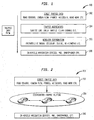
- FIG. 1 illustrates an architectural diagram of a traditional infrastructure-based traffic information system 100 for implementing route calculation taking into account congestion information.
- the system 100 includes a data acquisition layer 102, for collecting traffic data from road sensors, cameras, probes and the like.
- the collected data can be related to accidents, roadwork and so on.
- the collected data are aggregated and processed in a traffic aggregation layer 104 including a central unit, which can be provided by service providers, such as Navteq®, Inrix® and so on.
- the central unit performs various functions, including the function of calculating reduced travel time routes for the vehicles on the roadways.
- the data processed by the traffic aggregation layer 104 is subsequently distributed through a wireless distribution layer 106, which for example is implemented by FM or Satellite Radio.
- the information related to traffic congestion is fed to device layer 108 including in-vehicle navigation devices, smart phones or mobile phones, for conveying traffic information to drivers.
- US 2004/0073361 A1 discloses an enhanced mobile communication device and a transportation application thereof.
- the disclosed device communicates directly with other enhanced mobile communication devices in an ad-hoc mode over a wireless medium.
- the packets received and transmitted by the device comprise vehicle traffic congestion update information.
- the device maintains a traffic database and a map database. Traffic congestion update information is exchanged with other devices. Routes through the map from a source or current position of the device to a destination are computed according to an analysis of the traffic database.
- a method for distributed traffic navigation in a vehicular network comprises a plurality of road segments connected through a plurality of road junctions, and a plurality of vehicles operating on the road segments.
- the method comprises, at each vehicle entering the network, acquiring and storing information associated with the vehicular network, generating a destination address, and broadcasting the destination address as a route request.
- the method further comprises, at each vehicle in the network, updating the stored information through communication with at least one communicable vehicle.
- the method further comprises, at each junction, selecting a header vehicle, the header vehicle listening for broadcasts to determine the presence of a matrix, the header vehicle initializing the matrix based on the stored information of the header vehicle when the matrix is not present, the header vehicle estimating travel time on the road segments based on the matrix, the header vehicle computing a backlog indicator based on the travel time and the route request, the header vehicle updating the matrix based on the backlog indicator, the header vehicle generating a route based on the matrix, and the header vehicle broadcasting the matrix.
- a program storage device such as computer readable medium, readable by a machine, tangibly embodying a program of instructions executable by the machine to perform methods described herein may also be provided.
- the present invention advantageously provides a distributed vehicle traffic navigation system and method for calculating routes with minimum travel time for vehicles on roadways.
- FIG. 2 illustrates an architectural diagram of a distributed vehicle traffic navigation system 200 through vehicle to vehicle communication, according to an exemplary embodiment of the present invention.
- the system 200 includes a data acquisition layer 202 for collecting traffic data from road sensors, cameras, probes and the like. The collected data can be related to accidents, roadwork and so on.
- the system 200 further includes a distributed traffic data routing layer 204, in which the traffic data is communicated and exchanged between vehicles, without incurring centralized aggregation of all traffic-related data. In this manner, local information can be acquired to enhance the ability of the system to manage and navigate traffic data.
- the device layer 206 includes in-vehicle navigation devices, such as smart phones, mobile phones and so on, for conveying traffic information to a driver.
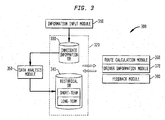
- Figure 3 illustrates a high-level functional block diagram of a distributed vehicle traffic data management system 300, according to an aspect of the present invention. Specifically, the operations performed at each vehicle support a distributed data management scheme.
- the block arrows denote information flow, queries, event triggers and so on; and the line arrows denote information flow.
- the system 300 includes an information input module 310, an information storage module 320 (including a short term or immediate database 330 and a historical database 340), a data analysis module 350, a route calculation module 360, a driver information module 370 and a feedback module 380.
- the information input module 310 includes an array of sensors, driver preferences, information obtained from other vehicles passively, information obtained from other vehicles via a lookup table and so on.
- the short term or immediate information database 330 stores the currently obtained information, the information being analyzed, and time sensitive information in the order of seconds or minutes. This may include, for example, the current estimate of the travel time on road segments and the like.
- the historical database 340 stores the information, which is trusted and relatively stable.
- the short term information may include nominal congestion profiles, event updates, road conditions that alter over days to weeks.
- the long term information may include road maps, construction work and the like, that alter over months.
- the data analysis module 350 performs the following functions.
- the data analysis module 350 categorizes information based on time sensitivity, and generates and updates averaged values for storage in the historical database 340.
- the data analysis module 350 performs a statistical analysis of information, including, for example, evaluation of congestion levels, elimination of outliers such as those deviating significantly from nominal traffic profiles and so on.
- the route calculation module 360 performs the function of calculating an optimal route for a vehicle based on traffic data, such as information relating to traffic congestion profiles, neighboring vehicle routes, information relating to short term aggregated congestion and so on.
- the driver information module 370 performs the function of providing information to drivers for roadway awareness. For example, the drivers can request information retrieved from a loop-up table through the driver information module 370.
- the feedback module 380 performs the function of updating the stored information based on driver's observation, driver's preferences, and other inputs.
- Table 1 shows a sample information database at a vehicle.
- Table 1 Info Lat/Lon Region Time Heading/Speed Other A B C
- the database can be, for example, in the form of a table, wherein each row corresponds to an information attribute named A, B and C, respectively.
- ancillary information such as position, region, time and so on, is stored.
- the table is updated instantly or in real time, when new traffic data is available, such as information relating to traffic, road condition, parking, potholes, safety, events and so on.
- the traffic data management system 300 utilizes scattered pieces of information present on the roadway to provide meaningful information to the driver. Since the information is not aggregated and processed at a central location before it is available to the drivers, the timeliness and accuracy of the data exchanged between the vehicles can be improved significantly, which in turn results in prompt response and flexible adaptation. Furthermore, without the geographical and logical restraints of the central unit, near term and short range information can be provided to the drivers.
- the distributed data aggregation achieved by the traffic data management system 300 can effectively improve the information quality available from traffic networks.
- commercially available service providers such as Navteq®, Inrix® and Total Traffic®, use road sensors, toll collection and so on to gather distributions of vehicles.
- Navteq®, Inrix® and Total Traffic® use road sensors, toll collection and so on to gather distributions of vehicles.
- translating from point density of vehicles to segment occupancy remains a challenging task without access to vehicle level length and driving behavior information.
- the application of vehicle traffic congestion prediction provided by the existing service providers remains unsatisfactory. Since the vehicle level length and driving behavior information can be accessed by the distributed data management system of the present invention in a small-scale region, much more accurate predictions can be realized.
- the traffic data management system 300 can be not only used independently to achieve efficient data communication between vehicles, but also can be used compatibly with existing traffic-based navigation systems to enhance and enrich the functionalities of the existing system, such that the existing systems can be complemented by providing the drivers with access to dynamic roadway information.
- the system has the capability to look up information in an on-demand fashion, which provides the drivers access to information that may not be available at the back-end server infrastructure, and enables access of near term and short range information to drivers.
- the system model used for generating a minimum travel time route for a vehicle and to dynamically update the travel route is defined as follows.
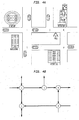
- Figure 4(a) illustrates a representation of a vehicular network as a graph
- Figure 4(b) illustrates a modeled graph of the network shown in Figure 4(a)
- the road segments are shown as edges and the road segments are connected through a plurality of junctions, such as intersections and/or interchanges, which are shown as nodes.
- the vehicular network of the present invention includes the road segments connected through junctions and the vehicles operating on the road segments.
- the direction of the edges shown in Figures 4(a) and 4(b) is the direction of vehicles on the street (one-way or two-ways). For considering bigger areas such as inter-city travel, a geographical region can also be treated as a vertex with major roads deemed to be edges.
- junction includes, for example, road intersections (including but not limited to stop signs and traffic lights) and road interchanges for highway (including but not limited to ramps, bridges and so on).
- the junctions are indexed by i and j and ij denotes the road between i and j .
- C ij can be dependent on road lengths, number of lanes, speed limits, safe following distances and so on.
- D ij depends on the number of vehicles entering the road segment, the road lengths, number of lanes, speed limits, safe following distances and so on.
- Length of cars is an additional parameter that can be leveraged to accurately translate from point densities to segment occupancy. The availability of such local information enhances the attractiveness of using a vehicle communication system to complement services from existing traffic information sources.
- the traffic and road conditions on each road segment can change rapidly with time, which are not reflected in paths suggested by known traffic information services.
- the system and method according to the present invention address this issue by dynamically computing from neighborhood information using a distributed algorithm, so as to ensure that the travel time is minimized while capturing the effect of altering roadway conditions and inter-dependence between the decisions at different vehicles.
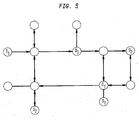
- Figure 5 illustrates a modeled graph showing the different traffic flows through the vehicular network.
- nodes S 1 , S 2 , and S 3 denote starting points of vehicles, that is, points at which vehicles enter the road network; and nodes D 1 , D 2 , and D 3 denote destination points of vehicles, that is, points at which the system assumes that the vehicles leave the road network.
- Numerous vehicles with different starting points and destination points travel through the network. The possibility of a vehicle of going through any given road segment depends on a number of factors such as intended destination, vehicle density, posted speed limit, current speeds and so on.
- Table 2 shows a matrix maintained and updated at each junction by vehicles.
- 'Des' denotes the destination numbered as 1, 2 and 3. Each row corresponds to a neighboring junction with names A, B, C and D. For example, consider the vehicles at current junction and headed to destination 2. The entry at B,2 (0.6) indicates the number of vehicles that should go towards junction B per unit time. This rate at the junction can be controlled based on local polling.
- the segment time and the capacity are the estimates of the parameters for the outgoing road segments. This matrix is updated at every iteration asynchronously.
- Figure 6 illustrates a distributed algorithm to update the matrix shown in Table 2.
- X kj r denotes variables that determine the number of vehicles at junction k that are intended for destination r and entering roadway kj per unit time.
- ⁇ is calculated based on the incoming and the outgoing traffic.
- ⁇ is calculated based on the total vehicles per unit time on each road segment and can be calculated at the junction.
- f k r is the rate at which new vehicles arrive at junction k and head to destination r.
- g k r is the rate at which vehicles at junction k reach their destination r.
- C kj represents the maximum number of vehicles per unit time at roadway kj so as to ensure a minimum speed level.
- C kj can be a function of road lengths, number of lanes, safe following distances and so on.
- D kj represents the current estimate of the time to travel from k to j and is a function of the vehicles entering the road segment as well as road lengths, number of lanes, road conditions and so on.
- D' kj denotes the derivative of the travel time function with respect to the traffic flow rates.
- ⁇ can be an arbitrary number larger than the minimum derivative of the travel time. At points where the function is non-differentiable, the assumption holds for the sub-gradients.
- the variable x n,r ij is the value of x ij r at the n -th iteration. [ ⁇ ]+ denotes the projection on [0, ⁇ ). At points where D' kj is non-differentiable, the sub-gradient is used instead.
- the iterative computation is only performed at junctions by vehicles currently at the junctions. In iteration n, a backlog indicator ⁇ n r,k is calculated at the junctions.
- the indicator can be represented using only two bits and needs to be communicated only to neighboring junctions though vehicle forwarding. Based on current congestion estimate on an outgoing road segment, a single bit congestion indicator a n kj is computed at the junctions.
- the computation can be done asynchronously at different junction vehicles and this eliminates the need for time synchronization. Moreover, the computation is dependent only on local information that can be gathered through vehicle to vehicle communication.
- FIG. 7 is a high-level flow diagram of the inventive method.
- steps A1 rates for the outgoing road segments are computed through vehicle to vehicle messages.
- vehicles send back the travel time towards the previous junction leading to knowledge of the flow rates, which results in estimation of changing travel time experienced at each outgoing road segment.
- step A2 any vehicle in the junction can be randomly chosen to maintain and update the matrix.
- the vehicle transfers the matrix to another vehicle while leaving the junction.
- the initialization in this step can be performed based on regular path information provided by navigation devices, which will significantly accelerate the convergence.
- route computation in a hierarchical manner based on sectors significantly reduces the state information that is maintained in the matrix, i.e., each sector may include of a set of collocated junctions.
- step A3 the matrix is updated in accordance with the distributed algorithm shown in Figure 6 , and an optimal travel route is chosen based on the contents of the matrix.
- step A4 it is determined whether a matrix is present at a different junction (such as a next junction). If the matrix is present, the process goes to step A3, for updating the matrix; otherwise, the process goes to step A2, for initializing the matrix.
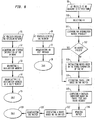
- FIG 8 is a flow diagram showing the detailed steps according to the inventive method.
- data is available to send in step S1.
- the vehicles acquire and store information associated with the vehicular network, including but not limited to traffic volume and congestion level of the vehicular network and the like.
- a destination address is generated by the entering vehicles in step S3, and the destination address is subsequently broadcasted in step S4 as a route request.
- the vehicles entering the road network wait for addition data from an application.
- step S6 data is available to send in step S6.
- step S7 the vehicles leaving the system broadcast an exit message.
- step S8 the vehicle leaving the system waits for additional data from an application.
- step S9 a vehicle is selected as Header Vehicle (HV). The selection can be performed based on a random countdown timer and vehicle ID. Other methods of selection can also be used.
- HV Header Vehicle
- step S15 the HV computes a backlog indicator based on the travel time experienced on the road segments and the route requests.
- the HV updates the matrix according to the distributed algorithm shown in Figure 6 , considering the backlog indicator.
- step S17 an optimal travel route is generated by the HV based on the contents of the matrix and the route is assigned to the neighboring vehicles.
- step S 18 the HV broadcasts the matrix at periodic intervals until the HV arrives at the next junction.
- the present invention provides a benefit of enabling route computation that dynamically updates based on conditions in different road segments.
- the method leverages vehicle to vehicle communication to achieve limited dissemination of congestion information in a local neighborhood.
- vehicle to vehicle communication performs well owing to availability of forwarding vehicles.
- congestion gets alleviated automatically.
- vehicle to vehicle communication becomes a natural choice for disseminating congestion information.
- aspects of the present disclosure may be embodied as a program, software, or computer instructions embodied in a computer or machine usable or readable medium, which causes the computer or machine to perform the steps of the method when executed on the computer, processor, and/or machine.
- a program storage device readable by a machine, tangibly embodying a program of instructions executable by the machine to perform various functionalities and methods described in the present disclosure is also provided.
- the system and method of the present disclosure may be implemented and run on a general-purpose computer or special-purpose computer system.
- the computer system may be any type of known or will be known systems and may typically include a processor, memory device, a storage device, input/output devices, internal buses, and/or a communications interface for communicating with other computer systems in conjunction with communication hardware and software, etc.
- the terms "computer system” and "computer network” as may be used in the present application may include a variety of combinations of fixed and/or portable computer hardware, software, peripherals, and storage devices.
- the computer system may include a plurality of individual components that are networked or otherwise linked to perform collaboratively, or may include one or more stand-alone components.
- the hardware and software components of the computer system of the present application may include and may be included within fixed and portable devices such as desktop, laptop, and server.
- a module may be a component of a device, software, program, or system that implements some "functionality", which can be embodied as software, hardware, firmware, electronic circuitry, or etc.
Landscapes
- Physics & Mathematics (AREA)
- General Physics & Mathematics (AREA)
- Life Sciences & Earth Sciences (AREA)
- Atmospheric Sciences (AREA)
- Engineering & Computer Science (AREA)
- Radar, Positioning & Navigation (AREA)
- Remote Sensing (AREA)
- Traffic Control Systems (AREA)
- Navigation (AREA)
Claims (14)
- Verfahren zur verteilten Verkehrs-Navigation in einem Fahrzeug-Netzwerk, wobei das Fahrzeug-Netzwerk eine Vielzahl von Straßensegmenten, die durch eine Vielzahl von Straßenkreuzungen verbunden sind, und eine Vielzahl von Fahrzeugen umfasst, die in den Straßensegmenten fahren, wobei das Verfahren folgende Schritte umfasst:bei jedem Fahrzeug (S1), das in das Netzwerk hineinfährt:Gewinnen und Speichern (S2) von Informationen, die mit dem Fahrzeug-Netzwerk verknüpft sind,Erzeugen (S3) einer Fahrtziel-AdresseundSenden (S4) der Fahrtziel-Adresse als Routen-Anforderung;bei jedem Fahrzeug in dem Netzwerk:Aktualisieren der gespeicherten Informationen durch Kommunikation mit mindestens einem kommunikationsfähigen Fahrzeugundbei jeder Kreuzung:Auswählen (S10) eines Leit-Fahrzeugs,wobei
das Leit-Fahrzeug Übermittlungen von anderen Fahrzeugen in dem Fahrzeug-Netzwerk zu empfangen versucht (S11), um das Vorliegen einer Matrix von Verkehrslast-Informationen zu ermitteln (S 12), die mit jedem Fahrtziel und jeder Kreuzung verknüpft sind,
das Leit-Fahrzeug die Matrix auf der Basis der gespeicherten Informationen des Leit-Fahrzeugs aktualisiert (S 13), wenn die Matrix in den Übermittlungen von den anderen Fahrzeugen nicht vorliegt,
das Leit-Fahrzeug die Fahrzeit in den Straßensegmenten auf der Basis der Matrix abschätzt (S 14),
das Leit-Fahrzeug einen Rückstau-Indikator auf der Basis der Fahrzeit und der Routen-Anforderung jedes Fahrzeugs berechnet (S 15),
das Leit-Fahrzeug die Matrix auf der Basis des Rückstau-Indikators aktualisiert (S16),
das Leit-Fahrzeug eine Route für jedes Fahrzeug auf der Basis der aktualisierten Matrix erzeugt (S 17)
und
das Leit-Fahrzeug die aktualisierte Matrix versendet (S18). - Verfahren nach Anspruch 1, das ferner umfasst: Zuordnen der Route (S 17) zu mindestens einem im Nahbereich befindlichen Fahrzeug.
- Verfahren nach Anspruch 1, das ferner umfasst: Gewinnen von Daten (S9), die mit einem Ort der Kreuzung verknüpft sind, bei jeder Kreuzung.
- Verfahren nach Anspruch 1, bei dem der Schritt des Auswählens (S10) auf der Basis eines rückwärts zählenden Zufalls-Timers und der Fahrzeug-Identität durchgeführt wird.
- Verfahren nach Anspruch 1, bei dem der Schritt des Sendens (S4) der Fahrtziel-Adresse als Routen-Anforderung periodisch durchgeführt wird.
- Verfahren nach Anspruch 1, bei dem der Schritt des Versendens (S18) der Matrix bei dem Leit-Fahrzeug periodisch durchgeführt wird, bis das Leit-Fahrzeug an einer unterschiedlichen Kreuzung ankommt.
- Verfahren nach Anspruch 1, das ferner umfasst: bei jedem Fahrzeug, welches das Netzwerk verlässt: Versenden einer Ausscheidensnachricht.
- Computerlesbares Medium mit einem zum Laufen auf einem Computer vorgesehenen computerlesbaren Programm zur verteilten Verkehrs-Navigation in einem Fahrzeug-Netzwerk, wobei das Fahrzeug-Netzwerk eine Vielzahl von Straßensegmenten, die durch eine Vielzahl von Straßenkreuzungen verbunden sind, und eine Vielzahl von Fahrzeugen umfasst, die in den Straßensegmenten fahren, wobei das Programm Befehle umfasst, die den Computer veranlassen, folgende Schritte durchzuführen:bei jedem Fahrzeug (S1), das in das Netzwerk hineinfährt:Gewinnen und Speichern (S2) von Informationen, die mit dem Fahrzeug-Netzwerk verknüpft sind,Erzeugen (S3) einer Fahrtziel-Adresse
undSenden (S4) der Fahrtziel-Adresse als Routen-Anforderung;bei jedem Fahrzeug in dem Netzwerk:Aktualisieren der gespeicherten Informationen durch Kommunikation mit mindestens einem kommunikationsfähigen Fahrzeug
undbei jeder Kreuzung:Auswählen (S10) eines Leit-Fahrzeugs,wobei
das Leit-Fahrzeug Übermittlungen von anderen Fahrzeugen in dem Fahrzeug-Netzwerk zu empfangen versucht (S11), um das Vorliegen einer Matrix von Verkehrslast-Informationen zu ermitteln (S 12), die mit jedem Fahrtziel und jeder Kreuzung verknüpft sind,
das Leit-Fahrzeug die Matrix auf der Basis der gespeicherten Informationen des Leit-Fahrzeugs aktualisiert (S 13), wenn die Matrix in den Übermittlungen von den anderen Fahrzeugen nicht vorliegt,
das Leit-Fahrzeug die Fahrzeit in den Straßensegmenten auf der Basis der Matrix abschätzt (S 14),
das Leit-Fahrzeug einen Rückstau-Indikator auf der Basis der Fahrzeit und der Routen-Anforderung jedes Fahrzeugs berechnet (S 15),
das Leit-Fahrzeug die Matrix auf der Basis des Rückstau-Indikators aktualisiert (S16),
das Leit-Fahrzeug eine Route für jedes Fahrzeug auf der Basis der aktualisierten Matrix erzeugt (S 17)
und
das Leit-Fahrzeug die aktualisierte Matrix versendet (S18). - Programm nach Anspruch 8, das ferner umfasst: Zuordnen der Route (S 17) zu mindestens einem im Nahbereich befindlichen Fahrzeug.
- Programm nach Anspruch 8, das ferner umfasst: Gewinnen von Daten (S9), die mit einem Ort der Kreuzung verknüpft sind, bei jeder Kreuzung.
- Programm nach Anspruch 8, bei dem der Schritt des Auswählens (S10) auf der Basis eines rückwärts zählenden Zufalls-Timers und der Fahrzeug-Identität durchgeführt wird.
- Programm nach Anspruch 8, bei dem der Schritt des Sendens (S4) der Fahrtziel-Adresse als Routen-Anforderung periodisch durchgeführt wird.
- Programm nach Anspruch 8, bei dem der Schritt des Versendens (S18) der Matrix bei dem Leit-Fahrzeug periodisch durchgeführt wird, bis das Leit-Fahrzeug an einer unterschiedlichen Kreuzung ankommt.
- Programm nach Anspruch 8, das ferner umfasst: bei jedem Fahrzeug, welches das Netzwerk verlässt: Versenden einer Ausscheidensnachricht.
Applications Claiming Priority (4)
| Application Number | Priority Date | Filing Date | Title |
|---|---|---|---|
| US23253809P | 2009-08-10 | 2009-08-10 | |
| US23253609P | 2009-08-10 | 2009-08-10 | |
| US12/646,277 US8589073B2 (en) | 2009-08-10 | 2009-12-23 | Distributed traffic navigation using vehicular communication |
| PCT/US2010/044827 WO2011019627A1 (en) | 2009-08-10 | 2010-08-09 | Distributed traffic navigation using vehicular communication |
Publications (3)
| Publication Number | Publication Date |
|---|---|
| EP2473820A1 EP2473820A1 (de) | 2012-07-11 |
| EP2473820A4 EP2473820A4 (de) | 2014-09-03 |
| EP2473820B1 true EP2473820B1 (de) | 2016-10-05 |
Family
ID=43535463
Family Applications (1)
| Application Number | Title | Priority Date | Filing Date |
|---|---|---|---|
| EP10808570.5A Active EP2473820B1 (de) | 2009-08-10 | 2010-08-09 | Verteilte verkehrsnavigation unter verwendung von fahrzeugkommunikation |
Country Status (4)
| Country | Link |
|---|---|
| US (1) | US8589073B2 (de) |
| EP (1) | EP2473820B1 (de) |
| JP (1) | JP5602856B2 (de) |
| WO (1) | WO2011019627A1 (de) |
Families Citing this family (41)
| Publication number | Priority date | Publication date | Assignee | Title |
|---|---|---|---|---|
| WO2011133016A2 (en) * | 2010-04-20 | 2011-10-27 | Dr Ir Tee Clarence Augustine Teck Huo | Junction adaptive reactive routing (jarr) protocol for vehicular ad-hoc networks in a city environment [1-3]. |
| US8897948B2 (en) * | 2010-09-27 | 2014-11-25 | Toyota | Systems and methods for estimating local traffic flow |
| DE102011013453A1 (de) * | 2011-03-09 | 2012-09-13 | Siemens Aktiengesellschaft | Energieverteilnetz für mit Akkus versehenen Elektroautos |
| US8744736B2 (en) * | 2011-07-28 | 2014-06-03 | GM Global Technology Operations LLC | Method and apparatus for updating travel time estimation |
| US9349234B2 (en) * | 2012-03-14 | 2016-05-24 | Autoconnect Holdings Llc | Vehicle to vehicle social and business communications |
| US9497564B2 (en) * | 2013-02-05 | 2016-11-15 | Qualcomm Incorporated | Apparatus and method for optimal scheduling of envelope updates to SIM card |
| US9791282B2 (en) * | 2014-09-27 | 2017-10-17 | Intel Corporation | Technologies for route navigation sharing in a community cloud |
| US10069919B2 (en) * | 2014-10-08 | 2018-09-04 | Huawei Technologies Co., Ltd. | Method for exchanging information between in-vehicle terminals and in-vehicle terminal |
| CN105761520A (zh) * | 2014-12-17 | 2016-07-13 | 上海宝康电子控制工程有限公司 | 实现交通路线自适应诱导的系统 |
| US11182870B2 (en) | 2014-12-24 | 2021-11-23 | Mcafee, Llc | System and method for collective and collaborative navigation by a group of individuals |
| CN105070078B (zh) * | 2015-08-16 | 2017-03-22 | 吉林大学 | 一种基于车车通信的动态路径诱导方法 |
| NO341085B1 (en) * | 2015-09-22 | 2017-08-21 | Eilertsen Roger Andre | A method and system of linear road sampling providing road traffic flow measurements |
| US10692126B2 (en) | 2015-11-17 | 2020-06-23 | Nio Usa, Inc. | Network-based system for selling and servicing cars |
| US20170295471A1 (en) * | 2016-04-07 | 2017-10-12 | Industrial Technology Research Institute | Access point in geographic routing system and controlling method thereof |
| US20180012197A1 (en) | 2016-07-07 | 2018-01-11 | NextEv USA, Inc. | Battery exchange licensing program based on state of charge of battery pack |
| US9928734B2 (en) | 2016-08-02 | 2018-03-27 | Nio Usa, Inc. | Vehicle-to-pedestrian communication systems |
| US10031523B2 (en) | 2016-11-07 | 2018-07-24 | Nio Usa, Inc. | Method and system for behavioral sharing in autonomous vehicles |
| US10708547B2 (en) | 2016-11-11 | 2020-07-07 | Nio Usa, Inc. | Using vehicle sensor data to monitor environmental and geologic conditions |
| US10410064B2 (en) | 2016-11-11 | 2019-09-10 | Nio Usa, Inc. | System for tracking and identifying vehicles and pedestrians |
| US10694357B2 (en) | 2016-11-11 | 2020-06-23 | Nio Usa, Inc. | Using vehicle sensor data to monitor pedestrian health |
| US10699305B2 (en) | 2016-11-21 | 2020-06-30 | Nio Usa, Inc. | Smart refill assistant for electric vehicles |
| US10249104B2 (en) | 2016-12-06 | 2019-04-02 | Nio Usa, Inc. | Lease observation and event recording |
| US10074223B2 (en) | 2017-01-13 | 2018-09-11 | Nio Usa, Inc. | Secured vehicle for user use only |
| US9984572B1 (en) | 2017-01-16 | 2018-05-29 | Nio Usa, Inc. | Method and system for sharing parking space availability among autonomous vehicles |
| US10471829B2 (en) | 2017-01-16 | 2019-11-12 | Nio Usa, Inc. | Self-destruct zone and autonomous vehicle navigation |
| US10031521B1 (en) | 2017-01-16 | 2018-07-24 | Nio Usa, Inc. | Method and system for using weather information in operation of autonomous vehicles |
| US10464530B2 (en) | 2017-01-17 | 2019-11-05 | Nio Usa, Inc. | Voice biometric pre-purchase enrollment for autonomous vehicles |
| US10286915B2 (en) | 2017-01-17 | 2019-05-14 | Nio Usa, Inc. | Machine learning for personalized driving |
| US10897469B2 (en) | 2017-02-02 | 2021-01-19 | Nio Usa, Inc. | System and method for firewalls between vehicle networks |
| EP3418998A1 (de) * | 2017-06-22 | 2018-12-26 | Nokia Technologies Oy | Strassenverkehrsverwaltung |
| US10234302B2 (en) | 2017-06-27 | 2019-03-19 | Nio Usa, Inc. | Adaptive route and motion planning based on learned external and internal vehicle environment |
| US10710633B2 (en) | 2017-07-14 | 2020-07-14 | Nio Usa, Inc. | Control of complex parking maneuvers and autonomous fuel replenishment of driverless vehicles |
| US10369974B2 (en) | 2017-07-14 | 2019-08-06 | Nio Usa, Inc. | Control and coordination of driverless fuel replenishment for autonomous vehicles |
| US10837790B2 (en) | 2017-08-01 | 2020-11-17 | Nio Usa, Inc. | Productive and accident-free driving modes for a vehicle |
| US10635109B2 (en) | 2017-10-17 | 2020-04-28 | Nio Usa, Inc. | Vehicle path-planner monitor and controller |
| US11486718B2 (en) | 2017-10-25 | 2022-11-01 | Tata Consultancy Services Limited | Predicting vehicle travel time on routes of unbounded length in arterial roads |
| US10606274B2 (en) | 2017-10-30 | 2020-03-31 | Nio Usa, Inc. | Visual place recognition based self-localization for autonomous vehicles |
| US10935978B2 (en) | 2017-10-30 | 2021-03-02 | Nio Usa, Inc. | Vehicle self-localization using particle filters and visual odometry |
| US10717412B2 (en) | 2017-11-13 | 2020-07-21 | Nio Usa, Inc. | System and method for controlling a vehicle using secondary access methods |
| US10369966B1 (en) | 2018-05-23 | 2019-08-06 | Nio Usa, Inc. | Controlling access to a vehicle using wireless access devices |
| CN114372182B (zh) * | 2021-12-24 | 2024-07-23 | 东南大学 | 基于od矩阵反推特定时间多种交通方式出行分布分析方法 |
Family Cites Families (20)
| Publication number | Priority date | Publication date | Assignee | Title |
|---|---|---|---|---|
| US5610821A (en) * | 1994-11-18 | 1997-03-11 | Ibm Corporation | Optimal and stable route planning system |
| US7418346B2 (en) * | 1997-10-22 | 2008-08-26 | Intelligent Technologies International, Inc. | Collision avoidance methods and systems |
| US7983836B2 (en) * | 1997-10-22 | 2011-07-19 | Intelligent Technologies International, Inc. | Vehicle-traffic control device communication techniques |
| SE512895C2 (sv) * | 1998-08-07 | 2000-05-29 | Dinbis Ab | Metod och anordning för ruttstyrning av trafik |
| US7280545B1 (en) * | 2001-12-20 | 2007-10-09 | Nagle Darragh J | Complex adaptive routing system and method for a nodal communication network |
| US20040073361A1 (en) * | 2002-10-15 | 2004-04-15 | Assimakis Tzamaloukas | Enhanced mobile communication device, and transportation application thereof |
| US6868333B2 (en) * | 2003-01-15 | 2005-03-15 | Toyota Infotechnology Center Co., Ltd. | Group interaction system for interaction with other vehicles of a group |
| US20070168118A1 (en) * | 2003-06-27 | 2007-07-19 | Dirk Lappe | System for coordinating the routes of navigation devices |
| EP1491858A1 (de) * | 2003-06-27 | 2004-12-29 | Harman Becker Automotive Systems GmbH | Navigationsverfahren und -System |
| US20060031003A1 (en) * | 2004-08-03 | 2006-02-09 | QiLun Sun | Distributed Traffic Information System |
| US7970540B2 (en) * | 2004-11-08 | 2011-06-28 | Toyota Motor Engineering & Manufacturing North America, Inc. | System and method of vehicular wireless communication using an integrated coordinating access point |
| US8254301B2 (en) * | 2005-11-22 | 2012-08-28 | Telcordia Technologies, Inc. | Group-header based method to organize local peer group of vehicles for inter-vehicle communication |
| US20070135990A1 (en) * | 2005-12-08 | 2007-06-14 | Seymour Shafer B | Navigation route information for traffic management |
| US7848278B2 (en) * | 2006-10-23 | 2010-12-07 | Telcordia Technologies, Inc. | Roadside network unit and method of organizing, managing and maintaining local network using local peer groups as network groups |
| FR2912587A1 (fr) * | 2007-02-09 | 2008-08-15 | France Telecom | Procede d'estimation et de signalisation de la densite de noeuds mobiles dans un reseau routier. |
| EP1959414B1 (de) * | 2007-02-14 | 2010-11-10 | Hitachi, Ltd. | Verfahren und Vorrichtung zum Schätzen der Reisezeit einer Reiseroute |
| US8351417B2 (en) * | 2008-05-14 | 2013-01-08 | Telcordia Technologies, Inc. | Methods for efficient organization of vehicle peer groups and efficient V2R communications |
| US8108141B2 (en) * | 2008-08-28 | 2012-01-31 | Empire Technology Development Llc | Intelligent travel routing system and method |
| TWI392847B (zh) * | 2009-04-15 | 2013-04-11 | Ind Tech Res Inst | 車隊維持方法及車載通訊系統 |
| US8706407B2 (en) * | 2011-03-30 | 2014-04-22 | Nokia Corporation | Method and apparatus for generating route exceptions |
-
2009
- 2009-12-23 US US12/646,277 patent/US8589073B2/en not_active Expired - Fee Related
-
2010
- 2010-08-09 EP EP10808570.5A patent/EP2473820B1/de active Active
- 2010-08-09 WO PCT/US2010/044827 patent/WO2011019627A1/en not_active Ceased
- 2010-08-09 JP JP2012524766A patent/JP5602856B2/ja active Active
Also Published As
| Publication number | Publication date |
|---|---|
| EP2473820A4 (de) | 2014-09-03 |
| JP2013501938A (ja) | 2013-01-17 |
| JP5602856B2 (ja) | 2014-10-08 |
| US20110035146A1 (en) | 2011-02-10 |
| EP2473820A1 (de) | 2012-07-11 |
| WO2011019627A1 (en) | 2011-02-17 |
| US8589073B2 (en) | 2013-11-19 |
Similar Documents
| Publication | Publication Date | Title |
|---|---|---|
| EP2473820B1 (de) | Verteilte verkehrsnavigation unter verwendung von fahrzeugkommunikation | |
| US6463382B1 (en) | Method of optimizing traffic content | |
| US10724870B2 (en) | Method of planning a route to a destination | |
| US10309794B2 (en) | Progressive map maintenance at a mobile navigation unit | |
| US11348453B2 (en) | Method and apparatus for dynamic speed aggregation of probe data for high-occupancy vehicle lanes | |
| CN101636771B (zh) | 行程时间运算服务器、车辆用行程时间运算装置及行程时间运算系统 | |
| EP1959414B1 (de) | Verfahren und Vorrichtung zum Schätzen der Reisezeit einer Reiseroute | |
| EP2154663B1 (de) | Verfahren und Vorrichtung zur Bestimmung von Verkehrsdaten | |
| TW201341759A (zh) | 將上下文與歷史資料整合至路線決定之技術 | |
| US11662215B2 (en) | Method, apparatus, and computer program product for anonymizing trajectories | |
| Lakas et al. | Detection and dissipation of road traffic congestion using vehicular communication | |
| CN1952993B (zh) | 交通信息处理装置和方法、车辆功能管理系统 | |
| Xu et al. | Travel time estimation techniques for traffic information systems based on intervehicle communications | |
| Lee et al. | Dove: Data offloading through spatio-temporal rendezvous in vehicular networks | |
| Meuser et al. | Relevance-aware information dissemination in vehicular networks | |
| US20240203246A1 (en) | Methods and systems for predicting traffic information for at least one map tile area | |
| JP4625335B2 (ja) | 渋滞緩和支援システムおよび車載端末 | |
| Sumon et al. | Fuel efficient route planning using vanet | |
| JP2004240543A (ja) | 移動体旅行時間提供装置 | |
| US20260036432A1 (en) | System and method for determining optimal route | |
| JPWO2019159429A1 (ja) | 管理装置、車載装置、データ収集システム、データ収集方法およびデータ収集プログラム | |
| Subramaniam et al. | A CERTAIN INVESTIGATION OF SMART SYSTEM FOR REGULATING VANET TRAFFIC WITH PROBABLE PATH PLANNING | |
| Subramaniam et al. | A certain investigation of smart system for regulating vanet traffic with probable path planning [articol] | |
| Miller | Analysis of fastest and shortest paths in an urban city using live vehicle data from a vehicle-to-infrastructure architecture | |
| HK1117227A (en) | A method of and a navigation device for time-dependent route planning |
Legal Events
| Date | Code | Title | Description |
|---|---|---|---|
| PUAI | Public reference made under article 153(3) epc to a published international application that has entered the european phase |
Free format text: ORIGINAL CODE: 0009012 |
|
| 17P | Request for examination filed |
Effective date: 20120312 |
|
| AK | Designated contracting states |
Kind code of ref document: A1 Designated state(s): AL AT BE BG CH CY CZ DE DK EE ES FI FR GB GR HR HU IE IS IT LI LT LU LV MC MK MT NL NO PL PT RO SE SI SK SM TR |
|
| DAX | Request for extension of the european patent (deleted) | ||
| REG | Reference to a national code |
Ref country code: DE Ref legal event code: R079 Ref document number: 602010037013 Country of ref document: DE Free format text: PREVIOUS MAIN CLASS: G01C0021000000 Ipc: G08G0001096800 |
|
| A4 | Supplementary search report drawn up and despatched |
Effective date: 20140805 |
|
| RIC1 | Information provided on ipc code assigned before grant |
Ipc: G08G 1/0967 20060101ALI20140730BHEP Ipc: G08G 1/0968 20060101AFI20140730BHEP |
|
| GRAP | Despatch of communication of intention to grant a patent |
Free format text: ORIGINAL CODE: EPIDOSNIGR1 |
|
| INTG | Intention to grant announced |
Effective date: 20160425 |
|
| GRAS | Grant fee paid |
Free format text: ORIGINAL CODE: EPIDOSNIGR3 |
|
| GRAA | (expected) grant |
Free format text: ORIGINAL CODE: 0009210 |
|
| RAP1 | Party data changed (applicant data changed or rights of an application transferred) |
Owner name: TELCORDIA TECHNOLOGIES, INC. |
|
| AK | Designated contracting states |
Kind code of ref document: B1 Designated state(s): AL AT BE BG CH CY CZ DE DK EE ES FI FR GB GR HR HU IE IS IT LI LT LU LV MC MK MT NL NO PL PT RO SE SI SK SM TR |
|
| REG | Reference to a national code |
Ref country code: GB Ref legal event code: FG4D |
|
| REG | Reference to a national code |
Ref country code: CH Ref legal event code: EP |
|
| REG | Reference to a national code |
Ref country code: AT Ref legal event code: REF Ref document number: 835215 Country of ref document: AT Kind code of ref document: T Effective date: 20161015 |
|
| REG | Reference to a national code |
Ref country code: IE Ref legal event code: FG4D |
|
| REG | Reference to a national code |
Ref country code: DE Ref legal event code: R096 Ref document number: 602010037013 Country of ref document: DE |
|
| REG | Reference to a national code |
Ref country code: NL Ref legal event code: MP Effective date: 20161005 |
|
| REG | Reference to a national code |
Ref country code: LT Ref legal event code: MG4D |
|
| PG25 | Lapsed in a contracting state [announced via postgrant information from national office to epo] |
Ref country code: LV Free format text: LAPSE BECAUSE OF FAILURE TO SUBMIT A TRANSLATION OF THE DESCRIPTION OR TO PAY THE FEE WITHIN THE PRESCRIBED TIME-LIMIT Effective date: 20161005 |
|
| REG | Reference to a national code |
Ref country code: AT Ref legal event code: MK05 Ref document number: 835215 Country of ref document: AT Kind code of ref document: T Effective date: 20161005 |
|
| PG25 | Lapsed in a contracting state [announced via postgrant information from national office to epo] |
Ref country code: SE Free format text: LAPSE BECAUSE OF FAILURE TO SUBMIT A TRANSLATION OF THE DESCRIPTION OR TO PAY THE FEE WITHIN THE PRESCRIBED TIME-LIMIT Effective date: 20161005 Ref country code: GR Free format text: LAPSE BECAUSE OF FAILURE TO SUBMIT A TRANSLATION OF THE DESCRIPTION OR TO PAY THE FEE WITHIN THE PRESCRIBED TIME-LIMIT Effective date: 20170106 Ref country code: LT Free format text: LAPSE BECAUSE OF FAILURE TO SUBMIT A TRANSLATION OF THE DESCRIPTION OR TO PAY THE FEE WITHIN THE PRESCRIBED TIME-LIMIT Effective date: 20161005 Ref country code: NO Free format text: LAPSE BECAUSE OF FAILURE TO SUBMIT A TRANSLATION OF THE DESCRIPTION OR TO PAY THE FEE WITHIN THE PRESCRIBED TIME-LIMIT Effective date: 20170105 |
|
| PG25 | Lapsed in a contracting state [announced via postgrant information from national office to epo] |
Ref country code: PL Free format text: LAPSE BECAUSE OF FAILURE TO SUBMIT A TRANSLATION OF THE DESCRIPTION OR TO PAY THE FEE WITHIN THE PRESCRIBED TIME-LIMIT Effective date: 20161005 Ref country code: BE Free format text: LAPSE BECAUSE OF FAILURE TO SUBMIT A TRANSLATION OF THE DESCRIPTION OR TO PAY THE FEE WITHIN THE PRESCRIBED TIME-LIMIT Effective date: 20161005 Ref country code: IS Free format text: LAPSE BECAUSE OF FAILURE TO SUBMIT A TRANSLATION OF THE DESCRIPTION OR TO PAY THE FEE WITHIN THE PRESCRIBED TIME-LIMIT Effective date: 20170205 Ref country code: AT Free format text: LAPSE BECAUSE OF FAILURE TO SUBMIT A TRANSLATION OF THE DESCRIPTION OR TO PAY THE FEE WITHIN THE PRESCRIBED TIME-LIMIT Effective date: 20161005 Ref country code: ES Free format text: LAPSE BECAUSE OF FAILURE TO SUBMIT A TRANSLATION OF THE DESCRIPTION OR TO PAY THE FEE WITHIN THE PRESCRIBED TIME-LIMIT Effective date: 20161005 Ref country code: PT Free format text: LAPSE BECAUSE OF FAILURE TO SUBMIT A TRANSLATION OF THE DESCRIPTION OR TO PAY THE FEE WITHIN THE PRESCRIBED TIME-LIMIT Effective date: 20170206 Ref country code: NL Free format text: LAPSE BECAUSE OF FAILURE TO SUBMIT A TRANSLATION OF THE DESCRIPTION OR TO PAY THE FEE WITHIN THE PRESCRIBED TIME-LIMIT Effective date: 20161005 Ref country code: FI Free format text: LAPSE BECAUSE OF FAILURE TO SUBMIT A TRANSLATION OF THE DESCRIPTION OR TO PAY THE FEE WITHIN THE PRESCRIBED TIME-LIMIT Effective date: 20161005 Ref country code: HR Free format text: LAPSE BECAUSE OF FAILURE TO SUBMIT A TRANSLATION OF THE DESCRIPTION OR TO PAY THE FEE WITHIN THE PRESCRIBED TIME-LIMIT Effective date: 20161005 |
|
| REG | Reference to a national code |
Ref country code: DE Ref legal event code: R097 Ref document number: 602010037013 Country of ref document: DE |
|
| PG25 | Lapsed in a contracting state [announced via postgrant information from national office to epo] |
Ref country code: RO Free format text: LAPSE BECAUSE OF FAILURE TO SUBMIT A TRANSLATION OF THE DESCRIPTION OR TO PAY THE FEE WITHIN THE PRESCRIBED TIME-LIMIT Effective date: 20161005 Ref country code: EE Free format text: LAPSE BECAUSE OF FAILURE TO SUBMIT A TRANSLATION OF THE DESCRIPTION OR TO PAY THE FEE WITHIN THE PRESCRIBED TIME-LIMIT Effective date: 20161005 Ref country code: DK Free format text: LAPSE BECAUSE OF FAILURE TO SUBMIT A TRANSLATION OF THE DESCRIPTION OR TO PAY THE FEE WITHIN THE PRESCRIBED TIME-LIMIT Effective date: 20161005 Ref country code: CZ Free format text: LAPSE BECAUSE OF FAILURE TO SUBMIT A TRANSLATION OF THE DESCRIPTION OR TO PAY THE FEE WITHIN THE PRESCRIBED TIME-LIMIT Effective date: 20161005 Ref country code: SK Free format text: LAPSE BECAUSE OF FAILURE TO SUBMIT A TRANSLATION OF THE DESCRIPTION OR TO PAY THE FEE WITHIN THE PRESCRIBED TIME-LIMIT Effective date: 20161005 |
|
| PLBE | No opposition filed within time limit |
Free format text: ORIGINAL CODE: 0009261 |
|
| STAA | Information on the status of an ep patent application or granted ep patent |
Free format text: STATUS: NO OPPOSITION FILED WITHIN TIME LIMIT |
|
| REG | Reference to a national code |
Ref country code: FR Ref legal event code: PLFP Year of fee payment: 8 |
|
| PG25 | Lapsed in a contracting state [announced via postgrant information from national office to epo] |
Ref country code: SM Free format text: LAPSE BECAUSE OF FAILURE TO SUBMIT A TRANSLATION OF THE DESCRIPTION OR TO PAY THE FEE WITHIN THE PRESCRIBED TIME-LIMIT Effective date: 20161005 Ref country code: BG Free format text: LAPSE BECAUSE OF FAILURE TO SUBMIT A TRANSLATION OF THE DESCRIPTION OR TO PAY THE FEE WITHIN THE PRESCRIBED TIME-LIMIT Effective date: 20170105 Ref country code: IT Free format text: LAPSE BECAUSE OF FAILURE TO SUBMIT A TRANSLATION OF THE DESCRIPTION OR TO PAY THE FEE WITHIN THE PRESCRIBED TIME-LIMIT Effective date: 20161005 |
|
| 26N | No opposition filed |
Effective date: 20170706 |
|
| PG25 | Lapsed in a contracting state [announced via postgrant information from national office to epo] |
Ref country code: SI Free format text: LAPSE BECAUSE OF FAILURE TO SUBMIT A TRANSLATION OF THE DESCRIPTION OR TO PAY THE FEE WITHIN THE PRESCRIBED TIME-LIMIT Effective date: 20161005 |
|
| REG | Reference to a national code |
Ref country code: CH Ref legal event code: PL |
|
| PG25 | Lapsed in a contracting state [announced via postgrant information from national office to epo] |
Ref country code: MC Free format text: LAPSE BECAUSE OF FAILURE TO SUBMIT A TRANSLATION OF THE DESCRIPTION OR TO PAY THE FEE WITHIN THE PRESCRIBED TIME-LIMIT Effective date: 20161005 |
|
| PG25 | Lapsed in a contracting state [announced via postgrant information from national office to epo] |
Ref country code: LI Free format text: LAPSE BECAUSE OF NON-PAYMENT OF DUE FEES Effective date: 20170831 Ref country code: CH Free format text: LAPSE BECAUSE OF NON-PAYMENT OF DUE FEES Effective date: 20170831 |
|
| REG | Reference to a national code |
Ref country code: IE Ref legal event code: MM4A |
|
| PG25 | Lapsed in a contracting state [announced via postgrant information from national office to epo] |
Ref country code: LU Free format text: LAPSE BECAUSE OF NON-PAYMENT OF DUE FEES Effective date: 20170809 |
|
| PG25 | Lapsed in a contracting state [announced via postgrant information from national office to epo] |
Ref country code: IE Free format text: LAPSE BECAUSE OF NON-PAYMENT OF DUE FEES Effective date: 20170809 |
|
| REG | Reference to a national code |
Ref country code: FR Ref legal event code: PLFP Year of fee payment: 9 |
|
| PG25 | Lapsed in a contracting state [announced via postgrant information from national office to epo] |
Ref country code: MT Free format text: LAPSE BECAUSE OF NON-PAYMENT OF DUE FEES Effective date: 20170809 |
|
| PG25 | Lapsed in a contracting state [announced via postgrant information from national office to epo] |
Ref country code: HU Free format text: LAPSE BECAUSE OF FAILURE TO SUBMIT A TRANSLATION OF THE DESCRIPTION OR TO PAY THE FEE WITHIN THE PRESCRIBED TIME-LIMIT; INVALID AB INITIO Effective date: 20100809 |
|
| PG25 | Lapsed in a contracting state [announced via postgrant information from national office to epo] |
Ref country code: CY Free format text: LAPSE BECAUSE OF NON-PAYMENT OF DUE FEES Effective date: 20161005 |
|
| PG25 | Lapsed in a contracting state [announced via postgrant information from national office to epo] |
Ref country code: MK Free format text: LAPSE BECAUSE OF FAILURE TO SUBMIT A TRANSLATION OF THE DESCRIPTION OR TO PAY THE FEE WITHIN THE PRESCRIBED TIME-LIMIT Effective date: 20161005 |
|
| PG25 | Lapsed in a contracting state [announced via postgrant information from national office to epo] |
Ref country code: TR Free format text: LAPSE BECAUSE OF FAILURE TO SUBMIT A TRANSLATION OF THE DESCRIPTION OR TO PAY THE FEE WITHIN THE PRESCRIBED TIME-LIMIT Effective date: 20161005 |
|
| PG25 | Lapsed in a contracting state [announced via postgrant information from national office to epo] |
Ref country code: AL Free format text: LAPSE BECAUSE OF FAILURE TO SUBMIT A TRANSLATION OF THE DESCRIPTION OR TO PAY THE FEE WITHIN THE PRESCRIBED TIME-LIMIT Effective date: 20161005 |
|
| PGFP | Annual fee paid to national office [announced via postgrant information from national office to epo] |
Ref country code: DE Payment date: 20250827 Year of fee payment: 16 |
|
| PGFP | Annual fee paid to national office [announced via postgrant information from national office to epo] |
Ref country code: GB Payment date: 20250827 Year of fee payment: 16 |
|
| PGFP | Annual fee paid to national office [announced via postgrant information from national office to epo] |
Ref country code: FR Payment date: 20250825 Year of fee payment: 16 |