EP2474270A2 - Appareil d'extraction chirurgicale pour procédures thoraciques - Google Patents
Appareil d'extraction chirurgicale pour procédures thoraciques Download PDFInfo
- Publication number
- EP2474270A2 EP2474270A2 EP12150271A EP12150271A EP2474270A2 EP 2474270 A2 EP2474270 A2 EP 2474270A2 EP 12150271 A EP12150271 A EP 12150271A EP 12150271 A EP12150271 A EP 12150271A EP 2474270 A2 EP2474270 A2 EP 2474270A2
- Authority
- EP
- European Patent Office
- Prior art keywords
- shaft
- end effector
- effector assembly
- disposed
- articulation
- Prior art date
- Legal status (The legal status is an assumption and is not a legal conclusion. Google has not performed a legal analysis and makes no representation as to the accuracy of the status listed.)
- Withdrawn
Links
- 238000000034 method Methods 0.000 title description 27
- 210000000115 thoracic cavity Anatomy 0.000 title description 17
- 239000012636 effector Substances 0.000 claims abstract description 147
- 230000007246 mechanism Effects 0.000 claims abstract description 47
- 238000013519 translation Methods 0.000 claims description 47
- 230000007704 transition Effects 0.000 claims description 12
- 230000000694 effects Effects 0.000 claims description 3
- 238000003780 insertion Methods 0.000 description 30
- 230000037431 insertion Effects 0.000 description 30
- 230000000717 retained effect Effects 0.000 description 7
- 238000001356 surgical procedure Methods 0.000 description 6
- 239000012530 fluid Substances 0.000 description 5
- 206010028980 Neoplasm Diseases 0.000 description 4
- 230000002401 inhibitory effect Effects 0.000 description 4
- 239000000463 material Substances 0.000 description 4
- 238000010899 nucleation Methods 0.000 description 3
- 201000011510 cancer Diseases 0.000 description 2
- 239000011248 coating agent Substances 0.000 description 2
- 238000000576 coating method Methods 0.000 description 2
- 208000014674 injury Diseases 0.000 description 2
- 230000003601 intercostal effect Effects 0.000 description 2
- 210000004072 lung Anatomy 0.000 description 2
- 238000002324 minimally invasive surgery Methods 0.000 description 2
- 238000012978 minimally invasive surgical procedure Methods 0.000 description 2
- 238000012986 modification Methods 0.000 description 2
- 230000004048 modification Effects 0.000 description 2
- 210000000056 organ Anatomy 0.000 description 2
- 238000011084 recovery Methods 0.000 description 2
- 230000008733 trauma Effects 0.000 description 2
- 206010011732 Cyst Diseases 0.000 description 1
- 239000004677 Nylon Substances 0.000 description 1
- 239000000560 biocompatible material Substances 0.000 description 1
- 239000012620 biological material Substances 0.000 description 1
- 238000002192 cholecystectomy Methods 0.000 description 1
- 230000006835 compression Effects 0.000 description 1
- 238000007906 compression Methods 0.000 description 1
- 230000008878 coupling Effects 0.000 description 1
- 238000010168 coupling process Methods 0.000 description 1
- 238000005859 coupling reaction Methods 0.000 description 1
- 208000031513 cyst Diseases 0.000 description 1
- 230000007423 decrease Effects 0.000 description 1
- 230000000994 depressogenic effect Effects 0.000 description 1
- -1 e.g. Substances 0.000 description 1
- 238000000605 extraction Methods 0.000 description 1
- 239000006260 foam Substances 0.000 description 1
- 230000000670 limiting effect Effects 0.000 description 1
- 230000014759 maintenance of location Effects 0.000 description 1
- 238000013059 nephrectomy Methods 0.000 description 1
- 229920001778 nylon Polymers 0.000 description 1
- 230000036961 partial effect Effects 0.000 description 1
- 230000007170 pathology Effects 0.000 description 1
- 239000011527 polyurethane coating Substances 0.000 description 1
- 230000002829 reductive effect Effects 0.000 description 1
- 238000002271 resection Methods 0.000 description 1
- 238000007493 shaping process Methods 0.000 description 1
- 230000007480 spreading Effects 0.000 description 1
- 238000012800 visualization Methods 0.000 description 1
Images







Classifications
-
- A—HUMAN NECESSITIES
- A61—MEDICAL OR VETERINARY SCIENCE; HYGIENE
- A61B—DIAGNOSIS; SURGERY; IDENTIFICATION
- A61B17/00—Surgical instruments, devices or methods
- A61B17/22—Implements for squeezing-off ulcers or the like on inner organs of the body; Implements for scraping-out cavities of body organs, e.g. bones; for invasive removal or destruction of calculus using mechanical vibrations; for removing obstructions in blood vessels, not otherwise provided for
- A61B17/221—Gripping devices in the form of loops or baskets for gripping calculi or similar types of obstructions
-
- A—HUMAN NECESSITIES
- A61—MEDICAL OR VETERINARY SCIENCE; HYGIENE
- A61B—DIAGNOSIS; SURGERY; IDENTIFICATION
- A61B17/00—Surgical instruments, devices or methods
-
- A—HUMAN NECESSITIES
- A61—MEDICAL OR VETERINARY SCIENCE; HYGIENE
- A61B—DIAGNOSIS; SURGERY; IDENTIFICATION
- A61B17/00—Surgical instruments, devices or methods
- A61B17/00234—Surgical instruments, devices or methods for minimally invasive surgery
-
- A—HUMAN NECESSITIES
- A61—MEDICAL OR VETERINARY SCIENCE; HYGIENE
- A61B—DIAGNOSIS; SURGERY; IDENTIFICATION
- A61B17/00—Surgical instruments, devices or methods
- A61B17/00234—Surgical instruments, devices or methods for minimally invasive surgery
- A61B2017/00287—Bags for minimally invasive surgery
-
- A—HUMAN NECESSITIES
- A61—MEDICAL OR VETERINARY SCIENCE; HYGIENE
- A61B—DIAGNOSIS; SURGERY; IDENTIFICATION
- A61B17/00—Surgical instruments, devices or methods
- A61B17/28—Surgical forceps
- A61B17/29—Forceps for use in minimally invasive surgery
- A61B2017/2926—Details of heads or jaws
- A61B2017/2927—Details of heads or jaws the angular position of the head being adjustable with respect to the shaft
Definitions
- the present disclosure relates to a retrieval apparatus, and more particularly, to a surgical retrieval apparatus for use in thoracic surgical procedures.
- tissue to allow passage of instruments to the interior of the body may be a natural passageway of the body, or it can be created by a tissue piercing instrument such as a trocar, or created by a small incision into which a cannula is inserted.
- the surgery is less invasive as compared to conventional surgical procedures in which the surgeon is required to cut open large areas of body tissue. Therefore, minimally invasive surgery minimizes trauma to the patient and reduces patient recovery time and hospital costs.
- Minimally invasive procedures may be used for partial or total removal of body tissue or organs from the interior of the body, e.g. nephrectomy, cholecystectomy, lobectomy and other procedures including thoracic, laparoscopic and endoscopic procedures.
- nephrectomy cholecystectomy
- lobectomy lobectomy
- other procedures including thoracic, laparoscopic and endoscopic procedures.
- cyst, tumor, or other affected tissue or organ needs to be removed via the access opening in the skin, or through a cannula.
- Various types of entrapment devices have been disclosed to facilitate this procedure. In many procedures where cancerous tumors are removed, removal of the specimen in an enclosed environment is highly desirable to prevent seeding of cancer cells.
- VATS video assisted thorascopic surgery
- thorascopic wedge resection and lobectomy it is often necessary to remove a portion of the lung and retrieve it relatively intact for pathology. It is also important that the specimen be sufficiently contained to prevent seeding of cancer cells during manipulation and removal.
- a surgical retrieval apparatus in one aspect includes a housing defining a longitudinal axis and having an elongated sleeve extending distally therefrom. The housing and the elongated sleeve cooperate to define a lumen extending longitudinally therethrough.
- a shaft having an end effector assembly disposed at a distal end thereof is configured for selective translation through the lumen of the housing and elongated sleeve between a first position and a second position. In the first position, the end effector assembly is disposed within the elongated sleeve.
- the shaft In the second position, the shaft is translated distally through the lumen such that the end effector assembly extends distally from the elongated sleeve.
- An articulation mechanism coupled to the end effector assembly is configured for selectively articulating the end effector assembly with respect to the longitudinal axis when the shaft is disposed in the second position. Articulation of the end effector assembly is inhibited when the shaft is disposed in the first position.
- a specimen retrieval bag is coupled to the end effector assembly. The specimen retrieval bag is deployed from an un-deployed, or retracted position, to an extended position upon movement of the end effector assembly from the first position to the second position.
- the shaft is manually translatable between the first and second positions, i.e., the shaft may be selectively translated by a hand of the clinician.
- a locking mechanism (or locking mechanisms) is provided for retaining the shaft in the first position and/or the second position.
- a release trigger may be provided, e.g., disposed on the housing, such that, upon actuation, the shaft is released, or unlocked, permitting the clinician to manually translate the shaft from the second position back to the first position.
- a plunger upon actuation of the release trigger, may be extended proximally from the shaft to facilitate manual translation of the shaft from the second position back to the first position, e.g., via grasping the plunger.
- the specimen retrieval bag is released from the end effector assembly upon translation of the shaft from the second position back to the first position. Additionally, an interference member may be provided to inhibit the specimen retrieval bag from being retained on the end effector assembly upon translation of the shaft from the second position back to the first position.
- a cinch cord is coupled at a distal end thereof to an open end of the specimen retrieval bag and is releasably engaged at a proximal end thereof to the shaft, wherein upon translation of the shaft from the second position back to the first position, the cinch cord is pulled proximally to cinch the open end of the bag closed.
- a releasable latch may be configured to engage the proximal end of the cinch cord to the shaft, such that when the shaft is disposed in the first position, the releasable latch may be released to disengage the cinch cord from the shaft.
- the articulation mechanism includes an articulation wheel coupled to an articulation bar.
- the articulation wheel can be selectively rotatable about the longitudinal axis to longitudinally translate the articulation bar along the longitudinal axis.
- the articulation bar in turn, can be configured to urge the end effector assembly to pivot relative to the shaft, thereby articulating the end effector assembly relative to the longitudinal axis.
- a surgical retrieval apparatus which includes a housing defining a longitudinal axis and having an elongated sleeve extending distally therefrom.
- the housing and the elongated sleeve cooperate to define a lumen extending longitudinally therethrough.
- a shaft having an end effector assembly disposed at a distal end thereof is selectively translatable through the lumen between a first position, wherein the end effector assembly is disposed within the elongated sleeve, and a second position, wherein the end effector assembly extends distally from the elongated sleeve.
- An articulation mechanism is coupled to the end effector assembly. The articulation mechanism is transitionable from a disengaged state to an engaged state upon translation of the shaft from the first position to the second position.
- a specimen retrieval bag is supported by the end effector assembly.
- rotation of the articulation mechanism articulates the end effector assembly relative to the longitudinal axis.
- the articulation mechanism includes an articulation wheel coupled to an articulation bar upon transitioning of the articulation mechanism to the engaged state. Accordingly, in such embodiments, in the engaged state, the articulation wheel may be selectively rotated to translate the articulation bar along the longitudinal axis, and as the articulation bar is translated along the longitudinal axis, the end effector assembly is urged to articulate, i.e., pivot, relative to the longitudinal axis.
- a clutch can be provided coupled to the articulation wheel such that rotation of the articulation wheel effects longitudinal translation of the clutch.
- the clutch in turn, can include an engagement arm configured to engage the articulation bar upon transition of the articulation mechanism to the engaged state.
- a collar can be provided to bias the engagement arm of the clutch into engagement with the articulation bar upon translation of the shaft from the first position to the second position, e.g., upon transition of the articulation mechanism from the disengaged state to the engaged state.
- a release trigger is provided.
- the release trigger can be configured, upon actuation, to permit manual translation of the shaft from the second position back to the first position. Further, the release trigger may be configured to transition the articulation mechanism to the disengaged state upon actuation thereof.
- the surgical retrieval apparatus may otherwise be configured according to any of the other embodiments discussed herein.
- a surgical retrieval apparatus which includes a housing having an elongated sleeve and a lumen extending therethrough.
- a shaft including an end effector assembly disposed at a distal end thereof is translatable between a first position, wherein the end effector assembly is disposed within the elongated sleeve, and a second position, wherein the end effector assembly extends distally from the elongated sleeve.
- a releasable latch is coupled to the shaft and is transitionable between an open condition and a closed condition.
- a specimen retrieval bag is releasably disposed on the end effector assembly and includes a cinch cord coupled to an open end thereof.
- the cinch cord extends proximally from the specimen retrieval bag to be engaged within the releasable latch.
- the releasable latch When the shaft is disposed in the first position, the releasable latch is operable, e.g. exposed from the housing, permitting manual manipulation of the releasable latch to release the cinch cord e.g., the latch can move between the open condition and the closed condition.
- the releasable latch is inoperable, e.g. positioned within the housing, inhibiting manual manipulation of the releasable latch, e.g., inhibiting access to the releasable latch.
- the surgical retrieval apparatus may otherwise be configured similarly to any of the other embodiments discussed herein.
- the releasable latch is retained in the closed condition via a protrusion-aperture engagement.
- a surgical retrieval apparatus which includes a housing having an elongated sleeve extending therefrom. A lumen extends through the housing and elongated sleeve.
- a shaft having an end effector assembly disposed at a distal end thereof is translatable between a first position and a second position.
- a plunger is slidably coupled to a proximal end of the shaft. The plunger is transitionable between a first condition, wherein the plunger is substantially disposed within the shaft, and a second condition, wherein the plunger substantially extends proximally from the shaft.
- a release trigger disposed on the housing is selectively actuatable to transition the plunger from the first condition to the second condition to facilitate translation of the shaft from the second position back to the first position.
- transitioning the plunger from the first condition to the second condition is inhibited when the shaft is disposed in the first position.
- the plunger when the shaft is disposed in the second position and the plunger is disposed in the first condition, the plunger is substantially flush with the housing, while when the shaft is disposed in the second position and the plunger is disposed in the second condition, the plunger extends proximally from the housing.
- a distal finger of the plunger upon actuation of the release trigger, is disengaged from an aperture defined within the shaft permitting the plunger to transition to the second condition.
- the surgical retrieval apparatus may otherwise be configured according to any of the other embodiments discussed herein.
- a method of specimen retrieval is also provided in accordance with another aspect of the present disclosure.
- the method includes providing a surgical retrieval apparatus according to any of the embodiments discussed above.
- the method further includes inserting the shaft partially into the lumen through a proximal end of the housing to the first position, inserting the surgical retrieval apparatus through an opening in tissue, translating the shaft distally through the lumen to the second position, and articulating the end effector assembly with respect to the longitudinal axis to position an open end of the specimen retrieval bag adjacent the specimen of tissue to be retrieved.
- the method further includes translating the shaft proximally from the second position back to the first position such that the end effector assembly is once again disposed within the lumen.
- the method further includes locking the shaft in the first position and/or the second position.
- a release trigger may be actuated to release, or unlock, the shaft to permit manual translation of the shaft between the first and second positions.
- the method further includes disengaging the proximal end of the cinch cord from the shaft upon movement of the shaft from second position back to the first position.
- the method further includes selectively rotating an articulation wheel about the longitudinal axis to articulate the end effector assembly relative to the longitudinal axis.
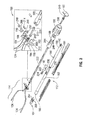
- Fig. 1 is a side, perspective view of one embodiment of a surgical retrieval apparatus in accordance with the present disclosure
- Fig. 2 is an exploded, perspective view of a housing of the surgical retrieval apparatus of Fig. 1 ;
- Fig. 3 is an exploded, perspective view of a shaft and end effector assembly of the surgical retrieval apparatus of Fig. 1 ;
- Fig. 4 is a side, perspective view of the surgical retrieval apparatus of Fig. 1 shown in an insertion position;
- Fig. 5 is a side, perspective view of the surgical retrieval apparatus of Fig. 1 showing the end effector assembly in the deployed (extended) position;
- Fig. 6 is a side, perspective view of the surgical retrieval apparatus of Fig. 1 showing the end effector assembly articulated relative to the shaft;
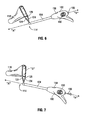
- Fig. 7 is a side, perspective view of the surgical retrieval apparatus of Fig. 1 , wherein a plunger has been released to permit retraction of the end effector assembly;
- Fig. 8 is a side, perspective view of the surgical retrieval apparatus of Fig. 1 , wherein the shaft and the end effector assembly have been returned to the insertion position to close the specimen retrieval bag;
- Fig. 9 is a side, perspective view of the surgical retrieval apparatus of Fig. 1 wherein the specimen retrieval bag has been released from the surgical retrieval apparatus;
- Fig. 10 is a side, cut-away view of the surgical retrieval apparatus of Fig. 1 shown in the insertion position, corresponding to the position of Fig. 4 ;
- Fig. 11 is a side, cut-away view of the surgical retrieval apparatus of Fig. 1 shown with the end effector assembly in the deployed (extended) position, corresponding to the position of Fig. 5 (the retrieval bag removed for clarity);
- Fig. 12 is an enlarged, longitudinal, cross-sectional view of an articulation assembly of the surgical retrieval apparatus of Fig. 1 wherein the articulation assembly is disposed in an engaged position;
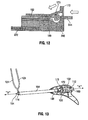
- Fig. 13 is a side, cut-away view of the surgical retrieval apparatus of Fig. 1 shown with the end effector assembly articulated relative to the shaft, corresponding to the position of Fig. 6 (the retrieval bag removed for clarity);
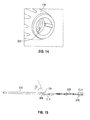
- Fig. 14 is an isolated, rear, perspective view of an articulation wheel of the articulation assembly of the surgical retrieval apparatus of Fig. 1 ;
- Fig. 15 is an isolated, side view of an articulation bar of the articulation assembly of the surgical retrieval apparatus of Fig. 1 shown pivotably engaged to the end effector assembly;
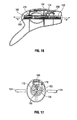
- Fig. 16 is a longitudinal, cross-sectional view of the housing of the surgical retrieval apparatus of Fig. 1 shown in the deployed position;
- Fig. 17 is a transverse, cross-sectional view of the housing of surgical retrieval apparatus of Fig. 1 shown in the deployed position;
- Fig. 18 is a longitudinal, cross-sectional view of the housing of the surgical retrieval apparatus of Fig. 1 wherein the plunger has been released;
- Fig. 19 is a transverse, cross-sectional view of the surgical retrieval apparatus of Fig. 1 similar to Fig. 17 . wherein the plunger has been released;
- Fig. 20 is a front, perspective view of the end effector assembly of the specimen retrieval apparatus of Fig. 1 shown including an interference member disposed at a distal end of the sleeve;
- Fig. 21 is a rear, perspective view of the specimen retrieval apparatus of Fig. 1 , wherein the shaft has been returned to the insertion position and wherein a releasable latch has been opened to disengage the cinch cord of the specimen retrieval bag from the specimen retrieval apparatus.
- proximal should be understood as referring to the end of the apparatus, or component thereof, that is closer to the clinician during proper use, while the term “distal” should be understood as referring to the end that is farther from the clinician, as is traditional and conventional in the art.
- the surgical retrieval apparatus is discussed with respect to minimally invasive thoracic procedures, it is within the scope of the present disclosure that the surgical retrieval apparatus is readily adaptable for use in other minimally invasive surgical procedures, including for example laparoscopic procedures.
- Surgical retrieval apparatus 10 includes a housing 102 defining a longitudinal axis "X-X" and an elongated sleeve 104 extending distally from housing 102.
- Housing 102 defines a longitudinal passageway 106a extending therethrough, while elongated sleeve 104 defines a lumen 106b extending longitudinally therethrough.
- Passageway 106a and lumen 106b cooperate to define a channel 106 disposed about longitudinal axis "X-X" and extending distally from proximal aperture 108 of housing 102, through housing 102, through elongated sleeve 104, and through distal aperture 110 of elongated sleeve 104, i.e., channel 106 extends completely through surgical retrieval apparatus 10.
- a shaft 112 including an end effector assembly 114 pivotably coupled thereto at a distal end 116 thereof is slidably positionable within channel 106.
- shaft 112 is longitudinally translatable between a first, or insertion (and removal) position, wherein shaft 112 is inserted partially through proximal aperture 108 into channel 106 such that end effector assembly 114 is disposed within channel 106, and a second, or extended position, wherein shaft 112 is translated further distally through channel 106 such that end effector assembly 114 extends distally from distal aperture 110 of elongated sleeve 104.
- a specimen retrieval bag 118 is removably coupled to end effector assembly 114 and depends therefrom. More specifically, as shown in Fig. 1 , specimen retrieval bag 118 is folded over at an open end 120 thereof to form a loop 122 around the outer periphery thereof. End effector assembly 114 includes a pair of arms 124 configured for positioning within loop 122 formed at open end 120 of specimen retrieval bag 118 to retain specimen retrieval bag 118 thereon. In the extended position, as shown in Fig.
- arms 124 of end effector assembly 114 define a spaced-apart, curvate configuration for retaining specimen retrieval bag 118 thereon in an open condition, although other configurations are also contemplated, e.g., end effector assembly 114 may include linear arms 124.
- a cinch cord 126 is disposed through loop 122 of specimen retrieval bag 118 at a first end 128 thereof and is engaged to shaft 112 at a second end 130 ( Fig. 21 ) thereof, such that, upon proximal translation of shaft 112 relative to specimen retrieval bag 118, open end 120 of specimen retrieval bag 118 is cinched closed.
- specimen retrieval bag 118 be formed from any suitable biocompatible material (or materials), e.g., 30 Denier Ripstop Nylon, configured to retain a specimen of tissue "S" ( Figs. 7-9 ) therein and to inhibit the passage of fluids and biological materials therethrough.
- the bag can include a coating, such as a polyurethane coating, to prevent egress of fluid if a permeable bag is utilized or to improve the impermeability.
- the coating can be placed on the inner surface and/or the outer surface of the bag.
- specimen retrieval bag 118 includes a lower portion 132 having a minimized cross-section configured to re-orient or re-position the specimen of tissue "S" ( Figs.
- specimen retrieval bag 118 to facilitate removal of specimen retrieval bag 118 from an internal body cavity
- a relatively expansive upper portion 134 configured to facilitate positioning of relatively large specimen of tissue "S" ( Figs. 7-9 ) within specimen retrieval bag 118.
- lower portion 132 has a smaller transverse dimension than the transverse dimension of upper portion 134.
- upper portion 134 of specimen retrieval bag 118 has a first side 136 and an angled side 138 disposed opposite first side 136. Angled side 138 tapers inwardly such that the transverse dimension of upper portion 134 of specimen retrieval bag 118 progressively decreases toward the lower portion 132 of specimen retrieval bag 118.
- Wall 140 which opposes wall 142 in lower portion 132 of specimen retrieval bag 118, extends substantially parallel to wall 142 such that the transverse dimension of lower portion 132 remains substantially constant along a length thereof until transitioning at the curved walls in the lowermost portion.
- specimen retrieval bag 118 may be formed in various other configurations depending on the intended use of specimen retrieval bag 118.
- Other retrieval bag configurations are also contemplated such as those disclosed in U.S. application serial no. 61/389,391, filed October 4, 2010 , and application serial no. 61/430,206, filed January 6, 2011 , the entire contents of both these applications incorporated herein by reference.
- Specimen retrieval bag 118 may in some embodiments further include a high-friction mesh material disposed on an inner surface thereof to facilitate retention of the tissue specimen "S" therein.
- the bag shape is relied on to retain the specimen and a smooth inner surface is provided to enable easy passage of the tissue specimen from the upper loading area of the bag to the lower shaping region of the bag during extraction.
- specimen retrieval bag 118 may include a channel (not explicitly shown) formed integral with or separately attached to specimen retrieval bag 118, e.g. attached to an inner surface thereof such as that disclosed in provisional patent application serial no. 61/389,391, filed October 4, 2010 , provisional application serial no. 61/430,206, filed January 6, 2011 , and provisional application serial no. 61/499,923, filed June 22, 2011 , the entire contents of each of these applications incorporated herein by reference.
- the channel may include at least one opening or slot along its length to allow the passage of fluids, e.g., air, into the channel.
- a support member (or support members) (not shown) may be disposed within specimen retrieval bag 118 to help inhibit collapse of the channel and/or for biasing specimen retrieval bag 118 toward an open position upon deployment from surgical retrieval apparatus 10.
- the support member may be formed from, for example, an open cell material such as open cell foam, or other suitable material that enables the passage of air and/or fluid therethrough, thus allowing air and/or fluid to escape the lower portion of specimen retrieval bag 118 upon collapse or compression of specimen retrieval bag 118 to reduce the internal pressure within specimen retrieval bag 118.
- elongated sleeve 104 is configured for insertion through an opening in tissue, e.g., through a thoracic surgical access port (not shown) disposed within an incision in tissue between adjacent ribs of a patient.
- elongated sleeve 104 defines a sufficient length such that elongated sleeve 104 may be advanced into the thoracic cavity to a position adjacent a tissue specimen "S" ( Figs. 7-9 ) to be removed, while housing 102 remains external of the patient.
- elongated sleeve 104 defines a diameter sufficiently large to permit passage of end effector assembly 114 and shaft 112 therethrough, but sufficiently small such that elongated sleeve 104 may be inserted between adjacent ribs of a patient, e.g., through a thoracic access port (not shown) disposed within an incision and intercostal space therebetween.
- Housing 102 includes a body portion 150 and a handle portion or gripping portion 152.
- Body portion 150 of housing 102 includes a proximal aperture 108, as mentioned above, that is configured to receive shaft 112 therethrough.
- Body portion 150 of housing 102 also includes a pair of oval-shaped windows 154 (although other configurations are contemplated). Windows 154 permit the clinician to grasp and manipulate articulation wheel 156 for articulating end effector assembly 114 relative to longitudinal axis "X-X" as described below.
- Surgical retrieval apparatus 10 further includes a release trigger 158 coupled to body portion 150 of housing 102.
- release trigger 158 is operable to release plunger 160, which is releasably engageable with shaft 112.
- plunger 160 extends proximally from proximal aperture 108 of body portion 150 of housing 102, allowing the clinician to grasp plunger 160 and pull proximally to translate shaft 112 proximally back to the insertion (retracted) position.
- end effector assembly 114 is translated proximally back within elongated sleeve 104.
- handle portion 152 of housing 102 extends downwardly and proximally from body portion 150 to define an ergonomically-enhanced configuration of housing 102 for grasping by the clinician. More specifically, the configuration of handle portion 152 of housing 102 permits the clinician to grasp housing 102 in numerous configurations, while still being able to firmly grasp and fully manipulate and operate surgical retrieval apparatus 10. For example, the clinician may grasp housing 102 using a pistol grip, a palm grip, an upside-down grip, a rear grip, a front grip, etc. The specific grip used may depend on the clinician's preference or the surgical procedure being performed.
- housing 102 includes a pair of housing parts 162, 164 that cooperate to form housing 102. Housing parts 162, 164 also define passageway 106a extending through housing 102, which forms a portion of channel 106.
- Elongated sleeve 104 is fixedly engaged within distal end 166 of body portion 150 of housing 102 and extends distally therefrom along longitudinal axis "X-X" defining lumen 106b therethrough. As mentioned above, lumen 106b cooperates with passageway 106a of housing 102 to form channel 106 extending through surgical retrieval apparatus 10 to permit translation of shaft 112 therethrough.
- windows 154 defined within housing parts 162, 164 of housing 102 provide access to articulation wheel 156, which is rotatably disposed within housing 102 adjacent windows 154.
- Articulation wheel 156 is longitudinally maintained in position within housing 102 via a pair of retainer walls 168 and 170.
- a collar 172 is positioned adjacent to and distal of articulation wheel 156 and is likewise retained in longitudinal position via a pair of retainer walls 170, 174.
- a clutch 188 disposed about longitudinal axis "X-X" and slidably positioned within collar 172 is coupled to articulation wheel 156.
- collar 172 selectively engages clutch 188 with articulation mechanism 180 ( Figs. 12-15 ) to permit articulation of end effector assembly 114 via rotation of articulation wheel 156.
- housing 102 further includes a shaft lock 176 pivotably coupled thereto and configured to retain shaft 112 in position once inserted into channel 106, e.g., shaft lock 176 is configured to retain shaft 112 in the first and/or second positions.
- Housing 102 also includes a release trigger 158 coupled thereto, as mentioned above.
- Release trigger 158 is coupled to a lever 178 that, upon actuation of release trigger 158, decouples plunger 160 from shaft 112, allowing plunger 160 to automatically extend proximally, e.g., "pop-out,” from shaft 112.
- Release trigger 158 upon actuation, also rotates collar 172 about longitudinal axis "X-X" relative to clutch 188 to disengage the articulation mechanism 180 ( Figs. 12-15 ), e.g., to inhibit articulation of end effector assembly 114 via rotation of articulation wheel 156.
- shaft 112 is slidably positioned within channel 106 ( Fig. 1 ) of housing 102 and elongated sleeve 104.
- Shaft 112 includes a tubular member 182, a nose 184 disposed at a distal end 186 of tubular member 182, a releasable latch 192 disposed on an outer surface of tubular member 182, and an articulation mechanism 180 positioned within tubular member 182 and longitudinally translatable with respect to tubular member 182.
- Tubular member 182 further includes an elongated slot 189 (or a pair of opposed elongated slots 189) defined therethrough toward a proximal end 190 thereof Plunger 160 is releasably engageable within tubular member 182 at proximal end 190 thereof
- Nose 184 is fixedly engaged to distal end 186 of tubular member 182 and includes end effector assembly 114 extending distally therefrom. More particularly, arms 124 of end effector assembly 114 are coupled to rotatable plates 194 disposed on either side of arms 124 via a first pin 196.
- Rotatable plates 194 each include a distal aperture 198 for securing pins 196 therethrough, a central aperture 200, and a proximal aperture 202 disposed proximally of and offset below central aperture 200.
- Rotatable plates 194 are pivotably coupled to flanges 204, 206 of nose 184 via a second pivot pin 208 that extends through arms 124, central apertures 200 of rotatable plates 194, and flanges 204, 206, respectively. Washers 210, 212 provide spacing between rotatable plates 194 and flanges 204, 206 of nose 184 and maintain the relative lateral positioning of the above-mentioned components.
- a third pin, pivot pin 214 is disposed through proximal apertures 202 of rotatable plates 194 for pivotably coupling articulation linkage 216 to rotatable plates 194 and, thus, to arms 124, of end effector assembly 114.
- An overmolded assembly can be utilized as an alternative to the plated assembly.
- articulation mechanism 180 includes an articulation linkage 216 that is pivotably coupled to rotatable plates 194 and arms 124 of end effector assembly 114 at a first distal end 218 thereof.
- Articulation linkage 216 is pivotably coupled, at a second proximal end 220 thereof, to articulation bar 222 of articulation mechanism 180.
- articulation bar 222 is longitudinally translatable through tubular member 182 upon rotation of articulation wheel 156 to urge articulation linkage 216 and, thus, pin 214 distally, thereby rotating rotatable plates 194 and arms 124 about pivot pin 208 to articulate arms 124 of end effector assembly 114 relative to longitudinal axis "X-X,” e.g., off of longitudinal axis "X-X.”
- articulation wheel 156 is rotated in the opposite direction
- articulation bar 222 is translated proximally, pulling articulation linkage 216 proximally and, as a result, rotating rotatable plates 194 and arms 124 about pivot pin 208 to articulate arms 124 of end effector assembly 114 in an opposite direction, e.g., back into alignment with longitudinal axis "X-X.”
- collar 172 upon rotation of articulation wheel 156 about longitudinal axis "X-X,” articulation wheel 156, collar 172 (
- Such articulation provides increased flexibility in the placement of the retrieval bag within the body cavity, e.g. thoracic cavity. It also enables the retrieval bag to be placed away from the immediate space adjacent the main access incision and placed towards the apex of the cavity. This provides the surgeon with a functional space immediately below the incision where the specimen can be easily and directly manipulated and where the space can be visualized from the separate scope port. That is, the bag can be out of the way of loading and visualization.
- releasable latch 192 is disposed on an outer surface of tubular member 182 at a proximal portion. More specifically, releasable latch 192 is snap-fit, or otherwise engaged to tubular member 182 at a first end 224 thereof and includes a flexible, or hinged body 226. A protrusion 228 ( Fig. 21 ) extends downwardly from a second end 230 of releasable latch 192 and is configured to engage a corresponding aperture 232 defined within tubular member 182 in a friction-fit engagement (or other suitable engagement) therewith.
- releasable latch 192 may manipulate releasable latch 192 between a closed position, wherein protrusion 228 ( Fig. 21 ) is engaged within aperture 232, and an open condition, wherein protrusion 228 ( Fig. 21 ) is disengaged from aperture 232.
- second end 230 of releasable latch 192 is flexed, or hinged upwardly away from tubular member 182.
- releasable latch 192 is configured to releasably retain cinch cord 126 of specimen retrieval bag 118 ( Fig. 1 ) thereon.
- specimen retrieval bag 118 is positioned on arms 124 of end effector assembly 114.
- cinch cord 126 is disposed through loop 122 of specimen retrieval bag 118 and extends proximally therefrom along shaft 112, wherein second end 130 of cinch cord 126 is retained within releasable latch 192.
- Specimen retrieval bag 118 is initially disposed in an undeployed, or collapsed condition, e.g., specimen retrieval bag 118 is rolled-up, to permit insertion of end effector assembly 114 and specimen retrieval bag 118 into elongated sleeve 104.
- shaft 112 extends proximally from housing 102 and partially through proximal aperture 108 of housing 102 and into channel 106 such that end effector assembly 114 is disposed and collapsed within elongated sleeve 104.
- shaft 112 is disposed in the insertion position.
- surgical retrieval apparatus 10 defines a reduced diameter to facilitate passage of elongated sleeve 104 through an incision in tissue, a natural body opening, or through an access port (not shown) (e.g. disposed between adjacent ribs of a patient) and into the internal surgical site.
- surgical retrieval apparatus 10 may be inserted through an opening in tissue, e.g., through a thoracic access port (not shown).
- shaft 112 is translated distally through channel 106 from the insertion position to the extended (deployed) position such that end effector assembly 114 is extended from elongated sleeve 104, i.e., to the second, or extended (deployed) position, to deploy specimen retrieval bag 118. More specifically, in order to deploy specimen retrieval bag 118, as shown in Fig. 5 , the clinician grasps plunger 160 and advances plunger 160 distally, translating shaft 112 distally through channel 106.
- Shaft 112 is translated distally through channel 106 until end effector assembly 114 extends distally from elongated sleeve 104.
- plunger 160 is disposed within proximal aperture 108 of housing 102. That is, in this extended or deployed position, plunger 160 is substantially flush with housing 102 to enable the multiple of hand holds described herein. Also, being flush, the plunger 160 is inhibited from being caught on the clinician's clothing, other surgical instrumentation, etc., or from being inadvertently withdrawn from housing 102.
- arms 124 move to their normal expanded position to open specimen retrieval bag 118 and the specimen retrieval bag 118 is deployed, or unrolled, to an open condition, as shown in Fig. 5 , e.g., due to the bias of specimen retrieval bag 118 toward the open condition.
- end effector assembly 114 may be articulated relative to longitudinal axis "X-X," e.g., via rotation of articulation wheel 156, and/or surgical retrieval apparatus 10 may be manipulated in order to better position specimen retrieval bag 118 relative to the tissue specimen "S" to be retrieved.
- tissue specimen "S” is moved into specimen retrieval bag 118, through open end 120 thereof, e.g., via use of a surgical grasper (not shown) or any other suitable mechanism which can be inserted through another access port.
- release trigger 158 is actuated to disengage articulation mechanism 180 ( Fig. 12-15 ) and to extend plunger 160 proximally from housing 102.
- release trigger 158 may be grasped by the clinician and translated proximally to return shaft 112 and end effector assembly 114 to the insertion position, as shown in Fig.
- specimen retrieval bag 118 is inhibited from being translated through elongated sleeve 104 via interference member 234 (see Fig. 20 ) which has been advanced from sleeve 104 with the end effector assembly 114, and, thus, remains disposed adjacent distal aperture 110 of elongated sleeve 104. Accordingly, as shaft 112 is translated proximally back through channel 106, arms 124 of end effector assembly 114 are translated proximally relative to specimen retrieval bag 118, ultimately disengaging arms 124 from within loop 122 of specimen retrieval bag 118 and releasing specimen retrieval bag 118 from end effector assembly 114, as shown in Fig. 8 .
- releasable latch 192 may be transitioned from the closed position to the open condition to release cinch cord 126, disengaging specimen retrieval bag 118 from surgical retrieval apparatus 10.
- Surgical retrieval apparatus 10 may then be withdrawn from the surgical site, e.g., the thoracic cavity, leaving specimen retrieval bag 118 behind.
- specimen retrieval bag 118 may be removed from the thoracic cavity, e.g., via grasping second end 130 of cinch cord 126 with a suitable surgical instrument (not shown).
- shaft 112 extends partially through proximal aperture 108 of housing 102 into channel 106. More specifically, shaft 112 extends only partially through channel 106 such that end effector assembly 114 is disposed within elongated sleeve 104, but does not extend distally therefrom. As such, a portion of shaft 112, including releasable latch 192 and plunger 160, remains proximal of channel 106, i.e., a portion of shaft 112 extends proximally from housing 102.
- clutch 188 In the insertion position, clutch 188 is disengaged from articulation bar 222, which is disposed within tubular member 182 of shaft 112. More particularly, in the insertion position, clutch 188 is spaced-apart from elongated slot 189 of tubular member 182 such that clutch 188 cannot extend into tubular member 182 to engage articulation bar 222. Accordingly, in the insertion position, articulation of end effector assembly 114 via rotation of articulation wheel 156 is inhibited.
- a distal finger 236 of plunger 160 is engaged within aperture 191 defined within tubular member 182 to engage plunger 160 to tubular member 182 of shaft 112 such that proximal end 240 of plunger 160 abuts proximal end 190 of tubular member 182 of shaft 112.
- Lever 178 of release trigger 158 is spaced-apart relative to aperture 191 of tubular member 182 and, thus, tubular member 182 inhibits, or locks-out release trigger 158 from being actuated.
- Fig. 11 in conjunction with Figs. 2-3 , surgical retrieval apparatus 10 is shown in the extended or deployed position.
- the clinician grasping housing 102, advances shaft 112 distally through channel 106 until end effector assembly 114 extends distally from elongated sleeve 104, e.g., the extended (deployed) position.
- shaft lock 176 is pivoted relative to housing 102 into engagement with proximal slot 142 defined within tubular member 182 of shaft 112 as proximal slot 142 is translated into position adjacent shaft lock 176.
- shaft lock 176 retains shaft 112 in the extended position (see Fig. 16 ), inhibiting inadvertent translation of shaft 112 from the extended position. Further, shaft lock 176 may be biased downwardly such that shaft lock 176 is automatically urged into engagement with proximal slot 142 upon positioning of proximal slot 142 adjacent shaft lock 176, e.g., upon translation of shaft 112 to the extended position. Additionally, in the extended position, aperture 191 of tubular member 182 is positioned adjacent lever 178 of release trigger 158 such that release trigger 158 is no longer locked-out. As such, release trigger 158 may thereafter be actuated to release plunger 160, allowing the clinician to return shaft 112 to the insertion (and removal) position at the completion of the procedure.
- collar 172 urges articulation arm 244 of clutch 188 through elongated slot 189 of tubular member 182 and into engagement with proximal hub 246 of articulation bar 222, e.g., via a protrusion-aperture engagement, to engage articulation mechanism 180. More specifically, as shaft 112 is translated to the extended position, elongated slot 189 is moved into alignment with articulation arm 244 of clutch 188, allowing flange 173 of collar 172 to urge articulation arm 244 inwardly into engagement with proximal hub 246 of articulation bar 222.
- a second elongated slot (not shown), articulation arm (not shown), and flange (not shown), respectively, may similarly be disposed opposite the first, such that the articulation arms 244 are urged into engagement with articulation bar 222 via flanges 173 of collar 172 on opposing side thereof
- radial tabs 248 disposed on an outer periphery of clutch 188 are engaged within helical threading 252 disposed on the interior surface of articulation wheel 156.
- Helical threading 252 of articulation wheel 156 is pitched such that, upon rotation of articulation wheel 156 in a first direction, clutch 188 is translated distally along longitudinal axis "X-X" relative to shaft 112 due to the engagement of tabs 248 within threading 252.
- rotation of articulation wheel 156 in the opposite direction translates clutch 188 proximally along longitudinal axis "X-X" relative to shaft 112.
- distal translation of clutch 188 e.g., upon rotation of articulation wheel 156, translates articulation arm 244 of clutch 188 distally which, in turn, urges articulation bar 222 distally (due to the protrusion-aperture engagement therebetween).
- articulation linkage 216 is likewise translated distally to urge rotatable plates 194 to pivot about pivot pins 208 disposed through central apertures 200 thereof.
- arms 124 of end effector assembly 114 are fixedly engaged with rotatable plates 194, arms 124 are also pivoted, or articulated relative to longitudinal axis "X-X," e.g., to the position shown in Fig. 13 .
- arms 124 of end effector assembly 114 may be articulated to the desired position to facilitate positioning of the tissue specimen "S" within specimen retrieval bag 118.
- Articulation wheel 156 may also be rotated in an opposite direction to translate articulation bar 222 proximally. As described above, upon proximal translation of articulation bar 22, rotatable plates 194 are pulled to rotate such that end effector assembly 114 is articulated back toward longitudinal axis "X-X".
- housing 102 of surgical retrieval apparatus 10 is shown wherein shaft 112 is disposed in the extended position, release trigger 158 and lever 178 are in un-actuated or initial positions, and shaft lock 176 is engaged with tubular member 182 of shaft 112 to retain shaft 112 in the extended position.
- the clinician may articulate end effector assembly 114 or otherwise manipulate surgical retrieval apparatus 10 for positioning the tissue specimen "S" within specimen retrieval bag 118 (see Figs. 4-9 ). Once the tissue specimen "S" is disposed within specimen retrieval bag 118, specimen retrieval bag 118 may be cinched closed, released from surgical retrieval apparatus 10 and, ultimately removed from the thoracic cavity (see Figs. 4-9 ).
- release trigger 158 is actuated, i.e., depressed. Actuation of release trigger 158 urges lever 178 downwardly. As lever 178 is urged downward, lever 178 eventually contacts distal finger 236 of plunger 160, urging distal finger 236 inwardly to disengage distal finger 236 of plunger 160 from aperture 191 defined within tubular member 182 of shaft 112. Once distal finger 236 of plunger 160 is disengaged from shaft 112, plunger 160 is automatically extended proximally from shaft 112.
- plunger 160 may be biased, e.g., via a spring (not shown), or other biasing member, toward the retracted position such that, once distal finger 236 of plunger 160 is disengaged from shaft 112, plunger 160 is automatically extended proximally, e.g., to "pop-out” from shaft 112, under the bias of the spring (not shown). Plunger 160 is inhibited from extending completely from shaft 112 via the engagement of annular rim 254 of plunger 160 within tubular member 182 of shaft 112.
- lever 178 Upon actuation of release trigger 158, lever 178 also engages collar 172 and rotates collar 172 about longitudinal axis "X-X.” More specifically, lever 178 contacts collar 172 upon depression of release trigger 158 to urge collar 172 to rotate about longitudinal axis "X-X" such that flange 173 of collar 172 is rotated out of contact with articulation arm 244 of clutch 188. With flange 173 rotated out of contact with articulation arm 244, articulation arm 244 is no longer biased into engagement with proximal hub 246 of articulation bar 222 (see Fig. 12 ).
- lever 178 rotates collar 172 to disengage articulation arm 244 from articulation bar 222, thereby disengaging articulation mechanism 180 and inhibiting articulation of end effector assembly 114 via rotation of articulation wheel 156.
- a clinician may grasp plunger 160 and pull proximally to translate shaft 112 through channel 106 back to the insertion (and removal) position.
- shaft 112 is translated proximally back to the insertion position such that end effector assembly 114 is completely disposed within channel 106 and such that releasable latch 192 is exposed, i.e., such that releasable latch 192 is positioned proximally of housing 102 (as opposed to the extended position of shaft 112, wherein releasable latch 192 is positioned within housing 102).
- proximal translation of shaft 112 relative to specimen retrieval bag 118 disengages specimen retrieval bag 118 from end effector assembly 114 and pulls cinch cord 126 proximally to cinch closed open end 120 of specimen retrieval bag 118. More specifically, due to the engagement of cinch cord 126 through loop 122 of specimen retrieval bag 118 at first end 128 thereof and within releasable latch 192 of shaft 112 at second end 130 thereof, cinch cord 126 is translated proximally relative to specimen retrieval bag 118 to close specimen retrieval bag 118 as shaft 112 is translated proximally back to the insertion (and removal) position.
- an interference member, or ring 234 disposed at the distal end of elongated sleeve 104 inhibits specimen retrieval bag 118 from being retracted into elongated sleeve 104 upon proximal translation of end effector assembly 114, helping to ensure that specimen retrieval bag 118 is disengaged from end effector assembly 114. Accordingly, during translation of shaft 112 from the extended position back to the insertion (and removal) position, specimen retrieval bag 118 is retained in position as shaft 112 and, thus, cinch cord 126 are translated proximally relative to specimen retrieval bag 118 to close specimen retrieval bag 118.
- releasable latch 192 may then be moved from the closed condition to the open condition to release cinch cord 126 from shaft 112, thereby disengaging specimen retrieval bag 118 from surgical retrieval apparatus 10. Thereafter, surgical retrieval apparatus 10 and the closed specimen retrieval bag 118 including the tissue specimen "S" disposed therein may each be removed, independently of one another, from the thoracic cavity.
Landscapes
- Health & Medical Sciences (AREA)
- Life Sciences & Earth Sciences (AREA)
- Surgery (AREA)
- Molecular Biology (AREA)
- General Health & Medical Sciences (AREA)
- Biomedical Technology (AREA)
- Heart & Thoracic Surgery (AREA)
- Medical Informatics (AREA)
- Nuclear Medicine, Radiotherapy & Molecular Imaging (AREA)
- Animal Behavior & Ethology (AREA)
- Engineering & Computer Science (AREA)
- Public Health (AREA)
- Veterinary Medicine (AREA)
- Orthopedic Medicine & Surgery (AREA)
- Vascular Medicine (AREA)
- Surgical Instruments (AREA)
- Endoscopes (AREA)
Applications Claiming Priority (2)
| Application Number | Priority Date | Filing Date | Title |
|---|---|---|---|
| US201161430208P | 2011-01-06 | 2011-01-06 | |
| US13/235,597 US8734464B2 (en) | 2011-01-06 | 2011-09-19 | Surgical retrieval apparatus for thoracic procedures |
Publications (2)
| Publication Number | Publication Date |
|---|---|
| EP2474270A2 true EP2474270A2 (fr) | 2012-07-11 |
| EP2474270A3 EP2474270A3 (fr) | 2013-02-20 |
Family
ID=45507436
Family Applications (1)
| Application Number | Title | Priority Date | Filing Date |
|---|---|---|---|
| EP12150271A Withdrawn EP2474270A3 (fr) | 2011-01-06 | 2012-01-05 | Appareil d'extraction chirurgicale pour procédures thoraciques |
Country Status (5)
| Country | Link |
|---|---|
| US (2) | US8734464B2 (fr) |
| EP (1) | EP2474270A3 (fr) |
| JP (1) | JP5939760B2 (fr) |
| AU (2) | AU2011232761B2 (fr) |
| CA (1) | CA2756317A1 (fr) |
Cited By (19)
| Publication number | Priority date | Publication date | Assignee | Title |
|---|---|---|---|---|
| EP2583629A3 (fr) * | 2011-10-19 | 2015-03-18 | Covidien LP | Appareil d'extraction chirurgicale pour procédures thoraciques |
| EP2996569A4 (fr) * | 2013-03-01 | 2017-05-03 | Covidien LP | Dispositif de récupération d'échantillons avec moyen de retenue de poche |
| US10653400B2 (en) | 2017-08-07 | 2020-05-19 | Covidien Lp | Specimen retrieval device |
| EP3714807A1 (fr) * | 2019-03-26 | 2020-09-30 | Covidien LP | Agrafeuse de capture de spécimens |
| US10874386B2 (en) | 2018-01-24 | 2020-12-29 | Covidien Lp | Specimen retrieval device |
| US10888308B2 (en) | 2016-03-30 | 2021-01-12 | Olympus Corporation | Tissue collector |
| US10973543B2 (en) | 2018-01-10 | 2021-04-13 | Covidien Lp | Dual wall tissue extraction bag |
| US11045176B2 (en) | 2018-05-18 | 2021-06-29 | Covidien Lp | Specimen retrieval device |
| US11065051B2 (en) | 2017-11-03 | 2021-07-20 | Covidien Lp | Specimen retrieval device |
| US11064984B2 (en) | 2019-05-07 | 2021-07-20 | Covidien Lp | Specimen containment device |
| US11083443B2 (en) | 2018-04-24 | 2021-08-10 | Covidien Lp | Specimen retrieval device |
| US11134932B2 (en) | 2018-08-13 | 2021-10-05 | Covidien Lp | Specimen retrieval device |
| US11172915B2 (en) | 2019-04-24 | 2021-11-16 | Covidien Lp | Specimen retrieval devices with selective bag release |
| US11191559B2 (en) | 2018-09-19 | 2021-12-07 | Covidien Lp | Specimen retrieval device |
| US11246578B2 (en) | 2019-05-15 | 2022-02-15 | Covidien Lp | Tissue collection bags with inner surface pouches |
| US11426151B2 (en) | 2019-06-04 | 2022-08-30 | Covidien Lp | Bag closure for specimen retrieval device |
| US11446015B2 (en) | 2019-10-30 | 2022-09-20 | Covidien Lp | Specimen retrieval bag |
| US11730480B2 (en) | 2018-09-14 | 2023-08-22 | Covidien Lp | Method and apparatus for accessing matter disposed within an internal body vessel |
| US11730459B2 (en) | 2018-02-22 | 2023-08-22 | Covidien Lp | Specimen retrieval devices and methods |
Families Citing this family (45)
| Publication number | Priority date | Publication date | Assignee | Title |
|---|---|---|---|---|
| US9549747B2 (en) * | 2012-01-23 | 2017-01-24 | Covidien Lp | Reusable surgical retrieval apparatus with disposable cartridge assembly |
| US9999470B1 (en) * | 2013-03-15 | 2018-06-19 | Leslie Passons | Robotic surgery manipulator |
| CN109394308B (zh) | 2013-08-23 | 2021-08-20 | 柯惠Lp公司 | 标本取出装置 |
| EP3329858A4 (fr) | 2015-07-27 | 2019-04-24 | Olympus Corporation | Outil d'extraction de tissu et système d'extraction de tissu |
| US10335129B2 (en) * | 2015-11-17 | 2019-07-02 | Ethicon Llc | Methods and devices for auto return of articulated end effectors |
| GB201600546D0 (en) * | 2016-01-12 | 2016-02-24 | Gyrus Medical Ltd | Electrosurgical device |
| CN105769307A (zh) * | 2016-04-05 | 2016-07-20 | 江苏风和医疗器材有限公司 | 一种医用取物装置 |
| CN105852943B (zh) * | 2016-04-05 | 2019-12-13 | 江苏风和医疗器材股份有限公司 | 一种医用取物装置 |
| CN105877820A (zh) * | 2016-04-05 | 2016-08-24 | 江苏风和医疗器材有限公司 | 一种医用取物装置 |
| CN105852942B (zh) * | 2016-04-05 | 2019-12-13 | 江苏风和医疗器材股份有限公司 | 一种固定结构及具有其的医用取物装置 |
| GB201608910D0 (en) * | 2016-05-20 | 2016-07-06 | Gyrus Medical Ltd | Tissue bag and method of removing excised tissue |
| CN105852920B (zh) * | 2016-06-08 | 2020-04-03 | 湖州市妇幼保健院 | 一种腹腔取物装置 |
| CN106236215A (zh) * | 2016-07-08 | 2016-12-21 | 江苏风和医疗器材有限公司 | 一种医用取物装置 |
| CN105943093B (zh) * | 2016-07-08 | 2019-10-25 | 江苏风和医疗器材股份有限公司 | 一种医用取物装置 |
| CN106419968A (zh) * | 2016-09-30 | 2017-02-22 | 江苏风和医疗器材有限公司 | 一种医用取物装置 |
| US10675058B2 (en) | 2017-01-19 | 2020-06-09 | Covidien Lp | Devices, systems, and methods for large tissue specimen removal |
| US11083490B2 (en) | 2017-09-21 | 2021-08-10 | Covidien Lp | Systems and methods for large tissue specimen removal |
| GB2570329B (en) * | 2018-01-22 | 2022-11-30 | Gyrus Medical Ltd | Surgical devices |
| US10792057B2 (en) | 2018-03-23 | 2020-10-06 | Covidien Lp | Articulation mechanisms for tissue specimen retrieval devices and tissue specimen retrieval devices incorporating the same |
| US10667800B2 (en) | 2018-05-08 | 2020-06-02 | Covidien Lp | Four bar articulation mechanism for tissue specimen retrieval device |
| US10792023B2 (en) | 2018-06-06 | 2020-10-06 | Covidien Lp | Shaft driven mechanism for articulating tissue specimen retrieval device |
| US10912545B2 (en) | 2019-02-04 | 2021-02-09 | Covidien Lp | Tissue specimen retrieval devices and methods |
| US11051834B2 (en) | 2019-05-17 | 2021-07-06 | Covidien Lp | Tissue specimen retrieval device |
| US11426203B2 (en) | 2019-05-23 | 2022-08-30 | Covidien Lp | Tissue guards and systems incorporating the same for tissue specimen removal procedures and other surgical procedures |
| US11051795B2 (en) | 2019-07-31 | 2021-07-06 | Covidien Lp | Tissue retrieval bag |
| US11304687B2 (en) | 2019-08-13 | 2022-04-19 | Covidien Lp | Tissue specimen bag furling device and method |
| US11071559B2 (en) | 2019-08-21 | 2021-07-27 | Covidien Lp | Tissue specimen retrieval devices with integrated bag cut-off mechanism |
| US11253240B2 (en) | 2019-09-10 | 2022-02-22 | Covidien Lp | Tissue specimen retrieval devices |
| US11172949B2 (en) | 2019-10-07 | 2021-11-16 | Covidien Lp | Tissue specimen retrieval devices |
| US11707264B2 (en) | 2020-01-30 | 2023-07-25 | Covidien Lp | Rollable tissue specimen bag with improved brim for tenting |
| US11759188B2 (en) | 2020-01-31 | 2023-09-19 | Covidien Lp | Devices, systems, and methods for specimen removal |
| US11944367B2 (en) | 2020-02-05 | 2024-04-02 | Covidien Lp | Electrosurgical device for cutting tissue |
| US11864815B2 (en) | 2020-02-06 | 2024-01-09 | Covidien Lp | Electrosurgical device for cutting tissue |
| US11344284B2 (en) | 2020-02-11 | 2022-05-31 | Covidien Lp | Tissue specimen retrieval device with variable bag brim |
| US11160543B2 (en) | 2020-02-13 | 2021-11-02 | Covidien Lp | Magnetic suture tab for free standing specimen bag |
| US11224413B2 (en) | 2020-02-19 | 2022-01-18 | Covidien Lp | Retrieval device with bag release mechanism |
| US11369352B2 (en) | 2020-03-31 | 2022-06-28 | Covidien Lp | Dual channel design for free standing specimen bag |
| US11406369B2 (en) | 2020-04-08 | 2022-08-09 | Covidien Lp | Tissue specimen retrieval device with reinforced spring |
| US11246613B2 (en) | 2020-05-15 | 2022-02-15 | Covidien Lp | Actuation mechanisms for tissue specimen retrieval devices and tissue specimen retrieval devices incorporating the same |
| US11304714B2 (en) | 2020-05-19 | 2022-04-19 | Covidien Lp | Tissue specimen retrieval device with assisted deployment |
| US11627987B2 (en) | 2020-05-20 | 2023-04-18 | Covidien Lp | Low impact cutting guard |
| US11510749B2 (en) | 2020-05-26 | 2022-11-29 | Covidien Lp | Insertable cutting guard |
| US11517297B2 (en) | 2020-06-05 | 2022-12-06 | Covidien Lp | Rollable tissue specimen bag with improved brim for tenting |
| US11931067B2 (en) | 2020-08-15 | 2024-03-19 | Covidien Lp | Insertable cutting guards |
| US12446867B1 (en) | 2024-09-20 | 2025-10-21 | Kobex LLC | Specimen retrieval apparatus and methods |
Family Cites Families (133)
| Publication number | Priority date | Publication date | Assignee | Title |
|---|---|---|---|---|
| US30471A (en) | 1860-10-23 | Apparatus foe | ||
| US35164A (en) | 1862-05-06 | Improvement in terra-cotta roofing | ||
| US156477A (en) | 1874-11-03 | Improvement in litholycites | ||
| US1609014A (en) | 1925-09-25 | 1926-11-30 | Dowd James Edward | Tonsil remover |
| DE1095457B (de) | 1959-11-04 | 1960-12-22 | Dr Med Kurt Kreie | Harnleiterkatheter mit Spreizkorb zum Entfernen von Nierensteinen |
| US3800781A (en) | 1972-05-30 | 1974-04-02 | K Zalucki | Specimen-taking device |
| US4557255A (en) | 1983-08-22 | 1985-12-10 | Goodman Tobias M | Ureteroscope |
| US4611594A (en) | 1984-04-11 | 1986-09-16 | Northwestern University | Medical instrument for containment and removal of calculi |
| DE8435489U1 (de) | 1984-12-04 | 1986-08-28 | Richard Wolf Gmbh, 7134 Knittlingen | Nephroskop |
| DE3542667A1 (de) | 1984-12-04 | 1986-06-05 | Richard Wolf Gmbh, 7134 Knittlingen | Vorrichtung zur entfernung von koerpersteinen |
| US4790812A (en) | 1985-11-15 | 1988-12-13 | Hawkins Jr Irvin F | Apparatus and method for removing a target object from a body passsageway |
| US4744363A (en) | 1986-07-07 | 1988-05-17 | Hasson Harrith M | Intra-abdominal organ stabilizer, retractor and tissue manipulator |
| US5451204A (en) | 1988-07-22 | 1995-09-19 | Yoon; Inbae | Multifunctional devices for endoscopic surgical procedures |
| US5556376A (en) | 1988-07-22 | 1996-09-17 | Yoon; Inbae | Multifunctional devices having loop configured portions and collection systems for endoscopic surgical procedures and methods thereof |
| US6004330A (en) | 1989-08-16 | 1999-12-21 | Medtronic, Inc. | Device or apparatus for manipulating matter |
| US4997435A (en) | 1989-09-25 | 1991-03-05 | Methodist Hospital Of Indiana Inc. | Percutaneous catheter with encapsulating receptacle |
| US4927427A (en) | 1989-09-29 | 1990-05-22 | Northgate Research, Inc. | Lithotriptor device for trapping and destroying concretions |
| US5084054A (en) | 1990-03-05 | 1992-01-28 | C.R. Bard, Inc. | Surgical gripping instrument |
| US5074867A (en) | 1990-05-18 | 1991-12-24 | Wilk Peter J | Surgical instrument assembly and related surgical method |
| US5037379A (en) | 1990-06-22 | 1991-08-06 | Vance Products Incorporated | Surgical tissue bag and method for percutaneously debulking tissue |
| DE69133618D1 (de) | 1990-10-09 | 2009-07-30 | Medtronic Inc | Chirurgische Vorrichtung zur Manipulation von Gewebe |
| US5312416A (en) | 1991-10-18 | 1994-05-17 | Endomedix Corporation | Method and system for enclosing, manipulating, debulking and removing tissue through minimal access incisions |
| US5354303A (en) | 1991-01-09 | 1994-10-11 | Endomedix Corporation | Devices for enclosing, manipulating, debulking and removing tissue through minimal incisions |
| US5370647A (en) | 1991-01-23 | 1994-12-06 | Surgical Innovations, Inc. | Tissue and organ extractor |
| US5190561A (en) | 1991-01-23 | 1993-03-02 | Surgical Innovations, Inc. | Tissue and organ extractor |
| DE69131050T2 (de) | 1991-03-25 | 1999-11-18 | Espiner Medical Products, Bristol | Chirurgische aufnahmevorrichtung |
| US5143082A (en) | 1991-04-03 | 1992-09-01 | Ethicon, Inc. | Surgical device for enclosing an internal organ |
| US5176687A (en) | 1991-05-10 | 1993-01-05 | Hasson Harrith M | Disposable pouch container for isolation and retrieval of tissues removed at laparoscopy |
| US5147371A (en) | 1991-06-28 | 1992-09-15 | Washington Charles N | Apparatus for removing gallstones and tissue during surgery |
| US5192286A (en) | 1991-07-26 | 1993-03-09 | Regents Of The University Of California | Method and device for retrieving materials from body lumens |
| US5486182A (en) | 1991-11-05 | 1996-01-23 | Wilk & Nakao Medical Technology Inc. | Polyp retrieval assembly with separable web member |
| US5336227A (en) | 1991-11-05 | 1994-08-09 | Wilk & Nakao Medical Technology Incorporated | Surgical cauterization snare with polyp capturing web net |
| US5759187A (en) | 1991-11-05 | 1998-06-02 | Wilk & Nakao Medical Technology, Incorporated | Surgical retrieval assembly and associated method |
| US5201740A (en) | 1991-11-05 | 1993-04-13 | Nakao Naomi L | Surgical retrieval assembly and related method |
| US5190542A (en) | 1991-11-05 | 1993-03-02 | Nakao Naomi L | Surgical retrieval assembly and related method |
| US5997547A (en) | 1991-11-05 | 1999-12-07 | Nakao; Naomi L. | Surgical retrieval assembly and associated method |
| US5524633A (en) | 1991-11-25 | 1996-06-11 | Advanced Surgical, Inc. | Self-deploying isolation bag |
| US5308327A (en) | 1991-11-25 | 1994-05-03 | Advanced Surgical Inc. | Self-deployed inflatable retractor |
| US5215521A (en) | 1991-11-26 | 1993-06-01 | Cochran James C | Laparoscopy organ retrieval apparatus and procedure |
| DE4140156C2 (de) | 1991-12-05 | 1995-07-06 | Guenter Dr Med Schaller | Hilfsmittel für laparoskopische Operationen |
| US5190555A (en) | 1991-12-13 | 1993-03-02 | Unisurge, Inc. | Device for collection and removal of body parts during laparoscopic surgery |
| US5643283A (en) | 1992-01-03 | 1997-07-01 | Younker; Marlin E. | Surgical pouch |
| US5192284A (en) | 1992-01-10 | 1993-03-09 | Pleatman Mark A | Surgical collector and extractor |
| US5352184A (en) | 1992-03-12 | 1994-10-04 | Uresil Corporation | Reservoir for enclosing and retrieving body specimens |
| CA2098896C (fr) | 1992-06-30 | 2005-03-29 | H. Jonathan Tovey | Pochette pour le prelevement d'echantillons et methode d'utilisation |
| US5234439A (en) | 1992-08-06 | 1993-08-10 | Wilk Peter J | Method and instrument assembly for removing organ |
| US5279539A (en) | 1992-08-17 | 1994-01-18 | Ethicon, Inc. | Drawstring surgical pouch and method of use for preventing ovarian adhesions |
| US5330483A (en) | 1992-12-18 | 1994-07-19 | Advanced Surgical Inc. | Specimen reduction device |
| US5341815A (en) | 1993-03-25 | 1994-08-30 | Ethicon, Inc. | Endoscopic surgical pouch |
| US5368597A (en) | 1993-05-24 | 1994-11-29 | Pagedas; Anthony | Reclosable pouch for laparoscopic use |
| US5480404A (en) | 1993-06-16 | 1996-01-02 | Ethicon, Inc. | Surgical tissue retrieval instrument |
| US5785677A (en) | 1993-06-22 | 1998-07-28 | Auweiler; Udo | Laparoscopy bag |
| US5630822A (en) | 1993-07-02 | 1997-05-20 | General Surgical Innovations, Inc | Laparoscopic tissue removal device |
| US5469863A (en) | 1993-08-11 | 1995-11-28 | Polygenex International, Inc. | Polyurethane condom of welded polyurethane film |
| US5578048A (en) * | 1993-09-15 | 1996-11-26 | United States Surgical Corporation | Manipulator apparatus |
| US5443472A (en) | 1993-10-08 | 1995-08-22 | Li Medical Technologies, Inc. | Morcellator system |
| US5645083A (en) | 1994-02-10 | 1997-07-08 | Essig; Mitchell N. | Peritoneal surgical method |
| US5643282A (en) | 1994-08-22 | 1997-07-01 | Kieturakis; Maciej J. | Surgical instrument and method for removing tissue from an endoscopic workspace |
| US5535759A (en) | 1994-11-02 | 1996-07-16 | Wilk; Peter J. | Endoscopic method of cleaning and operating on a site within a patient |
| US5658296A (en) | 1994-11-21 | 1997-08-19 | Boston Scientific Corporation | Method for making surgical retrieval baskets |
| US5611803A (en) | 1994-12-22 | 1997-03-18 | Urohealth Systems, Inc. | Tissue segmentation device |
| WO1996023446A1 (fr) | 1995-02-02 | 1996-08-08 | Boston Scientific Corporation | Extracteur chirurgical en panier de fils |
| US6350266B1 (en) | 1995-02-02 | 2002-02-26 | Scimed Life Systems, Inc. | Hybrid stone retrieval device |
| US6348056B1 (en) | 1999-08-06 | 2002-02-19 | Scimed Life Systems, Inc. | Medical retrieval device with releasable retrieval basket |
| US5814044A (en) | 1995-02-10 | 1998-09-29 | Enable Medical Corporation | Apparatus and method for morselating and removing tissue from a patient |
| DE19515280C2 (de) | 1995-04-26 | 1997-06-12 | Siegfried Riek | Vorrichtung zum Entfernen von Gewebe oder dergleichen aus der Bauchhöhle |
| US5618296A (en) | 1995-07-24 | 1997-04-08 | Endomedix Corporation/Box 330 | Tissue morcellator system and method |
| US5853374A (en) | 1995-10-11 | 1998-12-29 | Applied Medical Resources Corporation | Tissue collection and retrieval bag |
| SE508742C2 (sv) | 1996-03-25 | 1998-11-02 | Safe Conduct Ab | Anordning för användning vid endoskopiska operationer, för att fixera, omsluta, dela upp och föra ut ett preparat |
| US5906621A (en) | 1996-05-14 | 1999-05-25 | United States Endoscopy Group, Inc. | Endoscopic surgical device |
| US5735289A (en) | 1996-08-08 | 1998-04-07 | Pfeffer; Herbert G. | Method and apparatus for organic specimen retrieval |
| US5769794A (en) | 1996-09-04 | 1998-06-23 | Smith & Nephew Endoscopy, Inc | Tissue retrieval bag and method for removing cancerous tissue |
| US5702343A (en) | 1996-10-02 | 1997-12-30 | Acorn Medical, Inc. | Cardiac reinforcement device |
| AU8507398A (en) | 1997-07-24 | 1999-02-16 | James F. Mcguckin Jr. | Breast surgery method and apparatus |
| AU1187899A (en) | 1997-10-09 | 1999-05-03 | Camran Nezhat | Methods and systems for organ resection |
| US6019770A (en) | 1997-12-04 | 2000-02-01 | Christoudias; George C. | Versatile endoscopic retrieval bag |
| US6344026B1 (en) | 1998-04-08 | 2002-02-05 | Senorx, Inc. | Tissue specimen encapsulation device and method thereof |
| US5971995A (en) | 1998-03-30 | 1999-10-26 | Ethicon, Inc. | Surgical pouch instrument |
| US6383195B1 (en) | 1998-04-13 | 2002-05-07 | Endoline, Inc. | Laparoscopic specimen removal apparatus |
| US5980544A (en) | 1998-05-18 | 1999-11-09 | Ethicon Endo-Surgery, Inc. | Ballistic specimen bag for use with ultrasonic devices |
| US6162235A (en) | 1998-05-18 | 2000-12-19 | Ethicon Endo-Surgery, Inc. | Method of tissue morcellation using an ultrasonic surgical instrument with a ballistic specimen bag |
| JP2000037388A (ja) | 1998-05-20 | 2000-02-08 | Osamu Yoshida | 臓器収納バッグと臓器収納バッグ挿入具 |
| IL125965A (en) | 1998-08-27 | 2003-03-12 | Hendler Shoshan | Apparatus and method for acquisition and retrieval of resected biological specimens |
| US5944727A (en) * | 1998-09-02 | 1999-08-31 | Datascope Investment Corp. | Stent/graft catheter handle |
| US6059793A (en) | 1998-11-20 | 2000-05-09 | Pagedas; Anthony C. | Reusable laproscopic retrieval mechanism and method for use |
| US6537273B1 (en) | 1999-07-02 | 2003-03-25 | Alexander K. D. Sosiak | Device and method for removing large tissue masses |
| US6544279B1 (en) | 2000-08-09 | 2003-04-08 | Incept, Llc | Vascular device for emboli, thrombus and foreign body removal and methods of use |
| US6419639B2 (en) | 1999-08-05 | 2002-07-16 | National Institute Of Health | Laparoscopic SAC holder assembly |
| US6368328B1 (en) | 1999-09-16 | 2002-04-09 | Scimed Life Systems, Inc. | Laser-resistant medical retrieval device |
| US6228095B1 (en) | 1999-10-14 | 2001-05-08 | Core Dynamics, Inc. | Specimen retrieval device |
| US6471659B2 (en) | 1999-12-27 | 2002-10-29 | Neothermia Corporation | Minimally invasive intact recovery of tissue |
| US6277083B1 (en) | 1999-12-27 | 2001-08-21 | Neothermia Corporation | Minimally invasive intact recovery of tissue |
| US6755779B2 (en) | 2000-12-01 | 2004-06-29 | Acorn Cardiovascular, Inc. | Apparatus and method for delivery of cardiac constraint jacket |
| US6350267B1 (en) | 2000-12-21 | 2002-02-26 | Ethicon Endo-Surgery, Inc. | Method of use of an improved specimen retrieval bag |
| US6406440B1 (en) | 2000-12-21 | 2002-06-18 | Ethicon Endo-Surgery, Inc. | Specimen retrieval bag |
| US6409733B1 (en) | 2001-06-29 | 2002-06-25 | Ethicon Endo-Surgery, Inc. | Specimen retrieval bag |
| US6383197B1 (en) | 2001-06-29 | 2002-05-07 | Ethicon Endo-Surgery, Inc. | Self disengaging anti-backup mechanism for specimen retrieval bag deployment |
| JP3875059B2 (ja) | 2001-10-17 | 2007-01-31 | ユニ・チャーム株式会社 | 体液吸収製品の個包装体 |
| US7052454B2 (en) | 2001-10-20 | 2006-05-30 | Applied Medical Resources Corporation | Sealed surgical access device |
| US6887255B2 (en) | 2002-04-19 | 2005-05-03 | Peter Shimm | Laparoscopic specimen extraction port |
| US6805699B2 (en) | 2002-04-19 | 2004-10-19 | Peter Shimm | Laparoscopic specimen retrieval shoehorn |
| US6840948B2 (en) | 2002-06-06 | 2005-01-11 | Ethicon-Endo Surgery, Inc. | Device for removal of tissue lesions |
| ES2378149T3 (es) | 2002-06-18 | 2012-04-09 | Tyco Healthcare Group Lp | Dispositivo para eliminar tejido |
| DE10229137A1 (de) | 2002-06-28 | 2004-01-29 | Ethicon Gmbh | Chirurgisches Instrument |
| JP3926237B2 (ja) | 2002-08-08 | 2007-06-06 | 株式会社モリタ製作所 | 腹腔鏡下手術に用いる臓器摘出袋 |
| JP3686947B2 (ja) | 2002-12-09 | 2005-08-24 | 国立大学法人 東京大学 | 能動鉗子用高剛性鉗子先端部構体およびそれを具える能動鉗子 |
| US20040138587A1 (en) | 2003-01-15 | 2004-07-15 | Lyons William Lawrence | Specimen collection instrument with inflatable bag |
| US7090637B2 (en) | 2003-05-23 | 2006-08-15 | Novare Surgical Systems, Inc. | Articulating mechanism for remote manipulation of a surgical or diagnostic tool |
| US7270663B2 (en) | 2003-10-16 | 2007-09-18 | Granit Medical Innovations, Llc | Medical snare loop with indentations for changing effective size of loop and associated method |
| CN1247159C (zh) | 2003-10-17 | 2006-03-29 | 李艳芳 | 易回收的生物标本袋 |
| US8343031B2 (en) | 2004-03-23 | 2013-01-01 | Michael Gertner | Obesity treatment systems |
| US20050267492A1 (en) | 2004-05-12 | 2005-12-01 | Philippe Poncet | Surgical instrument for specimen retrieval |
| US20060200169A1 (en) | 2005-03-07 | 2006-09-07 | Kevin Sniffin | Specimen retrieval apparatus and method of use |
| US20060200170A1 (en) | 2005-03-07 | 2006-09-07 | Ernest Aranyi | Specimen retrieval apparatus and method of use |
| US7547310B2 (en) | 2005-03-29 | 2009-06-16 | Tyco Healthcare Group Lp | Specimen retrieval apparatus |
| US7670346B2 (en) | 2005-03-29 | 2010-03-02 | Tyco Healthcare Group Lp | Specimen retrieval apparatus |
| US7837612B2 (en) | 2005-04-08 | 2010-11-23 | Ethicon Endo-Surgery, Inc. | Tissue suspension device |
| US8206401B2 (en) | 2005-07-15 | 2012-06-26 | Granit Medical Innovation Llc | Endoscope cutting and retrieving snare instrument |
| US7618437B2 (en) | 2005-07-15 | 2009-11-17 | Granit Medical Innovation, Llc | Endoscope retrieval instrument assembly |
| US8652147B2 (en) | 2005-10-14 | 2014-02-18 | Applied Medical Resources Corporation | Device for isolating and removing tissue from a body cavity |
| AU2006304894B2 (en) | 2005-10-14 | 2012-10-04 | Applied Medical Resources Corporation | Tissue retrieval apparatus |
| US20070135780A1 (en) | 2005-12-09 | 2007-06-14 | Pagedas Anthony C | Surgical bag and morcellator system and method of use |
| US8057485B2 (en) | 2007-03-06 | 2011-11-15 | The Hollis Group | Specimen retrieval device |
| US8075567B2 (en) | 2007-03-22 | 2011-12-13 | Anchor Products Company | Surgical tissue retrieval instrument |
| US8348827B2 (en) | 2007-06-12 | 2013-01-08 | Ethicon Endo-Surgery, Inc. | Specimen removal pouch |
| US8097001B2 (en) | 2007-09-24 | 2012-01-17 | Granit Medical Innovations Llc | Medical instrument with stop motion override and associated method |
| EP2078497B8 (fr) | 2008-01-10 | 2012-03-28 | A.M.I. Agency for Medical Innovations GmbH | Instrument médical |
| US20090192518A1 (en) * | 2008-01-24 | 2009-07-30 | Boston Scientific Scimed, Inc. | Apparatus and method for loading and delivering a stent having improved handles to control relative catheter component movement |
| US8435237B2 (en) | 2008-01-29 | 2013-05-07 | Covidien Lp | Polyp encapsulation system and method |
| US20090240238A1 (en) | 2008-03-24 | 2009-09-24 | Medtronic Vascular, Inc. | Clot Retrieval Mechanism |
| US8906035B2 (en) * | 2008-06-04 | 2014-12-09 | Ethicon Endo-Surgery, Inc. | Endoscopic drop off bag |
| US20100000471A1 (en) | 2008-07-07 | 2010-01-07 | Darrell Hibbard | Retrieval device for creatures |
| US9370341B2 (en) | 2008-10-23 | 2016-06-21 | Covidien Lp | Surgical retrieval apparatus |
-
2011
- 2011-09-19 US US13/235,597 patent/US8734464B2/en active Active
- 2011-10-05 AU AU2011232761A patent/AU2011232761B2/en not_active Ceased
- 2011-10-18 JP JP2011228903A patent/JP5939760B2/ja not_active Expired - Fee Related
- 2011-10-25 CA CA2756317A patent/CA2756317A1/fr not_active Abandoned
-
2012
- 2012-01-05 EP EP12150271A patent/EP2474270A3/fr not_active Withdrawn
-
2014
- 2014-04-11 US US14/250,426 patent/US20140222016A1/en not_active Abandoned
-
2016
- 2016-02-05 AU AU2016200733A patent/AU2016200733A1/en not_active Abandoned
Cited By (24)
| Publication number | Priority date | Publication date | Assignee | Title |
|---|---|---|---|---|
| US10327745B2 (en) | 2011-10-19 | 2019-06-25 | Covidien Lp | Surgical retrieval apparatus for thoracic procedures |
| EP2583629A3 (fr) * | 2011-10-19 | 2015-03-18 | Covidien LP | Appareil d'extraction chirurgicale pour procédures thoraciques |
| EP2996569A4 (fr) * | 2013-03-01 | 2017-05-03 | Covidien LP | Dispositif de récupération d'échantillons avec moyen de retenue de poche |
| US10154833B2 (en) | 2013-03-01 | 2018-12-18 | Covidien Lp | Specimen retrieval device with pouch stop |
| US10888308B2 (en) | 2016-03-30 | 2021-01-12 | Olympus Corporation | Tissue collector |
| US10653400B2 (en) | 2017-08-07 | 2020-05-19 | Covidien Lp | Specimen retrieval device |
| US11065051B2 (en) | 2017-11-03 | 2021-07-20 | Covidien Lp | Specimen retrieval device |
| US10973543B2 (en) | 2018-01-10 | 2021-04-13 | Covidien Lp | Dual wall tissue extraction bag |
| US10874386B2 (en) | 2018-01-24 | 2020-12-29 | Covidien Lp | Specimen retrieval device |
| US11730459B2 (en) | 2018-02-22 | 2023-08-22 | Covidien Lp | Specimen retrieval devices and methods |
| US11083443B2 (en) | 2018-04-24 | 2021-08-10 | Covidien Lp | Specimen retrieval device |
| US11045176B2 (en) | 2018-05-18 | 2021-06-29 | Covidien Lp | Specimen retrieval device |
| US11805999B2 (en) | 2018-08-13 | 2023-11-07 | Covidien Lp | Specimen retrieval device |
| US11134932B2 (en) | 2018-08-13 | 2021-10-05 | Covidien Lp | Specimen retrieval device |
| US11730480B2 (en) | 2018-09-14 | 2023-08-22 | Covidien Lp | Method and apparatus for accessing matter disposed within an internal body vessel |
| US11191559B2 (en) | 2018-09-19 | 2021-12-07 | Covidien Lp | Specimen retrieval device |
| US11344300B2 (en) | 2019-03-26 | 2022-05-31 | Covidien Lp | Specimen capture stapler |
| CN111743581A (zh) * | 2019-03-26 | 2020-10-09 | 柯惠Lp公司 | 试样采集缝合器 |
| EP3714807A1 (fr) * | 2019-03-26 | 2020-09-30 | Covidien LP | Agrafeuse de capture de spécimens |
| US11172915B2 (en) | 2019-04-24 | 2021-11-16 | Covidien Lp | Specimen retrieval devices with selective bag release |
| US11064984B2 (en) | 2019-05-07 | 2021-07-20 | Covidien Lp | Specimen containment device |
| US11246578B2 (en) | 2019-05-15 | 2022-02-15 | Covidien Lp | Tissue collection bags with inner surface pouches |
| US11426151B2 (en) | 2019-06-04 | 2022-08-30 | Covidien Lp | Bag closure for specimen retrieval device |
| US11446015B2 (en) | 2019-10-30 | 2022-09-20 | Covidien Lp | Specimen retrieval bag |
Also Published As
| Publication number | Publication date |
|---|---|
| EP2474270A3 (fr) | 2013-02-20 |
| AU2011232761A1 (en) | 2012-07-26 |
| JP5939760B2 (ja) | 2016-06-22 |
| AU2016200733A1 (en) | 2016-02-25 |
| US20120179165A1 (en) | 2012-07-12 |
| US8734464B2 (en) | 2014-05-27 |
| CA2756317A1 (fr) | 2012-07-06 |
| AU2011232761B2 (en) | 2016-01-14 |
| JP2012143538A (ja) | 2012-08-02 |
| US20140222016A1 (en) | 2014-08-07 |
Similar Documents
| Publication | Publication Date | Title |
|---|---|---|
| US8734464B2 (en) | Surgical retrieval apparatus for thoracic procedures | |
| US10327745B2 (en) | Surgical retrieval apparatus for thoracic procedures | |
| US9005215B2 (en) | Specimen retrieval apparatus | |
| US8777961B2 (en) | Surgical retrieval apparatus | |
| EP2387952B1 (fr) | Appareil d'extraction de spécimens | |
| EP2591733B1 (fr) | Dispositif de prélèvement de spécimen | |
| US20160256145A1 (en) | Surgical retrieval apparatus | |
| US20120238823A1 (en) | Surgical access devices with anvil introduction and specimen retrieval structures |
Legal Events
| Date | Code | Title | Description |
|---|---|---|---|
| PUAI | Public reference made under article 153(3) epc to a published international application that has entered the european phase |
Free format text: ORIGINAL CODE: 0009012 |
|
| AK | Designated contracting states |
Kind code of ref document: A2 Designated state(s): AL AT BE BG CH CY CZ DE DK EE ES FI FR GB GR HR HU IE IS IT LI LT LU LV MC MK MT NL NO PL PT RO RS SE SI SK SM TR |
|
| AX | Request for extension of the european patent |
Extension state: BA ME |
|
| RAP1 | Party data changed (applicant data changed or rights of an application transferred) |
Owner name: COVIDIEN LP |
|
| PUAL | Search report despatched |
Free format text: ORIGINAL CODE: 0009013 |
|
| AK | Designated contracting states |
Kind code of ref document: A3 Designated state(s): AL AT BE BG CH CY CZ DE DK EE ES FI FR GB GR HR HU IE IS IT LI LT LU LV MC MK MT NL NO PL PT RO RS SE SI SK SM TR |
|
| AX | Request for extension of the european patent |
Extension state: BA ME |
|
| RIC1 | Information provided on ipc code assigned before grant |
Ipc: A61B 17/00 20060101AFI20130115BHEP |
|
| 17P | Request for examination filed |
Effective date: 20130819 |
|
| RBV | Designated contracting states (corrected) |
Designated state(s): AL AT BE BG CH CY CZ DE DK EE ES FI FR GB GR HR HU IE IS IT LI LT LU LV MC MK MT NL NO PL PT RO RS SE SI SK SM TR |
|
| STAA | Information on the status of an ep patent application or granted ep patent |
Free format text: STATUS: THE APPLICATION HAS BEEN WITHDRAWN |
|
| 18W | Application withdrawn |
Effective date: 20161011 |