EP2474553A2 - Verbindungen zur Diagnose der Apoptose - Google Patents
Verbindungen zur Diagnose der Apoptose Download PDFInfo
- Publication number
- EP2474553A2 EP2474553A2 EP12163474A EP12163474A EP2474553A2 EP 2474553 A2 EP2474553 A2 EP 2474553A2 EP 12163474 A EP12163474 A EP 12163474A EP 12163474 A EP12163474 A EP 12163474A EP 2474553 A2 EP2474553 A2 EP 2474553A2
- Authority
- EP
- European Patent Office
- Prior art keywords
- peptide
- compound
- signal
- apoptosis
- seq
- Prior art date
- Legal status (The legal status is an assumption and is not a legal conclusion. Google has not performed a legal analysis and makes no representation as to the accuracy of the status listed.)
- Granted
Links
- 0 CCN(CCN(CCN(CCNCC(O)=O)CC(O)=O)CC=O)C(CCC*CC(C(C1=O)=O)=C1NCCOCCOCC(N[C@@](CC(O)=O)C(N[C@@](C)C(N[C@@](Cc1c[n]cn1)C(NC(CO)C(N[C@@](Cc1ccccc1)C(N[C@@](CO)C(O)=O)=O)=O)=O)=O)=O)=O)C([U])=O Chemical compound CCN(CCN(CCN(CCNCC(O)=O)CC(O)=O)CC=O)C(CCC*CC(C(C1=O)=O)=C1NCCOCCOCC(N[C@@](CC(O)=O)C(N[C@@](C)C(N[C@@](Cc1c[n]cn1)C(NC(CO)C(N[C@@](Cc1ccccc1)C(N[C@@](CO)C(O)=O)=O)=O)=O)=O)=O)=O)C([U])=O 0.000 description 7
- DSPSKVBMDFGEPW-JGPNWBRFSA-N CC/C(/C)=C(/C(N[C@@H](CCCCN)C(N[C@@H](CCCCN)C(N(CCC1)[C@@H]1N[C@@H](Cc1ccccc1)C(O)=O)=O)=O)=O)\NC([C@H](CC(C)C)NC(C(C1=O)=O)=C1NCCCC(C)C(C)=O)=O Chemical compound CC/C(/C)=C(/C(N[C@@H](CCCCN)C(N[C@@H](CCCCN)C(N(CCC1)[C@@H]1N[C@@H](Cc1ccccc1)C(O)=O)=O)=O)=O)\NC([C@H](CC(C)C)NC(C(C1=O)=O)=C1NCCCC(C)C(C)=O)=O DSPSKVBMDFGEPW-JGPNWBRFSA-N 0.000 description 1
- WGONPKGRWSHYKL-BHDAJCPISA-N CCN(CCN(CC(O)=O)CCN(CC1)C(CCC(NCCCC(NC(CC(O)=O)C(N[C@@H](C)C(N[C@@H](Cc2c[nH]cn2)C(N[C@@H](CO)C(N[C@@H](Cc2ccccc2)C(N[C@@H](CO)C(O)=O)=O)=O)=O)=O)=O)=O)=O)C(O)=O)CCN1C(O)=O Chemical compound CCN(CCN(CC(O)=O)CCN(CC1)C(CCC(NCCCC(NC(CC(O)=O)C(N[C@@H](C)C(N[C@@H](Cc2c[nH]cn2)C(N[C@@H](CO)C(N[C@@H](Cc2ccccc2)C(N[C@@H](CO)C(O)=O)=O)=O)=O)=O)=O)=O)=O)C(O)=O)CCN1C(O)=O WGONPKGRWSHYKL-BHDAJCPISA-N 0.000 description 1
- OJAPBTUUHNGLOK-PHFICOJESA-L CC[C@@H](C(C)=O)NC([C@H](Cc1ccccc1)NC([C@H](CC)NC([C@H](Cc1c[nH]cn1)NC([C@H](C)NC([C@H](CC(C)=O)NC(COCCOCCNC(C(C1=O)=O)=C1NCCCC(C([O-])=O)[N](C)(CC1)CCN(CC(O)=O)CCN(CC([O-])=O)CCC2C1C2CC=O)=O)=O)=O)=O)=O)=O Chemical compound CC[C@@H](C(C)=O)NC([C@H](Cc1ccccc1)NC([C@H](CC)NC([C@H](Cc1c[nH]cn1)NC([C@H](C)NC([C@H](CC(C)=O)NC(COCCOCCNC(C(C1=O)=O)=C1NCCCC(C([O-])=O)[N](C)(CC1)CCN(CC(O)=O)CCN(CC([O-])=O)CCC2C1C2CC=O)=O)=O)=O)=O)=O)=O OJAPBTUUHNGLOK-PHFICOJESA-L 0.000 description 1
- XLSZMDLNRCVEIJ-UHFFFAOYSA-N Cc1c[nH]cn1 Chemical compound Cc1c[nH]cn1 XLSZMDLNRCVEIJ-UHFFFAOYSA-N 0.000 description 1
- YXFVVABEGXRONW-UHFFFAOYSA-N Cc1ccccc1 Chemical compound Cc1ccccc1 YXFVVABEGXRONW-UHFFFAOYSA-N 0.000 description 1
Images


Classifications
-
- A—HUMAN NECESSITIES
- A61—MEDICAL OR VETERINARY SCIENCE; HYGIENE
- A61K—PREPARATIONS FOR MEDICAL, DENTAL OR TOILETRY PURPOSES
- A61K49/00—Preparations for testing in vivo
- A61K49/06—Nuclear magnetic resonance [NMR] contrast preparations; Magnetic resonance imaging [MRI] contrast preparations
- A61K49/18—Nuclear magnetic resonance [NMR] contrast preparations; Magnetic resonance imaging [MRI] contrast preparations characterised by a special physical form, e.g. emulsions, microcapsules, liposomes
- A61K49/1818—Nuclear magnetic resonance [NMR] contrast preparations; Magnetic resonance imaging [MRI] contrast preparations characterised by a special physical form, e.g. emulsions, microcapsules, liposomes particles, e.g. uncoated or non-functionalised microparticles or nanoparticles
- A61K49/1821—Nuclear magnetic resonance [NMR] contrast preparations; Magnetic resonance imaging [MRI] contrast preparations characterised by a special physical form, e.g. emulsions, microcapsules, liposomes particles, e.g. uncoated or non-functionalised microparticles or nanoparticles coated or functionalised microparticles or nanoparticles
- A61K49/1824—Nuclear magnetic resonance [NMR] contrast preparations; Magnetic resonance imaging [MRI] contrast preparations characterised by a special physical form, e.g. emulsions, microcapsules, liposomes particles, e.g. uncoated or non-functionalised microparticles or nanoparticles coated or functionalised microparticles or nanoparticles coated or functionalised nanoparticles
- A61K49/1827—Nuclear magnetic resonance [NMR] contrast preparations; Magnetic resonance imaging [MRI] contrast preparations characterised by a special physical form, e.g. emulsions, microcapsules, liposomes particles, e.g. uncoated or non-functionalised microparticles or nanoparticles coated or functionalised microparticles or nanoparticles coated or functionalised nanoparticles having a (super)(para)magnetic core, being a solid MRI-active material, e.g. magnetite, or composed of a plurality of MRI-active, organic agents, e.g. Gd-chelates, or nuclei, e.g. Eu3+, encapsulated or entrapped in the core of the coated or functionalised nanoparticle
- A61K49/1851—Nuclear magnetic resonance [NMR] contrast preparations; Magnetic resonance imaging [MRI] contrast preparations characterised by a special physical form, e.g. emulsions, microcapsules, liposomes particles, e.g. uncoated or non-functionalised microparticles or nanoparticles coated or functionalised microparticles or nanoparticles coated or functionalised nanoparticles having a (super)(para)magnetic core, being a solid MRI-active material, e.g. magnetite, or composed of a plurality of MRI-active, organic agents, e.g. Gd-chelates, or nuclei, e.g. Eu3+, encapsulated or entrapped in the core of the coated or functionalised nanoparticle having a (super)(para)magnetic core coated or functionalised with an organic macromolecular compound, i.e. oligomeric, polymeric, dendrimeric organic molecule
- A61K49/1857—Nuclear magnetic resonance [NMR] contrast preparations; Magnetic resonance imaging [MRI] contrast preparations characterised by a special physical form, e.g. emulsions, microcapsules, liposomes particles, e.g. uncoated or non-functionalised microparticles or nanoparticles coated or functionalised microparticles or nanoparticles coated or functionalised nanoparticles having a (super)(para)magnetic core, being a solid MRI-active material, e.g. magnetite, or composed of a plurality of MRI-active, organic agents, e.g. Gd-chelates, or nuclei, e.g. Eu3+, encapsulated or entrapped in the core of the coated or functionalised nanoparticle having a (super)(para)magnetic core coated or functionalised with an organic macromolecular compound, i.e. oligomeric, polymeric, dendrimeric organic molecule the organic macromolecular compound being obtained otherwise than by reactions only involving carbon-to-carbon unsaturated bonds, e.g. PLGA
- A61K49/186—Nuclear magnetic resonance [NMR] contrast preparations; Magnetic resonance imaging [MRI] contrast preparations characterised by a special physical form, e.g. emulsions, microcapsules, liposomes particles, e.g. uncoated or non-functionalised microparticles or nanoparticles coated or functionalised microparticles or nanoparticles coated or functionalised nanoparticles having a (super)(para)magnetic core, being a solid MRI-active material, e.g. magnetite, or composed of a plurality of MRI-active, organic agents, e.g. Gd-chelates, or nuclei, e.g. Eu3+, encapsulated or entrapped in the core of the coated or functionalised nanoparticle having a (super)(para)magnetic core coated or functionalised with an organic macromolecular compound, i.e. oligomeric, polymeric, dendrimeric organic molecule the organic macromolecular compound being obtained otherwise than by reactions only involving carbon-to-carbon unsaturated bonds, e.g. PLGA the organic macromolecular compound being polyethyleneglycol [PEG]
-
- A—HUMAN NECESSITIES
- A61—MEDICAL OR VETERINARY SCIENCE; HYGIENE
- A61K—PREPARATIONS FOR MEDICAL, DENTAL OR TOILETRY PURPOSES
- A61K49/00—Preparations for testing in vivo
- A61K49/06—Nuclear magnetic resonance [NMR] contrast preparations; Magnetic resonance imaging [MRI] contrast preparations
- A61K49/08—Nuclear magnetic resonance [NMR] contrast preparations; Magnetic resonance imaging [MRI] contrast preparations characterised by the carrier
- A61K49/085—Nuclear magnetic resonance [NMR] contrast preparations; Magnetic resonance imaging [MRI] contrast preparations characterised by the carrier conjugated systems
-
- A—HUMAN NECESSITIES
- A61—MEDICAL OR VETERINARY SCIENCE; HYGIENE
- A61K—PREPARATIONS FOR MEDICAL, DENTAL OR TOILETRY PURPOSES
- A61K49/00—Preparations for testing in vivo
- A61K49/06—Nuclear magnetic resonance [NMR] contrast preparations; Magnetic resonance imaging [MRI] contrast preparations
- A61K49/08—Nuclear magnetic resonance [NMR] contrast preparations; Magnetic resonance imaging [MRI] contrast preparations characterised by the carrier
- A61K49/10—Organic compounds
- A61K49/14—Peptides, e.g. proteins
-
- A—HUMAN NECESSITIES
- A61—MEDICAL OR VETERINARY SCIENCE; HYGIENE
- A61K—PREPARATIONS FOR MEDICAL, DENTAL OR TOILETRY PURPOSES
- A61K49/00—Preparations for testing in vivo
- A61K49/06—Nuclear magnetic resonance [NMR] contrast preparations; Magnetic resonance imaging [MRI] contrast preparations
- A61K49/18—Nuclear magnetic resonance [NMR] contrast preparations; Magnetic resonance imaging [MRI] contrast preparations characterised by a special physical form, e.g. emulsions, microcapsules, liposomes
- A61K49/1818—Nuclear magnetic resonance [NMR] contrast preparations; Magnetic resonance imaging [MRI] contrast preparations characterised by a special physical form, e.g. emulsions, microcapsules, liposomes particles, e.g. uncoated or non-functionalised microparticles or nanoparticles
- A61K49/1821—Nuclear magnetic resonance [NMR] contrast preparations; Magnetic resonance imaging [MRI] contrast preparations characterised by a special physical form, e.g. emulsions, microcapsules, liposomes particles, e.g. uncoated or non-functionalised microparticles or nanoparticles coated or functionalised microparticles or nanoparticles
- A61K49/1824—Nuclear magnetic resonance [NMR] contrast preparations; Magnetic resonance imaging [MRI] contrast preparations characterised by a special physical form, e.g. emulsions, microcapsules, liposomes particles, e.g. uncoated or non-functionalised microparticles or nanoparticles coated or functionalised microparticles or nanoparticles coated or functionalised nanoparticles
- A61K49/1827—Nuclear magnetic resonance [NMR] contrast preparations; Magnetic resonance imaging [MRI] contrast preparations characterised by a special physical form, e.g. emulsions, microcapsules, liposomes particles, e.g. uncoated or non-functionalised microparticles or nanoparticles coated or functionalised microparticles or nanoparticles coated or functionalised nanoparticles having a (super)(para)magnetic core, being a solid MRI-active material, e.g. magnetite, or composed of a plurality of MRI-active, organic agents, e.g. Gd-chelates, or nuclei, e.g. Eu3+, encapsulated or entrapped in the core of the coated or functionalised nanoparticle
- A61K49/1851—Nuclear magnetic resonance [NMR] contrast preparations; Magnetic resonance imaging [MRI] contrast preparations characterised by a special physical form, e.g. emulsions, microcapsules, liposomes particles, e.g. uncoated or non-functionalised microparticles or nanoparticles coated or functionalised microparticles or nanoparticles coated or functionalised nanoparticles having a (super)(para)magnetic core, being a solid MRI-active material, e.g. magnetite, or composed of a plurality of MRI-active, organic agents, e.g. Gd-chelates, or nuclei, e.g. Eu3+, encapsulated or entrapped in the core of the coated or functionalised nanoparticle having a (super)(para)magnetic core coated or functionalised with an organic macromolecular compound, i.e. oligomeric, polymeric, dendrimeric organic molecule
- A61K49/1863—Nuclear magnetic resonance [NMR] contrast preparations; Magnetic resonance imaging [MRI] contrast preparations characterised by a special physical form, e.g. emulsions, microcapsules, liposomes particles, e.g. uncoated or non-functionalised microparticles or nanoparticles coated or functionalised microparticles or nanoparticles coated or functionalised nanoparticles having a (super)(para)magnetic core, being a solid MRI-active material, e.g. magnetite, or composed of a plurality of MRI-active, organic agents, e.g. Gd-chelates, or nuclei, e.g. Eu3+, encapsulated or entrapped in the core of the coated or functionalised nanoparticle having a (super)(para)magnetic core coated or functionalised with an organic macromolecular compound, i.e. oligomeric, polymeric, dendrimeric organic molecule the organic macromolecular compound being a polysaccharide or derivative thereof, e.g. chitosan, chitin, cellulose, pectin, starch
-
- A—HUMAN NECESSITIES
- A61—MEDICAL OR VETERINARY SCIENCE; HYGIENE
- A61K—PREPARATIONS FOR MEDICAL, DENTAL OR TOILETRY PURPOSES
- A61K49/00—Preparations for testing in vivo
- A61K49/06—Nuclear magnetic resonance [NMR] contrast preparations; Magnetic resonance imaging [MRI] contrast preparations
- A61K49/18—Nuclear magnetic resonance [NMR] contrast preparations; Magnetic resonance imaging [MRI] contrast preparations characterised by a special physical form, e.g. emulsions, microcapsules, liposomes
- A61K49/1818—Nuclear magnetic resonance [NMR] contrast preparations; Magnetic resonance imaging [MRI] contrast preparations characterised by a special physical form, e.g. emulsions, microcapsules, liposomes particles, e.g. uncoated or non-functionalised microparticles or nanoparticles
- A61K49/1821—Nuclear magnetic resonance [NMR] contrast preparations; Magnetic resonance imaging [MRI] contrast preparations characterised by a special physical form, e.g. emulsions, microcapsules, liposomes particles, e.g. uncoated or non-functionalised microparticles or nanoparticles coated or functionalised microparticles or nanoparticles
- A61K49/1824—Nuclear magnetic resonance [NMR] contrast preparations; Magnetic resonance imaging [MRI] contrast preparations characterised by a special physical form, e.g. emulsions, microcapsules, liposomes particles, e.g. uncoated or non-functionalised microparticles or nanoparticles coated or functionalised microparticles or nanoparticles coated or functionalised nanoparticles
- A61K49/1827—Nuclear magnetic resonance [NMR] contrast preparations; Magnetic resonance imaging [MRI] contrast preparations characterised by a special physical form, e.g. emulsions, microcapsules, liposomes particles, e.g. uncoated or non-functionalised microparticles or nanoparticles coated or functionalised microparticles or nanoparticles coated or functionalised nanoparticles having a (super)(para)magnetic core, being a solid MRI-active material, e.g. magnetite, or composed of a plurality of MRI-active, organic agents, e.g. Gd-chelates, or nuclei, e.g. Eu3+, encapsulated or entrapped in the core of the coated or functionalised nanoparticle
- A61K49/1866—Nuclear magnetic resonance [NMR] contrast preparations; Magnetic resonance imaging [MRI] contrast preparations characterised by a special physical form, e.g. emulsions, microcapsules, liposomes particles, e.g. uncoated or non-functionalised microparticles or nanoparticles coated or functionalised microparticles or nanoparticles coated or functionalised nanoparticles having a (super)(para)magnetic core, being a solid MRI-active material, e.g. magnetite, or composed of a plurality of MRI-active, organic agents, e.g. Gd-chelates, or nuclei, e.g. Eu3+, encapsulated or entrapped in the core of the coated or functionalised nanoparticle the nanoparticle having a (super)(para)magnetic core coated or functionalised with a peptide, e.g. protein, polyamino acid
-
- A—HUMAN NECESSITIES
- A61—MEDICAL OR VETERINARY SCIENCE; HYGIENE
- A61P—SPECIFIC THERAPEUTIC ACTIVITY OF CHEMICAL COMPOUNDS OR MEDICINAL PREPARATIONS
- A61P25/00—Drugs for disorders of the nervous system
-
- A—HUMAN NECESSITIES
- A61—MEDICAL OR VETERINARY SCIENCE; HYGIENE
- A61P—SPECIFIC THERAPEUTIC ACTIVITY OF CHEMICAL COMPOUNDS OR MEDICINAL PREPARATIONS
- A61P35/00—Antineoplastic agents
-
- A—HUMAN NECESSITIES
- A61—MEDICAL OR VETERINARY SCIENCE; HYGIENE
- A61P—SPECIFIC THERAPEUTIC ACTIVITY OF CHEMICAL COMPOUNDS OR MEDICINAL PREPARATIONS
- A61P37/00—Drugs for immunological or allergic disorders
-
- B—PERFORMING OPERATIONS; TRANSPORTING
- B82—NANOTECHNOLOGY
- B82Y—SPECIFIC USES OR APPLICATIONS OF NANOSTRUCTURES; MEASUREMENT OR ANALYSIS OF NANOSTRUCTURES; MANUFACTURE OR TREATMENT OF NANOSTRUCTURES
- B82Y5/00—Nanobiotechnology or nanomedicine, e.g. protein engineering or drug delivery
-
- C—CHEMISTRY; METALLURGY
- C07—ORGANIC CHEMISTRY
- C07D—HETEROCYCLIC COMPOUNDS
- C07D257/00—Heterocyclic compounds containing rings having four nitrogen atoms as the only ring hetero atoms
- C07D257/02—Heterocyclic compounds containing rings having four nitrogen atoms as the only ring hetero atoms not condensed with other rings
-
- C—CHEMISTRY; METALLURGY
- C07—ORGANIC CHEMISTRY
- C07D—HETEROCYCLIC COMPOUNDS
- C07D403/00—Heterocyclic compounds containing two or more hetero rings, having nitrogen atoms as the only ring hetero atoms, not provided for by group C07D401/00
- C07D403/02—Heterocyclic compounds containing two or more hetero rings, having nitrogen atoms as the only ring hetero atoms, not provided for by group C07D401/00 containing two hetero rings
- C07D403/06—Heterocyclic compounds containing two or more hetero rings, having nitrogen atoms as the only ring hetero atoms, not provided for by group C07D401/00 containing two hetero rings linked by a carbon chain containing only aliphatic carbon atoms
-
- C—CHEMISTRY; METALLURGY
- C07—ORGANIC CHEMISTRY
- C07K—PEPTIDES
- C07K7/00—Peptides having 5 to 20 amino acids in a fully defined sequence; Derivatives thereof
- C07K7/04—Linear peptides containing only normal peptide links
- C07K7/06—Linear peptides containing only normal peptide links having 5 to 11 amino acids
Definitions
- the invention provides novel diagnostic compounds for apoptosis-related diseases, their method of preparation and their use in medical imaging.
- Apoptosis refers to the mechanisms that lead to the suicide of eukaryotic cells in response to certain stimuli. This physiological phenomenon ensures the balance between cells that proliferate and those that must be naturally eliminated. In pathological conditions, it can be increased and have devastating functional consequences in some tissues.
- the role of apoptosis has been widely demonstrated in chronic neurodegenerative diseases (Alzheimer's disease, Parkinson's disease), in ischemic diseases (myocardial infarction, cerebral ischemia) and in inflammatory diseases (atherosclerosis, arthritis). Conversely, apoptosis can play a beneficial role when it leads to the death of tumor cells during radiotherapy or chemotherapy treatments.
- the detection of apoptosis in imaging is a new diagnostic tool that is very useful in helping clinicians to assess the severity of a disease, predict the risk of occurrence of a serious event, and monitor treatment efficacy through characterization. fine lesions.
- apoptosis in vivo is difficult because of the fact that the phenomenon is not always expressed, and that it is relatively brief since it takes place over a period of 6 to 24 hours maximum, after which the Cell debris is removed by phagocytic cells.
- the prior art describes several attempts to develop contrast agents intended to target apoptotic cells.
- These agents typically comprise a targeting part called a biovector intended for the specific recognition of the biological target associated with the apoptosis mechanism, and a part of the signal capable of being detected by the imaging methods: optical imaging, scintigraphy, magnetic resonance imaging (MRI).
- the signal part is for example a paramagnetic metal chelate such as Gadolinium, linear or macrocyclic, in particular DTPA, DTPA BMA, DTPA BOPTA, DO3A, DOTA.
- PS phosphatidylserine
- telomeres proteins have high affinity and specificity for PS. It is in particular annexin V. It is an endogenous protein of 35 kDa of molecular weight, present intra or extra cellular. It was linked to different reporter groups according to the imaging modalities chosen. In particular, it has been conjugated to superparamagnetic iron oxide particles ( Schellenberger EA. et al., Mol. Imaging, 2002, 1: 102-107 ). In vitro, this contrast agent made it possible to obtain an MRI image in Jurkat cells made apoptotic after treatment with camptothecin.
- Oncology is also looking for products that allow imaging of early signs of apoptosis, in particular to help select the most effective chemotherapy treatments.
- the activity of antihormonal drugs, anti-angiogenic drugs and radiotherapy depend mainly on the apoptosis of the tumor cells, which is why the imaging follow-up of this phenomenon will bring critical information for the management of patients.
- apoptosis usually occurs 24 to 48 hours after the initial accident.
- Anti-apoptotic drugs acting for example on the caspase pathway, would certainly be useful if they could be associated with an imaging method. It is the same for the use of immunosuppressive drugs in cases of rejection of organ transplant. There are therefore many indications for a contrast agent capable of effectively detecting apoptotic cells in vivo.
- the applicant has succeeded in obtaining compounds comprising a targeting portion of apoptosis zones, effective not only in vitro but also and especially in vivo MRI.
- Such compounds are indeed difficult to obtain because it is necessary not only to identify an effective biovector in vitro, but to obtain an effective compound in human clinical diagnostic imaging. This is particularly the case for MRI, which is known to be a highly requested technique because it has no radioactivity, but its sensitivity is much lower than that of nuclear medicine.
- the compound obtained must both have sufficient affinity to recognize its target, a high specificity to be a distinctive indicator of the disease state, a stability suitable not to be degraded or modified in vivo; and additionally without the signal part interfering in a way with these different parameters (for example without altering the affinity and stability of the ligand).
- the invention thus relates to a compound of general formula (I) below: Signal - Link - peptide I in which Signal represents a signal entity; Link, present or not, represents a chemical bond and
- the expression peptide targeting apoptosis, and disease associated with apoptosis it is meant that the applicant's compounds are compounds capable of targeting biological zones (cells, tissues, organs, etc.) undergoing an apoptosis mechanism. This mechanism results in a disease related to apoptosis at an early stage or already advanced.
- This diagnostic information then allows the clinician a more appropriate treatment, such as the administration of a drug anti-apoptosis adapted to the biological territory concerned, and, if necessary, any additional diagnostics.
- the invention relates to compounds of formula I and their use for targeting areas (one or more) biological (cells, tissues, organs ...) undergoing an apoptosis mechanism.
- peptide targeting apoptosis is also referred to as PEPTIDE P in the application.
- Advantageously Peptide represents a PEPTIDE P.
- the functional equivalents are analogous or derivative peptides which have an imaging efficiency similar to or better than that of the peptide of the formula (2) to (5).
- the invention also relates to the compounds of formula (I) functionally equivalent to the compound of formula (I), that is to say having an activity in vitro and in vivo comparable to these compounds, the affinity and the specificity of the peptides equivalent to the peptide of the compound (I) being evaluated by appropriate screening methods, such as that described in the detailed description.
- peptide comprising at least one peptide targeting apoptosis (PEPTIDE P), a peptide having the peptide sequence of recognition of the biological target of PEPTIDE P, optionally flanked at the N- and / or C-terminal end of a chemical group that does not interfere with this sequence.
- PEPTIDE P peptide targeting apoptosis
- the peptide targeting apoptosis and its derivatives is designated by "PEPTIDE P”.
- these peptides are excluded when Signal represents a lipid nanoparticle.
- the following compounds are excluded from the compounds of formula I according to the present invention: and This is particularly the case of compounds of formula 1 in which Signal represents a chelate coupled to a radionuclide, and in particular to the Ga68 radionuclide, particularly in the context of PET imaging.
- the signal entity comprises at least one chelate Ch (in the form of complexing a metal M).
- the chelate is coupled to the metal M.
- the metal M is a paramagnetic metal ion, or a radionuclide.
- it is a paramagnetic metal.
- the complex formed by the chelate and the metal M is stable under physiological conditions so as to avoid undesired release of the metal M into the body.
- the chelate or the signal entity comprises at least one functional group making it possible to connect the signal entity with the link or directly with Peptide.
- the invention also relates to the compounds of formula (I) in which the chelate is not complexed with the metal.
- Ch is a linear chelate chosen from: EDTA, diethylenetriaminopentaacetic acid DTPA, N- [2- [bis (carboxymethyl) amino] -3- (4-ethoxyphenyl) propyl] -N- [2- [bis (carboxymethyl) amino ] ethyl-L-glycine (EOB-DTPA), mono- or bis-amide derivatives of DTPA, such as N, N-bis [2- [carboxymethyl [(methylcarbamoyl) methyl] amino] ethyl] glycine (DTPA) -BMA), 4-carboxy-5,8,11-tris (carboxymethyl) -1-phenyl-2-oxa-5,8,11-triazatridecan-13-oic acid (BOPTA).
- EDTA diethylenetriaminopentaacetic acid
- DTPA N- [2- [bis (carboxymethyl) amino] -3- (4-ethoxyphenyl) propyl
- Ch is a macrocyclic chelate selected from 1,4,7,10-tetraazacyclododecan-1,4,7,10-tetraacetic acid (DOTA), 1,4,7,10-tetraazacyclododecan-1,4,7 -triacetic acid (DO3A), 10- (2-hydroxypropyl) -1,4,7,10-tetraazacyclododecan-1,4,7-triacetic acid (HPDO3A) 2-methyl-1,4,7,10-tetraazacyclododecan 1,4,7,10-tetraacetic acid (MCTA), (alpha, alpha ', alpha ", alpha"') -tetramethyl-1,4,7,10-tetraazacyclododecan-1,4,7,10-tetraacetic acid (DOTMA), 3,6,9,15-tetraazabicyclo [9.3.1] pentadeca-1 (15), 11,13-triene-3,6,9-triacetic acid (PC)
- Ch may also be a derivative of those compounds in which one or more carboxylic groups are in the form of a salt, ester, corresponding amide; or a corresponding compound in which one or more carboxylic groups are replaced by a phosphonic and / or phosphinic group.
- a chelate chosen from: DOTA gadofluorins, OD3A, HPDO3A, TETA, TRITA, HETA, DOTA-NHS, M4DOTA, M4DO3A, PCTA and their derivatives, advantageously chosen from.
- the chelate (s) forming the signal entity will be able to respond to the formula of the document WO01 / 60416 next :
- the compounds DTPA, DOTA, NOTA, DO3A and derivatives may be used.
- chelates recalled in WO03 / 011115 in particular of the following formulas: and with X a group capable of coordinating a metal cation, preferably O-, OH, NH 2 , OPO 3 -, NHR with R an aliphatic chain, Y a chemical bond.
- Ch is DTPA or DOTA or their derivatives.
- the relaxivity r 1 of these chelates is typically of the order of 4 to 20 s -1 mMol -1 Gd -1 at a field of 0.5 to 1.5 T. It is recalled that the longitudinal relaxivity r 1 of a paramagnetic contrast product gives the measurement of its magnetic efficiency and allows to appreciate its influence on the recorded signal. In MRI medical imaging, contrast media modify the relaxation time of the protons, and the increase of the relaxivity obtained makes it possible to obtain a higher signal.
- the coupling of chelates with biovectors, in particular peptides, is described in the prior art, and generally involves a chemical bond (Link) as described in the document WO01 / 60416 .
- the structure and the chemical nature of the chemical bond are defined to allow the chemical coupling between the peptide part of PEPTIDE P and the chelate (s) used, and in order to obtain an affinity of the PEPTIDE P part for its target and a specificity of the appropriate recognition for use.
- a large number of bonds may be used, as long as they are capable of interacting with at least one biovector functional group and at least one chelate functional group.
- Link structure and size
- Link can be done in particular so as to control in particular the load, lipophilicity, hydrophilicity of the product of formula (I), to optimize biological targeting, biodistribution.
- Signal represents a marker for optical imaging (fluorescent molecule used in optical imaging).
- markers for optical imaging mention will be made in particular of US2006 / 0018830 and in particular those cited on pages 11 and 12 paragraph 1.B, with precise imaging modalities described in column 33 ([0259]) in paragraph 6 (techniques and chromophores and fluorophores described in detail).
- Signal represents quantum dots (inorganic fluorophores comprising nanocrystals).
- T-L2 represents the bond of the compound of formula (I).
- the composition is in the form of a stable aqueous solution of nanoparticles.
- the complexation rate (of the layer with the peptide) of the compound (C) on the particles is greater than 50%, advantageously 70%, and preferably greater than 80, 90, 95%. It is particularly preferred that the acid magnetic particles (p) are complexed on at least 90% of their protonated sites with compounds of formula (C).
- part of the T functions of the layer is coupled to a PEPTIDE P, and part of the T functions is coupled to a hydrophilic compound, in particular a compound bearing a hydroxyl group and in particular a hydrophilic aminoalcohol compound designated AAG1AA28 described in FIG. WO2004058275 (Example 8) or a PEG group.
- the magnetic particles (p) have a hydrodynamic diameter of between 5 and 300 nm, preferably between 5 and 60 nm, more preferably between 5 and 30 nm.
- the linker L2 makes it possible to connect and / or to space the gem- bisphosphonate function and the reactive entity T capable of ensuring the covalent grafting of the PEPTIDE P (the biovector) on the nanoparticle, via or without the Link. .
- the link L2 represents a divalent group.
- L 2 represents a substituted or unsubstituted aliphatic group, and more preferentially a - (CH 2 ) p - group, where p is an integer of 1 to 5, or preferably a - (CH 2 ) n --NHCO- group. (CH 2 ) m - where n and m represent an integer from 0 to 5.
- T represents a group -COOH or -NH 2 and L2 a substituted or unsubstituted aliphatic group, advantageously a group - (CH 2 ) p -, where p is an integer of 1 to 5.
- the layer of formula (C1) below is particularly preferred: HOOC- (CH 2 ) 2 -CH (PO 3 H 2 ) 2
- Signal represents a lipid nanoparticle comprising at least one chelate.
- the lipid nanoparticles can be in the form of nanoparticulate emulsion, containing or not perfluorocarbons, such as those described in the documents WO 03/062198 , US 5,958,371 , US 5,080,885 , US 6,403,056 .
- the lipid nanoparticles can be suspended in an aqueous or hydrophilic medium. These nanoparticles have a diameter of the order of 10 nm to 500 nm, especially 20 to 250 nm.
- the emulsion nanoparticles may comprise or be coupled with a large number of chelates, for example 10,000 to 100,000 chelates per nanoparticle.
- the emulsions comprise sufficient compounds of formula (I) and thus peptide to allow recognition of the apoptosis zone.
- liposomes Mention may be made, as nanoparticles, of liposomes, unilamellar or multilamellar, micelles, microgels, oil droplets, lipoproteins, such as HDL, LDL, IDL, VLDL, chylomicrons, fluorocarbon nanoparticles, nanobulles, or the like of which the surface is lipophilic.
- the chelate is lipophilic and attached to the membrane of the nanoparticle.
- the bond of the compound of formula (I) is sufficiently lipophilic to couple the peptide to the membrane of the lipid nanoparticle, the PEPTIDE P being sufficiently expressed on the outer part of the nanoparticle for specific recognition. of the apoptotic target.
- the link is for example a lipophilic group such as a C10-C20 alkylene chain, this chain being inserted into the lipid layer of the nanoparticle and thus allowing the peptide to be attached to the nanoparticle.
- the chelate carries a long lipophilic chain (phospholipid for example) which is inserted into the membrane of the lipid nanoparticle (liposome, micelle, nanoemulsion).
- the PEPTIDE P advantageously carries a lipophilic chain (the Link) which is inserted into the membrane of the lipid nanoparticle.
- the lipid nanoparticle includes perfluorocarbons as described in US 5,958,371 , the liquid emulsion containing nanoparticles comprising a perfluorocarbon with a relatively high boiling point (for example between 50 and 90 ° C.) surrounded by a coating composed of a lipid and / or a surfactant.
- the surfactant is capable of coupling directly to a targeting biovector or to include an intermediate compound covalently bound to the biovector, optionally using a chemical linker.
- Phosphatidylcholine dioleoylphosphatidylcholine, dimyristoylphosphatidylcholine, dipalmitoylphosphatidylcholine, distearoylphosphatidylcholine and phosphatidylethanolamine are commonly used as membrane forming phospholipids of the nanoparticles.
- compositions are described for example in US 5,989,520 and US 5,958,371 as recalled in the document US 20040248856 which notably mentions perfluorocarbon compounds: perfluorodecalin, perfluorooctane, perfluorodichlorooctane, perfluoro-n-octyl bromide, perfluoroheptane and the like.
- suitable methods and lipid compositions recalled in US Pat. US 6,010,682 , especially with regard to the detailed description of the lipid composition, and the preparation of liposomes, micelles, emulsions.
- the emulsions are heterogeneous lipid mixtures obtained suitably by mechanical stirring and / or addition of emulsifying agents.
- emulsifying agents For example, we mechanically blends lipophilic chelates with organic solvents such as chloroform. After evaporation of the solvent, the lipids are resuspended in an aqueous medium such as PBS to obtain an emulsion which then typically undergoes sonication and microfluidization.
- the emulsions obtained can be lyophilized with the use, if appropriate, of anti-agglutination agents.
- the contrast agent-forming composition is preferably administered intravascularly, depending on the patient examined, for example 0.1 mg to 1 g of lipophilic chelate compound and 1 to 50 micromoles of paramagnetic metal ion per kg. of patient.
- the lipid compositions obtained are, where appropriate, formulated using the additives recalled in US 6,010,682 , especially for administration by intravenous injection. These include dextrose, sodium chloride, antimicrobials.
- the invention relates to contrast products for MRI comprising a compound of formula (I) as previously described, the paramagnetic metal ion M of which is of atomic number 21-29, 42-44 or 58, 70, preferably gadolinium.
- Paramagnetic metals M include lanthanides of atomic number 58-70 and transition metals of atomic number 21-29, 42 or 44, for example scandium, titanium, vanadium, chromium, manganese, iron, cobalt, nickel, copper, molybdenum , ruthenium, cerium, praseodymium, neodymium, promethium, samarium, europium, gadolinium, terbium, dysprosium, holmium, erbium, thulium, and ytterbium.
- the elements Gd (III), Mn (II), europium and dysprosium are particularly preferred, advantageously M is chosen from Gd, Mn, Fe, Dy and Tm.
- the invention relates to contrast agents for imaging.
- X-ray or CT comprising a compound (I) as described above whose heavy metal ion M is atomic number 21-31, 39-50, 56-80, 82, 83 or
- the invention relates to radiopharmaceutical products, comprising a compound of formula (I) as previously described, the chelate of which is coupled with a radionuclide or a radiohalogen known to those skilled in the art, typically gadolinium, technetium, chromium, gallium, indium, ytterbium, rhenium, lanthanium, yttrium, dysprosium, copper or the like.
- a radionuclide or a radiohalogen known to those skilled in the art typically gadolinium, technetium, chromium, gallium, indium, ytterbium, rhenium, lanthanium, yttrium, dysprosium, copper or the like.
- the radionuclides include the radioactive forms of the elements Sm, Ho, Y, Pm, Gd, La, Lu, Yb, Sc, Pr, Tc, Re, Ru, Rh, Pd, Pt, Cu, Au, Ga, In, Sn, Cr, Pb, especially 99 Tc, 117 Sn, 111 In, 97 Ru, 67 Ga, 68 Ga, 89 Zr, 177 Lu, 47 Sc, 105 Rh; 188 Re, 60 Cu, 62 Cu, 64 Cu, 67 Cu, 90 Y, 159 Gd, 149 Pr, 166 Ho; 68 Ga is the least advantageous in the context of the present invention.
- the invention relates to a diagnostic method and a radiopharmaceutical treatment method using a compound of formula (I) as described above.
- the present invention furthermore relates to a composition comprising at least one compound of general formula (I) as described above and a pharmaceutically acceptable excipient, advantageously intended for parenteral administration. It further relates to a process for preparing such a composition comprising the addition of a compound of general formula (I) as defined above to an injectable medium comprising the pharmaceutically acceptable excipient.
- the invention relates to the use of a composition according to the present invention for the diagnosis of a pathology associated with apoptosis.
- the diagnostic compositions and radiopharmaceuticals according to the invention can be used as described in the applications US 2002/0090342 , US 2002/0098149 , WO 02/055111 for anticancer indications.
- the invention further relates to the compounds of general formula (I) as defined above for their use as diagnostic agent for diseases associated with apoptosis.
- the invention also relates to the use of the compounds described above for the preparation of a diagnostic or radiopharmaceutical composition intended for the diagnosis and / or treatment of diseases associated with apoptosis, advantageously chosen from chronic neurodegenerative diseases, ischemic diseases and inflammatory pathologies.
- the compounds of the Applicant's general formula (I) will be used as a diagnostic agent, or as a therapeutic treatment agent at apoptosis zones, or as a diagnostic and diagnostic agent. therapeutic treatment, or diagnostic follow-up of therapeutic efficacy. If appropriate, the compound will be co-administered simultaneously or in a delayed manner with other diagnostic and / or therapeutic agents targeting apoptosis.
- the invention also relates to an imaging method comprising the synthesis of a compound comprising a paramagnetic metal according to the invention, capable of targeting a pathological zone, its administration to a patient, MRI imaging.
- the invention also relates to an imaging method comprising the synthesis of a radiopharmaceutical compound according to the invention, capable of targeting a pathological zone, its administration to a patient, SPECT or planar gamma scintigraphy imaging, or emission tomography. of positrons.
- intravenous administration by injection usually in saline is typically at a metal ion dose of 0.001 to 1.5 mmol / kg body weight, for example 1 to 500 ⁇ mol Gd / kg .
- intravenous administration by injection usually in saline is typically at a dose of 1 to 100 mCi per 70 kg body weight, preferably 5 to 50 mCi, with diagnostic imaging for example 180 minutes after injection for 99 Tc.
- the concentration of the heavy atom is typically from 0.1 M to 5 M, with concentrations by intravenous administration of the order of 0.5 to 1.5 mmol / kg.
- the invention relates to the use of a compound of formula (I) as described above for the preparation of a composition intended for optical imaging.
- compositions for medical imaging are described in the prior art, for example in the document WO 0226776 and US 2006/0018830 column 36 ([0282]) paragraph 8 (assays and additives).
- compositions comprising the compounds described above are known from the prior art.
- salts sodium, calcium, meglumine
- pH control agents acetic acid, citric acid, fumaric acid, antioxidants
- the invention also relates to a process for preparing compounds comprising coupling a peptide with at least one chelate.
- Several general methods of preparing compounds of formula (I) described in US2006 / 0018830 (Bracco) are applicable using Peptide instead of the peptides of these documents. These methods chosen in particular according to the chosen chelate are recalled in 2006/0018830 column 37 ([0288] to ([0291]) ("general preparation of compounds", and "alternative preparation of compounds via segment coupling"), for example SPPS and FMOC methods.
- the invention also relates to a radiopharmaceutical diagnostic or treatment method comprising administering a compound (I), performing an imaging test using appropriate equipment, and analyzing the results. .
- the invention covers, unless otherwise indicated, all the chiral, diastereoisomeric, racemic forms, in particular cis-trans, L-D, of the compounds of formula (I) described.
- the Applicant has also studied the possibilities of combining a PEPTIDE P coupled to several chelates in the compound of formula (I).
- the applicant has also studied compounds of formula (I) having an assembly between one or more peptides of the compound of formula (I) targeting apoptosis, and one or more chelates; and so that access to the target is not impeded despite the presence of the chelate (s).
- the chelate is spaced from the PEPTIDES P by the link of sufficient size and a chemical structure such that the recognition of the peptide or peptides by their target is not impaired.
- the method of construction of multimeric compounds described in US2005 / 0100963 in the case of peptides targeting KDR receptors (for example using method 13 of the examples: "preparation of homodimers and heterodimers"), but using PEPTIDE P (on For example, the peptides of the compounds of Figures 44 to 47 of US2005100963 by PEPTIDES P).
- the compound may thus advantageously comprise a peptide coupled to several chelates, or a chelate coupled to several identical or different peptides.
- the invention also relates to mixed compounds comprising in addition to PEPTIDE P at least one other biovector targeting apoptosis, the biovector being either another peptide or another biovector but nonpeptide. It may be possible, if appropriate, to couple the peptide part or the chelate part to chemical groups making it possible to promote biodistribution, the product's shelf life in the blood.
- the specificity of the product refers to its specific affinity for at least one marker of apoptosis or any associated pathological disorder, the specificity of the binding typically expressed by Kd and Ka constants, the Kd value for the target markers being less than 10 ⁇ M, preferably less than 1 ⁇ M.
- cation salts of inorganic bases include sodium, sodium, calcium, magnesium, etc.
- organic base cations include organic base cations (ethanolamine, diethanolamine, morpholine, glucamine, N-methylglucamine, N, N). -dimethylglucamine ...), anions of inorganic acids (in particular chlorides, bromides, iodides, sulphates, etc.), organic acid anions (acetate, succinate, citrate, fumarate, maleate, oxalate, trifluoroacetate). .), amino acid ions (taurine, glycine, lysine, arginine, ornithine, aspartic acid, glutamic acid ).
- vascular disease apoptosis at atheromatous plaque areas
- alteration of liver tissue apoptosis of the liver
- alteration of nerve tissue nerve tissue causing brain diseases including Parkinson's disease in particular.
- Iron is assayed by atomic absorption spectroscopy (VARIAN AA 10 Spectrophotometer) after mineralization with concentrated HCl and dilution against a standard range of ferric ions (0, 5, 10, 15 and 20 ppm)
- Hydrodynamic diameter of the grafted particle (Z ave): Determined by PCS (Malvern 4700 apparatus, 488 nm laser at 90 °) on a sample diluted to ⁇ 1 millimolar with PPI water filtered on 0.22 ⁇ m.
- T1 and T2 relaxation times were determined by standard procedures on a Minispec 120 (Bruker) apparatus at 20 MHz (0.47 T) and 37 ° C.
- the longitudinal relaxation time T1 is measured using a Reversal Recovery sequence and the T2 transverse relaxation time is measured by a CPMG technique.
- the correlation between R1 or R2 as a function of the concentration is linear, and the slope represents the relaxivity r1 (R1 / C) or r2 (R2 / C) expressed in (1 / second) x (1 / mmol / L) ie s -1 .mM -1 ).
- nanoparticles were prepared according to the methods described in the patent WO2004 / 058,275 ( US 2004/253181 ) Examples 8 and 9 for the preparation of the colloidal solutions of magnetic particles and Examples 10 to 12 for the complexation of the magnetic particles by a gem-bisphosphonate coating of Example 1 of WO2004 / 058,275 .
- solution A 24 ml of the solution obtained above (solution A) are stirred at ambient temperature and a solution of 1.88 g of the polyhydroxy amine (prepared according to the procedure described in the patent EP 0 922 700 A1 ) is added in 5 ml of water.
- the pH is adjusted to 8 with HCl solution and 600 mg of EDCI are introduced at room temperature.
- the medium is stirred overnight, the pH is adjusted to 7.5 and the solution is filtered on a 0.22 ⁇ porosity filter and then ultrafiltered on a 30 kD membrane.
- solution B The previous solution (solution B) is stirred at room temperature and the pH is adjusted to 10 with NaOH solution. After stirring for 6 h, the solution is filtered on a 0.22 ⁇ porosity filter and then ultrafiltered on a 14 kD membrane.
- amino PEG-NH 2 750 (-O- (2-aminoethyl) -O'-methyl polyethylene glycol 750 was obtained from FLUKA®).
- AminoPEG 350 is prepared according to the following reaction sequence according to procedures described in the literature.
- solution A 24 ml of the protected USPIO-peptide solution (solution A) are stirred at room temperature and a solution of PEG 750-NH2 (1.57 g) in 5 ml of water is added. The pH is adjusted to 8 with HCl solution and 1 g of EDCI is added in two equal portions. The mixture is stirred overnight, the pH is adjusted to 7.5 and the solution is filtered on a 0.22 ⁇ filter and then ultrafiltered on a 30 kD cut-off membrane; final volume 20 ml (solution C).
- the peptide (350 mg, 0.323 mmol) is dissolved in 2 ml of water and the polycarboxylated compound (NCS-Bz-DTPA 420 mg, 0.646 mmol, 2 equivalents) dissolved in water is added dropwise.
- the pH of the reaction mixture is adjusted to 10 with NaOH solution and the solution is stirred for 48h.
- the pH is readjusted to 7, and the solution is percolated on a column of silica RPC 18.
- the fractions containing the condensation product are concentrated and the ligand is complexed with one equivalent of GdCl 3 .6H 2 O (0.235 mmol) for 6 hours. .
- Step 1 5- (1,3-Dioxo-1,3-dihydro-isoindol-2-yl) -2- (1,4,7,10-tetraaza-cyclododec-1-yl) -pentanoic acid benzyl ester
- Step 2 5- (1,3-Dioxo-1,3-dihydro-isoindol-2-yl) -2- (4,7,10-tris-ethoxycarbonylmethyl-1,4,7-benzyl ester, 10tétraaza-cyclododéc-1-yl) -pentanoic acid
- Step 3 5-Amino-2- (4,7,10-tris-carboxymethyl-1,4,7,10tetraaza-cyclododec-1-yl) -pentanoic acid
- Step 4 5-Amino-2- (4,7,10-tris-carboxymethyl-1,4,7,10tetraaza-cyclododec-1-yl) -pentanoic acid gadolinium complex
- Step 5 5- (2-Ethoxy-3,4-dioxo-cyclobut-1-enylamino) -2- (4,7,10-tris-carboxymethyl-1,4,7,10tetraaza) gadolinium complex -cyclododéc-1-yl) -pentanoic acid
- Step 1 Coupling Peptide Nos. 1, 2, 3, 4, 5, 6 or the Squarate Derivative
- step 5 of Example 3 The compound obtained in step 5 of Example 3 (100 mg, 1.35 ⁇ 10 -4 mol) is dissolved in 15 ml of aqueous Na 2 CO 3 solution pH 9.4.
- the protected peptide (1.6 ⁇ 10 -4 mol) is introduced while maintaining the pH at 9.4 by addition of Na 2 CO 3 . If the peptide is not soluble in water, a few drops of DMF are added until complete dissolution. After 48 hours of reaction to at room temperature, the medium is precipitated in an ethanol / ethyl ether mixture. The precipitate is filtered and dried.
- step 1 The compound obtained in step 1 above is dissolved in a mixture of 10 cm 3 of TFA / TIS / H 2 O in the proportions 90/5/5.
- the medium is stirred for 5 hours at ambient temperature and the solvent is then evaporated off under reduced pressure.
- the residue is taken up in ethyl ether and the precipitate is filtered and dried.
- the product is then purified by preparative HPLC on a Symmetry® column with an eluent consisting of water / TFA PH 3 / CH 3 CN.
- Example 3 210 mg of the compound obtained in step 5 of Example 3 are dissolved in 20 ml of water and the pH is adjusted to 9 with a solution of Na 2 CO 3 . 350 mg of protected peptide (peptide No. 7) are added and the pH is adjusted to 9.2. The medium is stirred at ambient temperature and the solution is dialyzed on a 1 kD cut-off membrane for 48 h and then chromatographed on an RP-18 column (MeOH / water (50/50) mixture). No.
- Peptides are synthesized on a solid phase using 2.5 equivalents of each Fmoc protected amino acid at each coupling cycle. Activation of the carboxylic acids is carried out with HATU, N-methylmorpholine in DMF. The Fmoc groups are cut by piperidine treatment (20% in DMF). After introduction of the last amino acid of the peptide sequence and cleavage of the Fmoc protecting group, the N-terminal amine of the peptide is acylated by the compound prepared in step 1 (2.5 equivalents) dissolved in CH 2 Cl 2 in the presence of HoBt and N-methylmorpholine.
- the peptide is then released from the resin and the protective groups of the side functions are cleaved by action of a trifluoroacetic acid / thioanisole mixture (95/5) for 30 minutes at 0 ° C and then 2 hours at room temperature.
- the resin is removed and the solvent is evaporated under reduced pressure.
- the lipopeptide is precipitated in ethyl ether.
- the products are purified by preparative HPLC on a Vydac ODS® column, eluting with a water / acetonitrile / TFA mixture. Structure Molecular weight ES + m / z 901.08 902.5 983.40 986 882.12 884
- the affinity of peptide LIKKPF (SEQ ID No. 11) is measured on immobilized PS (ELISA plate).
- the peptide is incubated at increasing concentrations of 5.10 -14 M to 4.2 ⁇ 10 -7 M.
- Annexin V-biotin is then added at a concentration of 5.10 -10 M which corresponds to its K d value for PS. Incubation at 37 ° C is continued for 1.5 hours.
- the bound annexin V is detected by addition of a streptavidin-HRP solution, and then an ABTS substrate solution containing 0.05% H 2 O 2 .
- OD 405 is measured to calculate the IC 50 value of the peptide.
- USPIO-LIKKPF The affinity of USPIO-LIKKPF is measured on immobilized PS (120 ⁇ g / mL). After saturation of nonspecific sites, the USPIO-LIKKPF is incubated at increasing concentrations (122 nM - 4 mM iron) for 2 hours at 37 ° C. After washing the wells, the PS-bound molecules are digested in a volume of 5 N HCl. The samples are digested in a volume of 5N HCl, 48h at 37 ° C, and the iron assay is made by Prussian Blue ( DO 630 ).
- In vitro MRI is performed on apoptotic cells (or controls) pre-incubated with USPIO-LIKKPF or non-functionalized USPIO (3 or 4 mM iron) for 2 hours at 37 ° C.
- USPIO-LIKKPF or non-functionalized USPIO 3 or 4 mM iron
- the apoptosis of Jurkat cells is induced by treatment with 2 ⁇ M camptothecin for 24 hours.
- the peptides LIKKPF (SEQ ID No. 11) and FKIPKL ("scramble" peptide - mixed sequence) are grafted separately on a Gd-DTPA chelate.
- Peptides protected by TFA on two lys are attached to the 8-amino-3,6-dioxooctanoyl linker.
- the protected peptide is coupled to DTPA-isothiocyanate (NCS-Bz-DTPA), then the Lys are deprotected in a basic medium.
- apoptotic Jurkat cells (2.10 6 cells / ml) are incubated in the presence of the Gd-DTPA-LIKKPF product at concentrations of 400, 200 and 100 ⁇ M in Gd. The cells are incubated for 2 hours at room temperature. After rinsing and centrifugation, the cell pellet is mineralized under acidic conditions and the amounts of Gd are measured by ICP-MS (inductively coupled plasma - mass spectrometry).
- ICP-MS inductively coupled plasma - mass spectrometry
- the targeting efficiency of the Gd-DTPA-LIKKPF product by MRI was also evaluated on an apoptotic liver model in mice. Apoptosis is induced by i.v. (caudal vein) injection of anti-Fas monoclonal antibody in anesthetized Balb / c mice (Blankenberg et al., 1998, 1999, Rodriguez et al., 1996).
- mice Prior to MRI acquisition, the mice are anesthetized with pentobarbital.
- the experiments are conducted using a 200 MHz (4.7 T) Bruker spectrometer equipped with a vertical magnet and a mini-imaging system.
- Images are acquired before and after injection of the contrast media, up to 1.5 hours.
- the signal intensity (SI) is measured in the liver.
- the SI value is also measured in a tube filled with a 2% aqueous solution of gelatin enriched with 50 ⁇ M Gd-DTPA, used as reference product, in a region outside the image of the mouse which corresponds to the background noise.
- the MRI protocol is as follows: (1) the pre-contrast MRI starts 1:15 after the injection of anti-Fas; (2) the contrast product is injected into the femoral vein at a dose of 60 ⁇ mol Gd / kg approximately 1:45 after injection of anti-Fas; (3) several post-contrast acquisitions are made during 1h30.
- a competition protocol is performed by injection of 100 ⁇ mol peptide / kg 10 minutes before the injection of the contrast product Gd-DTPA-LIKKPF.
- the targeting efficacy of the Gd-DTPA-LIKKPF product was also evaluated on another model of apoptosis: the apoE - / - mouse, model of atherosclerosis.
- Female mice C57B1 ApoE - / - about 15 months are on a high cholesterol diet for 3 months prior to MRI studies.
- For MRI acquisition the animals are anesthetized with pentobarbital.
- the Gd-DTPA-LIKKPF contrast agent is injected iv at a dose of 100 ⁇ mol Gd / kg. All images are acquired at the level of the abdominal aorta, particularly the region near the kidney that is known for the development of atheromatous plaques due to the presence of arterial branches.
- the parameters of the Rapid Acquisition with Relaxation Enhancement (RARE) sequence are adjusted using a reference tube filled with a 1mM solution of Gd-DTPA.
- SI values are measured in different regions of interest (abdominal artery wall or whole liver) using OSIRIS image analysis software. The regions are first drawn on the post-contrast images, then duplicated on the pre-contrast images. The SI value is measured on all sections of images where the arterial wall and the liver are visible. Finally, the SI values obtained for serial aortic sections over a length of 3.2 - 8 mm are averaged for each animal.
- the affinity (in order of magnitude) of these peptides for PS (apparent dissociation constant K * d ) is between 10 -6 and 10 -9 M.
- Peptide LIKKPF (SEQ ID No. 11) with high specificity has been particularly well characterized.
- the interaction specificity of the peptide with PS is confirmed using the annexin V competition test.
- the IC 50 value of annexin V is equal to 1.08 ⁇ 10 -9 M ( figure 1 ).
- the immobilized PS test makes it possible to calculate an IC 50 value ( figure 2 ).
- Example II.6 USPIO-PEG-PEPTIDE P contrast medium with PEPTIDE P being LIKKPF (SEO ID No. 11) (also known as USPIO-LIKKPF)
- the USPIO-LIKKPF interaction test with the immobilized PS allows a K * d value of 7.85 ⁇ 10 -8 M. to be measured.
- the USPIO-LIKKPF interaction specificity with the PS is verified with a test.
- the IC 50 value is equal to 4.2 ⁇ 10 -7 M. figure 3
- MRI on cells shows that USPIO-LIKKPF binds specifically to apoptotic cells. Indeed, the intensity of MRI signal recorded with these cells is lower than that obtained with the control cells.
- the decrease in the MRI signal induced by the incubation with the USPIO-LIKKPF is greater than that recorded with the non-functionalized USPIO (USPIO-PEG not coupled to the peptide LIKKPF (SEQ ID NO. 11)) - cf.
- Figure 4 Apoptotic cells, the left column corresponds to the 3 mM concentration, the right column corresponds to the concentration of Fe of 4 mM.
- the grafting of the LIKKPF peptide (SEQ ID No. 11) on the Gd-DTPA contrast product makes it possible to preserve the targeting of the apoptotic cells. Indeed, the ICP-MS assay of apoptotic cells incubated with Gd-DTPA-LIKKPF proves that their concentration-dependent interaction is greater than the capture of the product by the control cells ( Figure 5 ).
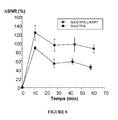
- the dynamic follow-up of the mouse apoptotic liver MRI signal shows enhancement with Gd-DTPA-LIKKPF greater than that measured with Gd-DTPA-FKIPKL (scramble) or non-functionalized Gd-DTPA.
- the pre-injection of peptide LIKKPF SEQ ID No. 11
- blocks the enhancement caused by Gd-DTPA-LIKKPF blocks the enhancement caused by Gd-DTPA-LIKKPF, which testifies to the specificity of interaction between Gd-DTPA-LIKKPF and the PS.
- Immunohistochemistry and MRI are very revealing. Sick and healthy mice were studied on the 4th, 5th, 6th day of treatment, and one and three weeks after the end of MPTP treatment. Imaging shows an evolution of the signal during the treatment, the targeting being more marked on the 5th day and then decreasing after. Sections made with these non-vectorized USPIOs (without peptide) show no marked targeting. MRI localization of diseased areas corresponds to zones containing dopaminergic neurons (immunohistochemistry: detection of dopaminergic neurons by measurement of tyrosine hydroxylase in the basal ganglia).
Landscapes
- Chemical & Material Sciences (AREA)
- Health & Medical Sciences (AREA)
- Nanotechnology (AREA)
- Engineering & Computer Science (AREA)
- Life Sciences & Earth Sciences (AREA)
- Nuclear Medicine, Radiotherapy & Molecular Imaging (AREA)
- Organic Chemistry (AREA)
- General Health & Medical Sciences (AREA)
- Public Health (AREA)
- Veterinary Medicine (AREA)
- Animal Behavior & Ethology (AREA)
- Radiology & Medical Imaging (AREA)
- Epidemiology (AREA)
- Medicinal Chemistry (AREA)
- Molecular Biology (AREA)
- Pharmacology & Pharmacy (AREA)
- Immunology (AREA)
- Bioinformatics & Cheminformatics (AREA)
- Proteomics, Peptides & Aminoacids (AREA)
- Biophysics (AREA)
- General Chemical & Material Sciences (AREA)
- Chemical Kinetics & Catalysis (AREA)
- Genetics & Genomics (AREA)
- Biochemistry (AREA)
- Biotechnology (AREA)
- General Engineering & Computer Science (AREA)
- Medical Informatics (AREA)
- Crystallography & Structural Chemistry (AREA)
- Biomedical Technology (AREA)
- Neurology (AREA)
- Neurosurgery (AREA)
- Medicines Containing Antibodies Or Antigens For Use As Internal Diagnostic Agents (AREA)
- Peptides Or Proteins (AREA)
Applications Claiming Priority (2)
| Application Number | Priority Date | Filing Date | Title |
|---|---|---|---|
| FR0754086A FR2914303A1 (fr) | 2007-03-28 | 2007-03-28 | Composes pour le diagnostic de l'apoptose. |
| EP08718146A EP2137208A2 (de) | 2007-03-28 | 2008-03-21 | Verbindungen zur diagnose von apoptose |
Related Parent Applications (2)
| Application Number | Title | Priority Date | Filing Date |
|---|---|---|---|
| EP08718146.7 Division | 2008-03-21 | ||
| EP08718146A Division EP2137208A2 (de) | 2007-03-28 | 2008-03-21 | Verbindungen zur diagnose von apoptose |
Publications (3)
| Publication Number | Publication Date |
|---|---|
| EP2474553A2 true EP2474553A2 (de) | 2012-07-11 |
| EP2474553A3 EP2474553A3 (de) | 2012-08-22 |
| EP2474553B1 EP2474553B1 (de) | 2015-01-21 |
Family
ID=38596617
Family Applications (2)
| Application Number | Title | Priority Date | Filing Date |
|---|---|---|---|
| EP12163474.5A Not-in-force EP2474553B1 (de) | 2007-03-28 | 2008-03-21 | Verbindungen zur Diagnose der Apoptose |
| EP08718146A Withdrawn EP2137208A2 (de) | 2007-03-28 | 2008-03-21 | Verbindungen zur diagnose von apoptose |
Family Applications After (1)
| Application Number | Title | Priority Date | Filing Date |
|---|---|---|---|
| EP08718146A Withdrawn EP2137208A2 (de) | 2007-03-28 | 2008-03-21 | Verbindungen zur diagnose von apoptose |
Country Status (4)
| Country | Link |
|---|---|
| US (1) | US20100143250A1 (de) |
| EP (2) | EP2474553B1 (de) |
| FR (1) | FR2914303A1 (de) |
| WO (1) | WO2008125420A2 (de) |
Families Citing this family (5)
| Publication number | Priority date | Publication date | Assignee | Title |
|---|---|---|---|---|
| FR2921837B1 (fr) * | 2007-10-05 | 2015-07-31 | Guerbet Sa | Nouveau procede de preparation de nanoparticules recouvertes d'une couche stabilisatrice organique couplee a des ligands de ciblage |
| WO2011159951A2 (en) * | 2010-06-17 | 2011-12-22 | Sanford-Burnham Medical Research Institute | Targeting tumor associated macrophages using bisphosphonate-loaded particles |
| FR2968562B1 (fr) | 2010-12-14 | 2013-01-11 | Guerbet Sa | Composes pour le diagnostic de maladies liees a l'expression de muc5ac |
| WO2025094171A1 (en) * | 2023-11-02 | 2025-05-08 | Yissum Research Development Company Of The Hebrew University Of Jerusalem Ltd. | Superhydrophobic coating |
| WO2026019458A1 (en) * | 2024-07-19 | 2026-01-22 | Monopar Therpeutics, Inc | Squaramide bi-functional chelators and associated radiopharmaceuticals and methods of use |
Citations (28)
| Publication number | Priority date | Publication date | Assignee | Title |
|---|---|---|---|---|
| WO1990004943A1 (en) | 1988-11-09 | 1990-05-17 | Unger Evan C | Liposomal radiologic contrast agents |
| US5080885A (en) | 1986-01-14 | 1992-01-14 | Alliance Pharmaceutical Corp. | Brominated perfluorocarbon emulsions for internal animal use for contrast enhancement and oxygen transport |
| EP0661279A1 (de) | 1993-12-30 | 1995-07-05 | Guerbet S.A. | Polyaminierte Liganden, Metallkomplexe, Verfahren zur Herstellung und diagnostische und therapeutische Verwendungen |
| EP0922700A1 (de) | 1997-12-10 | 1999-06-16 | Guerbet | Metallchelate von makrocyclischen polyaminocarbocyclischen Derivaten und deren Verwendung zur Diagnostik-Bilderzeugung |
| US5958371A (en) | 1995-06-08 | 1999-09-28 | Barnes-Jewish Hospital | Site specific binding system, nuclear imaging compositions and methods |
| US5989520A (en) | 1995-06-08 | 1999-11-23 | Barnes-Jewish Hospital | Site specific binding system, imaging compositions and methods |
| US6010682A (en) | 1991-05-23 | 2000-01-04 | Imarx Pharmaceuticals Corp. | Liposoluble compounds useful as magnetic resonance imaging agents |
| US6045821A (en) | 1994-10-10 | 2000-04-04 | Nycomed Salutar, Inc. | Liposomal agents |
| WO2001060416A2 (en) | 2000-02-15 | 2001-08-23 | Bristol-Myers Squibb Pharma Company | Matrix metalloproteinase inhibitors as targeting components in diagnostic agents |
| WO2002026776A2 (en) | 2000-09-26 | 2002-04-04 | Amersham Health As | Peptide-based compounds |
| US6403056B1 (en) | 1997-03-21 | 2002-06-11 | Imarx Therapeutics, Inc. | Method for delivering bioactive agents using cochleates |
| US20020090342A1 (en) | 2001-01-09 | 2002-07-11 | Shuang Liu | Polypodal chelants for metallopharmaceuticals |
| WO2002055111A2 (en) | 2000-11-27 | 2002-07-18 | Bristol Myers Squibb Medical I | Simultaneous imaging of cardiac perfusion and a vitronectin receptor targeted imaging agent |
| US20020098149A1 (en) | 2001-01-09 | 2002-07-25 | Shuang Liu | New macrocyclic chelants useful for metallopharmaceuticals |
| US6440956B1 (en) | 1999-06-09 | 2002-08-27 | Guerbet | Bicyclic polyaminoacid metal complexes, their process of preparation and their application in medical imaging |
| WO2002085908A1 (en) | 2001-04-24 | 2002-10-31 | Purdue Research Foundation | Folate mimetics and folate-receptor binding conjugates thereof |
| WO2003011115A2 (en) | 2001-07-30 | 2003-02-13 | Epix Medical, Inc. | Peptide-based multimeric targeted contrast agents |
| US6537520B1 (en) | 1998-03-31 | 2003-03-25 | Bristol-Myers Squibb Pharma Company | Pharmaceuticals for the imaging of angiogenic disorders |
| WO2003062198A1 (en) | 2002-01-24 | 2003-07-31 | Barnes Jewish Hospital | Integrin targeted imaging agents |
| US6676963B1 (en) | 2000-10-27 | 2004-01-13 | Barnes-Jewish Hospital | Ligand-targeted emulsions carrying bioactive agents |
| WO2004058275A2 (fr) | 2002-12-20 | 2004-07-15 | Guerbet | Compositions de particules magnetiques recouvertes de derives gem-bisphosphonates |
| US20040248856A1 (en) | 2002-01-24 | 2004-12-09 | Lanza Gregory M | Chelating agents with lipophilic carriers |
| US20050100963A1 (en) | 2002-03-01 | 2005-05-12 | Dyax Corporation | KDR and VEGF/KDR binding peptides and their use in diagnosis and therapy |
| DE102004062258B3 (de) | 2004-12-23 | 2006-01-05 | Schering Ag | Hydroxypyridinon-Derivate, deren Metallkomplexe und deren Verwendung zur Herstellung von Konjugaten mit Biomolekülen |
| WO2006000273A1 (de) | 2004-06-24 | 2006-01-05 | Forschungszentrum Karlsruhe Gmbh | Verfahren zum verbinden von werkstücken aus kunststoff |
| US20060018830A1 (en) | 2003-01-13 | 2006-01-26 | Bracco Imaging S.P.A. | Gastrin releasing peptide compounds |
| WO2006031885A2 (en) | 2004-09-13 | 2006-03-23 | Dyax Corp. | Kdr and vegf/kdr binding peptides |
| WO2006100305A2 (fr) | 2005-03-24 | 2006-09-28 | Guerbet | Chelates métalliques de dérivés macrocycliques polyaminocarboxyliques et leur utilisation en imagerie diagnostique |
Family Cites Families (11)
| Publication number | Priority date | Publication date | Assignee | Title |
|---|---|---|---|---|
| US5215680A (en) * | 1990-07-10 | 1993-06-01 | Cavitation-Control Technology, Inc. | Method for the production of medical-grade lipid-coated microbubbles, paramagnetic labeling of such microbubbles and therapeutic uses of microbubbles |
| ATE314097T1 (de) * | 1996-10-28 | 2006-01-15 | Amersham Health As | Kontrastmittel |
| US20070048808A1 (en) * | 1999-03-12 | 2007-03-01 | Feitelson Mark A | Hepatocellular carcinoma screening |
| US20020122806A1 (en) * | 2001-03-05 | 2002-09-05 | Chinnaiyan Arul M. | Compositions and methods for in situ and in vivo imaging of cells and tissues |
| US7011816B2 (en) * | 2001-12-26 | 2006-03-14 | Immunomedics, Inc. | Labeling targeting agents with gallium-68 and gallium-67 |
| US20040022731A1 (en) * | 2002-04-26 | 2004-02-05 | Alexei Bogdanov | In vivo imaging of apoptosis |
| WO2004112840A2 (en) * | 2003-06-25 | 2004-12-29 | Guerbet | Peptide conjugate for magnetic resonance imaging |
| WO2006032705A2 (en) * | 2004-09-23 | 2006-03-30 | Guerbet | Contrast agents encapsulating systems for cest imaging |
| US8926945B2 (en) * | 2005-10-07 | 2015-01-06 | Guerbet | Compounds comprising a biological target recognizing part, coupled to a signal part capable of complexing gallium |
| FR2891830B1 (fr) * | 2005-10-07 | 2011-06-24 | Guerbet Sa | Composes a chaines aminoalcools courtes et complexes metalliques pour l'imagerie medicale |
| CN101222009A (zh) * | 2007-01-12 | 2008-07-16 | 清华大学 | 发光二极管 |
-
2007
- 2007-03-28 FR FR0754086A patent/FR2914303A1/fr active Pending
-
2008
- 2008-03-21 WO PCT/EP2008/053447 patent/WO2008125420A2/fr not_active Ceased
- 2008-03-21 EP EP12163474.5A patent/EP2474553B1/de not_active Not-in-force
- 2008-03-21 EP EP08718146A patent/EP2137208A2/de not_active Withdrawn
- 2008-03-21 US US12/593,495 patent/US20100143250A1/en not_active Abandoned
Patent Citations (30)
| Publication number | Priority date | Publication date | Assignee | Title |
|---|---|---|---|---|
| US5080885A (en) | 1986-01-14 | 1992-01-14 | Alliance Pharmaceutical Corp. | Brominated perfluorocarbon emulsions for internal animal use for contrast enhancement and oxygen transport |
| WO1990004943A1 (en) | 1988-11-09 | 1990-05-17 | Unger Evan C | Liposomal radiologic contrast agents |
| US6010682A (en) | 1991-05-23 | 2000-01-04 | Imarx Pharmaceuticals Corp. | Liposoluble compounds useful as magnetic resonance imaging agents |
| EP0661279A1 (de) | 1993-12-30 | 1995-07-05 | Guerbet S.A. | Polyaminierte Liganden, Metallkomplexe, Verfahren zur Herstellung und diagnostische und therapeutische Verwendungen |
| US5919432A (en) | 1993-12-30 | 1999-07-06 | Guerbet S.A. | Polyaminated ligands and metal complexes thereof |
| US6045821A (en) | 1994-10-10 | 2000-04-04 | Nycomed Salutar, Inc. | Liposomal agents |
| US5989520A (en) | 1995-06-08 | 1999-11-23 | Barnes-Jewish Hospital | Site specific binding system, imaging compositions and methods |
| US5958371A (en) | 1995-06-08 | 1999-09-28 | Barnes-Jewish Hospital | Site specific binding system, nuclear imaging compositions and methods |
| US6403056B1 (en) | 1997-03-21 | 2002-06-11 | Imarx Therapeutics, Inc. | Method for delivering bioactive agents using cochleates |
| EP0922700A1 (de) | 1997-12-10 | 1999-06-16 | Guerbet | Metallchelate von makrocyclischen polyaminocarbocyclischen Derivaten und deren Verwendung zur Diagnostik-Bilderzeugung |
| US6537520B1 (en) | 1998-03-31 | 2003-03-25 | Bristol-Myers Squibb Pharma Company | Pharmaceuticals for the imaging of angiogenic disorders |
| US6440956B1 (en) | 1999-06-09 | 2002-08-27 | Guerbet | Bicyclic polyaminoacid metal complexes, their process of preparation and their application in medical imaging |
| WO2001060416A2 (en) | 2000-02-15 | 2001-08-23 | Bristol-Myers Squibb Pharma Company | Matrix metalloproteinase inhibitors as targeting components in diagnostic agents |
| WO2002026776A2 (en) | 2000-09-26 | 2002-04-04 | Amersham Health As | Peptide-based compounds |
| US6676963B1 (en) | 2000-10-27 | 2004-01-13 | Barnes-Jewish Hospital | Ligand-targeted emulsions carrying bioactive agents |
| WO2002055111A2 (en) | 2000-11-27 | 2002-07-18 | Bristol Myers Squibb Medical I | Simultaneous imaging of cardiac perfusion and a vitronectin receptor targeted imaging agent |
| US20020098149A1 (en) | 2001-01-09 | 2002-07-25 | Shuang Liu | New macrocyclic chelants useful for metallopharmaceuticals |
| US20020090342A1 (en) | 2001-01-09 | 2002-07-11 | Shuang Liu | Polypodal chelants for metallopharmaceuticals |
| WO2002085908A1 (en) | 2001-04-24 | 2002-10-31 | Purdue Research Foundation | Folate mimetics and folate-receptor binding conjugates thereof |
| WO2003011115A2 (en) | 2001-07-30 | 2003-02-13 | Epix Medical, Inc. | Peptide-based multimeric targeted contrast agents |
| WO2003062198A1 (en) | 2002-01-24 | 2003-07-31 | Barnes Jewish Hospital | Integrin targeted imaging agents |
| US20040248856A1 (en) | 2002-01-24 | 2004-12-09 | Lanza Gregory M | Chelating agents with lipophilic carriers |
| US20050100963A1 (en) | 2002-03-01 | 2005-05-12 | Dyax Corporation | KDR and VEGF/KDR binding peptides and their use in diagnosis and therapy |
| US20040253181A1 (en) | 2002-12-20 | 2004-12-16 | Marc Port | Novel compositions magnetic particles covered with gem-bisphosphonate derivatives |
| WO2004058275A2 (fr) | 2002-12-20 | 2004-07-15 | Guerbet | Compositions de particules magnetiques recouvertes de derives gem-bisphosphonates |
| US20060018830A1 (en) | 2003-01-13 | 2006-01-26 | Bracco Imaging S.P.A. | Gastrin releasing peptide compounds |
| WO2006000273A1 (de) | 2004-06-24 | 2006-01-05 | Forschungszentrum Karlsruhe Gmbh | Verfahren zum verbinden von werkstücken aus kunststoff |
| WO2006031885A2 (en) | 2004-09-13 | 2006-03-23 | Dyax Corp. | Kdr and vegf/kdr binding peptides |
| DE102004062258B3 (de) | 2004-12-23 | 2006-01-05 | Schering Ag | Hydroxypyridinon-Derivate, deren Metallkomplexe und deren Verwendung zur Herstellung von Konjugaten mit Biomolekülen |
| WO2006100305A2 (fr) | 2005-03-24 | 2006-09-28 | Guerbet | Chelates métalliques de dérivés macrocycliques polyaminocarboxyliques et leur utilisation en imagerie diagnostique |
Non-Patent Citations (3)
| Title |
|---|
| KOLODGIE FD. ET AL., CIRCULATION, vol. 108, 2003, pages 3134 - 3139 |
| R. PECORA, J. OFNANO. RES., vol. 2, 2000, pages 123 - 131 |
| SCHELLENBERGER EA ET AL., MOL. IMAGING, vol. 1, 2002, pages 102 - 107 |
Also Published As
| Publication number | Publication date |
|---|---|
| EP2474553B1 (de) | 2015-01-21 |
| EP2137208A2 (de) | 2009-12-30 |
| EP2474553A3 (de) | 2012-08-22 |
| WO2008125420A3 (fr) | 2008-12-11 |
| WO2008125420A2 (fr) | 2008-10-23 |
| US20100143250A1 (en) | 2010-06-10 |
| FR2914303A1 (fr) | 2008-10-03 |
Similar Documents
| Publication | Publication Date | Title |
|---|---|---|
| EP1940841B1 (de) | Verbindungen mit einem eine biologische zielstruktur erkennenden teil, das mit einem zum komplexieren von gallium fähigen signalteil gekoppelt ist | |
| EP1572246B1 (de) | Zusammensetzungen von magnetischen partikeln mit gem-biphosphonate derivaten beschichtet | |
| CN101305006B (zh) | 含有短氨基醇链的化合物和用于医学成像的金属络合物 | |
| Bryson et al. | A β-cyclodextrin “click cluster” decorated with seven paramagnetic chelates containing two water exchange sites | |
| EP2322538B1 (de) | Verbindungen zur Diagnose von Krankheiten in Verbindung mit einer Expression von VCAM | |
| EP2474553B1 (de) | Verbindungen zur Diagnose der Apoptose | |
| JP2007521254A (ja) | 診断画像用化合物 | |
| CN101301479A (zh) | 用于磁共振成像诊断的肿瘤靶向显影组合物及其制备方法 | |
| EP2651453B1 (de) | Verbindungen zur diagnose von erkrankungen in zusammenhang mit der expression von muc5ac | |
| EP1796738B1 (de) | Bicyclam konjugat für die mrt und szintigraphie von krankheiten assoziert mit dem cxcr4 rezeptor | |
| JP2002521384A (ja) | 3−,8−置換された常磁性ジューテロポルフィリン誘導体、該誘導体を含有する医薬調剤、その製造法及び壊死及び梗塞の核磁気共鳴映像法のための使用 | |
| TW202540073A (zh) | 靶向sstr受體的放射性化合物及其用途 | |
| FR2899585A1 (fr) | Composes comprenant une partie de reconnaissance d'une cible biologique, couplee a une partie de signal capable de complexer le gallium | |
| Morisco | TARGETING PEPTIDES CONTAINING SUPRAMOLECULAR AGGREGATES TOWARD CANCER CELLS |
Legal Events
| Date | Code | Title | Description |
|---|---|---|---|
| PUAI | Public reference made under article 153(3) epc to a published international application that has entered the european phase |
Free format text: ORIGINAL CODE: 0009012 |
|
| AC | Divisional application: reference to earlier application |
Ref document number: 2137208 Country of ref document: EP Kind code of ref document: P |
|
| AK | Designated contracting states |
Kind code of ref document: A2 Designated state(s): AT BE BG CH CY CZ DE DK EE ES FI FR GB GR HR HU IE IS IT LI LT LU LV MC MT NL NO PL PT RO SE SI SK TR |
|
| AX | Request for extension of the european patent |
Extension state: AL BA MK RS |
|
| PUAL | Search report despatched |
Free format text: ORIGINAL CODE: 0009013 |
|
| AK | Designated contracting states |
Kind code of ref document: A3 Designated state(s): AT BE BG CH CY CZ DE DK EE ES FI FR GB GR HR HU IE IS IT LI LT LU LV MC MT NL NO PL PT RO SE SI SK TR |
|
| AX | Request for extension of the european patent |
Extension state: AL BA MK RS |
|
| RIC1 | Information provided on ipc code assigned before grant |
Ipc: A61K 49/18 20060101ALI20120713BHEP Ipc: C07D 403/06 20060101ALI20120713BHEP Ipc: A61K 49/08 20060101ALI20120713BHEP Ipc: B82Y 5/00 20110101ALI20120713BHEP Ipc: C07D 257/02 20060101ALI20120713BHEP Ipc: G01N 33/68 20060101ALI20120713BHEP Ipc: A61K 49/14 20060101ALI20120713BHEP Ipc: C07K 7/06 20060101AFI20120713BHEP |
|
| 17P | Request for examination filed |
Effective date: 20130207 |
|
| 17Q | First examination report despatched |
Effective date: 20130319 |
|
| GRAP | Despatch of communication of intention to grant a patent |
Free format text: ORIGINAL CODE: EPIDOSNIGR1 |
|
| INTG | Intention to grant announced |
Effective date: 20140807 |
|
| GRAS | Grant fee paid |
Free format text: ORIGINAL CODE: EPIDOSNIGR3 |
|
| GRAA | (expected) grant |
Free format text: ORIGINAL CODE: 0009210 |
|
| AC | Divisional application: reference to earlier application |
Ref document number: 2137208 Country of ref document: EP Kind code of ref document: P |
|
| AK | Designated contracting states |
Kind code of ref document: B1 Designated state(s): AT BE BG CH CY CZ DE DK EE ES FI FR GB GR HR HU IE IS IT LI LT LU LV MC MT NL NO PL PT RO SE SI SK TR |
|
| REG | Reference to a national code |
Ref country code: GB Ref legal event code: FG4D Free format text: NOT ENGLISH |
|
| REG | Reference to a national code |
Ref country code: CH Ref legal event code: EP |
|
| REG | Reference to a national code |
Ref country code: IE Ref legal event code: FG4D Free format text: LANGUAGE OF EP DOCUMENT: FRENCH |
|
| REG | Reference to a national code |
Ref country code: DE Ref legal event code: R096 Ref document number: 602008036523 Country of ref document: DE Effective date: 20150305 |
|
| REG | Reference to a national code |
Ref country code: AT Ref legal event code: REF Ref document number: 709136 Country of ref document: AT Kind code of ref document: T Effective date: 20150315 |
|
| REG | Reference to a national code |
Ref country code: NL Ref legal event code: VDEP Effective date: 20150121 |
|
| REG | Reference to a national code |
Ref country code: AT Ref legal event code: MK05 Ref document number: 709136 Country of ref document: AT Kind code of ref document: T Effective date: 20150121 |
|
| REG | Reference to a national code |
Ref country code: LT Ref legal event code: MG4D |
|
| PG25 | Lapsed in a contracting state [announced via postgrant information from national office to epo] |
Ref country code: SE Free format text: LAPSE BECAUSE OF FAILURE TO SUBMIT A TRANSLATION OF THE DESCRIPTION OR TO PAY THE FEE WITHIN THE PRESCRIBED TIME-LIMIT Effective date: 20150121 Ref country code: NO Free format text: LAPSE BECAUSE OF FAILURE TO SUBMIT A TRANSLATION OF THE DESCRIPTION OR TO PAY THE FEE WITHIN THE PRESCRIBED TIME-LIMIT Effective date: 20150421 Ref country code: LT Free format text: LAPSE BECAUSE OF FAILURE TO SUBMIT A TRANSLATION OF THE DESCRIPTION OR TO PAY THE FEE WITHIN THE PRESCRIBED TIME-LIMIT Effective date: 20150121 Ref country code: BG Free format text: LAPSE BECAUSE OF FAILURE TO SUBMIT A TRANSLATION OF THE DESCRIPTION OR TO PAY THE FEE WITHIN THE PRESCRIBED TIME-LIMIT Effective date: 20150421 Ref country code: ES Free format text: LAPSE BECAUSE OF FAILURE TO SUBMIT A TRANSLATION OF THE DESCRIPTION OR TO PAY THE FEE WITHIN THE PRESCRIBED TIME-LIMIT Effective date: 20150121 Ref country code: FI Free format text: LAPSE BECAUSE OF FAILURE TO SUBMIT A TRANSLATION OF THE DESCRIPTION OR TO PAY THE FEE WITHIN THE PRESCRIBED TIME-LIMIT Effective date: 20150121 Ref country code: HR Free format text: LAPSE BECAUSE OF FAILURE TO SUBMIT A TRANSLATION OF THE DESCRIPTION OR TO PAY THE FEE WITHIN THE PRESCRIBED TIME-LIMIT Effective date: 20150121 |
|
| PG25 | Lapsed in a contracting state [announced via postgrant information from national office to epo] |
Ref country code: GR Free format text: LAPSE BECAUSE OF FAILURE TO SUBMIT A TRANSLATION OF THE DESCRIPTION OR TO PAY THE FEE WITHIN THE PRESCRIBED TIME-LIMIT Effective date: 20150422 Ref country code: NL Free format text: LAPSE BECAUSE OF FAILURE TO SUBMIT A TRANSLATION OF THE DESCRIPTION OR TO PAY THE FEE WITHIN THE PRESCRIBED TIME-LIMIT Effective date: 20150121 Ref country code: AT Free format text: LAPSE BECAUSE OF FAILURE TO SUBMIT A TRANSLATION OF THE DESCRIPTION OR TO PAY THE FEE WITHIN THE PRESCRIBED TIME-LIMIT Effective date: 20150121 Ref country code: IS Free format text: LAPSE BECAUSE OF FAILURE TO SUBMIT A TRANSLATION OF THE DESCRIPTION OR TO PAY THE FEE WITHIN THE PRESCRIBED TIME-LIMIT Effective date: 20150521 Ref country code: PL Free format text: LAPSE BECAUSE OF FAILURE TO SUBMIT A TRANSLATION OF THE DESCRIPTION OR TO PAY THE FEE WITHIN THE PRESCRIBED TIME-LIMIT Effective date: 20150121 Ref country code: LV Free format text: LAPSE BECAUSE OF FAILURE TO SUBMIT A TRANSLATION OF THE DESCRIPTION OR TO PAY THE FEE WITHIN THE PRESCRIBED TIME-LIMIT Effective date: 20150121 |
|
| REG | Reference to a national code |
Ref country code: DE Ref legal event code: R097 Ref document number: 602008036523 Country of ref document: DE |
|
| PG25 | Lapsed in a contracting state [announced via postgrant information from national office to epo] |
Ref country code: DK Free format text: LAPSE BECAUSE OF FAILURE TO SUBMIT A TRANSLATION OF THE DESCRIPTION OR TO PAY THE FEE WITHIN THE PRESCRIBED TIME-LIMIT Effective date: 20150121 Ref country code: RO Free format text: LAPSE BECAUSE OF FAILURE TO SUBMIT A TRANSLATION OF THE DESCRIPTION OR TO PAY THE FEE WITHIN THE PRESCRIBED TIME-LIMIT Effective date: 20150121 Ref country code: MC Free format text: LAPSE BECAUSE OF FAILURE TO SUBMIT A TRANSLATION OF THE DESCRIPTION OR TO PAY THE FEE WITHIN THE PRESCRIBED TIME-LIMIT Effective date: 20150121 Ref country code: SK Free format text: LAPSE BECAUSE OF FAILURE TO SUBMIT A TRANSLATION OF THE DESCRIPTION OR TO PAY THE FEE WITHIN THE PRESCRIBED TIME-LIMIT Effective date: 20150121 Ref country code: LU Free format text: LAPSE BECAUSE OF FAILURE TO SUBMIT A TRANSLATION OF THE DESCRIPTION OR TO PAY THE FEE WITHIN THE PRESCRIBED TIME-LIMIT Effective date: 20150321 Ref country code: CZ Free format text: LAPSE BECAUSE OF FAILURE TO SUBMIT A TRANSLATION OF THE DESCRIPTION OR TO PAY THE FEE WITHIN THE PRESCRIBED TIME-LIMIT Effective date: 20150121 Ref country code: EE Free format text: LAPSE BECAUSE OF FAILURE TO SUBMIT A TRANSLATION OF THE DESCRIPTION OR TO PAY THE FEE WITHIN THE PRESCRIBED TIME-LIMIT Effective date: 20150121 |
|
| REG | Reference to a national code |
Ref country code: CH Ref legal event code: PL |
|
| PLBE | No opposition filed within time limit |
Free format text: ORIGINAL CODE: 0009261 |
|
| STAA | Information on the status of an ep patent application or granted ep patent |
Free format text: STATUS: NO OPPOSITION FILED WITHIN TIME LIMIT |
|
| 26N | No opposition filed |
Effective date: 20151022 |
|
| PG25 | Lapsed in a contracting state [announced via postgrant information from national office to epo] |
Ref country code: IT Free format text: LAPSE BECAUSE OF FAILURE TO SUBMIT A TRANSLATION OF THE DESCRIPTION OR TO PAY THE FEE WITHIN THE PRESCRIBED TIME-LIMIT Effective date: 20150121 |
|
| REG | Reference to a national code |
Ref country code: IE Ref legal event code: MM4A |
|
| PG25 | Lapsed in a contracting state [announced via postgrant information from national office to epo] |
Ref country code: IE Free format text: LAPSE BECAUSE OF NON-PAYMENT OF DUE FEES Effective date: 20150321 Ref country code: CH Free format text: LAPSE BECAUSE OF NON-PAYMENT OF DUE FEES Effective date: 20150331 Ref country code: LI Free format text: LAPSE BECAUSE OF NON-PAYMENT OF DUE FEES Effective date: 20150331 |
|
| PG25 | Lapsed in a contracting state [announced via postgrant information from national office to epo] |
Ref country code: SI Free format text: LAPSE BECAUSE OF FAILURE TO SUBMIT A TRANSLATION OF THE DESCRIPTION OR TO PAY THE FEE WITHIN THE PRESCRIBED TIME-LIMIT Effective date: 20150121 |
|
| REG | Reference to a national code |
Ref country code: FR Ref legal event code: PLFP Year of fee payment: 9 |
|
| PG25 | Lapsed in a contracting state [announced via postgrant information from national office to epo] |
Ref country code: MT Free format text: LAPSE BECAUSE OF FAILURE TO SUBMIT A TRANSLATION OF THE DESCRIPTION OR TO PAY THE FEE WITHIN THE PRESCRIBED TIME-LIMIT Effective date: 20150121 |
|
| REG | Reference to a national code |
Ref country code: FR Ref legal event code: PLFP Year of fee payment: 10 |
|
| PG25 | Lapsed in a contracting state [announced via postgrant information from national office to epo] |
Ref country code: HU Free format text: LAPSE BECAUSE OF FAILURE TO SUBMIT A TRANSLATION OF THE DESCRIPTION OR TO PAY THE FEE WITHIN THE PRESCRIBED TIME-LIMIT; INVALID AB INITIO Effective date: 20080321 |
|
| PG25 | Lapsed in a contracting state [announced via postgrant information from national office to epo] |
Ref country code: CY Free format text: LAPSE BECAUSE OF FAILURE TO SUBMIT A TRANSLATION OF THE DESCRIPTION OR TO PAY THE FEE WITHIN THE PRESCRIBED TIME-LIMIT Effective date: 20150121 |
|
| PG25 | Lapsed in a contracting state [announced via postgrant information from national office to epo] |
Ref country code: PT Free format text: LAPSE BECAUSE OF FAILURE TO SUBMIT A TRANSLATION OF THE DESCRIPTION OR TO PAY THE FEE WITHIN THE PRESCRIBED TIME-LIMIT Effective date: 20150521 Ref country code: BE Free format text: LAPSE BECAUSE OF NON-PAYMENT OF DUE FEES Effective date: 20150331 |
|
| PG25 | Lapsed in a contracting state [announced via postgrant information from national office to epo] |
Ref country code: TR Free format text: LAPSE BECAUSE OF FAILURE TO SUBMIT A TRANSLATION OF THE DESCRIPTION OR TO PAY THE FEE WITHIN THE PRESCRIBED TIME-LIMIT Effective date: 20150121 |
|
| REG | Reference to a national code |
Ref country code: FR Ref legal event code: PLFP Year of fee payment: 11 |
|
| PGFP | Annual fee paid to national office [announced via postgrant information from national office to epo] |
Ref country code: DE Payment date: 20190327 Year of fee payment: 12 Ref country code: FR Payment date: 20190325 Year of fee payment: 12 |
|
| PGFP | Annual fee paid to national office [announced via postgrant information from national office to epo] |
Ref country code: GB Payment date: 20190404 Year of fee payment: 12 |
|
| REG | Reference to a national code |
Ref country code: DE Ref legal event code: R119 Ref document number: 602008036523 Country of ref document: DE |
|
| PG25 | Lapsed in a contracting state [announced via postgrant information from national office to epo] |
Ref country code: FR Free format text: LAPSE BECAUSE OF NON-PAYMENT OF DUE FEES Effective date: 20200331 Ref country code: DE Free format text: LAPSE BECAUSE OF NON-PAYMENT OF DUE FEES Effective date: 20201001 |
|
| GBPC | Gb: european patent ceased through non-payment of renewal fee |
Effective date: 20200321 |
|
| PG25 | Lapsed in a contracting state [announced via postgrant information from national office to epo] |
Ref country code: GB Free format text: LAPSE BECAUSE OF NON-PAYMENT OF DUE FEES Effective date: 20200321 |