EP2475655B1 - Stabilisateur d'amine entravee steriquement - Google Patents
Stabilisateur d'amine entravee steriquement Download PDFInfo
- Publication number
- EP2475655B1 EP2475655B1 EP10747463.7A EP10747463A EP2475655B1 EP 2475655 B1 EP2475655 B1 EP 2475655B1 EP 10747463 A EP10747463 A EP 10747463A EP 2475655 B1 EP2475655 B1 EP 2475655B1
- Authority
- EP
- European Patent Office
- Prior art keywords
- alkyl
- formula
- independently
- group
- hydrogen
- Prior art date
- Legal status (The legal status is an assumption and is not a legal conclusion. Google has not performed a legal analysis and makes no representation as to the accuracy of the status listed.)
- Active
Links
- 0 C*c(cc1*)cc(C(C)c2cc(*)cc(*)c2O2)c1OP2F Chemical compound C*c(cc1*)cc(C(C)c2cc(*)cc(*)c2O2)c1OP2F 0.000 description 7
- FLMNYDSYBJWMPM-UHFFFAOYSA-N CCCCN(C(CC1(C)C)CC(C)(C)N1OC)c1nc(N(CCCC)C(CC2(C)C)CC(C)(C)N2OC)nc(N(CCCCCCN(C(CC2(C)C)CC(CC)(CC)N2OC)c2nc(N(CCCC)C(CC3(C)C)CC(C)(C)N3OC)nc(N(CCCC)C(CC3(C)C)CC(C)(C)N3OC)n2)C(CC2(C)C)CC(C)(C)N2OC)n1 Chemical compound CCCCN(C(CC1(C)C)CC(C)(C)N1OC)c1nc(N(CCCC)C(CC2(C)C)CC(C)(C)N2OC)nc(N(CCCCCCN(C(CC2(C)C)CC(CC)(CC)N2OC)c2nc(N(CCCC)C(CC3(C)C)CC(C)(C)N3OC)nc(N(CCCC)C(CC3(C)C)CC(C)(C)N3OC)n2)C(CC2(C)C)CC(C)(C)N2OC)n1 FLMNYDSYBJWMPM-UHFFFAOYSA-N 0.000 description 1
- AYURVWIHIUROAP-UHFFFAOYSA-N CCCCN(C(CC1(C)C)CC(C)(C)N1OCCC)c1nc(NCCN(CCNc2nc(N(CCCC)C(CC3(C)C)CC(C)(C)N3OCCC)nc(N(CCCC)C(CC3(C)C)CC(C)(C)N3OCCC)n2)CCNc2nc(N(CCCC)C(CC3(C)C)CC(C)(C)N3OCCC)nc(N(CCCC)C(CC3(C)C)CC(C)(C)N3OCCC)n2)nc(N(CCCC)C(CC2(C)C)CC(C)(C)N2OCCC)n1 Chemical compound CCCCN(C(CC1(C)C)CC(C)(C)N1OCCC)c1nc(NCCN(CCNc2nc(N(CCCC)C(CC3(C)C)CC(C)(C)N3OCCC)nc(N(CCCC)C(CC3(C)C)CC(C)(C)N3OCCC)n2)CCNc2nc(N(CCCC)C(CC3(C)C)CC(C)(C)N3OCCC)nc(N(CCCC)C(CC3(C)C)CC(C)(C)N3OCCC)n2)nc(N(CCCC)C(CC2(C)C)CC(C)(C)N2OCCC)n1 AYURVWIHIUROAP-UHFFFAOYSA-N 0.000 description 1
Classifications
-
- C—CHEMISTRY; METALLURGY
- C07—ORGANIC CHEMISTRY
- C07D—HETEROCYCLIC COMPOUNDS
- C07D401/00—Heterocyclic compounds containing two or more hetero rings, having nitrogen atoms as the only ring hetero atoms, at least one ring being a six-membered ring with only one nitrogen atom
- C07D401/14—Heterocyclic compounds containing two or more hetero rings, having nitrogen atoms as the only ring hetero atoms, at least one ring being a six-membered ring with only one nitrogen atom containing three or more hetero rings
-
- C—CHEMISTRY; METALLURGY
- C07—ORGANIC CHEMISTRY
- C07D—HETEROCYCLIC COMPOUNDS
- C07D401/00—Heterocyclic compounds containing two or more hetero rings, having nitrogen atoms as the only ring hetero atoms, at least one ring being a six-membered ring with only one nitrogen atom
- C07D401/02—Heterocyclic compounds containing two or more hetero rings, having nitrogen atoms as the only ring hetero atoms, at least one ring being a six-membered ring with only one nitrogen atom containing two hetero rings
- C07D401/12—Heterocyclic compounds containing two or more hetero rings, having nitrogen atoms as the only ring hetero atoms, at least one ring being a six-membered ring with only one nitrogen atom containing two hetero rings linked by a chain containing hetero atoms as chain links
-
- C—CHEMISTRY; METALLURGY
- C08—ORGANIC MACROMOLECULAR COMPOUNDS; THEIR PREPARATION OR CHEMICAL WORKING-UP; COMPOSITIONS BASED THEREON
- C08K—Use of inorganic or non-macromolecular organic substances as compounding ingredients
- C08K5/00—Use of organic ingredients
- C08K5/16—Nitrogen-containing compounds
- C08K5/34—Heterocyclic compounds having nitrogen in the ring
- C08K5/3467—Heterocyclic compounds having nitrogen in the ring having more than two nitrogen atoms in the ring
- C08K5/3477—Six-membered rings
- C08K5/3492—Triazines
-
- C—CHEMISTRY; METALLURGY
- C08—ORGANIC MACROMOLECULAR COMPOUNDS; THEIR PREPARATION OR CHEMICAL WORKING-UP; COMPOSITIONS BASED THEREON
- C08K—Use of inorganic or non-macromolecular organic substances as compounding ingredients
- C08K5/00—Use of organic ingredients
- C08K5/16—Nitrogen-containing compounds
- C08K5/34—Heterocyclic compounds having nitrogen in the ring
- C08K5/3467—Heterocyclic compounds having nitrogen in the ring having more than two nitrogen atoms in the ring
- C08K5/3477—Six-membered rings
- C08K5/3492—Triazines
- C08K5/34926—Triazines also containing heterocyclic groups other than triazine groups
-
- C—CHEMISTRY; METALLURGY
- C08—ORGANIC MACROMOLECULAR COMPOUNDS; THEIR PREPARATION OR CHEMICAL WORKING-UP; COMPOSITIONS BASED THEREON
- C08L—COMPOSITIONS OF MACROMOLECULAR COMPOUNDS
- C08L101/00—Compositions of unspecified macromolecular compounds
-
- C—CHEMISTRY; METALLURGY
- C08—ORGANIC MACROMOLECULAR COMPOUNDS; THEIR PREPARATION OR CHEMICAL WORKING-UP; COMPOSITIONS BASED THEREON
- C08L—COMPOSITIONS OF MACROMOLECULAR COMPOUNDS
- C08L23/00—Compositions of homopolymers or copolymers of unsaturated aliphatic hydrocarbons having only one carbon-to-carbon double bond; Compositions of derivatives of such polymers
- C08L23/02—Compositions of homopolymers or copolymers of unsaturated aliphatic hydrocarbons having only one carbon-to-carbon double bond; Compositions of derivatives of such polymers not modified by chemical after-treatment
- C08L23/04—Homopolymers or copolymers of ethene
- C08L23/06—Polyethylene
-
- C—CHEMISTRY; METALLURGY
- C08—ORGANIC MACROMOLECULAR COMPOUNDS; THEIR PREPARATION OR CHEMICAL WORKING-UP; COMPOSITIONS BASED THEREON
- C08L—COMPOSITIONS OF MACROMOLECULAR COMPOUNDS
- C08L23/00—Compositions of homopolymers or copolymers of unsaturated aliphatic hydrocarbons having only one carbon-to-carbon double bond; Compositions of derivatives of such polymers
- C08L23/02—Compositions of homopolymers or copolymers of unsaturated aliphatic hydrocarbons having only one carbon-to-carbon double bond; Compositions of derivatives of such polymers not modified by chemical after-treatment
- C08L23/10—Homopolymers or copolymers of propene
- C08L23/12—Polypropene
-
- C—CHEMISTRY; METALLURGY
- C09—DYES; PAINTS; POLISHES; NATURAL RESINS; ADHESIVES; COMPOSITIONS NOT OTHERWISE PROVIDED FOR; APPLICATIONS OF MATERIALS NOT OTHERWISE PROVIDED FOR
- C09K—MATERIALS FOR MISCELLANEOUS APPLICATIONS, NOT PROVIDED FOR ELSEWHERE
- C09K15/00—Anti-oxidant compositions; Compositions inhibiting chemical change
- C09K15/04—Anti-oxidant compositions; Compositions inhibiting chemical change containing organic compounds
- C09K15/20—Anti-oxidant compositions; Compositions inhibiting chemical change containing organic compounds containing nitrogen and oxygen
Definitions
- Sterically hindered amines are known to be efficient stabilizers for organic materials against the harmful effect of light and heat - especially for synthetic polymers like polyolefins.
- agricultural films produced from polyolefins are stabilized by sterically hindered amine stabilizers, since light transmission has got a major impact on the growth of crops and a sustainable light transmission depends on the long-term stability of the film.
- the sterically hindered nitrogen atom of the sterically hindered amine can either possess a hydrogen atom, i.e. a secondary amine, or can be substituted further for example by an oxygen atom like in the case of an alkylether.
- the basicity of the sterically hinderd amine is reduced in case of substitution of its nitrogen atom with an oxygen atom.
- These oxygen-substituted sterically hindered amines proved to be especially useful in applications where exposure to acids takes place.
- the acids or traces of acid might be present from the start - e.g. an acid-cured coating resin - or be released over time.
- the latter one can be an acid release from another component of the organic material, for example specific halogen-containing flame retardants, or the immission of traces of acid from the external environment, for example by exposure to vapours of specific crop protection agents like vapam.
- oxygen-substituted sterically hindered amine stabilizers which provide a further improvement of the long-term stabilization of organic materials.
- Another aspect is the replacement of polymeric oxygen-substituted sterically hindered amine stabilizers, which are by definition multi-component mixtures, by more well-defined, in principle single molecule type of oxygen-substituted sterically hindered amine stabilizers. This is desirable in regard to a more precise and better managable synthesis and also a more straightforward analytical characterization afterwards. Furthermore, better fine-tuning of physical-chemical properties is possible for a more single-molecule type of material.
- An embodiment of this invention is a compound of formula I or formula II wherein
- C 1 -C 18 alkyl comprises linear and branched alkyl.
- Examples are methyl, ethyl, n -propyl, 1-methylethyl, n -butyl, 2-methylpropyl, 1-methylpropyl, tert-butyl, pentyl, 1-methylbutyl, 2-methylbutyl, 3-methylbutyl, 1,1-dimethylpropyl, 1-ethylpropyl, tert-butylmethyl, hexyl, 1-methylpentyl, heptyl, isoheptyl, 2-ethylpentyl, 1-propylbutyl, octyl, isooctyl, 1-ethylhexyl, 2-ethylhexyl, 1,1,3,3-tetramethylbutyl, 2,4,4-trimethylpentyl, nonyl, isononyl, neononyl, undecyl, lauryl, tri
- C 3 -C 18 alkenyl comprises linear and branched alkenyl including possible E - and Z-isomers. Examples are allyl, 3-methyl-but-2-enyl, dec-9-enyl, hexadec-9-enyl, octadec-9-enyl. Preferred is C 3 -C 12 alkenyl. A preferred example is allyl.
- C 3 -C 12 cycloalkyl comprises unsubstituted and substituted, i.e. by one or more C 1 -C 4 alkyl, cycloalkyl.
- Examples are cyclopropyl, 3-methylcyclopropyl, 2,2,3,3-tetramethylcyclopropyl, cyclobutyl, cyclopentyl, cyclohexyl, 1-methylcyclohexyl, 2-methylcyclohexyl, 3-methylcyclohexyl, 4-methylcyclohexyl, 4-tert-butylcyclohexyl and cycloheptyl.
- Preferred are C 3 -C 6 cycloalkyl, particularly C 5 -C 6 cycloalkyl.
- a preferred example is cyclohexyl.
- C 5 -C 8 cycloalkenyl comprises unsubstituted and substituted, i.e. by one or more C 1 -C 4 alkyl, cycloalkenyl.
- Examples are cyclopentenyl, cyclohexenyl, cycloheptenyl and cyclooctenyl.
- C 6 -C 10 bicycloalkyl comprises unsubstituted and substituted, i.e. by one or more C 1 -C 4 alkyl, bicycloalkyl.
- Examples are bicyclo[2.2.1]heptyl, bicyclo[3.1.1]heptyl, 3-methyl-bicyclo[3.1.1]-heptyl and 1,7,7-trimethylbicyclo[2.2.1]heptyl.
- C 3 -C 18 alkynyl are exemplified by propargyl, but-3-inyl, hex-5-inyl, oct-7-inyl, dec-9-inyl, dodec-11-inyl, tetradec-13-inyl, hexadec-15-inyl and octadec-17-inyl.
- Preferred is C 3 -C 12 alkinyl.
- a preferred example is propargyl.
- C 6 -C 10 aryl comprises unsubstituted and substituted, i.e. by one or more C 1 -C 4 alkyl, aryl.
- Examples are phenyl, 3-methylphenyl, 4-methylphenyl, dimethylphenyl, 3-ethylphenyl, 4-ethylphenyl, iso -propylphenyl, tert -butylphenyl, naphtyl and biphenyl.
- Preferred is unsubstituted or substituted phenyl, in particular unsubstituted and para substituted phenyl.
- C 7 -C 9 aralkyl is exemplified by benzyl, phenylethyl and phenylpropyl.
- a preferred example is benzyl.
- C 7 -C 20 aralkyl substituted by C 1 -C 4 alkyl or C 6 -C 10 aryl is exemplied by ⁇ -methylbenzyl, 3-methylbenzyl, 4-methylbenzyl, ⁇ , ⁇ -dimethylbenzyl, ⁇ -ethylbenzyl, 4-ethylbenzyl, 4-propylbenzyl, 4- iso -propyl-benzyl, 4- tert -butylbenzyl and diphenylmethyl.
- C 1 -C 18 alkyloxy comprises unsubstituted and substituted, i.e. by C 1 -C 9 alkyl, alkyloxy.
- Preferred is C 1 -C 12 alkyloxy.
- Preferred examples are methyloxy, ethyloxy, propyloxy, octyloxy and undecyloxy.
- propyloxy is preferably propyloxy.
- C 1 -C 18 alkyloxy wherein in case of C 3 -C 18 alkyloxy both carbon atoms in ⁇ - and ⁇ -position next to the oxygen are not branched.
- Examples are methyloxy, ethyloxy, n- propyloxy, n -butyloxy, n -pentyloxy, 3-methylbutyloxy, n -hexyloxy, 3-methylpentyloxy, 4-methylpentyloxy, n -heptyloxy, 3-methylhexyloxy, 4-methylhexyloxy, 5-methylhexyloxy, 3-ethylpentyloxy, 3,4-dimethylpentyloxy, n -octyloxy, 3-methylheptyloxy, 4-methylheptyloxy, 5-methylheptyloxy, 6-methylheptyloxy, 3-ethylhexyloxy, 4-ethylhexyloxy, 3,4-dimethylhe
- C 1 -C 12 alkyloxy wherein in case of C 3 -C 12 alkyloxy both carbon atoms in ⁇ - and ⁇ -position next to the oxygen are not branched.
- C 1 -C 8 alkyloxy wherein in case of C 3 -C 8 alkyloxy both carbon atoms in ⁇ - and ⁇ -position next to the oxygen are not branched.
- Preferred is linear C 1 -C 12 alkyloxy.
- Examples are methyloxy, ethyloxy, n -propyloxy, n- butyloxy, n -pentyloxy, n -hexyloxy, n -heptyloxy, n -octyloxy, n -nonyloxy, n -undecyloxy and n- lauryloxy.
- methyloxy, ethyloxy and n -propyloxy are especially preferred.
- C 3 -C 18 alkenyloxy comprises unsubstituted and substituted, i.e. by C 1 -C 9 alkyl, C 3 -C 18 alkenyloxy.
- Examples are prop-2-enyloxy, prop-1-enyloxy, but-2-enyloxy and 3-methyl-but-2-enyl.
- Preferred is C 3 -C 12 alkenyloxy.
- a preferred example is prop-2-enyloxy.
- C 3 -C 12 cycloalkyloxy is exemplified by cyclopentyloxy, cyclohexyloxy, cycloheptyloxy and cyclooctyloxy.
- Preferred is C 5 -C 8 cycloalkyloxy.
- a preferred example is cyclohexyloxy.
- C 5 -C 8 cycloalkenyloxy is exemplified by cyclopentenyloxy, cyclohexenyloxy, cycloheptenyloxy and cylcooctenyloxy.
- Preferred is C 5 -C 7 cycloalkenyloxy.
- a preferred example is cyclohexenyloxy.
- C 6 -C 10 bicycloalkyloxy is exemplified by bicyclo[2.2.1]heptyloxy, bicyclo[3.1.1]heptyloxy, 3-methyl-bicyclo[3.1.1]heptyloxy and 1,7,7-trimethylbicyclo[2.2.1]heptyloxy.
- C 3 -C 18 alkynyloxy is exemplified by propargyloxy.
- C 6 -C 10 aryloxy is exemplified by phenyloxy, napthyloxy and biphenyloxy.
- C 7 -C 9 aralkyloxy is exemplified by benzyloxy, 2-phenylethyl and 3-phenylpropyl.
- a preferred example is benzyloxy.
- C 7 -C 20 aralkyloxy substituted by C 1 -C 4 alkyl or C 6 -C 10 aryl is exemplified by ⁇ -methylbenzyloxy, 3-methylbenzyloxy, 4-methylbenzyloxy, ⁇ , ⁇ -dimethylbenzyloxy, ⁇ -ethylbenzyloxy, 4-ethylbenzyloxy, 4-propylbenzyloxy, 4- iso -propyl-benzyloxy, 4- tert- butylbenzyloxy and diphenylmethyloxy.
- C 2 -C 12 alkylene comprises unsubstituted and substituted, i.e. by one or more C 1 -C 4 alkyl, alkylene.
- Examples are ethylene, propylene, 1-methylethylene, butylene, pentylene, 2-methylbutylene, hexamethylene and octamethylene.
- Preferred are C 2 -C 8 alkylene, in particular C 2 -C 6 alkylene.
- Preferred examples are hexamethylene, propylene and ethylene.
- C 3 -C 12 alkylene substituted by hydroxyl comprises no further substituted and further substituted, i.e. by one or more C 1 -C 4 alkyl, alkylene substituted by hydroxyl.
- Examples are 2-hydroxypropylene, 2-hydroxy-butylene, 2,3-dihydroxybutylene, 2,5-hexamethylene and 2-hydroxy-2-methylpropylene.
- a preferred example is 2-hydroxypropylene.
- Preferred is a compound of formula I.
- Preferred is a compound of formula II.
- R 1 is a group of formula III, hydrogen, C 1 -C 12 alkyl, C 3 -C 12 alkenyl, C 5 -C 8 cycloalkyl, C 5 -C 7 cycloalkenyl or benzyl
- R 4 is a group of formula IV, hydrogen, C 1 -C 12 alkyl, C 3 -C 12 alkenyl, C 5 -C 8 cycloalkyl, C 5 -C 7 cycloalkenyl or benzyl
- R 2 , R 3 , R 5 and R 6 are each independently from each other C 1 -C 12 alkyl, C 3 -C 12 alkenyl, C 5 -C 8 cycloalkyl, C 5 -C 7 cycloalkenyl or benzyl
- Z 1 , Z 2 , Z 3 , Z 4 , Z 11 and Z 12 are each independently from each other C 1 -C 12 alkyloxy,
- R 2 , R 3 , R 5 and R 6 are each independently from each other C 1 -C 12 alkyl; or R 8 , R 9 , R 11 , R 12 , R 14 and R 15 are each independently from each other C 1 -C 12 alkyl.
- a compound of formula I or formula II is preferred, wherein R 1 is a group of formula III and R 4 is a group of formula IV; or R 7 is a group of formula V, R 10 is a group of formula VI and R 13 is a group of formula VII.
- Z 1 , Z 2 , Z 3 , Z 4 , Z 11 and Z 12 are each independently from each other methyloxy, ethyloxy, propyloxy, octyloxy, undecyloxy or prop-2-enyloxy; or Z 5 , Z 6 , Z 7 , Z 8 , Z 9 , Z 10 , Z 13 , Z 14 and Z 15 are independently from each other methyloxy, ethyloxy, propyloxy, octyloxy, undecyloxy, cyclohexyloxy or prop-2-enyloxy.
- R 1 and R 4 are each independently from each other hydrogen, C 1 -C 12 alkyl or C 5 -C 8 cycloalkyl; or R 7 , R 10 and R 13 are each independently from each other hydrogen, C 1 -C 12 alkyl or C 5 -C 8 cycloalkyl.
- X 1 is C 2 -C 6 alkylene; or X 2 , X 3 and X 4 are C 2 -C 6 alkylene.
- R 1 is a group of formula III or hydrogen
- R 4 is a group of formula IV or hydrogen
- R 2 , R 3 , R 5 and R 6 are each independently from each other C 1 -C 12 alkyl
- Z 1 , Z 2 , Z 3 , Z 4 , Z 11 and Z 12 are each independently from each other C 1 -C 12 alkyloxy
- X 1 is C 2 -C 8 alkylene
- R 7 is a group of formula V or hydrogen
- R 10 is a group of formula VI or hydrogen
- R 13 is a group of formula VII or hydrogen
- R 8 , R 9 , R 11 , R 12 , R 14 and R 15 are each independently from each other C 1 -C 12 alkyl
- Z 5 , Z 6 , Z 7 , Z 8 , Z 9 , Z 10 , Z 13 , Z 14 and Z 15 are each independently from each other C 1 -C 12 alkyloxy
- R 1 is a group of formula III and R 4 is a group of formula IV
- R 2 , R 3 , R 5 and R 6 are butyl
- Z 1 , Z 2 , Z 3 , Z 4 , Z 11 and Z 12 are methyloxy, ethyloxy, propyloxy, octyloxy or undecyloxy
- X 1 is hexamethylene
- R 7 is a group of formula V
- R 10 is a group of formula VI and R 13 is a group of formula VII
- R 8 , R 9 , R 11 , R 12 , R 13 and R 15 are butyl
- Z 5 , Z 6 , Z 7 , Z 8 , Z 9 , Z 10 , Z 13 , Z 14 and Z 15 are methyloxy, ethyloxy, propyloxy, octyloxy, undecyloxy or cyclohexyloxy, X 2 , X 3 and
- R 1 is a group of formula III, hydrogen, C 1 -C 18 alkyl, C 3 -C 18 alkenyl, C 3 -C 12 cycloalkyl, C 5 -C 8 cycloalkenyl, C 6 -C 10 bicycloalkyl, C 3 -C 18 alkynyl, C 6 -C 10 aryl, C 7 -C 9 aralkyl or C 7 -C 20 aralkyl substituted by C 1 -C 4 alkyl or C 6 -C 10 aryl;
- R 4 is a group of formula IV, hydrogen, C 1 -C 18 alkyl, C 3 -C 18 alkenyl, C 3 -C 12 cycloalkyl, C 5 -C 8 cycloalkenyl, C 6 -C 10 bicycloalkyl, C 3 -C 18 alkynyl, C 6 -C 10 aryl, C 7 -
- R 1 is a group of formula III, hydrogen, C 1 -C 12 alkyl, C 3 -C 12 alkenyl, C 5 -C 8 cycloalkyl, C 5 -C 7 cycloalkenyl or benzyl
- R 4 is a group of formula IV, hydrogen, C 1 -C 12 alkyl, C 3 -C 12 alkenyl, C 5 -C 8 cycloalkyl, C 5 -C 7 cycloalkenyl or benzyl
- R 2 , R 3 , R 5 and R 6 are each independently from each other C 1 -C 12 alkyl, C 3 -C 12 alkenyl, C 5 -C 8 cycloalkyl, C 5 -C 7 cycloalkenyl or benzyl
- Z 1 , Z 2 , Z 3 , Z 4 , Z 11 and Z 12 are each independently from each other C 1 -C 12 alkyloxy,
- R 1 is a group of formula III or hydrogen
- R 4 is a group of formula IV or hydrogen
- R 2 , R 3 , R 5 and R 6 are each independently from each other C 1 -C 12 alkyl
- Z 1 , Z 2 , Z 3 , Z 4 , Z 11 and Z 12 are each independently from each other C 1 -C 12 alkyloxy, wherein in case of C 3 -C 12 alkyloxy both carbon atoms in ⁇ - and ⁇ -position next to the oxygen are not branched
- X 1 is C 2 -C 8 alkylene
- R 7 is a group of formula V or hydrogen
- R 10 is a group of formula VI or hydrogen
- R 13 is a group of formula VII or hydrogen
- R 8 , R 9 , R 11 , R 12 , R 14 and R 15 are each independently from each other C 1 -C 12 alkyl
- R 1 is a group of formula III or hydrogen
- R 4 is a group of formula IV or hydrogen
- R 2 , R 3 , R 5 and R 6 are each independently from each other C 1 -C 12 alkyl
- Z 1 , Z 2 , Z 3 , Z 4 , Z 11 and Z 12 are each independently from each other linear C 1 -C 12 alkyloxy
- X 1 is C 2 -C 8 alkylene
- R 7 is a group of formula V or hydrogen
- R 10 is a group of formula VI or hydrogen
- R 13 is a group of formula VII or hydrogen
- R 8 , R 9 , R 11 , R 12 , R 14 and R 15 are each independently from each other C 1 -C 12 alkyl
- Z 5 , Z 6 , Z 7 , Z 8 , Z 9 , Z 10 , Z 13 , Z 14 and Z 15 are each independently from each other linear C 1 -C 12 alkyloxy
- R 1 is a group of formula III and R 4 is a group of formula IV
- R 2 , R 3 , R 5 and R 6 are butyl
- Z 1 , Z 2 , Z 3 , Z 4 , Z 11 and Z 12 are methyloxy, ethyloxy, n -propyloxy or n -undecyloxy
- X 1 is hexamethylene
- R 7 is a group of formula V
- R 10 is a group of formula VI and R 13 is a group of formula VII
- R 8 , R 9 , R 11 , R 12 , R 13 and R 15 are butyl
- Z 5 , Z 6 , Z 7 , Z 8 , Z 9 , Z 10 , Z 13 , Z 14 and Z 15 are methyloxy, ethyloxy, n -propyloxy or n -undecyloxy
- X 2 , X 3 and X 4 are ethylene.
- Preferred is the compound P-201, P-202, P-203 or P-204.
- the compounds are depicted below.
- an organic material comprises natural, semi-natural and synthetic polymers.
- Examples for polymers are:
- a coating binder is for example an acid catalyzed two component system or an air drying system.
- a preferred polymer for component a) is a thermoplastic polymer or a coating binder.
- component a) is a thermoplastic polymer.
- thermoplastic polyolefins especially homo- or copolymers containing polymerized propylene or ethylene.
- polypropylene or polyethylene is especially preferred.
- Preferred as component a) are also biodegradable polymers of either natural or synthetic origin.
- examples are polyethylensuccinate (Lunare SE (RTM, Nihon Shokubai)), polybutylensuccinate (Bionolle 1000 (RTM, Showa Highpolymer)), polybutylensuccinate/adipate (Bionolle 3000 (RTM, Showa Highpolymer)), polybutylensuccinate/carbonate (lupec (RTM, Mitsubishi Gas Chemicals)), polybutylensuccinate/terephtalate (Biomax (RTM, Dupont), Ecoflex (RTM, BASF), EasterBio (RTM, Eastman Chemicals)), polycaprolactone (CelGreen PH (RTM, Daicel Kagaku), Tone (RTM, UCC)), poly(hydroxyalkanoates) (Nodax (RTM, Procter and Gamble), from Metabolix), poly-3-hydroxybutyrate (
- component b) in regard to component a) varies with the particular organic material and the selected application.
- the component b) of the present invention is employed from about 0.01 to about 10% by weight of the component a).
- An advantageous range is from 0.05 to 5%, in particular 0.05% to 3%.
- Especially preferred is 0.1% to 1%.
- Another advantageous range is, in particular for improving flame retardancy, from 0.6% to 3%, especially from 0.7% to 1.5%.
- composition as described above comprising component a) and component b) may contain further additives.
- composition which comprises components a), b), a metal oxide and a phenolic antioxidant selected from the lists 1.1-1.18 as provided above.
- An especially preferred metal oxide in such a combination is zinc oxide.
- composition which comprises components a), b) and a phenolic antioxidant selected from the lists 1.1-1.18 as provided above.
- phenolic antioxidants in these compositions are esters of ⁇ -(3,5-di- tert -butyl-4-hydroxyphenyl)propionic acid with mono- or polyhydric alcohols (i.e. list 1.13.). Especially preferred are tetrakis-[3-(3,5-di- tert -butyl-4-hydroxy-phenyl)-propionyloxymethyl]-methane and 3-(3,5-di- tert -butyl-4-hydroxy-phenyl)-propionic acid octadecyl ester.
- composition which comprises components a), b), a phenolic antioxidant selected from the lists 1.1-1.18 as provided above, a phosphite stabilizer selected from the list 4 as provided above and a basic costabilizer selected from the list 10 as provided above.
- said basic costabilizer is calcium stearate.
- the optional further additive in the stabilized compositions of the invention may be contained from 0.01% to 5%, preferably from 0.025% to 2%, and especially from 0.1% to 1% by weight of the stabilized composition.
- the flame retardant is advantageously contained in the composition of the invention in an amount from 0.5% to 60.0% by weight of the organic material; for instance from 1.0% to 40.0%; for example from 5.0% to 35.0% by weight of the organic material.
- the component b) as well as an optional further additive of the invention may readily be incorporated into the organic material as component a) by conventional techniques, at any convenient stage prior to the manufacture of shaped articles therefrom.
- the component b) as well as an optional further additive can judiciously be incorporated by one of the following methods:
- the organic material as component a) can be in the form of a solid, solution, suspension or emulsion.
- incorporación of the component b) as well as an optional further additive is in case of thermoplastic polymers as component a) performed best in a thermal compounding step. Thorough blending of the component a), component b) as well as an optional further additive is followed by an extrusion of the physical blend at elevated temperature. Typically an extruder with suitable screw configuration is used for this step.
- the additives can also be added to the polymer as component a) in the form of a masterbatch ('concentrate'), which contains the component b) as well as an optional further additive incorporated in a further polymer of the masterbatch.
- concentration for the additives is, for example, from 1 % to 40%, in particular 2.5% to 25% by weight of the masterbatch.
- Said further masterbatch polymer must not be necessarily of identical structure than the polymer as component a).
- the masterbatch polymer can be produced in a different manner to that of the polymer as component a).
- the masterbatch can be in the form of a powder, granules, solutions, suspensions or in the form of latices.
- the polymer compositions of this invention can be employed in various forms and / or processed to give various final products, for example as to obtain films, fibres, tapes, moulding compositions, profiles or as binders for coating materials, adhesives or putties.
- the final product respectively article can be any type of polymeric article, which needs stabilization in natural sunlight and/or humidity at low, ambient or elevated temperature.
- the polymer component may be used to manufacture polymeric films, sheets, bags, bottles, styrofoam cups, plates, utensils, blister packages, boxes, package wrappings, plastic fibers, tapes, agricultural articles such as twine agricultural films, mulch films, small tunnel films, banana bags, direct covers, nonwoven, pots for agricultural use, goetextiles, landfill covers, industrial covers, waste covers, temporary scaffolding sheets, building films, silt fences, poultry curtains, films for building temporary shelter constructions, disposable diapers, disposable garments or the like.
- agricultural articles such as twine agricultural films, mulch films, small tunnel films, banana bags, direct covers, nonwoven, pots for agricultural use, goetextiles, landfill covers, industrial covers, waste covers, temporary scaffolding sheets, building films, silt fences, poultry curtains, films for building temporary shelter constructions, disposable diapers, disposable garments or the like.
- the polymeric articles may be manufactured by any process available to those of ordinary skill in the art including, but not limited to, extrusion, extrusion blowing, film casting, film blowing, calendering, injection molding, blow molding, compression molding, thermoforming, spinning, blow extrusion or rotational casting.
- any appropriate equipment can be used, depending on the final form of the article, for example a blow extruder in the case of films, an extrusion machine in the case of sheets or an injection molding machine.
- a further embodiment of this invention is a method for stabilization of an organic material susceptible to oxidative, thermal or light-induced degradation, which comprises the incorporation therein or applying thereto a compound of formula I or formula II.
- Preferred is also the use of a compound of formula I or formula II for stabilization of an organic material susceptible to oxidative, thermal or light-induced degradation.
- a further embodiment of this invention is a method for improving flame retardancy of an organic material, which comprises the incorporation therein or applying thereto a compound of formula I or formula II.
- Preferred is also the use of a compound of formula I or formula II for improving the flame retardancy of an organic material.
- Another aspect of this invention is the intermediate N -(2,2,6,6-tetramethyl-1-propoxy-piperidin-4-yl)- N',N' -bis-[2-(2,2,6,6-tetramethyl-1-propoxy-piperidin-4-ylamino)-ethyl]-ethane-1,2-diamine.
- the compounds of formula I or formula II can be prepared according to known methods. Some of the methods are exemplified in the synthetic example. Furthermore, the referred literature therein provides further synthetic approaches.
- Example 1 N , N '-Bis-(2,2,6,6-tetramethyl-piperidin-4-yl)- N , N '-bis- ⁇ 2,4-bis- ⁇ n -butyl-(2,2,6,6-tetramethyl-piperidin-4-yl)-amino ⁇ -[1,3,5]triazin-6-yl ⁇ -hexane-1,6-diamine (I-101)
- Example 2 N,N' -Bis-(2,2,6,6-tetramethyl-1-propoxy-piperidin-4-yl)- N , N' -bis- ⁇ 2,4-bis- ⁇ n -butyl-(2,2,6,6-tetramethyl-1-propoxy-piperidin-4-yl)-amino ⁇ -[1,3,5]triazin-6-yl ⁇ -hexane-1,6-diamine (P-201)
- Example 5 N , N -Bis-(2- ⁇ (2,4-bis- ⁇ n -butyl-(2,2,6,6-tetramethyl-1-propoxy-piperidin-4-yl)-amino ⁇ -[1,3,5]triazin-6-yl)-amino ⁇ -ethyl)- N '-(2,4-bis- ⁇ n -butyl-(2,2,6,6-tetramethyl-1-propoxy-piperidin-4-yl)-amino ⁇ -[1,3,5]triazin-6-yl)-ethane-1,2-diamine (P-202)
- a four-necked round-bottom flask equipped with a mechanical stirrer, thermocouple, dropping funnel and condenser is charged with 30.0 g (0.141 mol) of 2,2,6,6-tetramethyl-1-propoxy-piperidin-4-one, 7.7 g (0.0526 mol) of tris-(2-aminoethyl)-amine and 350 mL of cyclohexane.
- the solution is heated at reflux for 3 hours and water removed. Then it is cooled to room temperature and 120 mL of MeOH are added at 15°C.
- Example 7 N , N -Bis-(2- ⁇ (2,2,6,6-tetramethyl-1-propoxy-piperidin-4-yl)-(2,4-bis- ⁇ n -butyl-(2,2,6,6-tetramethyl-1-propoxy-piperidin-4-yl)-amino ⁇ -[1,3,5]triazin-6-yl)-amino ⁇ -ethyl)- N '-(2,2,6,6-tetramethyl-1-propoxy-piperidin-4-yl)- N '-(2,4-bis- ⁇ n -butyl-(2,2,6,6-tetramethyl-1-propoxy-piperidin-4-yl)-amino ⁇ -[1,3,5]triazin-6-yl)-ethane-1,2-diamine (P-203)
- Example 8 N , N '-Bis-(3- ⁇ (2,4-bis- ⁇ n -butyl-(2,2,6,6-tetramethyl-1-propoxy-piperidin-4-yl)-amino ⁇ -[1,3,5]triazin-6-yl)-amino ⁇ -propyl)-bis- N , N '-(2,4-bis- ⁇ n -butyl-(2,2,6,6-tetramethyl-1-propoxy-piperidin-4-yl)-amino ⁇ -[1,3,5]triazin-6-yl)-ethane-1,2-diamine (C-301)
- Example 9 N , N '-Bis-(2,2,6,6-tetramethyl-1-methoxy-piperidin-4-yl)- N , N '-bis- ⁇ 2,4-bis- ⁇ n -butyl-(2,2,6,6-tetramethyl-1-methoxy-piperidin-4-yl)-amino ⁇ -[1,3,5]triazin-6-yl ⁇ -hexane-1,6-diamine (P-204)
- a 1 L reactor is charged with 150 g (0.107 mol) of compound I-101 in 275 g toluene. There are added 0.8 g (0.0024 mol) sodium tungstate dihydrate, 0.6 g (0.010 mol) acetic acid, 6.3 g (0.350 mol) water and 1.3 g benzyltrimethylammonium chloride (0.0069 mol).
- the reaction mass is heated to 58 °C and 213 g hydrogen peroxide (50 % w/w; 3.13 mol) is added within 3 h. The reaction is stirred over night at room temperature. The reaction mass is washed with sodium carbonate solution and then with water.
- the obtained dark red solution is transferred to a 1.5 L reactor and 105 g toluene, 54 g water, 125 g acetic acid, 1.9 g (0.019 mol) CuCl and 120 g (2.71 mol) acetaldehyde are added.
- the reaction mass is heated to 40 °C and 145 g hydrogen peroxide (50 % w/w; 2.13 mol) is added within 4 h followed by stirring over night. Then 0.98 g (0.0099 mol) CuCl and 60 g (1.36 mol) acetaldehyde are added.
- Example 10 Light stabilization of low-density polyethylene films
- the additives according to table 1 are mixed with LDPE (i.e. low density polyethylene).
- LDPE i.e. low density polyethylene
- the mixture is extruded at a maximum temperature of 200°C using an O.M.C. twin-screw extruder (model EBV 19/25, with a 19 mm screw diameter and 1:25 ratio) to granules.
- the granules are subsequently mixed and diluted with the same LDPE in order to obtain the calculated final concentration for preparing a 150 ⁇ m thick film, using a blow-extruder (Dolci) working at a maximum temperature of 210°C.
- Dolci blow-extruder
- Table 1 Concentration of additives employed for the LDPE film Film No. Additives Film 1 a) 0.4% compound P-201 0.1% Irganox 1010 c) Film 2 a) 0.4% compound P-202 0.1% Irganox 1010 c) Film 3 a) 0.4% compound P-203 0.1% Irganox 1010 c) Film 4 b) 0.4% compound C-301 0.1% Irganox 1010 c) Film 5 b) 0.4% Tinuvin NOR 371 d) 0.1% Irganox 1010 c) Film 6 b) 0.4% Chimassorb 2020 e) 0.1% Iganox 1010 c)
- Table 3 Tensile measurements of 150 ⁇ m additivated LDPE films upon WOM exposure Time of exposure (hours) ----> Film No. 0 1635 2580 3270 3996 Film 1 a) 100 99 96 86 86 Film 2 a) 100 100 98* not measured 92** Film 4 b) 100 not measured 99 78 70 Film 5 b) 100 99 94 88 80 Film 6 b) 100 89 78 74 70 Footnotes are listed at table 1. *: after 2492 hours **: after 5000 hours
- Table 4 Carbonyl increment of 150 ⁇ m additivated LDPE films upon vapam-WOM exposure Time of exposure (hours) ----> Film No.
- Example 11 Flame retardancy of polypropylene films
- commercial polypropylene (Moplen HP 552 R, manufacturer: Basell ) is processed on a co-rotating extruder type Berstorff 32D (lab size twin screw extruder, 25 mm screw diameter, 9 heating zones) at a maximum temperature Tmax of 230 °C with a throughput rate of about 12 kg/h for 120 rpm screw speed and the additives indicated in Table 6. After cooling in a water bath the polymer strand is granulated.
- Test specimens are prepared by cast film extrusion (150 ⁇ m thickness) using a cast film equipment Tech-line CR 72T coupled with an extruder Tech-line E 20 T from Collin.
- Table 8 Flaming test on 150 ⁇ m PP cast films according to UL94-VTM Film No. Total burning time [sec] Burning drips cotton ignition g) UL94-VTM rating Film 7 b) 19 5(5) not classified Film 8 a) 9 3(5) VTM2 Film 9 a) 4 0(5) VTM0 Film 10 a) 6 4(5) VTM2 Film 11 a) 4 0(5) VTM0 Footnotes a) and b) are listed at table 1. g): Number of tests (out of five tests) in which burning drips dripping from the ignited test specimen ignite cotton placed underneath the test specimen according to the UL94-VTM test norm.
Landscapes
- Chemical & Material Sciences (AREA)
- Organic Chemistry (AREA)
- Medicinal Chemistry (AREA)
- Health & Medical Sciences (AREA)
- Chemical Kinetics & Catalysis (AREA)
- Polymers & Plastics (AREA)
- Materials Engineering (AREA)
- Engineering & Computer Science (AREA)
- Compositions Of Macromolecular Compounds (AREA)
- Hydrogenated Pyridines (AREA)
- Plural Heterocyclic Compounds (AREA)
- Anti-Oxidant Or Stabilizer Compositions (AREA)
- Organic Low-Molecular-Weight Compounds And Preparation Thereof (AREA)
- Fireproofing Substances (AREA)
Claims (15)
- Composé de formule I

 R1 est un groupe de formule III
 R4 est un groupe de formule IV
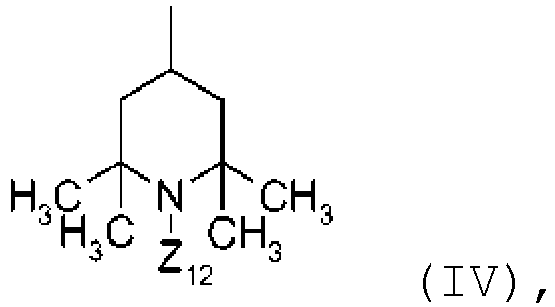 R2, R3, R5 et R6 sont, chacun indépendamment les uns des autres, alkyle en C1-C18, alcényle en C3-C18, cycloalkyle en C3-C12, cycloalcényle en C5-C8, bicycloalkyle en C6-C10, alcynyle en C3-C18, aryle en C6-C10, aralkyle en C7-C9 ou aralkyle en C7-C20 substitué par alkyle en C1-C4 ou aryle en C6-C10 ;Z1, Z2, Z3, Z4, Z11 et Z12 sont, chacun indépendamment les uns des autres, alkyloxy en C1-C18, alcényloxy en C3-C18, alcynyloxy en C3-C18, aryloxy en C6-C10, aralkyloxy en C7-C9 ou aralkyloxy en C7-C20 substitué par alkyle en C1-C4 ou aryle en C6-C10 ;X1 est alkylène en C2-C12 ou alkylène en C3-C12 substitué par hydroxyle ; ouR7 est un groupe de formule V
 R10 est un groupe de formule VI
 R13 est un groupe de formule VII
 R8, R9, R11, R12, R14 et R15 sont, chacun indépendamment les uns des autres, alkyle en C1-C18, alcényle en C3-C18, cycloalkyle en C3-C12, cycloalcényle en C5-C8, bicycloalkyle en C6-C10, alcynyle en C3-C18, aryle en C6-C10, aralkyle en C7-C9 ou aralkyle en C7-C20 substitué par alkyle en C1-C4 ou aryle en C6-C10 ;Z5, Z6, Z7, Z8, Z9, Z10, Z13, Z14 et Z15 sont, chacun indépendamment les uns des autres, alkyloxy en C1-C18, alcényloxy en C3-C18, cycloalkyloxy en C3-C12, cycloalcényloxy en C5-C8, bicycloalkyloxy en C6-C10, alcynyloxy en C3-C18, aryloxy en C6-C10, aralkyloxy en C7-C9 ou aralkyloxy en C7-C20 substitué par alkyle en C1-C4 ou aryle en C6-C10 ;X2, X3 et X4 sont, chacun indépendamment les uns des autres, alkylène en C2-C12 ou alkylène en C3-C12 substitué par hydroxyle.
 - Composé selon la revendication 1, dans lequel
R1 est un groupe de formule III, hydrogène, alkyle en C1-C12, alcényle en C3-C12, cycloalkyle en C5-C8, cycloalcényle en C5-C7 ou benzyle ;
R4 est un groupe de formule IV, hydrogène, alkyle en C1-C12, alcényle en C3-C12, cycloalkyle en C5-C8, cycloalcényle en C5-C7 ou benzyle ;
R2, R3, R5 et R6 sont, chacun indépendamment les uns des autres, alkyle en C1-C12, alcényle en C3-C12, cycloalkyle en C5-C8, cycloalcényle en C5-C7 ou benzyle ;
Z1, Z2, Z3, Z4, Z11 et Z12 sont, chacun indépendamment les uns des autres, alkyloxy en C1-C12, alcényloxy en C3-C12 ou benzyloxy ;
X1 est alkylène en C2-C8 ; ou
R7 est un groupe de formule V, hydrogène, alkyle en C1-C12, alcényle en C3-C12, cycloalkyle en C5-C8, cycloalcényle en C5-C7 ou benzyle ;
R10 est un groupe de formule VI, hydrogène, alkyle en C1-C12, alcényle en C3-C12, cycloalkyle en C5-C8, cycloalcényle en C5-C7 ou benzyle ;
R13 est un groupe de formule VII, hydrogène, alkyle en C1-C12, alcényle en C3-C12, cycloalkyle en C5-C8, cycloalcényle en C5-C7 ou benzyle ;
R8, R9, R11, R12, R14 et R15 sont, chacun indépendamment les uns des autres, alkyle en C1-C12, alcényle en C3-C12, cycloalkyle en C5-C8, cycloalcényle en C5-C7 ou benzyle ;
Z5, Z6, Z7, Z8, Z9, Z10, Z13, Z14 et Z15 sont, chacun indépendamment les uns des autres, alkyloxy en C1-C12, alcényloxy en C3-C12, cycloalkyloxy en C5-C8, cycloalcényloxy en C5-C7, benzyloxy ;
X2, X3 et X4 sont, chacun indépendamment les uns des autres, alkylène en C2-C6. - Composé selon les revendications 1 ou 2, dans lequel
R2, R3, R5 et R6 sont, chacun indépendamment les uns des autres, alkyle en C1-C12 ; ou
R8, R9, R11, R12, R14 et R15 sont, chacun indépendamment les uns des autres, alkyle en C1-C12. - Composé selon l'une quelconque des revendications 1 à 3, dans lequel
R1 est un groupe de formule III et R4 est un groupe de formule IV ; ou
R7 est un groupe de formule V, R10 est un groupe de formule VI et R13 est un groupe de formule VII. - Composé selon l'une quelconque des revendications 1 à 4, dans lequel
Z1, Z2, Z3, Z4, Z11 et Z12 sont, chacun indépendamment les uns des autres, méthyloxy, éthyloxy, propyloxy, octyloxy, undécyloxy ou prop-2-ényloxy ; ou
Z5, Z6, Z7, Z8, Z9, Z10, Z13, Z14 et Z15 sont, indépendamment les uns des autres, méthyloxy, éthyloxy, propyloxy, octyloxy, undécyloxy, cyclohexyloxy ou prop-2-ényloxy. - Composé selon l'une quelconque des revendications 1 à 3, dans lequel
R1 et R4 sont, chacun indépendamment l'un de l'autre, hydrogène, alkyle en C1-C12 ou cycloalkyle en C5-C8 ; ou
R7, R10 et R13 sont, chacun indépendamment les uns des autres, hydrogène, alkyle en C1-C12 ou cycloalkyle en C5-C8. - Composé selon l'une quelconque des revendications 1 à 3, dans lequel
R1 est un groupe de formule III ou hydrogène ;
R4 est un groupe de formule IV ou hydrogène ;
R2, R3, R5 et R6 sont, chacun indépendamment les uns des autres, alkyle en C1-C12 ;
Z1, Z2, Z3, Z4, Z11 et Z12 sont, chacun indépendamment les uns des autres, alkyloxy en C1-C12, où, dans le cas d'alkyloxy en C3-C12, les deux atomes de carbone en position α et β par rapport à l'oxygène ne sont pas ramifiés ;
X1 est alkylène en C2-C8 ; ou
R7 est un groupe de formule V ou hydrogène ;
R10 est un groupe de formule VI ou hydrogène ;
R13 est un groupe de formule VII ou hydrogène ;
R8, R9, R11, R12, R14 et R15 sont, chacun indépendamment les uns des autres, alkyle en C1-C12 ;
Z5, Z6, Z7, Z8, Z9, Z10, Z13, Z14 et Z15 sont, chacun indépendamment les uns des autres, alkyloxy en C1-C12, où, dans le cas d'alkyloxy en C3-C12, les deux atomes de carbone en position α et β par rapport à l'oxygène ne sont pas ramifiés ;
X2, X3 et X4 sont, chacun indépendamment les uns des autres, alkylène en C2-C6. - Composé selon l'une quelconque des revendications 1 à 7, dans lequel
X1 est hexaméthylène ; ou
X2, X3 et X4 sont éthylène. - Composé selon la revendication 1, dans lequel le composé est


- Composition comprenanta) un matériau organique qui est sensible à la dégradation oxydative, thermique ou induite par la lumière ; etb) au moins un composé de formule I ou formule II selon la revendication 1.
- Composition selon la revendication 10, dans laquelle le composant b) est présent en une quantité de 0,001 à 10 % sur la base du poids de composant a).
- Composition selon les revendications 10 ou 11, qui contient des additifs supplémentaires.
- Composition selon l'une quelconque des revendication 10 à 12, qui contient un additif supplémentaire choisi dans le groupe des antioxydants, absorbeurs UV, photostabilisants à amine encombrée, composés de nickel, désactivateurs de métaux, phosphites et phosphonites, hydroxylamines, thiosynergiques, agents de nucléation, inactivateurs de peroxyde, charges ou agents de renforcement et dérivés de terpène.
- Procédé de stabilisation d'un matériau organique sensible à la dégradation oxydative, thermique ou induite par la lumière, qui comprend l'incorporation dans celui-ci ou l'application sur celui-ci d'un composé selon la formule I ou la formule II de la revendication 1.
- Procédé d'amélioration de l'ininflammabilité d'un matériau organique qui comprend l'incorporation dans celui-ci ou l'application sur celui-ci d'un composé selon la formule I ou la formule II de la revendication 1.
Priority Applications (2)
| Application Number | Priority Date | Filing Date | Title |
|---|---|---|---|
| EP10747463.7A EP2475655B1 (fr) | 2009-09-10 | 2010-08-31 | Stabilisateur d'amine entravee steriquement |
| PL10747463T PL2475655T3 (pl) | 2009-09-10 | 2010-08-31 | Stabilizator aminowy z zawadą przestrzenną |
Applications Claiming Priority (3)
| Application Number | Priority Date | Filing Date | Title |
|---|---|---|---|
| EP09169926 | 2009-09-10 | ||
| PCT/EP2010/062664 WO2011029744A1 (fr) | 2009-09-10 | 2010-08-31 | Agent stabilisant aminé stériquement encombré |
| EP10747463.7A EP2475655B1 (fr) | 2009-09-10 | 2010-08-31 | Stabilisateur d'amine entravee steriquement |
Publications (2)
| Publication Number | Publication Date |
|---|---|
| EP2475655A1 EP2475655A1 (fr) | 2012-07-18 |
| EP2475655B1 true EP2475655B1 (fr) | 2017-10-11 |
Family
ID=42026196
Family Applications (1)
| Application Number | Title | Priority Date | Filing Date |
|---|---|---|---|
| EP10747463.7A Active EP2475655B1 (fr) | 2009-09-10 | 2010-08-31 | Stabilisateur d'amine entravee steriquement |
Country Status (15)
| Country | Link |
|---|---|
| US (3) | US8895647B2 (fr) |
| EP (1) | EP2475655B1 (fr) |
| JP (2) | JP5836952B2 (fr) |
| KR (2) | KR101994057B1 (fr) |
| CN (2) | CN105399730B (fr) |
| BR (1) | BR112012005454A2 (fr) |
| CO (1) | CO6531418A2 (fr) |
| DK (1) | DK2475655T3 (fr) |
| EC (1) | ECSP12011760A (fr) |
| ES (1) | ES2655321T3 (fr) |
| IL (2) | IL218220A (fr) |
| MA (1) | MA33652B1 (fr) |
| MX (2) | MX339362B (fr) |
| PL (1) | PL2475655T3 (fr) |
| WO (1) | WO2011029744A1 (fr) |
Families Citing this family (15)
| Publication number | Priority date | Publication date | Assignee | Title |
|---|---|---|---|---|
| US8895647B2 (en) * | 2009-09-10 | 2014-11-25 | Basf Se | Sterically hindered amine stabilizer |
| JP5992422B2 (ja) | 2010-10-20 | 2016-09-14 | ビーエーエスエフ ソシエタス・ヨーロピアBasf Se | 混合官能化による立体障害アミン型光安定剤 |
| MX2013003999A (es) | 2010-10-20 | 2013-05-20 | Basf Se | Estabilizadores de luz oligomericos con una funcionalizacion especifica. |
| EP2729523B1 (fr) * | 2011-07-07 | 2015-09-16 | Dow Global Technologies LLC | Compositions de polymères à base d'éthylène |
| JP6188734B2 (ja) | 2012-03-16 | 2017-08-30 | ビーエーエスエフ ソシエタス・ヨーロピアBasf Se | 難燃剤としてのnor−hals化合物 |
| US9388341B2 (en) * | 2012-03-21 | 2016-07-12 | Basf Se | Pale-colored flame-retardant polyamides |
| EP3143082B1 (fr) * | 2014-05-15 | 2020-11-18 | Basf Se | Stabilisateur hautement efficace |
| EP3601428A1 (fr) | 2017-03-28 | 2020-02-05 | Basf Se | Mélange photostabilisant |
| KR102848554B1 (ko) * | 2019-03-08 | 2025-08-22 | 바스프 에스이 | 입체 장애 아민 안정화제 혼합물 |
| AU2020312165A1 (en) | 2019-07-09 | 2022-01-20 | Basf Se | Tableting of specific polymer stabilizers |
| CN110452223B (zh) * | 2019-07-29 | 2021-06-08 | 宿迁联盛科技股份有限公司 | 一种复合型光稳定剂的制备方法 |
| WO2021160524A1 (fr) | 2020-02-10 | 2021-08-19 | Basf Se | Mélange photostabilisant |
| CN112159393A (zh) * | 2020-10-20 | 2021-01-01 | 宿迁联盛科技股份有限公司 | 一种受阻胺类光稳定剂及其制备工艺 |
| JP2025511683A (ja) | 2022-04-04 | 2025-04-16 | ジェネアスケム・アーゲー | 立体障害ニトロキシルエーテルを調製するためのプロセス |
| CN121986091A (zh) * | 2023-09-27 | 2026-05-05 | 基因化学股份公司 | 由对应的羟胺制备n-烷氧基胺hals |
Family Cites Families (23)
| Publication number | Priority date | Publication date | Assignee | Title |
|---|---|---|---|---|
| GB2042562B (en) | 1979-02-05 | 1983-05-11 | Sandoz Ltd | Stabilising polymers |
| US5096950A (en) * | 1988-10-19 | 1992-03-17 | Ciba-Geigy Corporation | Polyolefin compositions stabilized with NOR-substituted hindered amines |
| US5175312A (en) | 1989-08-31 | 1992-12-29 | Ciba-Geigy Corporation | 3-phenylbenzofuran-2-ones |
| TW206220B (fr) | 1991-07-01 | 1993-05-21 | Ciba Geigy Ag | |
| US5252643A (en) | 1991-07-01 | 1993-10-12 | Ciba-Geigy Corporation | Thiomethylated benzofuran-2-ones |
| GB2267490B (en) | 1992-05-22 | 1995-08-09 | Ciba Geigy Ag | 3-(Carboxymethoxyphenyl)benzofuran-2-one stabilisers |
| NL9300801A (nl) | 1992-05-22 | 1993-12-16 | Ciba Geigy | 3-(acyloxyfenyl)benzofuran-2-on als stabilisatoren. |
| TW260686B (fr) | 1992-05-22 | 1995-10-21 | Ciba Geigy | |
| TW255902B (fr) | 1992-09-23 | 1995-09-01 | Ciba Geigy | |
| MX9305489A (es) | 1992-09-23 | 1994-03-31 | Ciba Geigy Ag | 3-(dihidrobenzofuran-5-il)benzofuran-2-onas, estabilizadores. |
| US5844026A (en) * | 1997-06-30 | 1998-12-01 | Ciba Specialty Chemicals Corporation | N,N',N''-tris{2,4-bis Hydrocarbyloxy-2,2,6,6-tetra-methylpiperidin-4-yl)alkylamino!-s-triazin-6-yl}-3,3'-ethylenediiminodipropylamines, their isomers and bridged derivatives and polymer compositions stabilized therewith |
| SG74700A1 (en) * | 1998-02-25 | 2000-08-22 | Ciba Sc Holding Ag | Preparation of sterically hindered amine ethers |
| ITMI980366A1 (it) | 1998-02-25 | 1999-08-25 | Ciba Spec Chem Spa | Preparazione di eteri amminici stericamente impediti |
| KR100550224B1 (ko) * | 1998-12-14 | 2006-02-08 | 시바 스폐셜티 케미칼스 홀딩 인코포레이티드 | 입체장애 아민 화합물 |
| TW593303B (en) | 2001-09-11 | 2004-06-21 | Ciba Sc Holding Ag | Stabilization of synthetic polymers |
| CN1302060C (zh) * | 2001-12-21 | 2007-02-28 | 西巴特殊化学品控股有限公司 | 新型阻燃化合物 |
| US6858217B2 (en) | 2002-03-22 | 2005-02-22 | Unilever Home & Personal Care Usa Division Of Conopco, Inc. | Stabilization of terpenoids in cosmetic compositions |
| GB0219260D0 (en) * | 2002-08-19 | 2002-09-25 | Clariant Gmbh | Improvements in or relating to organic compounds |
| US7550599B2 (en) * | 2003-02-26 | 2009-06-23 | Ciba Specialty Chemicals Corporation | Water compatible sterically hindered alkoxyamines and hydroxy substituted alkoxyamines |
| JP5089992B2 (ja) | 2005-01-21 | 2012-12-05 | 三井化学株式会社 | ポリアミン誘導体およびポリオール誘導体 |
| US8481726B2 (en) | 2006-07-05 | 2013-07-09 | Basf Se | Process for the preparation of sterically hindered nitroxyl ethers |
| CN102307940B (zh) | 2009-02-04 | 2014-06-25 | 巴斯夫欧洲公司 | 稳定剂 |
| US8895647B2 (en) * | 2009-09-10 | 2014-11-25 | Basf Se | Sterically hindered amine stabilizer |
-
2010
- 2010-08-31 US US13/394,431 patent/US8895647B2/en active Active
- 2010-08-31 EP EP10747463.7A patent/EP2475655B1/fr active Active
- 2010-08-31 KR KR1020187014412A patent/KR101994057B1/ko active Active
- 2010-08-31 BR BR112012005454A patent/BR112012005454A2/pt active IP Right Grant
- 2010-08-31 WO PCT/EP2010/062664 patent/WO2011029744A1/fr not_active Ceased
- 2010-08-31 PL PL10747463T patent/PL2475655T3/pl unknown
- 2010-08-31 KR KR1020127008391A patent/KR101932772B1/ko active Active
- 2010-08-31 MX MX2012002448A patent/MX339362B/es active IP Right Grant
- 2010-08-31 DK DK10747463.7T patent/DK2475655T3/en active
- 2010-08-31 JP JP2012528312A patent/JP5836952B2/ja active Active
- 2010-08-31 CN CN201510716710.9A patent/CN105399730B/zh active Active
- 2010-08-31 CN CN201080040407.7A patent/CN102482261B/zh active Active
- 2010-08-31 ES ES10747463.7T patent/ES2655321T3/es active Active
-
2012
- 2012-02-20 IL IL218220A patent/IL218220A/en active IP Right Grant
- 2012-02-27 MX MX2013014300A patent/MX349699B/es unknown
- 2012-03-26 CO CO12050071A patent/CO6531418A2/es active IP Right Grant
- 2012-03-30 EC ECSP12011760 patent/ECSP12011760A/es unknown
- 2012-04-04 MA MA34747A patent/MA33652B1/fr unknown
-
2014
- 2014-07-28 US US14/444,495 patent/US9464070B2/en active Active
-
2015
- 2015-03-23 JP JP2015060005A patent/JP5980365B2/ja active Active
- 2015-10-14 IL IL242064A patent/IL242064A/en active IP Right Grant
-
2016
- 2016-08-10 US US15/233,479 patent/US9944623B2/en active Active
Non-Patent Citations (1)
| Title |
|---|
| None * |
Also Published As
Similar Documents
| Publication | Publication Date | Title |
|---|---|---|
| US8895647B2 (en) | Sterically hindered amine stabilizer | |
| RU2230758C2 (ru) | Стабилизированная полимерная композиция, стабилизатор, входящий в ее состав, и способ его получения | |
| JP2012529455A (ja) | 立体障害アミン安定剤 | |
| IL225572A (en) | Spatially disturbed amines that are functionally involved as organic material stabilizers | |
| KR100525180B1 (ko) | 유기 물질용 안정화제로서 유용한1-히드로카르빌옥시-2,2,6,6-테트라메틸-4-피페리딜기를함유하는 블록 올리고머 | |
| EP3328928B1 (fr) | Mélange d'additif | |
| EP2640777B1 (fr) | Composition stabilisante pour polymères | |
| US12116469B2 (en) | Sterically hindered amine stabilizer mixtures | |
| BR112012005454B1 (pt) | Composition, and methods for stabilizing organic material susceptible to oxidative, thermal or induced lighting degradation and to enhance flame retardance of an organic material. | |
| BR112021016271B1 (pt) | Mistura de aditivo, composição, métodos para estabilização de um material orgânico susceptível à degradação oxidativa, térmica ou induzida pela luz e para aperfeiçoar retardamento de chama, e, processo |
Legal Events
| Date | Code | Title | Description |
|---|---|---|---|
| PUAI | Public reference made under article 153(3) epc to a published international application that has entered the european phase |
Free format text: ORIGINAL CODE: 0009012 |
|
| 17P | Request for examination filed |
Effective date: 20120410 |
|
| AK | Designated contracting states |
Kind code of ref document: A1 Designated state(s): AL AT BE BG CH CY CZ DE DK EE ES FI FR GB GR HR HU IE IS IT LI LT LU LV MC MK MT NL NO PL PT RO SE SI SK SM TR |
|
| RIN1 | Information on inventor provided before grant (corrected) |
Inventor name: LUDOLPH, BJOERN Inventor name: LIPS, GERARD Inventor name: MENOZZI, EDOARDO Inventor name: HOPPE, HOLGER Inventor name: BASSI, ANNA Inventor name: SALA, MASSIMILIANO |
|
| DAX | Request for extension of the european patent (deleted) | ||
| 17Q | First examination report despatched |
Effective date: 20160901 |
|
| GRAP | Despatch of communication of intention to grant a patent |
Free format text: ORIGINAL CODE: EPIDOSNIGR1 |
|
| INTG | Intention to grant announced |
Effective date: 20170518 |
|
| GRAS | Grant fee paid |
Free format text: ORIGINAL CODE: EPIDOSNIGR3 |
|
| GRAA | (expected) grant |
Free format text: ORIGINAL CODE: 0009210 |
|
| AK | Designated contracting states |
Kind code of ref document: B1 Designated state(s): AL AT BE BG CH CY CZ DE DK EE ES FI FR GB GR HR HU IE IS IT LI LT LU LV MC MK MT NL NO PL PT RO SE SI SK SM TR |
|
| REG | Reference to a national code |
Ref country code: GB Ref legal event code: FG4D |
|
| REG | Reference to a national code |
Ref country code: CH Ref legal event code: EP |
|
| REG | Reference to a national code |
Ref country code: IE Ref legal event code: FG4D |
|
| REG | Reference to a national code |
Ref country code: AT Ref legal event code: REF Ref document number: 935897 Country of ref document: AT Kind code of ref document: T Effective date: 20171115 |
|
| REG | Reference to a national code |
Ref country code: DE Ref legal event code: R096 Ref document number: 602010045891 Country of ref document: DE |
|
| REG | Reference to a national code |
Ref country code: DK Ref legal event code: T3 Effective date: 20180109 |
|
| REG | Reference to a national code |
Ref country code: NL Ref legal event code: FP |
|
| REG | Reference to a national code |
Ref country code: SE Ref legal event code: TRGR |
|
| REG | Reference to a national code |
Ref country code: ES Ref legal event code: FG2A Ref document number: 2655321 Country of ref document: ES Kind code of ref document: T3 Effective date: 20180219 |
|
| REG | Reference to a national code |
Ref country code: LT Ref legal event code: MG4D |
|
| PG25 | Lapsed in a contracting state [announced via postgrant information from national office to epo] |
Ref country code: NO Free format text: LAPSE BECAUSE OF FAILURE TO SUBMIT A TRANSLATION OF THE DESCRIPTION OR TO PAY THE FEE WITHIN THE PRESCRIBED TIME-LIMIT Effective date: 20180111 Ref country code: LT Free format text: LAPSE BECAUSE OF FAILURE TO SUBMIT A TRANSLATION OF THE DESCRIPTION OR TO PAY THE FEE WITHIN THE PRESCRIBED TIME-LIMIT Effective date: 20171011 |
|
| REG | Reference to a national code |
Ref country code: GR Ref legal event code: EP Ref document number: 20170403223 Country of ref document: GR Effective date: 20180420 |
|
| PG25 | Lapsed in a contracting state [announced via postgrant information from national office to epo] |
Ref country code: HR Free format text: LAPSE BECAUSE OF FAILURE TO SUBMIT A TRANSLATION OF THE DESCRIPTION OR TO PAY THE FEE WITHIN THE PRESCRIBED TIME-LIMIT Effective date: 20171011 Ref country code: IS Free format text: LAPSE BECAUSE OF FAILURE TO SUBMIT A TRANSLATION OF THE DESCRIPTION OR TO PAY THE FEE WITHIN THE PRESCRIBED TIME-LIMIT Effective date: 20180211 Ref country code: LV Free format text: LAPSE BECAUSE OF FAILURE TO SUBMIT A TRANSLATION OF THE DESCRIPTION OR TO PAY THE FEE WITHIN THE PRESCRIBED TIME-LIMIT Effective date: 20171011 Ref country code: BG Free format text: LAPSE BECAUSE OF FAILURE TO SUBMIT A TRANSLATION OF THE DESCRIPTION OR TO PAY THE FEE WITHIN THE PRESCRIBED TIME-LIMIT Effective date: 20180111 |
|
| REG | Reference to a national code |
Ref country code: DE Ref legal event code: R097 Ref document number: 602010045891 Country of ref document: DE |
|
| PG25 | Lapsed in a contracting state [announced via postgrant information from national office to epo] |
Ref country code: SK Free format text: LAPSE BECAUSE OF FAILURE TO SUBMIT A TRANSLATION OF THE DESCRIPTION OR TO PAY THE FEE WITHIN THE PRESCRIBED TIME-LIMIT Effective date: 20171011 Ref country code: EE Free format text: LAPSE BECAUSE OF FAILURE TO SUBMIT A TRANSLATION OF THE DESCRIPTION OR TO PAY THE FEE WITHIN THE PRESCRIBED TIME-LIMIT Effective date: 20171011 |
|
| PLBE | No opposition filed within time limit |
Free format text: ORIGINAL CODE: 0009261 |
|
| STAA | Information on the status of an ep patent application or granted ep patent |
Free format text: STATUS: NO OPPOSITION FILED WITHIN TIME LIMIT |
|
| REG | Reference to a national code |
Ref country code: FR Ref legal event code: PLFP Year of fee payment: 9 |
|
| PG25 | Lapsed in a contracting state [announced via postgrant information from national office to epo] |
Ref country code: RO Free format text: LAPSE BECAUSE OF FAILURE TO SUBMIT A TRANSLATION OF THE DESCRIPTION OR TO PAY THE FEE WITHIN THE PRESCRIBED TIME-LIMIT Effective date: 20171011 Ref country code: SM Free format text: LAPSE BECAUSE OF FAILURE TO SUBMIT A TRANSLATION OF THE DESCRIPTION OR TO PAY THE FEE WITHIN THE PRESCRIBED TIME-LIMIT Effective date: 20171011 |
|
| 26N | No opposition filed |
Effective date: 20180712 |
|
| PG25 | Lapsed in a contracting state [announced via postgrant information from national office to epo] |
Ref country code: SI Free format text: LAPSE BECAUSE OF FAILURE TO SUBMIT A TRANSLATION OF THE DESCRIPTION OR TO PAY THE FEE WITHIN THE PRESCRIBED TIME-LIMIT Effective date: 20171011 |
|
| PG25 | Lapsed in a contracting state [announced via postgrant information from national office to epo] |
Ref country code: MC Free format text: LAPSE BECAUSE OF FAILURE TO SUBMIT A TRANSLATION OF THE DESCRIPTION OR TO PAY THE FEE WITHIN THE PRESCRIBED TIME-LIMIT Effective date: 20171011 |
|
| REG | Reference to a national code |
Ref country code: CH Ref legal event code: PL |
|
| PG25 | Lapsed in a contracting state [announced via postgrant information from national office to epo] |
Ref country code: CH Free format text: LAPSE BECAUSE OF NON-PAYMENT OF DUE FEES Effective date: 20180831 Ref country code: LU Free format text: LAPSE BECAUSE OF NON-PAYMENT OF DUE FEES Effective date: 20180831 Ref country code: LI Free format text: LAPSE BECAUSE OF NON-PAYMENT OF DUE FEES Effective date: 20180831 |
|
| PG25 | Lapsed in a contracting state [announced via postgrant information from national office to epo] |
Ref country code: MT Free format text: LAPSE BECAUSE OF NON-PAYMENT OF DUE FEES Effective date: 20180831 |
|
| PG25 | Lapsed in a contracting state [announced via postgrant information from national office to epo] |
Ref country code: HU Free format text: LAPSE BECAUSE OF FAILURE TO SUBMIT A TRANSLATION OF THE DESCRIPTION OR TO PAY THE FEE WITHIN THE PRESCRIBED TIME-LIMIT; INVALID AB INITIO Effective date: 20100831 Ref country code: PT Free format text: LAPSE BECAUSE OF FAILURE TO SUBMIT A TRANSLATION OF THE DESCRIPTION OR TO PAY THE FEE WITHIN THE PRESCRIBED TIME-LIMIT Effective date: 20171011 |
|
| PG25 | Lapsed in a contracting state [announced via postgrant information from national office to epo] |
Ref country code: MK Free format text: LAPSE BECAUSE OF NON-PAYMENT OF DUE FEES Effective date: 20171011 Ref country code: IE Free format text: LAPSE BECAUSE OF NON-PAYMENT OF DUE FEES Effective date: 20180831 Ref country code: CY Free format text: LAPSE BECAUSE OF FAILURE TO SUBMIT A TRANSLATION OF THE DESCRIPTION OR TO PAY THE FEE WITHIN THE PRESCRIBED TIME-LIMIT Effective date: 20171011 |
|
| PG25 | Lapsed in a contracting state [announced via postgrant information from national office to epo] |
Ref country code: AL Free format text: LAPSE BECAUSE OF FAILURE TO SUBMIT A TRANSLATION OF THE DESCRIPTION OR TO PAY THE FEE WITHIN THE PRESCRIBED TIME-LIMIT Effective date: 20171011 |
|
| REG | Reference to a national code |
Ref country code: AT Ref legal event code: UEP Ref document number: 935897 Country of ref document: AT Kind code of ref document: T Effective date: 20171011 |
|
| P01 | Opt-out of the competence of the unified patent court (upc) registered |
Effective date: 20230314 |
|
| PGFP | Annual fee paid to national office [announced via postgrant information from national office to epo] |
Ref country code: NL Payment date: 20250825 Year of fee payment: 16 |
|
| PGFP | Annual fee paid to national office [announced via postgrant information from national office to epo] |
Ref country code: FI Payment date: 20250825 Year of fee payment: 16 Ref country code: ES Payment date: 20250916 Year of fee payment: 16 |
|
| PGFP | Annual fee paid to national office [announced via postgrant information from national office to epo] |
Ref country code: DE Payment date: 20250827 Year of fee payment: 16 Ref country code: DK Payment date: 20250825 Year of fee payment: 16 |
|
| PGFP | Annual fee paid to national office [announced via postgrant information from national office to epo] |
Ref country code: GR Payment date: 20250820 Year of fee payment: 16 |
|
| PGFP | Annual fee paid to national office [announced via postgrant information from national office to epo] |
Ref country code: TR Payment date: 20250811 Year of fee payment: 16 Ref country code: IT Payment date: 20250825 Year of fee payment: 16 Ref country code: PL Payment date: 20250812 Year of fee payment: 16 |
|
| PGFP | Annual fee paid to national office [announced via postgrant information from national office to epo] |
Ref country code: BE Payment date: 20250825 Year of fee payment: 16 Ref country code: GB Payment date: 20250826 Year of fee payment: 16 |
|
| PGFP | Annual fee paid to national office [announced via postgrant information from national office to epo] |
Ref country code: FR Payment date: 20250825 Year of fee payment: 16 Ref country code: AT Payment date: 20250819 Year of fee payment: 16 |
|
| PGFP | Annual fee paid to national office [announced via postgrant information from national office to epo] |
Ref country code: SE Payment date: 20250825 Year of fee payment: 16 |
|
| PGFP | Annual fee paid to national office [announced via postgrant information from national office to epo] |
Ref country code: CZ Payment date: 20250814 Year of fee payment: 16 |