EP2476331A1 - Chaussure dotée d'une semelle convexe - Google Patents
Chaussure dotée d'une semelle convexe Download PDFInfo
- Publication number
- EP2476331A1 EP2476331A1 EP12000179A EP12000179A EP2476331A1 EP 2476331 A1 EP2476331 A1 EP 2476331A1 EP 12000179 A EP12000179 A EP 12000179A EP 12000179 A EP12000179 A EP 12000179A EP 2476331 A1 EP2476331 A1 EP 2476331A1
- Authority
- EP
- European Patent Office
- Prior art keywords
- sole
- shoe
- elements
- roller
- heel
- Prior art date
- Legal status (The legal status is an assumption and is not a legal conclusion. Google has not performed a legal analysis and makes no representation as to the accuracy of the status listed.)
- Withdrawn
Links
- 229920001971 elastomer Polymers 0.000 claims abstract description 4
- 239000000463 material Substances 0.000 claims description 6
- 239000012815 thermoplastic material Substances 0.000 claims description 2
- 239000005038 ethylene vinyl acetate Substances 0.000 abstract description 3
- 229920001169 thermoplastic Polymers 0.000 abstract description 2
- DQXBYHZEEUGOBF-UHFFFAOYSA-N but-3-enoic acid;ethene Chemical compound C=C.OC(=O)CC=C DQXBYHZEEUGOBF-UHFFFAOYSA-N 0.000 abstract 1
- 229920001200 poly(ethylene-vinyl acetate) Polymers 0.000 abstract 1
- 238000013016 damping Methods 0.000 description 7
- 210000003205 muscle Anatomy 0.000 description 7
- 238000005096 rolling process Methods 0.000 description 6
- 239000003381 stabilizer Substances 0.000 description 5
- 230000007423 decrease Effects 0.000 description 3
- 239000013013 elastic material Substances 0.000 description 2
- 239000007779 soft material Substances 0.000 description 2
- 239000004677 Nylon Substances 0.000 description 1
- 238000005299 abrasion Methods 0.000 description 1
- 239000002250 absorbent Substances 0.000 description 1
- 238000010276 construction Methods 0.000 description 1
- 230000003247 decreasing effect Effects 0.000 description 1
- 230000001687 destabilization Effects 0.000 description 1
- 230000000368 destabilizing effect Effects 0.000 description 1
- 230000000694 effects Effects 0.000 description 1
- 230000005484 gravity Effects 0.000 description 1
- 229920001778 nylon Polymers 0.000 description 1
- 239000004033 plastic Substances 0.000 description 1
- 229920003023 plastic Polymers 0.000 description 1
- 229920002635 polyurethane Polymers 0.000 description 1
- 239000004814 polyurethane Substances 0.000 description 1
- 230000002787 reinforcement Effects 0.000 description 1
- 239000004576 sand Substances 0.000 description 1
- 239000007787 solid Substances 0.000 description 1
- 230000006641 stabilisation Effects 0.000 description 1
- 238000011105 stabilization Methods 0.000 description 1
- 239000004416 thermosoftening plastic Substances 0.000 description 1
Images

Classifications
-
- A—HUMAN NECESSITIES
- A43—FOOTWEAR
- A43B—CHARACTERISTIC FEATURES OF FOOTWEAR; PARTS OF FOOTWEAR
- A43B13/00—Soles; Sole-and-heel integral units
- A43B13/14—Soles; Sole-and-heel integral units characterised by the constructive form
- A43B13/143—Soles; Sole-and-heel integral units characterised by the constructive form provided with wedged, concave or convex end portions, e.g. for improving roll-off of the foot
- A43B13/145—Convex portions, e.g. with a bump or projection, e.g. 'Masai' type shoes
-
- A—HUMAN NECESSITIES
- A43—FOOTWEAR
- A43B—CHARACTERISTIC FEATURES OF FOOTWEAR; PARTS OF FOOTWEAR
- A43B13/00—Soles; Sole-and-heel integral units
- A43B13/02—Soles; Sole-and-heel integral units characterised by the material
- A43B13/12—Soles with several layers of different materials
- A43B13/125—Soles with several layers of different materials characterised by the midsole or middle layer
- A43B13/127—Soles with several layers of different materials characterised by the midsole or middle layer the midsole being multilayer
Definitions
- the invention relates to a shoe with a sole, which has a convex shape, wherein the sole has a midsole and an outsole.
- Instabil quaternary depression which consists partly of a soft material. This is to simulate running as on sand or barefoot and lead to a more conscious and targeted movement.
- Such a shoe is for example from the EP 0 999 764 B1 known.
- the shoe has a sole body made of a soft material in the heel area, which causes the foot to be damped during placement. This is intended to reduce the impact load on the joints and the spine.
- the sole has a pivot axis which is designed to be flexible in order to facilitate unrolling.
- EP 1 785 048 A1 Another shoe with a convex sole is made of EP 1 785 048 A1 known. This has in addition to a soft sole body in the heel area a kink area in the front half of the sole. The sole construction should allow both a smooth appearance and a smooth unrolling.
- Object of the present invention is therefore to provide a shoe, in addition to a good cushioning when putting on and while walking the required
- roller-shaped elements preferably have a different size, wherein preferably the largest element is placed on the heel and the smallest element in the middle of the sole, so that the elements have a descending size from the heel to the middle of the sole.
- roller-shaped means elongated elements which have a significantly greater longitudinal than transverse extent.
- the cross-section of the roller-shaped elements is oval in the broadest sense, and due to the fit in the sole or in recesses of the midsole individual sections of the cross section may also be straight, so that an oval cut is formed.
- the two front roller-shaped elements are arranged approximately so that both elements approximately in the middle of the sole, i. in the center of gravity of the shoe, in which it is in a horizontal position.
- the middle of the sole is considered in the broadest sense next to the exact center of the sole and the entire middle third of the sole.
- the three roll-shaped elements closest to the heel are also referred to as the back elements.
- the two roller-shaped elements closest to the sole center are correspondingly as front elements.
- the rear elements serve while the damping of the shoe, while the front elements form a resistance to the rolling motion while walking.
- the two front cylindrical elements in the middle of the sole preferably have the same hardness and consist of the same material. Particularly preferably, they are made of rubber or a thermoplastic material.
- the front elements are in one embodiment part of the outsole and integrated into it.
- the midsole has at the corresponding locations recesses for receiving the roller-shaped elements.
- the three rear roller-shaped elements closest to the heel are preferably made of ethylene vinyl acetate (EVA) or other elastic material that aids cushioning.
- EVA ethylene vinyl acetate
- the back elements are preferably integrated as separate form elements in the midsole, i. inserted in this.
- the outsole of the shoe according to the invention is preferably an abrasion-resistant outsole of thermoplastic or rubber.
- the material is preferably chosen so that the sole is non-slip.
- the two roller-shaped elements are integrated in the middle of the sole in the outsole.
- the midsole preferably consists of a convex molded body with recesses for the roller-shaped elements.
- the midsole is polyurethane.
- the material of the midsole is chosen so that, as with all instability shoes, it leads to the destabilization of walking.
- the material chosen is also shock-absorbent to protect the joints and spine while walking.
- the three roller-shaped elements in the heel area are preferably made of ethylene vinyl acetate (EVA).
- EVA ethylene vinyl acetate
- the three roller-shaped elements in the heel area preferably have increasing degrees of hardness towards the middle of the sole.
- the elements are preferably inserted in the midsole.
- the hardness (Shore hardness) can be, for example, from the heel to the shoe center 40 °, 45 °, 50 ° and 55 °.
- the shoe according to the invention additionally has a shoe upper, which is designed, for example, as a sports shoe, leisure shoe or sandal.
- the shoe according to the invention optionally has an insole and / or an insole.
- the shoe according to the invention additionally contains a stabilizer. This stabilizer is e.g. poured into the midsole and e.g. made of a plastic like nylon. The stabilizer preferably has a length of 70 to 90% of the midsole length, more preferably 75 to 85%.
- the shoe according to the invention actively trains the addressed muscle groups during normal walking or running.
- the heel area initially experiences a strong damping due to the cylindrical elements in the heel, which have the lowest hardness. This damping decreases gradually in the course of the rolling movement of the foot forward, since the roller-shaped elements from the heel back to the middle of the sole have an increasing hardness.
- Due to the damping or sinking of the sole the heel sits lower than the foot center, so that the foot must be actively unrolled from the wearer of the shoe to allow it to move forward. Due to the strong cushioning of the heel and the deep sinking an active foot movement forward is necessary.
- the resistance to the rolling motion increases during the movement.
- the resistance is generated on the one hand by the decreasing damping in the heel and on the other hand by the roller-shaped elements in the middle region of the sole, over which the wearer must move the foot away.
- the rolling movement encounters a resistance, which is generated by the solid cylindrical elements integrated in the sole, preferably the outsole.
- These two front cylindrical elements have a greater hardness than the three rear cylindrical elements.
- the wearer of the shoe must actively support the rolling forward, ie it must roll over the roller-shaped elements. For this additional muscle power is necessary, which also trains the mentioned muscle groups.
- a roller-shaped element In the middle of the sole, only a roller-shaped element could be used. According to the invention, however, two front elements are preferably used. This has the advantage that the kinetic energy, which is transferred after overcoming the first front element as momentum forward, is somewhat reduced by the second, smaller element, because here again a resistance is overcome. The kinetic energy that is transmitted to the front, is thereby reduced, so that the wearer of the shoe is not catapulted forward, but "dosed" is pushed in the direction of travel, but then the movement must actively slow down. Due to this effect, the first of the front elements that is positioned closer to the heel is definitely larger than the second front element that is positioned closer to the toe.
- FIG. 1 shows a shoe 1 according to the invention with a sole 2 and a shoe upper 3.
- the sole 2 is constructed of a midsole 4 and an outsole 5 arranged thereunder.
- In recesses of the midsole 4 five roller-shaped elements 6a, 6b, 6c, 7a and 7b are arranged.
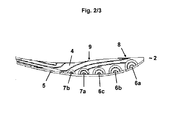
- FIG. 2 shows a side view of the sole 2 of the shoe according to the invention 1. It can be seen that in the midsole 4 five cylindrical elements 6a, 6b, 6c, 7a and 7b are arranged. The cross-section of the cylindrical elements decreases from the heel 8 to the middle of the sole 9 from. While the element 6a is the largest element, the element 7b arranged in the sole center 9 forms the smallest element. The sizes thus decrease in order 6a to 6b to 6c to 7a to 7b.
- the three roller-shaped elements 6a, 6b and 6c, which are arranged in the region of the heel 8, are preferably made of an elastic material and serve to cushion the shoe 1 when placing the heel 8.
- the two cylindrical elements 7a and 7b which are in the range the sole center 9 are made of a harder material. These form a resistance against which it is necessary to work during the unrolling of the foot.
- the two middle roller-shaped elements 7a and 7b are also designed differently sized here, but they can also be made almost the same size.
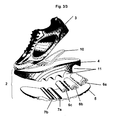
- FIG. 3 shows an exploded view of the shoe 1 according to the invention.
- the sole 2 is arranged under the shoe upper 3.
- the sole 2 consists of a midsole 4, which has a stabilizer 10, and five different large recesses 11.
- the recesses 11 serve to receive the roller-shaped elements 6a, 6b, 6c, 7a and 7b.
- the rear elements 6a, 6b and 6c are separate elements in the present embodiment.
- the two front elements 7a and 7b are formed as part of the outsole 5.
- the outsole has a reinforcement in the ball area, which leads to a better stabilization.
Landscapes
- Chemical & Material Sciences (AREA)
- Engineering & Computer Science (AREA)
- Materials Engineering (AREA)
- Footwear And Its Accessory, Manufacturing Method And Apparatuses (AREA)
Applications Claiming Priority (1)
| Application Number | Priority Date | Filing Date | Title |
|---|---|---|---|
| DE201110008664 DE102011008664B4 (de) | 2011-01-14 | 2011-01-14 | Schuh mit konvexer Sohle |
Publications (1)
| Publication Number | Publication Date |
|---|---|
| EP2476331A1 true EP2476331A1 (fr) | 2012-07-18 |
Family
ID=43972702
Family Applications (1)
| Application Number | Title | Priority Date | Filing Date |
|---|---|---|---|
| EP12000179A Withdrawn EP2476331A1 (fr) | 2011-01-14 | 2012-01-13 | Chaussure dotée d'une semelle convexe |
Country Status (2)
| Country | Link |
|---|---|
| EP (1) | EP2476331A1 (fr) |
| DE (1) | DE102011008664B4 (fr) |
Cited By (2)
| Publication number | Priority date | Publication date | Assignee | Title |
|---|---|---|---|---|
| EP3580637A1 (fr) * | 2017-02-08 | 2019-12-18 | Cybershoes Gmbh | Dispositif de détection de mouvements d'une personne utilisant ledit dispositif aux fins de la transformation de mouvements dans un espace virtuel |
| US11666119B2 (en) | 2020-07-13 | 2023-06-06 | Nike, Inc. | Sole structure with midsole protrusions and arced profile for forward momentum |
Families Citing this family (2)
| Publication number | Priority date | Publication date | Assignee | Title |
|---|---|---|---|---|
| US11583029B2 (en) * | 2018-01-22 | 2023-02-21 | Adidas Ag | Article of footwear with ribbed outsole and notched midsole |
| US10986896B2 (en) | 2018-01-22 | 2021-04-27 | Adidas Ag | Article of footwear with ribbed outsole and notched midsole |
Citations (6)
| Publication number | Priority date | Publication date | Assignee | Title |
|---|---|---|---|---|
| US4372059A (en) * | 1981-03-04 | 1983-02-08 | Frank Ambrose | Sole body for shoes with upwardly deformable arch-supporting segment |
| EP0999764B1 (fr) | 1997-07-17 | 2003-05-07 | Negort AG | Chaussure |
| EP1785048A1 (fr) | 2005-11-09 | 2007-05-16 | Arno Schneider | Chaussure |
| WO2009061103A1 (fr) * | 2007-11-08 | 2009-05-14 | Ryn Korea. Co., Ltd. | Chaussure de marche de type masai |
| US20100275471A1 (en) * | 2008-12-16 | 2010-11-04 | Skechers U.S.A., Inc. Ii | Shoe |
| WO2011001353A2 (fr) * | 2009-07-03 | 2011-01-06 | A.C. Studio S.N.C. Di Armando Cietto & C. | Structure de semelle intercalaire, en particulier pour des chaussures |
-
2011
- 2011-01-14 DE DE201110008664 patent/DE102011008664B4/de not_active Expired - Fee Related
-
2012
- 2012-01-13 EP EP12000179A patent/EP2476331A1/fr not_active Withdrawn
Patent Citations (6)
| Publication number | Priority date | Publication date | Assignee | Title |
|---|---|---|---|---|
| US4372059A (en) * | 1981-03-04 | 1983-02-08 | Frank Ambrose | Sole body for shoes with upwardly deformable arch-supporting segment |
| EP0999764B1 (fr) | 1997-07-17 | 2003-05-07 | Negort AG | Chaussure |
| EP1785048A1 (fr) | 2005-11-09 | 2007-05-16 | Arno Schneider | Chaussure |
| WO2009061103A1 (fr) * | 2007-11-08 | 2009-05-14 | Ryn Korea. Co., Ltd. | Chaussure de marche de type masai |
| US20100275471A1 (en) * | 2008-12-16 | 2010-11-04 | Skechers U.S.A., Inc. Ii | Shoe |
| WO2011001353A2 (fr) * | 2009-07-03 | 2011-01-06 | A.C. Studio S.N.C. Di Armando Cietto & C. | Structure de semelle intercalaire, en particulier pour des chaussures |
Cited By (4)
| Publication number | Priority date | Publication date | Assignee | Title |
|---|---|---|---|---|
| EP3580637A1 (fr) * | 2017-02-08 | 2019-12-18 | Cybershoes Gmbh | Dispositif de détection de mouvements d'une personne utilisant ledit dispositif aux fins de la transformation de mouvements dans un espace virtuel |
| US11216081B2 (en) | 2017-02-08 | 2022-01-04 | Cybershoes Gmbh | Apparatus for capturing movements of a person using the apparatus for the purposes of transforming the movements into a virtual space |
| US11989354B2 (en) | 2017-02-08 | 2024-05-21 | Cybershoes Gmbh | Apparatus for capturing movements of a person using the apparatus for the purposes of transforming the movements into a virtual space |
| US11666119B2 (en) | 2020-07-13 | 2023-06-06 | Nike, Inc. | Sole structure with midsole protrusions and arced profile for forward momentum |
Also Published As
| Publication number | Publication date |
|---|---|
| DE102011008664B4 (de) | 2012-02-23 |
| DE102011008664A1 (de) | 2011-06-09 |
Similar Documents
| Publication | Publication Date | Title |
|---|---|---|
| DE102014215897B4 (de) | adistar boost | |
| DE102016118168B4 (de) | Sohlenstruktur für Schuh und Schuh mit dieser Sohlenstruktur | |
| DE60307344T2 (de) | Schuhsohle | |
| AT402680B (de) | Stoss-dämpfende, energie-speichernde fersenfeder- und stabilisierungseinrichtungfür einen sportschu h | |
| DE102013202353B4 (de) | Sohle für einen Schuh | |
| DE3886287T2 (de) | Sport- oder Freizeitschuh mit stossdämpfender Sohle. | |
| DE3115488A1 (de) | Sportschuh | |
| DE3329742A1 (de) | Sohlenanordnung fuer sportschuhe | |
| DE102008033241B3 (de) | Schuhsohle | |
| DE102011051444A1 (de) | Sohle für einen Schuh, insbesondere Laufschuh | |
| DE102011007623A1 (de) | High-Heel-Schuh | |
| WO2014068128A1 (fr) | Semelle pour chaussures ou sandales | |
| DE3723549C2 (fr) | ||
| DE102014107751A1 (de) | Schuh, insbesondere Laufschuh | |
| DE102011008664B4 (de) | Schuh mit konvexer Sohle | |
| DE2751146A1 (de) | Sportschuh, insbesondere laufschuh zur verwendung auf harten bahnen | |
| DE69909941T2 (de) | Vorrichtung zur Stabilitätserhöhung für Schuhe für Tennis oder ähnlichem Sport | |
| EP4132314B1 (fr) | Semelle intercalaire d'article chaussant et chaussure de course produite avec celle-ci | |
| DE102009010360B4 (de) | Sohle für einen Schuh und Schuh | |
| DE102010017340A1 (de) | Sohlenaufbau für einen Laufschuh sowie Laufschuh | |
| WO2016146397A1 (fr) | Chaussure avec élément d'amortissement en matériau de disque intervertébral | |
| DE102024111995A1 (de) | Sohle für einen Laufschuh | |
| WO2011020798A1 (fr) | Amortisseur de marche pour semelles de chaussure | |
| DE102010020104B4 (de) | Einlegesohle für einen Schuh sowie Schuh mit Einlegesohle | |
| DE102009050783A1 (de) | Auftrittspuffer für Schuhsohlen |
Legal Events
| Date | Code | Title | Description |
|---|---|---|---|
| PUAI | Public reference made under article 153(3) epc to a published international application that has entered the european phase |
Free format text: ORIGINAL CODE: 0009012 |
|
| AK | Designated contracting states |
Kind code of ref document: A1 Designated state(s): AL AT BE BG CH CY CZ DE DK EE ES FI FR GB GR HR HU IE IS IT LI LT LU LV MC MK MT NL NO PL PT RO RS SE SI SK SM TR |
|
| AX | Request for extension of the european patent |
Extension state: BA ME |
|
| 17P | Request for examination filed |
Effective date: 20121115 |
|
| GRAP | Despatch of communication of intention to grant a patent |
Free format text: ORIGINAL CODE: EPIDOSNIGR1 |
|
| STAA | Information on the status of an ep patent application or granted ep patent |
Free format text: STATUS: THE APPLICATION IS DEEMED TO BE WITHDRAWN |
|
| 18D | Application deemed to be withdrawn |
Effective date: 20130709 |