EP2479263B1 - Neuartige Fucosyltransferasen und ihre Verwendungen - Google Patents
Neuartige Fucosyltransferasen und ihre Verwendungen Download PDFInfo
- Publication number
- EP2479263B1 EP2479263B1 EP11151571.4A EP11151571A EP2479263B1 EP 2479263 B1 EP2479263 B1 EP 2479263B1 EP 11151571 A EP11151571 A EP 11151571A EP 2479263 B1 EP2479263 B1 EP 2479263B1
- Authority
- EP
- European Patent Office
- Prior art keywords
- seq
- nucleic acid
- host cell
- acid sequence
- alpha
- Prior art date
- Legal status (The legal status is an assumption and is not a legal conclusion. Google has not performed a legal analysis and makes no representation as to the accuracy of the status listed.)
- Active
Links
Images




Classifications
-
- C—CHEMISTRY; METALLURGY
- C12—BIOCHEMISTRY; BEER; SPIRITS; WINE; VINEGAR; MICROBIOLOGY; ENZYMOLOGY; MUTATION OR GENETIC ENGINEERING
- C12N—MICROORGANISMS OR ENZYMES; COMPOSITIONS THEREOF; PROPAGATING, PRESERVING, OR MAINTAINING MICROORGANISMS; MUTATION OR GENETIC ENGINEERING; CULTURE MEDIA
- C12N9/00—Enzymes; Proenzymes; Compositions thereof; Processes for preparing, activating, inhibiting, separating or purifying enzymes
- C12N9/10—Transferases (2.)
-
- C—CHEMISTRY; METALLURGY
- C07—ORGANIC CHEMISTRY
- C07H—SUGARS; DERIVATIVES THEREOF; NUCLEOSIDES; NUCLEOTIDES; NUCLEIC ACIDS
- C07H3/00—Compounds containing only hydrogen atoms and saccharide radicals having only carbon, hydrogen, and oxygen atoms
- C07H3/04—Disaccharides
-
- C—CHEMISTRY; METALLURGY
- C12—BIOCHEMISTRY; BEER; SPIRITS; WINE; VINEGAR; MICROBIOLOGY; ENZYMOLOGY; MUTATION OR GENETIC ENGINEERING
- C12N—MICROORGANISMS OR ENZYMES; COMPOSITIONS THEREOF; PROPAGATING, PRESERVING, OR MAINTAINING MICROORGANISMS; MUTATION OR GENETIC ENGINEERING; CULTURE MEDIA
- C12N15/00—Mutation or genetic engineering; DNA or RNA concerning genetic engineering, vectors, e.g. plasmids, or their isolation, preparation or purification; Use of hosts therefor
- C12N15/09—Recombinant DNA-technology
- C12N15/11—DNA or RNA fragments; Modified forms thereof; Non-coding nucleic acids having a biological activity
- C12N15/52—Genes encoding for enzymes or proenzymes
-
- C—CHEMISTRY; METALLURGY
- C12—BIOCHEMISTRY; BEER; SPIRITS; WINE; VINEGAR; MICROBIOLOGY; ENZYMOLOGY; MUTATION OR GENETIC ENGINEERING
- C12N—MICROORGANISMS OR ENZYMES; COMPOSITIONS THEREOF; PROPAGATING, PRESERVING, OR MAINTAINING MICROORGANISMS; MUTATION OR GENETIC ENGINEERING; CULTURE MEDIA
- C12N9/00—Enzymes; Proenzymes; Compositions thereof; Processes for preparing, activating, inhibiting, separating or purifying enzymes
- C12N9/10—Transferases (2.)
- C12N9/1048—Glycosyltransferases (2.4)
- C12N9/1051—Hexosyltransferases (2.4.1)
-
- C—CHEMISTRY; METALLURGY
- C12—BIOCHEMISTRY; BEER; SPIRITS; WINE; VINEGAR; MICROBIOLOGY; ENZYMOLOGY; MUTATION OR GENETIC ENGINEERING
- C12P—FERMENTATION OR ENZYME-USING PROCESSES TO SYNTHESISE A DESIRED CHEMICAL COMPOUND OR COMPOSITION OR TO SEPARATE OPTICAL ISOMERS FROM A RACEMIC MIXTURE
- C12P19/00—Preparation of compounds containing saccharide radicals
- C12P19/18—Preparation of compounds containing saccharide radicals produced by the action of a glycosyl transferase, e.g. alpha-, beta- or gamma-cyclodextrins
-
- C—CHEMISTRY; METALLURGY
- C12—BIOCHEMISTRY; BEER; SPIRITS; WINE; VINEGAR; MICROBIOLOGY; ENZYMOLOGY; MUTATION OR GENETIC ENGINEERING
- C12P—FERMENTATION OR ENZYME-USING PROCESSES TO SYNTHESISE A DESIRED CHEMICAL COMPOUND OR COMPOSITION OR TO SEPARATE OPTICAL ISOMERS FROM A RACEMIC MIXTURE
- C12P21/00—Preparation of peptides or proteins
- C12P21/005—Glycopeptides, glycoproteins
-
- C—CHEMISTRY; METALLURGY
- C12—BIOCHEMISTRY; BEER; SPIRITS; WINE; VINEGAR; MICROBIOLOGY; ENZYMOLOGY; MUTATION OR GENETIC ENGINEERING
- C12Y—ENZYMES
- C12Y204/00—Glycosyltransferases (2.4)
- C12Y204/01—Hexosyltransferases (2.4.1)
- C12Y204/01069—Galactoside 2-alpha-L-fucosyltransferase (2.4.1.69)
Definitions
- the present invention relates to a novel fucosyltransferase and its applications.
- fucosylated structures e.g., in order to exhibit a particular biological activity.
- many intercellular recognition mechanisms require a fucosylated oligosaccharide: e.g., in order to be bound by cell adhesion molecules, such as L-selectin, specific cell structures have to comprise fucosylated carbohydrates.
- fucosylated structures having a biological function are structures that form the AB0 blood group system.
- therapeutic (glyco)proteins represent the fastest growing class of pharmaceutical reagents, whereby their pharmacokinetic properties and stability are/is ascribed to their glycans.
- glycoconjugates Due to their complex nature and inherent chemical properties, the chemical synthesis of glycoconjugates is a major challenge and associated with substantial difficulties. Unlike proteins and nucleic acids, for which automated synthesizers are commercially available, glycans - and let alone glycoconjugates - cannot (yet) be synthesized using a general commercial system. Apart from the requirement to control stereochemistry, the formation of specific linkages remains difficult.
- glycosyltransferases to enzymatically synthesize (glyco)proteins and (glyco)lipids comprising oligosaccharide residues.
- Fucosyltransferases which belong to enzyme family of glycosyltransferases, are widely expressed in vertebrates, invertebrates, plants and bacteria. They catalyze the transfer of a fucose residue from a donor, generally guanosine-diphosphate fucose (GDP-fucose) to an acceptor, which include oligosaccharides, (glyco)proteins and (glyco)lipids.
- GDP-fucose guanosine-diphosphate fucose
- acceptor include oligosaccharides, (glyco)proteins and (glyco)lipids.
- the thus fucosylated acceptor substrates are involved in a variety of biological and pathological processes.
- fucosyltransferases are classified into alpha-1,2-, alpha-1,3/4- and O-fucosyltransferases.
- alpha-1,2-fucosyltransferases have been identified, e.g. in the bacteria Helicobacter pylori and Escherichia coli, in mammals, Caenorhabditis elegans and Schistosoma mansoni, as well as in plants. Most of these enzymes can either not be expressed in an active form in bacterial systems, or cannot use lactose as an acceptor.
- Liu et al. (“Sequencing and analysis of the Escherichia coli serogroup 0117, 0126, and O146 O-antigen gene clusters and development of PCR assays targeting serogroup 0117-, O126-, and 0146-specific DNA sequences", MOLECULAR AND CELLULAR PROBES 21 (2007) 295-302 ) disclose the sequencing and identification of O-antigen gene clusters of Escherichia coli serogroups O117, O126, and O146.
- Liu et al. also disclose that Escherichia coli serogroup O126 does naturally contain a gene which has 42 % identity/57 % similarity with the glycosyltransferase genes from Salmonella enterica.
- Albermann et al. (“Synthesis of the milk oligosaccharide 2'-fucosyllactose using recombinant bacterial enzymes", CARBOHYDRATE RESEARCH 334 (2001) 97-103 ) disclose the synthesis of the milk oligosaccharide 2'-fucosyllactose using recombinant bacterial enzymes with specific sequences from Helicobacter pylori.
- EP 1 275 714 A1 discloses processes and cells for producing a fucose-containing complex carbohydrate, which cells incorporate recombinant fucosyltransferase from Bacteroides fragilis.
- GDP-Fucose is synthesized in the cytoplasm through de novo synthesis and salvage pathway. With the de novo synthesis, GDP-mannose is converted to GDP-fucose via two enzymes, whilst the salvage pathway utilizes the free cytosolic fucose as substrate.
- GDP-fucose becomes concentrated in vesicles and is recognized by fucosyltransferases as a donor substrate.
- fucosyltransferases proved difficult in prokaryotic expression systems.
- Mammalian and in particular human oligosaccharides such as HMOs are not known from prokaryotic sources, thus making the discovery of glycosyltransferases making these oligosaccharides extremely unlikely.
- this object is solved, inter alia, by the use of an isolated, recombinant or synthetic polynucleotide encoding a polypeptide with alpha-1,2-fucosyltransferase activity and comprising a sequence or consisting of a sequence selected from the group consisting of:
- the polynucleotide used in the invention represents a fucosyltransferase of the species Escherichia coli serogroup 0126.
- the fucosyltransferase has surprising effects since by using them reactions can be performed which are not naturally occurring in the source organism: Within the scope of the present invention it has been found that the above identified alpha-1,2-fucosyltransferase is able to use lactose as substrate and is able to produce fucosylated oligosaccharides, in particular 2'-fucosyllactose. Up to date, none of the known alpha-1,2-fucosyltransferases isolated from bacteria has been shown to use lactose as a natural substrate for the production of fucosyllactose.
- HMOs human milk oligosaccharides
- the structural homology of HMO to epithelial epitopes accounts for protective properties against bacterial pathogens.
- HMOs selectively nourish the growth of selected bacteria strains and are, thus, priming the development of a unique gut microbiota in breast milk-fed infants.
- HMOs Since until now, the structural complexity of these oligosaccharides has hindered their synthetic production, the main source for HMOs is still human milk. Thus, there is a need for readily and easily obtainable HMOs, which can be provided by using the -surprisingly suitable - fucosyltransferase presented herein.
- polynucleotide(s) generally refers to any polyribonucleotide or polydeoxyribonucleotide, which may be unmodified RNA or DNA or modified RNA or DNA.
- Polynucleotide(s) include, without limitation, single- and double-stranded DNA, DNA that is a mixture of single- and double-stranded regions or single-, double- and triple-stranded regions, single- and double-stranded RNA, and RNA that is mixture of single- and double-stranded regions, hybrid molecules comprising DNA and RNA that may be single-stranded or, more typically, double-stranded, or triple-stranded regions, or a mixture of single- and double-stranded regions.
- polynucleotide refers to triple-stranded regions comprising RNA or DNA or both RNA and DNA.
- the strands in such regions may be from the same molecule or from different molecules.
- the regions may include all of one or more of the molecules, but more typically involve only a region of some of the molecules.
- One of the molecules of a triple-helical region often is an oligonucleotide.
- the term "polynucleotide(s)” also includes DNAs or RNAs as described above that contain one or more modified bases. Thus, DNAs or RNAs with backbones modified for stability or for other reasons are "polynucleotide(s)" as that term is intended herein.
- DNAs or RNAs comprising unusual bases, such as inosine, or modified bases, such as tritylated bases, to name just two examples are polynucleotides as the term is used herein. It will be appreciated that a great variety of modifications have been made to DNA and RNA that serve many useful purposes known to those of skill in the art.
- the term "polynucleotide(s)" as it is employed herein embraces such chemically, enzymatically or metabolically modified forms of polynucleotides, as well as the chemical forms of DNA and RNA characteristic of viruses and cells, including, for example, simple and complex cells. Also, "Polynucleotide(s)” also embraces short polynucleotides often referred to as oligonucleotide(s).
- Polypeptide(s) refers to any peptide or protein comprising two or more amino acids joined to each other by peptide bonds or modified peptide bonds.
- Polypeptide(s) refers to both short chains, commonly referred to as peptides, oligopeptides and oligomers and to longer chains generally referred to as proteins. Polypeptides may contain amino acids other than the 20 gene encoded amino acids.
- Polypeptide(s) include those modified either by natural processes, such as processing and other post-translational modifications, but also by chemical modification techniques. Such modifications are well described in basic texts and in more detailed monographs, as well as in a voluminous research literature, and they are well known to those of skill in the art.
- Modifications can occur anywhere in a polypeptide, including the peptide backbone, the amino acid side-chains, and the amino or carboxyl termini.
- Modifications include, for example, acetylation, acylation, ADP-ribosylation, amidation, covalent attachment of flavin, covalent attachment of a heme moiety, covalent attachment of a nucleotide or nucleotide derivative, covalent attachment of a lipid or lipid derivative, covalent attachment of phosphatidylinositol, cross-linking, cyclization, disulfide bond formation, demethylation, formation of covalent cross-links, formation of pyroglutamate, formylation, gamma-carboxylation, glycosylation, GPI anchor formation, hydroxylation, iodination, methylation, myristoylation, oxidation, proteolytic processing, phosphorylation, prenylation, racemization, lipid attachment, sulfation, gamma-carboxylation of glutamic acid residues, hydroxylation and ADP-ribosylation, selenoylation, transfer-RNA mediated addition
- isolated means altered “by the hand of man” from its natural state, i.e., if it occurs in nature, it has been changed or removed from its original environment, or both.
- a polynucleotide or a polypeptide naturally present in a living organism is not “isolated,” but the same polynucleotide or polypeptide separated from the coexisting materials of its natural state is “isolated”, as the term is employed herein.
- a “synthetic" sequence as the term is used herein, means any sequence that has been generated synthetically and not directly isolated from a natural source.
- Recombinant means genetically engineered DNA prepared by transplanting or splicing genes from one species into the cells of a host organism of a different species. Such DNA becomes part of the host's genetic makeup and is replicated.
- polynucleotide encoding a polypeptide encompasses polynucleotides that include the sequence encoding the polypeptide of the invention, particularly an alpha-1,2-fucosyltransferase having the amino acid sequence as set forth in SEQ ID No. 2.
- the term also encompasses polynucleotides that include a single continuous region or discontinuous regions encoding the polypeptide (for example, interrupted by integrated phage or an insertion sequence or editing) together with additional regions that also may contain coding and/or non-coding sequences.
- Variant(s) is a polynucleotide or polypeptide that differs from a reference polynucleotide or polypeptide, respectively, but retains essential properties.
- a typical variant of a polynucleotide differs in nucleotide sequence from another, reference polynucleotide. Changes in the nucleotide sequence of the variant may or may not alter the amino acid sequence of a polypeptide encoded by the reference polynucleotide. Nucleotide changes may result in amino acid substitutions, additions, deletions, fusions and truncations in the polypeptide encoded by the reference sequence, as discussed below.
- a typical variant of a polypeptide differs in amino acid sequence from another, reference polypeptide. Generally, differences are limited so that the sequences of the reference polypeptide and the variant are closely similar overall and, in many regions, identical.
- a variant and reference polypeptide may differ in amino acid sequence by one or more substitutions, additions, deletions in any combination.
- a substituted or inserted amino acid residue may or may not be one encoded by the genetic code.
- a variant of a polynucleotide or polypeptide may be a naturally occurring such as an allelic variant, or it may be a variant that is not known to occur naturally. Non-naturally occurring variants of polynucleotides and polypeptides may be made by mutagenesis techniques, by direct synthesis, and by other recombinant methods known to the persons skilled in the art.
- alpha-1,2-fucosyltranferase or "fucosyltransferase” or a nucleic acid/polynucleotide encoding an "alpha-1,2-fucosyltranferase” or “fucosyltransferase” refer to a glycosyltransferase that catalyzes the transfer of fucose from a donor substrate, for example, GDP-fucose, to an acceptor molecule in an alpha-1,2-linkage.
- the acceptor molecule can be a carbohydrate, an oligosaccharide, a protein or glycoprotein, or a lipid or glycolipid, and can be, e.g., N - acetylglucosamine, N- acetyllactosamine, galactose, fucose, sialic acid, glucose, lactose or any combination thereof.
- nucleic acid/polynucleotide and polypeptide polymorphic variants, alleles, mutants, and interspecies homologs are comprised by those terms, that have an amino acid sequence that has greater than about 60% amino acid sequence identity, 65%, 70%, 75%, 80%, 85%, 90%, preferably 91%, 92%, 93%, 94%, 95%, 96%, 97%, 98% or 99% or greater amino acid sequence identity, preferably over a region of at least about 25, 50, 100, 200, 500, 1000, or more amino acids, to a polypeptide encoded by the nucleic acid from SEQ ID No. 1, or the amino acid sequence from SEQ ID No. 2.
- alpha-1,2-fucosyltransferase polypeptide may be altered by additions or deletions of peptide sequences in order to modify its activity.
- polypeptide sequences may be fused to the alpha-1,2-fucosyltransferase polypeptide in order to effectuate additional enzymatic activity.
- amino acids may be deleted to remove or modify the activity of the protein.
- the protein may be modified to lack alpha-1,2-fucosyltransferase enzymatic activity but yet retain its structural three-dimensional structure. Such modification would be useful in the development of antibodies against alpha-1,2-fucosyltransferase polypeptide.
- alpha-1,2-fucosyltransferase gene products may include proteins or polypeptides that represent functionally equivalent gene products.
- Such an equivalent alpha-1,2-fucosyltransferase gene product may contain deletions, additions or substitutions of amino acid residues within the amino acid sequence encoded by the alpha-1,2-fucosyltransferase gene sequence described above, but which results in a silent change, thus producing a functionally equivalent alpha-1,2-fucosyltransferase gene product.
- Amino acid substitutions may be made on the basis of similarity in polarity, charge, solubility, hydrophobicity, hydrophilicity, and/or the amphipathic nature of the residues involved.
- nonpolar (hydrophobic) amino acids include alanine, leucine, isoleucine, valine, proline, phenylalanine, tryptophan, and methionine; planar neutral amino acids include glycine, serine, threonine, cysteine, tyrosine, asparagine, and glutamine; positively charged (basic) amino acids include arginine, lysine, and histidine; and negatively charged (acidic) amino acids include aspartic acid and glutamic acid.
- “functionally equivalent”, as used herein, refers to a polypeptide capable of exhibiting a substantially similar in vivo activity as the endogenous alpha-1,2-fucosyltransferase gene product encoded by the alpha-1,2-fucosyltransferase gene sequence described above, as judged by any of a number of criteria, including but not limited to antigenicity, i.e., the ability to bind to an anti-alpha-1,2-fucosyltransferase antibody, immunogenicity, i.e., the ability to generate an antibody which is capable of binding an alpha-1,2-fucosyltransferase protein or polypeptide, as well as enzymatic activity.
- antigenicity i.e., the ability to bind to an anti-alpha-1,2-fucosyltransferase antibody
- immunogenicity i.e., the ability to generate an antibody which is capable of binding an alpha-1,2-fucosyltransferase protein or polypeptid
- alpha-1,2-fucosyltransferase proteins include polypeptides, and derivatives (including fragments) which are differentially modified during or after translation.
- non-classical amino acids or chemical amino acid analogs can be introduced as a substitution or addition into the alpha-1,2-fucosyltransferase polypeptide sequence.
- the alpha-1,2-fucosyltransferase polypeptide may be produced by recombinant DNA technology using techniques well known in the art. Methods which are well known to those skilled in the art can be used to construct expression vectors containing alpha-1,2-fucosyltransferase coding sequences and appropriate transcriptional translational control signals. These methods include, for example, in vitro recombinant DNA techniques, synthetic techniques, and in vivo genetic recombination. See, for example, the techniques described in Sambrook et al., Molecular Cloning: A Laboratory Manual, 2nd Ed., Cold Spring Harbor Laboratory Press, Cold Spring Harbor, N.Y. (1989 ).
- Oleaccharide refers to a saccharide polymer containing a small number, typically three to ten, of simple sugars, i.e. monosaccharides.
- a vector is used, containing a nucleic acid sequence as given above encoding a polypeptide with alpha-1,2-fucosyltransferase activity, wherein the nucleic acid sequence is operably linked to control sequences recognized by a host cell transformed with the vector.
- the vector is an expression vector, and, according to another aspect of the invention, the vector can be present in the form of a plasmid, cosmid, phage, liposome, or virus.
- the invention relates to host cells, containing a sequence consisting of the polynucleotide according to the invention and as described above, wherein the sequence is a sequence foreign to the host cell and wherein the sequence is integrated in the genome of the host cell.
- “foreign to the host cell” means, that the sequence is not naturally occurring in said host cell, i.e. the sequence is heterologous with respect to the host cell.
- the heterologous sequence may be stably introduced, e.g. by transfection, transformation, or transduction, into the genome of the host cell, wherein techniques may be applied which will depend on the host cell the sequence is to be introduced.
- host cells can be genetically engineered to incorporate expression systems or portions thereof or polynucleotides of the invention.
- Introduction of a polynucleotide into the host cell can be effected by methods described in many standard laboratory manuals, such as Davis et al ., Basic Methods in Molecular Biology, (1986), and Sambrook et al., 1989, supra.
- the polynucleotide according to the invention may, e.g., be comprised in a vector which is to be stably transformed/transfected into host cells.
- the polynucleotide of the invention is under control of an, e.g., inducible promoter, so that the expression of the gene/polynucleotide can be specifically targeted, and, if desired, the gene may be overexpressed in that way.
- vectors include, among others, chromosomal, episomal and virus-derived vectors, e.g., vectors derived from bacterial plasmids, from bacteriophage, from transposons, from yeast episomes, from insertion elements, from yeast chromosomal elements, from viruses, and vectors derived from combinations thereof, such as those derived from plasmid and bacteriophage genetic elements, such as cosmids and phagemids.
- the expression system constructs may contain control regions that regulate as well as engender expression.
- any system or vector suitable to maintain, propagate or express polynucleotides and/or to express a polypeptide in a host may be used for expression in this regard.
- the appropriate DNA sequence may be inserted into the expression system by any of a variety of well-known and routine techniques, such as, for example, those set forth in Sambrook et al ., see above.
- the present invention also relates to the use of a polypeptide with alpha-1,2-fucosyltransferase activity consisting of an amino acid sequence selected from the group consisting of:
- stringent conditions refers to conditions under which a probe will hybridize to its target subsequence, but to no other sequences. Stringent conditions are sequence-dependent and will be different in different circumstances. Longer sequences hybridize specifically at higher temperatures. Generally, stringent conditions are selected to be about 15 C lower than the thermal melting point (Tm) for the specific sequence at a defined ionic strength and pH. The Tm is the temperature (under defined ionic strength, pH, and nucleic acid concentration) at which 50% of the probes complementary to the target sequence hybridize to the target sequence at equilibrium.
- Tm thermal melting point
- Exemplary stringent hybridization conditions can be as following: 50% formamide, 5x SSC, and 1% SDS, incubating at 42 C, or, 5x SSC, 1% SDS, incubating at 65 C, with wash in 0.2x SSC, and 0.1% SDS at 65 C.
- the invention refers to a host cell containing a vector as defined above, or containing the polynucleotide according to the invention as a heterologous sequence introduced in the host cell's genome, and in particular a host cell which is selected from the group consisting of fungi including yeast, bacteria, insect, animal and plant cells. It is particularly preferred if the host cell is an Escherichia coli cell.
- the term "host cell” is presently defined as a cell which has been transformed or transfected, or is capable of transformation or transfection by an exogenous polynucleotide sequence.
- host-expression vector systems may be utilized to express the alpha-1,2-fucosyltransferase gene coding sequence of the invention.
- Such host-expression systems represent vehicles by which the coding sequence of interest may be produced and subsequently purified, but also represent cells which, when transformed or transfected with the appropriate nucleotide coding sequence, exhibit the alpha-1,2-fucosyltransferase gene product of the invention in situ.
- the nucleic acid encoding the polypeptide with alpha-1,2-fucosyltransferase activity is adapted to the codon usage of the respective cell.
- the invention relates to the use of a polynucleotide, the vector, or of the polypeptide as disclosed in the invention, respectively, for the production of a fucosylated oligosaccharide.
- the production of said fucosylated oligosaccharide is performed by means of a heterologous or homologous expression of the polynucleotide encoding the alpha-1,2-fucosyltransferase.
- the fucosylated oligosaccharide is an oligosaccharide known from human milk, such as 2'-fucosyllactose.
- the invention also relates to a method for producing fucosylated oligosaccharides comprising the steps of:
- the method for producing fucosylated oligosaccharides may be performed in a cell-free system or in a system containing cells.
- the substrates are allowed to react with the alpha-1,2-fucosyltransferase polypeptide for a sufficient time and under sufficient conditions to allow formation of the enzymatic product. It is to be understood, that these conditions will vary depending upon the amounts and purity of the substrate and enzyme, whether the system is a cell-free or cellular based system. These variables will be easily adjusted by those skilled in the art.
- the polypeptide according to the invention In cell-free systems, the polypeptide according to the invention, the acceptor substrate(s), donor substrate(s) and, as the case may be, other reaction mixture ingredients, including other glycosyltransferases and accessory enzymes are combined by admixture in an aqueous reaction medium.
- the enzymes can be utilized free in solution, or they can be bound or immobilized to a support such as a polymer and the substrates may be added to the support.
- the support may be, e.g., packed in a column.
- Cell containing systems for the synthesis of fucosylated oligosaccharides may include recombinantly modified host cells.
- the invention also relates to a method for producing fucosylated oligosaccharides comprising the steps of:
- the donor substrate may be GDP-fucose. It is particularly preferred if the donor substrate is GDP-fucose.
- the acceptor substrate is selected from N-acetylglucosamine, N-acetyllactosamine, galactose, fucose, sialic acid, glucose, lactose or any combination thereof.
- lactose is preferred as acceptor substrate.
- substrate means any material or combinations of different materials that may be acted upon by the polypeptide of the invention to give rise to fucosylated oligosaccharides.
- the substrates are allowed to react with the alpha-1,2-fucosyltransferase polypeptide for a sufficient time and under sufficient conditions to allow formation of the enzymatic product. These conditions will vary depending upon the amounts and purity of the substrate and enzyme, whether the system is a cell-free or cellular based system. These variables will be easily adjusted by those skilled in the art.
- the donor substrate is provided in step b. by means of having it produced within the host cell.
- an enzyme converting, e.g., fucose, which is to be added to the host cell, to GDP-fucose is simultaneously expressed in the host cell.
- This enzyme may be, e.g., a bifunctional fucose kinase / fucose-1-phosphate guanylyltransferase, like Fkp from Bacteroides fragilis , or the combination of one separate fucose kinase together with one separate fucose-1-phosphate guanylyltransferase like they are known from several species including Homo sapiens, Sus scrofa and Rattus norvegicus.
- the donor substrate may be added to the culture medium/the host cells or be produced by the cells own metabolism.
- the invention relates to a method comprising the following steps
- the peptide which is expressed in the host cell displays alpha-1,2-fucosyltransferase activity and, thus, transfers a fucose residue from a donor, e.g. guanosine-diphosphate fucose (GDP-fucose), to an acceptor, which include oligosaccharides.
- a donor e.g. guanosine-diphosphate fucose (GDP-fucose
- GDP-fucose guanosine-diphosphate fucose
- the thus fucosylated acceptor substrate may be used as food additive, for the supplementation of baby food, or as either therapeutically or pharmaceutically active compound.
- the term "isolating” means harvesting, collecting or separating from the gene expression system the product produced by the alpha-1,2-fucosyltransferase according to the invention.
- the invention also discloses the fucosylated oligosaccharide obtained by the methods according to the invention, as well as to the use of a polynucleotide, the vector or the polypeptide as described above for the production of fucosylated oligosaccharides.
- the production of said fucosylated oligosaccharide is performed by means of a heterologous or homologous (over)expression of the polynucleotide encoding the alpha-1,2-fucosyltransferase.
- the invention also covers fragments of the polynucleotide sequences disclosed therein.
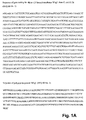
- Fig. 1A shows the DNA and the amino acid sequence of the gene coding for alpha-1,2-fucosyltransferase WbgL from E. coli 0126;
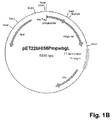
- Fig. 1B shows the vector map of pET22bHIS6PropwbgL, i.e. codon optimized gene wbgL from Escherichia coli O126 encoding the new alpha-1,2-fucosyltransferase WbgL cloned into pET22b(+) (Novagen, Darmstadt, Germany, via BamHI / XhoI) to which 18 bp coding for an N-terminal His-Tag and 621 bp from the propeptide of Staphylococcus hyicus lipase were added previously via Ndel/BamHI (description see below);
- Fig. 1C shows the vector map of pACYC-wbgL, i.e. codon optimized gene wbgL from Escherichia coli O126 encoding the new alpha-1,2-fucosyltransferase WbgL cloned into pACYCDuet-1 (Novagen via NcoI / BamHI);
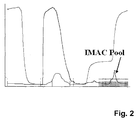
- Fig. 2 shows the chromatogram of WbgL purification by IMAC Ni 2+- NTA Sepharose column (blue: absorption at 280 nm, red: conductivity; fractions containing His 6 -Propeptide-WbgL eluting from the column are called IMAC pool);
- Fig. 3 shows SDS-PAGE analysis of His 6 -Propeptide-WbgL expression in crude extract and insoluble fractions of E. coli JM109(DE3) pET22bHIS6PropwbgL as well as in wash fractions of purification of His 6 -Propeptide-WbgL and of purified His 6 -Propeptide-WbgL;
- Fig. 4 shows detection of His 6 -Propeptide-WbgL on an immunoblot using a monoclonal anti-His 6 -antibody conjugated to horse radish peroxidase (HRP) (Roche Diagnostics, Mannheim, Germany) after incubation with DAB substrate (Roche Diagnostics, Mannheim, Germany);
- HRP horse radish peroxidase
- Fig. 5 shows the continuous photometric assay of purified His 6 -Propeptide-WbgL with 0.4 mM GDP- -L-fucose and 5 mM lactose in which activity can be detected by decrease of absorption at 340 nm caused by oxidation of NADH;
- Fig. 6 shows detection of 2'-fucosyllactose production from WbgL reaction by HPAEC-PAD at start of reaction where no 2'fucosyllactose is present ( A ); and 2'-fucosyllactose produced after 1 hour of WbgL reaction with 2 mM GDP-beta-L-fucose and 5 mM lactose ( B );
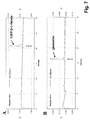
- Fig. 7 shows the analysis of reaction mixture started with 2 mM GDP-fucose and 5 mM lactose and WbgL by capillary electrophoresis at the beginning of the reaction where only GDP- -L-fucose can be detected ( A ); and after 16 hours of reaction where only guanosine as degradation product of GDP released by WbgL activity can be detected ( B );
- Fig. 8 shows relative activity of WbgL at different pH values (pH 6.8 to 8.4) in 50 mM Tris-HCl buffer;
- Fig. 9 shows the increase of 2'-fucosyllactose concentration as measured in a WbgL reaction started with 2 mM GDP-beta-L-fucose and 5 mM lactose at different time points during 16 hours of reaction process;
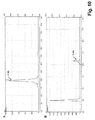
- Fig. 10 shows HPLC chromatogram; separation by Phenomenex Rezex RCM Ca2+ column with water as eluent (0.6 ml/min for 30 minutes at 80 °C) and detection by refractive index detector (Shimadzu, Germany) ( A ); and the HPLC chromatogram; separation by Reprosil Carbohydrate column, 5 ⁇ m, 250 x 4,6 mm, with acetonitrile / water (68 : 32) as eluent (1.4 ml/min for 20 minutes at 35 °C; detection by refractive index detector (Shimadzu, Germany)) ( B );
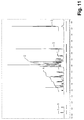
- Fig. 11 shows the NMR spectrum of 2'-fucosyllactose produced by WbgL.
- Transformants were grown in 100 ml Erlenmeyer flasks containing 20 ml LB medium with 100 ⁇ g/mL ampicillin and incubated overnight at 37°C and 130 rpm.
- For protein production cells were grown in 5 L Erlenmeyer flasks with 1000 mL TB-medium at 37°C and 80 rpm.
- buffer C 50 mM Tris-HCl pH 7.6., 0.3 M NaCl and 300 mM imidazole. All fractions were analysed for protein concentration and assayed for enzyme activity. All fractions containing active soluble WbgL from elution with buffer C were pooled and the resulting solution was called IMAC pool (see Fig. 2 ).
- Enzyme activities of His 6 -Propeptide-WbgL in the crude extract and IMAC fractions were determined by a photometric assay and HPAEC-PAD analysis of 2'fucosyllactose.
- the photometric assay was performed using the pyruvate kinase/lactate dehydrogenase system for the detection of released GDP ( Barratt, D. H., L. Barber, et al. (2001). "Multiple, distinct isoforms of sucrose synthase in pea.” Plant Physiology 127(2): 655-664 .).
- the reaction mixture for the microtiter plate assay contained 50 mM Tris-HCl pH 7.6, 2 mM GDP-beta-L-fucose, 5 mM Lactose, 1 mM phosphoenolpyruvate, 1 mM DTT, 0.25 mM NADH, 2 mM MnCl 2 , 5 U pyruvate kinase, and 5 U lactate dehydrogenase in a total volume of 250 ⁇ l.
- the reaction was started by addition of 100 ⁇ l enzyme solution and followed at 340 nm at 30° C. Control experiments for the detection of side activities were done without acceptor substrate lactose (see Fig. 5 ).
- Enzyme activity was also determined by HPAEC-PAD analysis for detection of 2'-fucosyllactose.
- the assay solution contained 2 mM GDP- -L-fucose, 5 mM lactose, 50 mM Tris-HCl pH 7.6 with 2 mM MnCl 2 , 1 mM DTT, 1 U alkaline phosphatase in a total volume of 175 ⁇ l and was incubated at 30 °C after the addition of 175 ⁇ l crude extract and purified enzyme solution. The reaction was stopped by heating for 5 min at 95° C at different time points where the conversion rate was linear.
- the centrifuged samples were analysed by Dionex HPAEC- PAD (Dionex Corporation, Sunnyvale, CA, USA) on CarboPac PA1 column using ChromeleonTM 6.40 Software.
- the elution was carried out with 50 mM NaOH at 30 °C (flow rate 1 mL/min, 50 ⁇ L injection volume).
- the concentration of the generated trisaccharide 2'-fucosyllactose was determined by a standard calibration curve with commercially available 2'-fucosyllactose and used for subsequent calculation of enzyme activity (see Fig. 6 ).
- 1 U of His 6 -Propeptide-WbgL is the amount of enzyme which produces 1 ⁇ mol product (GDP or 2'-fucosyllactose) per minute under standard assay conditions.
- GDP-beta-L-fucose and its consumption was analysed by capillary electrophoresis on a P/ACE MDQ apparatus from Beckman Coulter (Krefeld, Germany), equipped with a UV detector.
- the samples for the determination of the activated donor substrate GDP-beta-L-fucose were stopped by heating (95 °C) for 5 min and centrifuged for 10 min at 15000 rpm (Rotina 35R, Hettich, Tuttlingen, Germany). The detection was accomplished on an untreated fused-silica capillary (I.D.
- the kinetic constants of His 6 -Propeptide-WbgL for the acceptor substrate lactose and the donor substrate GDP-beta-L-fucose were derived from initial rate analysis at a variable substrate concentrations using the photometric assay described above. GDP-beta-L-fucose was varied from 0.02 mM to 4 mM at a constant concentration of 10 mM lactose and lactose was altered from 0.05 to 40 mM at a constant concentration of 2 mM GDP-beta-L-fucose. All data were determined by non linear- regression analysis according to the Michaelis-Menten equation using the Sigma Plot 10 software (SPSS Science Software GmbH, Erkrath, Germany).
- the substrate spectrum of recombinant His 6 -Propeptide-WbgL was analysed by HPAEC-PAD according to activity assay described above. Instead of 5 mM lactose different acceptor substrates were tested to determine the relative activity compared to lactose.
- Table 3 Comparison of the amount of 2'-fucosyllactose yield using alpha-1,2-fucosyltransferases FucT2 from Helicobacter pylori and WbgL from Escherichia coli O126 Fucosyltransferase Yield 2'-mL [mM] without (negative control) 0,00 FucT2 ( Helicobacter pylori ) 2,01 WbgL ( Escherichia coli O126) 4,05
- the amount of the fucosylated product 2'-fucosyllactose was significantly higher when using the alpha-1,2-fucosyltransferase according to the invention, i.e. WbgL from Escherichia coli O126, compared to the alpha-1,2-fucosyltransferase FucT2 from Helicobacter pylori, which is state of the art.
- 2'-fucosyllactose produced as described above was purified in several steps.
- First step was the purification by adsorption on activated charcoal. Culture supernatant from the production step was applied to a bed of activated charcoal. Flow-through was collected and analyzed, but no remaining 2'-fucosyllactose was detected. For removal of unspecifically bound medium compounds such as e.g. salts and amino acids the bed was washed with distilled water (no 2'-FL in flow-through). 2'-FL and remaining lactose and fucose were then eluted with 96 % ethanol.
- Ethanol was subsequently evaporated in a rotary evaporator and the residue filtrated via 10 kDa crossflow module (Microdyn Nadir, Germany). Remaining salts were removed by electrodialysation and thereafter endotoxins were removed by filtration using a crossflow module (Pall, Germany).
- 2'-FL was then separated from lactose and fucose in gram scale using gel permeation chromatography material Biogel P-2 (BioRad, Germany) packed into a 520 mm x 428 mm glass column with frit. Purification of 2'-FL was monitored by thin layer chromatography. Fractions containing only 2'-fucosyllactose were pooled and freeze-dried.
Landscapes
- Chemical & Material Sciences (AREA)
- Organic Chemistry (AREA)
- Life Sciences & Earth Sciences (AREA)
- Health & Medical Sciences (AREA)
- Engineering & Computer Science (AREA)
- Zoology (AREA)
- Wood Science & Technology (AREA)
- Genetics & Genomics (AREA)
- Bioinformatics & Cheminformatics (AREA)
- Biotechnology (AREA)
- General Health & Medical Sciences (AREA)
- Biochemistry (AREA)
- General Engineering & Computer Science (AREA)
- Microbiology (AREA)
- Molecular Biology (AREA)
- Chemical Kinetics & Catalysis (AREA)
- General Chemical & Material Sciences (AREA)
- Biomedical Technology (AREA)
- Medicinal Chemistry (AREA)
- Physics & Mathematics (AREA)
- Biophysics (AREA)
- Plant Pathology (AREA)
- Enzymes And Modification Thereof (AREA)
- Micro-Organisms Or Cultivation Processes Thereof (AREA)
- Preparation Of Compounds By Using Micro-Organisms (AREA)
- Saccharide Compounds (AREA)
Claims (12)
- Wirtszelle zur Herstellung eines fucosylierten Oligosaccharids, wobei die Wirtszelle eine Sequenz aufweist, die aus einem Polynukleotid besteht, welches für ein Polypeptid mit einer alpha-1,2-Fucosyltransferase-Aktivität codiert, und welches eine Sequenz aufweist, die ausgewählt ist aus der Gruppe bestehend aus a) SEQ ID Nr. 1 des beigefügten Sequenzprotokolls, b) einer Nukleinsäuresequenz, die zur SEQ ID Nr. 1 komplementär ist, oder c) Nukleinsäuresequenzen, die unter stringenten Bedingungen an die Nukleinsäuresequenzen wie in a) und b) definiert oder deren komplementäre Stränge hybridisieren, wobei die Sequenz eine Sequenz ist, die bezüglich der Wirtszelle fremd ist, und wobei die Sequenz in das Genom der Wirtszelle integriert ist, oder wobei die Wirtszelle einen Vektor aufweist, der das Polynukleotid aufweist, wobei die Nukleinsäuresequenz funktionell mit Kontrollsequenzen verknüpft ist, welche von einer mit dem Vektor transformierten Wirtszelle erkannt werden.
- Wirtszelle nach Anspruch 1, dadurch gekennzeichnet, dass die Wirtszelle ausgewählt ist aus der Gruppe bestehend aus Hefe-, Bakterien-, Insekten-, Tier- und Pflanzenzellen.
- Wirtszelle nach einem der Ansprüche 1 oder 2, dadurch gekennzeichnet, dass die Wirtszelle eine Escherichia coli Zelle ist.
- Wirtszelle nach einem der Ansprüche 1 bis 3, dadurch gekennzeichnet, dass die Nukleinsäure, die für das Polypeptid mit der alpha-1,2-Fucosyltransferase-Aktivität codiert, der Codonverwendung der jeweiligen Zelle angepasst ist.
- Verwendung eines Polynukleotids, das für ein Polypeptid mit einer alpha-1,2-Fucosyltransferase-Aktivität codiert, und welches eine Sequenz aufweist, die ausgewählt ist aus der Gruppe bestehend aus:a) der SEQ ID Nr. 1 des beigefügten Sequenzprotokolls;b) einer Nukleinsäuresequenz, die zu der SEQ ID Nr. 1 komplementär ist;c) Nukleinsäuren, die unter stringenten Bedingungen an die in a) und b) definierten Nukleinsäuresequenzen, oder deren komplementäre Stränge, hybridisieren,oder eines Vektors, der das Polynukleotid enthält,
oder eines Polypeptids mit alpha-1,2-Fucosyltransferase-Aktivität, welches aus einer Aminosäuresequenz besteht, die ausgewählt ist aus der Gruppe bestehend aus:a) der in SEQ ID Nr. 2 gezeigten Aminosäuresequenz;b) einer Aminosäuresequenz einer allelischen Variante der in SEQ ID Nr. 2 gezeigten Aminosäuresequenz, wobei die allelische Variante durch ein Nukleinsäuremolekül codiert wird, das unter stringenten Bedingungen an den entgegengesetzten Strang eines in SEQ ID Nr. 1 gezeigten Nukleinsäuremoleküls hybridisiert;c) einer Aminosäuresequenz eines Orthologs einer in Sequenz SEQ ID Nr. 2 gezeigten Aminosäuresequenz, wobei das Ortholog durch ein Nukleinsäuremolekül codiert wird, welches unter stringenten Bedingungen an den entgegengesetzten Strang des in SEQ ID Nr. 1 gezeigten Nukleinsäuremoleküls hybridisiert; undd) einem Fragment der in SEQ ID Nr. 2 gezeigten Aminosäuresequenz, wobei das Fragment zumindest 10 zusammenhängende Aminosäuren aufweist,zur Herstellung eines fucosylierten Oligosaccharids. - Verwendung nach Anspruch 5, dadurch gekennzeichnet, dass die Produktion des fucosylierten Oligosaccharids mittels einer heterologen oder homologen Expression des Polynukleotids durchgeführt wird, welches die für die alpha-1,2-Fucosyltransferase codiert, wobei die Sequenz eine Sequenz ist, die bezüglich der Wirtszelle fremd ist.
- Verwendung nach Anspruch 5 oder 6, dadurch gekennzeichnet, dass das fucosylierte Oligosaccharid ein Oligosaccharid ist, das aus humaner Milch bekannt ist.
- Verwendung nach Anspruch 7, dadurch gekennzeichnet, dass das fucosylierte Oligosaccharid 2'-Fucosyllactose ist.
- Verfahren zur Herstellung fucosylierter Oligosaccharide, wobei das Verfahren die Schritte aufweist:a) Bereitstellen eines Polypeptids mit alpha-1,2-Fucosyltransferase-Aktivität, welches aus einer Aminosäuresequenz besteht, die ausgewählt ist aus der Gruppe bestehend aus a) der in SEQ ID Nr. 2 gezeigten Aminosäuresequenz; b) einer Aminosäuresequenz einer allelischen Variante der in SEQ ID Nr. 2 gezeigten Aminosäuresequenz, wobei die allelische Variante durch ein Nukleinsäuremolekül codiert wird, das unter stringenten Bedingungen an den entgegengesetzten Strang eines in SEQ ID Nr. 1 gezeigten Nukleinsäuremoleküls hybridisiert; c) einer Aminosäuresequenz eines Orthologs einer in Sequenz SEQ ID Nr. 2 gezeigten Aminosäuresequenz, wobei das Ortholog durch ein Nukleinsäuremolekül codiert wird, welches unter stringenten Bedingungen an den entgegengesetzten Strang des in SEQ ID Nr. 1 gezeigten Nukleinsäuremoleküls hybridisiert; und d) einem Fragment der in SEQ ID Nr. 2 gezeigten Aminosäuresequenz, wobei das Fragment zumindest 10 zusammenhängende Aminosäuren aufweist,b) Kontaktieren des Polypeptids mit alpha-1,2-Fucosyltransferase-Aktivität aus Schritt a) mit einer Mischung, die ein Donorsubstrat aufweist, welches einen Fucoserest aufweist, sowie ein Akzeptorsubstrat, welches ein Mono- oder Oligosaccharid aufweist, und zwar unter Bedingungen, unter welchen das Polypeptid den Transfer eines Fucose-Rests vom Donorsubstrat auf das Akzeptorsubstrat katalysiert, wodurch ein fucosyliertes Oligosaccharid produziert wird.
- Verfahren zur Herstellung fucosylierter Oligosaccharide, wobei das Verfahren die Schritte aufweist:a) Wachsenlassen einer Wirtszelle nach einem der Ansprüche 1 bis 4, und zwar unter geeigneten Nährstoffbedingungen, welche die Herstellung des fokusylierten Oligosaccharids gestatten, und welche die Expression eines Polypeptids mit alpha-1,2-Fucosyltransferase-Aktivität gestatten;b) gleichzeitig oder auf Schritt a) folgendes Bereitstellen eines Donorsubstrats, welches einen Fucoserest aufweist, und eines Akzeptorsubstrats, welches ein Mono- oder Oligosaccharid aufweist, um die Katalyse des Transfers eines Fucoserests vom Donorsubstrat auf das Akzeptorsubstrat durch das alpha-1,2-Fucosyltransferase-Polypeptid zu bewirken, wodurch fucosyliertes Oligosaccharid produziert wird; undc) Isolieren des fucosylierten Oligosaccharids aus der Wirtszelle oder deren Wachstumsmedium.
- Verfahren nach Anspruch 9 oder 10, dadurch gekennzeichnet, dass das Donorsubstrat GDP-Fucose ist.
- Verfahren nach Anspruch 11, dadurch gekennzeichnet, dass die GDP-Fucose mittels eines Enzyms bereitgestellt wird, das gleichzeitig in der Wirtszelle exprimiert wird, oder mittels des Metabolismus der Wirtszelle.
Priority Applications (15)
| Application Number | Priority Date | Filing Date | Title |
|---|---|---|---|
| EP11151571.4A EP2479263B1 (de) | 2011-01-20 | 2011-01-20 | Neuartige Fucosyltransferasen und ihre Verwendungen |
| DK11151571.4T DK2479263T3 (da) | 2011-01-20 | 2011-01-20 | Nye fucosyltransferaser og deres anvendelser |
| ES11151571.4T ES2439507T3 (es) | 2011-01-20 | 2011-01-20 | Fucosiltransferasas novedosas y sus aplicaciones |
| RU2013138474A RU2628307C2 (ru) | 2011-01-20 | 2011-12-30 | Новые фукозилтрасферазы и их применения |
| KR1020137019052A KR101891649B1 (ko) | 2011-01-20 | 2011-12-30 | 신규 푸코실트랜스페라제 및 그 적용 |
| BR112013018539A BR112013018539A8 (pt) | 2011-01-20 | 2011-12-30 | Novas fucosil transferases e suas aplicações |
| MX2013008423A MX344314B (es) | 2011-01-20 | 2011-12-30 | Fucosiltransferasas novedosas y sus aplicaciones. |
| CN2011800655811A CN103328630A (zh) | 2011-01-20 | 2011-12-30 | 新型岩藻糖基转移酶及其应用 |
| CN201710788461.3A CN107604023A (zh) | 2011-01-20 | 2011-12-30 | 岩藻糖基转移酶及其应用 |
| PCT/EP2011/074291 WO2012097950A1 (en) | 2011-01-20 | 2011-12-30 | Novel fucosyltransferases and their applications |
| JP2013549748A JP6155196B2 (ja) | 2011-01-20 | 2011-12-30 | 新規フコシルトランスフェラーゼおよびそれらの用途 |
| PH1/2013/501536A PH12013501536A1 (en) | 2011-01-20 | 2011-12-30 | Novel fucosyltransferases and their applications |
| AU2011356210A AU2011356210B8 (en) | 2011-01-20 | 2011-12-30 | Novel fucosyltransferases and their applications |
| HK12108431.6A HK1167683B (en) | 2012-08-29 | Novel fucosyltransferases and their applications | |
| US13/946,845 US9611285B2 (en) | 2011-01-20 | 2013-07-19 | Fucosyltransferases and their applications |
Applications Claiming Priority (1)
| Application Number | Priority Date | Filing Date | Title |
|---|---|---|---|
| EP11151571.4A EP2479263B1 (de) | 2011-01-20 | 2011-01-20 | Neuartige Fucosyltransferasen und ihre Verwendungen |
Publications (2)
| Publication Number | Publication Date |
|---|---|
| EP2479263A1 EP2479263A1 (de) | 2012-07-25 |
| EP2479263B1 true EP2479263B1 (de) | 2013-11-27 |
Family
ID=44072605
Family Applications (1)
| Application Number | Title | Priority Date | Filing Date |
|---|---|---|---|
| EP11151571.4A Active EP2479263B1 (de) | 2011-01-20 | 2011-01-20 | Neuartige Fucosyltransferasen und ihre Verwendungen |
Country Status (13)
| Country | Link |
|---|---|
| US (1) | US9611285B2 (de) |
| EP (1) | EP2479263B1 (de) |
| JP (1) | JP6155196B2 (de) |
| KR (1) | KR101891649B1 (de) |
| CN (2) | CN107604023A (de) |
| AU (1) | AU2011356210B8 (de) |
| BR (1) | BR112013018539A8 (de) |
| DK (1) | DK2479263T3 (de) |
| ES (1) | ES2439507T3 (de) |
| MX (1) | MX344314B (de) |
| PH (1) | PH12013501536A1 (de) |
| RU (1) | RU2628307C2 (de) |
| WO (1) | WO2012097950A1 (de) |
Cited By (5)
| Publication number | Priority date | Publication date | Assignee | Title |
|---|---|---|---|---|
| EP3425052A1 (de) | 2017-07-07 | 2019-01-09 | Jennewein Biotechnologie GmbH | Fucosyltransferasen und deren verwendung bei der herstellung von fucosylierten oligosacchariden |
| US20200354760A1 (en) * | 2017-11-21 | 2020-11-12 | Jennewein Biotechnologie Gmbh | Process for the purification of l-fucose from a fermentation broth |
| WO2020249512A1 (en) | 2019-06-12 | 2020-12-17 | Jennewein Biotechnologie Gmbh | Production of fucosylated oligosaccharides in bacillus |
| AU2017351657B2 (en) * | 2016-10-29 | 2022-08-04 | Chr. Hansen HMO GmbH | Improved process for the production of fucosylated oligosaccharides |
| US11912735B2 (en) | 2017-08-29 | 2024-02-27 | Chr Hansen Hmo Gmbh | Process for purifying sialylated oligosaccharides |
Families Citing this family (53)
| Publication number | Priority date | Publication date | Assignee | Title |
|---|---|---|---|---|
| AU2012217650B9 (en) | 2011-02-16 | 2017-09-14 | Glycosyn LLC | Biosynthesis of human milk oligosaccharides in engineered bacteria |
| US9029136B2 (en) | 2012-07-25 | 2015-05-12 | Glycosyn LLC | Alpha (1,2) fucosyltransferases suitable for use in the production of fucosylated oligosaccharides |
| EP2728009B1 (de) | 2012-10-31 | 2017-07-26 | Jennewein Biotechnologie GmbH | Verfahren zur Herstellung von Monosacchariden |
| US9902984B2 (en) | 2013-09-06 | 2018-02-27 | Glycom A/S | Fermentative production of oligosaccharides |
| ES2875327T3 (es) * | 2013-09-10 | 2021-11-10 | Chr Hansen Hmo Gmbh | Producción de oligosacáridos |
| WO2015091843A1 (en) | 2013-12-18 | 2015-06-25 | Københavns Universitet | Glycosyltransferase glycosylating flavokermesic acid and/or kermesic acid |
| ES2701163T3 (es) * | 2014-01-20 | 2019-02-21 | Jennewein Biotechnologie Gmbh | Procedimiento para la purificación eficiente de oligosacáridos de la leche humana (HMO) neutros a partir de la fermentación microbiana |
| ES2715010T3 (es) | 2014-03-31 | 2019-05-31 | Jennewein Biotechnologie Gmbh | Fermentación total de oligosacáridos |
| CA2945661C (en) | 2014-05-15 | 2023-10-17 | Glycosyn LLC | Alpha (1,2) fucosyltransferase syngenes for use in the production of fucosylated oligosaccharides |
| DE202015009782U1 (de) | 2014-06-11 | 2020-02-10 | Glycom A/S | Trennung von 2'-O-Fucosyllactose aus Fermentationsbrühe |
| US9616114B1 (en) | 2014-09-18 | 2017-04-11 | David Gordon Bermudes | Modified bacteria having improved pharmacokinetics and tumor colonization enhancing antitumor activity |
| US10676770B2 (en) | 2014-12-16 | 2020-06-09 | Glycom A/S | Separation of 2′-FL from a fermentation broth |
| EP3050973A1 (de) | 2015-01-30 | 2016-08-03 | Jennewein Biotechnologie GmbH | Fermentationsverfahren zur Herstellung von Monosacchariden in freier Form aus nukleotidaktivierten Zuckern |
| US10676723B2 (en) | 2015-05-11 | 2020-06-09 | David Gordon Bermudes | Chimeric protein toxins for expression by therapeutic bacteria |
| CN105695537B (zh) * | 2016-02-29 | 2019-11-19 | 福建农林大学 | 一种降血糖及调节肠道菌群的糖基化浒苔寡糖制备方法 |
| EP3423587B1 (de) * | 2016-04-05 | 2020-06-24 | Council of Scientific & Industrial Research | Multifunktionelles rekombinantes nukleotidabhängiges glycosyltransferaseprotein und dessen verfahren zur glycosylierung |
| CN106190937B9 (zh) * | 2016-07-18 | 2020-12-01 | 南开大学 | 一种构建重组大肠杆菌生物合成2’-岩藻乳糖的方法 |
| CN108103039B (zh) * | 2016-11-25 | 2021-10-22 | 上海交通大学 | 一组岩藻糖基转移酶突变体及其筛选方法和应用 |
| US11180535B1 (en) | 2016-12-07 | 2021-11-23 | David Gordon Bermudes | Saccharide binding, tumor penetration, and cytotoxic antitumor chimeric peptides from therapeutic bacteria |
| US11129906B1 (en) | 2016-12-07 | 2021-09-28 | David Gordon Bermudes | Chimeric protein toxins for expression by therapeutic bacteria |
| CN106434590A (zh) * | 2016-12-13 | 2017-02-22 | 福建农林大学 | 一种岩藻糖基转移酶及其基因工程菌和应用 |
| CN106434591A (zh) * | 2016-12-13 | 2017-02-22 | 福建农林大学 | 一种岩藻糖基转移酶及其应用 |
| JP7066977B2 (ja) * | 2017-04-03 | 2022-05-16 | 味の素株式会社 | L-アミノ酸の製造法 |
| EP3613858B1 (de) * | 2017-04-21 | 2024-03-13 | Seoul National University R&DB Foundation | Verfahren zur herstellung von 3'-fucosyllactose mittels corynebacterium glutamicum |
| KR101953375B1 (ko) * | 2017-11-20 | 2019-02-28 | 고려대학교 산학협력단 | 다양하고 신규한 퓨코실 올리고당의 제조법 및 이의 용도 |
| EP3494807A1 (de) | 2017-12-11 | 2019-06-12 | Jennewein Biotechnologie GmbH | Sprühgetrocknete sialyllactose |
| ES3040419T3 (en) | 2017-12-08 | 2025-10-30 | Chr Hansen Hmo Gmbh | Spray-dried lacto-n-fucopentaose |
| ES3039971T3 (en) | 2017-12-08 | 2025-10-28 | Chr Hansen Hmo Gmbh | Spray-dried 3-fucosyllactose |
| AU2018380962B2 (en) | 2017-12-08 | 2024-12-19 | Chr. Hansen HMO GmbH | Spray-dried lacto-N-fucopentaose |
| PL3494805T3 (pl) | 2017-12-08 | 2025-10-06 | Chr. Hansen HMO GmbH | Suszone rozpyłowo tetrasacharydy |
| ES3026362T3 (en) | 2018-02-08 | 2025-06-11 | Chr Hansen Hmo Gmbh | Spray-dried mixture of human milk oligosaccharides |
| US11913046B2 (en) | 2018-04-23 | 2024-02-27 | Inbiose N.V. | Increasing export of 2'fucosyllactose from microbial cells through the expression of a heterologous nucleic acid |
| US12071614B2 (en) | 2018-04-23 | 2024-08-27 | Inbiose N.V. | Increasing activity of 2′fucosyllactose transporters endogenous to microbial cells |
| EP3569713A1 (de) * | 2018-05-16 | 2019-11-20 | Jennewein Biotechnologie GmbH | Verwendung von glycosidasen bei der herstellung von oligosacchariden |
| EP3867258A1 (de) | 2018-10-18 | 2021-08-25 | Basf Se | Verfahren zur herstellung von kristalliner 2'-fucosyllactose |
| CN109337882A (zh) * | 2018-12-07 | 2019-02-15 | 福建农林大学 | 一种α-1,2-岩藻糖基转移酶及制备人乳寡糖中的应用 |
| CN109337883A (zh) * | 2018-12-07 | 2019-02-15 | 福建农林大学 | 一种α-1,2-岩藻糖基转移酶及其在奶粉中的应用 |
| CN109735479B (zh) * | 2019-01-30 | 2022-04-01 | 光明乳业股份有限公司 | 一种合成2’-岩藻糖基乳糖的重组枯草芽孢杆菌及其构建方法与应用 |
| MX2022002949A (es) | 2019-09-24 | 2022-04-06 | Prolacta Bioscience Inc | Composiciones y metodos para el tratamiento de enfermedades inflamatorias e inmunes. |
| JP2023506287A (ja) | 2019-12-17 | 2023-02-15 | インバイオス エン.フェー. | ラクトースを変換するアルファ-1,2-フコシルトランスフェラーゼ酵素 |
| KR20220154158A (ko) | 2020-03-12 | 2022-11-21 | 글리콤 에이/에스 | 2'-fl의 결정화 |
| IL300573A (en) | 2020-08-14 | 2023-04-01 | Prolacta Bioscience Inc | Breast milk oligosaccharide compositions for use with bacteriotherapy |
| KR20230131228A (ko) | 2021-01-12 | 2023-09-12 | 프롤랙타 바이오사이언스, 인코포레이티드 | 신바이오틱 치료 요법 |
| US20240286081A1 (en) | 2021-06-15 | 2024-08-29 | Dsm Ip Assets B.V. | Separation of human milk oligosaccharides from a fermentation broth |
| WO2022263425A1 (en) | 2021-06-15 | 2022-12-22 | Dsm Ip Assets B.V. | Separation of human milk oligosaccharides from a fermentation broth |
| EP4355465A1 (de) | 2021-06-15 | 2024-04-24 | DSM IP Assets B.V. | Trennung von menschlichen milcholigosacchariden aus einer fermentationsbrühe |
| BE1029434B1 (nl) | 2021-06-15 | 2023-07-31 | Dsm Ip Assets Bv | Scheiding van moedermelkoligosachariden uit een fermentatiebouillon |
| CN113667656B (zh) * | 2021-08-23 | 2023-07-25 | 光明乳业股份有限公司 | 岩藻糖基转移酶半胱氨酸突变体及其合成2′-岩藻糖基乳糖的重组大肠杆菌及构建方法 |
| WO2023242194A1 (en) | 2022-06-14 | 2023-12-21 | Dsm Ip Assets B.V. | Separation of human milk oligosaccharides from a fermentation broth |
| KR20240002283A (ko) * | 2022-06-28 | 2024-01-05 | 주식회사 삼양사 | 2’-푸코실락토오스 제조방법 |
| AU2023331862A1 (en) | 2022-08-29 | 2025-02-13 | Chr. Hansen A/S | Process for the production of a purified human milk oligosaccharide derived from a microbial fermentation process |
| WO2024130119A2 (en) | 2022-12-16 | 2024-06-20 | Prolacta Bioscience, Inc. | Synbiotic compositions for short chain fatty acid production |
| CN116042671B (zh) * | 2023-02-14 | 2024-11-22 | 华熙生物科技股份有限公司 | 一种用于制备母乳寡糖的核酸分子、表达载体和微生物 |
Family Cites Families (12)
| Publication number | Priority date | Publication date | Assignee | Title |
|---|---|---|---|---|
| RU2125092C1 (ru) * | 1991-10-15 | 1999-01-20 | Дзе Скриппс Рисерч Инститьют | Способ получения фукозилированного углевода, способ получения фукозилированной сиалилированной углеводной молекулы, реакционная система in vitro |
| US5807732A (en) * | 1995-02-28 | 1998-09-15 | Lowe; John B. | GDP-L-fucose: β-D-galactoside 2-α-L-fucosyltransferases, DNA sequences encoding the same, method for producing the same and a method of genotyping a person |
| US6238894B1 (en) | 1998-11-04 | 2001-05-29 | Diane Taylor | α1,2 fucosyltransferase |
| AT408446B (de) * | 1999-02-18 | 2001-11-26 | Altmann Friedrich Dr | Fucosyltransferase-gen |
| US6329170B1 (en) * | 1999-04-23 | 2001-12-11 | Northwest Hospital | Nucleic acids and proteins of a rat ganglioside GM1-specific α1→2fucosyltransferase and uses thereof |
| FI19992070A7 (fi) * | 1999-09-28 | 2001-03-29 | Carbion Oy | Uudet fukosyloidut oligosakkaridit ja menetelmä niiden valmistamiseksi |
| JP2001546898A (en) | 1999-12-21 | 2003-06-10 | Kyowa Hakko Kogyo Kk | MODIFIED alpha -1,2-FUCOSYLTRANSFERASE GENE AND PROCESS FOR PRODUCING alpha -1,2-FUCOSYLTRANSFERASE AND FUCOSE-CONTAINING SUGAR CHAIN |
| US20040058418A1 (en) * | 2000-04-11 | 2004-03-25 | Tetsuo Endo | Alpha 1,2-fucosyltransferase and process for producing fucose-containing complex carbohydrate |
| WO2003018794A1 (fr) * | 2001-08-24 | 2003-03-06 | Kyowa Hakko Kogyo Co., Ltd. | $g(a)-1,2-fucosyle transferase et adn codant pour celle-ci |
| US7326770B2 (en) * | 2004-01-22 | 2008-02-05 | Neose Technologies, Inc. | H. pylori fucosyltransferases |
| BRPI0923433B1 (pt) * | 2008-12-19 | 2021-06-01 | Jennewein Biotechnologie Gmbh | Método para produzir uma célula geneticamente modificada tendo a capacidade de produzir compostos fucosilados e método para fazer um composto fucosilado |
| US9029136B2 (en) * | 2012-07-25 | 2015-05-12 | Glycosyn LLC | Alpha (1,2) fucosyltransferases suitable for use in the production of fucosylated oligosaccharides |
-
2011
- 2011-01-20 ES ES11151571.4T patent/ES2439507T3/es active Active
- 2011-01-20 DK DK11151571.4T patent/DK2479263T3/da active
- 2011-01-20 EP EP11151571.4A patent/EP2479263B1/de active Active
- 2011-12-30 JP JP2013549748A patent/JP6155196B2/ja active Active
- 2011-12-30 KR KR1020137019052A patent/KR101891649B1/ko active Active
- 2011-12-30 MX MX2013008423A patent/MX344314B/es active IP Right Grant
- 2011-12-30 PH PH1/2013/501536A patent/PH12013501536A1/en unknown
- 2011-12-30 CN CN201710788461.3A patent/CN107604023A/zh active Pending
- 2011-12-30 WO PCT/EP2011/074291 patent/WO2012097950A1/en not_active Ceased
- 2011-12-30 BR BR112013018539A patent/BR112013018539A8/pt not_active Application Discontinuation
- 2011-12-30 RU RU2013138474A patent/RU2628307C2/ru active
- 2011-12-30 CN CN2011800655811A patent/CN103328630A/zh active Pending
- 2011-12-30 AU AU2011356210A patent/AU2011356210B8/en active Active
-
2013
- 2013-07-19 US US13/946,845 patent/US9611285B2/en active Active
Cited By (7)
| Publication number | Priority date | Publication date | Assignee | Title |
|---|---|---|---|---|
| AU2017351657B2 (en) * | 2016-10-29 | 2022-08-04 | Chr. Hansen HMO GmbH | Improved process for the production of fucosylated oligosaccharides |
| EP3425052A1 (de) | 2017-07-07 | 2019-01-09 | Jennewein Biotechnologie GmbH | Fucosyltransferasen und deren verwendung bei der herstellung von fucosylierten oligosacchariden |
| WO2019008133A1 (en) | 2017-07-07 | 2019-01-10 | Jennewein Biotechnologie Gmbh | FUCOSYLTRANSFERASES AND THEIR USE IN THE PRODUCTION OF FUCOSYLATED OLIGOSACCHARIDES |
| US11912735B2 (en) | 2017-08-29 | 2024-02-27 | Chr Hansen Hmo Gmbh | Process for purifying sialylated oligosaccharides |
| US20200354760A1 (en) * | 2017-11-21 | 2020-11-12 | Jennewein Biotechnologie Gmbh | Process for the purification of l-fucose from a fermentation broth |
| US11732282B2 (en) * | 2017-11-21 | 2023-08-22 | Chr. Hansen HMO GmbH | Process for the purification of L-fucose from a fermentation broth |
| WO2020249512A1 (en) | 2019-06-12 | 2020-12-17 | Jennewein Biotechnologie Gmbh | Production of fucosylated oligosaccharides in bacillus |
Also Published As
| Publication number | Publication date |
|---|---|
| CN107604023A (zh) | 2018-01-19 |
| CN103328630A (zh) | 2013-09-25 |
| WO2012097950A1 (en) | 2012-07-26 |
| RU2628307C2 (ru) | 2017-08-15 |
| AU2011356210B2 (en) | 2015-08-13 |
| US20140024820A1 (en) | 2014-01-23 |
| ES2439507T3 (es) | 2014-01-23 |
| KR101891649B1 (ko) | 2018-08-27 |
| PH12013501536A1 (en) | 2013-09-23 |
| RU2013138474A (ru) | 2015-02-27 |
| US9611285B2 (en) | 2017-04-04 |
| BR112013018539A8 (pt) | 2023-01-31 |
| AU2011356210A1 (en) | 2013-07-11 |
| JP2014504874A (ja) | 2014-02-27 |
| BR112013018539A2 (pt) | 2017-09-05 |
| DK2479263T3 (da) | 2014-02-03 |
| AU2011356210A8 (en) | 2015-09-03 |
| JP6155196B2 (ja) | 2017-06-28 |
| AU2011356210B8 (en) | 2015-09-03 |
| KR20140032983A (ko) | 2014-03-17 |
| MX2013008423A (es) | 2013-10-17 |
| MX344314B (es) | 2016-12-13 |
| EP2479263A1 (de) | 2012-07-25 |
| HK1167683A1 (en) | 2012-12-07 |
Similar Documents
| Publication | Publication Date | Title |
|---|---|---|
| US9611285B2 (en) | Fucosyltransferases and their applications | |
| EP2439264B1 (de) | Neuartige Fucosyltransferasen und ihre Verwendungen | |
| US20220002773A1 (en) | Production of 3-fucosyllactose and lactose converting alpha-1,3-fucosyltransferase enzymes | |
| WO2005024008A1 (ja) | スクロースホスホリラーゼ(sp)の耐熱化方法 | |
| Hu et al. | Coupled bioconversion for preparation of N-acetyl-D-neuraminic acid using immobilized N-acetyl-D-glucosamine-2-epimerase and N-acetyl-D-neuraminic acid lyase | |
| Kotani et al. | Purification and characterization of UDP-arabinopyranose mutase from Chlamydomonas reinhardtii | |
| WO2019035482A1 (ja) | エピメリ化活性を有するタンパク質 | |
| US9938510B2 (en) | Photobacterium sp. alpha-2-6-sialyltransferase variants | |
| HK1167683B (en) | Novel fucosyltransferases and their applications | |
| KR101083065B1 (ko) | 박테리아 유래의 신규 트랜스-시알리다아제 및 이를 이용한시알산 올리고당 제조방법 | |
| HK1181814B (zh) | 新岩藻糖基转移酶及它们的应用 | |
| HK1181814A (en) | Novel fucosyltransferases and their applications | |
| KR20200047176A (ko) | 투라노스의 제조방법 |
Legal Events
| Date | Code | Title | Description |
|---|---|---|---|
| PUAI | Public reference made under article 153(3) epc to a published international application that has entered the european phase |
Free format text: ORIGINAL CODE: 0009012 |
|
| AK | Designated contracting states |
Kind code of ref document: A1 Designated state(s): AL AT BE BG CH CY CZ DE DK EE ES FI FR GB GR HR HU IE IS IT LI LT LU LV MC MK MT NL NO PL PT RO RS SE SI SK SM TR |
|
| AX | Request for extension of the european patent |
Extension state: BA ME |
|
| 17P | Request for examination filed |
Effective date: 20120718 |
|
| REG | Reference to a national code |
Ref country code: HK Ref legal event code: DE Ref document number: 1167683 Country of ref document: HK |
|
| 17Q | First examination report despatched |
Effective date: 20121213 |
|
| REG | Reference to a national code |
Ref country code: DE Ref legal event code: R079 Ref document number: 602011003910 Country of ref document: DE Free format text: PREVIOUS MAIN CLASS: C12N0009100000 Ipc: C12P0019180000 |
|
| RIC1 | Information provided on ipc code assigned before grant |
Ipc: C12P 21/00 20060101ALI20130326BHEP Ipc: C12P 19/18 20060101AFI20130326BHEP Ipc: C12N 9/10 20060101ALI20130326BHEP |
|
| GRAP | Despatch of communication of intention to grant a patent |
Free format text: ORIGINAL CODE: EPIDOSNIGR1 |
|
| RAP1 | Party data changed (applicant data changed or rights of an application transferred) |
Owner name: JENNEWEIN BIOTECHNOLOGIE GMBH |
|
| INTG | Intention to grant announced |
Effective date: 20130529 |
|
| RIN1 | Information on inventor provided before grant (corrected) |
Inventor name: HUEFNER, ERIC Inventor name: PARKOT, JULIA Inventor name: JENNEWEIN, STEFAN Inventor name: ENGELS, LEONIE Inventor name: ELLING, LOTHAR |
|
| GRAS | Grant fee paid |
Free format text: ORIGINAL CODE: EPIDOSNIGR3 |
|
| GRAA | (expected) grant |
Free format text: ORIGINAL CODE: 0009210 |
|
| AK | Designated contracting states |
Kind code of ref document: B1 Designated state(s): AL AT BE BG CH CY CZ DE DK EE ES FI FR GB GR HR HU IE IS IT LI LT LU LV MC MK MT NL NO PL PT RO RS SE SI SK SM TR |
|
| REG | Reference to a national code |
Ref country code: GB Ref legal event code: FG4D |
|
| RIN1 | Information on inventor provided before grant (corrected) |
Inventor name: ENGELS, LEONIE Inventor name: JENNEWEIN, STEFAN Inventor name: HUEFNER, ERIC Inventor name: PARKOT, JULIA Inventor name: ELLING, LOTHAR |
|
| REG | Reference to a national code |
Ref country code: CH Ref legal event code: EP |
|
| REG | Reference to a national code |
Ref country code: AT Ref legal event code: REF Ref document number: 642743 Country of ref document: AT Kind code of ref document: T Effective date: 20131215 |
|
| REG | Reference to a national code |
Ref country code: CH Ref legal event code: NV Representative=s name: TROESCH SCHEIDEGGER WERNER AG, CH |
|
| REG | Reference to a national code |
Ref country code: IE Ref legal event code: FG4D |
|
| REG | Reference to a national code |
Ref country code: DE Ref legal event code: R096 Ref document number: 602011003910 Country of ref document: DE Effective date: 20140123 Ref country code: ES Ref legal event code: FG2A Ref document number: 2439507 Country of ref document: ES Kind code of ref document: T3 Effective date: 20140123 |
|
| REG | Reference to a national code |
Ref country code: DK Ref legal event code: T3 Effective date: 20140127 |
|
| REG | Reference to a national code |
Ref country code: NL Ref legal event code: T3 |
|
| REG | Reference to a national code |
Ref country code: SE Ref legal event code: TRGR |
|
| REG | Reference to a national code |
Ref country code: AT Ref legal event code: MK05 Ref document number: 642743 Country of ref document: AT Kind code of ref document: T Effective date: 20131127 |
|
| REG | Reference to a national code |
Ref country code: LT Ref legal event code: MG4D |
|
| PG25 | Lapsed in a contracting state [announced via postgrant information from national office to epo] |
Ref country code: LT Free format text: LAPSE BECAUSE OF FAILURE TO SUBMIT A TRANSLATION OF THE DESCRIPTION OR TO PAY THE FEE WITHIN THE PRESCRIBED TIME-LIMIT Effective date: 20131127 Ref country code: NO Free format text: LAPSE BECAUSE OF FAILURE TO SUBMIT A TRANSLATION OF THE DESCRIPTION OR TO PAY THE FEE WITHIN THE PRESCRIBED TIME-LIMIT Effective date: 20140227 Ref country code: FI Free format text: LAPSE BECAUSE OF FAILURE TO SUBMIT A TRANSLATION OF THE DESCRIPTION OR TO PAY THE FEE WITHIN THE PRESCRIBED TIME-LIMIT Effective date: 20131127 Ref country code: IS Free format text: LAPSE BECAUSE OF FAILURE TO SUBMIT A TRANSLATION OF THE DESCRIPTION OR TO PAY THE FEE WITHIN THE PRESCRIBED TIME-LIMIT Effective date: 20140327 Ref country code: HR Free format text: LAPSE BECAUSE OF FAILURE TO SUBMIT A TRANSLATION OF THE DESCRIPTION OR TO PAY THE FEE WITHIN THE PRESCRIBED TIME-LIMIT Effective date: 20131127 |
|
| REG | Reference to a national code |
Ref country code: HK Ref legal event code: GR Ref document number: 1167683 Country of ref document: HK |
|
| PG25 | Lapsed in a contracting state [announced via postgrant information from national office to epo] |
Ref country code: CY Free format text: LAPSE BECAUSE OF FAILURE TO SUBMIT A TRANSLATION OF THE DESCRIPTION OR TO PAY THE FEE WITHIN THE PRESCRIBED TIME-LIMIT Effective date: 20131127 Ref country code: BE Free format text: LAPSE BECAUSE OF FAILURE TO SUBMIT A TRANSLATION OF THE DESCRIPTION OR TO PAY THE FEE WITHIN THE PRESCRIBED TIME-LIMIT Effective date: 20131127 Ref country code: LV Free format text: LAPSE BECAUSE OF FAILURE TO SUBMIT A TRANSLATION OF THE DESCRIPTION OR TO PAY THE FEE WITHIN THE PRESCRIBED TIME-LIMIT Effective date: 20131127 Ref country code: RS Free format text: LAPSE BECAUSE OF FAILURE TO SUBMIT A TRANSLATION OF THE DESCRIPTION OR TO PAY THE FEE WITHIN THE PRESCRIBED TIME-LIMIT Effective date: 20131127 Ref country code: AT Free format text: LAPSE BECAUSE OF FAILURE TO SUBMIT A TRANSLATION OF THE DESCRIPTION OR TO PAY THE FEE WITHIN THE PRESCRIBED TIME-LIMIT Effective date: 20131127 |
|
| PG25 | Lapsed in a contracting state [announced via postgrant information from national office to epo] |
Ref country code: PT Free format text: LAPSE BECAUSE OF FAILURE TO SUBMIT A TRANSLATION OF THE DESCRIPTION OR TO PAY THE FEE WITHIN THE PRESCRIBED TIME-LIMIT Effective date: 20140327 |
|
| PG25 | Lapsed in a contracting state [announced via postgrant information from national office to epo] |
Ref country code: EE Free format text: LAPSE BECAUSE OF FAILURE TO SUBMIT A TRANSLATION OF THE DESCRIPTION OR TO PAY THE FEE WITHIN THE PRESCRIBED TIME-LIMIT Effective date: 20131127 |
|
| REG | Reference to a national code |
Ref country code: DE Ref legal event code: R097 Ref document number: 602011003910 Country of ref document: DE |
|
| PG25 | Lapsed in a contracting state [announced via postgrant information from national office to epo] |
Ref country code: LU Free format text: LAPSE BECAUSE OF FAILURE TO SUBMIT A TRANSLATION OF THE DESCRIPTION OR TO PAY THE FEE WITHIN THE PRESCRIBED TIME-LIMIT Effective date: 20140120 Ref country code: CZ Free format text: LAPSE BECAUSE OF FAILURE TO SUBMIT A TRANSLATION OF THE DESCRIPTION OR TO PAY THE FEE WITHIN THE PRESCRIBED TIME-LIMIT Effective date: 20131127 Ref country code: RO Free format text: LAPSE BECAUSE OF FAILURE TO SUBMIT A TRANSLATION OF THE DESCRIPTION OR TO PAY THE FEE WITHIN THE PRESCRIBED TIME-LIMIT Effective date: 20131127 Ref country code: SK Free format text: LAPSE BECAUSE OF FAILURE TO SUBMIT A TRANSLATION OF THE DESCRIPTION OR TO PAY THE FEE WITHIN THE PRESCRIBED TIME-LIMIT Effective date: 20131127 Ref country code: PL Free format text: LAPSE BECAUSE OF FAILURE TO SUBMIT A TRANSLATION OF THE DESCRIPTION OR TO PAY THE FEE WITHIN THE PRESCRIBED TIME-LIMIT Effective date: 20131127 |
|
| PLBE | No opposition filed within time limit |
Free format text: ORIGINAL CODE: 0009261 |
|
| STAA | Information on the status of an ep patent application or granted ep patent |
Free format text: STATUS: NO OPPOSITION FILED WITHIN TIME LIMIT |
|
| 26N | No opposition filed |
Effective date: 20140828 |
|
| REG | Reference to a national code |
Ref country code: DE Ref legal event code: R097 Ref document number: 602011003910 Country of ref document: DE Effective date: 20140828 |
|
| REG | Reference to a national code |
Ref country code: HU Ref legal event code: AG4A Ref document number: E021413 Country of ref document: HU |
|
| PG25 | Lapsed in a contracting state [announced via postgrant information from national office to epo] |
Ref country code: SI Free format text: LAPSE BECAUSE OF FAILURE TO SUBMIT A TRANSLATION OF THE DESCRIPTION OR TO PAY THE FEE WITHIN THE PRESCRIBED TIME-LIMIT Effective date: 20131127 |
|
| PG25 | Lapsed in a contracting state [announced via postgrant information from national office to epo] |
Ref country code: MC Free format text: LAPSE BECAUSE OF FAILURE TO SUBMIT A TRANSLATION OF THE DESCRIPTION OR TO PAY THE FEE WITHIN THE PRESCRIBED TIME-LIMIT Effective date: 20131127 |
|
| REG | Reference to a national code |
Ref country code: FR Ref legal event code: PLFP Year of fee payment: 6 |
|
| PG25 | Lapsed in a contracting state [announced via postgrant information from national office to epo] |
Ref country code: MT Free format text: LAPSE BECAUSE OF FAILURE TO SUBMIT A TRANSLATION OF THE DESCRIPTION OR TO PAY THE FEE WITHIN THE PRESCRIBED TIME-LIMIT Effective date: 20131127 |
|
| PG25 | Lapsed in a contracting state [announced via postgrant information from national office to epo] |
Ref country code: SM Free format text: LAPSE BECAUSE OF FAILURE TO SUBMIT A TRANSLATION OF THE DESCRIPTION OR TO PAY THE FEE WITHIN THE PRESCRIBED TIME-LIMIT Effective date: 20131127 |
|
| PG25 | Lapsed in a contracting state [announced via postgrant information from national office to epo] |
Ref country code: BG Free format text: LAPSE BECAUSE OF FAILURE TO SUBMIT A TRANSLATION OF THE DESCRIPTION OR TO PAY THE FEE WITHIN THE PRESCRIBED TIME-LIMIT Effective date: 20131127 Ref country code: GR Free format text: LAPSE BECAUSE OF FAILURE TO SUBMIT A TRANSLATION OF THE DESCRIPTION OR TO PAY THE FEE WITHIN THE PRESCRIBED TIME-LIMIT Effective date: 20140228 |
|
| REG | Reference to a national code |
Ref country code: FR Ref legal event code: PLFP Year of fee payment: 7 |
|
| REG | Reference to a national code |
Ref country code: FR Ref legal event code: PLFP Year of fee payment: 8 |
|
| PG25 | Lapsed in a contracting state [announced via postgrant information from national office to epo] |
Ref country code: MK Free format text: LAPSE BECAUSE OF FAILURE TO SUBMIT A TRANSLATION OF THE DESCRIPTION OR TO PAY THE FEE WITHIN THE PRESCRIBED TIME-LIMIT Effective date: 20131127 |
|
| PG25 | Lapsed in a contracting state [announced via postgrant information from national office to epo] |
Ref country code: AL Free format text: LAPSE BECAUSE OF FAILURE TO SUBMIT A TRANSLATION OF THE DESCRIPTION OR TO PAY THE FEE WITHIN THE PRESCRIBED TIME-LIMIT Effective date: 20131127 |
|
| REG | Reference to a national code |
Ref country code: DE Ref legal event code: R082 Ref document number: 602011003910 Country of ref document: DE Representative=s name: WITTE, WELLER & PARTNER PATENTANWAELTE MBB, DE Ref country code: DE Ref legal event code: R081 Ref document number: 602011003910 Country of ref document: DE Owner name: CHR. HANSEN HMO GMBH, DE Free format text: FORMER OWNER: JENNEWEIN BIOTECHNOLOGIE GMBH, 53619 RHEINBREITBACH, DE |
|
| REG | Reference to a national code |
Ref country code: NL Ref legal event code: HC Owner name: CHR. HANSEN HMO GMBH; DE Free format text: DETAILS ASSIGNMENT: CHANGE OF OWNER(S), CHANGE OF OWNER(S) NAME; FORMER OWNER NAME: JENNEWEIN BIOTECHNOLOGIE GMBH Effective date: 20210628 |
|
| REG | Reference to a national code |
Ref country code: HU Ref legal event code: HC9C Owner name: CHR. HANSEN HMO GMBH, DE Free format text: FORMER OWNER(S): JENNEWEIN BIOTECHNOLOGIE GMBH, DE |
|
| REG | Reference to a national code |
Ref country code: ES Ref legal event code: PC2A Owner name: CHR HANSEN HMO GMBH. Effective date: 20220307 |
|
| REG | Reference to a national code |
Ref country code: DE Ref legal event code: R082 Ref document number: 602011003910 Country of ref document: DE |
|
| PGFP | Annual fee paid to national office [announced via postgrant information from national office to epo] |
Ref country code: GB Payment date: 20251218 Year of fee payment: 16 |
|
| PGFP | Annual fee paid to national office [announced via postgrant information from national office to epo] |
Ref country code: NL Payment date: 20251225 Year of fee payment: 16 Ref country code: FR Payment date: 20251222 Year of fee payment: 16 |
|
| PGFP | Annual fee paid to national office [announced via postgrant information from national office to epo] |
Ref country code: IE Payment date: 20251223 Year of fee payment: 16 |
|
| REG | Reference to a national code |
Ref country code: CH Ref legal event code: U11 Free format text: ST27 STATUS EVENT CODE: U-0-0-U10-U11 (AS PROVIDED BY THE NATIONAL OFFICE) Effective date: 20260201 |
|
| PGFP | Annual fee paid to national office [announced via postgrant information from national office to epo] |
Ref country code: HU Payment date: 20260122 Year of fee payment: 16 |
|
| PGFP | Annual fee paid to national office [announced via postgrant information from national office to epo] |
Ref country code: SE Payment date: 20251230 Year of fee payment: 16 |
|
| PGFP | Annual fee paid to national office [announced via postgrant information from national office to epo] |
Ref country code: ES Payment date: 20260206 Year of fee payment: 16 |
|
| PGFP | Annual fee paid to national office [announced via postgrant information from national office to epo] |
Ref country code: DK Payment date: 20260113 Year of fee payment: 16 Ref country code: DE Payment date: 20251216 Year of fee payment: 16 |
|
| PGFP | Annual fee paid to national office [announced via postgrant information from national office to epo] |
Ref country code: IT Payment date: 20251230 Year of fee payment: 16 |
|
| PGFP | Annual fee paid to national office [announced via postgrant information from national office to epo] |
Ref country code: TR Payment date: 20260119 Year of fee payment: 16 |
|
| PGFP | Annual fee paid to national office [announced via postgrant information from national office to epo] |
Ref country code: CH Payment date: 20260201 Year of fee payment: 16 |