EP2479687A2 - Appareil de recherche, procédé de recherche et logiciel - Google Patents
Appareil de recherche, procédé de recherche et logiciel Download PDFInfo
- Publication number
- EP2479687A2 EP2479687A2 EP12150146A EP12150146A EP2479687A2 EP 2479687 A2 EP2479687 A2 EP 2479687A2 EP 12150146 A EP12150146 A EP 12150146A EP 12150146 A EP12150146 A EP 12150146A EP 2479687 A2 EP2479687 A2 EP 2479687A2
- Authority
- EP
- European Patent Office
- Prior art keywords
- search
- subjective
- unit
- relative value
- elements
- Prior art date
- Legal status (The legal status is an assumption and is not a legal conclusion. Google has not performed a legal analysis and makes no representation as to the accuracy of the status listed.)
- Withdrawn
Links
Images





Classifications
-
- G—PHYSICS
- G06—COMPUTING OR CALCULATING; COUNTING
- G06F—ELECTRIC DIGITAL DATA PROCESSING
- G06F16/00—Information retrieval; Database structures therefor; File system structures therefor
- G06F16/20—Information retrieval; Database structures therefor; File system structures therefor of structured data, e.g. relational data
- G06F16/24—Querying
- G06F16/245—Query processing
- G06F16/2452—Query translation
- G06F16/24522—Translation of natural language queries to structured queries
-
- G—PHYSICS
- G06—COMPUTING OR CALCULATING; COUNTING
- G06F—ELECTRIC DIGITAL DATA PROCESSING
- G06F16/00—Information retrieval; Database structures therefor; File system structures therefor
- G06F16/20—Information retrieval; Database structures therefor; File system structures therefor of structured data, e.g. relational data
- G06F16/24—Querying
- G06F16/242—Query formulation
- G06F16/243—Natural language query formulation
-
- G—PHYSICS
- G06—COMPUTING OR CALCULATING; COUNTING
- G06F—ELECTRIC DIGITAL DATA PROCESSING
- G06F16/00—Information retrieval; Database structures therefor; File system structures therefor
- G06F16/90—Details of database functions independent of the retrieved data types
- G06F16/903—Querying
- G06F16/9032—Query formulation
- G06F16/90324—Query formulation using system suggestions
- G06F16/90328—Query formulation using system suggestions using search space presentation or visualization, e.g. category or range presentation and selection
Definitions
- the present invention relates to a search apparatus, a search method, and a program.
- a price range indicated by "cheap” in a search condition "Show me cheap sushi restaurants in Ginza” differs from a price range indicated by "cheap” in a search condition "Show me cheap soba restaurants in Ginza.”
- the subjective representations "cheap" contained in the two search conditions is substituted with the same numerical range. Thereby, it is necessary for the user to perform a manipulation for designating a search condition again by referencing the search result.
- the present invention has been devised to provide a search apparatus, a search method, and a program which are new and improved and capable of converting a subjective representation into a numerical range suitable for a user's intention according to content of a natural sentence containing the subjective representation.
- Some embodiments relate to apparatus comprising at least one processor; and at least one memory storing processor-executable instructions configured to cause the at least one processor to receive a search query comprising at least one or more subjective elements and one or more objective elements, perform a first search for content based on the one or more objective elements, determine a distribution of a numerical characteristic of results returned from the first search, the numerical characteristic corresponding to a first subjective element of the one or more subjective elements, determine one or more proportional thresholds for the first subjective element, select a range of the numerical characteristic by applying the one or more proportional thresholds to the distribution, and perform a second search for content based on the selected range of the numerical characteristic.
- Some embodiments relate to a method comprising receiving a search query comprising at least one or more subjective elements and one or more objective elements; performing a first search for content based on the one or more objective elements; determining, using at least one processor, a distribution of a numerical characteristic of results returned from the first search, the numerical characteristic corresponding to a first subjective element of the one or more subjective elements; determining one or more proportional thresholds for the first subjective element; selecting a range of the numerical characteristic by applying the one or more proportional thresholds to the distribution; and performing a second search for content based on the selected range of the numerical characteristic.
- Some embodiments relate to at least one computer-readable storage medium encoded with computer-executable instructions that, when executed, perform a method comprising receiving a search query comprising at least one or more subjective elements and one or more objective elements; performing a first search for content based on the one or more objective elements; determining a distribution of a numerical characteristic of results returned from the first search, the numerical characteristic corresponding to a first subjective element of the one or more subjective elements; determining one or more proportional thresholds for the first subjective element; selecting a range of the numerical characteristic by applying the one or more proportional thresholds to the distribution; and performing a second search for content based on the selected range of the numerical characteristic.
- Some embodiments relate to apparatus comprising means for receiving a search query comprising at least one or more subjective elements and one or more objective elements; means for performing a first search for content based on the one or more objective elements; means for determining a distribution of a numerical characteristic of results returned from the first search, the numerical characteristic corresponding to a first subjective element of the one or morse subjective elements; means for determining one or more proportional thresholds for the first subjective element; means for selecting a range of the numerical characteristic by applying the one or more proportional thresholds to the distribution; and means for performing a second search for content based on the selected range of the numerical characteristic.
- Some embodiments relate to apparatus comprising at least one processor; and at least one memory storing processor-executable instructions configured to cause the at least one processor to receive a search query comprising at least one or more subjective elements and one or more objective elements, display a range of a numerical characteristic of results returned from a first search for content based on the one or more objective elements, the numerical characteristic corresponding to a first subjective element of the one or more subjective elements, receive user input to modify the range of the numerical characteristic, and display results of a second search for content based on the modified range of the numerical characteristic.
- FIG. 4 a functional configuration of the search apparatus 100 capable of realizing the information search method according to the present embodiment will be described with reference to FIG. 4 .
- structures of various databases used in the information search method according to the present embodiment, a method of digitizing a subjective representation, or a method of modifying a search condition will be described in detail with reference to FIGS. 5 to 11 .
- a flow of a process performed by the search apparatus 100 to realize the information search method according to the present embodiment will be described with reference to FIGS. 12 and 13 .
- FIGS. 14 and 15 a functional configuration of the search apparatus 130 according to a first variant of the present embodiment will be described with reference to FIGS. 14 and 15 . Further, a flow of a process performed by the search apparatus 130 to realize an information search method according to the first variant of the present embodiment will be described with reference to FIGS. 16 and 17 . Then, a functional configuration of a search apparatus 150 according to a second variant of the present embodiment will be described with reference to FIG. 18 . Further, a flow of a process performed by the search apparatus 150 to realize an information search method according to the second variant of the present embodiment will be described with reference to FIGS. 19 and 20 .
- a technique according to the present embodiment relates to an information search system.
- a technique according to the present embodiment relates to a method of outputting a search result suitable for a user's intention based on a search condition when a natural sentence is input as the search condition.
- a technique according to the present embodiment relates to a mechanism for, if a natural sentence containing a subjective representation to be converted into a numerical range is input, converting the subjective representation into an appropriate numerical range and efficiently performing a search using a search condition containing the numerical range.
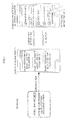
- the technique according to the present embodiment includes a mechanism for enabling a user to confirm or modify a numerical range corresponding to a subjective representation. For example, if a subjective representation "inexpensive” is converted into a numerical range “budget: 0 to 5000 yen” as shown in FIG. 1 , this numerical range is presented to a user so that the numerical range can be changed by the user. Similarly, if a subjective representation "delicious” is converted into a numerical range “evaluation: 2.5 to 5.0,” this numerical range is presented to the user so that the numerical range can be changed by the user. Further, some of the search conditions may be deleted or each search condition may be weighted.
- the technique according to the present embodiment includes a mechanism for enabling a modification of a numerical range for a certain search result to be reflected to another search result. For example, in a search result with an input of a natural sentence, "Show me an inexpensive and delicious sushi restaurant in Ginza,” as a search condition, if a numerical range "budget: 0 to 5000 yen" for a subjective representation "inexpensive" is modified, modified content is also reflected on a search result with an input of a natural sentence, "Show me an inexpensive soba restaurant in Shibuya,” as a search condition.
- technique according to the present embodiment has a mechanism for enabling a user to eliminate a difference between a concept "inexpensive" of the user or a sense “inexpensive” thought by the user and a concept or sense “inexpensive” contained in the search result.
- the technique according to the present embodiment relates to an information search system for converting a subjective representation in an appropriate numerical range to generate a search condition and efficiently performing a search based on the search condition. Further, the technique according to the present embodiment provides a mechanism capable of converting a subjective representation into an appropriate numerical range according to a search condition without using a large database. Further, the technique according to the present embodiment enables a user to modify information for converting a subjective representation into a numerical range and adjust a concept or sense represented by the subjective representation. The technique according to the present embodiment enables a search mechanism based on subjective representations to be personalized.
- information on sushi restaurants corresponding to "budget: 0 to 5000 yen” in Ginza is output as a search result in response to an input of the natural sentence, "Show, me an inexpensive sushi restaurant in Ginza.” That is, information on the sushi restaurants with "inexpensive” sushi in Ginza is actually output.
- the method of reconfiguring a search condition using a database with subjective representations associated with numerical ranges involves the problem as described above.
- the present inventor has devised a mechanism for resolving such a problem and increasing efficiency of a search with a natural sentence containing subjective representations as search conditions. Hereinafter, this mechanism will be described in detail.
- the present embodiment relates to an information search method of converting a subjective representation into an appropriate numerical range to perform a search without using a large database.
- FIG. 4 is an illustrative diagram illustrating the functional configuration of the search Apparatus 100 according to the present embodiment.
- the search apparatus 100 includes a speech recognition unit 101, a natural language analysis unit 102, a language analysis dictionary database 103, a query generation unit 104, and a query generation dictionary database 105. Further, the search apparatus 100 includes a content search unit 106, a content metadata database 107, a digitizing unit 108, a standard relative value database 109, and a personal relative value database 110. Further, the search apparatus 100 includes a search information output unit 111, a search condition modification unit 112, and a relative value reverse calculation unit 113.
- the language analysis dictionary database 103, the query generation dictionary database 105, the content metadata database 107, the standard relative value database 109, and the personal relative value database 110 are assumed to be stored in a storage means that is not shown.
- the language analysis dictionary database 103, the query generation dictionary database 105, the content metadata database 107, the standard relative value database 109, and the personal relative value database 110 may be provided external to the search apparatus 100.
- the search apparatus 100 may have an input means and an output means, which are not shown.
- the input means includes, for example, a keyboard, a mouse, a switch, a touch panel, a touch pad, or a microphone.
- the output means includes, for example, a display or a speaker.
- a method of inputting a search condition through speech will be described by way of example, the method of inputting a search condition may be appropriately changed according to a type of the input means included in the search apparatus 100.
- a method of displaying and outputting a search result or a search condition is assumed for description, the method of displaying and outputting the search result or the search condition may be changed, for example, into speech output according to a type of the output means included in the search apparatus 100. It is understood that such a change is included in a technical scope of the present embodiment.
- speech is input using an input means by the user.
- the user inputs a search condition as if speaking to a friend.
- a search condition For example, the user inputs a natural language query, "Show me an inexpensive sushi restaurant in Ginza," as a search condition through speech.
- a speech signal is output from the input means and input to the speech recognition unit 101.
- the speech recognition unit 101 converts the input speech signal into a text.
- the speech recognition unit 101 inputs the text obtained by converting the speech signal to the natural language analysis unit 102.
- the natural language analysis unit 102 performs natural language analysis such as morphological analysis to convert the input text into information such as parts of speech, an attribute, a phrase, and a dependency relation. For example, the natural language analysis unit 102 divides the natural sentence, "Show me an inexpensive sushi restaurant in Ginza” into phrases “in Ginza/inexpensive/sushi restaurant/show me.” The natural language analysis unit 102 outputs an analysis result such as "Ginza: proper noun, place name” "sushi: noun, food name” ("word representation: parts of speech, attribute"). When such natural language analysis is performed, the natural language analysis unit 102 uses the language analysis dictionary database 103.
- information connecting a word with a concept or information indicating classification or usage of a word is stored in the language analysis dictionary database 103.
- an individual phrase (e.g., one or more words) divided by the natural language analysis unit 102 is referred to as an element.
- the elements extracted from the natural sentence by the natural language analysis unit 102 are input to the query generation unit 104. If the elements constituting the natural sentence are input, the query generation unit 104 generates a query for performing interim search (hereinafter interim query) using elements other than those elements corresponding to a subjective representation to be converted into a numerical range. First, the query generation unit 104 extracts elements of the natural sentence to be contained in the search condition. For example, if restaurant information is searched, the query generation unit 104 extracts elements of the natural sentence suitable for search conditions such as "place,” "genre” and "budget.”
- the query generation unit 104 extracts elements of the natural sentence suitable for the search conditions in consideration of mapping information of "word representation, parts of speech, attribute," case, a dependency relation and the like registered in the query generation dictionary database 105 (e.g., see FIG. 5 ) in advance.
- the query generation unit 104 extracts "Ginza” as an element suitable for the search condition "place,” and extracts “sushi” as an element suitable for the search condition “genre.” Further, the query generation unit 104 extracts "inexpensive” as an element suitable for the search condition “budget.” In this case, the query generation unit 104 confirms that the subjective element "inexpensive” is a subjective representation to be converted into a numerical range.
- the query generation unit 104 combines elements other than subjective representations to generate an interim query. For example, the query generation unit 104 generates an interim query with objective elements "place: Ginza” and "genre: sushi" as search conditions.
- the interim query generated by the query generation unit 104 is input to the content search unit 106. If the interim query is input, the content search unit 106 extracts information suitable for the input interim query from the content metadata database 107 (e.g., see FIG. 10 ). For example, if the interim query with "place: Ginza" and "genre: sushi" is used as search conditions, the content search unit 106 can extract the search result as shown in FIG. 9 .
- the search result extracted by the content search unit 106 using the interim query is input to the digitizing unit 108. Further, a subjective representation to be converted into a numerical range is input from the query generation unit 104 to the digitizing unit 108. If a search result and a subjective representation based on the interim query are input, the digitizing unit 108 converts the input subjective representation into a numerical range based on the input search result. In this case, the digitizing unit 108 converts the subjective representation into the numerical range using the information stored in the standard relative value database 109 or the personal relative value database 110. The numerical range converted from the subjective representation by the digitizing unit 108 is input to the query generation unit 104.
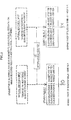
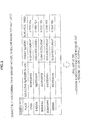
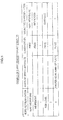
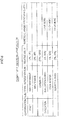
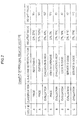
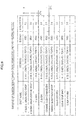
- the standard relative value database 109 is a database with subjective representations associated with relative values. Further, records of the standard relative value database 109 are assumed to be set in advance. For example, a subjective representation "inexpensive" is associated with a relative value, 0% to 30%. Further, as shown in FIG. 7 , the personal relative value database 110 is a database indicating an association relationship between subjective representations different from user to user and relative values. Further, the record of the personal relative value database 110 is added or modified if the relative value is modified by the user.
- the relative value indicates a sense (e.g., sense of reasonable price) that a user desires to represent using a subjective representation.
- a relative value 0% to 30%, corresponding to a subjective representation, "inexpensive” means that the user feels a price range of a lower 0 to 30 percentile to be "inexpensive" in a list of price ranges extracted under certain conditions. That is, the standard relative value database 109 and the personal relative value database 110 quantitatively represent a user's sense of a subjective representation using a relative value. If this relative value is used, a subjective representation can be converted into a numerical range suitable for a user's sense on all such occasions even when a user's sense to the same subjective representation is changed according to a search condition.
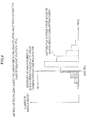
- a process of acquiring a distribution of a numerical characteristic (in the example of FIG. 8 , a price range) from the search result based on the interim query and determining a numerical range suitable for the relative value from the distribution is performed. For example, if a subjective representation "very inexpensive" is contained in the natural sentence, the digitizing unit 108 extracts a relative value (0 to 10%) corresponding to the subjective representation from the standard relative value database 109 (see FIG. 6 ). Next, the digitizing unit 103 acquires the distribution of the price range from the search result based on the interim query. If the distribution of the price range is acquired, the digitizing unit 108 determines price (in the example of FIG.
- the digitizing unit 108 determines the numerical range corresponding to the subjective representation to be from 0 to 3200 yen.
- the digitizing unit 108 determines a numerical range corresponding to the subjective representation using the search result and the relative value based on the interim query.
- the digitizing unit 108 converts the subjective representation into the numerical range. While the example in which the standard relative value database 109 is used is shown herein, the personal relative value database 110 is used if there is a record corresponding to the subjective representation in the personal relative value database 110.
- the query generation unit 104 generates a last query with the input numerical range added to the search condition. That is, the last query contains a numerical range corresponding to the search condition and the subjective representation contained in the interim query.
- the last query generated by the query generation unit 104 is input to the content search unit 106. If the last query is input, the content search unit 106 searches information of the content metadata database 107 based on the input last query. The content search unit 106 inputs the search result and the search condition based on the last query to the search information output unit 111.
- the search information output unit 111 outputs the input search result and search condition. For example, the search information output unit 111 displays the search result based on the last query, as shown in FIG. 1 . If transition to a search condition modification screen is instructed by the user after the search result based on the last query is output, the search information output unit 111 displays the search condition. In particular, the search information output unit 111 displays the numerical range corresponding to the subjective representation. Further, the search information output unit 111 displays a manipulation object for manipulation so that the numerical range corresponding to the subjective representation can be modified, as shown in FIG. 11 .
- FIG. 11 three areas A1, A2 and A3 are displayed.
- a natural sentence, "inexpensive sushi restaurant near Ginza station,” input as a search condition is displayed in the area A1.
- a button Obj1 for performing a re-search based on the modified search condition is displayed in the area A1. If the user presses this button Obj1 after modifying the search condition, a search can performed based on the modified search condition.
- objects Obj2 and Obj3 for modifying a phrase that is an object of the subjective representation, the numerical range corresponding to the subjective representation, and the search condition are displayed in the areas A2 and A3.
- the object Obj2 is a check box for switching validity/invalidity of the search condition. For example, if the object Obj2 in the area A2 is unchecked, the search condition displayed in the area A2 becomes invalid.
- the object Obj3 is a slide bar for modifying the numerical range. For example, if the bar of the object Obj3 in the area A2 is slid, the numerical range "distance" is changed.
- the objects Obj2 and Obj3 may not be the checkbox and the slide bar, respectively.
- modified content is input to the condition modification unit 112.
- the search condition modification unit 112 inputs the modified numerical range to the relative value reverse calculation unit 113.
- the relative value reverse calculation unit 113 acquires, from the digitizing unit 108, a distribution of the numerical range acquired from the search result based on the interim query, and calculates a relative value corresponding to the modified numerical range based on the acquired distribution. For example, if the numerical range of 0 to 3200 yen determined in the example of FIG.
- the relative value reverse calculation unit 113 calculates a percentage of the number of search results in which the price corresponds to 0 to 2500 yen in the distribution, and calculates a relative value based on the percentage.
- the user input to change the upper boundary from 3200 yen to 2500 yen thus changes the proportional threshold associated with "inexpensive" from one relative value (e.g., percentage) to another.
- a lower limit of the numerical range may be modified.
- both the upper limit and the lower limit of the numerical range may be modified.
- the relative value reverse calculation unit 113 calculates a percentage Q1 of the number of search results in which the price corresponds to 0 to 1500 yen in the distribution and a percentage Q2 of the number of search results in which the price corresponds to 0 to 3000 yen in the distribution, and determines relative values Q1 and Q2.
- multiple proportional thresholds may be modified and/or otherwise specified by the user, and the numerical range of the search condition may be arbitrarily broadened or narrowed.
- the relative value reverse calculation unit 113 updates the record of the personal relative value database 110 with the calculated relative value. However, if there is no record of the subjective representation corresponding to the calculated relative value in the personal relative value database 110, the relative value reverse calculation unit 113 adds the record to the personal relative value database 110. In this case, the relative value reverse calculation unit 113 individually identifies users based on user IDs and adds or updates a record, as shown in FIG. 7 . Further, if a re-search is instructed by the user, a last query is generated by the numerical range based on the updated record stored in the personal relative value database 110 again, and information is searched based on the last query.
- the function and operation of the search Apparatus 100 has been described in the flow of a process from search condition input to search result output.
- the search Apparatus 100 converts the subjective representation into the numerical range based on the relative value.
- a search result appropriately considering the analysis of the subjective representation varying with the search condition can be obtained.
- the subjective representation is represented by the relative value, the size of the database is small and information for converting the subjective representation into a numerical range can be realistically personalized.
- the interim query may be generated using the following method. For example, a method in which a numerical range for an interim query for subjective representations is prepared as shown in FIG. 6 and this numerical range for an interim query is contained in a search condition constituting the interim query is considered. If this method is used, the number of search results based on the interim query can be suppressed by excluding search results considered to be unnecessary. As a result, efficiency of the process increases when a distribution is acquired from the search results based on the interim query.
- a method of selecting a subjective representation using the numerical range for an interim query for example, a method of preferentially selecting a subjective representation having a low weight, which will be described, may be considered.
- a frequently modified search condition is considered to be a search condition having relatively high importance for the user.
- an invalidated search condition is considered to be a search condition having relatively low importance for the user.
- a method of assigning a weight according to a modification action of a user when the record of the personal relative value database 110 is added or modified will be introduced.
- the user tries to limit the number of search results by adjusting the search conditions.
- the user is considered to change a search condition having relatively high importance. That is, a search condition changed to reduce the number of search results is considered to be a search condition having relatively high importance.
- a search condition changed to decrease a width of the numerical range is considered to be a search condition having relatively high importance.
- a weight of such a search condition is set to a great value.
- the user tries to increase the number of search results by adjusting search conditions or invalidating some of the search conditions.
- the user is considered to change or invalidate a search condition having relatively low importance.
- the user tries to remove the limitations by broadening the numerical range of the search condition or invalidating the search conditions.
- Such a change of the search condition may be said to be a result of loose compromise of the user for a condition. That is, a search condition changed to increase the number of search results may be said to be those considered to be allowed to be compromised by the user. Thereby, a weight of such a search condition is set to a small value.
- a search condition having a high change frequency is considered to be a search condition noticed by the user.
- a weight of the search condition having a high change frequency is set to a relatively great value or modified to have a great value.
- a search condition having a great change amount is considered to be a search condition having relatively low importance for the user. That is, a search condition that may be greatly changed may be considered to be a search condition not too strongly required by the user.
- a weight of the search condition having a great change amount is set to a relatively small value or modified to have a small value.
- a weight corresponding to each search condition is set according to a method by which the user changes the search condition.
- This weight is considered as a weight of each search condition when search is performed. As a result, a search result greatly considering a search condition that is important for the user can be obtained.
- the weight setting method is not limited thereto, but any setting method may be applied as long as the weight is set to a value reflecting importance thought by the user.
- the method of directly registering the relative value calculated by the relative value reverse calculation unit 113 in the personal relative value database 110 has been introduced.
- the relative value registered in the personal relative value database 110 may be limited. That is, since the analysis of the subjective representation may be considered not to be suddenly greatly changed, an extreme change of the relative value is not reflected in the personal relative value database 110. For example, a given number of logs may be accumulated and an average of the logs may be calculated and registered in the personal relative value database 110.
- a search satisfaction degree is input by a user and a relative value subjected to weighted average based on the input search satisfaction degree may be registered in the personal relative value database 110. For example, if a first changed relative value is 0 to 23% (search satisfaction degree is 50), a second changed relative value is 5 to 23% (search satisfaction degree is 70), and a third changed relative value is 5 to 30% (search satisfaction degree is 80), a weighted average is (0*50 + 5*70+ 5*80)/200-(23*50 + 23*70 + 30*80)/200. This value is registered in the personal relative value database 110, thereby preventing the relative value from being extremely greatly changed.
- the search satisfaction degree may be manually input by the user, or may be automatically calculated based on, for example, a screen retention time.
- a method by which a user manually inputs a search satisfaction degree a method of inputting a search satisfaction degree as a numerical value or a method of causing a check box indicating whether a user is satisfied with an individual search result to be checked and calculating a search satisfaction degree from the check result is considered.
- the screen retention time for example, a time for which a detailed search result has been referenced or a time for which content such as a movie or music has been used is considered. It is possible to a obtain search satisfaction degree by using such a method.
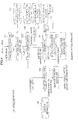
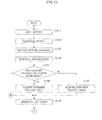
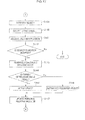
- FIGS. 12 and 13 are flowcharts showing a flow of a process that is performed to realize the information search method according to the present embodiment.
- a search condition is input through speech by the user (S101). If the search condition is input through speech by the user, the search apparatus 100 converts the input speech into text using the function of the speech recognition unit 101 (S102). The search apparatus 100 then analyzes the search condition (e.g., natural language query) converted to the text using the function of the natural language analysis unit 102 (S103). The search apparatus 100 then combines elements of the natural sentence obtained by the analysis in step S103 to generate an interim query using the function of the query generation unit 104 (S104). In this case, the query generation unit 104 combines the elements of the natural sentence other than a subjective representation (e.g., the objective elements) to be converted into a numerical range to generate the interim query.
- a subjective representation e.g., the objective elements
- the search apparatus 100 performs the search based on the interim query using the function of the content search unit 106, and acquires search results based on the interim query.
- the search apparatus 100 then confirms whether a record corresponding to the subjective representation to be converted into the numerical range has been registered in the personal relative value database 110 using the function of the digitizing unit 108 (S105). If the record has been registered in the personal relative value database 110, the process in the search apparatus 100 proceeds to step S106. On the other hand, if the record has not been registered in the personal relative value database 110, the process in the search apparatus 100 proceeds to step S107.
- the search apparatus 100 acquires a relative value corresponding to the subjective representation from the personal relative value database 110 (S106).
- the search apparatus 100 acquires a relative value corresponding to the subjective representation from the standard relative value database 109 (S107).
- the search apparatus 100 having acquired the relative value acquires a distribution of the numerical characteristic from the result based on the interim query using the function of the digitizing unit 108, and determines a numerical range corresponding to the relative value based on the distribution (e.g., by applying one or more proportional thresholds based on the relative value to the distribution).
- the search apparatus 100 generates a last query with the determined numerical range added to the search condition, using the function of the query generation unit 104 (S108), and the process proceeds to step A.
- the search apparatus 100 in which the process has proceeded to step A performs a search based on the last query generated in step S108 using the function of the content search unit 106 (S109).
- the search apparatus 100 then outputs the search result based on the last query using the function of the search information output unit 111 (S110).
- the search apparatus 100 displays the search conditions contained in the last query and an interface for modifying the search conditions using the function of the search information output unit 111, and receives user input such as a user manipulation (S111).
- the search apparatus 100 judges whether the search condition has been modified by the user (S112).
- step S113 the process in the search apparatus 100 proceeds to step S113.
- the search apparatus 100 calculates a relative value from the modified numerical range using the function of the relative value reverse calculation unit 113 (S113).
- the relative value reverse calculation unit 113 calculates the relative value using the distribution acquired from the search result based on the interim query.
- the search apparatus 100 updates the personal relative value database 110 with the relative value calculated in step S113 using the function of the relative value reverse calculation unit 113 (S114). However, if there is no corresponding record in the personal relative value database 110, the relative value reverse calculation unit 113 adds a record of the subjective representation corresponding to the calculated relative value to the personal relative value database 110.
- step S114 After the search apparatus 100 ends the process of step S114, the process proceeds to step B. That is, the process in the search apparatus 100 returns to step S108 shown in FIG. 12 , and performs the process from step S108 again.
- the search apparatus 100 iteratively performs the process of steps S108 to S114 until the search condition modification by the user is completed, and ends the series cf processes after the search condition modification ends. Further, if a plurality of subjective elements are contained in a natural sentence input as a search condition, the from step S104 is performed on each subjective representation.
- the information search method according to the present embodiment has been described above.
- the present variant relates to a method of reflecting a fine condition of a user on a search result.
- FIG. 14 is an illustrative diagram illustrating a functional configuration of the search apparatus 130 according to the present variant. Components having substantially the same functions as those of the search apparatus 100 are assigned the same reference numerals and a detailed description thereof will be omitted.
- the search apparatus 130 includes a speech recognition unit 101, a natural language analysis unit 102, a language analysis dictionary database 103, a query generation unit 104, and a query generation dictionary database 105. Further, the search apparatus 130 includes a content search unit 106, a content metadata database 107, a digitizing unit 13, a standard relative value database 109, and a personal relative value database 110. Further, the search apparatus 130 includes a search information output unit 111, a search condition modification unit 112, a relative value reverse calculation unit 113, and a semantic concept dictionary database 132.
- a difference with the search apparatus 100 is in a function of the digitizing unit 131 and presence of the semantic concept dictionary database 132. Only configurations of the digitizing unit 131 and the semantic concept dictionary database 132 will be described in detail.
- an object of the present variant is to reflect a fine condition of a user on a search result. For example, a certain user is assumed to consider that "taste is important for sushi while a low price is important for a pub.” The user is assumed to have input a natural sentence, "Show me an inexpensive and delicious sushi restaurant in Ginza," as a search condition and obtained a normal search result.
- search condition is modified based on the search result
- relative values corresponding to subjective representations "inexpensive” and “delicious” may be considered to be modified based on a condition for "sushi restaurant.” Then, if a natural sentence, "Show me an inexpensive and delicious pub in Ginza" is input and a search is performed, the search is performed based on the relative value reflecting a condition for "sushi restaurant.”
- a search result suitable for the analysis of a subjective representation of a user may not be obtained.
- the search condition is modified, an appropriate search result may be obtained, but modifying the search condition one by one is complicated.
- a method of reflecting such a condition of the user on the search result by clustering an object of a subjective representation(an element of the natural sentence) is proposed. Components for realizing this method are the digitizing unit 131 and the semantic concept dictionary database 132.
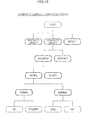
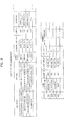
- the digitizing unit 131 clusters the object using the semantic concept dictionary database 132 having a structure as shown in FIG. 15 (a conceptual diagram of a data structure) and recognizes a difference of a concept (the analysis of the subjective representation) according to objects.
- the digitizing unit 131 uses dependency analysis to recognize an object from the natural sentence. For example, for a natural sentence, "Show me an inexpensive and delicious sushi restaurant in Ginza," the digitizing unit 131 recognizes that a "sushi restaurant" is the object.
- the digitizing unit 131 stores a combination of the object, a subjective representation, and a relative value in the personal relative value database 110. In this example, a record having a combination of sushi restaurant, inexpensive, and 0 to 35% is stored in the personal relative value database 110.
- the digitizing unit 131 converts the subjective representation into a numerical range using a relative value "0 to 35%" corresponding to the subjective representation "inexpensive” by referencing the record having a combination of sushi restaurant, inexpensive, and 0 to 35%, which is stored in the personal relative value database 110. Then, if a relative value is greatly modified by the user (e.g., if the relative value is modified to 0 to 20%), the digitizing unit 131 stores a record having a combination of pub, inexpensive, and 0 to 20% in the personal relative value database 110.
- a record about "sushi restaurant" stored in the personal relative value database 110 is updated using a word of a parent node having both the sushi restaurant and the pub as child nodes using a tree structure of the semantic concept dictionary database 132.
- the digitizing unit 131 updates an original record with the record having a combination of restaurant, inexpensive, and 0 to 33.5% using a word, "restaurant,” corresponding to the parent node of the "sushi restaurant” and the "pub.”
- a numerical value 33.5% is an average of 35% and 32%.
- the digitizing unit 131 uses a record of "pub, inexpensive, and 0 to 20%.” This is because “pub” and “bar” are judged to be nearer than "sushi restaurant” and “bar” based on the semantic concept dictionary database 132. This judgment is made based on a distance to a node (parent node) common to two words as subjects. In the case of this example, if “pub” and “bar” are merged by an object”drinking estabtishment,” they may be judged to be nearer than “sushi restaurant” and "bar.”
- the digitizing unit 131 clusters an object having an influence on the analysis of the subjective representation or manages the relative value in object or cluster units using the semantic concept dictionary database 132.
- This configuration can realize both an adaptive search not dependent on the object and a specific search dependent on the object, thereby realizing a search reflecting a condition of the user.
- a functional configuration of the search apparatus 130 according to the first variant of the present embodiment has been described above.
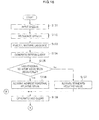
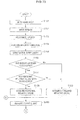
- FIGS. 16 and 17 are flowcharts showing flows of a process executed to realize the information search method according to the first variant of the present embodiment.
- a search condition is input through speech by the user, as shown in FIG. 16 (S131). If the search condition is input through speech by the user, the search apparatus 130 converts the input speech into text using the function of the speech recognition unit 101 (S132). The search apparatus 130 then analyzes the search condition (natural sentence) converted into the text using the function of the natural language analysis unit 102 (S133). The search apparatus 130 then combines elements of the natural sentence obtained by the analysis in step S133 to generate an interim query using the function of the query generation unit 104 (S134). In this case, the query generation unit 104 combines the elements of the natural sentence other than the subjective representation to be converted into the numerical range to
- the search apparatus 130 performs the search based on the interim query and acquires the search result based on the interim query using the function of the content search unit 106.
- the search apparatus 130 then confirms whether a record corresponding to the subjective representation to be converted into the numerical range has been registered in the personal relative value database 110 using the function of the digitizing unit 131 (S135). If the record has been registered in the personal relative value database 110, the process in the search apparatus 130 proceeds to step S136, On the other hand, if the record has not been registered in the personal relative value database 110, the process in the search apparatus 130 proceeds to step S137.
- step S136 the search apparatus 130 acquires, from the personal relative value database 110, a relative value recorded in a record containing a word closest to an object contained in the search condition by referencing the semantic concept dictionary database 132 using the function of the digitizing unit 131 (S136).
- step S137 the search apparatus 130 acquires a relative value corresponding to the subjective representation from the standard relative value database 109 (S137).
- the search apparatus 130 having acquired the relative value acquires a distribution of the numerical range from the search result based on the interim query using the function of the digitizing unit 131, and determines a numerical range corresponding to the relative value based on the distribution.
- the search apparatus 130 generates a last query with the determined numerical range added to the search condition using the function of the query generation unit 104 (S138), and the process proceeds to step A.
- the search apparatus 130 in which the process has proceeded to step A performs a search based on the last query generated in step S138 using the function of the content search unit 106 (S139).
- the search apparatus 130 outputs the search result using the function of the search information output unit 111, based on the last query (S140).
- the search apparatus 130 displays search conditions contained in the last query and an interface for modifying the search conditions using the function of the search information output unit 111, and receives a user manipulation (S141).
- the search apparatus 130 judges whether the search condition has been modified by the user (S142).
- step S143 the process in the search apparatus 130 proceeds to step S143.
- the search apparatus 130 calculates a relative value from the modified numerical range using the function of the relative value reverse calculation unit 113 (S143).
- the relative value reverse calculation unit 113 calculates the relative value using the distribution acquired from the search result based on the interim query.
- the search apparatus 130 judges whether a modification width of the relative value is smaller than a given value using the function of the digitizing unit 131 (S144). If the modification width of the relative value is smaller than the given value, the process in the search apparatus 130 proceeds to step S145. On the other hand, if the modification width of the relative value is greater than the given value, the process in the search apparatus 130 proceeds to step S146.
- step S145 the search apparatus 130 generates a record with a merged object by referencing the semantic concept dictionary database 132 using the function of the digitizing unit 131 (S145).
- step S146 the search apparatus 130 generates a record for separately registering the object using the function of the digitizing unit 131 (S146).
- the search apparatus 130 in which the process has proceeded to step S147 updates the personal relative value database 110 with the record generated in step S145 or S146 using the function of the digitizing unit 131 (S147).
- step S147 proceeds to step B. That is, the process in the search apparatus 130 returns to step S138 shown in FIG. 16 and the search apparatus 130 performs the process from step S138 again.
- the search Apparatus 130 iteratively performs the process of steps S138 to S147 until the search condition modification by the user is completed, and ends the series of processes after the search condition modification ends . If a plurality of subjective representations are contained in a natural sentence input as a search condition, the process from step S134 is performed on each subjective representation.
- the present variant relates to a method of automatically adjusting a search condition for a subjective representation based on a weight of the search condition if the number of search results is too great or small.
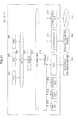
- FIG. 18 is an illustrative diagram illustrating the functional configuration of the search apparatus 150 according to the present variant. Components having substantially the same function as those of the search apparatus 100 are assigned the same reference numerals and a detailed description thereof will be omitted.
- the search apparatus 150 includes a speech recognition unit 101, a natural language analysis unit 102, a language analysis dictionary database 103, a query generation unit 104, and a query generation dictionary database 105.
- the search apparatus 150 further includes a content search unit 106, a content metadata database 107, a digitizing unit 151, a standard relative value database 109, and a personal relative value database 110.
- the search apparatus 150 further includes a search information output unit 111, a search condition modification unit 112, and a relative value reverse calculation unit 113.
- a difference with the search apparatus 100 is in the digitizing unit 151. Only a configuration of the digitizing unit 151will be described in detail.
- an object of the present variant is to determine a search condition to be changed and a change amount in consideration of a weight of a concept held by a user (a weight assigned to each subjective representation; see FIG 7 ) when the number of search results is too great or small. For example, if a natural sentence, "a delicious sushi restaurant for 2000 yen or less in Ginza," is input as a search condition, since a severe restriction of 2000 yen or less is contained, the sufficient number of search results may not be obtained.
- the present variant provides a mechanism for automatically performing such a re-examination of the search conditions
- the weight for the subjective representation is stored in the personal relative value database 110, as shown in FIG. 7 .
- the digitizing unit 151 adjusts a relative value corresponding to the subjective representation having a small weight to be great or invalidates a search condition corresponding to the subjective representation by referencing the personal relative value database 110.
- a user severely considering a place and roughly considering a budget is considered. Further, the user is assumed to set a weight for the "place” to 160 and a weight for the "budget” to 75. If search results cannot be sufficiently obtained for an input of a certain natural sentence, the user may change either a numerical range of the "place” or a numerical range of the "budget.”
- the digitizing unit 151 updates the relative value, for example, based on the following algorithm.
- FIGS. 19 and 20 are flowcharts showing a flow of a process in an information search method according to the second variant of the present embodiment.
- an identifier (user ID) for identifying a user is input, as shown in FIG. 19 (S151).
- a search condition is input through speech by the (S152). If the search condition is input through speech by the user, the search apparatus 150 converts the input speech into text using the function of the speech recognition unit 101 (S153). The search apparatus 150 then analyzes the search condition (natural sentence) converted into the text using the function of the natural language analysis unit 102 (S154). The search apparatus 150 then combines elements of the natural sentence obtained by the analysis of step S154 to generate an interim query using the function of the query generation unit 104 (S155). In this case, the query generation unit 104 combines the elements of the natural sentence other than a subjective representation to be converted into a numerical range to generate an interim query.
- the search apparatus 150 performs a search based on the interim query to acquire a search result based on the interim query using the function of the content search unit 106.
- the search apparatus 150 then confirms whether the identifier has been registered in the personal relative value database 110 using the function of the digitizing unit 151 (S156). If the identifier has been registered, the process in the search apparatus 150 proceeds to step S157. On the other hand, if the identifier has not been registered, the process in the search apparatus 150 proceeds to step S159.
- step S157 the search apparatus 150 confirms whether a record corresponding to a subjective representation to be converted into a numerical range has been registered in the personal relative value database 110 using the function of the digitizing unit 151 (S157). If the record has been registered in the personal relative value database 110, the process in the search apparatus 150 proceeds to step S158. On the other hand, if the record has not been registered in the personal relative value database 110, the process in the search apparatus 150 proceeds to step S159.
- the search apparatus 150 acquires the relative value from the personal relative value database 110 using the function of the digitizing unit 151 (S158). Meanwhile, if the process proceeds to step S159, the search apparatus 150 acquires a relative value corresponding to the subjective representation from the standard relative value database 109 using the function of the digitizing unit 151 (S159). The search apparatus 150 having acquired the relative value acquires a distribution of the numerical range from the search result based on the interim query and determines a numerical range corresponding to the relative value based on the distribution using the function of the digitizing unit 151. The search apparatus 150 generates a last query with the determined numerical range added to a search condition using the function of the query generation unit 104 (S160), and the process proceeds to step A.
- the search apparatus 150 in which the process has proceeded to step A performs a search based on the last query generated in step S160 using the function of the content search unit 106 (S161).
- the search apparatus 150 judges whether the number of search results is suitable using the function of the digitizing unit 151 (S162). If the number of search results is the process in the search apparatus 150 proceeds to step S163. On the other hand, if the number of search results is not suitable, the process in the search apparatus 150 proceeds to step S164.
- step S163 the search apparatus 150 scores the search result using the function of the digitizing unit 151 (S163), and the process proceeds to step S165. Meanwhile, if the process proceeds to step S164, the search apparatus 150 adjusts the relative value based on the weight and updates the personal relative value database 110 using the function of the digitizing unit 151 (S164).
- step B the process in the search apparatus 150 returns to step S160 shown in FIG. 19 and the search apparatus 150 performs the process from step S160 again.
- the search apparatus 150 in which the process has proceeded to step S165 outputs the search result based on the last query using the function of the search information output unit 111 (S165). Further, the search apparatus 150 displays search conditions contained in the last query and an interface for modifying the search conditions to receive a user manipulation using the function of the search information output unit 111 (S166). The search apparatus 150 then judges whether a search condition has been modified by the user (S167).
- step S163 the process in the search apparatus 150 proceeds to step S163.
- the search apparatus 150 ends the series of processes. If the process proceeds to step S168, the search apparatus 150 calculates a relative value from the modified numerical) range using the function of the relative value reverse calculation unit 113 (S168). In this case, the relative value reverse calculation unit 113 calculates the relative value based on the interim query using the distribution acquired from the search result. The search apparatus 150 then updates the personal relative value database 110 with the relative value calculated in step S168 using the function of the relative value reverse calculation unit 113 (S169).
- step S169 proceeds to step B. That is, the process in the search apparatus 150 returns to the step S160 shown in FIG. 19 and performs the process from step S160 again.
- the search apparatus 150 iteratively performs the process of steps S160 to S169 until the search condition modification by the user is completed and ends the series of processes after the search condition modification ends, Further, if a plurality of subjective representations are contained in a natural sentence input as a search condition, the process from step S155 is performed on each subjective representation,
- a subjective representation in a search condition input by a user may be ambiguous, and the search apparatus may perform processing to disambiguate the intended search condition.
- a user's subjective representation "cheap” may mean either "inexpensive” or "low quality.”
- the search apparatus may use a thesaurus or other database of word meanings or associations to determine that the user's subjective representation is ambiguous.
- the search apparatus may prompt the user to disambiguate the search condition.
- the search apparatus may present the user with a number of options (e.g., "inexpensive” and "low quality"), and allow the user to select the one that best corresponds to the intended meaning of the subjective representation.
- each structural element of the search apparatus 100, 130 and 150 described above can be performed by using, for example, the hardware configuration of the information processing apparatus shown in FIG. 21 . That is, the function of each structural element can be realized by controlling the hardware shown in FIG. 21 using a computer program. Additionally, the mode of this hardware is arbitrary, and may be a personal computer, a mobile information terminal such as a mobile phone, a PHS or a PDA, a game machine, or various types of information appliances. Moreover, the PHS is an abbreviation for Personal Handy-phone System. Also, the PDA is an abbreviation for Personal Digital Assistant.
- this hardware mainly includes at least one processor such as a CPU 902, a ROM 904, a RAM 906, a host bus 908, and a bridge 910. Furthermore, this hardware includes an external bus 912, an interface 914, an input unit 916, an output unit 918, a storage unit 920, a drive 922, a connection port 924, and a communication unit 926.
- the CPU is an abbreviation for Central Processing Unit.
- the ROM is an abbreviation for Read Only Memory.
- the RAM is an abbreviation for Random Access Memory.
- the CPU 902 functions as an arithmetic processing unit or a control unit, for example, and controls entire operation or a part of the operation of each structural element based on various programs recorded on the ROM 904, the RAM 906, the storage unit 920, or a removal recording medium 928.
- the ROM 904 is means for storing, for example, a program to be loaded on the CPU 902 or data or the like used in an arithmetic operation.
- the RAM 906 temporarily or perpetually stores, for example, a program to be loaded on the CPU 902 or various parameters or the like arbitrarily changed in execution of the program.
- the host bus 908 capable of performing high-speed data transmission.
- the host bus 908 is connected through the bridge 910 to the external bus 912 whose data transmission speed is relatively low, for example.
- the input unit 916 is, for example, a mouse, a keyboard, a touch panel, a button, a switch, or a lever.
- the input unit 916 may be a remote control that can transmit a control signal by using an infrared ray or other radio waves.
- the output unit 918 is, for example, a display device such as a CRT, an LCD, a PDP or an ELD, an audio output device such as a speaker or headphones, a printer, a mobile phone, or a facsimile, that can visually or auditorily notify a user of acquired information.
- a display device such as a CRT, an LCD, a PDP or an ELD
- an audio output device such as a speaker or headphones, a printer, a mobile phone, or a facsimile, that can visually or auditorily notify a user of acquired information.
- the CRT is an abbreviation for Cathode Ray Tube.
- the LCD is an abbreviation for Liquid Crystal Display.
- the PDP is an abbreviation for Plasma Display Panel
- the ELD is an abbreviation for Electro-Luminescence Display.
- the storage unit 920 is a device for storing various data.
- the storage unit 920 is, for example, a magnetic storage device such as a hard disk drive (HDD), a semiconductor storage device, an optical storage device, or a magneto-optical storage device.
- the HDD is an abbreviation for Hard Disk Drive.
- the drive 922 is a device that reads information recorded on the removal recording medium 928 such as a magnetic disk, an optical disk, a magneto-optical disk, or a semiconductor memory, or writes information in the removal recording medium 928.
- the removal recording medium 928 is, for example, a DVD medium, a Blu-ray medium, an HD-DVD medium, various types of semiconductor storage media, or the like.
- the removal recording medium 928 may be, for example, an electronic device or an IC card on which a non-contact IC chip is mounted.
- the IC is an abbreviation for Integrated Circuit.
- the connection port 924 is a port such as an USB port, an IEEE1394 port, a SCSI, an RS-232C port, or a port for connecting an externally connected device 930 such as an optical audio terminal.
- the externally connected device 930 is, for example, a printer, a mobile music player, a digital camera, a digital video camera, or an IC recorder.
- the USB is an abbreviation for Universal Serial Bus.
- the SCSI is an abbreviation for Small Computer System interface.
- the communication unit 926 is a communication device to be connected to a network 932, and is, for example, a communication card for a wired or wireless LAN, Bluetooth (registered trademark), or WUSB, an optical communication router, an ADSL router, or a modem for various types of communication.
- the network 932 connected to the communication unit 926 is configured from a wire-connected or wirelessly connected network, and is the Internet, a home-use LAN, infrared communication, visible light communication, broadcasting, or satellite communication, for example.
- the LAN is an abbreviation for Local Area Network.
- the WUSB is an abbreviation for Wireless USB.
- the ADSL is an abbreviation for Asymmetric Digital Subscriber Line.
- Some embodiments may comprise a computer readable storage medium (or multiple computer readable media) (e.g., a computer memory, one or more floppy discs, compact discs (CD), optical discs, digital video disks (DVD), magnetic tapes, flash memories, circuit configurations in Field Programmable Gate Arrays or other semiconductor devices, or other tangible computer storage medium) encoded with one or more programs that, when executed on one or more computers or other processors, perform methods that implement the various embodiments discussed above.
- a computer readable storage medium may retain information for a sufficient time to provide computer-executable instructions in a non-transitory form.
- Such a computer readable storage medium or media can be transportable, such that the program or programs stored thereon can be loaded onto one or more different computers or other processors to implement various aspects of the present invention as discussed above.
- the term "computer-readabte storage medium” encompasses only a computer-readable medium that can be considered to be a manufacture (i.e., article of manufacture) or a machine.
- the invention may be embodied as a computer readable medium other than a computer-readable storage medium, such as a propagating signal.
- content of the technique according to the embodiment of the present invention will be simply summarized.
- the content of the technique described herein may be applied, for example, to several information processing apparatuses such as a PC, a portable telephone, a portable game machine, a personal digital assistant, an information appliance, and a car navigation system.
- the information processing apparatus includes the following interim search unit, the distribution acquisition unit, the numerical range selection unit, and the present search unit. If a natural sentence containing a subjective representation to be converted into a numerical range is input, the interim search unit performs a search using elements other than the subjective representation among the elements constituting the natural sentence as search conditions. For example, if a natural sentence, "Show me an inexpensive sushi restaurant in Ginza,” is input, a subjective representation to be converted into a numerical range is an element, "inexpensive,” indicating a price range.
- the interim search unit provisionally searches information using the elements of the natural sentence other than this subjective representation. Using this interim search, information indicating a situation to be a prerequisite by the user can be collected. For example, information on "a sushi restaurant in Ginza" can be collected. Using this information, for example, market outlook Of user be predicted.
- the distribution acquisition unit acquires a distribution of a numerical value corresponding to the subjective representation with respect to the search result of the interim search unit. Based on the above example, this distribution acquisition unit acquires the distribution of the price range from information collected about "a sushi restaurant in Ginza.” If the distribution of the price range can be acquired, "expensive sushi restaurant” and “inexpensive sushi restaurant” among “sushi restaurants in Ginza” can be identified. For example, a “sushi restaurant” corresponding to X percent in order from low price may be judged to be “inexpensive sushi restaurant with.” However, X is a value to be determined by the user in advance. Further, if "inexpensive sushi restaurant” can be identified, a price range or "inexpensive sushi restaurant” can be conversely obtained.
- the numerical range selection unit selects a numerical range from the distribution of the numerical value acquired by the distribution acquisition unit based on the relative value associated with the subjective representation in advance.
- This relative value is a numerical value corresponding to X.
- the numerical range indicated by the subjective representation can be selected using the distribution of the numerical value and the relative value.
- this numerical range selection unit may select a price range (e.g., 0 to 5000 yen) corresponding to a "sushi restaurant” corresponding to upper X percent with a low price range among "sushi restaurants in Ginza.”
- the price range selected herein is one reflecting the market price of a "sushi restaurant in Ginza” and satisfies a criterion of "inexpensive"(X percent) thought by the user.
- the present search unit performs a search using elements other than the subjective representation among elements constituting a natural sentence, and the numerical range selected by the numerical range selection unit as search conditions. Since the subjective representation is automatically converted into the numerical range as described above, a search result suitable for the numerical range can be correctly obtained.
- a price range suitable for market price of a "sushi restaurant in Ginza” is used as a search condition and an appropriate search result desired by the user is obtained. If the search condition is changed into "an inexpensive sushi restaurant in Shibuya,” a price range suitable for market price of a "sushi restaurant in Shibuya” is used as a search condition. Thus, if the information processing apparatus is used, a search condition having reflected a situation assumed as a prerequisite by the user is automatically generated and an appropriate search result is obtained based on the search condition.
- the information processing apparatus is capable of appropriately resolving such a problem. Further, the information processing apparatus can adaptively cope with a difference between any elements that are objects of the subjective representation, as well as a place difference.
- a price range having reflected market price of "sushi restaurant in Ginza” is a search condition for an input "an inexpensive sushi restaurant in Ginza”
- a price range having reflected market price of "steakhouse in Ginza” is a search condition for an input "inexpensive steakhouse in Ginza.”
- the subjective representation can be substituted with an appropriate numerical range in a situation determined, by elements of a natural sentence other than subjective representations.
- the subjective representation can be substituted with an appropriate numerical range in a situation determined, by elements of a natural sentence other than subjective representations.
- the query generation unit 104 and the content search unit 106 are examples of the interim search unit and the present search unit.
- the digitizing units 108, 131 and 151 are examples of the distribution acquisition unit and the numerical range selection unit.
- the search information output unit 111 is an example of the output unit.
- the personal relative value database 110 is an example of the relative value holding unit and the element-specific relative value holding unit.
- the speech recognition unit 101 is an example of the speech/text conversion unit.
- the query generation unit 104 is an example of the subjective representation extraction unit.
- the digitizing unit 131 is an example of the clustering unit.
- the digitizing unit 151 is an example of the weight setting unit and the relative value adjustment unit.
- the present technology can adopt the following configurations.
Landscapes
- Engineering & Computer Science (AREA)
- Physics & Mathematics (AREA)
- Theoretical Computer Science (AREA)
- Databases & Information Systems (AREA)
- Mathematical Physics (AREA)
- Computational Linguistics (AREA)
- Data Mining & Analysis (AREA)
- General Engineering & Computer Science (AREA)
- General Physics & Mathematics (AREA)
- Artificial Intelligence (AREA)
- Information Retrieval, Db Structures And Fs Structures Therefor (AREA)
Applications Claiming Priority (1)
| Application Number | Priority Date | Filing Date | Title |
|---|---|---|---|
| JP2011003005A JP5630275B2 (ja) | 2011-01-11 | 2011-01-11 | 検索装置、検索方法、及びプログラム |
Publications (2)
| Publication Number | Publication Date |
|---|---|
| EP2479687A2 true EP2479687A2 (fr) | 2012-07-25 |
| EP2479687A3 EP2479687A3 (fr) | 2015-03-04 |
Family
ID=45557853
Family Applications (1)
| Application Number | Title | Priority Date | Filing Date |
|---|---|---|---|
| EP12150146.4A Withdrawn EP2479687A3 (fr) | 2011-01-11 | 2012-01-04 | Appareil de recherche, procédé de recherche et logiciel |
Country Status (4)
| Country | Link |
|---|---|
| US (1) | US8595210B2 (fr) |
| EP (1) | EP2479687A3 (fr) |
| JP (1) | JP5630275B2 (fr) |
| CN (1) | CN102622399A (fr) |
Cited By (2)
| Publication number | Priority date | Publication date | Assignee | Title |
|---|---|---|---|---|
| WO2018220387A1 (fr) * | 2017-06-01 | 2018-12-06 | Upshoot Limited | Procédé et système de recherche améliorés |
| JP7697741B1 (ja) * | 2024-09-19 | 2025-06-24 | 株式会社テクトム | 情報処理装置、情報処理方法および情報処理プログラム |
Families Citing this family (21)
| Publication number | Priority date | Publication date | Assignee | Title |
|---|---|---|---|---|
| KR101361190B1 (ko) | 2007-01-22 | 2014-02-21 | 삼성전자주식회사 | 무선 메쉬 네트워크에서 채널을 할당하기 위한 방법 및이를 이용한 통신 디바이스 |
| CN103000173B (zh) * | 2012-12-11 | 2015-06-17 | 优视科技有限公司 | 一种语音交互方法及装置 |
| US10453103B2 (en) | 2013-03-15 | 2019-10-22 | Home Depot Product Authority, Llc | Price estimation system |
| US10157175B2 (en) * | 2013-03-15 | 2018-12-18 | International Business Machines Corporation | Business intelligence data models with concept identification using language-specific clues |
| CN103207917B (zh) * | 2013-04-25 | 2017-03-08 | 百度在线网络技术(北京)有限公司 | 标注多媒体内容的方法、生成推荐内容的方法及系统 |
| US10698924B2 (en) | 2014-05-22 | 2020-06-30 | International Business Machines Corporation | Generating partitioned hierarchical groups based on data sets for business intelligence data models |
| US9798801B2 (en) * | 2014-07-16 | 2017-10-24 | Microsoft Technology Licensing, Llc | Observation-based query interpretation model modification |
| US9087090B1 (en) | 2014-07-31 | 2015-07-21 | Splunk Inc. | Facilitating execution of conceptual queries containing qualitative search terms |
| US9129041B1 (en) | 2014-07-31 | 2015-09-08 | Splunk Inc. | Technique for updating a context that facilitates evaluating qualitative search terms |
| US10002179B2 (en) | 2015-01-30 | 2018-06-19 | International Business Machines Corporation | Detection and creation of appropriate row concept during automated model generation |
| CN106294367A (zh) * | 2015-05-15 | 2017-01-04 | 常州明石晶电科技有限公司 | 搜索装置及其搜索方法 |
| US9984116B2 (en) | 2015-08-28 | 2018-05-29 | International Business Machines Corporation | Automated management of natural language queries in enterprise business intelligence analytics |
| CN108701430B (zh) * | 2016-03-28 | 2020-12-01 | Abb瑞士股份有限公司 | 确定用于焊缝点校准的搜索参数的方法、系统和装置 |
| CN106372191A (zh) * | 2016-08-31 | 2017-02-01 | 广东华邦云计算股份有限公司 | 一种数据搜索方法和装置 |
| US10296659B2 (en) * | 2016-09-26 | 2019-05-21 | International Business Machines Corporation | Search query intent |
| JP6649232B2 (ja) * | 2016-11-18 | 2020-02-19 | 株式会社東芝 | 検索装置、表示装置および検索方法 |
| WO2019160133A1 (fr) * | 2018-02-19 | 2019-08-22 | 日本電信電話株式会社 | Dispositif, procédé et programme de gestion d'informations |
| US11416481B2 (en) * | 2018-05-02 | 2022-08-16 | Sap Se | Search query generation using branching process for database queries |
| CN110232137B (zh) * | 2019-05-10 | 2021-09-03 | 北京搜狗科技发展有限公司 | 一种数据处理方法、装置和电子设备 |
| CN110347910A (zh) * | 2019-05-28 | 2019-10-18 | 成都美美臣科技有限公司 | 一个电子商务网站搜索结果过滤规则 |
| CN113836166B (zh) * | 2020-06-24 | 2025-08-22 | 华为云计算技术有限公司 | 一种数据库的查询方法及装置 |
Citations (2)
| Publication number | Priority date | Publication date | Assignee | Title |
|---|---|---|---|---|
| JP2002024212A (ja) | 2000-07-12 | 2002-01-25 | Mitsubishi Electric Corp | 音声対話システム |
| JP2011003005A (ja) | 2009-06-18 | 2011-01-06 | Canon Inc | 印刷システム、印刷システムの制御方法、及びプログラム |
Family Cites Families (21)
| Publication number | Priority date | Publication date | Assignee | Title |
|---|---|---|---|---|
| JPH0573317A (ja) * | 1991-09-13 | 1993-03-26 | Nippon Telegr & Teleph Corp <Ntt> | 相対的表現の量の度合い判断処理方法 |
| JPH05101107A (ja) * | 1991-10-07 | 1993-04-23 | Hitachi Ltd | 適合率を用いた絞り込みデータ検索装置及び方法 |
| US7216116B1 (en) * | 1996-05-06 | 2007-05-08 | Spotfire Ab | Data analysis system with automated query and visualization environment setup |
| JPH10254891A (ja) * | 1997-03-11 | 1998-09-25 | Sharp Corp | 情報検索装置 |
| US6578022B1 (en) * | 2000-04-18 | 2003-06-10 | Icplanet Corporation | Interactive intelligent searching with executable suggestions |
| US20030217052A1 (en) * | 2000-08-24 | 2003-11-20 | Celebros Ltd. | Search engine method and apparatus |
| US7536413B1 (en) * | 2001-05-07 | 2009-05-19 | Ixreveal, Inc. | Concept-based categorization of unstructured objects |
| US7194483B1 (en) * | 2001-05-07 | 2007-03-20 | Intelligenxia, Inc. | Method, system, and computer program product for concept-based multi-dimensional analysis of unstructured information |
| US7133864B2 (en) * | 2001-08-23 | 2006-11-07 | Syngenta Participations Ag | System and method for accessing biological data |
| JP4326174B2 (ja) * | 2001-10-04 | 2009-09-02 | ソニー株式会社 | 情報処理システム、情報処理装置および方法、記録媒体、並びにプログラム |
| JP2003271630A (ja) * | 2002-03-15 | 2003-09-26 | Yamaha Corp | 情報検索方法、プログラム及び装置 |
| JP2003281170A (ja) * | 2002-03-20 | 2003-10-03 | Fujitsu Ltd | 情報検索方法、情報検索プログラムおよびその装置 |
| US7246113B2 (en) * | 2002-10-02 | 2007-07-17 | General Electric Company | Systems and methods for selecting a material that best matches a desired set of properties |
| CA2545238A1 (fr) * | 2003-11-13 | 2005-06-02 | Knowledgeworks, Llc | Systeme permettant d'obtenir, de gerer et de fournir un contenu recupereet systeme connexe |
| CN101438279B (zh) * | 2004-10-28 | 2012-12-12 | 雅虎公司 | 包括信任网络的集成有用户判断的搜索系统和方法 |
| US8832055B1 (en) * | 2005-06-16 | 2014-09-09 | Gere Dev. Applications, LLC | Auto-refinement of search results based on monitored search activities of users |
| US7844599B2 (en) * | 2005-08-24 | 2010-11-30 | Yahoo! Inc. | Biasing queries to determine suggested queries |
| US20070106664A1 (en) * | 2005-11-04 | 2007-05-10 | Minfo, Inc. | Input/query methods and apparatuses |
| US7831685B2 (en) * | 2005-12-14 | 2010-11-09 | Microsoft Corporation | Automatic detection of online commercial intention |
| US8886637B2 (en) * | 2008-05-12 | 2014-11-11 | Enpulz, L.L.C. | Web browser accessible search engine which adapts based on user interaction |
| JP5531443B2 (ja) * | 2009-04-08 | 2014-06-25 | ソニー株式会社 | 情報処理装置および方法、並びにプログラム |
-
2011
- 2011-01-11 JP JP2011003005A patent/JP5630275B2/ja not_active Expired - Fee Related
-
2012
- 2012-01-04 CN CN2012100045785A patent/CN102622399A/zh active Pending
- 2012-01-04 EP EP12150146.4A patent/EP2479687A3/fr not_active Withdrawn
- 2012-01-04 US US13/343,210 patent/US8595210B2/en not_active Expired - Fee Related
Patent Citations (2)
| Publication number | Priority date | Publication date | Assignee | Title |
|---|---|---|---|---|
| JP2002024212A (ja) | 2000-07-12 | 2002-01-25 | Mitsubishi Electric Corp | 音声対話システム |
| JP2011003005A (ja) | 2009-06-18 | 2011-01-06 | Canon Inc | 印刷システム、印刷システムの制御方法、及びプログラム |
Cited By (3)
| Publication number | Priority date | Publication date | Assignee | Title |
|---|---|---|---|---|
| WO2018220387A1 (fr) * | 2017-06-01 | 2018-12-06 | Upshoot Limited | Procédé et système de recherche améliorés |
| GB2577458A (en) * | 2017-06-01 | 2020-03-25 | Upshoot Ltd | Improved method and system for searching |
| JP7697741B1 (ja) * | 2024-09-19 | 2025-06-24 | 株式会社テクトム | 情報処理装置、情報処理方法および情報処理プログラム |
Also Published As
| Publication number | Publication date |
|---|---|
| JP5630275B2 (ja) | 2014-11-26 |
| CN102622399A (zh) | 2012-08-01 |
| JP2012146062A (ja) | 2012-08-02 |
| EP2479687A3 (fr) | 2015-03-04 |
| US8595210B2 (en) | 2013-11-26 |
| US20120179710A1 (en) | 2012-07-12 |
Similar Documents
| Publication | Publication Date | Title |
|---|---|---|
| US8595210B2 (en) | Search apparatus, search method and program | |
| US11675845B2 (en) | Identifying merchant data associated with multiple data structures | |
| CN107291792B (zh) | 用于确定相关实体的方法和系统 | |
| CN112507068A (zh) | 文档查询方法、装置、电子设备和存储介质 | |
| CN110334356B (zh) | 文章质量的确定方法、文章筛选方法、以及相应的装置 | |
| US10146775B2 (en) | Apparatus, system and method for string disambiguation and entity ranking | |
| CN102906736B (zh) | 用于匹配实体的系统和方法及其中使用的同义词群组织器 | |
| CN110390094B (zh) | 对文档进行分类的方法、电子设备和计算机程序产品 | |
| CN104794145B (zh) | 基于内容和关系距离来连接人们 | |
| CN103699625A (zh) | 基于关键词进行检索的方法及装置 | |
| CN108268617A (zh) | 用户意图确定方法及装置 | |
| KR20190128246A (ko) | 검색 방법 및 장치 및 비-일시적 컴퓨터-판독가능 저장 매체 | |
| CN105760526B (zh) | 一种新闻分类的方法和装置 | |
| CN108959516B (zh) | 会话消息处理方法和装置 | |
| CN107229731B (zh) | 用于分类数据的方法和装置 | |
| CN110795542A (zh) | 对话方法及相关装置、设备 | |
| CN110569496A (zh) | 实体链接方法、装置及存储介质 | |
| CN109960721A (zh) | 基于源内容的多重压缩构造内容 | |
| CN106257452A (zh) | 基于上下文特征修改搜索结果 | |
| US10037379B2 (en) | Voice input and output database search method and device | |
| CN113849688B (zh) | 资源处理方法、资源处理装置、电子设备以及存储介质 | |
| CN105653546A (zh) | 一种目标主题的检索方法和系统 | |
| KR20190109628A (ko) | 개인화된 기사 컨텐츠 제공 방법 및 장치 | |
| CN113892110A (zh) | 基于图像的菜肴识别装置和方法 | |
| CN116186198A (zh) | 信息检索方法、装置、计算机设备及存储介质 |
Legal Events
| Date | Code | Title | Description |
|---|---|---|---|
| PUAI | Public reference made under article 153(3) epc to a published international application that has entered the european phase |
Free format text: ORIGINAL CODE: 0009012 |
|
| 17P | Request for examination filed |
Effective date: 20120118 |
|
| AK | Designated contracting states |
Kind code of ref document: A2 Designated state(s): AL AT BE BG CH CY CZ DE DK EE ES FI FR GB GR HR HU IE IS IT LI LT LU LV MC MK MT NL NO PL PT RO RS SE SI SK SM TR |
|
| AX | Request for extension of the european patent |
Extension state: BA ME |
|
| PUAL | Search report despatched |
Free format text: ORIGINAL CODE: 0009013 |
|
| STAA | Information on the status of an ep patent application or granted ep patent |
Free format text: STATUS: THE APPLICATION HAS BEEN WITHDRAWN |
|
| AK | Designated contracting states |
Kind code of ref document: A3 Designated state(s): AL AT BE BG CH CY CZ DE DK EE ES FI FR GB GR HR HU IE IS IT LI LT LU LV MC MK MT NL NO PL PT RO RS SE SI SK SM TR |
|
| AX | Request for extension of the european patent |
Extension state: BA ME |
|
| RIC1 | Information provided on ipc code assigned before grant |
Ipc: G06F 17/30 20060101AFI20150123BHEP |
|
| 18W | Application withdrawn |
Effective date: 20150218 |