EP2479966A1 - Identification de contexte personnel - Google Patents
Identification de contexte personnel Download PDFInfo
- Publication number
- EP2479966A1 EP2479966A1 EP12151729A EP12151729A EP2479966A1 EP 2479966 A1 EP2479966 A1 EP 2479966A1 EP 12151729 A EP12151729 A EP 12151729A EP 12151729 A EP12151729 A EP 12151729A EP 2479966 A1 EP2479966 A1 EP 2479966A1
- Authority
- EP
- European Patent Office
- Prior art keywords
- context
- person
- contextual
- contexts
- determinable
- Prior art date
- Legal status (The legal status is an assumption and is not a legal conclusion. Google has not performed a legal analysis and makes no representation as to the accuracy of the status listed.)
- Withdrawn
Links
Images

Classifications
-
- H—ELECTRICITY
- H04—ELECTRIC COMMUNICATION TECHNIQUE
- H04M—TELEPHONIC COMMUNICATION
- H04M1/00—Substation equipment, e.g. for use by subscribers
- H04M1/72—Mobile telephones; Cordless telephones, i.e. devices for establishing wireless links to base stations without route selection
- H04M1/724—User interfaces specially adapted for cordless or mobile telephones
- H04M1/72448—User interfaces specially adapted for cordless or mobile telephones with means for adapting the functionality of the device according to specific conditions
- H04M1/72454—User interfaces specially adapted for cordless or mobile telephones with means for adapting the functionality of the device according to specific conditions according to context-related or environment-related conditions
-
- H—ELECTRICITY
- H04—ELECTRIC COMMUNICATION TECHNIQUE
- H04M—TELEPHONIC COMMUNICATION
- H04M2242/00—Special services or facilities
- H04M2242/30—Determination of the location of a subscriber
-
- H—ELECTRICITY
- H04—ELECTRIC COMMUNICATION TECHNIQUE
- H04M—TELEPHONIC COMMUNICATION
- H04M2250/00—Details of telephonic subscriber devices
- H04M2250/12—Details of telephonic subscriber devices including a sensor for measuring a physical value, e.g. temperature or motion
-
- H—ELECTRICITY
- H04—ELECTRIC COMMUNICATION TECHNIQUE
- H04M—TELEPHONIC COMMUNICATION
- H04M3/00—Automatic or semi-automatic exchanges
- H04M3/42—Systems providing special services or facilities to subscribers
- H04M3/42365—Presence services providing information on the willingness to communicate or the ability to communicate in terms of media capability or network connectivity
Definitions
- the present invention is comprised within the field of telecommunication and deals with user context information of a user or a group of users. It addresses how context information is obtained and shared in order to allow user applications to interact.
- the personal context is construed as a specific situation of a user.
- it may relate to a mobility status derived from the mode of transportation (by car, by plane, by train, by bicycle) and it may relate to the surroundings of the user (like beach, cinema, discotheque, etc.).
- the concept can be extended to groups of users (e.g. in a concert, in a football match, etc.)
- Google Latitude A service provided by Google, called Google Latitude, that relates to a location-based social network, offers sharing and alerting a user's location amongst a group of users.
- devices capable of automatically detecting the context are based on connection with a satellite navigation system (e.g. GPS).
- GPS satellite navigation system
- Google Latitude is one such service and permits users to see the approximate location of friends who opt to share their location.
- a satellite navigation system does not provide information in the Z-axis (i.e. altitude). That is to say, it is focused on two dimensions over the X-Y plane.
- Satellite positioning systems do not operate effectively indoors. Since a GPS receiver lacks the sensitivity to operate at very low signal/noise ratio, it typically lacks connectivity inside buildings. This fact means GPS is inadequate in distinguishing between many common personal contexts.
- the invention also addresses the task of retrieving information from a plurality of distributed sensors, and optionally, from the telecommunication network. From this information, the invention is able to infer which of a plurality of personal contexts best characterises a user.
- the sensors may be wearable or external ones.
- a method for identifying a context of a person in a telecommunication network comprising the steps of:
- a system for identifying a context of a person in a telecommunication network the system comprises:
- the system therefore collects sensor information in real time, without active user participation and what is more without being intrusive, in order to determine the context of a user in a particular moment. Furthermore, gathering and processing individual context information of several users may serve to identify certain events.
- the invention facilitates the implementation of sensors that save battery consumption in contrast to satellite navigation receivers and other type of sensors.
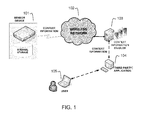
- FIG. 1 illustrates some key elements in a network architecture comprising a wireless network (102) used by system (101) according to the present invention.
- the collected data concerning a person context is transmitted to a server (103) as context information enabler through the wireless network (102) and processed therein prior to be utilised by third party applications (104) and other users (105).
- FIG. 2 shows a flow chart illustrating particular contextual conditions (403) evaluated by means of comparisons of physical variables (201-209) to identify several mobility contexts in view of the environment information, in this case the environment information is provided by an accelerometer and by an orientation sensor. By using additional sensors, such as a light sensor, more specific contexts can be identified.
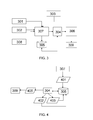
- FIG. 3 is a block diagram of an embodiment of the present invention that shows a processing module (304) for processing the data collected by a sensor interface (307) coupled with an accelerometer (101), an orientation sensor (302) and optionally by other specific sensors (303).
- the said data is stored in a database (305) in order to be processed by the processing module (304). After being processed, it may be used to be transmitted by a communication module (306) to a telecommunication entity (309).
- FIG. 4 shows generation of environment information (401) in a collecting module (307) and stored in a storage module (305) to be processed by a processing module (304) in order to produce data relating to a subset of contexts (402) and a degree of contextual matching (404).
- the subset of contexts (402) are those contexts that can be determined according to the collected information (401).
- the degree of contextual matching (404) refers to a level of correspondence with a particular context.
- an active context (405) is selected.
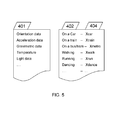
- FIG. 5 shows examples of physical variables gathered from an environment in order to determine a plurality of determinable contexts (402) along with its corresponding value as a degree of matching (404),
- the table below sets out several individual contexts and the related sensors that may be needed for their identification.
- a table of this kind is populated with the data from sensors in order to identify a suitable context. After processing this table, an additional column regarding the probability associated with each context is added.
- the algorithm checks different physical parameters and their values and provides a subset of determinable contexts; a filter algorithm will provide the feasible context available (by assigning a probability to each determinable context in order to estimate how measured values match a candidate context).
- a filter algorithm will provide the feasible context available (by assigning a probability to each determinable context in order to estimate how measured values match a candidate context).
- a gravimetric sensor which collects terrestrial gravitational data may offer additional relevant information assisting to differentiate possible contexts.
- the accelerometers and orientation sensors provide information about the inertial speed.
- the acceleration in three mutually orthogonal axes and the orientation in those three axes are stored in a database (305), the processor calculates the inertial speed and stores the results also in the database (305). All these data are periodically checked by a processing module (304).
- the processing module (304) analyses the contextual conditions as illustrated by the figure 2 (vibration, inertial speed, light threshold, semi-periodic start/stop... etc), when a sufficient number of conditions are satisfied, the context can be deduced and stored as active in a database (305) (can be external or internal storage) or use a communication module (306) to send it .
- the number of conditions needed for making a decision can be established by experimentation (i.e. empirically) when there are no suitable theoretical models.
- the inertial acceleration provided by the accelerometer will offer a subset of possible contexts: in this case, riding, cycling, bus, train and underground. Riding and cycling are easily filtered using the pendulum movement of one of the accelerometer axes for the cycling and the up and down variations in the acceleration axes for the riding, additionally the orientation sensor will provide larger variations for these contexts than "in car" context.
- Light sensor can be useful to filter a underground context.
- each determinable context has an associated probability according to the degree of matching between measured value and the expected value according to the definition of said context.
- selecting one general context of the person as active can help in the search of additional contexts (compatible with the general active context identified).
- the contexts can be upgraded by using cell information from the communication module (306). Said cell information required to communicate with a mobile network allowing to geometrical allocation.
- Additional sensors sound, light, humidity, temperature, air pressure, UV radiation, chemical or particulate detection, etc
- sound, light, humidity, temperature, air pressure, UV radiation, chemical or particulate detection, etc may be used to assist in determining more contexts and many of these are shown on the table.
- more sensors may be used to better identify specific contexts.
- Certain embodiments of the invention may address medical or sports applications - in such circumstances, connection to body temperature and/or heart function sensors may be advantageous: personal contexts that might otherwise be interpreted incorrectly may be better recognised.
- the above cases are examples of how two different situations may be modelled in order to identify a pattern in the data collected and processed and to associate said pattern to a context. It is to be appreciated that information from more than one user may be managed and be extended to group of users. A search for specific patterns in data retrieved by device sensors regarding a plurality of users may be used to that end. The active context and corresponding environment information of a group of persons may be used to extend individual context of persons to a common context for a group of users.
- an earthquake is associated to simultaneous movement detected by devices of a plurality of users.
- this type of alerting service is useful can be easily conceived. If an emergency arises, gathering such information may be helpful to authorities, since the information also may include the location of persons according to the assigned cell in a mobile telecommunication network.
- a further application is within the field of statistics.
- the information obtained from sensors of a group of users in a place may serve as samples to apply statistical analysis.
- Environment information (401), mainly relating to values from sensors (301,302,303,...) are collected by a collecting module (307).
- Said values are schematically represented in figure 5 , they may be in the form of a position inside an array of data (e.g. [34 4 0 55]) or as a header associated to this data (e.g. light 34; accelX 4; accelY 0;:accelZ 55).
- these are managed by an application running in the collecting module (307).
- a processor module (304) and a storage module (305) can operate with them. More in particular, since the sensors (301,302,303,308) can not only be local but remote ones. The way to assign a remote sensor to a user can be carried out via a specific user gateway.
- the value and its associated physical parameter are identified and stored in the storage module (305) regarding environment information.
- Another thread in the application running in the processor module (304) checks the latest values of acceleration and orientation and variations thereof. Hence, it is possible to work with such information (401) and to obtain true or false in some conditions (201-209) previously defined (vibration, inertial speed higher than..., light value higher than..., pendulum movement detected, up and down detected). When no true/false can be established, a probability is defined instead.
- This thread checks all the values available and filter possible contexts (402) and its probability (404) according to how such data match expected data for the context.
- data can be stored in the database (305) or sent to a remote server (306).
- a subscription to a notification service having a context based application can be developed and offered to users.
- a notification can be generated based on his interests and customised according to his particular context. For instance, alerts or advertisements can be sent to a person by a remote server (306) or through another network entity (103,104,105) aware of his current context. Therefore notifications received by users can be highly personalised.
- the user gateway previously referred to is in charge of associating remote sensors to a given user.
- external Bluetooth sensors can be searched.
- An IEEE 802.15.4 board associated with 6LoWPAN (IPv6 over Low power Wireless Personal Area Networks) or Zigbee user's information can be updated and conveyed to a context enabler.
- 6LoWPAN IPv6 over Low power Wireless Personal Area Networks
- Zigbee user's information can be updated and conveyed to a context enabler.
- this gateway will not be addressed herein.
- data from the sensors are collected as a environment information (401). These data relate to physical variables values in connection with the surroundings of the person at a given moment.
- the environment information (401) is processed based on contextual conditions. Such conditions relate to comparisons and requirements to be satisfied according to each context. Particularly, it may be in the format of a truth table allowing parallel processing.
- a subset of candidate contexts is prepared (402).
- an associated degree of correspondence (404) with the selected context is estimated.
- the subset of determinable contexts (402) may be further processed and checked in order to confirm they are also compatible with other contextual conditions previously evaluated. Finally, a context among them is set as the active context (405) of the person.
- subsequent data are timely handled taking into account whether they relate to the prior context. To the extent that said data are not related to the prior context and not sufficient to determine any other possible contexts, such data are disregarded. Thus, contexts that require verification based on data of unavailable sensors are excluded.
- the discotheque context cannot be verified (due to uncomplete information to determine it). However, most of the transportation modes may be checked, provided that the accelerometer sensor is available and thus, an inference can be made to find a matching context among the subset of context relating to transportation modes.
- the collecting module (307) has gathered the following information:
- the processing module (304) raises the probability of car, underground and train.
- An algorithm tries to detect the periodic stop/start movements and raises the probability of underground and train over car context.
- the light sensor value and the time provide more or less probability to be on an underground or on a train.
- the available sensors may complement one another, corroborating an inference that might have been reached using only a subset of the available sensors.
- accelerometer, orientation, and gravitational data may be used alone to distinguish between running and walking - data from a heart rate sensor (if also available) may make the inference more conclusive.
Landscapes
- Engineering & Computer Science (AREA)
- Environmental & Geological Engineering (AREA)
- Human Computer Interaction (AREA)
- Computer Networks & Wireless Communication (AREA)
- Signal Processing (AREA)
- Telephonic Communication Services (AREA)
Applications Claiming Priority (1)
| Application Number | Priority Date | Filing Date | Title |
|---|---|---|---|
| ES201130054A ES2398832B1 (es) | 2011-01-19 | 2011-01-19 | Identificación de contexto personal. |
Publications (1)
| Publication Number | Publication Date |
|---|---|
| EP2479966A1 true EP2479966A1 (fr) | 2012-07-25 |
Family
ID=45531767
Family Applications (1)
| Application Number | Title | Priority Date | Filing Date |
|---|---|---|---|
| EP12151729A Withdrawn EP2479966A1 (fr) | 2011-01-19 | 2012-01-19 | Identification de contexte personnel |
Country Status (2)
| Country | Link |
|---|---|
| EP (1) | EP2479966A1 (fr) |
| ES (1) | ES2398832B1 (fr) |
Cited By (2)
| Publication number | Priority date | Publication date | Assignee | Title |
|---|---|---|---|---|
| US9564042B2 (en) | 2013-06-13 | 2017-02-07 | Motorola Solutions, Inc. | Communication system with improved safety feature |
| WO2017113653A1 (fr) * | 2015-12-28 | 2017-07-06 | 歌尔股份有限公司 | Procédé et appareil permettant d'identifier l'état de mouvement du corps humain |
Citations (6)
| Publication number | Priority date | Publication date | Assignee | Title |
|---|---|---|---|---|
| US20040043758A1 (en) * | 2002-08-29 | 2004-03-04 | Nokia Corporation | System and method for providing context sensitive recommendations to digital services |
| WO2005096597A1 (fr) * | 2004-03-30 | 2005-10-13 | Sharp Kabushiki Kaisha | Dispositif portable de traitement d'informations, systeme de traitement d'informations, procede de commande pour dispositif portable de traitement d'informations, programme de commande pour dispositif portable de traitement d'informations et support d'enregistrement |
| US20050228882A1 (en) * | 2004-03-25 | 2005-10-13 | Nec Corporation | Apparatus, system and program for issuing presence information |
| EP1732300A2 (fr) * | 2005-06-09 | 2006-12-13 | Sony Corporation | Procédé, logiciel et dispositif de traitement d'information pour détecter l'activité de l'abonné appelé |
| US20080278312A1 (en) * | 2007-05-09 | 2008-11-13 | Sony Ericsson Mobile Communications Ab | Methods, electronic devices, and computer program products for generating presence information associated with a user of an electronic device based on environmental information |
| US20100216490A1 (en) * | 2009-02-23 | 2010-08-26 | Sony Ericsson Mobile Communications Ab | Method and arrangement relating to communication device |
Family Cites Families (1)
| Publication number | Priority date | Publication date | Assignee | Title |
|---|---|---|---|---|
| EP2264988A1 (fr) * | 2009-06-18 | 2010-12-22 | Deutsche Telekom AG | Procédé de détection de l'activité actuelle d'un utilisateur et contexte environnemental d'un utilisateur d'un téléphone mobile utilisant un capteur d'accélération et un microphone, produit de programme informatique, et téléphone mobile |
-
2011
- 2011-01-19 ES ES201130054A patent/ES2398832B1/es active Active
-
2012
- 2012-01-19 EP EP12151729A patent/EP2479966A1/fr not_active Withdrawn
Patent Citations (6)
| Publication number | Priority date | Publication date | Assignee | Title |
|---|---|---|---|---|
| US20040043758A1 (en) * | 2002-08-29 | 2004-03-04 | Nokia Corporation | System and method for providing context sensitive recommendations to digital services |
| US20050228882A1 (en) * | 2004-03-25 | 2005-10-13 | Nec Corporation | Apparatus, system and program for issuing presence information |
| WO2005096597A1 (fr) * | 2004-03-30 | 2005-10-13 | Sharp Kabushiki Kaisha | Dispositif portable de traitement d'informations, systeme de traitement d'informations, procede de commande pour dispositif portable de traitement d'informations, programme de commande pour dispositif portable de traitement d'informations et support d'enregistrement |
| EP1732300A2 (fr) * | 2005-06-09 | 2006-12-13 | Sony Corporation | Procédé, logiciel et dispositif de traitement d'information pour détecter l'activité de l'abonné appelé |
| US20080278312A1 (en) * | 2007-05-09 | 2008-11-13 | Sony Ericsson Mobile Communications Ab | Methods, electronic devices, and computer program products for generating presence information associated with a user of an electronic device based on environmental information |
| US20100216490A1 (en) * | 2009-02-23 | 2010-08-26 | Sony Ericsson Mobile Communications Ab | Method and arrangement relating to communication device |
Non-Patent Citations (2)
| Title |
|---|
| F. BENTLEY ET AL.: "A time to glance: Studying the use of mobile ambient information", PERVASIVE '07 WORKSHOP: W9 - AMBIENT INFORMATION SYSTEMS, 13 May 2007 (2007-05-13) |
| T. KANTER ET AL.: "Ubiquitous Mobile Awareness from Sensor Networks", MOBILWARE 2009 WORKSHOPS, vol. 12, 2009, pages 147 - 150 |
Cited By (3)
| Publication number | Priority date | Publication date | Assignee | Title |
|---|---|---|---|---|
| US9564042B2 (en) | 2013-06-13 | 2017-02-07 | Motorola Solutions, Inc. | Communication system with improved safety feature |
| WO2017113653A1 (fr) * | 2015-12-28 | 2017-07-06 | 歌尔股份有限公司 | Procédé et appareil permettant d'identifier l'état de mouvement du corps humain |
| US10856777B2 (en) | 2015-12-28 | 2020-12-08 | Goertek Inc. | Method and device for identifying human movement state |
Also Published As
| Publication number | Publication date |
|---|---|
| ES2398832B1 (es) | 2014-01-30 |
| ES2398832A1 (es) | 2013-03-22 |
Similar Documents
| Publication | Publication Date | Title |
|---|---|---|
| US20240419732A1 (en) | Distributed video storage and search with edge computing | |
| US8700054B2 (en) | Prediction of indoor level and location using a three stage process | |
| Ye et al. | FTrack: Infrastructure-free floor localization via mobile phone sensing | |
| US8320939B1 (en) | Crowd-sourced information for interior localization and navigation | |
| US9900119B2 (en) | Radiobeacon data sharing by forwarding low energy transmissions to a cloud host | |
| Gonzalez et al. | Automating mode detection for travel behaviour analysis by using global positioning systems-enabled mobile phones and neural networks | |
| Kanhere | Participatory sensing: Crowdsourcing data from mobile smartphones in urban spaces | |
| Chon et al. | Lifemap: A smartphone-based context provider for location-based services | |
| US9277362B2 (en) | Method and apparatus for generating and using location information | |
| US8599758B1 (en) | Indoor localization of mobile devices | |
| US8639640B1 (en) | Prediction of indoor location using decision trees | |
| US9258681B2 (en) | Indoor localization of mobile devices | |
| CN103649770B (zh) | 移动设备的位置估计 | |
| EP2426460B1 (fr) | Procédé et appareil pour générer et utiliser des informations d'emplacement | |
| Higuchi et al. | Mobile devices as an infrastructure: A survey of opportunistic sensing technology | |
| Purahoo et al. | SenseAPP: An IoT-based mobile crowdsensing application for smart cities | |
| EP2479966A1 (fr) | Identification de contexte personnel | |
| Marakkalage et al. | Identifying indoor points of interest via mobile crowdsensing: An experimental study | |
| CN115623531B (zh) | 利用无线射频信号的隐藏监控设备发现和定位方法 | |
| Larsen et al. | Mobile Context Toolbox: an extensible context framework for S60 mobile phones | |
| Boukhechba et al. | Battery-Aware Mobile Solution for Online Activity Recognition from Users' Movements | |
| CN117580153A (zh) | 无线设备的匹配方法、装置、设备、介质及程序产品 | |
| Sun et al. | Mlogger: an automatic blogging system by mobile sensing user behaviors | |
| US20220030333A1 (en) | Drone gateway device to collect the sensor data | |
| de Almeida Rodrigues | Capturing Unattended Demand In Bike-Sharing Systems |
Legal Events
| Date | Code | Title | Description |
|---|---|---|---|
| PUAI | Public reference made under article 153(3) epc to a published international application that has entered the european phase |
Free format text: ORIGINAL CODE: 0009012 |
|
| AK | Designated contracting states |
Kind code of ref document: A1 Designated state(s): AL AT BE BG CH CY CZ DE DK EE ES FI FR GB GR HR HU IE IS IT LI LT LU LV MC MK MT NL NO PL PT RO RS SE SI SK SM TR |
|
| AX | Request for extension of the european patent |
Extension state: BA ME |
|
| STAA | Information on the status of an ep patent application or granted ep patent |
Free format text: STATUS: THE APPLICATION IS DEEMED TO BE WITHDRAWN |
|
| 18D | Application deemed to be withdrawn |
Effective date: 20130126 |