EP2480144B1 - Systeme zur öffnung einer gewebebarriere - Google Patents
Systeme zur öffnung einer gewebebarriere Download PDFInfo
- Publication number
- EP2480144B1 EP2480144B1 EP10818027.4A EP10818027A EP2480144B1 EP 2480144 B1 EP2480144 B1 EP 2480144B1 EP 10818027 A EP10818027 A EP 10818027A EP 2480144 B1 EP2480144 B1 EP 2480144B1
- Authority
- EP
- European Patent Office
- Prior art keywords
- tissue
- target value
- microbubbles
- opening
- acoustic
- Prior art date
- Legal status (The legal status is an assumption and is not a legal conclusion. Google has not performed a legal analysis and makes no representation as to the accuracy of the status listed.)
- Active
Links
Images









Classifications
-
- A—HUMAN NECESSITIES
- A61—MEDICAL OR VETERINARY SCIENCE; HYGIENE
- A61M—DEVICES FOR INTRODUCING MEDIA INTO, OR ONTO, THE BODY; DEVICES FOR TRANSDUCING BODY MEDIA OR FOR TAKING MEDIA FROM THE BODY; DEVICES FOR PRODUCING OR ENDING SLEEP OR STUPOR
- A61M37/00—Other apparatus for introducing media into the body; Percutany, i.e. introducing medicines into the body by diffusion through the skin
- A61M37/0092—Other apparatus for introducing media into the body; Percutany, i.e. introducing medicines into the body by diffusion through the skin using ultrasonic, sonic or infrasonic vibrations, e.g. phonophoresis
-
- A—HUMAN NECESSITIES
- A61—MEDICAL OR VETERINARY SCIENCE; HYGIENE
- A61B—DIAGNOSIS; SURGERY; IDENTIFICATION
- A61B17/00—Surgical instruments, devices or methods
- A61B17/22—Implements for squeezing-off ulcers or the like on inner organs of the body; Implements for scraping-out cavities of body organs, e.g. bones; for invasive removal or destruction of calculus using mechanical vibrations; for removing obstructions in blood vessels, not otherwise provided for
- A61B17/225—Implements for squeezing-off ulcers or the like on inner organs of the body; Implements for scraping-out cavities of body organs, e.g. bones; for invasive removal or destruction of calculus using mechanical vibrations; for removing obstructions in blood vessels, not otherwise provided for for extracorporeal shock wave lithotripsy [ESWL], e.g. by using ultrasonic waves
-
- A—HUMAN NECESSITIES
- A61—MEDICAL OR VETERINARY SCIENCE; HYGIENE
- A61B—DIAGNOSIS; SURGERY; IDENTIFICATION
- A61B5/00—Measuring for diagnostic purposes; Identification of persons
- A61B5/0059—Measuring for diagnostic purposes; Identification of persons using light, e.g. diagnosis by transillumination, diascopy, fluorescence
- A61B5/0071—Measuring for diagnostic purposes; Identification of persons using light, e.g. diagnosis by transillumination, diascopy, fluorescence by measuring fluorescence emission
-
- A—HUMAN NECESSITIES
- A61—MEDICAL OR VETERINARY SCIENCE; HYGIENE
- A61B—DIAGNOSIS; SURGERY; IDENTIFICATION
- A61B8/00—Diagnosis using ultrasonic, sonic or infrasonic waves
- A61B8/08—Clinical applications
- A61B8/0808—Clinical applications for diagnosis of the brain
-
- A—HUMAN NECESSITIES
- A61—MEDICAL OR VETERINARY SCIENCE; HYGIENE
- A61B—DIAGNOSIS; SURGERY; IDENTIFICATION
- A61B8/00—Diagnosis using ultrasonic, sonic or infrasonic waves
- A61B8/48—Diagnostic techniques
- A61B8/481—Diagnostic techniques involving the use of contrast agents, e.g. microbubbles introduced into the bloodstream
-
- A—HUMAN NECESSITIES
- A61—MEDICAL OR VETERINARY SCIENCE; HYGIENE
- A61B—DIAGNOSIS; SURGERY; IDENTIFICATION
- A61B8/00—Diagnosis using ultrasonic, sonic or infrasonic waves
- A61B8/08—Clinical applications
- A61B8/0808—Clinical applications for diagnosis of the brain
- A61B8/0816—Clinical applications for diagnosis of the brain using echo-encephalography
-
- A—HUMAN NECESSITIES
- A61—MEDICAL OR VETERINARY SCIENCE; HYGIENE
- A61M—DEVICES FOR INTRODUCING MEDIA INTO, OR ONTO, THE BODY; DEVICES FOR TRANSDUCING BODY MEDIA OR FOR TAKING MEDIA FROM THE BODY; DEVICES FOR PRODUCING OR ENDING SLEEP OR STUPOR
- A61M2202/00—Special media to be introduced, removed or treated
- A61M2202/0007—Special media to be introduced, removed or treated introduced into the body
-
- A—HUMAN NECESSITIES
- A61—MEDICAL OR VETERINARY SCIENCE; HYGIENE
- A61M—DEVICES FOR INTRODUCING MEDIA INTO, OR ONTO, THE BODY; DEVICES FOR TRANSDUCING BODY MEDIA OR FOR TAKING MEDIA FROM THE BODY; DEVICES FOR PRODUCING OR ENDING SLEEP OR STUPOR
- A61M2205/00—General characteristics of the apparatus
- A61M2205/02—General characteristics of the apparatus characterised by a particular materials
- A61M2205/0244—Micromachined materials, e.g. made from silicon wafers, microelectromechanical systems [MEMS] or comprising nanotechnology
-
- A—HUMAN NECESSITIES
- A61—MEDICAL OR VETERINARY SCIENCE; HYGIENE
- A61M—DEVICES FOR INTRODUCING MEDIA INTO, OR ONTO, THE BODY; DEVICES FOR TRANSDUCING BODY MEDIA OR FOR TAKING MEDIA FROM THE BODY; DEVICES FOR PRODUCING OR ENDING SLEEP OR STUPOR
- A61M2205/00—General characteristics of the apparatus
- A61M2205/05—General characteristics of the apparatus combined with other kinds of therapy
- A61M2205/058—General characteristics of the apparatus combined with other kinds of therapy with ultrasound therapy
-
- A—HUMAN NECESSITIES
- A61—MEDICAL OR VETERINARY SCIENCE; HYGIENE
- A61M—DEVICES FOR INTRODUCING MEDIA INTO, OR ONTO, THE BODY; DEVICES FOR TRANSDUCING BODY MEDIA OR FOR TAKING MEDIA FROM THE BODY; DEVICES FOR PRODUCING OR ENDING SLEEP OR STUPOR
- A61M2210/00—Anatomical parts of the body
- A61M2210/06—Head
- A61M2210/0693—Brain, cerebrum
-
- A—HUMAN NECESSITIES
- A61—MEDICAL OR VETERINARY SCIENCE; HYGIENE
- A61M—DEVICES FOR INTRODUCING MEDIA INTO, OR ONTO, THE BODY; DEVICES FOR TRANSDUCING BODY MEDIA OR FOR TAKING MEDIA FROM THE BODY; DEVICES FOR PRODUCING OR ENDING SLEEP OR STUPOR
- A61M2210/00—Anatomical parts of the body
- A61M2210/12—Blood circulatory system
-
- A—HUMAN NECESSITIES
- A61—MEDICAL OR VETERINARY SCIENCE; HYGIENE
- A61M—DEVICES FOR INTRODUCING MEDIA INTO, OR ONTO, THE BODY; DEVICES FOR TRANSDUCING BODY MEDIA OR FOR TAKING MEDIA FROM THE BODY; DEVICES FOR PRODUCING OR ENDING SLEEP OR STUPOR
- A61M2250/00—Specially adapted for animals
Definitions
- the present application relates to systems for opening a tissue utilizing acoustic parameters in conjunction with microbubbles.
- biomarkers and therapeutic agents for the monitoring and treatment of neurological disorders. Many of these agents have proven in vitro specificity or neurological potency, but their in vivo efficacy remains limited by their inability to reach their target due to the blood-brain barrier. This interface regulates the exchange of molecules across the cerebral capillaries through passive, transport, and metabolic barriers, resulting in the exclusion of nearly all agents larger than 400 Da from the brain's extracellular space. Biomarkers and therapeutic agents, such as inhibitors to enzymes ( ⁇ 1 kDa) and antibodies (30 to 300 kDa), are thus rendered ineffective because they do not reach their intended targets. Systems for opening a tissue to a target value are known from US 2009/0005711 , as described further below.
- a region of the tissue is targeted for opening, which is not part of the present invention
- an acoustic parameter corresponding to the target value is determined and an ultrasound beam is applied to the target region at the acoustic parameter such that the tissue at the target region is opened to the target value with the microbubbles.
- the method can further include positioning microbubbles in proximity to the targeted region and, in some embodiments, positioning the microbubbles can include performing an injection of the microbubbles such that the microbubbles are positioned proximate to the targeted region.
- the method can further include determining a number of injections and/or a duration of an injection corresponding to the target value.
- the injection can be a systemic injection, a bolus injection and/or a slow diffusion injection.
- the acoustic parameter can be selected to control an acoustic cavitation event and, in some embodiments, controlling an acoustic cavitation event can include controlling a location, number and/or magnitude of acoustic cavitation events.
- the acoustic parameter can be a pulse length, a pulse repetition frequency, a burst length, a burst repetition frequency, an ultrasound frequency, a pressure range, and/or a duration corresponding to the target value.
- the pressure range can correspond to the resonance frequency of the microbubbles proximate to the targeted region.
- the method can include determining a concentration range of microbubbles corresponding to the target value and applying an ultrasound beam to move the microbubbles into vessels of the tissue.
- the microbubbles can have a size range of 1 to 10 microns, and in other embodiments can have a size range of 1 to 2 microns, 4 to 5 microns, or 6 to 8 microns.
- the microbubbles can be acoustically activated and/or molecule-carrying.
- the molecule-carrying microbubbles can carry or be coated with medicinal molecules and/or a contrast agent and/or a biomarker and/or a liposome. Medicinal molecules and/or contrast agents can also be separately positioned in proximity to the targeted region.
- the method can further include imaging the targeted region, to form an image of the opened tissue.
- imaging the targeted region includes applying an ultrasound beam to the targeted region, while in other embodiments imaging the targeted region includes utilizing a magnetic resonance imaging device and/or a fluorescence imaging device to image the targeted region.
- An embodiment of a system for opening a tissue to a target value according to claim 1 and dependent claims using a solution of microbubbles having a size range corresponding to the target value includes a targeting assembly for targeting a region of the tissue, an introducer for delivering the solution to a location proximate to the targeted region and a transducer, coupled to the targeting assembly, for applying an ultrasound beam to the targeted region at an acoustic parameter corresponding to the target value thereby opening the tissue with the microbubbles to the target value.
- the acoustic parameter can be selected to control an acoustic cavitation event.
- the system according to claim 5 can further include an imaging device for capturing image data of the opened tissue of the targeted region, and a processor, operatively coupled to the imaging device, for processing the image data to form an image therefrom.
- the imaging device includes a transducer for applying an ultrasound beam to the targeted region, while in other embodiments the imaging device includes a magnetic resonance imaging device and/or a fluorescence imaging device to image the targeted region.
- the systems described herein are useful for opening a tissue utilizing microbubbles and focused ultrasound at certain acoustic parameters. Although the description provides as an example opening the blood-brain barrier, the systems herein are useful for opening other tissues, such as muscular tissue, liver tissue or tumorous tissue, among others.
- the subjected matter disclosed herein are systems for determining the acoustic parameters for opening a tissue with the assistance of microbubbles to allow for the passage of certain molecules over selected areas. Accordingly, the techniques described herein make use of selected acoustic parameters chosen to produce a desired opening effect in a tissue when subjected to focus ultrasound utilizing microbubbles of selected sizes and in selected concentrations.
- the techniques described herein for determining the acoustic parameters for opening a tissue can also be employed in conjunction with other ultrasound techniques, e.g., diagnostic techniques, where opening of a tissue should be avoided.
- the techniques described herein can be used to determine the acoustic parameters that can be avoided in order to prevent unwanted tissue opening when utilizing such other techniques that, for example, use microbubbles.
- acoustic waves propagate several centimeters through water or tissue and converge onto a focal region while its surroundings remain relatively unaffected.
- Noninvasive and localized drug delivery systems have emerged from advances in FUS and microbubble technologies.
- techniques such as blood-brain barrier (BBB) disruption for the treatment of neurological diseases, delivery of nanoparticles to tumors, gene therapy for treating heart conditions, and enhancement of renal ultrafiltration have all shown promise due to their ability to increase uptake of luminal molecules into the interstitial space.
- BBB blood-brain barrier
- the mechanistic event underlying the tissue opening in such examples is the reaction of microbubbles to ultrasonic pulses, which can result in an array of behaviors known as acoustic cavitation.
- acoustic cavitation the microbubble expands and contracts with the acoustic pressure rarefaction and compression over several cycles, and such action can result in the displacement of the vessel diameter through dilation and contraction.
- inertial cavitation the bubble can expand to several factors greater than its equilibrium radius and subsequently collapse due to the inertia of the surrounding media, thus also inducing an alteration of the vascular physiology.
- each cavitation activity can be dictated by, among other things, the microbubble composition and distribution, the ultrasonic pulse shape and sequence, and the in vivo environment in which the bubbles circulate. Control of molecular delivery using FUS can therefore be facilitated by selecting microbubbles and the acoustic environment conditions that they interact with.
- acoustic pressure can have a large influence on the type and magnitude of acoustic cavitation activity.
- increasing the pressure increases the likelihood and extent of BBB opening, but also is associated with neurovascular and neuronal damage.
- histological assessments reveal no detectable damage (e.g., erythrocyte extravasations and/or neuronal damage) but at such low pressures there is also a reduction in molecular delivery. Lowering the transmitted center frequency of the ultrasound can result in a decrease of the acoustic pressure threshold.
- the pulse repetition frequency can effect the ability of microbubbles to reperfuse the vasculature since each pulse can destroy microbubbles.
- PRF pulse repetition frequency
- a long pulse length was a necessary characteristic of an ultrasonic pulse for inducing BBB disruption, for example PLs of 10 or 20 ms (15200 and 30400 cycles at 1.5 MHz) and such long PLs have been associated with inhomogeneity of drug delivery.
- PL pulse length
- BBB disruption is feasible at a low pressure (less than 1 MPa) using a PL of 33 ⁇ s (50 cycles at 1.5 MHz).
- pulse sequences based on the use of a PL of 2.3 ⁇ s can enhance the dose and distribution of delivery without compromising safety.
- An acoustic parameter design can be formed on the basis that BBB disruption is dependent on the number, magnitude and/or location of cavitation events occurring throughout the cerebral microvasculature. Further, acoustic cavitation activity within the microvasculature can be modified by taking into account concepts of microbubble persistence, fragmentation, and microvascular replenishment. In one embodiment, a series of pulses can be grouped into a burst, with a sufficient duration between bursts to allow for microbubble replenishment in the microvasculature before arrival of the subsequent acoustic pulses.
- bursts can increase the persistence and mobility of the microbubbles, which can result in a single bubble generating cavitation activity at multiple sites along the cerebral microvasculature.
- short PLs used in a burst sequence can enhance the dose and distribution of molecular delivery without attendant damage to the microvasculature.
- the number injections and duration of each injection of bubbles can be altered to enhance the microbubble persistence, for example.
- Figure 1 illustrates a method 100 , which is not part of the present invention, for opening a tissue to a target value, e.g., a measure of increased ability of the tissue to pass molecules through.
- the target value can be expressed in terms of an increase in the size of vessels in the tissue, as an area of the tissue that has been opened, or in terms of a rate at which molecules pass through, e . g ., a permeability, or as a combination of any of these measures.
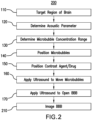
- the method 100 involves targeting 110 a region of the tissue for opening, determining 120 at least one acoustic parameter corresponding to the target value, positioning 140 microbubbles in proximity to the targeted region, and applying 170 an ultrasound beam at the acoustic parameter to the targeted region such that the tissue is opened with the assistance of the microbubbles to the target value.
- positioning 140 the microbubbles can include performing an injection of the microbubbles such that the microbubbles are positioned proximate to the targeted region.
- the method 100 can further include determining a number of injections and/or a duration of an injection corresponding to the target value.
- the injection 140 can be a systemic injection, a bolus injection and/or a slow diffusion injection.
- the method 100 which is not part of the present invention. can further include of determining 130 a concentration range of microbubbles corresponding to the target value and the positioning 140 of the microbubbles can also include positioning the microbubbles of the concentration range that corresponds to the target value.
- the method 100 can also include positioning 150 a contrast agent and/or medicinal molecule (e.g. , a drug) in proximity to the target region.
- method 100 which is not part of the present invention. can include applying 160 an ultrasound beam to move the microbubbles into vessels of the tissue.
- This application 160 of the ultrasound beam can be the same, or a different, than the application 170 that is used to open the tissue. Further, the application 160 of the ultrasound beam can be at the same, or at a different, acoustic parameter than that determined 120 for the purposes of opening the tissue.
- the acoustic parameter to be determined 120 as corresponding to the target value can be selected to control one or more acoustic cavitation events.
- the acoustic parameter(s) can be selected such that the location, number and/or magnitude of acoustic cavitation events can be controlled in the targeted tissue.
- the acoustic parameter can be at least one of the pulse length, the pulse repetition frequency, the burst length, or the burst repetition frequency, or a combination thereof.
- the acoustic parameters that are determined 120 can be the pressure range, the frequency, and the duration of the application 170 of ultrasound.
- the target value of the tissue can be selected based on the size of the molecule that is to pass through the tissue, e.g., the BBB, or based on the size, e.g. , area, of the region that is to be exposed to the molecule, or a combination of the two.
- the acoustic parameters can be determined 120 such that the tissue is subject to a certain number of acoustic cavitations at selected locations and of selected magnitudes, which can result in a selected number of molecules of a given size passing through the tissue at selected locations.
- the target value can be such that molecules up to the megaDalton size range are able to pass through the BBB, e . g ., 2 MDa molecules.
- NOD normalized optical density
- the acoustic parameter can be determined 120 by finding the lowest acoustic parameter value for which the tissue will open to the target value, where the target value is considered to be the minimum amount of opening.
- the acoustic parameters to be determined 120 were the PRF and the PL.
- a PRF value of 1 Hz was experimentally determined 120 to be the lowest PRF for which the BBB of a mouse subject was observed to open based on an observed NOD of approximately 2 ⁇ 10 7 .
- a PL value of 0.033 ms was experimentally determined 120 to be the lowest PL for which the BBB was observed to open based on an observed NOD of approximately 0.5 ⁇ 10 7 .
- a PL of 3 cycles was experimentally determined 120 to open the BBB in mice, in an experiment conducted in accordance with an exemplary embodiment described below.
- the acoustic parameter can be determined 120 by finding the lowest reliable acoustic parameter value which will reliably open the tissue to the target value.
- the acoustic parameters to be determined 120 were the PRF and the PL.
- a PRF value of 5 Hz was experimentally determined 120 to be the lowest PRF for which the BBB of a mouse subject was observed to reliably open based on an observed NOD of approximately 2 ⁇ 10 7 .
- a PL value of 0.2 ms was experimentally determined 120 to be the lowest PL for which the BBB was observed to reliably open based on an observed NOD of approximately 0.5 ⁇ 10 7 .
- the acoustic parameter can be determined 120 by finding the acoustic parameter value above which no further significant increase in opening of the tissue is achieved.
- the acoustic parameters to be determined 120 were the PRF and the PL.
- a PRF value of 5 Hz was experimentally determined 120 to be the PRF for which no further significant increase in the opening of the BBB of a mouse subject was observed and such opening corresponded to an NOD of approximately 2.5 ⁇ 10 7 .
- a PL value of 10 ms was experimentally determined 120 to be the lowest PL for which no further significant increase in the opening of the BBB of a mouse subject was observed and such opening corresponded to an observed NOD of approximately 3 ⁇ 10 7 .
- the acoustic parameters to be determined 120 can be the burst repetition frequency (BRF) and burst length (BL), where each burst can represent a cluster of pulses.
- BRF burst repetition frequency
- BL burst length
- a BRF of 10 Hz was experimentally determined 120 to open the BBB of a mouse subject, where the PRF was set at 100 kHz, and a BRF of 5 Hz was experimentally determined 120 to produce the maximal BBB opening at the same frequency.
- a BL of 100 pulses was experimentally determined 120 to open the BBB where the PRF was set at 100 kHz and the BRF was set at 5 Hz.
- determining 130 a concentration range of microbubbles corresponding to the target value can include determining the minimum microbubble concentration range that will open the tissue to the target value.
- a microbubble concentration of 0.01 ⁇ l/g was experimentally determined 130 to be the minimum concentration needed to open the BBB.
- the appropriate concentration of microbubbles can be determined 130 based on the nature of the subject, e . g ., a human or a mouse, based on the size of the target region, e . g ., the surface area of the BBB that one wishes to open, and based on the vessel size in the target region, e .
- a concentration range of 10 7 to 10 9 bubbles/mL can be appropriate.
- the bubbles were generated at an initial yield larger than the desired concentration and then diluted in PBS one minute before intravenous injection into the mouse.
- the bubble concentration can be chosen to be the same across different size distributions as opposed to the volume fraction, because it can be assumed that BBB opening occurs discretely, e.g., the sites of molecular leakage highly correlated with the instantaneous locations of the bubbles at the time of sonication. This implies that BBB opening sites are punctuated along the length of the capillaries. In the case where the volume fraction was kept the same for both sets of bubbles, it is deemed that the imaging protocol used would have the required sensitivity to detect minute increases in fluorescence.
- the appropriate size range of microbubbles can be determined by comparing the bubble size to the cerebral vasculature size and selecting a bubble size that is small enough to perfuse the vessels while at the same time large enough to induce sufficient mechanical stress on the vessel walls, such that the vessels are opened to the target value.
- FIG. 2 illustrates a method 200 , which is not part of the present invention, in accordance with the disclosed subject matter for imaging the opening of a tissue.
- the method 200 includes the same basic techniques for opening the tissue to a target value: targeting 110 a region of the tissue for opening, determining 120 at least one acoustic parameter corresponding to the target value, positioning 140 microbubbles of a known size range in proximity to the targeted region, and applying 170 an ultrasound beam at the acoustic parameter to the targeted region such that the tissue is opened with the assistance of the microbubbles to the target value.
- the method 200 further includes imaging 210 the opened tissue.
- imaging 210 the opened tissue can be the same as the application 170 of an ultrasound beam to open the tissue.
- imaging 210 can include utilizing an MRI device to image the opening of the tissue.
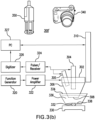
- Figure 3(a) illustrates a system 300 for opening a tissue to a target value.
- System 300 has many of the same features as the system described in U.S. Patent Pub. No. 2009/0005711 and International Patent Pub. No. WO 2010/030819 , commonly assigned patent applications.
- Ultrasound waves are generated by a focused ultrasound transducer (FUS) 302 , which can be a single-element circular-aperture FUS transducer.
- the FUS transducer 302 can be a single-element, spherical segment FUS transducer with center frequency of 1.525 MHz, a focal depth of 90 mm, an outer radius of 30 mm, and an inner radius of 11.2 mm (Riverside Research Institute, New York, NY, USA).
- the FUS transducer can be provided with hole in its center for receipt of an imaging transducer 304 , which can be a single-element diagnostic transducer having a center frequency of 7.5 MHz with a focal length of 60 mm (Riverside Research Institute, New York, NY, USA).
- the FUS transducer 302 and the diagnostic transducer 304 can be positioned so that the foci of the two transducers are properly aligned, e . g ., overlap.
- an exemplary system 300 can include a cone 306 filled with degassed and distilled water and mounted on system 300 .
- the cone 306 can, for example, be manufactured from a clear plastic, such as polyurethane.
- the water is contained in the cone 306 by capping it with a material considered substantially "transparent" to the ultrasound beam, such as an ultrathin polyurethane membrane 308 (Trojan; Church & Dwight Co., Princeton, N.J., USA).
- the transducer assembly which can include the FUS transducer 302 and the diagnostic transducer 304 , can be mounted to a computer-controlled 3-D positioning system 310 (Velmex Inc., Lachine, QC, Canada), including motors VXM-1 and VXM-2 used in the exemplary embodiment. It is understood that other positioning systems can be incorporated for positioning the transducer assembly with respect to the targeted tissue.
- a computer-controlled 3-D positioning system 310 (Velmex Inc., Lachine, QC, Canada), including motors VXM-1 and VXM-2 used in the exemplary embodiment. It is understood that other positioning systems can be incorporated for positioning the transducer assembly with respect to the targeted tissue.
- the FUS transducer 302 can be driven by a function generator 320 , e.g., function generator HP33150A, manufactured by Agilent Technologies, Palo Alto, Calif., USA, through an amplifier 322 , such as a 50-dB power amplifier 3100L (ENI, Inc., Rochester, N.Y., USA).
- the diagnostic transducer 304 can be driven by a pulser-receiver system 342 , for example a pulser-receiver 5052PR (Panametrics, Waltham, Mass., USA), connected to a digitizer 326 , e.g. , digitizer CS14200 (Gage Applied Technologies, Inc., Lachine, QC, Canada).
- Computer 328 typically includes a processor, such as a CPU (not shown), and can be any appropriate personal computer or distributed computer system including a server and a client.
- a computer useful for this system is a Dell Precision 380 personal computer. It is understood that any personal computer, laptop, or other processor that can load software and communicate with the various components discussed herein can be used.
- a memory unit (not shown), such as a disk drive, flash memory, volatile memory, etc., can be used to store software for positioning and operating the transducer assembly, image data, a user interface software, and any other software which can be loaded onto the CPU.
- system 300' can include a transducer assembly having an array of a plurality of single-element FUS transducers 304 and 305 which can be targeted to different regions of the tissue of the subject.
- Each FUS transducer 304 , 305 in the array can be fired individually, thereby permitting opening of the BBB in several locations without repositioning the transducer assembly.
- a scan such as a 3-D raster-scan (lateral step size: 0.2 mm; axial step size: 1.0 mm), of the beam of the FUS transducer 302 , can optionally be performed in a large water tank containing degassed water with a needle hydrophone having a needle diameter on the order of about 0.2 mm (Precision Acoustics Ltd., Dorchester, Dorset, UK). In this manner the pressure amplitudes and three-dimensional beam dimensions of the FUS transducer 302 can be measured.
- the pressure amplitudes can be measured by calculating the peak-rarefactional pressure values and accounting for an pressure attenuation due to transcranial propagation, e.g., an 18% pressure attenuation.
- the dimensions of the beam provided by the FUS transmitter 302 can have a lateral and axial full-width at half-maximum (FWHM) intensity of approximately 1.32 and 13.0 mm, respectively, and in some embodiments can be approximately equal to the dimensions of the beam after propagation through the skull.
- FWHM full-width at half-maximum
- System 300 also includes a liquid container 334 containing an appropriate liquid 336 , e . g ., degassed and distilled water, which is sealed at the bottom with a membrane 338 , which can be a polyurethane membrane that is acoustically and transparent, e . g ., plastic wrap.
- the system 300 can also include an optical imaging device 340 , such as a digital camera, for imaging the skull of the subject 332 and a MRI device 350 for imaging the brain of the subject 332 .
- System 300 also includes a platform 330 for the subject.
- the platform 330 for the subject can be a polyurethane bed for a smaller subject 332 , such as a mouse.
- the membrane 338 can be placed over the subject 332 .
- the platform 330 can be a hospital bed or surgical table, in which a larger subject 332 (such as a human subject) can be laid prone or supine and the transducer assembly positioned on top of the region of the skull targeted.
- Additional components of the system 300 include a targeting system 400 , coupled to the FUS transducer 302 , for locating the focus of the FUS transducer 302 in the brain of the subject 332 .
- the targeting system 400 can be coupled by any known method that permits the targeting system 400 to aid in properly targeting the FUS transducer 302 to the region of interest for opening of the target tissue, e.g., acoustic and/or optical coupling.
- Figures 4(a)-(d) illustrate a targeting system 400 for use with an embodiment where the subject 332 is a mouse.
- Figure 4(a) illustrates mouse skull 401 , where the skull's sutures can be seen through the skin and used as anatomic landmarks for targeting purposes.
- the landmarks of mouse skull 401 include the sagittal suture 402 , the frontal bone 404 , the interparietal bone 406 , the left parietal bone 408 , and the right parietal bone 410 .
- FIG. 4(b) illustrates the placement of targeting system 400 on skull 401 in accordance with an exemplary embodiment.
- the targeting system 400 can include a plurality of members 420 , 422 , 424 , such as thin metal bars, e . g ., 0.3 mm thin metal bars, fabricated from an acoustically reflective material, e . g ., paper clips.
- the metal bars 420 , 422 , 424 can be placed on several landmarks of the skull of the subject to create a layout, or grid.
- a grid consisting of three equally spaced 0.3-mm thin F2 metal bars 420 , 422 , 424 were placed in the water bath 334 on top of the skull 401 and in alignment with these landmarks, e . g ., bone sutures.
- the first bar 420 was aligned parallel and along the sagittal suture 402
- the second bar 424 was attached perpendicularly to the first bar and in alignment with the suture between the parietal 408 and interparietal bone 406 .
- the third bar 422 was placed 4 mm away from and parallel to the second bar 424 .
- Figure 4(c) illustrates the location of a brain structure 440 to be targeted, here the hippocampus, relative to the landmarks noted above.
- the location of the hippocampi are assumed relative to the sutures based on the mouse brain and known skull anatomy.
- the location of one of the hippocampi (indicated by circle 440 ) was reproducibly targeted when assumed to be at mid-distance (arrow 442 ) between the parallel bars 422 , 424 and 2 mm away from the center bar 420 (arrow 444 ).
- the targeting system can include other imaging devices, such as a digital camera 340 .
- a digital camera 340 can be used to photograph the head of the subject 332 .
- the relevant landmarks can be identified in the photograph, and the focus of the FUS transducer 302 targeted to a location relative to the landmarks.
- other MRI targeting equipment as is known in the art, can be used for targeting the desired brain structure 440 or other targeted tissue structure.
- Figure 4(d) illustrates the actual location of the hippocampus 446 as indicated in the histology slice.
- Figure 4(e) illustrates a lateral 2-D raster-scan 490 of the grid 400 using the diagnostic transducer 304 .
- the location of the hippocampus can be identified relative to this grid.
- the focus of the FUS transducer 302 was placed 3 mm beneath the top of the skull by measuring distance with the diagnostic transducer 304 .
- precise, accurate and reproducible targeting of the hippocampus or other brain structures can be performed.
- the grid positioning system 400 allowed for sonication of the same location with good accuracy across different mice. This allowed for not only good reproducibility across different mice, but also a good comparison of BBB opening effects in different regions 440 within the sonicated area.
- the subject 332 is positioned on a platform 330 .
- Subject 332 can be positioned in a prone position, and can be anesthetized for the sonication procedure.
- the degassed and distilled water bath 334 is suspended over the subject's 332 head.
- Ultrasound gel can be used to reduce any remaining impedance mismatches between the thin plastic layer 338 and the subject's 332 skin.
- the transducer assembly can be placed in the water bath 334 with its beam axis perpendicular to the surface of the skull 401 .
- the focus of the transducer is positioned inside the subject's 332 brain.
- the focus can be targeted 110 to a region of the brain 440 , such as the desired brain tissue, e.g., the hippocampus 446 , or to the vasculature of the brain, e.g., arteries, ventricles, arterioles, and capillaries of the brain, or to other target tissue regions at different locations in the subject 332 .
- the targeted region 440 of the brain can be located 110 utilizing the targeting system as discussed above.
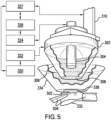
- Figure 5 illustrates a system 300 used in an experiment, approved by the Columbia University Institutional Animal Care and Use Committee, on seventy-nine wild-type mice (strain: C57BL/6, mass: 28.0 ⁇ 4.5 g, sex: male; Harlan, Indianapolis, IN, USA) which were studied in accordance with the techniques described herein.
- the system 300 can include a FUS transducer 302 , a pulse-echo diagnostic transducer 304 , a cone 306 , a latex membrane 308 , a 3-D positioning system 310 all operatively connected to a function generator 320 , a power amplifier 322 , a pulse-receiver system 324 , a digitizer 326 and a computer 327 .
- the cone 306 can be inserted into a water container 334 which is sealed at the bottom by a polyurethane membrane 338 and placed on the shaved skull 502 of the mouse subject 332 .
- the mouse subject 332 is held in place using a stereotaxic apparatus 504 .
- mice were anesthetized using 1.25-2.50% isoflurane (SurgiVet, Smiths Medical PM, Inc., Wisconsin, USA) throughout both the BBB opening and transcardial perfusion procedures.
- each mouse 332 was placed prone with its head immobilized by the stereotaxic apparatus 504 (David Kopf Instruments, Tujunga, CA, USA). The hair on the skull was removed using an electric trimmer and a depiatory cream.
- the FUS transducer 302 was then submerged in the water of the container 334 with its beam axis perpendicular to the surface of the skull 332 .
- the focus of the transducer was positioned inside the mouse brain using a grid-positioning method that utilized the pulse-echo diagnostic transducer 304 , as discussed above.
- the grid was constructed from three 0.30 mm thin metal bars (i . e ., paper clips) with two of the bars parallel to one another and separated by 4.00 mm. At the center of the parallel bars, and perpendicular to the two, was soldered the third bar.
- the grid was placed in the water bath 334 , on top of the skull, and in alignment with sutures visible through the skin. The center bar was aligned along the sagittal suture and one of the parallel bars with the lambdoid suture.
- a lateral two-dimensional raster-scan of the grid using the diagnostic transducer was made and the transducer's beam axis was positioned 2.25 and 2.00 mm away from the sagittal and lambdoid suture, respectively.
- the focal point was placed 3.00 mm beneath the top of the skull so that the acoustic wave propagated through the left parietal bone and overlapped with the left hippocampus and a small portion of the lateral region of the thalamus.
- the right hippocampus was not targeted and was used as the control.
- the grid positioning method was sufficiently precise to have the FUS beam consistently overlap the hippocampus of the murine brain.
- the tissue opening procedure 100 involved injection 140 , 150 a 25 ⁇ l bolus of Definity ® microbubbles (1-10 ⁇ m) and a dextran contrast agent (Texas-Red ® fluorescent dye with a molecular weight of 3 kDa) into the tail vein 1 minute after the start of sonication 170 , with the injection taking place over a 30 second period. Sonication was performed for 11 minutes total using pulsed FUS at a set pressure of 0.51 MPa peak-rarefactional at a single location ( e . g ., the hippocampus).
- a dextran contrast agent Texas-Red ® fluorescent dye with a molecular weight of 3 kDa
- the dextran was allowed to circulate and accumulate in the mouse brain for 10 minutes, after which a transcardial perfusion with phosphate buffer saline (138 mM sodium chloride, 10 mM phosphate, pH 7.4) and 60 ml of 4% paraformaldehyde was performed.
- the brain was extracted from the skull and then post-fixed in the paraformaldehyde overnight. Following the aforementioned procedures, the brain was prepared for frozen sections.
- the frozen sectioning protocol provided an efficient means of analyzing fluorescence in order to determine the threshold for BBB opening. In preparation of frozen sectioning, the brain was cryoprotected by soaking it in 30% sucrose overnight.
- the brain was then embedded in a cutting temperature compound (Sakura Tissue-Tek O.C.T. Compound; Torrance, CA, USA), frozen in a square mold, and then sectioned using a cryostat into nine sections of 100 ⁇ m slices in the horizontal orientation.
- a cutting temperature compound Sakura Tissue-Tek O.C.T. Compound; Torrance, CA, USA
- Bright field and fluorescent images of the frozen sections were acquired using an inverted light and fluorescence microscope (IX-81; Olympus, Melville, NY, USA) at 4X magnification and with a motorized stage-scanner. Images of the paraffin sections were acquired using an upright light and fluorescence microscope (BX61; Olympus, Melville, NY, USA) at 4 ⁇ and 10 ⁇ magnification. The Texas Red-tagged dextrans were excited at 568 ⁇ 24 nm while emissions were filtered for 610 ⁇ 40 nm.
- Figure 6(a) illustrates a horizontal section at 10 ⁇ magnification, with the left and right ROIs shown in the left and right boxes.
- Figure 6(b) shows the left ROI, which was subjected to sonication procedures, as detailed above
- Figure 6(c) shows the right ROI, which was the control.
- the regions of interest (ROIs) for each of the nine sections were outlined using Adobe ® Photoshop ® CS2 (San Jose, CA, USA), as illustrated Figures 6(b)-(c) . The outlines were then loaded into MATLAB ® (Natick, MA, USA) and used to isolate the hippocampus in the fluorescent images.
- the images were normalized by dividing both the left and right images by the spatially averaged right (control) image of the hippocampus, thus calculating F L-HIP .
- the threshold for an image was were the pixel value was greater than 2 standard deviations of F L-HIP ; images exceeding the threshold were excluded from the calculations.
- the NOD for the brain was calculated by averaging the NOD of across all nine sections. The resulting averaged NOD was then used to determine whether, to what extent, the BBB had opened.
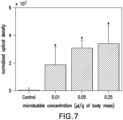
- Figure 7 is a graph illustrating the effects of varying the microbubble concentration in an exemplary embodiment where the FUS pressure was 0.46 MPa, the microbubbles used where Definity ® bubbles, the PRF was 10 Hz and the PL was 20 ms.
- the asterisks (*) indicates a significant difference in NOD from the control. As can be seen in Figure 7 , there was a significant NOD increase for all concentrations test and further there was not a significant difference between the tested concentrations, indicating that with Definity microbubbles a concentration of 0.01 ⁇ l/g of body mass is both sufficient to open the BBB in mice and also reliable for doing the same.
- Figure 8(a) is a graph illustrating the effects of varying the PRF in an exemplary embodiment where the FUS pressure was 0.46 MPa, the microbubbles used were Definity ® bubbles, the microbubble concentration was set at 0.05 ⁇ l/g of body mass, and the PL was 20 ms.
- the asterisks (*) indicates a significant difference in NOD from the control.
- at least one pulse is needed to open the BBB in a mouse brain prepared in accordance with the procedures set forth above. Further, the lowest PRF that was observed to open the BBB was 1 Hz, while the lowest PRF that was observed to reliably open the BBB was 5 Hz.
- Figure 8(b) further illustrates these findings, showing the PRF as a function of the probability of BBB opening. As illustrated in Figure 8(b), at 5 Hz and above there is a 100% probability of the BBB opening in the mice subjects prepared in accordance with the exemplary procedures set forth above. Figure 8(a) also illustrates that no additional benefits are gained from using a PRF greater than 5 Hz.
- Figure 9(a) is a graph illustrating the effects of varying the PL in an exemplary embodiment where the FUS pressure was 0.46 MPa, the microbubbles used were Definity ® bubbles, the microbubble concentration was set at 0.05 ⁇ l/g of body mass, and the PRF was 10 Hz.
- the asterisks (*) indicates a significant difference in NOD from the control.
- lowest PL which was resulted in BBB opening was 0.033 ms
- 0.2 ms was the lowest PL which produced reliable BBB opening in mice prepared in accordance with the above-detailed exemplary procedures.
- Figure 9(a) demonstrate that, contrary to prior understanding, pulse lengths shorter than 10 ms can reliably open the BBB for FUS applications utilizing pressures less than 0.5 MPa.
- Figure 9(a) also illustrates that no additional benefits are gained from using a PL greater than 10 ms.
- Figures 9(b) and 9(c) illustrate the PL as a function of the probability of BBB opening, with Figure 9(b) showing the data across all PLs tested in the exemplary experiment discussed herein and Figure 9(c) illustrating the shortest PLs tested.
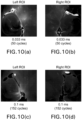
- Figures 10(a)-(h) are images of murine brains prepared in accordance with the above-detailed exemplary procedures and illustrate the results of varying the PL from 0.033 ms (50 cycles) to 30 ms (45600 cycles).
- Figures 10(a) and 10(b) illustrate the left sonicated ROI and right control ROI, respectively, at a PL of 0.033 ms (50 cycles).
- Figures 10(c) and 10(d) illustrate the left sonicated ROI and right control ROI, respectively, at a PL of 0.1 ms (152 cycles).
- Figures 10(e) and 10(f) illustrate the left sonicated ROI and right control ROI, respectively, at a PL of 20 ms (30400 cycles).
- Figures 10(g) and 10(h) illustrate the left sonicated ROI and right control ROI, respectively, at a PL of 30 ms (45600 cycles).
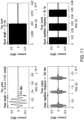
- FIG 11 illustrates an exemplary pulse and burst sequence, where each burst is composed set of pulses operating at a certain pulse rate frequency (PRF).
- PRF pulse rate frequency
- one pulse can have a PL of 2.5 ⁇ s (approximately 3.5 cycles) at a pressure of 0.6 MPa.
- the pulses can be repeated at a PRF of, for example, 100 kHz.
- the pulsing can be continued for a period of time, e.g., 10 ms, which comprises a single burst of a certain length (BL).
- the bursts can be repeated at a certain rate, for example 50 Hz, which is the BRF.
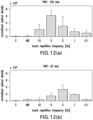
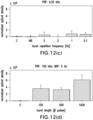
- Figures 12(a)-(c) illustrate the NOD as a function of the BRF for three different PRFs, for an exemplary experiment involving mice preformed in accordance with the above-detailed procedures.
- Figure 12(a) is a graph illustrating the effects of varying the BRF, in an exemplary embodiment where the FUS pressure was 0.46 MPa, the microbubbles used were Definity ® bubbles, the microbubble concentration was set at 0.05 ⁇ l/g of body mass, the sonication duration was 11 minutes, the BL was 1000 pulses, and the PRF was set at 100 kHz.
- Figure 12(b) is a graph illustrating the effects of varying the BRF, in an exemplary embodiment having the same parameters as noted for Figure 12(a) , except at a PRF of 25 kHz.
- Figure 12(b) is a graph illustrating the effects of varying the BRF, in an exemplary embodiment having the same parameters as noted for Figure 12(a) , except at a PRF of 6.25 kHz.
- Figure 12(d) is a graph illustrating the effects of varying the BL, in an exemplary embodiment where the FUS pressure was 0.46 MPa, the microbubbles used were Definity ® bubbles, the microbubble concentration was set at 0.05 ⁇ l/g of body mass, the sonication duration was 11 minutes, the BRF was 5 Hz, and the PRF was 100 kHz.
- Figures 13(a)-(b) illustrate images of a mouse brain, prepared in accordance with the exemplary methods described herein but not claimed, showing BBB opening where the FUS pressure was 0.6 MPa, the microbubbles used were Definity ® bubbles, the microbubble concentration was set at 0.05 ⁇ l/g of body mass, the sonication duration was 11 minutes, the PL was 3 cycles (less than 2.5 ⁇ s), the PRF was 6.25 kHz, the BL was 1000 pulses, and the BRF was 5 kHz.
- Figure 13(b) is an enlarged image of the area of interest illustrated by the box in Figure 13(a) , and it illustrates that the BBB was opened at a PL of 3 cycles.
- Figures 13(c)-(d) illustrate images of a mouse brain, prepared in accordance with the exemplary methods described but not claimed herein, showing BBB opening where the FUS pressure was 0.6 MPa, the microbubbles used were Defmity ® bubbles, the microbubble concentration was set at 0.05 ⁇ l/g of body mass, the sonication duration was 11 minutes, the PL was 3 cycles (less than 2.5 ⁇ s), the PRF was 100 kHz, the BL was 1000 pulses, and the BRF was 2 Hz.
- Figure 13(d) is an enlarged image of the area of interest illustrated by the box in Figure 13(c) , and the boxed area in Figure 13(d) illustrates that the neuronal uptake occurred at a PL of 3 cycles.
- Table 1 illustrates the results of another experiment preformed on ninety-nine male mice (strain: C57Bl6; 24.71 ⁇ 1.77 g) in accordance with the exemplary methods described herein but not claimed and the procedures of the Columbia University Institutional Animal Care and Use Committee.
- Table 1 illustrates eighteen different experimental conditions, varying the microbubble concentration ( ⁇ L/g of body mass), the PRF (Hz), and the PL (ms). The results are shown in terms of the NOD (mean ⁇ s.d. ⁇ 10 9 ) and the number of mice with delivered dextran.
- the first entry corresponds to a sham mouse, where no ultrasound was applied; in the second entry the microbubbles and dextran were administered 1 minute before a 30-second sonication; and in the final entry the microbubbles were injected over a 180 second period.
- the mice were intravenously injected with a solution of dextran and microbubble 1 minute after the start of an 11-minute sonication. All sonications were performed with an 1.525 MHz acoustic beam and at a peak-rarefactional pressure of 0.46 MPa.
- Table 1 Microbubble concentration ( ⁇ L/g of body mass) Pulse repetition frequency (Hz) Pulse length (ms) NOD x 1e9 (mean ⁇ std.
- Table 2 illustrates the results of another experiment preformed on ninety-five C57Bl6 male mice in accordance with the exemplary methods described herein and the procedures of the Columbia University Institutional Animal Care and Use Committee.
- Table 2 illustrates eighteen different experimental conditions, varying the PRF (kHz), BRF (Hz), the BL (# of pulses) and the peak-rarefactional pressure. The results are shown in terms of the NOD (mean ⁇ s.d. ⁇ 10 9 ) and the number of mice with an incidence of NOD increase, calculated as detailed above.
- Table 2 further illustrates, the dependence of acoustic peak-rarefactional pressure on BBB disruption was evaluated in a sham (0 MPa) and pressures of 0.13, 0.25, 0.37, and 0.51 MPa.
- a significant increase in NOD was only observed at 0.51 MPa.
- 0.37 MPa had no significant increase in NOD, 2 out of 3 mice had detectable levels of fluorescence. Therefore, the pressure threshold for BBB disruption for a 3.5-cycle pulse was between 0.25 and 0.51 MPa.
- the effect of BL was evaluated from 1 to 1000 pulses. A single pulse was insufficient in disrupting the BBB. The lowest pressure show feasible in disrupting the BBB was at 5 pulses and was observed in 1 out of 3 mice.
- a significant increase in NOD was observed from 50 pulses and higher. In general, increasing the number of pulses increased the likelihood and magnitude of NOD increase.
- the 70-kDa dextran had heterogeneous spots of high levels of fluorescence on top of diffusely distributed fluorescence.
- the morphology of neurons and/or glial cells can be seen.
- a neuronal axon with an approximately 1 ⁇ m diameter can be observed extending from its cellular body and attached to a capillary, which had a diameter for approximately 4.5 ⁇ m.
Landscapes
- Health & Medical Sciences (AREA)
- Life Sciences & Earth Sciences (AREA)
- Engineering & Computer Science (AREA)
- Surgery (AREA)
- Animal Behavior & Ethology (AREA)
- Public Health (AREA)
- Veterinary Medicine (AREA)
- General Health & Medical Sciences (AREA)
- Biomedical Technology (AREA)
- Heart & Thoracic Surgery (AREA)
- Medical Informatics (AREA)
- Molecular Biology (AREA)
- Nuclear Medicine, Radiotherapy & Molecular Imaging (AREA)
- Physics & Mathematics (AREA)
- Pathology (AREA)
- Biophysics (AREA)
- Radiology & Medical Imaging (AREA)
- Hematology (AREA)
- Neurology (AREA)
- Orthopedic Medicine & Surgery (AREA)
- Vascular Medicine (AREA)
- Dermatology (AREA)
- Anesthesiology (AREA)
- Surgical Instruments (AREA)
- High Energy & Nuclear Physics (AREA)
- Ultra Sonic Daignosis Equipment (AREA)
Claims (6)
- System (300) zur Öffnung eines Gewebes bis zu einem Zielwert unter Verwendung einer Lösung von Mikrobläschen, die einen Größenbereich aufweisen, der dem Zielwert entspricht, umfassend:eine Zielanordnung zum Zielen (110) auf eine Region des Gewebes;eine Einführvorrichtung zum Abgeben der Lösung an eine Stelle nahe der Zielregion; undeinen Wandler, der an die Zielanordnung gekoppelt ist, um einen Ultraschallstrahl (170) auf die Zielregion anzuwenden, wobei der Ultraschallstrahl (170) mindestens einen akustischen Parameter aufweist, der dem Zielwert entspricht, wodurch das Gewebe mit den Mikrobläschen bis zu dem Zielwert geöffnet wird, dadurch gekennzeichnet, dass der mindestens eine akustische Parameter ausgewählt ist, um eine Größenordnung und eine Art eines oder mehrerer akustischer Kavitationsereignisse zu steuern, um das Gewebe bis zu dem Zielwert zu öffnen, und der Zielwert einem Wert entspricht, der den Durchgang von medikamentösen Molekülen und Kontrastmitteln ermöglicht, wobei der mindestens eine akustische Parameter auf der Grundlage von Eigenschaften des Gewebes, der Mikrobläschen und der medikamentösen Moleküle und/oder Moleküle ermittelt wird,wobei der ermittelte akustische Parameter einen niedrigsten akustischen Parameterwert umfasst, für den sich das Gewebe bis zu dem Zielwert öffnet, wobei der Zielwert eine minimale Öffnung des Gewebes zum Ermöglichen des Durchgangs ist und die minimale Öffnung eine normalisierte optische Dichte (NOD) der Kontrastmittel oberhalb eines vorgegebenen Werts ist, wobei der vorgegebene Wert oberhalb von 0,5 × 10⁷ liegt,wobei der mindestens eine akustische Parameter umfassteine Impulswiederholfrequenz oberhalb von 10 Hz,eine Impulslänge oberhalb von 0,2 Millisekunden undeinen fokalen Ultraschalldruck von 0,46 bis 0,5 MPa,wobei eine Konzentration der Mikrobläschen mindestens 0,05 µl/g beträgt.
- System (300) nach Anspruch 1, wobei die Zielanordnung (110) einen Ultraschallwandler umfasst.
- System (300) nach Anspruch 1, wobei die Zielanordnung (110) ein oder mehrere Elemente zur Platzierung auf einem anatomischen Orientierungspunkt des Gewebes umfasst.
- System (300) nach Anspruch 1, wobei die Mikrobläschenlösung ferner einen Mikrobläschenkonzentrationsbereich umfasst, der dem Zielwert entspricht.
- System (300) nach Anspruch 1, ferner umfassend:eine Bildgebungsvorrichtung (340) zum Erfassen von Bilddaten des geöffneten Gewebes der Zielregion; undeinen Prozessor, der funktionsmäßig mit der Bildgebungsvorrichtung(340) wirkgekoppelt ist, um die Bilddaten zu verarbeiten, um daraus ein Bild zu erzeugen.
- System (300) nach Anspruch 5, wobei die Bildgebungsvorrichtung (340) mindestens eines von einem Wandler, einer Magnetresonanz-Bildgebungsvorrichtung und einer Fluoreszenz-Bildgebungsvorrichtung umfasst.
Applications Claiming Priority (4)
| Application Number | Priority Date | Filing Date | Title |
|---|---|---|---|
| US24431109P | 2009-09-21 | 2009-09-21 | |
| US35361110P | 2010-06-10 | 2010-06-10 | |
| US35363110P | 2010-06-10 | 2010-06-10 | |
| PCT/US2010/049681 WO2011035312A1 (en) | 2009-09-21 | 2010-09-21 | Systems and methods for opening of a tissue barrier |
Publications (3)
| Publication Number | Publication Date |
|---|---|
| EP2480144A1 EP2480144A1 (de) | 2012-08-01 |
| EP2480144A4 EP2480144A4 (de) | 2017-02-22 |
| EP2480144B1 true EP2480144B1 (de) | 2024-03-06 |
Family
ID=43759062
Family Applications (1)
| Application Number | Title | Priority Date | Filing Date |
|---|---|---|---|
| EP10818027.4A Active EP2480144B1 (de) | 2009-09-21 | 2010-09-21 | Systeme zur öffnung einer gewebebarriere |
Country Status (3)
| Country | Link |
|---|---|
| US (2) | US9358023B2 (de) |
| EP (1) | EP2480144B1 (de) |
| WO (1) | WO2011035312A1 (de) |
Families Citing this family (37)
| Publication number | Priority date | Publication date | Assignee | Title |
|---|---|---|---|---|
| US10687785B2 (en) | 2005-05-12 | 2020-06-23 | The Trustees Of Columbia Univeristy In The City Of New York | System and method for electromechanical activation of arrhythmias |
| WO2008027520A2 (en) | 2006-08-30 | 2008-03-06 | The Trustees Of Columbia University In The City Of New York | Systems and methods for composite elastography and wave imaging |
| WO2011035312A1 (en) | 2009-09-21 | 2011-03-24 | The Trustees Of Culumbia University In The City Of New York | Systems and methods for opening of a tissue barrier |
| WO2010014977A1 (en) | 2008-08-01 | 2010-02-04 | The Trustees Of Columbia University In The City Of New York | Systems and methods for matching and imaging tissue characteristics |
| WO2010030819A1 (en) | 2008-09-10 | 2010-03-18 | The Trustees Of Columbia University In The City Of New York | Systems and methods for opening a tissue |
| WO2012162664A1 (en) | 2011-05-26 | 2012-11-29 | The Trustees Of Columbia University In The City Of New York | Systems and methods for opening of a tissue barrier in primates |
| EP2726152B1 (de) * | 2011-06-29 | 2022-08-24 | Sunnybrook Health Sciences Centre | System zur steuerung einer fokussierten ultraschallbehandlung |
| WO2014059170A1 (en) | 2012-10-10 | 2014-04-17 | The Trustees Of Columbia University In The City Of New York | Systems and methods for mechanical mapping of cardiac rhythm |
| DE102012222778A1 (de) | 2012-12-11 | 2014-06-12 | Siemens Aktiengesellschaft | Intravaskuläre Ultraschallquelle zur Verwendung als Vorrichtung zur reversiblen Überwindung der Blut-Hirn-Schranke, intravaskuläre Ultraschallquelle und Verfahren zur reversiblen Überwindung der Blut-Hirn-Schranke |
| US9247921B2 (en) | 2013-06-07 | 2016-02-02 | The Trustees Of Columbia University In The City Of New York | Systems and methods of high frame rate streaming for treatment monitoring |
| US10322178B2 (en) | 2013-08-09 | 2019-06-18 | The Trustees Of Columbia University In The City Of New York | Systems and methods for targeted drug delivery |
| US10028723B2 (en) | 2013-09-03 | 2018-07-24 | The Trustees Of Columbia University In The City Of New York | Systems and methods for real-time, transcranial monitoring of blood-brain barrier opening |
| WO2015192189A1 (en) | 2014-06-20 | 2015-12-23 | The University Of Queensland | Neurodegenerative disease treatment |
| HK1251190A1 (zh) | 2014-12-19 | 2019-01-25 | 皮埃尔与玛丽‧居里-巴黎第六大学 | 用於脑治疗的可植入的超声发生治疗装置、包括此装置的设备以及实施此装置的方法 |
| US10098539B2 (en) * | 2015-02-10 | 2018-10-16 | The Trustees Of Columbia University In The City Of New York | Systems and methods for non-invasive brain stimulation with ultrasound |
| CN104887266B (zh) * | 2015-05-29 | 2017-04-26 | 西安交通大学 | 基于面阵的小区域三维被动空化成像及三维复合成像方法 |
| WO2017004562A1 (en) | 2015-07-01 | 2017-01-05 | The Trustees Of Columbia University In The City Of New York | Systems and methods for modulation and mapping of brain tissue using an ultrasound assembly |
| US10076652B2 (en) * | 2015-08-10 | 2018-09-18 | Chang Gung University | Method for ultrasound-mediated delivery system to monitor molecular penetration |
| US20170157366A1 (en) * | 2015-12-03 | 2017-06-08 | Benny Assif | Urinary catheters, systems and methods for use during treatment of the prostate |
| CN109414243B (zh) | 2016-03-11 | 2022-03-29 | 索邦大学 | 用于脊髓和脊神经治疗的外部超声波生成治疗装置、包括该装置的设备和实施该装置的方法 |
| EP3426347B1 (de) | 2016-03-11 | 2024-05-15 | Sorbonne Universite | Implantierbare ultraschallerzeugende behandlungsvorrichtung zur rückenmarksbehandlung und einrichtung mit solch einer vorrichtung |
| US11020617B2 (en) | 2016-07-27 | 2021-06-01 | The Trustees Of Columbia University In The City Of New York | Methods and systems for peripheral nerve modulation using non ablative focused ultrasound with electromyography (EMG) monitoring |
| WO2018022902A1 (en) | 2016-07-27 | 2018-02-01 | The Trustees Of Columbia University In The City Of New York | Methods and systems for peripheral nerve modulation using focused ultrasound |
| US10232161B2 (en) | 2016-09-13 | 2019-03-19 | National Tsing Hua University | Ultrasonic device for transversely manipulating drug delivery carriers and method using the same |
| EP3292882B1 (de) * | 2016-09-13 | 2020-06-10 | National Tsing Hua University | Ultraschallvorrichtung zur transversalen manipulation von arzneimittelabgabeträgern |
| US10589129B2 (en) * | 2016-09-14 | 2020-03-17 | Insightec, Ltd. | Therapeutic ultrasound with reduced interference from microbubbles |
| US11369810B2 (en) * | 2016-12-19 | 2022-06-28 | Michalakis Averkiou | Method and apparatus for ultrasonic mediation of drug delivery using microbubbles |
| US11123575B2 (en) * | 2017-06-29 | 2021-09-21 | Insightec, Ltd. | 3D conformal radiation therapy with reduced tissue stress and improved positional tolerance |
| CN111032157B (zh) * | 2017-06-29 | 2023-04-21 | 医视特有限公司 | 基于模拟的药物治疗计划 |
| EP3863505A4 (de) * | 2018-10-10 | 2022-08-17 | The Trustees of Columbia University in the City of New York | System, verfahren und computerzugängliches medium für eine neuromelaninsensitive magnetresonanzbildgebung als nicht-invasives proxy-mass für die dopaminfunktion im menschlichen gehirn |
| FR3087642B1 (fr) * | 2018-10-24 | 2020-11-06 | Commissariat Energie Atomique | Procede et systeme d'analyse spectrale et de determination d'un marqueur permettant d'assurer la securite d'interventions d'ultrasons therapeutiques |
| FR3089128B1 (fr) | 2018-11-30 | 2020-12-18 | Carthera | Fenetre acoustique pour l’imagerie et/ou le traitement d’un tissu cerebral |
| US12409345B2 (en) | 2019-07-25 | 2025-09-09 | Insightec Ltd. | Aberration corrections for dynamically changing media during ultrasound therapy |
| US12350010B2 (en) * | 2019-12-05 | 2025-07-08 | Regents Of The University Of Minnesota | Systems and methods for multimodal neural sensing |
| KR102835426B1 (ko) | 2022-02-16 | 2025-07-17 | 연세대학교 산학협력단 | 뇌혈관 장벽(bbb)를 통과하여 약물을 전달할 대상체에 대하여 초음파로 전처리를 하는 방법 |
| KR102786572B1 (ko) * | 2022-02-28 | 2025-03-24 | 한림대학교 산학협력단 | 해마에서의 신경 재생용 장치 및 이를 이용한 해마에서의 신경 재생 방법 |
| KR102626932B1 (ko) * | 2023-01-03 | 2024-01-23 | 주식회사 뉴머스 | 환자 맞춤형 헬멧 및 이의 제조 방법 |
Family Cites Families (189)
| Publication number | Priority date | Publication date | Assignee | Title |
|---|---|---|---|---|
| US3598111A (en) | 1968-12-09 | 1971-08-10 | Health Technology Corp | Technique and apparatus for measuring and monitoring the mechanical impedance of body tissues and organ systems |
| US4463608A (en) | 1979-05-07 | 1984-08-07 | Yokogawa Hokushin Electric Corp. | Ultrasound imaging system |
| US4777599A (en) | 1985-02-26 | 1988-10-11 | Gillette Company | Viscoelastometry of skin using shear wave propagation |
| DE3529195A1 (de) | 1985-08-14 | 1987-02-26 | Max Planck Gesellschaft | Kontrastmittel fuer ultraschalluntersuchungen und verfahren zu seiner herstellung |
| AU597002B2 (en) | 1985-10-28 | 1990-05-24 | Board Of Regents, The University Of Texas System | Pulse centroid echo method and apparatus for enhanced sound velocity estimation in vivo |
| US4882679A (en) | 1987-11-27 | 1989-11-21 | Picker International, Inc. | System to reformat images for three-dimensional display |
| US4858613A (en) | 1988-03-02 | 1989-08-22 | Laboratory Equipment, Corp. | Localization and therapy system for treatment of spatially oriented focal disease |
| US4926675A (en) | 1988-03-18 | 1990-05-22 | Tennessee Valley Authority | Air detector for liquid-filled sensing lines |
| US5038787A (en) | 1988-08-10 | 1991-08-13 | The Board Of Regents, The University Of Texas System | Method and apparatus for analyzing material properties using reflected ultrasound |
| US5107837A (en) | 1989-11-17 | 1992-04-28 | Board Of Regents, University Of Texas | Method and apparatus for measurement and imaging of tissue compressibility or compliance |
| US5457754A (en) | 1990-08-02 | 1995-10-10 | University Of Cincinnati | Method for automatic contour extraction of a cardiac image |
| US6405072B1 (en) | 1991-01-28 | 2002-06-11 | Sherwood Services Ag | Apparatus and method for determining a location of an anatomical target with reference to a medical apparatus |
| JP3109749B2 (ja) | 1991-04-17 | 2000-11-20 | 株式会社東芝 | 超音波映像化装置 |
| WO1992020290A1 (en) | 1991-05-17 | 1992-11-26 | Innerdyne Medical, Inc. | Method and device for thermal ablation |
| CA2112905A1 (en) | 1991-07-05 | 1993-01-21 | Michael R. Violante | Ultrasmall non-aggregated porous particles entrapping gas-bubbles |
| EP0627206B1 (de) | 1993-03-12 | 2002-11-20 | Kabushiki Kaisha Toshiba | Vorrichtung zur medizinischen Behandlung mit Ultraschall |
| US5435310A (en) | 1993-06-23 | 1995-07-25 | University Of Washington | Determining cardiac wall thickness and motion by imaging and three-dimensional modeling |
| US5601084A (en) | 1993-06-23 | 1997-02-11 | University Of Washington | Determining cardiac wall thickness and motion by imaging and three-dimensional modeling |
| US20020169394A1 (en) | 1993-11-15 | 2002-11-14 | Eppstein Jonathan A. | Integrated tissue poration, fluid harvesting and analysis device, and method therefor |
| US6259943B1 (en) | 1995-02-16 | 2001-07-10 | Sherwood Services Ag | Frameless to frame-based registration system |
| US5718241A (en) | 1995-06-07 | 1998-02-17 | Biosense, Inc. | Apparatus and method for treating cardiac arrhythmias with no discrete target |
| US5662113A (en) | 1995-06-30 | 1997-09-02 | Siemens Medical Systems, Inc | Edge enhancement system for ultrasound images |
| US6351659B1 (en) | 1995-09-28 | 2002-02-26 | Brainlab Med. Computersysteme Gmbh | Neuro-navigation system |
| US5606971A (en) | 1995-11-13 | 1997-03-04 | Artann Corporation, A Nj Corp. | Method and device for shear wave elasticity imaging |
| US5810731A (en) | 1995-11-13 | 1998-09-22 | Artann Laboratories | Method and apparatus for elasticity imaging using remotely induced shear wave |
| ATE238072T1 (de) | 1996-02-19 | 2003-05-15 | Amersham Health As | Verbesserungen an (oder im bezug auf) kontrastmittel |
| AU1983397A (en) | 1996-02-29 | 1997-09-16 | Acuson Corporation | Multiple ultrasound image registration system, method and transducer |
| JP3652791B2 (ja) | 1996-06-24 | 2005-05-25 | 独立行政法人科学技術振興機構 | 超音波診断装置 |
| US6026173A (en) | 1997-07-05 | 2000-02-15 | Svenson; Robert H. | Electromagnetic imaging and therapeutic (EMIT) systems |
| US5752515A (en) | 1996-08-21 | 1998-05-19 | Brigham & Women's Hospital | Methods and apparatus for image-guided ultrasound delivery of compounds through the blood-brain barrier |
| US8003705B2 (en) | 1996-09-23 | 2011-08-23 | Incept Llc | Biocompatible hydrogels made with small molecule precursors |
| US5769790A (en) | 1996-10-25 | 1998-06-23 | General Electric Company | Focused ultrasound surgery system guided by ultrasound imaging |
| US6090800A (en) | 1997-05-06 | 2000-07-18 | Imarx Pharmaceutical Corp. | Lipid soluble steroid prodrugs |
| GB2340040B (en) | 1997-04-30 | 2001-11-28 | Point Biomedical Corp | Microparticles useful as ultrasonic contrast agents and for delivery of drugs into the bloodstream |
| US6102864A (en) | 1997-05-07 | 2000-08-15 | General Electric Company | Three-dimensional ultrasound imaging of velocity and power data using average or median pixel projections |
| US20020039594A1 (en) | 1997-05-13 | 2002-04-04 | Evan C. Unger | Solid porous matrices and methods of making and using the same |
| CA2289702C (en) | 1997-05-14 | 2008-02-19 | Inex Pharmaceuticals Corp. | High efficiency encapsulation of charged therapeutic agents in lipid vesicles |
| US6095976A (en) | 1997-06-19 | 2000-08-01 | Medinol Ltd. | Method for enhancing an image derived from reflected ultrasound signals produced by an ultrasound transmitter and detector inserted in a bodily lumen |
| US5928151A (en) | 1997-08-22 | 1999-07-27 | Acuson Corporation | Ultrasonic system and method for harmonic imaging in three dimensions |
| US6106465A (en) | 1997-08-22 | 2000-08-22 | Acuson Corporation | Ultrasonic method and system for boundary detection of an object of interest in an ultrasound image |
| DE19746060A1 (de) | 1997-10-17 | 1999-04-22 | Itt Mfg Enterprises Inc | Kolben für eine hydraulische Kolben-Zylinder-Einheit |
| US6896659B2 (en) * | 1998-02-06 | 2005-05-24 | Point Biomedical Corporation | Method for ultrasound triggered drug delivery using hollow microbubbles with controlled fragility |
| US6200266B1 (en) | 1998-03-31 | 2001-03-13 | Case Western Reserve University | Method and apparatus for ultrasound imaging using acoustic impedance reconstruction |
| JP4260920B2 (ja) | 1998-05-13 | 2009-04-30 | 株式会社東芝 | 超音波診断装置 |
| US6287765B1 (en) | 1998-05-20 | 2001-09-11 | Molecular Machines, Inc. | Methods for detecting and identifying single molecules |
| US6270459B1 (en) | 1998-05-26 | 2001-08-07 | The Board Of Regents Of The University Of Texas System | Method for estimating and imaging of transverse displacements, transverse strains and strain ratios |
| US6511426B1 (en) | 1998-06-02 | 2003-01-28 | Acuson Corporation | Medical diagnostic ultrasound system and method for versatile processing |
| US6241675B1 (en) | 1998-06-09 | 2001-06-05 | Volumetrics Medical Imaging | Methods and systems for determining velocity of tissue using three dimensional ultrasound data |
| US6425865B1 (en) | 1998-06-12 | 2002-07-30 | The University Of British Columbia | Robotically assisted medical ultrasound |
| US6425867B1 (en) | 1998-09-18 | 2002-07-30 | University Of Washington | Noise-free real time ultrasonic imaging of a treatment site undergoing high intensity focused ultrasound therapy |
| US6246895B1 (en) | 1998-12-18 | 2001-06-12 | Sunnybrook Health Science Centre | Imaging of ultrasonic fields with MRI |
| US6309355B1 (en) * | 1998-12-22 | 2001-10-30 | The Regents Of The University Of Michigan | Method and assembly for performing ultrasound surgery using cavitation |
| US6547730B1 (en) | 1998-12-31 | 2003-04-15 | U-Systems, Inc. | Ultrasound information processing system |
| FR2791136B1 (fr) | 1999-03-15 | 2001-06-08 | Mathias Fink | Procede et dispositif d'imagerie utilisant les ondes de cisaillement |
| WO2000076406A1 (en) * | 1999-06-14 | 2000-12-21 | Exogen, Inc. | Method and kit for cavitation-induced tissue healing with low intensity ultrasound |
| GB9916851D0 (en) | 1999-07-20 | 1999-09-22 | Univ Wales Bangor | Manipulation of particles in liquid media |
| US6352507B1 (en) | 1999-08-23 | 2002-03-05 | G.E. Vingmed Ultrasound As | Method and apparatus for providing real-time calculation and display of tissue deformation in ultrasound imaging |
| US7520856B2 (en) | 1999-09-17 | 2009-04-21 | University Of Washington | Image guided high intensity focused ultrasound device for therapy in obstetrics and gynecology |
| US6775400B1 (en) | 1999-10-29 | 2004-08-10 | Acuson Corporation | Medical diagnostic ultrasonic imaging method and apparatus for suppressing electronic noise |
| US6447450B1 (en) | 1999-11-02 | 2002-09-10 | Ge Medical Systems Global Technology Company, Llc | ECG gated ultrasonic image compounding |
| US6312382B1 (en) | 1999-11-15 | 2001-11-06 | Ronald Mucci | Method and apparatus for extracting cardiac information from acoustic information acquired with an ultrasound device |
| US7374538B2 (en) | 2000-04-05 | 2008-05-20 | Duke University | Methods, systems, and computer program products for ultrasound measurements using receive mode parallel processing |
| NZ524765A (en) | 2000-07-19 | 2006-10-27 | Nigel E Sharrock | Non-invasive measurement of suprasystolic signals |
| US6514221B2 (en) * | 2000-07-27 | 2003-02-04 | Brigham And Women's Hospital, Inc. | Blood-brain barrier opening |
| US6821274B2 (en) | 2001-03-07 | 2004-11-23 | Gendel Ltd. | Ultrasound therapy for selective cell ablation |
| US6529770B1 (en) | 2000-11-17 | 2003-03-04 | Valentin Grimblatov | Method and apparatus for imaging cardiovascular surfaces through blood |
| US6508768B1 (en) | 2000-11-22 | 2003-01-21 | University Of Kansas Medical Center | Ultrasonic elasticity imaging |
| CA2428872C (en) | 2000-11-28 | 2013-01-08 | Allez Physionix Limited | Systems and methods for making non-invasive physiological assessments |
| US7022077B2 (en) | 2000-11-28 | 2006-04-04 | Allez Physionix Ltd. | Systems and methods for making noninvasive assessments of cardiac tissue and parameters |
| US6671541B2 (en) | 2000-12-01 | 2003-12-30 | Neomed Technologies, Inc. | Cardiovascular imaging and functional analysis system |
| US6537221B2 (en) | 2000-12-07 | 2003-03-25 | Koninklijke Philips Electronics, N.V. | Strain rate analysis in ultrasonic diagnostic images |
| US6491636B2 (en) | 2000-12-07 | 2002-12-10 | Koninklijke Philips Electronics N.V. | Automated border detection in ultrasonic diagnostic images |
| WO2002064205A2 (en) | 2001-02-13 | 2002-08-22 | Quetzal Biomedical, Inc. | Multi-electrode apparatus and method for treatment of congestive heart failure |
| US6689060B2 (en) | 2001-02-28 | 2004-02-10 | Siemens Medical Solutions Usa, Inc | System and method for re-orderable nonlinear echo processing |
| US6488629B1 (en) | 2001-07-31 | 2002-12-03 | Ge Medical Systems Global Technology Company, Llc | Ultrasound image acquisition with synchronized reference image |
| EP1425385B1 (de) | 2001-08-14 | 2009-03-18 | Washington University in St. Louis | Systeme und verfahren zum screening pharmazeutischer chemikalien |
| US6537217B1 (en) | 2001-08-24 | 2003-03-25 | Ge Medical Systems Global Technology Company, Llc | Method and apparatus for improved spatial and temporal resolution in ultrasound imaging |
| WO2003028801A2 (en) | 2001-10-04 | 2003-04-10 | Case Western Reserve University | Systems and methods for noninvasive electrocardiographic imaging (ecgi) using generalized minimum residual (gmres) |
| FR2830936B1 (fr) | 2001-10-16 | 2004-08-27 | Agronomique Inst Nat Rech | Procede pour mesurer l'etat de tension d'un materiau et applications de ce procede |
| US6855114B2 (en) | 2001-11-23 | 2005-02-15 | Karen Drukker | Automated method and system for the detection of abnormalities in sonographic images |
| US6685641B2 (en) | 2002-02-01 | 2004-02-03 | Siemens Medical Solutions Usa, Inc. | Plane wave scanning reception and receiver |
| US7166075B2 (en) | 2002-03-08 | 2007-01-23 | Wisconsin Alumni Research Foundation | Elastographic imaging of in vivo soft tissue |
| CA2421468A1 (en) | 2002-03-14 | 2003-09-14 | Matsushita Electric Industrial Co., Ltd. | Image processing device and ultrasonic diagnostic device |
| US6683454B2 (en) | 2002-03-28 | 2004-01-27 | Ge Medical Systems Global Technology Company, Llc | Shifting of artifacts by reordering of k-space |
| US20040126400A1 (en) | 2002-05-03 | 2004-07-01 | Iversen Patrick L. | Delivery of therapeutic compounds via microparticles or microbubbles |
| US20030220556A1 (en) | 2002-05-20 | 2003-11-27 | Vespro Ltd. | Method, system and device for tissue characterization |
| US7819806B2 (en) | 2002-06-07 | 2010-10-26 | Verathon Inc. | System and method to identify and measure organ wall boundaries |
| US7043292B2 (en) | 2002-06-21 | 2006-05-09 | Tarjan Peter P | Single or multi-mode cardiac activity data collection, processing and display obtained in a non-invasive manner |
| US6780152B2 (en) | 2002-06-26 | 2004-08-24 | Acuson Corporation | Method and apparatus for ultrasound imaging of the heart |
| US7549985B2 (en) | 2002-06-26 | 2009-06-23 | The Regents Of The University Of Michigan | Method and system to create and acoustically manipulate a microbubble |
| US20040049134A1 (en) | 2002-07-02 | 2004-03-11 | Tosaya Carol A. | System and methods for treatment of alzheimer's and other deposition-related disorders of the brain |
| US7136518B2 (en) | 2003-04-18 | 2006-11-14 | Medispectra, Inc. | Methods and apparatus for displaying diagnostic data |
| US7314446B2 (en) | 2002-07-22 | 2008-01-01 | Ep Medsystems, Inc. | Method and apparatus for time gating of medical images |
| FR2843874B1 (fr) | 2002-08-28 | 2004-11-05 | Centre Nat Rech Scient | Procede non invasif pour obtenir un champ predetermine d'ondes acoustiques dans un milieu sensiblement homogene masque par une barriere osseuse, procede d'imagerie, et dispositif pour la mise en oeuvre de ces procedes |
| US8560063B2 (en) | 2002-09-10 | 2013-10-15 | Uab Research Foundation | Post-defibrillation pacing methods and devices |
| US6749571B2 (en) | 2002-09-19 | 2004-06-15 | Wisconsin Alumni Research Foundation | Method and apparatus for cardiac elastography |
| US7103400B2 (en) | 2002-11-08 | 2006-09-05 | Koninklijke Philips Electronics, N.V. | Artifact elimination in time-gated anatomical imaging |
| US7697972B2 (en) | 2002-11-19 | 2010-04-13 | Medtronic Navigation, Inc. | Navigation system for cardiac therapies |
| US7074187B2 (en) | 2002-12-13 | 2006-07-11 | Selzer Robert H | System and method for improving ultrasound image acquisition and replication for repeatable measurements of vascular structures |
| JP3872424B2 (ja) | 2002-12-20 | 2007-01-24 | アロカ株式会社 | 超音波診断装置 |
| WO2004060447A2 (en) | 2002-12-31 | 2004-07-22 | Ultra-Sonic Technologies, L.L.C. | Transdermal delivery using encapsulated agent activated by ultrasound and/or heat |
| US6994673B2 (en) | 2003-01-16 | 2006-02-07 | Ge Ultrasound Israel, Ltd | Method and apparatus for quantitative myocardial assessment |
| US7257244B2 (en) | 2003-02-24 | 2007-08-14 | Vanderbilt University | Elastography imaging modalities for characterizing properties of tissue |
| US20040172081A1 (en) | 2003-02-28 | 2004-09-02 | Dai-Yuan Wang | Intracardiac pressure guided pacemaker |
| US20040258760A1 (en) | 2003-03-20 | 2004-12-23 | Wheatley Margaret A. | Isolated nanocapsule populations and surfactant-stabilized microcapsules and nanocapsules for diagnostic imaging and drug delivery and methods for their production |
| US7175599B2 (en) | 2003-04-17 | 2007-02-13 | Brigham And Women's Hospital, Inc. | Shear mode diagnostic ultrasound |
| US7344509B2 (en) | 2003-04-17 | 2008-03-18 | Kullervo Hynynen | Shear mode therapeutic ultrasound |
| US7601122B2 (en) | 2003-04-22 | 2009-10-13 | Wisconsin Alumni Research Foundation | Ultrasonic elastography with angular compounding |
| US7052460B2 (en) | 2003-05-09 | 2006-05-30 | Visualsonics Inc. | System for producing an ultrasound image using line-based image reconstruction |
| US20050277835A1 (en) | 2003-05-30 | 2005-12-15 | Angelsen Bjorn A | Ultrasound imaging by nonlinear low frequency manipulation of high frequency scattering and propagation properties |
| US7693315B2 (en) | 2003-06-25 | 2010-04-06 | Siemens Medical Solutions Usa, Inc. | Systems and methods for providing automated regional myocardial assessment for cardiac imaging |
| US6984209B2 (en) | 2003-07-02 | 2006-01-10 | The Brigham And Women's Hospital, Inc. | Harmonic motion imaging |
| US20050026262A1 (en) | 2003-07-30 | 2005-02-03 | Sonoenergy, Llc | Sonication-enhanced digestion process |
| US7055378B2 (en) | 2003-08-11 | 2006-06-06 | Veeco Instruments, Inc. | System for wide frequency dynamic nanomechanical analysis |
| US7358226B2 (en) | 2003-08-27 | 2008-04-15 | The Regents Of The University Of California | Ultrasonic concentration of drug delivery capsules |
| US20050080469A1 (en) | 2003-09-04 | 2005-04-14 | Larson Eugene A. | Treatment of cardiac arrhythmia utilizing ultrasound |
| US20050054930A1 (en) | 2003-09-09 | 2005-03-10 | The University Court Of The University Of Dundee | Sonoelastography using power Doppler |
| EP1520517B1 (de) | 2003-09-30 | 2005-12-14 | Esaote S.p.A. | Verfahren zur Bestimmung von Gewebedeformation und Gewebegeschwindigkeitsvektoren mittels Ultraschallbilddarstellung |
| US7421101B2 (en) | 2003-10-02 | 2008-09-02 | Siemens Medical Solutions Usa, Inc. | System and method for local deformable motion analysis |
| US7753847B2 (en) | 2003-10-03 | 2010-07-13 | Mayo Foundation For Medical Education And Research | Ultrasound vibrometry |
| US7896821B1 (en) | 2003-11-14 | 2011-03-01 | Perfusion Technology, LLC | Low intensity directed ultrasound (LODUS) mediated blood brain barrier disruption |
| JP2007511616A (ja) | 2003-11-19 | 2007-05-10 | バーンズ−ジューイッシュ ホスピタル | 増強された薬物送達 |
| US7318804B2 (en) | 2003-12-09 | 2008-01-15 | The Regents Of The University Of Michigan | Methods and systems for measuring mechanical property of a vascular wall and method and system for determining health of a vascular structure |
| US20070219447A1 (en) | 2003-12-10 | 2007-09-20 | Hiroshi Kanai | Ultrasonograph and ultrasonography |
| ATE466596T1 (de) | 2004-01-20 | 2010-05-15 | Sunnybrook & Womens College | Hochfrequenz-ultraschall-darstellung mit kontrastmitteln |
| US7951083B2 (en) | 2004-02-05 | 2011-05-31 | Siemens Medical Solutions Usa, Inc. | Motion analysis improvements for medical diagnostic ultrasound |
| EP1735732A4 (de) | 2004-03-29 | 2007-12-19 | Peter T German | Systeme und verfahren zur bestimmung elastischer eigenschaften von materialien |
| US7809426B2 (en) | 2004-04-29 | 2010-10-05 | The Cleveland Clinic Foundation | Acquiring contrast-enhanced, T1 weighted, cine magnetic resonance images |
| US7372984B2 (en) | 2004-05-05 | 2008-05-13 | California Institute Of Technology | Four-dimensional imaging of periodically moving objects via post-acquisition synchronization of nongated slice-sequences |
| JP4465535B2 (ja) | 2004-06-09 | 2010-05-19 | 株式会社日立メディコ | 弾性画像表示方法及び超音波診断装置 |
| JP2008509890A (ja) | 2004-08-05 | 2008-04-03 | ベイラー・リサーチ・インスチチユート | 遺伝子または薬剤送達系 |
| US7699780B2 (en) | 2004-08-11 | 2010-04-20 | Insightec—Image-Guided Treatment Ltd. | Focused ultrasound system with adaptive anatomical aperture shaping |
| US20060058651A1 (en) | 2004-08-13 | 2006-03-16 | Chiao Richard Y | Method and apparatus for extending an ultrasound image field of view |
| US7678050B2 (en) | 2004-08-24 | 2010-03-16 | General Electric Company | Method and apparatus for detecting cardiac events |
| US20060074315A1 (en) | 2004-10-04 | 2006-04-06 | Jianming Liang | Medical diagnostic ultrasound characterization of cardiac motion |
| WO2006044996A2 (en) | 2004-10-15 | 2006-04-27 | The Trustees Of Columbia University In The City Of New York | System and method for automated boundary detection of body structures |
| WO2006044997A2 (en) | 2004-10-15 | 2006-04-27 | The Trustees Of Columbia University In The City Of New York | System and method for localized measurement and imaging of viscosity of tissues |
| US7223241B2 (en) | 2004-12-16 | 2007-05-29 | Aloka Co., Ltd. | Method and apparatus for elasticity imaging |
| US7674229B2 (en) | 2005-03-07 | 2010-03-09 | The Brigham And Women's Hospital, Inc. | Adaptive ultrasound delivery system |
| US20060241462A1 (en) | 2005-03-14 | 2006-10-26 | Yi-Hong Chou | Method of intracranial ultrasound imaging and related system |
| US8858441B2 (en) | 2005-05-12 | 2014-10-14 | The Trustees Of Columbia University In The City Of New York | System and method for electromechanical wave imaging of body structures |
| US20070129652A1 (en) * | 2005-11-15 | 2007-06-07 | Henry Nita | Methods and apparatus for intracranial ultrasound therapies |
| US20110313328A1 (en) | 2005-06-24 | 2011-12-22 | Penumbra, Inc. | Methods and apparatus for dissolving blockages in intracranial catheters |
| WO2007027584A2 (en) | 2005-08-30 | 2007-03-08 | University Of Virginia Patent Foundation | Deposit contrast agents and related methods thereof |
| US7967763B2 (en) * | 2005-09-07 | 2011-06-28 | Cabochon Aesthetics, Inc. | Method for treating subcutaneous tissues |
| EP1937151A4 (de) * | 2005-09-19 | 2011-07-06 | Univ Columbia | Systeme und verfahren zur öffnung der blut-hirn-schranke einer person mit ultraschall |
| US20070071683A1 (en) | 2005-09-27 | 2007-03-29 | The Regents Of The University Of California | Ultrasonic concentration of carrier particles |
| US8257338B2 (en) * | 2006-10-27 | 2012-09-04 | Artenga, Inc. | Medical microbubble generation |
| EP1952175B1 (de) | 2005-11-02 | 2013-01-09 | Visualsonics, Inc. | Digitaler Sendebündelformer für ein Ultraschallgruppenstrahlersystem |
| WO2007067987A2 (en) | 2005-12-09 | 2007-06-14 | The Trustees Of Columbia University In The City Ofnew York | Systems and methods for elastography imaging |
| US9028748B2 (en) | 2006-02-24 | 2015-05-12 | Nanovibronix Inc | System and method for surface acoustic wave treatment of medical devices |
| JP4732925B2 (ja) | 2006-03-09 | 2011-07-27 | イマグノーシス株式会社 | 医用画像の表示方法およびそのプログラム |
| US20090149756A1 (en) | 2006-06-23 | 2009-06-11 | Koninklijke Philips Electronics, N.V. | Method, apparatus and computer program for three-dimensional ultrasound imaging |
| ITBO20060593A1 (it) | 2006-08-04 | 2008-02-05 | Francesca Cavalieri | Microbolle realizzate in alcol polivinilico e relativo caricamento delle stesse con ossido di azoto |
| WO2008027520A2 (en) | 2006-08-30 | 2008-03-06 | The Trustees Of Columbia University In The City Of New York | Systems and methods for composite elastography and wave imaging |
| US20080089848A1 (en) | 2006-10-11 | 2008-04-17 | Dimauro Thomas | Intrathecal injection of microbubbles |
| WO2008062342A2 (en) | 2006-11-20 | 2008-05-29 | Koninklijke Philips Electronics, N.V. | Control and display of ultrasonic microbubble cavitation |
| US8574157B2 (en) | 2007-02-14 | 2013-11-05 | General Electric Company | Method and apparatus for generating an ultrasound image of moving objects using deformable models |
| KR101490374B1 (ko) | 2007-03-26 | 2015-02-05 | 보스톤 싸이엔티픽 리미티드 | 고해상도 전기 생리학 카테터 |
| WO2008131302A2 (en) * | 2007-04-19 | 2008-10-30 | The Foundry, Inc. | Methods and apparatus for reducing sweat production |
| WO2008131217A1 (en) | 2007-04-20 | 2008-10-30 | Oregon Healty & Science University | Ultrasound imaging with targeted microbubbles |
| US20080311045A1 (en) * | 2007-06-06 | 2008-12-18 | Biovaluation & Analysis, Inc. | Polymersomes for Use in Acoustically Mediated Intracellular Drug Delivery in vivo |
| WO2008157422A1 (en) | 2007-06-13 | 2008-12-24 | Charles Thomas Hardy | Materials, methods, and systems for cavitation-mediated ultrasonic drug delivery |
| US20080319355A1 (en) | 2007-06-20 | 2008-12-25 | Henry Nita | Ischemic stroke therapy |
| US20090191244A1 (en) | 2007-09-27 | 2009-07-30 | Children's Medical Center Corporation | Microbubbles and methods for oxygen delivery |
| WO2011035312A1 (en) | 2009-09-21 | 2011-03-24 | The Trustees Of Culumbia University In The City Of New York | Systems and methods for opening of a tissue barrier |
| US20090247911A1 (en) | 2008-03-25 | 2009-10-01 | Petr Novak | Multiple-angle switched high intensity focused ultrasound |
| US8208709B2 (en) | 2008-04-17 | 2012-06-26 | The Ohio State University Research Foundation | System and method for improved real-time cine imaging |
| US8545405B2 (en) | 2008-04-23 | 2013-10-01 | Therataxis, Llc | Device, methods, and control for sonic guidance of molecules and other material utilizing time-reversal acoustics |
| US9089278B2 (en) | 2008-07-10 | 2015-07-28 | Koninklijke Philips N.V. | Ultrasonic assessment of cardiac synchronicity and viability |
| WO2010014977A1 (en) | 2008-08-01 | 2010-02-04 | The Trustees Of Columbia University In The City Of New York | Systems and methods for matching and imaging tissue characteristics |
| WO2010030819A1 (en) | 2008-09-10 | 2010-03-18 | The Trustees Of Columbia University In The City Of New York | Systems and methods for opening a tissue |
| WO2010044385A1 (ja) | 2008-10-14 | 2010-04-22 | 株式会社 日立メディコ | 超音波診断装置、及び超音波画像表示方法 |
| US20100143241A1 (en) | 2008-10-22 | 2010-06-10 | Johnson G Allan | Method and apparatus for delivery of agents across the blood brain barrier |
| FR2939512B1 (fr) | 2008-12-04 | 2012-07-27 | Echosens | Dispositif et procede d'elastographie |
| US20100286527A1 (en) | 2009-05-08 | 2010-11-11 | Penrith Corporation | Ultrasound system with multi-head wireless probe |
| US8628477B2 (en) | 2009-07-31 | 2014-01-14 | Nellcor Puritan Bennett Ireland | Systems and methods for non-invasive determination of blood pressure |
| WO2011028690A1 (en) | 2009-09-01 | 2011-03-10 | The Trustees Of Columbia University In The City Of New York | Microbubble devices, methods and systems |
| EP2515762A4 (de) | 2009-12-22 | 2014-04-09 | Univ Columbia | Planungssystem zur anzielung von gewebestrukturen mit ultraschall |
| US8709451B2 (en) | 2010-01-20 | 2014-04-29 | University Of Utah Research Foundation | Stable nanoemulsions for ultrasound-mediated drug delivery and imaging |
| JP5906200B2 (ja) | 2010-03-19 | 2016-04-20 | コーニンクレッカ フィリップス エヌ ヴェKoninklijke Philips N.V. | 超音波撮像における撮像平面の自動配置 |
| WO2011130658A1 (en) | 2010-04-16 | 2011-10-20 | University Of Pittsburgh -Of The Commonwealth System Of Higher Education | Custom designed microbubble contrast agents and techniques of ultrasound delivery optimized for nucleic acid delivery to alter gene expression |
| US8717210B2 (en) | 2010-04-27 | 2014-05-06 | Technion Research & Development Foundation Ltd. | Multi-channel sampling of pulse streams at the rate of innovation |
| US8380305B2 (en) | 2010-07-01 | 2013-02-19 | DynaDx Corporation | System and method for predicting successful defibrillation for ventricular fibrillation cardiac arrest |
| US9265483B2 (en) | 2010-08-06 | 2016-02-23 | The Trustees Of Columbia University In The City Of New York | Medical imaging contrast devices, methods, and systems |
| WO2012162664A1 (en) | 2011-05-26 | 2012-11-29 | The Trustees Of Columbia University In The City Of New York | Systems and methods for opening of a tissue barrier in primates |
| JP5865050B2 (ja) | 2011-12-15 | 2016-02-17 | キヤノン株式会社 | 被検体情報取得装置 |
| JP6072231B2 (ja) | 2012-05-09 | 2017-02-01 | カーディオインサイト テクノロジーズ インコーポレイテッド | チャネルの完全性の検出 |
| US10322178B2 (en) | 2013-08-09 | 2019-06-18 | The Trustees Of Columbia University In The City Of New York | Systems and methods for targeted drug delivery |
-
2010
- 2010-09-21 WO PCT/US2010/049681 patent/WO2011035312A1/en not_active Ceased
- 2010-09-21 EP EP10818027.4A patent/EP2480144B1/de active Active
-
2012
- 2012-03-21 US US13/426,400 patent/US9358023B2/en active Active
-
2016
- 2016-05-26 US US15/165,942 patent/US10166379B2/en active Active
Also Published As
| Publication number | Publication date |
|---|---|
| US10166379B2 (en) | 2019-01-01 |
| US20130046229A1 (en) | 2013-02-21 |
| US9358023B2 (en) | 2016-06-07 |
| US20160346526A1 (en) | 2016-12-01 |
| WO2011035312A1 (en) | 2011-03-24 |
| EP2480144A1 (de) | 2012-08-01 |
| EP2480144A4 (de) | 2017-02-22 |
Similar Documents
| Publication | Publication Date | Title |
|---|---|---|
| EP2480144B1 (de) | Systeme zur öffnung einer gewebebarriere | |
| US9302124B2 (en) | Systems and methods for opening a tissue | |
| Choi et al. | Molecules of various pharmacologically-relevant sizes can cross the ultrasound-induced blood-brain barrier opening in vivo | |
| Choi et al. | Spatio-temporal analysis of molecular delivery through the blood–brain barrier using focused ultrasound | |
| US20090005711A1 (en) | Systems and methods for opening of the blood-brain barrier of a subject using ultrasound | |
| US11358007B2 (en) | Ultrasound frequency and microbubble size optimization in microbubble-enhanced ultrasound treatment | |
| Choi et al. | Microbubble-size dependence of focused ultrasound-induced blood–brain barrier opening in mice in vivo | |
| EP3645117B1 (de) | Ultraschallfrequenz- und mikrobläschengrössenoptimierung in mikrobläschenerweiterter ultraschallbehandlung | |
| McDannold et al. | Targeted disruption of the blood–brain barrier with focused ultrasound: association with cavitation activity | |
| Arvanitis et al. | Cavitation-enhanced nonthermal ablation in deep brain targets: feasibility in a large animal model | |
| Thanou et al. | MRI‐Guided Focused Ultrasound as a New Method of Drug Delivery | |
| US20120116221A1 (en) | Methods and systems for image-guided treatment of blood vessels | |
| US20220273929A1 (en) | Systems and methods for opening tissues | |
| Moonen et al. | Focused ultrasound: noninvasive image-guided therapy | |
| US20060058708A1 (en) | Method and apparatus for ultrasonically increasing the transportation of therapeutic substances through tissue | |
| Davies et al. | Imaging with therapeutic acoustic wavelets–short pulses enable acoustic localization when time of arrival is combined with delay and sum | |
| Lewis Jr et al. | Time-reversal techniques in ultrasound-assisted convection-enhanced drug delivery to the brain: technology development and in vivo evaluation | |
| Bhadane | High intensity focused ultrasound and microbubble induced tissue ablation: Effect of treatment parameters on thermal lesion volume and temperature (unpublished MSc thesis) | |
| Chattenton | Drug delivery across the blood-brain barrier using short-pulse focused ultrasound and microbubbles for the treatment of diffuse intrinsic pontine glioma | |
| McDannold et al. | Use of Ultrasound Pulses Combined with Definity for Targeted Blood‐Brain Barrier Disruption | |
| Huang et al. | Technical Parameters and Feedback Control for Blood-Brain Barrier Permeability Enhancement by Focused Ultrasound | |
| Choi et al. | P0-3 Focused Ultrasound-Induced Molecular Delivery through the Blood-Brain Barrier | |
| Magnetto | HIGH INTENSITY FOCUSED ULTRASOUND AND OXYGEN LOAD NANOBUBBLES: TWO DIFFERENT APPROCHES FOR CANCER TREATMENT | |
| Wu | Neuronavigation-guided transcranial ultrasound: development towards a clinical system & protocol for blood-brain barrier opening | |
| Kovacs et al. | Therapeutic Ultrasound Conference 2017 |
Legal Events
| Date | Code | Title | Description |
|---|---|---|---|
| PUAI | Public reference made under article 153(3) epc to a published international application that has entered the european phase |
Free format text: ORIGINAL CODE: 0009012 |
|
| 17P | Request for examination filed |
Effective date: 20120420 |
|
| AK | Designated contracting states |
Kind code of ref document: A1 Designated state(s): AL AT BE BG CH CY CZ DE DK EE ES FI FR GB GR HR HU IE IS IT LI LT LU LV MC MK MT NL NO PL PT RO SE SI SK SM TR |
|
| DAX | Request for extension of the european patent (deleted) | ||
| RA4 | Supplementary search report drawn up and despatched (corrected) |
Effective date: 20170123 |
|
| RIC1 | Information provided on ipc code assigned before grant |
Ipc: A61B 17/225 20060101AFI20170117BHEP |
|
| STAA | Information on the status of an ep patent application or granted ep patent |
Free format text: STATUS: EXAMINATION IS IN PROGRESS |
|
| 17Q | First examination report despatched |
Effective date: 20210625 |
|
| P01 | Opt-out of the competence of the unified patent court (upc) registered |
Effective date: 20230314 |
|
| GRAP | Despatch of communication of intention to grant a patent |
Free format text: ORIGINAL CODE: EPIDOSNIGR1 |
|
| STAA | Information on the status of an ep patent application or granted ep patent |
Free format text: STATUS: GRANT OF PATENT IS INTENDED |
|
| INTG | Intention to grant announced |
Effective date: 20230706 |
|
| GRAS | Grant fee paid |
Free format text: ORIGINAL CODE: EPIDOSNIGR3 |
|
| GRAA | (expected) grant |
Free format text: ORIGINAL CODE: 0009210 |
|
| STAA | Information on the status of an ep patent application or granted ep patent |
Free format text: STATUS: THE PATENT HAS BEEN GRANTED |
|
| AK | Designated contracting states |
Kind code of ref document: B1 Designated state(s): AL AT BE BG CH CY CZ DE DK EE ES FI FR GB GR HR HU IE IS IT LI LT LU LV MC MK MT NL NO PL PT RO SE SI SK SM TR |
|
| REG | Reference to a national code |
Ref country code: GB Ref legal event code: FG4D |
|
| REG | Reference to a national code |
Ref country code: CH Ref legal event code: EP |
|
| REG | Reference to a national code |
Ref country code: IE Ref legal event code: FG4D |
|
| REG | Reference to a national code |
Ref country code: DE Ref legal event code: R096 Ref document number: 602010069288 Country of ref document: DE |
|
| REG | Reference to a national code |
Ref country code: LT Ref legal event code: MG9D |
|
| PG25 | Lapsed in a contracting state [announced via postgrant information from national office to epo] |
Ref country code: LT Free format text: LAPSE BECAUSE OF FAILURE TO SUBMIT A TRANSLATION OF THE DESCRIPTION OR TO PAY THE FEE WITHIN THE PRESCRIBED TIME-LIMIT Effective date: 20240306 |
|
| REG | Reference to a national code |
Ref country code: NL Ref legal event code: MP Effective date: 20240306 |
|
| PG25 | Lapsed in a contracting state [announced via postgrant information from national office to epo] |
Ref country code: GR Free format text: LAPSE BECAUSE OF FAILURE TO SUBMIT A TRANSLATION OF THE DESCRIPTION OR TO PAY THE FEE WITHIN THE PRESCRIBED TIME-LIMIT Effective date: 20240607 |
|
| PG25 | Lapsed in a contracting state [announced via postgrant information from national office to epo] |
Ref country code: HR Free format text: LAPSE BECAUSE OF FAILURE TO SUBMIT A TRANSLATION OF THE DESCRIPTION OR TO PAY THE FEE WITHIN THE PRESCRIBED TIME-LIMIT Effective date: 20240306 |
|
| PG25 | Lapsed in a contracting state [announced via postgrant information from national office to epo] |
Ref country code: ES Free format text: LAPSE BECAUSE OF FAILURE TO SUBMIT A TRANSLATION OF THE DESCRIPTION OR TO PAY THE FEE WITHIN THE PRESCRIBED TIME-LIMIT Effective date: 20240306 |
|
| PG25 | Lapsed in a contracting state [announced via postgrant information from national office to epo] |
Ref country code: NO Free format text: LAPSE BECAUSE OF FAILURE TO SUBMIT A TRANSLATION OF THE DESCRIPTION OR TO PAY THE FEE WITHIN THE PRESCRIBED TIME-LIMIT Effective date: 20240606 Ref country code: LT Free format text: LAPSE BECAUSE OF FAILURE TO SUBMIT A TRANSLATION OF THE DESCRIPTION OR TO PAY THE FEE WITHIN THE PRESCRIBED TIME-LIMIT Effective date: 20240306 Ref country code: HR Free format text: LAPSE BECAUSE OF FAILURE TO SUBMIT A TRANSLATION OF THE DESCRIPTION OR TO PAY THE FEE WITHIN THE PRESCRIBED TIME-LIMIT Effective date: 20240306 Ref country code: GR Free format text: LAPSE BECAUSE OF FAILURE TO SUBMIT A TRANSLATION OF THE DESCRIPTION OR TO PAY THE FEE WITHIN THE PRESCRIBED TIME-LIMIT Effective date: 20240607 Ref country code: FI Free format text: LAPSE BECAUSE OF FAILURE TO SUBMIT A TRANSLATION OF THE DESCRIPTION OR TO PAY THE FEE WITHIN THE PRESCRIBED TIME-LIMIT Effective date: 20240306 Ref country code: ES Free format text: LAPSE BECAUSE OF FAILURE TO SUBMIT A TRANSLATION OF THE DESCRIPTION OR TO PAY THE FEE WITHIN THE PRESCRIBED TIME-LIMIT Effective date: 20240306 Ref country code: BG Free format text: LAPSE BECAUSE OF FAILURE TO SUBMIT A TRANSLATION OF THE DESCRIPTION OR TO PAY THE FEE WITHIN THE PRESCRIBED TIME-LIMIT Effective date: 20240306 |
|
| REG | Reference to a national code |
Ref country code: AT Ref legal event code: MK05 Ref document number: 1662687 Country of ref document: AT Kind code of ref document: T Effective date: 20240306 |
|
| PG25 | Lapsed in a contracting state [announced via postgrant information from national office to epo] |
Ref country code: SE Free format text: LAPSE BECAUSE OF FAILURE TO SUBMIT A TRANSLATION OF THE DESCRIPTION OR TO PAY THE FEE WITHIN THE PRESCRIBED TIME-LIMIT Effective date: 20240306 Ref country code: LV Free format text: LAPSE BECAUSE OF FAILURE TO SUBMIT A TRANSLATION OF THE DESCRIPTION OR TO PAY THE FEE WITHIN THE PRESCRIBED TIME-LIMIT Effective date: 20240306 |
|
| PG25 | Lapsed in a contracting state [announced via postgrant information from national office to epo] |
Ref country code: NL Free format text: LAPSE BECAUSE OF FAILURE TO SUBMIT A TRANSLATION OF THE DESCRIPTION OR TO PAY THE FEE WITHIN THE PRESCRIBED TIME-LIMIT Effective date: 20240306 |
|
| PG25 | Lapsed in a contracting state [announced via postgrant information from national office to epo] |
Ref country code: NL Free format text: LAPSE BECAUSE OF FAILURE TO SUBMIT A TRANSLATION OF THE DESCRIPTION OR TO PAY THE FEE WITHIN THE PRESCRIBED TIME-LIMIT Effective date: 20240306 |
|
| PG25 | Lapsed in a contracting state [announced via postgrant information from national office to epo] |
Ref country code: IS Free format text: LAPSE BECAUSE OF FAILURE TO SUBMIT A TRANSLATION OF THE DESCRIPTION OR TO PAY THE FEE WITHIN THE PRESCRIBED TIME-LIMIT Effective date: 20240706 |
|
| PGFP | Annual fee paid to national office [announced via postgrant information from national office to epo] |
Ref country code: DE Payment date: 20240927 Year of fee payment: 15 |
|
| PG25 | Lapsed in a contracting state [announced via postgrant information from national office to epo] |
Ref country code: SM Free format text: LAPSE BECAUSE OF FAILURE TO SUBMIT A TRANSLATION OF THE DESCRIPTION OR TO PAY THE FEE WITHIN THE PRESCRIBED TIME-LIMIT Effective date: 20240306 Ref country code: PT Free format text: LAPSE BECAUSE OF FAILURE TO SUBMIT A TRANSLATION OF THE DESCRIPTION OR TO PAY THE FEE WITHIN THE PRESCRIBED TIME-LIMIT Effective date: 20240708 |
|
| PGFP | Annual fee paid to national office [announced via postgrant information from national office to epo] |
Ref country code: GB Payment date: 20240927 Year of fee payment: 15 |
|
| PGFP | Annual fee paid to national office [announced via postgrant information from national office to epo] |
Ref country code: FR Payment date: 20240925 Year of fee payment: 15 |
|
| PG25 | Lapsed in a contracting state [announced via postgrant information from national office to epo] |
Ref country code: EE Free format text: LAPSE BECAUSE OF FAILURE TO SUBMIT A TRANSLATION OF THE DESCRIPTION OR TO PAY THE FEE WITHIN THE PRESCRIBED TIME-LIMIT Effective date: 20240306 Ref country code: CZ Free format text: LAPSE BECAUSE OF FAILURE TO SUBMIT A TRANSLATION OF THE DESCRIPTION OR TO PAY THE FEE WITHIN THE PRESCRIBED TIME-LIMIT Effective date: 20240306 |
|
| PG25 | Lapsed in a contracting state [announced via postgrant information from national office to epo] |
Ref country code: AT Free format text: LAPSE BECAUSE OF FAILURE TO SUBMIT A TRANSLATION OF THE DESCRIPTION OR TO PAY THE FEE WITHIN THE PRESCRIBED TIME-LIMIT Effective date: 20240306 |
|
| PG25 | Lapsed in a contracting state [announced via postgrant information from national office to epo] |
Ref country code: PL Free format text: LAPSE BECAUSE OF FAILURE TO SUBMIT A TRANSLATION OF THE DESCRIPTION OR TO PAY THE FEE WITHIN THE PRESCRIBED TIME-LIMIT Effective date: 20240306 |
|
| PG25 | Lapsed in a contracting state [announced via postgrant information from national office to epo] |
Ref country code: SK Free format text: LAPSE BECAUSE OF FAILURE TO SUBMIT A TRANSLATION OF THE DESCRIPTION OR TO PAY THE FEE WITHIN THE PRESCRIBED TIME-LIMIT Effective date: 20240306 |
|
| PG25 | Lapsed in a contracting state [announced via postgrant information from national office to epo] |
Ref country code: SM Free format text: LAPSE BECAUSE OF FAILURE TO SUBMIT A TRANSLATION OF THE DESCRIPTION OR TO PAY THE FEE WITHIN THE PRESCRIBED TIME-LIMIT Effective date: 20240306 Ref country code: SK Free format text: LAPSE BECAUSE OF FAILURE TO SUBMIT A TRANSLATION OF THE DESCRIPTION OR TO PAY THE FEE WITHIN THE PRESCRIBED TIME-LIMIT Effective date: 20240306 Ref country code: RO Free format text: LAPSE BECAUSE OF FAILURE TO SUBMIT A TRANSLATION OF THE DESCRIPTION OR TO PAY THE FEE WITHIN THE PRESCRIBED TIME-LIMIT Effective date: 20240306 Ref country code: PT Free format text: LAPSE BECAUSE OF FAILURE TO SUBMIT A TRANSLATION OF THE DESCRIPTION OR TO PAY THE FEE WITHIN THE PRESCRIBED TIME-LIMIT Effective date: 20240708 Ref country code: PL Free format text: LAPSE BECAUSE OF FAILURE TO SUBMIT A TRANSLATION OF THE DESCRIPTION OR TO PAY THE FEE WITHIN THE PRESCRIBED TIME-LIMIT Effective date: 20240306 Ref country code: IS Free format text: LAPSE BECAUSE OF FAILURE TO SUBMIT A TRANSLATION OF THE DESCRIPTION OR TO PAY THE FEE WITHIN THE PRESCRIBED TIME-LIMIT Effective date: 20240706 Ref country code: EE Free format text: LAPSE BECAUSE OF FAILURE TO SUBMIT A TRANSLATION OF THE DESCRIPTION OR TO PAY THE FEE WITHIN THE PRESCRIBED TIME-LIMIT Effective date: 20240306 Ref country code: CZ Free format text: LAPSE BECAUSE OF FAILURE TO SUBMIT A TRANSLATION OF THE DESCRIPTION OR TO PAY THE FEE WITHIN THE PRESCRIBED TIME-LIMIT Effective date: 20240306 Ref country code: AT Free format text: LAPSE BECAUSE OF FAILURE TO SUBMIT A TRANSLATION OF THE DESCRIPTION OR TO PAY THE FEE WITHIN THE PRESCRIBED TIME-LIMIT Effective date: 20240306 |
|
| PG25 | Lapsed in a contracting state [announced via postgrant information from national office to epo] |
Ref country code: IT Free format text: LAPSE BECAUSE OF FAILURE TO SUBMIT A TRANSLATION OF THE DESCRIPTION OR TO PAY THE FEE WITHIN THE PRESCRIBED TIME-LIMIT Effective date: 20240306 |
|
| REG | Reference to a national code |
Ref country code: DE Ref legal event code: R097 Ref document number: 602010069288 Country of ref document: DE |
|
| PG25 | Lapsed in a contracting state [announced via postgrant information from national office to epo] |
Ref country code: IT Free format text: LAPSE BECAUSE OF FAILURE TO SUBMIT A TRANSLATION OF THE DESCRIPTION OR TO PAY THE FEE WITHIN THE PRESCRIBED TIME-LIMIT Effective date: 20240306 |
|
| PLBE | No opposition filed within time limit |
Free format text: ORIGINAL CODE: 0009261 |
|
| STAA | Information on the status of an ep patent application or granted ep patent |
Free format text: STATUS: NO OPPOSITION FILED WITHIN TIME LIMIT |
|
| PG25 | Lapsed in a contracting state [announced via postgrant information from national office to epo] |
Ref country code: DK Free format text: LAPSE BECAUSE OF FAILURE TO SUBMIT A TRANSLATION OF THE DESCRIPTION OR TO PAY THE FEE WITHIN THE PRESCRIBED TIME-LIMIT Effective date: 20240306 |
|
| PG25 | Lapsed in a contracting state [announced via postgrant information from national office to epo] |
Ref country code: DK Free format text: LAPSE BECAUSE OF FAILURE TO SUBMIT A TRANSLATION OF THE DESCRIPTION OR TO PAY THE FEE WITHIN THE PRESCRIBED TIME-LIMIT Effective date: 20240306 |
|
| 26N | No opposition filed |
Effective date: 20241209 |
|
| PG25 | Lapsed in a contracting state [announced via postgrant information from national office to epo] |
Ref country code: MC Free format text: LAPSE BECAUSE OF FAILURE TO SUBMIT A TRANSLATION OF THE DESCRIPTION OR TO PAY THE FEE WITHIN THE PRESCRIBED TIME-LIMIT Effective date: 20240306 Ref country code: SI Free format text: LAPSE BECAUSE OF FAILURE TO SUBMIT A TRANSLATION OF THE DESCRIPTION OR TO PAY THE FEE WITHIN THE PRESCRIBED TIME-LIMIT Effective date: 20240306 |
|
| REG | Reference to a national code |
Ref country code: CH Ref legal event code: PL |
|
| PG25 | Lapsed in a contracting state [announced via postgrant information from national office to epo] |
Ref country code: LU Free format text: LAPSE BECAUSE OF NON-PAYMENT OF DUE FEES Effective date: 20240921 |
|
| REG | Reference to a national code |
Ref country code: BE Ref legal event code: MM Effective date: 20240930 |
|
| PG25 | Lapsed in a contracting state [announced via postgrant information from national office to epo] |
Ref country code: BE Free format text: LAPSE BECAUSE OF NON-PAYMENT OF DUE FEES Effective date: 20240930 |
|
| PG25 | Lapsed in a contracting state [announced via postgrant information from national office to epo] |
Ref country code: CH Free format text: LAPSE BECAUSE OF NON-PAYMENT OF DUE FEES Effective date: 20240930 |
|
| PG25 | Lapsed in a contracting state [announced via postgrant information from national office to epo] |
Ref country code: IE Free format text: LAPSE BECAUSE OF NON-PAYMENT OF DUE FEES Effective date: 20240921 |
|
| PG25 | Lapsed in a contracting state [announced via postgrant information from national office to epo] |
Ref country code: CY Free format text: LAPSE BECAUSE OF FAILURE TO SUBMIT A TRANSLATION OF THE DESCRIPTION OR TO PAY THE FEE WITHIN THE PRESCRIBED TIME-LIMIT; INVALID AB INITIO Effective date: 20100921 |
|
| PG25 | Lapsed in a contracting state [announced via postgrant information from national office to epo] |
Ref country code: HU Free format text: LAPSE BECAUSE OF FAILURE TO SUBMIT A TRANSLATION OF THE DESCRIPTION OR TO PAY THE FEE WITHIN THE PRESCRIBED TIME-LIMIT; INVALID AB INITIO Effective date: 20100921 |