EP2482191B1 - Speicherkorrektheitsprüfung in verteilten Computersystemen - Google Patents
Speicherkorrektheitsprüfung in verteilten Computersystemen Download PDFInfo
- Publication number
- EP2482191B1 EP2482191B1 EP11152773.5A EP11152773A EP2482191B1 EP 2482191 B1 EP2482191 B1 EP 2482191B1 EP 11152773 A EP11152773 A EP 11152773A EP 2482191 B1 EP2482191 B1 EP 2482191B1
- Authority
- EP
- European Patent Office
- Prior art keywords
- memory
- user data
- transfer
- correctness
- data
- Prior art date
- Legal status (The legal status is an assumption and is not a legal conclusion. Google has not performed a legal analysis and makes no representation as to the accuracy of the status listed.)
- Not-in-force
Links
Images


Classifications
-
- G—PHYSICS
- G06—COMPUTING OR CALCULATING; COUNTING
- G06F—ELECTRIC DIGITAL DATA PROCESSING
- G06F11/00—Error detection; Error correction; Monitoring
- G06F11/36—Prevention of errors by analysis, debugging or testing of software
- G06F11/362—Debugging of software
Definitions
- the present invention relates to memory correctness checking as employed, for example, on massively parallel processors, supercomputers and other distributed computer systems.
- Memory correctness checking is a technology for auditing and tracking the allocation and initialization state of computer storage so that incorrect usage of storage and undesired program behaviour can be detected. Memory correctness checking is performed during the testing or debugging phase of program development.
- a conventional computer 1 forms one node of a distributed computer system.
- the computer 1 has a processor 2 for processing user data, and a network interface controller (NIC) 3 for interfacing with an external network 7, enabling the computer to communicate with other nodes in the distributed computer system.
- the computer 1 is connected to external storage 4 as well as having its own built-in storage 8.
- An input device 5 is used to give instructions to the computer, and an output device presents results in the form of a graphical display for example.
- OS operating system
- the NIC handles the necessary data transfers.
- Supervision of the NIC is generally at the program or OS level, without directly involving the user.
- FIG. 2 shows a network-on-chip processor 10 with a network 70 (indicated by the solid grid lines) linking discrete processing elements 20.
- Each processing element 20 may be multi-core and may have its own storage. In reality, there may be hundreds of processing elements rather than the sixteen depicted.
- Network interface controllers 30 are provided respectively for each of the processing elements 20 as well as for an external storage 40 which is shared amongst the processing elements.
- This network-on-chip processor 10 may be used as the processor in a conventional computer.
- Remote Direct Memory Access is a technology allowing a conventional computer, as shown in Figure 1 , to use its network interface controller 3 to transmit information via the network to modify the storage at a second conventional computer.
- This technology is important in high performance computing, where the first and the second computers are part of a supercomputer, as it reduces the work placed on the processor 2 of the computer shown in Figure 1 .
- RDMA technology is also beneficial to the network-on-chip processor 10 of Figure 2 as a processing element 20 is able to modify storage local to a second processing element in a way that minimizes the work placed on the second processing element.
- RDMA relies on single-sided communication, also referred to as "third-party I/O" or "zero copy networking".
- a source processor under control of a program or process being executed by that processor
- a processor can read data from another processor's memory without interrupting the remote processor.
- the operating system of the remote processor is normally not aware that its memory has been read or written to.
- the writing or reading are handled by the processors' network interface controllers (or equivalent, e.g. network adapter) without any copying of data to or from data buffers in the operating system (hence, "zero copy”). This reduces latency and increases the speed of data transfer, which is obviously beneficial in high performance computing.
- references in this specification to data being transferred from one processor to another should be understood to mean that the respective network interface controllers (or equivalent) transfer data, without necessarily involving the host processors themselves.
- Conventional RDMA instructions include "rdma_put” and "rdma_get”.
- An “rdma_put” allows one node to write data directly to a memory at a remote node, which node must have granted suitable access rights to the first node in advance, and have a memory (or buffer) ready to receive the data.
- “rdma_get” allows one node to read data directly from the memory (or memory buffer) of a remote node, assuming again that the required privileges have already been granted.
- MPI The Message Passing Interface
- nodes which may be conventional computers
- MPI provides a message-passing library specification capable of being applied to a wide range of distributed computer systems including parallel computers, clusters and heterogeneous networks, and is not dependent on any specific language or compiler.
- MPI allows communication among processes which have separate address spaces.
- the basic version involves co-operative (two-sided) communication, in which data is explicitly sent by one process and received by another.
- a later version of the standard, MPI-2 includes support for single-sided communication which gives RDMA functionality but does not provide direct support for memory correctness checking.
- PVM Parallel Virtual Machine
- SHMEM Shared Memory
- ARMCI Aggregate Remote Memory Copy interface
- IBM's Rational Purify performs binary instrumentation to track four states of memory as shown in Figure 3 .
- a processor is executing a program, which program must "own” a given byte of memory in order to have access rights to it.
- the function "malloc" (memory allocate) is used to allocate or free memory.
- the four possible memory states are:-
- Two bits are used to track each byte of memory: the first bit records allocation status and the second bit records initialization status. Assuming one byte is made up of eight bits, it follows that one byte of application-employed memory results in a correctness checking overhead of two bits. Purify checks each memory operation attempted by a program against the state of the memory block involved, to check whether the operation is valid, and if it is not, reports an error. Purify does not have direct support for memory correctness checking of inter-computer communications (e.g. via the Message Passing Interface, MPI).
- MPI Message Passing Interface
- Valgrind memcheck is a dynamic binary instrumentation tool which shadows each 8-bit byte of memory assigned to the user with 8-bits to track memory value validity (initialization state) and one bit to track memory access validity (allocation state). Assuming one byte is made up of eight bits, it follows that one byte of application-employed memory results in a correctness checking overhead of one byte and one bit. As memory is allocated as a whole number of bytes, the single allocation state bit applies to all 8-bits of an application-employed byte so that each bit of application-employed memory is associated with two bits representing the memory correctness states. Valgrind memcheck uses the MPI profiling interface to provide wrappers to certain MPI functions so that memory checking can be performed when transfers are made between MPI processes.
- Parasoft's Insure++ is a source-code-level instrumentation tool for detecting C/C++ run-time memory errors. At present, however, there appears to be no documented support for MPI or RDMA operations as convenient for Partitioned Global Address Space languages.
- RDMA Remote Direct Memory Access
- Open MPI objects such as communicators, types and requests, when passed to MPI-calls, are immediately checked for definiteness and checked upon exit.
- Memory passed to Send operations is checked for accessibility and definiteness, and pointers in Recv-operations are checked for accessibility only.
- an error message is produced if there is any read or write to the memory area of the user buffer before the corresponding completion operation terminates.
- Subunits of data may be read or written as fragments.
- a hardware-implemented communications interface for a processor, the processor being used as a node in a distributed computer system, the communications interface comprising remote direct memory access means for transferring user data between a memory used by the processor and a memory used by another node in the system, and memory correctness checking means for maintaining memory correctness information of respective subunits of said user data, wherein said remote direct memory access means is operable, in response to a predetermined remote direct memory access instruction, to perform said remote direct memory access by selectively transferring subunits of said user data in dependence upon said memory correctness information.
- communication interface refers to hardware provided to handle the processor's communications in the system, whether or not as a separately-distinguishable unit from the processor itself.
- such an interface may include circuits for forming and decoding packets exchanged over the network, a DMA controller for accessing a local memory of the processor, and so on.
- processor may refer to a standalone computer which is networked as part of a large-scale computer system (as in Figure 1 for example); or it may refer to one of a plurality of processors on the same die or substrate (as in Fig. 2 for example); or any other kind of computing resource operable as part of a distributed computer system.
- distributed computer system means any system in which the computational resources are distributed among various nodes such that the nodes perform computations concurrently and/or in parallel. No restriction whatsoever is intended by use of the terms “distributed”, “parallel” or “concurrent” here or elsewhere in this specification.
- the "another node” means any other computational and/or storage resource in the system, which may or may not have the same properties as the processor first mentioned.
- the distributed computer system will have a large number of identical processors as nodes of the system, but this is not essential.
- the present invention can also be applied to heterogeneous networks.
- the "user” data refers to data involved in performing a computational task, as opposed to memory correctness data.
- “user” need not refer to any human operator but more typically will refer to a specific program being executed by the distributed computer system, in particular a program under test or analysis for purposes of memory correctness checking.
- a subunit of data means any subdivision of the data from a single bit upwards.
- a "transfer" of user data by the remote direct memory access (RDMA) means may involve either or both of writing data from the node to the remote node (in other words a "put"), or reading user data from the remote node (a so-called “get”).
- a "memory used by" a node does not necessarily mean a dedicated memory exclusive to the node, or located at the node itself.
- the nodes may be allocated respective areas of a shared memory in the system, instead of or in addition to any local memory.
- predetermined remote direct memory access instruction refers to a novel instruction defined in the present invention, rather than a conventional remote direct memory access instruction, as conventional remote direct memory access instructions do not support memory correctness checking.
- “Selectively transferring” means that the interface has the ability to transfer a subset of the data rather than necessarily transferring all the data. It is however possible that all the user data will be transferred, depending on the memory correctness information.
- the communications interface is preferably further operable to transfer said memory correctness information in addition to the selected subunits of user data.
- One option is to transfer all said memory correctness information of said user data which is the subject of said instruction. Alternatively, it is possible to transfer only the memory correctness information of the selected subunits of user data. Transfer of all memory correctness information, regardless of whether the associated user data is actually transferred, has the advantage of revealing memory correctness problems more quickly but at the expense of occupying more memory capacity.
- the memory correctness state may be the same for contiguous portions (or "ranges") of the user data. Therefore, preferably, the communications interface is preferably arranged to compress the memory correctness information prior to transfer. For example, this may be done by sending memory correctness information in the form of state ranges - in other words lengths of memory correctness information all in the same state - each with an associated memory correctness state.
- the memory correctness information indicates, for each subunit of user data, one of a plurality of possible memory correctness states as the memory correctness state of the subunit. These states may comprise any of the four combinations of initialized (yes or no) and allocated (yes or no) as described below.
- the remote direct memory access means is arranged to select subunits of user data for transfer in accordance with an instructed data transfer mode, the mode defining, for each of the possible memory correctness states just mentioned, whether transfer is permitted.
- an instructed data transfer mode the mode defining, for each of the possible memory correctness states just mentioned, whether transfer is permitted.
- the data transfer mode is separately definable for writing user data to the remote node and reading from the remote node, and separately definable for each node involved in the transfer.
- each subunit of user data considered during the selection for transfer, is definable and may be varied during operation.
- the smallest and most rigorous subunit is one bit; in other words every bit of user data is checked separately. However this comes at the cost of requiring a large amount of computation and memory allocation for memory correctness checking.
- Other possible sizes of subunit include a byte, fraction of a byte, or multiple number of bytes. Different subunits may be defined depending on the type of data transfer (put or get), the source and destination nodes, and/or other factors.
- the predetermined remote direct memory access instruction which causes the communications interface to perform the selective remote direct memory access, preferably defines all of: (i) remote direct memory access, (ii) memory correctness checking and (iii) put or get.
- the communications interface may be provided in the form of, or included in, a network interface controller or network adaptor of each node in the system (or equivalent, such as the "channel adaptor" of an InfiniBand network).
- the communications interface may be part of each switch or router as may be provided in the system. In this way, it is possible to implement an embodiment of the present invention at a hardware level in the system.
- a hardware-implemented remote direct memory access method for use in a computer system having a plurality of nodes, each node using a respective memory and remote direct memory access between nodes being performed by transferring user data from the memory used by one node to the memory used by another node, the method comprising: maintaining memory correctness information of the user data at a subunit level; selecting subunits of user data for transfer in dependence upon memory correctness information of each subunit; and selectively transferring the subunits so selected.
- the method of the invention is a remote direct memory access method with memory correctness checking. As such, it is preferably performed in response to a predetermined instruction defined for this purpose.
- the method preferably involves transferring the memory correctness information of at least the selected subunits of user data, in addition to the selected subunits of user data.
- Two alternative options are to transfer only the memory correctness information of the actually-transferred user data, or to transfer all the memory correctness information associated with the instruction, regardless of whether the corresponding user data is actually transferred.
- the method includes compressing the memory correctness information prior to transfer.
- the selecting may comprise: comparing a memory correctness state of each subunit with a predetermined data transfer mode defining transfer or non-transfer for each of a plurality of possible memory correctness states.
- a third aspect of the present invention there is provided computer-readable instructions which, when implemented on a communications interface of a node in a distributed computer system, perform the method as defined above to provide remote direct memory access with transfer of memory correctness information.
- the instructions preferably include remote direct memory access instructions defining all of: (i) remote direct memory access, (ii) memory correctness checking and (iii) put or get. These instructions may be written as rdma_mc_put and rdma_mc_get respectively.
- Other such instructions preferably include mode setting instructions for defining in what circumstances subunits of user data in various memory correctness states should be transferred. As the mode may be set differently for put and get, these instructions may be written rdma_mc_put_mode and rdma_mc_get_mode respectively. Further novel instructions in an embodiment of the present invention may include start and end instructions for RDMA with transfer of memory correctness information.
- These instructions are recognised at a hardware level in the communications interface so as to be acted upon with the lowest possible latency.
- they may be provided as part of a compiler for compiling source code intended for execution on a distributed computer system, and/or as part of a library of functions accessible to such a compiler.
- Remote Direct Memory Access instructions are disclosed that support memory correctness checking. These instructions are primarily intended to be implemented in the network interface controller (or programmable switch or router) of Figures 1 or 2 .
- the invention provides functionality falling into the Session and Transport Layers of the Open Systems Interconnection (OSI) model (see Table 1 below) and is intended to be implemented in hardware (the Physical Layer) for high performance.
- OSI Open Systems Interconnection
- MPI is mainly applicable to the Session and Presentation Layers.
- Table 1 The Open Systems Interconnection model and examples. OSI Architecture Layer Examples Application HTTP,FTP Presentation SSL Session NetBIOS Transport TCP, UDP Network IP Data Link IEEE 802.3 LAN, IEEE 802.11 wireless LAN Physical Hardware and electronics facilitating communication
- Six Remote Direct Memory Access instructions to support memory correctness checking are provided in an embodiment of the present invention.
- the instructions are intended to be used by compilers as part of memory correctness checking instrumentation, or by previously described instrumentation tools.
- the support instruction rdma_mc_init specifies that memory correctness (MC) checking is to be activated for RDMA operations.
- MC memory correctness
- rdma_mc_put_mode is used to specify what combinations of allocation states will result in a remote write
- rdma_mc_get_mode is used to specify what combinations of allocation states will result in a remote read.
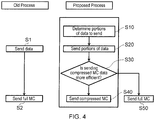
- Figure 4 provides an overview of how the instruction rdma_mc_put works in an embodiment of the present invention (“Proposed Process”) as compared to the state of the art (“Old Process”).
- the invention provides instructions to accomplish high performance memory correctness checking, and allowing co-ordination of transferring user data and MC at the hardware level.
- step S10 the network interface controller of the source processor determines which portions of the user data to send. As explained below, this step checks the MC of user data requested to be sent, against the selected mode to see if it may be sent. This step may be performed bit by bit of the user data; alternatively any other required subdivision of the user data (such as in byte units) may be used.
- the appropriate parts of the user data are then sent to the network interface controller of the destination node (step S20).
- step S30 it is determined how to send the memory correctness information MC.
- the choice here is between normal, uncompressed MC or "compressed" MC (see below).
- the criterion for sending compressed MC, as opposed to full (uncompressed) MC, is whether sending compressed MC is more efficient than sending full MC taking into account compression and transfer cost.
- a threshold for example 1000 or 100000 bytes, may be employed, depending on whether the NIC is more efficient at processing data (so that compression and/or calculation of ranges is preferred) or transferring data (so that a direct data transfer is preferred).
- step S30 If it is determined in step S30 to send compressed MC, the compressed MC is then transmitted over the network to the network interface controller of the destination processor in step S40; if not, the full MC is sent instead (S50).
- rdma_mc_put/rdma_mc_get are used in place of standard put/get.
- standard put/get must be used in an ad hoc fashion to accomplish one or two features of the invention perhaps in a limited part of the code.
- MC need not be in same remote location as user data.
- Fig. 3 shows MC being sent after the user data, this is purely for illustrative purposes. It is possible to send the MC first; parallel transmission of both is also possible and may indeed be preferable.
- step S10 in Figure 4 The determination of which parts of user data to send (step S10 in Figure 4 ) will now be explained in more detail.
- Each subunit of the user data down to as little as each individual bit of memory assigned to the user, will have one of two possible allocation states and one of two possible initialization states. Note that this differs from Rational Purify where each byte will have one of two possible allocation states and one of two possible initialization states. The difference is in granularity of the correctness tracking, allowing neighbouring bits in a byte to be tracked separately (bit-granularity) and not necessarily treated together (byte-granularity as in Rational Purify).
- the preferred implementation maintains the allocation and initialization states separately and contiguously although other arrangements are possible.
- the MC memory there will be distinct but contiguous memory areas for both allocation and initialization data.
- Each bit of memory assigned to the user will therefore have one of four possible memory correctness states in a similar fashion to that illustrated in Figure 3 , and as shown in Table 2.
- Table 2 A single bit of memory assigned to the user has one of four possible memory correctness states shown in the rows of the table. These states correspond to the possible combinations of allocation and initialization states, as also shown in Fig.3 . State Initialized Allocated 0 No No 1 No Yes 2 Yes No 3 Yes Yes
- the present embodiment allows data transfer to be handled differently for the different memory correctness states in Table 2.
- the instructions rdma_mc_put_mode and rdma_mc_get_mode are used to select how user data transfers are handled by selecting one of the sixteen possible modes shown in Table 3 below, numbered 0 to 15. Such mode selection may be changed during execution.
- Mode 8 is the most appropriate mode for ensuring that user data is only transferred when it is both legal and useful to do so.
- both the default put and get modes will be 15 so that all user data is transferred regardless of whether the user-chosen data is allocated or initialized.
- a completely correct program would give the same output using mode 8 or mode 15 (mode 15 corresponds to standard put/get).
- the permissive setting will use put and get mode 14 to allow tolerance of user errors with regard to allocation and initialization of memory assigned to the user.
- modes 9 to 14 can then be used to identify the type of incorrectness being relied on.
- Mode 7 can be used to identify that either the whole program or a portion of the program relies on accessing memory in one of the incorrect states 0, 1 and 2. Modes 1 to 6 can then be used to identify the type of incorrectness being relied on.
- the put and get modes may be set independently of each other and independently for each switch, router or NIC associated with different processing elements (able to carry out calculations and other computations) in order to isolate different types of memory correctness errors and localize them to a particular processing element.
- Table 3 Data transfer handling of any particular bit of memory assigned to the user depends on the data transfer mode selected for the four different memory correctness states. The memory correctness states are shown in the top row. In the body of the table, the number zero indicates non-transfer of data whereas the number one indicates transfer of data. Here, transfer and non-transfer refer only to memory assigned to the user. The transfer of memory correctness states is handled separately.
- the different user data transfer modes are numbered in the left-most column, from zero to 15.
- Rational Purify works at the byte (i.e. 8-bit level) and an embodiment of the present invention may provide this less computation-intensive option too. This can be achieved either using Rational Purify's byte level granularity, or by keeping bit-granularity but allowing switching to only checking the first bit of the byte and assuming that the other 7 bits are the same.
- state ranges can also be applied to the checking step. That is, the MC may be maintained in a compressed state right up until decompression is decided to be absolutely necessary. It is then possible to manipulate compressed ranges of MC, which is a simpler task than manipulating uncompressed memory correctness information.
- the RDMA memory correctness instructions rdma_mc_put and rdma_mc_get carry out remote memory accesses while maintaining the memory correctness state of memory assigned to the user.
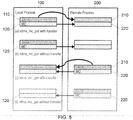
- Figure 5 shows remote memory accesses using rdma_mc_put and rdma_mc_get with complete transfer of memory correctness state information.
- the data transfer illustrated in Figure 5 is a simplified illustration showing either complete transfer of user data or non-transfer. In general, and in accordance with the mode selected from Table 3, part of the data will be transferred and part of the data will not be transferred.
- only the memory correctness information associated with the data actually transferred is also transferred, in order to maintain consistency of DATA and MC.
- Table 3 describes what happens both to the user data and the associated MC.
- all MC is transferred regardless of how much of the user data is actually transferred.
- FIG. 5 this shows remote memory access between a local process 100 and a remote process 200 with full sending of memory correctness state information.
- the user data, DATA is shown as dark-shaded blocks and memory correctness (MC) state information is shown as light-shaded blocks.
- MC memory correctness
- the proximity and positioning of the dark-shaded and light-shaded blocks are purely for illustration.
- the arrows show transfers of between processes 100, 200. The empty blocks indicate that no transfer has taken place into these regions of memory.
- Figure 5 illustrates four possible ways in which data may be transferred:
- the user data will all be of one or two of the memory correctness states shown in Table 2, so that the memory correctness state information can be sent in compressed form as "state ranges", or lengths (in byte or address terms) of user data having the same MC state.
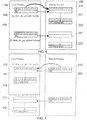
- Figure 6 shows placement of state ranges from a local process 100 onto a remote process 200 to achieve efficient sending of memory correctness state information (MC).
- MC memory correctness state information
- two bytes are used to signify the number of state ranges sent and this will typically number in the tens.
- the state ranges themselves are coded in eight bytes (more bytes may be used) with the highest two bits reserved to denote one of the states in Table 2, the size of the range being represented by the remaining 62-bits (or more if a larger size was chosen). The ranges are assumed to run one after another.
- compressed MC state information can take the form of a sequence of state ranges, preceded by a 2-byte value to signify the number of state ranges which follow.
- the exact form of representation will be hardware dependent and various possibilities will occur to the skilled person. For example, a virtual start address and a length may be used to define the start and end points of a state range.
- rdma_mc_put with transfer as in Fig. 5(a) the user data 110 is transferred along with the MC, the difference being that the MC 120 is compressed prior to transmission, to form compressed memory correctness information 221.
- a copy 210 of the user data is thus created at the remote process 200, and upon receipt of the compressed MC 221 this is expanded to form a copy (MC (recreated)) 222 of the original MC 120.
- the MC may not be necessary to decompress the MC immediately at the receiving process, as it may be maintained and/or manipulated in compressed form.
- Figure 7 likewise shows remote collection of data from a remote process 200 onto the local process 100 with efficient sending of memory correctness state information (MC).
- MC memory correctness state information
- the user data 210 is transferred from remote process 200 to local process 100 in similar fashion to Fig. 5(c) , and the MC is also obtained; however, it is transmitted in compressed form, the received compressed MC 111 being expanded as MC 112.
- Figure 7(b) shows an rdma_mc_get without transfer of user data, analogous with Figure 5(d) except for receiving the MC in compressed form.
- a novel rdma_mc_end instruction may be invoked to perform necessary "clean-up" operations.
- memory which has been reserved for RDMA may be returned to the system so that regular operations such as copying memory to and from disk can occur (RDMA reserved memory cannot be "paged” to disk as reads and write occur unexpectedly).
- Summary information may be calculated (e.g. total number of puts/gets requested and amount of data transferred) and, for example, output to a display device for inspection by a human operator.
- the present invention is intended to be implemented in the NIC of each processor or processing element which is part of a larger system.
- one form of implementation of the disclosed RDMA instructions supporting memory correctness checking is in the on-chip network interface controllers or switches. That is, each network interface controller or switch is adapted to recognise the novel instructions provided by the present invention and act on them accordingly for RDMA purposes.
- a NIC includes hardware means such as a control unit (possibly, a DMA controller) which is responsive to the novel instructions described above, these instructions being received from the local node, for example via a local bus.
- the control unit controls reading and/or writing over the network, for example via packet transmitting and receiving units.
- a packet transmitting unit may be arranged to receive data from a local memory of the local node and configured to form the data into one or more suitably-formatted packets for transmission over the network.
- the packet receiving unit may be arranged to receive packets over the network and decode, divide or recombine them to a form understood by the local processor. Both circuits will be coupled, through the network, to corresponding units at the destination node.
- the instructions may direct data transfer between storages local to two processing elements.
- the large shared storage/cache may be divided equally between the different processing elements and the RDMA instructions direct data transfer between parts of the large shared cache currently allocated to different processing elements.
- an embodiment of the present invention can provide a process to send memory correctness information (to support memory correctness checking) on systems (e.g. a supercomputer or network-on-chip) with distributed memory and with different parts of the system connected by a network.
- systems e.g. a supercomputer or network-on-chip
- RDMA Remote Direct Memory Access
- the rdma_mc_put and rdma_mc_get instructions activate the transfer of compressed or fully expanded memory correctness information to maximize efficiency.
- Transfer modes may be specified separately for the put and get operations and these are independent for each processing element to allow localization of memory handling errors to a particular processing element.
- the disclosed RDMA memory correctness checking instructions enable high performance as compared to the state-of-the-art as exemplified by the Valgrind tool with its MPI wrappers, IBM Rational Purify's memory error detection functionality, Insure++ and other such tools.
- embodiments of the present invention can provide Remote Direct Memory Access instructions supporting memory correctness checking, by transferring memory correctness information, implemented in network interface controllers or switches or routers of a conventional computer or a Network-on-chip processor.
- the above-mentioned RDMA instructions may use a compressed mode of transfer for ranges of memory correctness information.
- RDMA instructions allow configurable transfer modes separately selectable for the put/get operations and separately selectable for different processing elements.
- the disclosed invention allows memory correctness checking to be performed efficiently and in a highly configurable way in traditional and emerging languages for Network-on-chip processors and massively parallel computers.
- the invention provides an automated way of debugging memory correctness that shortens time taken in debugging and shortens development time for programming on distributed memory systems.
Landscapes
- Engineering & Computer Science (AREA)
- Theoretical Computer Science (AREA)
- Computer Hardware Design (AREA)
- Quality & Reliability (AREA)
- Physics & Mathematics (AREA)
- General Engineering & Computer Science (AREA)
- General Physics & Mathematics (AREA)
- Multi Processors (AREA)
- Debugging And Monitoring (AREA)
Claims (15)
- Hardwareimplementierte Kommunikationsschnittstelle (3, 30) für einen Prozessor (2, 20), wobei der Prozessor als ein Knoten in einem verteilten Computersystem verwendet wird, wobei die Kommunikationsschnittstelle Mittel für den direkten Fernzugriff auf einen Speicher zum Übertragen von Anwenderdaten (110, 210) zwischen einem von dem Prozessor verwendeten Speicher (8) und einem von einem anderen Knoten im System verwendeten Speicher und Mittel zum Überprüfen der Richtigkeit des Speichers zum Aufrechterhalten von Informationen über die Richtigkeit des Speichers (120, 220) der jeweiligen Untereinheiten von Anwenderdaten umfasst, wobei das Mittel für den direkten Fernzugriff auf einen Speicher als Antwort auf eine vorbestimmte Anweisung zum direkten Fernzugriff auf einen Speicher zum Durchführen des direkten Fernzugriffs auf einen Speicher durch ausgewähltes Übertragen von Untereinheiten der Anwenderdaten (110, 210) in Abhängigkeit von den Informationen über die Richtigkeit des Speichers (120, 220) betreibbar ist.
- Kommunikationsschnittstelle nach Anspruch 1, die weiterhin zusätzlich zu den ausgewählten Untereinheiten von Anwenderdaten (110, 210) zum Übertragen der Informationen über die Richtigkeit des Speichers (120, 220) betreibbar ist.
- Kommunikationsschnittstelle nach Anspruch 2, die zum Übertragen aller Informationen über die Richtigkeit des Speichers (120, 220) der Anwenderdaten (110, 210) angeordnet ist, die Gegenstand der Anweisung sind.
- Kommunikationsschnittstelle nach Anspruch 2, die zum Übertragen nur der Informationen über die Richtigkeit des Speichers (120, 220) der ausgewählten Untereinheiten von Anwenderdaten (110, 210) angeordnet ist.
- Kommunikationsschnittstelle nach Anspruch 2, 3 oder 4, die zum Komprimieren der Informationen über die Richtigkeit des Speichers (120, 220) vor dem Übertragen angeordnet ist.
- Kommunikationsschnittstelle nach einem der vorhergehenden Ansprüche, wobei die Informationen über die Richtigkeit des Speichers (120, 220) für jede Untereinheit von Anwenderdaten (110, 210) einen einer Vielzahl von möglichen Zuständen der Richtigkeit des Speichers als den Zustand der Richtigkeit des Speichers dieser Untereinheit angeben.
- Kommunikationsschnittstelle nach Anspruch 6, wobei das Mittel für den direkten Fernzugriff zum Auswählen von Untereinheiten von Anwenderdaten (110, 210) zum Übertragen in Übereinstimmung mit einem angewiesenen Datenübertragungsmodus angeordnet ist, wobei der Modus für jeden möglichen Zustand der Richtigkeit des Speichers festlegt, ob die Übertragung zulässig ist.
- Kommunikationsschnittstelle nach Anspruch 7, wobei der Datenübertragungsmodus getrennt für Schreibanwenderdaten (110) zu dem Fernknoten und Leseanwenderdaten (210) von dem Fernknoten festlegbar sowie getrennt für jeden an der Übertragung beteiligten Knoten festlegbar ist.
- Kommunikationsschnittstelle nach einem der vorhergehenden Ansprüche, wobei die Größe jeder Untereinheit festlegbar ist.
- Kommunikationsschnittstelle nach einem der vorhergehenden Ansprüche, wobei die vorbestimmte Anweisung zum direkten Fernzugriff auf einen Speicher alle festlegt: (i) direkten Fernzugriff auf einen Speicher, (ii) Überprüfung der Richtigkeit des Speichers und (iii) Speichern oder Auslesen.
- Verfahren für den hardwareimplementierten direkten Fernzugriff auf einen Speicher zur Verwendung in einem Computersystem mit einer Vielzahl von Knoten (2, 20), wobei jeder Knoten jeweils einen Speicher (8) verwendet und wobei ein direkter Fernzugriff auf einen Speicher durch Übertragen von Anwenderdaten (110, 210) von einem von einem Knoten verwendeten Speicher zu einem von einem anderen Knoten verwendeten Speicher durchgeführt wird, wobei das Verfahren umfasst:Aufrechterhalten von Informationen über die Richtigkeit des Speichers (120, 220) von Anwenderdaten auf einer Untereinheitenebene; undals Antwort auf eine vorbestimmte Anweisung zum direkten Fernzugriff auf einen Speicher:Auswählen von Untereinheiten von Anwenderdaten (110, 210) zum Übertragen in Abhängigkeit von Informationen über die Richtigkeit des Speichers (120, 220) jeder Untereinheit; undausgewähltes Übertragen der so ausgewählten Untereinheiten.
- Verfahren für den direkten Fernzugriff auf einen Speicher nach Anspruch 11, weiterhin umfassend:zusätzlich zu den ausgewählten Untereinheiten von Anwenderdaten Übertragen der Informationen über die Richtigkeit des Speichers (120, 220) mindestens der ausgewählten Untereinheiten von Anwenderdaten (110, 210).
- Verfahren für den direkten Fernzugriff auf einen Speicher nach Anspruch 12, weiterhin umfassend:Komprimieren der Informationen über die Richtigkeit des Speichers (120, 220) vor dem Übertragen.
- Verfahren für den direkten Fernzugriff auf einen Speicher nach einem der Ansprüche 10 bis 13, wobei das Auswählen umfasst:Vergleichen eines Zustands der Richtigkeit des Speichers jeder Untereinheit mit einem vorbestimmten Datenübertragungsmodus, der das Übertragen oder Nichtübertragen jedes einer Vielzahl von möglichen Zuständen der Richtigkeit des Speichers festlegt.
- Computerlesbare Anweisungen, die beim Ausführen durch eine hardwareimplementierte Kommunikationsschnittstelle eines Knotens in einem verteilten Computersystem das Verfahren nach einem der Ansprüche 11 bis 14 durchführen.
Priority Applications (3)
| Application Number | Priority Date | Filing Date | Title |
|---|---|---|---|
| EP11152773.5A EP2482191B1 (de) | 2011-01-31 | 2011-01-31 | Speicherkorrektheitsprüfung in verteilten Computersystemen |
| JP2012016853A JP5780167B2 (ja) | 2011-01-31 | 2012-01-30 | 分散コンピュータシステムにおけるメモリの正確性チェック |
| US13/362,550 US8892957B2 (en) | 2011-01-31 | 2012-01-31 | Memory correctness checking in distributed computer systems |
Applications Claiming Priority (1)
| Application Number | Priority Date | Filing Date | Title |
|---|---|---|---|
| EP11152773.5A EP2482191B1 (de) | 2011-01-31 | 2011-01-31 | Speicherkorrektheitsprüfung in verteilten Computersystemen |
Publications (2)
| Publication Number | Publication Date |
|---|---|
| EP2482191A1 EP2482191A1 (de) | 2012-08-01 |
| EP2482191B1 true EP2482191B1 (de) | 2017-03-22 |
Family
ID=44117207
Family Applications (1)
| Application Number | Title | Priority Date | Filing Date |
|---|---|---|---|
| EP11152773.5A Not-in-force EP2482191B1 (de) | 2011-01-31 | 2011-01-31 | Speicherkorrektheitsprüfung in verteilten Computersystemen |
Country Status (3)
| Country | Link |
|---|---|
| US (1) | US8892957B2 (de) |
| EP (1) | EP2482191B1 (de) |
| JP (1) | JP5780167B2 (de) |
Families Citing this family (11)
| Publication number | Priority date | Publication date | Assignee | Title |
|---|---|---|---|---|
| JP5937209B2 (ja) * | 2012-07-03 | 2016-06-22 | 株式会社日立製作所 | 故障影響評価システム及び評価方法 |
| US10275375B2 (en) | 2013-03-10 | 2019-04-30 | Mellanox Technologies, Ltd. | Network interface controller with compression capabilities |
| US9696933B2 (en) * | 2014-08-15 | 2017-07-04 | International Business Machines Corporation | Virtual machine manager initiated page-in of kernel pages |
| US10331595B2 (en) * | 2014-10-23 | 2019-06-25 | Mellanox Technologies, Ltd. | Collaborative hardware interaction by multiple entities using a shared queue |
| US9287208B1 (en) * | 2014-10-27 | 2016-03-15 | Intel Corporation | Architecture for on-die interconnect |
| US9792248B2 (en) | 2015-06-02 | 2017-10-17 | Microsoft Technology Licensing, Llc | Fast read/write between networked computers via RDMA-based RPC requests |
| US10725963B2 (en) | 2015-09-12 | 2020-07-28 | Microsoft Technology Licensing, Llc | Distributed lock-free RDMA-based memory allocation and de-allocation |
| US10713210B2 (en) | 2015-10-13 | 2020-07-14 | Microsoft Technology Licensing, Llc | Distributed self-directed lock-free RDMA-based B-tree key-value manager |
| US10375167B2 (en) | 2015-11-20 | 2019-08-06 | Microsoft Technology Licensing, Llc | Low latency RDMA-based distributed storage |
| EP3333714B1 (de) * | 2016-12-07 | 2020-02-12 | Commissariat A L'energie Atomique Et Aux Energies Alternatives | Computerimplementiertes verfahren und system zur codierung eines stapelanwendungsspeicherzustands mit einem schattenspeicher |
| CN117539705B (zh) * | 2024-01-10 | 2024-06-11 | 深圳鲲云信息科技有限公司 | 片上系统的验证方法、装置、系统及电子设备 |
Family Cites Families (8)
| Publication number | Priority date | Publication date | Assignee | Title |
|---|---|---|---|---|
| JPH03161845A (ja) * | 1989-11-20 | 1991-07-11 | Mitsubishi Electric Corp | 情報処理装置 |
| US5193180A (en) * | 1991-06-21 | 1993-03-09 | Pure Software Inc. | System for modifying relocatable object code files to monitor accesses to dynamically allocated memory |
| US5613063A (en) * | 1994-07-01 | 1997-03-18 | Digital Equipment Corporation | Method and apparatus for checking validity of memory operations |
| US6711709B1 (en) * | 1998-06-24 | 2004-03-23 | Unisys Corporation | Integrated block checking system for rapid file transfer of compressed data |
| US6634020B1 (en) * | 2000-03-24 | 2003-10-14 | International Business Machines Corporation | Uninitialized memory watch |
| JP3848171B2 (ja) * | 2002-02-01 | 2006-11-22 | 富士通株式会社 | 計算機シミュレーションプログラム、プロセッサのモデルの検証方法、及び計算機シミュレーション方法 |
| ES2671059T3 (es) * | 2003-07-17 | 2018-06-04 | e-distribuzione S.p.A. | Procedimiento y sistema para actualizaciones remotas de medidores para medir el consumo de electricidad, agua o gas |
| US7702821B2 (en) * | 2005-09-15 | 2010-04-20 | Eye-Fi, Inc. | Content-aware digital media storage device and methods of using the same |
-
2011
- 2011-01-31 EP EP11152773.5A patent/EP2482191B1/de not_active Not-in-force
-
2012
- 2012-01-30 JP JP2012016853A patent/JP5780167B2/ja active Active
- 2012-01-31 US US13/362,550 patent/US8892957B2/en not_active Expired - Fee Related
Non-Patent Citations (1)
| Title |
|---|
| None * |
Also Published As
| Publication number | Publication date |
|---|---|
| EP2482191A1 (de) | 2012-08-01 |
| US20120198284A1 (en) | 2012-08-02 |
| US8892957B2 (en) | 2014-11-18 |
| JP2012160182A (ja) | 2012-08-23 |
| JP5780167B2 (ja) | 2015-09-16 |
Similar Documents
| Publication | Publication Date | Title |
|---|---|---|
| EP2482191B1 (de) | Speicherkorrektheitsprüfung in verteilten Computersystemen | |
| US8799917B2 (en) | Balancing a data processing load among a plurality of compute nodes in a parallel computer | |
| EP4044042B1 (de) | Verfahren zur unterstützung von multiverbindungsprotokollen für eine verbindung | |
| US8478982B2 (en) | Media access control security management in physical layer | |
| Mogul et al. | The packer filter: an efficient mechanism for user-level network code | |
| US7895260B2 (en) | Processing data access requests among a plurality of compute nodes | |
| US8595736B2 (en) | Parsing an application to find serial and parallel data segments to minimize mitigation overhead between serial and parallel compute nodes | |
| US12455741B2 (en) | Low overhead error correction code | |
| US7653716B2 (en) | Determining a bisection bandwidth for a multi-node data communications network | |
| US8122228B2 (en) | Broadcasting collective operation contributions throughout a parallel computer | |
| US9424087B2 (en) | Optimizing collective operations | |
| US20100005189A1 (en) | Pacing Network Traffic Among A Plurality Of Compute Nodes Connected Using A Data Communications Network | |
| US7797445B2 (en) | Dynamic network link selection for transmitting a message between compute nodes of a parallel computer | |
| US20100017655A1 (en) | Error Recovery During Execution Of An Application On A Parallel Computer | |
| US9404970B2 (en) | Debug interface for multiple CPU cores | |
| US20110267197A1 (en) | Monitoring Operating Parameters In A Distributed Computing System With Active Messages | |
| US7796527B2 (en) | Computer hardware fault administration | |
| US20130246533A1 (en) | Broadcasting A Message In A Parallel Computer | |
| US20090240930A1 (en) | Executing An Application On A Parallel Computer | |
| US9348661B2 (en) | Assigning a unique identifier to a communicator | |
| US7646721B2 (en) | Locating hardware faults in a data communications network of a parallel computer | |
| US20080178177A1 (en) | Method and Apparatus for Operating a Massively Parallel Computer System to Utilize Idle Processor Capability at Process Synchronization Points | |
| US9246792B2 (en) | Providing point to point communications among compute nodes in a global combining network of a parallel computer | |
| US8296457B2 (en) | Providing nearest neighbor point-to-point communications among compute nodes of an operational group in a global combining network of a parallel computer | |
| US20090300624A1 (en) | Tracking data processing in an application carried out on a distributed computing system |
Legal Events
| Date | Code | Title | Description |
|---|---|---|---|
| PUAI | Public reference made under article 153(3) epc to a published international application that has entered the european phase |
Free format text: ORIGINAL CODE: 0009012 |
|
| AK | Designated contracting states |
Kind code of ref document: A1 Designated state(s): AL AT BE BG CH CY CZ DE DK EE ES FI FR GB GR HR HU IE IS IT LI LT LU LV MC MK MT NL NO PL PT RO RS SE SI SK SM TR |
|
| AX | Request for extension of the european patent |
Extension state: BA ME |
|
| 17P | Request for examination filed |
Effective date: 20130128 |
|
| 17Q | First examination report despatched |
Effective date: 20150706 |
|
| GRAP | Despatch of communication of intention to grant a patent |
Free format text: ORIGINAL CODE: EPIDOSNIGR1 |
|
| INTG | Intention to grant announced |
Effective date: 20161013 |
|
| GRAS | Grant fee paid |
Free format text: ORIGINAL CODE: EPIDOSNIGR3 |
|
| GRAA | (expected) grant |
Free format text: ORIGINAL CODE: 0009210 |
|
| AK | Designated contracting states |
Kind code of ref document: B1 Designated state(s): AL AT BE BG CH CY CZ DE DK EE ES FI FR GB GR HR HU IE IS IT LI LT LU LV MC MK MT NL NO PL PT RO RS SE SI SK SM TR |
|
| REG | Reference to a national code |
Ref country code: GB Ref legal event code: FG4D |
|
| REG | Reference to a national code |
Ref country code: CH Ref legal event code: EP |
|
| REG | Reference to a national code |
Ref country code: AT Ref legal event code: REF Ref document number: 878406 Country of ref document: AT Kind code of ref document: T Effective date: 20170415 |
|
| REG | Reference to a national code |
Ref country code: IE Ref legal event code: FG4D |
|
| REG | Reference to a national code |
Ref country code: DE Ref legal event code: R096 Ref document number: 602011036131 Country of ref document: DE |
|
| REG | Reference to a national code |
Ref country code: NL Ref legal event code: MP Effective date: 20170322 |
|
| PG25 | Lapsed in a contracting state [announced via postgrant information from national office to epo] |
Ref country code: GR Free format text: LAPSE BECAUSE OF FAILURE TO SUBMIT A TRANSLATION OF THE DESCRIPTION OR TO PAY THE FEE WITHIN THE PRESCRIBED TIME-LIMIT Effective date: 20170623 Ref country code: NO Free format text: LAPSE BECAUSE OF FAILURE TO SUBMIT A TRANSLATION OF THE DESCRIPTION OR TO PAY THE FEE WITHIN THE PRESCRIBED TIME-LIMIT Effective date: 20170622 Ref country code: LT Free format text: LAPSE BECAUSE OF FAILURE TO SUBMIT A TRANSLATION OF THE DESCRIPTION OR TO PAY THE FEE WITHIN THE PRESCRIBED TIME-LIMIT Effective date: 20170322 Ref country code: FI Free format text: LAPSE BECAUSE OF FAILURE TO SUBMIT A TRANSLATION OF THE DESCRIPTION OR TO PAY THE FEE WITHIN THE PRESCRIBED TIME-LIMIT Effective date: 20170322 Ref country code: HR Free format text: LAPSE BECAUSE OF FAILURE TO SUBMIT A TRANSLATION OF THE DESCRIPTION OR TO PAY THE FEE WITHIN THE PRESCRIBED TIME-LIMIT Effective date: 20170322 |
|
| REG | Reference to a national code |
Ref country code: LT Ref legal event code: MG4D |
|
| REG | Reference to a national code |
Ref country code: AT Ref legal event code: MK05 Ref document number: 878406 Country of ref document: AT Kind code of ref document: T Effective date: 20170322 |
|
| PG25 | Lapsed in a contracting state [announced via postgrant information from national office to epo] |
Ref country code: BG Free format text: LAPSE BECAUSE OF FAILURE TO SUBMIT A TRANSLATION OF THE DESCRIPTION OR TO PAY THE FEE WITHIN THE PRESCRIBED TIME-LIMIT Effective date: 20170622 Ref country code: RS Free format text: LAPSE BECAUSE OF FAILURE TO SUBMIT A TRANSLATION OF THE DESCRIPTION OR TO PAY THE FEE WITHIN THE PRESCRIBED TIME-LIMIT Effective date: 20170322 Ref country code: SE Free format text: LAPSE BECAUSE OF FAILURE TO SUBMIT A TRANSLATION OF THE DESCRIPTION OR TO PAY THE FEE WITHIN THE PRESCRIBED TIME-LIMIT Effective date: 20170322 Ref country code: LV Free format text: LAPSE BECAUSE OF FAILURE TO SUBMIT A TRANSLATION OF THE DESCRIPTION OR TO PAY THE FEE WITHIN THE PRESCRIBED TIME-LIMIT Effective date: 20170322 |
|
| PG25 | Lapsed in a contracting state [announced via postgrant information from national office to epo] |
Ref country code: NL Free format text: LAPSE BECAUSE OF FAILURE TO SUBMIT A TRANSLATION OF THE DESCRIPTION OR TO PAY THE FEE WITHIN THE PRESCRIBED TIME-LIMIT Effective date: 20170322 |
|
| PG25 | Lapsed in a contracting state [announced via postgrant information from national office to epo] |
Ref country code: ES Free format text: LAPSE BECAUSE OF FAILURE TO SUBMIT A TRANSLATION OF THE DESCRIPTION OR TO PAY THE FEE WITHIN THE PRESCRIBED TIME-LIMIT Effective date: 20170322 Ref country code: AT Free format text: LAPSE BECAUSE OF FAILURE TO SUBMIT A TRANSLATION OF THE DESCRIPTION OR TO PAY THE FEE WITHIN THE PRESCRIBED TIME-LIMIT Effective date: 20170322 Ref country code: EE Free format text: LAPSE BECAUSE OF FAILURE TO SUBMIT A TRANSLATION OF THE DESCRIPTION OR TO PAY THE FEE WITHIN THE PRESCRIBED TIME-LIMIT Effective date: 20170322 Ref country code: SK Free format text: LAPSE BECAUSE OF FAILURE TO SUBMIT A TRANSLATION OF THE DESCRIPTION OR TO PAY THE FEE WITHIN THE PRESCRIBED TIME-LIMIT Effective date: 20170322 Ref country code: CZ Free format text: LAPSE BECAUSE OF FAILURE TO SUBMIT A TRANSLATION OF THE DESCRIPTION OR TO PAY THE FEE WITHIN THE PRESCRIBED TIME-LIMIT Effective date: 20170322 Ref country code: RO Free format text: LAPSE BECAUSE OF FAILURE TO SUBMIT A TRANSLATION OF THE DESCRIPTION OR TO PAY THE FEE WITHIN THE PRESCRIBED TIME-LIMIT Effective date: 20170322 |
|
| PG25 | Lapsed in a contracting state [announced via postgrant information from national office to epo] |
Ref country code: IS Free format text: LAPSE BECAUSE OF FAILURE TO SUBMIT A TRANSLATION OF THE DESCRIPTION OR TO PAY THE FEE WITHIN THE PRESCRIBED TIME-LIMIT Effective date: 20170722 Ref country code: PT Free format text: LAPSE BECAUSE OF FAILURE TO SUBMIT A TRANSLATION OF THE DESCRIPTION OR TO PAY THE FEE WITHIN THE PRESCRIBED TIME-LIMIT Effective date: 20170724 Ref country code: SM Free format text: LAPSE BECAUSE OF FAILURE TO SUBMIT A TRANSLATION OF THE DESCRIPTION OR TO PAY THE FEE WITHIN THE PRESCRIBED TIME-LIMIT Effective date: 20170322 Ref country code: PL Free format text: LAPSE BECAUSE OF FAILURE TO SUBMIT A TRANSLATION OF THE DESCRIPTION OR TO PAY THE FEE WITHIN THE PRESCRIBED TIME-LIMIT Effective date: 20170322 |
|
| REG | Reference to a national code |
Ref country code: DE Ref legal event code: R097 Ref document number: 602011036131 Country of ref document: DE |
|
| PLBE | No opposition filed within time limit |
Free format text: ORIGINAL CODE: 0009261 |
|
| STAA | Information on the status of an ep patent application or granted ep patent |
Free format text: STATUS: NO OPPOSITION FILED WITHIN TIME LIMIT |
|
| PG25 | Lapsed in a contracting state [announced via postgrant information from national office to epo] |
Ref country code: DK Free format text: LAPSE BECAUSE OF FAILURE TO SUBMIT A TRANSLATION OF THE DESCRIPTION OR TO PAY THE FEE WITHIN THE PRESCRIBED TIME-LIMIT Effective date: 20170322 |
|
| 26N | No opposition filed |
Effective date: 20180102 |
|
| PG25 | Lapsed in a contracting state [announced via postgrant information from national office to epo] |
Ref country code: SI Free format text: LAPSE BECAUSE OF FAILURE TO SUBMIT A TRANSLATION OF THE DESCRIPTION OR TO PAY THE FEE WITHIN THE PRESCRIBED TIME-LIMIT Effective date: 20170322 Ref country code: IT Free format text: LAPSE BECAUSE OF FAILURE TO SUBMIT A TRANSLATION OF THE DESCRIPTION OR TO PAY THE FEE WITHIN THE PRESCRIBED TIME-LIMIT Effective date: 20170322 |
|
| REG | Reference to a national code |
Ref country code: DE Ref legal event code: R119 Ref document number: 602011036131 Country of ref document: DE |
|
| REG | Reference to a national code |
Ref country code: CH Ref legal event code: PL |
|
| GBPC | Gb: european patent ceased through non-payment of renewal fee |
Effective date: 20180131 |
|
| PG25 | Lapsed in a contracting state [announced via postgrant information from national office to epo] |
Ref country code: DE Free format text: LAPSE BECAUSE OF NON-PAYMENT OF DUE FEES Effective date: 20180801 Ref country code: FR Free format text: LAPSE BECAUSE OF NON-PAYMENT OF DUE FEES Effective date: 20180131 Ref country code: LU Free format text: LAPSE BECAUSE OF NON-PAYMENT OF DUE FEES Effective date: 20180131 |
|
| REG | Reference to a national code |
Ref country code: IE Ref legal event code: MM4A |
|
| REG | Reference to a national code |
Ref country code: FR Ref legal event code: ST Effective date: 20180928 |
|
| REG | Reference to a national code |
Ref country code: BE Ref legal event code: MM Effective date: 20180131 |
|
| PG25 | Lapsed in a contracting state [announced via postgrant information from national office to epo] |
Ref country code: CH Free format text: LAPSE BECAUSE OF NON-PAYMENT OF DUE FEES Effective date: 20180131 Ref country code: LI Free format text: LAPSE BECAUSE OF NON-PAYMENT OF DUE FEES Effective date: 20180131 Ref country code: BE Free format text: LAPSE BECAUSE OF NON-PAYMENT OF DUE FEES Effective date: 20180131 Ref country code: GB Free format text: LAPSE BECAUSE OF NON-PAYMENT OF DUE FEES Effective date: 20180131 |
|
| PG25 | Lapsed in a contracting state [announced via postgrant information from national office to epo] |
Ref country code: IE Free format text: LAPSE BECAUSE OF NON-PAYMENT OF DUE FEES Effective date: 20180131 |
|
| PG25 | Lapsed in a contracting state [announced via postgrant information from national office to epo] |
Ref country code: MC Free format text: LAPSE BECAUSE OF FAILURE TO SUBMIT A TRANSLATION OF THE DESCRIPTION OR TO PAY THE FEE WITHIN THE PRESCRIBED TIME-LIMIT Effective date: 20170322 |
|
| PG25 | Lapsed in a contracting state [announced via postgrant information from national office to epo] |
Ref country code: MT Free format text: LAPSE BECAUSE OF NON-PAYMENT OF DUE FEES Effective date: 20180131 |
|
| PG25 | Lapsed in a contracting state [announced via postgrant information from national office to epo] |
Ref country code: TR Free format text: LAPSE BECAUSE OF FAILURE TO SUBMIT A TRANSLATION OF THE DESCRIPTION OR TO PAY THE FEE WITHIN THE PRESCRIBED TIME-LIMIT Effective date: 20170322 |
|
| PG25 | Lapsed in a contracting state [announced via postgrant information from national office to epo] |
Ref country code: HU Free format text: LAPSE BECAUSE OF FAILURE TO SUBMIT A TRANSLATION OF THE DESCRIPTION OR TO PAY THE FEE WITHIN THE PRESCRIBED TIME-LIMIT; INVALID AB INITIO Effective date: 20110131 |
|
| PG25 | Lapsed in a contracting state [announced via postgrant information from national office to epo] |
Ref country code: MK Free format text: LAPSE BECAUSE OF NON-PAYMENT OF DUE FEES Effective date: 20170322 Ref country code: CY Free format text: LAPSE BECAUSE OF FAILURE TO SUBMIT A TRANSLATION OF THE DESCRIPTION OR TO PAY THE FEE WITHIN THE PRESCRIBED TIME-LIMIT Effective date: 20170322 |
|
| PG25 | Lapsed in a contracting state [announced via postgrant information from national office to epo] |
Ref country code: AL Free format text: LAPSE BECAUSE OF FAILURE TO SUBMIT A TRANSLATION OF THE DESCRIPTION OR TO PAY THE FEE WITHIN THE PRESCRIBED TIME-LIMIT Effective date: 20170322 |