EP2482477B1 - Procédé destiné à la transmission de signaux de données émis par les utilisateurs dans un réseau de communication de diffusion à fréquence unique - Google Patents
Procédé destiné à la transmission de signaux de données émis par les utilisateurs dans un réseau de communication de diffusion à fréquence unique Download PDFInfo
- Publication number
- EP2482477B1 EP2482477B1 EP12152899.6A EP12152899A EP2482477B1 EP 2482477 B1 EP2482477 B1 EP 2482477B1 EP 12152899 A EP12152899 A EP 12152899A EP 2482477 B1 EP2482477 B1 EP 2482477B1
- Authority
- EP
- European Patent Office
- Prior art keywords
- uplink
- cgc
- ground station
- terminals
- data
- Prior art date
- Legal status (The legal status is an assumption and is not a legal conclusion. Google has not performed a legal analysis and makes no representation as to the accuracy of the status listed.)
- Active
Links
Images

Classifications
-
- H—ELECTRICITY
- H04—ELECTRIC COMMUNICATION TECHNIQUE
- H04H—BROADCAST COMMUNICATION
- H04H20/00—Arrangements for broadcast or for distribution combined with broadcast
- H04H20/28—Arrangements for simultaneous broadcast of plural pieces of information
- H04H20/30—Arrangements for simultaneous broadcast of plural pieces of information by a single channel
-
- H—ELECTRICITY
- H04—ELECTRIC COMMUNICATION TECHNIQUE
- H04H—BROADCAST COMMUNICATION
- H04H20/00—Arrangements for broadcast or for distribution combined with broadcast
- H04H20/42—Arrangements for resource management
- H04H20/423—Transmitter side
-
- H—ELECTRICITY
- H04—ELECTRIC COMMUNICATION TECHNIQUE
- H04H—BROADCAST COMMUNICATION
- H04H20/00—Arrangements for broadcast or for distribution combined with broadcast
- H04H20/65—Arrangements characterised by transmission systems for broadcast
- H04H20/67—Common-wave systems, i.e. using separate transmitters operating on substantially the same frequency
-
- H—ELECTRICITY
- H04—ELECTRIC COMMUNICATION TECHNIQUE
- H04H—BROADCAST COMMUNICATION
- H04H20/00—Arrangements for broadcast or for distribution combined with broadcast
- H04H20/65—Arrangements characterised by transmission systems for broadcast
- H04H20/71—Wireless systems
- H04H20/72—Wireless systems of terrestrial networks
-
- H—ELECTRICITY
- H04—ELECTRIC COMMUNICATION TECHNIQUE
- H04H—BROADCAST COMMUNICATION
- H04H20/00—Arrangements for broadcast or for distribution combined with broadcast
- H04H20/65—Arrangements characterised by transmission systems for broadcast
- H04H20/71—Wireless systems
- H04H20/74—Wireless systems of satellite networks
-
- H—ELECTRICITY
- H04—ELECTRIC COMMUNICATION TECHNIQUE
- H04H—BROADCAST COMMUNICATION
- H04H2201/00—Aspects of broadcast communication
- H04H2201/30—Aspects of broadcast communication characterised by the use of a return channel, e.g. for collecting users' opinions, for returning broadcast space/time information or for requesting data
Definitions
- the invention relates to a method for transmitting payload data signals in a direct-frequency communications network.
- This communication network may, for example, be the DVB-SH (Digital Video Broadcast Satellite Services to Handheld).
- DVB-SH Digital Video Broadcast Satellite Services to Handheld. The invention will be described below with reference to this standard, but is not limited to this standard.
- the new DVB-SH standard was developed to provide mobile subscribers with an efficient radio service in the frequency range below 3 GHz by means of an integrated communication system, which includes satellite and terrestrial components.
- the satellite allows a wide coverage area to provide services for satellite terminals, but the shading effect of trees and tall buildings results in terminals located in such areas being unable to receive the satellite signal because there is no line of sight in those areas between satellites and terminals.
- DVB-SH standard terrestrial components also referred to as Complementary Ground Components (CGC) or Ancillary Terrestrial Components (ATC), which transmit the same content as the satellite.
- CGC Complementary Ground Components
- ATC Ancillary Terrestrial Components
- Such CGC ground stations can be installed in areas where there are gaps in the satellite coverage area, eg in cities.
- Integrated terminal receivers conforming to the DVB-SH standard are capable of receiving the signals transmitted by satellites and / or CGC ground stations, whichever is available in the terminal's geographic environment, and if so If both signals can be received, the terminals are even able to combine the signals to improve the signal quality.
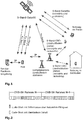
- Fig. 1 shows a schematic representation of such a system in which various types of terminals (outdoor use type, handheld type, vehicle type, professional type and type for use in buildings) can receive the satellite and the CGC signal to receive services from the service platform through the integrated system.
- various types of terminals outdoor use type, handheld type, vehicle type, professional type and type for use in buildings
- Satellites and CGC ground stations may transmit data using a Time Division Multiplexing (TDM) scheme or an Orthogonal Frequency Division Multiplexing (OFDM) scheme according to the DVB-SH specification.
- TDM Time Division Multiplexing
- OFDM Orthogonal Frequency Division Multiplexing
- satellites and CGC ground stations can operate in the single frequency network SFN (single frequency network), i. in the same frequency slot, while if they use different multiplexing schemes (e.g., satellite component TDM and CGC ground station OFDM), they should operate in the multi-frequency network (MFN); in different frequency slots.
- SFN single frequency network
- MFN multi-frequency network
- CGC ground stations are used installed to transmit the same data stream simultaneously and in the same frequency slot.
- the satellite operates in a different frequency slot than the CGC ground stations, but all CGC ground stations operate in the common service area in an SFN network.
- the problem solved by this invention is to identify individual CGC ground stations in a DC network having additional features compared to the rest of the CGC ground stations in the same SFN network, e.g. an uplink that terminals can access to send messages (instead of just receiving them).
- the DVB-SH standard used in a broadcast service specifies the satellite hub and the CGC ground stations only for downlink operation, i.e., in the downlink. the CGC ground stations repeat the satellite signal to the user terminals. No precautions are taken to use the CGC ground stations in the uplink. Nevertheless, there is interest in extending the set of services to include not only broadcast / multicast, but also interactive broadcast / multicast services and messaging, which requires the availability of an uplink channel.
- the identification of individual transmitters can be achieved by embedding in the transmitters a watermark sequence which uniquely identifies the transmitters in the network.
- a watermark is added at the content level. This can be done because the transmitters can send different content without jeopardizing the performance of the network. This is not the case for broadcast systems operating in an SFN network.
- DVB-T2 terrestrial digital television
- DVB-T2 also has several transmitters operating in an SFN network, and it is necessary for each test or commercial purpose to identify individual transmitters.
- the CGC identification is only for specifying the availability (or unavailability) of an uplink in this CGC ground station
- trial-and-error protocols are also possible.
- the CGC ground station does not actively provide any way to indicate the availability or unavailability of an uplink; it is rather the terminal trying to transmit messages in the frequency range assigned to the uplink in the system. If an ARQ mechanism is provided in the system that confirms the correct receipt of a message, after some attempts (in limited numbers) the terminal determines whether an uplink is available in the CGC ground station or not.
- the DVB-T2 proposed method of embedding a watermark at the high frequency level poses a backward compatibility problem.
- Embedding a watermark at the high frequency level in the DVB-T2 signal as shown in WO 2009/109883 proposed for DVB-T2 is in principle implementable, but also implies that the processing chain of the DVB-SH receiver chipset (hardware) must be updated, and this has an impact on costs.
- a watermark may be embedded in an additional (independent) signal and superimposed in CDM fashion on the very high spreading factor DVB-SH signal to allow negligible interference with the DVB-SH receivers, and in DVB-SH Terminals with send function Parallel to the DVB-SH receive chain, an additional receive chain is implemented that can demodulate and interpret the watermark. While this approach is backward compatible, it does have a cost implication, since in practice, transmitters must implement two receivers.
- the trial-and-error approach does not affect the cost of the terminal because it can be implemented in software as a "detection" algorithm in a protocol layer.
- this approach results in unnecessary battery drain (depending on the number of attempts made until an uplink is available or unavailable) and, ultimately, relatively long delays in successfully receiving a message in the uplink.
- An object of the invention is the provision of a signaling infrastructure, which allows the bidirectional use of a broadcast ground station.
- Claim 2 relates to a development of the invention.
- the invention relates to a direct-frequency broadcast communication system in which all terrestrial components (CGC ground stations) can transmit in the same frequency or transmit in the same frequency, and does not relate to a mobile radio network.
- each unicast-mode terrestrial component transmits to each user terminal data (or signaling) intended for a particular user, or in broadcast mode, data or signaling data common to all users in the coverage area of that terrestrial component are provided.
- those terrestrial components that are located closely adjacent, ie, have overlapping coverage areas transmit in different frequency slots or in different time slots or using different spreading codes so that the transmission data sent from different terrestrial components with overlapping coverage areas does not interfere with each other.
- the disadvantage of using watermarking is the high cost of the terminal as it requires two receivers.
- a more cost effective solution is proposed (without the need for a second receiver on the terminal, thus allowing for very low cost terminals) based on an intelligent position of the capability information of the terrestrial components in the data frame structure of the signal.
- Solutions that are used in terrestrial cellular mobile networks, such as out-of-band signaling, are currently not possible in the system according to the invention (which works in the DVB-SH system or S-band), since this additional Tape is not available and the user terminal should be kept as cheap as possible, so that the cost of installing more Receiver should be avoided.
- Essential feature of the invention is thus to transfer the reservation of certain data structures in the broadcast signal, for example "codewords" to configuration data that identifies a ground station as uplink capable.
- codewords reserved for this purpose are not used by the non-pluggable ground station, i.
- Non-uplink ground stations transmit in this reserved code words no payload or signaling data, but known "dummy" sequences.
- To transmit a dummy sequence in this context means that no (useful) data is transmitted, but any known sequence among the participants is transmitted, which can be relatively easily identified and thus deleted. This minimizes the effects of interference.
- an uplink may be provided by the satellite, by the CGC ground station, or by both.
- both satellite and CGC ground station uplinks are available, it is desirable that terminals located in the coverage area of a CGC ground station with uplink capability (ie, in the coverage area of a second ground station), Use the CGC uplink as the first option even when in line with the satellite.
- This operational requirement serves the purpose of distributing the uplink traffic such that the satellite link does not become a bottleneck and is only used if there is no uplink terrestrial component available, which is assuming that the capacity of the satellite uplink is comparable to the capacity of the CGC uplink.
- DVB-SH terminals must be operable in a DVB-SH network, which also has an uplink capability; in other words, the installation of a backward link must ensure backward compatibility with DVB-SH terminals implemented according to the DVB-SH specification.
- the present invention is based on relaxing the condition that all transmitters in an SFN network must send identical signals. If different transmitters of the same SFN network send different signals, they will interfere with each other and degrade network performance. However, the effect of such interference can be reduced such that the implied performance degradation takes on an acceptable (or even negligible) measure.
- Fig. 2 shows an example of a possible periodic assignment of a DVB-SH code word to indicate the existence of an uplink.
- the effect of interference in the effective coverage area of the uplink CGC ground station can be limited by imposing requirements on the installation of the SFN network (eg minimum distance between CGC ground stations, assigned EIRP (Equivalent Isotropically Radiated Power) for each Downlink CGC ground station, etc.) to guarantee the uplink service area in the desired geographic area.
- the SFN network eg minimum distance between CGC ground stations, assigned EIRP (Equivalent Isotropically Radiated Power) for each Downlink CGC ground station, etc.
- EIRP Equivalent Isotropically Radiated Power
- High power transmitters are installed to cover large areas while medium and low power transmitters are installed to cover the gaps left by the high power transmitters; this type of approach is called broadcasting care.
- the design of a transmitter network to supply a specific area depends considerably on the landscape. In radio-like coverage, the entire coverage area of some CGC ground stations may overlap, as in FIG Fig. 4 in which the CGC ground station has an available uplink.
- the CGC ground station "A" is a high performance CGC ground station, and the remaining CGC ground stations are these are medium or low power designed to fill the CGC ground station "A" supply gaps.
- the CGC ground stations "B” to “D” are located in areas where, for example due to the landscape, the CGC ground station "A” signal is weak and thus it can be assumed that the CGC ground stations " A "to” C "caused interference in the code word carrying various information is small in most of the coverage area of the CGC ground station" C ".
- the disadvantage of this solution is that a full code word must be reserved to perform signaling with respect to the uplinked CGC ground stations, and this code word can not be used to transmit user data or cues that are common to the entire SFN network. Given that a code word up to transport eight MPG-TS, this causes a not insignificant loss of capacity. However, the impact on capacity utilization is marginal if additional signaling related to the uplink CGC ground stations is also transmitted in the assigned uplink availability code word rather than this information to send whole SFN. Examples of this information include the currently applicable uplink configuration (frequency range, channels, etc.) and information related to the access scheme, eg, the spreading factor in the case of CDMA-based systems, etc.
- the invention can be used in interactive DVB-SH networks with terrestrial components (and satellite components) designed as return channel.
Landscapes
- Engineering & Computer Science (AREA)
- Signal Processing (AREA)
- Business, Economics & Management (AREA)
- General Business, Economics & Management (AREA)
- Mobile Radio Communication Systems (AREA)
Claims (2)
- Procédé de transmission de signaux de données d'utilisateur dans un réseau de communication de même fréquence de diffusion comprenant- au moins une première station au sol et au moins une deuxième station au sol et une pluralité de terminaux,- l'au moins une première station au sol et l'au moins une deuxième station au sol transmettant des données d'utilisateur reçues au niveau des terminaux et- l'au moins une deuxième station au sol étant en outre capable de recevoir et de transmettre des données depuis un terminal,- grâce à quoi avec le procédé,- l'au moins une première station au sol et l'au moins une deuxième station au sol recevant en même temps ou sensiblement en même des données d'utilisateur identiques et les transmettant aux terminaux en même temps ou sensiblement en même temps et- l'au moins une première station au sol et l'au moins une deuxième station au sol transmettant des données de configuration qui peuvent être traitées en plus des données d'utilisateur au niveau des terminaux,- les données de configuration transmises par l'une de l'au moins une première station au sol aux terminaux qui reçoivent ces données de configuration indiquant que la première station au sol en question est incapable de recevoir et/ou de transmettre potentiellement des données envoyées par ces terminaux,- seules les données de configuration transmises par l'un de l'au moins une deuxième station au sol aux terminaux qui reçoivent ces données de configuration, indiquant que la deuxième station au sol en question peut potentiellement recevoir et émettre des données envoyées par ces terminaux, et- l'au moins une première station au sol et l'au moins une deuxième station au sol envoyant les données de configuration respectives en utilisant la même bande de fréquence, le même créneau temporel et le même code d'étalement.
- Procédé selon la revendication 1, caractérisé en ce que le réseau de communication de même fréquence de diffusion comporte au moins un satellite capable de liaison montante et en ce qu'un terminal situé dans la zone de réception du satellite et d'une deuxième station au sol, dans le cas où ce terminal nécessite une liaison montante, envoie des données non pas au satellite mais à la deuxième station au sol.
Priority Applications (1)
| Application Number | Priority Date | Filing Date | Title |
|---|---|---|---|
| EP12152899.6A EP2482477B1 (fr) | 2011-02-01 | 2012-01-27 | Procédé destiné à la transmission de signaux de données émis par les utilisateurs dans un réseau de communication de diffusion à fréquence unique |
Applications Claiming Priority (3)
| Application Number | Priority Date | Filing Date | Title |
|---|---|---|---|
| EP11152902 | 2011-02-01 | ||
| DE102011104197 | 2011-06-15 | ||
| EP12152899.6A EP2482477B1 (fr) | 2011-02-01 | 2012-01-27 | Procédé destiné à la transmission de signaux de données émis par les utilisateurs dans un réseau de communication de diffusion à fréquence unique |
Publications (3)
| Publication Number | Publication Date |
|---|---|
| EP2482477A2 EP2482477A2 (fr) | 2012-08-01 |
| EP2482477A3 EP2482477A3 (fr) | 2013-08-21 |
| EP2482477B1 true EP2482477B1 (fr) | 2019-04-10 |
Family
ID=45614801
Family Applications (1)
| Application Number | Title | Priority Date | Filing Date |
|---|---|---|---|
| EP12152899.6A Active EP2482477B1 (fr) | 2011-02-01 | 2012-01-27 | Procédé destiné à la transmission de signaux de données émis par les utilisateurs dans un réseau de communication de diffusion à fréquence unique |
Country Status (2)
| Country | Link |
|---|---|
| EP (1) | EP2482477B1 (fr) |
| DE (1) | DE102012201220A1 (fr) |
Family Cites Families (3)
| Publication number | Priority date | Publication date | Assignee | Title |
|---|---|---|---|---|
| KR100671336B1 (ko) * | 2005-10-21 | 2007-01-19 | 주식회사 케이티프리텔 | 단일 또는 다중 주파수망에서의 송출국에 따른 제한 수신이가능하도록 하는 디지털 방송 송출 시스템 및 그 방법과,디지털 방송 수신 단말 및 그 방법 |
| KR100943762B1 (ko) | 2007-12-04 | 2010-02-23 | 한국전자통신연구원 | 이동 통신 시스템에서의 통신 방법 |
| JP2011517874A (ja) | 2008-03-04 | 2011-06-16 | コーニンクレッカ フィリップス エレクトロニクス エヌ ヴィ | 送信機を識別する方法 |
-
2012
- 2012-01-27 DE DE201210201220 patent/DE102012201220A1/de not_active Withdrawn
- 2012-01-27 EP EP12152899.6A patent/EP2482477B1/fr active Active
Non-Patent Citations (1)
| Title |
|---|
| None * |
Also Published As
| Publication number | Publication date |
|---|---|
| EP2482477A2 (fr) | 2012-08-01 |
| EP2482477A3 (fr) | 2013-08-21 |
| DE102012201220A1 (de) | 2012-08-02 |
Similar Documents
| Publication | Publication Date | Title |
|---|---|---|
| DE3854092T2 (de) | Multiplexierte adressensteuer-schaltung in einem zeitmultiplex vermittlungssystem. | |
| DE69608464T2 (de) | Verfahren zur verbesserung der effizienz der verwendung eines funkkanals in überlappenden bedeckungszonen | |
| DE69124664T2 (de) | Satellitenübertragungssystem für ein Rufsystem | |
| DE3855894T2 (de) | Alternierendes sequentielles halb duplex uebertragungssystem | |
| DE69718628T2 (de) | Vorrichtung und verfahren zur reduktion von gleichkanalstörungen | |
| DE60006564T2 (de) | Umschaltung einer funkverbindung von einem flugzeug zum anderen | |
| DE69933622T2 (de) | Ein Zeitmultiplex-Ansatz für Rundfunk mit mehreren Sendern | |
| DE102018215194A1 (de) | Netzwerksynchronisation eines Strahlsprung-Satellitensystems | |
| DE69233707T2 (de) | Schnurloses Kommunikationssystem mit Vielfachzugriff durch Raummultiplexierung | |
| DE60213355T2 (de) | Verfahren und Vorrichtung zum Identifizieren, welches einer Vielzahl von mobilen Endgeräten eine Interferenz bzw. Störung mit einem oder mehreren einem Zielsatelliten benachbarten Satelliten verursacht | |
| WO2017162740A1 (fr) | Procédé de transmission d'un télégramme par répartition pour les réseaux bidirectionnels | |
| WO2004039114A2 (fr) | Procede de gestion de ressources radio | |
| DE112017006735T5 (de) | Kommunikationsvorrichtungen, infrastrukturgeräte und verfahren | |
| DE60204215T2 (de) | Mobiles kommunikationsnetz, verfahren und geräte | |
| EP1659814A1 (fr) | Procédé de suppression d'interférence d'intersystème entre au moins deux méthodes de transfert de radio | |
| DE3633882C2 (fr) | ||
| EP2055128A1 (fr) | Émission d'informations d'organisation qui dépendent de la direction dans un canal intersystème | |
| DE19827916A1 (de) | Verfahren und Funk-Kommunikationssystem zur Datenübertragung | |
| DE69808298T2 (de) | Wiederholung-rundfunkübertragungssystem | |
| DE69507601T2 (de) | Digitale rundfunksysteme fur lokale übertragungen | |
| EP0612460B1 (fr) | Procede pour transmission par radio en utilisant une station de base fixe et une pluralite des postes d'abonne independants fixes | |
| EP2482477A2 (fr) | Procédé destiné à la transmission de signaux de données émis par les utilisateurs dans un réseau de communication de diffusion | |
| EP1027815A2 (fr) | Systeme de communication radio et dispositif de commande | |
| DE10134764A1 (de) | Satelliten-Managementsystem für eine effiziente Auslastung der Transponderbandbreite | |
| EP0991289A2 (fr) | Station de base pour un système de radiocommunication |
Legal Events
| Date | Code | Title | Description |
|---|---|---|---|
| PUAI | Public reference made under article 153(3) epc to a published international application that has entered the european phase |
Free format text: ORIGINAL CODE: 0009012 |
|
| AK | Designated contracting states |
Kind code of ref document: A2 Designated state(s): AL AT BE BG CH CY CZ DE DK EE ES FI FR GB GR HR HU IE IS IT LI LT LU LV MC MK MT NL NO PL PT RO RS SE SI SK SM TR |
|
| AX | Request for extension of the european patent |
Extension state: BA ME |
|
| PUAL | Search report despatched |
Free format text: ORIGINAL CODE: 0009013 |
|
| AK | Designated contracting states |
Kind code of ref document: A3 Designated state(s): AL AT BE BG CH CY CZ DE DK EE ES FI FR GB GR HR HU IE IS IT LI LT LU LV MC MK MT NL NO PL PT RO RS SE SI SK SM TR |
|
| AX | Request for extension of the european patent |
Extension state: BA ME |
|
| RIC1 | Information provided on ipc code assigned before grant |
Ipc: H04H 20/67 20080101ALI20130718BHEP Ipc: H04H 20/42 20080101ALI20130718BHEP Ipc: H04H 20/30 20080101ALI20130718BHEP Ipc: H04H 20/72 20080101ALN20130718BHEP Ipc: H04H 20/74 20080101AFI20130718BHEP |
|
| 17P | Request for examination filed |
Effective date: 20140131 |
|
| RBV | Designated contracting states (corrected) |
Designated state(s): AL AT BE BG CH CY CZ DE DK EE ES FI FR GB GR HR HU IE IS IT LI LT LU LV MC MK MT NL NO PL PT RO RS SE SI SK SM TR |
|
| 17Q | First examination report despatched |
Effective date: 20151110 |
|
| STAA | Information on the status of an ep patent application or granted ep patent |
Free format text: STATUS: EXAMINATION IS IN PROGRESS |
|
| GRAP | Despatch of communication of intention to grant a patent |
Free format text: ORIGINAL CODE: EPIDOSNIGR1 |
|
| STAA | Information on the status of an ep patent application or granted ep patent |
Free format text: STATUS: GRANT OF PATENT IS INTENDED |
|
| RIC1 | Information provided on ipc code assigned before grant |
Ipc: H04H 20/30 20080101ALI20180928BHEP Ipc: H04H 20/67 20080101ALI20180928BHEP Ipc: H04H 20/72 20080101ALN20180928BHEP Ipc: H04H 20/42 20080101ALI20180928BHEP Ipc: H04H 20/74 20080101AFI20180928BHEP |
|
| RIC1 | Information provided on ipc code assigned before grant |
Ipc: H04H 20/74 20080101AFI20181011BHEP Ipc: H04H 20/72 20080101ALN20181011BHEP Ipc: H04H 20/42 20080101ALI20181011BHEP Ipc: H04H 20/30 20080101ALI20181011BHEP Ipc: H04H 20/67 20080101ALI20181011BHEP |
|
| INTG | Intention to grant announced |
Effective date: 20181024 |
|
| GRAS | Grant fee paid |
Free format text: ORIGINAL CODE: EPIDOSNIGR3 |
|
| GRAA | (expected) grant |
Free format text: ORIGINAL CODE: 0009210 |
|
| STAA | Information on the status of an ep patent application or granted ep patent |
Free format text: STATUS: THE PATENT HAS BEEN GRANTED |
|
| AK | Designated contracting states |
Kind code of ref document: B1 Designated state(s): AL AT BE BG CH CY CZ DE DK EE ES FI FR GB GR HR HU IE IS IT LI LT LU LV MC MK MT NL NO PL PT RO RS SE SI SK SM TR |
|
| REG | Reference to a national code |
Ref country code: GB Ref legal event code: FG4D Free format text: NOT ENGLISH |
|
| REG | Reference to a national code |
Ref country code: CH Ref legal event code: EP Ref country code: AT Ref legal event code: REF Ref document number: 1120115 Country of ref document: AT Kind code of ref document: T Effective date: 20190415 |
|
| REG | Reference to a national code |
Ref country code: IE Ref legal event code: FG4D Free format text: LANGUAGE OF EP DOCUMENT: GERMAN |
|
| REG | Reference to a national code |
Ref country code: DE Ref legal event code: R096 Ref document number: 502012014575 Country of ref document: DE |
|
| REG | Reference to a national code |
Ref country code: NL Ref legal event code: MP Effective date: 20190410 |
|
| REG | Reference to a national code |
Ref country code: LT Ref legal event code: MG4D |
|
| PG25 | Lapsed in a contracting state [announced via postgrant information from national office to epo] |
Ref country code: NL Free format text: LAPSE BECAUSE OF FAILURE TO SUBMIT A TRANSLATION OF THE DESCRIPTION OR TO PAY THE FEE WITHIN THE PRESCRIBED TIME-LIMIT Effective date: 20190410 |
|
| PG25 | Lapsed in a contracting state [announced via postgrant information from national office to epo] |
Ref country code: AL Free format text: LAPSE BECAUSE OF FAILURE TO SUBMIT A TRANSLATION OF THE DESCRIPTION OR TO PAY THE FEE WITHIN THE PRESCRIBED TIME-LIMIT Effective date: 20190410 Ref country code: ES Free format text: LAPSE BECAUSE OF FAILURE TO SUBMIT A TRANSLATION OF THE DESCRIPTION OR TO PAY THE FEE WITHIN THE PRESCRIBED TIME-LIMIT Effective date: 20190410 Ref country code: LT Free format text: LAPSE BECAUSE OF FAILURE TO SUBMIT A TRANSLATION OF THE DESCRIPTION OR TO PAY THE FEE WITHIN THE PRESCRIBED TIME-LIMIT Effective date: 20190410 Ref country code: NO Free format text: LAPSE BECAUSE OF FAILURE TO SUBMIT A TRANSLATION OF THE DESCRIPTION OR TO PAY THE FEE WITHIN THE PRESCRIBED TIME-LIMIT Effective date: 20190710 Ref country code: PT Free format text: LAPSE BECAUSE OF FAILURE TO SUBMIT A TRANSLATION OF THE DESCRIPTION OR TO PAY THE FEE WITHIN THE PRESCRIBED TIME-LIMIT Effective date: 20190910 Ref country code: HR Free format text: LAPSE BECAUSE OF FAILURE TO SUBMIT A TRANSLATION OF THE DESCRIPTION OR TO PAY THE FEE WITHIN THE PRESCRIBED TIME-LIMIT Effective date: 20190410 Ref country code: SE Free format text: LAPSE BECAUSE OF FAILURE TO SUBMIT A TRANSLATION OF THE DESCRIPTION OR TO PAY THE FEE WITHIN THE PRESCRIBED TIME-LIMIT Effective date: 20190410 Ref country code: FI Free format text: LAPSE BECAUSE OF FAILURE TO SUBMIT A TRANSLATION OF THE DESCRIPTION OR TO PAY THE FEE WITHIN THE PRESCRIBED TIME-LIMIT Effective date: 20190410 |
|
| PG25 | Lapsed in a contracting state [announced via postgrant information from national office to epo] |
Ref country code: RS Free format text: LAPSE BECAUSE OF FAILURE TO SUBMIT A TRANSLATION OF THE DESCRIPTION OR TO PAY THE FEE WITHIN THE PRESCRIBED TIME-LIMIT Effective date: 20190410 Ref country code: LV Free format text: LAPSE BECAUSE OF FAILURE TO SUBMIT A TRANSLATION OF THE DESCRIPTION OR TO PAY THE FEE WITHIN THE PRESCRIBED TIME-LIMIT Effective date: 20190410 Ref country code: GR Free format text: LAPSE BECAUSE OF FAILURE TO SUBMIT A TRANSLATION OF THE DESCRIPTION OR TO PAY THE FEE WITHIN THE PRESCRIBED TIME-LIMIT Effective date: 20190711 Ref country code: PL Free format text: LAPSE BECAUSE OF FAILURE TO SUBMIT A TRANSLATION OF THE DESCRIPTION OR TO PAY THE FEE WITHIN THE PRESCRIBED TIME-LIMIT Effective date: 20190410 Ref country code: BG Free format text: LAPSE BECAUSE OF FAILURE TO SUBMIT A TRANSLATION OF THE DESCRIPTION OR TO PAY THE FEE WITHIN THE PRESCRIBED TIME-LIMIT Effective date: 20190710 |
|
| PG25 | Lapsed in a contracting state [announced via postgrant information from national office to epo] |
Ref country code: IS Free format text: LAPSE BECAUSE OF FAILURE TO SUBMIT A TRANSLATION OF THE DESCRIPTION OR TO PAY THE FEE WITHIN THE PRESCRIBED TIME-LIMIT Effective date: 20190810 |
|
| REG | Reference to a national code |
Ref country code: DE Ref legal event code: R097 Ref document number: 502012014575 Country of ref document: DE |
|
| PG25 | Lapsed in a contracting state [announced via postgrant information from national office to epo] |
Ref country code: CZ Free format text: LAPSE BECAUSE OF FAILURE TO SUBMIT A TRANSLATION OF THE DESCRIPTION OR TO PAY THE FEE WITHIN THE PRESCRIBED TIME-LIMIT Effective date: 20190410 Ref country code: RO Free format text: LAPSE BECAUSE OF FAILURE TO SUBMIT A TRANSLATION OF THE DESCRIPTION OR TO PAY THE FEE WITHIN THE PRESCRIBED TIME-LIMIT Effective date: 20190410 Ref country code: SK Free format text: LAPSE BECAUSE OF FAILURE TO SUBMIT A TRANSLATION OF THE DESCRIPTION OR TO PAY THE FEE WITHIN THE PRESCRIBED TIME-LIMIT Effective date: 20190410 Ref country code: EE Free format text: LAPSE BECAUSE OF FAILURE TO SUBMIT A TRANSLATION OF THE DESCRIPTION OR TO PAY THE FEE WITHIN THE PRESCRIBED TIME-LIMIT Effective date: 20190410 Ref country code: DK Free format text: LAPSE BECAUSE OF FAILURE TO SUBMIT A TRANSLATION OF THE DESCRIPTION OR TO PAY THE FEE WITHIN THE PRESCRIBED TIME-LIMIT Effective date: 20190410 |
|
| PLBE | No opposition filed within time limit |
Free format text: ORIGINAL CODE: 0009261 |
|
| STAA | Information on the status of an ep patent application or granted ep patent |
Free format text: STATUS: NO OPPOSITION FILED WITHIN TIME LIMIT |
|
| PG25 | Lapsed in a contracting state [announced via postgrant information from national office to epo] |
Ref country code: IT Free format text: LAPSE BECAUSE OF FAILURE TO SUBMIT A TRANSLATION OF THE DESCRIPTION OR TO PAY THE FEE WITHIN THE PRESCRIBED TIME-LIMIT Effective date: 20190410 Ref country code: SM Free format text: LAPSE BECAUSE OF FAILURE TO SUBMIT A TRANSLATION OF THE DESCRIPTION OR TO PAY THE FEE WITHIN THE PRESCRIBED TIME-LIMIT Effective date: 20190410 |
|
| 26N | No opposition filed |
Effective date: 20200113 |
|
| PG25 | Lapsed in a contracting state [announced via postgrant information from national office to epo] |
Ref country code: TR Free format text: LAPSE BECAUSE OF FAILURE TO SUBMIT A TRANSLATION OF THE DESCRIPTION OR TO PAY THE FEE WITHIN THE PRESCRIBED TIME-LIMIT Effective date: 20190410 |
|
| PG25 | Lapsed in a contracting state [announced via postgrant information from national office to epo] |
Ref country code: SI Free format text: LAPSE BECAUSE OF FAILURE TO SUBMIT A TRANSLATION OF THE DESCRIPTION OR TO PAY THE FEE WITHIN THE PRESCRIBED TIME-LIMIT Effective date: 20190410 |
|
| PG25 | Lapsed in a contracting state [announced via postgrant information from national office to epo] |
Ref country code: MC Free format text: LAPSE BECAUSE OF FAILURE TO SUBMIT A TRANSLATION OF THE DESCRIPTION OR TO PAY THE FEE WITHIN THE PRESCRIBED TIME-LIMIT Effective date: 20190410 |
|
| REG | Reference to a national code |
Ref country code: CH Ref legal event code: PL |
|
| GBPC | Gb: european patent ceased through non-payment of renewal fee |
Effective date: 20200127 |
|
| REG | Reference to a national code |
Ref country code: BE Ref legal event code: MM Effective date: 20200131 |
|
| PG25 | Lapsed in a contracting state [announced via postgrant information from national office to epo] |
Ref country code: LU Free format text: LAPSE BECAUSE OF NON-PAYMENT OF DUE FEES Effective date: 20200127 Ref country code: GB Free format text: LAPSE BECAUSE OF NON-PAYMENT OF DUE FEES Effective date: 20200127 Ref country code: FR Free format text: LAPSE BECAUSE OF NON-PAYMENT OF DUE FEES Effective date: 20200131 |
|
| PG25 | Lapsed in a contracting state [announced via postgrant information from national office to epo] |
Ref country code: LI Free format text: LAPSE BECAUSE OF NON-PAYMENT OF DUE FEES Effective date: 20200131 Ref country code: CH Free format text: LAPSE BECAUSE OF NON-PAYMENT OF DUE FEES Effective date: 20200131 Ref country code: BE Free format text: LAPSE BECAUSE OF NON-PAYMENT OF DUE FEES Effective date: 20200131 |
|
| PG25 | Lapsed in a contracting state [announced via postgrant information from national office to epo] |
Ref country code: IE Free format text: LAPSE BECAUSE OF NON-PAYMENT OF DUE FEES Effective date: 20200127 |
|
| REG | Reference to a national code |
Ref country code: AT Ref legal event code: MM01 Ref document number: 1120115 Country of ref document: AT Kind code of ref document: T Effective date: 20200127 |
|
| PG25 | Lapsed in a contracting state [announced via postgrant information from national office to epo] |
Ref country code: AT Free format text: LAPSE BECAUSE OF NON-PAYMENT OF DUE FEES Effective date: 20200127 |
|
| PGFP | Annual fee paid to national office [announced via postgrant information from national office to epo] |
Ref country code: DE Payment date: 20211216 Year of fee payment: 11 |
|
| PG25 | Lapsed in a contracting state [announced via postgrant information from national office to epo] |
Ref country code: MT Free format text: LAPSE BECAUSE OF FAILURE TO SUBMIT A TRANSLATION OF THE DESCRIPTION OR TO PAY THE FEE WITHIN THE PRESCRIBED TIME-LIMIT Effective date: 20190410 Ref country code: CY Free format text: LAPSE BECAUSE OF FAILURE TO SUBMIT A TRANSLATION OF THE DESCRIPTION OR TO PAY THE FEE WITHIN THE PRESCRIBED TIME-LIMIT Effective date: 20190410 |
|
| PG25 | Lapsed in a contracting state [announced via postgrant information from national office to epo] |
Ref country code: MK Free format text: LAPSE BECAUSE OF FAILURE TO SUBMIT A TRANSLATION OF THE DESCRIPTION OR TO PAY THE FEE WITHIN THE PRESCRIBED TIME-LIMIT Effective date: 20190410 |
|
| REG | Reference to a national code |
Ref country code: DE Ref legal event code: R119 Ref document number: 502012014575 Country of ref document: DE |
|
| PG25 | Lapsed in a contracting state [announced via postgrant information from national office to epo] |
Ref country code: DE Free format text: LAPSE BECAUSE OF NON-PAYMENT OF DUE FEES Effective date: 20230801 |