EP2483018B1 - Procédé de fabrication d'une prothèse biocompatible - Google Patents
Procédé de fabrication d'une prothèse biocompatible Download PDFInfo
- Publication number
- EP2483018B1 EP2483018B1 EP10782387.4A EP10782387A EP2483018B1 EP 2483018 B1 EP2483018 B1 EP 2483018B1 EP 10782387 A EP10782387 A EP 10782387A EP 2483018 B1 EP2483018 B1 EP 2483018B1
- Authority
- EP
- European Patent Office
- Prior art keywords
- materials
- process according
- component
- layer
- sintering
- Prior art date
- Legal status (The legal status is an assumption and is not a legal conclusion. Google has not performed a legal analysis and makes no representation as to the accuracy of the status listed.)
- Active
Links
Images

Classifications
-
- A—HUMAN NECESSITIES
- A61—MEDICAL OR VETERINARY SCIENCE; HYGIENE
- A61F—FILTERS IMPLANTABLE INTO BLOOD VESSELS; PROSTHESES; DEVICES PROVIDING PATENCY TO, OR PREVENTING COLLAPSING OF, TUBULAR STRUCTURES OF THE BODY, e.g. STENTS; ORTHOPAEDIC, NURSING OR CONTRACEPTIVE DEVICES; FOMENTATION; TREATMENT OR PROTECTION OF EYES OR EARS; BANDAGES, DRESSINGS OR ABSORBENT PADS; FIRST-AID KITS
- A61F2/00—Filters implantable into blood vessels; Prostheses, i.e. artificial substitutes or replacements for parts of the body; Appliances for connecting them with the body; Devices providing patency to, or preventing collapsing of, tubular structures of the body, e.g. stents
- A61F2/02—Prostheses implantable into the body
- A61F2/30—Joints
- A61F2/30767—Special external or bone-contacting surface, e.g. coating for improving bone ingrowth
-
- A—HUMAN NECESSITIES
- A61—MEDICAL OR VETERINARY SCIENCE; HYGIENE
- A61F—FILTERS IMPLANTABLE INTO BLOOD VESSELS; PROSTHESES; DEVICES PROVIDING PATENCY TO, OR PREVENTING COLLAPSING OF, TUBULAR STRUCTURES OF THE BODY, e.g. STENTS; ORTHOPAEDIC, NURSING OR CONTRACEPTIVE DEVICES; FOMENTATION; TREATMENT OR PROTECTION OF EYES OR EARS; BANDAGES, DRESSINGS OR ABSORBENT PADS; FIRST-AID KITS
- A61F2/00—Filters implantable into blood vessels; Prostheses, i.e. artificial substitutes or replacements for parts of the body; Appliances for connecting them with the body; Devices providing patency to, or preventing collapsing of, tubular structures of the body, e.g. stents
- A61F2/02—Prostheses implantable into the body
- A61F2/30—Joints
- A61F2/32—Joints for the hip
- A61F2/34—Acetabular cups
-
- B—PERFORMING OPERATIONS; TRANSPORTING
- B22—CASTING; POWDER METALLURGY
- B22F—WORKING METALLIC POWDER; MANUFACTURE OF ARTICLES FROM METALLIC POWDER; MAKING METALLIC POWDER; APPARATUS OR DEVICES SPECIALLY ADAPTED FOR METALLIC POWDER
- B22F5/00—Manufacture of workpieces or articles from metallic powder characterised by the special shape of the product
- B22F5/10—Manufacture of workpieces or articles from metallic powder characterised by the special shape of the product of articles with cavities or holes, not otherwise provided for in the preceding subgroups
-
- B—PERFORMING OPERATIONS; TRANSPORTING
- B22—CASTING; POWDER METALLURGY
- B22F—WORKING METALLIC POWDER; MANUFACTURE OF ARTICLES FROM METALLIC POWDER; MAKING METALLIC POWDER; APPARATUS OR DEVICES SPECIALLY ADAPTED FOR METALLIC POWDER
- B22F7/00—Manufacture of composite layers, workpieces, or articles, comprising metallic powder, by sintering the powder, with or without compacting wherein at least one part is obtained by sintering or compression
- B22F7/002—Manufacture of composite layers, workpieces, or articles, comprising metallic powder, by sintering the powder, with or without compacting wherein at least one part is obtained by sintering or compression of porous nature
- B22F7/004—Manufacture of composite layers, workpieces, or articles, comprising metallic powder, by sintering the powder, with or without compacting wherein at least one part is obtained by sintering or compression of porous nature comprising at least one non-porous part
-
- C—CHEMISTRY; METALLURGY
- C04—CEMENTS; CONCRETE; ARTIFICIAL STONE; CERAMICS; REFRACTORIES
- C04B—LIME, MAGNESIA; SLAG; CEMENTS; COMPOSITIONS THEREOF, e.g. MORTARS, CONCRETE OR LIKE BUILDING MATERIALS; ARTIFICIAL STONE; CERAMICS; REFRACTORIES; TREATMENT OF NATURAL STONE
- C04B35/00—Shaped ceramic products characterised by their composition; Ceramics compositions; Processing powders of inorganic compounds preparatory to the manufacturing of ceramic products
- C04B35/01—Shaped ceramic products characterised by their composition; Ceramics compositions; Processing powders of inorganic compounds preparatory to the manufacturing of ceramic products based on oxide ceramics
- C04B35/10—Shaped ceramic products characterised by their composition; Ceramics compositions; Processing powders of inorganic compounds preparatory to the manufacturing of ceramic products based on oxide ceramics based on aluminium oxide
- C04B35/111—Fine ceramics
-
- C—CHEMISTRY; METALLURGY
- C04—CEMENTS; CONCRETE; ARTIFICIAL STONE; CERAMICS; REFRACTORIES
- C04B—LIME, MAGNESIA; SLAG; CEMENTS; COMPOSITIONS THEREOF, e.g. MORTARS, CONCRETE OR LIKE BUILDING MATERIALS; ARTIFICIAL STONE; CERAMICS; REFRACTORIES; TREATMENT OF NATURAL STONE
- C04B35/00—Shaped ceramic products characterised by their composition; Ceramics compositions; Processing powders of inorganic compounds preparatory to the manufacturing of ceramic products
- C04B35/01—Shaped ceramic products characterised by their composition; Ceramics compositions; Processing powders of inorganic compounds preparatory to the manufacturing of ceramic products based on oxide ceramics
- C04B35/10—Shaped ceramic products characterised by their composition; Ceramics compositions; Processing powders of inorganic compounds preparatory to the manufacturing of ceramic products based on oxide ceramics based on aluminium oxide
- C04B35/111—Fine ceramics
- C04B35/117—Composites
- C04B35/119—Composites with zirconium oxide
-
- C—CHEMISTRY; METALLURGY
- C04—CEMENTS; CONCRETE; ARTIFICIAL STONE; CERAMICS; REFRACTORIES
- C04B—LIME, MAGNESIA; SLAG; CEMENTS; COMPOSITIONS THEREOF, e.g. MORTARS, CONCRETE OR LIKE BUILDING MATERIALS; ARTIFICIAL STONE; CERAMICS; REFRACTORIES; TREATMENT OF NATURAL STONE
- C04B35/00—Shaped ceramic products characterised by their composition; Ceramics compositions; Processing powders of inorganic compounds preparatory to the manufacturing of ceramic products
- C04B35/01—Shaped ceramic products characterised by their composition; Ceramics compositions; Processing powders of inorganic compounds preparatory to the manufacturing of ceramic products based on oxide ceramics
- C04B35/48—Shaped ceramic products characterised by their composition; Ceramics compositions; Processing powders of inorganic compounds preparatory to the manufacturing of ceramic products based on oxide ceramics based on zirconium or hafnium oxides, zirconates, zircon or hafnates
- C04B35/486—Fine ceramics
-
- C—CHEMISTRY; METALLURGY
- C04—CEMENTS; CONCRETE; ARTIFICIAL STONE; CERAMICS; REFRACTORIES
- C04B—LIME, MAGNESIA; SLAG; CEMENTS; COMPOSITIONS THEREOF, e.g. MORTARS, CONCRETE OR LIKE BUILDING MATERIALS; ARTIFICIAL STONE; CERAMICS; REFRACTORIES; TREATMENT OF NATURAL STONE
- C04B35/00—Shaped ceramic products characterised by their composition; Ceramics compositions; Processing powders of inorganic compounds preparatory to the manufacturing of ceramic products
- C04B35/01—Shaped ceramic products characterised by their composition; Ceramics compositions; Processing powders of inorganic compounds preparatory to the manufacturing of ceramic products based on oxide ceramics
- C04B35/48—Shaped ceramic products characterised by their composition; Ceramics compositions; Processing powders of inorganic compounds preparatory to the manufacturing of ceramic products based on oxide ceramics based on zirconium or hafnium oxides, zirconates, zircon or hafnates
- C04B35/486—Fine ceramics
- C04B35/488—Composites
- C04B35/4885—Composites with aluminium oxide
-
- C—CHEMISTRY; METALLURGY
- C04—CEMENTS; CONCRETE; ARTIFICIAL STONE; CERAMICS; REFRACTORIES
- C04B—LIME, MAGNESIA; SLAG; CEMENTS; COMPOSITIONS THEREOF, e.g. MORTARS, CONCRETE OR LIKE BUILDING MATERIALS; ARTIFICIAL STONE; CERAMICS; REFRACTORIES; TREATMENT OF NATURAL STONE
- C04B35/00—Shaped ceramic products characterised by their composition; Ceramics compositions; Processing powders of inorganic compounds preparatory to the manufacturing of ceramic products
- C04B35/622—Forming processes; Processing powders of inorganic compounds preparatory to the manufacturing of ceramic products
- C04B35/64—Burning or sintering processes
- C04B35/645—Pressure sintering
- C04B35/6455—Hot isostatic pressing
-
- C—CHEMISTRY; METALLURGY
- C04—CEMENTS; CONCRETE; ARTIFICIAL STONE; CERAMICS; REFRACTORIES
- C04B—LIME, MAGNESIA; SLAG; CEMENTS; COMPOSITIONS THEREOF, e.g. MORTARS, CONCRETE OR LIKE BUILDING MATERIALS; ARTIFICIAL STONE; CERAMICS; REFRACTORIES; TREATMENT OF NATURAL STONE
- C04B35/00—Shaped ceramic products characterised by their composition; Ceramics compositions; Processing powders of inorganic compounds preparatory to the manufacturing of ceramic products
- C04B35/71—Ceramic products containing macroscopic reinforcing agents
- C04B35/78—Ceramic products containing macroscopic reinforcing agents containing non-metallic materials
- C04B35/80—Fibres, filaments, whiskers, platelets, or the like
-
- A—HUMAN NECESSITIES
- A61—MEDICAL OR VETERINARY SCIENCE; HYGIENE
- A61F—FILTERS IMPLANTABLE INTO BLOOD VESSELS; PROSTHESES; DEVICES PROVIDING PATENCY TO, OR PREVENTING COLLAPSING OF, TUBULAR STRUCTURES OF THE BODY, e.g. STENTS; ORTHOPAEDIC, NURSING OR CONTRACEPTIVE DEVICES; FOMENTATION; TREATMENT OR PROTECTION OF EYES OR EARS; BANDAGES, DRESSINGS OR ABSORBENT PADS; FIRST-AID KITS
- A61F2/00—Filters implantable into blood vessels; Prostheses, i.e. artificial substitutes or replacements for parts of the body; Appliances for connecting them with the body; Devices providing patency to, or preventing collapsing of, tubular structures of the body, e.g. stents
- A61F2/02—Prostheses implantable into the body
- A61F2/30—Joints
- A61F2/3094—Designing or manufacturing processes
-
- A—HUMAN NECESSITIES
- A61—MEDICAL OR VETERINARY SCIENCE; HYGIENE
- A61F—FILTERS IMPLANTABLE INTO BLOOD VESSELS; PROSTHESES; DEVICES PROVIDING PATENCY TO, OR PREVENTING COLLAPSING OF, TUBULAR STRUCTURES OF THE BODY, e.g. STENTS; ORTHOPAEDIC, NURSING OR CONTRACEPTIVE DEVICES; FOMENTATION; TREATMENT OR PROTECTION OF EYES OR EARS; BANDAGES, DRESSINGS OR ABSORBENT PADS; FIRST-AID KITS
- A61F2/00—Filters implantable into blood vessels; Prostheses, i.e. artificial substitutes or replacements for parts of the body; Appliances for connecting them with the body; Devices providing patency to, or preventing collapsing of, tubular structures of the body, e.g. stents
- A61F2/02—Prostheses implantable into the body
- A61F2/30—Joints
- A61F2002/30001—Additional features of subject-matter classified in A61F2/28, A61F2/30 and subgroups thereof
- A61F2002/30003—Material related properties of the prosthesis or of a coating on the prosthesis
- A61F2002/30004—Material related properties of the prosthesis or of a coating on the prosthesis the prosthesis being made from materials having different values of a given property at different locations within the same prosthesis
- A61F2002/30011—Material related properties of the prosthesis or of a coating on the prosthesis the prosthesis being made from materials having different values of a given property at different locations within the same prosthesis differing in porosity
-
- A—HUMAN NECESSITIES
- A61—MEDICAL OR VETERINARY SCIENCE; HYGIENE
- A61F—FILTERS IMPLANTABLE INTO BLOOD VESSELS; PROSTHESES; DEVICES PROVIDING PATENCY TO, OR PREVENTING COLLAPSING OF, TUBULAR STRUCTURES OF THE BODY, e.g. STENTS; ORTHOPAEDIC, NURSING OR CONTRACEPTIVE DEVICES; FOMENTATION; TREATMENT OR PROTECTION OF EYES OR EARS; BANDAGES, DRESSINGS OR ABSORBENT PADS; FIRST-AID KITS
- A61F2/00—Filters implantable into blood vessels; Prostheses, i.e. artificial substitutes or replacements for parts of the body; Appliances for connecting them with the body; Devices providing patency to, or preventing collapsing of, tubular structures of the body, e.g. stents
- A61F2/02—Prostheses implantable into the body
- A61F2/30—Joints
- A61F2/3094—Designing or manufacturing processes
- A61F2002/30968—Sintering
-
- A—HUMAN NECESSITIES
- A61—MEDICAL OR VETERINARY SCIENCE; HYGIENE
- A61F—FILTERS IMPLANTABLE INTO BLOOD VESSELS; PROSTHESES; DEVICES PROVIDING PATENCY TO, OR PREVENTING COLLAPSING OF, TUBULAR STRUCTURES OF THE BODY, e.g. STENTS; ORTHOPAEDIC, NURSING OR CONTRACEPTIVE DEVICES; FOMENTATION; TREATMENT OR PROTECTION OF EYES OR EARS; BANDAGES, DRESSINGS OR ABSORBENT PADS; FIRST-AID KITS
- A61F2250/00—Special features of prostheses classified in groups A61F2/00 - A61F2/26 or A61F2/82 or A61F9/00 or A61F11/00 or subgroups thereof
- A61F2250/0014—Special features of prostheses classified in groups A61F2/00 - A61F2/26 or A61F2/82 or A61F9/00 or A61F11/00 or subgroups thereof having different values of a given property or geometrical feature, e.g. mechanical property or material property, at different locations within the same prosthesis
- A61F2250/0023—Special features of prostheses classified in groups A61F2/00 - A61F2/26 or A61F2/82 or A61F9/00 or A61F11/00 or subgroups thereof having different values of a given property or geometrical feature, e.g. mechanical property or material property, at different locations within the same prosthesis differing in porosity
-
- A—HUMAN NECESSITIES
- A61—MEDICAL OR VETERINARY SCIENCE; HYGIENE
- A61F—FILTERS IMPLANTABLE INTO BLOOD VESSELS; PROSTHESES; DEVICES PROVIDING PATENCY TO, OR PREVENTING COLLAPSING OF, TUBULAR STRUCTURES OF THE BODY, e.g. STENTS; ORTHOPAEDIC, NURSING OR CONTRACEPTIVE DEVICES; FOMENTATION; TREATMENT OR PROTECTION OF EYES OR EARS; BANDAGES, DRESSINGS OR ABSORBENT PADS; FIRST-AID KITS
- A61F2310/00—Prostheses classified in A61F2/28 or A61F2/30 - A61F2/44 being constructed from or coated with a particular material
- A61F2310/00005—The prosthesis being constructed from a particular material
- A61F2310/00011—Metals or alloys
-
- A—HUMAN NECESSITIES
- A61—MEDICAL OR VETERINARY SCIENCE; HYGIENE
- A61F—FILTERS IMPLANTABLE INTO BLOOD VESSELS; PROSTHESES; DEVICES PROVIDING PATENCY TO, OR PREVENTING COLLAPSING OF, TUBULAR STRUCTURES OF THE BODY, e.g. STENTS; ORTHOPAEDIC, NURSING OR CONTRACEPTIVE DEVICES; FOMENTATION; TREATMENT OR PROTECTION OF EYES OR EARS; BANDAGES, DRESSINGS OR ABSORBENT PADS; FIRST-AID KITS
- A61F2310/00—Prostheses classified in A61F2/28 or A61F2/30 - A61F2/44 being constructed from or coated with a particular material
- A61F2310/00005—The prosthesis being constructed from a particular material
- A61F2310/00179—Ceramics or ceramic-like structures
-
- C—CHEMISTRY; METALLURGY
- C04—CEMENTS; CONCRETE; ARTIFICIAL STONE; CERAMICS; REFRACTORIES
- C04B—LIME, MAGNESIA; SLAG; CEMENTS; COMPOSITIONS THEREOF, e.g. MORTARS, CONCRETE OR LIKE BUILDING MATERIALS; ARTIFICIAL STONE; CERAMICS; REFRACTORIES; TREATMENT OF NATURAL STONE
- C04B2235/00—Aspects relating to ceramic starting mixtures or sintered ceramic products
- C04B2235/02—Composition of constituents of the starting material or of secondary phases of the final product
- C04B2235/30—Constituents and secondary phases not being of a fibrous nature
- C04B2235/32—Metal oxides, mixed metal oxides, or oxide-forming salts thereof, e.g. carbonates, nitrates, (oxy)hydroxides, chlorides
- C04B2235/3205—Alkaline earth oxides or oxide forming salts thereof, e.g. beryllium oxide
- C04B2235/3206—Magnesium oxides or oxide-forming salts thereof
-
- C—CHEMISTRY; METALLURGY
- C04—CEMENTS; CONCRETE; ARTIFICIAL STONE; CERAMICS; REFRACTORIES
- C04B—LIME, MAGNESIA; SLAG; CEMENTS; COMPOSITIONS THEREOF, e.g. MORTARS, CONCRETE OR LIKE BUILDING MATERIALS; ARTIFICIAL STONE; CERAMICS; REFRACTORIES; TREATMENT OF NATURAL STONE
- C04B2235/00—Aspects relating to ceramic starting mixtures or sintered ceramic products
- C04B2235/02—Composition of constituents of the starting material or of secondary phases of the final product
- C04B2235/30—Constituents and secondary phases not being of a fibrous nature
- C04B2235/32—Metal oxides, mixed metal oxides, or oxide-forming salts thereof, e.g. carbonates, nitrates, (oxy)hydroxides, chlorides
- C04B2235/3224—Rare earth oxide or oxide forming salts thereof, e.g. scandium oxide
- C04B2235/3225—Yttrium oxide or oxide-forming salts thereof
-
- C—CHEMISTRY; METALLURGY
- C04—CEMENTS; CONCRETE; ARTIFICIAL STONE; CERAMICS; REFRACTORIES
- C04B—LIME, MAGNESIA; SLAG; CEMENTS; COMPOSITIONS THEREOF, e.g. MORTARS, CONCRETE OR LIKE BUILDING MATERIALS; ARTIFICIAL STONE; CERAMICS; REFRACTORIES; TREATMENT OF NATURAL STONE
- C04B2235/00—Aspects relating to ceramic starting mixtures or sintered ceramic products
- C04B2235/02—Composition of constituents of the starting material or of secondary phases of the final product
- C04B2235/30—Constituents and secondary phases not being of a fibrous nature
- C04B2235/32—Metal oxides, mixed metal oxides, or oxide-forming salts thereof, e.g. carbonates, nitrates, (oxy)hydroxides, chlorides
- C04B2235/3224—Rare earth oxide or oxide forming salts thereof, e.g. scandium oxide
- C04B2235/3229—Cerium oxides or oxide-forming salts thereof
-
- C—CHEMISTRY; METALLURGY
- C04—CEMENTS; CONCRETE; ARTIFICIAL STONE; CERAMICS; REFRACTORIES
- C04B—LIME, MAGNESIA; SLAG; CEMENTS; COMPOSITIONS THEREOF, e.g. MORTARS, CONCRETE OR LIKE BUILDING MATERIALS; ARTIFICIAL STONE; CERAMICS; REFRACTORIES; TREATMENT OF NATURAL STONE
- C04B2235/00—Aspects relating to ceramic starting mixtures or sintered ceramic products
- C04B2235/02—Composition of constituents of the starting material or of secondary phases of the final product
- C04B2235/50—Constituents or additives of the starting mixture chosen for their shape or used because of their shape or their physical appearance
- C04B2235/52—Constituents or additives characterised by their shapes
- C04B2235/5208—Fibers
- C04B2235/5216—Inorganic
- C04B2235/524—Non-oxidic, e.g. borides, carbides, silicides or nitrides
- C04B2235/5248—Carbon, e.g. graphite
-
- C—CHEMISTRY; METALLURGY
- C04—CEMENTS; CONCRETE; ARTIFICIAL STONE; CERAMICS; REFRACTORIES
- C04B—LIME, MAGNESIA; SLAG; CEMENTS; COMPOSITIONS THEREOF, e.g. MORTARS, CONCRETE OR LIKE BUILDING MATERIALS; ARTIFICIAL STONE; CERAMICS; REFRACTORIES; TREATMENT OF NATURAL STONE
- C04B2235/00—Aspects relating to ceramic starting mixtures or sintered ceramic products
- C04B2235/65—Aspects relating to heat treatments of ceramic bodies such as green ceramics or pre-sintered ceramics, e.g. burning, sintering or melting processes
- C04B2235/66—Specific sintering techniques, e.g. centrifugal sintering
- C04B2235/666—Applying a current during sintering, e.g. plasma sintering [SPS], electrical resistance heating or pulse electric current sintering [PECS]
-
- Y—GENERAL TAGGING OF NEW TECHNOLOGICAL DEVELOPMENTS; GENERAL TAGGING OF CROSS-SECTIONAL TECHNOLOGIES SPANNING OVER SEVERAL SECTIONS OF THE IPC; TECHNICAL SUBJECTS COVERED BY FORMER USPC CROSS-REFERENCE ART COLLECTIONS [XRACs] AND DIGESTS
- Y10—TECHNICAL SUBJECTS COVERED BY FORMER USPC
- Y10T—TECHNICAL SUBJECTS COVERED BY FORMER US CLASSIFICATION
- Y10T29/00—Metal working
- Y10T29/49—Method of mechanical manufacture
- Y10T29/4998—Combined manufacture including applying or shaping of fluent material
-
- Y—GENERAL TAGGING OF NEW TECHNOLOGICAL DEVELOPMENTS; GENERAL TAGGING OF CROSS-SECTIONAL TECHNOLOGIES SPANNING OVER SEVERAL SECTIONS OF THE IPC; TECHNICAL SUBJECTS COVERED BY FORMER USPC CROSS-REFERENCE ART COLLECTIONS [XRACs] AND DIGESTS
- Y10—TECHNICAL SUBJECTS COVERED BY FORMER USPC
- Y10T—TECHNICAL SUBJECTS COVERED BY FORMER US CLASSIFICATION
- Y10T29/00—Metal working
- Y10T29/49—Method of mechanical manufacture
- Y10T29/4998—Combined manufacture including applying or shaping of fluent material
- Y10T29/49982—Coating
- Y10T29/49984—Coating and casting
Definitions
- the invention regards a method for the realization of biologically compatible prosthesis, particularly suitable for obtaining elements implantable in human and animal body.
- Prosthesis such as for example acetabular cups, femoral and tibial implants, glenoids and other components of the like, are used for implants into human or animal body so as to replace bone parts or joints which have been irremediably damaged by trauma or diseases such as arthritis and arthrosis.
- Some of the external surfaces of the prosthesis are then usually treated to confer porosity and/or roughness features thereto, so as to facilitate or accelerate the osteointegration process.
- a particular method, of the subtractive type, is described in the patent application WO2009/004444 .
- a given amount of powder material containing a second removable granular material (also called spacer) having a melting temperature that is higher than the sintering temperature of the former, is placed in mould.
- the two materials are first mixed homogeneously, and subsequently subjected to a sintering and solidification process.
- the obtained object, concave and/or convex is submerged in water or in an acid or basic solution. Submersion into the solution allows dissolving the spacer material, which leaves the volume it had occupied in the pressing and sintering step empty.
- the piece which is made up of only the first material, is characterized by the presence of pits and pores on the surface.
- the patent application No. US 2006/0015187 discloses a porous medical implant made by bonding or simultaneously creating and bonding a porous structure to a solid substrate using pulsed electrical sintering; the porous surface is formed by application of pulsed electrical energy in such a way to cause a localized heating in the surface of the material comprising portions of the implant
- the main object of the invention is defining a method for the realization of biologically compatible prosthesis having greater degrees of freedom in the realization of the prosthesis themselves.
- Another object is that of providing biologically compatible prosthesis with improved resistance, duration and compatibility with the body that receives them.
- Such object is attained through a method for the realization of a biologically compatible prosthesis component, characterized in that it comprises the steps of having at least two materials with different physical/chemical features, defining in forming means the component - which may be concave and/or convex and/or flat-shaped - as a composition of at least two volumes of said at least two materials, and sintering the component in said forming means and at a preset sintering temperature, according to what indicated in claim 1.
- the use of two or more materials allows designing the component with less structural constraints, alongside allowing obtaining a porous surface for osteointegration on a base resistant to wear.
- one or each of the two or more materials is initially available in form of powder, so as to best exploit the sintering techniques.
- a porous part may be obtained starting from a first powder material, possibly adding thereto a material called spacer, having a melting temperature that is greater than the sintering temperature of the first material. Subsequently, the spacer material is removed from the finished component hence creating corresponding empty spaces (pores) on the finished component.
- spacer a material having a melting temperature that is greater than the sintering temperature of the first material.
- the spacer material is removed from the finished component hence creating corresponding empty spaces (pores) on the finished component.
- there are other techniques for forming the porous parts see for example US 6 849 230 . Thus, after sintering the piece may be entirely dense, given that the spacer is yet to be removed.
- one or each of these two or more materials may be a material initially available in sintered or pre-sintered form. This opens the field to numerous new products, which may exploit the physical/mechanical features of portions of the prosthesis realized or prepared before sintering. Same case applies should one or each of these two or more materials be a material already having a porous structure, which may be associated to the rest of the component sintered in the method described herein, but be produced previously, with the advantage of for example disregarding the parameters or requirements of the described sintering method.
- the component is defined by overlapping the two or more materials in layers.
- the sintering method is the SPS (Spark Plasma Sintering) method.
- One or more of said materials may be made up of alloys of the same metal and/or different metals and/or pure metals.
- the metals may be selected from among: Ti, Cr, Co, Mo, Fe, Zr, Nb, Ta, Mg.
- the metal alloys may be selected from among groups that consist of: Cobalt-Chromium, Cobalt-Chromium-Molybdenum, Magnesium, Titanium-Aluminium, Titanium-Nickel, Zirconium-Niobium and Tantalum, Iron-Carbon and any combination therebetween.
- one or each of said one or more materials is a ceramic material or a ceramic composite.
- the ceramic material may be selected from the group consisting of: Alumina, Zirconia, Zirconia stabilised with oxides such as for example Yttria, Ceria, Magnesia, etc., Zirconia Toughened Alumina (ZTA), Alumina Toughened Zirconia (ATZ), Chromium nitride, Silicon Carbide, Silicon Nitride, Titanium Carbide, Titanium Nitride, Zirconium Carbide, Zirconium Nitride, Tantalum Carbide, Tungsten Carbide, Hydroxyapatite, Calcium Phosphate, Magnesia, and any other combination therebetween.
- one or each of said one or more materials may be a material made up of mixture of metal and/or ceramic powders or by a metal or ceramic or polymer matrix or a polymer matrix reinforced by fibrous or particle materials.
- the invention also has the aim of providing a biocompatible prosthesis obtained according to the aforedescribed method.
- the present invention is suitable for obtaining orthopaedic prosthesis in general.
- the method is suitable for obtaining components, such as orthopaedic prosthesis and the like, made up of two or more materials 20, 22 having different physical/chemical characteristics, and which may be in different form in the finished piece depending on the specific application needs, for example dense, or porous, or a combination of both forms, as clarified hereinafter.
- components such as orthopaedic prosthesis and the like, made up of two or more materials 20, 22 having different physical/chemical characteristics, and which may be in different form in the finished piece depending on the specific application needs, for example dense, or porous, or a combination of both forms, as clarified hereinafter.
- the method described in an embodiment thereof is ideal for obtaining a hip prosthesis, for example an acetabulum cup 50 ( fig 1 ).
- the cup 50 obtained through the method itself has a porous convex external surface 52 (the one that shall end up in contact with the bone seat) made up of a first material 22 and an internal cup resistant to wear made of a second material 20 (dense part).
- the method of the invention may also be used for obtaining coating prosthesis, femoral stems, a tibial plate 90 ( fig 5 ), for a knee prosthesis, unicompartimental prosthesis (and not for the knee), or generally orthopaedic prosthesis that consist of flat and/or curved geometries, with or without holes, fins, pins, etc.
- the present method may be applied to obtain objects, such as prosthesis and the like, of any shape, without any limitations whatsoever.
- the materials 20, 22 preferably have different chemical/physical features and they are selected to maximise a different function with the properties thereof: maximum biointegration for the material 22, maximum resistance to wear and mechanical resistance for the material 20.
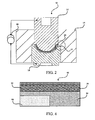
- the cup 50 may be obtained through sintering methods that use pulsating currents such as for example the Spark Plasma Sintering (SPS), or, generally, through any sintering method ( fig. 2 , 3 ) which uses temperature and pressure simultaneously, for example using a given sintering temperature T1 suitably selected depending on the type of materials used.
- Sintering exploits a metal mould 10 made up of a body 14, a punch 12 and a die 18.
- the spacer material 26 has, suitably, a melting temperature T2 that is greater than the sintering temperature T1.
- the first material 22, intended for obtaining the porous part of the object to be obtained is first mixed in a substantially homogeneous manner with the third spacer material 26, for example in form of granules, so as to obtain a mixture containing a spacer percentage equivalent to that of the porosity that is intended to be obtained on the final piece.
- the mixing step may be performed both manually and with more or less energetic mixing instruments, such as for example, ball milling, high energy milling, etc.
- the mixing of the first material 22 and the spacer 26 may also include the use of mixing additives such as water or volatile organic solvents which allow creating a slurry.
- the percentage in volume of the spacer material may generally range between 1% and 99% of the layer provided for.
- the percentage in volume of the spacer material may generally vary between 10% and 80% of the layer provided for and even more preferably between 50% and 80%.
- the dimensions of the spacer material may range between 5 and 3000 ⁇ m. More preferably the dimensions of the spacer material, for example in form of granules, may range between 100 and 1500 ⁇ m and even more preferably between 200 and 400 ⁇ m or between 400 and 600 ⁇ m or between 800 and 1000 ⁇ m.
- the first material 22, mixed with the third spacer material 26 according to the described methods, is arranged inside the die 18 in a manner such that the thickness of the layer is uniform over the entire profile of the die.
- This operation may be performed both manually and using instruments to facilitate the operation.
- a layer of the second material 20 is deposited on the layer of the first material 22.
- Two materials are considered in the example but the method may provide for even more, depending on the type and structure designed for the prosthesis to be obtained. Even the final structure may be considered as a multilayer, having for example an n number of materials for forming an n number of layers.
- the order of depositing the materials 20, 22 in the die 18 may be inverted, depending on the type of component to be obtained.
- a voltage generator 16 is connected between the punch 12 and the die 18 with the aim of inducing a current between the two pieces. Such current also flows in the materials (conductors) 20, 22 and locally generates plasmas between the particles thereof, optimizing the densification of the powders.
- the object made up of the three materials 20, 22, 26 is taken from the mould 10 and submerged in water or a suitable solution (acid or basic), so as to dissolve the material 26, remove it from the host material 22 leaving it partly porous.
- the space emptied by the material 26 constitutes the empty spaces or pores of the porous part 52.
- An embodiment of the method according to the invention comprises, at this point, a further step of optimising the densification of the component obtained through thermal treatments, performed at a temperature lower than the lowest among the melting temperatures of the materials that constitute the component, with or without using a given treatment pressure (for example methods such as Hot Isostatic Pressing).
- Another embodiment of the method according to the invention comprises, at this point, a further step of performing mechanical post-machining operations on the obtained component to modify the surface quality of a part or the entire component, for example in terms of surface roughness.
- Another embodiment of the method according to the invention comprises, at this point, a further step of depositing, on a part of the component or on the entire component, a single or multi-layer coating, through the Plasma Spray technique, a biologically compatible material which helps the osteointegration of Titanium and/or Hydroxyapatite and/or a material belonging to the class of Calcium-Phosphates.
- Another embodiment of the method according to the invention comprises, at this point, a further step of depositing, on a part of the component or on the entire component, a single or multi-layer coating, through chemical or electrochemical means, a biologically compatible material which helps the osteointegration of Hydroxyapatite and/or a material belonging to the class of Calcium-Phosphates.
- Another embodiment of the method according to the invention comprises, at this point, a further step of depositing, on a part of the component or on the entire component, a single or multi-layer coating, through the Physical Vapor Deposition (PVD) or Chemical Vapor Deposition (CVD) techniques, of a biologically compatible material capable of facilitating osteointegration.
- PVD Physical Vapor Deposition
- CVD Chemical Vapor Deposition
- Another embodiment of the method according to the invention comprises, at this point, at least one further step of performing surface treatments on a part or on the entire component suitable to modify the surface roughness of the same components.
- Examples of such treatments may be sanding, or other treatments both mechanical and chemical.
- the final components provided according to the invention may for example be made up of or comprise:
- MgO may be used as the spacer material 26 but even for example sodium chloride or hydroxyapatite may also be used.
- the sintering temperatures and the other parameters of the method depend on many variables, among which the type of object to be produced, the shape thereof, the constituting materials and the materials with which the mould is made.
- the sintering temperature may range between 500-2000°C
- the pressure may range between 5-100 MPa
- the duration of the sintering may vary between 1-20 minutes.
- the cooling of the produced piece determines a considerable contraction of the first metal material 22, such contraction instead being lower in the second material 20, considerably lower or absent in case of ceramic material.
- the contraction of the first metal material 22 determines the occurrence of a given internal "lock" tension between the two materials 20, 22, which in particular withholds the second material 20 within the first material 22 in a considerably firm, rigid and precise manner with respect to what occurs in the pieces produced through conventional methods. Furthermore, due to this effect, thinner metal layers may be obtained, increasing the thickness of the ceramic layer.
- Another embodiment of the method according to the invention provides for the realization of a component made up of two materials 20, 22, with different physical/chemical features, which define two respective volumes both dense, i.e. without any porous area, so as to meet the needs of some specific applications which require this solution, for example applications which provide for a subsequent step of creating a porous coating through the Plasma Spray technique or the like.
- the method thus comprises at least the steps of defining the component, in the forming means 10, as a composition of two volumes of different materials 20, 22, followed by a step of sintering, in the forming means 10, the two volumes of materials 20, 22, which in particular acquire the form, in the obtained component, of two respective adjacent or coupled layers.
- the component is defined, in the forming means 10, as the composition of volumes of materials 20, 22 of different physical/chemical features, and at least one volume of a third spacer material 26.
- the component to be obtained is defined as a succession of volumes of the above-mentioned materials 20,22,26.
- the component 50,60,90 as made up of at least one layer of the second material 20, coupled to at least one layer of the first material 22, to which at least one layer of the third spacer material 26, for example in form of granules, however not mixed to any other material in this case is associated in turn (the order of the layers may obviously be inverted depending on the type of component to be obtained).
- the third spacer material 26 is removed, through the aforementioned techniques, so as to create a rough surface on the component 50,60,90.
- the roughness of the surface may be defined, for example, by the size of the granules of the third spacer material 26.
Landscapes
- Chemical & Material Sciences (AREA)
- Engineering & Computer Science (AREA)
- Ceramic Engineering (AREA)
- Health & Medical Sciences (AREA)
- Manufacturing & Machinery (AREA)
- Materials Engineering (AREA)
- Structural Engineering (AREA)
- Organic Chemistry (AREA)
- Composite Materials (AREA)
- Orthopedic Medicine & Surgery (AREA)
- Transplantation (AREA)
- Animal Behavior & Ethology (AREA)
- Cardiology (AREA)
- Oral & Maxillofacial Surgery (AREA)
- Veterinary Medicine (AREA)
- Biomedical Technology (AREA)
- Heart & Thoracic Surgery (AREA)
- Vascular Medicine (AREA)
- Life Sciences & Earth Sciences (AREA)
- Mechanical Engineering (AREA)
- General Health & Medical Sciences (AREA)
- Public Health (AREA)
- Chemical Kinetics & Catalysis (AREA)
- Inorganic Chemistry (AREA)
- Prostheses (AREA)
- Materials For Medical Uses (AREA)
- Powder Metallurgy (AREA)
- Manufacture Of Alloys Or Alloy Compounds (AREA)
Claims (14)
- Procédé pour la réalisation d'un composant de prothèse biologiquement compatible (50 ; 60 ; 90), caractérisé en ce qu'il comprend les étapes suivantes :- la fourniture d'au moins deux matériaux (20, 22, 26) avec des caractéristiques physiques/chimiques différentes ;- la définition dans des moyens de formage (10) du composant (50 ; 60 ; 90) comme une composition d'au moins deux volumes desdits au moins deux matériaux (20, 22, 26), dans lequel un ou chacun desdits au moins deux matériaux (20, 22, 26) est initialement disponible sous forme de poudre et dans lequel lesdits volumes desdits matériaux (20, 22, 26) sont réalisés en jouxtant des couches ;- le frittage du composant (50, 60, 90) dans lesdits moyens de formage (10) à une certaine température de frittage (T1) par le frittage par plasma à étincelle (SPS) qui utilise des courants pulsés ou par un quelconque procédé de frittage qui utilise simultanément la température et la pression et qui utilise des courants pulsés, dans lequel un générateur de tension (16) est connecté entre un poinçon (12) et une matrice (18) desdits moyens de formage (10) induisant un courant entre lesdits matériaux (20, 22), dans lequel ledit courant circule dans lesdits matériaux (20, 22) et génère localement des plasmas entre leurs particules, en optimisant la densification desdites poudres et en obtenant lesdites couches desdits matériaux (20, 22) qui sont denses.
- Procédé selon la revendication 1, dans lequel lesdites couches desdits matériaux (20, 22) comprennent une première couche poreuse dudit premier matériau (22) et une deuxième couche dense dudit deuxième matériau (20), dans lequel ladite couche poreuse est obtenue en ajoutant, audit premier matériau (22), un troisième matériau d'écartement (26), sous la forme de poudre et ayant une température de fusion (T2) supérieure à ladite température de frittage (T1), et en enlevant dudit composant fini (50, 60, 90) ledit troisième matériau d'écartement (26) pour laisser sur ledit composant fini (50, 60, 90) des espaces vides correspondants.
- Procédé selon la revendication 1 ou 2, dans lequel lesdites couches desdits matériaux (20, 22) comprennent une couche rugueuse dudit premier matériau (22) et une couche dense dudit deuxième matériau (20).
- Procédé selon la revendication 3, comprenant une étape de dépôt, sur la couche dudit premier matériau (22), d'au moins une couche dudit troisième matériau d'écartement (26).
- Procédé selon la revendication 4, comprenant une étape consistant à enlever, dudit composant fini (50, 60, 90), ledit troisième matériau d'écartement (26) pour laisser sur ledit composant fini (50, 60, 90) une surface rugueuse correspondante.
- Procédé selon l'une quelconque des revendications précédentes, dans lequel lesdits matériaux (20, 22) sont tous deux sous forme de poudre.
- Procédé selon la revendication 1, dans lequel ledit deuxième matériau (20) est un matériau déjà fritté ou un matériau pré-fritté.
- Procédé selon l'une quelconque des revendications précédentes, dans lequel un ou plusieurs desdits matériaux (20, 22) sont constitués d'alliages du même métal et/ou de métaux différents et/ou de métaux purs.
- Procédé selon la revendication 8, dans lequel le métal est choisi à partir du groupe comprenant Ti, Cr, Co, Mo, Fe, Zr, Mn, Ta, Mg et/ou des alliages métalliques sélectionnés à partir du groupe comprenant : cobalt-chrome, chrome-cobalt-molybdène, magnésium, titan-aluminium, zirconium-niobium et tantale, fer-carbone et n'importe quelle combinaison de ceux-ci.
- Procédé selon l'une quelconque des revendications précédentes, dans lequel un ou chacun desdits un ou plusieurs matériaux (20, 22) est un matériau céramique ou un composite céramique.
- Procédé selon la revendication 10, dans lequel le matériau céramique est sélectionné à partir du groupe comprenant : alumine, zircone, zircone stabilisé avec des oxydes tels que, par exemple, oxyde d'yttrium, oxyde de cérium, magnésie, etc., alumine renforcée en zircone (ZTA), zircone renforcé en alumine (ATZ), nitrure de chrome, carbure de silicium, nitrure de silicium, carbure de titane, nitrure de titane, carbure de zirconium, nitrure de zirconium, carbure de tantale, carbure de tungstène, hydroxyapatite, phosphate de calcium, magnésie, et n'importe quelle combinaison entre eux.
- Procédé selon l'une quelconque des revendications précédentes, dans lequel un ou chacun desdits un ou plusieurs matériaux (20, 22) est un matériau formé par des mélanges de poudres métalliques et/ou céramiques ou par une matrice métallique ou céramique ou polymère ou une matrice polymère renforcée par des matériaux fibreux ou particulaires.
- Procédé selon l'une quelconque des revendications précédentes, comprenant une étape d'exécution d'opérations post-usinage mécanique et/ou de traitements de surface sur le composant (50 ; 60 ; 90) réalisées pour modifier la qualité de surface d'une partie ou de la totalité du composant (50; 60; 90).
- Procédé selon la revendication 13, comprenant une étape de dépôt, sur une partie du composant ou sur la totalité du composant (50; 60; 90), d'un revêtement monocouche ou multicouche, par le biais de la technique de dépôt physique en phase vapeur (PVD) ou de dépôt chimique en phase vapeur (CVD) ou de projection de plasma ou par le biais de moyens chimiques et/ou électrochimiques, d'un matériau biologiquement compatible capable de faciliter l'ostéointégration.
Applications Claiming Priority (2)
| Application Number | Priority Date | Filing Date | Title |
|---|---|---|---|
| IT000154A ITVR20090154A1 (it) | 2009-09-30 | 2009-09-30 | Procedimento per la realizzazione di protesi biologicamente compatibili |
| PCT/IB2010/054401 WO2011039716A1 (fr) | 2009-09-30 | 2010-09-29 | Procédé de fabrication d'une prothèse biocompatible |
Publications (2)
| Publication Number | Publication Date |
|---|---|
| EP2483018A1 EP2483018A1 (fr) | 2012-08-08 |
| EP2483018B1 true EP2483018B1 (fr) | 2015-07-22 |
Family
ID=42234493
Family Applications (1)
| Application Number | Title | Priority Date | Filing Date |
|---|---|---|---|
| EP10782387.4A Active EP2483018B1 (fr) | 2009-09-30 | 2010-09-29 | Procédé de fabrication d'une prothèse biocompatible |
Country Status (6)
| Country | Link |
|---|---|
| US (1) | US20120213911A1 (fr) |
| EP (1) | EP2483018B1 (fr) |
| JP (1) | JP2013506486A (fr) |
| CN (1) | CN102665971A (fr) |
| IT (1) | ITVR20090154A1 (fr) |
| WO (1) | WO2011039716A1 (fr) |
Families Citing this family (29)
| Publication number | Priority date | Publication date | Assignee | Title |
|---|---|---|---|---|
| IT1398443B1 (it) * | 2010-02-26 | 2013-02-22 | Lima Lto S P A Ora Limacorporate Spa | Elemento protesico integrato |
| MX2014002757A (es) * | 2011-09-15 | 2014-08-26 | Amedica Corp | Implantes recubiertos y metodos relacionados. |
| JP6312978B2 (ja) * | 2012-06-28 | 2018-04-18 | 京セラ株式会社 | 人工関節用コンポーネント |
| US8843229B2 (en) * | 2012-07-20 | 2014-09-23 | Biomet Manufacturing, Llc | Metallic structures having porous regions from imaged bone at pre-defined anatomic locations |
| CN103044024B (zh) * | 2012-12-11 | 2015-08-19 | 北京固圣生物科技有限公司 | 骨植入假体用氧化锆基复合陶瓷及由其制备的骨植入假体 |
| CN103041449B (zh) * | 2012-12-19 | 2015-01-14 | 北京固圣生物科技有限公司 | 复合结构生物活性功能涂层 |
| US9259784B2 (en) * | 2013-03-06 | 2016-02-16 | Howmedica Osteonics Corp. | Multi-part axial powder compression mold for complex parts |
| CN103205602B (zh) * | 2013-04-07 | 2015-05-13 | 昆明理工大学 | 氧化物颗粒增强的钛基多孔生物材料及其制备方法 |
| CN105012000A (zh) * | 2014-04-29 | 2015-11-04 | 爱派司生技股份有限公司 | 具光滑表面且具特殊曲率的锁骨骨板 |
| EP3166538B1 (fr) * | 2014-07-09 | 2019-03-27 | CeramTec GmbH | Cotyle prothétique en céramique intégrale pourvu d'une garniture poreuse sur sa face arrière |
| CN106083027A (zh) * | 2014-11-10 | 2016-11-09 | 充梦霞 | 用于骨缺损修复的复合生物陶瓷 |
| CN105030376B (zh) * | 2015-02-10 | 2017-02-01 | 江苏奥康尼医疗科技发展有限公司 | 一种全髋表面置换植入物 |
| CN104825255A (zh) * | 2015-05-21 | 2015-08-12 | 北京爱康宜诚医疗器材股份有限公司 | 股骨髁假体部件 |
| CN104840273A (zh) * | 2015-05-21 | 2015-08-19 | 北京爱康宜诚医疗器材股份有限公司 | 假体部件及其制造方法 |
| ES2882580T3 (es) * | 2015-08-03 | 2021-12-02 | Zanini Auto Grup Sa | Componente de prótesis y procedimiento para su fabricación |
| US11109976B2 (en) * | 2016-03-18 | 2021-09-07 | Dean Baker | Material compositions, apparatus and method of manufacturing composites for medical implants or manufacturing of implant product, and products of the same |
| CN107502769A (zh) * | 2017-08-22 | 2017-12-22 | 东北大学 | 一种钛‑陶复合生物多孔材料的制备方法 |
| CN109464225A (zh) * | 2017-09-08 | 2019-03-15 | 苏州玄陶商务咨询有限公司 | 一种氮化硅陶瓷人工髋关节 |
| CN108247061B (zh) * | 2018-02-05 | 2023-11-24 | 山东建筑大学 | 一种镁基可再生多孔纳米复合材料的连续挤压制备方法 |
| DE102018105489A1 (de) * | 2018-03-09 | 2019-09-12 | Hnp Mikrosysteme Gmbh | Verbundwerkstoffe auf Basis von Wolframcarbid mit Edelmetallbindern sowie Verwendung und Verfahren zu deren Herstellung |
| CN108689699A (zh) * | 2018-06-14 | 2018-10-23 | 长沙鹏登生物陶瓷有限公司 | 一种高柔韧性人工骨骼关节用陶瓷复合材料及制备方法 |
| CN108836576A (zh) * | 2018-07-18 | 2018-11-20 | 北京爱康宜诚医疗器材有限公司 | 置换假体 |
| KR102130343B1 (ko) * | 2018-11-14 | 2020-08-06 | 한국기계연구원 | 레이저와 분말을 이용한 3차원 형상 제조장치 |
| CN109678524B (zh) * | 2019-02-22 | 2021-08-24 | 苏州玄陶商务咨询有限公司 | 一种性能可控的氮化硅陶瓷植入物及其制备方法 |
| CN110509308A (zh) * | 2019-08-28 | 2019-11-29 | 燕山大学 | 一种刚柔结合的仿生机器人球头关节 |
| CN112294499B (zh) * | 2020-10-30 | 2024-04-09 | 嘉思特医疗器材(天津)股份有限公司 | 含氧化层锆铌合金分区骨小梁股骨髁假体及制备方法 |
| CN112456980B (zh) * | 2020-12-11 | 2021-09-07 | 西安交通大学 | 阵列式陶瓷预制体烧结单元单体与高通量无压烧结方法 |
| CN113106520B (zh) * | 2021-03-26 | 2022-07-01 | 暨南大学 | 一种碳化钽增强聚醚醚酮复合涂层及其制备方法与应用 |
| US20260008099A1 (en) * | 2022-07-17 | 2026-01-08 | San Diego State University (SDSU) Foundation, dba San Diego State University Research Foundation | Methods for Forming Parts by Spark Plasma Sintering and Additive Manufacturing |
Family Cites Families (7)
| Publication number | Priority date | Publication date | Assignee | Title |
|---|---|---|---|---|
| US4612160A (en) * | 1984-04-02 | 1986-09-16 | Dynamet, Inc. | Porous metal coating process and mold therefor |
| US6022509A (en) * | 1998-09-18 | 2000-02-08 | Johnson & Johnson Professional, Inc. | Precision powder injection molded implant with preferentially leached texture surface and method of manufacture |
| HK1045960B (zh) | 1999-09-14 | 2004-04-23 | Synthes | 用於生產可以高溫燒結的壓坯的兩種顆粒相的混合物 |
| WO2005072785A1 (fr) * | 2004-01-30 | 2005-08-11 | Cam Implants B.V. | Structure d'implant biocompatible tridimensionnel extremement poreux |
| CA2573545A1 (fr) * | 2004-07-19 | 2006-02-23 | Smith & Nephew, Inc. | Frittage par courant pulse de surfaces d'implants medicaux |
| WO2006053044A1 (fr) * | 2004-11-10 | 2006-05-18 | Dynamet Technology, Inc. | Article en alliage de titane a grain fin et articles dotes de surfaces de titane poreuses enrobees |
| ITMO20070223A1 (it) | 2007-07-04 | 2009-01-05 | Francesco Casari | "procedimento per la realizzazione di elementi tridimensionali biologicamente compatibili" |
-
2009
- 2009-09-30 IT IT000154A patent/ITVR20090154A1/it unknown
-
2010
- 2010-09-29 WO PCT/IB2010/054401 patent/WO2011039716A1/fr not_active Ceased
- 2010-09-29 CN CN2010800495663A patent/CN102665971A/zh active Pending
- 2010-09-29 JP JP2012531536A patent/JP2013506486A/ja active Pending
- 2010-09-29 EP EP10782387.4A patent/EP2483018B1/fr active Active
- 2010-09-29 US US13/499,233 patent/US20120213911A1/en not_active Abandoned
Also Published As
| Publication number | Publication date |
|---|---|
| CN102665971A (zh) | 2012-09-12 |
| ITVR20090154A1 (it) | 2011-04-01 |
| JP2013506486A (ja) | 2013-02-28 |
| US20120213911A1 (en) | 2012-08-23 |
| WO2011039716A1 (fr) | 2011-04-07 |
| EP2483018A1 (fr) | 2012-08-08 |
Similar Documents
| Publication | Publication Date | Title |
|---|---|---|
| EP2483018B1 (fr) | Procédé de fabrication d'une prothèse biocompatible | |
| Singh et al. | Titanium foams for biomedical applications: a review | |
| EP2531145B1 (fr) | Prothèse | |
| US20100174377A1 (en) | Reticulated particle porous coating for medical implant use | |
| EP2731638B1 (fr) | Fabrication rapide de prothèses métalliques poreuses | |
| US20050100578A1 (en) | Bone and tissue scaffolding and method for producing same | |
| CN102006838B (zh) | 内置式假肢部件 | |
| JP4339606B2 (ja) | 多孔性金属足場 | |
| EP0760687B1 (fr) | Biomateriau et implant osseux pour refection et remplacement d'un os | |
| Bandyopadhyay et al. | Metal additive manufacturing for load-bearing implants | |
| EP2727559B1 (fr) | Particule métallique épineuse | |
| WO2009022911A2 (fr) | Prothèse comprenant une surface d'interface osseuse anti-micromouvement, et son procédé de fabrication | |
| JP2010069311A (ja) | 医療用インプラントおよびその製作 | |
| AU2005274881A1 (en) | Pulsed current sintering for surfaces of medical implants | |
| Fukuda | Additive manufacturing technology for orthopedic implants | |
| US20210178015A1 (en) | Method to produce a prosthetic component, and prosthetic component thus produced | |
| Zhout et al. | Preparation, modification, and clinical application of porous | |
| Abd-Elaziem et al. | Multidisciplinary Materials Chronicles |
Legal Events
| Date | Code | Title | Description |
|---|---|---|---|
| PUAI | Public reference made under article 153(3) epc to a published international application that has entered the european phase |
Free format text: ORIGINAL CODE: 0009012 |
|
| 17P | Request for examination filed |
Effective date: 20120423 |
|
| AK | Designated contracting states |
Kind code of ref document: A1 Designated state(s): AL AT BE BG CH CY CZ DE DK EE ES FI FR GB GR HR HU IE IS IT LI LT LU LV MC MK MT NL NO PL PT RO SE SI SK SM TR |
|
| DAX | Request for extension of the european patent (deleted) | ||
| 17Q | First examination report despatched |
Effective date: 20130307 |
|
| GRAP | Despatch of communication of intention to grant a patent |
Free format text: ORIGINAL CODE: EPIDOSNIGR1 |
|
| INTG | Intention to grant announced |
Effective date: 20141014 |
|
| GRAS | Grant fee paid |
Free format text: ORIGINAL CODE: EPIDOSNIGR3 |
|
| GRAA | (expected) grant |
Free format text: ORIGINAL CODE: 0009210 |
|
| RAP1 | Party data changed (applicant data changed or rights of an application transferred) |
Owner name: EUROCOATING S.P.A. |
|
| AK | Designated contracting states |
Kind code of ref document: B1 Designated state(s): AL AT BE BG CH CY CZ DE DK EE ES FI FR GB GR HR HU IE IS IT LI LT LU LV MC MK MT NL NO PL PT RO SE SI SK SM TR |
|
| REG | Reference to a national code |
Ref country code: GB Ref legal event code: FG4D |
|
| REG | Reference to a national code |
Ref country code: CH Ref legal event code: EP |
|
| REG | Reference to a national code |
Ref country code: IE Ref legal event code: FG4D |
|
| REG | Reference to a national code |
Ref country code: AT Ref legal event code: REF Ref document number: 737598 Country of ref document: AT Kind code of ref document: T Effective date: 20150815 |
|
| REG | Reference to a national code |
Ref country code: DE Ref legal event code: R096 Ref document number: 602010026093 Country of ref document: DE |
|
| REG | Reference to a national code |
Ref country code: FR Ref legal event code: PLFP Year of fee payment: 6 |
|
| REG | Reference to a national code |
Ref country code: AT Ref legal event code: MK05 Ref document number: 737598 Country of ref document: AT Kind code of ref document: T Effective date: 20150722 |
|
| REG | Reference to a national code |
Ref country code: LT Ref legal event code: MG4D |
|
| REG | Reference to a national code |
Ref country code: NL Ref legal event code: MP Effective date: 20150722 |
|
| PG25 | Lapsed in a contracting state [announced via postgrant information from national office to epo] |
Ref country code: GR Free format text: LAPSE BECAUSE OF FAILURE TO SUBMIT A TRANSLATION OF THE DESCRIPTION OR TO PAY THE FEE WITHIN THE PRESCRIBED TIME-LIMIT Effective date: 20151023 Ref country code: LT Free format text: LAPSE BECAUSE OF FAILURE TO SUBMIT A TRANSLATION OF THE DESCRIPTION OR TO PAY THE FEE WITHIN THE PRESCRIBED TIME-LIMIT Effective date: 20150722 Ref country code: FI Free format text: LAPSE BECAUSE OF FAILURE TO SUBMIT A TRANSLATION OF THE DESCRIPTION OR TO PAY THE FEE WITHIN THE PRESCRIBED TIME-LIMIT Effective date: 20150722 Ref country code: NO Free format text: LAPSE BECAUSE OF FAILURE TO SUBMIT A TRANSLATION OF THE DESCRIPTION OR TO PAY THE FEE WITHIN THE PRESCRIBED TIME-LIMIT Effective date: 20151022 Ref country code: LV Free format text: LAPSE BECAUSE OF FAILURE TO SUBMIT A TRANSLATION OF THE DESCRIPTION OR TO PAY THE FEE WITHIN THE PRESCRIBED TIME-LIMIT Effective date: 20150722 |
|
| PG25 | Lapsed in a contracting state [announced via postgrant information from national office to epo] |
Ref country code: PT Free format text: LAPSE BECAUSE OF FAILURE TO SUBMIT A TRANSLATION OF THE DESCRIPTION OR TO PAY THE FEE WITHIN THE PRESCRIBED TIME-LIMIT Effective date: 20151123 Ref country code: SE Free format text: LAPSE BECAUSE OF FAILURE TO SUBMIT A TRANSLATION OF THE DESCRIPTION OR TO PAY THE FEE WITHIN THE PRESCRIBED TIME-LIMIT Effective date: 20150722 Ref country code: HR Free format text: LAPSE BECAUSE OF FAILURE TO SUBMIT A TRANSLATION OF THE DESCRIPTION OR TO PAY THE FEE WITHIN THE PRESCRIBED TIME-LIMIT Effective date: 20150722 Ref country code: PL Free format text: LAPSE BECAUSE OF FAILURE TO SUBMIT A TRANSLATION OF THE DESCRIPTION OR TO PAY THE FEE WITHIN THE PRESCRIBED TIME-LIMIT Effective date: 20150722 Ref country code: IS Free format text: LAPSE BECAUSE OF FAILURE TO SUBMIT A TRANSLATION OF THE DESCRIPTION OR TO PAY THE FEE WITHIN THE PRESCRIBED TIME-LIMIT Effective date: 20151122 Ref country code: ES Free format text: LAPSE BECAUSE OF FAILURE TO SUBMIT A TRANSLATION OF THE DESCRIPTION OR TO PAY THE FEE WITHIN THE PRESCRIBED TIME-LIMIT Effective date: 20150722 Ref country code: AT Free format text: LAPSE BECAUSE OF FAILURE TO SUBMIT A TRANSLATION OF THE DESCRIPTION OR TO PAY THE FEE WITHIN THE PRESCRIBED TIME-LIMIT Effective date: 20150722 |
|
| REG | Reference to a national code |
Ref country code: DE Ref legal event code: R097 Ref document number: 602010026093 Country of ref document: DE |
|
| PG25 | Lapsed in a contracting state [announced via postgrant information from national office to epo] |
Ref country code: DK Free format text: LAPSE BECAUSE OF FAILURE TO SUBMIT A TRANSLATION OF THE DESCRIPTION OR TO PAY THE FEE WITHIN THE PRESCRIBED TIME-LIMIT Effective date: 20150722 Ref country code: LU Free format text: LAPSE BECAUSE OF FAILURE TO SUBMIT A TRANSLATION OF THE DESCRIPTION OR TO PAY THE FEE WITHIN THE PRESCRIBED TIME-LIMIT Effective date: 20150929 Ref country code: MC Free format text: LAPSE BECAUSE OF FAILURE TO SUBMIT A TRANSLATION OF THE DESCRIPTION OR TO PAY THE FEE WITHIN THE PRESCRIBED TIME-LIMIT Effective date: 20150722 Ref country code: EE Free format text: LAPSE BECAUSE OF FAILURE TO SUBMIT A TRANSLATION OF THE DESCRIPTION OR TO PAY THE FEE WITHIN THE PRESCRIBED TIME-LIMIT Effective date: 20150722 Ref country code: SK Free format text: LAPSE BECAUSE OF FAILURE TO SUBMIT A TRANSLATION OF THE DESCRIPTION OR TO PAY THE FEE WITHIN THE PRESCRIBED TIME-LIMIT Effective date: 20150722 Ref country code: CZ Free format text: LAPSE BECAUSE OF FAILURE TO SUBMIT A TRANSLATION OF THE DESCRIPTION OR TO PAY THE FEE WITHIN THE PRESCRIBED TIME-LIMIT Effective date: 20150722 |
|
| PLBE | No opposition filed within time limit |
Free format text: ORIGINAL CODE: 0009261 |
|
| STAA | Information on the status of an ep patent application or granted ep patent |
Free format text: STATUS: NO OPPOSITION FILED WITHIN TIME LIMIT |
|
| PG25 | Lapsed in a contracting state [announced via postgrant information from national office to epo] |
Ref country code: RO Free format text: LAPSE BECAUSE OF FAILURE TO SUBMIT A TRANSLATION OF THE DESCRIPTION OR TO PAY THE FEE WITHIN THE PRESCRIBED TIME-LIMIT Effective date: 20150722 |
|
| 26N | No opposition filed |
Effective date: 20160425 |
|
| REG | Reference to a national code |
Ref country code: IE Ref legal event code: MM4A |
|
| PG25 | Lapsed in a contracting state [announced via postgrant information from national office to epo] |
Ref country code: IE Free format text: LAPSE BECAUSE OF NON-PAYMENT OF DUE FEES Effective date: 20150929 |
|
| PG25 | Lapsed in a contracting state [announced via postgrant information from national office to epo] |
Ref country code: SI Free format text: LAPSE BECAUSE OF FAILURE TO SUBMIT A TRANSLATION OF THE DESCRIPTION OR TO PAY THE FEE WITHIN THE PRESCRIBED TIME-LIMIT Effective date: 20150722 |
|
| REG | Reference to a national code |
Ref country code: FR Ref legal event code: PLFP Year of fee payment: 7 |
|
| PG25 | Lapsed in a contracting state [announced via postgrant information from national office to epo] |
Ref country code: BE Free format text: LAPSE BECAUSE OF FAILURE TO SUBMIT A TRANSLATION OF THE DESCRIPTION OR TO PAY THE FEE WITHIN THE PRESCRIBED TIME-LIMIT Effective date: 20150722 |
|
| PG25 | Lapsed in a contracting state [announced via postgrant information from national office to epo] |
Ref country code: MT Free format text: LAPSE BECAUSE OF FAILURE TO SUBMIT A TRANSLATION OF THE DESCRIPTION OR TO PAY THE FEE WITHIN THE PRESCRIBED TIME-LIMIT Effective date: 20150722 |
|
| PG25 | Lapsed in a contracting state [announced via postgrant information from national office to epo] |
Ref country code: SM Free format text: LAPSE BECAUSE OF FAILURE TO SUBMIT A TRANSLATION OF THE DESCRIPTION OR TO PAY THE FEE WITHIN THE PRESCRIBED TIME-LIMIT Effective date: 20150722 Ref country code: BG Free format text: LAPSE BECAUSE OF FAILURE TO SUBMIT A TRANSLATION OF THE DESCRIPTION OR TO PAY THE FEE WITHIN THE PRESCRIBED TIME-LIMIT Effective date: 20150722 Ref country code: HU Free format text: LAPSE BECAUSE OF FAILURE TO SUBMIT A TRANSLATION OF THE DESCRIPTION OR TO PAY THE FEE WITHIN THE PRESCRIBED TIME-LIMIT; INVALID AB INITIO Effective date: 20100929 |
|
| PG25 | Lapsed in a contracting state [announced via postgrant information from national office to epo] |
Ref country code: CY Free format text: LAPSE BECAUSE OF FAILURE TO SUBMIT A TRANSLATION OF THE DESCRIPTION OR TO PAY THE FEE WITHIN THE PRESCRIBED TIME-LIMIT Effective date: 20150722 Ref country code: NL Free format text: LAPSE BECAUSE OF FAILURE TO SUBMIT A TRANSLATION OF THE DESCRIPTION OR TO PAY THE FEE WITHIN THE PRESCRIBED TIME-LIMIT Effective date: 20150722 |
|
| PG25 | Lapsed in a contracting state [announced via postgrant information from national office to epo] |
Ref country code: TR Free format text: LAPSE BECAUSE OF FAILURE TO SUBMIT A TRANSLATION OF THE DESCRIPTION OR TO PAY THE FEE WITHIN THE PRESCRIBED TIME-LIMIT Effective date: 20150722 |
|
| REG | Reference to a national code |
Ref country code: FR Ref legal event code: PLFP Year of fee payment: 8 |
|
| PG25 | Lapsed in a contracting state [announced via postgrant information from national office to epo] |
Ref country code: MK Free format text: LAPSE BECAUSE OF FAILURE TO SUBMIT A TRANSLATION OF THE DESCRIPTION OR TO PAY THE FEE WITHIN THE PRESCRIBED TIME-LIMIT Effective date: 20150722 |
|
| REG | Reference to a national code |
Ref country code: FR Ref legal event code: PLFP Year of fee payment: 9 |
|
| PG25 | Lapsed in a contracting state [announced via postgrant information from national office to epo] |
Ref country code: AL Free format text: LAPSE BECAUSE OF FAILURE TO SUBMIT A TRANSLATION OF THE DESCRIPTION OR TO PAY THE FEE WITHIN THE PRESCRIBED TIME-LIMIT Effective date: 20150722 |
|
| REG | Reference to a national code |
Ref country code: CH Ref legal event code: NV Representative=s name: BOVARD SA NEUCHATEL CONSEILS EN PROPRIETE INTE, CH Ref country code: CH Ref legal event code: PFA Owner name: LINCOTEK TRENTO S.P.A., IT Free format text: FORMER OWNER: EUROCOATING S.P.A., IT |
|
| REG | Reference to a national code |
Ref country code: DE Ref legal event code: R081 Ref document number: 602010026093 Country of ref document: DE Owner name: LINCOTEK TRENTO S.P.A., IT Free format text: FORMER OWNER: EUROCOATING S.P.A., TRENTO, IT |
|
| REG | Reference to a national code |
Ref country code: CH Ref legal event code: U11 Free format text: ST27 STATUS EVENT CODE: U-0-0-U10-U11 (AS PROVIDED BY THE NATIONAL OFFICE) Effective date: 20251001 |
|
| PGFP | Annual fee paid to national office [announced via postgrant information from national office to epo] |
Ref country code: DE Payment date: 20250929 Year of fee payment: 16 |
|
| PGFP | Annual fee paid to national office [announced via postgrant information from national office to epo] |
Ref country code: IT Payment date: 20250918 Year of fee payment: 16 |
|
| PGFP | Annual fee paid to national office [announced via postgrant information from national office to epo] |
Ref country code: GB Payment date: 20250929 Year of fee payment: 16 |
|
| PGFP | Annual fee paid to national office [announced via postgrant information from national office to epo] |
Ref country code: FR Payment date: 20250925 Year of fee payment: 16 |
|
| PGFP | Annual fee paid to national office [announced via postgrant information from national office to epo] |
Ref country code: CH Payment date: 20251001 Year of fee payment: 16 |
|
| REG | Reference to a national code |
Ref country code: CH Ref legal event code: R18 Free format text: ST27 STATUS EVENT CODE: U-0-0-R10-R18 (AS PROVIDED BY THE NATIONAL OFFICE) Effective date: 20260209 |
|
| REG | Reference to a national code |
Ref country code: CH Ref legal event code: R18 Free format text: ST27 STATUS EVENT CODE: U-0-0-R10-R18 (AS PROVIDED BY THE NATIONAL OFFICE) Effective date: 20260320 |