EP2485261A2 - Détecteur de rayonnement et son procédé de fabrication - Google Patents
Détecteur de rayonnement et son procédé de fabrication Download PDFInfo
- Publication number
- EP2485261A2 EP2485261A2 EP12151742A EP12151742A EP2485261A2 EP 2485261 A2 EP2485261 A2 EP 2485261A2 EP 12151742 A EP12151742 A EP 12151742A EP 12151742 A EP12151742 A EP 12151742A EP 2485261 A2 EP2485261 A2 EP 2485261A2
- Authority
- EP
- European Patent Office
- Prior art keywords
- electrode
- electrodes
- insulation layer
- photosensors
- capacitor
- Prior art date
- Legal status (The legal status is an assumption and is not a legal conclusion. Google has not performed a legal analysis and makes no representation as to the accuracy of the status listed.)
- Withdrawn
Links
Images



Classifications
-
- H—ELECTRICITY
- H10—SEMICONDUCTOR DEVICES; ELECTRIC SOLID-STATE DEVICES NOT OTHERWISE PROVIDED FOR
- H10F—INORGANIC SEMICONDUCTOR DEVICES SENSITIVE TO INFRARED RADIATION, LIGHT, ELECTROMAGNETIC RADIATION OF SHORTER WAVELENGTH OR CORPUSCULAR RADIATION
- H10F30/00—Individual radiation-sensitive semiconductor devices in which radiation controls the flow of current through the devices, e.g. photodetectors
- H10F30/20—Individual radiation-sensitive semiconductor devices in which radiation controls the flow of current through the devices, e.g. photodetectors the devices having potential barriers, e.g. phototransistors
- H10F30/29—Individual radiation-sensitive semiconductor devices in which radiation controls the flow of current through the devices, e.g. photodetectors the devices having potential barriers, e.g. phototransistors the devices being sensitive to radiation having very short wavelengths, e.g. X-rays, gamma-rays or corpuscular radiation
-
- H—ELECTRICITY
- H10—SEMICONDUCTOR DEVICES; ELECTRIC SOLID-STATE DEVICES NOT OTHERWISE PROVIDED FOR
- H10F—INORGANIC SEMICONDUCTOR DEVICES SENSITIVE TO INFRARED RADIATION, LIGHT, ELECTROMAGNETIC RADIATION OF SHORTER WAVELENGTH OR CORPUSCULAR RADIATION
- H10F39/00—Integrated devices, or assemblies of multiple devices, comprising at least one element covered by group H10F30/00, e.g. radiation detectors comprising photodiode arrays
- H10F39/10—Integrated devices
- H10F39/12—Image sensors
- H10F39/18—Complementary metal-oxide-semiconductor [CMOS] image sensors; Photodiode array image sensors
- H10F39/189—X-ray, gamma-ray or corpuscular radiation imagers
- H10F39/1898—Indirect radiation image sensors, e.g. using luminescent members
-
- H—ELECTRICITY
- H10—SEMICONDUCTOR DEVICES; ELECTRIC SOLID-STATE DEVICES NOT OTHERWISE PROVIDED FOR
- H10F—INORGANIC SEMICONDUCTOR DEVICES SENSITIVE TO INFRARED RADIATION, LIGHT, ELECTROMAGNETIC RADIATION OF SHORTER WAVELENGTH OR CORPUSCULAR RADIATION
- H10F39/00—Integrated devices, or assemblies of multiple devices, comprising at least one element covered by group H10F30/00, e.g. radiation detectors comprising photodiode arrays
- H10F39/011—Manufacture or treatment of image sensors covered by group H10F39/12
-
- H—ELECTRICITY
- H10—SEMICONDUCTOR DEVICES; ELECTRIC SOLID-STATE DEVICES NOT OTHERWISE PROVIDED FOR
- H10F—INORGANIC SEMICONDUCTOR DEVICES SENSITIVE TO INFRARED RADIATION, LIGHT, ELECTROMAGNETIC RADIATION OF SHORTER WAVELENGTH OR CORPUSCULAR RADIATION
- H10F39/00—Integrated devices, or assemblies of multiple devices, comprising at least one element covered by group H10F30/00, e.g. radiation detectors comprising photodiode arrays
- H10F39/80—Constructional details of image sensors
- H10F39/803—Pixels having integrated switching, control, storage or amplification elements
-
- H—ELECTRICITY
- H10—SEMICONDUCTOR DEVICES; ELECTRIC SOLID-STATE DEVICES NOT OTHERWISE PROVIDED FOR
- H10F—INORGANIC SEMICONDUCTOR DEVICES SENSITIVE TO INFRARED RADIATION, LIGHT, ELECTROMAGNETIC RADIATION OF SHORTER WAVELENGTH OR CORPUSCULAR RADIATION
- H10F99/00—Subject matter not provided for in other groups of this subclass
Definitions
- the present invention relate to a radiation detector capable of generating images of the inside of a subject body by detecting x-rays.
- An X-ray apparatus may be used to diagnose a disease without dissecting a body of an animal or a patient by applying x-rays to the body, detecting the x-rays having passed through the body, and processing the detected x-rays so as to obtain images of the inside of the body.
- an x-ray tube for generating x-rays includes a filament for generating thermoelectrons and electrodes for forming a strong electric field upon the application to the electrodes of a high voltage.
- the high voltage is generated by a high voltage supply which is applied to the x-ray tube so as to result in emission of thermoelectrons from the filament which forms a cathode portion of the x-ray tube.
- the emitted thermoelectrons are caused to drift under the influence of the strong electric field, and collide at an anode portion of the x-ray tube. At a local spot on the anode where the thermoelectrons collide, a x-rays are generated.
- An x-ray detector detects an amount of the x-rays which pass through (or penetrate) the object when the x-rays are generated as described above.
- the detector is part of an imaging apparatus used to show images of the inside of the object as a result of detecting the penetration amount of the x-rays.
- an x-ray detector includes a thin film transistor array substrate and a photosensor.
- leakage current may be generated during driving of the thin film transistor which results in noise during signal output.
- the present invention provides a radiation detector including a photosensor and a capacitor.
- a radiation detector includes a plurality of photosensors having front and rear electrodes formed on front and rear surfaces thereof, an insulation layer formed on the rear surface of the photosensors, a plurality of data electrodes formed on the rear surface of the insulation layer, a plurality of signal electrodes formed on the front surface of the photosensors, and a capacitor comprising the rear electrode formed on the rear surface of the photosensor, the insulation layer formed on the rear surface of the rear electrode, and the data electrode formed on the rear surface of the insulation layer.
- the data electrode may induce an electrical signal in response to an electrical signal generated from the photosensor.
- the signal electrode may apply voltage to the plurality of photosensors.
- the signal electrode and the data electrode may be arranged to cross each other in a substantially perpendicular manner.
- the front electrode of the photosensor may be a transparent electrode.
- the front electrode may be made of any one of indium tin oxide (ITO) or indium zinc oxide (IZO).
- ITO indium tin oxide
- IZO indium zinc oxide
- the photosensor may be any one of a PIN photodiode or a PN photodiode.
- the radiation detector may further include a scintillator formed on the front surface of the front electrode of the photosensor that converts radiation applied to the radiation detector into visible light.
- the radiation detector may further include a protective layer, which is an insulating layer, formed so as to surround the photosensor.
- the protective layer may be made of a material selected from a group including silicon oxide, silicon nitride, silicon oxynitride, benzocyclobutene, and polyamide.
- a radiation detector includes a plurality of photosensors having front and rear electrodes formed on front and rear surfaces thereof, a plurality of data electrodes formed on the rear surface of the photosensors, an insulation layer formed on the front surface of the photosensors, a plurality of capacitor electrodes formed on the front surface of the insulation layer, a plurality of signal electrodes formed on the front surface of the plurality of capacitor electrodes, and a capacitor comprising the front electrode formed on the front surface of the photosensor, the insulation layer formed on the front surface of the front electrode, and the capacitor electrode formed on the front surface of the insulation layer.
- the data electrode may receive an electrical signal generated from the photosensor.
- the signal electrode may apply voltage to the plurality of capacitor electrodes.
- the signal electrode and the data electrode may be arranged to cross each other.
- the front electrode of the photosensor may be a transparent electrode.
- the front electrode may be made of any one selected from indium tin oxide (ITO) or indium zinc oxide (IZO).
- ITO indium tin oxide
- IZO indium zinc oxide
- the photosensor may be any one of a PIN photodiode or a PN photodiode.
- the radiation detector may further include a scintillator formed on the front surface of the capacitor electrode that converts radiation applied to the radiation detector into visible light.
- the radiation detector may further include a protective layer, which is an insulating layer, to surround the photosensor.
- the protective layer may be made of a material selected from a group including silicon oxide, silicon nitride, silicon oxynitride, benzocyclobutene, and polyamide.
- a method for manufacturing a radiation detector includes forming a plurality of data electrodes on a substrate, forming an insulation layer on the front surface of the data electrode, forming a plurality of photosensors having front and rear electrodes formed on front and rear surfaces thereof on the front surface of the insulation layer, and forming a capacitor including the rear electrode, the insulation layer, and the data electrode.
- a method for manufacturing a radiation detector includes forming a plurality of data electrodes on a substrate, forming a plurality of photosensors having front and rear electrodes formed on front and rear surfaces thereof on the front surface of the data electrode, forming an insulation layer on the front surface of the photosensor, forming a plurality of capacitor electrodes on the front surface of the insulation layer, and forming a capacitor including the capacitor electrode, the insulation layer, and the front electrode.
- an X-ray image processing system which incorporates a radiation detector according to one or more of the illustrated embodiments
- the radiation detector according to one aspect of the present invention may reduce noise by solving the problem of current leakage generated when using a thin film transistor.
- the radiation detector according to one aspect of the present invention may increase an aperture ratio by eliminating the thin film transistor.
- FIG. 1 is a schematic cross-sectional view in the z-x plane showing a radiation detector according to one embodiment of the present invention.
- the radiation detector includes, a scintillator 1 formed on an incident surface where radiation incidence occurs, a plurality of photosensors 3 formed on the rear surface of the scintillator 1, a protective layer 6, which is an insulating material, formed to surround the photosensors 3, a plurality of signal electrodes 7 formed on the front surface of the photosensors 3, an insulation layer 8 formed on the rear surface of the photosensors 3, a plurality of data electrodes 9 formed on the rear surface of the insulation layer 8, and a substrate 10 having the data electrodes 9 formed thereon.
- the scintillator 1 may be formed in the forward direction (+z-axis direction) of the detector to allow x-rays, which have passed through a subject body, to be incident thereon and absorbed therein.
- the scintillator 1 may convert the absorbed x-rays into an optical wavelength, namely visible light in the green wavelength range, which in turn may be absorbed at the photosensors 3 of the detector.
- the scintillator 1 may be made of a halogen compound such as cesium iodide doped with thallium or sodium or may include an oxide compound such as gadolinium sulfur oxide.
- a halogen compound such as cesium iodide doped with thallium or sodium
- an oxide compound such as gadolinium sulfur oxide.
- embodiments of the present invention are not limited thereto.
- the scintillator 1 may include a photo-reflective layer 2 formed on the front surface of the scintillator 1 upon which the x-rays are incident.
- the reflective layer 2 may be made of a material which allows penetration of x-rays.
- the reflective layer 2 may be made of a metal such as aluminum or titanium, or an organic material such as glass, carbon, or ceramic.
- embodiments of the present invention are not limited thereto.
- the reflective layer 2 may improve radiation use efficiency by reflecting lost visible light among the converted visible light that have been emitted from the scintillator 1, back into the scintillator 1.
- the scintillator 1 may be adhered to the front surface of the photosensor 3 as a thin film, or deposited thereon by chemical vapor deposition (CVD).
- the photosensors 3 may be formed on the rear surface of the scintillator 1, where the visible light that has been converted by passing through the scintillator 1, is absorbed and converted into an electrical signal.
- the photosensors 3 may each have a front electrode 4 and a rear electrode 5 formed on the front and rear surfaces of the photosensors 3, respectively.
- the front electrode 4 contacts the signal electrode 7 which applies voltage to the photosensor 3, and the rear electrode 5 contacts the insulation layer 8.
- the front electrode 4 may be made of a transparent conductive material so as to allow penetration of light absorbed from the outside.
- the front electrode 4 may be made of indium tin oxide (ITO) or indium zinc oxide (IZO).
- ITO indium tin oxide
- IZO indium zinc oxide
- embodiments of the present invention are not limited thereto.
- the photosensor 3 may be made of a semiconductor material such as silicone.
- the photosensor 3 may be a PIN photodiode having a so-called PIN structure, which includes a P(positive)-type semiconductor layer, an I(intrinsic)-type semiconductor layer, and an N(negative)-type semiconductor layer, or a PN photodiode having a so-called PN structure, which includes a P(positive)-type semiconductor layer, and an N(negative)-type semiconductor layer.
- PIN structure which includes a P(positive)-type semiconductor layer, an I(intrinsic)-type semiconductor layer, and an N(negative)-type semiconductor layer
- PN photodiode having a so-called PN structure, which includes a P(positive)-type semiconductor layer, and an N(negative)-type semiconductor layer.
- visible light passes through the P-type amorphous silicon layer and is absorbed by the I-type amorphous silicon layer.
- the absorbed visible light has greater energy than an optical band gap of the amorphous silicon in the I-type amorphous silicon layer, resulting in production of electrons and holes.
- the electrons and holes generated in the I-type amorphous silicon layer may be collected at the P-type and N-type silicon layers by an internal electric field. Finally, the electrons and holes are supplied to the external circuit through electrodes.
- the photosensors 3 are provided in the ratio of one per pixel, and may be arranged in a two-dimensional array as a matrix to form an X-ray detector as shown in FIG. 2 .
- the photosensors 3 may be arranged as a square matrix having four rows and four columns (see FIG. 2 ).
- the photosensor 3 may be covered/surrounded with the protective layer 6 which is an insulating material.
- the protective layer 6 may be made of an inorganic insulating material such as silicon oxide, silicon nitride, or silicon oxynitride, or an organic insulating material such as benzocyclobutene or polyamide.
- the signal electrode 7 is formed on the front surface of the front electrode 4 of the photosensor 3 for electrical contact.
- the signal electrode 7 may receive reverse and forward bias voltage from an external power supply (not shown).
- a plurality of signal electrodes 7 in the form of lines may be respectively disposed on each row (x-axis direction) of the photosensors 3 arranged in a two-dimensional array as a matrix.
- the signal electrodes 7 in the form of lines are respectively disposed on each row of the photosensors 3 arranged as a matrix having four rows and four columns.
- voltage may be applied to each row of the photosensors 3. That is, when voltage is applied to one row of the signal electrode 7, the voltage is applied to all the photosensors 3 disposed on the row, and the voltage is not applied to the other photosensors 3.
- the signal electrode 7 may be made of a metal such as aluminum, molybdenum, chrome, neodymium, tantalum, titanium, tungsten, copper, or silver, alone or an alloy thereof. However, embodiments of the present invention are not limited thereto.
- the insulation layer 8 is formed on the rear surface of the photosensor 3.
- the detailed descriptions of the capacitor 13 will be illustrated with the description of the data electrode 9.
- the data electrode 9 may be formed between the front (top) surface of the substrate 10 and the rear (bottom) surface of the insulation layer 8.
- a plurality of data electrodes 9 in the form of lines may be respectively disposed on each column (y-axis direction) of the photosensors 3 arranged in a two-dimensional array as a matrix. That is, the above-described signal electrodes 7 and the data electrodes 9 may be arranged to cross each other. That is, the signal electrodes 7 and the data electrodes 9 may be arranged substantially perpendicular to each other.
- the data electrodes 9 in the form of lines are respectively disposed on each column of the photosensors 3 arranged as a matrix having four rows and four columns.
- the data electrodes 9 may have induced thereon an electrical signal in response to an electrical signal generated from the photosensor 3.
- the data electrodes 9 may be connected to a read out IC (ROIC) where the electrical signal from the data electrodes 9 is detected and a corresponding image signal is output to further processing and display units, as well known (see FIG. 5 ), to generate and display various types of images of the target.
- ROIC read out IC
- the data electrodes 9 together with the insulation layer 8 formed on the front surface of the data electrodes 9 and the rear electrodes of the photosensors 3 form the capacitor 13.
- the converted visible light passing through the scintillator 1 is absorbed into the photosensors 3 where the visible light is converted into the electrical signal.
- a reverse bias voltage is applied to the signal electrodes 7, electrons are accumulated at the rear electrodes 5 of the photosensors 3. Since a degree of penetration of an x-ray differs according to a density of a subject body, the size of the electrical signal also differs accordingly. Therefore, a quantity of electric charge accumulated at the rear electrodes 5 also changes.
- the data electrodes 9, which form the other electrode of the capacitor 13 are induced with a charge in response to the quantity of accumulated charge at the rear electrodes 5 of the photosensors 3, thereby transferring the electrical signal to the data electrodes 9.
- the read out IC ROIC detects the electrical signal induced to data electrodes 9, and outputs a corresponding image signal. As described in conjunction with FIG.
- the capacitor 13 may be formed by forming the plurality of data electrodes 9 on the substrate 10 in a column direction (y-axis direction) as a matrix, forming the insulation layer 8, made of an insulating material, on a front surface of the plurality of data electrodes 9, and forming the plurality of photosensors 3 formed with the front and rear electrodes 4 and 5 on the front surface of the insulation layer 8.
- the substrate 10 is provided as a base for manufacturing the radiation detector.
- the substrate 10 may be in a form of plate.
- the substrate 10 may be made of a transparent insulating material such as glass, quartz, or plastic.
- FIG. 3 is a schematic cross-sectional view showing a radiation detector according to another embodiment of the present invention.
- the radiation detector includes, a scintillator 1 formed on an incident surface where radiation incidence occurs, an insulation layer 8 formed on the rear surface of the scintillator 1, a plurality of capacitor electrodes 11 covered with the insulation layer 8, a plurality of signal electrodes 7 formed on the front surface of the capacitor electrodes 11, a plurality of photosensors 3 formed on the rear surface of the insulation layer 8, a protective layer 6, which is an insulating material, formed to surround the photosensors 3, a plurality of data electrodes 9 formed on the rear surface of the photosensors 3, and a substrate 10 having the data electrodes 9 formed thereon.
- the detailed descriptions of the capacitor 13 will be illustrated with the descriptions of the capacitor electrode 11.
- the insulation layer 8 may be made of a transparent insulating material such as glass, quartz, or plastic, in order to pass visible light that has been converted from x-rays by passing through the scintillator 1.
- the capacitor electrode 11 may be made of a transparent conductive material such as indium tin oxide (ITO) or indium zinc oxide (IZO).
- ITO indium tin oxide
- IZO indium zinc oxide
- the capacitor electrode 11 together with the insulation layer 8 and the front electrode 4 of the photosensor 3 form the capacitor 13.
- the converted visible light by passing through the scintillator 1 is absorbed into the photosensors 3 where the visible light is converted into an electrical signal.
- a reverse bias voltage is applied to the signal electrodes 7, electrons are accumulated at the front electrodes 4 of the photosensors 3. Since a degree of penetration of x-rays differs according to a density of a subject body, the size of the electrical signal also differs accordingly. Therefore, a quantity of electric charge accumulated at the front electrodes 4 also changes.
- the read out IC ROIC detects the electrical signal transferred to the data electrodes 9, and outputs a corresponding image signal.
- the capacitor 13 may be formed by forming the plurality of data electrodes 9 on the substrate 10 in a column direction (y-axis direction) as a matrix, forming the plurality of photosensors 3 formed with the front and rear electrodes 4 and 5 on the front surface of the data electrodes 9, and forming the insulation layer 8, made of an insulating material on a front surface of photosensors 3, and forming the capacitor electrodes 11 buried in the insulation layer 8.
- the signal electrodes 7 are formed on the front surface of the capacitor electrode 11 for electrical contact.
- the signal electrodes 7 may receive reverse and forward bias voltage from an external power supply (not shown).
- a plurality of signal electrodes 7 in the form of lines may be respectively disposed on each row (in the x-axis direction) of the photosensors 3 arranged in a two-dimensional array as a matrix.
- the signal electrodes 7 in form of lines are respectively disposed on each row of the photosensors 3 arranged as a matrix having four rows and four columns.
- voltage may be applied to each row of the photosensors 3. That is, when voltage is applied to one row of the signal electrodes 7, the voltage is applied to all the capacitor electrodes 11 I disposed on the row, and the voltage is not applied to the other capacitor electrodes 11.
- the signal electrode 7 may be made of a metal such as aluminum, molybdenum, chrome, neodymium, tantalum, titanium, tungsten, copper, or silver, alone or an alloy thereof. However, embodiments of the present invention are not limited thereto.
- the photosensor 3 is formed on the rear surface of the insulation layer 8, where the visible light that has been converted by passing through the scintillator 1, is absorbed and converted into an electrical signal.
- the photosensor 3 may have a front electrode 4 and a rear electrode 5 formed on the front and rear surfaces of the photosensor 3, respectively.
- the front electrode 4 contacts the insulation layer 8 and the rear electrode 5 contacts the data electrode 9.
- the front electrode 4 may be made of a transparent conductive material so as to allow penetration of light absorbed from the outside.
- the front electrode 4 may be made of indium tin oxide (ITO) or indium zinc oxide (IZO).
- ITO indium tin oxide
- IZO indium zinc oxide
- the photosensor 3 may be surrounded with the protective layer 6 which is an insulating material.
- the protective layer 6 may be made of an inorganic insulation material such as silicon oxide, silicon nitride, or silicon oxynitride, or an organic insulation material such as benzocyclobutene or polyamide.
- the data electrode 9 may be formed between the front surface of the substrate 10 and the rear surface of the photosensors 3.
- a plurality of data electrodes 9 in the form of lines may be respectively disposed on each column of the photosensors 3 arranged in a two-dimensional array as a matrix.
- the above-described signal electrodes 7 and the data electrodes 9 may be arranged to cross each other. That is, the signal electrodes 7 and the data electrodes 9 may be arranged substantially perpendicular to each other.
- the data electrodes 9 in the form of lines are respectively disposed on each column of the photosensors 3 arranged as a matrix having four rows and four columns.
- the data electrodes 9 may directly receive an electrical signal generated from the photosensor 3.
- the data electrodes 9 may be connected to a read out IC (ROIC) where the electrical signal from the data electrodes 9 is detected and a corresponding image signal is output.
- ROIC read out IC
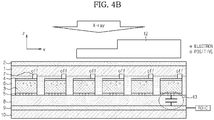
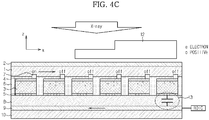
- FIGS. 4A through 4C are schematic views which illustrate the operation of a radiation detector according to one embodiment of the present invention, such as the detector shown in FIG. 1 .
- FIG. 4A illustrates a detector before having x-rays applied to a subject body (target) 12.
- signal electrodes 7 are applied with a reverse bias voltage (for example, -5v) to maintain an off-state.
- a data electrode 9, an insulation layer 8, and a rear electrode 5 of a photosensor 3 form a capacitor 13.
- the strength of the x-rays becomes attenuated by a density of the subject body 12 (in FIGS. 4A through 4C , a difference in the density is shown as a difference in thickness of the subject body 12) of the subject body 12, which attenuated X-rays become incident to/are applied to a scintillator 1 of the detector (see FIG. 4B ).
- the x-rays applied to the scintillator 1 is converted into visible light which is then applied to the photosensors 3.
- the photosensors 3 absorbs the visible light, and convert the light energy into an electrical signal.
- the electrical signal is accumulated on the rear electrodes 5 of the photosensors 3.
- the data electrodes 9 are induced with opposite charges in response to the accumulated charges on the rear electrodes 5.
- the capacitor 13 formed including the rear electrode 5, the insulation layer 8, and the data electrode 9 is charged with charges.
- the two left-most respective photosensors 3 present in the region where the x-rays are directly applied, that is, without having passed through body 12, have a greater electrical signal than that of the third and fourth photosensors 3 from the left (which present in the region where attenuated x-rays pass through a lower density portion of the subject body 12).
- the third and fourth photosensors 3 from the left have a greater electrical signal than that generated from the remaining twoe respective photosensors 3 which present in the region where attenuated x-rays pass through the highest density portion of the subject body 12.
- such a difference corresponds to a difference in the number of electrons accumulated on each rear electrode 5.
- a forward bias voltage is applied in an orderly manner to each signal electrode 7 in a form of line formed on respective row of the photosensors 3 arranged to cross each other.
- voltage applied to the data electrodes 9 of the capacitor 13 changes in response thereto.
- charges are transferred in accordance with the changes in the voltage.
- each rear electrode 5 of the photosensors 3 when the signal electrodes 7 in an off-state (for example, applied with a reverse bias voltage of -5v) are applied with a forward bias voltage of +5v to change the signal electrodes 7 to an on-state, each rear electrode 5 of the photosensors 3 generates holes, while electrons in response to the voltage change are generated at the other electrode, i.e. the data electrode, forming the capacitor 13.
- the signal electrodes 7 when the signal electrodes 7 are turned on orderly from the left to right the charges are transferred to the left.
- the read out IC ROIC connected with the data electrodes 9 detects movement of the charges generated in the data electrodes 9 (as shown by the directional arrow in electrode 9) and outputs an image signal.
- FIG. 5 illustrates the basic components of a typical X-ray image generating system 100, modified, however, so as to incorporate an X-ray detector constructed and operated according to one or more of the embodiments described above.
- the X-ray image generating system 100 may include an X-ray source 110, an X-ray detector 130, a controller 140, and an image processing/analyzing unit 150.
- a stage 120 may be a device designed to selectively immobilize a target by applying a predetermined amount of pressure to the target or by removing the applied pressure from the target.
- a display 160 is included in or separate from the image processing system 100.
- any of the controller 140, X-ray detector 130, image processing/analyzing unit 150, or display 160 may also include a memory for storing and later recall of any detected target images, optimal images, or hard and soft tissue images generated by image generating system 100.
- the image processing/analyzing unit 150 is further configured to control the display of any detected target images, optimal images, or hard and soft tissue images by display 160.
- the X-ray source 110 may radiate X-rays toward a target (object to be imaged) illustrated in FIG. 5 , such that the X-rays radiate through the target toward the X-ray detector 130.
- the X-rays passing through the target may be detected by the X-ray detector 130.
- a dose and voltage of the X-rays radiated from the X-ray source 110, and a radiation time may be controlled by the control unit 140, as well known by those of ordinary skill in the art.
- the X-ray detector 130 may acquire a plurality of target images that are formed by passing X-rays from the X-ray source 110, through the target, thereby acquiring the plurality of target images.
- the controller 140 may control the X-ray source 110 so that an X-ray may be radiated to the target in a predetermined dose/voltage within or during a predetermined time period. Additionally, at any time during the process, the controller 140 may control the stage 120 to adjust the pressure applied to the target.
- the image processing/analyzing unit 150 may perform image processing on the target images acquired by the X-ray detector 130 during the predetermined time interval. Any one of several well known image processing schemes can then be used to create and display one or more images based on the target images acquired by the X-ray detector 130.
Landscapes
- Solid State Image Pick-Up Elements (AREA)
- Measurement Of Radiation (AREA)
- Light Receiving Elements (AREA)
Applications Claiming Priority (1)
| Application Number | Priority Date | Filing Date | Title |
|---|---|---|---|
| KR1020110010426A KR101257699B1 (ko) | 2011-02-07 | 2011-02-07 | 방사선 디텍터 및 그 제조방법 |
Publications (2)
| Publication Number | Publication Date |
|---|---|
| EP2485261A2 true EP2485261A2 (fr) | 2012-08-08 |
| EP2485261A3 EP2485261A3 (fr) | 2013-12-11 |
Family
ID=45524340
Family Applications (1)
| Application Number | Title | Priority Date | Filing Date |
|---|---|---|---|
| EP12151742.9A Withdrawn EP2485261A3 (fr) | 2011-02-07 | 2012-01-19 | Détecteur de rayonnement et son procédé de fabrication |
Country Status (4)
| Country | Link |
|---|---|
| US (1) | US20120201350A1 (fr) |
| EP (1) | EP2485261A3 (fr) |
| KR (1) | KR101257699B1 (fr) |
| CN (1) | CN102628953A (fr) |
Families Citing this family (16)
| Publication number | Priority date | Publication date | Assignee | Title |
|---|---|---|---|---|
| US8872120B2 (en) | 2012-08-23 | 2014-10-28 | Semiconductor Energy Laboratory Co., Ltd. | Imaging device and method for driving the same |
| CN103829959B (zh) * | 2012-11-23 | 2016-04-27 | 群康科技(深圳)有限公司 | X光平板侦测装置 |
| TWI500926B (zh) | 2012-11-23 | 2015-09-21 | Innocom Tech Shenzhen Co Ltd | X光平板偵測裝置 |
| KR101687747B1 (ko) | 2015-08-24 | 2016-12-19 | (주)에프와이디 | 방사선 감지 센서 및 이의 구동 방법 |
| CN111430393A (zh) * | 2015-08-27 | 2020-07-17 | 中国科学院微电子研究所 | 一种x射线传感器及其制造方法 |
| WO2018117485A1 (fr) * | 2016-12-19 | 2018-06-28 | 경희대학교산학협력단 | Détecteur de rayonnement comprenant un transistor formé sur un substrat en carbure de silicium |
| KR101864963B1 (ko) * | 2016-12-19 | 2018-06-05 | 경희대학교 산학협력단 | 방사선 디텍터 및 그 제조 방법 |
| JP6986857B2 (ja) * | 2017-05-17 | 2021-12-22 | アズビル株式会社 | 光電センサ |
| KR102487841B1 (ko) * | 2018-03-14 | 2023-01-11 | 삼성전자주식회사 | 반도체 패키지 |
| CN109686811A (zh) * | 2018-06-12 | 2019-04-26 | 南京迪钛飞光电科技有限公司 | 一种光电平板探测器及其基板结构 |
| US11398520B2 (en) * | 2019-01-11 | 2022-07-26 | HKC Corporation Limited | X-ray detector, method for manufacturing x-ray detector, and medical equipment |
| CN113812005B (zh) * | 2019-05-14 | 2024-05-28 | 棱镜传感器公司 | 具有场限环配置的x射线传感器 |
| KR102697765B1 (ko) * | 2019-05-15 | 2024-08-21 | 삼성전자주식회사 | 지문 센서, 지문 센서 어레이 및 장치 |
| CN114823745B (zh) | 2021-01-28 | 2024-10-29 | 睿生光电股份有限公司 | X射线装置 |
| EP4068363B1 (fr) | 2021-03-30 | 2023-06-07 | Siemens Healthcare GmbH | Détecteur de rayonnement avec carreaux d'absorbeur à buttes sans zones mortes |
| JP7449264B2 (ja) * | 2021-08-18 | 2024-03-13 | 株式会社東芝 | 放射線検出器 |
Family Cites Families (14)
| Publication number | Priority date | Publication date | Assignee | Title |
|---|---|---|---|---|
| US3521244A (en) * | 1968-10-23 | 1970-07-21 | Rca Corp | Electrical circuit for processing periodic signal pulses |
| JPS6271881A (ja) * | 1985-09-26 | 1987-04-02 | Toshiba Corp | 放射線検出器 |
| FR2593343B1 (fr) * | 1986-01-20 | 1988-03-25 | Thomson Csf | Matrice d'elements photosensibles et son procede de fabrication, procede de lecture associe, et application de cette matrice a la prise de vue d'images |
| GB9209734D0 (en) * | 1992-05-06 | 1992-06-17 | Philips Electronics Uk Ltd | An image sensor |
| GB9702991D0 (en) * | 1997-02-13 | 1997-04-02 | Philips Electronics Nv | Array of photosensitive pixels |
| US6097788A (en) * | 1998-04-14 | 2000-08-01 | Siemens Aktiengesellschaft | Method and apparatus for multi-planar radiation emission for imaging |
| JP3436196B2 (ja) * | 1999-09-06 | 2003-08-11 | 株式会社島津製作所 | 2次元アレイ型検出装置 |
| KR100660813B1 (ko) * | 1999-12-31 | 2006-12-26 | 엘지.필립스 엘시디 주식회사 | 엑스레이 디텍터용 어레이기판 제조방법 |
| KR100835970B1 (ko) * | 2001-03-12 | 2008-06-09 | 엘지디스플레이 주식회사 | 엑스레이 영상 감지소자 및 그 제조방법 |
| KR100852516B1 (ko) * | 2001-12-31 | 2008-08-14 | 비오이 하이디스 테크놀로지 주식회사 | 엑스레이 디텍터의 제조방법 |
| AU2003294822A1 (en) * | 2002-12-09 | 2004-06-30 | Quantum Semiconductor Llc | Cmos image sensor |
| US7304308B2 (en) | 2005-02-16 | 2007-12-04 | Hologic, Inc. | Amorphous selenium flat panel x-ray imager for tomosynthesis and static imaging |
| US7208742B1 (en) | 2005-12-15 | 2007-04-24 | General Electric Company | X-ray detector with radiation hard photodiode design |
| CN107425020B (zh) * | 2009-06-17 | 2019-10-18 | 密执安州立大学董事会 | 辐射传感器 |
-
2011
- 2011-02-07 KR KR1020110010426A patent/KR101257699B1/ko not_active Expired - Fee Related
-
2012
- 2012-01-19 EP EP12151742.9A patent/EP2485261A3/fr not_active Withdrawn
- 2012-01-30 US US13/361,021 patent/US20120201350A1/en not_active Abandoned
- 2012-02-07 CN CN201210028632XA patent/CN102628953A/zh active Pending
Non-Patent Citations (1)
| Title |
|---|
| None |
Also Published As
| Publication number | Publication date |
|---|---|
| CN102628953A (zh) | 2012-08-08 |
| KR20120090169A (ko) | 2012-08-17 |
| EP2485261A3 (fr) | 2013-12-11 |
| US20120201350A1 (en) | 2012-08-09 |
| KR101257699B1 (ko) | 2013-04-24 |
Similar Documents
| Publication | Publication Date | Title |
|---|---|---|
| EP2485261A2 (fr) | Détecteur de rayonnement et son procédé de fabrication | |
| JP5683850B2 (ja) | 放射線検出素子、及び放射線画像撮影装置 | |
| US9268037B2 (en) | Universal kV-MV imagers | |
| EP3267483B1 (fr) | Substrat de matrice et son procédé de fabrication, détecteur de rayons x à panneau plat et système de caméra | |
| CN103270595B (zh) | 用于包括反射能力的高性能放射线摄影成像阵列的装置和方法 | |
| US9697923B2 (en) | Radiation image capturing system | |
| EP2144271B1 (fr) | Dispositif d'imagerie par rayons x et appareil de radiographie par rayons x | |
| JP2013089869A (ja) | 検出装置及び検出システム | |
| US20130048862A1 (en) | Radiation detector, radiation detector fabrication method, and radiographic image capture device | |
| CN108604591A (zh) | 摄像装置、摄像显示系统和显示装置 | |
| KR102536859B1 (ko) | 광 검출 장치 및 그의 제조 방법 | |
| JP2003031837A (ja) | 画像検出器およびその製造方法、画像記録方法および読取方法並びに画像記録装置および読取装置 | |
| KR20140119818A (ko) | X선 검출기 및 x선 측정 방법 | |
| US7054410B2 (en) | Multi energy x-ray imager | |
| EP2604188A1 (fr) | Détecteur numérique et appareil de rayonnement l'utilisant | |
| US9935152B2 (en) | X-ray detector having improved noise performance | |
| JP2022506008A (ja) | デュアルセンササブピクセル放射線検出器 | |
| US9165957B2 (en) | Detecting device, detecting system, and manufacturing method of detecting device | |
| US8415634B2 (en) | Apparatus and method for detecting radiation | |
| JP6282363B2 (ja) | 検出装置及び検出システム | |
| KR20160017490A (ko) | 엑스선 검출기 | |
| KR20160105775A (ko) | 광학적 와이핑을 가능하게 하는 광의 발생기를 소유하는 디지털 검출기 | |
| JP2007235098A (ja) | 放射線損傷の影響を小さくするダイオード設計 | |
| JP2012227538A (ja) | 放射線撮像装置及び放射線撮像システム | |
| JP3983963B2 (ja) | 画像検出器およびその製造方法、並びに画像記録/読取方法および装置 |
Legal Events
| Date | Code | Title | Description |
|---|---|---|---|
| PUAI | Public reference made under article 153(3) epc to a published international application that has entered the european phase |
Free format text: ORIGINAL CODE: 0009012 |
|
| AK | Designated contracting states |
Kind code of ref document: A2 Designated state(s): AL AT BE BG CH CY CZ DE DK EE ES FI FR GB GR HR HU IE IS IT LI LT LU LV MC MK MT NL NO PL PT RO RS SE SI SK SM TR |
|
| AX | Request for extension of the european patent |
Extension state: BA ME |
|
| RAP1 | Party data changed (applicant data changed or rights of an application transferred) |
Owner name: SAMSUNG ELECTRONICS CO., LTD. |
|
| PUAL | Search report despatched |
Free format text: ORIGINAL CODE: 0009013 |
|
| AK | Designated contracting states |
Kind code of ref document: A3 Designated state(s): AL AT BE BG CH CY CZ DE DK EE ES FI FR GB GR HR HU IE IS IT LI LT LU LV MC MK MT NL NO PL PT RO RS SE SI SK SM TR |
|
| AX | Request for extension of the european patent |
Extension state: BA ME |
|
| RIC1 | Information provided on ipc code assigned before grant |
Ipc: H01L 27/146 20060101AFI20131106BHEP |
|
| STAA | Information on the status of an ep patent application or granted ep patent |
Free format text: STATUS: THE APPLICATION IS DEEMED TO BE WITHDRAWN |
|
| 18D | Application deemed to be withdrawn |
Effective date: 20140612 |