EP2487155B1 - Nachweis von synthetischen Cannabinoiden - Google Patents
Nachweis von synthetischen Cannabinoiden Download PDFInfo
- Publication number
- EP2487155B1 EP2487155B1 EP20120154614 EP12154614A EP2487155B1 EP 2487155 B1 EP2487155 B1 EP 2487155B1 EP 20120154614 EP20120154614 EP 20120154614 EP 12154614 A EP12154614 A EP 12154614A EP 2487155 B1 EP2487155 B1 EP 2487155B1
- Authority
- EP
- European Patent Office
- Prior art keywords
- jwh
- immunogen
- crosslinker
- antibodies
- molecules
- Prior art date
- Legal status (The legal status is an assumption and is not a legal conclusion. Google has not performed a legal analysis and makes no representation as to the accuracy of the status listed.)
- Active
Links
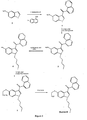
- WDMRAMRBEVMLND-UHFFFAOYSA-N CCOC(CCCCC[n]1c2ccccc2c(C(c2cccc3c2cccc3)=O)c1)=O Chemical compound CCOC(CCCCC[n]1c2ccccc2c(C(c2cccc3c2cccc3)=O)c1)=O WDMRAMRBEVMLND-UHFFFAOYSA-N 0.000 description 1
- QIXQGVQLBPQVOR-UHFFFAOYSA-N O=C(c1c[nH]c2ccccc12)c1c(cccc2)c2ccc1 Chemical compound O=C(c1c[nH]c2ccccc12)c1c(cccc2)c2ccc1 QIXQGVQLBPQVOR-UHFFFAOYSA-N 0.000 description 1
- NSNPSJGHTQIXDO-UHFFFAOYSA-N O=C(c1cccc2c1cccc2)Cl Chemical compound O=C(c1cccc2c1cccc2)Cl NSNPSJGHTQIXDO-UHFFFAOYSA-N 0.000 description 1
- UDTPRZAPKMVJMV-UHFFFAOYSA-N OC(CCCCC[n]1c2ccccc2c(C(c2c(cccc3)c3ccc2)=O)c1)=O Chemical compound OC(CCCCC[n]1c2ccccc2c(C(c2c(cccc3)c3ccc2)=O)c1)=O UDTPRZAPKMVJMV-UHFFFAOYSA-N 0.000 description 1
- SIKJAQJRHWYJAI-UHFFFAOYSA-N c1c[nH]c2ccccc12 Chemical compound c1c[nH]c2ccccc12 SIKJAQJRHWYJAI-UHFFFAOYSA-N 0.000 description 1
Images




Classifications
-
- G—PHYSICS
- G01—MEASURING; TESTING
- G01N—INVESTIGATING OR ANALYSING MATERIALS BY DETERMINING THEIR CHEMICAL OR PHYSICAL PROPERTIES
- G01N33/00—Investigating or analysing materials by specific methods not covered by groups G01N1/00 - G01N31/00
- G01N33/48—Biological material, e.g. blood, urine; Haemocytometers
- G01N33/50—Chemical analysis of biological material, e.g. blood, urine; Testing involving biospecific ligand binding methods; Immunological testing
- G01N33/94—Chemical analysis of biological material, e.g. blood, urine; Testing involving biospecific ligand binding methods; Immunological testing involving narcotics or drugs or pharmaceuticals, neurotransmitters or associated receptors
- G01N33/948—Sedatives, e.g. cannabinoids, barbiturates
-
- C—CHEMISTRY; METALLURGY
- C07—ORGANIC CHEMISTRY
- C07K—PEPTIDES
- C07K17/00—Carrier-bound or immobilised peptides; Preparation thereof
- C07K17/14—Peptides being immobilised on, or in, an inorganic carrier
-
- C—CHEMISTRY; METALLURGY
- C07—ORGANIC CHEMISTRY
- C07K—PEPTIDES
- C07K16/00—Immunoglobulins [IG], e.g. monoclonal or polyclonal antibodies
- C07K16/44—Immunoglobulins [IG], e.g. monoclonal or polyclonal antibodies against material not provided for elsewhere, e.g. haptens, metals, DNA, RNA, amino acids
-
- Y—GENERAL TAGGING OF NEW TECHNOLOGICAL DEVELOPMENTS; GENERAL TAGGING OF CROSS-SECTIONAL TECHNOLOGIES SPANNING OVER SEVERAL SECTIONS OF THE IPC; TECHNICAL SUBJECTS COVERED BY FORMER USPC CROSS-REFERENCE ART COLLECTIONS [XRACs] AND DIGESTS
- Y10—TECHNICAL SUBJECTS COVERED BY FORMER USPC
- Y10S—TECHNICAL SUBJECTS COVERED BY FORMER USPC CROSS-REFERENCE ART COLLECTIONS [XRACs] AND DIGESTS
- Y10S435/00—Chemistry: molecular biology and microbiology
- Y10S435/81—Packaged device or kit
-
- Y—GENERAL TAGGING OF NEW TECHNOLOGICAL DEVELOPMENTS; GENERAL TAGGING OF CROSS-SECTIONAL TECHNOLOGIES SPANNING OVER SEVERAL SECTIONS OF THE IPC; TECHNICAL SUBJECTS COVERED BY FORMER USPC CROSS-REFERENCE ART COLLECTIONS [XRACs] AND DIGESTS
- Y10—TECHNICAL SUBJECTS COVERED BY FORMER USPC
- Y10S—TECHNICAL SUBJECTS COVERED BY FORMER USPC CROSS-REFERENCE ART COLLECTIONS [XRACs] AND DIGESTS
- Y10S436/00—Chemistry: analytical and immunological testing
- Y10S436/807—Apparatus included in process claim, e.g. physical support structures
- Y10S436/81—Tube, bottle, or dipstick
Definitions
- a problem for governments and drug enforcement agencies is that even after identifying and banning a new synthetic cannabinoid, the manufacturers can rapidly react to the banning by incorporating a different active analogue into the same or a different herbal product; targeted minor changes in the molecular structure of the known active compound can preserve receptor activity but often produces a molecule whose GC-MS/LC-MS (the commonly applied detection techniques) profile is completely different from the original active molecule.
- the new active molecule initially remains unidentified and a further resource intensive and costly chemical analytical study to enable structural characterisation is required.
- the main active ingredients highlighted in SSC products to date are JWH-018, CP 47,497 and JWH-073 (Uchiyama et al. 2010; Hudson et al.
- JWH refers to molecules comprising structure I which are CB 1 -active or metabolites of the CB 1 -active parent, in which the indole ring system is present as a fused heterobicyclic i.e. it is not part of, for example, a fused heterotricyclic ring system.
- Y can be hydrogen or a substituted or unsubstituted alkyl group such as butyl, pentyl or 2-(morpholin-4-yl)ethyl, while R is a carbon atom which may be part of a fused or unfused, substituted or unsubstituted aromatic ring or a substituted or unsubstituted alkyl, alkenyl or alkynyl chain optionally attached to a fused or unfused, substituted or unsubstituted aromatic ring, but is usually a substituted or unsubstituted naphthyl ring.
- R is a carbon atom which may be part of a fused or unfused, substituted or unsubstituted aromatic ring or a substituted or unsubstituted alkyl, alkenyl or alkynyl chain optionally attached to a fused or unfused, substituted or unsubstituted aromatic ring, but is usually a substituted or unsubsti
- CP refers to synthetic cannabinoid molecules comprising the unfused bicyclic structure II, in which X is either ethyl, n -propyl or n -butyl as well as metabolites thereof.
- X is either ethyl, n -propyl or n -butyl as well as metabolites thereof.
- Indolyl, naphthyl, carboxyalkyl, N-dealkylated and N-alkyl mono-, di-, and tri-hydroxylated metabolites, as well as their glucuronidated conjugates are reported JWH-018 metabolites (Sobolevsky et al. 2010; Kraemer et al. 2008). Moller et al. (2010) highlighted the same metabolites as Sobolevsky et al.
- EP0736529 A1 discloses a method for detecting tetrahydrocannabinol metabolites using antibodies against said cannabinoids in immunoassays.
- the Inventors devised a novel method based on novel antibodies raised from novel immunogens.
- the antibodies underpin an effective analytical and economic solution to the detection and quantification of current and future JWH and CP CB 1 -active molecules in in vitro patient samples and herbal therapeutics.
- the invention describes a rapid and practical method for the detection and determination of known and/or stealth synthetic cannabinoids based on the JWH and CP drug families. Kits and their use for JWH and CP SSC detection and determination in herbal therapeutics and in vitro patient samples are also described. The invention is underpinned by novel immunogens and antibodies which enable said methods, kits and applications.
- the invention provides immunogens, antibodies, methods kits, uses and solid substrates as defined in the appended claims.
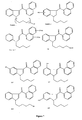
- a first aspect of the invention is one or more immunogens possessing the following structures
- the crosslinker in which the accm is an antigenicity conferring carrier material; the crosslinker is a functionalised linking group joining the accm to the remainder of the molecule. By functionalised it is meant the crosslinker incorporates atoms that enable it to bond to both the accm and the JWH or CP moiety, forming a bridging group.
- the crosslinker forms either a single or double bond to the cylcohexyl ring, in structure (c) the crosslinker extends from the 4, 5, 6 or 7-position of the indole ring and in structure (d) the crosslinker extends from the 2, 3, 4, 5, 6, 7, or 8-position of the naphthyl ring.
- crosslinker concept is well known to the person skilled in immunogen synthesis.
- the nature and length of the crosslinker follows standard methods in order to optimise hapten epitopic recognition by the antibody. This entails a crosslinker of low immunogenicity and a chain length preferably of no greater than about ten atoms, most preferably no greater than six atoms.
- Preferred immunogens correspond to structures (a) and (c).
- the crosslinker of structure (c) of Group I is preferably attached to the 5-indole position.
- the crosslinker of structure (d) of Group I is preferably attached to the 4-naphthyl position.
- immunogens of the invention raise antibodies that are able to bind to several JWH molecules and metabolites.
- the skilled person is aware that for these antibodies to recognize JWH and CP molecules they must bind to particular structures or epitopes of the hapten (in this context the hapten being that part of the immunogen that is not the crosslinker or accm); the epitopes are often distinct groups incorporating functional groups.
- the epitope recognized by the antibody will be all or part of the 3-(1-naphthoyl)-1H-indole moiety
- the epitope recognized by the antibody will be all or part of the N-pentyl-3-carbonyl-1H-indole moiety.
- the accm can be any material that makes all or part of the hapten susceptible to antibody recognition and binding.
- the accm can be a protein, a protein fragment, a synthetic polypeptide or a semisynthetic polypeptide.
- a further aspect of the invention is an antibody raised against an immunogen of structure (a), (b) or (c) of Group I, that is able to bind to molecules of the JWH family and their metabolites that comprise structure I.
- the term 'able to bind to' does not imply that the antibodies have a choice of whether or not to bind to the JWH molecules, but that under standard immunoassay conditions the antibodies will bind to the JWH or CP molecules.
- the antibodies are preferably raised against immunogens of structure (a) or (c) of Group I, the antibodies being able to bind to several molecules and metabolites of the JWH family, including JWH-018 and its N-alkyl hydroxylated metabolites.
- the antibodies also have the potential to bind to CB 1 -active derivatives of JWH molecules that could represent future generations of SSCs.
- the invention also describes an antibody raised against an immunogen of structure (d), (e), (f) or (g) the antibody being able to bind to molecules of the CP family, metabolites of CP molecules and future SSC molecules comprising structure II.
- an antibody raised against an immunogen of structure (d), (e), (f) or (g) the antibody being able to bind to molecules of the CP family, metabolites of CP molecules and future SSC molecules comprising structure II.
- the word specific in the context of the current invention refers to the analyte that is preferably bound by the antibody, as gauged by a suitable metric such as the IC 50 . Given the IC 50 of various analytes their cross-reactivities can be calculated.
- the antibody can either be a polyclonal or monoclonal antibody using well-known methods.
- the polyclonal antibody possesses the required specificity and sensitivity, that is, it binds a single analyte within the detection range of the assay, development of a monoclonal antibody is unnecessary.
- a polyclonal or monoclonal antibody that binds to several analytes might be desirable; in the context of the current invention antibodies that bind several analytes are preferred.
- One or more antibodies of the invention can be incorporated into a kit for the detection and determination of individual or multiple SSCs. The skilled person in the immunodiagnostic field is aware of several alternative immunoassay formats that could incorporate the antibodies of the invention either in solution or tethered (e.g.
- a preferred solid substrate onto which the antibodies of the invention are covalently bonded is a chip, preferably a ceramic chip; the word 'biochip' can be used to refer to a chip with antibodies attached.
- the antibodies of the invention can be used for the detection or determination of a single SSC such as JWH-018, either as the parent molecule or as a metabolite, but a preferred embodiment is the use of one or more antibodies, preferably two or more antibodies, at least one derived from Group I and one derived from Group II, for the detection or determination of several SSCs and/or their metabolites from the JWH and CP families.
- the detection and determination criteria for a SSC using an immunoassay platform includes, as is well-known in the art, exceeding a pre-defined cut-off/concentration value or measuring the calibrator equivalent value as derived from a calibrator curve (also referred to as a standard curve).
- Another aspect of the invention is a method of detecting or determining synthetic cannabinoids of the JWH and/or CP families and their metabolites in an in vitro sample of an individual or in a solution derived from a substance suspected of containing synthetic cannabinoids comprising: contacting the sample or solution with one or more detecting agents and one or more antibodies of the invention that bind to molecules of the JWH family and/or one or more antibodies of the invention that bind to molecules of the CP family, measuring the detecting agents, and detecting or determining, by reference to calibrators, the presence or concentration of a molecule or molecules of the JWH family and/or CP family.
- the detecting agent is a small molecule, generally of similar structure to a molecule to be detected conjugated to a labelling agent, that is able to bind to one of the antibodies of the invention.
- the labelling agent is selected from an enzyme, a luminescent substance, a radioactive substance, or a mixture thereof.
- the labelling agent is an enzyme, preferably a peroxidase, most preferably horseradish peroxidase (HRP).
- the luminescent substance may be a bioluminescent, chemiluminescent or fluorescent material.
- the patient sample to be used for in vitro analysis can be hair or a peripheral biological fluid but is preferably whole blood, serum, plasma, or urine.
- the synthetic cannabinoids to be detected or determined are one or more of JWH-018, JWH-073, JWH-200 and JWH-398 and the one or more antibodies are derived from immunogens of structures (a) and (c) of Group I.
- the metabolite or metabolites are also inferred unless otherwise stated.
- the immunogen of structure (a) preferably has a crosslinker -X-Y- in which Y is carbonyl and is attached to the accm, and X is pentylene, and the immunogen of structure (c) has a crosslinker -O-CH2-C(O)- in which the carbonyl is attached to the accm.
- kits for detecting or determining a molecule or molecules of the JWH family and/or CP family comprising one or more antibodies of the invention.
- the kit comprises one or more antibodies raised to an immunogen of either structure (a), (b), (c) or (d) of Group I and one or more antibodies raised to an immunogen of structure (d), (e), (f) or (g) of Group II.
- the antibodies of the kit are derived from an immunogen of structure (a) and/or (c).
- a kit comprising antibodies derived from Immunogens I or II ( Figure 5 ) for detecting or determining one or more of JWH-018, JWH-073, JWH-200 and JWH-398 is particularly preferred.
- the antibodies of the kit are preferably tethered to any suitable solid support such as a chip.
- the solid support can be of any suitable shape such as a bead or a slide and of any suitable material such as silicon, glass or plastic, the solid support is preferably a ceramic chip.
- the kit may further include calibrators and one or more detecting agents and optionally includes instructions for the use of the antibodies of the kit and if incorporated, the calibrators and detecting agents, for detecting and determining molecules from the JWH and/or CP families.
- the invention also embodies solid supports comprising the novel antibodies.
- the antibodies of the invention are used for the detection or determination of JWH and/or CP molecules either in herbal mixtures, an in vitro sample taken from an individual or any other substance suspected of their incorporation.
- a preferred use of the antibodies of the invention is their use in the detection and/or quantification of JWH-018, JWH-073, JWH-200 and JWH-398 in herbal mixtures and/or JWH-073, JWH-200, JWH-398 and JWH-018 and its metabolites in vitro samples taken from individuals.
- haptens provide defined structural epitopes, they are not in themselves immunogenic and therefore need to be conjugated to carrier materials, which will elicit an immunogenic response when administered to a host animal.
- carrier materials commonly contain poly(amino acid) segments and include polypeptides, proteins and protein fragments.
- useful carrier materials are bovine serum albumin (BSA), egg ovalbumin, bovine gamma globulin, bovine thyroglobulin (BTG), keyhole limpet haemocyanin (KLH) etc.
- BSA bovine serum albumin
- BBG bovine gamma globulin
- BBG bovine thyroglobulin
- KLH keyhole limpet haemocyanin
- synthetic poly(amino acids) having a sufficient number of available amino groups, such as lysine may be employed, as may other synthetic or natural polymeric materials bearing reactive functional groups.
- carbohydrates, yeasts or polysaccharides may be conjugated to the hapten to produce an immunogen.
- the haptens can also be coupled to a detectable labelling agent such as an enzyme (for example, horseradish peroxidase), a substance having fluorescent properties or a radioactive label for the preparation of detecting agents for use in the immunoassays.
- the fluorescent substance may be, for example, a monovalent residue of fluorescein or a derivative thereof.
- Immunogen formation for the invention described herein involves conventional conjugation chemistry.
- each immunogen is evaluated using matrix-assisted UV laser desorption /ionisation time-of-flight mass spectroscopy (MALDI-TOF MS).
- MALDI-TOF MS matrix-assisted UV laser desorption /ionisation time-of-flight mass spectroscopy
- MALDI-TOF mass spectrometry was performed using a Voyager STR Biospectrometry Research Station laser-desorption mass spectrometer coupled with delayed extraction. An aliquot of each sample to be analysed was diluted in 0.1% aqueous trifluoroacetic acid (TFA) to create 1mg/ml sample solutions. Aliquots (1 ⁇ l) were analysed using a matrix of sinapinic acid and bovine serum albumin (Fluka) was used as an external calibrant.
- TFA trifluoroacetic acid
- an immunogen of the present invention is mixed with Freund's adjuvant and the mixture is injected into a host animal, such as rabbit, sheep, mouse, guinea pig or horse. Sheep are the preferred host animal. Further injections (boosts) are made and serum is sampled for evaluation of the antibody titre. When the optimal titre has been attained, the host animal is bled to yield a suitable volume of specific antiserum.
- the degree of antibody purification required depends on the intended application. For many purposes, there is no requirement for purification, however, in other cases, such as where the antibody is to be immobilised on a solid support, purification steps can be taken to remove undesired material and eliminate non-specific binding.
- an immunoassay is well known to the person skilled in the art. Briefly, for a competitive immunoassay in which the target analyte is a non-immunogenic molecule such as a hapten, the following process is conducted: antibodies are produced by immunising an animal, preferably a mammalian animal, by repeated administration of an immunogen. The serum from the immunised animal is collected when the antibody titre is sufficiently high. A detecting agent is added to a sample containing the target analyte and the raised antibodies, and the detecting agent and analyte compete for binding to the antibodies. The process may comprise fixing said serum antibodies to a backing substrate such as a polystyrene solid support or a ceramic chip.
- a backing substrate such as a polystyrene solid support or a ceramic chip.
- the antibodies can be polyclonal or monoclonal using standard techniques.
- the signal emitted in the immunoassay is proportionate to the amount of detecting agent bound to the antibodies which in turn is inversely proportionate to the analyte concentration.
- the signal can be detected or quantified by comparison with a calibrator.
- EDC hydrochloride (10mg) was dissolved in water (0.5ml) and immediately added to a solution of Hapten-A (2mg) in DMF (0.2ml). After mixing, this solution was added dropwise to a solution of HRP (20mg) in water (1ml). Sulfo-NHS (5mg) was added and the reaction mixture was incubated in the dark at room temperature overnight. Excess hapten was removed with double PD-10 columns (Pharmacia) in series, pre-equilibrated with PBS at pH 7.2. The hapten-HRP detecting agent was then dialysed overnight against 10L of PBS at pH 7.2 at 4 ° C.
- NMR 13 C (CD 3 OD, ⁇ ppm): 194.55, 173.21, 156.53, 141.14, 140.15, 135.25, 134.10, 131.98, 131.17, 129.46, 128.9, 1127.85, 127.44, 126.87, 125.55, 125.85, 117.92, 115.14, 112.72, 106.33, 65.54, 30.59, 29.87, 23.2, 14.25
- Indole 3-carboxylic acid (3g, 18.62mmol) was added to a suspension of sodium hydride (60% in oil) (1.11g, 1.5eq) in dry DMF (30ml) under a nitrogen atmosphere. The mixture was stirred at room temperature for 45 min (H 2 evolving has ceased) and to this was added 1-bromopentane (4.62ml, 2eq) in dry DMF (10ml) dropwise. The mixture was stirred at room temperature overnight. The solvents were removed in vacuo and to the residue was added water (30ml) and ethyl acetate (30ml). The ethyl acetate portion was separated, dried over sodium sulphate, filtered and evaporated to dryness. The crude residue was purified by column chromatography (silica gel: 20% ethyl acetate in hexane) to give the title compound (2.12g, 49%) as a cream solid.
- Example - 16 Conjugation of 1-pentyl-1-H-indole-3-carboxylic acid to BTG (Immunogen III)
- EDC hydrochloride (10mg) was dissolved in water (0.5ml) and immediately added to a solution of Hapten-B (2mg) in DMF (0.2ml). After mixing, this solution was added dropwise to a solution of HRP (20mg) in water (1ml). Sulfo-NHS (5mg) was added and the reaction mixture was incubated in the dark at room temperature overnight. Excess hapten was removed with double PD-10 columns (Pharmacia) in series, pre-equilibrated with PBS at pH 7.2. The hapten-HRP detecting agent was then dialysed overnight against 10L of PBS at pH 7.2 at 4 ° C.
- Aqueous solutions of the immunogens prepared in examples 5 and 13 were formulated with Freund's Complete Adjuvant (FCA) to form emulsions consisting of 2mg/ml Immunogen I and 2mg/ml of Immunogen II in 50%(v/v) FCA.
- FCA Freund's Complete Adjuvant
- Three sheep were immunised with each emulsion (1° immunisations), 0.25ml being intramuscularly injected at four sites in the rump of each animal.
- Subsequent immunisations contained 1mg/ml Immunogen I and 1mg/ml Immunogen II.
- Example 19 Development of competitive ELISA for JWH synthetic cannabinoids and metabolites.
- conjugate Heapten A-HRP diluted in Tris buffer containing EDTA, D-mannitol, sucrose, thimerosal and BSA, was added to each of the wells. The appropriate dilution of conjugate was also determined using standard ELISA checkerboard techniques. The plate was incubated at 25°C for 1 hour. The excess unbound conjugate was removed by washing 6 times over a 10-minute period with TBST and tapped dry. 125 ⁇ l of tetramethylbenzedine (TMB) substrate solution was added to each well of the plate that was then incubated for 15-20 minutes in the dark at room temperature. The reaction was terminated by addition of 125 ⁇ l of 0.2M sulphuric acid to each well. The absorbance was then measured at 450nm using a microtiter plate reader.
- TMB tetramethylbenzedine
- %CR is the percentage cross-reactivity
- IC 50 JWH-018 is the concentration of JWH-018 that causes 50% displacement of signal
- IC 50 CR is the concentration of JWH synthetic cannabinoid/metabolite/selected molecule that causes 50% displacement of signal.
- Table 1 Data generated from a competitive microtiter plate assay for JWH synthetic cannabinoids and metabolites, employing antiserum raised to Immunogen I (Hapten A-BTG) and conjugate (Hapten A-HRP) as detection reagent.
- Table 2 Data generated from a competitive microtiter plate assay for JWH synthetic cannabinoids and metabolites, employing antiserum raised to Immunogen II (Hapten B-BTG) and conjugate (Hapten A-HRP) as detection reagent.
- Table 3 confirms that the same antibodies do not cross-react with other psychoactive drugs, with molecules present in biological samples of patients who have not taken JWH containing substances or with molecules without the 3-(1-naphthoyl)-1H-indole such as 3-carboxy-1H-indole.
- the concept of using the antibodies of the invention to detect and determine future stealth synthetic cannabinoids is highlighted in Table 4; the 5-fluoropentyl derivative known to bind the CB 1 receptor, but which as of yet has not been detected in herbal therapeutics or similar substances, binds to antibodies raised from Immunogens I and II.
Landscapes
- Chemical & Material Sciences (AREA)
- Health & Medical Sciences (AREA)
- Life Sciences & Earth Sciences (AREA)
- Molecular Biology (AREA)
- Organic Chemistry (AREA)
- Engineering & Computer Science (AREA)
- Biochemistry (AREA)
- General Health & Medical Sciences (AREA)
- Medicinal Chemistry (AREA)
- Immunology (AREA)
- Genetics & Genomics (AREA)
- Biophysics (AREA)
- Proteomics, Peptides & Aminoacids (AREA)
- Biomedical Technology (AREA)
- Urology & Nephrology (AREA)
- Hematology (AREA)
- Inorganic Chemistry (AREA)
- Cell Biology (AREA)
- Biotechnology (AREA)
- Pharmacology & Pharmacy (AREA)
- Bioinformatics & Cheminformatics (AREA)
- Microbiology (AREA)
- Anesthesiology (AREA)
- Food Science & Technology (AREA)
- Physics & Mathematics (AREA)
- Analytical Chemistry (AREA)
- General Physics & Mathematics (AREA)
- Pathology (AREA)
- Peptides Or Proteins (AREA)
Claims (17)
- Ein oder mehrere Immunogene mit den folgenden Strukturen


für Struktur (e) m = 1-3 ist und der Crosslinker entweder -(L)p-M-Q- oder =N-O-M-Q- ist, wobei Q, das an dem accm gebunden ist, aus Carbonyl, Amino, Thiol, Maleimid, Isocyanat, Isothiocyanat, Aldehyd, Diazo und Dithiopyridyl ausgewählt ist, M ein C1-10-, vorzugsweise ein C1-5-substituierter oder unsubstituierter geradkettiger Alkylen- oder Arylenanteil ist, p = 0 oder 1 ist und L= O, NH, S, Ester, Thioester oder Amid ist;
für Struktur (g) m = 1-3 ist und der Crosslinker -(L)p-M-N- ist, wobei N, das an dem accm gebunden ist, entweder Carbonyl oder Amino ist, M ein C1-10-, vorzugsweise ein C1-5-substituierter oder unsubstituierter geradkettiger Alkylen- oder Arylenanteil ist, p = 0 oder 1 ist und L O, NH, S, Ester, Thioester oder Amid ist. - Immunogen mit Struktur (c) nach Anspruch 1, wobei der Crosslinker sich von der Position 5 des Indolrings aus erstreckt.
- Immunogene mit Strukturen (a) und (c) nach Anspruch 1, wobei das Immunogen (a) ein Y = Carbonyl, n = 0 und D = Pentylen aufweist, und Immunogen (c), wobei sich der Crosslinker von der Position 5 des Indolrings aus erstreckt, welches Y = Carbonyl, A = O, n = 1 und D = Methylen aufweist.
- Antikörper, der gegen ein Immunogen mit einer der Strukturen (a), (b), (c), (d), (e), (f), (g) oder (h) nach Anspruch 1 gebildet wurde, wobei ein Antikörper, der gegen ein Immunogen mit Struktur (a), (b), (c) oder (d) gebildet wurde, dazu in der Lage ist, sich an ein Epitop von einem oder mehreren Molekülen der JWH-Familie zu binden, und wobei ein Antikörper, der gegen ein Immunogen mit Struktur (e), (f), (g) oder (h) gebildet wurde, dazu in der Lage ist, sich an ein Epitop von einem oder mehreren Molekülen der CP-Familie zu binden.
- Antikörper nach Anspruch 4, der gegen ein Immunogen mit Struktur (a) gebildet wurde, welcher dazu in der Lage ist, sich an ein Epitop von JWH-073, JWH-200, JWH-018, M1, M2, M3, M4 und M5 zu binden.
- Antikörper nach Anspruch 4, der gegen ein Immunogen mit Struktur (c) gebildet wurde, welcher dazu in der Lage ist, sich an ein Epitop von JWH-073, JWH-200, JWH-398, JWH-018, M1, M2, M3, M4, M5 und 3-(1-Naphthoyl)-1H-indol zu binden.
- Verfahren zum Nachweisen oder zum Bestimmen synthetischer Cannabinoide aus der JWH-Familie und/oder der CP-Familie in einer In-Vitro-Probe eines Individuums oder in einer Lösung, die von einer Substanz abgeleitet wurde, welche im Verdacht steht, synthetische Cannabinoide zu enthalten, umfassend in Kontakt bringen der Probe oder Lösung mit einem oder mehreren Nachweismitteln und einem oder mehreren Antikörpern nach Anspruch 4, die gegen ein Immunogen mit einer der Strukturen (a), (b), (c), (d) gebildet wurden, und/oder mit einem oder mehreren Antikörpern, die gegen ein Immunogen mit einer der Strukturen (e), (f) (g) oder (h) gebildet wurden; Nachweisen oder Bestimmen der Menge des einen oder der mehreren Nachweismittel; und Schlussfolgern auf das Vorhandenseins von oder einer Menge von einem Molekül oder von Molekülen aus der JWH-Familie und/oder der CP-Familie in der Probe oder der Lösung mithilfe von Kalibratoren.
- Verfahren nach Anspruch 7, wobei es sich bei den synthetischen Cannabinoiden, die unter Verwendung eines Antikörpers, der gegen ein Immunogen mit Struktur (c) gebildet wurde, nachgewiesen oder bestimmt werden sollen, um ein oder mehrere Moleküle aus JWH-018, JWH-073, JWH-200 und JWH-398 handelt.
- Verfahren nach Anspruch 7, wobei es sich bei den synthetischen Cannabinoiden, die unter Verwendung eines Antikörpers, der gegen ein Immunogen mit Struktur (a) gebildet wurde, nachgewiesen oder bestimmt werden sollen, um ein oder mehrere Moleküle aus JWH-018, JWH-073 und JWH-200 handelt.
- Verfahren nach Anspruch 8, wobei das Immunogen mit Struktur (c) den Crosslinker - O-CH2-C(O)- aufweist, wobei das Carbonyl an dem accm gebunden ist und der Crosslinker an Position 5 des Indolrings gebunden ist.
- Verfahren nach Anspruch 9, wobei das Immunogen mit Struktur (a) den Crosslinker - X-Y- aufweist, wobei Y Carbonyl ist und an dem accm gebunden ist, und X Pentylen ist.
- Kit zum Nachweisen oder zum Bestimmen eines Moleküls oder von Molekülen aus der JWH-Familie und/oder der CP-Familie, umfassend einen oder mehrere Antikörper nach Anspruch 4.
- Kit nach Anspruch 12 zum Nachweisen oder zum Bestimmen eines Moleküls oder mehrerer Moleküle aus JWH-018, JWH-073 und JWH-200, umfassend einen Antikörper nach Anspruch 5.
- Kit nach Anspruch 12 zum Nachweisen oder zum Bestimmen eines Moleküls oder mehrerer Moleküle aus JWH-018, JWH-073, JWH-200 und JWH-389, umfassend einen Antikörper nach Anspruch 6.
- Gebrauch von einem oder mehreren Antikörpern nach Anspruch 4 zum Nachweisen und/oder zum Quantifizieren von JWH- und/oder CP-Molekülen in einer Substanz, die im Verdacht steht JWH- und/oder CP-Moleküle zu enthalten.
- Gebrauch nach Anspruch 15, wobei die Substanz eine Kräutermischung oder eine In-Vitro-Probe von einem Patienten ist.
- Festes Substrat, vorzugsweise ein Biochip, umfassend einen oder mehrere Antikörper nach Anspruch 4.
Applications Claiming Priority (2)
| Application Number | Priority Date | Filing Date | Title |
|---|---|---|---|
| GB201102544A GB201102544D0 (en) | 2011-02-14 | 2011-02-14 | Assay |
| GBGB1110425.4A GB201110425D0 (en) | 2011-02-14 | 2011-06-21 | Assay |
Publications (2)
| Publication Number | Publication Date |
|---|---|
| EP2487155A1 EP2487155A1 (de) | 2012-08-15 |
| EP2487155B1 true EP2487155B1 (de) | 2015-01-21 |
Family
ID=43859383
Family Applications (1)
| Application Number | Title | Priority Date | Filing Date |
|---|---|---|---|
| EP20120154614 Active EP2487155B1 (de) | 2011-02-14 | 2012-02-09 | Nachweis von synthetischen Cannabinoiden |
Country Status (4)
| Country | Link |
|---|---|
| US (2) | US8906633B2 (de) |
| EP (1) | EP2487155B1 (de) |
| ES (1) | ES2534599T3 (de) |
| GB (2) | GB201102544D0 (de) |
Families Citing this family (22)
| Publication number | Priority date | Publication date | Assignee | Title |
|---|---|---|---|---|
| GB201102544D0 (en) | 2011-02-14 | 2011-03-30 | Randox Lab Ltd | Assay |
| US9441033B2 (en) | 2011-02-14 | 2016-09-13 | Randox Laboratories Limited | Detection of synthetic cannabinoids |
| US9435817B2 (en) | 2011-02-14 | 2016-09-06 | Randox Laboratories Limited | Detection of synthetic cannabinoids |
| US9434687B2 (en) * | 2011-02-14 | 2016-09-06 | Randox Laboratories Limited | Detection of synthetic cannabinoids |
| EP2698383B1 (de) * | 2012-08-14 | 2020-11-25 | Randox Laboratories Ltd. | Nachweis von synthetischen Cannabionoiden |
| EP2698384A1 (de) * | 2012-08-14 | 2014-02-19 | Randox Laboratories Ltd. | Nachweis von synthetischen Cannabionoiden |
| EP2698385A1 (de) * | 2012-08-14 | 2014-02-19 | Randox Laboratories Ltd. | Nachweis von synthetischen Cannabionoiden |
| CN102838525A (zh) * | 2012-09-04 | 2012-12-26 | 江苏昊华精细化工有限公司 | 1-戊基-3-(1萘甲酰基)吲哚的合成方法 |
| EP2722669A1 (de) * | 2012-10-22 | 2014-04-23 | Securetec Detektions-Systeme AG | Verfahren und Vorrichtung zum Nachweis von illegalen Drogen |
| GB201305061D0 (en) * | 2013-03-20 | 2013-05-01 | Randox Lab | Immunoassay for UR-144,XLR-11,metabolites and derivatives |
| KR102553870B1 (ko) | 2014-03-27 | 2023-07-10 | 버드 락 바이오, 인크. | 인간 카나비노이드 1(cb1) 수용체 결합 항체 |
| EP2950103B1 (de) | 2014-05-28 | 2018-10-17 | Randox Laboratories Ltd. | Immunoassay für synthetischen cannabinoiden der familie 3-adamantanyl indazole/indole-3-carboxamide |
| EP2998743B1 (de) * | 2014-09-19 | 2018-02-21 | Randox Laboratories Ltd | Nachweis von indazole synthetischen cannabinoiden |
| CN104402992B (zh) * | 2014-11-28 | 2018-09-18 | 杭州安旭科技有限公司 | 一种合成大麻抗原的合成方法及合成大麻抗原的应用 |
| JP6493786B2 (ja) * | 2015-01-06 | 2019-04-03 | パナソニックIpマネジメント株式会社 | 免疫原、それを用いた抗体の製造方法、及び、そのモノクローナル抗体 |
| JP6435505B2 (ja) * | 2015-01-13 | 2018-12-12 | パナソニックIpマネジメント株式会社 | 化合物 |
| JP6746108B2 (ja) * | 2015-03-11 | 2020-08-26 | プリマハム株式会社 | カンナビノイド類の検出方法 |
| PE20181199A1 (es) | 2015-09-30 | 2018-07-23 | Bird Rock Bio Inc | Anticuerpos que se unen al receptor cannabinoide 1 (cb1) humano |
| WO2020242744A1 (en) * | 2019-05-31 | 2020-12-03 | Metabolon, Inc. | Mass spectrometry assay methods for detection of metabolites |
| CN112098533A (zh) * | 2020-08-11 | 2020-12-18 | 浙江工业大学 | 一种检测jwh-122体内生物标记物及其应用 |
| CN113861101A (zh) * | 2021-11-03 | 2021-12-31 | 公安部第三研究所 | 合成大麻素半抗原化合物及其制备方法和用途 |
| CN113999176A (zh) * | 2021-11-03 | 2022-02-01 | 公安部第三研究所 | 合成大麻素半抗原化合物及其制备方法和用途 |
Family Cites Families (10)
| Publication number | Priority date | Publication date | Assignee | Title |
|---|---|---|---|---|
| US5248611A (en) | 1987-05-28 | 1993-09-28 | Scripps Clinic And Research Foundation | Stereoisomer separation method using antibody combing site-containing molecules |
| US5817766A (en) | 1995-04-05 | 1998-10-06 | Roche Diagnostic Systems, Inc. | Reagents for a cannabinoid immunoassay |
| US6900236B1 (en) | 1999-10-18 | 2005-05-31 | University Of Connecticut | Cannabimimetic indole derivatives |
| US6686209B2 (en) | 2001-03-12 | 2004-02-03 | Lifepoint, Inc. | Reagents for detecting cannabinoids |
| ES2374203T3 (es) * | 2004-11-10 | 2012-02-14 | Randox Laboratories Ltd. | Haptenos derivados de fenetanolamina, inmunógenos y conjugados que los comprenden y anticuerpos que reconocen dichos inmunógenos y conjugados. |
| US8809382B2 (en) | 2009-05-04 | 2014-08-19 | The Royal Institution For The Advancement Of Learning/Mcgill University | 5-oxo-ETE receptor antagonist compounds |
| GB201102544D0 (en) | 2011-02-14 | 2011-03-30 | Randox Lab Ltd | Assay |
| US9434687B2 (en) * | 2011-02-14 | 2016-09-06 | Randox Laboratories Limited | Detection of synthetic cannabinoids |
| US9435817B2 (en) | 2011-02-14 | 2016-09-06 | Randox Laboratories Limited | Detection of synthetic cannabinoids |
| US9441033B2 (en) * | 2011-02-14 | 2016-09-13 | Randox Laboratories Limited | Detection of synthetic cannabinoids |
-
2011
- 2011-02-14 GB GB201102544A patent/GB201102544D0/en not_active Ceased
- 2011-06-21 GB GBGB1110425.4A patent/GB201110425D0/en active Pending
- 2011-12-20 US US13/332,042 patent/US8906633B2/en active Active
-
2012
- 2012-02-09 EP EP20120154614 patent/EP2487155B1/de active Active
- 2012-02-09 ES ES12154614.7T patent/ES2534599T3/es active Active
-
2014
- 2014-11-07 US US14/536,163 patent/US10175258B2/en active Active
Also Published As
| Publication number | Publication date |
|---|---|
| GB201110425D0 (en) | 2011-08-03 |
| GB201102544D0 (en) | 2011-03-30 |
| US10175258B2 (en) | 2019-01-08 |
| ES2534599T3 (es) | 2015-04-24 |
| EP2487155A1 (de) | 2012-08-15 |
| US20120208213A1 (en) | 2012-08-16 |
| US8906633B2 (en) | 2014-12-09 |
| US20150118763A1 (en) | 2015-04-30 |
Similar Documents
| Publication | Publication Date | Title |
|---|---|---|
| EP2487155B1 (de) | Nachweis von synthetischen Cannabinoiden | |
| US9434687B2 (en) | Detection of synthetic cannabinoids | |
| US9441033B2 (en) | Detection of synthetic cannabinoids | |
| EP2442110B1 (de) | Drogen Nachweisung | |
| EP2998743B1 (de) | Nachweis von indazole synthetischen cannabinoiden | |
| US9435817B2 (en) | Detection of synthetic cannabinoids | |
| US6946547B2 (en) | Ecstasy-class analogs and use of same in detection of ecstasy-class compounds | |
| EP2769987B1 (de) | Immunoassay zum Nachweis von Kratom seinen Komponenten und deren Verwendung | |
| EP2440938B1 (de) | Mcpp-immuntest | |
| EP3002592B1 (de) | Verbesserter immunoassay für pyrrolidinophenone | |
| JP2732825B2 (ja) | 新規なベンゾジアゼピン−タンパク質結合体 | |
| EP2698383B1 (de) | Nachweis von synthetischen Cannabionoiden | |
| EP2950103B1 (de) | Immunoassay für synthetischen cannabinoiden der familie 3-adamantanyl indazole/indole-3-carboxamide | |
| EP2781527B1 (de) | Immunoassay für cyclopropylindolbasierte synthetische Cannabinoide, Metabolite und Derivate davon | |
| EP3112873B1 (de) | Methoxetamine test | |
| EP2769994B1 (de) | Immunoassay zum Nachweiss von Ritalinsäure | |
| EP2698384A1 (de) | Nachweis von synthetischen Cannabionoiden | |
| EP2698385A1 (de) | Nachweis von synthetischen Cannabionoiden | |
| EP2454260B1 (de) | Immundetektion und quantifizierung von pyrazolpyrimidinsedativa | |
| EP2835648B1 (de) | Immunoassay für Phenethylamin der 2C- und DO-Unterfamilien | |
| Class et al. | Patent application title: IMMUNOASSAY FOR SYNTHETIC CANNABINOIDS OF THE ADAMANTYL INDAZOLE/INDOLE-3-CARBOXAMIDE FAMILY Inventors: Ivan Mcconnell (Crumlin, GB) Ivan Mcconnell (Crumlin, GB) Elouard Benchikh (Crumlin, GB) Elouard Benchikh (Crumlin, GB) Philip Lowry (Crumlin, GB) Philip Lowry (Crumlin, GB) Peter Fitzgerald (Crumlin, GB) Peter Fitzgerald (Crumlin, GB) |
Legal Events
| Date | Code | Title | Description |
|---|---|---|---|
| PUAI | Public reference made under article 153(3) epc to a published international application that has entered the european phase |
Free format text: ORIGINAL CODE: 0009012 |
|
| AK | Designated contracting states |
Kind code of ref document: A1 Designated state(s): AL AT BE BG CH CY CZ DE DK EE ES FI FR GB GR HR HU IE IS IT LI LT LU LV MC MK MT NL NO PL PT RO RS SE SI SK SM TR |
|
| AX | Request for extension of the european patent |
Extension state: BA ME |
|
| 17P | Request for examination filed |
Effective date: 20121025 |
|
| 17Q | First examination report despatched |
Effective date: 20121123 |
|
| GRAP | Despatch of communication of intention to grant a patent |
Free format text: ORIGINAL CODE: EPIDOSNIGR1 |
|
| INTG | Intention to grant announced |
Effective date: 20141029 |
|
| GRAS | Grant fee paid |
Free format text: ORIGINAL CODE: EPIDOSNIGR3 |
|
| GRAA | (expected) grant |
Free format text: ORIGINAL CODE: 0009210 |
|
| AK | Designated contracting states |
Kind code of ref document: B1 Designated state(s): AL AT BE BG CH CY CZ DE DK EE ES FI FR GB GR HR HU IE IS IT LI LT LU LV MC MK MT NL NO PL PT RO RS SE SI SK SM TR |
|
| REG | Reference to a national code |
Ref country code: GB Ref legal event code: FG4D |
|
| REG | Reference to a national code |
Ref country code: CH Ref legal event code: EP |
|
| REG | Reference to a national code |
Ref country code: IE Ref legal event code: FG4D |
|
| REG | Reference to a national code |
Ref country code: DE Ref legal event code: R096 Ref document number: 602012004984 Country of ref document: DE Effective date: 20150305 |
|
| REG | Reference to a national code |
Ref country code: AT Ref legal event code: REF Ref document number: 709102 Country of ref document: AT Kind code of ref document: T Effective date: 20150315 |
|
| REG | Reference to a national code |
Ref country code: NL Ref legal event code: T3 |
|
| REG | Reference to a national code |
Ref country code: ES Ref legal event code: FG2A Ref document number: 2534599 Country of ref document: ES Kind code of ref document: T3 Effective date: 20150424 |
|
| REG | Reference to a national code |
Ref country code: AT Ref legal event code: MK05 Ref document number: 709102 Country of ref document: AT Kind code of ref document: T Effective date: 20150121 |
|
| REG | Reference to a national code |
Ref country code: LT Ref legal event code: MG4D |
|
| PG25 | Lapsed in a contracting state [announced via postgrant information from national office to epo] |
Ref country code: BE Free format text: LAPSE BECAUSE OF NON-PAYMENT OF DUE FEES Effective date: 20150228 |
|
| PG25 | Lapsed in a contracting state [announced via postgrant information from national office to epo] |
Ref country code: FI Free format text: LAPSE BECAUSE OF FAILURE TO SUBMIT A TRANSLATION OF THE DESCRIPTION OR TO PAY THE FEE WITHIN THE PRESCRIBED TIME-LIMIT Effective date: 20150121 Ref country code: BG Free format text: LAPSE BECAUSE OF FAILURE TO SUBMIT A TRANSLATION OF THE DESCRIPTION OR TO PAY THE FEE WITHIN THE PRESCRIBED TIME-LIMIT Effective date: 20150421 Ref country code: NO Free format text: LAPSE BECAUSE OF FAILURE TO SUBMIT A TRANSLATION OF THE DESCRIPTION OR TO PAY THE FEE WITHIN THE PRESCRIBED TIME-LIMIT Effective date: 20150421 Ref country code: SE Free format text: LAPSE BECAUSE OF FAILURE TO SUBMIT A TRANSLATION OF THE DESCRIPTION OR TO PAY THE FEE WITHIN THE PRESCRIBED TIME-LIMIT Effective date: 20150121 Ref country code: HR Free format text: LAPSE BECAUSE OF FAILURE TO SUBMIT A TRANSLATION OF THE DESCRIPTION OR TO PAY THE FEE WITHIN THE PRESCRIBED TIME-LIMIT Effective date: 20150121 Ref country code: LT Free format text: LAPSE BECAUSE OF FAILURE TO SUBMIT A TRANSLATION OF THE DESCRIPTION OR TO PAY THE FEE WITHIN THE PRESCRIBED TIME-LIMIT Effective date: 20150121 |
|
| PG25 | Lapsed in a contracting state [announced via postgrant information from national office to epo] |
Ref country code: AT Free format text: LAPSE BECAUSE OF FAILURE TO SUBMIT A TRANSLATION OF THE DESCRIPTION OR TO PAY THE FEE WITHIN THE PRESCRIBED TIME-LIMIT Effective date: 20150121 Ref country code: GR Free format text: LAPSE BECAUSE OF FAILURE TO SUBMIT A TRANSLATION OF THE DESCRIPTION OR TO PAY THE FEE WITHIN THE PRESCRIBED TIME-LIMIT Effective date: 20150422 Ref country code: PL Free format text: LAPSE BECAUSE OF FAILURE TO SUBMIT A TRANSLATION OF THE DESCRIPTION OR TO PAY THE FEE WITHIN THE PRESCRIBED TIME-LIMIT Effective date: 20150121 Ref country code: IS Free format text: LAPSE BECAUSE OF FAILURE TO SUBMIT A TRANSLATION OF THE DESCRIPTION OR TO PAY THE FEE WITHIN THE PRESCRIBED TIME-LIMIT Effective date: 20150521 Ref country code: LV Free format text: LAPSE BECAUSE OF FAILURE TO SUBMIT A TRANSLATION OF THE DESCRIPTION OR TO PAY THE FEE WITHIN THE PRESCRIBED TIME-LIMIT Effective date: 20150121 Ref country code: RS Free format text: LAPSE BECAUSE OF FAILURE TO SUBMIT A TRANSLATION OF THE DESCRIPTION OR TO PAY THE FEE WITHIN THE PRESCRIBED TIME-LIMIT Effective date: 20150121 |
|
| REG | Reference to a national code |
Ref country code: CH Ref legal event code: PL |
|
| REG | Reference to a national code |
Ref country code: DE Ref legal event code: R097 Ref document number: 602012004984 Country of ref document: DE |
|
| PG25 | Lapsed in a contracting state [announced via postgrant information from national office to epo] |
Ref country code: MC Free format text: LAPSE BECAUSE OF FAILURE TO SUBMIT A TRANSLATION OF THE DESCRIPTION OR TO PAY THE FEE WITHIN THE PRESCRIBED TIME-LIMIT Effective date: 20150121 Ref country code: EE Free format text: LAPSE BECAUSE OF FAILURE TO SUBMIT A TRANSLATION OF THE DESCRIPTION OR TO PAY THE FEE WITHIN THE PRESCRIBED TIME-LIMIT Effective date: 20150121 Ref country code: RO Free format text: LAPSE BECAUSE OF FAILURE TO SUBMIT A TRANSLATION OF THE DESCRIPTION OR TO PAY THE FEE WITHIN THE PRESCRIBED TIME-LIMIT Effective date: 20150121 Ref country code: CH Free format text: LAPSE BECAUSE OF NON-PAYMENT OF DUE FEES Effective date: 20150228 Ref country code: SK Free format text: LAPSE BECAUSE OF FAILURE TO SUBMIT A TRANSLATION OF THE DESCRIPTION OR TO PAY THE FEE WITHIN THE PRESCRIBED TIME-LIMIT Effective date: 20150121 Ref country code: CZ Free format text: LAPSE BECAUSE OF FAILURE TO SUBMIT A TRANSLATION OF THE DESCRIPTION OR TO PAY THE FEE WITHIN THE PRESCRIBED TIME-LIMIT Effective date: 20150121 Ref country code: DK Free format text: LAPSE BECAUSE OF FAILURE TO SUBMIT A TRANSLATION OF THE DESCRIPTION OR TO PAY THE FEE WITHIN THE PRESCRIBED TIME-LIMIT Effective date: 20150121 Ref country code: LI Free format text: LAPSE BECAUSE OF NON-PAYMENT OF DUE FEES Effective date: 20150228 |
|
| PLBE | No opposition filed within time limit |
Free format text: ORIGINAL CODE: 0009261 |
|
| STAA | Information on the status of an ep patent application or granted ep patent |
Free format text: STATUS: NO OPPOSITION FILED WITHIN TIME LIMIT |
|
| 26N | No opposition filed |
Effective date: 20151022 |
|
| REG | Reference to a national code |
Ref country code: FR Ref legal event code: PLFP Year of fee payment: 5 |
|
| PG25 | Lapsed in a contracting state [announced via postgrant information from national office to epo] |
Ref country code: SI Free format text: LAPSE BECAUSE OF FAILURE TO SUBMIT A TRANSLATION OF THE DESCRIPTION OR TO PAY THE FEE WITHIN THE PRESCRIBED TIME-LIMIT Effective date: 20150121 |
|
| PG25 | Lapsed in a contracting state [announced via postgrant information from national office to epo] |
Ref country code: BE Free format text: LAPSE BECAUSE OF FAILURE TO SUBMIT A TRANSLATION OF THE DESCRIPTION OR TO PAY THE FEE WITHIN THE PRESCRIBED TIME-LIMIT Effective date: 20150121 |
|
| PG25 | Lapsed in a contracting state [announced via postgrant information from national office to epo] |
Ref country code: MT Free format text: LAPSE BECAUSE OF FAILURE TO SUBMIT A TRANSLATION OF THE DESCRIPTION OR TO PAY THE FEE WITHIN THE PRESCRIBED TIME-LIMIT Effective date: 20150121 |
|
| REG | Reference to a national code |
Ref country code: FR Ref legal event code: PLFP Year of fee payment: 6 |
|
| PG25 | Lapsed in a contracting state [announced via postgrant information from national office to epo] |
Ref country code: SM Free format text: LAPSE BECAUSE OF FAILURE TO SUBMIT A TRANSLATION OF THE DESCRIPTION OR TO PAY THE FEE WITHIN THE PRESCRIBED TIME-LIMIT Effective date: 20150121 Ref country code: HU Free format text: LAPSE BECAUSE OF FAILURE TO SUBMIT A TRANSLATION OF THE DESCRIPTION OR TO PAY THE FEE WITHIN THE PRESCRIBED TIME-LIMIT; INVALID AB INITIO Effective date: 20120209 |
|
| PG25 | Lapsed in a contracting state [announced via postgrant information from national office to epo] |
Ref country code: CY Free format text: LAPSE BECAUSE OF FAILURE TO SUBMIT A TRANSLATION OF THE DESCRIPTION OR TO PAY THE FEE WITHIN THE PRESCRIBED TIME-LIMIT Effective date: 20150121 |
|
| PG25 | Lapsed in a contracting state [announced via postgrant information from national office to epo] |
Ref country code: PT Free format text: LAPSE BECAUSE OF FAILURE TO SUBMIT A TRANSLATION OF THE DESCRIPTION OR TO PAY THE FEE WITHIN THE PRESCRIBED TIME-LIMIT Effective date: 20150521 |
|
| PG25 | Lapsed in a contracting state [announced via postgrant information from national office to epo] |
Ref country code: TR Free format text: LAPSE BECAUSE OF FAILURE TO SUBMIT A TRANSLATION OF THE DESCRIPTION OR TO PAY THE FEE WITHIN THE PRESCRIBED TIME-LIMIT Effective date: 20150121 |
|
| PG25 | Lapsed in a contracting state [announced via postgrant information from national office to epo] |
Ref country code: LU Free format text: LAPSE BECAUSE OF NON-PAYMENT OF DUE FEES Effective date: 20150209 |
|
| REG | Reference to a national code |
Ref country code: FR Ref legal event code: PLFP Year of fee payment: 7 |
|
| PG25 | Lapsed in a contracting state [announced via postgrant information from national office to epo] |
Ref country code: MK Free format text: LAPSE BECAUSE OF FAILURE TO SUBMIT A TRANSLATION OF THE DESCRIPTION OR TO PAY THE FEE WITHIN THE PRESCRIBED TIME-LIMIT Effective date: 20150121 |
|
| PG25 | Lapsed in a contracting state [announced via postgrant information from national office to epo] |
Ref country code: AL Free format text: LAPSE BECAUSE OF FAILURE TO SUBMIT A TRANSLATION OF THE DESCRIPTION OR TO PAY THE FEE WITHIN THE PRESCRIBED TIME-LIMIT Effective date: 20150121 |
|
| REG | Reference to a national code |
Ref country code: GB Ref legal event code: 732E Free format text: REGISTERED BETWEEN 20210708 AND 20210714 |
|
| PGFP | Annual fee paid to national office [announced via postgrant information from national office to epo] |
Ref country code: NL Payment date: 20260109 Year of fee payment: 15 |
|
| PGFP | Annual fee paid to national office [announced via postgrant information from national office to epo] |
Ref country code: GB Payment date: 20260106 Year of fee payment: 15 |
|
| PGFP | Annual fee paid to national office [announced via postgrant information from national office to epo] |
Ref country code: ES Payment date: 20260311 Year of fee payment: 15 |
|
| PGFP | Annual fee paid to national office [announced via postgrant information from national office to epo] |
Ref country code: DE Payment date: 20260109 Year of fee payment: 15 Ref country code: IE Payment date: 20260109 Year of fee payment: 15 |
|
| PGFP | Annual fee paid to national office [announced via postgrant information from national office to epo] |
Ref country code: IT Payment date: 20260225 Year of fee payment: 15 |
|
| PGFP | Annual fee paid to national office [announced via postgrant information from national office to epo] |
Ref country code: FR Payment date: 20260225 Year of fee payment: 15 |