EP2490420A1 - Alerte et association simultanées d'un appareil - Google Patents
Alerte et association simultanées d'un appareil Download PDFInfo
- Publication number
- EP2490420A1 EP2490420A1 EP11155038A EP11155038A EP2490420A1 EP 2490420 A1 EP2490420 A1 EP 2490420A1 EP 11155038 A EP11155038 A EP 11155038A EP 11155038 A EP11155038 A EP 11155038A EP 2490420 A1 EP2490420 A1 EP 2490420A1
- Authority
- EP
- European Patent Office
- Prior art keywords
- communication device
- transmitting
- association
- receiving station
- signal
- Prior art date
- Legal status (The legal status is an assumption and is not a legal conclusion. Google has not performed a legal analysis and makes no representation as to the accuracy of the status listed.)
- Granted
Links
Images
Classifications
-
- H—ELECTRICITY
- H04—ELECTRIC COMMUNICATION TECHNIQUE
- H04M—TELEPHONIC COMMUNICATION
- H04M1/00—Substation equipment, e.g. for use by subscribers
- H04M1/72—Mobile telephones; Cordless telephones, i.e. devices for establishing wireless links to base stations without route selection
- H04M1/725—Cordless telephones
- H04M1/72502—Cordless telephones with one base station connected to a single line
- H04M1/72505—Radio link set-up procedures
-
- H—ELECTRICITY
- H04—ELECTRIC COMMUNICATION TECHNIQUE
- H04M—TELEPHONIC COMMUNICATION
- H04M1/00—Substation equipment, e.g. for use by subscribers
- H04M1/60—Substation equipment, e.g. for use by subscribers including speech amplifiers
- H04M1/6033—Substation equipment, e.g. for use by subscribers including speech amplifiers for providing handsfree use or a loudspeaker mode in telephone sets
- H04M1/6041—Portable telephones adapted for handsfree use
- H04M1/6058—Portable telephones adapted for handsfree use involving the use of a headset accessory device connected to the portable telephone
-
- H—ELECTRICITY
- H04—ELECTRIC COMMUNICATION TECHNIQUE
- H04M—TELEPHONIC COMMUNICATION
- H04M1/00—Substation equipment, e.g. for use by subscribers
- H04M1/60—Substation equipment, e.g. for use by subscribers including speech amplifiers
- H04M1/6033—Substation equipment, e.g. for use by subscribers including speech amplifiers for providing handsfree use or a loudspeaker mode in telephone sets
- H04M1/6041—Portable telephones adapted for handsfree use
- H04M1/6058—Portable telephones adapted for handsfree use involving the use of a headset accessory device connected to the portable telephone
- H04M1/6066—Portable telephones adapted for handsfree use involving the use of a headset accessory device connected to the portable telephone including a wireless connection
-
- H—ELECTRICITY
- H04—ELECTRIC COMMUNICATION TECHNIQUE
- H04M—TELEPHONIC COMMUNICATION
- H04M1/00—Substation equipment, e.g. for use by subscribers
- H04M1/72—Mobile telephones; Cordless telephones, i.e. devices for establishing wireless links to base stations without route selection
- H04M1/724—User interfaces specially adapted for cordless or mobile telephones
- H04M1/72403—User interfaces specially adapted for cordless or mobile telephones with means for local support of applications that increase the functionality
- H04M1/72409—User interfaces specially adapted for cordless or mobile telephones with means for local support of applications that increase the functionality by interfacing with external accessories
- H04M1/72412—User interfaces specially adapted for cordless or mobile telephones with means for local support of applications that increase the functionality by interfacing with external accessories using two-way short-range wireless interfaces
-
- H—ELECTRICITY
- H04—ELECTRIC COMMUNICATION TECHNIQUE
- H04M—TELEPHONIC COMMUNICATION
- H04M1/00—Substation equipment, e.g. for use by subscribers
- H04M1/72—Mobile telephones; Cordless telephones, i.e. devices for establishing wireless links to base stations without route selection
- H04M1/725—Cordless telephones
- H04M1/72502—Cordless telephones with one base station connected to a single line
-
- H—ELECTRICITY
- H04—ELECTRIC COMMUNICATION TECHNIQUE
- H04M—TELEPHONIC COMMUNICATION
- H04M1/00—Substation equipment, e.g. for use by subscribers
- H04M1/72—Mobile telephones; Cordless telephones, i.e. devices for establishing wireless links to base stations without route selection
- H04M1/725—Cordless telephones
- H04M1/72502—Cordless telephones with one base station connected to a single line
- H04M1/72505—Radio link set-up procedures
- H04M1/72513—On hold, intercom or transfer communication modes
-
- H—ELECTRICITY
- H04—ELECTRIC COMMUNICATION TECHNIQUE
- H04M—TELEPHONIC COMMUNICATION
- H04M2250/00—Details of telephonic subscriber devices
- H04M2250/08—Details of telephonic subscriber devices home cordless telephone systems using the DECT standard
Definitions
- the invention relates to a method for simultaneous registration and association (assignment) of a communication device, such as a headset, a handsfree, a handset or the like, with a communication device, in particular a handset of a cordless phone, via an interface, such as the DECT (Digital Enhanced Cordless Telecommunications) interface, a transmitting and receiving station, preferably a base station of a telephone, in particular a cordless telephone.
- a communication device such as a headset, a handsfree, a handset or the like
- a communication device in particular a handset of a cordless phone
- an interface such as the DECT (Digital Enhanced Cordless Telecommunications) interface
- a transmitting and receiving station preferably a base station of a telephone, in particular a cordless telephone.
- the invention is preferably used for telephone systems, in particular for cordless telephones, with at least one mobile part and at least one base station.
- the invention relates to a communication device, such as a headset, a handsfree, a handset or the like, which logs via an interface at a transmitting and receiving station and connected via the transmitting and receiving station with a already registered at the transmitting and receiving station communication device and is associated.
- a communication device such as a headset, a handsfree, a handset or the like, which logs via an interface at a transmitting and receiving station and connected via the transmitting and receiving station with a already registered at the transmitting and receiving station communication device and is associated.
- a communication device for example a cordless telephone handset
- a communication device for example another handset, a headset, a hands-free device or the like.
- This allows the user in addition to the conversation other activities, such as making notes or lookup, or execute several people in a conversation, for example, in the case of a speakerphone a teleconference, to participate or to pass conversations to people without covering a distance.
- the transfer of the call from the communication device to the communication device takes place by calling the communication device through the communication device.
- the call partner is usually transferred to a waiting loop and waits for the call to have been transferred from the communication device to the communication device.
- the communication device can be connected directly to the communication device via a radio link, such as Bluetooth or infrared, or via cable.
- both the communication device and the communication device are placed in a login state.
- the communication device sends an assignable registration signal to the communication device and the communication device sends an assignable registration signal to the communication device.
- the connection information is stored both in the communication device and in the communication device.
- both the communication device and the communication device require additional components, such as transmit and receive interfaces or a memory, which leads to higher production costs and increased production costs.
- a wireless connection via Bluetooth or infrared does not have the range of a DECT connection.
- the communication device In a handset as a communication device, the communication device is directly associated with the transmitting and receiving station, and each communication device registered at the transmitting and receiving station can communicate with the communication device. Furthermore, a conversation can only be passed, so too for a handset as a communication device, the caller must wait in a holding pattern.
- hands-free systems of the prior art these are usually integrated in the communication device or in the transmitting and receiving station and / or firmly connected.
- the communication device also has access to the call during the transmission of the call via the hands-free system.
- a method for associating (assigning) a communication device for example a headset, a hands-free device, a mobile part or the like, with a communication device, in particular a cordless telephone handset, via an interface, for example a DECT interface, at a transmitting and receiving station , preferably a base station of a cordless telephone.
- the transmitting and receiving station is already connected to at least one communication device, and may already be connected to at least one communication device.
- the communication device and the transmitting and receiving station can each be placed in the readiness for mutual registration, the so-called log-on readiness.
- the transmitting and receiving station can over the interface the registration readiness of the Receive communication device, wherein the log-on readiness is formed as a logon signal.
- the transmitting and receiving station transmits via an interface, for example the DECT interface, to the at least one communication device or to the at least one communication device for message information that an association signal of a communication device available for association or a communication device available for association has been received is to assign the communication device available for association or the communication device available for association to a communication device or a communication device.
- the message information is a signaling of the base to the communication devices or communication devices with the request to confirm a possible association.
- the association signal comprises a signal which informs the communication devices or the possibly communication devices that an association device available for association or an association device available for association is available for association.
- the association signal is an information element which serves as the trigger of the message information relating to the association, and may be caused by the class of the device, an operation procedure or other signaling.
- One of the at least one communication device or the at least one communication device confirms the association with the communication device available for association or the communication device available for association by transmitting an association confirmation signal to the transmitting and receiving station.
- the association confirmation signal is a signal that a communication device or a communication device sends out to confirm the association request sent out by the transmitting and receiving station.
- the transmitting and receiving station receives the association confirmation signal of the one of the at least one communication device or the at least one communication device.
- the transmitting and receiving station internally stores the association of the communication device available for association or for association standing communication device with the one of the at least one communication device or with the one of the at least one communication device.
- the transmitting and receiving station notifies, if any, the other of the at least one communication device or the other of the at least one communication device that the communication device available for association or the communication device available for association with the one of the at least one communication device or the one of the at least one communication device is associated, and the association request is completed. Further, if no communication device or no communication device transmits an association confirmation signal to the transmitting and receiving station to be associated with the communication device available for association or the communication device available for association, it is possible that after lapse of a predetermined time the transmitting and receiving station terminates the request for association.
- the at least one message signal is an association signal, for example a signal indicative of DECT such as e.g. the DECT IWU, the DECT IPUI ESC to PROPRIETARY etc, for a communication device or a communication device, which is triggered by the respective application at the transmitting and receiving station.
- the transmitting and receiving station processes the registration signal into an association signal to notify the at least one communication device and / or the at least one communication device that it is possible to communicate with the one available for association Communication device or the communication device available to associate.
- the transmitting and receiving station internally generates the message information itself. This is advantageous if no new communication device or communication device at the Transmitting and receiving station is registered, for example, a communication device or a communication device has been deregistered from the transmitting and receiving station, so that a freed communication device or a freed communication device can be associated with another communication device or another communication device.
- the transmission of the association signal of a communication device or a communication device is caused by an operating procedure, for example by pressing a key or key combination or via a menu entry. This makes it possible that the association can also take place later, after the successful registration. This can be useful, for example, if the association between a communication device and a communication device is to be solved in order, for example, to associate the communication device with another communication device.
- the association signal is caused by an operating procedure, for example the pressing of a key or a key combination or via a menu entry, at the transmitting and receiving station.
- an operating procedure for example the pressing of a key or a key combination or via a menu entry
- the message information of the transmitting and receiving station is preferably configured such that the at least one communication device or the at least one communication device selects the communication device available for association or the communication device available for association via a communication device dialing unit.
- the message information may be a digital signal, an acoustic signal and / or an optical signal and / or a selection menu.
- An audible signal turns one user into one Communicated communication device or a communication device without display that the transmitting and receiving station has transmitted at least one message information.
- the acoustic signal may be, for example, a beep or a question.
- an optical signal in a displayless communication device or in a displayless communication device may be, for example, a light or a light on the telephone keypad to notify the user of the communication device or the communication device that the transmitting and receiving station has transmitted message information. If the communication device or the communication device has a display, the optical signal can be, for example, an icon in the display. In a selection menu, the entire display of the communication device or the communication device is filled.
- the communication device or the communication device requests by displaying the question "connect communication device to the communication device?" to actively agree with the user on the association with the communication device available for association or the communication device available for association. It is also easily possible, via the communication device selection unit, to inform the transmitting and receiving station that the communication device wishes to release the association from the associated communication device.
- the communication device to be associated with the communication device is selectable from a group of communication devices, each communication device having its own assignable association confirmation signal, each having an assignable recognition code, For example, the International Portable Equipment Identifier (IPEI) and / or the International Portable User Identity (IPUI).
- IPEI International Portable Equipment Identifier
- IPUI International Portable User Identity
- the communication device to be associated with the communication device is selectable from a group of communication devices, each communication device having its own assignable association confirmation signal, each having an assignable recognition code, for example the International Portable Equipment Identifier ( IPEI) and / or the International Portable User Identity (IPUI).
- IPEI International Portable Equipment Identifier
- IPUI International Portable User Identity
- the transmitting and receiving station has a memory.
- the transmitting and receiving station processes the association signals of the communication devices available for association and the communication devices available for association and the association confirmation signals of the communication devices and the communication devices in a processor and connects the respectively selected communication device with the respectively selected communication device stores the corresponding association information in memory.
- the association information including the association confirmation signal and the association signal between the communication device and the communication device is managed and stored by the transmitting and receiving station.
- the invention relates to a communication device which can be assigned via an interface, for example a DECT interface, a transmitting and receiving station, wherein the communication device is arranged for carrying out the method according to the invention.
- the user of the communication device by a first operating procedure take over a guided by the associated communication device on the communication device without the communication device a handover procedure, such as pressing a key or key combination is pressed, or the communication device initiated a transfer to the communication device.
- a simple transmission of the call from the communication device to the communication device can be achieved, and the call partner is immediately accepted by the communication device without waiting in a waiting loop.
- the call on the communication device can be terminated after being taken over by the communication device, so that the call only takes place via the communication device.
- a second operating procedure for example pressing a key or key combination, which may be the same as the first operating procedure, at the communication device, the call can be transmitted back to the communication device.
- a method for the acquisition of a guided on a communication device conversation by a communication device in which the acquisition can be done by a first operating procedure on the communication device.
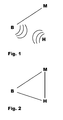
- Fig. 1 shows a transmitting and receiving station B, which is connected to a communication device M.
- the transmitting and receiving station B is in Fig. 1
- a base station of a DECT cordless phone which may be, for example, an analog or ISDN cordless telephone system
- this has an interface, such as a DECT interface, and is via the interface with the communication device M, which in this example is a DECT -Mobile part of a DECT cordless phone display, wirelessly connected.
- the connection of the transmitting and receiving station B to the communication device M is shown as a solid line. It would also be possible for the communication device M to be connected to the transmitting and receiving station B via a cable connection.
- a connected communication device M is shown, however, it is also possible for a group of communication devices M to be connected to the transmitting and receiving station B.
- This will be in Fig. 1 represented by the dashed lines to the communication devices M 1 to M n , where M 1 corresponds to a communication device M and M n corresponds to any number of communication devices M, which may be connected to the transmitting and receiving station B.
- the points between the communication devices M 1 and M n represent any number of communication devices M, which may be connected to the transmitting and receiving station. For example, if the placeholder n in the communication device M n would be an 8, then Fig.
- At least one communication device H 1 to H n is already connected to the transmitting and receiving station B. This is in Fig. 1 not shown.
- a communication device H for example a headset, a hands-free system or a mobile part, is placed in a log-in status and in the process emits a log-on signal.
- the sending of the registration signal is in Fig. 1 Wavy shown.
- the communication device H is to be wirelessly connected to the transmitting and receiving station B. It would also be possible for the communication device H to be connected to the transmitting and receiving station B via a cable connection.
- the transmitting and receiving station B In order for the transmitting and receiving station B can receive the registration signal of the communication device H, the transmitting and receiving station B is also placed in a registration status. This login status is transmitted via the DECT interface. In Fig. 1 the registration status of the transmitting and receiving station B is wavy.
- the registration signal of the communication device H contains an assignable identification code, for example the IPEI or the IPUI.
- assignable recognition code the transmitting and receiving station B is able to recognize what type of device it is and can uniquely identify the device based on the assignable recognition code.
- a communication device M logs on at the transmitting and receiving station B. This is in Fig. 1 not shown.
- the transmitting and receiving station B in the logon state via the DECT interface receives the registration signal of the communication device H, transmits the transmitting and receiving station B to the connected communication device M, and if available to the also connected to the transmitting and receiving station B communication devices M. 1 to M n at least one message information.
- a communication device M may log on to the transmitting and receiving station B, and the transmitting and receiving station B to transmit at least one message information to the already connected communication devices H, H 1 to H n . This is in Fig. 1 not shown.
- the at least one message information comprises an association signal, for example DECT signaling such as e.g. the DECT IWU, the DECT IPUI ESC to PROPRIETARY, etc., for a communication device H or a communication device M, which is triggered by the respective application to the transmitting and receiving station B.
- DECT signaling such as e.g. the DECT IWU, the DECT IPUI ESC to PROPRIETARY, etc.
- the transmitting and receiving station B may generate the message information on its own without a communication device M or a communication device H logging on to the transmitting and receiving station B. This is in Fig. 1 also not shown.
- the user selects, via a communication device selection unit on the communication device M, the communication device H available for association. This is in Fig. 1 also not shown.
- the at least one message information transmitted by the transmitting and receiving station B may be a digital signal, an acoustic signal, an optical signal and / or a selection menu
- a user of a communication device M or a communication device H without a display can be informed by, for example, a beep or a question that the transmitting and receiving station B has transmitted at least one message information.
- the user can send an association confirmation signal to the transmitting and receiving station B for association with the association device H available for association or the communication device M available for association.
- a light or the telephone keypad may light up to notify the user of the communication device M or the communication device H that the transmitting and receiving station B has transmitted at least one message information.
- the optical signal can be, for example, an icon in the display. Also in this case, by an operation procedure, for example, pressing a key or a key combination, the user can obtain an association confirmation signal for association with the communication device available for association Send H or the communication device M available to the association to the transmitting and receiving station B.
- the entire display of the communication device M or the communication device H is filled.
- the communication device M or the communication device H requests by displaying the question "connect communication device to the communication device?" to agree with the user actively on the association with the communication device H available for association or the communication device M available for association.
- the communication device selecting unit of the communication apparatus M or the communication apparatus H is a combination of the communication apparatus dialing units described above, for example, the communication apparatus selecting unit could be a combination of an audible signal and a selection menu.
- the association confirmation signal of the communication device M or the communication device H contains, like the registration signal of the communication device H available for association or the communication device M available for association, an assignable identification code, for example the IPEI or the IPU.
- an assignable identification code for example the IPEI or the IPU.
- the transmitting and receiving station B receives the association confirmation signal of the communication device M or the communication device H. This is in Fig. 1 not shown.
- the transmitting and receiving station B has a memory and a processor, both are in Fig. 1 not shown.
- the registration signal and association confirmation signal data are processed into association information and stored in the memory of the transmitting and receiving station B. In this way, the association information between the communication device H and the communication device M remains at the transmitting and receiving station B and is not stored in the communication device H or the communication device M.
- FIG. 2 schematically shows how a communication device M is connected via the transmitting and receiving station B to the communication device H.
- the connection between the communication device M and the transmitting and receiving station B, and between the transmitting and receiving station B and the communication device H are shown as solid lines.
- a solid line between the communication device M and the communication device H is shown.
- This solid line is intended to clarify that the communication device H is associated with the communication device M, and can be used only by this communication device M. It is thus other communication devices M 1 to M n , which may also be connected to the transmitting and receiving station B, this is using the dashed lines for the communication devices M 1 to M n in Fig. 2 illustrated, not possible to communicate with the communication device H.
- the communication device M is no longer possible to be associated with further communication devices H 1 to H n , as long as the association between the communication device M and the communication device H exists.
- the association information between the communication device H and the communication device M are located in the memory of the transmitting and receiving station B, not shown.
- the association information stored in the transmitting and receiving station B comprises the assignable registration signal of the communication device H and the assignable association confirmation signal of the Communication device M, which are associated with each other.
- the association information stored in the transmitting and receiving station B comprises the assignable registration signal of the communication device H and the assignable association confirmation signal of the Communication device M, which are associated with each other.
- a communication device H instead of a communication device H, a communication device M is registered at the transmitting and receiving station B. As soon as an already connected communication device H transmits an association confirmation signal to the transmitting and receiving station B, a possibly existing association with another already connected communication device M 1 to M n is resolved, and the transmitting and receiving station B sets the association information for the Communication device M and the communication device H in memory from. This is in Fig. 2 not shown.
- the communication device H may be, for example, a cordless speakerphone, which carries the user, for example, in his shirt pocket with him.
- the user conducts a conversation via a communication device M and wants other people to follow the conversation and actively participate in the conversation.
- a first operating procedure for example, pressing a key or a key combination or menu entry
- the communication device H takes over the call from the Communication device M.
- the acquisition takes place without confirmation of the communication device M and without an interruption, so that the interlocutor is transmitted directly to the communication device H, without the other party is waiting in a waiting loop.
- the transfer of the call is made possible via the transmitting and receiving station B.
- the transmitting and receiving station B receives the signal of the communication device H which is sent out by the first operating procedure of the communication device H.
- This signal may include, for example, the identification code of the communication device H, so that the transmitting and receiving station B knows that the communication device H wants to take a call.
- the transmitting and receiving station B checks in the internal memory the recognition code of the communication device H.
- the processor inside the transmitting and receiving station B checks the stored association information and can thereby determine which communication device M of the communication device H is assigned.
- the transmitting and receiving station B then transmits the call of the communication device M to the communication device H and ends the call on the communication device M, so that the call is continued only on the communication device H.
- association signal of a communication device H or a communication device M by the transmitting and receiving station B by an operating procedure, for example, by pressing a key or a key combination or menu entry can be caused.
- the emission of the at least one message information, including the association signal is possible for the emission of the at least one message information, including the association signal to be triggered by an operating procedure, for example pressing a key or a key combination or menu entry, at the transmitting and receiving station B.
- an operating procedure for example pressing a key or a key combination or menu entry
- the transmitting and receiving station B may terminate the request for association on its own if, after a defined time, no association confirmation signal is received from a communication device M, M 1 to M n or from a communication device H, H 1 to H n has been received.
- a time of 0.5 to 5 minutes, preferably 1 to 2 minutes pass before the transmitting and receiving station terminates the request to associate with a communication device H available for association or a communication device M available for association.
Landscapes
- Engineering & Computer Science (AREA)
- Computer Networks & Wireless Communication (AREA)
- Signal Processing (AREA)
- Human Computer Interaction (AREA)
- Mobile Radio Communication Systems (AREA)
Priority Applications (2)
| Application Number | Priority Date | Filing Date | Title |
|---|---|---|---|
| EP11155038.0A EP2490420B1 (fr) | 2011-02-18 | 2011-02-18 | Alerte et association simultanées d'un appareil de télécommunication |
| EP13155980.9A EP2600596A1 (fr) | 2011-02-18 | 2011-02-18 | Alerte et association simultanées d'un appareil |
Applications Claiming Priority (1)
| Application Number | Priority Date | Filing Date | Title |
|---|---|---|---|
| EP11155038.0A EP2490420B1 (fr) | 2011-02-18 | 2011-02-18 | Alerte et association simultanées d'un appareil de télécommunication |
Related Child Applications (1)
| Application Number | Title | Priority Date | Filing Date |
|---|---|---|---|
| EP13155980.9A Division-Into EP2600596A1 (fr) | 2011-02-18 | 2011-02-18 | Alerte et association simultanées d'un appareil |
Publications (2)
| Publication Number | Publication Date |
|---|---|
| EP2490420A1 true EP2490420A1 (fr) | 2012-08-22 |
| EP2490420B1 EP2490420B1 (fr) | 2018-10-10 |
Family
ID=44237210
Family Applications (2)
| Application Number | Title | Priority Date | Filing Date |
|---|---|---|---|
| EP13155980.9A Withdrawn EP2600596A1 (fr) | 2011-02-18 | 2011-02-18 | Alerte et association simultanées d'un appareil |
| EP11155038.0A Active EP2490420B1 (fr) | 2011-02-18 | 2011-02-18 | Alerte et association simultanées d'un appareil de télécommunication |
Family Applications Before (1)
| Application Number | Title | Priority Date | Filing Date |
|---|---|---|---|
| EP13155980.9A Withdrawn EP2600596A1 (fr) | 2011-02-18 | 2011-02-18 | Alerte et association simultanées d'un appareil |
Country Status (1)
| Country | Link |
|---|---|
| EP (2) | EP2600596A1 (fr) |
Citations (2)
| Publication number | Priority date | Publication date | Assignee | Title |
|---|---|---|---|---|
| US20050197061A1 (en) * | 2004-03-03 | 2005-09-08 | Hundal Sukhdeep S. | Systems and methods for using landline telephone systems to exchange information with various electronic devices |
| US20060128376A1 (en) * | 2002-07-09 | 2006-06-15 | Alexis Glenroy J | Communication systems and methods |
Family Cites Families (2)
| Publication number | Priority date | Publication date | Assignee | Title |
|---|---|---|---|---|
| DE10209719B4 (de) * | 2002-03-06 | 2010-03-11 | T-Mobile Deutschland Gmbh | Verfahren zur Durchführung eines Rufaufbaus zwischen zwei Kontaktinstanzen eines Kommunikationsnetzes |
| EP1814295B1 (fr) * | 2006-01-27 | 2014-04-16 | Mitel Networks Corporation | Transfert de communication entre appareils de téléphone |
-
2011
- 2011-02-18 EP EP13155980.9A patent/EP2600596A1/fr not_active Withdrawn
- 2011-02-18 EP EP11155038.0A patent/EP2490420B1/fr active Active
Patent Citations (2)
| Publication number | Priority date | Publication date | Assignee | Title |
|---|---|---|---|---|
| US20060128376A1 (en) * | 2002-07-09 | 2006-06-15 | Alexis Glenroy J | Communication systems and methods |
| US20050197061A1 (en) * | 2004-03-03 | 2005-09-08 | Hundal Sukhdeep S. | Systems and methods for using landline telephone systems to exchange information with various electronic devices |
Also Published As
| Publication number | Publication date |
|---|---|
| EP2490420B1 (fr) | 2018-10-10 |
| EP2600596A1 (fr) | 2013-06-05 |
Similar Documents
| Publication | Publication Date | Title |
|---|---|---|
| DE4215096C2 (de) | System zur Kommunikation zwischen tragbaren Telefoneinheiten | |
| DE69532923T2 (de) | Zellulares funktelefon mit wahlnummeranalyse | |
| DE3888583T2 (de) | Verfahren zur steuerung der verbindung kabelfreier fernsprecher. | |
| DE69820208T2 (de) | TDMA Kommunikationssystem und Verfahren | |
| EP2716040A1 (fr) | Procédé d'échange de signaux entre une installation de communication domestique et un système de communication ne faisant pas partie de l'installation de communication domestique | |
| DE1762884C3 (de) | Schaltungsanordnung zur Bereitstellung von Sonderdiensten in Fernmelde-, insbesondere Fernsprechvermittlungsanlagen | |
| DE102011053994B3 (de) | Verfahren zur Festnetzerreichbarkeit und dafür geeignetes Mobilfunkendgerät | |
| DE10013607B4 (de) | Funkgerät | |
| EP2039183B1 (fr) | Agent d'utilisateur back-to-back de messagerie instantanée (push-to-talk) permettant de relier un système ptt à l'univers pstn/isdn | |
| EP2490420B1 (fr) | Alerte et association simultanées d'un appareil de télécommunication | |
| DE602004010027T2 (de) | System zur Mehrfachaussendung, sowie entsprechendes Kommunikationsendgerät | |
| DE10392561B4 (de) | Websitegesteuerter Aufbau von Telefonverbindung | |
| EP3130135A1 (fr) | Système et procédé de sélection d'un numéro de téléphone par le biais d'une plateforme voip et d'un téléphone mobile | |
| EP1423982A2 (fr) | Procede de configuration a distance d'un terminal de telecommunication | |
| DE102017131471B4 (de) | Sprachgesteuerte Nutzung einer telekommunikativen Sprachverbindung | |
| EP1811738B1 (fr) | Station de base de WLAN, système de communication local et méthode pour l'établissement d'une connexion vocale | |
| DE19943742A1 (de) | Verfahren zum Zurverfügungstellen zusätzlicher Dienste an einem Teilnehmeranschluß | |
| DE102019002944A1 (de) | Verfahren in einem System zur Anwahl einer Rufnummer über eine VoIP-Plattform mit einem mobilen Funkgerät | |
| EP3731479A1 (fr) | Procédé dans un système de sélection d'un numéro d'appel sur une plateforme voip à l'aide d'un appareil radio mobile | |
| DE102012023906B3 (de) | Verfahren zur Konfiguration von zielrufnummernbezogenen Telefonieleistungsmerkmalen eines Telekommunikationsnetzes, Vorrichtung, Computerprogramm und Computerprogrammprodukt | |
| DE10355364B4 (de) | Schalter zum Wechseln zwischen Video- und Sprachfunktion bei Mobilfunkendgeräten | |
| DE102005014519A1 (de) | PoC-Kommunikationssystem, Verfahren zum Übertragen einer PoC-Signalisierung und/oder von PoC-Daten sowie Servervorrichtung dafür | |
| DE2219104C3 (de) | Schaltungsanordnung für Fernmeldeanlagen, in denen die Verbindungswege für verschiedene Arten der Nachrichtenübermittlung, z.B. Fernsprechen und Datenübertragung, benutzbar sind Siemens AG, 1000 Berlin und 8000 München | |
| DE102005056623A1 (de) | Mobile Vermittlungsvorrichtung und Verfahren zum Übertragen von Informationen zwischen wenigstens zwei Teilnehmern | |
| DE102005053282B4 (de) | Einrichtung und Verfahren zum Aufbau einer Kommunikationsverbindung |
Legal Events
| Date | Code | Title | Description |
|---|---|---|---|
| PUAI | Public reference made under article 153(3) epc to a published international application that has entered the european phase |
Free format text: ORIGINAL CODE: 0009012 |
|
| AK | Designated contracting states |
Kind code of ref document: A1 Designated state(s): AL AT BE BG CH CY CZ DE DK EE ES FI FR GB GR HR HU IE IS IT LI LT LU LV MC MK MT NL NO PL PT RO RS SE SI SK SM TR |
|
| AX | Request for extension of the european patent |
Extension state: BA ME |
|
| 17P | Request for examination filed |
Effective date: 20130220 |
|
| RAP1 | Party data changed (applicant data changed or rights of an application transferred) |
Owner name: GIGASET COMMUNICATIONS GMBH |
|
| STAA | Information on the status of an ep patent application or granted ep patent |
Free format text: STATUS: EXAMINATION IS IN PROGRESS |
|
| 17Q | First examination report despatched |
Effective date: 20170814 |
|
| GRAP | Despatch of communication of intention to grant a patent |
Free format text: ORIGINAL CODE: EPIDOSNIGR1 |
|
| STAA | Information on the status of an ep patent application or granted ep patent |
Free format text: STATUS: GRANT OF PATENT IS INTENDED |
|
| INTG | Intention to grant announced |
Effective date: 20180502 |
|
| GRAS | Grant fee paid |
Free format text: ORIGINAL CODE: EPIDOSNIGR3 |
|
| GRAA | (expected) grant |
Free format text: ORIGINAL CODE: 0009210 |
|
| STAA | Information on the status of an ep patent application or granted ep patent |
Free format text: STATUS: THE PATENT HAS BEEN GRANTED |
|
| AK | Designated contracting states |
Kind code of ref document: B1 Designated state(s): AL AT BE BG CH CY CZ DE DK EE ES FI FR GB GR HR HU IE IS IT LI LT LU LV MC MK MT NL NO PL PT RO RS SE SI SK SM TR |
|
| REG | Reference to a national code |
Ref country code: GB Ref legal event code: FG4D Free format text: NOT ENGLISH |
|
| REG | Reference to a national code |
Ref country code: CH Ref legal event code: EP Ref country code: AT Ref legal event code: REF Ref document number: 1052617 Country of ref document: AT Kind code of ref document: T Effective date: 20181015 |
|
| REG | Reference to a national code |
Ref country code: IE Ref legal event code: FG4D Free format text: LANGUAGE OF EP DOCUMENT: GERMAN Ref country code: DE Ref legal event code: R096 Ref document number: 502011014819 Country of ref document: DE |
|
| REG | Reference to a national code |
Ref country code: NL Ref legal event code: MP Effective date: 20181010 |
|
| REG | Reference to a national code |
Ref country code: LT Ref legal event code: MG4D |
|
| PG25 | Lapsed in a contracting state [announced via postgrant information from national office to epo] |
Ref country code: NL Free format text: LAPSE BECAUSE OF FAILURE TO SUBMIT A TRANSLATION OF THE DESCRIPTION OR TO PAY THE FEE WITHIN THE PRESCRIBED TIME-LIMIT Effective date: 20181010 |
|
| PG25 | Lapsed in a contracting state [announced via postgrant information from national office to epo] |
Ref country code: ES Free format text: LAPSE BECAUSE OF FAILURE TO SUBMIT A TRANSLATION OF THE DESCRIPTION OR TO PAY THE FEE WITHIN THE PRESCRIBED TIME-LIMIT Effective date: 20181010 Ref country code: IS Free format text: LAPSE BECAUSE OF FAILURE TO SUBMIT A TRANSLATION OF THE DESCRIPTION OR TO PAY THE FEE WITHIN THE PRESCRIBED TIME-LIMIT Effective date: 20190210 Ref country code: PL Free format text: LAPSE BECAUSE OF FAILURE TO SUBMIT A TRANSLATION OF THE DESCRIPTION OR TO PAY THE FEE WITHIN THE PRESCRIBED TIME-LIMIT Effective date: 20181010 Ref country code: LT Free format text: LAPSE BECAUSE OF FAILURE TO SUBMIT A TRANSLATION OF THE DESCRIPTION OR TO PAY THE FEE WITHIN THE PRESCRIBED TIME-LIMIT Effective date: 20181010 Ref country code: NO Free format text: LAPSE BECAUSE OF FAILURE TO SUBMIT A TRANSLATION OF THE DESCRIPTION OR TO PAY THE FEE WITHIN THE PRESCRIBED TIME-LIMIT Effective date: 20190110 Ref country code: HR Free format text: LAPSE BECAUSE OF FAILURE TO SUBMIT A TRANSLATION OF THE DESCRIPTION OR TO PAY THE FEE WITHIN THE PRESCRIBED TIME-LIMIT Effective date: 20181010 Ref country code: BG Free format text: LAPSE BECAUSE OF FAILURE TO SUBMIT A TRANSLATION OF THE DESCRIPTION OR TO PAY THE FEE WITHIN THE PRESCRIBED TIME-LIMIT Effective date: 20190110 Ref country code: FI Free format text: LAPSE BECAUSE OF FAILURE TO SUBMIT A TRANSLATION OF THE DESCRIPTION OR TO PAY THE FEE WITHIN THE PRESCRIBED TIME-LIMIT Effective date: 20181010 Ref country code: LV Free format text: LAPSE BECAUSE OF FAILURE TO SUBMIT A TRANSLATION OF THE DESCRIPTION OR TO PAY THE FEE WITHIN THE PRESCRIBED TIME-LIMIT Effective date: 20181010 |
|
| PG25 | Lapsed in a contracting state [announced via postgrant information from national office to epo] |
Ref country code: RS Free format text: LAPSE BECAUSE OF FAILURE TO SUBMIT A TRANSLATION OF THE DESCRIPTION OR TO PAY THE FEE WITHIN THE PRESCRIBED TIME-LIMIT Effective date: 20181010 Ref country code: SE Free format text: LAPSE BECAUSE OF FAILURE TO SUBMIT A TRANSLATION OF THE DESCRIPTION OR TO PAY THE FEE WITHIN THE PRESCRIBED TIME-LIMIT Effective date: 20181010 Ref country code: AL Free format text: LAPSE BECAUSE OF FAILURE TO SUBMIT A TRANSLATION OF THE DESCRIPTION OR TO PAY THE FEE WITHIN THE PRESCRIBED TIME-LIMIT Effective date: 20181010 Ref country code: GR Free format text: LAPSE BECAUSE OF FAILURE TO SUBMIT A TRANSLATION OF THE DESCRIPTION OR TO PAY THE FEE WITHIN THE PRESCRIBED TIME-LIMIT Effective date: 20190111 Ref country code: PT Free format text: LAPSE BECAUSE OF FAILURE TO SUBMIT A TRANSLATION OF THE DESCRIPTION OR TO PAY THE FEE WITHIN THE PRESCRIBED TIME-LIMIT Effective date: 20190210 |
|
| REG | Reference to a national code |
Ref country code: DE Ref legal event code: R097 Ref document number: 502011014819 Country of ref document: DE |
|
| PG25 | Lapsed in a contracting state [announced via postgrant information from national office to epo] |
Ref country code: IT Free format text: LAPSE BECAUSE OF FAILURE TO SUBMIT A TRANSLATION OF THE DESCRIPTION OR TO PAY THE FEE WITHIN THE PRESCRIBED TIME-LIMIT Effective date: 20181010 Ref country code: DK Free format text: LAPSE BECAUSE OF FAILURE TO SUBMIT A TRANSLATION OF THE DESCRIPTION OR TO PAY THE FEE WITHIN THE PRESCRIBED TIME-LIMIT Effective date: 20181010 Ref country code: CZ Free format text: LAPSE BECAUSE OF FAILURE TO SUBMIT A TRANSLATION OF THE DESCRIPTION OR TO PAY THE FEE WITHIN THE PRESCRIBED TIME-LIMIT Effective date: 20181010 |
|
| PLBE | No opposition filed within time limit |
Free format text: ORIGINAL CODE: 0009261 |
|
| STAA | Information on the status of an ep patent application or granted ep patent |
Free format text: STATUS: NO OPPOSITION FILED WITHIN TIME LIMIT |
|
| PG25 | Lapsed in a contracting state [announced via postgrant information from national office to epo] |
Ref country code: EE Free format text: LAPSE BECAUSE OF FAILURE TO SUBMIT A TRANSLATION OF THE DESCRIPTION OR TO PAY THE FEE WITHIN THE PRESCRIBED TIME-LIMIT Effective date: 20181010 Ref country code: SM Free format text: LAPSE BECAUSE OF FAILURE TO SUBMIT A TRANSLATION OF THE DESCRIPTION OR TO PAY THE FEE WITHIN THE PRESCRIBED TIME-LIMIT Effective date: 20181010 Ref country code: RO Free format text: LAPSE BECAUSE OF FAILURE TO SUBMIT A TRANSLATION OF THE DESCRIPTION OR TO PAY THE FEE WITHIN THE PRESCRIBED TIME-LIMIT Effective date: 20181010 Ref country code: SK Free format text: LAPSE BECAUSE OF FAILURE TO SUBMIT A TRANSLATION OF THE DESCRIPTION OR TO PAY THE FEE WITHIN THE PRESCRIBED TIME-LIMIT Effective date: 20181010 |
|
| 26N | No opposition filed |
Effective date: 20190711 |
|
| REG | Reference to a national code |
Ref country code: CH Ref legal event code: PL |
|
| PG25 | Lapsed in a contracting state [announced via postgrant information from national office to epo] |
Ref country code: LU Free format text: LAPSE BECAUSE OF NON-PAYMENT OF DUE FEES Effective date: 20190218 Ref country code: MC Free format text: LAPSE BECAUSE OF FAILURE TO SUBMIT A TRANSLATION OF THE DESCRIPTION OR TO PAY THE FEE WITHIN THE PRESCRIBED TIME-LIMIT Effective date: 20181010 Ref country code: SI Free format text: LAPSE BECAUSE OF FAILURE TO SUBMIT A TRANSLATION OF THE DESCRIPTION OR TO PAY THE FEE WITHIN THE PRESCRIBED TIME-LIMIT Effective date: 20181010 |
|
| REG | Reference to a national code |
Ref country code: BE Ref legal event code: MM Effective date: 20190228 |
|
| REG | Reference to a national code |
Ref country code: IE Ref legal event code: MM4A |
|
| PG25 | Lapsed in a contracting state [announced via postgrant information from national office to epo] |
Ref country code: LI Free format text: LAPSE BECAUSE OF NON-PAYMENT OF DUE FEES Effective date: 20190228 Ref country code: CH Free format text: LAPSE BECAUSE OF NON-PAYMENT OF DUE FEES Effective date: 20190228 |
|
| PG25 | Lapsed in a contracting state [announced via postgrant information from national office to epo] |
Ref country code: IE Free format text: LAPSE BECAUSE OF NON-PAYMENT OF DUE FEES Effective date: 20190218 |
|
| PG25 | Lapsed in a contracting state [announced via postgrant information from national office to epo] |
Ref country code: BE Free format text: LAPSE BECAUSE OF NON-PAYMENT OF DUE FEES Effective date: 20190228 |
|
| PG25 | Lapsed in a contracting state [announced via postgrant information from national office to epo] |
Ref country code: TR Free format text: LAPSE BECAUSE OF FAILURE TO SUBMIT A TRANSLATION OF THE DESCRIPTION OR TO PAY THE FEE WITHIN THE PRESCRIBED TIME-LIMIT Effective date: 20181010 |
|
| REG | Reference to a national code |
Ref country code: AT Ref legal event code: MM01 Ref document number: 1052617 Country of ref document: AT Kind code of ref document: T Effective date: 20190218 |
|
| PG25 | Lapsed in a contracting state [announced via postgrant information from national office to epo] |
Ref country code: AT Free format text: LAPSE BECAUSE OF NON-PAYMENT OF DUE FEES Effective date: 20190218 |
|
| PG25 | Lapsed in a contracting state [announced via postgrant information from national office to epo] |
Ref country code: MT Free format text: LAPSE BECAUSE OF FAILURE TO SUBMIT A TRANSLATION OF THE DESCRIPTION OR TO PAY THE FEE WITHIN THE PRESCRIBED TIME-LIMIT Effective date: 20181010 |
|
| PG25 | Lapsed in a contracting state [announced via postgrant information from national office to epo] |
Ref country code: CY Free format text: LAPSE BECAUSE OF FAILURE TO SUBMIT A TRANSLATION OF THE DESCRIPTION OR TO PAY THE FEE WITHIN THE PRESCRIBED TIME-LIMIT Effective date: 20181010 |
|
| PG25 | Lapsed in a contracting state [announced via postgrant information from national office to epo] |
Ref country code: HU Free format text: LAPSE BECAUSE OF FAILURE TO SUBMIT A TRANSLATION OF THE DESCRIPTION OR TO PAY THE FEE WITHIN THE PRESCRIBED TIME-LIMIT; INVALID AB INITIO Effective date: 20110218 |
|
| PG25 | Lapsed in a contracting state [announced via postgrant information from national office to epo] |
Ref country code: MK Free format text: LAPSE BECAUSE OF FAILURE TO SUBMIT A TRANSLATION OF THE DESCRIPTION OR TO PAY THE FEE WITHIN THE PRESCRIBED TIME-LIMIT Effective date: 20181010 |
|
| P01 | Opt-out of the competence of the unified patent court (upc) registered |
Effective date: 20230527 |
|
| PGFP | Annual fee paid to national office [announced via postgrant information from national office to epo] |
Ref country code: GB Payment date: 20260219 Year of fee payment: 16 |
|
| PGFP | Annual fee paid to national office [announced via postgrant information from national office to epo] |
Ref country code: DE Payment date: 20260218 Year of fee payment: 16 |
|
| PGFP | Annual fee paid to national office [announced via postgrant information from national office to epo] |
Ref country code: FR Payment date: 20260218 Year of fee payment: 16 |