EP2490459B1 - Verfahren zur Sprachsignalmischung - Google Patents
Verfahren zur Sprachsignalmischung Download PDFInfo
- Publication number
- EP2490459B1 EP2490459B1 EP11155021.6A EP11155021A EP2490459B1 EP 2490459 B1 EP2490459 B1 EP 2490459B1 EP 11155021 A EP11155021 A EP 11155021A EP 2490459 B1 EP2490459 B1 EP 2490459B1
- Authority
- EP
- European Patent Office
- Prior art keywords
- signal
- noise
- microphone
- blending
- level
- Prior art date
- Legal status (The legal status is an assumption and is not a legal conclusion. Google has not performed a legal analysis and makes no representation as to the accuracy of the status listed.)
- Active
Links
Images



Classifications
-
- H—ELECTRICITY
- H04—ELECTRIC COMMUNICATION TECHNIQUE
- H04R—LOUDSPEAKERS, MICROPHONES, GRAMOPHONE PICK-UPS OR LIKE ACOUSTIC ELECTROMECHANICAL TRANSDUCERS; ELECTRIC HEARING AIDS; PUBLIC ADDRESS SYSTEMS
- H04R3/00—Circuits for transducers
- H04R3/005—Circuits for transducers for combining the signals of two or more microphones
-
- H—ELECTRICITY
- H04—ELECTRIC COMMUNICATION TECHNIQUE
- H04R—LOUDSPEAKERS, MICROPHONES, GRAMOPHONE PICK-UPS OR LIKE ACOUSTIC ELECTROMECHANICAL TRANSDUCERS; ELECTRIC HEARING AIDS; PUBLIC ADDRESS SYSTEMS
- H04R2499/00—Aspects covered by H04R or H04S not otherwise provided for in their subgroups
- H04R2499/10—General applications
- H04R2499/11—Transducers incorporated or for use in hand-held devices, e.g. mobile phones, PDA's, camera's
-
- H—ELECTRICITY
- H04—ELECTRIC COMMUNICATION TECHNIQUE
- H04R—LOUDSPEAKERS, MICROPHONES, GRAMOPHONE PICK-UPS OR LIKE ACOUSTIC ELECTROMECHANICAL TRANSDUCERS; ELECTRIC HEARING AIDS; PUBLIC ADDRESS SYSTEMS
- H04R2499/00—Aspects covered by H04R or H04S not otherwise provided for in their subgroups
- H04R2499/10—General applications
- H04R2499/13—Acoustic transducers and sound field adaptation in vehicles
-
- H—ELECTRICITY
- H04—ELECTRIC COMMUNICATION TECHNIQUE
- H04R—LOUDSPEAKERS, MICROPHONES, GRAMOPHONE PICK-UPS OR LIKE ACOUSTIC ELECTROMECHANICAL TRANSDUCERS; ELECTRIC HEARING AIDS; PUBLIC ADDRESS SYSTEMS
- H04R3/00—Circuits for transducers
- H04R3/02—Circuits for transducers for preventing acoustic reaction, i.e. acoustic oscillatory feedback
Definitions
- the invention refers to a method and system installed in a car for the communication of people sitting in remote locations. Therefore at least one loudspeaker is installed and at least two microphones, one assigned to each person.
- the invention relates to method applied to a hands-free telephony system or to an automatic speech recognition system, where conditions and requirements are quite similar. More specifically, the invention relates to a method according to the introductory clause of claim 1 as well as to a software product according to claim 7 and a system according to claim 8.
- EP1850640B1 shows and describes a typical setup for a basic intercom system with two microphones and one loudspeaker.
- the mixer in this setup decides depending on a criterion which of the microphone signals shall be switched to the next module or the output.
- This criterion can depend on the detected occupation of a seat.
- it has been also proposed in US006549629B2 such decision criterion can depend on the Signal plus Noise to Noise Ratio (SNNR).
- SNNR Signal plus Noise to Noise Ratio
- the fundamental disadvantage of such a system is that the feedback is still contained in the signal and therefore SNNR is not a good approach to a Signal to Noise Ratio (SNR).
- SNR Signal to Noise Ratio
- a further disadvantage of these systems is a possible change in background-noise level when switching from one speaking person to another (e.g. driver speaks to a passenger in the back while having his window open, and then the co-driver speaks to the passenger in the back having his window closed and driver as well as co-driver are each equipped with a microphone).
- This change in background-noise level of the signal played back over the loudspeaker might be experienced as unpleasant by a listener.
- Another disadvantage that occurs is, when the play-back level between two speaking persons differs. This can occur if for example the driver is quite tall and therefore the distance to the microphone is little, which means significant speech level in the microphone signal.
- US-A-2005/0265560 discloses a system, where a beamformer is used for microphone signal blending. The, thus, blended output signal is then subjected to feedback suppression.
- This has the disadvantage that the power of the signals to be blended is relative high and, moreover, the output signal of the beamformer is adulterated by the feedback component of the signal.
- the suppression is merely the suppression of frequencies, which are just developing resonance oscillations, which means that feedback components remain, and only resonance oscillations are prevented.
- US 2009/0316923 and US 2003/0026437 A1 disclose a feedback suppression or compensation effected before blending the signals of the at least two microphones. If in this connection the term "feedback suppression or compensation" is used, it is in any case a minimization of feedback components of a signal.
- a feedback compensation is for example described in EP 1 679 874 B1 .
- Feedback suppression can be applied by filtering, for example with a notch-filter.
- Another known compensation method uses frequency shifting.
- the method for voice signal blending is applied in a communication system, such as an indoor communication system, particularly in a vehicle, or in a hands-free telephony system or an automatic speech recognition system, comprising at least two microphones and at least one loudspeaker.
- the microphone signals are blended with respective weights to be delivered to the at least one loudspeaker.
- the feedback suppression or compensation is effected before blending the signals of the at least two microphones.
- US 5 602 962 discloses a solution, where time series of microphone signals are added.
- the measure according to the characterizing clause of claim 1 For at least a sub-band of the microphone signals the energies of the microphone signals are determined and at least the energies of the noise components are estimated, wherein for blending, a higher weight is given to the microphone signal with the highest ratio of signal energy to noise energy. Sub-dividing the entire frequency band into sub-bands enables it to give individual sub-bands a different weight. Blending will be made for each sub-band with the respective weights.
- the feedback suppression or compensation is effected before blending the signals of the at least two microphones. This improves the quality of the blended signal and is more robust in relation to feedback components.
- the feedback components are minimized by estimating the feedback signal or its energy level, preferably its power spectral density, and applying a Wiener filter which eliminates the estimated feedback signal from the signals to be blended.
- a signal level adjustment of the at least two microphone signals to a predetermined value is carried out particularly immediately before or immediately after blending, wherein the adjustment is depending on the energies of the noise components and minimizes the perceivable difference in the noise level when blending from one microphone to the other.
- the signal levels of the microphone signals are adjusted to a predetermined value so that there is no perceivable difference in the speech level when blending from one microphone to the other.
- the noise level of at least two microphones can be unpleasantly different. An adjustment can be achieved, if the characteristics of claim 5 are fulfilled.
- the microphone signals comprise different components, each with a certain level. If a person close to a microphone is speaking, then the signal of this microphone comprises this voice with a corresponding voice level.
- the voice levels of the at least two microphone signals are adjusted substantially to the same level by adjusting the microphone signals. Then the difference of the noise levels of the at least two adjusted microphone signals is determined.
- the noise suppressions in the microphone signals are controlled by adapting the parameters of the noise suppression characteristic in such a way, that the noise suppressed signals have substantially the same level of residual noise and the same level of speech signal in it for each microphone signal.
- the respective speaking and/or listening, non-speaking party is detected by one of the following measures:
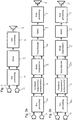
- Fig. 1 shows a typical setup for a basic intercom system with two microphones 1 and 2 and one loudspeaker 3.
- a voice mixer 5 which receives the pre-processed signals of the microphones 1, 2 and decides depending on a criterion which of the microphone signals shall be switched to its output and to the next module 6.
- Fig. 2a one embodiment of the invention is illustrated, where the signals of the microphones 1, 2, after an optional pre-processing stage 4a, are subjected to feedback suppression or compensation in a stage 7.
- the first component after some optional pre-processing is a feedback suppression or feedback compensation at 7.
- This module 7 suppresses or compensates for the portion of the loudspeaker signal that is coupling back into the microphone and therefore being an undesired signal component.
- noise suppression in a noise suppression module 8 can be effected.
- This module 8 suppresses the background noise components of the microphone signals resulting from the background noise being present in the car cabin and being picked up by the microphones.
- a practical embodiment with a noise suppression postponed to the voice blender 5a is shown in Fig. 4b .
- the signal m i of microphone i is made up of the signal from the speaker in the cabin s i , the feedback of the system from the loudspeaker into the microphone f i and the background noise of the cabin recorded by the microphone b i .
- m i k , ⁇ s i k , ⁇ + f i k , ⁇ + b i k , ⁇
- i corresponds to the microphone index
- k to the time interval
- ⁇ to the frequency band.
- the noise suppression is located before the voice blender 5a which is not necessarily required (without limitation of generality, see e.g. Fig. 4b ).
- the blended and noise suppressed signal goes suitably to a NDGC or noise dependent gain control 9.
- the voice blender module blends the at least two feedback suppressed or compensated and noise suppressed signals according to Fig. 2a together to one output signal following below described criterion. According to Fig. 2b the blended signals are only feedback suppressed or compensated.
- the blending is made by giving weights to the microphones.
- the blending or weighting criterion can either be evaluated in a non-frequency selective manner or in a frequency selective manner resulting in a non-frequency selective weighting or in a frequency selective weighting of the microphone signals m i .
- 4a , 4b , 4c is a function of the ratio of the energy of every microphone signal S m i m i subtracted by the feedback f i (respectively S f i f i for the energy of the feedback component at every microphone) due to the coupling of the loudspeaker signal back into the microphone signal and further subtracted by the noise b i (respectively S b i b i for the energy of the noise component at every microphone) within the microphone signal resulting from the noise present in the car cabin and being picked up by the microphone (for the setup according to Fig. 2b each microphone signal is only subtracted by the feedback) to the estimated noise present in each microphone signal.
- Double indices are used for the energy of the signal, and for power spectral densities.
- w i k , ⁇ f S mm k , ⁇ , S ff k , ⁇ + S bb k , ⁇
- N the number of microphones.
- ⁇ m is a smoothing constant that has to be chosen between zero and one. This means the current short-term power is weighted with ⁇ m and the estimate of the previous time frame is weighted with (1- ⁇ m ).
- the feedback component S f i f i ( k , ⁇ ) is estimated in the feedback compensation or feedback suppression module and is therefore given.
- ⁇ is a small number depending on the sampling rate.
- the modified SNR after subtracting the power of the feedback signal and of the background noise from the microphone signal power, is set into relation with the sum over all microphones of the modified SNR.
- the resulting weight is more robust against misinterpretations of feedback power as desired speech power as would be the case using an SNNR as described in US006549629B2 .
- the voice blender module 5a determines the difference in noise levels between the different signals and causes noise suppression to adapt the parameters of the noise suppression characteristic to result in a noise suppressed signal having the same level of residual noise in it for each speaker.
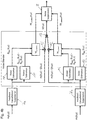
- Fig. 4a shows, how a voice blender for carrying out the method according to the invention may be structured. It is clearly visible that feedback suppression or feedback compensation is done for each of the signals stemming from the microphones 1 and 2 in modules 7a and 7b. The output of these modules 7a, 7b is delivered to the voice blender 5a, i.e. to noise estimation modules 10, 10' (see equations 1-4), to power estimation modules 11, 11' (see equation 8) and to multiplicators 12 and 12' for weighting the incoming signals.
- multiplicators 12, 12' are each controlled by a module Wi which determines the blender weights for each signal of the microphones 1, 2.
- a summing point 13 At the output of blender 5a is a summing point 13.
- the output signal v( ⁇ ,k) of the voice blender 5a can be used to influence noise suppression in module 8. This is shown in Fig. 4b , where the weighting signals W i,speech (k, ⁇ ) are supplied to module 8. Noise suppression down to zero gives mostly a bad feeling to the listener, for which reason it is preferred to adjust noise suppression to a predetermined level to a predetermined minimum level. This level typically equals 0.316 meaning a maximum suppression of -10 dB.
- Fig. 4c a configuration according to Fig. 4c is possible within the scope of the present invention taking equation 8 in mind.
- the weighting signals W i,speech (k, ⁇ ) are supplied to module 9, the noise dependent gain control, which, to have an information of noise present in the signal, receives also the output signal S bibi (k, ⁇ ) of the noise estimation modules 10 and 10'.
- the weighting signal W i of the voice blender 5a could be used to control an equalizer 6a which forms part of the post-processor 6 ( Fig. 1 to Fig. 2b ).
- the decision of the voice blender module is used for the noise dependent gain control module.
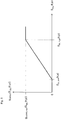
- the noise dependent gain control module is responsible for increasing the level of the output signal by applying a gain g l,NDGC ( S b l b l ( k , ⁇ )), depending on the level of noise perceived by the listening party.
- This increase of the output signal level depends on a characteristic which maps the level of background noise in the car cabin to a gain applied to the output signal. The characteristic chosen for this mapping depends on which speaker is active. This information is delivered by the voice blender module in the form of the microphone index of the most active microphone l( k ).
- g l,NDGC,max ( S b l b l ( k, ⁇ )) represents the maximum gain of the NDGC (e.g. 10dB). So all properties of the different NDGC characteristics are described by g l,NDGC,max ( S b l b l ( k, ⁇ )), S bb,l,high ( k, ⁇ ) and S bb,l,low ( k , ⁇ ).
- S b l b l ( k , ⁇ ) represents the noise component that is present in the microphone signal of the active speaker.
- equalizer 6a part of post processing 6 of an intercom system is the equalizer 6a.
- This equalizer 6a can as well be implemented as a multi-channel equalizer individual for each channel.
- the settings of the equalizer 6a are chosen depending on the voice blender decision of which person is speaking to enhance the perceived quality of the output for the listening party (see Fig.3 and Fig. 5 ).
Landscapes
- Health & Medical Sciences (AREA)
- General Health & Medical Sciences (AREA)
- Otolaryngology (AREA)
- Physics & Mathematics (AREA)
- Engineering & Computer Science (AREA)
- Acoustics & Sound (AREA)
- Signal Processing (AREA)
- Circuit For Audible Band Transducer (AREA)
- Fittings On The Vehicle Exterior For Carrying Loads, And Devices For Holding Or Mounting Articles (AREA)
Claims (8)
- Verfahren für die Sprachsignalüberblendung in einem Kommunikationssystem, das wenigstens zwei Mikrophone (1, 2) und wenigstens einen Lautsprecher (3) umfasst, wobei die wenigstens zwei Mikrophonsignale mit jeweiligen Gewichtungen überblendet werden (5a), wobei das überblendete Signal an den wenigstens einen Lautsprecher geliefert wird, wobei eine Rückkopplungsunterdrückung oder -kompensation (7, 7a, 7b) bewirkt wird, bevor die Signale der wenigstens zwei Mikrophone überblendet werden,
dadurch gekennzeichnet, dass
das gesamte Frequenzband der Mikrophonsignale in Teilbänder unterteilt wird, für wenigstens ein Frequenzteilband der Mikrophonsignale die Energien der Mikrophonsignale (11, 11') bestimmt werden und die Energien des Rauschens (10, 10') geschätzt werden, wobei zum Überblenden ermöglicht wird, dass einzelne Teilbänder eine unterschiedliche Gewichtung aufweisen, wobei dem Mikrophonsignal mit dem höchsten Verhältnis von Signalenergie zu Rauschenergie eine höhere Gewichtung gegeben wird, und wobei das Überblenden für jedes Teilband mit den jeweiligen Gewichtungen vorgenommen wird. - Verfahren nach Anspruch 1, dadurch gekennzeichnet, dass insbesondere unmittelbar vor oder unmittelbar nach dem Überblenden eine Signalpegeleinstellung der wenigstens zwei Mikrophonsignale auf einen vorgegebenen Wert ausgeführt wird, wobei die Einstellung von den Energien der Rauschkomponenten abhängt und die Differenz des Rauschpegels beim Überblenden von einem Mikrophon zu dem anderen minimiert.
- Verfahren nach einem der vorhergehenden Ansprüche, dadurch gekennzeichnet, dass die Signalpegel der Mikrophonsignale in der Weise auf einen vorgegebenen Wert eingestellt werden, dass es keine Differenz des Signalpegels gibt, wenn von einem Mikrophon zu dem anderen überblendet wird.
- Verfahren nach Anspruch 3, dadurch gekennzeichnet, dass die Sprachpegel der wenigstens zwei Mikrophonsignale im Wesentlichen auf denselben Pegel eingestellt werden, daraufhin die Differenz der Energien der Rauschkomponenten der wenigstens zwei eingestellten Mikrophonsignale bestimmt wird und eine Rauschunterdrückung ausgeführt wird, um ein Signal mit unterdrücktem Rauschen zu erzeugen, das für jedes Mikrophonsignal im Wesentlichen denselben Pegel des Restrauschens und denselben Pegel des Sprachsignals in sich aufweist.
- Verfahren nach einem der vorhergehenden Ansprüche, wobei das Kommunikationssystem ein Innenraumkommunikationssystem in einem Fahrzeug ist, dadurch gekennzeichnet, dass ein sprechender und/oder ein hörender nicht sprechender Beteiligter durch eine der folgenden Maßnahmen detektiert werden:a) durch Analysieren des Signals der wenigstens zwei Mikrophone während des Überblendens;b) durch Erfassen mittels Fahrzeugsensoren z. B. für die Sitzbelegung.
- Verfahren nach Anspruch 5, dadurch gekennzeichnet, dass nach der Detektion wenigstens eine der folgenden Maßnahmen ergriffen wird:a) Die Signalgewichtung des Mikrophonsignals, bei dem kein sprechender Beteiligter detektiert wird, wird während des Schritts des Überblendens verringert;b) für Hörer und/oder Sprecher werden vorgegebene Verstärkercharakteristiken der Verstärkungsregelung, z. B. eine rauschabhängige Verstärkungsregelung, bereitgestellt und es wird diejenige Verstärkercharakteristik gewählt, die der Lage des jeweiligen Hörers und/oder Sprechers entspricht.
- Softwareprodukt, das dafür ausgelegt ist, das Verfahren nach einem der vorhergehenden Ansprüche auszuführen.
- Kommunikationssystem, das wenigstens einen Lautsprecher und wenigstens zwei Mikrophone sowie eine Signalbehandlungsvorrichtung, die dafür ausgelegt ist, das Verfahren nach einem der Ansprüche 1 bis 6 auszuführen, umfasst.
Priority Applications (1)
| Application Number | Priority Date | Filing Date | Title |
|---|---|---|---|
| EP11155021.6A EP2490459B1 (de) | 2011-02-18 | 2011-02-18 | Verfahren zur Sprachsignalmischung |
Applications Claiming Priority (1)
| Application Number | Priority Date | Filing Date | Title |
|---|---|---|---|
| EP11155021.6A EP2490459B1 (de) | 2011-02-18 | 2011-02-18 | Verfahren zur Sprachsignalmischung |
Publications (2)
| Publication Number | Publication Date |
|---|---|
| EP2490459A1 EP2490459A1 (de) | 2012-08-22 |
| EP2490459B1 true EP2490459B1 (de) | 2018-04-11 |
Family
ID=44065560
Family Applications (1)
| Application Number | Title | Priority Date | Filing Date |
|---|---|---|---|
| EP11155021.6A Active EP2490459B1 (de) | 2011-02-18 | 2011-02-18 | Verfahren zur Sprachsignalmischung |
Country Status (1)
| Country | Link |
|---|---|
| EP (1) | EP2490459B1 (de) |
Families Citing this family (7)
| Publication number | Priority date | Publication date | Assignee | Title |
|---|---|---|---|---|
| US9516418B2 (en) | 2013-01-29 | 2016-12-06 | 2236008 Ontario Inc. | Sound field spatial stabilizer |
| US9099973B2 (en) | 2013-06-20 | 2015-08-04 | 2236008 Ontario Inc. | Sound field spatial stabilizer with structured noise compensation |
| US9271100B2 (en) | 2013-06-20 | 2016-02-23 | 2236008 Ontario Inc. | Sound field spatial stabilizer with spectral coherence compensation |
| US9106196B2 (en) | 2013-06-20 | 2015-08-11 | 2236008 Ontario Inc. | Sound field spatial stabilizer with echo spectral coherence compensation |
| EP2816816B1 (de) * | 2013-06-20 | 2018-01-17 | 2236008 Ontario Inc. | Räumlicher Schallfeldstabilisator mit strukturierter Rauschkompensation |
| US20170011753A1 (en) | 2014-02-27 | 2017-01-12 | Nuance Communications, Inc. | Methods And Apparatus For Adaptive Gain Control In A Communication System |
| EP3799444B1 (de) | 2019-09-25 | 2025-04-09 | Oticon A/s | Hörgerät, ein richtmikrofonsystem umfassend |
Family Cites Families (7)
| Publication number | Priority date | Publication date | Assignee | Title |
|---|---|---|---|---|
| DE4330243A1 (de) * | 1993-09-07 | 1995-03-09 | Philips Patentverwaltung | Sprachverarbeitungseinrichtung |
| US6549629B2 (en) | 2001-02-21 | 2003-04-15 | Digisonix Llc | DVE system with normalized selection |
| EP1413167A2 (de) * | 2001-07-20 | 2004-04-28 | Koninklijke Philips Electronics N.V. | Schallverstärkungsystem mit multimikrofon echounterdrücker als postprozessor |
| EP1591995B1 (de) | 2004-04-29 | 2019-06-19 | Harman Becker Automotive Systems GmbH | Innenraum-Nachrichtübertragungssystem für eine Fahrzeugkabine |
| EP1679874B1 (de) | 2005-01-11 | 2008-05-21 | Harman Becker Automotive Systems GmbH | Verringerung der Rückkopplung von Kommunikationssystemen |
| DE602006007322D1 (de) * | 2006-04-25 | 2009-07-30 | Harman Becker Automotive Sys | Fahrzeugkommunikationssystem |
| US8385557B2 (en) * | 2008-06-19 | 2013-02-26 | Microsoft Corporation | Multichannel acoustic echo reduction |
-
2011
- 2011-02-18 EP EP11155021.6A patent/EP2490459B1/de active Active
Non-Patent Citations (1)
| Title |
|---|
| None * |
Also Published As
| Publication number | Publication date |
|---|---|
| EP2490459A1 (de) | 2012-08-22 |
Similar Documents
| Publication | Publication Date | Title |
|---|---|---|
| EP0932142B1 (de) | Integriertes System zur Sprachverbesserung in einem Fahrzeug sowie Freisprech-Mobilfunksystem | |
| EP3040984A1 (de) | Schallzonenanordnung mit zonenweiser sprachunterdrückung | |
| US6674865B1 (en) | Automatic volume control for communication system | |
| US7171003B1 (en) | Robust and reliable acoustic echo and noise cancellation system for cabin communication | |
| CN103299656B (zh) | 动态麦克风信号混合器 | |
| US8805453B2 (en) | Hands-free telephony and in-vehicle communication | |
| US7039197B1 (en) | User interface for communication system | |
| EP2490459A1 (de) | Verfahren zur Sprachsignalmischung | |
| EP2859772B1 (de) | Windgeräuscherkennung für wageninstallierte kommunikationssysteme mit mehreren akustischen zonen | |
| US20070053524A1 (en) | Method and system for communication enhancement in a noisy environment | |
| EP1855456B1 (de) | Echoverringerung für zeitvariante Systeme | |
| US20100111324A1 (en) | Systems and Methods for Selectively Switching Between Multiple Microphones | |
| US20140233757A1 (en) | Noisy Environment Communication Enhancement System | |
| EP1885154A1 (de) | Enthallung eines Mikrofonsignals | |
| US9532149B2 (en) | Method of signal processing in a hearing aid system and a hearing aid system | |
| EP1718103B1 (de) | Kompensation des Echos und der Rückkopplung | |
| EP3103204A1 (de) | Verfahren und vorrichtung zur adaptiven verstärkungssteuerung in einem kommunikationssystem | |
| EP1858295B1 (de) | Entzerrung zur Anwendung von akustischen Signalen | |
| EP2490218B1 (de) | Verfahren zur Interferenzunterdrückung | |
| Fuchs et al. | Noise suppression for automotive applications based on directional information | |
| EP1623600B1 (de) | Verfahren und system zur kommunikationsverbesserung in einer rauschenden umgebung | |
| EP2416593A1 (de) | Verfahren zur Innenraumkommunikation | |
| US20060184361A1 (en) | Method and apparatus for reducing an interference noise signal fraction in a microphone signal | |
| Gimm et al. | 11 Combination of hands-free and ICC systems | |
| Linhard et al. | Passenger in-car communication enhancement |
Legal Events
| Date | Code | Title | Description |
|---|---|---|---|
| PUAI | Public reference made under article 153(3) epc to a published international application that has entered the european phase |
Free format text: ORIGINAL CODE: 0009012 |
|
| AK | Designated contracting states |
Kind code of ref document: A1 Designated state(s): AL AT BE BG CH CY CZ DE DK EE ES FI FR GB GR HR HU IE IS IT LI LT LU LV MC MK MT NL NO PL PT RO RS SE SI SK SM TR |
|
| AX | Request for extension of the european patent |
Extension state: BA ME |
|
| 17P | Request for examination filed |
Effective date: 20130220 |
|
| 17Q | First examination report despatched |
Effective date: 20130705 |
|
| RIC1 | Information provided on ipc code assigned before grant |
Ipc: H04R 3/00 20060101AFI20170824BHEP Ipc: H04R 3/02 20060101ALN20170824BHEP |
|
| GRAP | Despatch of communication of intention to grant a patent |
Free format text: ORIGINAL CODE: EPIDOSNIGR1 |
|
| STAA | Information on the status of an ep patent application or granted ep patent |
Free format text: STATUS: GRANT OF PATENT IS INTENDED |
|
| RIC1 | Information provided on ipc code assigned before grant |
Ipc: H04R 3/02 20060101ALN20170913BHEP Ipc: H04R 3/00 20060101AFI20170913BHEP |
|
| INTG | Intention to grant announced |
Effective date: 20171016 |
|
| GRAS | Grant fee paid |
Free format text: ORIGINAL CODE: EPIDOSNIGR3 |
|
| GRAA | (expected) grant |
Free format text: ORIGINAL CODE: 0009210 |
|
| STAA | Information on the status of an ep patent application or granted ep patent |
Free format text: STATUS: THE PATENT HAS BEEN GRANTED |
|
| AK | Designated contracting states |
Kind code of ref document: B1 Designated state(s): AL AT BE BG CH CY CZ DE DK EE ES FI FR GB GR HR HU IE IS IT LI LT LU LV MC MK MT NL NO PL PT RO RS SE SI SK SM TR |
|
| REG | Reference to a national code |
Ref country code: GB Ref legal event code: FG4D |
|
| REG | Reference to a national code |
Ref country code: CH Ref legal event code: EP |
|
| REG | Reference to a national code |
Ref country code: AT Ref legal event code: REF Ref document number: 989245 Country of ref document: AT Kind code of ref document: T Effective date: 20180415 |
|
| REG | Reference to a national code |
Ref country code: IE Ref legal event code: FG4D |
|
| REG | Reference to a national code |
Ref country code: DE Ref legal event code: R096 Ref document number: 602011047312 Country of ref document: DE |
|
| REG | Reference to a national code |
Ref country code: NL Ref legal event code: MP Effective date: 20180411 |
|
| REG | Reference to a national code |
Ref country code: LT Ref legal event code: MG4D |
|
| PG25 | Lapsed in a contracting state [announced via postgrant information from national office to epo] |
Ref country code: NL Free format text: LAPSE BECAUSE OF FAILURE TO SUBMIT A TRANSLATION OF THE DESCRIPTION OR TO PAY THE FEE WITHIN THE PRESCRIBED TIME-LIMIT Effective date: 20180411 |
|
| PG25 | Lapsed in a contracting state [announced via postgrant information from national office to epo] |
Ref country code: BG Free format text: LAPSE BECAUSE OF FAILURE TO SUBMIT A TRANSLATION OF THE DESCRIPTION OR TO PAY THE FEE WITHIN THE PRESCRIBED TIME-LIMIT Effective date: 20180711 Ref country code: FI Free format text: LAPSE BECAUSE OF FAILURE TO SUBMIT A TRANSLATION OF THE DESCRIPTION OR TO PAY THE FEE WITHIN THE PRESCRIBED TIME-LIMIT Effective date: 20180411 Ref country code: SE Free format text: LAPSE BECAUSE OF FAILURE TO SUBMIT A TRANSLATION OF THE DESCRIPTION OR TO PAY THE FEE WITHIN THE PRESCRIBED TIME-LIMIT Effective date: 20180411 Ref country code: ES Free format text: LAPSE BECAUSE OF FAILURE TO SUBMIT A TRANSLATION OF THE DESCRIPTION OR TO PAY THE FEE WITHIN THE PRESCRIBED TIME-LIMIT Effective date: 20180411 Ref country code: AL Free format text: LAPSE BECAUSE OF FAILURE TO SUBMIT A TRANSLATION OF THE DESCRIPTION OR TO PAY THE FEE WITHIN THE PRESCRIBED TIME-LIMIT Effective date: 20180411 Ref country code: LT Free format text: LAPSE BECAUSE OF FAILURE TO SUBMIT A TRANSLATION OF THE DESCRIPTION OR TO PAY THE FEE WITHIN THE PRESCRIBED TIME-LIMIT Effective date: 20180411 Ref country code: NO Free format text: LAPSE BECAUSE OF FAILURE TO SUBMIT A TRANSLATION OF THE DESCRIPTION OR TO PAY THE FEE WITHIN THE PRESCRIBED TIME-LIMIT Effective date: 20180711 Ref country code: PL Free format text: LAPSE BECAUSE OF FAILURE TO SUBMIT A TRANSLATION OF THE DESCRIPTION OR TO PAY THE FEE WITHIN THE PRESCRIBED TIME-LIMIT Effective date: 20180411 |
|
| PG25 | Lapsed in a contracting state [announced via postgrant information from national office to epo] |
Ref country code: RS Free format text: LAPSE BECAUSE OF FAILURE TO SUBMIT A TRANSLATION OF THE DESCRIPTION OR TO PAY THE FEE WITHIN THE PRESCRIBED TIME-LIMIT Effective date: 20180411 Ref country code: LV Free format text: LAPSE BECAUSE OF FAILURE TO SUBMIT A TRANSLATION OF THE DESCRIPTION OR TO PAY THE FEE WITHIN THE PRESCRIBED TIME-LIMIT Effective date: 20180411 Ref country code: GR Free format text: LAPSE BECAUSE OF FAILURE TO SUBMIT A TRANSLATION OF THE DESCRIPTION OR TO PAY THE FEE WITHIN THE PRESCRIBED TIME-LIMIT Effective date: 20180712 Ref country code: HR Free format text: LAPSE BECAUSE OF FAILURE TO SUBMIT A TRANSLATION OF THE DESCRIPTION OR TO PAY THE FEE WITHIN THE PRESCRIBED TIME-LIMIT Effective date: 20180411 |
|
| REG | Reference to a national code |
Ref country code: AT Ref legal event code: MK05 Ref document number: 989245 Country of ref document: AT Kind code of ref document: T Effective date: 20180411 |
|
| PG25 | Lapsed in a contracting state [announced via postgrant information from national office to epo] |
Ref country code: PT Free format text: LAPSE BECAUSE OF FAILURE TO SUBMIT A TRANSLATION OF THE DESCRIPTION OR TO PAY THE FEE WITHIN THE PRESCRIBED TIME-LIMIT Effective date: 20180813 |
|
| REG | Reference to a national code |
Ref country code: DE Ref legal event code: R097 Ref document number: 602011047312 Country of ref document: DE |
|
| PG25 | Lapsed in a contracting state [announced via postgrant information from national office to epo] |
Ref country code: SK Free format text: LAPSE BECAUSE OF FAILURE TO SUBMIT A TRANSLATION OF THE DESCRIPTION OR TO PAY THE FEE WITHIN THE PRESCRIBED TIME-LIMIT Effective date: 20180411 Ref country code: EE Free format text: LAPSE BECAUSE OF FAILURE TO SUBMIT A TRANSLATION OF THE DESCRIPTION OR TO PAY THE FEE WITHIN THE PRESCRIBED TIME-LIMIT Effective date: 20180411 Ref country code: CZ Free format text: LAPSE BECAUSE OF FAILURE TO SUBMIT A TRANSLATION OF THE DESCRIPTION OR TO PAY THE FEE WITHIN THE PRESCRIBED TIME-LIMIT Effective date: 20180411 Ref country code: RO Free format text: LAPSE BECAUSE OF FAILURE TO SUBMIT A TRANSLATION OF THE DESCRIPTION OR TO PAY THE FEE WITHIN THE PRESCRIBED TIME-LIMIT Effective date: 20180411 Ref country code: AT Free format text: LAPSE BECAUSE OF FAILURE TO SUBMIT A TRANSLATION OF THE DESCRIPTION OR TO PAY THE FEE WITHIN THE PRESCRIBED TIME-LIMIT Effective date: 20180411 Ref country code: DK Free format text: LAPSE BECAUSE OF FAILURE TO SUBMIT A TRANSLATION OF THE DESCRIPTION OR TO PAY THE FEE WITHIN THE PRESCRIBED TIME-LIMIT Effective date: 20180411 |
|
| PLBE | No opposition filed within time limit |
Free format text: ORIGINAL CODE: 0009261 |
|
| STAA | Information on the status of an ep patent application or granted ep patent |
Free format text: STATUS: NO OPPOSITION FILED WITHIN TIME LIMIT |
|
| PG25 | Lapsed in a contracting state [announced via postgrant information from national office to epo] |
Ref country code: SM Free format text: LAPSE BECAUSE OF FAILURE TO SUBMIT A TRANSLATION OF THE DESCRIPTION OR TO PAY THE FEE WITHIN THE PRESCRIBED TIME-LIMIT Effective date: 20180411 Ref country code: IT Free format text: LAPSE BECAUSE OF FAILURE TO SUBMIT A TRANSLATION OF THE DESCRIPTION OR TO PAY THE FEE WITHIN THE PRESCRIBED TIME-LIMIT Effective date: 20180411 |
|
| 26N | No opposition filed |
Effective date: 20190114 |
|
| PG25 | Lapsed in a contracting state [announced via postgrant information from national office to epo] |
Ref country code: SI Free format text: LAPSE BECAUSE OF FAILURE TO SUBMIT A TRANSLATION OF THE DESCRIPTION OR TO PAY THE FEE WITHIN THE PRESCRIBED TIME-LIMIT Effective date: 20180411 |
|
| REG | Reference to a national code |
Ref country code: CH Ref legal event code: PL |
|
| GBPC | Gb: european patent ceased through non-payment of renewal fee |
Effective date: 20190218 |
|
| PG25 | Lapsed in a contracting state [announced via postgrant information from national office to epo] |
Ref country code: LU Free format text: LAPSE BECAUSE OF NON-PAYMENT OF DUE FEES Effective date: 20190218 Ref country code: MC Free format text: LAPSE BECAUSE OF FAILURE TO SUBMIT A TRANSLATION OF THE DESCRIPTION OR TO PAY THE FEE WITHIN THE PRESCRIBED TIME-LIMIT Effective date: 20180411 |
|
| REG | Reference to a national code |
Ref country code: BE Ref legal event code: MM Effective date: 20190228 |
|
| REG | Reference to a national code |
Ref country code: IE Ref legal event code: MM4A |
|
| PG25 | Lapsed in a contracting state [announced via postgrant information from national office to epo] |
Ref country code: CH Free format text: LAPSE BECAUSE OF NON-PAYMENT OF DUE FEES Effective date: 20190228 Ref country code: LI Free format text: LAPSE BECAUSE OF NON-PAYMENT OF DUE FEES Effective date: 20190228 |
|
| PG25 | Lapsed in a contracting state [announced via postgrant information from national office to epo] |
Ref country code: IE Free format text: LAPSE BECAUSE OF NON-PAYMENT OF DUE FEES Effective date: 20190218 Ref country code: GB Free format text: LAPSE BECAUSE OF NON-PAYMENT OF DUE FEES Effective date: 20190218 |
|
| PG25 | Lapsed in a contracting state [announced via postgrant information from national office to epo] |
Ref country code: FR Free format text: LAPSE BECAUSE OF NON-PAYMENT OF DUE FEES Effective date: 20190228 Ref country code: BE Free format text: LAPSE BECAUSE OF NON-PAYMENT OF DUE FEES Effective date: 20190228 |
|
| PG25 | Lapsed in a contracting state [announced via postgrant information from national office to epo] |
Ref country code: TR Free format text: LAPSE BECAUSE OF FAILURE TO SUBMIT A TRANSLATION OF THE DESCRIPTION OR TO PAY THE FEE WITHIN THE PRESCRIBED TIME-LIMIT Effective date: 20180411 |
|
| PG25 | Lapsed in a contracting state [announced via postgrant information from national office to epo] |
Ref country code: MT Free format text: LAPSE BECAUSE OF NON-PAYMENT OF DUE FEES Effective date: 20190218 |
|
| PG25 | Lapsed in a contracting state [announced via postgrant information from national office to epo] |
Ref country code: CY Free format text: LAPSE BECAUSE OF FAILURE TO SUBMIT A TRANSLATION OF THE DESCRIPTION OR TO PAY THE FEE WITHIN THE PRESCRIBED TIME-LIMIT Effective date: 20180411 |
|
| PG25 | Lapsed in a contracting state [announced via postgrant information from national office to epo] |
Ref country code: IS Free format text: LAPSE BECAUSE OF FAILURE TO SUBMIT A TRANSLATION OF THE DESCRIPTION OR TO PAY THE FEE WITHIN THE PRESCRIBED TIME-LIMIT Effective date: 20180811 |
|
| PG25 | Lapsed in a contracting state [announced via postgrant information from national office to epo] |
Ref country code: HU Free format text: LAPSE BECAUSE OF FAILURE TO SUBMIT A TRANSLATION OF THE DESCRIPTION OR TO PAY THE FEE WITHIN THE PRESCRIBED TIME-LIMIT; INVALID AB INITIO Effective date: 20110218 |
|
| PG25 | Lapsed in a contracting state [announced via postgrant information from national office to epo] |
Ref country code: MK Free format text: LAPSE BECAUSE OF FAILURE TO SUBMIT A TRANSLATION OF THE DESCRIPTION OR TO PAY THE FEE WITHIN THE PRESCRIBED TIME-LIMIT Effective date: 20180411 |
|
| PGFP | Annual fee paid to national office [announced via postgrant information from national office to epo] |
Ref country code: DE Payment date: 20251224 Year of fee payment: 16 |