EP2491965A2 - Implant et son procédé de fabrication - Google Patents
Implant et son procédé de fabrication Download PDFInfo
- Publication number
- EP2491965A2 EP2491965A2 EP12154833A EP12154833A EP2491965A2 EP 2491965 A2 EP2491965 A2 EP 2491965A2 EP 12154833 A EP12154833 A EP 12154833A EP 12154833 A EP12154833 A EP 12154833A EP 2491965 A2 EP2491965 A2 EP 2491965A2
- Authority
- EP
- European Patent Office
- Prior art keywords
- coating
- implant
- active substance
- pharmaceutically active
- openings
- Prior art date
- Legal status (The legal status is an assumption and is not a legal conclusion. Google has not performed a legal analysis and makes no representation as to the accuracy of the status listed.)
- Withdrawn
Links
Images



Classifications
-
- A—HUMAN NECESSITIES
- A61—MEDICAL OR VETERINARY SCIENCE; HYGIENE
- A61L—METHODS OR APPARATUS FOR STERILISING MATERIALS OR OBJECTS IN GENERAL; DISINFECTION, STERILISATION OR DEODORISATION OF AIR; CHEMICAL ASPECTS OF BANDAGES, DRESSINGS, ABSORBENT PADS OR SURGICAL ARTICLES; MATERIALS FOR BANDAGES, DRESSINGS, ABSORBENT PADS OR SURGICAL ARTICLES
- A61L31/00—Materials for other surgical articles, e.g. stents, stent-grafts, shunts, surgical drapes, guide wires, materials for adhesion prevention, occluding devices, surgical gloves, tissue fixation devices
- A61L31/14—Materials characterised by their function or physical properties, e.g. injectable or lubricating compositions, shape-memory materials, surface modified materials
- A61L31/16—Biologically active materials, e.g. therapeutic substances
-
- A—HUMAN NECESSITIES
- A61—MEDICAL OR VETERINARY SCIENCE; HYGIENE
- A61F—FILTERS IMPLANTABLE INTO BLOOD VESSELS; PROSTHESES; DEVICES PROVIDING PATENCY TO, OR PREVENTING COLLAPSING OF, TUBULAR STRUCTURES OF THE BODY, e.g. STENTS; ORTHOPAEDIC, NURSING OR CONTRACEPTIVE DEVICES; FOMENTATION; TREATMENT OR PROTECTION OF EYES OR EARS; BANDAGES, DRESSINGS OR ABSORBENT PADS; FIRST-AID KITS
- A61F2/00—Filters implantable into blood vessels; Prostheses, i.e. artificial substitutes or replacements for parts of the body; Appliances for connecting them with the body; Devices providing patency to, or preventing collapsing of, tubular structures of the body, e.g. stents
- A61F2/82—Devices providing patency to, or preventing collapsing of, tubular structures of the body, e.g. stents
- A61F2/86—Stents in a form characterised by the wire-like elements; Stents in the form characterised by a net-like or mesh-like structure
- A61F2/90—Stents in a form characterised by the wire-like elements; Stents in the form characterised by a net-like or mesh-like structure characterised by a net-like or mesh-like structure
- A61F2/91—Stents in a form characterised by the wire-like elements; Stents in the form characterised by a net-like or mesh-like structure characterised by a net-like or mesh-like structure made from perforated sheets or tubes, e.g. perforated by laser cuts or etched holes
- A61F2/915—Stents in a form characterised by the wire-like elements; Stents in the form characterised by a net-like or mesh-like structure characterised by a net-like or mesh-like structure made from perforated sheets or tubes, e.g. perforated by laser cuts or etched holes with bands having a meander structure, adjacent bands being connected to each other
-
- A—HUMAN NECESSITIES
- A61—MEDICAL OR VETERINARY SCIENCE; HYGIENE
- A61L—METHODS OR APPARATUS FOR STERILISING MATERIALS OR OBJECTS IN GENERAL; DISINFECTION, STERILISATION OR DEODORISATION OF AIR; CHEMICAL ASPECTS OF BANDAGES, DRESSINGS, ABSORBENT PADS OR SURGICAL ARTICLES; MATERIALS FOR BANDAGES, DRESSINGS, ABSORBENT PADS OR SURGICAL ARTICLES
- A61L31/00—Materials for other surgical articles, e.g. stents, stent-grafts, shunts, surgical drapes, guide wires, materials for adhesion prevention, occluding devices, surgical gloves, tissue fixation devices
- A61L31/14—Materials characterised by their function or physical properties, e.g. injectable or lubricating compositions, shape-memory materials, surface modified materials
- A61L31/18—Materials at least partially X-ray or laser opaque
-
- A—HUMAN NECESSITIES
- A61—MEDICAL OR VETERINARY SCIENCE; HYGIENE
- A61F—FILTERS IMPLANTABLE INTO BLOOD VESSELS; PROSTHESES; DEVICES PROVIDING PATENCY TO, OR PREVENTING COLLAPSING OF, TUBULAR STRUCTURES OF THE BODY, e.g. STENTS; ORTHOPAEDIC, NURSING OR CONTRACEPTIVE DEVICES; FOMENTATION; TREATMENT OR PROTECTION OF EYES OR EARS; BANDAGES, DRESSINGS OR ABSORBENT PADS; FIRST-AID KITS
- A61F2250/00—Special features of prostheses classified in groups A61F2/00 - A61F2/26 or A61F2/82 or A61F9/00 or A61F11/00 or subgroups thereof
- A61F2250/0058—Additional features; Implant or prostheses properties not otherwise provided for
- A61F2250/0067—Means for introducing or releasing pharmaceutical products into the body
- A61F2250/0068—Means for introducing or releasing pharmaceutical products into the body the pharmaceutical product being in a reservoir
-
- A—HUMAN NECESSITIES
- A61—MEDICAL OR VETERINARY SCIENCE; HYGIENE
- A61L—METHODS OR APPARATUS FOR STERILISING MATERIALS OR OBJECTS IN GENERAL; DISINFECTION, STERILISATION OR DEODORISATION OF AIR; CHEMICAL ASPECTS OF BANDAGES, DRESSINGS, ABSORBENT PADS OR SURGICAL ARTICLES; MATERIALS FOR BANDAGES, DRESSINGS, ABSORBENT PADS OR SURGICAL ARTICLES
- A61L2300/00—Biologically active materials used in bandages, wound dressings, absorbent pads or medical devices
- A61L2300/60—Biologically active materials used in bandages, wound dressings, absorbent pads or medical devices characterised by a special physical form
- A61L2300/606—Coatings
Definitions
- the present invention relates to an implant, in particular an intraluminal endoprosthesis, with a preferably hollow-cylindrical basic structure, a system comprising a catheter and such an implant and a method for producing such an implant or such a system.
- implants are endovascular prostheses or other endoprostheses, for example stents (vascular stent, bile duct stent, vascular stent (including the heart and heart valve stent), mitral stent), endoprostheses for closing off persistent foramen ovale (PFO) , Pulmonary valve stent, endoprostheses for closing an atrial septal defect (ASD) and hard and soft tissue prostheses.
- stents vascular stent, bile duct stent, vascular stent (including the heart and heart valve stent), mitral stent)
- PFO persistent foramen ovale
- Pulmonary valve stent endoprostheses for closing an atrial septal defect (ASD) and hard and soft tissue prostheses.
- implants are used more frequently as stents, which are used for the treatment of stenoses (vessel narrowing). They have a perforated tubular or hollow cylindrical basic structure which is open at both longitudinal ends. The basic structure thus has a plurality of through openings.
- the basic structure of the stent is often composed of individual stitches which are formed from differently shaped webs (struts), for example zigzag or meander-shaped webs.
- struts zigzag or meander-shaped webs.
- Such an endoprosthesis is often inserted by means of a catheter in the vessel to be treated and serves to support the vessel over a longer period (months to years).
- stents or other implants may be one for the success of therapy primarily necessary permanent vessel cross-section can be achieved, however, the permanent presence of a stent, which is intrinsically a foreign body, initiates a cascade of microbiological processes that favor, for example, inflammation (inflammation) of the treated vessel or a necrotic vessel change and / or gradual growth can lead to the formation of plaques or coagulation of body fluid due to a flow change or as a result of an infection process.
- inflammation inflammation
- stents or other implants are often provided with a coating of drugs that have, for example, an anticoagulant or an anti-inflammatory effect.
- the implants it is desirable for the implants to release the pharmaceutically active substances in a more targeted manner.
- the object of the present invention is therefore to provide an implant that allows a more targeted and the organism less burdensome delivery of a drug.
- a cost-effective system of an implant and a catheter to be created and a simple method for the production of such an implant or such a system can be specified.
- an implant in which at least 20% of the cross-sectional area, preferably at least 50% of the cross-sectional area, of at least a portion of the apertures of a predetermined portion of the basic structure, preferably the apertures of the predetermined portion having the smallest cross-sectional area, more preferably at most 95 % of the sum of the cross-sectional areas of all openings of the predetermined section, in the dilated state with the at least one pharmaceutically active substance releasing coating is covered or covered.
- the coating contains the at least one pharmaceutically active substance, for example in pores.
- the openings having a coating can be completely covered. Only during dilatation can the coating e.g. tear along a predetermined breaking point, so that in the expanded state, a lesser part of the cross-sectional area of the respective openings is covered.
- a calculation of the behavior of the coating in a simulation via a FEM analysis finite element analysis
- the term 'cross-sectional area' means the area which spans the respective opening along the abluminal plane of the shell of the implant.
- the cross-sectional area corresponds to the area of the opening that is visible when a viewer looks at the opening from the outside.
- the coating extends from the basic structure surrounding the respective opening into the opening and spans it like a 'skin'.
- the layer thickness of the coating is preferably at most 100 ⁇ m.
- the implant according to the invention has the advantage that now a large area for the delivery of drugs is available. For example, this area is significantly larger than the area of the lands used in the art to deliver the drug. A more even distribution of the pharmaceutically active substance over the area to be treated, for example the inner wall of a vessel, is thus achieved. Consequently, an overdose of the pharmaceutically active substance in the area of the treated organ can be avoided, so that side effects, e.g. toxic reactions, no longer occur.
- the abluminal supply of the pharmaceutically active substance is sufficient. Consequently, it is provided according to the invention that the pharmaceutically active substance is released from the coating at least predominantly in the abluminal direction. Preferably, at least 95% by weight of the at least one pharmaceutically active substance is released from the coating in the abluminal direction.
- the luminal delivery of drugs can hinder ingrowth of the implant or endothelialization. In the solution according to the invention, therefore, there is sufficient endothealization of the implant due to the lack of luminal delivery of the drug, and late thrombosis can be avoided.
- the delivery of the at least one pharmaceutically active substance takes place by expansion of pores, which has the coating, during and after the dilatation of the implant.
- the release of the at least one pharmaceutically active substance arranged in the matrix of the coating is thus first initialized or excited by the dilatation of the implant.
- the open pores of the coating provide an attack surface for the degradation of the preferably polymer-based matrix of use when degradable materials are employed for the coating matrix.
- the pores for receiving the pharmaceutically active substance may be provided, for example, by using a porous polymer as a coating material.
- pores can be obtained by mechanical means, for example by punching, be generated.
- the material of the coating is first stretched greatly, then the pores are punched and then the material is relieved again.
- the filling is then also under stretching of the coating material.
- the coating material is relieved, so that the polymer goes back to its original form.
- the strain range of the plastic deformation should be avoided. This method applies to both "normal" polymers and shape memory polymers.
- Another way to introduce pores in the coating is the etching.
- the coating has a plurality of layers (layers), wherein the first layer arranged farthest in the luminal direction is preferably designed as a diffusion barrier for the at least one pharmaceutically active substance.
- a multilayer coating is used wherein a layer (layer) containing no pharmaceutically active substance is first applied.
- This preferably made of a polymer or a degradable material layer serves as a diffusion barrier or diffusion barrier for the pharmaceutically active substance and is arranged in the coating farthest in the luminal direction.
- at least one further layer is applied, which has at least one pharmaceutically active substance embedded in its matrix.
- the material of the matrix can also be made biodegradable.
- one or more predetermined breaking points may be provided in the coating, which tear defined during the dilation of the implant. This favors in particular the release of the pharmaceutically active substance contained in the coating.
- the basic structure for example, only the ends of the implant in the direction of a longitudinal axis of the implant with the coating with the pharmaceutically active substance, to effects such as dogbing, flow-induced proliferation at the ends of the implant or the like prevent.
- the medicament administered only locally in the given portion of the basic structure can be targeted where it is needed and need not be placed unnecessarily along the entire axis of the implant.
- the degradation of the implant will not be unnecessarily influenced by the pharmaceutically active substance.
- the substance can be eluted undisturbed and effective against restenosis.
- a pharmaceutically active substance is understood to mean a plant, animal or synthetic active substance (medicament) or a hormone which, in a suitable dosage, acts as a therapeutic agent for influencing states or functions of the body Substitute for naturally produced by the human or animal body active ingredients, such as insulin, as well as for the elimination or to make Harmful of pathogens, tumors, cancer cells or body foreign substances use.
- the release of the substance in the endoprosthesis environment has a positive effect on the healing process or counteracts pathological changes in the tissue as a result of the surgical procedure or serves to neutralize malady cells in oncology.
- Such pharmaceutically active substances have, for example, an anti-inflammatory and / or antiproliferative and / or spasmolytic action, as a result of which, for example, restenoses, inflammations or (vascular) spasms can be avoided.
- Such substances may, in particularly preferred embodiments, consist of one or more substances of the active substance group of calcium channel blockers, lipid regulators (such as fibrates), immunosuppressants, calcineurin inhibitors (such as tacrolimus), antiflogistics (such as cortisone or dichlofenac), antiinflammatory agents (such as imidazoles), antiallergic agents, oligonucleotides (such as dODN), estrogens (such as genistein), endothelium formers (such as fibrin), steroids, analgesics, antirheumatics of proteins, hormones, Insulins, cytostatic agents, peptides, vasodilators (such as Sartane) and the antiproliferative (antipro
- a particularly simple construction of the implant, in particular for stents, is achieved in that the basic structure is composed of closed cells or meshes, each cell having a through opening.
- each cell is formed by two or more, optionally kinked and / or curved webs.
- the material of the coating which contains the pharmaceutically active substance is elastic.
- the material of the coating preferably has an E-modulus in the range of 0.01 kN / mm 2 to 4 kN / mm 2 , preferably in the range of 0.01 kN / mm 2 to 2 kN / mm 2 .
- the corresponding extensibility or the corresponding elasticity of the material of the coating is 100% to 800%, preferably 300% to 800%. This makes it possible to perform a dilatation of the implant, without the coating is damaged.
- the elution (delivery) of the pharmaceutically active substance in certain areas of the coating starts faster than in other areas. This ensures that the pharmaceutically active substance is released over a longer period of time and is not completely rinsed off immediately at the beginning of the treatment.
- This kinetics can be controlled by the dilatation given by the mechanics of the basic structure and by the design of the coating.
- the coating comprises at least one polymer of the group comprising the polymers of the class of elastomers, in particular rubber and latex, further comprising PET (polyethylene terephthalate), PS (polystyrene), PA (polyamide), PUR (polyurethane), PE ( Polyethylene), PES (polyethersulfone), PTFE (polytetrafluoroethylene, Teflon®), PLA (polylactide, polylactic acids), PLLA (poly-L-lactide), PLGA (poly-L-glycolide), PGA (polyglycolide), PBMA (poly-) Butyl methacrylates), PEVA (polyethylene-vinyl acetate), shape memory polymers, as well as their blends as well as copolymers and block polymers.
- PET polyethylene terephthalate
- PS polystyrene
- PA polyamide
- PUR polyurethane
- PE Polyethylene
- PES polyethers
- polymers with shape memory effect are multiblock copolymers or standard polymers (PET, PS, PUR, PE, PES, PTFE).
- PET polyblock copolymers
- PS polystyrene
- PUR polystyrene
- PE polystyrene
- PES polystyrene
- PTFE polystyrene-styrene-styrene-styrene-styrenethacrylate
- PT polymers with shape memory effect
- the polymers mentioned are particularly well suited to receive a pharmaceutically active substance in a variety of forms and deliver them again at the treatment site, since these polymers are highly elastic and do not tear at small strains.
- many of the polymers mentioned have the above-mentioned properties in terms of their extensibility, since the implant is often dilated at the treatment site.
- the material of the coating is biocompatible and possibly also degradable.
- Shape memory polymers are plastics that have a shape-memory effect, so they seem to "remember” their former outer shape despite a strong interim transformation.
- Such shape memory polymers usually consist of two components. The first is an elastic polymer, a kind of "spring element”. The second component is a hardening wax, which can lock the "spring element” after its curing in any desired shape. When the shape memory polymer is heated, the wax softens and therefore can no longer counteract the force of the elastic polymer (1st component). The shape memory polymer resumes its (original) shape in this state.
- the above-mentioned shape memory polymers are particularly well suited to take a pharmaceutically active substance in a variety of forms and these again at the treatment site again, since in these polymers pores can be "programmed", the only during and after the dilatation on Implantation be opened and thus release the at least one pharmaceutically active substance.
- the provision or production (“programming") of pores in the coating material containing at least one shape memory polymer has already been presented above.
- the coating which is designed layer or skin-shaped, connected by means of an adhesive bond, a positive connection and / or a material connection (ie, by means of a chemical compound) to the basic structure, for example, the coating with the pharmaceutically active substance on the attached to the basic structure forming webs.
- the basic structure of the implant preferably a part of the webs, in one embodiment, preferably on the abluminal side on a groove for fixing the coating
- the basic structure of such an implant may preferably comprise at least one element and / or compound from the following group comprising metals, metal alloys, preferably stainless steel, CoCr, magnesium alloys, iron alloys, zinc alloys, manganese alloys, nitinol, polymers from the class of biodegradable polymers, preferably polylactic acids, Poly-caprolactones, mixtures or copolymers thereof, polymers from the class of biocompatible polymers, preferably UHMWPE and PEEK, included.
- the implant is provided in one embodiment of the invention with at least one X-ray marker, which contains a material having a higher absorption of X-rays (also referred to as radiopaque or radiopaque material) as the surrounding material.
- the radiopaque material in the coating is preferably in liquid form, e.g. as pure iodine, included.
- the liquid X-ray opaque material is processed during the coating process together with the material of the matrix.
- the radiopaque material may be in encapsulated form.
- the material of the microcapsule is biocompatible and non-absorbable.
- the radiopaque material may include, for example, gold, silver or tantalum particles.
- the microcapsules preferably have a size of 0.5 .mu.m to 1 .mu.m.
- Such an X-ray marker comprises X-ray opaque material, namely one or more of the elements and / or compounds from the group comprising gold, platinum, silver, tungsten, iodine, tantalum, yttrium, niobium, molybdenum, ruthenium, rhodium, barium, lanthanum, cerium, Praseodymium, neodymium, samarium, europium, gadolinium, terbium, dysprosium, holmium, erbium, thulium, ytterbium, lutetium, hafnium, rhenium, osmium and bismuth, and a radiopaque compound of these elements, especially their complexes when in salt form, and Barium sulfate, bismuth trioxide, bromin, iodine, iodide, ionic iodine-containing compounds (e.g., amidotrizo
- a system comprising a catheter having a balloon and an implant, wherein the implant is described above and the implant is arranged on the balloon of the catheter.
- a system is well suited for incorporation of the implant with the advantages given above for treatment in an organism.
- the specified method according to the invention is a simple method for producing an implant according to the invention.
- the coating is preferably applied such that at most every other one of the juxtaposed, continuous openings of the predetermined portion is covered with the coating releasing at least one pharmaceutically active substance.
- the coating is applied such that at most 95% of the sum of the cross-sectional areas of all openings of the predetermined section in the dilated state is covered or spanned by the coating releasing at least one pharmaceutically active substance.
- the coating is applied by means of dipping, dipping, spraying, pipetting or the like, wherein the areas not to be coated can be protected by means of a masking and / or a cover.
- the coating is applied first, then, preferably in a stretched state of the coating, pores are introduced into the coating or pores are broken and during or after the introduction or break-up of the pores, the at least one pharmaceutically active substance in the pores are introduced.
- This ensures that the pharmaceutically active substance is released from the coating, in particular, only after the implant has been dilated. Furthermore, it can be easily controlled in which direction the delivery of the at least one pharmaceutically active substance takes place.
- the above object is also achieved by a method for producing a system of a catheter and an implant, wherein first the implant is manufactured as indicated above and then the implant on the catheter, preferably on the balloon of the catheter, attached, for example, crimped, is , This manufacturing process is inexpensive.
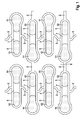
- FIG. 1 shown portion of a basic structure of a hollow cylindrical stent has straight, longitudinally extending webs 2 and S-shaped bent webs 3, which extend on the lateral surface transverse to the longitudinal direction.
- two curved webs 5 are arranged, which together form an approximately keyhole-shaped, continuous opening 7.
- the extending in the longitudinal direction webs 2 are arranged only in every second, extending in the longitudinal direction of the row formed by the webs 5 stitches.
- the keyhole-shaped opening 7 forming webs 5 a mesh or cell is formed.
- the keyhole-shaped openings 7 are covered to about 70% of their cross-sectional area with a coating containing at least one pharmaceutically active substance.
- the coating consists of a matrix material, in particular of rubber, latex, PLLA (poly-L-lactide), PLGA (poly-L-glycolide) or PBMA (poly-butyl-methacrylate) or a shape memory polymer.
- the coating further comprises one or more pharmaceutically active substance (s), preferably paclitaxel or sirolimus. The release of the pharmaceutically active substance (s) is carried out by rinsing with body fluid.
- the coating shown has two parts, a first part 11 at the head end and a second part 12 at the foot end of each keyhole-shaped opening 7.
- the H-shaped openings 8 are not covered by a coating.
- this design of the coating it is possible to vary the drug quantity and concentration by the design and the variable filling density.
- the basic structure of the stent with the webs 2, 3 and 5 is preferably made of the metal alloy CoCr, or, in a particularly preferred embodiment, of a biodegradable magnesium alloy.
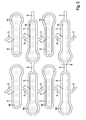
- each keyhole-shaped opening 7 100% of the cross-sectional area of each keyhole-shaped opening 7 are covered with a coating 10.
- the basic structure of the stent still contains H-shaped openings, which, however, analogous to those in Fig. 1 embodiment not covered with a coating containing the pharmaceutically active substance, are covered.
- the cross-sectional area formed by the approximately oval openings 7 ' is 100% covered with the coating 10'.
- the intervening, formed by the webs 2, 3 'and 5' approximately H-shaped openings 8 ' are each not provided with a coating.
- Fig. 4 there is shown a basic structure of a stent according to the invention having approximately circular meshes formed by arcuate ridges 5 ". Each approximately circular cross-sectional area of the mesh opening 7" is completely covered with the coating 10 ".
- the approximately circular meshes are connected by transverse to the longitudinal direction webs 3 'together. In the direction of the longitudinal direction of the stent no separate webs are arranged in this embodiment. The through the webs 3 'and the webs 5 "formed, H-shaped mesh 8" wear no coating.
- Fig. 5 shows the portion of a web 15, which forms a mesh or cell of the basic structure of an implant according to the invention, in a view from the luminal direction.
- This web is covered with a coating 20 containing at least one pharmaceutically active substance, which in each case spans a through opening 27 formed by the web 15.
- FIGS. 5a) and 5b ) sections of the same mesh are shown, wherein the in Fig. 5a ) illustrated web 15 with coating 20 belongs to a non-dilated implant, while the web 15, which in Fig. 5b ) was dilated with the appropriate implant.
- the coating 20 is elastic so that it can assume both states without tearing.
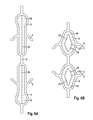
- Fig. 6 a further embodiment of an implant according to the invention is shown, which is essentially based on the Fig. 2 illustrated embodiment corresponds.
- the keyhole-shaped openings are arranged in opposite directions.
- the coating 10 has approximately along a center line a dashed line perforation 22, which in the non-dilated state (see Fig. 6a )) is still closed and represents a break line.
- spaced-apart holes are arranged in the coating 10 and / or the coating 10 has a slightly smaller layer thickness.
- the opening 24 is enclosed by the edges 23, which extend along the previously existing, ie in the non-dilated state, perforation line 22.
- the tearing of the coating 10 along a predetermined perforation line 22 during the dilatation has the advantage that, on the one hand, an opening 24 is formed in the coating 10 at a defined location. On the other hand will tearing open the coating 10 promotes the release of the pharmaceutically active substance (s) contained in the coating 10.
- Fig. 7 shows that in Fig. 5 already illustrated embodiment in a cross section.
- the anchoring of the coating 20 takes place by means of lasered-in grooves (slots) 17, which are arranged on the abluminal side 16 of the respective web 15.
- the coating 20 is fastened in the grooves 17 by means of a positive connection and / or by means of an adhesive (material closure), not shown.
- a cohesive connection between the coating 20 and web 15 can also take place without a groove.
- the course of the bottom line 18 of the triangular in cross-section groove 17 is illustrated as a dashed line.
- Coating 10, 10 ', 10 ", 11, 12 and 20 serves as a preferably highly elastic carrier of one or more pharmaceutically active substances
- These substances can, for example, be prepared by dipping or diffusing into the solution and thus into the future polymer during the preparation of the coating solution
- X-ray markers or X-ray opaque materials may be provided in the coating, which may be introduced into the layer or by means of entrapped particles, immersion, diffusion, sputtering, electrochemical or static deposition processes, possibly with subsequent heat treatment for introduction or fixation
- the layer material is embedded.
- the coating is applied by means of dipping, spraying, pipetting or the like, wherein the areas not to be coated are protected by means of a mask, a hydrophobic coating and / or a cover.
- all non-coated surfaces or recesses are provided with a cover and / or a hydrophobic protective layer.
- the implant is coated by dipping or dipping to produce the at least one pharmaceutically active substance releasing coating.
- the coating is done from all sides in this step, the luminal side of the stent is covered.
- the coating material does not adhere to the surfaces of the stent, which were provided with the cover or protective layer.
- the covers or protective layers are removed by heating, stripping or etching.
- the hydrophobic protective layer can also remain on the webs if it is made biocompatible.
- the coating not only attaches itself to the webs, but selectively spans certain openings or a specific area of specific openings by producing the coating by targeted pipetting, if not all openings are to be coated. This ensures that, as in Fig. 7 shown, all holding areas are used.
- Suitable methods would be, for example, laser cutting, dotting or cutting.
- so-called predetermined breaking points can also be punched or rolled into the coating. During dilatation, the coating then breaks down exactly at this point.
- Shape memory polymers can also be used in the coating.
- the first element or basic building block for a shape memory polymer all materials can be used from which polymers can be prepared. It is further preferred if these materials are biocompatible.
- the second element for producing a shape memory material causes the programming, with which the plastic is brought into its second, temporary shape. After the preparation of the polymer for a specific application this is processed classically. Here, the material is once melted and cooled. This gives the plastic its first, permanent form. Subsequently, the material is reheated, beyond its so-called switching temperature. This switching temperature results from the specific properties of the material and is based on a phase transition of the polymer chains, which is well below the original processing temperature.
- the plastic is deformed for the second time, cooled again below the switching temperature and thereby "programmed", ie fixed in its second temporary shape.
- the coating is then brought to its place of use.
- the material receives its specific thermal stimulus, for example, by the body temperature of the treated
- Organism or via a warm liquid which is brought to the polymer via a probe.
- This stimulus causes the polymer to regain its first, permanent shape at the treatment site.
- the said shape memory polymers (FGP) are thus particularly well suited to receive a pharmaceutically active substance in a variety of forms and this again at the treatment site, as provided in these polymers pores ("programmed"), which only after dilation reappear at the site of implantation and release the drug.
- the introduction of the pharmaceutically active substance takes place during or after the "programming”.
- Examples of polymers with shape memory effect are multiblock copolymers or standard polymers (PET, PS, PUR, PE, PES, PTFE).
- the programming is done, for example, by briefly heating the shape memory polymer to the shape memory temperature, with the polymer expanding.
- pores can break open or be introduced by punching or etching.
- the active ingredient can be filled in the pores, e.g. by diffusion.
- the maximum layer thickness of the coating is preferably 100 ⁇ m. With a layer thickness of more than 100 microns, the required elasticity of the coating is not guaranteed.
- the implants according to the invention are characterized in that a large area for the release of a pharmaceutically active substance is created. As a result, a more uniform distribution of the active ingredient in the treated area of the organ is possible. The dosage of the active ingredients can thus be increased. Furthermore, the distribution of the coating at different sections of the implant can also be configured differently, for example differently at the proximal end or at the distal end of the implant.
Landscapes
- Health & Medical Sciences (AREA)
- Life Sciences & Earth Sciences (AREA)
- Public Health (AREA)
- Veterinary Medicine (AREA)
- Biomedical Technology (AREA)
- Vascular Medicine (AREA)
- Engineering & Computer Science (AREA)
- Heart & Thoracic Surgery (AREA)
- Animal Behavior & Ethology (AREA)
- General Health & Medical Sciences (AREA)
- Optics & Photonics (AREA)
- Physics & Mathematics (AREA)
- Epidemiology (AREA)
- Surgery (AREA)
- Chemical & Material Sciences (AREA)
- Medicinal Chemistry (AREA)
- Molecular Biology (AREA)
- Cardiology (AREA)
- Oral & Maxillofacial Surgery (AREA)
- Transplantation (AREA)
- Materials For Medical Uses (AREA)
Applications Claiming Priority (1)
| Application Number | Priority Date | Filing Date | Title |
|---|---|---|---|
| US201161446049P | 2011-02-24 | 2011-02-24 |
Publications (2)
| Publication Number | Publication Date |
|---|---|
| EP2491965A2 true EP2491965A2 (fr) | 2012-08-29 |
| EP2491965A3 EP2491965A3 (fr) | 2014-04-23 |
Family
ID=45581746
Family Applications (1)
| Application Number | Title | Priority Date | Filing Date |
|---|---|---|---|
| EP12154833.3A Withdrawn EP2491965A3 (fr) | 2011-02-24 | 2012-02-10 | Implant et son procédé de fabrication |
Country Status (2)
| Country | Link |
|---|---|
| US (1) | US8974521B2 (fr) |
| EP (1) | EP2491965A3 (fr) |
Cited By (1)
| Publication number | Priority date | Publication date | Assignee | Title |
|---|---|---|---|---|
| WO2015039880A1 (fr) * | 2013-09-17 | 2015-03-26 | Cortronik GmbH | Endoprothèse intra-luminale ayant une distribution de principe actif optimisée |
Families Citing this family (4)
| Publication number | Priority date | Publication date | Assignee | Title |
|---|---|---|---|---|
| EP3060178A4 (fr) * | 2013-10-22 | 2017-06-14 | OrbusNeich Medical, Inc. | Dispositif médical destiné à être implanté dans des structures luminales et intégrant des éléments de structure ondulés |
| US9980835B2 (en) | 2013-10-22 | 2018-05-29 | Orbusneich Medical Inc. | Medical device for implantation into luminal structures incorporating corrugated structural elements |
| DE102015108835A1 (de) * | 2015-06-03 | 2016-12-08 | Andratec Gmbh | Gefäßstütze |
| US10940015B2 (en) * | 2017-11-21 | 2021-03-09 | Institute for Musculoskeletal Science and Education, Ltd. | Implant with improved flow characteristics |
Citations (1)
| Publication number | Priority date | Publication date | Assignee | Title |
|---|---|---|---|---|
| US7060093B2 (en) | 2000-10-30 | 2006-06-13 | Advanced Cardiovascular Systems, Inc. | Increased drug-loading and reduced stress drug delivery device |
Family Cites Families (11)
| Publication number | Priority date | Publication date | Assignee | Title |
|---|---|---|---|---|
| DE10012460A1 (de) * | 2000-03-15 | 2001-09-20 | Biotronik Mess & Therapieg | Stent |
| US6540776B2 (en) | 2000-12-28 | 2003-04-01 | Advanced Cardiovascular Systems, Inc. | Sheath for a prosthesis and methods of forming the same |
| US20040024448A1 (en) * | 2002-08-05 | 2004-02-05 | Chang James W. | Thermoplastic fluoropolymer-coated medical devices |
| DE102005013547B4 (de) * | 2005-03-23 | 2009-02-05 | Admedes Schuessler Gmbh | Aneurysmen-Stent und Verfahren zu seiner Herstellung |
| US8802184B2 (en) * | 2007-05-30 | 2014-08-12 | Abbott Cardiovascular Systems Inc. | Medical devices containing biobeneficial particles |
| DE102007034041A1 (de) * | 2007-07-20 | 2009-01-22 | Biotronik Vi Patent Ag | Medikamentendepots für medizinische Implantate |
| DE102007034363A1 (de) * | 2007-07-24 | 2009-01-29 | Biotronik Vi Patent Ag | Endoprothese |
| US8070720B2 (en) | 2008-01-11 | 2011-12-06 | Medtronic Vascular, Inc | Methods for incorporating a drug into an elastomeric medical device |
| EP2249893A2 (fr) * | 2008-02-01 | 2010-11-17 | Boston Scientific Scimed, Inc. | Dispositifs médicaux recouverts de médicament pour une libération différentielle de médicament |
| US20120078348A1 (en) | 2009-05-28 | 2012-03-29 | Orr David E | Apparatus and methods for delivering at least one therapeutic agent |
| US9402754B2 (en) * | 2010-05-18 | 2016-08-02 | Abbott Cardiovascular Systems, Inc. | Expandable endoprostheses, systems, and methods for treating a bifurcated lumen |
-
2012
- 2012-02-09 US US13/369,977 patent/US8974521B2/en not_active Expired - Fee Related
- 2012-02-10 EP EP12154833.3A patent/EP2491965A3/fr not_active Withdrawn
Patent Citations (1)
| Publication number | Priority date | Publication date | Assignee | Title |
|---|---|---|---|---|
| US7060093B2 (en) | 2000-10-30 | 2006-06-13 | Advanced Cardiovascular Systems, Inc. | Increased drug-loading and reduced stress drug delivery device |
Cited By (1)
| Publication number | Priority date | Publication date | Assignee | Title |
|---|---|---|---|---|
| WO2015039880A1 (fr) * | 2013-09-17 | 2015-03-26 | Cortronik GmbH | Endoprothèse intra-luminale ayant une distribution de principe actif optimisée |
Also Published As
| Publication number | Publication date |
|---|---|
| US8974521B2 (en) | 2015-03-10 |
| US20120220934A1 (en) | 2012-08-30 |
| EP2491965A3 (fr) | 2014-04-23 |
Similar Documents
| Publication | Publication Date | Title |
|---|---|---|
| DE10107795B4 (de) | Gefäßstütze mit einem Grundkörper, Verfahren zur Herstellung der Gefäßstütze, Vorrichtung zur Beschichtung der Gefäßstütze | |
| EP2018834B1 (fr) | Stent en métal dégradable doté d'un revêtement contenant des additifs | |
| DE60025161T2 (de) | Vorrichtung zur arzneimittelabgabe | |
| DE60310686T2 (de) | Metallverstärkter bio-abbaubarer intraluminaler stent | |
| DE10145714B4 (de) | Stent | |
| EP2016960B1 (fr) | Réservoirs de médicaments pour implants médicaux | |
| DE602004011418T2 (de) | Vorrichtung zum Einbringen beschichteter medizinischer Implantate | |
| DE60029925T2 (de) | Stent mit vorrübergehenden haltebändern | |
| EP0923389B1 (fr) | Implant metallique degradable in vivo | |
| EP2967934B1 (fr) | Endoprothèse biorésorbable | |
| DE102008002395A1 (de) | Wirkstoffbeladenes Implantat | |
| DE29624503U1 (de) | Arzneimittel-freisetzender beschichteter Stent | |
| EP1886650A1 (fr) | Endoprothèse et procédures pour sa fabrication | |
| EP1393766A1 (fr) | Implant endovasculaire pour injecter un principe actif dans le media d'un vaisseau sanguin | |
| EP2491965A2 (fr) | Implant et son procédé de fabrication | |
| EP1632256A2 (fr) | Endoprothèse à base d'un alliage de magnésium | |
| EP2138130A1 (fr) | Extenseur revêtu avec profil d'élution axialement varié | |
| EP2147688B1 (fr) | Endoprothèse et son procédé de fabrication | |
| EP2327380B1 (fr) | Stent doté d'éléments de fonction | |
| EP2446917A1 (fr) | Cathéter, système d'introduction d'une endoprothèse intraluminale et son procédé de fabrication | |
| EP2806981B1 (fr) | Procédé pour revêtir une endoprothèse | |
| EP3613449A1 (fr) | Amélioration de la couche polymère dans des dispositifs dégradables | |
| EP2586404A1 (fr) | Implant | |
| EP2465476B1 (fr) | Stent et son procédé de fabrication | |
| EP2098194B1 (fr) | Cathéter et système d'introduction d'une endoprothèse intraluminale |
Legal Events
| Date | Code | Title | Description |
|---|---|---|---|
| PUAI | Public reference made under article 153(3) epc to a published international application that has entered the european phase |
Free format text: ORIGINAL CODE: 0009012 |
|
| AK | Designated contracting states |
Kind code of ref document: A2 Designated state(s): AL AT BE BG CH CY CZ DE DK EE ES FI FR GB GR HR HU IE IS IT LI LT LU LV MC MK MT NL NO PL PT RO RS SE SI SK SM TR |
|
| AX | Request for extension of the european patent |
Extension state: BA ME |
|
| PUAL | Search report despatched |
Free format text: ORIGINAL CODE: 0009013 |
|
| AK | Designated contracting states |
Kind code of ref document: A3 Designated state(s): AL AT BE BG CH CY CZ DE DK EE ES FI FR GB GR HR HU IE IS IT LI LT LU LV MC MK MT NL NO PL PT RO RS SE SI SK SM TR |
|
| AX | Request for extension of the european patent |
Extension state: BA ME |
|
| RIC1 | Information provided on ipc code assigned before grant |
Ipc: A61F 2/90 20130101ALI20140317BHEP Ipc: A61L 31/16 20060101AFI20140317BHEP |
|
| STAA | Information on the status of an ep patent application or granted ep patent |
Free format text: STATUS: THE APPLICATION IS DEEMED TO BE WITHDRAWN |
|
| 18D | Application deemed to be withdrawn |
Effective date: 20141024 |