EP2491993B1 - Procédés de séparation de composés - Google Patents
Procédés de séparation de composés Download PDFInfo
- Publication number
- EP2491993B1 EP2491993B1 EP12004053.0A EP12004053A EP2491993B1 EP 2491993 B1 EP2491993 B1 EP 2491993B1 EP 12004053 A EP12004053 A EP 12004053A EP 2491993 B1 EP2491993 B1 EP 2491993B1
- Authority
- EP
- European Patent Office
- Prior art keywords
- chromatographic separation
- mobile phase
- sample
- separation mode
- separation
- Prior art date
- Legal status (The legal status is an assumption and is not a legal conclusion. Google has not performed a legal analysis and makes no representation as to the accuracy of the status listed.)
- Revoked
Links
- 238000000034 method Methods 0.000 title claims description 57
- 150000001875 compounds Chemical class 0.000 title claims description 45
- 238000000926 separation method Methods 0.000 claims description 116
- 108090000765 processed proteins & peptides Proteins 0.000 claims description 90
- 238000013375 chromatographic separation Methods 0.000 claims description 85
- 102000004196 processed proteins & peptides Human genes 0.000 claims description 66
- 238000004587 chromatography analysis Methods 0.000 claims description 38
- 238000004007 reversed phase HPLC Methods 0.000 claims description 32
- 239000003480 eluent Substances 0.000 claims description 31
- 238000004128 high performance liquid chromatography Methods 0.000 claims description 29
- 150000003839 salts Chemical class 0.000 claims description 25
- 238000004949 mass spectrometry Methods 0.000 claims description 21
- 239000007788 liquid Substances 0.000 claims description 19
- 239000012491 analyte Substances 0.000 claims description 17
- 229920001184 polypeptide Polymers 0.000 claims description 17
- 108090000623 proteins and genes Proteins 0.000 claims description 14
- 102000004169 proteins and genes Human genes 0.000 claims description 14
- 239000012535 impurity Substances 0.000 claims description 12
- 238000004811 liquid chromatography Methods 0.000 claims description 12
- 238000001704 evaporation Methods 0.000 claims description 5
- 230000008020 evaporation Effects 0.000 claims description 5
- 238000004780 2D liquid chromatography Methods 0.000 claims description 4
- 238000005070 sampling Methods 0.000 claims description 3
- WEVYAHXRMPXWCK-UHFFFAOYSA-N Acetonitrile Chemical compound CC#N WEVYAHXRMPXWCK-UHFFFAOYSA-N 0.000 description 93
- 239000000523 sample Substances 0.000 description 54
- BDAGIHXWWSANSR-UHFFFAOYSA-N methanoic acid Natural products OC=O BDAGIHXWWSANSR-UHFFFAOYSA-N 0.000 description 37
- 230000014759 maintenance of location Effects 0.000 description 27
- 238000012799 strong cation exchange Methods 0.000 description 26
- OSWFIVFLDKOXQC-UHFFFAOYSA-N 4-(3-methoxyphenyl)aniline Chemical compound COC1=CC=CC(C=2C=CC(N)=CC=2)=C1 OSWFIVFLDKOXQC-UHFFFAOYSA-N 0.000 description 18
- 235000019253 formic acid Nutrition 0.000 description 18
- 239000000203 mixture Substances 0.000 description 18
- 238000002013 hydrophilic interaction chromatography Methods 0.000 description 17
- 239000000872 buffer Substances 0.000 description 15
- 238000002347 injection Methods 0.000 description 14
- 239000007924 injection Substances 0.000 description 14
- 238000004895 liquid chromatography mass spectrometry Methods 0.000 description 14
- 235000018102 proteins Nutrition 0.000 description 13
- 238000001542 size-exclusion chromatography Methods 0.000 description 13
- 239000002594 sorbent Substances 0.000 description 13
- 239000003643 water by type Substances 0.000 description 13
- 238000002474 experimental method Methods 0.000 description 12
- 238000004458 analytical method Methods 0.000 description 11
- DTQVDTLACAAQTR-UHFFFAOYSA-N Trifluoroacetic acid Chemical compound OC(=O)C(F)(F)F DTQVDTLACAAQTR-UHFFFAOYSA-N 0.000 description 10
- XLYOFNOQVPJJNP-UHFFFAOYSA-N water Chemical compound O XLYOFNOQVPJJNP-UHFFFAOYSA-N 0.000 description 10
- 230000005526 G1 to G0 transition Effects 0.000 description 9
- VYPSYNLAJGMNEJ-UHFFFAOYSA-N Silicium dioxide Chemical compound O=[Si]=O VYPSYNLAJGMNEJ-UHFFFAOYSA-N 0.000 description 9
- 230000002209 hydrophobic effect Effects 0.000 description 9
- FAPWRFPIFSIZLT-UHFFFAOYSA-M Sodium chloride Chemical compound [Na+].[Cl-] FAPWRFPIFSIZLT-UHFFFAOYSA-M 0.000 description 8
- VZTDIZULWFCMLS-UHFFFAOYSA-N ammonium formate Chemical compound [NH4+].[O-]C=O VZTDIZULWFCMLS-UHFFFAOYSA-N 0.000 description 8
- 238000001514 detection method Methods 0.000 description 8
- 230000003993 interaction Effects 0.000 description 8
- 230000000717 retained effect Effects 0.000 description 8
- VHUUQVKOLVNVRT-UHFFFAOYSA-N Ammonium hydroxide Chemical compound [NH4+].[OH-] VHUUQVKOLVNVRT-UHFFFAOYSA-N 0.000 description 7
- 239000000908 ammonium hydroxide Substances 0.000 description 6
- 238000013459 approach Methods 0.000 description 6
- 239000002904 solvent Substances 0.000 description 6
- 239000012472 biological sample Substances 0.000 description 5
- 239000000463 material Substances 0.000 description 5
- 239000000377 silicon dioxide Substances 0.000 description 5
- 230000001066 destructive effect Effects 0.000 description 4
- 238000010790 dilution Methods 0.000 description 4
- 239000012895 dilution Substances 0.000 description 4
- 239000003814 drug Substances 0.000 description 4
- 238000004012 multidimensional HPLC Methods 0.000 description 4
- 102000040430 polynucleotide Human genes 0.000 description 4
- 108091033319 polynucleotide Proteins 0.000 description 4
- 239000002157 polynucleotide Substances 0.000 description 4
- 238000011084 recovery Methods 0.000 description 4
- 239000011780 sodium chloride Substances 0.000 description 4
- QTBSBXVTEAMEQO-UHFFFAOYSA-N Acetic acid Chemical compound CC(O)=O QTBSBXVTEAMEQO-UHFFFAOYSA-N 0.000 description 3
- ZMANZCXQSJIPKH-UHFFFAOYSA-N Triethylamine Chemical compound CCN(CC)CC ZMANZCXQSJIPKH-UHFFFAOYSA-N 0.000 description 3
- 239000012062 aqueous buffer Substances 0.000 description 3
- 238000012512 characterization method Methods 0.000 description 3
- 230000000295 complement effect Effects 0.000 description 3
- 238000011033 desalting Methods 0.000 description 3
- 238000000605 extraction Methods 0.000 description 3
- 238000001906 matrix-assisted laser desorption--ionisation mass spectrometry Methods 0.000 description 3
- 125000000538 pentafluorophenyl group Chemical group FC1=C(F)C(F)=C(*)C(F)=C1F 0.000 description 3
- 125000001997 phenyl group Chemical group [H]C1=C([H])C([H])=C(*)C([H])=C1[H] 0.000 description 3
- 238000002360 preparation method Methods 0.000 description 3
- 101800000112 Acidic peptide Proteins 0.000 description 2
- QGZKDVFQNNGYKY-UHFFFAOYSA-O Ammonium Chemical class [NH4+] QGZKDVFQNNGYKY-UHFFFAOYSA-O 0.000 description 2
- ATRRKUHOCOJYRX-UHFFFAOYSA-N Ammonium bicarbonate Chemical compound [NH4+].OC([O-])=O ATRRKUHOCOJYRX-UHFFFAOYSA-N 0.000 description 2
- 229910000013 Ammonium bicarbonate Inorganic materials 0.000 description 2
- NBIIXXVUZAFLBC-UHFFFAOYSA-N Phosphoric acid Chemical compound OP(O)(O)=O NBIIXXVUZAFLBC-UHFFFAOYSA-N 0.000 description 2
- 239000002253 acid Substances 0.000 description 2
- 230000002378 acidificating effect Effects 0.000 description 2
- 150000007513 acids Chemical class 0.000 description 2
- 239000000654 additive Substances 0.000 description 2
- 235000001014 amino acid Nutrition 0.000 description 2
- 150000001413 amino acids Chemical class 0.000 description 2
- 235000012538 ammonium bicarbonate Nutrition 0.000 description 2
- 239000001099 ammonium carbonate Substances 0.000 description 2
- 230000002596 correlated effect Effects 0.000 description 2
- 238000004807 desolvation Methods 0.000 description 2
- 150000002009 diols Chemical class 0.000 description 2
- 238000010828 elution Methods 0.000 description 2
- 238000000105 evaporative light scattering detection Methods 0.000 description 2
- 239000007789 gas Substances 0.000 description 2
- 239000011159 matrix material Substances 0.000 description 2
- 238000000816 matrix-assisted laser desorption--ionisation Methods 0.000 description 2
- 230000007246 mechanism Effects 0.000 description 2
- 239000003607 modifier Substances 0.000 description 2
- 229920005615 natural polymer Polymers 0.000 description 2
- 230000007935 neutral effect Effects 0.000 description 2
- 102000039446 nucleic acids Human genes 0.000 description 2
- 108020004707 nucleic acids Proteins 0.000 description 2
- 150000007523 nucleic acids Chemical class 0.000 description 2
- 239000003960 organic solvent Substances 0.000 description 2
- 238000010647 peptide synthesis reaction Methods 0.000 description 2
- 238000001556 precipitation Methods 0.000 description 2
- 238000012545 processing Methods 0.000 description 2
- 238000005086 pumping Methods 0.000 description 2
- AJPJDKMHJJGVTQ-UHFFFAOYSA-M sodium dihydrogen phosphate Chemical compound [Na+].OP(O)([O-])=O AJPJDKMHJJGVTQ-UHFFFAOYSA-M 0.000 description 2
- 229910000162 sodium phosphate Inorganic materials 0.000 description 2
- 239000007787 solid Substances 0.000 description 2
- 229920001059 synthetic polymer Polymers 0.000 description 2
- GETQZCLCWQTVFV-UHFFFAOYSA-N trimethylamine Chemical compound CN(C)C GETQZCLCWQTVFV-UHFFFAOYSA-N 0.000 description 2
- LWIHDJKSTIGBAC-UHFFFAOYSA-K tripotassium phosphate Chemical compound [K+].[K+].[K+].[O-]P([O-])([O-])=O LWIHDJKSTIGBAC-UHFFFAOYSA-K 0.000 description 2
- 239000011800 void material Substances 0.000 description 2
- USFZMSVCRYTOJT-UHFFFAOYSA-N Ammonium acetate Chemical compound N.CC(O)=O USFZMSVCRYTOJT-UHFFFAOYSA-N 0.000 description 1
- 239000005695 Ammonium acetate Substances 0.000 description 1
- 239000004475 Arginine Substances 0.000 description 1
- 239000000055 Corticotropin-Releasing Hormone Substances 0.000 description 1
- NZNMSOFKMUBTKW-UHFFFAOYSA-N Cyclohexanecarboxylic acid Natural products OC(=O)C1CCCCC1 NZNMSOFKMUBTKW-UHFFFAOYSA-N 0.000 description 1
- WHUUTDBJXJRKMK-UHFFFAOYSA-N Glutamic acid Natural products OC(=O)C(N)CCC(O)=O WHUUTDBJXJRKMK-UHFFFAOYSA-N 0.000 description 1
- 108010015899 Glycopeptides Proteins 0.000 description 1
- 102000002068 Glycopeptides Human genes 0.000 description 1
- CKLJMWTZIZZHCS-REOHCLBHSA-N L-aspartic acid Chemical compound OC(=O)[C@@H](N)CC(O)=O CKLJMWTZIZZHCS-REOHCLBHSA-N 0.000 description 1
- OUYCCCASQSFEME-QMMMGPOBSA-N L-tyrosine Chemical compound OC(=O)[C@@H](N)CC1=CC=C(O)C=C1 OUYCCCASQSFEME-QMMMGPOBSA-N 0.000 description 1
- KDXKERNSBIXSRK-UHFFFAOYSA-N Lysine Natural products NCCCCC(N)C(O)=O KDXKERNSBIXSRK-UHFFFAOYSA-N 0.000 description 1
- 239000004472 Lysine Substances 0.000 description 1
- 108010001441 Phosphopeptides Proteins 0.000 description 1
- 102000012288 Phosphopyruvate Hydratase Human genes 0.000 description 1
- 108010022181 Phosphopyruvate Hydratase Proteins 0.000 description 1
- AFVLVVWMAFSXCK-VMPITWQZSA-N alpha-cyano-4-hydroxycinnamic acid Chemical compound OC(=O)C(\C#N)=C\C1=CC=C(O)C=C1 AFVLVVWMAFSXCK-VMPITWQZSA-N 0.000 description 1
- 229910000147 aluminium phosphate Inorganic materials 0.000 description 1
- 150000001408 amides Chemical class 0.000 description 1
- 125000003277 amino group Chemical group 0.000 description 1
- -1 aminopropyl Chemical group 0.000 description 1
- QGZKDVFQNNGYKY-UHFFFAOYSA-N ammonia Natural products N QGZKDVFQNNGYKY-UHFFFAOYSA-N 0.000 description 1
- 229940043376 ammonium acetate Drugs 0.000 description 1
- 235000019257 ammonium acetate Nutrition 0.000 description 1
- 230000003466 anti-cipated effect Effects 0.000 description 1
- 239000007864 aqueous solution Substances 0.000 description 1
- ODKSFYDXXFIFQN-UHFFFAOYSA-N arginine Natural products OC(=O)C(N)CCCNC(N)=N ODKSFYDXXFIFQN-UHFFFAOYSA-N 0.000 description 1
- 235000003704 aspartic acid Nutrition 0.000 description 1
- OQFSQFPPLPISGP-UHFFFAOYSA-N beta-carboxyaspartic acid Natural products OC(=O)C(N)C(C(O)=O)C(O)=O OQFSQFPPLPISGP-UHFFFAOYSA-N 0.000 description 1
- 238000004850 capillary HPLC Methods 0.000 description 1
- 150000001768 cations Chemical class 0.000 description 1
- 230000008859 change Effects 0.000 description 1
- 239000003153 chemical reaction reagent Substances 0.000 description 1
- 238000011208 chromatographic data Methods 0.000 description 1
- 238000011097 chromatography purification Methods 0.000 description 1
- 230000000052 comparative effect Effects 0.000 description 1
- 230000001143 conditioned effect Effects 0.000 description 1
- 239000000470 constituent Substances 0.000 description 1
- 239000000356 contaminant Substances 0.000 description 1
- 230000000875 corresponding effect Effects 0.000 description 1
- IDLFZVILOHSSID-OVLDLUHVSA-N corticotropin Chemical compound C([C@@H](C(=O)N[C@@H](CO)C(=O)N[C@@H](CCSC)C(=O)N[C@@H](CCC(O)=O)C(=O)N[C@@H](CC=1NC=NC=1)C(=O)N[C@@H](CC=1C=CC=CC=1)C(=O)N[C@@H](CCCNC(N)=N)C(=O)N[C@@H](CC=1C2=CC=CC=C2NC=1)C(=O)NCC(=O)N[C@@H](CCCCN)C(=O)N1[C@@H](CCC1)C(=O)N[C@@H](C(C)C)C(=O)NCC(=O)N[C@@H](CCCCN)C(=O)N[C@@H](CCCCN)C(=O)N[C@@H](CCCNC(N)=N)C(=O)N[C@@H](CCCNC(N)=N)C(=O)N1[C@@H](CCC1)C(=O)N[C@@H](C(C)C)C(=O)N[C@@H](CCCCN)C(=O)N[C@@H](C(C)C)C(=O)N[C@@H](CC=1C=CC(O)=CC=1)C(=O)N1[C@@H](CCC1)C(=O)N[C@@H](CC(N)=O)C(=O)NCC(=O)N[C@@H](C)C(=O)N[C@@H](CCC(O)=O)C(=O)N[C@@H](CC(O)=O)C(=O)N[C@@H](CCC(O)=O)C(=O)N[C@@H](CO)C(=O)N[C@@H](C)C(=O)N[C@@H](CCC(O)=O)C(=O)N[C@@H](C)C(=O)N[C@@H](CC=1C=CC=CC=1)C(=O)N1[C@@H](CCC1)C(=O)N[C@@H](CC(C)C)C(=O)N[C@@H](CCC(O)=O)C(=O)N[C@@H](CC=1C=CC=CC=1)C(O)=O)NC(=O)[C@@H](N)CO)C1=CC=C(O)C=C1 IDLFZVILOHSSID-OVLDLUHVSA-N 0.000 description 1
- 229960000258 corticotropin Drugs 0.000 description 1
- 238000007405 data analysis Methods 0.000 description 1
- 230000003247 decreasing effect Effects 0.000 description 1
- 239000008367 deionised water Substances 0.000 description 1
- 229910021641 deionized water Inorganic materials 0.000 description 1
- 230000003111 delayed effect Effects 0.000 description 1
- 238000011161 development Methods 0.000 description 1
- BNIILDVGGAEEIG-UHFFFAOYSA-L disodium hydrogen phosphate Chemical compound [Na+].[Na+].OP([O-])([O-])=O BNIILDVGGAEEIG-UHFFFAOYSA-L 0.000 description 1
- 229910000397 disodium phosphate Inorganic materials 0.000 description 1
- 235000019800 disodium phosphate Nutrition 0.000 description 1
- 230000000694 effects Effects 0.000 description 1
- 238000011156 evaluation Methods 0.000 description 1
- 230000007717 exclusion Effects 0.000 description 1
- 238000001914 filtration Methods 0.000 description 1
- 239000012530 fluid Substances 0.000 description 1
- 238000005194 fractionation Methods 0.000 description 1
- 238000004817 gas chromatography Methods 0.000 description 1
- 235000013922 glutamic acid Nutrition 0.000 description 1
- 239000004220 glutamic acid Substances 0.000 description 1
- HNDVDQJCIGZPNO-UHFFFAOYSA-N histidine Natural products OC(=O)C(N)CC1=CN=CN1 HNDVDQJCIGZPNO-UHFFFAOYSA-N 0.000 description 1
- 230000002452 interceptive effect Effects 0.000 description 1
- 238000004255 ion exchange chromatography Methods 0.000 description 1
- 150000002500 ions Chemical class 0.000 description 1
- 230000000670 limiting effect Effects 0.000 description 1
- 238000011068 loading method Methods 0.000 description 1
- 238000001819 mass spectrum Methods 0.000 description 1
- 238000013178 mathematical model Methods 0.000 description 1
- 238000002156 mixing Methods 0.000 description 1
- 125000000896 monocarboxylic acid group Chemical group 0.000 description 1
- 238000000148 multi-dimensional chromatography Methods 0.000 description 1
- 238000010606 normalization Methods 0.000 description 1
- 239000003002 pH adjusting agent Substances 0.000 description 1
- 238000012510 peptide mapping method Methods 0.000 description 1
- SNGREZUHAYWORS-UHFFFAOYSA-N perfluorooctanoic acid Chemical compound OC(=O)C(F)(F)C(F)(F)C(F)(F)C(F)(F)C(F)(F)C(F)(F)C(F)(F)F SNGREZUHAYWORS-UHFFFAOYSA-N 0.000 description 1
- 108010064470 polyaspartate Proteins 0.000 description 1
- 229910000160 potassium phosphate Inorganic materials 0.000 description 1
- 235000011009 potassium phosphates Nutrition 0.000 description 1
- 230000002829 reductive effect Effects 0.000 description 1
- 150000004819 silanols Chemical class 0.000 description 1
- 238000000638 solvent extraction Methods 0.000 description 1
- 238000001228 spectrum Methods 0.000 description 1
- 230000007480 spreading Effects 0.000 description 1
- 229910001220 stainless steel Inorganic materials 0.000 description 1
- 239000010935 stainless steel Substances 0.000 description 1
- 238000004899 strong cation exchang reversed phase HPLC Methods 0.000 description 1
- 238000012437 strong cation exchange chromatography Methods 0.000 description 1
- 239000000126 substance Substances 0.000 description 1
- 238000004808 supercritical fluid chromatography Methods 0.000 description 1
- WROMPOXWARCANT-UHFFFAOYSA-N tfa trifluoroacetic acid Chemical compound OC(=O)C(F)(F)F.OC(=O)C(F)(F)F WROMPOXWARCANT-UHFFFAOYSA-N 0.000 description 1
- OUYCCCASQSFEME-UHFFFAOYSA-N tyrosine Natural products OC(=O)C(N)CC1=CC=C(O)C=C1 OUYCCCASQSFEME-UHFFFAOYSA-N 0.000 description 1
- 238000010626 work up procedure Methods 0.000 description 1
- AFVLVVWMAFSXCK-UHFFFAOYSA-N α-cyano-4-hydroxycinnamic acid Chemical compound OC(=O)C(C#N)=CC1=CC=C(O)C=C1 AFVLVVWMAFSXCK-UHFFFAOYSA-N 0.000 description 1
Images


Classifications
-
- B—PERFORMING OPERATIONS; TRANSPORTING
- B01—PHYSICAL OR CHEMICAL PROCESSES OR APPARATUS IN GENERAL
- B01D—SEPARATION
- B01D15/00—Separating processes involving the treatment of liquids with solid sorbents; Apparatus therefor
- B01D15/08—Selective adsorption, e.g. chromatography
- B01D15/26—Selective adsorption, e.g. chromatography characterised by the separation mechanism
- B01D15/32—Bonded phase chromatography
- B01D15/325—Reversed phase
-
- B—PERFORMING OPERATIONS; TRANSPORTING
- B01—PHYSICAL OR CHEMICAL PROCESSES OR APPARATUS IN GENERAL
- B01D—SEPARATION
- B01D15/00—Separating processes involving the treatment of liquids with solid sorbents; Apparatus therefor
- B01D15/08—Selective adsorption, e.g. chromatography
- B01D15/10—Selective adsorption, e.g. chromatography characterised by constructional or operational features
- B01D15/18—Selective adsorption, e.g. chromatography characterised by constructional or operational features relating to flow patterns
- B01D15/1864—Selective adsorption, e.g. chromatography characterised by constructional or operational features relating to flow patterns using two or more columns
- B01D15/1871—Selective adsorption, e.g. chromatography characterised by constructional or operational features relating to flow patterns using two or more columns placed in series
- B01D15/1878—Selective adsorption, e.g. chromatography characterised by constructional or operational features relating to flow patterns using two or more columns placed in series for multi-dimensional chromatography
-
- B—PERFORMING OPERATIONS; TRANSPORTING
- B01—PHYSICAL OR CHEMICAL PROCESSES OR APPARATUS IN GENERAL
- B01D—SEPARATION
- B01D15/00—Separating processes involving the treatment of liquids with solid sorbents; Apparatus therefor
- B01D15/08—Selective adsorption, e.g. chromatography
- B01D15/26—Selective adsorption, e.g. chromatography characterised by the separation mechanism
- B01D15/30—Partition chromatography
- B01D15/305—Hydrophilic interaction chromatography [HILIC]
-
- G—PHYSICS
- G01—MEASURING; TESTING
- G01N—INVESTIGATING OR ANALYSING MATERIALS BY DETERMINING THEIR CHEMICAL OR PHYSICAL PROPERTIES
- G01N30/00—Investigating or analysing materials by separation into components using adsorption, absorption or similar phenomena or using ion-exchange, e.g. chromatography or field flow fractionation
- G01N30/02—Column chromatography
-
- G—PHYSICS
- G01—MEASURING; TESTING
- G01N—INVESTIGATING OR ANALYSING MATERIALS BY DETERMINING THEIR CHEMICAL OR PHYSICAL PROPERTIES
- G01N30/00—Investigating or analysing materials by separation into components using adsorption, absorption or similar phenomena or using ion-exchange, e.g. chromatography or field flow fractionation
- G01N30/02—Column chromatography
- G01N30/26—Conditioning of the fluid carrier; Flow patterns
- G01N30/38—Flow patterns
- G01N30/46—Flow patterns using more than one column
- G01N30/461—Flow patterns using more than one column with serial coupling of separation columns
-
- G—PHYSICS
- G01—MEASURING; TESTING
- G01N—INVESTIGATING OR ANALYSING MATERIALS BY DETERMINING THEIR CHEMICAL OR PHYSICAL PROPERTIES
- G01N30/00—Investigating or analysing materials by separation into components using adsorption, absorption or similar phenomena or using ion-exchange, e.g. chromatography or field flow fractionation
- G01N30/02—Column chromatography
- G01N30/26—Conditioning of the fluid carrier; Flow patterns
- G01N30/38—Flow patterns
- G01N30/46—Flow patterns using more than one column
- G01N30/461—Flow patterns using more than one column with serial coupling of separation columns
- G01N30/463—Flow patterns using more than one column with serial coupling of separation columns for multidimensional chromatography
Definitions
- HPLC high performance liquid chromatography
- SFC super-critical fluid chromatography
- a single chromatographic (e.g., HPLC) separation may not be capable of separating all of the compounds into well-separated peaks or fractions. If peaks are not well-resolved, impurities or contaminants may be present even after separation, interfering with characterization of a collected fraction.
- multi-dimension chromatographic methods have been developed. In these methods, a sample is subjected to a first separation. The solvent stream resulting from the first separation is typically collected in fractions representing partially-purified compound mixtures; individual fractions are then selected and subjected to a second separation technique.
- the conditions of the first and second separations are generally different, and, if chosen carefully, the second separation should permit the separation of compounds which were not resolved in the first separation dimension.
- multi-dimensional chromatographic methods include, e.g., Tranchida, PQ et al. J. Chromatogr. A. 1054(1-2):3-16 (2004 ) and Wagner, K et al. Anal. Chem. 74:809-820 (2002 ) the latter disclosing an automated on-line multidimensional HPLC system for protein and peptide mapping with integrated sample preparation.
- SCX strong-cation exchange
- RP-HPLC RP-HPLC
- the mobile phases or mobile phase additives used in the two separations may not be compatible with detectors, including mass spectrometers, or other parts of the analytical system, leading to additional difficulty in detection or sample processing.
- multi-dimensional HPLC can be performed using an HPLC separation for both the first and second dimensions by varying the pH of the mobile phase used in the two separations.
- the invention provides a method for analyzing a sample containing at least one analyte, the method comprising:
- first and second chromatographic separations are substantially orthogonal to each other. In certain preferred embodiments, the first and/or second chromatographic separation has a peak capacity of at least 100 peaks.
- the at least one analyte is a peptide, polypeptide, or protein. In certain preferred embodiments, the at least one analyte is a small organic molecule. In certain preferred embodiments, the sample contains at least 10 analytes. In certain preferred embodiments, the sample contains at least 100 analytes. In certain preferred embodiments, the sample contains at least 1000 analytes. In certain preferred embodiments, the total peak capacity of the method is at least 1,000, 5,000, or 10,000 peaks. In certain preferred embodiments, the first and/or second chromatographic separation is performed using a microbore column, capillary column, or nanocolumn.
- the at least one fraction or portion collected or sampled in step b) is concentrated or diluted prior to subjecting the at least one fraction to the second chromatographic separation mode; in certain embodiments, the at least one fraction is concentrated by evaporation. In other preferred embodiments, the at least one fraction (or portion) collected (or selected) in step b) is diluted on-line prior to performing the second chromatographic separation mode. In certain embodiments, the at least one fraction collected in step b) is diluted using on-line dilution.
- the step of detecting is performed using a mass spectrometer.
- the first and second chromatographic modes are the same.
- the first and/or second mobile phase is substantially free of non-volatile salts.
- the second mobile phase comprises less than about 20 mM (more preferably less than 10 or 5 mM) non-volatile salts.
- the first and/or second mobile phase contains less than about 20 mM of volatile salts.
- the invention provides a method for separating a plurality of analytes in a sample, the method comprising:
- the at least one analyte is a peptide, polypeptide, or protein. In certain preferred embodiments, the at least one analyte is a small organic molecule. In certain preferred embodiments, the sample contains at least 10 analytes. In certain preferred embodiments, the sample contains at least 100 analytes. In certain preferred embodiments, the sample contains at least 1000 analytes. In certain preferred embodiments, the total peak capacity of the method is at least 1,000, 5,000, or 10,000 peaks. In certain preferred embodiments, the first and/or second chromatographic separation is performed using a microbore column, capillary column, or nanocolumn.
- the at least one fraction or portion collected or sampled in step b) is concentrated or diluted prior to subjecting the at least one fraction to the second chromatographic separation mode; in certain embodiments, the at least one fraction is concentrated by evaporation. In other preferred embodiments, the at least one fraction (or portion) collected (or selected) in step b) is diluted on-line prior to performing the second chromatographic separation mode. In certain embodiments, the at least one fraction collected in step b) is diluted using on-line dilution.
- the step of detecting is performed using a mass spectrometer.
- the first and second chromatographic modes are the same.
- the second mobile phase is substantially free of non-volatile salts.
- the first and/or second mobile phase comprises less than about 20 mM (more preferably less than 10 or 5 mM) non-volatile salts.
- the first and/or second mobile phase contains less than about 20 mM of volatile salts.
- the invention provides a method for characterizing a sample containing a plurality of polypeptides in a multidimensional liquid chromatography system, the method comprising:
- the at least one analyte is a small organic molecule.
- the sample contains at least 10 analytes.
- the sample contains at least 100 analytes.
- the sample contains at least 1000 analytes.
- the total peak capacity of the method is at least 1,000, 5,000, or 10,000 peaks.
- the first and/or second chromatographic separation is performed using a microbore column, capillary column, or nanocolumn.
- the at least one fraction or portion collected or sampled in step b) is concentrated or diluted prior to subjecting the at least one fraction to the second chromatographic separation mode; in certain embodiments, the at least one fraction is concentrated by evaporation. In other preferred embodiments, the at least one fraction (or portion) collected (or selected) in step b) is diluted on-line prior to performing the second chromatographic separation mode. In certain embodiments, the at least one fraction collected in step b) is diluted using on-line dilution.
- the first and second chromatographic modes are the same.
- the second mobile phase is substantially free of non-volatile salts.
- the first and/or second mobile phase comprises less than about 20 mM (more preferably less than 10 or 5 mM) non-volatile salts.
- the first and/or second mobile phase contains less than about 20 mM of volatile salts.
- the invention provides a method for purifying a compound in a sample containing the compound and at least two impurities, the method comprising:
- the method can further include the step of identifying one, some, or all of the compound(s) and/or impurities present in the sample.
- the identification is performed by mass spectrometry.
- the present invention provides methods for separating, purifying, and/or analyzing a compound or mixture of compounds.
- the methods of the invention are capable of separating and thereby resolving complex mixtures of compounds, allowing rapid identification of components of such mixtures.
- the compounds present in the mixture can be, e.g., small organic molecules (such as pharmaceuticals or candidate pharmaceuticals), peptides or polypeptides (e.g., from peptide synthesis or from biological samples, including digests of proteins or mixtures of proteins), nucleic acids or polynucleotides (e.g., from biological samples or from synthesized polynucleotides), synthetic or natural polymers, or mixtures of these materials.
- the types of compounds are limited only by the chromatographic methods selected for compound separation, as described herein.
- at least one compound or impurity is at least partially charged at a pH in the range of about 2 to about 12.
- At least one compound or impurity has a first charge state at a first pH in the range of about 2 to about 12 and a second charge state at a second pH in the range of about 2 to about 12.
- a compound could have a charge of +1 at a lower pH, and have a charge of 0 (neutral) at a higher pH; or a charge of +2 at a lower pH, a charge of +1 at a higher pH, and a charge of 0 at a third, still higher pH.
- an analyte to be detected, analyzed, or purified is a peptide, polypeptide, or protein.
- the pH of the first chromatographic separation mode mobile phase and the pH of the second chromatographic separation mode mobile phase are kept substantially constant during each of the first and second chromatographic separations, respectively, e.g., the separations are isocratic with respect to pH.
- the pH of the mobile phase supplied to the first and/or second chromatographic mode can be varied over a pH range during the first and/or second chromatographic separations.
- the difference between the pH of the first chromatographic separation mode mobile phase and the pH of the second chromatographic separation mode mobile phase is at least 3 pH units; e.g., if the pH of the first chromatographic separation mode mobile phase is 2.5, then the pH of the second chromatographic separation mode mobile phase can be at least 5.5. In certain embodiments, the pH difference is at least 4 pH units, 5 pH units or 6 pH units.
- the pH of one chromatographic separation mode mobile phase is between 2 and 5, while the pH of another chromatographic separation mode mobile phase is at least 3 pH units greater, e.g., between 5 and 8, or 5 and 10, or 7 and 12. In certain preferred embodiments, the pH of the first chromatographic mode is between 2.5 and 4.5.
- preferred separation modes are those in which the mobile phase is compatible with analytical techniques such as mass spectrometry, e.g., the mobile phase is suitable for injection into a mass spectrometer with little or no sample clean-up or desalting. Therefore, in certain preferred embodiments, the mobile phase of a separation mode in which the eluent is to be analyzed by mass spectrometry, e.g., the second chromatographic mode mobile phase, is substantially free of non-volatile salts; for example, in certain embodiments, the second mobile phase comprises less than about 20 mM (or less than 10 mM or 5 mM) of non-volatile salts.
- non-volatile salts refers to salts present in the mobile phase which are substantially non-volatile under conditions used for removing mobile phase solvents when interfacing a liquid chromatography system with a mass spectrometer.
- salts such as sodium chloride or potassium phosphate are considered non-volatile salts
- salts such as ammonium formate, ammonium bicarbonate, or ammonium acetate, which are largely removed under vacuum, are volatile salts.
- Other volatile salts can be used, as will be apparent to one of ordinary skill in the art.
- ammonium (NH 4 + ) salts of volatile acids are generally volatile salts suitable for use with MS detection.
- volatile acids e.g., formic acid, acetic acid, trifluoroacetic acid, perfluorooctanoic acid
- the analytes or compounds present in the mixture can be, e.g., small organic molecules (such as pharmaceuticals or candidate pharmaceuticals, typically having a molecular weight of less than 1000), peptides or polypeptides (e.g., from peptide synthesis or from biological samples, including digests of proteins or mixtures of proteins), nucleic acids or polynucleotides (e.g., from biological samples or from synthesized polynucleotides), synthetic or natural polymers, or mixtures of these materials.
- the types of compounds are limited only by the chromatographic methods selected for compound separation, as described herein.
- an analyte to be detected, analyzed, or purified is a peptide, polypeptide, or protein.
- the sample to be analyzed or purified contains at least 20, 50, 100, 500, 1000, or 5000 analytes and/or compounds and/or components and/or impurities.
- the first chromatographic separation mode has a peak capacity of at least 10, 20, 50, or 100 peaks
- the second chromatographic separation mode has a peak capacity of at least 10, 20, 50, or 100 peaks.
- Two separations in which the retention time of a group of compounds in the first separation is not highly correlated to the retention time of the group of compounds in the second separation can be said to be "orthogonal". For example, if the retention times of a group of compounds in a first separation are plotted against the retention times of the compounds in the second separation, the correlation coefficient (R 2 ) of the resulting graph would be 1.0 if the two separations were identical, and 0.0 if the two separations were perfectly orthogonal. In certain embodiments, two separation modes are "substantially orthogonal", as that term is used herein, if the correlation coefficient (R 2 ) is less than about 0.8.
- two separation modes are "substantially orthogonal", as that term is used herein, if orthogonality % (O%) is greater than about 30% (as determined according to the method described in Gilar, M.; Olivova, P.; Daly, A. E.; Gebler, J. C., Anal. Chem. (2005) 77, 6426-6434 ).
- the correlation coefficient between a first separation and a second separation according to the invention is less than 0.8, more preferably less than 0.6, more preferably less than 0.4, still more preferably less than 0.2, and even more preferably less than 0.1.
- the total peak capacity of the method will be the product of the peak capacities of the individual methods (i.e., the peak capacities of the individual methods, multiplied).
- the total peak capacity will be somewhat less than the product of the peak capacities of the individual methods. It will be appreciated that the peak capacity can be decreased by factors such as the frequency of fraction collection and so may be less than the theoretical peak capacity.
- the method has a total peak capacity of at least 1000, 2000, 5000, or 10000 peaks.
- peptide retention maps can be constructed, as described previously ( Gilar, M.; Olivova, P.; Daly, A. E.; Gebler, J. C. J. Sep. Sci. (2005) 28, 1694-1703 ; see also Gilar, M.; Olivova, P.; Daly, A. E.; Gebler, J. C., Anal. Chem. (2005) 77, 6426-6434 ). Briefly, five protein digests (each comprising of 20-100 peptides) were sequentially injected on LC-UV-MS system, the peptides were identified by their unique mass, and their retention was recorded. Retention data were acquired for each LC mode in single-dimensional LC setup, and normalized according to equation 1.
- R T i norm R T i ⁇ R T min R T max ⁇ R T min
- RT max and RT min represent the retention times of the most and least retained peptide in the data set, respectively.
- the retention times RT i are converted to normalized RT i(norm) ; the values of RT i(norm) range from 0 to 1.
- the normalization serves two purposes: First, it allows for comparison of different chromatographic data in a uniform 2D retention space, regardless of absolute retention time values. Second, it removes the void spaces in the 2D separation plot, where no peaks elute.
- the voids can be caused by column void volume, LC system gradient delay, or by using gradient spanning outside of the useful range (for example gradient of 0-100% acetonitrile in RP-LC, while practically all tryptic peptides elute within 0-50% acetonitrile).
- the tools developed for the characterization of orthogonality in 2D-LC separation utilize several complementary descriptors, such as informational similarity, percentage of synentropy, peak spreading angle, and practical peak capacity. While those mathematical models are suitable for description for some situations, other situations (including data clusters) may be difficult to describe. Therefore, an intuitive, single descriptor can be used.
- the model utilizes the following approach: (i) The normalized retention data (equation 1) are plotted into a 2D separation space as shown in Figure 4 . (ii) Area is assigned to each data point, representing a normalized peak area (peak width is measured according to Snyder at 4 ⁇ , at 13.4% of peak height). (iii) The orthogonality is defined as a normalized area covered by peaks in 2D separation space. The greater is coverage, the greater the orthogonality.
- RP-HPLC columns include C 8 , C 18 , and phenyl-substituted solid supports.
- Normal-phase columns can employ silica as the stationary phase.
- HILIC separations are generally performed using a silica-based column material, optionally modified with, e.g., aminopropyl or diol modifiers.
- Pre-packed or coated columns or capillaries are available from commercial sources; selection of a particular stationary phase or solid support for use in a separation can be made according to factors such as the amount and complexity of the mixture to separated, the type of analyte to be determined, and the like.
- the size of the column can be selected according to factors such as the amount of sample to be analyzed or purified.
- an HPLC column having a diameter of about 3 mm to about 20 mm may be used.
- a microbore column, capillary column, or nanocolumn may be used.
- a sample is subjected to chromatography in a first dimension (i.e., a first chromatographic mode).
- the sample may require clean-up, filtration, concentration, or other pre-analysis preparation prior to beginning the first chromatographic separation.
- the sample is then introduced into the first-dimension separation system, typically by injection through an injection valve.
- the components of the sample are then carried by the mobile phase of the first HPLC system into and through the first stationary phase of the multi-dimensional liquid chromatography system. At least one sample component of the sample is chromatographically separated from other sample components, such that a mobile phase eluent exiting from the first-dimension column includes two or more separated sample components.
- a detector can be used to determine whether a component or components is present at any portion of the eluent stream.
- a non-destructive detector such as a UV/VIS (ultraviolet/visible wavelength light detector) can be used to determine whether a component or analyte is present in the eluent stream.
- a small portion of the eluent stream can be split and diverted to a destructive detector such as a mass spectrometer or evaporative light-scattering detector (ELSD).
- a variety of such destructive and non-destructive detectors are commercially available and an appropriate detector can be selected for a particular application, depending on factors such as, e.g., the nature and amount of the expected analytes, compounds, components or impurities in the sample, the type of mobile phase being used, and the like.
- Fractions or portions of eluent from the first dimension eluent stream can be selected for processing in the second dimension in several ways.
- the information obtained from a first-dimension detector e.g., as described above
- the first-dimension detector can trigger a fraction collector to collect a specified fraction of eluent, or can signal a computerized chromatography analysis system to mark a specific fraction for later injection into the second dimension chromatography system.
- fractions can be collected or sampled at pre-determined intervals or at a pre-determined frequency (e.g., a fraction is collected every 30 seconds, every minute, every two minutes, and the like) for injection into the second chromatography system.
- a fraction collector can be used in automated or manual mode to collect samples as needed.
- At least a portion of the first-dimension mobile phase eluent is sampled and directed into the second HPLC dimension of the multi-dimensional chromatography system (e.g., using sample loops associated with a multi-port injection valve).
- the first separation mode must interface with the second separation mode to permit a fraction of the eluent from the first chromatographic separation to be introduced into the second separation mode.
- This interfacing can be accomplished in several ways. For example, fractions of the first-dimension eluent can be collected in a fraction collector; all or some of the fractions can be selected for introduction into the second chromatographic separation mode. If desired, the fractions can be concentrated or evaporated, e.g., to reduce volume or remove incompatible solvents prior to introduction into the second-dimension HPLC system.
- fractions or portions of eluent from the first eluent stream can be directly injected into the second-dimension separation system, e.g., by injection through a rotary multi-port injection valve (see, e.g., U.S. Patent No. 6,730,228 ).
- a fraction of the first eluent can be diluted on-line prior to performing the second chromatographic separation mode.
- the sampled portion or portions of the first-dimension eluent stream are then injected directly into the second HPLC dimension of the multi-dimensional liquid chromatography system (e.g., using a multi-port injection valve as a second-dimension injector).
- At least one sample component or analyte present in the selected portions or fractions of the first dimension eluent stream is then chromatographically separated from other sample components in a second-dimension separation, such that a mobile phase eluent exiting from the second-dimension column includes two or more separated sample components.
- a detector can be used to determine whether a component or components is present at any portion of the second dimension eluent stream, as described above for the first-dimension eluent stream. Mass spectrometric detection is preferred for detecting and identifying the separated components or analytes present in the sample.
- the mobile phases for the first and second chromatographic separations can be selected to optimize the separation of a particular analyte or analytes, or to optimize separation of unknown components of the sample.
- changes in pH of the mobile phases can be used to provide at least partially orthogonal separations even when the first and second dimensions utilize the same type of separation (e.g., RP-HPLC for both dimensions, using the same type of column for each).
- the chromatographic columns used for the first and second dimensions can be of the same type (e.g., both reversed phase), and the mobile phases of the separations can be substantially similar, with the principal difference being a pH difference as described herein.
- Mobile phase pH can be altered by addition of pH modifiers to the mobile phase; for example, acids such as trifluoroacetic acid or formic acid can be added to provide lower (more acidic) pH, while ammonium hydroxide (i.e., aqueous ammonia) or other bases such as trimethylamine or triethylamine can be added to provide higher (more basic) mobile phase pH.
- acids such as trifluoroacetic acid or formic acid
- ammonium hydroxide i.e., aqueous ammonia
- other bases such as trimethylamine or triethylamine
- a liquid chromatography system for separating a mixture of compounds includes a) a first chromatographic analysis system comprising a first chromatographic column and a pump for pumping a first mobile phase through the first chromatographic column; b) a second chromatographic analysis system comprising a second chromatographic column and a pump for pumping a second mobile phase through the second chromatographic column; c) means for selecting at least one compound-containing fraction from an effluent stream of the first chromatographic column and introducing the at least one compound-containing fraction into the second chromatographic column; wherein the pH of the first mobile phase and the pH of the second mobile phase are different.
- Each of the first and second chromatographic analysis systems preferably includes an injector for introducing a sample or fraction into the system.
- injector for introducing a sample or fraction into the system.
- Conventional multi-port rotary injection valves can be used.
- Pumps for liquid chromatographic systems are commercially available; a pump can be selected according to criteria such as the amount of solvent that must be pumped through the chromatographic system, and the back pressure present in the system.
- the system described herein can include a fraction collector for collecting eluent fractions from either or both of the first and second eluent streams.
- the means for selecting at least one compound-containing fraction from an effluent stream of the first chromatographic column include fraction collectors and the like, while the means for introducing the at least one compound-containing fraction into the second chromatographic column can include manual injectors or on-line injection systems (e.g., using a multi-port injection valve as a second-dimension injector) as described above.
- the system can include a module for on-line dilution of portions or fractions of the first eluent stream.
- the multi-dimensional HPLC system described herein is preferably operated through a computerized control and data analysis system, preferably configured with software effective for operating the hardware of both chromatographic dimensions (sampling systems, injection valves, mobile-phase pumps, detection systems) and for effecting tracking and acquiring data from the hardware.
- Suitable software is commercially available, for example, from liquid chromatography systems manufacturers, such as Waters (Milford MA), and/or from software manufacturers, such as Lab View brand software.
- the software can additionally include control elements for operating robotic fluid handlers and other devices that may be integrated into the multi-dimensional HPLC system.
- chromatographic dimensions can be added, e.g., a third chromatographic separations system, e.g., to further improve separation of analytes not resolved by the first or second separations.
- a third chromatographic dimension can be added.
- an additional dimension is mutually orthogonal to one or more of the other dimensions.
- an additional dimension is mutually orthogonal to one or all other utilized dimensions.
- Such multi-dimensional approaches may be especially useful, e.g., in separation and analysis of phosphopeptides, glycopeptides, highly acidic peptides, and the like.
- Trifluoroacetic acid was purchased from Pierce (Rockford, IL, USA).
- Formic acid (FA) concentrated ammonium hydroxide, ammonium formate, sodium hydrogen phosphate, phosphoric acid, and HPLC grade acetonitrile were purchased from J.T. Baker (Phillipsburg, NJ, USA).
- a Milli-Q system (Millipore, Bedford, MA, USA) was used to prepare deionized water (18 MQcm) for HPLC mobile phases.
- MassPREP peptide standard and MassPREP protein digest standards were obtained from Waters (Milford, MA, USA).
- the SCX and HIC separation modes utilize high concentration of salts in the mobile phase. Therefore it was not possible to directly assign the retention times to eluting peptides (since their identity is unknown). Instead, fractions were collected in fine intervals (0.5-2 minutes) and later analyzed using either capillary LC-MS or MALDI MS.
- RP reversed-phase
- SEC size exclusion chromatography
- HILIC hydrophilic-interaction chromatography
- SCX strong cation exchange
- HIC hydrophobic interaction
- MALDI matrix alpha-cyano-4-hydroxycinnamic acid CHCA
- MALDI target for analysis a stainless steel MALDI target for analysis.
- the matrix was prepared in 80% ACN at a concentration of 10 mg/ml, spiked with 100-500 fmole of a chosen peptide (ACTH) serving as an internal standard.
- Mass spectra were acquired by a Micromass M@LDI R TOF instrument (Waters, Milford MA, USA) equipped with a pulsed N 2 laser (337 nm) and a 2.3 meter flight path and controlled by MassLynx 4.0 (Waters, Milford MA, USA). This instrument was operated in reflectron mode with delayed extraction.
- HILIC A 2.1 ⁇ 150 mm, 3 ⁇ m Atlantis HILIC column (Waters Corporation, Milford, MA, USA) was used with a flow rate of 200 ⁇ l/min; column temperature was set to 40°C.
- Mobile phase A was water
- mobile phase B was ACN
- mobile phase C was aqueous 200 mM ammonium formate, pH 4.5.
- Gradient was from 90 to 40% B in 62.5 minutes (0.8% ACN/minute), the buffer C was kept constant at 5% (making the constant concentration 10 mM ammonium formate in the mobile phase).
- SCX-HPLC A polySULFOETHYL AspartamideTM SCX, 5 ⁇ m column (PolyLC, Columbia, MD, USA) was used for ion-exchange HPLC separations. The column was operated at 25 °C.
- the mobile phases were A: 20 mM NaH 2 PO 4 , pH 2.6 with 5% acetonitrile and B: 20 mM NaH 2 PO 4 , pH 3 with 5% in acetonitrile with addition of 1 M NaCl. Gradients was 0-15% B in 100 minutes.
- the conditions were as follows: the SCX experiment was carried out at 30 °C with a flow rate of 0.2 mL/min.
- Mobile phase A was water, B acetonitrile, and C 400 mM NH 4 FA aqueous buffer, pH 3.25.
- the gradient was from 10 to 75% C in 40 minutes; pump B was used to deliver isocratically 25% of acetonitrile for the entire duration of the salt gradient.
- the NH 4 FA buffer was compatible with direct MS detection.
- Capillary LC-MS The 0.3 ⁇ 150 mm, 3.5 ⁇ m bridged hybrid C18 column (Waters Corporation, Milford, MA, USA) was used with a flow rate of 5 ⁇ l/min; column temperature was set to 40 °C. Mobile phase A was 0.1% FA in water, mobile phase B was 0.1% FA in 80% ACN/20% water. Gradient was from 0 to 80% B in 64 minutes (1% ACN/minute).
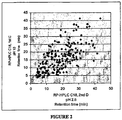
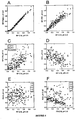
- Figures 1 - 3 The results of these studies are shown in Figures 1 - 3 .
- SCX separation (as described above) in one chromatographic dimension was compared to RP-HPLC on an AtlantisTM C 18 column.
- the key in Figure 1 indicates the charge state of the peptide.
- RP-HPLC in one dimension (pH 2.6, Atlantis column, as described above) was compared to RP-HPLC on an Xterra MS C18 column at pH 10.
- Figure 3 HILIC separation in one dimension was compared to RP-HPLC on an AtlantisTM C 18 column at pH 2.6.
- HILIC and RP modes are highly efficient separation modes, suitable for analysis of peptides of broad range of hydrophobicity.
- the mobile phases used, including any additives can be selected to be volatile, so the separation dimensions are interchangeable and are compatible with mass spectrometric analysis.
- the SEC combined with RP also offers good orthogonality (results not shown), however, the low SEC peak capacity makes this separation dimension less attractive (at least for peptides). Because of the limited efficiency of SEC, we connected three columns in series to enhance the peak capacity and recorded the retention data. The residual interaction of relatively hydrophobic peptides with the sorbent was minimized by addition of 20% acetonitrile and 40 mM NH 4 FA buffer, pH 4.5 into a mobile phase. However, some secondary interaction still prevailed, limiting the recovery of larger peptides, and affecting the overall selectivity of separation. Only a loose correlation between size of the peptides and their SEC retention was observed.
- HILIC mode was also evaluated for peptide separation. Only a few reports have been published for peptide separation in HILC mode, mostly using polyaspartate or amide sorbents. We have utilized a HILIC column packed with bare silica sorbent; both peptide peak shapes and recovery were good. No precipitation was observed when dissolving peptide samples in 70% acetonitrile prior to injection. Some correlation between peptide charge and their HILIC retention suggests that the retention mechanism includes both partitioning and ionic interaction (e.g., due to the charged silanols). Therefore, the separation selectivity partially resembles the peptide retention in SCX mode. The high degree of HILIC-RP system orthogonality makes it a promising approach for 2D-LC.
- SCX sorbents were investigated in greater detail. Elution in SCX mode is usually accomplished with a gradient of NaCl, which makes this mode incompatible with MS detection. Both off-line and on-line 2D-LC-MS setups usually rely on sample desalting, often realized via RP trapping columns. Previously published reports indicate that available SCX sorbents exhibit a secondary (hydrophobic) interaction, which reduces the recovery of hydrophobic peptides. It has been suggested that addition of organic solvents in a mobile phase improves the peak shape and peptide recovery. However, even with 25% acetonitrile in the mobile phases we observed lower number of peptides than expected. Therefore, we investigated alternative mobile phases and direct MS detection.
- the mobile phase was prepared from volatile buffer, namely 400 mM ammonium hydroxide titrated to pH 3.25 with FA.
- the final concentration of FA was approximately 1.3 M (5% FA). Since the pK a of FA is 3.75, the pH of buffer (0.5 pH unit lower) insures that only 25% of FA is de-protonated, bringing the concentration of [H + ] to 325 mM. Together with the ammonium cation, the total cation strength of this buffer adds to 725 mM.
- the gradient from 10 to 75% of buffer (72.5 to 543.75 mM) successfully eluted all desirable peptides up to 5+ charge.
- the MS signal was not dramatically suppressed; on-line LC-MS detection was possible.
- the average peak width is typically 0.5 minute at the baseline; 2.5 minute fractions (5 peak widths) were collected, and partially evaporated in order to reduce the acetonitrile and ammonium hydroxide content.
- the final volume of fractions was 10 ⁇ l; 1 ⁇ l was injected into a second LC-MS dimension using 150 ⁇ 0.3 mm, 3.5 ⁇ m BEH C18 capillary column.
- the peptides eluting earlier in the first LC dimension tend to elute earlier in the second dimension as well.
- the peptides collected in later fractions elute later in the second separation dimension.
- the orthogonality of separation appears to be good, especially when considering that the same type of C18 sorbent was used for the first and second dimension, thus the orthogonality is generated solely via the pH effect.
- the gradient delay of the capillary LC system used was approximately 13 minutes; this specific time is not populated by the peaks. Few if any tryptic peptides elute beyond 43 minutes, making the useful separation window only 30 minutes wide. Most collected fractions eluting peptides cover 50-70% of the useful LC-MS time. Adjustment of the gradient starting strength and span for early, medium and later collected fractions can potentially spread the peptides over the separation space more evenly.
- Peptides pI values represent the pH at which the molecule net charge is equal to zero.
- the pI is a sum of contributions of many ionizable amino acids, such as basic arginine (pKa 12.5), lysine (pKa 10.2), histidine (pKa 6.45), terminal amino group NH 2 (pKa 7.6), acidic amino acids such as aspartic acid (pKa 3.95), glutamic acid (pKa 4.45), tyrosine (pKa 9.8), and terminal COOH group (pKa 3.6).
- Even "neutral" peptides in pI range 5.5-7.5 should be affected by pH, since at least some of the ionizable groups will be differently charged/discharged at separation conditions (pH 2.6 or 10).
Landscapes
- Chemical & Material Sciences (AREA)
- Analytical Chemistry (AREA)
- Chemical Kinetics & Catalysis (AREA)
- Other Investigation Or Analysis Of Materials By Electrical Means (AREA)
- Organic Low-Molecular-Weight Compounds And Preparation Thereof (AREA)
- Treatment Of Liquids With Adsorbents In General (AREA)
- Investigating Or Analysing Biological Materials (AREA)
- Peptides Or Proteins (AREA)
- Sampling And Sample Adjustment (AREA)
Claims (20)
- Un procédé destiné à l'analyse d'un échantillon contenant au moins un analyte, le procédé comprenant les étapes consistant à :a) soumettre l'échantillon à un premier mode de séparation par chromatographie liquide à un premier pH avec une première phase mobile ;b) collecter au moins une fraction provenant de la première séparation chromatographique ;c) soumettre la au moins une fraction à un deuxième mode de séparation par chromatographie liquide à un deuxième pH avec une deuxième phase mobile ; etd) détecter la présence ou l'absence du au moins un analyte dans l'échantillon ;dans lequel le premier pH et le deuxième pH sont différents ;
dans lequel le pH d'une phase mobile de mode de séparation chromatographique est entre 2 et 5, tandis que le pH d'une autre phase mobile de mode de séparation chromatographique est supérieur d'au moins 3 unités pH ; et
dans lequel le premier et le deuxième modes de séparation chromatographique liquide sont les mêmes et comprennent une CLPH en phase inversée (PI). - Un procédé destiné à séparer une pluralité d'analytes dans un échantillon, le procédé comprenant les étapes consistant à :a) soumettre au moins une portion de l'échantillon à un premier mode de séparation par chromatographie liquide à un premier pH ;b) collecter au moins une fraction provenant de la première séparation chromatographique ; etc) soumettre la au moins une fraction à un deuxième mode de séparation par chromatographie liquide à un deuxième pH, dans des conditions telles qu'au moins deux analytes dans l'échantillon sont séparés ;dans lequel le premier pH et le deuxième pH sont différents ;
dans lequel le pH d'une phase mobile de mode de séparation chromatographique est entre 2 et 5, tandis que le pH d'une autre phase mobile de mode de séparation chromatographique est supérieur d'au moins 3 unités pH ; et dans lequel le premier et le deuxième modes de séparation chromatographique liquide sont les mêmes et comprennent une CLPH-PI. - Le procédé de la revendication 1 ou 2, dans lequel la première et la deuxième séparations chromatographiques sont substantiellement orthogonales l'une par rapport à l'autre.
- Le procédé de la revendication 1 ou 2, dans lequel le premier mode de séparation chromatographique a une capacité de pic d'au moins 100 pics.
- Le procédé de la revendication 1 ou 2, dans lequel le au moins un analyte est un peptide, un polypeptide ou une protéine.
- Le procédé de la revendication 1 ou 2, dans lequel le au moins un analyte est une petite molécule organique.
- Le procédé de la revendication 1 ou 2, dans lequel l'échantillon contient au moins 1000 analytes.
- Le procédé de la revendication 1 ou 2, dans lequel la capacité totale de pics du procédé est d'au moins 1000 pics.
- Le procédé de la revendication 1 ou 2, dans lequel la séparation par CLPH est exécutée au moyen d'une colonne à microbilles, d'une colonne capillaire ou d'une nanocolonne.
- Le procédé de la revendication 1 ou 2, dans lequel la au moins une fraction collectée en étape b) est concentrée ou diluée avant que la au moins une fraction soit soumise au deuxième mode de séparation chromatographique.
- Le procédé de la revendication 10, dans lequel la au moins une fraction est concentrée par évaporation.
- Le procédé de la revendication 10, dans lequel la au moins une fraction collectée en étape b) est diluée en ligne avant l'exécution du deuxième mode de séparation chromatographique.
- Le procédé de la revendication 1 ou 2, dans lequel l'étape de détection est réalisée au moyen d'une spectrométrie de masse.
- Le procédé de la revendication 1 ou 2, dans lequel la première et/ou la deuxième phase mobile est substantiellement exempte de sels non-volatils.
- Le procédé de la revendication 1 ou 2, dans lequel la première et/ou la deuxième phase mobile comprend moins d'environ 20 mM de sels non-volatils.
- Le procédé de la revendication 1 ou 2, dans lequel une pluralité de portions sont recueillies et soumises à la deuxième séparation chromatographique.
- Procédé destiné à la caractérisation d'un échantillon contenant une pluralité de polypeptides dans un système de chromatographie liquide multidimensionnelle, le procédé comprenant les étapes consistant à :a) injecter l'échantillon dans un appareil de chromatographie selon une première dimension dudit système de chromatographie liquide multidimensionnelle ;b) séparer par voie chromatographique au moins un premier composant polypeptidique dudit échantillon d'avec au moins un deuxième polypeptide dudit échantillon dans une colonne de chromatographie dudit appareil de chromatographie selon une première dimension utilisant une première phase mobile ;c) éluer lesdits premier et deuxième composants polypeptidiques séparés dans un éluant à partir de ladite colonne de chromatographie ;d) échantillonner au moins un volume discret dudit éluant ;e) injecter ledit au moins un volume discret dans un appareil de chromatographie selon une deuxième dimension dudit système de chromatographie liquide multidimensionnelle ;f) soumettre le volume discret injecté à une séparation chromatographique dans une colonne de chromatographie dudit appareil de chromatographie selon une deuxième dimension avec utilisation d'une deuxième phase mobile ;g) caractériser un éluant à partir de ladite colonne de chromatographie dudit appareil de chromatographie selon une deuxième dimension avec utilisation d'une spectroscopie de masse, caractérisant ainsi l'échantillon contenant une pluralité de polypeptides ;dans lequel le pH d'une phase mobile de mode de séparation chromatographique est entre 2 et 5, tandis que le pH d'une autre phase mobile de mode de séparation chromatographique est supérieur d'au moins 3 unités pH ; et
dans lequel le mode des appareils de séparation chromatographique selon une première et une deuxième dimension est le même et comprend une CLPH-PI - Le procédé de la revendication 17, dans lequel le système de chromatographie liquide multidimensionnelle est un système de chromatographie liquide bidimensionnelle.
- Un procédé destiné à la purification d'un composé dans un échantillon contenant le composé et au moins deux impuretés, le procédé comprenant les étapes consistant à :a) soumettre l'échantillon à un premier mode de séparation par chromatographie liquide à un premier pH, dans des conditions telles que le composé est séparé d'une première impureté ;b) collecter au moins une fraction contenant du composé provenant de la première séparation chromatographique ;c) soumettre la au moins une fraction contenant du composé à un deuxième mode de séparation par chromatographie liquide à un deuxième pH, dans des conditions telles que le composé est séparé d'une deuxième impureté ; etd) collecter le composé purifié ;dans lequel le premier pH et le deuxième pH sont différents ;
dans lequel le pH d'une phase mobile de mode de séparation chromatographique est entre 2 et 5, tandis que le pH d'une autre phase mobile de mode de séparation chromatographique est supérieur d'au moins 3 unités pH ; et
dans lequel le premier et le deuxième modes de séparation chromatographique sont les mêmes et comprennent une CLPH-PI - Le procédé de n'importe quelle revendication 1 à 19, dans lequel le pH de la première phase mobile de mode de séparation chromatographique est entre 2,5 et 5, tandis que le pH de la deuxième phase mobile de mode de séparation chromatographique est d'au moins 5,5.
Priority Applications (2)
| Application Number | Priority Date | Filing Date | Title |
|---|---|---|---|
| EP21162750.0A EP3885018A1 (fr) | 2005-01-20 | 2006-01-20 | Procédés de séparation de composés |
| EP15168031.1A EP2937126B1 (fr) | 2005-01-20 | 2006-01-20 | Procédés de séparation de composés |
Applications Claiming Priority (5)
| Application Number | Priority Date | Filing Date | Title |
|---|---|---|---|
| US64581005P | 2005-01-20 | 2005-01-20 | |
| US65584005P | 2005-02-23 | 2005-02-23 | |
| US68626805P | 2005-05-31 | 2005-05-31 | |
| EP06718965.4A EP1871503B2 (fr) | 2005-01-20 | 2006-01-20 | Procedes de separation de composes |
| PCT/US2006/001968 WO2006078859A2 (fr) | 2005-01-20 | 2006-01-20 | Procedes de separation de composes |
Related Parent Applications (2)
| Application Number | Title | Priority Date | Filing Date |
|---|---|---|---|
| EP06718965.4A Division EP1871503B2 (fr) | 2005-01-20 | 2006-01-20 | Procedes de separation de composes |
| EP06718965.4A Division-Into EP1871503B2 (fr) | 2005-01-20 | 2006-01-20 | Procedes de separation de composes |
Related Child Applications (3)
| Application Number | Title | Priority Date | Filing Date |
|---|---|---|---|
| EP21162750.0A Division EP3885018A1 (fr) | 2005-01-20 | 2006-01-20 | Procédés de séparation de composés |
| EP15168031.1A Division-Into EP2937126B1 (fr) | 2005-01-20 | 2006-01-20 | Procédés de séparation de composés |
| EP15168031.1A Division EP2937126B1 (fr) | 2005-01-20 | 2006-01-20 | Procédés de séparation de composés |
Publications (2)
| Publication Number | Publication Date |
|---|---|
| EP2491993A1 EP2491993A1 (fr) | 2012-08-29 |
| EP2491993B1 true EP2491993B1 (fr) | 2018-10-03 |
Family
ID=36692888
Family Applications (4)
| Application Number | Title | Priority Date | Filing Date |
|---|---|---|---|
| EP06718965.4A Ceased EP1871503B2 (fr) | 2005-01-20 | 2006-01-20 | Procedes de separation de composes |
| EP15168031.1A Ceased EP2937126B1 (fr) | 2005-01-20 | 2006-01-20 | Procédés de séparation de composés |
| EP12004053.0A Revoked EP2491993B1 (fr) | 2005-01-20 | 2006-01-20 | Procédés de séparation de composés |
| EP21162750.0A Withdrawn EP3885018A1 (fr) | 2005-01-20 | 2006-01-20 | Procédés de séparation de composés |
Family Applications Before (2)
| Application Number | Title | Priority Date | Filing Date |
|---|---|---|---|
| EP06718965.4A Ceased EP1871503B2 (fr) | 2005-01-20 | 2006-01-20 | Procedes de separation de composes |
| EP15168031.1A Ceased EP2937126B1 (fr) | 2005-01-20 | 2006-01-20 | Procédés de séparation de composés |
Family Applications After (1)
| Application Number | Title | Priority Date | Filing Date |
|---|---|---|---|
| EP21162750.0A Withdrawn EP3885018A1 (fr) | 2005-01-20 | 2006-01-20 | Procédés de séparation de composés |
Country Status (4)
| Country | Link |
|---|---|
| US (2) | US8123949B2 (fr) |
| EP (4) | EP1871503B2 (fr) |
| JP (1) | JP5063361B2 (fr) |
| WO (1) | WO2006078859A2 (fr) |
Cited By (2)
| Publication number | Priority date | Publication date | Assignee | Title |
|---|---|---|---|---|
| US20220065827A1 (en) * | 2020-08-26 | 2022-03-03 | Agilent Technologies, Inc. | Multi-dimensional liquid chromotography with second dimension having a variable flow rate |
| US20220266169A1 (en) * | 2019-04-23 | 2022-08-25 | Rensselaer Polytechnic Institute | Product agnostic tool for quantifying separability and orthogonality for individual and sequential separation processes |
Families Citing this family (31)
| Publication number | Priority date | Publication date | Assignee | Title |
|---|---|---|---|---|
| EP1871503B2 (fr) | 2005-01-20 | 2025-04-23 | Waters Technologies Corporation | Procedes de separation de composes |
| US8168440B2 (en) | 2006-03-28 | 2012-05-01 | Georgia State University | Polymeric sulfated surfactants for capillary electrophoresis (CE) and CE-mass spectrometry (CE-MS) |
| US20080220532A1 (en) * | 2007-03-08 | 2008-09-11 | Polylc Inc. | Separation of Charged Solutes by Electrostatic Repulsion-Hydrophilic Interaction Chromatography |
| JP2010527452A (ja) * | 2007-05-15 | 2010-08-12 | ウオーターズ・テクノロジーズ・コーポレイシヨン | 血漿メタネフリンを検出するための装置および方法 |
| WO2008150763A1 (fr) * | 2007-05-29 | 2008-12-11 | Waters Investments Limited | Appareil et procédés pour analyse multidimensionnelle |
| US7823439B2 (en) | 2007-11-15 | 2010-11-02 | Midwest Research Institute | Method for identifying the composition of a sample |
| TWI355491B (en) * | 2007-12-07 | 2012-01-01 | Anchor Res & Consultation Co Ltd | Method for ingredient analysis |
| EP2247933B1 (fr) * | 2008-02-25 | 2019-11-06 | Waters Technologies Corporation | Procédés pour la détermination de la présence et de la quantité d'analogues de vitamine d dans des échantillons |
| JP5624709B2 (ja) * | 2008-03-13 | 2014-11-12 | 大日本住友製薬株式会社 | 内因性代謝物の分析方法 |
| JP5119053B2 (ja) * | 2008-06-06 | 2013-01-16 | 株式会社日立ハイテクノロジーズ | 生体試料分離方法,生体試料検出方法,生体試料分離システム及び生体試料分離・検出システム |
| CN102150041B (zh) | 2008-09-08 | 2014-07-09 | 安捷伦科技有限公司 | 考虑到偏离理想行为的流体设备之间的方法转化 |
| CA2736479A1 (fr) * | 2008-09-09 | 2010-03-18 | De Staat Der Nederlanden, Vert. Door De Minister Van Vws | Technologie lcms et ses utilisations |
| WO2010080494A1 (fr) * | 2008-12-19 | 2010-07-15 | Tercica, Inc. | Procédés d'identification de produits de dégradation dans un échantillon polypeptidique. |
| US9527010B2 (en) | 2009-09-25 | 2016-12-27 | Ge Healthcare Bio-Sciences Corp. | Separation system and method |
| SG191186A1 (en) | 2010-12-15 | 2013-07-31 | Baxter Int | Eluate collection using conductivity gradient |
| GB2486650B (en) * | 2010-12-21 | 2019-01-30 | Agilent Technologies Inc | Two-dimensional liquid chromatography with control of injection in relation to a state of a reciprocating pump of the second dimension |
| US8716025B2 (en) * | 2011-07-08 | 2014-05-06 | Agilent Technologies, Inc. | Drifting two-dimensional separation with adaption of second dimension gradient to actual first dimension condition |
| US9404900B2 (en) | 2012-12-21 | 2016-08-02 | Thermo Finnigan Llc | System for analysis of phase-I and phase-II metabolites and parent compounds without hydrolysis |
| US10542918B2 (en) | 2013-10-23 | 2020-01-28 | Verily Life Sciences Llc | Modulation of a response signal to distinguish between analyte and background signals |
| US9874554B1 (en) | 2014-07-16 | 2018-01-23 | Verily Life Sciences Llc | Aptamer-based in vivo diagnostic system |
| US9820690B1 (en) | 2014-07-16 | 2017-11-21 | Verily Life Sciences Llc | Analyte detection system |
| US9910035B1 (en) | 2014-07-16 | 2018-03-06 | Verily Life Sciences Llc | Polyvalent functionalized nanoparticle-based in vivo diagnostic system |
| US20170328872A1 (en) * | 2014-11-21 | 2017-11-16 | Waters Technologies Corporation | Chromatographic separation device having improved peak capacity |
| KR101725948B1 (ko) * | 2014-12-01 | 2017-04-11 | 주식회사 엘지화학 | 이온성 계면활성제 분리방법 및 분리 시스템 |
| GB2533162A (en) * | 2014-12-12 | 2016-06-15 | Agilent Technologies Inc | Uninterrupted fluid flow while modulating fluid |
| EP3234585B1 (fr) | 2014-12-17 | 2022-11-02 | Waters Technologies Corporation | Dispositif pour une extraction de phase solide |
| JP2018508793A (ja) * | 2015-02-09 | 2018-03-29 | マックス−プランク−ゲゼルシャフト・ツア・フェルデルング・デア・ヴィッセンシャフテン・エー・ファオ | クロマトグラフィー適用におけるスウェプトボリュームおよびデッドボリュームを最小限にするための手段および方法 |
| EP3115369A1 (fr) * | 2015-07-09 | 2017-01-11 | Max-Planck-Gesellschaft zur Förderung der Wissenschaften e.V. | Purification de peptides utilisant un matériau d'extraction en phase solide à phase mixte |
| CN114354798B (zh) * | 2021-12-30 | 2024-12-24 | 广电计量检测(无锡)有限公司 | 一种基于二维色谱分离测定肽类产品中游离氨基酸的方法及其应用 |
| CN114307252B (zh) * | 2021-12-30 | 2022-09-20 | 南京工业大学 | 一种利用准二维色谱法分离糖和酸的工艺 |
| CN117074588B (zh) * | 2023-08-23 | 2025-11-04 | 博莱克科技(武汉)有限公司 | 一种同时检测多种胆碱代谢物的方法 |
Citations (4)
| Publication number | Priority date | Publication date | Assignee | Title |
|---|---|---|---|---|
| US5658739A (en) | 1994-05-10 | 1997-08-19 | The Regents Of The University Of California | Method for characterization of the fine structure of protein binding sites |
| WO2002050531A2 (fr) | 2000-11-21 | 2002-06-27 | Waters Investments Limited | Schema de dilution de phase mobile pour chromatographie optimisee |
| US20040124128A1 (en) | 2002-12-25 | 2004-07-01 | Yosuke Iwata | Liquid chromatograph |
| US6802967B2 (en) | 2002-03-06 | 2004-10-12 | Shimadzu Corporation | Multi-dimension liquid chromatography separation system |
Family Cites Families (12)
| Publication number | Priority date | Publication date | Assignee | Title |
|---|---|---|---|---|
| US4872992A (en) * | 1987-12-09 | 1989-10-10 | Atlantic Richfield Company | Method and apparatus for analyzing diluted and undiluted fluid samples |
| US5398539A (en) * | 1993-08-02 | 1995-03-21 | Hewlett-Packard Company | Correlated multi-dimensional chromatography with confirmatory hybrid run |
| US7176298B2 (en) * | 1998-09-25 | 2007-02-13 | Clontech Laboratories, Inc. | Polynucleotides encoding metal ion affinity peptides and related products |
| US20040180415A1 (en) * | 2001-05-15 | 2004-09-16 | Tchaga Grigoriy S. | Methods and compositions for protein purification |
| WO2003021251A1 (fr) | 2001-08-28 | 2003-03-13 | Symyx Technologies, Inc. | Procede de caracterisation de polymeres a moyen d'une chromatographie liquide multidimensionnelle |
| JP2003149218A (ja) | 2001-11-08 | 2003-05-21 | Nano Solution:Kk | 2次元高速液体クロマトグラフ装置及びそれを用いた蛋白質分析装置 |
| US20040033591A1 (en) * | 2002-05-31 | 2004-02-19 | The Regents Of The University Of Michigan | Automated protein analysis system |
| JP4447851B2 (ja) * | 2003-05-29 | 2010-04-07 | 株式会社島津製作所 | 液体クロマトグラフ装置 |
| US7125492B2 (en) * | 2003-07-17 | 2006-10-24 | Agilent Technologies, Inc. | Additives for reversed-phase HPLC mobile phases |
| EP1871503B2 (fr) | 2005-01-20 | 2025-04-23 | Waters Technologies Corporation | Procedes de separation de composes |
| US20100300971A1 (en) * | 2005-05-18 | 2010-12-02 | Sequant Ab | Zwitterionic stationary phase as well as method for using and producing said phase |
| WO2007016971A1 (fr) * | 2005-07-25 | 2007-02-15 | Agilent Technologies, Inc. | Analyse fluidique comportant le piegeage de composes hydrophobes et hydrophiles |
-
2006
- 2006-01-20 EP EP06718965.4A patent/EP1871503B2/fr not_active Ceased
- 2006-01-20 EP EP15168031.1A patent/EP2937126B1/fr not_active Ceased
- 2006-01-20 EP EP12004053.0A patent/EP2491993B1/fr not_active Revoked
- 2006-01-20 US US11/795,650 patent/US8123949B2/en active Active
- 2006-01-20 JP JP2007552275A patent/JP5063361B2/ja not_active Expired - Fee Related
- 2006-01-20 WO PCT/US2006/001968 patent/WO2006078859A2/fr not_active Ceased
- 2006-01-20 EP EP21162750.0A patent/EP3885018A1/fr not_active Withdrawn
-
2012
- 2012-02-28 US US13/406,746 patent/US20120153137A1/en not_active Abandoned
Patent Citations (4)
| Publication number | Priority date | Publication date | Assignee | Title |
|---|---|---|---|---|
| US5658739A (en) | 1994-05-10 | 1997-08-19 | The Regents Of The University Of California | Method for characterization of the fine structure of protein binding sites |
| WO2002050531A2 (fr) | 2000-11-21 | 2002-06-27 | Waters Investments Limited | Schema de dilution de phase mobile pour chromatographie optimisee |
| US6802967B2 (en) | 2002-03-06 | 2004-10-12 | Shimadzu Corporation | Multi-dimension liquid chromatography separation system |
| US20040124128A1 (en) | 2002-12-25 | 2004-07-01 | Yosuke Iwata | Liquid chromatograph |
Non-Patent Citations (13)
| Title |
|---|
| DOLAN: "A Guide to HPLC and LC-MS Buffer Selection", ACE HPLC COLUMNS, pages 1 - 20 |
| GILAR ET AL.: "Orthogonality of Separation in Two-Dimensional Liquid Chromatography", ANAL. CHEM, vol. 77, 2005, pages 6426 - 6434, XP055620103 |
| GILAR ET AL.: "Two-dimensional separation of peptides using RP-RP-HPLC- system with different pH in first and second separation dimensions", J. SEP. SCI., vol. 28, 2005, pages 1694 - 1703, XP008144253, doi:10.1002/jssc.200500116 |
| GUO ET AL.: "Prediction of Peptide Retention Times in Reversed-Phase High- Performance Liquid Chromatography", JOURNAL OF CHROMATOGRAPHY, vol. 359, 1986, pages 499 - 517, XP009032750, doi:10.1016/0021-9673(86)80102-9 |
| LINDNER ET AL.: "Application of hydrophilic-interaction liquid chromatography to the separation of phosphorylated H1 histones", J. CHROMATOGR. A, vol. 782, 1997, pages 55 - 62, XP004096293, doi:10.1016/S0021-9673(97)00468-8 |
| MARTIN GILAR ET AL: "Two-Dimensional Separation of Peptides Using RP-RP-HPLC System with Different pH in First and Second Separation Dimensions", JOURNAL OF SEPARATION SCIENCE, WILEY, DE, vol. 28, no. 24, 1 September 2005 (2005-09-01), pages 1694 - 1703, XP008144253, ISSN: 1615-9306, DOI: 10.1002/JSSC.200500116 * |
| MORITZ ET AL.: "High-Speed Chromatographic Separation of Proteins and Peptides for High Sensitivity Microsequence Analysis", METHODS IN PROTEIN STRUCTURE ANALYSIS, 1995, New York, pages 27 - 38, XP055620083 |
| OPITECK ET AL.: "Comprehensive Two-Dimensional High-Performance Liquid Chromatography for the Isolation of Overexpressed Proteins and Proteome Mapping", ANALYTICAL BIOCHEMISTRY, vol. 258, 1998, pages 349 - 361, XP000960771, doi:10.1006/abio.1998.2588 |
| PALIWAL ET AL.: "Rapid Separations of Proteins by Liquid Chromatography", METHODS IN ENZYMOLOGY, vol. 270, 1996, pages 133 - 151, XP055620091 |
| PAUL RAINVILLE ET AL.: "The Influence of pH on Elution Order of Tryptic Peptides on Reversed-Phase Columns: A Unique Approach to Multidimensional Liquid Chromatography Separations for Proteomics", ASMS, 2002, pages 1, XP055550807 |
| PAUL RAINVILLE ET AL.: "The influence of pH on elution order of tryptic peptides on reversed-phase columns: A unique approach to multidimensional liquid chromatograpic separations for proteomics", WATERS CORPORATION, 2002, ASMS, Orlando, Florida, XP055550807, Retrieved from the Internet <URL:http://www.waters.com/webassets/cms/library/docs/wa20271.pdf> |
| VAN GYSEGHEM ET AL.: "Determining orthogonal chromatographic systems prior to the development of methods to characzterise impurities in drug substances", J. CHROMATOGR. A, vol. 988, 2003, pages 77 - 93, XP004405865, doi:10.1016/S0021-9673(02)02012-5 |
| WAGNER ET AL.: "An Automated On-Line Multidimensional HPLC System for Protein and Peptide Mapping with Integrated Sample Preparation", ANAL. CHEM., vol. 74, 2002, pages 809 - 820, XP001115830, doi:10.1021/ac010627f |
Cited By (3)
| Publication number | Priority date | Publication date | Assignee | Title |
|---|---|---|---|---|
| US20220266169A1 (en) * | 2019-04-23 | 2022-08-25 | Rensselaer Polytechnic Institute | Product agnostic tool for quantifying separability and orthogonality for individual and sequential separation processes |
| US20220065827A1 (en) * | 2020-08-26 | 2022-03-03 | Agilent Technologies, Inc. | Multi-dimensional liquid chromotography with second dimension having a variable flow rate |
| US11808742B2 (en) * | 2020-08-26 | 2023-11-07 | Agilent Technologies, Inc. | Multi-dimensional liquid chromatography with second dimension having a variable flow rate |
Also Published As
| Publication number | Publication date |
|---|---|
| US8123949B2 (en) | 2012-02-28 |
| EP2937126A1 (fr) | 2015-10-28 |
| WO2006078859A2 (fr) | 2006-07-27 |
| US20120153137A1 (en) | 2012-06-21 |
| EP1871503B2 (fr) | 2025-04-23 |
| EP1871503B1 (fr) | 2014-03-12 |
| WO2006078859A3 (fr) | 2009-05-14 |
| JP2008537994A (ja) | 2008-10-02 |
| EP1871503A2 (fr) | 2008-01-02 |
| EP2937126B1 (fr) | 2021-03-17 |
| US20090126466A1 (en) | 2009-05-21 |
| JP5063361B2 (ja) | 2012-10-31 |
| EP2491993A1 (fr) | 2012-08-29 |
| EP3885018A1 (fr) | 2021-09-29 |
| EP1871503A4 (fr) | 2010-03-17 |
Similar Documents
| Publication | Publication Date | Title |
|---|---|---|
| EP2491993B1 (fr) | Procédés de séparation de composés | |
| Lavén et al. | Serial mixed-mode cation-and anion-exchange solid-phase extraction for separation of basic, neutral and acidic pharmaceuticals in wastewater and analysis by high-performance liquid chromatography–quadrupole time-of-flight mass spectrometry | |
| Gilar et al. | Two‐dimensional separation of peptides using RP‐RP‐HPLC system with different pH in first and second separation dimensions | |
| US10317377B2 (en) | Monolithic column chromatography | |
| WO2009070233A1 (fr) | Etalons internes et procédés destinés à être utilisés pour mesurer quantitativement des analytes dans un échantillon | |
| Pleasance et al. | Ionspray mass spectrometry of marine toxins. III. Analysis of paralytic shellfish poisoning toxins by flow‐injection analysis, liquid chromatography/mass spectrometry and capillary electrophoresis/mass spectrometry | |
| US20090145203A1 (en) | Plugged flow 2d chromatography | |
| Bruins et al. | On-line coupling of solid-phase extraction with mass spectrometry for the analysis of biological samples: I. Determination of clenbuterol in urine | |
| Periat et al. | Systematic evaluation of matrix effects in hydrophilic interaction chromatography versus reversed phase liquid chromatography coupled to mass spectrometry | |
| Giusti et al. | Selenopeptide mapping in a selenium–yeast protein digest by parallel nanoHPLC-ICP-MS and nanoHPLC-electrospray-MS/MS after on-line preconcentration | |
| WO2014195662A1 (fr) | Systèmes et procédés de séparation et d'analyse | |
| Masuda et al. | Fully automated micro-and nanoscale one-or two-dimensional high-performance liquid chromatography system for liquid chromatography–mass spectrometry compatible with non-volatile salts for ion exchange chromatography | |
| Hu et al. | Analysis of the endogenous human serum peptides by on-line extraction with restricted-access material and HPLC-MS/MS identification | |
| US20030141253A1 (en) | Apparatus for efficient liquid chromatography/mass spectrometry processing | |
| US5968361A (en) | Rapid method for separation of small molecules using reverse phase high performance liquid chromatography | |
| JP2008292456A (ja) | 静電的反発作用−親水性相互作用クロマトグラフィーによる帯電溶質の分離 | |
| Aguilar et al. | Determination of pesticides by on-line trace enrichment-reversed-phase liquid chromatography-diode-array detection and confirmation by particle-beam mass spectrometry | |
| Thamizhanban et al. | A review on hyphenated separation techniques used in pharmaceutical analysis | |
| Jong et al. | Investigation of on-line reversed-phase liquid chromatography–gas chromatography–mass spectrometry as a tool for the identification of impurities in drug substances | |
| Walther et al. | Method transfer from ion pair chromatography to charged aerosol detector-compatible mixed-mode chromatography: A case study using carbocisteine | |
| Sandra et al. | Considerations on column selection and operating conditions for LC–MS | |
| Hogendoorn et al. | The Versatility of Coupled-Column LC. | |
| Stry et al. | Coupling of size-exclusion chromatography to liquid chromatography/mass spectrometry for determination of trace levels of thifensulfuron-methyl and tribenuron-methyl in cottonseed and cotton gin trash | |
| Buckenmaier et al. | Method Development for Non-Comprehensive Two-Dimensional Liquid Chromatography | |
| Brinkman | Multidimensional gas and liquid chromatographic approaches to trace-level environmental analysis |
Legal Events
| Date | Code | Title | Description |
|---|---|---|---|
| PUAI | Public reference made under article 153(3) epc to a published international application that has entered the european phase |
Free format text: ORIGINAL CODE: 0009012 |
|
| AC | Divisional application: reference to earlier application |
Ref document number: 1871503 Country of ref document: EP Kind code of ref document: P |
|
| AK | Designated contracting states |
Kind code of ref document: A1 Designated state(s): DE FR GB |
|
| 17P | Request for examination filed |
Effective date: 20130228 |
|
| 17Q | First examination report despatched |
Effective date: 20140225 |
|
| TPAC | Observations filed by third parties |
Free format text: ORIGINAL CODE: EPIDOSNTIPA |
|
| STAA | Information on the status of an ep patent application or granted ep patent |
Free format text: STATUS: EXAMINATION IS IN PROGRESS |
|
| REG | Reference to a national code |
Ref country code: DE Ref legal event code: R079 Ref document number: 602006056519 Country of ref document: DE Free format text: PREVIOUS MAIN CLASS: B01D0015080000 Ipc: B01D0015180000 |
|
| RIC1 | Information provided on ipc code assigned before grant |
Ipc: B01D 15/32 20060101ALI20180302BHEP Ipc: B01D 15/18 20060101AFI20180302BHEP |
|
| GRAP | Despatch of communication of intention to grant a patent |
Free format text: ORIGINAL CODE: EPIDOSNIGR1 |
|
| STAA | Information on the status of an ep patent application or granted ep patent |
Free format text: STATUS: GRANT OF PATENT IS INTENDED |
|
| INTG | Intention to grant announced |
Effective date: 20180418 |
|
| GRAS | Grant fee paid |
Free format text: ORIGINAL CODE: EPIDOSNIGR3 |
|
| GRAA | (expected) grant |
Free format text: ORIGINAL CODE: 0009210 |
|
| STAA | Information on the status of an ep patent application or granted ep patent |
Free format text: STATUS: THE PATENT HAS BEEN GRANTED |
|
| AC | Divisional application: reference to earlier application |
Ref document number: 1871503 Country of ref document: EP Kind code of ref document: P |
|
| AK | Designated contracting states |
Kind code of ref document: B1 Designated state(s): DE FR GB |
|
| REG | Reference to a national code |
Ref country code: GB Ref legal event code: FG4D |
|
| REG | Reference to a national code |
Ref country code: DE Ref legal event code: R096 Ref document number: 602006056519 Country of ref document: DE |
|
| REG | Reference to a national code |
Ref country code: DE Ref legal event code: R026 Ref document number: 602006056519 Country of ref document: DE |
|
| PLBI | Opposition filed |
Free format text: ORIGINAL CODE: 0009260 |
|
| PLAX | Notice of opposition and request to file observation + time limit sent |
Free format text: ORIGINAL CODE: EPIDOSNOBS2 |
|
| 26 | Opposition filed |
Opponent name: AGILENT TECHNOLOGIES, INC. -A DELAWARE CORPORATION Effective date: 20190702 |
|
| PG25 | Lapsed in a contracting state [announced via postgrant information from national office to epo] |
Ref country code: FR Free format text: LAPSE BECAUSE OF NON-PAYMENT OF DUE FEES Effective date: 20190131 |
|
| PLBB | Reply of patent proprietor to notice(s) of opposition received |
Free format text: ORIGINAL CODE: EPIDOSNOBS3 |
|
| RDAF | Communication despatched that patent is revoked |
Free format text: ORIGINAL CODE: EPIDOSNREV1 |
|
| APAH | Appeal reference modified |
Free format text: ORIGINAL CODE: EPIDOSCREFNO |
|
| APBM | Appeal reference recorded |
Free format text: ORIGINAL CODE: EPIDOSNREFNO |
|
| APBP | Date of receipt of notice of appeal recorded |
Free format text: ORIGINAL CODE: EPIDOSNNOA2O |
|
| APAH | Appeal reference modified |
Free format text: ORIGINAL CODE: EPIDOSCREFNO |
|
| APBQ | Date of receipt of statement of grounds of appeal recorded |
Free format text: ORIGINAL CODE: EPIDOSNNOA3O |
|
| PGFP | Annual fee paid to national office [announced via postgrant information from national office to epo] |
Ref country code: GB Payment date: 20211216 Year of fee payment: 17 |
|
| PGFP | Annual fee paid to national office [announced via postgrant information from national office to epo] |
Ref country code: DE Payment date: 20211215 Year of fee payment: 17 |
|
| APBU | Appeal procedure closed |
Free format text: ORIGINAL CODE: EPIDOSNNOA9O |
|
| REG | Reference to a national code |
Ref country code: DE Ref legal event code: R103 Ref document number: 602006056519 Country of ref document: DE Ref country code: DE Ref legal event code: R064 Ref document number: 602006056519 Country of ref document: DE |
|
| RDAG | Patent revoked |
Free format text: ORIGINAL CODE: 0009271 |
|
| STAA | Information on the status of an ep patent application or granted ep patent |
Free format text: STATUS: PATENT REVOKED |
|
| 27W | Patent revoked |
Effective date: 20221021 |
|
| GBPR | Gb: patent revoked under art. 102 of the ep convention designating the uk as contracting state |
Effective date: 20221021 |
|
| REG | Reference to a national code |
Ref country code: DE Ref legal event code: R082 Ref document number: 602006056519 Country of ref document: DE Representative=s name: KUEHR, VERA, DIPL.-BIOL., DE |