EP2492996A2 - Aktives Positivelektrodenmaterial, Lithiumionen-Speichervorrichtung damit und Herstellungsverfahren dafür - Google Patents
Aktives Positivelektrodenmaterial, Lithiumionen-Speichervorrichtung damit und Herstellungsverfahren dafür Download PDFInfo
- Publication number
- EP2492996A2 EP2492996A2 EP12156148A EP12156148A EP2492996A2 EP 2492996 A2 EP2492996 A2 EP 2492996A2 EP 12156148 A EP12156148 A EP 12156148A EP 12156148 A EP12156148 A EP 12156148A EP 2492996 A2 EP2492996 A2 EP 2492996A2
- Authority
- EP
- European Patent Office
- Prior art keywords
- positive electrode
- lithium
- lithium ion
- active material
- electrode active
- Prior art date
- Legal status (The legal status is an assumption and is not a legal conclusion. Google has not performed a legal analysis and makes no representation as to the accuracy of the status listed.)
- Withdrawn
Links
Images
Classifications
-
- H—ELECTRICITY
- H01—ELECTRIC ELEMENTS
- H01M—PROCESSES OR MEANS, e.g. BATTERIES, FOR THE DIRECT CONVERSION OF CHEMICAL ENERGY INTO ELECTRICAL ENERGY
- H01M4/00—Electrodes
- H01M4/02—Electrodes composed of, or comprising, active material
- H01M4/36—Selection of substances as active materials, active masses, active liquids
- H01M4/48—Selection of substances as active materials, active masses, active liquids of inorganic oxides or hydroxides
-
- H—ELECTRICITY
- H01—ELECTRIC ELEMENTS
- H01M—PROCESSES OR MEANS, e.g. BATTERIES, FOR THE DIRECT CONVERSION OF CHEMICAL ENERGY INTO ELECTRICAL ENERGY
- H01M4/00—Electrodes
- H01M4/02—Electrodes composed of, or comprising, active material
- H01M4/04—Processes of manufacture in general
- H01M4/0402—Methods of deposition of the material
- H01M4/0404—Methods of deposition of the material by coating on electrode collectors
-
- H—ELECTRICITY
- H01—ELECTRIC ELEMENTS
- H01G—CAPACITORS; CAPACITORS, RECTIFIERS, DETECTORS, SWITCHING DEVICES, LIGHT-SENSITIVE OR TEMPERATURE-SENSITIVE DEVICES OF THE ELECTROLYTIC TYPE
- H01G11/00—Hybrid capacitors, i.e. capacitors having different positive and negative electrodes; Electric double-layer [EDL] capacitors; Processes for the manufacture thereof or of parts thereof
- H01G11/22—Electrodes
- H01G11/30—Electrodes characterised by their material
- H01G11/50—Electrodes characterised by their material specially adapted for lithium-ion capacitors, e.g. for lithium-doping or for intercalation
-
- H—ELECTRICITY
- H01—ELECTRIC ELEMENTS
- H01M—PROCESSES OR MEANS, e.g. BATTERIES, FOR THE DIRECT CONVERSION OF CHEMICAL ENERGY INTO ELECTRICAL ENERGY
- H01M10/00—Secondary cells; Manufacture thereof
- H01M10/05—Accumulators with non-aqueous electrolyte
- H01M10/052—Li-accumulators
-
- H—ELECTRICITY
- H01—ELECTRIC ELEMENTS
- H01M—PROCESSES OR MEANS, e.g. BATTERIES, FOR THE DIRECT CONVERSION OF CHEMICAL ENERGY INTO ELECTRICAL ENERGY
- H01M10/00—Secondary cells; Manufacture thereof
- H01M10/05—Accumulators with non-aqueous electrolyte
- H01M10/052—Li-accumulators
- H01M10/0525—Rocking-chair batteries, i.e. batteries with lithium insertion or intercalation in both electrodes; Lithium-ion batteries
-
- H—ELECTRICITY
- H01—ELECTRIC ELEMENTS
- H01M—PROCESSES OR MEANS, e.g. BATTERIES, FOR THE DIRECT CONVERSION OF CHEMICAL ENERGY INTO ELECTRICAL ENERGY
- H01M4/00—Electrodes
- H01M4/02—Electrodes composed of, or comprising, active material
- H01M4/13—Electrodes for accumulators with non-aqueous electrolyte, e.g. for lithium-accumulators; Processes of manufacture thereof
- H01M4/131—Electrodes based on mixed oxides or hydroxides, or on mixtures of oxides or hydroxides, e.g. LiCoOx
-
- H—ELECTRICITY
- H01—ELECTRIC ELEMENTS
- H01M—PROCESSES OR MEANS, e.g. BATTERIES, FOR THE DIRECT CONVERSION OF CHEMICAL ENERGY INTO ELECTRICAL ENERGY
- H01M4/00—Electrodes
- H01M4/02—Electrodes composed of, or comprising, active material
- H01M4/13—Electrodes for accumulators with non-aqueous electrolyte, e.g. for lithium-accumulators; Processes of manufacture thereof
- H01M4/139—Processes of manufacture
-
- H—ELECTRICITY
- H01—ELECTRIC ELEMENTS
- H01M—PROCESSES OR MEANS, e.g. BATTERIES, FOR THE DIRECT CONVERSION OF CHEMICAL ENERGY INTO ELECTRICAL ENERGY
- H01M4/00—Electrodes
- H01M4/02—Electrodes composed of, or comprising, active material
- H01M4/13—Electrodes for accumulators with non-aqueous electrolyte, e.g. for lithium-accumulators; Processes of manufacture thereof
- H01M4/139—Processes of manufacture
- H01M4/1391—Processes of manufacture of electrodes based on mixed oxides or hydroxides, or on mixtures of oxides or hydroxides, e.g. LiCoOx
-
- H—ELECTRICITY
- H01—ELECTRIC ELEMENTS
- H01M—PROCESSES OR MEANS, e.g. BATTERIES, FOR THE DIRECT CONVERSION OF CHEMICAL ENERGY INTO ELECTRICAL ENERGY
- H01M4/00—Electrodes
- H01M4/02—Electrodes composed of, or comprising, active material
- H01M4/36—Selection of substances as active materials, active masses, active liquids
- H01M4/362—Composites
- H01M4/364—Composites as mixtures
-
- H—ELECTRICITY
- H01—ELECTRIC ELEMENTS
- H01M—PROCESSES OR MEANS, e.g. BATTERIES, FOR THE DIRECT CONVERSION OF CHEMICAL ENERGY INTO ELECTRICAL ENERGY
- H01M4/00—Electrodes
- H01M4/02—Electrodes composed of, or comprising, active material
- H01M4/36—Selection of substances as active materials, active masses, active liquids
- H01M4/48—Selection of substances as active materials, active masses, active liquids of inorganic oxides or hydroxides
- H01M4/485—Selection of substances as active materials, active masses, active liquids of inorganic oxides or hydroxides of mixed oxides or hydroxides for inserting or intercalating light metals, e.g. LiTi2O4 or LiTi2OxFy
-
- H—ELECTRICITY
- H01—ELECTRIC ELEMENTS
- H01M—PROCESSES OR MEANS, e.g. BATTERIES, FOR THE DIRECT CONVERSION OF CHEMICAL ENERGY INTO ELECTRICAL ENERGY
- H01M4/00—Electrodes
- H01M4/02—Electrodes composed of, or comprising, active material
- H01M4/36—Selection of substances as active materials, active masses, active liquids
- H01M4/48—Selection of substances as active materials, active masses, active liquids of inorganic oxides or hydroxides
- H01M4/50—Selection of substances as active materials, active masses, active liquids of inorganic oxides or hydroxides of manganese
- H01M4/505—Selection of substances as active materials, active masses, active liquids of inorganic oxides or hydroxides of manganese of mixed oxides or hydroxides containing manganese for inserting or intercalating light metals, e.g. LiMn2O4 or LiMn2OxFy
-
- H—ELECTRICITY
- H01—ELECTRIC ELEMENTS
- H01M—PROCESSES OR MEANS, e.g. BATTERIES, FOR THE DIRECT CONVERSION OF CHEMICAL ENERGY INTO ELECTRICAL ENERGY
- H01M4/00—Electrodes
- H01M4/02—Electrodes composed of, or comprising, active material
- H01M4/36—Selection of substances as active materials, active masses, active liquids
- H01M4/48—Selection of substances as active materials, active masses, active liquids of inorganic oxides or hydroxides
- H01M4/52—Selection of substances as active materials, active masses, active liquids of inorganic oxides or hydroxides of nickel, cobalt or iron
- H01M4/525—Selection of substances as active materials, active masses, active liquids of inorganic oxides or hydroxides of nickel, cobalt or iron of mixed oxides or hydroxides containing iron, cobalt or nickel for inserting or intercalating light metals, e.g. LiNiO2, LiCoO2 or LiCoOxFy
-
- H—ELECTRICITY
- H01—ELECTRIC ELEMENTS
- H01M—PROCESSES OR MEANS, e.g. BATTERIES, FOR THE DIRECT CONVERSION OF CHEMICAL ENERGY INTO ELECTRICAL ENERGY
- H01M4/00—Electrodes
- H01M4/02—Electrodes composed of, or comprising, active material
- H01M4/36—Selection of substances as active materials, active masses, active liquids
- H01M4/58—Selection of substances as active materials, active masses, active liquids of inorganic compounds other than oxides or hydroxides, e.g. sulfides, selenides, tellurides, halogenides or LiCoFy; of polyanionic structures, e.g. phosphates, silicates or borates
-
- H—ELECTRICITY
- H01—ELECTRIC ELEMENTS
- H01M—PROCESSES OR MEANS, e.g. BATTERIES, FOR THE DIRECT CONVERSION OF CHEMICAL ENERGY INTO ELECTRICAL ENERGY
- H01M4/00—Electrodes
- H01M4/02—Electrodes composed of, or comprising, active material
- H01M4/36—Selection of substances as active materials, active masses, active liquids
- H01M4/58—Selection of substances as active materials, active masses, active liquids of inorganic compounds other than oxides or hydroxides, e.g. sulfides, selenides, tellurides, halogenides or LiCoFy; of polyanionic structures, e.g. phosphates, silicates or borates
- H01M4/5825—Oxygenated metallic salts or polyanionic structures, e.g. borates, phosphates, silicates, olivines
-
- H—ELECTRICITY
- H01—ELECTRIC ELEMENTS
- H01M—PROCESSES OR MEANS, e.g. BATTERIES, FOR THE DIRECT CONVERSION OF CHEMICAL ENERGY INTO ELECTRICAL ENERGY
- H01M4/00—Electrodes
- H01M4/02—Electrodes composed of, or comprising, active material
- H01M4/62—Selection of inactive substances as ingredients for active masses, e.g. binders, fillers
- H01M4/621—Binders
-
- Y—GENERAL TAGGING OF NEW TECHNOLOGICAL DEVELOPMENTS; GENERAL TAGGING OF CROSS-SECTIONAL TECHNOLOGIES SPANNING OVER SEVERAL SECTIONS OF THE IPC; TECHNICAL SUBJECTS COVERED BY FORMER USPC CROSS-REFERENCE ART COLLECTIONS [XRACs] AND DIGESTS
- Y02—TECHNOLOGIES OR APPLICATIONS FOR MITIGATION OR ADAPTATION AGAINST CLIMATE CHANGE
- Y02E—REDUCTION OF GREENHOUSE GAS [GHG] EMISSIONS, RELATED TO ENERGY GENERATION, TRANSMISSION OR DISTRIBUTION
- Y02E60/00—Enabling technologies; Technologies with a potential or indirect contribution to GHG emissions mitigation
- Y02E60/10—Energy storage using batteries
-
- Y—GENERAL TAGGING OF NEW TECHNOLOGICAL DEVELOPMENTS; GENERAL TAGGING OF CROSS-SECTIONAL TECHNOLOGIES SPANNING OVER SEVERAL SECTIONS OF THE IPC; TECHNICAL SUBJECTS COVERED BY FORMER USPC CROSS-REFERENCE ART COLLECTIONS [XRACs] AND DIGESTS
- Y02—TECHNOLOGIES OR APPLICATIONS FOR MITIGATION OR ADAPTATION AGAINST CLIMATE CHANGE
- Y02E—REDUCTION OF GREENHOUSE GAS [GHG] EMISSIONS, RELATED TO ENERGY GENERATION, TRANSMISSION OR DISTRIBUTION
- Y02E60/00—Enabling technologies; Technologies with a potential or indirect contribution to GHG emissions mitigation
- Y02E60/13—Energy storage using capacitors
-
- Y—GENERAL TAGGING OF NEW TECHNOLOGICAL DEVELOPMENTS; GENERAL TAGGING OF CROSS-SECTIONAL TECHNOLOGIES SPANNING OVER SEVERAL SECTIONS OF THE IPC; TECHNICAL SUBJECTS COVERED BY FORMER USPC CROSS-REFERENCE ART COLLECTIONS [XRACs] AND DIGESTS
- Y02—TECHNOLOGIES OR APPLICATIONS FOR MITIGATION OR ADAPTATION AGAINST CLIMATE CHANGE
- Y02P—CLIMATE CHANGE MITIGATION TECHNOLOGIES IN THE PRODUCTION OR PROCESSING OF GOODS
- Y02P70/00—Climate change mitigation technologies in the production process for final industrial or consumer products
- Y02P70/50—Manufacturing or production processes characterised by the final manufactured product
-
- Y—GENERAL TAGGING OF NEW TECHNOLOGICAL DEVELOPMENTS; GENERAL TAGGING OF CROSS-SECTIONAL TECHNOLOGIES SPANNING OVER SEVERAL SECTIONS OF THE IPC; TECHNICAL SUBJECTS COVERED BY FORMER USPC CROSS-REFERENCE ART COLLECTIONS [XRACs] AND DIGESTS
- Y02—TECHNOLOGIES OR APPLICATIONS FOR MITIGATION OR ADAPTATION AGAINST CLIMATE CHANGE
- Y02T—CLIMATE CHANGE MITIGATION TECHNOLOGIES RELATED TO TRANSPORTATION
- Y02T10/00—Road transport of goods or passengers
- Y02T10/60—Other road transportation technologies with climate change mitigation effect
- Y02T10/70—Energy storage systems for electromobility, e.g. batteries
Definitions
- the present invention relates to a lithium ion secondary battery pertaining to a positive electrode active material exhibiting a high degree of safety, a lithium ion electric storage device using the positive electrode active material, and a manufacturing method for a lithium ion electric storage device.
- Lithium ion secondary batteries, lithium ion capacitors, and so on are currently used as electric storage devices employed in electric vehicles, electric devices, and so on. As a result, a reduction in size, an improvement in performance, and an increase in continuous operation time can be achieved in the vehicle or electric device.
- LiCoO 2 LiCo l-x-y M 1 x M 2 y O 2 (where M 1 and M 2 are metallic elements), which has a similar crystal structure to LiCoO 2 , and so on are used as a positive electrode active material (also referred to as a positive electrode material), and with these materials, a high-power, high-capacity electric storage device is realized.
- a positive electrode active material also referred to as a positive electrode material
- Japanese Unexamined Patent Application Publication JP-A-2-21559 proposes a separator for a battery constituted by a polyethylene microporous film formed using two types of polyethylene having different specific molecular weights as raw materials.
- JP-A-2-21559 the ion conductivity can be reduced in advance at a temperature where an electric storage device is not yet in danger of catching fire or the like, and therefore the current can be blocked in advance, before fire breaks out or the like.
- JP-A-2002-216770 investigates the use of olivine Fe (LiFePO 4 ), which exhibits superior thermal stability even in a high-temperature and high-potential condition, and olivine Mn (LiMnPO 4 ) having a similar crystal structure thereto, as a positive electrode material for use in a nonaqueous electrolyte secondary battery.
- olivine Fe and olivine Mn a great bonding strength is achieved between the phosphorous and the oxygen, and therefore these materials remain stable even at high temperatures such that the oxygen is unlikely to escape. As a result, the safety of the secondary battery is increased.
- JP-A-2010-262939 describes a nonaqueous electrolyte secondary battery employing a separator that includes a heat resistant insulating layer formed by mixing oxidation resistant ceramic particles into a heat resistant resin in a predetermined proportion.
- JP-A-2007-324073 describes a separator for a lithium secondary battery including a polymer microporous film layer and high heat resistant porous layers formed integrally on respective surfaces of the polymer microporous film layer, and the high heat resistant porous layers respectively contain a heat resistant polymer and a ceramic filler.
- JP-A-2004-127545 describes a lithium battery including a separator constituted by a polytetrafluoroethylene porous film and an unwoven fabric made of ceramic fiber or the like.
- the separators described in JP-A-2010-262939 , JP-A-2007-324073 , and JP-A-2004-127545 are formed using materials that are unlikely to contract even during overcharging and overheating. Therefore, contraction is prevented, enabling effective prevention of a short-circuit between the positive and negative electrodes caused by separator contraction, as well as heat generation and fire in the cell resulting from the short-circuit.
- JP-A-2-21559 , on JP-A-2010-262939 , JP-A-2007-324073 , and JP-A-2004-127545 aim to prevent internal short-circuits in an electric storage device by improving the insulating property of the separator, reducing contraction, and so on, thereby enhancing the functions of the separator.
- JP-A-2002-216770 aims to avoid fire and high-temperature heat generation by selecting a positive electrode material from which a small amount of oxygen is emitted upon heat generation following a short-circuit.
- the present invention has been designed in consideration of the circumstances described above, and an object thereof is to provide a positive electrode material used to constitute an electric storage device in which safety is enhanced by reducing the possibility of a reaction between lithium ions and an electrolyte solution during a short-circuit between positive and negative electrodes.
- Another object of the present invention is to provide a lithium ion electric storage device that contains the positive electrode active material described above and therefore exhibits a high degree of safety while maintaining a conventional storage performance, and a manufacturing method for the electric storage device.
- a first aspect of the present invention provides a positive electrode active material containing: (1) lithium nickel cobalt manganese oxide; and at least one type of a lithium ion acceptance capacity adjustment compound selected from (2a) lithium vanadium composite oxide, vanadium oxide, lithium vanadium phosphate, and lithium vanadium fluorophosphate, and (2b) Nb 2 O 5 , TiO 2 , Lb 3/4 Ti 5/3 O 4 , WO 2 , MoO 2 , and Fe 2 O 3 .
- the positive electrode active material constituted by the mixed materials described above a lithium ion acceptance capacity can be increased, and therefore fire and overheating can be suppressed when a short-circuit occurs in an electric storage device using the positive electrode active material. As a result, safety can be enhanced.
- the lithium ion acceptance capacity adjustment compound of (2a) should be contained in an amount of 5 % to 95 % by weight based on a total weight of the positive electrode active material. Further preferably, in the positive electrode active material, the lithium ion acceptance capacity adjustment compound of (2b) should be contained in an amount of 5 % to 20 % by weight based on the total weight of the positive electrode active material.
- the positive electrode active material containing the lithium ion acceptance capacity adjustment compound in the ranges described above exhibits a superior lithium ion acceptance capacity, and therefore the possibility of fire and overheating during a short-circuit is reduced dramatically.
- the present invention provides a lithium ion electric storage device which includes the positive electrode active material described above.
- the lithium ion electric storage device according to the present invention exhibits a superior degree of safety due to the low possibility of fire and overheating, as described above. Moreover, the lithium ion electric storage device exhibits superior typical electric storage device characteristics such as required power and durability.
- Another aspect of the present invention provides a manufacturing method for a lithium ion electric storage device including the steps of: obtaining a positive electrode composite material by dispersing a mixture containing the positive electrode active material and a binder in a solvent; coating a positive electrode collector with the positive electrode composite material; and drying the positive electrode composite material.
- the lithium ion electric storage device exhibiting a superior degree of safety according to the present invention is manufactured.
- the positive electrode active material and the lithium ion electric storage device containing the positive electrode active material according to the present invention include lithium nickel cobalt manganese oxide and a lithium ion acceptance capacity adjustment compound as the positive electrode active material.
- the lithium ion acceptance capacity adjustment compound according to the present invention has a site where lithium ions can be accepted in a lower potential region than a potential region used by the lithium nickel cobalt manganese oxide.
- the lithium ions are inserted into the positive electrode active material in a stable condition.
- Lithium ions are active when deposited on the surface of the positive electrode active material, and therefore the safety of an electric storage device in this condition is low. In the present invention, however, the amount of lithium ions deposited on the surface of the positive electrode active material during a short-circuit can be suppressed to an extremely low level.
- a highly reliable lithium ion electric storage device in which the behavior of the lithium ions in the electric storage device is controlled significantly, in contrast to incidental measures taken conventionally to prevent short-circuits and overheating, can be obtained.
- the positive electrode material of the present invention is extremely important for securing the safety of the lithium ion electric storage device, and therefore an electric storage device obtained using this positive electrode material is highly suitable for installation in means of transportation intended to travel safely using clean energy, such as an electric vehicle or a hybrid vehicle, and other electric devices.
- the present invention is a technique relating to a lithium ion electric storage device, and mainly to a positive electrode forming the lithium ion electric storage device.
- a lithium ion secondary battery is cited as the electric storage device, but the present invention may also be applied to a lithium ion capacitor or the like.
- the present invention may be implemented in appropriate combination with a known conventional technique,
- the electric storage device employs a positive electrode active material containing:
- a mixture of (1) lithium nickel cobalt manganese oxide and (2) at least one type of a lithium ion acceptance capacity adjustment compound is used as the positive electrode active material.
- Both the lithium nickel cobalt manganese oxide and the lithium ion acceptance capacity adjustment compound include a site for accepting lithium ions at a predetermined high potential (to be referred to for convenience as a high potential acceptance site), and during ordinary charging and discharging, lithium ions are inserted into and extracted from this high potential acceptance site.
- ordinary charging and discharging means normal charging and discharging originally intended in the lithium ion electric storage device according to the present invention.
- the positive electrode active material is designed such that when the positive electrode is in a fully discharged condition, lithium ions are inserted into the lithium ion acceptance site (corresponding to a high potential acceptance site according to the present invention) of the positive electrode in a range of 80 % to 100 %.
- the lithium ions react with an electrolyte solution, and as a result, heat may be generated such that the electric storage device possibly catches fire.
- the present inventors investigated the acceptance and release of lithium ions during ordinary charging and discharging, and a site where the lithium ions are stably accepted when a short-circuit or the like occurs.
- the present inventors found that a favorable effect is obtained when a lithium ion acceptance capacity adjustment compound is intermixed in addition to lithium nickel cobalt manganese oxide.
- the lithium ion acceptance capacity adjustment compound according to the present invention is a compound having not only a high potential acceptance site but also a site for accepting lithium ions at a low potential (to be referred to for convenience as a low potential acceptance site).
- the lithium ion acceptance capacity adjustment compound (compound 2) includes the aforementioned compounds 2a and compounds 2b.
- one or a plurality of compounds selected from the compounds 2a and the compounds 2b is used together with the lithium nickel cobalt manganese oxide (compound 1), whereby even when a large amount of lithium ions are generated during a short-circuit between the positive and negative electrodes or the like, the electric storage device containing these materials can be maintained in a safe condition and situations in which heat is generated or fire breaks out can be avoided.
- compound 1 the lithium nickel cobalt manganese oxide
- a lithium ion electric storage device exhibiting a high degree of safety can be constructed, in which the large amount of lithium ions emitted during a short-circuit are taken into the low potential acceptance site of the lithium ion acceptance capacity adjustment compound such that the amount of lithium ions present in an active condition in the electrolyte and on the positive electrode surface decreases.
- the positive electrode active material according to the present invention may be applied to a lithium ion capacitor and so on in addition to a lithium ion secondary battery.
- a compounding ratio between the lithium nickel cobalt manganese oxide and the lithium ion acceptance capacity adjustment compound may be set freely according to a required performance of the electric storage device.
- At least one of the compounds 2a is preferably added as the lithium ion acceptance capacity adjustment compound in a proportion between 5 % and 95 % by weight, and more preferably between 10 % and 70 % by weight, relative to a total weight of the positive electrode active material (for example, a total weight of the lithium nickel cobalt manganese oxide and the lithium ion acceptance capacity adjustment compound).
- the lithium ion acceptance capacity adjustment compound exceeds 95 % by weight based on the total weight of the positive electrode active material, a superior energy density and a superior cycle characteristic of the lithium nickel cobalt manganese oxide cannot be utilized.
- the lithium ion electric storage device When the compound 2a is maintained within a range of 10 % to 70 % by weight based on the total weight of the positive electrode active material, the lithium ion electric storage device is unlikely to catch fire, overheat, or the like even when a short-circuit occurs, and desired characteristics such as a superior charge/discharge cycle characteristic are stably obtained during ordinary charging and discharging.
- At least one type of lithium ion acceptance capacity adjustment compound selected from Nb 2 O 5 , TiO 2 , Li 3/4 Ti 5/3 O 4 , WO 2 , MoO 2 , and Fe 2 O 3 is preferably added in a proportion between 5 % and 20 % by weight, and more preferably between 10 % and 15 % by weight, relative to the total weight of the positive electrode active material.
- Nb 2 O 5 , TiO 2 , Li 3/4 Ti 5/3 O 4 , WO 2 , MoO 2 , Fe 2 O 3 , or a mixture thereof (the compounds 2b)
- the proportion thereof falls below 5 % by weight, it becomes difficult to prevent fire due to overcharging or a short-circuit, and a desired lithium ion acceptance capacity adjustment effect cannot be exhibited.
- the lithium ion acceptance capacity adjustment compound exceeds 20 % by weight based on the total weight of the positive electrode active material, a reduction in energy density occurs since these compounds are not used during ordinary charging and discharging.
- the lithium ion electric storage device is unlikely to catch fire, overheat, and so on even when a short-circuit occurs, and desired characteristics such as a large overall battery energy amount represented by the energy density are stably obtained during ordinary charging and discharging.
- the total weight of the lithium ion acceptance capacity adjustment compound (the total weight of the compounds 2a and the compounds 2b) relative to the total weight of the positive electrode active material preferably falls within a range of 5 % to 95 % by weight.
- the percentage by weight of the compounds 2b is preferably set within a range of 5 % to 20 % by weight of the total weight of the positive electrode active material.
- the 2b lithium ion acceptance capacity adjustment compound does not have a lithium ion acceptance site in a voltage region of 2.5 V or more, which is used normally with lithium nickel cobalt manganese oxide, and therefore the total energy amount of the battery, represented by the energy density, decreases as the added amount thereof increases.
- the lithium nickel cobalt manganese oxide may be any compound having a high potential acceptance site, and is preferably an oxide expressed by a chemical formula Li a Ni x CoyMn z O 2 (wherein a, x, y, z > 0).
- the high potential acceptance site is a site for inserting and extracting lithium ions in a lithium counter electrode potential range of 2.5 V to 5 V
- the low potential acceptance site is a site for inserting and extracting lithium ions in a lithium counter electrode potential range of 0 V to 2.5 V.
- the lithium nickel cobalt manganese oxide according to the present invention may be manufactured using any method, and there are no particular limitations thereon.
- the lithium nickel cobalt manganese oxide may be manufactured by mixing together an Ni-M 1 precursor synthesized using a solid reaction method, a coprecipitation method, a sol-gel method, or the like and a lithium compound at a desired stoichiometric mixture ratio and then baking the mixture or the like in an air atmosphere.
- the lithium nickel cobalt manganese oxide is normally provided in a particle form obtained by pulverizing a baked component or the like. There are no particular limitations on a particle diameter thereof, and a material having a desired particle diameter may be used.
- the particle diameter affects the stability and density of the compound, and therefore an average particle diameter of particles of the lithium nickel cobalt manganese oxide according to the present invention is preferably between 0.5 ⁇ m and 25 ⁇ m.
- an average particle diameter of particles of the lithium nickel cobalt manganese oxide according to the present invention is preferably between 0.5 ⁇ m and 25 ⁇ m.
- the average particle diameter of the lithium nickel cobalt manganese oxide is more preferably between 1 ⁇ m and 25 ⁇ m, and further more preferably between 1 ⁇ m and 10 ⁇ m.
- the average particle diameter of the particles is set to a value measured using a particle size distribution measurement device employing a laser diffractometry (a light scattering method).
- the lithium ion acceptance capacity adjustment compound according to the present invention is a compound having a low potential acceptance site.
- the compound may include a low potential acceptance site alone, but, from the viewpoint of increasing the capacity of the positive electrode active material, the compound preferably also includes a high potential acceptance site.
- the compounds 2a according to the present invention are lithium vanadium composite oxide, vanadium oxide, lithium vanadium phosphate, and lithium vanadium fluorophosphate.
- These compounds include a low potential acceptance site having a site where lithium ions are inserted and extracted within a lithium counter electrode potential range of 0 V to 2.5 V, and a high potential acceptance site having a site where lithium ions are inserted and extracted within a range of 2.5 V to 5 V.
- the compounds 2a according to the present invention are preferably contained in an amount of 5 % to 95 % by weight based on the total weight of the positive electrode active material.
- the lithium vanadium composite oxide is a vanadium oxide containing lithium, and, in particular, is preferably a compound formed by mixing lithium into vanadium pentoxide, represented by Li a V 2 O 5 .
- the lithium vanadium composite oxide is preferably contained in an amount of 5 % to 95 % by weight based on the total weight of the positive electrode active material.
- the lithium vanadium composite oxide is contained in an amount of at least 5 % by weight, a favorable effect is achieved on short-circuits caused by nail penetrating.
- the lithium vanadium composite oxide is further more preferably contained in an amount of 10 % to 95 % by weight.
- lithium vanadium composite oxide When the lithium vanadium composite oxide is contained in an amount of at least 10 % by weight, a favorable effect is achieved on both short-circuits caused by nail penetrating and short-circuits caused by overcharging.
- the vanadium oxide is vanadium oxide not containing lithium, and, in particular, is preferably a compound represented by V 2 O 5 or V 3 O 8 .
- the vanadium oxide is preferably contained in an amount of 5 % to 95 % by weight based on the total weight of the positive electrode active material.
- the vanadium oxide When the vanadium oxide is contained in an amount of at least 5 % by weight, a favorable effect is achieved on short-circuits caused by nail penetrating.
- the vanadium oxide is further more preferably contained in an amount of 10 % to 95 % by weight.
- the vanadium oxide When the vanadium oxide is contained in an amount of at least 10 % by weight, a favorable effect is achieved on both short-circuits caused by nail penetrating and short-circuits caused by overcharging.
- the lithium vanadium phosphate is a compound containing phosphate (PO 4 ), in contrast to the aforementioned oxides, and, in particular, is preferably Li 3 V 2 (PO 4 ) 3 , LiVOPO 4 , or LiVPO 4 .
- the lithium vanadium phosphate is preferably contained in an amount of 10 % to 95 % by weight based on the total weight of the positive electrode active material.
- the lithium vanadium phosphate When the lithium vanadium phosphate is contained in an amount of at least 10 % by weight, a favorable effect is achieved on short-circuits caused by nail penetrating.
- the lithium vanadium phosphate is further more preferably contained in an amount of 25 % to 95 % by weight.
- the lithium vanadium phosphate When the lithium vanadium phosphate is contained in an amount of at least 25 % by weight, a favorable effect is achieved on both short-circuits caused by nail penetrating and short-circuits caused by overcharging.
- the lithium vanadium fluorophosphate is a compound formed by bonding fluorine to lithium vanadium phosphate, and, in particular, is preferably LiVPO 4 F.
- the lithium vanadium fluorophosphate is preferably contained in an amount of 25 % to 95 % by weight based on the total weight of the positive electrode active material.
- lithium vanadium fluorophosphate When the lithium vanadium fluorophosphate is contained in an amount of at least 25 % by weight, a favorable effect is achieved on both short-circuits caused by nail penetrating and short-circuits caused by overcharging.
- the compounds 2a may be manufactured using any method, and there are no particular limitations thereon.
- the compounds may be manufactured through hydrothermal synthesis, for example, by mixing, reacting, baking, and otherwise processing a lithium source such as LiOH or LiOH/H 2 O, a vanadium source such as V 2 O 5 or V 2 O 3 , a phosphate source such as NH 4 H 2 PO 4 or (NH 4 ) 2 HPO 4 , a source of halogen gas, halide, or the like, and so on.
- a lithium source such as LiOH or LiOH/H 2 O
- a vanadium source such as V 2 O 5 or V 2 O 3
- a phosphate source such as NH 4 H 2 PO 4 or (NH 4 ) 2 HPO 4
- a source of halogen gas, halide, or the like and so on.
- the resulting products are normally provided in a particle form obtained by pulverizing a baked component or the like.
- Li 3 V 2 (PO 4 ) 3 , LiVOPO 4 , and LiVPO 4 exhibit low electron conductivity by themselves, and are therefore preferably provided in the form of particles with surfaces thereof being coated with conductive carbon.
- the electron conductivity of the lithium ion acceptance capacity adjustment compound can be improved.
- the conductive carbon coating may be applied using a normal method.
- a conductive carbon coating can be formed on the surface of the lithium ion acceptance capacity adjustment compound by mixing citric acid, ascorbic acid, polyethylene glycol, sucrose, methanol, propene, carbon black, Ketjen black, or the like into the lithium ion acceptance capacity adjustment compound as a carbon coating material during the reaction process or the baking process of the compound manufacturing process.
- the particle size of the compounds 2a there are no particular limitations on the particle size of the compounds 2a, and compounds having a desired particle size may be used. However, the particle size affects the stability and density of the lithium ion acceptance capacity adjustment compound.
- examples of a D 50 in a particle size distribution of secondary particles are illustrated below for several types of compounds.
- the D 50 of Li 0.33 V 2 O 5 is preferably between 0,1 ⁇ m and 25 ⁇ m, more preferably between 1 ⁇ m and 10 ⁇ m, and further more preferably between 3 ⁇ m and 7 ⁇ m.
- the D 50 of V 3 O 8 is preferably between 0.1 ⁇ m and 25 ⁇ m, more preferably between 1 ⁇ m and 10 ⁇ m, and further more preferably between 3 ⁇ m and 7 ⁇ m.
- the D 50 of Li 3 V 2 (PO 4 ) 3 is preferably between 0.1 ⁇ m and 25 ⁇ m, more preferably between 1 ⁇ m and 10 ⁇ m, and further more preferably between 3 ⁇ m and 7 ⁇ m.
- the D 50 of LiVOPO 4 is preferably between 0.1 ⁇ m and 25 ⁇ m, more preferably between 1 ⁇ m and 10 ⁇ m, and further more preferably between 3 ⁇ m and 7 ⁇ m.
- the D 50 of LiVOPO 4 F is preferably between 0,1 ⁇ m and 25 ⁇ m, more preferably between 1 ⁇ m and 10 ⁇ m, and further more preferably between 3 ⁇ m and 7 ⁇ m.
- the compounds 2b of the present invention are Nb 2 O 5 , TiO 2 , Li 3/4 Ti 5/3 O 4 , WO 2 , MoO 2 , and Fe 2 O 3 . These compounds include a low potential acceptance site having a site where lithium ions are inserted and extracted within a lithium counter electrode potential range of 0 V to 2.5 V.
- Nb 2 O 5 , Li 3/4 Ti 5/3 O 4 , and WO 2 are preferably contained in an amount of at least 10 % by weight based on the total weight of the positive electrode active material.
- these compounds are contained in an amount of at least 10 % by weight, a favorable effect is achieved on short-circuits caused by nail penetrating.
- the Nb 2 O 5 , Li 3/4 Ti 5/3 O 4 , and WO 2 are contained in an amount of at least 20 % by weight.
- these compounds are contained in an amount of at least 20 % by weight, a favorable effect is achieved on both short-circuits caused by nail penetrating and short-circuits caused by overcharging.
- Nb 2 O 5 , Li 3/4 Ti 5/3 O 4 , and WO 2 may be intermixed in a proportion of more than 20 % by weight. However, when the mixing amount increases, the capacity of the positive electrode active material decreases. Therefore, these compounds should be mixed in appropriate amounts, with safety being taken into account.
- TiO 2 is preferably contained in an amount of at least 10 % by weight based on the total weight of the positive electrode active material. When TiO 2 is contained in an amount of at least 10 % by weight, a favorable effect is achieved on both short-circuits caused by nail penetrating and short-circuits caused by overcharging.
- TiO 2 may be intermixed in a proportion of more than 20 % by weight. However, when the mixing amount increases, the capacity of the positive electrode active material decreases. Therefore TiO 2 should be mixed in an appropriate amount, with safety being taken into account.
- Fe 2 O 3 is preferably contained in an amount of at least 5 % by weight based on the total weight of the positive electrode active material.
- Fe 2 O 3 is contained in an amount of at least 5 % by weight, a favorable effect is achieved on short-circuits caused by nail penetrating.
- Fe 2 O 3 is contained in an amount of at least 10 % by weight.
- Fe 2 O 3 is contained in an amount of at least 10 % by weight, a favorable effect is achieved on both short-circuits caused by nail penetrating and short-circuits caused by overcharging.
- Fe 2 O 3 may be intermixed in a proportion of more than 20 % by weight. However, when the mixing amount increases, the capacity of the positive electrode active material decreases. Therefore Fe 2 O 3 should be mixed in an appropriate amount, with safety being taken into account.
- Nb 2 O 5 , TiO 2 , Li 3/4 Ti 5/3 O 4 , WO 2 , MoO 2 , and Fe 2 O 3 there are no particular limitations on the manufacturing method of Nb 2 O 5 , TiO 2 , Li 3/4 Ti 5/3 O 4 , WO 2 , MoO 2 , and Fe 2 O 3 , and commercially available products may be used.
- particle diameter of Nb 2 O 5 , TiO 2 , Li 3/4 Ti 5/3 O 4 , WO 2 , MoO 2 , and Fe 2 O 3 although the particle diameter is typically set within the following range, with the stability and density of the compounds being taken into consideration.
- the D 50 of Nb 2 O 5 is preferably between 0.1 ⁇ m and 25 ⁇ m, more preferably between 1 ⁇ m and 10 ⁇ m, and further more preferably between 3 ⁇ m and 7 ⁇ m.
- the D 50 of TiO 2 is preferably between 0.1 ⁇ m and 25 ⁇ m, more preferably between 1 ⁇ m and 10 ⁇ m, and further more preferably between 3 ⁇ m and 7 ⁇ m.
- the D 50 of Li 3/4 Ti 5/3 O 4 is preferably between 0.1 ⁇ m and 25 ⁇ m, more preferably between 1 ⁇ m and 10 ⁇ m, and further more preferably between 3 ⁇ m and 7 ⁇ m.
- the D 50 of WO 2 is preferably between 0.1 ⁇ m and 25 ⁇ m, more preferably between 1 ⁇ m and 10 ⁇ m, and even further preferably between 3 ⁇ m and 7 ⁇ m.
- the D 50 of MoO 2 is preferably between 0.1 ⁇ m and 25 ⁇ m, more preferably between 1 ⁇ m and 10 ⁇ m, and further more preferably between 3 ⁇ m and 7 ⁇ m.
- the D 50 of Fe 2 O 3 is preferably between 0.1 ⁇ m and 25 ⁇ m, more preferably between 1 ⁇ m and 10 ⁇ m, and further more preferably between 3 ⁇ m and 7 ⁇ m.
- the D 50 of the particle size distribution of secondary particles is set to a value measured using a particle size distribution measurement device employing a laser analysis method (a light scattering method).
- the positive electrode active material according to the present invention is obtained by mixing at least one lithium ion acceptance capacity adjustment compound (from the compounds 2a), or at least one lithium ion acceptance capacity adjustment compound (from the compounds 2b), that is, Nb 2 O 5 , TiO 2 , Li 3/4 Ti 5/3 O 4 , WO 2 , MoO 2 , and Fe 2 O 3 , or a mixture of at least one of each of the compounds 2a and 2b, with the compound 1.
- the selected compounds may be mixed together in advance, and each compound may be mixed directly with a conduction assistant and a binder or the like.
- a commercially available stirrer such as a Planetary Despa Mixer is used to mix the mixture.
- the electric storage device may be a lithium ion secondary battery or the like that includes, in addition to the above-described positive electrode containing the positive electrode active material, a negative electrode and an electrolyte layer or a nonaqueous electrolyte solution formed by dissolving an electrolyte in a solvent.
- the electric storage device is not limited to a lithium ion secondary battery, and includes any electric storage device having a function for doping and de-doping lithium ions to and from a positive electrode, such as a capacitor.
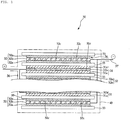
- Fig. 1 is a schematic sectional view showing an embodiment of the lithium ion secondary battery according to the present invention.
- a lithium ion secondary battery 30 includes an electrode unit 34 formed by laminating a plurality of positive electrodes 31 and negative electrodes 32 alternately via separators 33.
- the positive electrode 31 and the negative electrode 32 may each be provided in 5 to 30 layers.
- the positive electrode 31 and the negative electrode 32 may each be provided in a single layer.
- the positive electrode 31 is formed by providing a positive electrode composite material layer 31a on either surface of a positive electrode collector 31b.
- the negative electrode 32 is formed by providing a negative electrode composite material layer 32a on either surface of a negative electrode collector 32b.
- Positive electrode collectors 31 b are connected to each other via a positive electrode terminal 36, and the negative electrode collectors 32b are connected to each other via a negative electrode terminal 37.
- the lithium ion secondary battery 30 is formed by packaging the electrode unit 34 described above in a laminate film 40 and charging an electrolyte solution into an interior thereof.
- the positive electrode terminal 36 and the negative electrode terminal 37 provided on the respective collectors extend from the laminate film 40 to the outside so that the lithium ion secondary battery 30 can be connected externally.
- a lithium electrode may be provided above and below, or either above or below, the electrode unit 34 to ensure that the amount of lithium ions in the positive electrode 31 and the negative electrode 32 of the lithium ion secondary battery 30 is sufficient.
- lithium ions can be predoped to the positive electrode 31 and the negative electrode 32 smoothly from the lithium electrode by providing through holes 31c and 32c in the positive electrode collector 31b and the negative electrode collector 32b.
- the positive electrode according to the present invention is manufactured using the above-described positive electrode active material according to the present invention.
- Other positive electrode materials are ones used to manufacture a typical positive electrode. More specifically, the positive electrode is manufactured as follows, for example.
- the positive electrode materials including the positive electrode active material according to the present invention, a binder, and, if necessary, a conduction assistant and the like, are dispersed in a solvent to form a positive electrode composite material.
- a positive electrode composite material layer is then formed by coating the positive electrode collector with the positive electrode composite material and then drying the positive electrode composite material.
- a layer thickness of the positive electrode composite material layer is typically between 10 ⁇ m and 200 ⁇ m, and preferably between 20 ⁇ m and 100 ⁇ m.
- binder employed in the positive electrode composite material examples include a fluorine-containing resin such as polyvinylidene fluoride, an acrylic binder, a rubber-based binder such as SBR, a thermoplastic resin such as polypropylene and polyethylene, and carboxymethyl cellulose.
- the binder is preferably a fluorine-containing resin or a thermoplastic resin, both of which exhibit chemical and electrochemical stability relative to the nonaqueous electrolyte solution employed in the electric storage device according to the present invention, and, in particular, is preferably a fluorine-containing resin.
- fluorine-containing resin examples include, in addition to polyvinylidene fluoride, polytetrafluoroethylene, vinylidene fluoride-ethylene trifluoride copolymer, ethylene-ethylene tetrafluoride copolymer, and propylene-ethylene tetrafluoride copolymer.
- a blending amount of the binder is preferably between 0.5 % and 20 % by weight of the positive electrode active material described above.
- Examples of the conduction assistant (conductive particles, for example) employed in the positive electrode composite material include conductive carbon such as Ketjen black, a metal such as copper, iron, silver, nickel, palladium, gold, platinum, indium, and tungsten, and a conductive metal oxide such as indium oxide and tin oxide.
- a blending amount of the conduction assistant is preferably between 0.1 % and 30 % by weight of the positive electrode active material described above.
- Examples of the solvent employed in the positive electrode composite material include water, isopropyl alcohol, N-methyl pyrrolidone, and dimethylformamide.
- a surface of the positive electrode collector that contacts the positive electrode composite material layer is formed from a conductive substrate exhibiting conductivity, for example a conductive substrate formed from a conductive material such as a metal, a conductive metal oxide, and conductive carbon, or a non-conductive substrate main body covered with one of these conductive materials.
- the conductive material include copper, gold, aluminum, or an alloy thereof, and conductive carbon.
- the material of the positive electrode collector may be provided in the form of expanded metal, punching metal, foil, mesh, a foamed body, and so on,
- a negative electrode composite material layer is formed by applying a negative electrode composite material, which is obtained by dispersing a mixture containing a typically used negative electrode active material and a binder in a solvent, onto the negative electrode collector and then performing drying and the like on the resulting component.
- employed binder, solvent, and collector may be similar to those used for the above-described positive electrode, described above.
- Examples of the negative electrode active material include a lithium-based metallic material, an intermetallic compound material of a metal and lithium metal, a lithium compound, and a lithium-intercalated carbon material.
- lithium-based metallic material examples include metallic lithium and a lithium alloy (for example, an Li-Al compound).
- the intermetallic compound material of a metal and lithium metal examples include an intermetallic compound containing tin, silicon, or the like.
- the lithium compound is lithium nitride, for example.
- examples of the lithium-intercalated carbon materials include carbon-based materials such as graphite and a non-graphitizable carbon material, and a polyacene material.
- the polyacene material is insoluble and infusible PAS having a polyacene-based skeleton or the like, for example.
- a layer thickness of the negative electrode composite material layer is typically between 10 ⁇ m and 200 ⁇ m, and preferably between 20 ⁇ m and 100 ⁇ m.
- doping means occlusion, support, adsorption, insertion, and so on, and indicates a condition in which lithium ions, anions, and so on enter the positive electrode active material and negative electrode active material,
- dedoping means emission, extraction, and so on, and indicates a condition in which the lithium ions, anions, and so on are released from the positive electrode active material and negative electrode active material.
- predoping of the lithium ions means that lithium ions are doped in advance to the positive electrode active material or the negative electrode active material of the electric storage device prior to shipping as a product.
- nonaqueous electrolyte solution there are no particular limitations on the nonaqueous electrolyte solution according to the present invention, and ordinary materials may be used. From the viewpoint of ensuring that electrolysis does not occur even at high voltages and that the lithium ions can be present with stability, for example, general purpose lithium salt may be used as an electrolyte and dissolved in an organic solvent for use as an electrolyte solution.
- electrolyte examples include CF 3 SO 3 Li, C 4 F 9 SO 8 Li, (CF 3 SO 2 ) 2 NLi, (CF 3 SO 2 ) 3 CLi, LiBF 4 , LiPF 6 , LiClO 4 , and a mixture of two or more of these substances.
- organic solvent examples include propylene carbonate, ethylene carbonate, butylene carbonate, dimethyl carbonate, diethyl carbonate, ethylmethyl carbonate, vinyl carbonate, trifluoromethylpropylene carbonate, 1, 2-dimetoxyethane, 1, 2-dietoxyethane, ⁇ -butyrolactone, tetrahydrofuran, 1, 3-dioxolane, 4-methyl-1, 3-dioxolane, diethylether, sulfolane, methylsulfolane, acetonitrile, propionitrile, and a mixed solvent containing two or more of these substances.
- An electrolyte concentration of the nonaqueous electrolyte solution is preferably between 0.1 mol/L and 5.0 mol/L, and more preferably between 0.5 mol/L and 3.0 mol/L.
- the nonaqueous electrolyte solution may be a liquid, or may be formed as a solid electrolyte or a polymer gel electrolyte by intermixing a plasticizer, a polymer or the like.
- the separator 33 used in the embodiment shown in Fig. 1 is preferably constituted of a porous body or the like that does not possess electron conductivity, has communicating pores, and is durable against the electrolyte solution, the positive electrode active material, and the negative electrode active material.
- porous body examples include woven fabric, non-woven fabric, a synthetic resin microporous film, glass fiber.
- a synthetic resin microporous film can be used favorably, and a polyolefin microporous film made of polyethylene, polypropylene, or similar is particularly preferable in terms of thickness, film strength, and film resistance.
- a manufacturing method for the electric storage device according to the present invention should include a step for forming the above-described positive electrode composite material layer of the positive electrode. Other steps may be similar to ones in a ordinary manufacturing method.
- lithium ions are inserted into the positive electrode active material in a stable condition even when generated in a large amount due to overcharging or a short-circuit.
- a mixed material forming the positive electrode active material was manufactured using LiNi 1/3 Co 1/3 Mn 1/3 O 2 (lithium nickel cobalt manganese oxide (also referred to simply as an oxide hereafter)) and a lithium ion acceptance capacity adjustment compound (also referred to simply as an adjustment compound hereafter) (Li 0.33 V 2 O 5 , V 3 O 8 , Li 3 V 2 (PO 4 ) 3 , LiVOPO 4 , LiVPO 4 F, Nb 2 O 5 , TiO 2 , Li 3/4 Ti 5/3 O 4 , WO 2 , Fe 2 O 3 ) shown in Table 1, to be described below.
- a mixing ratio of the materials was adjusted such that the adjustment compound was provided in the proportions shown in Table 1 relative to the total weight of the oxide and the adjustment compound.
- a positive electrode composite material having the following composition was obtained.
- Positive electrode active material (the aforementioned mixed material) 100 parts Binder (polyvinylidene fluoride (PVdF)) 5 parts Conduction assistant (conductive carbon black) 5 parts Solvent (N-methyl 2-pyrrolidinone (NMP)) 100 parts
- Binder polyvinylidene fluoride (PVdF)
- Conduction assistant conductive carbon black
- Solvent N-methyl 2-pyrrolidinone (NMP)
- Both surfaces of the positive electrode collector (aluminum foil (thickness 30 ⁇ m)) were coated with any one of the positive electrode composite materials at a speed of 2 m/minute using a roll to roll continuous coating device, whereupon the resulting component was dried at a drying temperature of 100°C.
- positive electrode composite material layers (each having a layer thickness of 80 ⁇ m) were formed on the positive electrode collector. Positive electrodes were then formed by cutting the component to 50 mm x 50 mm (not including an uncoated projecting tab part).
- Negative electrode active material (graphite) 95 parts Binder (PVdF) 5 parts Solvent (NMP) 150 parts
- the negative electrode composite material was prepared.
- Both surfaces of the negative electrode collector (copper foil (thickness 10 ⁇ m)) were coated with the negative electrode composite material using a roll to roll continuous coating device, whereupon the resulting component was dried such that a negative electrode composite material layer (layer thickness 60 ⁇ m) was formed on the negative electrode collector.
- the negative electrode was then formed by cutting the component to 52 mm x 52 mm (not including an uncoated projecting tab part).
- an aluminum lead was welded to the uncoated projecting tab part of each positive electrode collector, and a nickel lead was welded to each negative electrode collector.
- the positive electrodes and the negative electrodes were coupled via the leads, thereby forming a positive electrode terminal and a negative electrode terminal.
- the resultant electrode laminated body was sealed into an aluminum laminate covering material, whereupon the positive electrode terminal and the negative electrode terminal were drawn to the outside of the covering material. The laminated body was then fused tightly, leaving open an electrolyte solution filling port.
- An electrolyte solution (manufactured by adding 1.5 M LiPF 6 to a mixed solvent constituted by 1 part by weight of ethylene carbonate (EC), 3 parts by weight of diethyl carbonate (DEC), and 1 % by weight of vinylene carbonate (VC) relative to the total weight of the EC and DEC) was injected through the electrolyte solution filling port, whereupon the electrolyte solution was caused to penetrate to the interior of the electrodes by vacuum impregnation,
- the covering material was then vacuum-sealed, whereby the lithium ion secondary battery according to the present invention was manufactured.
- a comparative lithium ion secondary battery was manufactured by repeating similar operations to those of Examples 1 to 10, except that the positive electrode active materials (100 parts) constituted by the mixed materials of Examples 1 to 10 were replaced by a positive electrode active material (100 parts) constituted only by LiNi 1/3 Co 1/3 Mn 1/3 O 2 .
- the lithium ion secondary batteries according to Examples 1 to 10 and Comparative Example 1 were connected to a circuit having a charger (a constant voltage power supply, manufactured by Kikusui Electronics Corp.) and an ammeter/voltmeter (a shunt resistor manufactured by Yokogawa Electric Corporation + a data logger manufactured by Keyence Corporation).
- a charger a constant voltage power supply, manufactured by Kikusui Electronics Corp.
- an ammeter/voltmeter a shunt resistor manufactured by Yokogawa Electric Corporation + a data logger manufactured by Keyence Corporation.
- the lithium ion secondary batteries were then charged for 50 minutes using a direct current corresponding to 3C in a current rate conversion. Based on an integrated overall current capacity value flowing into the battery, this charging operation corresponds to 250 % overcharging,
- the appearance of the lithium ion secondary batteries charged in the above-described manner was observed visually. Fire was observed following the elapse of 1 second to 10 minutes after the charging was stopped, depending on the type of the secondary battery. The batteries that did not catch fire were observed continuously for further 24 hours but still did not catch fire.
- the lithium ion secondary batteries according to Examples 1 to 10 and Comparative Example 1 were charged (fully charged) to 4.2 V using a charging/discharging device manufactured by Aska Electronic Co., Ltd.
- An iron nail having a nail diameter of ⁇ 5 mm was prepared, and the lithium ion secondary battery was placed on a metallic substrate. A central portion of the lithium ion secondary battery was pierced by the nail in a lamination direction of the positive electrodes and negative electrodes at a nail penetrating speed of 15 mm/second so as to penetrate the aluminum laminate.
- the lithium ion secondary batteries according to Examples 1 to 10 and Comparative Example 1 were connected to a charging/discharging device manufactured by Aska Electronic Co., Ltd.
- thermocouple was disposed on a central upper surface of an outside planar portion of the battery and fixed by heat-resistant glass cloth tape.
- Example 1-b 10 O O 58 Example 1-c 25 O O 52
- Example 1-d 50 O O 46 Example 1-e 75 O O 43
- Example 1-f 95 O O 38 Example 2-a LiNil 1/3 Co 1/3 Mn 1/3 O 2 V 3 O 8 5 X O 65
- Example 2-b 10 O O 62 Example 2-c 25 O O 57
- lithium nickel cobalt manganese oxide and a lithium ion acceptance capacity adjustment compound are used together as the positive electrode active material, fire caused by overcharging and an internal short-circuit can be suppressed.
- the temperature of the electric storage device main body is unlikely to rise due to an external short-circuit or the like.
- an electric storage device exhibiting a high degree of safety can be realized.
- the present invention is not limited to the embodiment and examples described above, and may be subjected to various modifications within the scope of the spirit of the invention.
- the above examples relate to a lithium ion secondary battery formed from an electrode laminated body, but the present invention may also be used to manufacture a wound-type lithium ion secondary battery, or an electrode laminated body-type or wound-type lithium ion capacitor, exhibiting a high degree of safety.
Landscapes
- Chemical & Material Sciences (AREA)
- Chemical Kinetics & Catalysis (AREA)
- Electrochemistry (AREA)
- General Chemical & Material Sciences (AREA)
- Engineering & Computer Science (AREA)
- Materials Engineering (AREA)
- Inorganic Chemistry (AREA)
- Manufacturing & Machinery (AREA)
- Power Engineering (AREA)
- Composite Materials (AREA)
- Microelectronics & Electronic Packaging (AREA)
- Crystallography & Structural Chemistry (AREA)
- Battery Electrode And Active Subsutance (AREA)
- Secondary Cells (AREA)
- Electric Double-Layer Capacitors Or The Like (AREA)
Applications Claiming Priority (1)
| Application Number | Priority Date | Filing Date | Title |
|---|---|---|---|
| JP2011035438A JP2012174485A (ja) | 2011-02-22 | 2011-02-22 | 正極活物質、これを用いたリチウムイオン蓄電デバイス、及びその製造方法 |
Publications (1)
| Publication Number | Publication Date |
|---|---|
| EP2492996A2 true EP2492996A2 (de) | 2012-08-29 |
Family
ID=45656165
Family Applications (1)
| Application Number | Title | Priority Date | Filing Date |
|---|---|---|---|
| EP12156148A Withdrawn EP2492996A2 (de) | 2011-02-22 | 2012-02-20 | Aktives Positivelektrodenmaterial, Lithiumionen-Speichervorrichtung damit und Herstellungsverfahren dafür |
Country Status (6)
| Country | Link |
|---|---|
| US (1) | US20120213920A1 (de) |
| EP (1) | EP2492996A2 (de) |
| JP (1) | JP2012174485A (de) |
| KR (1) | KR20120096425A (de) |
| CN (1) | CN102651471A (de) |
| TW (1) | TW201236248A (de) |
Cited By (4)
| Publication number | Priority date | Publication date | Assignee | Title |
|---|---|---|---|---|
| CN103700844A (zh) * | 2013-12-18 | 2014-04-02 | 江苏科捷锂电池有限公司 | 锂离子电池镍钴铝复合三元正极材料的制备方法 |
| EP2757616A1 (de) * | 2013-01-16 | 2014-07-23 | Samsung SDI Co., Ltd. | Positive Elektrode für eine wiederaufladbare Lithiumbatterie und wiederaufladbare Lithiumbatterie damit |
| WO2015006058A1 (en) * | 2013-07-09 | 2015-01-15 | Dow Global Technologies Llc | Mixed positive active material comprising lithium metal oxide and lithium metal phosphate |
| CN105633366A (zh) * | 2015-12-30 | 2016-06-01 | 镇江宜能新能源材料科技有限公司 | C及锂钒氧化物导电层共包覆磷酸锰铁锂正极材料及其制备方法 |
Families Citing this family (21)
| Publication number | Priority date | Publication date | Assignee | Title |
|---|---|---|---|---|
| WO2013146864A1 (ja) * | 2012-03-27 | 2013-10-03 | Tdk株式会社 | 活物質、およびそれを用いた電極、ならびにリチウムイオン二次電池 |
| US9263736B2 (en) * | 2012-03-27 | 2016-02-16 | Tdk Corporation | Positive electrode material for lithium ion secondary battery, positive electrode for lithium ion secondary battery, and lithium ion secondary battery |
| CN102916192A (zh) * | 2012-10-17 | 2013-02-06 | 上海锦众信息科技有限公司 | 一种锂离子电池锰钒复合正极的制备方法 |
| KR101538838B1 (ko) * | 2013-02-13 | 2015-07-22 | 삼성정밀화학 주식회사 | 리튬이온 이차전지용 양극활물질 및 이것을 포함하는 리튬이온 이차전지 |
| KR101794097B1 (ko) | 2013-07-03 | 2017-11-06 | 삼성에스디아이 주식회사 | 리튬 이차 전지용 양극 활물질, 이의 제조 방법, 그리고 이를 포함하는 리튬 이차 전지용 양극 및 리튬 이차 전지 |
| CN103400993B (zh) * | 2013-08-14 | 2014-03-26 | 青海绿草地新能源科技有限公司 | 一种电池正极和锂离子电池 |
| CN103700817A (zh) * | 2013-12-18 | 2014-04-02 | 江苏科捷锂电池有限公司 | LiV3O8 和LiNi0.4Co0.2Mn0.4O2共混改性锂电池正极材料的制备方法 |
| US10522877B2 (en) * | 2014-07-30 | 2019-12-31 | Sanyo Electric Co., Ltd. | Positive electrode for nonaqueous electrolyte secondary battery and nonaqueous electrolyte secondary battery |
| JP2016072077A (ja) * | 2014-09-30 | 2016-05-09 | セイコーエプソン株式会社 | 電極複合体、電極複合体の製造方法およびリチウム電池 |
| CN105355820A (zh) * | 2015-10-13 | 2016-02-24 | 深圳宏泰电池科技有限公司 | 一种高能量密度的钛酸锂动力电池及其制备方法 |
| CN105355819A (zh) * | 2015-10-13 | 2016-02-24 | 深圳宏泰电池科技有限公司 | 一种富锂锰基的高能量密度锂离子电池及其制备方法 |
| JP6567442B2 (ja) * | 2016-02-24 | 2019-08-28 | 古河電池株式会社 | リチウム二次電池の充放電方法 |
| US10312523B2 (en) * | 2016-02-25 | 2019-06-04 | Tdk Corporation | Lithium ion secondary battery |
| CN106684323B (zh) * | 2016-12-22 | 2018-06-01 | 广州朝锂新能源科技有限公司 | 一种活性氧化物改善锂离子电池三元正极材料及其制备方法 |
| CN106876669B (zh) * | 2016-12-23 | 2019-10-18 | 山东精工电子科技有限公司 | 一种微晶LiVOPO4-LiMPO4-TiO2复合锂电材料及制备方法 |
| CN110603668A (zh) * | 2017-05-31 | 2019-12-20 | 松下知识产权经营株式会社 | 二次电池用正极和二次电池 |
| KR102328254B1 (ko) | 2017-11-08 | 2021-11-18 | 주식회사 엘지에너지솔루션 | 마그헤마이트를 포함하는 리튬-황 전지용 양극 및 이를 구비한 리튬-황 전지 |
| JP7036701B2 (ja) * | 2018-10-19 | 2022-03-15 | 本田技研工業株式会社 | リチウムイオン二次電池用正極材料、リチウムイオン二次電池用正極、およびリチウムイオン二次電池 |
| CA3213286A1 (en) | 2019-07-17 | 2021-01-21 | The Regents Of The University Of California | Nanoporous lithium vanadium fluorophosphate materials and cathodes for fast charging li-ion batteries |
| JP7461752B2 (ja) * | 2020-02-18 | 2024-04-04 | 本田技研工業株式会社 | リチウムイオン二次電池用正極活物質複合体、リチウムイオン二次電池用正極、およびリチウムイオン二次電池 |
| EP4507048A4 (de) * | 2022-04-08 | 2025-12-31 | Panasonic Ip Man Co Ltd | Sekundärbatterie mit nichtwässrigem elektrolyten |
Citations (5)
| Publication number | Priority date | Publication date | Assignee | Title |
|---|---|---|---|---|
| JPH0221559A (ja) | 1988-07-08 | 1990-01-24 | Nitto Denko Corp | 電池用セパレータとその製造法 |
| JP2002216770A (ja) | 2001-01-22 | 2002-08-02 | Denso Corp | 非水電解質二次電池 |
| JP2004127545A (ja) | 2002-09-30 | 2004-04-22 | Sanyo Electric Co Ltd | リチウム電池 |
| JP2007324073A (ja) | 2006-06-05 | 2007-12-13 | Matsushita Electric Ind Co Ltd | リチウム二次電池並びにそのセパレータ及びその製造方法 |
| JP2010262939A (ja) | 2010-07-20 | 2010-11-18 | Sony Corp | 非水電解質二次電池 |
Family Cites Families (9)
| Publication number | Priority date | Publication date | Assignee | Title |
|---|---|---|---|---|
| US20040121234A1 (en) * | 2002-12-23 | 2004-06-24 | 3M Innovative Properties Company | Cathode composition for rechargeable lithium battery |
| JP2007123251A (ja) * | 2005-09-28 | 2007-05-17 | Sanyo Electric Co Ltd | 非水電解質二次電池 |
| CN101213704B (zh) * | 2006-01-25 | 2010-09-15 | 松下电器产业株式会社 | 非水电解液二次电池及其制造方法、安装方法 |
| KR20080068593A (ko) * | 2007-01-18 | 2008-07-23 | 주식회사 엘지화학 | 양극 활물질 및 이를 포함한 이차전지 |
| JP5518696B2 (ja) * | 2007-03-26 | 2014-06-11 | シンベット・コーポレイション | 薄膜リチウム電池用基板 |
| JP2011515824A (ja) * | 2008-03-24 | 2011-05-19 | スリーエム イノベイティブ プロパティズ カンパニー | 高電圧カソード組成物 |
| WO2010058993A2 (ko) * | 2008-11-20 | 2010-05-27 | 주식회사 엘지화학 | 전지특성이 향상된 리튬 이차전지 |
| JP5434727B2 (ja) * | 2010-03-19 | 2014-03-05 | 株式会社Gsユアサ | 非水電解質二次電池用電極及び非水電解質二次電池 |
| JP5434720B2 (ja) * | 2010-03-19 | 2014-03-05 | 株式会社Gsユアサ | 非水電解質二次電池用電極及び非水電解質二次電池 |
-
2011
- 2011-02-22 JP JP2011035438A patent/JP2012174485A/ja active Pending
-
2012
- 2012-02-13 US US13/371,694 patent/US20120213920A1/en not_active Abandoned
- 2012-02-17 KR KR1020120016347A patent/KR20120096425A/ko not_active Withdrawn
- 2012-02-20 EP EP12156148A patent/EP2492996A2/de not_active Withdrawn
- 2012-02-20 TW TW101105431A patent/TW201236248A/zh unknown
- 2012-02-22 CN CN2012100428161A patent/CN102651471A/zh active Pending
Patent Citations (5)
| Publication number | Priority date | Publication date | Assignee | Title |
|---|---|---|---|---|
| JPH0221559A (ja) | 1988-07-08 | 1990-01-24 | Nitto Denko Corp | 電池用セパレータとその製造法 |
| JP2002216770A (ja) | 2001-01-22 | 2002-08-02 | Denso Corp | 非水電解質二次電池 |
| JP2004127545A (ja) | 2002-09-30 | 2004-04-22 | Sanyo Electric Co Ltd | リチウム電池 |
| JP2007324073A (ja) | 2006-06-05 | 2007-12-13 | Matsushita Electric Ind Co Ltd | リチウム二次電池並びにそのセパレータ及びその製造方法 |
| JP2010262939A (ja) | 2010-07-20 | 2010-11-18 | Sony Corp | 非水電解質二次電池 |
Cited By (6)
| Publication number | Priority date | Publication date | Assignee | Title |
|---|---|---|---|---|
| EP2757616A1 (de) * | 2013-01-16 | 2014-07-23 | Samsung SDI Co., Ltd. | Positive Elektrode für eine wiederaufladbare Lithiumbatterie und wiederaufladbare Lithiumbatterie damit |
| US10224538B2 (en) | 2013-01-16 | 2019-03-05 | Samsung Sdi Co., Ltd. | Positive electrode for rechargeable lithium battery and rechargeable lithium battery including the same |
| WO2015006058A1 (en) * | 2013-07-09 | 2015-01-15 | Dow Global Technologies Llc | Mixed positive active material comprising lithium metal oxide and lithium metal phosphate |
| US9911970B2 (en) | 2013-07-09 | 2018-03-06 | Dow Global Technologies Llc | Lithium ion batteries |
| CN103700844A (zh) * | 2013-12-18 | 2014-04-02 | 江苏科捷锂电池有限公司 | 锂离子电池镍钴铝复合三元正极材料的制备方法 |
| CN105633366A (zh) * | 2015-12-30 | 2016-06-01 | 镇江宜能新能源材料科技有限公司 | C及锂钒氧化物导电层共包覆磷酸锰铁锂正极材料及其制备方法 |
Also Published As
| Publication number | Publication date |
|---|---|
| KR20120096425A (ko) | 2012-08-30 |
| US20120213920A1 (en) | 2012-08-23 |
| CN102651471A (zh) | 2012-08-29 |
| JP2012174485A (ja) | 2012-09-10 |
| TW201236248A (en) | 2012-09-01 |
Similar Documents
| Publication | Publication Date | Title |
|---|---|---|
| US20120213920A1 (en) | Positive electrode active material, lithium ion electric storage device using the same, and manufacturing method thereof | |
| JP4306697B2 (ja) | 二次電池 | |
| JP5079461B2 (ja) | リチウムイオン二次電池用正極、その製造方法及びリチウムイオン二次電池 | |
| JP4760816B2 (ja) | リチウムイオン二次電池用正極及びリチウムイオン二次電池 | |
| KR101699568B1 (ko) | 축전 디바이스 및 축전 디바이스용 양극 | |
| EP3104440B1 (de) | Negativelektroden-aktivmaterial für negativelektrodenmaterial einer sekundärbatterie mit wasserfreiem elektrolyt, negativelektrode für sekundärbatterie mit wasserfreiem elektrolyt und sekundärbatterie mit wasserfreiem elektrolyt | |
| KR20260018138A (ko) | 리튬 이차전지용 음극 및 이를 포함하는 리튬 이차전지 | |
| EP2575197B1 (de) | Sekundär-Batterie mit nicht-wässrigem Elektrolyten | |
| EP2575201A1 (de) | Sekundärbatterie mit nichtwässrigem Elektrolyten enthaltend Lithium-Vanadium-Phosphat und Lithium-Nickel-Kompositoxid als positives Elektrodenaktivmaterial | |
| EP2006940B1 (de) | Kathodenmischung und Batterie mit wasserfreiem Elektrolyt | |
| KR20130035911A (ko) | 양극 재료, 이것을 이용한 리튬 이온 2차 전지, 및 양극 재료의 제조 방법 | |
| JP2005353452A (ja) | 非水電解質電池 | |
| KR101742427B1 (ko) | 리튬 이온 2차 전지 | |
| EP3322024B1 (de) | Batterie mit wasserfreiem elektrolyt und batteriepack | |
| EP2814083A1 (de) | Sekundärbatterie | |
| JP2022520586A (ja) | オンデマンドで高性能となる安定的な電池 | |
| US20160276643A1 (en) | Non-aqueous electrolyte secondary battery | |
| EP3745501B1 (de) | Positivelektrode für eine sekundärbatterie mit wasserfreiem elektrolyt und sekundärbatterien mit wasserfreiem elektrolyt | |
| EP3926718A1 (de) | Stromkollektor, paste zur herstellung einer elektrisch leitenden schicht, elektrode und energiespeicherelement | |
| JP2012074339A (ja) | 電極材料、該電極材料を用いた蓄電デバイス、リチウムイオン二次電池、及び電極材料の製造方法。 | |
| JP3794283B2 (ja) | 非水電解質電池 | |
| CN111164799A (zh) | 电极和蓄电元件 | |
| CN111164798A (zh) | 电极和蓄电元件 | |
| KR101470334B1 (ko) | 기계적 특성이 향상된 부직포 분리막의 제조방법 및 이를 사용하여 제조되는 부직포 분리막 | |
| KR20180100857A (ko) | 고로딩에 적합한 이차전지용 전극의 제조방법 |
Legal Events
| Date | Code | Title | Description |
|---|---|---|---|
| PUAI | Public reference made under article 153(3) epc to a published international application that has entered the european phase |
Free format text: ORIGINAL CODE: 0009012 |
|
| AK | Designated contracting states |
Kind code of ref document: A2 Designated state(s): AL AT BE BG CH CY CZ DE DK EE ES FI FR GB GR HR HU IE IS IT LI LT LU LV MC MK MT NL NO PL PT RO RS SE SI SK SM TR |
|
| AX | Request for extension of the european patent |
Extension state: BA ME |
|
| RAP1 | Party data changed (applicant data changed or rights of an application transferred) |
Owner name: FUJI JUKOGYO KABUSHIKI KAISHA |
|
| STAA | Information on the status of an ep patent application or granted ep patent |
Free format text: STATUS: THE APPLICATION IS DEEMED TO BE WITHDRAWN |
|
| 18D | Application deemed to be withdrawn |
Effective date: 20150901 |