EP2493211A2 - Kopfhörervorrichtung und zugehöriges Tonwiedergabeverfahren - Google Patents
Kopfhörervorrichtung und zugehöriges Tonwiedergabeverfahren Download PDFInfo
- Publication number
- EP2493211A2 EP2493211A2 EP12152486A EP12152486A EP2493211A2 EP 2493211 A2 EP2493211 A2 EP 2493211A2 EP 12152486 A EP12152486 A EP 12152486A EP 12152486 A EP12152486 A EP 12152486A EP 2493211 A2 EP2493211 A2 EP 2493211A2
- Authority
- EP
- European Patent Office
- Prior art keywords
- sound
- headphone
- speaker
- user
- speaker array
- Prior art date
- Legal status (The legal status is an assumption and is not a legal conclusion. Google has not performed a legal analysis and makes no representation as to the accuracy of the status listed.)
- Granted
Links
Images







Classifications
-
- H—ELECTRICITY
- H04—ELECTRIC COMMUNICATION TECHNIQUE
- H04R—LOUDSPEAKERS, MICROPHONES, GRAMOPHONE PICK-UPS OR LIKE ACOUSTIC ELECTROMECHANICAL TRANSDUCERS; ELECTRIC HEARING AIDS; PUBLIC ADDRESS SYSTEMS
- H04R1/00—Details of transducers, loudspeakers or microphones
- H04R1/10—Earpieces; Attachments therefor ; Earphones; Monophonic headphones
- H04R1/1091—Details not provided for in groups H04R1/1008 - H04R1/1083
-
- H—ELECTRICITY
- H04—ELECTRIC COMMUNICATION TECHNIQUE
- H04R—LOUDSPEAKERS, MICROPHONES, GRAMOPHONE PICK-UPS OR LIKE ACOUSTIC ELECTROMECHANICAL TRANSDUCERS; ELECTRIC HEARING AIDS; PUBLIC ADDRESS SYSTEMS
- H04R1/00—Details of transducers, loudspeakers or microphones
- H04R1/10—Earpieces; Attachments therefor ; Earphones; Monophonic headphones
-
- H—ELECTRICITY
- H04—ELECTRIC COMMUNICATION TECHNIQUE
- H04R—LOUDSPEAKERS, MICROPHONES, GRAMOPHONE PICK-UPS OR LIKE ACOUSTIC ELECTROMECHANICAL TRANSDUCERS; ELECTRIC HEARING AIDS; PUBLIC ADDRESS SYSTEMS
- H04R1/00—Details of transducers, loudspeakers or microphones
- H04R1/20—Arrangements for obtaining desired frequency or directional characteristics
- H04R1/32—Arrangements for obtaining desired frequency or directional characteristics for obtaining desired directional characteristic only
- H04R1/40—Arrangements for obtaining desired frequency or directional characteristics for obtaining desired directional characteristic only by combining a number of identical transducers
-
- H—ELECTRICITY
- H04—ELECTRIC COMMUNICATION TECHNIQUE
- H04R—LOUDSPEAKERS, MICROPHONES, GRAMOPHONE PICK-UPS OR LIKE ACOUSTIC ELECTROMECHANICAL TRANSDUCERS; ELECTRIC HEARING AIDS; PUBLIC ADDRESS SYSTEMS
- H04R3/00—Circuits for transducers
- H04R3/12—Circuits for transducers for distributing signals to two or more loudspeakers
-
- H—ELECTRICITY
- H04—ELECTRIC COMMUNICATION TECHNIQUE
- H04S—STEREOPHONIC SYSTEMS
- H04S1/00—Two-channel systems
-
- H—ELECTRICITY
- H04—ELECTRIC COMMUNICATION TECHNIQUE
- H04R—LOUDSPEAKERS, MICROPHONES, GRAMOPHONE PICK-UPS OR LIKE ACOUSTIC ELECTROMECHANICAL TRANSDUCERS; ELECTRIC HEARING AIDS; PUBLIC ADDRESS SYSTEMS
- H04R2430/00—Signal processing covered by H04R, not provided for in its groups
- H04R2430/20—Processing of the output signals of the acoustic transducers of an array for obtaining a desired directivity characteristic
-
- H—ELECTRICITY
- H04—ELECTRIC COMMUNICATION TECHNIQUE
- H04S—STEREOPHONIC SYSTEMS
- H04S2400/00—Details of stereophonic systems covered by H04S but not provided for in its groups
- H04S2400/11—Positioning of individual sound objects, e.g. moving airplane, within a sound field
-
- H—ELECTRICITY
- H04—ELECTRIC COMMUNICATION TECHNIQUE
- H04S—STEREOPHONIC SYSTEMS
- H04S7/00—Indicating arrangements; Control arrangements, e.g. balance control
- H04S7/30—Control circuits for electronic adaptation of the sound field
Definitions
- the present invention relates to a headphone apparatus and a sound reproduction method for the headphone apparatus, and particularly to a headphone apparatus and the like which reproduces two-channel sound signals.
- a headphone user wears a headphone on his/her head so as to cover both ears and listens to a sound signal (acoustic signal) from both ears.
- a sound signal acoustic signal
- the binaural collected sound reproduction scheme is a scheme as follows. That is, microphones called dummy-head microphones are provided for holes of both left and right ears of a dummy head on the assumption of the head of the headphone user. A sound signal from a signal source is collected by the dummy-head microphones.
- the headphone user can feel as if the headphone user were listening to the sound directly from the signal source.
- a binaural collected sound reproduction method it is possible to enhance a sense of direction, a sense of orientation, a sense of presence, and the like.
- a signal source as a special source, which is different from a source for speaker reproduction, which collects sound source signals with a dummy-head microphone, in order to perform such a binaural collected sound reproduction method.
- a reproduction effect that typical two-channel sound signals (stereo signals), for example, are used so as to be oriented outside a head (speaker positions) in the same manner as in speaker reproduction is obtained by applying the aforementioned binaural collected sound reproduction method by the headphone.
- radiation impedance from entrances of external auditory canals of a headphone user to the outside becomes different from that in a case of a headphone non-wearing state.
- Japanese Patent No. 3637596 discloses that headphone sound generating units are positioned so as to be separate from ear auricles of a headphone user.
- a headphone apparatus including: sound reproduction units which respectively reproduce sound signals and are arranged so as to be separated from ear auricles of a headphone user, wherein each of the sound reproduction units is configured by a speaker array including a plurality of speakers.
- the headphone apparatus may be provided with sound reproduction units which respectively reproduce sound signals.
- Each of the sound reproduction units is arranged so as to be separated from an ear auricle of the headphone user and configured by a speaker array including a plurality of speakers.
- a speaker array including a plurality of speakers.
- the sound signal output from each speaker of the speaker array may be configured such that sound formed by the sound signal is focused at a predetermined position. That is, a virtual sound source in which sound pressure is high is created at the predetermined position.
- the focusing may be performed by adding a time difference and/or a level difference to the sound signal output from each speaker of the speaker array.
- the focusing is performed by arranging each speaker of the speaker array on a curved surface so as to surround an ear auricle of the headphone user. In such a case, it is possible to achieve various effects in accordance with the positions of the focusing.
- the focusing may be positioned at an entrance of an external auditory canal of the headphone user.
- the virtual sound source is synthesized at the entrance of the external auditory canal of the headphone user. Since the virtual sound source is an intangible sound source, radiation impedance from the entrance of the external auditory canal of the headphone user to the outside becomes close to that in the non-wearing state, and therefore, it becomes possible to reduce disruptions in a property due to reflection in the speaker array. Accordingly, the acoustic property is less influenced by the ear auricle, and it becomes possible to provide a stable acoustic property in which influences of variations due to individual differences are reduced.
- the focusing may be positioned between the speaker array and the entrance of the external auditory canal of the headphone user.
- the virtual sound source is synthesized between the speaker array and the entrance of the external auditory canal of the headphone user.
- the focusing may be positioned behind the speaker array.
- the virtual sound source is synthesized behind the speaker array. By synthesizing the virtual sound source at such a position, it is possible to enhance a sense of distance in a sound image orientation.
- the sound signal output from each speaker of the speaker array may be configured such that the sound formed by the sound signal becomes a planar wave. In such a case, it is possible to allow states of reflection and refraction in the ear auricle of the headphone user to be close to those in reproduction by placing the speaker away from the headphone user and thereby realizing a natural sound image orientation.
- the headphone apparatus may further include a head motion detecting unit which detects a state of a head of the headphone user, and an orientation of a sound image formed by the sound signal is controlled based on the state of the head of the headphone user, which has been detected by the head motion detecting unit. For example, the position of focusing is changed based on the state of the head of the headphone user. In such a case, it is possible to correct a sound image orientation position so as not to be deviated even when the head of the headphone user moves, and it is possible to allow a sound image position to be coincident with a moving image position, for example.
- Each sound reproduction unit may be arranged in front of or behind the ear auricle of the headphone user, for example.
- a sound generating surface of the speaker array is arranged so as to have a predetermined angle with respect to a surface facing the ear auricle of the headphone user. In so doing, it is possible to reduce the disruptions in a property due to reflection in the speaker array even when each sound reproduction unit is arranged in front of the ear auricle of the headphone user, for example.
- Fig. 1 shows a configuration example of a stereo headphone system 10 according to a first embodiment.
- the stereo headphone system 10 is provided with an input terminal 101, an A/D converter 102, a signal processing unit 103, D/A converters 104L and 104R, amplifiers 105L and 105R, and a headphone unit 106.
- the input terminal 101 is a terminal to which a sound signal SA is input.
- the A/D converter 102 converts the sound signal SA input to the input terminal 101 from an analog signal to a digital signal.
- the signal processing unit 103 performs filtering to obtain a left channel sound signal SL and a right channel sound signal SR from the sound signal SA. That is, the signal processing unit 103 includes a filter (filter 1) 103L which is for obtaining the left channel sound signal SL from the sound signal SA and a filter (filter 2) 103R which is for obtaining the right channel sound signal SR from the sound signal SA.
- the sound signals SL and SR configure two-channel sound signals.
- Fig. 2 shows a state in which sound is propagated by speaker reproduction.
- the sound reproduced by a speaker SP has a property to which reflection and refraction in ears of a listener M and reflection in a room and the like are added.
- the sound reproduced by the speaker SP reaches both ears of the listener M after a transmission property HL to the left ear and a transmission property HR to the right ear are respectively added thereto.
- the filter 103L is a filter with the transmission property HL from a sound source (speaker SP) located at a position where it is desired to orient a sound image to the left ear of the listener M.
- the filter 103R is a filter with the transmission property HR from the sound source (speaker SP) located at a position where it is desired to orient a sound image to the right ear of the listener M.
- the filters 103L and 103R are configured by FIR (Finite Impulse Response) filters as shown in Fig. 3 , for example.
- the transmission properties HL and HR are measured with impulse response data, for example, and the measurement data is realized with the FIR filters.
- the D/A converters 104L and 104R converts the sound signals SL and SR obtained by the signal processing unit 103 from a digital signal to an analog signal.
- the amplifiers 105L and 105R amplify the analog sound signals SL and SR converted by the D/A converters 104L and 104R and supply the amplified sound signals SL and SR to the sound reproduction units (speaker arrays) 106L and 106R for the left and right channels in the headphone unit 106.
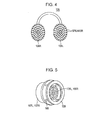
- the sound reproduction units 106L and 106R for the left and right channels in the headphone unit 106 are configured by speaker arrays including a plurality of speakers arranged in array shapes as shown in Fig. 4 .
- Each of the sound reproduction units 106L and 106R has a structure as shown in Fig. 5 . That is, each of the sound reproduction units 106L and 106R has a structure arranged so as not to be in contact with an ear auricle of the user (listener) of the headphone unit 106, that is, so as to be separated from the ear auricle.
- contact units 109 are provided so as to protrude via supporting pillars 108 inside the headphone units 107L and 107R with the sound reproduction units (speaker arrays) 106L and 106R disposed in front thereof.
- the contact units 109 are formed to torus shapes and have a configuration in which ear auricles of the headphone user are inserted into hollow parts of the contact units 109.
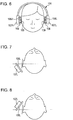
- Fig. 6 shows a state in which the headphone user (listener) wears the headphone unit 106 on his/her head.
- the aforementioned contact units 109 are pressed onto side parts of a face of the headphone user, and the sound reproduction units (speaker arrays) 106L and 106R are brought to be in a state in which the sound reproduction units (speaker arrays) 106L and 106R are separated from the ear auricles of the headphone user by predetermined distances.
- Figs. 7 and 8 schematically shows arrangement examples of the sound reproduction units (speaker arrays) in a state in which the headphone user wears the headphone unit 106 on his/her head as described above when viewed from an upper direction of the head.
- the sound reproduction unit 106L is shown in Figs. 7 and 8 for simplification of the drawings, the same is true for the sound reproduction unit 106R.
- the sound reproduction unit 106L is arranged behind the ear auricle of the headphone user.
- the sound reproduction unit 106L is arranged in front of the ear auricle of the headphone user. Both arrangement positions are available for the sound reproduction unit.
- a sound generating surface of the sound reproduction unit 106L is not parallel to a surface facing to the ear auricle of the headphone user, for example, a surface shown by a broken line in the drawing, and has a predetermined angle. With such a configuration, it is possible to reduce disruptions in the property due to the reflection in the sound reproduction unit 106L.
- the sound signal output from each speaker of the sound reproduction units (speaker arrays) 106L and 106R is configured such that the sound formed by the sound signal is focused at a predetermined position. In such a case, a virtual sound source in which sound pressure is high is created at the predetermined position.
- the sound signal output from each speaker of the sound reproduction units (speaker arrays) 106L and 106R is configured such that the sound formed by the sound signal becomes a planar wave in this embodiment.
- Fig. 9 shows a configuration example in which the sound formed by the sound signal output from each speaker of the sound reproduction units (speaker arrays) 106L and 106R is focused at a predetermined position.
- each speaker (speaker unit) configuring the sound reproduction unit (speaker array) is arranged on a curve surface so as to be focused at a point which is separated from each speaker by the same distances, namely a focus position.
- each speaker is arranged on a curve surface so as to surround the ear auricle of the headphone user when the headphone user wears the headphone unit 106 as described above.
- Fig. 9A is a diagram of the sound reproduction units (speaker arrays) 106L and 106R when viewed from the front side.
- each of the sound signals SL and SR is supplied to each speaker configuring the sound reproduction units 106L and 106R via the amplifiers 105L and 105R.
- Figs. 10A and 10B show another configuration example in which the sound formed by the sound signal output from each speaker of the sound reproduction units (speaker arrays) 106L and 106R is focused at a predetermined position.
- Figs. 10A and 10B also show a configuration example in which the sound formed by the sound signal output from each speaker of the sound reproduction units (speaker arrays) 106L and 106R is allowed to be a planer wave.
- each speaker (speaker unit) configuring the sound reproduction unit (speaker array) is arranged on a plane as shown in Fig. 10B.
- Fig. 10A is a diagram of the sound reproduction units (speaker arrays) 106L and 106R when viewed from the front side.
- Fig. 10A is a diagram of the sound reproduction units (speaker arrays) 106L and 106R when viewed from the front side. Since it is possible to arrange each speaker on a plane in this case, the structure of the speaker array becomes simple. In addition, it is also possible to freely set a position of a synthesized virtual sound source.
- each of the sound signals SL and SR is supplied to each speaker configuring the sound reproduction units 106L and 106R via series circuits including the delay devices 111L and 111R and the amplifiers 105L and 105R.
- the delay devices 111L and 111R in Fig. 10B are not shown in Fig. 1 , the delay devices 111L and 111R are inserted between the D/A converters 104L and 104R and the amplifiers 105L and 105R, for example.
- the time difference and/or the level difference are added to the sound signal output from each speaker by the delay devices 111L and 111R and the amplifiers 105L and 105R after the sound signals SL and SR are converted into analog signals.
- a configuration can also be considered in which the time difference and/or the level difference are added to the sound signal output from each speaker by the delay devices and the level adjusters in a stage in which the sound signals SL and SR are digital signals.
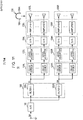
- Fig. 11 shows a configuration example of the stereo headphone system 10 in such a case.
- delay devices 121L and 121R and level adjusters 122L and 122R are inserted between the filters 103L and 103R and the D/A converters 104L and 104R.
- the order of the delay devices 121L and 121R and the level adjusters 122L and 122R may be opposite.
- the focusing can be positioned both in front of and behind the sound generating surfaces of the sound reproduction units (speaker arrays) 106L and 106R.
- the focusing in front of the sound generating surfaces of the sound reproduction units (speaker arrays) 106L and 106R and synthesize the virtual sound source at the positions, by adding the time difference and the level difference such that the delay time becomes longer while the level becomes lower from a peripheral part to a center.
- the sound signal SA is input to the input terminal 101.
- the sound signal SA is input to the signal processing unit 103 after the sound signal SA is converted from an analog signal to a digital signal by the A/D converter 102.
- the signal processing unit 103 performs filtering on the sound signal SA with the filter (filter 1) 103L to obtain a left channel sound signal SL.
- the signal processing unit 103 performs filtering on the sound signal SA with the filter (filter 2) 103R to obtain a right channel sound signal SR.
- Each of the sound signals SL and SR obtained by the signal processing unit 103 is converted from a digital signal to an analog signal by the D/A converters 104L and 104R, respectively. Then, the sound signals SL and SR are supplied to the sound reproduction units (speaker arrays) 106L and 106R for both channels in the headphone unit 106 after being amplified by the amplifiers 105L and 105R. Then, each speaker of the speaker arrays configuring the sound reproduction units 106L and 106R is driven by the sound signals SL and SR.
- the sound formed by the sound signal output from each speaker of the sound reproduction units (speaker arrays) 106L and 106R is focused at a predetermined position, and the virtual sound source is synthesized at the predetermined position, for example.
- the sound formed by the sound signal output from each speaker of the sound reproduction units (speaker arrays) 106L and 106R is allowed to be a planer wave in this case, for example.
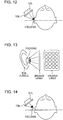
- the focusing of the sound formed by the sound signal output from each speaker of the sound reproduction units (speaker arrays) 106L and 106R can be positioned at the entrance of the external auditory canal of the headphone user (listener) as shown in Fig. 12 .
- the entrance of the external auditory canal described herein includes the vicinity of the entrance of the external auditory canal.
- Fig. 13 shows an example in which the focusing of the sound at the entrance of the external auditory canal is realized by the speaker array in which each speaker is arranged on a plane.
- the virtual sound source is synthesized at the entrance of the external auditory canal.
- the sound source is not a substantial sound source. Therefore, radiation impedance from the entrance of the external auditory canal to the outside becomes close to that in the non-wearing state, and it is possible to reduce disruptions in the property due to reflection in the speaker array as the sound generating unit. Therefore, an acoustic property is less influenced by the ear auricle in this case, and it is possible to reduce the influence by variations due to individual differences and thereby to provide a stable acoustic property to the headphone user.
- the focusing of the sound formed by the sound signal output from each speaker of the sound reproduction units (speaker arrays) 106L and 106R can be positioned between the speaker array and the entrance of the external auditory canal as shown in Fig. 14 , and the virtual sound source is synthesized at the position.
- the speaker array as the sound generating unit is not provided in the vicinity of the ear auricle, and there is no reflection in the speaker array, it is possible to obtain a stable property.
- reflection occurs in the ear auricle of the headphone user (listener) in this case, the reflection is the same as that of the sound which the headphone user usually listens to. That is, since the sound transmitted from the entrance of the external auditory canal to the drum membrane includes a property of the ear auricle of the headphone user (listener), it is possible to improve the front orientation of the sound image.
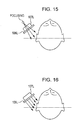
- the focusing of the sound formed by the sound signal output from each speaker of the sound reproduction units (speaker arrays) 106L and 106R can be positioned behind the speaker array as shown in Fig. 15 , and the virtual sound source with no substance is synthesized at this position. Since the virtual sound source is already synthesized away from the headphone user (listener) in this case, it is possible to enhance a sense of distance in the sound image orientation.
- the sound formed by the sound signal output from each speaker of the sound reproduction units (speaker arrays) 106L and 106R is allowed to be a planer wave as shown in Fig. 16 .
- a sound wave in a low-frequency band namely a sound wave with a long wavelength is generated from the speaker placed in front of the headphone user in a form which is close to that of a planer wave.
- the sound formed by the sound signal output from each speaker of the sound reproduction units (speaker arrays) 106L and 106R can be focused at a predetermined position, and a virtual sound source can be synthesized at the predetermined position.
- a virtual sound source can be synthesized at the predetermined position.
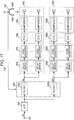
- Fig. 17 shows a configuration example of a stereo headphone system 10A according to a second embodiment.
- the same reference numerals are given to components corresponding to those in Figs. 1 and 11 , and the detailed description thereof will be appropriately omitted.
- the stereo headphone system 10A is provided with the input terminal 101, the A/D converter 102, the signal processing unit 103, the D/A converters 104L and 104R, the amplifiers 105L and 105R, and the headphone unit 106.
- the stereo headphone system 10A is provided with the delay devices 121L and 121R and the level adjusters 122L and 122R between the signal processing unit 103 (filters 103L and 103R) and the D/A converters 104L and 104R.
- the headphone unit 106 is provided with a sensor 131 which detects a state of the head of the headphone user (listener).
- the sensor 131 is an angular velocity sensor such as a gyro sensor, a gravity acceleration sensor, a magnetic sensor, or the like.
- the sensor 131 configures a head motion detecting unit.
- Fig. 18 shows a state in which the headphone user (listener) wears the headphone unit 106 provided with the sensor 131.
- the stereo headphone system 10A shown in Fig. 17 corrects a sound image orientation position by the headphone reproduction so as not to be deviated even when the state of the head is varied as described above.
- the stereo headphone system 10A updates coefficients of the filters 103L and 103R in the signal processing unit 103, namely transmission properties thereof in accordance with the output signal of the sensor 131 and operates such that the sound image orientation position is fixed.
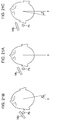
- HL and HR represent transmission properties when the headphone user (listener) faces front as shown in Fig. 19A and HL ⁇ and HR ⁇ represent transmission properties when the headphone user (listener) faces a direction rotated from the front by an angle ⁇ as shown in Fig. 19B .
- the coefficients set in the filters 103L and 103R change from HL to HL ⁇ in the filter 103L and from HR to HR ⁇ in the filter 103R in accordance with the angle ⁇ of the head.
- the stereo headphone system 10A shown in Fig. 17A it is possible to change the properties of the filters 103L and 103R in accordance with the motion of the head of the headphone user (listener) and thereby to avoid deviation of the sound image position with respect to the moving image position when the state of the head is changed. That is, it is possible to allow a direction of the moving image to be coincident with a direction of the sound image and thereby to realize moving image and sound reproduction with high quality.
- the sound image orientation direction By allowing the sound image orientation direction to be equivalent to how the sound sounds when the headphone user does not wear the headphone as described above, it is also possible to achieve an effect that a sense of a front orientation of a sound image is enhanced, which is difficult in the headphone reproduction.
- Fig. 20 shows a configuration example of a stereo headphone system 10B according to a third embodiment.
- the same reference numerals are given to components corresponding to those in Figs. 1 , 11 , and 17 , and the detailed description thereof will be appropriately omitted.
- the stereo headphone system 10B is provided with the input terminal 101, the A/D converter 102, the signal processing unit 103, the D/A converters 104L and 104R, the amplifiers 105L and 105R, and the headphone unit 106.
- the stereo headphone system 10A is provided with the delay devices 121L and 121R and the level adjusters 122L and 122R between the signal processing unit 103 (filters 103L and 103R) and the D/A converters 104L and 104R.
- the headphone unit 106 is provided with the sensor 131 which detects a state of a head of the headphone user (listener) in the same manner as in the aforementioned stereo headphone system 10A.
- the stereo headphone system 10B corrects the sound image orientation position by the headphone reproduction so as not to be deviated even when the state of the head is varied in the same manner as in the aforementioned headphone system 10A.
- the aforementioned stereo headphone system 10A updates coefficients in the filters 103L and 103R of the signal processing unit 103, namely transmission properties thereof in accordance with the motion of the head in accordance with the output signal of the sensor 131.
- the stereo headphone system 10B updates a position of a virtual sound source synthesized by the sound reproduction units (speaker arrays) 106L and 106R in accordance with the output signal of the sensor 131, namely the motion of the head. That is, the stereo headphone system 10B controls delay time and/or a level of the sound signal output to each speaker of the speaker array in accordance with the output signal of the sensor 131, namely the motion of the head, and moves the position of the virtual sound source. In such a case, a delay amount and a level adjustment amount in the delay devices 121L and 121R and the level adjusters 122L and 122R are controlled based on the output signal of the sensor 131.
- the virtual sound source is synthesized at a position Pa.
- the virtual sound source is synthesized at a position Pb which is far from the ear auricles.
- the virtual sound source is synthesized at a position Pc which is close to the ear auricles.
- the virtual sound source is positioned in front of the sound reproduction unit (speaker array 106L). However, the virtual sound source may be at the back position Pb behind the sound reproduction unit (speaker array) 106L as shown in Fig. 22 depending on the angle ⁇ of the head motion of the headphone user (listener).
- the virtual sound source position is controlled in accordance with the motion of the head according to the stereo headphone system 10B shown in Fig. 20 . Therefore, it is possible to fix the sound image orientation position even when the state of the head is varied in the same manner as in the stereo headphone system 10A shown in Fig. 17 and thereby to achieve the same effect.
- control of the virtual sound source corresponds to control of the sound image by wave surface synthesis according to the stereo headphone system 108, it is possible to realize sound image control which is less influenced by the property of the ear auricles of the headphone user (listener).
Landscapes
- Physics & Mathematics (AREA)
- Engineering & Computer Science (AREA)
- Acoustics & Sound (AREA)
- Signal Processing (AREA)
- Health & Medical Sciences (AREA)
- Otolaryngology (AREA)
- General Health & Medical Sciences (AREA)
- Stereophonic System (AREA)
- Headphones And Earphones (AREA)
- Stereophonic Arrangements (AREA)
- Circuit For Audible Band Transducer (AREA)
- Obtaining Desirable Characteristics In Audible-Bandwidth Transducers (AREA)
Applications Claiming Priority (1)
| Application Number | Priority Date | Filing Date | Title |
|---|---|---|---|
| JP2011040964A JP5716451B2 (ja) | 2011-02-25 | 2011-02-25 | ヘッドホン装置およびヘッドホン装置の音声再生方法 |
Publications (3)
| Publication Number | Publication Date |
|---|---|
| EP2493211A2 true EP2493211A2 (de) | 2012-08-29 |
| EP2493211A3 EP2493211A3 (de) | 2013-05-22 |
| EP2493211B1 EP2493211B1 (de) | 2016-01-13 |
Family
ID=45655235
Family Applications (1)
| Application Number | Title | Priority Date | Filing Date |
|---|---|---|---|
| EP12152486.2A Not-in-force EP2493211B1 (de) | 2011-02-25 | 2012-01-25 | Kopfhörervorrichtung und zugehöriges Tonwiedergabeverfahren |
Country Status (5)
| Country | Link |
|---|---|
| US (1) | US9191733B2 (de) |
| EP (1) | EP2493211B1 (de) |
| JP (1) | JP5716451B2 (de) |
| KR (1) | KR101912466B1 (de) |
| CN (1) | CN102651831A (de) |
Cited By (3)
| Publication number | Priority date | Publication date | Assignee | Title |
|---|---|---|---|---|
| EP3346731A1 (de) * | 2017-01-04 | 2018-07-11 | Harman Becker Automotive Systems GmbH | Systeme und verfahren zur erzeugung natürlicher richtungswahrnehmung zur virtuellen schallquellensynthese |
| EP3466114B1 (de) * | 2016-06-06 | 2020-05-13 | Bose Corporation | Akustische vorrichtung zum tragen am körper |
| CN112351379A (zh) * | 2020-10-28 | 2021-02-09 | 歌尔光学科技有限公司 | 音频组件的控制方法以及智能头戴设备 |
Families Citing this family (20)
| Publication number | Priority date | Publication date | Assignee | Title |
|---|---|---|---|---|
| US9319773B2 (en) * | 2013-08-20 | 2016-04-19 | Ideavillage Products Corporation | Audio bass resonator |
| JP6242262B2 (ja) * | 2014-03-27 | 2017-12-06 | フォスター電機株式会社 | 音響再生装置 |
| CN105282642A (zh) * | 2014-07-24 | 2016-01-27 | 宏碁股份有限公司 | 耳机及其声道控制方法 |
| WO2016140058A1 (ja) * | 2015-03-04 | 2016-09-09 | シャープ株式会社 | 音声信号再生装置、音声信号再生方法、プログラム、および記録媒体 |
| CN106067996B (zh) * | 2015-04-24 | 2019-09-17 | 松下知识产权经营株式会社 | 语音再现方法、语音对话装置 |
| US10932082B2 (en) * | 2016-06-21 | 2021-02-23 | Dolby Laboratories Licensing Corporation | Headtracking for pre-rendered binaural audio |
| US10390165B2 (en) * | 2016-08-01 | 2019-08-20 | Magic Leap, Inc. | Mixed reality system with spatialized audio |
| CN106303832B (zh) * | 2016-09-30 | 2019-12-27 | 歌尔科技有限公司 | 扬声器及提高指向性的方法、头戴式设备及方法 |
| US10540138B2 (en) * | 2018-01-25 | 2020-01-21 | Harman International Industries, Incorporated | Wearable sound system with configurable privacy modes |
| TWI698132B (zh) | 2018-07-16 | 2020-07-01 | 宏碁股份有限公司 | 音效輸出裝置、運算裝置及其音效控制方法 |
| CN110740415B (zh) * | 2018-07-20 | 2022-04-26 | 宏碁股份有限公司 | 音效输出装置、运算装置及其音效控制方法 |
| US10645487B2 (en) * | 2018-07-23 | 2020-05-05 | Warped Dynamics, LLC | Vertically configured parametric transducer headphones |
| CN109379659A (zh) * | 2018-11-16 | 2019-02-22 | 王美金 | 一种用于虚拟与增强现实的人机交互声学定向耳机 |
| US10575094B1 (en) * | 2018-12-13 | 2020-02-25 | Dts, Inc. | Combination of immersive and binaural sound |
| CN110099326B (zh) * | 2019-05-24 | 2022-05-06 | 潍坊歌尔电子有限公司 | 一种带外放功能的头戴耳机及其调节方法、装置 |
| CN110099343A (zh) * | 2019-05-28 | 2019-08-06 | 安徽奥飞声学科技有限公司 | 一种具有mems扬声器阵列的听筒及通信装置 |
| US11197083B2 (en) * | 2019-08-07 | 2021-12-07 | Bose Corporation | Active noise reduction in open ear directional acoustic devices |
| US11284194B2 (en) * | 2020-07-06 | 2022-03-22 | Harman International Industries, Incorporated | Techniques for generating spatial sound via head-mounted external facing speakers |
| EP4181529A4 (de) * | 2020-07-09 | 2024-01-10 | Sony Group Corporation | Akustische ausgabevorrichtung und steuerungsverfahren für akustische ausgabevorrichtung |
| JPWO2024252549A1 (de) * | 2023-06-07 | 2024-12-12 |
Citations (2)
| Publication number | Priority date | Publication date | Assignee | Title |
|---|---|---|---|---|
| JP3637596B2 (ja) | 1994-01-27 | 2005-04-13 | ソニー株式会社 | オーディオ再生装置およびヘッドホン |
| JP2011040964A (ja) | 2009-08-10 | 2011-02-24 | Nippon Hoso Kyokai <Nhk> | デジタル伝送方式の復号器及び受信装置 |
Family Cites Families (19)
| Publication number | Priority date | Publication date | Assignee | Title |
|---|---|---|---|---|
| US5495534A (en) * | 1990-01-19 | 1996-02-27 | Sony Corporation | Audio signal reproducing apparatus |
| JPH05336599A (ja) * | 1992-06-03 | 1993-12-17 | Fujitsu Ltd | 音像定位ヘッドホン装置および、それを用いた仮想現実視聴覚装置 |
| JPH0795698A (ja) * | 1993-09-21 | 1995-04-07 | Sony Corp | オーディオ再生装置 |
| WO1995013690A1 (en) * | 1993-11-08 | 1995-05-18 | Sony Corporation | Angle detector and audio playback apparatus using the detector |
| JP3577798B2 (ja) * | 1995-08-31 | 2004-10-13 | ソニー株式会社 | ヘッドホン装置 |
| US5684879A (en) * | 1996-01-19 | 1997-11-04 | Verdick; Michael | Combination head mounted speaker assembly and multi-channel audio processing system |
| AUPO316096A0 (en) * | 1996-10-23 | 1996-11-14 | Lake Dsp Pty Limited | Head tracking with limited angle output |
| JPH11275696A (ja) * | 1998-01-22 | 1999-10-08 | Sony Corp | ヘッドホン、ヘッドホンアダプタおよびヘッドホン装置 |
| AUPP271598A0 (en) * | 1998-03-31 | 1998-04-23 | Lake Dsp Pty Limited | Headtracked processing for headtracked playback of audio signals |
| JP4281937B2 (ja) * | 2000-02-02 | 2009-06-17 | パナソニック株式会社 | ヘッドホンシステム |
| US7684577B2 (en) * | 2001-05-28 | 2010-03-23 | Mitsubishi Denki Kabushiki Kaisha | Vehicle-mounted stereophonic sound field reproducer |
| HRP20020861A2 (en) * | 2002-10-31 | 2005-02-28 | Milneršić Siniša | Multichannel headphones |
| FR2854537A1 (fr) * | 2003-04-29 | 2004-11-05 | Hong Cong Tuyen Pham | Casque acoustique pour la restitution spatiale d'un son. |
| JP4254502B2 (ja) * | 2003-11-21 | 2009-04-15 | ヤマハ株式会社 | アレースピーカ装置 |
| JP4308790B2 (ja) * | 2004-03-22 | 2009-08-05 | 固昌通訊股▲ふん▼有限公司 | 多重チャネル・イヤホン |
| GB0419346D0 (en) * | 2004-09-01 | 2004-09-29 | Smyth Stephen M F | Method and apparatus for improved headphone virtualisation |
| JP2006115396A (ja) * | 2004-10-18 | 2006-04-27 | Sony Corp | オーディオ信号の再生方法およびその再生装置 |
| US8515103B2 (en) * | 2009-12-29 | 2013-08-20 | Cyber Group USA Inc. | 3D stereo earphone with multiple speakers |
| JP5696427B2 (ja) * | 2010-10-22 | 2015-04-08 | ソニー株式会社 | ヘッドフォン装置 |
-
2011
- 2011-02-25 JP JP2011040964A patent/JP5716451B2/ja not_active Expired - Fee Related
-
2012
- 2012-01-25 EP EP12152486.2A patent/EP2493211B1/de not_active Not-in-force
- 2012-02-16 US US13/398,160 patent/US9191733B2/en not_active Expired - Fee Related
- 2012-02-17 CN CN2012100368531A patent/CN102651831A/zh active Pending
- 2012-02-17 KR KR1020120016457A patent/KR101912466B1/ko not_active Expired - Fee Related
Patent Citations (2)
| Publication number | Priority date | Publication date | Assignee | Title |
|---|---|---|---|---|
| JP3637596B2 (ja) | 1994-01-27 | 2005-04-13 | ソニー株式会社 | オーディオ再生装置およびヘッドホン |
| JP2011040964A (ja) | 2009-08-10 | 2011-02-24 | Nippon Hoso Kyokai <Nhk> | デジタル伝送方式の復号器及び受信装置 |
Cited By (4)
| Publication number | Priority date | Publication date | Assignee | Title |
|---|---|---|---|---|
| EP3466114B1 (de) * | 2016-06-06 | 2020-05-13 | Bose Corporation | Akustische vorrichtung zum tragen am körper |
| EP3346731A1 (de) * | 2017-01-04 | 2018-07-11 | Harman Becker Automotive Systems GmbH | Systeme und verfahren zur erzeugung natürlicher richtungswahrnehmung zur virtuellen schallquellensynthese |
| US10565975B2 (en) | 2017-01-04 | 2020-02-18 | Harman Becker Automotive Systems Gmbh | Systems and methods for generating natural directional pinna cues for virtual sound source synthesis |
| CN112351379A (zh) * | 2020-10-28 | 2021-02-09 | 歌尔光学科技有限公司 | 音频组件的控制方法以及智能头戴设备 |
Also Published As
| Publication number | Publication date |
|---|---|
| US20120219165A1 (en) | 2012-08-30 |
| JP5716451B2 (ja) | 2015-05-13 |
| EP2493211B1 (de) | 2016-01-13 |
| CN102651831A (zh) | 2012-08-29 |
| JP2012178748A (ja) | 2012-09-13 |
| US9191733B2 (en) | 2015-11-17 |
| KR101912466B1 (ko) | 2018-10-26 |
| KR20120098429A (ko) | 2012-09-05 |
| EP2493211A3 (de) | 2013-05-22 |
Similar Documents
| Publication | Publication Date | Title |
|---|---|---|
| EP2493211B1 (de) | Kopfhörervorrichtung und zugehöriges Tonwiedergabeverfahren | |
| CN1235443C (zh) | 多声道音频重放装置和方法 | |
| US9615189B2 (en) | Artificial ear apparatus and associated methods for generating a head related audio transfer function | |
| JP4304636B2 (ja) | 音響システム、音響装置及び最適音場生成方法 | |
| JP5696427B2 (ja) | ヘッドフォン装置 | |
| KR101486448B1 (ko) | 음향 변환기 | |
| JP4913256B1 (ja) | カナル型受話器用イヤーピース及びそれを利用したカナル型受話器、並びにカナル型受話器を利用した聴診器及び補聴器 | |
| US20150189423A1 (en) | Audio signal output device and method of processing an audio signal | |
| US8442244B1 (en) | Surround sound system | |
| JPH01192299A (ja) | ステレオ音響の収音装置 | |
| JP2005223713A (ja) | 音響再生装置、音響再生方法 | |
| US20200059750A1 (en) | Sound spatialization method | |
| JP2017028525A (ja) | 頭外定位処理装置、頭外定位処理方法、及びプログラム | |
| US6990210B2 (en) | System for headphone-like rear channel speaker and the method of the same | |
| JP6969789B2 (ja) | イヤホン、音響再生装置及び音響再生方法 | |
| US6983054B2 (en) | Means for compensating rear sound effect | |
| US20050041816A1 (en) | System and headphone-like rear channel speaker and the method of the same | |
| KR100307622B1 (ko) | 위치 조절이 가능한 가상 음상을 이용한 오디오 재생 장치 및그 방법 | |
| EP4207804A1 (de) | Kopfhöreranordnung | |
| EP4478735A1 (de) | Kopfhörer | |
| JP2008011099A (ja) | ヘッドフォン音響再生システム、ヘッドフォン装置 | |
| HK1237574A1 (en) | Artifical ear apparatus and associated methods for generating a head related audio transfer function | |
| HK1237574B (zh) | 用於產生與音頻傳輸功能相關的頭的人造耳裝置及其相關方法 |
Legal Events
| Date | Code | Title | Description |
|---|---|---|---|
| PUAI | Public reference made under article 153(3) epc to a published international application that has entered the european phase |
Free format text: ORIGINAL CODE: 0009012 |
|
| 17P | Request for examination filed |
Effective date: 20120210 |
|
| AK | Designated contracting states |
Kind code of ref document: A2 Designated state(s): AL AT BE BG CH CY CZ DE DK EE ES FI FR GB GR HR HU IE IS IT LI LT LU LV MC MK MT NL NO PL PT RO RS SE SI SK SM TR |
|
| AX | Request for extension of the european patent |
Extension state: BA ME |
|
| PUAL | Search report despatched |
Free format text: ORIGINAL CODE: 0009013 |
|
| AK | Designated contracting states |
Kind code of ref document: A3 Designated state(s): AL AT BE BG CH CY CZ DE DK EE ES FI FR GB GR HR HU IE IS IT LI LT LU LV MC MK MT NL NO PL PT RO RS SE SI SK SM TR |
|
| AX | Request for extension of the european patent |
Extension state: BA ME |
|
| RIC1 | Information provided on ipc code assigned before grant |
Ipc: H04R 1/10 20060101ALI20130416BHEP Ipc: H04R 1/40 20060101AFI20130416BHEP Ipc: H04R 3/12 20060101ALI20130416BHEP |
|
| 17Q | First examination report despatched |
Effective date: 20140221 |
|
| GRAP | Despatch of communication of intention to grant a patent |
Free format text: ORIGINAL CODE: EPIDOSNIGR1 |
|
| RIC1 | Information provided on ipc code assigned before grant |
Ipc: H04S 7/00 20060101ALN20150629BHEP Ipc: H04R 1/40 20060101AFI20150629BHEP Ipc: H04R 3/12 20060101ALI20150629BHEP Ipc: H04R 1/10 20060101ALI20150629BHEP |
|
| INTG | Intention to grant announced |
Effective date: 20150716 |
|
| GRAS | Grant fee paid |
Free format text: ORIGINAL CODE: EPIDOSNIGR3 |
|
| GRAA | (expected) grant |
Free format text: ORIGINAL CODE: 0009210 |
|
| AK | Designated contracting states |
Kind code of ref document: B1 Designated state(s): AL AT BE BG CH CY CZ DE DK EE ES FI FR GB GR HR HU IE IS IT LI LT LU LV MC MK MT NL NO PL PT RO RS SE SI SK SM TR |
|
| REG | Reference to a national code |
Ref country code: GB Ref legal event code: FG4D |
|
| REG | Reference to a national code |
Ref country code: CH Ref legal event code: EP |
|
| REG | Reference to a national code |
Ref country code: FR Ref legal event code: PLFP Year of fee payment: 5 |
|
| REG | Reference to a national code |
Ref country code: IE Ref legal event code: FG4D |
|
| REG | Reference to a national code |
Ref country code: AT Ref legal event code: REF Ref document number: 771196 Country of ref document: AT Kind code of ref document: T Effective date: 20160215 |
|
| REG | Reference to a national code |
Ref country code: DE Ref legal event code: R096 Ref document number: 602012013804 Country of ref document: DE |
|
| REG | Reference to a national code |
Ref country code: LT Ref legal event code: MG4D |
|
| REG | Reference to a national code |
Ref country code: NL Ref legal event code: MP Effective date: 20160113 |
|
| PG25 | Lapsed in a contracting state [announced via postgrant information from national office to epo] |
Ref country code: BE Free format text: LAPSE BECAUSE OF NON-PAYMENT OF DUE FEES Effective date: 20160131 |
|
| REG | Reference to a national code |
Ref country code: AT Ref legal event code: MK05 Ref document number: 771196 Country of ref document: AT Kind code of ref document: T Effective date: 20160113 |
|
| PG25 | Lapsed in a contracting state [announced via postgrant information from national office to epo] |
Ref country code: NL Free format text: LAPSE BECAUSE OF FAILURE TO SUBMIT A TRANSLATION OF THE DESCRIPTION OR TO PAY THE FEE WITHIN THE PRESCRIBED TIME-LIMIT Effective date: 20160113 |
|
| PG25 | Lapsed in a contracting state [announced via postgrant information from national office to epo] |
Ref country code: ES Free format text: LAPSE BECAUSE OF FAILURE TO SUBMIT A TRANSLATION OF THE DESCRIPTION OR TO PAY THE FEE WITHIN THE PRESCRIBED TIME-LIMIT Effective date: 20160113 Ref country code: FI Free format text: LAPSE BECAUSE OF FAILURE TO SUBMIT A TRANSLATION OF THE DESCRIPTION OR TO PAY THE FEE WITHIN THE PRESCRIBED TIME-LIMIT Effective date: 20160113 Ref country code: GR Free format text: LAPSE BECAUSE OF FAILURE TO SUBMIT A TRANSLATION OF THE DESCRIPTION OR TO PAY THE FEE WITHIN THE PRESCRIBED TIME-LIMIT Effective date: 20160414 Ref country code: HR Free format text: LAPSE BECAUSE OF FAILURE TO SUBMIT A TRANSLATION OF THE DESCRIPTION OR TO PAY THE FEE WITHIN THE PRESCRIBED TIME-LIMIT Effective date: 20160113 Ref country code: IT Free format text: LAPSE BECAUSE OF FAILURE TO SUBMIT A TRANSLATION OF THE DESCRIPTION OR TO PAY THE FEE WITHIN THE PRESCRIBED TIME-LIMIT Effective date: 20160113 Ref country code: NO Free format text: LAPSE BECAUSE OF FAILURE TO SUBMIT A TRANSLATION OF THE DESCRIPTION OR TO PAY THE FEE WITHIN THE PRESCRIBED TIME-LIMIT Effective date: 20160413 |
|
| PG25 | Lapsed in a contracting state [announced via postgrant information from national office to epo] |
Ref country code: AT Free format text: LAPSE BECAUSE OF FAILURE TO SUBMIT A TRANSLATION OF THE DESCRIPTION OR TO PAY THE FEE WITHIN THE PRESCRIBED TIME-LIMIT Effective date: 20160113 Ref country code: LV Free format text: LAPSE BECAUSE OF FAILURE TO SUBMIT A TRANSLATION OF THE DESCRIPTION OR TO PAY THE FEE WITHIN THE PRESCRIBED TIME-LIMIT Effective date: 20160113 Ref country code: PL Free format text: LAPSE BECAUSE OF FAILURE TO SUBMIT A TRANSLATION OF THE DESCRIPTION OR TO PAY THE FEE WITHIN THE PRESCRIBED TIME-LIMIT Effective date: 20160113 Ref country code: PT Free format text: LAPSE BECAUSE OF FAILURE TO SUBMIT A TRANSLATION OF THE DESCRIPTION OR TO PAY THE FEE WITHIN THE PRESCRIBED TIME-LIMIT Effective date: 20160513 Ref country code: IS Free format text: LAPSE BECAUSE OF FAILURE TO SUBMIT A TRANSLATION OF THE DESCRIPTION OR TO PAY THE FEE WITHIN THE PRESCRIBED TIME-LIMIT Effective date: 20160513 Ref country code: RS Free format text: LAPSE BECAUSE OF FAILURE TO SUBMIT A TRANSLATION OF THE DESCRIPTION OR TO PAY THE FEE WITHIN THE PRESCRIBED TIME-LIMIT Effective date: 20160113 Ref country code: SE Free format text: LAPSE BECAUSE OF FAILURE TO SUBMIT A TRANSLATION OF THE DESCRIPTION OR TO PAY THE FEE WITHIN THE PRESCRIBED TIME-LIMIT Effective date: 20160113 Ref country code: LT Free format text: LAPSE BECAUSE OF FAILURE TO SUBMIT A TRANSLATION OF THE DESCRIPTION OR TO PAY THE FEE WITHIN THE PRESCRIBED TIME-LIMIT Effective date: 20160113 |
|
| REG | Reference to a national code |
Ref country code: CH Ref legal event code: PL |
|
| REG | Reference to a national code |
Ref country code: DE Ref legal event code: R097 Ref document number: 602012013804 Country of ref document: DE |
|
| PG25 | Lapsed in a contracting state [announced via postgrant information from national office to epo] |
Ref country code: DK Free format text: LAPSE BECAUSE OF FAILURE TO SUBMIT A TRANSLATION OF THE DESCRIPTION OR TO PAY THE FEE WITHIN THE PRESCRIBED TIME-LIMIT Effective date: 20160113 Ref country code: CH Free format text: LAPSE BECAUSE OF NON-PAYMENT OF DUE FEES Effective date: 20160131 Ref country code: MC Free format text: LAPSE BECAUSE OF FAILURE TO SUBMIT A TRANSLATION OF THE DESCRIPTION OR TO PAY THE FEE WITHIN THE PRESCRIBED TIME-LIMIT Effective date: 20160113 Ref country code: EE Free format text: LAPSE BECAUSE OF FAILURE TO SUBMIT A TRANSLATION OF THE DESCRIPTION OR TO PAY THE FEE WITHIN THE PRESCRIBED TIME-LIMIT Effective date: 20160113 Ref country code: LI Free format text: LAPSE BECAUSE OF NON-PAYMENT OF DUE FEES Effective date: 20160131 |
|
| REG | Reference to a national code |
Ref country code: IE Ref legal event code: MM4A |
|
| PLBE | No opposition filed within time limit |
Free format text: ORIGINAL CODE: 0009261 |
|
| STAA | Information on the status of an ep patent application or granted ep patent |
Free format text: STATUS: NO OPPOSITION FILED WITHIN TIME LIMIT |
|
| PG25 | Lapsed in a contracting state [announced via postgrant information from national office to epo] |
Ref country code: CZ Free format text: LAPSE BECAUSE OF FAILURE TO SUBMIT A TRANSLATION OF THE DESCRIPTION OR TO PAY THE FEE WITHIN THE PRESCRIBED TIME-LIMIT Effective date: 20160113 Ref country code: SM Free format text: LAPSE BECAUSE OF FAILURE TO SUBMIT A TRANSLATION OF THE DESCRIPTION OR TO PAY THE FEE WITHIN THE PRESCRIBED TIME-LIMIT Effective date: 20160113 Ref country code: RO Free format text: LAPSE BECAUSE OF FAILURE TO SUBMIT A TRANSLATION OF THE DESCRIPTION OR TO PAY THE FEE WITHIN THE PRESCRIBED TIME-LIMIT Effective date: 20160113 Ref country code: SK Free format text: LAPSE BECAUSE OF FAILURE TO SUBMIT A TRANSLATION OF THE DESCRIPTION OR TO PAY THE FEE WITHIN THE PRESCRIBED TIME-LIMIT Effective date: 20160113 |
|
| 26N | No opposition filed |
Effective date: 20161014 |
|
| PG25 | Lapsed in a contracting state [announced via postgrant information from national office to epo] |
Ref country code: BE Free format text: LAPSE BECAUSE OF FAILURE TO SUBMIT A TRANSLATION OF THE DESCRIPTION OR TO PAY THE FEE WITHIN THE PRESCRIBED TIME-LIMIT Effective date: 20160113 |
|
| REG | Reference to a national code |
Ref country code: FR Ref legal event code: PLFP Year of fee payment: 6 |
|
| PG25 | Lapsed in a contracting state [announced via postgrant information from national office to epo] |
Ref country code: IE Free format text: LAPSE BECAUSE OF NON-PAYMENT OF DUE FEES Effective date: 20160125 |
|
| PG25 | Lapsed in a contracting state [announced via postgrant information from national office to epo] |
Ref country code: BG Free format text: LAPSE BECAUSE OF FAILURE TO SUBMIT A TRANSLATION OF THE DESCRIPTION OR TO PAY THE FEE WITHIN THE PRESCRIBED TIME-LIMIT Effective date: 20160413 Ref country code: SI Free format text: LAPSE BECAUSE OF FAILURE TO SUBMIT A TRANSLATION OF THE DESCRIPTION OR TO PAY THE FEE WITHIN THE PRESCRIBED TIME-LIMIT Effective date: 20160113 |
|
| PG25 | Lapsed in a contracting state [announced via postgrant information from national office to epo] |
Ref country code: MT Free format text: LAPSE BECAUSE OF FAILURE TO SUBMIT A TRANSLATION OF THE DESCRIPTION OR TO PAY THE FEE WITHIN THE PRESCRIBED TIME-LIMIT Effective date: 20160113 |
|
| REG | Reference to a national code |
Ref country code: FR Ref legal event code: PLFP Year of fee payment: 7 |
|
| PG25 | Lapsed in a contracting state [announced via postgrant information from national office to epo] |
Ref country code: HU Free format text: LAPSE BECAUSE OF FAILURE TO SUBMIT A TRANSLATION OF THE DESCRIPTION OR TO PAY THE FEE WITHIN THE PRESCRIBED TIME-LIMIT; INVALID AB INITIO Effective date: 20120125 Ref country code: CY Free format text: LAPSE BECAUSE OF FAILURE TO SUBMIT A TRANSLATION OF THE DESCRIPTION OR TO PAY THE FEE WITHIN THE PRESCRIBED TIME-LIMIT Effective date: 20160113 |
|
| PG25 | Lapsed in a contracting state [announced via postgrant information from national office to epo] |
Ref country code: MT Free format text: LAPSE BECAUSE OF FAILURE TO SUBMIT A TRANSLATION OF THE DESCRIPTION OR TO PAY THE FEE WITHIN THE PRESCRIBED TIME-LIMIT Effective date: 20160131 Ref country code: MK Free format text: LAPSE BECAUSE OF FAILURE TO SUBMIT A TRANSLATION OF THE DESCRIPTION OR TO PAY THE FEE WITHIN THE PRESCRIBED TIME-LIMIT Effective date: 20160113 Ref country code: LU Free format text: LAPSE BECAUSE OF NON-PAYMENT OF DUE FEES Effective date: 20160125 Ref country code: TR Free format text: LAPSE BECAUSE OF FAILURE TO SUBMIT A TRANSLATION OF THE DESCRIPTION OR TO PAY THE FEE WITHIN THE PRESCRIBED TIME-LIMIT Effective date: 20160113 |
|
| PG25 | Lapsed in a contracting state [announced via postgrant information from national office to epo] |
Ref country code: AL Free format text: LAPSE BECAUSE OF FAILURE TO SUBMIT A TRANSLATION OF THE DESCRIPTION OR TO PAY THE FEE WITHIN THE PRESCRIBED TIME-LIMIT Effective date: 20160113 |
|
| PGFP | Annual fee paid to national office [announced via postgrant information from national office to epo] |
Ref country code: GB Payment date: 20200124 Year of fee payment: 9 Ref country code: DE Payment date: 20200121 Year of fee payment: 9 |
|
| PGFP | Annual fee paid to national office [announced via postgrant information from national office to epo] |
Ref country code: FR Payment date: 20200121 Year of fee payment: 9 |
|
| REG | Reference to a national code |
Ref country code: DE Ref legal event code: R119 Ref document number: 602012013804 Country of ref document: DE |
|
| GBPC | Gb: european patent ceased through non-payment of renewal fee |
Effective date: 20210125 |
|
| PG25 | Lapsed in a contracting state [announced via postgrant information from national office to epo] |
Ref country code: FR Free format text: LAPSE BECAUSE OF NON-PAYMENT OF DUE FEES Effective date: 20210131 |
|
| PG25 | Lapsed in a contracting state [announced via postgrant information from national office to epo] |
Ref country code: DE Free format text: LAPSE BECAUSE OF NON-PAYMENT OF DUE FEES Effective date: 20210803 Ref country code: GB Free format text: LAPSE BECAUSE OF NON-PAYMENT OF DUE FEES Effective date: 20210125 |