EP2494983B1 - Formulation stable de glp-1 - Google Patents
Formulation stable de glp-1 Download PDFInfo
- Publication number
- EP2494983B1 EP2494983B1 EP12153063.8A EP12153063A EP2494983B1 EP 2494983 B1 EP2494983 B1 EP 2494983B1 EP 12153063 A EP12153063 A EP 12153063A EP 2494983 B1 EP2494983 B1 EP 2494983B1
- Authority
- EP
- European Patent Office
- Prior art keywords
- minutes
- glp
- solution
- insulinotropic
- liraglutide
- Prior art date
- Legal status (The legal status is an assumption and is not a legal conclusion. Google has not performed a legal analysis and makes no representation as to the accuracy of the status listed.)
- Revoked
Links
- 0 *C(CO)C(C(*)C(C*=C)O)N=O Chemical compound *C(CO)C(C(*)C(C*=C)O)N=O 0.000 description 1
- XAZKFISIRYLAEE-UHFFFAOYSA-N CC1CC(C)CC1 Chemical compound CC1CC(C)CC1 XAZKFISIRYLAEE-UHFFFAOYSA-N 0.000 description 1
Images









Classifications
-
- A—HUMAN NECESSITIES
- A61—MEDICAL OR VETERINARY SCIENCE; HYGIENE
- A61K—PREPARATIONS FOR MEDICAL, DENTAL OR TOILETRY PURPOSES
- A61K38/00—Medicinal preparations containing peptides
- A61K38/16—Peptides having more than 20 amino acids; Gastrins; Somatostatins; Melanotropins; Derivatives thereof
- A61K38/17—Peptides having more than 20 amino acids; Gastrins; Somatostatins; Melanotropins; Derivatives thereof from animals; from humans
- A61K38/22—Hormones
- A61K38/26—Glucagons
-
- A—HUMAN NECESSITIES
- A61—MEDICAL OR VETERINARY SCIENCE; HYGIENE
- A61K—PREPARATIONS FOR MEDICAL, DENTAL OR TOILETRY PURPOSES
- A61K47/00—Medicinal preparations characterised by the non-active ingredients used, e.g. carriers or inert additives; Targeting or modifying agents chemically bound to the active ingredient
- A61K47/06—Organic compounds, e.g. natural or synthetic hydrocarbons, polyolefins, mineral oil, petrolatum or ozokerite
- A61K47/26—Carbohydrates, e.g. sugar alcohols, amino sugars, nucleic acids, mono-, di- or oligo-saccharides; Derivatives thereof, e.g. polysorbates, sorbitan fatty acid esters or glycyrrhizin
-
- A—HUMAN NECESSITIES
- A61—MEDICAL OR VETERINARY SCIENCE; HYGIENE
- A61K—PREPARATIONS FOR MEDICAL, DENTAL OR TOILETRY PURPOSES
- A61K38/00—Medicinal preparations containing peptides
- A61K38/16—Peptides having more than 20 amino acids; Gastrins; Somatostatins; Melanotropins; Derivatives thereof
- A61K38/17—Peptides having more than 20 amino acids; Gastrins; Somatostatins; Melanotropins; Derivatives thereof from animals; from humans
- A61K38/22—Hormones
-
- A—HUMAN NECESSITIES
- A61—MEDICAL OR VETERINARY SCIENCE; HYGIENE
- A61K—PREPARATIONS FOR MEDICAL, DENTAL OR TOILETRY PURPOSES
- A61K47/00—Medicinal preparations characterised by the non-active ingredients used, e.g. carriers or inert additives; Targeting or modifying agents chemically bound to the active ingredient
- A61K47/06—Organic compounds, e.g. natural or synthetic hydrocarbons, polyolefins, mineral oil, petrolatum or ozokerite
- A61K47/08—Organic compounds, e.g. natural or synthetic hydrocarbons, polyolefins, mineral oil, petrolatum or ozokerite containing oxygen, e.g. ethers, acetals, ketones, quinones, aldehydes, peroxides
- A61K47/10—Alcohols; Phenols; Salts thereof, e.g. glycerol; Polyethylene glycols [PEG]; Poloxamers; PEG/POE alkyl ethers
-
- A—HUMAN NECESSITIES
- A61—MEDICAL OR VETERINARY SCIENCE; HYGIENE
- A61K—PREPARATIONS FOR MEDICAL, DENTAL OR TOILETRY PURPOSES
- A61K47/00—Medicinal preparations characterised by the non-active ingredients used, e.g. carriers or inert additives; Targeting or modifying agents chemically bound to the active ingredient
- A61K47/06—Organic compounds, e.g. natural or synthetic hydrocarbons, polyolefins, mineral oil, petrolatum or ozokerite
- A61K47/16—Organic compounds, e.g. natural or synthetic hydrocarbons, polyolefins, mineral oil, petrolatum or ozokerite containing nitrogen, e.g. nitro-, nitroso-, azo-compounds, nitriles, cyanates
- A61K47/18—Amines; Amides; Ureas; Quaternary ammonium compounds; Amino acids; Oligopeptides having up to five amino acids
-
- A—HUMAN NECESSITIES
- A61—MEDICAL OR VETERINARY SCIENCE; HYGIENE
- A61K—PREPARATIONS FOR MEDICAL, DENTAL OR TOILETRY PURPOSES
- A61K9/00—Medicinal preparations characterised by special physical form
- A61K9/0012—Galenical forms characterised by the site of application
- A61K9/0019—Injectable compositions; Intramuscular, intravenous, arterial, subcutaneous administration; Compositions to be administered through the skin in an invasive manner
-
- A—HUMAN NECESSITIES
- A61—MEDICAL OR VETERINARY SCIENCE; HYGIENE
- A61K—PREPARATIONS FOR MEDICAL, DENTAL OR TOILETRY PURPOSES
- A61K9/00—Medicinal preparations characterised by special physical form
- A61K9/08—Solutions
-
- A—HUMAN NECESSITIES
- A61—MEDICAL OR VETERINARY SCIENCE; HYGIENE
- A61K—PREPARATIONS FOR MEDICAL, DENTAL OR TOILETRY PURPOSES
- A61K9/00—Medicinal preparations characterised by special physical form
- A61K9/14—Particulate form, e.g. powders, Processes for size reducing of pure drugs or the resulting products, Pure drug nanoparticles
- A61K9/19—Particulate form, e.g. powders, Processes for size reducing of pure drugs or the resulting products, Pure drug nanoparticles lyophilised, i.e. freeze-dried, solutions or dispersions
-
- A—HUMAN NECESSITIES
- A61—MEDICAL OR VETERINARY SCIENCE; HYGIENE
- A61P—SPECIFIC THERAPEUTIC ACTIVITY OF CHEMICAL COMPOUNDS OR MEDICINAL PREPARATIONS
- A61P3/00—Drugs for disorders of the metabolism
- A61P3/04—Anorexiants; Antiobesity agents
-
- A—HUMAN NECESSITIES
- A61—MEDICAL OR VETERINARY SCIENCE; HYGIENE
- A61P—SPECIFIC THERAPEUTIC ACTIVITY OF CHEMICAL COMPOUNDS OR MEDICINAL PREPARATIONS
- A61P3/00—Drugs for disorders of the metabolism
- A61P3/06—Antihyperlipidemics
-
- A—HUMAN NECESSITIES
- A61—MEDICAL OR VETERINARY SCIENCE; HYGIENE
- A61P—SPECIFIC THERAPEUTIC ACTIVITY OF CHEMICAL COMPOUNDS OR MEDICINAL PREPARATIONS
- A61P3/00—Drugs for disorders of the metabolism
- A61P3/08—Drugs for disorders of the metabolism for glucose homeostasis
- A61P3/10—Drugs for disorders of the metabolism for glucose homeostasis for hyperglycaemia, e.g. antidiabetics
-
- A—HUMAN NECESSITIES
- A61—MEDICAL OR VETERINARY SCIENCE; HYGIENE
- A61P—SPECIFIC THERAPEUTIC ACTIVITY OF CHEMICAL COMPOUNDS OR MEDICINAL PREPARATIONS
- A61P43/00—Drugs for specific purposes, not provided for in groups A61P1/00-A61P41/00
-
- C—CHEMISTRY; METALLURGY
- C07—ORGANIC CHEMISTRY
- C07K—PEPTIDES
- C07K14/00—Peptides having more than 20 amino acids; Gastrins; Somatostatins; Melanotropins; Derivatives thereof
- C07K14/435—Peptides having more than 20 amino acids; Gastrins; Somatostatins; Melanotropins; Derivatives thereof from animals; from humans
- C07K14/575—Hormones
- C07K14/605—Glucagons
Definitions
- the present invention relates to the field of pharmaceutical formulations. More specifically the invention pertains to shelf-stable pharmaceutical formulations comprising an insulinotropic peptide.
- Therapeutic peptides are widely used in medical practise. Pharmaceutical compositions of such therapeutic peptides are required to have a shelf life of several years in order to be suitable for common use. However, peptide compositions are inherently unstable due to sensitivity towards chemical and physical degradation. Chemical degradation involves change of covalent bonds, such as oxidation, hydrolysis, racemization or cross linking. Physical degradation involves conformational changes relative to the native structure of the peptide, which may lead to aggregation, precipitation or adsorption to surfaces.
- Glucagon has been used for decades in medical practise within diabetes and several glucagon-like peptides are being developed for various therapeutic indications.
- the preproglucagon gene encodes glucagon as well as glucagon-like peptide 1 (GLP-1) and glucagon-like peptide 2 (GLP-2).
- GLP-1 analogs and derivatives as well as the homologous lizard peptide, exendin-4, are being developed for the treatment of hyperglycemia within type 2 diabetes.
- GLP-2 are potentially useful in the treatment of gastrointestinal diseases.
- all these peptides encompassing 29-39 amino acids have a high degree of homology and they share a number of properties, notably their tendency to aggregate and formation of insoluble fibrils.
- WO 01/77141 discloses heat treatment of Arg 34 -GLP-1(7-37) at elevated temperatures for less than 30 seconds.
- WO 04/55213 discloses microfiltration of Arg 34 -GLP-1(7-37) at pH 9.5.
- WO 01/55213 discloses treatment of Val 8 -GLP-1(7-37) at pH 12.3 for 10 minutes at room temperature.
- WO 03/35099 discloses the preparation of zinc crystals of GLP-1 at alkaline pH.
- the present invention relates to a method for preparation of a stable solution of an insulinotropic derivative of GLP-1(7-37), which method comprises heating a solution of said insulinotropic derivative, wherein the temperature is between 50° C and 85 °C, the pH is between 8.0 to 10.5 and said heating is continued for a period of time which is between 3 minutes and 180 minutes.
- the present invention relates to a method for preparation of a stable insulinotropic derivative of GLP-1(7-37), which method comprises that a bulk peptide product is produced by the procedure as defined herein followed by freeze drying of the solution or suspension of said insulinotropic derivative.
- the present invention relates to a method for preparation of a shelf-stable pharmaceutical composition of an insulinotropic derivative of GLP-1(7-37), which method comprises that the pharmaceutical composition is prepared from a freeze dried product as defined herein followed by one or more of the methods as defined herein.
- the present invention relates to a method for preparation of a shelf-stable pharmaceutical composition of an insulinotropic derivative of GLP-1(7-37), which method comprises the methods as defined herein followed by addition of pharmaceutically acceptable excipients.
- an effective amount means a dosage which is sufficient in order for the treatment of the patient to be effective compared with no treatment.
- medicament means a pharmaceutical composition suitable for administration of the pharmaceutically active compounds to a patient.
- pharmaceutical composition means a product comprising an active compound or a salt thereof together with pharmaceutical excipients such as buffer, preservative and tonicity modifier, said pharmaceutical composition being useful for treating, preventing or reducing the severity of a disease or disorder by administration of said pharmaceutical composition to a person.
- a pharmaceutical composition is also known in the art as a pharmaceutical formulation. It is to be understood that pH of a pharmaceutical composition which is to be reconstituted is the pH value which is measured on the reconstituted composition produced by reconstitution in the prescribed reconstitution liquid at room temperature.
- shelf-stable pharmaceutical composition means a pharmaceutical composition which is stable for at least the period which is required by regulatory agencies in connection with therapeutic proteins.
- a shelf-stable pharmaceutical composition is stable for at least one year at 5 °C. Stability includes chemical stability as well as physical stability.
- stable solution means a preparation of a compound which is used as intermediates in the preparation of shelf-stable pharmaceutical compositions as described above.
- pharmaceutically acceptable means suited for normal pharmaceutical applications, i.e. giving rise to no adverse events in patients etc.
- buffer refers to a chemical compound in a pharmaceutical composition that reduces the tendency of pH of the composition to change over time as would otherwise occur due to chemical reactions. Buffers include chemicals such as sodium phosphate, TRIS, glycine and sodium citrate.
- preservative refers to a chemical compound which is added to a pharmaceutical composition to prevent or delay microbial activity (growth and metabolism).
- examples of pharmaceutically acceptable preservatives are phenol, m-cresol and a mixture of phenol and m-cresol.
- isotonicity agent refers to a chemical compound in a pharmaceutical composition that serves to modify the osmotic pressure of the pharmaceutical composition so that the osmotic pressure becomes closer to that of human plasma.
- Isotonicity agents include NaCl, glycerol, mannitol etc.
- stabilizer refers to chemicals added to peptide containing pharmaceutical compositions in order to stabilize the peptide, i.e. to increase the shelf life and/or in-use time of such compositions.
- stabilizers used in pharmaceutical formulations are L-glycine, L-histidine, arginine, polyethylene glycol, and carboxymethylcellulose.
- surfactant refers to any molecules or ions that are comprised of a water-soluble (hydrophilic) part, the head, and a fat-soluble (lipophilic) segment.
- Surfactants accumulate preferably at interfaces, which the hydrophilic part is orientated towards the water (hydrophilic phase) and the lipophilic part towards the oil- or hydrophobic phase (i.e. glass, air, oil etc.).
- the concentration at which surfactants begin to form micelles is known as the critical micelle concentration or CMC.
- surfactants lower the surface tension of a liquid.
- Surfactants are also known as amphipathic compounds.
- Detergent is a synonym used for surfactants in general.
- Anionic surfactants may be selected from the group of: Chenodeoxycholic acid, Chenodeoxycholic acid sodium salt, Cholic acid, Dehydrocholic acid, Deoxycholic acid, Deoxycholic acid methyl ester, Digitonin, Digitoxigenin, N,N-Dimethyldodecylamine N-oxide, Docusate sodium, Glycochenodeoxycholic acid sodium, Glycocholic acid hydrate, Glycodeoxycholic acid monohydrate, Glycodeoxycholic acid sodium salt, Glycodeoxycholic acid sodium salt, Glycolithocholic acid 3-sulfate disodium salt, Glycolithocholic acid ethyl ester, N-Lauroylsarcosine sodium salt, N-Lauroylsarcosine sodium salt, N-Lauroylsarcosine, N-Lauroylsarcosine, Lithium dodecyl sulfate, Lugol, 1-Octanesulf
- Cationic surfactants may be selected from the group of: Alkyltrimethylammonium bromide Benzalkonium chloride, Benzalkonium chloride, Benzyldimethylhexadecylammonium chloride, Benzyldimethyltetradecylammonium chloride, Benzyltrimethylammonium tetrachloroiodate, Dimethyldioctadecylammonium bromide, Dodecylethyldimethylammonium bromide, Dodecyltrimethylammonium bromide, Dodecyltrimethylammonium bromide, Ethylhexadecyldimethylammonium bromide, Hexadecyltrimethylammonium bromide, Hexadecyltrimethylammonium bromide, Polyoxyethylene(10)-N-tallow-1,3-diaminopropane, Thonzonium bromide, and/or Trimethyl
- Nonionic surfactants may be selected from the group of: BigCHAP, Bis(polyethylene glycol bis[imidazoyl carbonyl]), block copolymers as polyethyleneoxide/polypropyleneoxide block copolymers such as poloxamers, poloxamer 188 and poloxamer 407, Brij® 35, Brij® 56, Brij® 72, Brij® 76, Brij® 92V, Brij® 97, Brij® 58P, Cremophor® EL, Decaethylene glycol monododecyl ether, N-Decanoyl-N-methylglucamine, n-Dodecanoyl-N-methylglucamide, alkyl-polyglucosides, ethoxylated castor oil, Heptaethylene glycol monodecyl ether, Heptaethylene glycol monododecyl ether, Heptaethylene glycol monotetradecyl ether, Hexaethylene glycol monodode
- Zwitterionic surfactants may be selected from the group of: CHAPS, CHAPSO, 3-(Decyldimethylammonio)propanesulfonate inner salt, 3-(Dodecyldimethylammonio)-propanesulfonate inner salt, 3-(Dodecyldimethylammonio)propanesulfonate inner salt, 3-(N,N-Dimethylmyristylammonio)propanesulfonate, 3-(N,N-Dimethyloctadecylammonio)-propanesulfonate, 3-(N,N-Dimethyloctylammonio)propanesulfonate inner salt, 3-(N,N-Dimethylpalmitylammonio)propanesulfonate, N-alkyl-N,N-dimethylammonio-1-propanesulfonates, 3-cholamido-1-propyldimethylammonio-1-propanesulfonate
- oleic acid and caprylic acid N-Hexadecyl-N,N-dimethyl-3-ammonio-1-propanesulfonate, anionic (alkyl-aryl-sulphonates) monovalent surfactants, palmitoyl lysophosphatidyl-L-serine, lysophospholipids (e.g. 1-acyl-sn-glycero-3-phosphate esters of ethanolamine, choline, serine or threonine), or mixtures thereof.
- anionic (alkyl-aryl-sulphonates) monovalent surfactants palmitoyl lysophosphatidyl-L-serine
- lysophospholipids e.g. 1-acyl-sn-glycero-3-phosphate esters of ethanolamine, choline, serine or threonine
- alkyl-polyglucosides as used herein in relates to an straight or branched C 5-20 -alkyl, -alkenyl or -alkynyl chain which is substituted by one or more glucoside moieties such as maltoside, saccharide etc.
- Embodiments of these alkyl-polyglucosides include C 6-18 -alkyl-polyglucosides.
- Specific embodiments of these alkyl-polyglucosides includes the even numbered carbon-chains such as C 6 , C 8 , C 10 , C 12 , C 14 , C 16 , C 18 and C 20 alkyl chain.
- glucoside moieties include pyranoside, glucopyranoside, maltoside, maltotrioside and sucrose. In embodiments of the invention less than 6 glucosid moieties are attached to the alkyl group. In embodiments of the invention less than 5 glucosid moieties are attached to the alkyl group. In embodiments of the invention less than 4 glucosid moieties are attached to the alkyl group. In embodiments of the invention less than 3 glucosid moieties are attached to the alkyl group. In embodiments of the invention less than 2 glucosid moieties are attached to the alkyl group.
- alkyl-polyglucosides are alkyl glucosides such n-decyl ⁇ -D-glucopyranoside, decyl ⁇ -D-maltopyranoside, dodecyl ⁇ -D-glucopyranoside, n-dodecyl ⁇ -D-maltoside, n-dodecyl ⁇ -D-maltoside, n-dodecyl ⁇ -D-maltoside, tetradecyl ⁇ -D-glucopyranoside, decyl ⁇ -D-maltoside, hexadecyl ⁇ -D-maltoside, decyl ⁇ -D-maltotrioside, dodecyl ⁇ -D-maltotrioside, tetradecyl ⁇ -D-maltotrioside, hexadecyl ⁇ -D-maltotrioside, n-dodecyl-s
- treatment of a disease means the management and care of a patient having developed the disease, condition or disorder.
- the purpose of treatment is to combat the disease, condition or disorder.
- Treatment includes the administration of the active compounds to eliminate or control the disease, condition or disorder as well as to alleviate the symptoms or complications associated with the disease, condition or disorder, and prevention of the disease, condition or disorder.
- prevention of a disease is defined as the management and care of an individual at risk of developing the disease prior to the clinical onset of the disease.
- the purpose of prevention is to combat the development of the disease, condition or disorder, and includes the administration of the active compounds to prevent or delay the onset of the symptoms or complications and to prevent or delay the development of related diseases, conditions or disorders.
- analogue as used herein referring to a peptide means a modified peptide wherein one or more amino acid residues of the peptide have been substituted by other amino acid residues and/or wherein one or more amino acid residues have been deleted from the peptide and/or wherein one or more amino acid residues have been deleted from the peptide and or wherein one or more amino acid residues have been added to the peptide.
- Such addition or deletion of amino acid residues can take place at the N-terminal of the peptide and/or at the C-terminal of the peptide.
- an analogue comprises less than 6 modifications (substitutions, deletions, additions) relative to the native peptide.
- an analogue comprises less than 5 modifications (substitutions, deletions, additions) relative to the native peptide. In another embodiment an analogue comprises less than 4 modifications (substitutions, deletions, additions) relative to the native peptide. In another embodiment an analogue comprises less than 3 modifications (substitutions, deletions, additions) relative to the native peptide. In another embodiment an analogue comprises less than 2 modifications (substitutions, deletions, additions) relative to the native peptide. In another embodiment an analogue comprises only a single modification (substitutions, deletions, additions) relative to the native peptide.
- derivative as used herein in relation to a parent peptide means a chemically modified parent protein or an analogue thereof, wherein at least one substituent is not present in the parent protein or an analogue thereof, i.e. a parent protein which has been covalently modified.
- Typical modifications are amides, carbohydrates, alkyl groups, acyl groups, esters, PEGylations and the like.
- GLP-1 compound as used herein means GLP-1 (7-37) (SEQ ID NO. 1), insulinotropic analogue thereof and insulinotropic derivatives thereof.
- GLP-1 analogues are GLP-1(7-36) amide, Arg 34 -GLP-1(7-37), Gly 8 -GLP-1(7-37), Val 8 -GLP-1(7-36)-amide and Val 8 Asp 22 -GLP-1(7-37).
- GLP-1 derivatives are desamino-His 7 , Arg 26 , Lys 34 (N ⁇ -( ⁇ -Glu(N ⁇ -hexadecanoyl)))-GLP-1(7-37), desamino-His 7 , Arg 26 , Lys 34 (N ⁇ -octanoyl)-GLP-1(7-37), Arg 26,34 , Lys 38 (N ⁇ -( ⁇ -carboxypentadecanoyl))-GLP-1(7-38), Arg 26,34 , Lys 36 (N ⁇ -( ⁇ -Glu(N ⁇ -hexadecanoyl)))-GLP-1(7-36) and Arg 34 , Lys 26 (N ⁇ -( ⁇ -Glu(N ⁇ -hexadecanoyl)))-GLP-1(7-37).
- dipeptidyl aminopeptidase IV protected means a compound, e.g. a GLP-1 analogue, which is more resistant to dipeptidyl aminopeptidase IV (DPP-IV) than the native compound, e.g. GLP-1(7-37). Resistance of a GLP-1 compound towards degradation by dipeptidyl aminopeptidase IV is determined by the following degradation assay: Aliquots of the GLP-1 compound (5 nmol) are incubated at 37 °C with 1 ⁇ L of purified dipeptidyl aminopeptidase IV corresponding to an enzymatic activity of 5 mU for 10-180 minutes in 100 ⁇ L of 0.1 M triethylamine-HCI buffer, pH 7.4.
- Enzymatic reactions are terminated by the addition of 5 ⁇ L of 10% trifluoroacetic acid, and the peptide degradation products are separated and quantified using HPLC analysis.
- One method for performing this analysis is : The mixtures are applied onto a Vydac C18 widepore (30 nm pores, 5 ⁇ m particles) 250 x 4.6 mm column and eluted at a flow rate of 1 ml/min with linear stepwise gradients of acetonitrile in 0.1% trifluoroacetic acid (0% acetonitrile for 3 min, 0-24% acetonitrile for 17 min, 24-48% acetonitrile for 1 min) according to Siegel et al., Regul. Pept.
- Peptides and their degradation products may be monitored by their absorbance at 220 nm (peptide bonds) or 280 nm (aromatic amino acids), and are quantified by integration of their peak areas related to those of standards.
- the rate of hydrolysis of a GLP-1 compound by dipeptidyl aminopeptidase IV is estimated at incubation times which result in less than 10% of the GLP-1 compound being hydrolysed.
- insulinotropic as used herein referring to a peptide or a compound means the ability to stimulate secretion of insulin in response to an increased plasma glucose level. Insulinotropic peptides and compounds are agonists of the GLP-1 receptor.
- the insulinotropic property of a compound may be determined by in vitro or in vivo assays known in the art. The following in vitro assay may be used to determine the insulinotropic nature of a compound such as a peptide.
- Preferably insulinotropic compounds exhibit an EC 50 value in below assay of less than 5 nM, even more preferably EC50 values less than 500 pM.
- Baby hamster kidney (BHK) cells expressing the cloned human GLP-1 receptor (BHK 467-12A) are grown in DMEM media with the addition of 100 IU/mL penicillin, 100 ⁇ L/mL streptomycin, 10% foetal calf serum and 1 mg/mL Geneticin G-418 (Life Technologies).
- Plasma membranes are prepared by homogenization in buffer (10 mM Tris-HCI, 30 mM NaCl and 1 mM dithiothreitol, pH 7.4, containing, in addition, 5 mg/mL leupeptin (Sigma), 5 mg/L pepstatin (Sigma), 100 mg/L bacitracin (Sigma), and 16 mg/L aprotinin (Calbiochem-Novabiochem, La Jolla, CA)).
- the homogenate was centrifuged on top of a layer of 41 % W7v sucrose. The white band between the two layers was diluted in buffer and centrifuged. Plasma membranes were stored at -80 °C until used.
- the functional receptor assay is carried out by measuring cAMP as a response to stimulation by the insulinotropic peptide or insulinotropic compound. Incubations are carried out in 96-well microtiter plates in a total volume of 140 mL and with the following final concentrations: 50 mM Tris-HCI, 1 mM EGTA, 1.5 mM MgSO 4 , 1.7 mM ATP, 20 mM GTP, 2 mM 3-isobutyl-1-methylxanthine (IBMX), 0.01% w/v Tween-20, pH 7.4. Compounds are dissolved and diluted in buffer.
- GTP is freshly prepared for each experiment: 2.5 ⁇ g of membrane is added to each well and the mixture is incubated for 90 min at room temperature in the dark with shaking. The reaction is stopped by the addition of 25 mL 0.5 M HCI. Formed cAMP is measured by a scintillation proximity assay (RPA 542, Amersham, UK). A dose-response curves is plotted for the compound and the EC 50 value is calculated using GraphPad Prism software.
- prodrug of an insulinotropic compound means a chemically modified compound which following administration to the patient is converted to an insulinotropic compound.
- prodrugs are typically amino acid extended versions or esters of an insulinotropic compound.
- exendin-4 compound as used herein is defined as exendin-4(1-39) (SEQ ID NO. 2), insulinotropic fragments thereof, insulinotropic analogs thereof and insulinotropic derivatives thereof.
- Insulinotropic fragments of exendin-4 are insulinotropic peptides for which the entire sequence can be found in the sequence of exendin-4 (SEQ ID NO. 2) and where at least one terminal amino acid has been deleted.
- Examples of insulinotropic fragments of exendin-4(1-39) are exendin-4(1-38) and exendin-4(1-31).
- the insulinotropic property of a compound may be determined by in vivo or in vitro assays well known in the art. For instance, the compound may be administered to an animal and monitoring the insulin concentration over time.
- Insulinotropic analogs of exendin-4(1-39) refer to the respective molecules wherein one or more of the amino acids residues have been exchanged with other amino acid residues and/or from which one or more amino acid residues have been deleted and/or from which one or more amino acid residues have been added with the proviso that said analogue either is insulinotropic or is a prodrug of an insulinotropic compound .
- An example of an insulinotropic analog of exendin-4(1-39) is Ser 2 Asp 3 -exendin-4(1-39) wherein the amino acid residues in position 2 and 3 have been replaced with serine and aspartic acid, respectively (this particular analog also being known in the art as exendin-3).
- Insulinotropic derivatives of exendin-4(1-39) and analogs thereof are what the person skilled in the art considers to be derivatives of these peptides, i.e. having at least one substituent which is not present in the parent peptide molecule with the proviso that said derivative either is insulinotropic or is a prodrug of an insulinotropic compound.
- substituents are amides, carbohydrates, alkyl groups, esters and lipophilic substituents.
- An example of an insulinotropic derivatives of exendin-4(1-39) and analogs thereof is Tyr 31 -exendin-4(1-31)-amide.
- stable exendin-4 compound as used herein means a chemically modified exendin-4(1-39), i.e. an analogue or a derivative which exhibits an in vivo plasma elimination half-life of at least 10 hours in man, as determined by the method described under the definition of "stable GLP-1 compound".
- dipeptidyl aminopeptidase IV protected exendin-4 compound as used herein means an exendin-4 compound which is more resistant towards the plasma peptidase dipeptidyl aminopeptidase IV (DPP-IV) than exendin-4 (SEQ ID NO. 2), as determined by the assay described under the definition of dipeptidyl aminopeptidase IV protected GLP-1 compound.
- isoelectric point means the pH value where the overall net charge of a macromolecule such as a peptide is zero. In peptides there may be several charged groups, and at the isoelectric point the sum of all these charges is zero. At a pH above the isoelectric point the overall net charge of the peptide will be negative, whereas at pH values below the isoelectric point the overall net charge of the peptide will be positive.
- reconstituted as used herein referring to a pharmaceutical composition means an aqueous composition which has been formed by the addition of water to a solid material comprising the active pharmaceutical ingredient.
- Pharmaceutical compositions for reconstitution are applied where a liquid composition with acceptable shelf-life cannot be produced.
- An example of a reconstituted pharmaceutical composition is the solution which results when adding water to a freeze dried composition. The solution is often for parenteral administration and thus water for injection is typically used for reconstituting the solid material.
- Described herein is a shelf-stable pharmaceutical composition
- a shelf-stable pharmaceutical composition comprising an insulinotropic peptide, a pharmaceutically acceptable preservative, a poloxamer or polysorbate 20 surfactant at a concentration of from about 10 mg/L to about 400 mg/L, and optionally a pharmaceutically acceptable tonicity modifier, where said composition has a pH that is in the range from about 7.0 to about 8.5.
- the concentration of surfactant is from about 20 mg/L to about 300 mg/L. In another embodiment the concentration of surfactant is from about 50 mg/L to about 200 mg/L.
- the concentration of surfactant is from about 10 mg/L to about 200 mg/L.
- the concentration of surfactant is from about 50 mg/L to about 400 mg/L.
- the concentration of surfactant is from about 50 mg/L to about 300 mg/L.
- the surfactant is poloxamer 188.
- the surfactant is selected from the group consisting of poloxamer 407, poloxamer 124, poloxamer 181, poloxamer 182, poloxamer 237, poloxamer 331 and poloxamer 338.
- the surfactant is polysorbate 20.
- composition comprising an insulinotropic peptide and an alkyl-polyglucosid, and optionally a pharmaceutically acceptable tonicity modifier.
- composition according to the embodiment above wherein said composition has a pH that is in the range from about 7.0 to about 8.5
- compositions according to any of the embodiments above wherein the alkyl-polyglucoside is present in a concentration from about 10mg/L.
- compositions according to any of the embodiments above wherein the alkyl-polyglucoside is present in a concentration from about 1000 mg/L. In an embodiment described herein is a composition according to any of the embodiments above, wherein the alkyl-polyglucoside is present in a concentration from about 10 mg/L to about 15000 mg/L.
- compositions according to any of the embodiments above wherein the alkyl-polyglucoside is present in a concentration from about 1000 mg/L to about 10000 mg/L.
- compositions according to any of the embodiments above wherein the alkyl-polyglucoside is present in a concentration from about 2000 mg/L to about 5000 mg/L.
- composition according to any one of the embodiments above, wherein the alkyl-polyglucoside is an C 10-20 -alkyl-polyglucoside.
- alkyl-polyglucoside is selected from dodecyl ⁇ -D-glucopyranoside, dodecyl ⁇ -D-maltoside, tetradecyl ⁇ -D-glucopyranoside, decyl ⁇ -D-maltoside, dodecyl ⁇ -D-maltoside, tetradecyl ⁇ -D-maltoside, hexadecyl ⁇ -D-maltoside, decyl ⁇ -D-maltotrioside, dodecyl ⁇ -D-maltotrioside, tetradecyl ⁇ -D-maltotrioside, hexadecyl ⁇ -D-maltotrioside, n-dodecyl-sucrose, n-decyl-sucrose.
- the pharmaceutical composition comprises two different surfactants. In another embodiment the pharmaceutical composition comprises two different surfactants wherein at least one surfactant is a non-ionic surfactant.
- the pharmaceutical composition comprises two different surfactants wherein the two different surfactants are both non-ionic surfactants.
- the pharmaceutical composition comprises two different surfactants wherein all surfactants are non-ionic surfactants.
- the pharmaceutical composition comprises poloxamer 188 and polysorbate 20.
- the pharmaceutical composition has a pH in the range from about 7.4 to about 8.0.
- the pharmaceutical composition has a pH in the range from about 7.4 to about 8.5.
- the pharmaceutical composition has a pH in the range from about 7.7 to about 8.2.
- the pharmaceutical composition comprises a buffer which is a phosphate buffer.
- the pharmaceutical composition comprises a buffer which is a zwitterionic buffer.
- the pharmaceutical composition comprises a buffer which is selected from the group consisting of glycyl-glycine, TRIS, bicine, HEPES, MOBS, MOPS, TES and mixtures thereof.
- the pharmaceutical composition comprises a tonicity modifier selected from the group consisting of glycerol, propylene glycol and mannitol.
- the preservative is selected from the group consisting of phenol, m-cresol, methyl p-hydroxybenzoate, propyl p-hydroxybenzoate, 2-phenoxyethanol, butyl p-hydroxybenzoate, 2-phenylethanol, benzyl alcohol, chlorobutanol, thiomerosal and mixtures thereof.
- the pharmaceutical composition comprises an insulinotropic peptide which is a DPP-IV protected peptide.
- the insulinotropic peptide comprises a lipophilic substituent selected from the group consisting of CH 3 (CH 2 ) n CO- wherein n is 4 to 38, and HOOC(CH 2 ) m CO- wherein m is from 4 to 38.
- the insulinotropic peptide is acylated GLP-1 or an acylated GLP-1 analogue.
- the pharmaceutical composition comprises an insulinotropic peptide which is an acylated GLP-1 analogue wherein said GLP-1 analogue is selected from the group consisting of Arg 34 -GLP-1(7-37), Gly 8 -GLP-1(7-36)-amide, Gly 8 -GLP-1(7-37), Val 8 -GLP-1(7-36)-amide, Val 8 -GLP-1(7-37), Aib 8 -GLP-1(7-36)-amide, Aib 8 -GLP-1(7-37), Val 8 Asp 22 -GLP-1(7-36)-amide, Val 8 Asp 22 -GLP-1(7-37), Val 8 Glu 22 -GLP-1(7-36)-amide, Val 8 Glu 22 -GLP-1(7-37), Val 8 Lys 22 -GLP-1(7-36)-amide, Val 8 Lys 22 -GLP-1(7-37), Val 8 Lys 22 -GLP-1(7-37
- the insulinotropic peptide is Arg 34 , Lys 26 (N ⁇ -( ⁇ -Glu(N ⁇ -hexadecanoyl)))-GLP-1(7-37).
- the concentration of said insulinotropic peptide is in the range from about 0.1 mg/ml to about 25 mg/ml, in the range from about 1 mg/ml to about 25 mg/ml, in the range from about 2 mg/ml to about 15 mg/ml, in the range from about 3 mg/ml to about 10 mg/ml, or in the range from about 5 mg/ml to about 8 mg/ml.
- the insulinotropic peptide is exendin-4 or ZP-10, i.e. HGEGTFTSDLSKQMEEEAVRLFIEWLKNGGPSSGAPPSKKKKKK-NH2.
- the insulinotropic peptide is acylated exendin-4 or an acylated exendin-4 analogue.
- the insulinotropic peptide is [N-epsilon(17-carboxyheptadecanoic acid)20 exendin-4(1-39)-amide or N-epsilon32-(17-carboxy-heptadecanoyl)[Lys32]exendin-4(1-39)amide
- the concentration of the insulinotropic peptide in the pharmaceutical composition is from about 5 ⁇ g/mL to about 10mg/mL, from about 5 ⁇ g/mL to about 5mg/mL, from about 5 ⁇ g/mL to about 5mg/mL, from about 0.1 mg/mL to about 3mg/mL, or from about 0.2mg/mL to about 1mg/mL.
- a method for preparation of a pharmaceutical composition according to the invention comprising dissolving said insulinotropic peptide and admixing the preservative and tonicity modifier.
- Described herein is also a method for preparation of a stable solution of a GLP-1 compound, which method comprises heating a solution of said GLP-1 compound at alkaline pH to a temperature above 40 °C for at least 5 minutes. Concentrations of the GLP-1 compound during the heat treatment is generally preferred to be in the range from 10 g/L to 100 g/L.
- the GLP-1 compound may be dissolved in an aqueous solution having the final temperature, or it may be dissolved in aqueous solution having room temperature followed by heating to the appropriate temperature for the specified time.
- Optimal conditions for heat treatment to dissolve fibril germs appear to be 3-20 minutes at pH 9-10.5 and 70-85°C. In production scale, this could be performed using common methods for fast heating and cooling of large volumes by heat exchangers.
- the present invention relates to a method for preparation of a stable solution of a GLP-1 compound, which method comprises heating a solution of said GLP-1 compound having a pH between pH 8.0 to pH 10.5 to a temperature between 50° C and 80 °C for a period of time which is between 3 minutes and 180 minutes.
- the present invention relates to a method for preparation of a stable solution of a GLP-1 compound, which method comprises heating a solution of said GLP-1 compound having a pH between pH 8.0 to pH 10.0 to a temperature between 50° C and 80 °C for a period of time which is between 3 minutes and 180 minutes.
- the present invention relates to a method for preparation of a stable solution of a GLP-1 compound, which method comprises heating a solution of said GLP-1 compound having a pH between pH 8.0 to pH 10.0 to a temperature between 50° C and 80 °C for a period of time which is between 3 minutes and 120 minutes.
- the temperature is between 60 °C and 80 °C for a period of time which is between 5 minutes and 15 minutes.
- the temperature is between 60 °C and 80 °C for a period of time which is between 1 minute and 15 minutes.
- the temperature is between 60 °C and 80 °C for a period of time which is between 3 minutes and 30 minutes.
- the temperature is between 60 °C and 80 °C for a period of time which is between 5 minutes and 30 minutes.
- the present invention relates to a method for preparation of a stable solution of exendin-4, which method comprises heating a solution of exendin-4 having a pH between pH 8.0 to pH 10.0 to a temperature between 50° C and 80 °C for a period of time which is between 3 minutes and 120 minutes.
- a method for preparation of a stable solution of Aib 8,35 -GLP-1(7-36)-amide comprises heating a solution of Aib 8,35 -GLP-1(7-36)-amide having a pH between pH 8.0 to pH 10.0 to a temperature between 50° C and 80 °C for a period of time which is between 3 minutes and 120 minutes.
- the GLP-1 compound is Arg 34 , Lys 26 (N ⁇ -( ⁇ -Glu(N ⁇ -hexadecanoyl)))-GLP-1(7-37).
- the invention relates to a method for preparation of a stable solution of a GLP-1 compound, which method comprises heating a solution of said GLP-1 compound. Described herein is a method as above wherein the temperature is between 50° C and 95 °C.
- Described herein is a method as above wherein the temperature is between 60° C and 95 °C.
- the invention relates to a method as above wherein the temperature is between 50° C and 80 °C.
- the invention relates to a method as above wherein the temperature is between 70° C and 80 °C
- the invention relates to a method as above wherein the temperature is between 60° C and 80 °C
- the invention relates to a method as above wherein the pH is between about 8.0 to 10.5.
- the invention relates to a method as above wherein the pH is between about 8.0 to 10.0.
- the invention relates to a method as above wherein the pH is between about 8.0 to about 9.7.
- the invention relates to a method as above wherein the pH is about 8.15;
- the invention relates to a method as above wherein the heating is continued for a period of time which is between 3 minutes and 180 minutes.
- the invention relates to a method as above wherein the heating is continued for a period of time which is between 10 minutes and 90 minutes.
- the invention relates to a method as above wherein the heating is continued for a period of time which is between 3 minutes and 30 minutes.
- the invention relates to a method as above wherein the heating is continued for a period of time which is between 5 minutes and 15 minutes.
- the invention relates to a method as above, wherein the pH is between pH 8.0 to pH 10.5 and the method includes heating to a temperature between 50° C and 85 °C for a period of time which is between 3 minutes and 180 minutes.
- the present invention relates to a method for preparation of a shelf-stable pharmaceutical composition of a GLP-1 compound, which method comprises heating a solution of said GLP-1 compound having a pH between pH 8.0 to pH 10.0 to a temperature between 50° C and 80 °C for a period of time which is between 3 minutes and 180 minutes.
- the present invention relates to a method for preparation of a shelf-stable pharmaceutical composition of a GLP-1 compound, which method comprises heating a solution of said GLP-1 compound having a pH between pH 8.0 to pH 10.0 to a temperature between 50° C and 80 °C for a period of time which is between 3 minutes and 120 minutes.
- the invention relates to a method for preparation of a stable solution of a GLP-1 compound, which method comprises heating a solution of said GLP-1 compound having a pH between pH 8.0 to pH 10.0 to a temperature between 70° C and 80 °C for a period of time which is between 3 minutes and 30 minutes.
- the invention relates to a method for preparation of a stable solution of a GLP-1 compound, which method comprises heating a solution of said GLP-1 compound having a pH between pH 8.0 to pH 10.0 to a temperature between 60° C and 80 °C for a period of time which is between 5 minutes and 15 minutes.
- Described herein is a method for preparation of a stable solution of a GLP-1 compound, which method comprises heating a solution of said GLP-1 compound to a temperature between 60° C and 95 °C for a period of time which is between 10 minutes and 90 minutes.
- the above aspect includes pH values of the solutions of about 7.5 to about 8.5. In an aspect the pH is about 7.7. In an aspect of the invention the pH value is about 8.15
- the invention relates to a method for preparation of a shelf-stable pharmaceutical composition of a GLP-1 compound, which method comprises one or more of the methods according to any one of the above aspects followed by addition of pharmaceutically acceptable excipients.
- the invention relates to a method for preparation of a shelf-stable pharmaceutical composition of a GLP-1 compound, which method comprises the a bulk peptide product which has been produced by the procedure according to any of the aspects above followed by freeze drying of the solution or suspension of said glucagon-like peptide.
- the invention relates to a method for preparation of a shelf-stable pharmaceutical composition of a GLP-1 compound, which method comprises that the pharmaceutical composition is prepared from a freeze dried product according to the aspect above followed by a treatment according to any of the aspects above.
- the invention relates to a method for preparation of a shelf-stable pharmaceutical composition of a GLP-1 compound, which method comprises that the pharmaceutical composition is prepared as described in the former aspect and followed by a treatment according to any of the aspects above, either before filling in a final delivery system or after filling the a final delivery system or both.
- the invention relates to a method according to any of the aspects above, wherein said GLP-1 compound is Arg 34 , Lys 26 (N ⁇ -( ⁇ -Glu(N ⁇ -hexadecanoyl)))-GLP-1(7-37).
- Described herein is a method for the treatment of hyperglycemia comprising parenteral administration of an effective amount of the pharmaceutical composition to a mammal in need of such treatment.
- Described herein is a method for the treatment of obesity, beta-cell deficiency, IGT or dyslipidemia comprising parenteral administration of an effective amount of the pharmaceutical composition to a mammal in need of such treatment.
- Thioflavin T (ThT) fibrillation assay Principle and examples
- Thioflavin T is such a probe and has a distinct fluorescence signature when binding to fibrils [ Naiki et al. (1989) Anal. Biochem. 177, 244-249 ; LeVine (1999) Methods. Enzymol. 309, 274-284 ].
- F is the ThT fluorescence at the time t.
- t 0 is the time needed to reach 50% of maximum fluorescence.
- Formation of a partially folded intermediate of the peptide is suggested as a general initiating mechanism for fibrillation. Few of those intermediates nucleate to form a template onto which further intermediates may assembly and the fibrillation proceeds.
- the lag-time corresponds to the interval in which the critical mass of nucleus is built up and the apparent rate constant is the rate with which the fibril itself is formed.
- Sample aliquots of 200 ⁇ l were placed in a 96 well microtiter plate (Packard OptiPlateTM-96, white polystyrene). Usually, eight replica of each sample (corresponding to one test condition) were placed in one column of wells. The plate was sealed with Scotch Pad (Qiagen).
- the measurement points were saved in Microsoft Excel format for further processing and curve drawing and fitting was performed using GraphPad Prism.
- the background emission from ThT in the absence of fibrils was negligible.
- the data points are typically a mean of eight samples and shown with standard deviation error bars. Only data obtained in the same experiment (i.e. samples on the same plate) are presented in the same graph ensuring a relative measure of fibrillation between the individual samples of one assay rather than comparison between different assays.
- the data set may be fitted to Eq. (1).
- the degree of fibrillation is expressed as ThT fluorescence at various time points calculated as the mean of the eight samples and shown with the standard deviation.
- the ThT fibrillation assay of a pharmaceutical composition of the acylated GLP-1 analogue liraglutide is shown in Figure 1 (experimental performed along procedures described in "General procedure”). After approximately 10 hours the ThT fluorescence emission increases indicating the on-set of fibrillation. This signal increases steadily and reaches a plateau before the assay is terminated. In the presence of 200 ppm Poloxamer 188, however, the ThT fluorescence signal remains at the background level. This indicates that no fibrillation occurs and, hence, the pharmaceutical composition is physical stable under these conditions.
- the pharmaceutical compositions used in example 1 ( Figure 1 ) is not added a buffer.
- Polysorbate 20 does also stabilise formulations of liraglutide.
- One such example is shown in Figure 3 (experimental performed along procedures described in "General procedure”).
- the presence of 200 ppm Polysorbate 20 attenuates the fibrillation, which is observed as a slower growth rate of the ThT fluorescence signal.
- a significantly smaller ThT fluorescence signal is observed in the Polysorbate 20 sample than in the reference after 40 hours of incubation.
- the turbidity of the pharmaceutical compositions is characterized by nephelometric measurement of the turbidity on a HACH Turbidimeter 2100AN.
- the turbidity measurement of a liquid is specified in "Nephelometric Turbidity Unit" (NTU).
- NTU Nephelometric Turbidity Unit
- composition F2 has a much more rapid increase in NTU as compared to that of the F1 composition.
- compositions F1-F3 were subjected to the rotation test as described in example 4.
- the resulting NTU measurements versus time are shown in figure 4 .
- the formulations were tested with respect to physical stability using the Thioflavin T assay.
- the resulting measurements are shown in figure 5 (lower curve being F2)
- Solution 1 was prepared by dissolving preservative, isotonic agent, and buffer in water, pH was adjusted to 7.3.
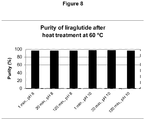
- solution 2 was prepared: liraglutide was dissolved in 60 °C hot water and kept on a water bath at 60 °C for 1, 20, and 120 minutes. The heat treatment of liraglutide was carried out in solution having pHs of about 8 and 10. After heat treatment solution 2 was cooled to 22 °C where after the two solutions were mixed and pH adjusted to 7.7 using sodium hydroxide and/or hydrochloric acid. Finally, the formulation was filtered through a 0.22 ⁇ m filter.
- the physical stability of the liraglutide preparations was evaluated by the use of a florescence method; the Thioflavine T-test where the histological thiazole dye Thioflavine T (ThT) was used as an indicator of fibril formation.
- Thioflavine T-test it was possible to determine the presence of fibrils in the different formulations. The method was based on the fluorescent characteristics of ThT. In the presence of fibrils, the fluorescence of ThT exhibited an excitation maximum at 450 nm and enhanced emission at 482 nm.
- the ThT fluorescence intensity has been shown to be linear with an increase in fibril concentration.
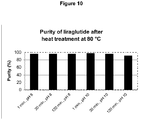
- the purity of the liraglutide preparations was measured by RP-HPLC.
- Solution 1 is prepared by dissolving preservative, isotonic agent, and buffer in water, pH was adjusted to 7.9.
- solution 2 is prepared: liraglutide is dissolved in 60°C hot water and kept on a water bath at 60°C for 1, 20, and 120 minutes. The heat treatment of liraglutide is carried out in a solution having a pH of about 8 to 10. The two solutions are mixed and pH adjusted to 8.15 using sodium hydroxide and/or hydrochloric acid. Finally, the formulation is filtered through a 0.22 ⁇ m filter.
- the physical stability of the liraglutide preparations is evaluated by the use of a florescence method; the Thioflavine T-test where the histological thiazole dye Thioflavine T (ThT) is used as an indicator of fibril formation.
- Thioflavine T-test it was possible to determine the presence of fibrils in the different formulations.
- the method is based on the fluorescent characteristics of ThT. In the presence of fibrils, the fluorescence of ThT exhibited an excitation maximum at 450 nm and enhanced emission at 482 nm.
- the ThT fluorescence intensity is shown to be linear with an increase in fibril concentration.
- Solution 1 was prepared by dissolving preservative, isotonic agent, and buffer in water, pH was adjusted to 7.3.
- solution 2 was prepared: liraglutide was dissolved in 80 °C hot water and kept on a water bath at 80 °C for 1, 30, and 120 minutes. The heat treatment of liraglutide was carried out in solution having pHs of about 8 and 10. After heat treatment solution 2 was cooled to 22 °C where after the two solutions were mixed and pH adjusted to 7.7 using sodium hydroxide and/or hydrochloric acid. Finally, the formulation was filtered through a 0.22 ⁇ m filter.
- Solution 1 is prepared by dissolving preservative, isotonic agent, and buffer in water, pH was adjusted to 7.9.
- solution 2 is prepared: liraglutide is dissolved in 80°C hot water and kept on a water bath at 80°C for 1, 20, and 120 minutes. The heat treatment of liraglutide is carried out in a solution having a pH of about 8 to 10. The two solutions are mixed and pH adjusted to 8.15 using sodium hydroxide and/or hydrochloric acid. Finally, the formulation is filtered through a 0.22 ⁇ m filter.
- the physical stability of the liraglutide preparations is evaluated by the use of a florescence method; the Thioflavine T-test where the histological thiazole dye Thioflavine T (ThT) is used as an indicator of fibril formation.
- Thioflavine T-test it was possible to determine the presence of fibrils in the different formulations.
- the method is based on the fluorescent characteristics of ThT. In the presence of fibrils, the fluorescence of ThT exhibited an excitation maximum at 450 nm and enhanced emission at 482 nm.
- the ThT fluorescence intensity is shown to be linear with an increase in fibril concentration.
- Solution 1 was prepared by dissolving preservative, isotonic agent, and buffer in water, pH was adjusted to 7.3.
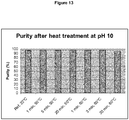
- solution 2 was prepared: liraglutide was dissolved in water of various temperatures: 22, 40, 60, and 80 °C and kept on a water bath for 15 minutes for all the investigated temperatures. The heat treatments of liraglutide were carried out in solution having a pH of about 10. After heat treatment solution 2 was cooled to 22 °C where after the two solutions were mixed and pH adjusted to 7.7 using sodium hydroxide and/or hydrochloric acid. Finally, the formulation was filtered through a 0.22 ⁇ m filter.
- liraglutide drug substance Prior to freeze-drying liraglutide drug substance is dissolved in 70-80°C hot water at pH about 8.0-10.0 to a concentration of 10-100 g/L. The heat treatment is carried out for 3-30 minutes. Hereafter the DS is freeze-dried. Subsequently, the freeze-dried drug substance is dissolved in water. The concentration is about 10-100 g/L and the pH of the solution (solution 2) is about 8-10.
- Another solution (solution 1) is prepared by dissolving preservative, isotonic agent, and buffer in water. pH is adjusted to 7.9. The two solutions are mixed and pH is adjusted to 8.15 using sodium hydroxide and/or hydrochloric acid..
- the base treatment of example 10a may be performed with or without the described heat treatment of example 10 before freeze drying.
- the treatment of drug substance in example 10a may be performed at 75°C for 8 min before freeze drying.
- liraglutide drug substance Prior to freeze-drying liraglutide drug substance is dissolved in 70-80°C hot water at pH about 8.0-10.0 to a concentration of 10-100 g/L. The heat treatment is carried out for 3-30 minutes. Hereafter the DS is freeze-dried. Subsequently, the freeze-dried drug substance is dissolved in water. The concentration is about 10-100 g/L and the pH of the solution (solution 2) is about 8-10.
- Another solution (solution 1) is prepared by dissolving preservative, isotonic agent, and buffer in water. pH is adjusted to 7.3. The two solutions are mixed and pH is adjusted to 7.7 using sodium hydroxide and/or hydrochloric acid..
- the base treatment of example 10c may be performed with or without the described heat treatment of example 10b before freeze drying.
- the treatment of drug substance in example 10c may be performed at 75°C for 8 min before freeze drying.
- Liraglutide was dissolved in water at room temperature and pH was adjusted to pH 10. The solution was heated on a water bath at 50 and 80°C for 1, 3, 5 and 20 minutes. After heat treatment, the solution was cooled to 22 °C on a water batch. The solution was then filtered through a 0.22 ⁇ m filter and freeze dried. The powder was dissolved in a solution containing preservative, isotonic agent, and buffer components and pH was adjusted to pH 7.7 using sodium hydroxide and/or hydrochloric acid.
- Liraglutide was dissolved in water at room temperature and pH was adjusted to pH 9 and 10. The solution was heated on a water bath at 60 and 80°C for 1 and 15 minutes. After heat treatment, the solution was cooled to 22 °C on a water bath. The solution was then filtered through a 0.22 ⁇ m filter and freeze dried. The powder was dissolved in a solution containing preservative, isotonic agent and buffer components and pH was adjusted to pH 7.7.
- Solution 1 was prepared by dissolving preservative, isotonic agent, and buffer in water, pH was adjusted to 7.9.
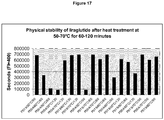
- solution 2 was prepared: liraglutide was dissolved in 60 - 70°C hot water and kept on a water bath at 50, 60, and 70°C for 60, 90, and 120 minutes. The heat treatment of liraglutide was carried out in solution having pHs of about 8 and 10. After heat treatment solution 2 was cooled to 22 °C where after the two solutions were mixed and pH adjusted to 8.15 using sodium hydroxide and/or hydrochloric acid. Finally, the formulation was filtered through a 0.22 ⁇ m filter.
- the physical stability of the liraglutide preparations were evaluated by the use of a florescence method; the Thioflavine T-test where the histological thiazole dye Thioflavine T (ThT) was used as an indicator of fibril formation.
- Thioflavine T-test it was possible to determine the presence of fibrils in the different formulations. The method was based on the fluorescent characteristics of ThT. In the presence of fibrils, the fluorescence of ThT exhibited an excitation maximum at 450 nm and enhanced emission at 482 nm.
- the ThT fluorescence intensity has been shown to be linear with an increase in fibril concentration.
- Solution 1 was prepared by dissolving preservative, isotonic agent, and buffer in water, pH was adjusted to 7.9.
- solution 2 was prepared: liraglutide was dissolved in 60 - 70°C hot water and kept on a water bath at 50, 60, 65, and 70°C for 30, 45, 150, and 180 minutes. The heat treatment of liraglutide was carried out in solution having pHs of about 8 and 10. After heat treatment solution 2 was cooled to 22 °C where after the two solutions were mixed and pH adjusted to 8.15 using sodium hydroxide and/or hydrochloric acid. Finally, the formulation was filtered through a 0.22 ⁇ m filter. The physical stability of the liraglutide preparations were evaluated by the use of a florescence method as described in example 14.
- the formulations as described above may all include surfactants as described previously in examples 8 - 15 and surfactants as described above.
- the surfactants are dissolved in solution 1 and subsequently admixed with solution 2 resulting in a final formulation.
- the surfactants can be in concentrations of 0 - 50 mg/ml.
- Penfill® containing fibrillated liraglutide were heat treated for 30 min at 85°C.
- Freshly produced liraglutide drug product has a turbidity of approx. 0,2-1,0 NTU.
- heat treatment of highly fibrillated liraglutide drug product can dissolve the otherwise very stable fibril structures.
- Penfill before heat treatment NTU
- Penfill after heat treatment NTU
- Approx. 50 average of 10 penfill containing fibrillated liraglutide DP
- Figure 18 shows Penfill® heat treated at different times and temperatures which were subsequently subjected to rotation.
- the procedure is as follows: Prior to freeze-drying liraglutide drug substance is dissolved in 70-80°C hot water at pH about 8.0-10.0 to a concentration of 10-100 g/L. The heat treatment is carried out for 3-30 minutes. Hereafter the drug substance is freeze-dried. Subsequently, the freeze-dried drug substance is dissolved in 50-80°C hot water for 30-180 min. The concentration is about 10-100 g/L and the pH of the solution (solution 2) is about 8-10.
- Another solution (solution 1) is prepared by dissolving preservative, isotonic agent, and buffer in water. pH is adjusted to 7.9.
- the two solutions are mixed and pH is adjusted to 8.15 using sodium hydroxide and/or hydrochloric acid. Finally, the formulation is filtered through a 0.22 ⁇ m filter. Either before or after filling in container-closure systems, the resulting liraglutide drug product can be exposed to heat treatment at 60-95°C for 10-90 min.
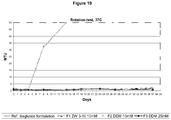
- n-Dodecyl- ⁇ -D-maltoside (DDM) and Zwittergent 3-10 in formulations comprising liraglutide The formulations F1, F2 and F3 were tested.
- the turbidity of the formulation is characterized by nephelometric measurement of the turbidity on a HACH Turbidimeter 2100AN.
- the turbidity measurement of a liquid is specified in "Nephelometric Turbidity Unit" (NTU).
- NTU Nephelometric Turbidity Unit
Landscapes
- Health & Medical Sciences (AREA)
- Life Sciences & Earth Sciences (AREA)
- Chemical & Material Sciences (AREA)
- Medicinal Chemistry (AREA)
- General Health & Medical Sciences (AREA)
- Animal Behavior & Ethology (AREA)
- Veterinary Medicine (AREA)
- Public Health (AREA)
- Pharmacology & Pharmacy (AREA)
- Engineering & Computer Science (AREA)
- Epidemiology (AREA)
- Bioinformatics & Cheminformatics (AREA)
- General Chemical & Material Sciences (AREA)
- Chemical Kinetics & Catalysis (AREA)
- Proteomics, Peptides & Aminoacids (AREA)
- Endocrinology (AREA)
- Organic Chemistry (AREA)
- Zoology (AREA)
- Gastroenterology & Hepatology (AREA)
- Immunology (AREA)
- Diabetes (AREA)
- Oil, Petroleum & Natural Gas (AREA)
- Nuclear Medicine, Radiotherapy & Molecular Imaging (AREA)
- Obesity (AREA)
- Biochemistry (AREA)
- Hematology (AREA)
- Molecular Biology (AREA)
- Dermatology (AREA)
- Genetics & Genomics (AREA)
- Biophysics (AREA)
- Toxicology (AREA)
- Child & Adolescent Psychology (AREA)
- Emergency Medicine (AREA)
- Medicines That Contain Protein Lipid Enzymes And Other Medicines (AREA)
- Medicinal Preparation (AREA)
- Peptides Or Proteins (AREA)
Claims (23)
- Procédé de préparation d'une solution stable d'un dérivé insulinotropique de GLP-1(7-37), lequel procédé comprend le chauffage d'une solution dudit dérivé insulinotropique, dans lequel la température est entre 50 °C et 85 °C, le pH est entre 8,0 et 10,5 et ledit chauffage est poursuivi pendant une durée qui est entre 3 minutes et 180 minutes.
- Procédé selon la revendication 1, dans lequel ladite température est entre 60 °C et 85 °C.
- Procédé selon l'une quelconque des revendications précédentes, dans lequel ladite température est entre 70 °C et 85 °C.
- Procédé selon l'une quelconque des revendications précédentes, dans lequel ledit pH est entre 8,0 et 10,0.
- Procédé selon l'une quelconque des revendications précédentes, dans lequel ledit pH est entre 8,0 et 9,7.
- Procédé selon l'une quelconque des revendications précédentes, dans lequel ledit pH est entre 8,5 et 10,5.
- Procédé selon l'une quelconque des revendications précédentes, dans lequel ledit pH est entre 8,5 et 10,0.
- Procédé selon l'une quelconque des revendications 1 à 5, dans lequel le pH est égal à 8,15.
- Procédé selon l'une quelconque des revendications 1 à 8, dans lequel ledit chauffage est poursuivi pendant une durée qui est entre 15 minutes et 120 minutes.
- Procédé selon l'une quelconque des revendications 1 à 8, dans lequel ledit chauffage est poursuivi pendant une durée qui est entre 10 minutes et 90 minutes.
- Procédé selon l'une quelconque des revendications 1 à 8, dans lequel ledit chauffage est poursuivi pendant une durée qui est entre 3 minutes et 30 minutes.
- Procédé selon l'une quelconque des revendications 1 à 8, dans lequel ledit dérivé insulinotropique est l'Arg34, Lys26(Nε-(y-Glu(Nα-hexadécanoyl)))-GLP-1(7-37) et dans lequel ledit chauffage est poursuivi pendant une durée qui est entre 15 minutes et 20 minutes.
- Procédé selon l'une quelconque des revendications 1 à 8, dans lequel ledit chauffage est poursuivi pendant une durée qui est entre 5 minutes et 15 minutes.
- Procédé selon l'une quelconque des revendications 1 à 8, dans lequel ledit chauffage est poursuivi pendant une durée qui est entre 5 minutes et 30 minutes.
- Procédé selon la revendication 1, dans lequel ledit pH est entre pH 9 et pH 10,5 et ledit procédé comprend un chauffage à une température entre 70 °C et 85 °C pendant une durée qui est entre 3 minutes et 20 minutes.
- Procédé de préparation d'un dérivé insulinotropique de GLP-1(7-37) stable, lequel procédé comprend le fait qu'un produit peptide en vrac est produit par la procédure telle que définie dans l'une quelconque des revendications 1 à 15, suivie d'une lyophilisation de la solution ou de la suspension dudit dérivé insulinotropique.
- Procédé de préparation d'une composition pharmaceutique d'un dérivé insulinotropique de GLP-1(7-37) à longue durée de conservation, lequel procédé comprend le fait que la composition pharmaceutique est préparée à partir d'un produit lyophilisé produit par la procédure telle que définie dans la revendication 16, suivie d'un ou de plusieurs parmi les procédés selon l'une quelconque des revendications 1 à 15.
- Procédé selon la revendication 17, lequel procédé est effectué soit avant le remplissage dans un système d'administration final, soit après le remplissage dans un système d'administration final, soit les deux.
- Procédé de préparation d'une composition pharmaceutique d'un dérivé insulinotropique de GLP-1(7-37) à longue conservation, lequel procédé comprend les procédés selon l'une quelconque des revendications 1 à 16 suivis d'une addition d'excipients pharmaceutiquement acceptables.
- Procédé selon l'une quelconque des revendications 17 à 19, dans lequel la concentration dudit dérivé insulinotropique dans ladite composition pharmaceutique est de 5 µg/ml à 10 mg/ml, par exemple, de 1 mg/ml à 10 mg/ml.
- Procédé selon l'une quelconque des revendications 1 à 19, dans lequel la concentration dudit dérivé insulinotropique, durant le traitement de chauffage est dans la plage de 10 g/l à 100 g/l.
- Procédé selon l'une quelconque des revendications précédentes, dans lequel ledit dérivé insulinotropique est l'Arg34, Lys26(Nε-(γ-Glu(Nα-hexadécanoyl)))-GLP-1(7-37).
- Procédé selon l'une quelconque des revendications précédentes, dans lequel ledit dérivé insulinotropique est soit (i) dissout dans une solution aqueuse ayant la température finale, soit (ii) dissout dans une solution aqueuse ayant la température ambiante, suivi d'un chauffage à la température appropriée pendant la durée spécifiée.
Applications Claiming Priority (7)
| Application Number | Priority Date | Filing Date | Title |
|---|---|---|---|
| DKPA200401753 | 2004-11-12 | ||
| DKPA200401906 | 2004-12-08 | ||
| EP05104050 | 2005-05-13 | ||
| EP05104172 | 2005-05-18 | ||
| PCT/EP2005/055916 WO2006051103A2 (fr) | 2004-11-12 | 2005-11-11 | Préparations stables de peptides |
| EP05817542.3A EP1817048B2 (fr) | 2004-11-12 | 2005-11-14 | Formulations stables de peptides insulinotrophiques |
| PCT/EP2005/055946 WO2006051110A2 (fr) | 2004-11-12 | 2005-11-14 | Formulations stables de peptides |
Related Parent Applications (2)
| Application Number | Title | Priority Date | Filing Date |
|---|---|---|---|
| EP05817542.3A Division EP1817048B2 (fr) | 2004-11-12 | 2005-11-14 | Formulations stables de peptides insulinotrophiques |
| EP05817542.3A Division-Into EP1817048B2 (fr) | 2004-11-12 | 2005-11-14 | Formulations stables de peptides insulinotrophiques |
Publications (2)
| Publication Number | Publication Date |
|---|---|
| EP2494983A1 EP2494983A1 (fr) | 2012-09-05 |
| EP2494983B1 true EP2494983B1 (fr) | 2019-04-24 |
Family
ID=39560969
Family Applications (2)
| Application Number | Title | Priority Date | Filing Date |
|---|---|---|---|
| EP12153063.8A Revoked EP2494983B1 (fr) | 2004-11-12 | 2005-11-14 | Formulation stable de glp-1 |
| EP05817542.3A Expired - Lifetime EP1817048B2 (fr) | 2004-11-12 | 2005-11-14 | Formulations stables de peptides insulinotrophiques |
Family Applications After (1)
| Application Number | Title | Priority Date | Filing Date |
|---|---|---|---|
| EP05817542.3A Expired - Lifetime EP1817048B2 (fr) | 2004-11-12 | 2005-11-14 | Formulations stables de peptides insulinotrophiques |
Country Status (13)
| Country | Link |
|---|---|
| US (1) | US8748376B2 (fr) |
| EP (2) | EP2494983B1 (fr) |
| JP (1) | JP5175103B2 (fr) |
| KR (1) | KR101340354B1 (fr) |
| CN (3) | CN105832658B (fr) |
| AU (1) | AU2005303777B2 (fr) |
| BR (1) | BRPI0517341A (fr) |
| CA (1) | CA2586771A1 (fr) |
| ES (2) | ES2458991T5 (fr) |
| MX (1) | MX2007005521A (fr) |
| PL (1) | PL1817048T5 (fr) |
| RU (1) | RU2413530C9 (fr) |
| WO (1) | WO2006051110A2 (fr) |
Cited By (2)
| Publication number | Priority date | Publication date | Assignee | Title |
|---|---|---|---|---|
| WO2020127476A1 (fr) | 2018-12-19 | 2020-06-25 | Krka, D.D., Novo Mesto | Composition pharmaceutique comprenant un analogue de glp -1 |
| WO2021123228A1 (fr) | 2019-12-18 | 2021-06-24 | Krka, D.D., Novo Mesto | Composition pharmaceutique comprenant un analogue de glp-1 |
Families Citing this family (77)
| Publication number | Priority date | Publication date | Assignee | Title |
|---|---|---|---|---|
| US9895444B2 (en) | 2004-08-25 | 2018-02-20 | Aegis Therapeutics, Llc | Compositions for drug administration |
| US20140162965A1 (en) | 2004-08-25 | 2014-06-12 | Aegis Therapeutics, Inc. | Compositions for oral drug administration |
| US20060046962A1 (en) | 2004-08-25 | 2006-03-02 | Aegis Therapeutics Llc | Absorption enhancers for drug administration |
| US8268791B2 (en) | 2004-08-25 | 2012-09-18 | Aegis Therapeutics, Llc. | Alkylglycoside compositions for drug administration |
| EP2494983B1 (fr) | 2004-11-12 | 2019-04-24 | Novo Nordisk A/S | Formulation stable de glp-1 |
| JP5248113B2 (ja) * | 2004-11-12 | 2013-07-31 | ノヴォ ノルディスク アー/エス | ペプチドの安定な処方 |
| TWI372629B (en) | 2005-03-18 | 2012-09-21 | Novo Nordisk As | Acylated glp-1 compounds |
| US7998927B2 (en) * | 2006-06-23 | 2011-08-16 | Aegis Therapeutics, Llc | Stabilizing alkylglycoside compositions and methods thereof |
| US8084022B2 (en) | 2006-06-23 | 2011-12-27 | Aegis Therapeutics, Llc | Stabilizing alkylglycoside compositions and methods thereof |
| US7425542B2 (en) | 2006-06-23 | 2008-09-16 | Aegis Therapeutics, Inc. | Stabilizing alkylglycoside compositions and methods thereof |
| US8173594B2 (en) | 2006-06-23 | 2012-05-08 | Aegis Therapeutics, Llc | Stabilizing alkylglycoside compositions and methods thereof |
| US8226949B2 (en) | 2006-06-23 | 2012-07-24 | Aegis Therapeutics Llc | Stabilizing alkylglycoside compositions and methods thereof |
| US8758648B2 (en) | 2008-03-19 | 2014-06-24 | Arkray, Inc. | Stabilizer of color former and use thereof |
| JP5613657B2 (ja) | 2008-03-28 | 2014-10-29 | ヘイル バイオファーマ ベンチャーズ,エルエルシー | ベンゾジアゼピン組成物の投与 |
| PT3228320T (pt) | 2008-10-17 | 2020-03-26 | Sanofi Aventis Deutschland | Combinação de uma insulina e de um agonista do glp-1 |
| KR101853606B1 (ko) | 2009-07-06 | 2018-05-03 | 사노피-아벤티스 도이칠란트 게엠베하 | 메티오닌을 함유하는 수성 인슐린 제제 |
| AP3329A (en) | 2009-07-13 | 2015-06-30 | Zealand Pharma As | Acylated glucagon analogues |
| DE102010011919A1 (de) | 2010-03-18 | 2011-09-22 | Sanofi-Aventis Deutschland Gmbh | Pharmazeutische Zusammensetzung umfassend einen GLP-1-Agonisten und Methionin |
| KR101337322B1 (ko) | 2009-11-13 | 2013-12-06 | 사노피-아벤티스 도이칠란트 게엠베하 | Glp-1 효능제 및 메티오닌을 포함하는 약제학적 조성물 |
| DK2498802T3 (en) | 2009-11-13 | 2015-04-13 | Sanofi Aventis Deutschland | Pharmaceutical composition comprising a GLP-1 agonist, insulin and a methionine |
| ES2606554T3 (es) | 2010-08-30 | 2017-03-24 | Sanofi-Aventis Deutschland Gmbh | Uso de AVE0010 para la fabricación de un medicamento para el tratamiento de la diabetes mellitus de tipo 2 |
| JP5759211B2 (ja) * | 2011-03-11 | 2015-08-05 | 三洋化成工業株式会社 | 凍結乾燥方法 |
| US9821032B2 (en) | 2011-05-13 | 2017-11-21 | Sanofi-Aventis Deutschland Gmbh | Pharmaceutical combination for improving glycemic control as add-on therapy to basal insulin |
| DK3415139T3 (da) | 2011-06-14 | 2022-06-20 | Neurelis Inc | Administration af benzodiazepin |
| PL2750699T3 (pl) | 2011-08-29 | 2015-12-31 | Sanofi Aventis Deutschland | Kombinacja farmaceutyczna do stosowania w kontroli glikemii u pacjentów z cukrzycą typu 2 |
| AR087744A1 (es) | 2011-09-01 | 2014-04-16 | Sanofi Aventis Deutschland | Composicion farmaceutica para uso en el tratamiento de una enfermedad neurodegenerativa |
| NZ702333A (en) | 2012-05-03 | 2017-06-30 | Zealand Pharma As | Gip-glp-1 dual agonist compounds and methods |
| RS67258B1 (sr) | 2012-07-01 | 2025-10-31 | Novo Nordisk As | Upotreba dugodelujućih glp-1 peptida |
| MX356957B (es) | 2012-07-23 | 2018-06-20 | Zealand Pharma As | Analogos del glucagon. |
| TWI608013B (zh) | 2012-09-17 | 2017-12-11 | 西蘭製藥公司 | 升糖素類似物 |
| UA116217C2 (uk) | 2012-10-09 | 2018-02-26 | Санофі | Пептидна сполука як подвійний агоніст рецепторів glp1-1 та глюкагону |
| JP6525456B2 (ja) | 2012-11-20 | 2019-06-05 | メデリス ダイアビーティーズ,エルエルシー | インスリン抵抗性のための改善されたペプチド製剤 |
| JP2016506401A (ja) | 2012-12-21 | 2016-03-03 | サノフイ | 二重glp1/gipまたは三方glp1/gip/グルカゴンアゴニストとしてのエキセンジン−4誘導体 |
| CN103893744B (zh) * | 2012-12-24 | 2017-12-19 | 杭州九源基因工程有限公司 | 一种治疗糖尿病的药物制剂及其制备方法 |
| KR20140088837A (ko) * | 2013-01-03 | 2014-07-11 | 한미약품 주식회사 | N-말단 전하가 변형된 인슐린 분비 펩티드 유도체 |
| TWI641381B (zh) | 2013-02-04 | 2018-11-21 | 法商賽諾菲公司 | 胰島素類似物及/或胰島素衍生物之穩定化醫藥調配物 |
| CN103405753B (zh) * | 2013-08-13 | 2016-05-11 | 上海仁会生物制药股份有限公司 | 稳定的促胰岛素分泌肽水针药物组合物 |
| LT3057984T (lt) | 2013-10-17 | 2018-12-27 | Zealand Pharma A/S | Acilinti gliukagono analogai |
| US9988429B2 (en) | 2013-10-17 | 2018-06-05 | Zealand Pharma A/S | Glucagon analogues |
| KR102310392B1 (ko) | 2013-11-06 | 2021-10-13 | 질랜드 파마 에이/에스 | 글루카곤-glp-1-gip 삼원 효능제 화합물 |
| AU2014345569B2 (en) | 2013-11-06 | 2020-08-13 | Zealand Pharma A/S | GIP-GLP-1 dual agonist compounds and methods |
| TW201609799A (zh) | 2013-12-13 | 2016-03-16 | 賽諾菲公司 | 雙重glp-1/gip受體促效劑 |
| WO2015086733A1 (fr) | 2013-12-13 | 2015-06-18 | Sanofi | Agonistes mixtes des récepteurs du glp-1/glucagon |
| TW201609796A (zh) | 2013-12-13 | 2016-03-16 | 賽諾菲公司 | 非醯化之艾塞那肽-4(exendin-4)胜肽類似物 |
| EP3080150B1 (fr) | 2013-12-13 | 2018-08-01 | Sanofi | Analogues peptidiques d'exendine-4 en tant qu'agonistes du récepteur gip/glp-1 double |
| EP3091965A1 (fr) | 2014-01-09 | 2016-11-16 | Sanofi | Formulations pharmaceutiques stabilisées sans glycérol d'analogues de l'insuline et/ou de dérivés de l'insuline |
| SG11201604706TA (en) | 2014-01-09 | 2016-07-28 | Sanofi Sa | Stabilized pharmaceutical formulations of insulin aspart |
| CN112957455A (zh) | 2014-01-09 | 2021-06-15 | 赛诺菲 | 胰岛素类似物和/或胰岛素衍生物的稳定化药物制剂 |
| TW201625668A (zh) | 2014-04-07 | 2016-07-16 | 賽諾菲公司 | 作為胜肽性雙重glp-1/昇糖素受體激動劑之艾塞那肽-4衍生物 |
| TW201625670A (zh) | 2014-04-07 | 2016-07-16 | 賽諾菲公司 | 衍生自exendin-4之雙重glp-1/升糖素受體促效劑 |
| TW201625669A (zh) | 2014-04-07 | 2016-07-16 | 賽諾菲公司 | 衍生自艾塞那肽-4(Exendin-4)之肽類雙重GLP-1/升糖素受體促效劑 |
| US9932381B2 (en) | 2014-06-18 | 2018-04-03 | Sanofi | Exendin-4 derivatives as selective glucagon receptor agonists |
| RU2716985C2 (ru) | 2014-10-29 | 2020-03-17 | Зилэнд Фарма А/С | Соединения-агонисты gip и способы |
| AU2015359376B2 (en) | 2014-12-12 | 2021-09-09 | Sanofi-Aventis Deutschland Gmbh | Insulin glargine/lixisenatide fixed ratio formulation |
| TWI748945B (zh) | 2015-03-13 | 2021-12-11 | 德商賽諾菲阿凡提斯德意志有限公司 | 第2型糖尿病病患治療 |
| TW201705975A (zh) | 2015-03-18 | 2017-02-16 | 賽諾菲阿凡提斯德意志有限公司 | 第2型糖尿病病患之治療 |
| JP6989385B2 (ja) | 2015-04-16 | 2022-01-05 | ジーランド ファーマ アクティーゼルスカブ | アシル化グルカゴン類似体 |
| AR105319A1 (es) | 2015-06-05 | 2017-09-27 | Sanofi Sa | Profármacos que comprenden un conjugado agonista dual de glp-1 / glucagón conector ácido hialurónico |
| CA2989283A1 (fr) * | 2015-06-16 | 2016-12-22 | Sun Pharma Advanced Research Company Limited | Compositions de liraglutide a action prolongee |
| TW201706291A (zh) | 2015-07-10 | 2017-02-16 | 賽諾菲公司 | 作為選擇性肽雙重glp-1/升糖素受體促效劑之新毒蜥外泌肽(exendin-4)衍生物 |
| TW201832783A (zh) | 2016-12-02 | 2018-09-16 | 法商賽諾菲公司 | 包含glp-1/胰高血糖素雙重激動劑、連接子和透明質酸的接合物 |
| IL322969A (en) | 2017-10-12 | 2025-10-01 | Novo Nordisk As | Semaglutide in medical therapy |
| US20210261642A1 (en) | 2017-12-19 | 2021-08-26 | Novo Nordisk A/S | Solubility of glp-1 peptide |
| FI3735295T3 (fi) | 2018-01-03 | 2024-11-20 | Mederis Diabetes Llc | Parannetut peptidilääkkeet nashin ja muiden sairauksien hoitoon |
| TWI705820B (zh) | 2018-06-22 | 2020-10-01 | 美商美國禮來大藥廠 | Gip/glp1促效劑組合物 |
| WO2020104833A1 (fr) * | 2018-11-19 | 2020-05-28 | 4P-Pharma | Composition et procédés pour réguler la prolifération de chondrocytes et augmenter la production de matrice cartilagineuse |
| US20220143150A1 (en) * | 2019-02-06 | 2022-05-12 | Enzene Biosciences Limited | Glucagon-like peptide-1 (glp-1) agonist analog, process of preparation and uses thereof |
| WO2020208541A1 (fr) * | 2019-04-08 | 2020-10-15 | Enzene Biosciences Limited | Composition comprenant un analogue de glp-1 |
| JP7752619B2 (ja) * | 2020-02-21 | 2025-10-10 | スピットファイア ファーマ エルエルシー | Glp-1rおよびgcgrアゴニスト、製剤、ならびに使用方法 |
| JP2023532764A (ja) * | 2020-07-07 | 2023-07-31 | エフ. ホフマン-ラ ロシュ アーゲー | 治療用タンパク質製剤の安定剤としての代替界面活性剤 |
| US12171806B2 (en) | 2021-09-28 | 2024-12-24 | Spitfire Pharma Llc | Therapeutic regimens and methods for lowering blood glucose and/or body weight using GLP-1R and GCGR balanced agonists |
| WO2022178737A1 (fr) * | 2021-02-25 | 2022-09-01 | 杭州九源基因工程有限公司 | Procédé de traitement pour préparation pharmaceutique stable de liraglutide |
| US12599611B2 (en) | 2021-06-10 | 2026-04-14 | Neurelis, Inc. | Methods and compositions for treating seizure disorders in pediatric patients |
| CN118924882A (zh) * | 2023-05-10 | 2024-11-12 | 上海仁会生物制药股份有限公司 | 药物组合物及其用途、提高药物组合物贮存稳定性的方法 |
| CN116832147B (zh) * | 2023-08-28 | 2023-11-07 | 谛邈生物科技(北京)有限公司 | Glp1多肽药物冻干闪释片及其制备方法 |
| EP4656183A1 (fr) | 2024-05-31 | 2025-12-03 | Galenicum Health SLU | Compositions de tirzépatide et méthode de préparation |
| EP4656181A1 (fr) | 2024-05-31 | 2025-12-03 | Galenicum Health S.L.U. | Compositions glp-1 et procédé de préparation |
Citations (7)
| Publication number | Priority date | Publication date | Assignee | Title |
|---|---|---|---|---|
| EP0577147A2 (fr) | 1988-06-21 | 1994-01-05 | Yoshie Kurihara | Procédé de stabilisation d'un agent modifiant le goût |
| WO2001077141A1 (fr) | 2000-04-06 | 2001-10-18 | Novo Nordisk A/S | Traitement de polypeptides par choc thermique chaud |
| WO2003002136A2 (fr) | 2001-06-28 | 2003-01-09 | Novo Nordisk A/S | Formulation stable de glp-1 modifie |
| WO2004029076A2 (fr) | 2002-09-25 | 2004-04-08 | Novo Nordisk A/S | Procede de purification comprenant une microfiltration a des temperatures elevees |
| US20040164023A1 (en) | 2002-09-25 | 2004-08-26 | Christensen Lars Hojlund | Purification process comprising microfiltration at elevated temperatures |
| WO2004105781A2 (fr) | 2003-06-03 | 2004-12-09 | Novo Nordisk A/S | Compositions pharmaceutiques peptidiques stabilisees |
| WO2006051110A2 (fr) | 2004-11-12 | 2006-05-18 | Novo Nordisk A/S | Formulations stables de peptides |
Family Cites Families (79)
| Publication number | Priority date | Publication date | Assignee | Title |
|---|---|---|---|---|
| US4468346A (en) | 1983-10-27 | 1984-08-28 | The United States Of America As Represented By The Secretary Of Agriculture | Monoclonal antibodies to porcine immunoglobulins |
| JPS62292772A (ja) † | 1986-06-12 | 1987-12-19 | Shikoku Chem Corp | シアヌル酸製造装置 |
| DE3641115A1 (de) * | 1986-12-02 | 1988-06-16 | Lentia Gmbh | Verfahren zur herstellung eines intravenoes anwendbaren und in fluessiger form stabilen immunglobulins |
| AU616411B2 (en) | 1987-05-14 | 1991-10-31 | Commonwealth Scientific And Industrial Research Organisation | Whey protein fractions |
| JPH03505401A (ja) | 1988-06-27 | 1991-11-28 | ジェネックス・コーポレーション | 組換えタンパク質の培養培地への熱放出 |
| DE69013471T2 (de) | 1989-12-05 | 1995-03-30 | Merck & Co Inc | Methode zur Stabilisierung von rekombinanten Hepatitis-B-Virus-Oberflächenproteinen aus Hefe. |
| DE4002066A1 (de) | 1990-01-25 | 1991-08-01 | Basf Ag | Verfahren zur abtrennung von riboflavin aus fermentationssuspensionen |
| US5272135A (en) | 1991-03-01 | 1993-12-21 | Chiron Ophthalmics, Inc. | Method for the stabilization of methionine-containing polypeptides |
| SE9101381D0 (sv) | 1991-05-07 | 1991-05-07 | Tomas Moks | Peptide hormone solution |
| US5206219A (en) | 1991-11-25 | 1993-04-27 | Applied Analytical Industries, Inc. | Oral compositions of proteinaceous medicaments |
| DK36492D0 (da) | 1992-03-19 | 1992-03-19 | Novo Nordisk As | Praeparat |
| SG45449A1 (en) | 1992-05-13 | 1998-01-16 | Sandoz Ltd | Ophthalmic compositions |
| US6284727B1 (en) | 1993-04-07 | 2001-09-04 | Scios, Inc. | Prolonged delivery of peptides |
| AU7531094A (en) | 1993-08-24 | 1995-03-21 | Novo Nordisk A/S | Protracted glp-1 |
| GB9320782D0 (en) | 1993-10-08 | 1993-12-01 | Univ Leeds Innovations Ltd | Stabilising of proteins on solution |
| CA2176462A1 (fr) | 1993-11-19 | 1995-05-26 | Larry P. Feigen | Preparation transdermique de n-[n-[5-[4-(aminoiminomethyl)phenyl]-1-oxopentyl]-l-.alpha.-aspartyl]-l-phenylalanine ou de ses esters et de leurs sels acceptables pharmaceutiquement |
| US5705483A (en) | 1993-12-09 | 1998-01-06 | Eli Lilly And Company | Glucagon-like insulinotropic peptides, compositions and methods |
| WO1995022560A1 (fr) | 1994-02-22 | 1995-08-24 | The Syntex-Synergen Neuroscience Joint Venture | Formulations pharmaceutiques comprenant un facteur neurotrophique ciliaire |
| US5652216A (en) | 1994-05-26 | 1997-07-29 | Novo Nordisk A/S | Pharmaceutical preparation |
| CA2157219C (fr) | 1994-08-31 | 2010-10-05 | Munehiro Noda | Procede pour la purification d'albumine de serum humain recombinante |
| US5512549A (en) | 1994-10-18 | 1996-04-30 | Eli Lilly And Company | Glucagon-like insulinotropic peptide analogs, compositions, and methods of use |
| WO1996020005A1 (fr) | 1994-12-23 | 1996-07-04 | Novo Nordisk A/S | Compositions a base de glp-1 et a action prolongee |
| JP2000510813A (ja) | 1995-02-06 | 2000-08-22 | ジェネテイックス・インスティテュート・インコーポレイテッド | Il−12用処方 |
| US5834428A (en) | 1995-04-14 | 1998-11-10 | 1149336 Ontario Inc. | Glucagon-like peptide-2 and its therapeutic use |
| US6184201B1 (en) | 1995-04-14 | 2001-02-06 | Nps Allelix Corp. | Intestinotrophic glucagon-like peptide-2 analogs |
| AU5996996A (en) | 1995-06-02 | 1996-12-18 | Novo Nordisk A/S | Al/fe-treatment of a protein solution, followed by membrane concentration |
| US5631347A (en) | 1995-06-07 | 1997-05-20 | Eli Lilly And Company | Reducing gelation of a fatty acid-acylated protein |
| DE19530865A1 (de) * | 1995-08-22 | 1997-02-27 | Michael Dr Med Nauck | Wirkstoff sowie Mittel zur parenteralen Ernährung |
| JPH10101696A (ja) | 1996-08-08 | 1998-04-21 | Shinotesuto:Kk | 形質転換体にて発現される蛋白質に含まれる夾雑物質の除去方法及び精製蛋白質 |
| JP3149958B2 (ja) * | 1996-08-30 | 2001-03-26 | ノボ ノルディスク アクティーゼルスカブ | Glp―1誘導体 |
| US6268343B1 (en) | 1996-08-30 | 2001-07-31 | Novo Nordisk A/S | Derivatives of GLP-1 analogs |
| KR20000070338A (ko) | 1997-01-20 | 2000-11-25 | 나가시마 카쭈시게, 노미야마 아키히코 | 펩티드의 안정화 방법 및 당해 방법을 이용한 펩티드 함유 동결건조 의약조성물 |
| CA2236519C (fr) | 1997-05-02 | 2011-09-13 | 1149336 Ontario Inc. | Methodes pour ameliorer le fonctionnement du gros intestin |
| ZA984697B (en) | 1997-06-13 | 1999-12-01 | Lilly Co Eli | Stable insulin formulations. |
| CA2306024C (fr) | 1997-10-01 | 2011-04-26 | Flemington Pharmaceutical Corporation | Pulverisation ou capsule buccale, polaire et non polaire |
| CN1243762C (zh) | 1997-10-10 | 2006-03-01 | Omg英国有限公司 | 橡胶粘合促进剂 |
| WO1999021889A1 (fr) | 1997-10-24 | 1999-05-06 | Genentech, Inc. | Purification de molecules |
| CA2312190A1 (fr) * | 1997-12-05 | 1999-06-17 | Eli Lilly And Company | Formulations de glp-1 |
| US6380357B2 (en) | 1997-12-16 | 2002-04-30 | Eli Lilly And Company | Glucagon-like peptide-1 crystals |
| WO1999043706A1 (fr) | 1998-02-27 | 1999-09-02 | Novo Nordisk A/S | Derives d'analogues de glp-1 |
| AU2610899A (en) | 1998-02-27 | 1999-09-15 | Novo Nordisk A/S | N-terminally modified glp-1 derivatives |
| JP2002504518A (ja) | 1998-02-27 | 2002-02-12 | ノボ ノルディスク アクティーゼルスカブ | 部分的に構造化されたミセルー様凝集体を形成する、25%を超えるヘリックス−含有率を有するglp−1誘導体 |
| ATE269103T1 (de) | 1998-03-13 | 2004-07-15 | Novo Nordisk As | Stabilisierte wässerige glukagonlösungen enthaltend detergenzien |
| US6245572B1 (en) | 1998-05-01 | 2001-06-12 | University Of Tennessee Research Corporation | Flow cytometric characterization of amyloid fibrils |
| ATE260674T1 (de) * | 1998-08-17 | 2004-03-15 | Pfizer Prod Inc | Stabilisierte proteinzusammensetzung |
| BR9913857A (pt) | 1998-09-17 | 2001-06-12 | Lilly Co Eli | Formulações de proteìna |
| CA2358107C (fr) * | 1998-12-22 | 2011-08-23 | Eli Lilly And Company | Formulation de longue conservation de peptide-1 de type glucagon |
| CN101181236A (zh) | 1999-01-14 | 2008-05-21 | 安米林药品公司 | 新型exendin激动剂制剂及其给药方法 |
| US6444788B1 (en) * | 1999-03-15 | 2002-09-03 | Novo Nordisk A/S | Ion exchange chromatography of GLP-1, analogs and derivatives thereof |
| HUP0200297A3 (en) | 1999-03-17 | 2002-09-30 | Novo Nordisk As | Method for acylating peptides and the glutaminic acid derivatives as acylating agents |
| CA2369839A1 (fr) * | 1999-06-25 | 2001-01-04 | Minimed, Inc. | Therapie anti diabete a agents multiples |
| US7022674B2 (en) | 1999-12-16 | 2006-04-04 | Eli Lilly And Company | Polypeptide compositions with improved stability |
| DE60018105T2 (de) | 1999-12-16 | 2005-12-29 | Eli Lilly And Co., Indianapolis | Polypeptidzusammensetzungen mit verbesserter stabilität |
| GB9930882D0 (en) | 1999-12-30 | 2000-02-23 | Nps Allelix Corp | GLP-2 formulations |
| AU2353701A (en) | 2000-01-11 | 2001-07-24 | Novo Nordisk A/S | Transepithelial delivery of glp-1 derivatives |
| WO2001052937A1 (fr) | 2000-01-24 | 2001-07-26 | Medtronic Minimed, Inc. | Systeme tampon melange pour la stabilisation de preparations pour polypeptides |
| EP1396499A3 (fr) | 2000-01-27 | 2004-12-29 | Eli Lilly And Company | Procédé de solubilisation de composés 1-peptidiques de type glucagon (GLP-1) |
| HUP0204281A3 (en) | 2000-01-27 | 2007-03-28 | Lilly Co Eli | Process for sulubilizing glucagon-like peptide 1 (glp-1) compounds |
| US6844321B2 (en) | 2000-01-31 | 2005-01-18 | Novo Nordisk A/S | Crystallization of a GLP-1 analogue |
| PT1695983E (pt) | 2000-06-16 | 2009-05-05 | Lilly Co Eli | Análogos do peptídeo-1 do tipo glucagon |
| JP4798833B2 (ja) | 2000-10-24 | 2011-10-19 | 一般財団法人化学及血清療法研究所 | 加熱処理工程を含むヒト血清アルブミンの製造方法 |
| US7199217B2 (en) * | 2000-12-13 | 2007-04-03 | Eli Lilly And Company | Amidated glucagon-like peptide-1 |
| EP2186824A3 (fr) | 2000-12-13 | 2010-09-22 | Eli Lilly & Company | Posologie de traitement chronique à l'aide de peptides insulinotropiques de type glucagon |
| US20020151467A1 (en) | 2000-12-21 | 2002-10-17 | Leung Frank K. | Methods and compositions for oral insulin delivery |
| GB2371227A (en) | 2001-01-10 | 2002-07-24 | Grandis Biotech Gmbh | Crystallisation - resistant aqueous growth hormone formulations |
| ATE396202T1 (de) | 2001-02-16 | 2008-06-15 | Conjuchem Biotechnologies Inc | Lang wirkendes glucagon-ähnliches peptid-2 für die behandlung von gastrointestinalen krankheiten und störungen |
| WO2002069994A2 (fr) | 2001-03-07 | 2002-09-12 | Novo Nordisk A/S | Utilisation combinee de derives d'analogues glp-1 et de ligands ppar |
| US6573237B2 (en) | 2001-03-16 | 2003-06-03 | Eli Lilly And Company | Protein formulations |
| EP1391209A4 (fr) | 2001-05-30 | 2009-12-16 | Chugai Pharmaceutical Co Ltd | Formulations de proteines |
| CN1335182A (zh) | 2001-08-08 | 2002-02-13 | 华中科技大学 | 胰岛素口腔喷剂及其制备工艺 |
| CA2452044A1 (fr) | 2001-08-28 | 2003-03-13 | Eli Lilly And Company | Pre-melanges de polypeptide glp-1 et d'insuline basale |
| CA2463803A1 (fr) | 2001-10-19 | 2003-05-01 | Eli Lilly And Company | Melanges biphasiques de glp-1 et d'insuline |
| PT1344533E (pt) | 2002-03-15 | 2007-01-31 | Natimmune As | Composições farmacêuticas compreendendo lectina de ligação a manose |
| JP2005535569A (ja) | 2002-04-04 | 2005-11-24 | ノボ・ノルデイスク・エー/エス | Glp−1アゴニスト及び心臓血管合併症 |
| GB0229287D0 (en) | 2002-12-16 | 2003-01-22 | Dna Res Innovations Ltd | Polyfunctional reagents |
| WO2004089985A1 (fr) | 2003-04-11 | 2004-10-21 | Novo Nordisk A/S | Compositions pharmaceutiques stables |
| ES2373660T3 (es) * | 2003-11-13 | 2012-02-07 | Novo Nordisk A/S | Composición farmacéutica que comprende un análogo insulinotrópico de glp-1 (7-37), insulina asp(b28) y un tensioactivo. |
| US20060287221A1 (en) | 2003-11-13 | 2006-12-21 | Novo Nordisk A/S | Soluble pharmaceutical compositions for parenteral administration comprising a GLP-1 peptide and an insulin peptide of short time action for treatment of diabetes and bulimia |
| EP1789075A4 (fr) * | 2004-08-25 | 2009-07-01 | Uab Research Foundation | Substances ameliorant l'absorption destinees a l'administration de medicaments |
-
2005
- 2005-11-14 EP EP12153063.8A patent/EP2494983B1/fr not_active Revoked
- 2005-11-14 BR BRPI0517341-8A patent/BRPI0517341A/pt not_active Application Discontinuation
- 2005-11-14 WO PCT/EP2005/055946 patent/WO2006051110A2/fr not_active Ceased
- 2005-11-14 CN CN201610190775.9A patent/CN105832658B/zh not_active Expired - Fee Related
- 2005-11-14 EP EP05817542.3A patent/EP1817048B2/fr not_active Expired - Lifetime
- 2005-11-14 ES ES05817542T patent/ES2458991T5/es not_active Expired - Lifetime
- 2005-11-14 JP JP2007540654A patent/JP5175103B2/ja not_active Expired - Lifetime
- 2005-11-14 CA CA002586771A patent/CA2586771A1/fr not_active Abandoned
- 2005-11-14 MX MX2007005521A patent/MX2007005521A/es active IP Right Grant
- 2005-11-14 AU AU2005303777A patent/AU2005303777B2/en not_active Expired
- 2005-11-14 CN CN2012102086794A patent/CN102772787A/zh active Pending
- 2005-11-14 PL PL05817542.3T patent/PL1817048T5/pl unknown
- 2005-11-14 ES ES12153063T patent/ES2735533T3/es not_active Expired - Lifetime
- 2005-11-14 RU RU2007116157A patent/RU2413530C9/ru active
- 2005-11-14 KR KR1020077010791A patent/KR101340354B1/ko not_active Expired - Lifetime
- 2005-11-14 CN CN201510572124.1A patent/CN106137952B/zh not_active Ceased
-
2009
- 2009-12-21 US US12/643,330 patent/US8748376B2/en active Active
Patent Citations (7)
| Publication number | Priority date | Publication date | Assignee | Title |
|---|---|---|---|---|
| EP0577147A2 (fr) | 1988-06-21 | 1994-01-05 | Yoshie Kurihara | Procédé de stabilisation d'un agent modifiant le goût |
| WO2001077141A1 (fr) | 2000-04-06 | 2001-10-18 | Novo Nordisk A/S | Traitement de polypeptides par choc thermique chaud |
| WO2003002136A2 (fr) | 2001-06-28 | 2003-01-09 | Novo Nordisk A/S | Formulation stable de glp-1 modifie |
| WO2004029076A2 (fr) | 2002-09-25 | 2004-04-08 | Novo Nordisk A/S | Procede de purification comprenant une microfiltration a des temperatures elevees |
| US20040164023A1 (en) | 2002-09-25 | 2004-08-26 | Christensen Lars Hojlund | Purification process comprising microfiltration at elevated temperatures |
| WO2004105781A2 (fr) | 2003-06-03 | 2004-12-09 | Novo Nordisk A/S | Compositions pharmaceutiques peptidiques stabilisees |
| WO2006051110A2 (fr) | 2004-11-12 | 2006-05-18 | Novo Nordisk A/S | Formulations stables de peptides |
Cited By (2)
| Publication number | Priority date | Publication date | Assignee | Title |
|---|---|---|---|---|
| WO2020127476A1 (fr) | 2018-12-19 | 2020-06-25 | Krka, D.D., Novo Mesto | Composition pharmaceutique comprenant un analogue de glp -1 |
| WO2021123228A1 (fr) | 2019-12-18 | 2021-06-24 | Krka, D.D., Novo Mesto | Composition pharmaceutique comprenant un analogue de glp-1 |
Also Published As
| Publication number | Publication date |
|---|---|
| RU2413530C2 (ru) | 2011-03-10 |
| CN102772787A (zh) | 2012-11-14 |
| MX2007005521A (es) | 2007-05-18 |
| PL1817048T5 (pl) | 2025-11-12 |
| CA2586771A1 (fr) | 2006-05-18 |
| ES2735533T3 (es) | 2019-12-19 |
| EP1817048A2 (fr) | 2007-08-15 |
| US20100173844A1 (en) | 2010-07-08 |
| KR20070084194A (ko) | 2007-08-24 |
| PL1817048T3 (pl) | 2014-07-31 |
| EP2494983A1 (fr) | 2012-09-05 |
| BRPI0517341A (pt) | 2008-10-07 |
| CN105832658B (zh) | 2020-07-31 |
| RU2413530C9 (ru) | 2021-05-18 |
| KR101340354B1 (ko) | 2013-12-11 |
| RU2007116157A (ru) | 2008-12-20 |
| AU2005303777B2 (en) | 2010-12-16 |
| JP5175103B2 (ja) | 2013-04-03 |
| JP2008519809A (ja) | 2008-06-12 |
| AU2005303777A1 (en) | 2006-05-18 |
| EP1817048B2 (fr) | 2025-06-18 |
| CN105832658A (zh) | 2016-08-10 |
| WO2006051110A3 (fr) | 2006-11-02 |
| CN106137952A (zh) | 2016-11-23 |
| EP1817048B1 (fr) | 2014-02-12 |
| ES2458991T3 (es) | 2014-05-07 |
| WO2006051110A2 (fr) | 2006-05-18 |
| US8748376B2 (en) | 2014-06-10 |
| CN106137952B (zh) | 2020-11-17 |
| ES2458991T5 (en) | 2025-10-14 |
Similar Documents
| Publication | Publication Date | Title |
|---|---|---|
| EP1817048B2 (fr) | Formulations stables de peptides insulinotrophiques | |
| US20080125361A1 (en) | Stable Formulations Of Peptides | |
| EP1814581B1 (fr) | Preparations stables de peptides comprenant un analogue du glp-1 acyle et une insuline basale | |
| CN102940879B (zh) | 稳定化的药物肽组合物 | |
| CN1812808B (zh) | 稳定化的药物肽组合物 | |
| AU2004243531B2 (en) | Stabilized pharmaceutical peptide compositions | |
| JP5312054B2 (ja) | アミリンとインスリンの混合物 | |
| EP2497462A1 (fr) | Compositions pharmaceutiques stables non aqueuses | |
| WO2004105790A1 (fr) | Compositions peptidiques pharmaceutiques stabilisees | |
| CN1812807A (zh) | 稳定化的药物肽组合物 | |
| RS51806B (sr) | Formulacije paratiroidnog hormona i njihova upotreba |
Legal Events
| Date | Code | Title | Description |
|---|---|---|---|
| PUAI | Public reference made under article 153(3) epc to a published international application that has entered the european phase |
Free format text: ORIGINAL CODE: 0009012 |
|
| AC | Divisional application: reference to earlier application |
Ref document number: 1817048 Country of ref document: EP Kind code of ref document: P |
|
| AK | Designated contracting states |
Kind code of ref document: A1 Designated state(s): AT BE BG CH CY CZ DE DK EE ES FI FR GB GR HU IE IS IT LI LT LU LV MC NL PL PT RO SE SI SK TR |
|
| 17P | Request for examination filed |
Effective date: 20130305 |
|
| STAA | Information on the status of an ep patent application or granted ep patent |
Free format text: STATUS: EXAMINATION IS IN PROGRESS |
|
| 17Q | First examination report despatched |
Effective date: 20170824 |
|
| GRAP | Despatch of communication of intention to grant a patent |
Free format text: ORIGINAL CODE: EPIDOSNIGR1 |
|
| STAA | Information on the status of an ep patent application or granted ep patent |
Free format text: STATUS: GRANT OF PATENT IS INTENDED |
|
| INTG | Intention to grant announced |
Effective date: 20181126 |
|
| GRAS | Grant fee paid |
Free format text: ORIGINAL CODE: EPIDOSNIGR3 |
|
| GRAA | (expected) grant |
Free format text: ORIGINAL CODE: 0009210 |
|
| STAA | Information on the status of an ep patent application or granted ep patent |
Free format text: STATUS: THE PATENT HAS BEEN GRANTED |
|
| AC | Divisional application: reference to earlier application |
Ref document number: 1817048 Country of ref document: EP Kind code of ref document: P |
|
| AK | Designated contracting states |
Kind code of ref document: B1 Designated state(s): AT BE BG CH CY CZ DE DK EE ES FI FR GB GR HU IE IS IT LI LT LU LV MC NL PL PT RO SE SI SK TR |
|
| REG | Reference to a national code |
Ref country code: GB Ref legal event code: FG4D |
|
| REG | Reference to a national code |
Ref country code: CH Ref legal event code: EP |
|
| REG | Reference to a national code |
Ref country code: DE Ref legal event code: R096 Ref document number: 602005055700 Country of ref document: DE |
|
| REG | Reference to a national code |
Ref country code: AT Ref legal event code: REF Ref document number: 1123334 Country of ref document: AT Kind code of ref document: T Effective date: 20190515 Ref country code: IE Ref legal event code: FG4D |
|
| REG | Reference to a national code |
Ref country code: NL Ref legal event code: MP Effective date: 20190424 |
|
| REG | Reference to a national code |
Ref country code: LT Ref legal event code: MG4D |
|
| PG25 | Lapsed in a contracting state [announced via postgrant information from national office to epo] |
Ref country code: NL Free format text: LAPSE BECAUSE OF FAILURE TO SUBMIT A TRANSLATION OF THE DESCRIPTION OR TO PAY THE FEE WITHIN THE PRESCRIBED TIME-LIMIT Effective date: 20190424 |
|
| PG25 | Lapsed in a contracting state [announced via postgrant information from national office to epo] |
Ref country code: SE Free format text: LAPSE BECAUSE OF FAILURE TO SUBMIT A TRANSLATION OF THE DESCRIPTION OR TO PAY THE FEE WITHIN THE PRESCRIBED TIME-LIMIT Effective date: 20190424 Ref country code: LT Free format text: LAPSE BECAUSE OF FAILURE TO SUBMIT A TRANSLATION OF THE DESCRIPTION OR TO PAY THE FEE WITHIN THE PRESCRIBED TIME-LIMIT Effective date: 20190424 Ref country code: FI Free format text: LAPSE BECAUSE OF FAILURE TO SUBMIT A TRANSLATION OF THE DESCRIPTION OR TO PAY THE FEE WITHIN THE PRESCRIBED TIME-LIMIT Effective date: 20190424 Ref country code: PT Free format text: LAPSE BECAUSE OF FAILURE TO SUBMIT A TRANSLATION OF THE DESCRIPTION OR TO PAY THE FEE WITHIN THE PRESCRIBED TIME-LIMIT Effective date: 20190824 |
|
| PG25 | Lapsed in a contracting state [announced via postgrant information from national office to epo] |
Ref country code: BG Free format text: LAPSE BECAUSE OF FAILURE TO SUBMIT A TRANSLATION OF THE DESCRIPTION OR TO PAY THE FEE WITHIN THE PRESCRIBED TIME-LIMIT Effective date: 20190724 Ref country code: GR Free format text: LAPSE BECAUSE OF FAILURE TO SUBMIT A TRANSLATION OF THE DESCRIPTION OR TO PAY THE FEE WITHIN THE PRESCRIBED TIME-LIMIT Effective date: 20190725 Ref country code: PL Free format text: LAPSE BECAUSE OF FAILURE TO SUBMIT A TRANSLATION OF THE DESCRIPTION OR TO PAY THE FEE WITHIN THE PRESCRIBED TIME-LIMIT Effective date: 20190424 Ref country code: LV Free format text: LAPSE BECAUSE OF FAILURE TO SUBMIT A TRANSLATION OF THE DESCRIPTION OR TO PAY THE FEE WITHIN THE PRESCRIBED TIME-LIMIT Effective date: 20190424 |
|
| REG | Reference to a national code |
Ref country code: AT Ref legal event code: MK05 Ref document number: 1123334 Country of ref document: AT Kind code of ref document: T Effective date: 20190424 |
|
| REG | Reference to a national code |
Ref country code: ES Ref legal event code: FG2A Ref document number: 2735533 Country of ref document: ES Kind code of ref document: T3 Effective date: 20191219 |
|
| PG25 | Lapsed in a contracting state [announced via postgrant information from national office to epo] |
Ref country code: IS Free format text: LAPSE BECAUSE OF FAILURE TO SUBMIT A TRANSLATION OF THE DESCRIPTION OR TO PAY THE FEE WITHIN THE PRESCRIBED TIME-LIMIT Effective date: 20190824 |
|
| REG | Reference to a national code |
Ref country code: DE Ref legal event code: R026 Ref document number: 602005055700 Country of ref document: DE |
|
| PLBI | Opposition filed |
Free format text: ORIGINAL CODE: 0009260 |
|
| PG25 | Lapsed in a contracting state [announced via postgrant information from national office to epo] |
Ref country code: EE Free format text: LAPSE BECAUSE OF FAILURE TO SUBMIT A TRANSLATION OF THE DESCRIPTION OR TO PAY THE FEE WITHIN THE PRESCRIBED TIME-LIMIT Effective date: 20190424 Ref country code: AT Free format text: LAPSE BECAUSE OF FAILURE TO SUBMIT A TRANSLATION OF THE DESCRIPTION OR TO PAY THE FEE WITHIN THE PRESCRIBED TIME-LIMIT Effective date: 20190424 Ref country code: DK Free format text: LAPSE BECAUSE OF FAILURE TO SUBMIT A TRANSLATION OF THE DESCRIPTION OR TO PAY THE FEE WITHIN THE PRESCRIBED TIME-LIMIT Effective date: 20190424 Ref country code: CZ Free format text: LAPSE BECAUSE OF FAILURE TO SUBMIT A TRANSLATION OF THE DESCRIPTION OR TO PAY THE FEE WITHIN THE PRESCRIBED TIME-LIMIT Effective date: 20190424 Ref country code: RO Free format text: LAPSE BECAUSE OF FAILURE TO SUBMIT A TRANSLATION OF THE DESCRIPTION OR TO PAY THE FEE WITHIN THE PRESCRIBED TIME-LIMIT Effective date: 20190424 Ref country code: SK Free format text: LAPSE BECAUSE OF FAILURE TO SUBMIT A TRANSLATION OF THE DESCRIPTION OR TO PAY THE FEE WITHIN THE PRESCRIBED TIME-LIMIT Effective date: 20190424 |
|
| PLBI | Opposition filed |
Free format text: ORIGINAL CODE: 0009260 |
|
| PLAX | Notice of opposition and request to file observation + time limit sent |
Free format text: ORIGINAL CODE: EPIDOSNOBS2 |
|
| 26 | Opposition filed |
Opponent name: HGF LIMITED Effective date: 20200122 |
|
| 26 | Opposition filed |
Opponent name: HOFFMANN EITLE Effective date: 20200124 |
|
| PG25 | Lapsed in a contracting state [announced via postgrant information from national office to epo] |
Ref country code: TR Free format text: LAPSE BECAUSE OF FAILURE TO SUBMIT A TRANSLATION OF THE DESCRIPTION OR TO PAY THE FEE WITHIN THE PRESCRIBED TIME-LIMIT Effective date: 20190424 |
|
| PG25 | Lapsed in a contracting state [announced via postgrant information from national office to epo] |
Ref country code: SI Free format text: LAPSE BECAUSE OF FAILURE TO SUBMIT A TRANSLATION OF THE DESCRIPTION OR TO PAY THE FEE WITHIN THE PRESCRIBED TIME-LIMIT Effective date: 20190424 |
|
| PLAB | Opposition data, opponent's data or that of the opponent's representative modified |
Free format text: ORIGINAL CODE: 0009299OPPO |
|
| REG | Reference to a national code |
Ref country code: CH Ref legal event code: PL |
|
| R26 | Opposition filed (corrected) |
Opponent name: HGF LIMITED Effective date: 20200122 |
|
| PLBB | Reply of patent proprietor to notice(s) of opposition received |
Free format text: ORIGINAL CODE: EPIDOSNOBS3 |
|
| PG25 | Lapsed in a contracting state [announced via postgrant information from national office to epo] |
Ref country code: LU Free format text: LAPSE BECAUSE OF NON-PAYMENT OF DUE FEES Effective date: 20191114 Ref country code: MC Free format text: LAPSE BECAUSE OF FAILURE TO SUBMIT A TRANSLATION OF THE DESCRIPTION OR TO PAY THE FEE WITHIN THE PRESCRIBED TIME-LIMIT Effective date: 20190424 Ref country code: LI Free format text: LAPSE BECAUSE OF NON-PAYMENT OF DUE FEES Effective date: 20191130 Ref country code: CH Free format text: LAPSE BECAUSE OF NON-PAYMENT OF DUE FEES Effective date: 20191130 |
|
| REG | Reference to a national code |
Ref country code: BE Ref legal event code: MM Effective date: 20191130 |
|
| PG25 | Lapsed in a contracting state [announced via postgrant information from national office to epo] |
Ref country code: IE Free format text: LAPSE BECAUSE OF NON-PAYMENT OF DUE FEES Effective date: 20191114 |
|
| PG25 | Lapsed in a contracting state [announced via postgrant information from national office to epo] |
Ref country code: BE Free format text: LAPSE BECAUSE OF NON-PAYMENT OF DUE FEES Effective date: 20191130 |
|
| PGFP | Annual fee paid to national office [announced via postgrant information from national office to epo] |
Ref country code: ES Payment date: 20201201 Year of fee payment: 16 Ref country code: DE Payment date: 20201020 Year of fee payment: 16 Ref country code: IT Payment date: 20201021 Year of fee payment: 16 Ref country code: FR Payment date: 20201021 Year of fee payment: 16 Ref country code: GB Payment date: 20201021 Year of fee payment: 16 |
|
| PLAB | Opposition data, opponent's data or that of the opponent's representative modified |
Free format text: ORIGINAL CODE: 0009299OPPO |
|
| R26 | Opposition filed (corrected) |
Opponent name: HOFFMANN EITLE Effective date: 20200124 |
|
| PG25 | Lapsed in a contracting state [announced via postgrant information from national office to epo] |
Ref country code: CY Free format text: LAPSE BECAUSE OF FAILURE TO SUBMIT A TRANSLATION OF THE DESCRIPTION OR TO PAY THE FEE WITHIN THE PRESCRIBED TIME-LIMIT Effective date: 20190424 |
|
| RDAF | Communication despatched that patent is revoked |
Free format text: ORIGINAL CODE: EPIDOSNREV1 |
|
| REG | Reference to a national code |
Ref country code: DE Ref legal event code: R103 Ref document number: 602005055700 Country of ref document: DE Ref country code: DE Ref legal event code: R064 Ref document number: 602005055700 Country of ref document: DE |
|
| PG25 | Lapsed in a contracting state [announced via postgrant information from national office to epo] |
Ref country code: HU Free format text: LAPSE BECAUSE OF FAILURE TO SUBMIT A TRANSLATION OF THE DESCRIPTION OR TO PAY THE FEE WITHIN THE PRESCRIBED TIME-LIMIT; INVALID AB INITIO Effective date: 20051114 |
|
| RDAG | Patent revoked |
Free format text: ORIGINAL CODE: 0009271 |
|
| STAA | Information on the status of an ep patent application or granted ep patent |
Free format text: STATUS: PATENT REVOKED |
|
| REG | Reference to a national code |
Ref country code: CH Ref legal event code: PL |
|
| REG | Reference to a national code |
Ref country code: FI Ref legal event code: MGE |
|
| 27W | Patent revoked |
Effective date: 20210701 |
|
| GBPR | Gb: patent revoked under art. 102 of the ep convention designating the uk as contracting state |
Effective date: 20210701 |