EP2495980A1 - Système et procédé pour capturer un ensemble de données stéréoscopiques - Google Patents
Système et procédé pour capturer un ensemble de données stéréoscopiques Download PDFInfo
- Publication number
- EP2495980A1 EP2495980A1 EP11305224A EP11305224A EP2495980A1 EP 2495980 A1 EP2495980 A1 EP 2495980A1 EP 11305224 A EP11305224 A EP 11305224A EP 11305224 A EP11305224 A EP 11305224A EP 2495980 A1 EP2495980 A1 EP 2495980A1
- Authority
- EP
- European Patent Office
- Prior art keywords
- stereoscopic
- camera
- capturing
- cameras
- pair
- Prior art date
- Legal status (The legal status is an assumption and is not a legal conclusion. Google has not performed a legal analysis and makes no representation as to the accuracy of the status listed.)
- Withdrawn
Links
Images

Classifications
-
- H—ELECTRICITY
- H04—ELECTRIC COMMUNICATION TECHNIQUE
- H04N—PICTORIAL COMMUNICATION, e.g. TELEVISION
- H04N13/00—Stereoscopic video systems; Multi-view video systems; Details thereof
- H04N13/20—Image signal generators
- H04N13/204—Image signal generators using stereoscopic image cameras
- H04N13/239—Image signal generators using stereoscopic image cameras using two two-dimensional [2D] image sensors having a relative position equal to or related to the interocular distance
-
- H—ELECTRICITY
- H04—ELECTRIC COMMUNICATION TECHNIQUE
- H04N—PICTORIAL COMMUNICATION, e.g. TELEVISION
- H04N13/00—Stereoscopic video systems; Multi-view video systems; Details thereof
- H04N13/20—Image signal generators
- H04N13/271—Image signal generators wherein the generated image signals comprise depth maps or disparity maps
-
- H—ELECTRICITY
- H04—ELECTRIC COMMUNICATION TECHNIQUE
- H04N—PICTORIAL COMMUNICATION, e.g. TELEVISION
- H04N13/00—Stereoscopic video systems; Multi-view video systems; Details thereof
- H04N2013/0074—Stereoscopic image analysis
- H04N2013/0081—Depth or disparity estimation from stereoscopic image signals
Definitions
- the invention relates to a system for capturing a stereoscopic dataset and further to a method for capturing a stereoscopic dataset.
- 3D reconstruction or 3D digitization of a row of houses inside a city or of a landscape is a challenging task.
- a stereoscopic 3D visualization of the captured scene the disparities between the different views of a captured stereoscopic dataset need to be extracted.
- One application for stereoscopic image acquisition is the generation of a 3D model of a scene, e.g. a 3D model of a street or a complete city.
- a sequence of stereoscopic images is captured along the street.
- a 3D reconstruction may be performed using still images that have been captured from different viewing directions as well as from a 2D video that has be captured when moving along the street or landscape. Both methods have advantages and disadvantages. While a set of 2D video frames usually misses the exact camera position, a stereoscopic camera typically takes a very low number of pictures from the same object and, therefore, there is only a small amount of data that may be used for calculation of the disparities. Especially systems comprising only two cameras provide a low number of stereoscopic images of a scene and accordingly the depth map offers a limited quality. However, even multi-view cameras do not provide enough pictures and, consequently, the quality of the resulting depth or disparity map is also rather low.
- a further disadvantage of a method using still pictures is that moving objects, e.g. a person walking along a street of a city, are difficult to identify and, accordingly, it is also difficult to eliminate these moving objects from the captured scene and the resulting 3D model.
- a method for capturing a stereoscopic dataset is provided.
- a stereoscopic pair of cameras is used, which is movable with respect to the object.
- the method comprises the steps of capturing a first pair of stereoscopic images at a first capturing position of a first camera of the stereoscopic pair of cameras and moving the stereoscopic pair of cameras relative to the object along a trajectory. Both, the first as well as the second camera of the stereoscopic pair of cameras follow the trajectory.
- a position of the second camera is determined. If the second camera is in the first capturing position, a second pair of stereoscopic images is captured.
- the method according to the invention has the advantage that a 2D sequence for temporal disparity extraction and a stereoscopic stream of pictures for a conventional stereoscopic disparity extraction is provided.
- the camera shots of the first and second camera i.e. the picture taken by the first camera at the first capturing position and the picture of the second camera captured at the same position, it is easy to distinguish the static 3D scenery from moving 3D objects.
- the two camera shots are taken from the same absolute camera position, namely the first capturing position, and have the same viewing direction, but they are taken at different points in time.
- the cameras are placed sequentially and pictures are captured during the movement of the stereoscopic pair of cameras.
- the second camera will arrive at the first capturing position with a certain time delay.
- the two shots are captured from the same absolute position but at different points in time.
- This synchronization with respect to the absolute camera position is achieved using a positioning system.
- the cameras are not triggered at a fixed frequency, but instead they are triggered by their absolute position.
- the quality of the disparity map is improved, since a high number of camera pictures is taken when moving along an object. Further, moving objects may be extracted from the 3D scenery.
- the method of capturing a stereoscopic dataset further comprises the step of capturing further pairs of stereoscopic images at further capturing positions of the first camera. These camera shots are taken before the second camera reaches the first capturing position. Further, a position of the second camera is determined and, if the second camera is in one of the aforementioned further capturing positions, a further second pair of stereoscopic images is captured.
- the stereoscopic cameras have a fixed base distance to each other and the further pairs of stereoscopic images are captured at a position of the first camera that is defined by the first capturing position plus a fractional amount of said base distance.
- an additional picture is taken if the first camera moves along the trajectory and reaches one half of the base distance between the stereoscopic pair of cameras.
- This example may be extended to further camera positions and further additional shots, e.g. at one third and at two thirds of the respective base distance. This allows to further increase the density of the captured pictures while leaving the base distance between the stereoscopic cameras at a constant value.
- an optical axis of the stereoscopic pair of cameras is aligned perpendicularly to the trajectory.
- the stereoscopic pair of cameras is arranged to capture a scene that is located left or right or - if the stereoscopic pair of cameras is directed to the sky - above the trajectory.
- the perpendicular alignment of the stereoscopic pair of cameras is advantageous for the disparity extraction algorithm.
- a system for capturing a stereoscopic dataset of a fixed object comprises a movable carrier, a stereoscopic pair of cameras that is mounted on the carrier and a positioning system for determining a position of the first and second camera.
- the carrier is capable of moving along the trajectory, wherein a base between the first and second camera is oriented parallel to the trajectory.
- the system allows to capture a stereoscopic dataset having a high quality since the optical axis of the stereoscopic pair of cameras is always aligned perpendicularly to the trajectory. This is advantageous for the disparity extraction algorithm.
- the carrier is a wheeled vehicle having a steering axle, wherein the stereoscopic pair of cameras is mounted to the vehicle at a position that is vertically above the steering axle. This position of the stereoscopic pair of cameras leads to a high consistency between the first and second camera position and the trajectory even if the vehicle has to perform a lot of steering actions, e.g. in small cities.
- the camera rig i.e. the base between the first and second camera of the stereoscopic pair of cameras
- the rotation is synchronized to the vehicle's wheels or the steering axle. This improves the consistency between the position of the first and second camera and the trajectory.
- Fig. 1 is a simplified top view showing a trajectory 2 for moving along a stereoscopic pair of cameras.
- a respective viewing angle is schematically illustrated by straight, dash-dotted and dashed lines. All viewing angles embrace a 3D scenery 4.
- This exemplary 3D scenery 4 comprises static objects 6, e.g. a row of houses, and a moving object 8, e.g. a person walking along the street.
- the moving object 8 At a first point in time the moving object 8 is at a position indicated by the straight line.
- the moving object has shifted to a position that is illustrated by the dashed line.
- the stereoscopic pair of cameras moves along the trajectory 2.
- the first camera is located at position P2.
- the distance between the capturing position P1 and P2 is the base length L between the first and the second camera of the stereoscopic pair of cameras.
- the second camera is located at position P1.
- a first stereoscopic pair of images is captured at t1.
- the first camera has a viewing angle that is illustrated by the dash-dotted line and the second camera has a viewing angle depicted by the straight line.
- the moving object 8 is assumed to be at the position indicated by the straight line. Accordingly, a 3D scene comprising the fixed objects 6 and the moving object 8 at the position indicated by the straight line is captured.
- the stereoscopic pair of cameras moves along the trajectory 2.
- the first camera reaches position P3 and the second camera is at position P2.
- the first camera has a viewing angle that is indicated by the dashed line
- the second camera has a viewing angle that is indicated by the dash-dotted line.
- the moving object 8 has moved from the position indicated by the straight line to the position indicated by the dashed line. Accordingly, a 3D scene 4 comprising the identical static object 6, e.g. the same row of houses but a shifted moving object 8 is captured.
- the moving object 8 When comparing the image of the first camera taken from position P2 at t1 and the image of the second camera also taken from P2 but later, namely at t2, the moving object 8 may be identified as such. Accordingly, the moving object 8 may be removed from the static scene and a clear 3D reconstruction of the fixed object 6 is possible.
- the first camera and the second camera are synchronized with respect to their absolute position.
- the second camera takes a picture at the same absolute position as the first camera did before.
- a positioning system e.g. a GPS system that may further take into account the position or the speed of a carrier, triggers the shutter of the cameras.
- Fig. 2 illustrates this mechanism.
- the position of the first camera camA1 at t0 is equal to the position of the second camera camA2 at t1.
- the distance between the first and second capturing positions is the base distance L.
- a 2D sequence for temporal disparity extraction and a stereoscopic stream of pictures for conventional stereoscopic disparity extraction are provided when the stereoscopic pair of cameras moves along the trajectory 2.
- Moving objects 8 may be distinguished from fixed object 6 when capturing the 3D scenery 4.
- the camera duo provides a stereoscopic video sequence as well as camera captures from the same position having a time delay that depends on the speed of the carrier only.
- Fig. 3 illustrates a further embodiment for a method of capturing a stereoscopic dataset.
- the camera distance L has been doubled to the base length L*, but the absolute density of the camera shots has been kept. While according to the embodiment in Fig. 2 the capturing positions a spaced apart by a full base length L, the capturing positions in Fig. 3 are spaced apart by half of the base length L*.
- the position of the first camera camB1 at t0 is equal to the position of the second camera camB2 at t2. Meanwhile, there is a shot at t1 at a position that is equal to half of the base distance L*.
- frames that have been taken from the same absolute position may be compared and identical parts of the fixed object 6 that may be occluded in one of the frames, e.g. by moving objects, will generally be visible in the other frames.
- Objects differing from each other in the two pictures can easily be identified as moving objects 8, e.g. a pedestrian or a moving car.
- the disparity extraction algorithms need lower artificial intelligence to distinguish between special lighting conditions (sunny, cloudy, reflections). Therefore, errors in the resulting disparity map or in the 3D reconstruction are reduced without additional processing power or artificial intelligence. Further, the disparity extraction needs less additional human assistance such that the resulting video sequences are suitable for every kind of reconstruction.
- a further advantage is that the size of the recorded stream depends on the driven track only and is independent from the speed of the carrier.
- Information about the position of the stereoscopic capturing system that is necessary for reconstruction of the 3D scene is favorably provided by a navigation system. Preferably this system uses all available sensors inside the carrier like wheel position, speed, GPS, compass etc.
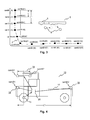
- Fig. 4 is a simplified view of a system 10 for capturing a stereoscopic dataset according to an embodiment.
- a wheeled vehicle i.e. a truck 12
- a truck 12 is taken as a carrier.
- two stereoscopic systems namely a first system 14 and a second system 18 are mounted to the truck 12.
- the first system 14 comprises the first camera camA1 and a second camera camA2 and is mounted at a position vertically above a steering axle 16 of the truck 12.
- the second system 18 is arranged to have a maximum base length L* and comprises a first camera camB1 and a second camera camB2.
- the truck 12 comprises a positioning system 20, which takes into account a GPS coordinate, the truck's speed, compass information, etc.
- a position of the cameras camA1, camA2, camB1, camB2 is calculated from the position of the truck 12 by taking into account the known position of the cameras camA1, camA2, camB1, camB2 on the truck 12.
- a steering angle of the steering axle 16 is preferably taken into account.
- the base L between the first and second camera camA1, camA2 of the first stereoscopic system 14 may be pivotable.
- the rotation of the base L around a vertical axis is synchronized with the movement of the steering axle 16 of the truck 12. Accordingly, the first stereoscopic system 14 provides an excellent accordance between the position of the first and second camera camA1, camA2 and the trajectory 2.
- the second stereoscopic system 18 provides a large base distance L* and is accordingly suitable for capture of long-distance scenes like landscapes or the like.
Landscapes
- Engineering & Computer Science (AREA)
- Multimedia (AREA)
- Signal Processing (AREA)
- Testing, Inspecting, Measuring Of Stereoscopic Televisions And Televisions (AREA)
- Studio Devices (AREA)
Priority Applications (1)
| Application Number | Priority Date | Filing Date | Title |
|---|---|---|---|
| EP11305224A EP2495980A1 (fr) | 2011-03-02 | 2011-03-02 | Système et procédé pour capturer un ensemble de données stéréoscopiques |
Applications Claiming Priority (1)
| Application Number | Priority Date | Filing Date | Title |
|---|---|---|---|
| EP11305224A EP2495980A1 (fr) | 2011-03-02 | 2011-03-02 | Système et procédé pour capturer un ensemble de données stéréoscopiques |
Publications (1)
| Publication Number | Publication Date |
|---|---|
| EP2495980A1 true EP2495980A1 (fr) | 2012-09-05 |
Family
ID=43970350
Family Applications (1)
| Application Number | Title | Priority Date | Filing Date |
|---|---|---|---|
| EP11305224A Withdrawn EP2495980A1 (fr) | 2011-03-02 | 2011-03-02 | Système et procédé pour capturer un ensemble de données stéréoscopiques |
Country Status (1)
| Country | Link |
|---|---|
| EP (1) | EP2495980A1 (fr) |
Citations (3)
| Publication number | Priority date | Publication date | Assignee | Title |
|---|---|---|---|---|
| US5473364A (en) * | 1994-06-03 | 1995-12-05 | David Sarnoff Research Center, Inc. | Video technique for indicating moving objects from a movable platform |
| JP2006258486A (ja) * | 2005-03-15 | 2006-09-28 | Nagoya City | 座標計測装置と座標計測方法 |
| WO2009061174A1 (fr) * | 2007-11-07 | 2009-05-14 | Tele Atlas B.V. | Procédé et dispositif pour mappage de données de capteur de distance sur des données de capteur d'image |
-
2011
- 2011-03-02 EP EP11305224A patent/EP2495980A1/fr not_active Withdrawn
Patent Citations (3)
| Publication number | Priority date | Publication date | Assignee | Title |
|---|---|---|---|---|
| US5473364A (en) * | 1994-06-03 | 1995-12-05 | David Sarnoff Research Center, Inc. | Video technique for indicating moving objects from a movable platform |
| JP2006258486A (ja) * | 2005-03-15 | 2006-09-28 | Nagoya City | 座標計測装置と座標計測方法 |
| WO2009061174A1 (fr) * | 2007-11-07 | 2009-05-14 | Tele Atlas B.V. | Procédé et dispositif pour mappage de données de capteur de distance sur des données de capteur d'image |
Similar Documents
| Publication | Publication Date | Title |
|---|---|---|
| US12020355B2 (en) | Artificially rendering images using viewpoint interpolation and extrapolation | |
| US10818029B2 (en) | Multi-directional structured image array capture on a 2D graph | |
| US10719733B2 (en) | Artificially rendering images using interpolation of tracked control points | |
| US10650574B2 (en) | Generating stereoscopic pairs of images from a single lens camera | |
| CN104318561B (zh) | 基于双目立体视觉与光流融合的车辆运动信息检测方法 | |
| US10726593B2 (en) | Artificially rendering images using viewpoint interpolation and extrapolation | |
| US10242474B2 (en) | Artificially rendering images using viewpoint interpolation and extrapolation | |
| CN106447705B (zh) | 应用于室内场景虚拟现实直播的多目立体视觉系统及方法 | |
| CN110570453A (zh) | 一种基于双目视觉的闭环式跟踪特征的视觉里程计方法 | |
| CN107257494B (zh) | 一种体育赛事拍摄方法及其拍摄系统 | |
| US10586378B2 (en) | Stabilizing image sequences based on camera rotation and focal length parameters | |
| US20080278569A1 (en) | Automatic Conversion from Monoscopic Video to Stereoscopic Video | |
| WO2001004837A3 (fr) | Procede et dispositif de detection de mouvement independant dans des scenes tridimensionnelles | |
| CN104539925A (zh) | 基于深度信息的三维场景增强现实的方法及系统 | |
| CN105262949A (zh) | 一种多功能全景视频实时拼接方法 | |
| CN101271579B (zh) | 采用环形低帧率摄像机阵列对高速运动物体建模的方法 | |
| US8717418B1 (en) | Real time 3D imaging for remote surveillance | |
| KR101079894B1 (ko) | 터널 벽면 전개화상 취득 시스템 | |
| CN108564654B (zh) | 三维大场景的画面进入方式 | |
| CN108090930A (zh) | 基于双目立体相机的障碍物视觉检测系统及方法 | |
| EP2495980A1 (fr) | Système et procédé pour capturer un ensemble de données stéréoscopiques | |
| Cavegn et al. | Evaluation of Matching Strategies for Image-Based Mobile Mapping | |
| Bok et al. | Capturing city-level scenes with a synchronized camera-laser fusion sensor | |
| JP4025556B2 (ja) | 特徴点追跡画像決定装置、特徴点追跡画像決定方法、この方法のプログラム、およびこのプログラムを記録した記録媒体 | |
| JP3728508B2 (ja) | 画像生成装置及び方法 |
Legal Events
| Date | Code | Title | Description |
|---|---|---|---|
| PUAI | Public reference made under article 153(3) epc to a published international application that has entered the european phase |
Free format text: ORIGINAL CODE: 0009012 |
|
| AK | Designated contracting states |
Kind code of ref document: A1 Designated state(s): AL AT BE BG CH CY CZ DE DK EE ES FI FR GB GR HR HU IE IS IT LI LT LU LV MC MK MT NL NO PL PT RO RS SE SI SK SM TR |
|
| AX | Request for extension of the european patent |
Extension state: BA ME |
|
| STAA | Information on the status of an ep patent application or granted ep patent |
Free format text: STATUS: THE APPLICATION IS DEEMED TO BE WITHDRAWN |
|
| 18D | Application deemed to be withdrawn |
Effective date: 20130306 |