EP2497762B1 - Fluorinierte verbindung und fluoriniertes polymer - Google Patents
Fluorinierte verbindung und fluoriniertes polymer Download PDFInfo
- Publication number
- EP2497762B1 EP2497762B1 EP10826913.5A EP10826913A EP2497762B1 EP 2497762 B1 EP2497762 B1 EP 2497762B1 EP 10826913 A EP10826913 A EP 10826913A EP 2497762 B1 EP2497762 B1 EP 2497762B1
- Authority
- EP
- European Patent Office
- Prior art keywords
- compound
- reaction
- solvent
- fluorinated
- group
- Prior art date
- Legal status (The legal status is an assumption and is not a legal conclusion. Google has not performed a legal analysis and makes no representation as to the accuracy of the status listed.)
- Not-in-force
Links
- 0 *CCOCc1ccc(CBr)cc1 Chemical compound *CCOCc1ccc(CBr)cc1 0.000 description 1
Classifications
-
- C—CHEMISTRY; METALLURGY
- C07—ORGANIC CHEMISTRY
- C07C—ACYCLIC OR CARBOCYCLIC COMPOUNDS
- C07C69/00—Esters of carboxylic acids; Esters of carbonic or haloformic acids
- C07C69/62—Halogen-containing esters
- C07C69/65—Halogen-containing esters of unsaturated acids
- C07C69/653—Acrylic acid esters; Methacrylic acid esters; Haloacrylic acid esters; Halomethacrylic acid esters
-
- C—CHEMISTRY; METALLURGY
- C07—ORGANIC CHEMISTRY
- C07C—ACYCLIC OR CARBOCYCLIC COMPOUNDS
- C07C69/00—Esters of carboxylic acids; Esters of carbonic or haloformic acids
- C07C69/62—Halogen-containing esters
- C07C69/65—Halogen-containing esters of unsaturated acids
-
- C—CHEMISTRY; METALLURGY
- C08—ORGANIC MACROMOLECULAR COMPOUNDS; THEIR PREPARATION OR CHEMICAL WORKING-UP; COMPOSITIONS BASED THEREON
- C08F—MACROMOLECULAR COMPOUNDS OBTAINED BY REACTIONS ONLY INVOLVING CARBON-TO-CARBON UNSATURATED BONDS
- C08F120/00—Homopolymers of compounds having one or more unsaturated aliphatic radicals, each having only one carbon-to-carbon double bond, and only one being terminated by only one carboxyl radical or a salt, anhydride, ester, amide, imide or nitrile thereof
- C08F120/02—Monocarboxylic acids having less than ten carbon atoms; Derivatives thereof
- C08F120/10—Esters
- C08F120/22—Esters containing halogen
-
- C—CHEMISTRY; METALLURGY
- C08—ORGANIC MACROMOLECULAR COMPOUNDS; THEIR PREPARATION OR CHEMICAL WORKING-UP; COMPOSITIONS BASED THEREON
- C08F—MACROMOLECULAR COMPOUNDS OBTAINED BY REACTIONS ONLY INVOLVING CARBON-TO-CARBON UNSATURATED BONDS
- C08F220/00—Copolymers of compounds having one or more unsaturated aliphatic radicals, each having only one carbon-to-carbon double bond, and only one being terminated by only one carboxyl radical or a salt, anhydride ester, amide, imide or nitrile thereof
- C08F220/02—Monocarboxylic acids having less than ten carbon atoms; Derivatives thereof
- C08F220/10—Esters
- C08F220/22—Esters containing halogen
Definitions
- the present invention relates to a novel fluorinated compound and a fluorinated polymer obtainable by polymerizing it.
- Such water/oil repellency is attributable to formation of "a low surface energy surface” having a low critical surface tension on the surface due to a surface orientation of R f groups on the coating film. It has been taken for granted that in order to attain both water repellency and oil repellency, orientation of R f groups at the surface is important, and in order to realize the surface orientation of R f groups, it is necessary to have constituting units derived from a monomer having a perfluoroalkyl group (a group having a structure wherein all of hydrogen atoms in an alkyl group are substituted by fluorine atoms, such a perfluoroalkyl group will be hereinafter referred to as an "R F group”) with at least 8 carbon atoms in the polymer.
- a perfluoroalkyl group a group having a structure wherein all of hydrogen atoms in an alkyl group are substituted by fluorine atoms, such a perfluoroalkyl group will be hereinafter
- the present invention provides the following.
- the fluorinated compound of the present invention By using the fluorinated compound of the present invention, it is possible to produce a fluorinated polymer having a highly durable water/oil repellency and presenting little load to the environment. Further, the fluorinated polymer of the present invention has a highly durable water/oil repellency and presents little load to the environment.
- the fluorinated compound of the present invention is a fluorinated compound which, as shown in the following formula (I), has a methacryloyloxy group as a polymerizable group at its one terminal and an R F group with at most 6 carbon atoms at the other terminal and which has, as a bivalent linking group to link the two, a linking group containing one benzene ring.
- a fluorinated polymer obtainable by polymerizing the fluorinated compound of the present invention having such a molecular structure, has a water/oil repellency and also has a high durability whereby the water/oil repellency will not be impaired by e.g. use for a long period of time.
- n is an integer of from 0 to 2
- Ph is a phenylene group
- X is a single bond or a C 1-4 alkylene group containing an etheric oxygen atom
- r is an integer of from 2 to 6
- n is an integer of from 0 to 2, but a preferred number of n is 1 or 2. When the number of n is 1 or 2, the raw material is readily available, and the durability will be excellent.
- Ph is a phenylene group. It may be any one of a 1,2-phenylene group, a 1,3-phenylene group and a 1,4-phenylene group, so long as it is a phenylene group. However, in the present invention, Ph is preferably a 1,4-phenylene group, whereby the raw material is readily available.
- X is a single bond or a C 1-4 alkylene group containing an etheric oxygen atom.
- -(CH 2 )-O-(CH 2 ) 2 -, -O-(CH 2 ) 3 -, etc. are preferred from the viewpoint of the availability of the raw material.
- a compound of the above formula (I) wherein X is a single bond i.e. a compound wherein an R F group with at most 6 carbon atoms is directly bonded to the benzene ring is more preferred in that it is thereby possible to impart excellent water repellency to a fluorinated polymer obtainable by polymerizing it.
- r is an integer of form 2 to 6, but a fluorinated compound wherein r is from 4 to 6, is preferred from the viewpoint of a high water/oil repellency.
- r is an integer of from 4 to 6, and C r F 2r+1 is linear.
- R F group in the above formulae (I-1) to (I-3) is preferably linear.
- a method for producing the fluorinated compound represented by the above formula (I) is not particularly limited.
- the following production methods may, respectively, be mentioned for the following respective compounds (i) to (iii) which are different in X in the formula (I).
- the above fluorinated compound (i) can be produced, for example, by carrying out reactions 1-1 to 1-4 which will be described below, although not limited thereto.
- identification or confirmation of the obtainable intermediate substances or desired substances may be carried out by common methods such as measurement 1 H-NMR, FT-IR, elemental analyses, etc.
- identification or confirmation of the obtainable intermediate substances or desired substances may be carried out by similar methods.
- a compound represented by the formula Y 1 (CH 2 ) n PhY 2 (wherein Y 1 is Cl, Br, I or a hydroxy group, Y 2 is Br or I, each independently, and n is an integer of from 0 to 2)
- a compound (A) is obtained by reacting an organic acid (acetic acid) thereto, as shown by the following reaction formula.
- reaction 1-1 as the organic acid, acetic acid, propionic acid or butyric acid may, for example, be used. Further, the reaction 1-1 is preferably carried out in the presence of an alkali. As the alkali, potassium carbonate, sodium carbonate or triethylamine may, for example, be preferably used. The reaction 1-1 is preferably carried out in a solvent, and as such a solvent, specifically, N,N-dimethylformamide (DMF), acetonitrile, acetone or 2-butanone may, for example, be used.
- DMF N,N-dimethylformamide
- acetonitrile acetone or 2-butanone
- reaction 1-1 is carried out under the following preferred reaction conditions, by mixing an alkali (such as potassium carbonate) in a proportion of from 20 to 200 parts by mass and a solvent in a proportion of from 50 to 5,000 parts by mass, to 100 parts by mass in a total amount of the above starting material as the reaction substance and an organic acid (such as acetic acid).
- an alkali such as potassium carbonate
- a solvent in a proportion of from 50 to 5,000 parts by mass
- reaction conditions preferably, conditions such as reaction container: made of glass, made of SUS, etc., temperature: from 40 to 150°C, pressure: from 0 to 1 MPa, time: from 1 to 50 hours, etc. may be mentioned.
- the pressure condition is not the absolute pressure in the reaction, and represents the range of pressure to be used for pressurizing or depressurizing.
- a method for purifying the compound (A) from the reaction crude liquid containing the compound (A) thus obtained a method may, for example, be mentioned wherein the reaction crude liquid is washed a few times with a sufficient amount of distilled water and the organic layer is separated.
- reaction catalyst is employed as the case requires.
- a copper may, for example, be mentioned.
- the reaction 1-2 is preferably carried out in a solvent, and as such a solvent, specifically, dimethylsulfoxide (DMSO) or DMF may, for example, be used.
- DMSO dimethylsulfoxide
- the reaction 1-2 is carried out under the following preferred reaction conditions by mixing the catalyst in a proportion of from 10 to 100 parts by mass and the solvent in a proportion of from 50 to 5,000 parts by mass, to 100 parts by mass in total of the above compound (A) and the compound having an R F group with at most 6 carbon atoms.
- reaction conditions preferably, conditions such as reaction container: made of glass, made of SUS, etc., temperature: from 80 to 180°C, pressure: from 0 to 10 MPa, atmosphere: gas substitution by nitrogen, argon or the like, time: from 1 to 50 hours, etc. may be mentioned.
- a method for purifying the compound (B) from the reaction crude liquid containing the compound (B) thus obtained a method, may, for example, be mentioned wherein the compound (B) is taken out, for example, by distillation from the reaction crude liquid and further washed a few times with a sufficient amount of distilled water, and the organic layer is separated.
- the reaction 1-3 is a reaction wherein to the compound (B) obtained in the above reaction 1-2, an alkali (sodium hydroxide) is reacted as shown in the following reaction formula to obtain a compound (C).
- an alkali sodium hydroxide
- reaction 1-3 as the alkali, potassium hydroxide or the like may be used instead of sodium hydroxide.
- the reaction 1-3 is preferably carried out in a solvent, and as such a solvent, specifically, a mixed solvent of distilled water with methanol, ethanol, 2-propanol or the like, may, for example, be used.
- reaction 1-3 is carried out under the following preferred reaction conditions, by mixing the solvent in a proportion of from 50 to 5,000 parts by mass per 100 parts by mass in total of the above compound (B) and the alkali (such as sodium hydroxide).
- the solvent in a proportion of from 50 to 5,000 parts by mass per 100 parts by mass in total of the above compound (B) and the alkali (such as sodium hydroxide).
- reaction conditions preferably, conditions such as reaction container: made of glass, made of SUS, etc., temperature: from 30 to 100°C, pressure: from 0 to 1 MPa, time: from 1 to 24 hours, etc. may be mentioned.
- a method for purifying the compound (C) from the reaction crude liquid containing the compound (C) thus obtained a method may, for example, be mentioned wherein after adjusting the pH to be from 2 to 7 by adding an acid such as hydrochloric acid, acetic acid or ammonium sulfate to the reaction crude liquid, it is extracted with a sufficient amount of an organic solvent such as dichloropentafluoropropane, ethyl acetate, methylene chloride or chloroform, further washed a few times with a sufficient amount of distilled water and then recrystallized from e.g. hexane or methanol.
- an organic solvent such as dichloropentafluoropropane, ethyl acetate, methylene chloride or chloroform
- a methacrylic acid compound is reacted as shown by the following reaction formula to obtain a fluorinated compound (i) of the formula (I) of the present invention wherein X is a single bond.
- Y 4 is Cl, a hydroxy group or an alkoxy group.
- reaction 1-4 in a case where to the compound (C) obtained in the above reaction 1-3, a compound-wherein Y 4 is Cl, i.e. methacrylic acid chloride is reacted as the methacrylic acid compound, such a reaction is preferably carried out in the presence of an alkali.
- an alkali triethylamine, potassium carbonate, sodium hydroxide or the like may be used.
- the reaction 1-4 is preferably carried out in a solvent, and as such a solvent, specifically, dichloropentafluoropropane, acetone, 2-butanone, ethyl acetate, methylene chloride, chloroform, pyridine or water may, for example, be mentioned.
- the reaction 1-4 in the case of using methacrylic acid chloride as the methacrylic acid compound is carried out under the following preferred reaction conditions by mixing an alkali (such as triethylamine) in a proportion of from 25 to 100 parts by mass and a solvent in a proportion of from 50 to 5,000 parts by mass, and further, as the case requires, a suitable amount of a polymerization inhibitor such as hydroquinone, to 100 parts by mass in total of the above compound (C) and the methacrylic acid chloride.
- the solvent is pyridine
- such pyridine serves also as an alkali and therefore, it is unnecessary to add an alkali.
- a catalyst such as N-methylimidazole or 4-(dimethylamino)pyridine may be used, as the case requires.
- reaction conditions preferably, conditions such as reaction container: made of glass, made of SUS, etc., temperature: from 0 to 40°C, pressure: from 0 to 1 MPa, atmosphere: gas substitution by nitrogen, argon or the like, time: from 1 to 24 hours, etc. may be mentioned.
- reaction 1-4 in a case where to the compound (C) obtained in the above reaction 1-3, a compound wherein Y 4 is a hydroxy group or an alkoxy group, is reacted as the methacrylic acid compound, in such a reaction, sulfuric acid, 4-toluenesulfonic acid monohydrate, or the like, may be used as a catalyst.
- the reaction 1-4 is carried out in the absence of a solvent or in a solvent, and as such a solvent, specifically, toluene or 2-butanone may, for example, be mentioned.
- the reaction 1-4 in the case of using a compound wherein Y 4 is a hydroxy group or an alkoxy group, as the methacrylic acid compound is carried out under the following preferred reaction conditions by mixing the catalyst (such as sulfuric acid) in a proportion of from 0.01 to 10 parts by mass and the solvent in a proportion of from 0 to 5,000 parts by mass, and further, as the case requires, a suitable amount of a polymerization inhibitor such as hydroquinone, to 100 parts by mass in total of the above compound (C) and the methacrylic acid compound.
- the catalyst such as sulfuric acid
- reaction conditions preferably, conditions such as reaction container: made of glass, made of SUS, etc., temperature: from 50 to 150°C, pressure: from -0.1 to 1 MPa, atmosphere: gas substitution by nitrogen, argon or the like, time: from 1 to 100 hours, etc. may be mentioned. Further, as the case requires, it is preferred to carry out the reaction while distilling the reaction byproducts off.
- a method for purifying the fluorinated compound (i) from the reaction crude liquid containing the fluorinated compound (i) thus obtained a method may, for example, be mentioned wherein the reaction crude liquid is washed a few times with a sufficient amount of distilled water, an organic layer is separated, and the solvent is distilled off.
- the above fluorinated compound (ii) can be produced, for example, by carrying out reactions 2-1 to 2-4 which will be described below, although not limited thereto.
- a compound (D) is obtained by reacting a compound having an R F group with at most 6 carbon atoms thereto as shown by the following reaction formula.
- the above reaction 2-1 is preferably carried out in the presence of an alkali.
- an alkali it is preferred to use sodium hydroxide, potassium hydroxide or the like.
- the reaction 2-1 is preferably carried out in a solvent, and as such a solvent, specifically, acetonitrile, DMF, water or the like may be used.
- the reaction 2-1 is carried out under the following preferred reaction conditions by mixing the alkali (such as sodium hydroxide) in a proportion of from 5 to 50 parts by mass and the solvent in a proportion of from 50 to 5,000 parts by mass, to 100 parts by mass in total of the above starting material as the reaction substance and the compound having an R F group with at most 6 carbon atoms.
- alkali such as sodium hydroxide
- reaction conditions preferably, conditions such as reaction container: made of glass, made of SUS, etc., temperature: from 50 to 150°C, pressure: from 0 to 5 MPa, time: from 1 to 100 hours, etc. may be mentioned.
- a method for purifying the compound (D) from the reaction crude liquid containing the compound (D) thus obtained a method may, for example, be mentioned wherein one having the solvent distilled off from the reaction crude liquid is suspended in methanol, acetone or the like, and after filtering off the solid, the solvent is distilled off to obtain the compound (D).
- reaction 2-2 as the organic acid, acetic acid, propionic acid or butyric acid may, for example, be used.
- the reaction 2-2 is preferably carried out in the presence of an alkali.
- the alkali it is preferred to use potassium carbonate, sodium carbonate, triethylamine or the like.
- the reaction 2-2 is preferably carried out in a solvent, and as such a solvent, specifically, DMF, acetonitrile, acetone or 2-butanone may, for example, be used.
- the reaction 2-2 is carried out under the following preferred reaction conditions by mixing the alkali (such as potassium carbonate) in a proportion of from 20 to 200 parts by mass and the solvent in a proportion of from 50 to 5,000 parts by mass, to 100 parts by mass in total of the above compound (D) and the organic acid (such as acetic acid).
- alkali such as potassium carbonate
- reaction conditions preferably, conditions such as reaction container: made of glass, made of SUS, etc., temperature: from 40 to 150°C, pressure: from 0 to 1 MPa, time: from 1 to 50 hours, etc. may be mentioned.
- a method for purifying the compound (E) from the reaction crude liquid containing the compound (E) thus obtained a method may, for example, be mentioned wherein the reaction crude liquid is washed a few times with a sufficient amount of distilled water, and the organic layer is separated.
- the reaction 2-3 is a reaction to obtain a compound (F) by reacting an alkali (sodium hydroxide) to the compound (E) obtained in the above reaction 2-2, as shown by the following reaction formula, in the same manner as the above reaction 1-3.
- reaction 2-3 as the alkali, sodium hydroxide or potassium hydroxide may, for example, be used.
- the reaction 2-3 is preferably carried out in a solvent, and as such a solvent, specifically, a mixed solvent of distilled water with ethanol, methanol, 2-propanol or the like, may be used.
- reaction 2-3 is carried out under the following preferred reaction conditions by mixing the solvent in a proportion of from 50 to 5,000 parts by mass to 100 parts by mass in total of the above compound (E) and the alkali (such as sodium hydroxide).
- the solvent in a proportion of from 50 to 5,000 parts by mass to 100 parts by mass in total of the above compound (E) and the alkali (such as sodium hydroxide).
- reaction conditions preferably, conditions such as reaction container: made of glass, made of SUS, etc., temperature: from 30 to 100°C, pressure: from 0 to 1 MPa, time: from 1 to 24 hours, etc. may be mentioned.
- a method for purifying the compound (F) from the reaction crude liquid containing the compound (F) thus obtained a method may, for example, be mentioned wherein after adjusting the pH to be from 2 to 7 by adding an acid such as hydrochloric acid, acetic acid or ammonium sulfate to the reaction crude liquid, it is extracted with a sufficient amount of an organic solvent such as dichloropentafluoropropane, ethyl acetate, methylene chloride or chloroform, further washed a few time with a sufficient amount of distilled water and then recrystallized from e.g. hexane or methanol.
- an organic solvent such as dichloropentafluoropropane, ethyl acetate, methylene chloride or chloroform
- reaction 2-4 in a case where a compound wherein Y 4 is Cl, i.e. methacrylic acid chloride, is reacted as the methacrylic acid compound to the compound (F) obtained by the above reaction 2-3, such a reaction is preferably carried out in the presence of an alkali.
- an alkali triethylamine, potassium carbonate or sodium hydroxide may, for example, be used.
- the reaction 2-4 is preferably carried out in a solvent, and as such a solvent, specifically, dichloropentafluoropropane, acetone, 2-butanone, ethyl acetate, methylene chloride, chloroform, pyridine or water may, for example, be mentioned.
- the reaction 2-4 in the case of using methacrylic acid chloride as the methacrylic acid compound is carried out under the following preferred reaction conditions by mixing the alkali (such as triethylamine) in a proportion of from 25 to 100 parts by mass and the solvent in a proportion of from 50 to 5,000 parts by mass, further, as the case requires, a suitable amount of a polymerization inhibitor such as hydroquinone, to 100 parts by mass in total amount of the above compound (F) and the methacrylic acid chloride.
- the solvent is pyridine
- pyridine serves also as an alkali, and therefore it is not necessary to add an alkali.
- a catalyst such as N-methylimidazole or 4-(dimethylamino)pyridine may be used, as the case requires.
- reaction conditions preferably, conditions such as reaction container: made of glass, made of SUS, etc., temperature: from 0 to 40°C, pressure: from 0 to 1 MPa, atmosphere: gas substitution by nitrogen, argon or the like, time: from 1 to 24 hours, etc. may be used.
- reaction 2-4 in a case where a compound wherein Y 4 is a hydroxy group or an alkoxy group, is reacted as the methacrylic acid compound to the compound (F) obtained by the above reaction 2-3, in such a reaction, as the catalyst, sulfuric acid or 4-toluenesulfonic acid monohydrate may, for example, be used.
- the reaction 2-4 is carried out in the absence of a solvent or in a solvent, and as such a solvent, specifically, toluene or 2-butanone may, for example, be mentioned.
- reaction 2-4 in the case of using the compound wherein Y 4 is a hydroxy group or an alkoxy group as the above methacrylic acid compound, is carried out under the following preferred reaction conditions by mixing the catalyst (such as sulfuric acid) in a proportion of from 0.01 to 10 parts by mass and the solvent in a proportion of from 0 to 5,000 parts by mass, and, as the case requires, a suitable amount of a polymerization inhibitor such as hydroquinone, to 100 parts by mass in total of the above compound (F) and the methacrylic acid compound.
- the catalyst such as sulfuric acid
- reaction conditions preferably, conditions such as reaction container: made of glass, made of SUS, etc., temperature: from 50 to 150°C, pressure: from -1 to 1 MPa, atmosphere: gas substitution by nitrogen, argon or the like, time: from 1 to 100 hours, etc. may be mentioned. Further, as the case requires, it is preferred to carry out the reaction while distilling the reaction byproducts off.
- a method for purifying the fluorinated compound (ii) from the reaction crude liquid containing the fluorinated compound (ii) thus obtained a method may, for example, be mentioned wherein the reaction crude liquid is washed a few times with a sufficient amount of distilled water, the organic layer is separated, and the solvent is distilled off.
- the above fluorinated compound (iii) may be produced, for example, by carrying out reactions 3-1 and 3-2 which will be described below, although not limited thereto.
- a compound (G) is obtained by reacting a compound having an R F group with at most 6 carbon atoms thereto as shown by the following reaction formula.
- the above reaction 3-1 is preferably carried out in the presence of an alkali.
- an alkali it is preferred to use e.g. potassium carbonate, sodium carbonate or triethylamine.
- the reaction 3-1 is preferably carried out in a solvent, and as such a solvent, specifically, DMF, acetonitrile, acetone or 2-butanone may, for example, be used.
- the reaction 3-1 is carried out under the following preferred reaction conditions by mixing the alkali (such as potassium carbonate) in a proportion of from 10 to 100 parts by mass and the solvent in a proportion of from 50 to 5,000 parts by mass, to 100 parts by mass in total of the above starting material as the reaction substance and the compound having an R F group with at most 6 carbon atoms.
- alkali such as potassium carbonate
- reaction conditions preferably, conditions such as reaction container: made of glass, made of SUS, etc., temperature: from 30 to 100°C, pressure: from 0 to 1 MPa, time: from 1 to 24 hours, etc. may be mentioned.
- a method for purifying the compound (G) from the reaction crude liquid containing the compound (G) thus obtained a method may, for example, be mentioned wherein the reaction crude liquid is dropped into a sufficient amount of distilled water, extraction is carried out by adding e.g. dichloropentafluoropropane, ethyl acetate, methylene chloride or chloroform, then the organic layer is separated and washed a few times with a sufficient amount of distilled water, and then, the solvent is distilled off.
- reaction 3-2 in a case where a compound wherein Y 4 is Cl, i.e. methacrylic acid chloride, is reacted as the methacrylic acid compound to the compound (G) obtained in the above reaction 3-1, such a reaction is preferably carried out in the presence of an alkali.
- an alkali triethylamine, potassium carbonate or sodium hydroxide may, for example, be used.
- the reaction 3-2 is preferably carried out in a solvent, and as such a solvent, specifically, dichloropentafluoropropane, acetone, 2-butanone, ethyl acetate, methylene chloride, chloroform, pyridine or water may, for example, be mentioned.
- the reaction 3-2 in the case of using methacrylic acid chloride as the methacrylic acid compound is carried out under the following preferred reaction conditions by mixing the alkali (such as triethylamine) in a proportion of from 25 to 100 parts by mass and the solvent in a proportion of from 50 to 5,000 parts by mass, and further, as the case requires, a suitable amount of a polymerization inhibitor such as hydroquinone, to 100 parts by mass in total of the above compound (G) and the methacrylic acid chloride.
- the solvent is pyridine
- pyridine serves also as an alkali, and therefore it is not necessary to add an alkali.
- a catalyst such as N-methylimidazole or 4-(dimethylamino)pyridine may be used, as the case requires.
- reaction conditions preferably, conditions such as reaction container: made of glass, made of SUS, etc., temperature: from 0 to 40°C, pressure: from 0 to 1 MPa, atmosphere: gas substitution by nitrogen, argon or the like, time: from 1 to 24 hours, etc. may be mentioned.
- reaction 3-2 in a case where a compound wherein Y 4 is a hydroxy group or an alkoxy group is reacted as the methacrylic acid compound to the compound (G) obtained by the above reaction 3-1, in such a reaction, sulfuric acid or 4-toluenesulfonic acid monohydrate may, for example, be used as a catalyst.
- the reaction 3-2 is carried out in the absence of a solvent or in a solvent, and as such a solvent, specifically, toluene or 2-butanone may, for example, be mentioned.
- reaction 3-2 in the case of using the compound wherein Y 4 is a hydroxy group or an alkoxy group as the above methacrylic acid compound is carried out under the following preferred reaction conditions by mixing the catalyst (such as sulfuric acid) in a proportion of from 0.01 to 10 parts by mass and the solvent in a proportion of from 0 to 5,000 parts by mass, and further, as the case requires, a suitable amount of a polymerization inhibitor such as hydroquinone, to 100 parts by mass in total of the above compound (G) and the methacrylic acid compound.
- the catalyst such as sulfuric acid
- reaction conditions preferably, conditions such as reaction container: made of glass, made of SUS, etc., temperature: from 50 to 150°C, pressure: from -0.1 to 1 MPa, atmosphere: gas substitution by nitrogen, argon or the like, time: from 1 to 100 hours, etc. may be mentioned. Further, as the case requires, it is preferred to carry out the reaction while distilling the reaction byproducts off.
- a method for purifying the fluorinated compound (iii) from the reaction crude liquid containing the fluorinated compound (iii) thus obtained a method may, for example, be mentioned wherein the reaction crude liquid is washed a few times with a sufficient amount of distilled water, the organic layer is separated, and the solvent is distilled off.
- the polymer of the present invention is a homopolymer obtainable by polymerizing one member selected from the above-described fluorinated compound of the present invention.
- the polymer of the present invention preferably has a mass average molecular weight (Mw) of from 2,000 to 1,000,000, more preferably from 5,000 to 500,000.
- Mw mass average molecular weight
- the polymer having a mass average molecular weight (Mw) within such a range is advantageous from the viewpoint of the durability of the water/oil repellency.
- the mass average molecular weight (Mw) of the polymer in this specification is a molecular weight calculated as a polymethyl methacrylate, which is measured by gel permeation chromatography (GPC).
- a method for polymerizing the fluorinated compound of the present invention it is possible to employ a polymerization method such as an ion polymerization method or a radical polymerization.
- a radical polymerization method is preferred in that the polymerization can be carried out under a mild condition by using a radical initiator as the polymerization initiator.
- the radical polymerization can be carried out by using a polymerization method such as suspension polymerization, solution polymerization, bulk polymerization or emulsion polymerization.
- polymerization methods in the production of the polymer according to the present invention, it is preferred to employ a polymerization method wherein the polymerization is carried out in a medium in the presence of a polymerization initiator, and a solution polymerization employing a solvent as the above medium, or an emulsion polymerization to be carried out by using a medium containing a surfactant and water, is more preferably used.
- the production of the polymer is specifically one to polymerize the monomer in a medium in the presence of a polymerization initiator.
- the monomer concentration in the medium is preferably from 5 to 50 vol%, more preferably from 20 to 40 vol%, by volume percentage of the monomer to the medium.
- a halogen compound, a hydrocarbon, a ketone, an ester or an ether may, for example, be mentioned.
- halogen compound a halogenated hydrocarbon or a halogenated ether may, for example, be mentioned.
- a halogenated hydrocarbon a hydrochlorofluorocarbon or a hydrofluorocarbon may, for example, be mentioned.
- CH 3 CCl 2 F, CHCl 2 CF 2 CF 3 or CHClFCF 2 CClF 2 may, for example, be mentioned.
- CF 3 CHFCHFCF 2 CF 3 As the hydrofluorocarbon, CF 3 CHFCHFCF 2 CF 3 , CF 3 (CF 2 ) 4 CHF 2 , CF 3 CF 2 CF 2 CH 2 CH 2 CH 3 , CF 3 (CF 2 ) 5 CH 2 CH 3 or 1,1,2,2,3,3,4-heptafluorocyclopentane may, for example, be mentioned.
- a hydrofluoroether may, for example, be mentioned.
- hydrocarbon an aliphatic hydrocarbon, an alicyclic hydrocarbon or an aromatic hydrocarbon may, for example, be mentioned.
- pentane, 2-methylbutane, 3-methylpentane, hexane, 2,2-dimethylbutane, 2,3-dimethylbutane, heptane, octane, 2,2,4-trimethylpentane, 2,2,3-trimethylhexane, decane, undecane, dodecane, 2,2,4,6,6-pentamethylheptane, tridecane, tetradecane or hexadecane may, for example, be mentioned.
- cyclopentane methylcyclopentane
- cyclohexane methylcyclohexane
- ethylcyclohexane ethylcyclohexane
- aromatic hydrocarbon benzene, toluene or xylene may, for example, be mentioned.
- ketone acetone, methyl ethyl ketone, 2-pentanone, 3-pentanone, 2-hexanone or methyl isobutyl ketone may, for example, be mentioned.
- ester methyl acetate, ethyl acetate, butyl acetate, methyl propionate, methyl lactate, ethyl lactate or pentyl lactate may, for example, be mentioned.
- ether diisopropyl ether, dioxane or tetrahydrofuran may, for example, be mentioned.
- radical polymerization initiator a commonly used initiator such as an azo type polymerization initiator, a peroxide type polymerization initiator or a redox type initiator may be used depending upon the polymerization temperature.
- an azo type compound is particularly preferred, and in a case where the polymerization is carried out in an aqueous medium, a salt of an azo type compound is more preferred.
- the amount of the polymerization initiator to be added is preferably from 0.05 to 5 parts by mass, more preferably from 0.1 to 3 parts by mass, per 100 parts by mass of the monomer.
- a molecular weight-adjusting agent may be used.
- an aromatic compound, a mercapto alcohol or a mercaptan is preferred, and an alkyl mercaptan is particularly preferred.
- mercapto ethanol, n-octyl mercaptan, n-dodecyl mercaptan, t-dodecyl mercaptan or stearyl mercaptan may, for example, be mentioned.
- the amount of the molecular weight-adjusting agent to be added is preferably from 0.01 to 5 parts by mass, more preferably from 0.1 to 3 parts by mass, per 100 parts by mass of the monomer.
- the polymerization temperature is preferably from 20 to 150°C.
- conditions similar to ones used for polymerization for a usual acrylate or methacrylate type polymer may be applied.
- the polymerization may be carried out in a nitrogen atmosphere, or an operation such as shaking may be added, such being preferred conditions in the production method of the present invention.
- the polymer of the present invention can be obtained by carrying out the polymerization for from about 2 to 24 hours, although it may depend also on other polymerization conditions such as the polymerization temperature.
- the conditions such as the monomer concentration, the amount of the polymerization initiator, the polymerization temperature, the amount of the molecular weight-adjusting agent, etc. may be adjusted within the above-described preferred ranges.
- the monomer concentration is high (low)
- the amount of the polymerization initiator is small (large)
- the polymerization temperature is low (high)
- the amount of the molecular weight-adjusting agent is small (large)
- the molecular weight tends to be large (small).
- R F groups are surface-oriented on the surface of a coating film by an interaction due to ⁇ - ⁇ stacking of a benzene ring contained in the linking group of the fluorinated compound by using the fluorinated compound of the present invention as the monomer.
- the fluorinated compound of the present invention has a methacryloyloxy group as a polymerizable group, whereby an effect to harden the main chain and the above-mentioned interaction are provided to present a highly durable water/oil repellency.
- each measured value means a measured value derived from a group shown in () following the measured value, but in a case where this group has a portion defined by [], the measured value means a measured value derived from the portion defined by [].
- the obtained reaction crude liquid was subjected to simple distillation to obtain 620 g of a mixture of DMSO and a compound (B-1) represented by the following structural formula (B-1), which is classified into the above compound (B).
- Distilled water 500 mL was added to the mixture, followed by liquid separation, and the organic layer was further washed twice with distilled water (200 mL) to obtain 129.6 g of the compound (B-1) (pale yellow liquid). The yield was 68%.
- reaction crude liquid was transferred to a dropping funnel and washed three times with distilled water (200 mL), and the solvent in the AK-225 phase was distilled off to obtain 111.9 g of a fluorinated compound (I-1) (colorless transparent liquid) represented by the following structural formula (I-1) and having linear C 6 F 13 .
- the yield was 96%.
- reaction crude liquid was transferred to a separating funnel and washed three times with distilled water (30 mL), and the solvent in the AK-225 phase was distilled off to obtain 9.93 g of the compound (Cf-1) (colorless transparent liquid). The yield was 65%.
- the obtained reaction crude liquid was put into distilled water (800 mL), and the organic phase was separated and further washed twice with distilled water (100 mL) to obtain 48.8 g of a compound (E-1) (purity by 1 H-NMR: 80 mass%, pale yellow liquid) represented by the following structural formula (E-1), which is classified into the above compound (E).
- the yield was 100%.
- reaction crude liquid was transferred to a separating funnel and washed three times with distilled water (20 mL), and the solvent in the AK-225 phase was distilled off to obtain 6.01 g of a fluorinated compound (I-2) of the present invention (colorless transparent liquid) represented by the following structural formula (I-2) and having linear C 6 F 13 .
- the yield was 88%.
- reaction crude liquid was transferred to a separating funnel and washed three times with distilled water (30 mL), and the solvent in the AK-225 phase was distilled off to obtain 5.90 g of the compound (Cf-2) (colorless transparent liquid). The yield was 89%.
- reaction crude liquid was put into distilled water (800 mL), and AK-225 (100 mL) was added for extraction.
- the organic layer was separated and further washed twice with distilled water (100 mL), and AK-225 was distilled off to obtain 37.6 g of a compound (G-1) (white solid) represented by the following structural formula (G-1), which is classified into the above compound (G).
- the yield was 92%.
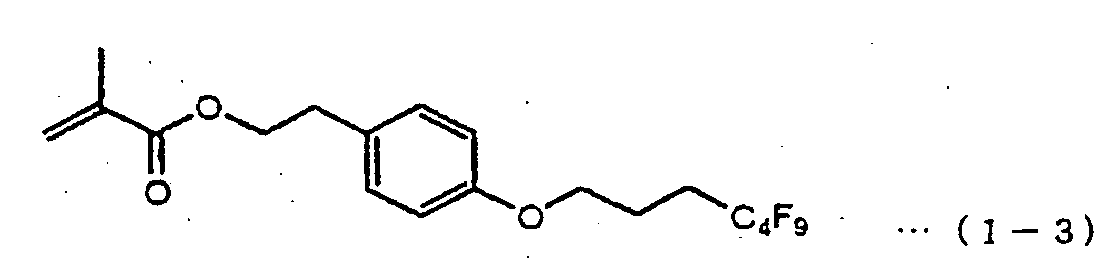
- reaction crude liquid was transferred to a separating funnel and washed three times with distilled water (20 mL), and the solvent in the AK-225 phase was distilled off to obtain 9.00 g of a fluorinated compound (I-3) of the present invention (colorless transparent liquid) represented by the following structural formula (I-3) and having linear C 4 F 9 .
- the yield was 81%.
- reaction crude liquid was transferred to a separating funnel and washed three times with distilled water (30 mL), and the solvent in the AK-225 phase was distilled off to obtain 10.3 g of the compound (Cf-3) (colorless transparent liquid). The yield was 96%.
- the solution containing the polymer was dropped into methanol of 20 times by mass, followed by stirring to let solid precipitate.
- the obtained solid was collected by filtration and vacuum-dried overnight at 60°C to obtain a polymer in the amount shown by mass in Table 1.
- the molecular weight of the recovered polymer was measured by GPC.
- the mass average molecular weight (Mw) of the obtained polymer is shown in Table 1.
- a fluorinated solvent AK-225, manufactured by Asahi Glass Company, Limited
- Mn number average molecular weight
- Mw mass average molecular weight
- HLC-8220GPC manufactured by TOSOH CORPORATION
- Column: Two MIXED-E manufactured by Polymer Laboratories, were connected in series
- a obtained polymer was diluted with AK-225 so that the solid content concentration became 2.0 mass%, and the obtained polymer solution was used as a treating liquid.
- the polymer solution was applied by dip coating to three glass plates and dried at 150°C for 10 minutes to obtain treated substrates each having a coating film formed on the surface.
- the contact angles of water and hexadecane on the coating film were measured, whereby the water/oil repellency of the coating film obtainable from the treating liquid containing the polymer prepared in each of the above Examples and Comparative Examples, was evaluated.
- the measurements of the contact angles were carried out by means of CA-X, manufactured by Kyowa Interface Science Co., Ltd. As results, the actually measured values of the contact angles as well as the results evaluated in accordance with the following standards, are shown.
- the water repellency was evaluated by three grades using the contact angle of water being 100° as the standard.
- the oil repellency was evaluated by three grades using the contact angle of n-hexadecane being 50° as the standard.
- the dynamic contact angles to water on the coating film was measured, whereby the dynamic water repellency of the coating film obtainable from the treating liquid containing a polymer prepared in each of the above Examples and Comparative Examples, was evaluated.
- the receding contact angle to water was measured at 25°C by Wilhelmy method.
- the dynamic water repellency was evaluated by three grades using the receding contact angle of water being 50° as the standard.
- the fluorinated compound of the present invention is a fluorinated compound having an R F group with at most 6 carbon atoms, which presents little environmental load, and a polymer obtainable by polymerizing it has a highly durable water/oil repellency. Accordingly, in place of a copolymer having an R F group with at least 8 carbon atoms presenting a high environmental load, it is useful for e.g. a water/oil repellent composition.
Landscapes
- Chemical & Material Sciences (AREA)
- Organic Chemistry (AREA)
- Health & Medical Sciences (AREA)
- Chemical Kinetics & Catalysis (AREA)
- Medicinal Chemistry (AREA)
- Polymers & Plastics (AREA)
- Organic Low-Molecular-Weight Compounds And Preparation Thereof (AREA)
- Addition Polymer Or Copolymer, Post-Treatments, Or Chemical Modifications (AREA)
Claims (9)
- Fluorierte Verbindung, dargestellt durch die folgende Formel (I):
CH2=C(CH3)COO(CH2)nPhXCrF2r+1 (I)
(in der Formel (I) ist n eine ganze Zahl von 0 bis 2, Ph ist eine Phenylengruppe, X ist eine Einfachbindung oder eine C1-4 Alkylengruppe enthaltend ein etherisches Sauerstoffatom und r ist eine ganze Zahl von 2 bis 6). - Fluorierte Verbindung gemäß Anspruch 1, wobei Ph in der Formel (I) eine 1,4-Phenylengruppe ist.
- Fluorierte Verbindung gemäß Anspruch 1 oder 2, wobei r in der Formel (I) eine ganze Zahl von 4 bis 6 ist.
- Fluorierte Verbindung gemäß einem der Ansprüche 1 bis 3, wobei X in der Formel (I) eine Einfachbindung ist.
- Fluorierte Verbindung gemäß Anspruch 1, wobei die fluorierte Verbindung, dargestellt durch die Formel (I), eine Verbindung ist, dargestellt durch jedwede der folgenden Formeln (I-1) bis (I-3):


- Fluorierte Verbindung gemäß einem der Ansprüche 1 bis 5, wobei in der Formel (I) r eine ganze Zahl von 4 bis 6 ist und CrF2r+1 linear ist.
- Fluoriertes Polymer, erhältlich durch Polymerisieren eines Mitglieds, ausgewählt aus der fluorierten Verbindung, wie in einem der Ansprüche 1 bis 6 definiert.
- Fluoriertes Polymer gemäß Anspruch 7, welches ein massenmittleres Molekulargewicht (Mw) von 2000 bis 1 000 000 aufweist.
- Fluoriertes Polymer gemäß Anspruch 8, welches ein massenmittleres Molekulargewicht (Mw) von 5000 bis 500 000 aufweist.
Applications Claiming Priority (2)
| Application Number | Priority Date | Filing Date | Title |
|---|---|---|---|
| JP2009252409 | 2009-11-02 | ||
| PCT/JP2010/069515 WO2011052783A1 (ja) | 2009-11-02 | 2010-11-02 | 含フッ素化合物および含フッ素重合体 |
Publications (3)
| Publication Number | Publication Date |
|---|---|
| EP2497762A1 EP2497762A1 (de) | 2012-09-12 |
| EP2497762A4 EP2497762A4 (de) | 2015-03-11 |
| EP2497762B1 true EP2497762B1 (de) | 2016-01-27 |
Family
ID=43922204
Family Applications (1)
| Application Number | Title | Priority Date | Filing Date |
|---|---|---|---|
| EP10826913.5A Not-in-force EP2497762B1 (de) | 2009-11-02 | 2010-11-02 | Fluorinierte verbindung und fluoriniertes polymer |
Country Status (6)
| Country | Link |
|---|---|
| US (1) | US9206113B2 (de) |
| EP (1) | EP2497762B1 (de) |
| JP (1) | JP5765230B2 (de) |
| KR (1) | KR20120089698A (de) |
| CN (1) | CN102596891B (de) |
| WO (1) | WO2011052783A1 (de) |
Families Citing this family (7)
| Publication number | Priority date | Publication date | Assignee | Title |
|---|---|---|---|---|
| WO2011052786A1 (ja) | 2009-11-02 | 2011-05-05 | 旭硝子株式会社 | 含フッ素化合物、含フッ素重合体、および含フッ素共重合体 |
| KR20120089698A (ko) * | 2009-11-02 | 2012-08-13 | 아사히 가라스 가부시키가이샤 | 함불소 화합물 및 함불소 중합체 |
| WO2011087717A1 (en) | 2009-12-22 | 2011-07-21 | 3M Innovative Properties Company | Fluorinated arylene-containing compounds, methods, and polymers prepared therefrom |
| JP5633561B2 (ja) * | 2010-04-01 | 2014-12-03 | 旭硝子株式会社 | 含フッ素化合物および含フッ素重合体 |
| US9297252B2 (en) | 2014-06-27 | 2016-03-29 | Baker Hughes Incorporated | Use of long chain amines and difunctional compounds as tracers |
| US9303497B2 (en) | 2014-06-27 | 2016-04-05 | Baker Hughes Incorporated | Use of long chain alcohols, ketones and organic acids as tracers |
| US9322269B2 (en) | 2014-06-27 | 2016-04-26 | Baker Hughes Incorporated | Use of long chain alcohols, ketones and organic acids as tracers |
Family Cites Families (15)
| Publication number | Priority date | Publication date | Assignee | Title |
|---|---|---|---|---|
| DE69310815T2 (de) * | 1992-07-03 | 1997-08-28 | Asahi Glass Co Ltd | Polyfluorkohlenwasserstoffgruppe enthaltende Monomere, ihre Polymere und die Anwendungen dieser Polymere |
| JPH06293705A (ja) * | 1992-07-03 | 1994-10-21 | Asahi Glass Co Ltd | 新規ポリフルオロ炭化水素基含有モノマー、その重合体、およびその用途 |
| JP3565521B2 (ja) * | 1995-07-11 | 2004-09-15 | シャープ株式会社 | 重合性化合物およびそれを用いた液晶表示素子 |
| US7605221B2 (en) * | 1999-05-18 | 2009-10-20 | Sabic Innovative Plastics Ip B.V. | Weatherable, thermostable polymers having improved flow composition |
| US6749756B1 (en) | 2000-02-18 | 2004-06-15 | University Of Pittsburgh | Reaction and separation methods |
| KR100889714B1 (ko) | 2001-04-13 | 2009-03-23 | 아사히 가라스 가부시키가이샤 | 발수발유제 조성물 |
| CN100351339C (zh) | 2002-10-15 | 2007-11-28 | 旭硝子株式会社 | 防水防油剂组合物 |
| US7078456B2 (en) * | 2003-11-26 | 2006-07-18 | 3M Innovative Properties Company | Fluorochemical oligomeric composition and use thereof |
| JP2006328003A (ja) * | 2005-05-27 | 2006-12-07 | Shin Etsu Chem Co Ltd | 新規な重合性エステル化合物 |
| KR101189027B1 (ko) * | 2006-10-31 | 2012-10-08 | 캐논 가부시끼가이샤 | 전자 사진 감광체, 전자 사진 감광체의 제조 방법, 공정 카트리지 및 전자 사진 장치 |
| JP2009031502A (ja) * | 2007-07-26 | 2009-02-12 | Canon Inc | 電子写真感光体、プロセスカートリッジ及び電子写真装置 |
| JP2009252409A (ja) | 2008-04-02 | 2009-10-29 | Komatsulite Mfg Co Ltd | 電池蓋と一体化された安全装置 |
| CN102596892B (zh) * | 2009-11-02 | 2015-05-20 | 旭硝子株式会社 | 含氟化合物及含氟聚合物 |
| KR20120089698A (ko) * | 2009-11-02 | 2012-08-13 | 아사히 가라스 가부시키가이샤 | 함불소 화합물 및 함불소 중합체 |
| WO2011052786A1 (ja) * | 2009-11-02 | 2011-05-05 | 旭硝子株式会社 | 含フッ素化合物、含フッ素重合体、および含フッ素共重合体 |
-
2010
- 2010-11-02 KR KR1020127011142A patent/KR20120089698A/ko not_active Withdrawn
- 2010-11-02 CN CN201080049396.9A patent/CN102596891B/zh not_active Expired - Fee Related
- 2010-11-02 EP EP10826913.5A patent/EP2497762B1/de not_active Not-in-force
- 2010-11-02 WO PCT/JP2010/069515 patent/WO2011052783A1/ja not_active Ceased
- 2010-11-02 JP JP2011538525A patent/JP5765230B2/ja not_active Expired - Fee Related
-
2012
- 2012-03-05 US US13/412,160 patent/US9206113B2/en not_active Expired - Fee Related
Also Published As
| Publication number | Publication date |
|---|---|
| EP2497762A4 (de) | 2015-03-11 |
| CN102596891B (zh) | 2014-09-03 |
| JPWO2011052783A1 (ja) | 2013-03-21 |
| KR20120089698A (ko) | 2012-08-13 |
| WO2011052783A1 (ja) | 2011-05-05 |
| US9206113B2 (en) | 2015-12-08 |
| CN102596891A (zh) | 2012-07-18 |
| JP5765230B2 (ja) | 2015-08-19 |
| EP2497762A1 (de) | 2012-09-12 |
| US20120165487A1 (en) | 2012-06-28 |
Similar Documents
| Publication | Publication Date | Title |
|---|---|---|
| EP2497762B1 (de) | Fluorinierte verbindung und fluoriniertes polymer | |
| US8558024B2 (en) | Fluorinated compound and fluorinated polymer | |
| EP2554556B1 (de) | Fluorhaltige verbindung und fluorhaltiges polymer | |
| CN104788608B (zh) | 一种低能表面涂层用含氟共聚物及其制备方法 | |
| EP2497788B1 (de) | Fluorhaltige verbindung, fluorhaltiges polymer und fluorhaltiges copolymer | |
| US11597696B2 (en) | Method for purifying polymerizable fluoromonomer by distillation | |
| JP2009286721A (ja) | α−置換アクリル酸エステル誘導体及びその製造方法 | |
| CN104926966A (zh) | 一种低能表面涂层用的含氟聚合物及其制备方法 | |
| CN121226703A (zh) | 一种含全氟聚醚链的阻聚剂及其合成方法 | |
| JP2018024818A (ja) | N−ビニルイミダゾリジン−2−オン化合物とビニルエステル類とのランダム共重合体およびそれを用いた細胞培養用材料 |
Legal Events
| Date | Code | Title | Description |
|---|---|---|---|
| PUAI | Public reference made under article 153(3) epc to a published international application that has entered the european phase |
Free format text: ORIGINAL CODE: 0009012 |
|
| 17P | Request for examination filed |
Effective date: 20120322 |
|
| AK | Designated contracting states |
Kind code of ref document: A1 Designated state(s): AL AT BE BG CH CY CZ DE DK EE ES FI FR GB GR HR HU IE IS IT LI LT LU LV MC MK MT NL NO PL PT RO RS SE SI SK SM TR |
|
| DAX | Request for extension of the european patent (deleted) | ||
| A4 | Supplementary search report drawn up and despatched |
Effective date: 20150205 |
|
| RIC1 | Information provided on ipc code assigned before grant |
Ipc: C07C 69/653 20060101AFI20150130BHEP Ipc: C08F 120/22 20060101ALI20150130BHEP Ipc: C07C 69/65 20060101ALI20150130BHEP Ipc: C08F 220/22 20060101ALI20150130BHEP |
|
| GRAP | Despatch of communication of intention to grant a patent |
Free format text: ORIGINAL CODE: EPIDOSNIGR1 |
|
| RIC1 | Information provided on ipc code assigned before grant |
Ipc: C07C 69/65 20060101ALI20150630BHEP Ipc: C08F 220/22 20060101ALI20150630BHEP Ipc: C07C 69/653 20060101AFI20150630BHEP Ipc: C08F 120/22 20060101ALI20150630BHEP |
|
| INTG | Intention to grant announced |
Effective date: 20150717 |
|
| GRAS | Grant fee paid |
Free format text: ORIGINAL CODE: EPIDOSNIGR3 |
|
| GRAA | (expected) grant |
Free format text: ORIGINAL CODE: 0009210 |
|
| AK | Designated contracting states |
Kind code of ref document: B1 Designated state(s): AL AT BE BG CH CY CZ DE DK EE ES FI FR GB GR HR HU IE IS IT LI LT LU LV MC MK MT NL NO PL PT RO RS SE SI SK SM TR |
|
| REG | Reference to a national code |
Ref country code: GB Ref legal event code: FG4D |
|
| REG | Reference to a national code |
Ref country code: CH Ref legal event code: EP |
|
| REG | Reference to a national code |
Ref country code: AT Ref legal event code: REF Ref document number: 772613 Country of ref document: AT Kind code of ref document: T Effective date: 20160215 |
|
| REG | Reference to a national code |
Ref country code: IE Ref legal event code: FG4D |
|
| REG | Reference to a national code |
Ref country code: DE Ref legal event code: R096 Ref document number: 602010030444 Country of ref document: DE |
|
| REG | Reference to a national code |
Ref country code: LT Ref legal event code: MG4D |
|
| REG | Reference to a national code |
Ref country code: NL Ref legal event code: MP Effective date: 20160127 |
|
| REG | Reference to a national code |
Ref country code: AT Ref legal event code: MK05 Ref document number: 772613 Country of ref document: AT Kind code of ref document: T Effective date: 20160127 |
|
| PG25 | Lapsed in a contracting state [announced via postgrant information from national office to epo] |
Ref country code: NL Free format text: LAPSE BECAUSE OF FAILURE TO SUBMIT A TRANSLATION OF THE DESCRIPTION OR TO PAY THE FEE WITHIN THE PRESCRIBED TIME-LIMIT Effective date: 20160127 |
|
| PG25 | Lapsed in a contracting state [announced via postgrant information from national office to epo] |
Ref country code: FI Free format text: LAPSE BECAUSE OF FAILURE TO SUBMIT A TRANSLATION OF THE DESCRIPTION OR TO PAY THE FEE WITHIN THE PRESCRIBED TIME-LIMIT Effective date: 20160127 Ref country code: HR Free format text: LAPSE BECAUSE OF FAILURE TO SUBMIT A TRANSLATION OF THE DESCRIPTION OR TO PAY THE FEE WITHIN THE PRESCRIBED TIME-LIMIT Effective date: 20160127 Ref country code: ES Free format text: LAPSE BECAUSE OF FAILURE TO SUBMIT A TRANSLATION OF THE DESCRIPTION OR TO PAY THE FEE WITHIN THE PRESCRIBED TIME-LIMIT Effective date: 20160127 Ref country code: NO Free format text: LAPSE BECAUSE OF FAILURE TO SUBMIT A TRANSLATION OF THE DESCRIPTION OR TO PAY THE FEE WITHIN THE PRESCRIBED TIME-LIMIT Effective date: 20160427 Ref country code: GR Free format text: LAPSE BECAUSE OF FAILURE TO SUBMIT A TRANSLATION OF THE DESCRIPTION OR TO PAY THE FEE WITHIN THE PRESCRIBED TIME-LIMIT Effective date: 20160428 |
|
| PG25 | Lapsed in a contracting state [announced via postgrant information from national office to epo] |
Ref country code: IS Free format text: LAPSE BECAUSE OF FAILURE TO SUBMIT A TRANSLATION OF THE DESCRIPTION OR TO PAY THE FEE WITHIN THE PRESCRIBED TIME-LIMIT Effective date: 20160527 Ref country code: LV Free format text: LAPSE BECAUSE OF FAILURE TO SUBMIT A TRANSLATION OF THE DESCRIPTION OR TO PAY THE FEE WITHIN THE PRESCRIBED TIME-LIMIT Effective date: 20160127 Ref country code: PT Free format text: LAPSE BECAUSE OF FAILURE TO SUBMIT A TRANSLATION OF THE DESCRIPTION OR TO PAY THE FEE WITHIN THE PRESCRIBED TIME-LIMIT Effective date: 20160527 Ref country code: RS Free format text: LAPSE BECAUSE OF FAILURE TO SUBMIT A TRANSLATION OF THE DESCRIPTION OR TO PAY THE FEE WITHIN THE PRESCRIBED TIME-LIMIT Effective date: 20160127 Ref country code: PL Free format text: LAPSE BECAUSE OF FAILURE TO SUBMIT A TRANSLATION OF THE DESCRIPTION OR TO PAY THE FEE WITHIN THE PRESCRIBED TIME-LIMIT Effective date: 20160127 Ref country code: AT Free format text: LAPSE BECAUSE OF FAILURE TO SUBMIT A TRANSLATION OF THE DESCRIPTION OR TO PAY THE FEE WITHIN THE PRESCRIBED TIME-LIMIT Effective date: 20160127 Ref country code: SE Free format text: LAPSE BECAUSE OF FAILURE TO SUBMIT A TRANSLATION OF THE DESCRIPTION OR TO PAY THE FEE WITHIN THE PRESCRIBED TIME-LIMIT Effective date: 20160127 Ref country code: LT Free format text: LAPSE BECAUSE OF FAILURE TO SUBMIT A TRANSLATION OF THE DESCRIPTION OR TO PAY THE FEE WITHIN THE PRESCRIBED TIME-LIMIT Effective date: 20160127 |
|
| REG | Reference to a national code |
Ref country code: DE Ref legal event code: R097 Ref document number: 602010030444 Country of ref document: DE |
|
| PG25 | Lapsed in a contracting state [announced via postgrant information from national office to epo] |
Ref country code: DK Free format text: LAPSE BECAUSE OF FAILURE TO SUBMIT A TRANSLATION OF THE DESCRIPTION OR TO PAY THE FEE WITHIN THE PRESCRIBED TIME-LIMIT Effective date: 20160127 Ref country code: EE Free format text: LAPSE BECAUSE OF FAILURE TO SUBMIT A TRANSLATION OF THE DESCRIPTION OR TO PAY THE FEE WITHIN THE PRESCRIBED TIME-LIMIT Effective date: 20160127 |
|
| PG25 | Lapsed in a contracting state [announced via postgrant information from national office to epo] |
Ref country code: CZ Free format text: LAPSE BECAUSE OF FAILURE TO SUBMIT A TRANSLATION OF THE DESCRIPTION OR TO PAY THE FEE WITHIN THE PRESCRIBED TIME-LIMIT Effective date: 20160127 Ref country code: RO Free format text: LAPSE BECAUSE OF FAILURE TO SUBMIT A TRANSLATION OF THE DESCRIPTION OR TO PAY THE FEE WITHIN THE PRESCRIBED TIME-LIMIT Effective date: 20160127 Ref country code: SM Free format text: LAPSE BECAUSE OF FAILURE TO SUBMIT A TRANSLATION OF THE DESCRIPTION OR TO PAY THE FEE WITHIN THE PRESCRIBED TIME-LIMIT Effective date: 20160127 Ref country code: SK Free format text: LAPSE BECAUSE OF FAILURE TO SUBMIT A TRANSLATION OF THE DESCRIPTION OR TO PAY THE FEE WITHIN THE PRESCRIBED TIME-LIMIT Effective date: 20160127 |
|
| PLBE | No opposition filed within time limit |
Free format text: ORIGINAL CODE: 0009261 |
|
| STAA | Information on the status of an ep patent application or granted ep patent |
Free format text: STATUS: NO OPPOSITION FILED WITHIN TIME LIMIT |
|
| PG25 | Lapsed in a contracting state [announced via postgrant information from national office to epo] |
Ref country code: BE Free format text: LAPSE BECAUSE OF FAILURE TO SUBMIT A TRANSLATION OF THE DESCRIPTION OR TO PAY THE FEE WITHIN THE PRESCRIBED TIME-LIMIT Effective date: 20160127 |
|
| 26N | No opposition filed |
Effective date: 20161028 |
|
| PG25 | Lapsed in a contracting state [announced via postgrant information from national office to epo] |
Ref country code: SI Free format text: LAPSE BECAUSE OF FAILURE TO SUBMIT A TRANSLATION OF THE DESCRIPTION OR TO PAY THE FEE WITHIN THE PRESCRIBED TIME-LIMIT Effective date: 20160127 Ref country code: BG Free format text: LAPSE BECAUSE OF FAILURE TO SUBMIT A TRANSLATION OF THE DESCRIPTION OR TO PAY THE FEE WITHIN THE PRESCRIBED TIME-LIMIT Effective date: 20160427 |
|
| REG | Reference to a national code |
Ref country code: CH Ref legal event code: PL |
|
| GBPC | Gb: european patent ceased through non-payment of renewal fee |
Effective date: 20161102 |
|
| PG25 | Lapsed in a contracting state [announced via postgrant information from national office to epo] |
Ref country code: CH Free format text: LAPSE BECAUSE OF NON-PAYMENT OF DUE FEES Effective date: 20161130 Ref country code: LI Free format text: LAPSE BECAUSE OF NON-PAYMENT OF DUE FEES Effective date: 20161130 |
|
| REG | Reference to a national code |
Ref country code: IE Ref legal event code: MM4A |
|
| REG | Reference to a national code |
Ref country code: FR Ref legal event code: ST Effective date: 20170731 |
|
| PG25 | Lapsed in a contracting state [announced via postgrant information from national office to epo] |
Ref country code: LU Free format text: LAPSE BECAUSE OF NON-PAYMENT OF DUE FEES Effective date: 20161130 |
|
| PG25 | Lapsed in a contracting state [announced via postgrant information from national office to epo] |
Ref country code: FR Free format text: LAPSE BECAUSE OF NON-PAYMENT OF DUE FEES Effective date: 20161130 |
|
| PG25 | Lapsed in a contracting state [announced via postgrant information from national office to epo] |
Ref country code: GB Free format text: LAPSE BECAUSE OF NON-PAYMENT OF DUE FEES Effective date: 20161102 Ref country code: IE Free format text: LAPSE BECAUSE OF NON-PAYMENT OF DUE FEES Effective date: 20161102 |
|
| PG25 | Lapsed in a contracting state [announced via postgrant information from national office to epo] |
Ref country code: HU Free format text: LAPSE BECAUSE OF FAILURE TO SUBMIT A TRANSLATION OF THE DESCRIPTION OR TO PAY THE FEE WITHIN THE PRESCRIBED TIME-LIMIT; INVALID AB INITIO Effective date: 20101102 Ref country code: CY Free format text: LAPSE BECAUSE OF FAILURE TO SUBMIT A TRANSLATION OF THE DESCRIPTION OR TO PAY THE FEE WITHIN THE PRESCRIBED TIME-LIMIT Effective date: 20160127 |
|
| PG25 | Lapsed in a contracting state [announced via postgrant information from national office to epo] |
Ref country code: MC Free format text: LAPSE BECAUSE OF FAILURE TO SUBMIT A TRANSLATION OF THE DESCRIPTION OR TO PAY THE FEE WITHIN THE PRESCRIBED TIME-LIMIT Effective date: 20160127 Ref country code: TR Free format text: LAPSE BECAUSE OF FAILURE TO SUBMIT A TRANSLATION OF THE DESCRIPTION OR TO PAY THE FEE WITHIN THE PRESCRIBED TIME-LIMIT Effective date: 20160127 Ref country code: MK Free format text: LAPSE BECAUSE OF FAILURE TO SUBMIT A TRANSLATION OF THE DESCRIPTION OR TO PAY THE FEE WITHIN THE PRESCRIBED TIME-LIMIT Effective date: 20160127 |
|
| REG | Reference to a national code |
Ref country code: DE Ref legal event code: R082 Ref document number: 602010030444 Country of ref document: DE Representative=s name: MUELLER-BORE & PARTNER PATENTANWAELTE PARTG MB, DE Ref country code: DE Ref legal event code: R081 Ref document number: 602010030444 Country of ref document: DE Owner name: AGC INC., JP Free format text: FORMER OWNER: ASAHI GLASS COMPANY, LIMITED, TOKYO, JP |
|
| PG25 | Lapsed in a contracting state [announced via postgrant information from national office to epo] |
Ref country code: MT Free format text: LAPSE BECAUSE OF NON-PAYMENT OF DUE FEES Effective date: 20161102 |
|
| PG25 | Lapsed in a contracting state [announced via postgrant information from national office to epo] |
Ref country code: AL Free format text: LAPSE BECAUSE OF FAILURE TO SUBMIT A TRANSLATION OF THE DESCRIPTION OR TO PAY THE FEE WITHIN THE PRESCRIBED TIME-LIMIT Effective date: 20160127 |
|
| PGFP | Annual fee paid to national office [announced via postgrant information from national office to epo] |
Ref country code: IT Payment date: 20221124 Year of fee payment: 13 Ref country code: DE Payment date: 20220620 Year of fee payment: 13 |
|
| REG | Reference to a national code |
Ref country code: DE Ref legal event code: R119 Ref document number: 602010030444 Country of ref document: DE |
|
| PG25 | Lapsed in a contracting state [announced via postgrant information from national office to epo] |
Ref country code: DE Free format text: LAPSE BECAUSE OF NON-PAYMENT OF DUE FEES Effective date: 20240601 |
|
| PG25 | Lapsed in a contracting state [announced via postgrant information from national office to epo] |
Ref country code: DE Free format text: LAPSE BECAUSE OF NON-PAYMENT OF DUE FEES Effective date: 20240601 |
|
| PG25 | Lapsed in a contracting state [announced via postgrant information from national office to epo] |
Ref country code: IT Free format text: LAPSE BECAUSE OF NON-PAYMENT OF DUE FEES Effective date: 20231102 |
|
| PG25 | Lapsed in a contracting state [announced via postgrant information from national office to epo] |
Ref country code: IT Free format text: LAPSE BECAUSE OF NON-PAYMENT OF DUE FEES Effective date: 20231102 |