EP2498044A2 - Mehrfach zündende Feuerwerksvorrichtung mit Einsatzanordnung und Mehrfachschussvorrichtung - Google Patents
Mehrfach zündende Feuerwerksvorrichtung mit Einsatzanordnung und Mehrfachschussvorrichtung Download PDFInfo
- Publication number
- EP2498044A2 EP2498044A2 EP11164635A EP11164635A EP2498044A2 EP 2498044 A2 EP2498044 A2 EP 2498044A2 EP 11164635 A EP11164635 A EP 11164635A EP 11164635 A EP11164635 A EP 11164635A EP 2498044 A2 EP2498044 A2 EP 2498044A2
- Authority
- EP
- European Patent Office
- Prior art keywords
- block
- holder
- top surface
- pyrotechnic composition
- tubular
- Prior art date
- Legal status (The legal status is an assumption and is not a legal conclusion. Google has not performed a legal analysis and makes no representation as to the accuracy of the status listed.)
- Withdrawn
Links
- 238000010304 firing Methods 0.000 title claims abstract description 13
- 239000000203 mixture Substances 0.000 claims abstract description 36
- 230000000694 effects Effects 0.000 claims description 14
- 239000000463 material Substances 0.000 claims description 14
- 239000007787 solid Substances 0.000 claims description 11
- 239000000853 adhesive Substances 0.000 claims description 6
- 230000001070 adhesive effect Effects 0.000 claims description 6
- 230000002093 peripheral effect Effects 0.000 claims description 6
- XLYOFNOQVPJJNP-UHFFFAOYSA-N water Substances O XLYOFNOQVPJJNP-UHFFFAOYSA-N 0.000 abstract description 4
- 239000000123 paper Substances 0.000 description 11
- 238000004519 manufacturing process Methods 0.000 description 5
- 238000000034 method Methods 0.000 description 5
- 239000003292 glue Substances 0.000 description 4
- 230000008901 benefit Effects 0.000 description 3
- 230000001419 dependent effect Effects 0.000 description 3
- 239000000843 powder Substances 0.000 description 3
- OKTJSMMVPCPJKN-UHFFFAOYSA-N Carbon Chemical compound [C] OKTJSMMVPCPJKN-UHFFFAOYSA-N 0.000 description 2
- 239000003086 colorant Substances 0.000 description 2
- 239000003063 flame retardant Substances 0.000 description 2
- 235000013312 flour Nutrition 0.000 description 2
- 238000003780 insertion Methods 0.000 description 2
- 230000037431 insertion Effects 0.000 description 2
- 238000012986 modification Methods 0.000 description 2
- 230000004048 modification Effects 0.000 description 2
- 102100026933 Myelin-associated neurite-outgrowth inhibitor Human genes 0.000 description 1
- 238000006243 chemical reaction Methods 0.000 description 1
- 239000007795 chemical reaction product Substances 0.000 description 1
- 238000010276 construction Methods 0.000 description 1
- 238000001816 cooling Methods 0.000 description 1
- 238000001746 injection moulding Methods 0.000 description 1
- 230000005923 long-lasting effect Effects 0.000 description 1
- 238000003754 machining Methods 0.000 description 1
- 238000000465 moulding Methods 0.000 description 1
- 239000005445 natural material Substances 0.000 description 1
- 230000002265 prevention Effects 0.000 description 1
- 238000003860 storage Methods 0.000 description 1
- 239000002699 waste material Substances 0.000 description 1
Images



Classifications
-
- F—MECHANICAL ENGINEERING; LIGHTING; HEATING; WEAPONS; BLASTING
- F42—AMMUNITION; BLASTING
- F42B—EXPLOSIVE CHARGES, e.g. FOR BLASTING, FIREWORKS, AMMUNITION
- F42B4/00—Fireworks, i.e. pyrotechnic devices for amusement, display, illumination or signal purposes
- F42B4/24—Fireworks, i.e. pyrotechnic devices for amusement, display, illumination or signal purposes characterised by having plural successively-ignited charges
-
- F—MECHANICAL ENGINEERING; LIGHTING; HEATING; WEAPONS; BLASTING
- F42—AMMUNITION; BLASTING
- F42B—EXPLOSIVE CHARGES, e.g. FOR BLASTING, FIREWORKS, AMMUNITION
- F42B4/00—Fireworks, i.e. pyrotechnic devices for amusement, display, illumination or signal purposes
- F42B4/22—Fireworks, i.e. pyrotechnic devices for amusement, display, illumination or signal purposes characterised by having means to separate article or charge from casing without destroying the casing
Definitions
- the invention concerns a device for fireworks, especially a multiple firing device with insert assembly and a multiple shot device.
- a multiple firing device comprises a series of tubular apertures.
- the pyrotechnic composition is injected into each tubular aperture.
- Each tubular aperture is connected together by a high-speed fuse to make a long lasting display with one ignition.
- a multiple shot device will resemble from the outside a simple cube or rectangular, circular, star or other covered shapes.
- a large number of cardboard tubes (the candles) form the tubular apertures.
- Tubular apertures are made by hand and are there susceptible to human error, which may lead to dangerous consequences when the fireworks are ignited.
- the tubes are not of equal size, more or less powder may be filled in.
- the tube may burst from too much pressure if there is too much powder. Some powder may not be burned and remain in the tube but may later re-ignite and the entire device may catch on fire. The stability of the device is not ensured in this case.
- a multiple firing device with insert assembly and a multiple shot device are provided.
- the pyrotechnic composition is injected into the holder beforehand instead of being in direct contact with the tubular aperture.
- the block can then be completely dissolved in the water for environmentally friendly disposal.
- a multiple firing device with insert assembly comprising: a block, having a plurality of tubular apertures which extends from top surface to the surface corresponding to the top surface i.e. bottom surface.
- the tubular apertures have open top ends on the top surface, open bottom ends on the bottom surface and a plurality of holders for receiving a pyrotechnic composition and being placed within the tubular aperture.
- the device may further comprise a bottom plate for attaching to the bottom surface of the block after the connection of an ignition fuse to the pyrotechnic composition of a holder, wherein the bottom plate prevents exposure of the ignition fuse at the bottom surface of the block.
- Each holder has a fuse which projects out of the bottom and is connected to a main fuse for ignition.
- the main fuse is connected to the bottom plate and then pressed into connection with the holder fuses.
- the block may be made from a paper material mixed with an adhesive, and the mixture is cooked to form a rigid solid block.
- the paper material also contains fire retardants.
- the block may be made by molding the hot paper mixture and then cooling.
- the block has a longitudinal slit extending from bottom surface (almost) to the top surface defined on at least one of the sidewalls to receive a portion of the ignition fuse.
- the block further comprises a cut-out portion defined at a bottom portion of the solid peripheral sidewall to enable the ignition fuse to pass through without affecting the stability of the device.
- the tubular apertures are oriented perpendicular or at an angle relative to the bottom surface of the block.
- the top surface of the bottom plate has a continuous path which corresponds with the open bottom ends of the tubular apertures.
- the path holds the ignition fuses extending from open bottom ends, which stem from the holders.
- the path also guides the main ignition fuse eventually to the exterior of the block through any of the cut-out portions defined in the sidewalls of the block.
- there is a main fuse and each holder has its own separate fuse extending from the bottom of the aperture which in turn is connected to the main fuse.
- the separate fuses of the holders will be connected to the main fuse after insertion of the holders into the apertures.
- the main fuse will be placed into the groove (path) in the bottom plate and the bottom plate is then attached to the block. In this way the main fuse and the separate fuses are in touch, i.e. connected to each other.
- the holder comprises: an upper section, which has a longer diameter and is placed near the top surface; a lower section, which has a shorter diameter and is placed near the bottom surface; and a narrowing conical portion, which joins the upper section and lower section.
- a multiple shot device comprising: a multiple firing device with an insert assembly; a pyrotechnic composition contained in a holder; and an ignition fuse extending from pyrotechnic composition to the open bottom end.
- the pyrotechnic composition comprises lifting a charge, a breaking charge and an effect charge and a cover covering the lifting charge, breaking charge and effect charge.
- the present embodiments of the invention pertain to a multiple firing device with an insert assembly and a multiple shot device.
- the pyrotechnic composition is inserted into the holder beforehand instead of being in direct contact with the tubular aperture.
- the block can then be completely dissolved in the water for environmentally friendly disposal.
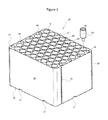
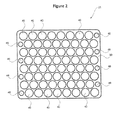
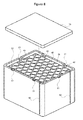
- a multiple firing device with an insert assembly 10 having a variety of colours and patterns comprises: a block 20 having solid peripheral sidewalls 30, a plurality of tubular apertures 40 which each extend from top surface 21 to the surface corresponding to the top surface i.e. bottom surface 22, the tubular apertures 40 have open top ends 41 on the top surface and open bottom ends 42 on the bottom surface, a plurality of holders 60 for receiving a pyrotechnic composition and being placed within the tubular apertures 40.
- a pyrotechnic composition comprises of fireworks projectiles 80A and effect charge 80.
- the pyrotechnic composition can further comprise a lifting charge, a breaking charge and an effect charge and a cover 82 attached to the top opening 64 of the holder 60 covering the lifting charge, breaking charge and effect charge.
- the cover can be made from paper and any other suitable materials.
- a multiple shot device 100 is provided. It comprises device 10, the pyrotechnic composition contained in a holder 60 and the ignition fuse 81 extending from pyrotechnic composition to the open bottom end 42.
- a holder 60 is a completed unit and can be manufactured separately from the block 20 and placed within each tubular aperture 40.
- the tubular aperture 40 is used for protection and serves an auxiliary function to launch the fireworks of the holder 60.
- the tubular apertures 40 are separated from each other by the same material as the block 20 which is integral with the solid peripheral sidewall 30.
- Fixing holes 46 are provided in the margin of the block 20, extending from top surface 21 to bottom surface 22. Fixing holes 46 are generally smaller in diameter than the tubular apertures 40. The fixing holes 46 enable the position of the block 20 to be fixed relative to another object and ensure stability and accuracy during the launching of fireworks.
- the tubular aperture 40 may have any cross section, for example, circular, square, and rectangular.
- the length, size and shape of the tubular aperture 40 are dependent on its application and the fireworks effects desired.
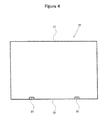
- a plurality of cut-out portions 51 is defined at the margin, i.e. the bottom of the sidewall of the block 20, to enable an ignition fuse 81 to pass through from an area beneath the tubular apertures 40 to the exterior of the block 20. This avoids affecting the stability of the device 10 because the device 10 does not have to rest on any part of the ignition fuse 81 or compromise its integrity.
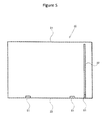
- the block 20 has longitudinal slits 52 extending from bottom surface 22 to top surface 21 defined on peripheral side walls 30, such as the exterior surface of a front surface and a left surface of the block 20, to receive a portion of the ignition fuse 81.
- the ignition fuse 81 coming from the bottom surface 22 of the block 20 can pass through the cut-out portions 51 and kept within the slits 52.
- the longitudinal slits 52 and cut-out portions 51 can be arranged on other surfaces of block 20.
- the block 20 is made from a paper material mixed with an adhesive, and the mixture is cooked, molded and then cooled to form a rigid solid block.
- the paper material may be a composition of craft paper, flour glue and graphite powder and also include fire retardants.
- the craft paper is mixed with the flour glue and graphite powder.
- the mixture is cooked, and then the cooked mixture is injected into a mold to create the block 20.
- the advantages of this paper material are that everything can be completely dissolved, it is easy to dispose of after use, environmentally friendly and it is a natural material as it is chemical-free.
- the material for the block 20 also has the benefit of fire prevention.
- the holder 60 is made from plastic.
- the holder 60 may be manufactured using plastic injection molding techniques. However, other suitable materials may be used.
- Each of the tubular apertures 40 can receive a holder 60.
- the holder 60 is sized so that it has a close fit within the tubular aperture 40.
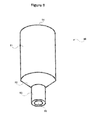
- the holder 60 is a hollow piece and generally cylindrical in shape.
- the holder 60 generally has three sections: an upper section 61, a lower section 63 and a narrowing conical portion 62.
- the upper section 61 includes the top opening 64 of the holder 60.
- the diameter of the upper section is 25mm.
- the upper section 61 contains the pyrotechnic composition.
- the lower section 63 has a diameter of 11 mm and is joined to the upper section 61 via a narrowing conical portion 62 to gradually reduce the diameter from the upper section 61 to the narrower lower section 63 of the holder 60.
- the bottom opening 65 of the holder 60 is defined at the bottom surface of the lower section 63.
- the bottom opening 65 has a diameter of 6mm.
- the total height of the holder 60 is 50mm.
- the upper section 61 has a length of 34mm.
- the lower section 63 has a length of 13mm.
- the narrowing conical portion 62 has a length of 3mm.
- a rectangular slit is defined having the same length as the diameter of the bottom opening 65 and is about 1 mm in width. The slit enables the fuse only to pass through to ignite the fireworks projectiles 80A and effect charge 80.
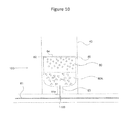
- the holder 60 is placed at the bottom of tubular aperture 40 so that the bottom opening 65 of the holder 60 and the bottom surface 22 of the block 20 are at the same level. Therefore, the entire pressure is directed upwards rather than downwards to launch the fireworks from the device 10.
- the holder 60 is dropped into a tubular aperture 40 with the lower section 63 entering the tubular aperture 40 first.
- the fireworks projectiles 80A and effect charge 80 after ignition leaves the holder 60 via the cover 82 and leaves the upper section 61 and tubular aperture 40. It is envisaged that a machine or tool may be used to drop multiple holders 60 into multiple tubular apertures 40 at the same time. This enables faster completion of the device 10 rather than individually dropping a holder 60 into a tubular aperture 40 sequentially.
- the holder 60 avoids generating a chemical reaction which causes some of the pyrotechnic composition to attach to the tubular aperture 40. If the pyrotechnic composition attaches to the tubular aperture 40, the device 10 cannot be dissolved and therefore it is not environmentally friendly.
- the pyrotechnic composition is injected into the holder 60 beforehand instead of being in direct contact with the tubular aperture 40. The holder 60 does not launch from the block 20 together with the pyrotechnic composition. After the fireworks are launched from the holder 60 and away from the device 10, the holder 60 will remain at the bottom of the tubular aperture 40 in the block 20.
- the holder 60 can be removed from the device 10 and the device 10 can then be completely dissolved in the water for safe disposal.
- the block 20 is rectangular in shape with rounded corners. This facilitates efficient storage and transport.
- the block 20 may be any shape or size and is dependent on its application and the fireworks effects desired, such as a simple cube or rectangular, circular, star or other covered shapes.
- a bottom plate 70 that is attached to the bottom surface 22 of the block 20 after the ignition fuse 81 has been connected to the holders 60 so that the ignition fuse 81 is not exposed.
- the peripheral sidewall 30 of the block 20 has a raised edge 31, the bottom plate 70 has a shape which fits tightly with the bottom surface 22 of the block 20. Glue/adhesive is used to firmly attach the bottom plate 70 to the bottom surface 22 of the block 20.
- the bottom plate 70 covers the entire bottom surface 22 of the block 20 while the bottom plate 70 and the raised edge 31 are at the same level, providing a major planar bottom surface.
- the bottom plate 70 is made of the same material as the block 20. However, any other suitable material may be used, such as plastic and paper.
- the top surface of the bottom plate 70 has a continuous path 71 which corresponds with the open bottom ends 42 of the tubular apertures 40.
- the path 71 holds the ignition fuses 81 extending from open bottom ends 42.
- a path 71 is used for guiding the ignition fuse 81 for connection each holder 60 in each tubular aperture 40.
- the separate fuses 81a of the holders 60 will be connected to the main fuse 81 after insertion of the holders into the apertures.
- the main fuse will be placed into the groove (path) 71 in the bottom plate 70 and the bottom plate is then attached to the block, thereby bringing the fuses into connection (touch) with each other at connection point 100.
- the path 71 also guides the ignition fuse 81 eventually to the exterior of the block 20 through any of the cut-out portions 51 defined in the sidewalls of the block 20.
- the bottom surface of the bottom plate 70 is a solid surface so that the ignition fuse 81 is not exposed which ensures safety. After the ignition fuse 81 is connected to the holder 60, the bottom plate 70 is attached to the bottom surface of the block 20. Referring to Figure 8 , there is a raised edge 31 on the bottom surface of the block 20.
- Glue/adhesive is used to firmly attach the raised edge 31 of the bottom plate 70 to the bottom surface 22 so that the bottom surface 22 of the block 20 and the raised edge 31 are at the same level.
- the block 20 in use substantially rests on the bottom plate 70 and the bottom plate 70 covers the ignition fuse 81 entirely and increases stability of the device 10 by providing a major planar bottom surface.
- the bottom plate 70 is also made using the same process as making the block 20 by using a mold for the bottom plate 70.
- a 3 mm ignition fuse 81 can be used to ensure accurate timing and the high probability of ignition of the fireworks. This can minimize the possibility of failed ignition of the fireworks occurring midway through the ignition process and which may stop the ignition process in between the tubular apertures 40 of the device 10.
- the block may be made from a paper material mixed with an adhesive and the mixture is cooked, formed and cooled to form a rigid solid block.
- the rigid solid block is machined (molded) to form the tubular apertures 40, the fixing holes 46, cut-out portions 51 and the longitudinal slits 52. Machining a rigid solid block maintains the integrity and strength of the device 10 as the end product is formed from a one-piece unitary construction. After the device 10 has been used, it may be recycled.
- the tubular aperture 40 may have any cross section, for example, circular, square, and rectangular. The length, size and shape of the tubular aperture 40 are dependent on its application and the fireworks effects desired.
- the holders 60 can be mass manufactured with the pyrotechnic composition (lifting charge, breaking charge, effect charge and a cover 82) and effects provided in an automated production line. This enables convenience and safety as after manufacture, the holder 60 is a completed unit and can be transported separately from the block 20. Since holders 60 are produced separately of the device 10, the process of managing the pyrotechnic composition can be simplified and the spaces required in the block 20 can be minimized in the automatic production line. In the automatic production line, the division of operation can be more secure and the management of safety is easier. Also, any waste resulting from manufacturing the holder and the block can be minimized.
Landscapes
- Engineering & Computer Science (AREA)
- General Engineering & Computer Science (AREA)
- Fire-Extinguishing By Fire Departments, And Fire-Extinguishing Equipment And Control Thereof (AREA)
- Fuses (AREA)
- Furnace Charging Or Discharging (AREA)
Applications Claiming Priority (1)
| Application Number | Priority Date | Filing Date | Title |
|---|---|---|---|
| CN201110065378.6A CN102679819B (zh) | 2011-03-11 | 2011-03-11 | 用于燃放烟花的多筒设备和组合烟花装置 |
Publications (2)
| Publication Number | Publication Date |
|---|---|
| EP2498044A2 true EP2498044A2 (de) | 2012-09-12 |
| EP2498044A3 EP2498044A3 (de) | 2014-07-23 |
Family
ID=44064920
Family Applications (1)
| Application Number | Title | Priority Date | Filing Date |
|---|---|---|---|
| EP11164635.2A Withdrawn EP2498044A3 (de) | 2011-03-11 | 2011-05-03 | Mehrfach zündende Feuerwerksvorrichtung mit Einsatzanordnung und Mehrfachschussvorrichtung |
Country Status (2)
| Country | Link |
|---|---|
| EP (1) | EP2498044A3 (de) |
| CN (1) | CN102679819B (de) |
Cited By (3)
| Publication number | Priority date | Publication date | Assignee | Title |
|---|---|---|---|---|
| EP2754991A3 (de) * | 2013-01-10 | 2017-07-19 | Xinghua Li | Durchgehende Zündstruktur für Feuerwerkkombinationen |
| CN109297368A (zh) * | 2018-12-12 | 2019-02-01 | 常德鼎工烟花爆竹科技发展有限公司 | 一种稳固式烟花内筒外筒组装机构 |
| WO2019051552A1 (en) * | 2017-09-15 | 2019-03-21 | Roger Carrigan | PHOSPHENE GAS FUMIGATION SYSTEM, RECTANGULAR PRISMATIC SHAPE ALUMINUM PHOSPHATE LOAD, APPLICATOR, AND STORAGE STORAGE STORAGE THEREFOR |
Families Citing this family (4)
| Publication number | Priority date | Publication date | Assignee | Title |
|---|---|---|---|---|
| CN103033090A (zh) * | 2012-12-14 | 2013-04-10 | 无锡火秀传媒科技有限公司 | 一种焰火发射中的即插式装弹点火装置 |
| CN105004226B (zh) * | 2015-07-22 | 2017-03-08 | 杨伦伟 | 一种无引线喜庆炮及其制作工艺 |
| CN106225602B (zh) * | 2016-08-29 | 2018-05-11 | 北海市铁山港区营盘烟花厂 | 鞭炮的一体成型化生产方法及该方法生产的鞭炮 |
| CN109489496A (zh) * | 2018-12-30 | 2019-03-19 | 苏州天为幕烟花科技有限公司 | 一种用于图文烟花点阵发射体的底板及其底板的成型模具 |
Family Cites Families (13)
| Publication number | Priority date | Publication date | Assignee | Title |
|---|---|---|---|---|
| ES2025403A6 (es) * | 1990-06-06 | 1992-03-16 | Garcia Gamon Manuel | Espoleta para fuegos de artificio. |
| CN2139688Y (zh) * | 1992-10-10 | 1993-08-04 | 许竞新 | 可连续发射的地面礼花炮 |
| US5429053A (en) * | 1993-12-22 | 1995-07-04 | Walker; Ronald R. | Pyrotechnic fan rack |
| US6393990B1 (en) * | 2000-03-24 | 2002-05-28 | Thomas J. Fagan | Firework launching system and method |
| US7866265B1 (en) * | 2006-06-30 | 2011-01-11 | Jacob Kravel | Flare apparatus |
| DE102007054435B4 (de) * | 2007-11-13 | 2011-03-31 | Weco Pyrotechnische Fabrik Gmbh | Feuerwerkskörperanordnungsvorrichtung und Feuerwerkskörperanordnung |
| CN201093954Y (zh) * | 2007-11-16 | 2008-07-30 | 武汉绿帝环保科技有限公司 | 一体式组合烟花发射管 |
| CN201129978Y (zh) * | 2007-11-23 | 2008-10-08 | 潘登 | 一种安全组合烟花 |
| CN201273796Y (zh) * | 2008-05-09 | 2009-07-15 | 胡跃辉 | 内置引线的一次成型组合花炮筒体 |
| CN101709937B (zh) * | 2009-07-22 | 2014-04-09 | 浏阳市东信烟花集团有限公司 | 一种整体式组合烟花 |
| CN201503237U (zh) * | 2009-08-29 | 2010-06-09 | 湖南省常德市科力特新材料有限公司 | 大口径石膏复合材料制作的组合烟花类花炮发射座 |
| CN101949667A (zh) * | 2010-09-30 | 2011-01-19 | 浏阳市余氏科技环保烟花厂 | 礼花弹的发射器 |
| CN202008318U (zh) * | 2011-03-11 | 2011-10-12 | 百乐特效科技有限公司 | 用于燃放烟花的多筒设备和组合烟花装置 |
-
2011
- 2011-03-11 CN CN201110065378.6A patent/CN102679819B/zh not_active Expired - Fee Related
- 2011-05-03 EP EP11164635.2A patent/EP2498044A3/de not_active Withdrawn
Non-Patent Citations (1)
| Title |
|---|
| None |
Cited By (3)
| Publication number | Priority date | Publication date | Assignee | Title |
|---|---|---|---|---|
| EP2754991A3 (de) * | 2013-01-10 | 2017-07-19 | Xinghua Li | Durchgehende Zündstruktur für Feuerwerkkombinationen |
| WO2019051552A1 (en) * | 2017-09-15 | 2019-03-21 | Roger Carrigan | PHOSPHENE GAS FUMIGATION SYSTEM, RECTANGULAR PRISMATIC SHAPE ALUMINUM PHOSPHATE LOAD, APPLICATOR, AND STORAGE STORAGE STORAGE THEREFOR |
| CN109297368A (zh) * | 2018-12-12 | 2019-02-01 | 常德鼎工烟花爆竹科技发展有限公司 | 一种稳固式烟花内筒外筒组装机构 |
Also Published As
| Publication number | Publication date |
|---|---|
| CN102679819B (zh) | 2015-05-20 |
| EP2498044A3 (de) | 2014-07-23 |
| CN102679819A (zh) | 2012-09-19 |
Similar Documents
| Publication | Publication Date | Title |
|---|---|---|
| EP2498044A2 (de) | Mehrfach zündende Feuerwerksvorrichtung mit Einsatzanordnung und Mehrfachschussvorrichtung | |
| CN202008318U (zh) | 用于燃放烟花的多筒设备和组合烟花装置 | |
| US4996923A (en) | Matrix-supported flechette load and method and apparatus for manufacturing the load | |
| EP3382323B1 (de) | Kombiniertes feuerwerk mit abfeuerungsschächten mit vertiefungen im bodenbereich | |
| US20150056562A1 (en) | Candle magazine | |
| NO852201L (no) | Tennladningsenhet. | |
| CN202109831U (zh) | 一种具程控电路片结构的组合烟花底座装置 | |
| US5719348A (en) | Component holder for cartridge reloading | |
| US3227084A (en) | Fireworks container | |
| EP3535544B1 (de) | Modularer ladungsbehälter | |
| EP3077762B1 (de) | Behälter zum verpacken und lagern von munitionseinheiten, eine einheitenfracht mit solchen behältern und verfahren zum verpacken und lagern solcher behälter | |
| US3525425A (en) | Package for cartridges | |
| JP3163405U (ja) | 打上花火発射用火薬収容部材 | |
| RU39198U1 (ru) | Фейерверочное изделие | |
| CN104729362A (zh) | 防火防爆组合烟花 | |
| NL2010859C2 (en) | Fireworks having a lowered danger classification and a method for lowering the danger classification of fireworks. | |
| WO1999020975A1 (de) | Zündeinrichtung für feuerwerksartikel | |
| RU2772262C1 (ru) | Крой картонной решётки-вкладыша для упаковки патронов стрелкового оружия | |
| JP7539707B2 (ja) | 打上花火発射用火薬収容部材 | |
| CN111006549A (zh) | 安全环保型鞭炮自动化生产装置及方法 | |
| WO2007090918A1 (es) | Dispositivo de cargador rápido para armas de fuego | |
| CN203534361U (zh) | 改进的烟火座结构 | |
| JPH11257895A (ja) | 打揚げ玩具煙火用星および打揚げ玩具煙火 | |
| AU2003100837A4 (en) | A Matchbox | |
| CN203561293U (zh) | 一种环保组合烟花盆架 |
Legal Events
| Date | Code | Title | Description |
|---|---|---|---|
| PUAI | Public reference made under article 153(3) epc to a published international application that has entered the european phase |
Free format text: ORIGINAL CODE: 0009012 |
|
| AK | Designated contracting states |
Kind code of ref document: A2 Designated state(s): AL AT BE BG CH CY CZ DE DK EE ES FI FR GB GR HR HU IE IS IT LI LT LU LV MC MK MT NL NO PL PT RO RS SE SI SK SM TR |
|
| AX | Request for extension of the european patent |
Extension state: BA ME |
|
| RIC1 | Information provided on ipc code assigned before grant |
Ipc: F42B 4/24 20060101AFI20140228BHEP Ipc: F42B 4/22 20060101ALN20140228BHEP |
|
| PUAL | Search report despatched |
Free format text: ORIGINAL CODE: 0009013 |
|
| AK | Designated contracting states |
Kind code of ref document: A3 Designated state(s): AL AT BE BG CH CY CZ DE DK EE ES FI FR GB GR HR HU IE IS IT LI LT LU LV MC MK MT NL NO PL PT RO RS SE SI SK SM TR |
|
| AX | Request for extension of the european patent |
Extension state: BA ME |
|
| RIC1 | Information provided on ipc code assigned before grant |
Ipc: F42B 4/22 20060101ALN20140619BHEP Ipc: F42B 4/24 20060101AFI20140619BHEP |
|
| STAA | Information on the status of an ep patent application or granted ep patent |
Free format text: STATUS: THE APPLICATION IS DEEMED TO BE WITHDRAWN |
|
| 18D | Application deemed to be withdrawn |
Effective date: 20150124 |