EP2498074A1 - Weitere Verbesserung an einem Temperaturkalibrator - Google Patents
Weitere Verbesserung an einem Temperaturkalibrator Download PDFInfo
- Publication number
- EP2498074A1 EP2498074A1 EP11157221A EP11157221A EP2498074A1 EP 2498074 A1 EP2498074 A1 EP 2498074A1 EP 11157221 A EP11157221 A EP 11157221A EP 11157221 A EP11157221 A EP 11157221A EP 2498074 A1 EP2498074 A1 EP 2498074A1
- Authority
- EP
- European Patent Office
- Prior art keywords
- calibrator
- sensor
- heat
- pressure
- calibrator body
- Prior art date
- Legal status (The legal status is an assumption and is not a legal conclusion. Google has not performed a legal analysis and makes no representation as to the accuracy of the status listed.)
- Withdrawn
Links
- 238000001816 cooling Methods 0.000 claims abstract description 4
- 238000010438 heat treatment Methods 0.000 claims abstract description 4
- 239000000463 material Substances 0.000 claims description 17
- 230000001105 regulatory effect Effects 0.000 claims description 12
- 239000007788 liquid Substances 0.000 claims description 7
- 239000011810 insulating material Substances 0.000 claims description 3
- 239000012528 membrane Substances 0.000 abstract description 28
- 239000012530 fluid Substances 0.000 description 11
- 239000007789 gas Substances 0.000 description 8
- 230000000694 effects Effects 0.000 description 5
- 238000009413 insulation Methods 0.000 description 5
- 239000013013 elastic material Substances 0.000 description 4
- 230000001419 dependent effect Effects 0.000 description 2
- 238000009826 distribution Methods 0.000 description 2
- OKTJSMMVPCPJKN-UHFFFAOYSA-N Carbon Chemical compound [C] OKTJSMMVPCPJKN-UHFFFAOYSA-N 0.000 description 1
- 150000001875 compounds Chemical class 0.000 description 1
- 230000001276 controlling effect Effects 0.000 description 1
- 239000000835 fiber Substances 0.000 description 1
- 239000003365 glass fiber Substances 0.000 description 1
- 229910021389 graphene Inorganic materials 0.000 description 1
- 230000005484 gravity Effects 0.000 description 1
- 238000004519 manufacturing process Methods 0.000 description 1
- 239000007769 metal material Substances 0.000 description 1
- 238000005192 partition Methods 0.000 description 1
- 238000000275 quality assurance Methods 0.000 description 1
- 230000002787 reinforcement Effects 0.000 description 1
- 238000007665 sagging Methods 0.000 description 1
- 238000009827 uniform distribution Methods 0.000 description 1
Images

Classifications
-
- G—PHYSICS
- G01—MEASURING; TESTING
- G01K—MEASURING TEMPERATURE; MEASURING QUANTITY OF HEAT; THERMALLY-SENSITIVE ELEMENTS NOT OTHERWISE PROVIDED FOR
- G01K15/00—Testing or calibrating of thermometers
- G01K15/005—Calibration
-
- G—PHYSICS
- G01—MEASURING; TESTING
- G01K—MEASURING TEMPERATURE; MEASURING QUANTITY OF HEAT; THERMALLY-SENSITIVE ELEMENTS NOT OTHERWISE PROVIDED FOR
- G01K15/00—Testing or calibrating of thermometers
Definitions
- the invention relates to an apparatus for calibration of temperature sensors, comprising a cavity for receiving a sensor to be calibrated, a heat-transferring medium for surrounding the sensor in the cavity, and a means for heating/cooling of the medium to a desired temperature.
- drift As components and equipment age, and also are subjected to temperature changes and mechanical strains, the critical capacity will decrease. This is called drift. When this happens, one can no longer rely on previous capacity tests, and this may result in poorer quality in development and production. Since one can not prevent drift, one must instead detect and eliminate the effect thereof by means of calibration.
- the prior art traditionally includes two principal types of calibrators, namely liquid bath calibrators and dry block calibrators.
- a main objective of the present invention is to provide an apparatus for calibration of temperature sensors that overcome the above problems.
- the present invention attains the above-described object by at least one pressure body exerting an even pressure on at least one calibrator body wherein each pressure body is separated from a respective calibrator body by a first membrane and on the opposite side of the calibrator body from the first membrane is a second membrane facing sensor to be calibrated.
- the term pliable relates to a property of a material wherein the material can be bent or reshaped but maintains substantially the same dimensions along its surface.
- An example of this is fibre reinforced cloths.
- the term elastic relates to a property of a material wherein the material can be bent, reshaped and also stretched and/or compressed, modifying the dimensions along its surface.
- An example of this is rubber.
- a separate pressure body typically pressurised by air means that a separate oil accumulator for the calibrator body is not required which in turn reduces size and allows for a compact and portable size of the calibrator system.
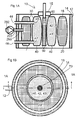
- the embodiment of the apparatus according to the invention shown in Fig. 1A and 1B comprises a circularly cylindrical container constituting a jacket 12 of a suitable, for example metallic material.
- the jacket defines a cavity 16 in which a pressure body 20 is placed.
- Said pressure body defines a cavity in which there is placed a thin-walled calibrator body 40 which is made of a suitable elastic material having a high thermal conductivity, e. g. a rubber material which is suitable for use within the relevant temperature limits.
- the calibrator body 40 defines a volume 42 receiving the relevant heat-transferring medium 43 which may be a liquid or a gas.
- the pressure body 20 is also provided with means for producing an overpressure, and possibly also an underpressure, on the calibrator body 40.
- the calibrator body 40 has an outer wall defined by a first membrane 30, and an inner wall defined by a second membrane 50 thus defining a central opening 60 extending along the longitudinal axis of the jacket 12 and being adapted to receive a temperature sensor 70 to be calibrated.
- an elastic, heat-insulating material 15 At the upper side of the calibrator body 40, where the opening 60 debouches and the temperature sensor 70 is to be introduced, there is applied an elastic, heat-insulating material 15.
- the calibrator body 40 is provided with an inlet 44 and an outlet 46 for connection to a circulation system, as further described in connection with Fig. 4 .
- the circulation system provides forced through-flow of the medium 43 through the calibrator body 40, it is also provided with means for producing an overpressure, and possibly also an underpressure, in the medium in the calibrator body 40.
- inlets and outlets shown in the drawings are only meant as illustrating examples. In the embodiments shown they may for example be placed tangentially in order to produce a vortex-like flow in the container. Generally, one will aim at a placing and a structural design that provides an optimal and uniform distribution of the through-flow, thereby obtaining minimal temperature gradients.
- Figs. 1A and 1B the apparatus is shown in a state wherein there is an underpressure in the medium 43.
- the inner wall of the calibrator body 40 i.e. the second membrane 50, then takes a position wherein it forms a suitable opening 60 for introduction of the temperature sensor 70 to be calibrated.
- the medium is subjected to an overpressure so that the second membrane 50 of the calibrator body is brought into tight-fitting abutment against the sensor 70.
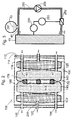
- Fig. 2 show a second embodiment of the apparatus according to the invention.
- the cavity-defining jacket 112 forms an upwardly open container having a rectangular cross-section as shown in Fig. 2 , and having a cavity 116 in which there are placed two thin walled essentially equal pressure bodies 120.
- Said pressure bodies defines a cavity in which there are placed two thin-walled, essentially equal calibrator bodies 140 which may be formed from an elastic material, or possibly from a suitably deformable, pliable, but inelastic material.
- Each calibrator body 140 defines a volume 142 receiving the relevant heat-transferring medium 143 (gas or liquid).
- Each calibrator body 140 has an outer wall defined by a first membrane 130, and an inner wall defined by a second membrane 150 thus defining a slot-shaped opening 160 extending centrally between a pair of opposite side walls of the container and being adapted for introduction and receipt of two or more sensors to be calibrated, in the illustrated case three sensors 170.
- sensors possibly may be an extra reference sensor which will thus be subjected to a temperature and a thermal condition which is so similar to the condition of the sensor or sensors to be calibrated that it will constitute a very accurate calibration reference.
- an insulation 115 of an elastic material At the upper side of the calibrator bodies 140, where the slot 160 debouches and the sensors 170 are to be introduced, there is applied an insulation 115 of an elastic material.
- each calibrator body 140 further is provided with an inlet 144 and an outlet 146 for connection to a circulation system which provides for a forced appropriate through-flow of the medium 143 through the calibrator bodies 140, and for the provision of an overpressure in the medium when this is desired.
- Fig. 2 the apparatus is shown in a first state in which there is zero overpressure in the medium 143.
- the inner walls 28 of the calibrator bodies then take a position in which the slot 160 is open for introduction of the temperature sensors 170.
- a second state in which the medium in the calibrator bodies is subjected to an overpressure, so that the second membrane 150 of the calibrator body is brought into tight-fitting abutment against the sensors 170, the walls having adapted themselves to the shape of the sensors.
- Fig. 3 shows a calibrator body 40 which is connected to a circulation system comprising a regulating circuit for regulating the temperature of the medium, and possibly also the through-flow velocity thereof through the calibrator body.
- the calibrator body 40 has an inlet 44, 144 and an outlet 46, 146 which are connected to a pipeline 288 having a pump 289 for circulation of the medium 43, 143.
- a heat-regulating unit 282 controlled by a regulating circuit 283.
- the regulating circuit supplies control signals from a number of temperature sensors 286 placed at appropriate places in the medium flow.
- the regulating circuit regulates supply or removal of heat energy via the unit 282, and it also controls the speed of the pump 289 and thereby the flow velocity of the medium, thus achieving the desired reference temperature of the medium in the calibrator body 40.
- a volume regulating device in the form of an accumulator for heat transferring medium 287 for adjusting the volume of medium 43, and thereby the volume of the calibrator body.
- This device is shown to be connected to a pump 289 connected to a pipeline 288, the medium in this embodiment of the apparatus being presupposed to be a liquid.
- the use of a gas may have advantages in case of extremely high or low temperatures.
- the calibrator bodies are preferably internally equipped with a system of manifolds 45, 145, 47, 147 with nozzles for inlet- and outlet fluid flow, to assure a well distributed fluid flow, and hence an equal temperature distribution inside the calibration bodies.
- Nozzles for inlet, respective outlet, of the fluid should not be positioned directly opposite to each other, to prevent the fluid flow going directly from inlet to outlet, instead of distributing inside the calibrator body.
- the manifolds should be positioned in such a way that they secure optimal fluid flow and not preventing the thermometers from being enclosed.
- the manifolds are connected through tubes or pipes to a circulation pump, or a fan for gas.
- the inlet manifold should optimally be placed near the bottom of the respective calibration body, and equipped with a number of nozzles to spread the fluid flow optimally.
- the nozzles should preferably have the main direction upwards and may have some angular spread to distribute the fluid flow.
- the sum of the cross sections of the inlet nozzles should correspond to cross section of the heat exchanger piping.
- the outlet manifold should be optimally placed at the top of the respective calibration body, and preferably provided with a number of outlet nozzles, not corresponding to the positions of the inlet nozzles. Like the inlet nozzles, the outlet nozzles may have some angular spread; however the main direction should be downwards.
- the sum of the cross sections of the outlet nozzles should be somewhat smaller, about 20%, compared to the inlet nozzles.
- the counter flow is e.g. provided by ensuring that the fluid flow in the first calibrator body flows in the opposite direction from the fluid flow of the second calibrator body. Thus the thermal contact between the two calibrator bodies will even out the temperature distribution.
- a pressurising pump 292 via a pressurising pipeline 296 to the connectors 22, 122.
- heat insulating layer 14, 114 can be placed between the calibrator body 40, 140 and the jacket 12, 112 and the bottom of the container.
- the first membrane 30, 130 between the pressure body and the calibrating body can either be a single membrane wherein the pressure body and the calibrating body are attached or a compound membrane, wherein the pressure body and the calibrating body can easily be detached from each other.
- the second membrane 50, 150 can in an alternative embodiment be applied like a sheath over the sensor to be calibrated and then be inserted into the heat transferring medium.
- the collar of the sheath can be attached to the calibrating body to enable the heat transferring medium to be put under pressure without spilling said medium.
- the membranes can also be made of graphene, thus combining strength, pliability with high thermal conductivity.
- the pressure body is typically defined by a separate thin walled body it can equally well be a volume defined by the calibrator body fitting tightly to the jacket, leaving a volume between the calibrator body and the jacket that can be pressurised.
- the pressure bodies will give efficient thermal insulation of the calibration bodies of the sides adjacent.
- the thermal insulation will be even more efficient if the natural convection in the gas filling is hindered by filling a cell structured spongy material into the pressure bodies.
- the gas filling will be subject to a pressure increase, or a pressure drop dependent upon the temperature, following the State Equation of ideal gases.
- the simplest solution may be to connect the gas filling of the pressure bodies to a pressure reservoir subject to the temperature of the ambient, or controlling the temperature and hence the pressure..
- the calibrator bodies are allowed to change the volume in order to have the thin walled material embracing the thermometers. This is obtained by carrying the manifolds at one end applying a bushing, permitting the manifolds to slide freely in the longitudinal direction.
- the bushing should have a slot in order not to hindering the fluid flow from, or into the nozzles. It may be feasible also to apply a hydraulic accumulator, to help changing the volume of the fluid inside the calibrator body. In this case, the air filling of the hydraulic accumulator should stay in free contact with the air in the pressure bodies.
- thermometers in an apparatus for calibration preferably built of a material giving good thermal insulation, and being easy to machine, comprising two substantially parallel pieces, being hinged together at one end and shaped/adjusted, individually, to hold/clamp the thermometers of different geometry.
- the device called a clamp 80, keeping the thermometers, is together with the thermometers to be calibrated and together with the reference thermometer, inserted in the slot above the calibration bodies, and kept in place by the thermal insulation between the inner and the outer calibrator box.
- the thermometers to be calibrated, together with the reference thermometer are, usually manually, clamped into a fixed position in the opening and inserted into the slot between the calibrator bodies, before imposing pressure into the pressure bodies.
- the invention according to the application can be made compact and portable, and thus suited for calibrating devices in the field.
Landscapes
- Physics & Mathematics (AREA)
- General Physics & Mathematics (AREA)
- Measuring Volume Flow (AREA)
- Measuring Temperature Or Quantity Of Heat (AREA)
Priority Applications (4)
| Application Number | Priority Date | Filing Date | Title |
|---|---|---|---|
| EP11157221A EP2498074A1 (de) | 2011-03-07 | 2011-03-07 | Weitere Verbesserung an einem Temperaturkalibrator |
| PCT/NO2012/000024 WO2012161582A1 (en) | 2011-03-07 | 2012-03-07 | Apparatus for calibration of temperature sensors |
| US14/004,025 US20140192834A1 (en) | 2011-03-07 | 2012-03-07 | Apparatus for calibration of temperature sensors |
| EP12790105.6A EP2684015A4 (de) | 2011-03-07 | 2012-03-07 | Vorrichtung zur kalibrierung von temperatursensoren |
Applications Claiming Priority (1)
| Application Number | Priority Date | Filing Date | Title |
|---|---|---|---|
| EP11157221A EP2498074A1 (de) | 2011-03-07 | 2011-03-07 | Weitere Verbesserung an einem Temperaturkalibrator |
Publications (1)
| Publication Number | Publication Date |
|---|---|
| EP2498074A1 true EP2498074A1 (de) | 2012-09-12 |
Family
ID=44541491
Family Applications (2)
| Application Number | Title | Priority Date | Filing Date |
|---|---|---|---|
| EP11157221A Withdrawn EP2498074A1 (de) | 2011-03-07 | 2011-03-07 | Weitere Verbesserung an einem Temperaturkalibrator |
| EP12790105.6A Withdrawn EP2684015A4 (de) | 2011-03-07 | 2012-03-07 | Vorrichtung zur kalibrierung von temperatursensoren |
Family Applications After (1)
| Application Number | Title | Priority Date | Filing Date |
|---|---|---|---|
| EP12790105.6A Withdrawn EP2684015A4 (de) | 2011-03-07 | 2012-03-07 | Vorrichtung zur kalibrierung von temperatursensoren |
Country Status (3)
| Country | Link |
|---|---|
| US (1) | US20140192834A1 (de) |
| EP (2) | EP2498074A1 (de) |
| WO (1) | WO2012161582A1 (de) |
Cited By (1)
| Publication number | Priority date | Publication date | Assignee | Title |
|---|---|---|---|---|
| CN105043594A (zh) * | 2015-09-10 | 2015-11-11 | 上海量值测控仪器科技有限公司 | 保温层风冷式热电偶检定炉及其制备方法 |
Families Citing this family (6)
| Publication number | Priority date | Publication date | Assignee | Title |
|---|---|---|---|---|
| JP2014182694A (ja) * | 2013-03-21 | 2014-09-29 | Fujitsu Ltd | センサ故障検知装置、方法、およびプログラム |
| US20160187206A1 (en) * | 2014-12-24 | 2016-06-30 | Jogtek Corp. | Calibration apparatus for wireless temperature recorder and calibration system for wireless temperature recorder |
| CN106840461A (zh) * | 2016-07-20 | 2017-06-13 | 国家电网公司 | 一种变压器电抗器温度保护装置现场检测方法 |
| CN108168737B (zh) * | 2018-03-21 | 2023-05-26 | 大连交通大学 | 薄膜热电偶标定专用隔离夹持装置 |
| DE102018115286A1 (de) * | 2018-06-26 | 2020-01-02 | Endress + Hauser Wetzer Gmbh + Co Kg | Temperatur-Kalibrator |
| DE102022113268A1 (de) | 2022-05-25 | 2023-11-30 | SIKA Dr. Siebert & Kühn GmbH & Co. KG | Verfahren zum Betrieb eines Temperaturkalibrators mit Kühleinheit |
Citations (1)
| Publication number | Priority date | Publication date | Assignee | Title |
|---|---|---|---|---|
| EP1190228A1 (de) * | 1999-04-29 | 2002-03-27 | Ole Einar Bronlund | Vorrichtung zur kalibrerung eines temperatursensors |
Family Cites Families (9)
| Publication number | Priority date | Publication date | Assignee | Title |
|---|---|---|---|---|
| US4119847A (en) * | 1976-10-28 | 1978-10-10 | Schlumberger Technology Corporation | Calibrator for radioactivity well logging tools |
| US5207087A (en) * | 1991-04-17 | 1993-05-04 | Optex Biomedical, Inc. | Sensor calibrator and test apparatus |
| US5618619A (en) * | 1994-03-03 | 1997-04-08 | Monsanto Company | Highly abrasion-resistant, flexible coatings for soft substrates |
| NO305295B1 (no) * | 1997-07-18 | 1999-05-03 | Instrutek Holding As | Innretning for kalibrering av temperaturf°lere |
| US6659551B1 (en) * | 2001-12-03 | 2003-12-09 | George Gabriel Arenas | Retractable seat protection cover |
| US20070268952A1 (en) * | 2006-05-19 | 2007-11-22 | Sherwood Services Ag | Thermometer calibration by immersion in non-electrically conductive liquid |
| JP2010032387A (ja) * | 2008-07-29 | 2010-02-12 | Yamabun Denki:Kk | 温度測定方法、温度測定装置、温度制御方法、温度制御装置、補正方法、及び補正装置 |
| CN102144136B (zh) * | 2008-09-05 | 2013-06-19 | 丹佛斯公司 | 用于校准过热传感器的方法 |
| CA2820434C (en) * | 2010-12-06 | 2016-08-23 | Michael Colburn | System for verifying temperature measurement |
-
2011
- 2011-03-07 EP EP11157221A patent/EP2498074A1/de not_active Withdrawn
-
2012
- 2012-03-07 US US14/004,025 patent/US20140192834A1/en not_active Abandoned
- 2012-03-07 EP EP12790105.6A patent/EP2684015A4/de not_active Withdrawn
- 2012-03-07 WO PCT/NO2012/000024 patent/WO2012161582A1/en not_active Ceased
Patent Citations (2)
| Publication number | Priority date | Publication date | Assignee | Title |
|---|---|---|---|---|
| EP1190228A1 (de) * | 1999-04-29 | 2002-03-27 | Ole Einar Bronlund | Vorrichtung zur kalibrerung eines temperatursensors |
| EP1190228B1 (de) | 1999-04-29 | 2004-12-01 | Ole Einar Bronlund | Vorrichtung zur kalibrierung eines temperatursensors |
Cited By (2)
| Publication number | Priority date | Publication date | Assignee | Title |
|---|---|---|---|---|
| CN105043594A (zh) * | 2015-09-10 | 2015-11-11 | 上海量值测控仪器科技有限公司 | 保温层风冷式热电偶检定炉及其制备方法 |
| CN105043594B (zh) * | 2015-09-10 | 2017-10-13 | 上海量值测控仪器科技有限公司 | 保温层风冷式热电偶检定炉及其制备方法 |
Also Published As
| Publication number | Publication date |
|---|---|
| EP2684015A4 (de) | 2014-08-27 |
| EP2684015A1 (de) | 2014-01-15 |
| US20140192834A1 (en) | 2014-07-10 |
| WO2012161582A1 (en) | 2012-11-29 |
Similar Documents
| Publication | Publication Date | Title |
|---|---|---|
| US20140192834A1 (en) | Apparatus for calibration of temperature sensors | |
| US6709152B1 (en) | Apparatus for calibration of temperature sensors | |
| CN106841297B (zh) | 一种多功能固体材料热物性测试装置及方法 | |
| CN102175348B (zh) | 一种提供空气介质温度源的校准装置及其校准方法 | |
| EP3152544B1 (de) | Luftströmungsumlenker für reduzierten probentemperaturgradienten | |
| CN104263634A (zh) | 一种基于毛细管的流式聚合酶链式反应循环加热仪及加热方法 | |
| CN109580427B (zh) | 一种模拟微通道阻塞的实验方法 | |
| CN105829858A (zh) | 容器测试系统 | |
| CN102492620B (zh) | 一种培养箱 | |
| US20200166416A1 (en) | Apparatus for calibration of temperature sensors | |
| CN202041324U (zh) | 一种提供空气介质温度源的校准装置 | |
| CN207300798U (zh) | 一种可控温度的粘度杯 | |
| CN110860268A (zh) | 结构材料水热生长反应器 | |
| CN113983757A (zh) | 恒温模块和具有其的备料桶 | |
| CN104662422A (zh) | 用于实时提供气体校准溶液的气体平衡线圈 | |
| CN107894795A (zh) | 一种气体恒温装置及检测系统 | |
| CN207488852U (zh) | 一种气体恒温装置及检测系统 | |
| CN105136799A (zh) | 一种金相观测装置 | |
| CN102365541B (zh) | 用于数字式测力传感器的温度补偿测试的装置和方法 | |
| KR20200044205A (ko) | 바이오 3d 프린터의 바이오웨어 고정용 타공 빌드플레이트 구조, 상기 바이오웨어의 온도를 조절하는 방법 및 상기 바이오웨어를 고정하는 방법 | |
| CN206661285U (zh) | 试管储运装置 | |
| CN115762818B (zh) | 柱塞、反应装置及核反应堆 | |
| CN103454310B (zh) | 一种标准通风干湿表 | |
| US11624450B2 (en) | Fluid delivery mounting panel and system | |
| CN219942887U (zh) | 水冷加热器 |
Legal Events
| Date | Code | Title | Description |
|---|---|---|---|
| PUAI | Public reference made under article 153(3) epc to a published international application that has entered the european phase |
Free format text: ORIGINAL CODE: 0009012 |
|
| AK | Designated contracting states |
Kind code of ref document: A1 Designated state(s): AL AT BE BG CH CY CZ DE DK EE ES FI FR GB GR HR HU IE IS IT LI LT LU LV MC MK MT NL NO PL PT RO RS SE SI SK SM TR |
|
| AX | Request for extension of the european patent |
Extension state: BA ME |
|
| STAA | Information on the status of an ep patent application or granted ep patent |
Free format text: STATUS: THE APPLICATION IS DEEMED TO BE WITHDRAWN |
|
| 18D | Application deemed to be withdrawn |
Effective date: 20130313 |