EP2499737B1 - Verfahren zum plausibilisieren des drehmomentes einer elektrischen maschine und maschinenregler zur regelung einer elektrischen maschine und zur durchführung des verfahrens - Google Patents
Verfahren zum plausibilisieren des drehmomentes einer elektrischen maschine und maschinenregler zur regelung einer elektrischen maschine und zur durchführung des verfahrens Download PDFInfo
- Publication number
- EP2499737B1 EP2499737B1 EP10754508.9A EP10754508A EP2499737B1 EP 2499737 B1 EP2499737 B1 EP 2499737B1 EP 10754508 A EP10754508 A EP 10754508A EP 2499737 B1 EP2499737 B1 EP 2499737B1
- Authority
- EP
- European Patent Office
- Prior art keywords
- electric machine
- stator
- pwr
- torque
- value
- Prior art date
- Legal status (The legal status is an assumption and is not a legal conclusion. Google has not performed a legal analysis and makes no representation as to the accuracy of the status listed.)
- Active
Links
Images
Classifications
-
- H—ELECTRICITY
- H02—GENERATION; CONVERSION OR DISTRIBUTION OF ELECTRIC POWER
- H02P—CONTROL OR REGULATION OF ELECTRIC MOTORS, ELECTRIC GENERATORS OR DYNAMO-ELECTRIC CONVERTERS; CONTROLLING TRANSFORMERS, REACTORS OR CHOKE COILS
- H02P29/00—Arrangements for regulating or controlling electric motors, appropriate for both AC and DC motors
- H02P29/02—Providing protection against overload without automatic interruption of supply
- H02P29/024—Detecting a fault condition, e.g. short circuit, locked rotor, open circuit or loss of load
- H02P29/0241—Detecting a fault condition, e.g. short circuit, locked rotor, open circuit or loss of load the fault being an overvoltage
-
- H—ELECTRICITY
- H02—GENERATION; CONVERSION OR DISTRIBUTION OF ELECTRIC POWER
- H02P—CONTROL OR REGULATION OF ELECTRIC MOTORS, ELECTRIC GENERATORS OR DYNAMO-ELECTRIC CONVERTERS; CONTROLLING TRANSFORMERS, REACTORS OR CHOKE COILS
- H02P29/00—Arrangements for regulating or controlling electric motors, appropriate for both AC and DC motors
- H02P29/02—Providing protection against overload without automatic interruption of supply
- H02P29/024—Detecting a fault condition, e.g. short circuit, locked rotor, open circuit or loss of load
-
- H—ELECTRICITY
- H02—GENERATION; CONVERSION OR DISTRIBUTION OF ELECTRIC POWER
- H02P—CONTROL OR REGULATION OF ELECTRIC MOTORS, ELECTRIC GENERATORS OR DYNAMO-ELECTRIC CONVERTERS; CONTROLLING TRANSFORMERS, REACTORS OR CHOKE COILS
- H02P21/00—Arrangements or methods for the control of electric machines by vector control, e.g. by control of field orientation
- H02P21/14—Estimation or adaptation of machine parameters, e.g. flux, current or voltage
- H02P21/20—Estimation of torque
-
- Y—GENERAL TAGGING OF NEW TECHNOLOGICAL DEVELOPMENTS; GENERAL TAGGING OF CROSS-SECTIONAL TECHNOLOGIES SPANNING OVER SEVERAL SECTIONS OF THE IPC; TECHNICAL SUBJECTS COVERED BY FORMER USPC CROSS-REFERENCE ART COLLECTIONS [XRACs] AND DIGESTS
- Y02—TECHNOLOGIES OR APPLICATIONS FOR MITIGATION OR ADAPTATION AGAINST CLIMATE CHANGE
- Y02T—CLIMATE CHANGE MITIGATION TECHNOLOGIES RELATED TO TRANSPORTATION
- Y02T10/00—Road transport of goods or passengers
- Y02T10/60—Other road transportation technologies with climate change mitigation effect
- Y02T10/64—Electric machine technologies in electromobility
Definitions
- the invention relates to a method according to claim 1 and a machine controller for controlling an electric machine according to claim 15.
- inverter - For the drive in hybrid or electric vehicles electrical machines in the form of induction machines are usually used, which in conjunction with inverters - often referred to as inverter - are operated.
- the electrical machines are operated either in motor or generator mode.
- the electric machine During engine operation, the electric machine generates a drive torque which, when used in a hybrid vehicle, supports an internal combustion engine, for example in an acceleration phase.
- generator mode the electric machine generates electrical energy that is stored in an energy storage such as a battery or a super-cap.
- Operating mode and power of the electrical machine are set by means of a control unit - often referred to as a machine controller - via the inverter.
- a continuous torque monitoring It is known to perform a continuous torque monitoring to detect malfunctions in a machine controller of an electrical machine. This serves in particular for the protection of vehicle occupants and external road users. It is intended to prevent a torque increase and a consequent unwanted acceleration or deceleration of the vehicle become.
- the core of a continuous torque monitoring is the comparison of an actual torque provided by the electric machine with a permissible torque. Normally, the actual torque is smaller than the permissible torque. If the actual torque exceeds the allowable torque, there is a fault in the engine governor of the electric machine and an error response leading to a safe vehicle condition is initiated.
- the torque of the electric machine is usually calculated using a mathematical machine model.
- the task of torque monitoring is therefore to plausibilize the electromagnetic torque calculated model-based by a machine controller.
- a method for controlling a vehicle drive unit with at least two individual motors in which a total actual torque is continuously compared with a permissible total torque.
- the total actual torque is calculated from individual actual torque values of the at least two individual motors and the permissible total torque from permissible individual torque values of the at least two individual motors.
- An error reaction is initiated when the comparison shows that the total actual torque is greater than the total permissible torque.
- the publication DE 100 19 152 A1 discloses a control system for the safety monitoring of an electromotive actuator with a model-based monitoring device, which evaluates the Stellgüte, including a model of the servomotor and the controlled system.
- the publication WO 2005/014329 A1 discloses a method for mathematically modeling the operation of an electrical load.
- the publication DE 10 2008 008 536 A1 discloses a method for controlling an electric machine of an electric vehicle, in which detected operating conditions of the machine with the control signals of the electric machine is checked for plausibility.
- the publication DE 10 2006 005 854 A1 discloses a method for determining the torque of an electric machine in which a phase voltage and the rotational speed of the electric machine are measured.
- a first value of an electromagnetic power of the electric machine is determined as a function of the calculated torque and a rotational speed of the electric machine.
- a second value of the electromagnetic power of the electric machine is determined, which is then compared with the first value of the electromagnetic power of the electric machine. If it is found that the second value of the electromagnetic power of the electric machine deviates by more than a predetermined threshold value from the first value of the electromagnetic power and the electric machine, then the torque calculated on the basis of the machine model of the electric machine is classified as implausible and as a result a Malfunction of the machine controller detected. As a result of the fault detection, the electrical machine can be converted into a safe operating state or even switched off completely.
- the plausibility of the calculated based on the machine model electromagnetic torque is thus based on a core balance on a power balance between a machine model based determined power (first value of the electromagnetic power) and a sensor-based determined comparison performance.
- the second value of the electromagnetic power serving as comparison power is calculated on the basis of the stator currents and stator phase voltages of the electrical machine, in particular a synchronous, asynchronous, reluctance or brushless DC machine.
- a measurement of the DC link current and thus a corresponding current sensor are not required to determine the comparison performance, which saves costs.
- the flow angle is not included in the calculation of the comparative power. This offers the additional possibility of a plausibility check of the flux angle with the aid of the calculated sensor-based comparison performance.
- the machine model specifies a pole pair number, a longitudinal current, a cross current, an excitation flux and longitudinal and transverse inductances of the electric machine, from which the torque of the electric machine is calculated.
- the longitudinal and transverse currents of the electric machine thereby designate stator current components in the two orthogonal directions of a field-oriented reference system and represent stator current setpoints depending on the type and state of the electric machine.
- the longitudinal and transverse inductances denote Machine-specific stator inductances in the two directions of the field-oriented reference system.
- At least one of the stator currents is measured and all unmetered stator currents are calculated model-based by utilizing the symmetry properties of the stator currents.
- stator currents are measured with the aid of current sensors, it is possible to detect an error in the current sensor system by evaluating the stator currents. It is exploited that the sum of the stator currents must be zero in an ideal system, so that an error can be detected if the sum of the stator currents exceeds a predetermined first stator current threshold. In this way, an error detection for the current sensor is realized without additional circuit complexity.
- the stator phase voltages are determined by calculation.
- An inverter upstream of the electrical machine usually has a power output stage for each of the phases of the electric machine, which also comprises power switching elements. These power switching elements are controlled by the machine controller usual way via pulse width modulated control signals. From these control signals, the duty cycles for the individual phases of the electrical machine can be determined directly. With the help of these duty cycle and a DC link voltage, which can be determined by measurement, the Statorstrangpositionen can be calculated. On a measurement of Statorstrangpositionen, which is basically possible, can be dispensed with in this way.
- a current power loss of the electric machine is taken into account, wherein these Advantageously read from a power loss map as a function of the stator currents and the speed of the electric machine.
- the amount of a maximum effective torque can be determined directly from the amount of the stator current.
- the set nominal torque corresponds to this maximum value at most. Deviations are possible depending on the temperature of the electric machine and its rotor.
- the amount of a desired stator current can be determined as a function of an amount of a setpoint torque.
- the amount of the desired stator current determined in this way is compared with the amount of an actual stator current and the torque of the electrical machine calculated using the machine model is classified as implausible if a deviation of the amount of the desired stator current from the amount of the actual stator current exceeds a predetermined second stator current threshold.
- the amount of the nominal stator current is advantageously read from a stator current characteristic as a function of the nominal torque.
- a sign of the effective torque can be determined depending on the second value of the electromagnetic power and the rotational speed of the electric machine. If the sign of the effective torque is not equal to the sign of the setpoint torque, the torque calculated on the basis of the machine model can likewise be classified as implausible.
- An inventive machine controller for controlling an electric machine is defined in claim 15.
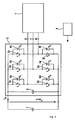
- FIG. 1 is a schematic block diagram of an electrical machine and an inverter with a motor controller according to the invention.
- FIG. 1 shows a schematic representation of a three-phase electric machine 1, which may be designed for example as a synchronous, asynchronous, reluctance or brushless DC machine, with a pulse inverter connected thereto 2.
- the pulse inverter 2 comprises circuit breakers 3a-3f, which with individual phases U, V, W of the electric machine 1 are connected and the phases U, V, W switch either against a high supply voltage potential in the form of a DC link voltage U dcLnk or a low reference potential in the form of ground.
- the switches 3a-3c connected to the intermediate circuit voltage U dcLnk are also referred to as "high-side switches” and the ground-connected switches 3d-3f are referred to as "low-side switches”.
- the pulse inverter 2 further comprises a plurality of freewheeling diodes 4a-4f, which are each arranged parallel to one of the switches 3a-3f.
- the pulse inverter 2 determines the power and operating mode of the electric machine and is controlled by a machine controller 5, which in FIG. 1 is shown only schematically and can also be integrated into the inverter, driven accordingly.
- the electric machine 1 can be operated either in the engine or generator mode.
- the pulse inverter 2 also comprises a so-called intermediate circuit capacitor 6, which essentially serves to stabilize a battery voltage.
- the electrical system of the vehicle with a battery 7 is connected in parallel to the DC link capacitor 6.
- the index "Mdl” indicates here and below that the calculation of the corresponding size is based exclusively on model data
- the rotational speed n can also be calculated from an angular differential (( ⁇ 2- ⁇ 1) / (t2-t1)) of two current vectors measured at time t1 and t2 (
- the measurement of the rotational speed n of the electric machine 1 can be dispensed with.
- this only over a whole electrical revolutions on average can deliver a significant torque when it is controlled synchronously, so that the rotor aligns with the magnetic flux in the stator and thus the current vector. That is, a synchronous machine can only output torque over complete electrical revolutions when the actual rotational speed of the electric machine is synchronous with the angular differential.
- the rotational speed calculated on the basis of the angular differential can be used to check the plausibility of the rotational speed signal of the rotational speed sensor and thus for fault detection for the rotational speed sensor.
- phase currents it is also possible to measure only one or at least only a part of the phase currents and to calculate the other phase currents model-based by utilizing the symmetry properties.
- the described plausibility check and the associated error detection in the current sensor are then not possible.
- stator current components I sA and I sB are calculated in the A and B directions of a stator-fixed reference system - hereinafter referred to as A / B system.
- I sA I sB 1 2 ⁇ 2 3 - 1 3 - 1 3 0 1 3 - 1 3 ⁇ I sU I sV I sW
- stator current components I sd and I sq in the d-direction (longitudinal direction) or q-direction (transverse direction) of a field-oriented one of the stator current components I sA and I sB in the stator-fixed A / B system Reference system - hereinafter referred to as d / q system - are calculated (see equation (6)).
- stator current components I sd and I sq in the d / q system serve as feedback variables in the control of the electrical machine 1.
- I sd I sq cos ⁇ FIx sin ⁇ FIx - sin ⁇ FIx cos ⁇ FIx ⁇ I sA I sB
- the flow angle ⁇ Flx represents the flow angle in the stator-fixed A / B system.
- the duty cycles dyc U , dyc V and dyc W for the individual phases U, V and W can be determined directly.
- the effective stator voltage U sU , U sV and U sW can be reconstructed.
- a current intermediate circuit voltage U dcLnk must additionally be measured.
- current error voltages U sUrr , U sVErr and U sWErr are taken into account, which are advantageously read from a map as a function of the stator currents I sU , I sV and I sW and the intermediate circuit voltage U dcLnk .
- the error voltages U sUrr , U sVErr and U sWErr are due to dead times and non-ideal switching behavior of the circuit breaker 3a-3f.
- an active electrical power Pwr ElMa of the electric machine 1 can be calculated according to equation (11).
- the power loss Pwr ElMaLos of the electric machine according to equation (11) is stored in a characteristic field as a function of the amount I s of the stator current and the rotational speed n.
- Pwr ElMaLos K ⁇ F I s n
- the index "Sens” indicates that no model data is used to calculate the power but only sensor data.
- the plausibility check of the calculated with the help of the machine model electromagnetic torque Trq EmMdl via a power balance The power that generates the electromagnetic torque, on the one hand determined from the machine model according to equation (2) and on the other hand from the sensor data according to equation (13).
- Pwr Err Pwr EmMdl - Pwr Emsens calculated, which is ideally zero and assumes small values in normal operation. If the amount of the thus calculated power error Pwr Err exceeds a predefined parameterizable power threshold value Pwr ErrLim , then the torque calculated on the basis of the machine model is classified as implausible and accordingly an error is detected. Pwr Err > Pwr ErrLim ⁇ error !
- the amount of a maximum effective torque can be determined directly from the amount I s of the stator current.
- the magnitude of the stator current can in turn be determined via the geometric sum of the two orthogonal stator current components in the stator-fixed A / B system according to equation (12).
- the dependence of the amount of the maximum effective torque on the amount of the stator current can advantageously be stored in a characteristic curve and is characteristic for each machine type.
- the set torque corresponds exactly to this maximum value.
- the inverse function can be used for each required setpoint torque Trq EmDes the associated stator current setpoint I sDes be determined.
- I sdes K ⁇ L - 1 Trq Emde
- I sErr I sdes - I s I sErr ⁇ I sErrLim ⁇ Trq em ⁇ Trq Emde I sErr > I sErrLim ⁇ error !
- Trq Em a check of the sign of the effective torque Trq Em. This is done as shown in equation (21) with the aid of the sign of the electromagnetic power Pwr EmSens according to equation (13) and the rotational speed n of the electric machine 1.
- Trq em sgn Pwr Emsens sgn n
Landscapes
- Engineering & Computer Science (AREA)
- Power Engineering (AREA)
- Control Of Ac Motors In General (AREA)
Description
- Die Erfindung betrifft ein Verfahren nach Anspruch 1 und einen Maschinenregler zur Regelung einer elektrischen Maschine nach Anspruch 15.
- Für den Antrieb in Hybrid- oder Elektrofahrzeugen werden in der Regel elektrische Maschinen in Form von Drehfeldmaschinen eingesetzt, welche in Verbindung mit Wechselrichtern - häufig auch als Inverter bezeichnet - betrieben werden. Die elektrischen Maschinen werden dabei wahlweise im Motor- oder Generatorbetrieb betrieben. Im Motorbetrieb erzeugt die elektrische Maschine ein Antriebsmoment, welches beim Einsatz in einem Hybridfahrzeug einen Verbrennungsmotor, zum Beispiel in einer Beschleunigungsphase, unterstützt. Im Generatorbetrieb erzeugt die elektrische Maschine elektrische Energie, die in einem Energiespeicher, wie zum Beispiel einer Batterie oder einem Super-Cap gespeichert wird. Betriebsart und Leistung der elektrischen Maschine werden mittels einer Regeleinheit - häufig als Maschinenregler bezeichnet - über den Wechselrichter eingestellt.
- Es ist bekannt, eine kontinuierliche Momentenüberwachung zur Aufdeckung von Fehlfunktionen in einem Maschinenregler einer elektrischen Maschine durchzuführen. Dies dient insbesondere dem Schutz von Fahrzeuginsassen sowie externen Verkehrsteilnehmern. Es soll eine Momentenüberhöhung und eine dadurch bedingte ungewollte Beschleunigung oder Verzögerung des Fahrzeugs verhindert werden. Der Kern einer kontinuierlichen Momentenüberwachung ist dabei der Vergleich eines von der elektrischen Maschine bereitgestellten Ist-Drehmomentes mit einem zulässigen Drehmoment. Im Normalfall ist das Ist-Drehmoment kleiner als das zulässige Drehmoment. Falls das Ist-Drehmoment das zulässige Drehmoment übersteigt, liegt ein Fehler im Maschinenregler der elektrischen Maschine vor und eine zu einem sicheren Fahrzeugzustand führende Fehlerreaktion wird eingeleitet.
- In herkömmlichen Fahrzeugen wird das Drehmoment der elektrischen Maschine üblicherweise anhand eines mathematischen Maschinenmodells berechnet. Aufgabe der Momentenüberwachung ist es demzufolge, das von einem Maschinenregler modellbasiert berechnete elektromagnetische Drehmoment zu plausibilisieren.
- Aus der
WO 2007/025839 A1 ist ein Verfahren zur Steuerung einer Fahrzeug-Antriebseinheit mit mindestens zwei einzelnen Motoren bekannt, bei dem ein Gesamt-Ist-Moment kontinuierlich mit einem zulässigen Gesamtmoment verglichen wird. Dabei wird das Gesamt-Ist-Moment aus Einzel-Ist-Momentwerten der mindestens zwei einzelnen Motoren und das zulässige Gesamtmoment aus zulässigen Einzelmomentwerten der mindestens zwei einzelnen Motoren berechnet. Eine Fehlerreaktion wird dann eingeleitet, wenn das Vergleichen ergibt, dass das Gesamt-Ist-Moment größer ist als das zulässige Gesamtmoment. - Die Druckschrift
DE 100 19 152 A1 offenbart ein Regelungssystem für die Sicherheitsüberwachung eines elektromotorischen Stellglieds mit einer modellgestützten Überwachungseinrichtung, die unter Einbezug eines Modells des Stellmotors und der Regelstrecke die Stellgüte bewertet. - Die Druckschrift
WO 2005/014329 A1 offenbart ein Verfahren zum mathematischen Modellieren des Betriebs einer elektrischen Last. - Die Druckschrift
DE 10 2008 008 536 A1 offenbart ein Verfahren für die Steuerung einer elektrischen Maschine eines Elektrofahrzeugs, bei welchem erfasste Betriebszustände der Maschine mit den Steuersignalen der elektrischen Maschine auf Plausibilität überprüft wird. - Die Druckschrift
DE 10 2006 005 854 A1 offenbart ein Verfahren zur Bestimmung des Drehmoments einer elektrischen Maschine, bei dem eine Phasenspannung und die Drehzahl der elektrischen Maschine gemessen werden. - Bei dem erfindungsgemäßen Verfahren zum Plausibilisieren eines anhand eines mathematischen Maschinenmodells einer elektrischen Maschine berechneten Drehmomentes wird abhängig von dem berechneten Drehmoment und einer Drehzahl der elektrischen Maschine ein erster Wert einer elektromagnetischen Leistung der elektrischen Maschine bestimmt. Außerdem werden Statorströme - häufig auch als Phasenströme bezeichnet - und Statorstrangspannungen - häufig auch als Stator- oder Phasenspannungen bezeichnet - in den Phasen der elektrischen Maschine ermittelt. Aus den Statorströmen und den Statorstrangspannungen werden Statorstromkomponenten und Statorstrangspannungskomponenten bezüglich eines statorfesten Bezugssystems berechnet. Abhängig von den Statorstromkomponenten und den Statorstrangspannungskomponenten wird ponenten wird ein zweiter Wert der elektromagnetischen Leistung der elektrischen Maschine bestimmt, welcher anschließend mit dem ersten Wert der elektromagnetischen Leistung der elektrischen Maschine verglichen wird. Ergibt sich dabei, dass der zweite Wert der elektromagnetischen Leistung der elektrischen Maschine um mehr als einen vorgegebenen Schwellenwert von dem ersten Wert der elektromagnetischen Leistung und der elektrischen Maschine abweicht, so wird das anhand des Maschinenmodells der elektrischen Maschine berechnete Drehmoment als unplausibel eingestuft und infolgedessen eine Fehlfunktion des Maschinenreglers detektiert. Als Folge der Fehlerdetektion kann die elektrische Maschine in einen sicheren Betriebszustand überführt werden oder auch ganz abgeschaltet werden.
- Die Plausibilisierung des anhand des Maschinenmodells berechneten elektromagnetischen Drehmomentes beruht somit im Kern auf einer Leistungsbilanz zwischen einer maschinenmodellbasiert ermittelten Leistung (erster Wert der elektromagnetischen Leistung) und einer sensorbasiert ermittelten Vergleichsleistung. Dabei wird der als Vergleichsleistung dienende zweite Wert der elektromagnetischen Leistung auf Basis der Statorströme und Statorstrangspannungen der elektrischen Maschine, insbesondere einer Synchron-, Asynchron-, Reluktanz- oder bürstenlosen Gleichstrom-Maschine, berechnet. Eine Messung des Zwischenkreisstromes und somit eine entsprechende Stromsensorik sind zur Ermittlung der Vergleichsleistung nicht erforderlich, was Kosten spart.
- Gemäß dem erfindungsgemäßen Verfahren geht auch der Flusswinkel nicht in die Berechnung der Vergleichsleistung ein. Dies bietet die zusätzliche Möglichkeit einer Plausibilisierung des Flusswinkels mit Hilfe der berechneten sensorbasiert ermittelten Vergleichsleistung.
- Gemäß einer Ausführungsform der Erfindung gibt das Maschinenmodell eine Polpaarzahl, einen Längsstrom, einen Querstrom, einen Erregerfluss sowie Längs- und Querinduktivitäten der elektrischen Maschine vor, aus welchen das Drehmoment der elektrischen Maschine berechnet wird. Der Längs- und Querstrom der elektrischen Maschine bezeichnen dabei Statorstromkomponenten in den beiden orthogonalen Richtungen eines feldorientierten Bezugssystems und repräsentieren Statorstrom-Sollwerte in Abhängigkeit von der Art und dem Zustand der elektrischen Maschine. Die Längs- und Querinduktivitäten bezeichnen maschinenspezifische Statorinduktivitäten in den beiden Richtungen des feldorientierten Bezugssystems.
- Gemäß einer Ausführungsform der Erfindung wird mindestens einer der Statorströme gemessen und alle nicht gemessenen Statorströme werden unter Ausnutzung der Symmetrieeigenschaften der Statorströme modellbasiert berechnet.
- Werden alle Statorströme mit Hilfe von Stromsensoren gemessen, ist es möglich, durch Auswertung der Statorströme einen Fehler in der Stromsensorik zu detektieren. Dabei wird ausgenutzt, dass die Summe der Statorströme in einem idealen System Null sein muss, so dass ein Fehler detektiert werden kann, falls die Summe der Statorströme einen vorgegebenen ersten Statorstrom-Schwellenwert überschreitet. Auf diese Weise wird ohne zusätzlichen schaltungstechnischen Aufwand eine Fehlererkennung für die Stromsensorik realisiert.
- Gemäß einer weiteren Ausführungsform der Erfindung werden die Statorstrangspannungen rechnerisch ermittelt. Ein der elektrischen Maschine vorgeschalteter Wechselrichter weist in der Regel für jede der Phasen der elektrischen Maschine eine Leistungsendstufe auf, welche auch Leistungsschaltelemente umfasst. Diese Leistungsschaltelemente werden von dem Maschinenregler üblicher Weise über pulsweitenmodulierte Steuersignale angesteuert. Aus diesen Steuersignalen lassen sich die Tastverhältnisse für die einzelnen Phasen der elektrischen Maschine unmittelbar ermitteln. Mit Hilfe dieser Tastverhältnisse und einer Zwischenkreisspannung, welche messtechnisch ermittelt werden kann, können die Statorstrangspannungen berechnet werden. Auf eine Messung der Statorstrangspannungen, welche grundsätzlich auch möglich ist, kann auf diese Weise verzichtet werden.
- Bei der Ermittlung der Statorstrangspannungen können auch Fehlerspannungen berücksichtigt werden, welche vorteilhaft aus einem Fehlerspannungs-Kennfeld in Abhängigkeit von den Statorströmen und der Zwischenkreisspannung ausgelesen werden.
- Gemäß einer weiteren Ausführungsform der Erfindung wird bei der Bestimmung des zweiten Wertes der elektromagnetischen Leistung der elektrischen Maschine eine aktuelle Verlustleistung der elektrischen Maschine berücksichtigt, wobei diese vorteilhaft aus einem Verlustleistungs-Kennfeld in Abhängigkeit von den Statorströmen und der Drehzahl der elektrischen Maschine ausgelesen wird.
- Bei kleinen Drehzahlen ist es aufgrund der damit verbundenen kleinen Leistungen sinnvoll, den kritischen Betriebszustand einer ungewollten Momentenüberhöhung über einen zusätzlichen Fehlerpfad abzusichern. Im Grunddrehzahlbereich der elektrischen Maschine kann der Betrag eines maximal wirksamen Drehmoments direkt aus dem Betrag des Statorstroms ermittelt werden. Im fehlerfreien Betrieb entspricht das eingestellte Soll-Drehmoment maximal diesem Maximalwert. Abweichungen sind je nach Temperatur der Elektromaschine und ihres Rotors möglich. Somit kann im Grunddrehzahlbereich der elektrischen Maschine in Abhängigkeit von einem Betrag eines Soll-Drehmoments der Betrag eines Soll-Statorstroms ermittelt werden. Gemäß einer Ausführungsform der Erfindung wird der auf diese Weise ermittelte Betrag des Soll-Statorstroms mit dem Betrag eines Ist-Statorstroms verglichen und das anhand des Maschinenmodells berechnete Drehmoment der elektrischen Maschine wird dann als unplausibel eingestuft, wenn eine Abweichung des Betrages des Soll-Statorstroms von dem Betrag des Ist-Statorstroms einen vorgegebenen zweiten Statorstrom-Schwellenwert übersteigt. Der Betrag des Soll-Statorstromes wird dabei vorteilhaft aus einem Statorstromkennfeld in Abhängigkeit von dem Soll-Drehmoment ausgelesen.
- Außerdem kann abhängig von dem zweiten Wert der elektromagnetischen Leistung und der Drehzahl der elektrischen Maschine ein Vorzeichen des wirksamen Drehmomentes ermittelt werden. Ist das Vorzeichen des wirksamen Drehmomentes ungleich dem Vorzeichen des Soll-Drehmomentes kann das anhand des Maschinenmodells berechnete Drehmoment ebenfalls als unplausibel eingestuft werden.
- Durch Ausnutzung der Abhängigkeit des Drehmoment-Betrages von dem Betrag des Statorstroms im Grunddrehzahlbereich wird in diesem Bereich auf einfache Weise ein zusätzlicher Fehlerpfad geschaffen, welcher die Betriebssicherheit der elektrischen Maschine weiter erhöht.
- Ein erfindungsgemäßer Maschinenregler zur Regelung einer elektrischen Maschine ist in Anspruch 15 definiert.
- Weitere Merkmale und Vorteile von Ausführungsformen der Erfindung ergeben sich aus der nachfolgenden Beschreibung mit Bezug auf die beigefügte Figur, welche ein schematisches Blockschaltbild einer elektrischen Maschine sowie eines Wechselrichters mit einem efindungsgemäßen Motorregler.
-
Figur 1 zeigt eine schematische Darstellung einer dreiphasigen elektrischen Maschine 1, welche beispielsweise als Synchron-, Asynchron-, Reluktanz- oder bürstenlose Gleichstrom-Maschine ausgeführt sein kann, mit einem daran angeschlossenen Pulswechselrichter 2. Der Pulswechselrichter 2 umfasst Leistungsschalter 3a-3f, welche mit einzelnen Phasen U, V, W der elektrischen Maschine 1 verbunden sind und die Phasen U, V, W entweder gegen ein hohes Versorgungsspannungspotential in Form einer Zwischenkreisspannung UdcLnk oder ein niedriges Bezugspotential in Form von Masse schalten. Die mit der Zwischenkreisspannung UdcLnk verbundenen Schalter 3a-3c werden dabei auch als "High-Side-Schalter" und die mit Masse verbundenen Schalter 3d-3f als "Low-Side-Schalter" bezeichnet. Der Pulswechselrichter 2 umfasst ferner mehrere Freilaufdioden 4a-4f, welche jeweils parallel zu einem der Schalter 3a-3f angeordnet sind. - Der Pulswechselrichter 2 bestimmt Leistung und Betriebsart der elektrischen Maschine und wird von einem Maschinenregler 5, welcher in
Figur 1 lediglich schematisch dargestellt ist und auch in den Wechselrichter integriert sein kann, entsprechend angesteuert. Die elektrische Maschine 1 kann dabei wahlweise im Motor- oder Generatorbetrieb betrieben werden. - Der Pulswechselrichter 2 umfasst außerdem einen sogenannten Zwischenkreis-Kondensator 6, welcher im Wesentlichen zur Stabilisierung einer Batteriespannung dient. Das Bordnetz des Fahrzeugs mit einer Batterie 7 ist parallel zum Zwischenkreis-Kondensator 6 geschaltet.
- Die elektrische Maschine 1 ist im dargestellten Ausführungsbeispiel dreiphasig ausgeführt, kann aber auch mehr oder weniger als drei Phasen aufweisen. In dem Maschinenregler wird das elektromagnetische Drehmoment TrqEmMdl der elektrischen Maschine 1 anhand eines mathematischen Maschinenmodells in Abhängigkeit von den maschinenspezifischen Parametern Polpaarzahl, Längsstrom, Querstrom, Erregerfluss sowie Längs- und Querinduktivitäten der elektrischen Maschine nach folgender Gleichung berechnet:

- TrqEmMdl
- Elektromagnetisches Drehmoment der Maschine (berechnet aus Modelldaten)
- p
- Polpaarzahl der Maschine
- lsd
- Längsstrom der Maschine (Statorstrangspannung in d-Richtung eines feldorientierten Bezugssystems)
- lsq
- Querstrom der Maschine (Statorstrangspannung in q-Richtung eines feldorientierten Bezugssystems)
- ψExc
- Erregerfluss der Maschine
- Lsd, Lsq
- Statorinduktivitäten in d- bzw. q-Richtung des feldorientierten Bezugssystems
- Der Index "Mdl" deutet hier und im Folgenden darauf hin, dass die Berechnung der entsprechenden Größe ausschließlich auf Modelldaten beruht
- Es ist auch denkbar die modellbasierte Berechnung des Drehmomentes in einer von dem Maschinenregler 5 getrennten Einheit auszuführen und dem Maschinenregler 5 lediglich das Berechnungsergebnis zur Verfügung zu stellen.
- Ein erster Wert der elektromagnetischen Leistung PwrEmMdl der elektrischen Maschine 1 wird gemäß der Gleichung

- Alternativ dazu kann die Drehzahl n auch aus einem Winkeldifferential ((α2-α1)/(t2-t1)) zweier zeitlich versetzt zum Zeitpunkt t1 und t2 gemessener Stromzeiger (|I1|·exp(iα1)und|I2|·exp(iα2)) der elektrischen Maschine 1 berechnet werden. Auf diese Weise kann auf die Messung der Drehzahl n der elektrischen Maschine 1 verzichtet werden. Für eine Synchronmaschine kann dabei zusätzlich ausgenutzt werden, dass diese über ganze elektrische Umdrehungen im Mittel nur dann ein signifikantes Drehmoment abgeben kann, wenn sie synchron angesteuert wird, so dass sich der Rotor nach dem magnetischen Fluss im Stator und somit nach dem Stromzeiger ausrichtet. Das heißt eine Synchronmaschine kann nur dann ein Drehmoment über vollständige elektrische Umdrehungen abgeben, wenn die tatsächliche Drehzahl der elektrischen Maschine synchron zum Winkeldifferential verläuft.
- Wird die Drehzahl n der elektrischen Maschine 1 aber dennoch gemessen, so kann die anhand des Winkeldifferentials berechnete Drehzahl zur Plausibilisierung des Drehzahlsignals des Drehzahlsensors und somit zur Fehlererkennung für die Drehzahlsensorik genutzt werden.
- Statorströme IsU, IsV und IsW in den Phasen U, V bzw. W der elektrischen Maschine 1 werden über drei, in
Fig. 1 nicht dargestellte, Stromsensoren gemessen. Sofern der Sternpunkt der elektrischen Maschine nicht geerdet ist oder die Maschinenwicklungen im Dreieck verschaltet sind, muss die Summe der Statorströme gemäß Gleichung (3) Null sein.
- Dieser Zusammenhang kann ausgenutzt werden, um einen Fehler in der Stromsensorik zur Messung der Statorströme zu detektieren. Dazu wird der Betrag der Stromsumme mit einem parametrierbaren ersten Statorstrom-Schwellenwert IsLim verglichen. Bei Überschreiten dieses Schwellenwertes wird ein Fehler in der Stromsensorik detektiert.

- Alternativ zur Messung aller Phasenströme ist es auch möglich, nur einen oder zumindest nur einen Teil der Phasenströme zu messen und die übrigen Phasenströme unter Ausnutzung der Symmetrieeigenschaften modellbasiert zu berechnen. Die beschriebene Plausibilitätsprüfung und die damit verbundene Fehlererkennung in der Stromsensorik sind dann jedoch nicht möglich.
- Aus den Statorströmen IsU, IsV und IsW werden gemäß Gleichung (5) Statorstromkomponenten IsA und IsB in A- und B-Richtung eines statorfesten Bezugssystem - im Weiteren als A/B-System bezeichnet - berechnet.

- Mit Hilfe eines gemessenen oder modellbasiert berechneten Flusswinkels αFlx können aus den Statorstromkomponenten IsA und IsB im statorfesten A/B-System zwei Stromkomponenten Isd und Isq in d-Richtung (Längsrichtung) bzw. q-Richtung (Querrichtung) eines feldorientierten Bezugssystems - im Weiteren als d/q-System bezeichnet - berechnet werden (vgl. Gleichung (6)). Diese Statorstromkomponenten Isd und Isq im d/q-System dienen als Rückführgrößen bei der Regelung der elektrischen Maschine 1.

- Der Flusswinkel αFlx stellt dabei den Flusswinkel im statorfesten A/B-System dar.
- Aus den pulsweitenmodulierten Ansteuersignalen der Leistungsschalter 3a bis 3f können die Tastverhältnisse dycU, dycV und dycW für die einzelnen Phasen U, V bzw. W unmittelbar ermittelt werden. Mit Hilfe dieser Tastverhältnisse können die wirksamen Statorstrangspannungen UsU, UsV und UsW rekonstruiert werden. Hierzu muss zusätzlich eine aktuelle Zwischenkreisspannung UdcLnk gemessen werden. Gemäß einer vorteilhaften Ausführungsform der Erfindung werden auch aktuelle Fehlerspannungen UsUErr, UsVErr und UsWErr berücksichtigt, welche vorteilhaft aus einem Kennfeld in Abhängigkeit von den Statorströmen IsU, IsV und IsW und der Zwischenkreisspannung UdcLnk ausgelesen werden. Die Fehlerspannungen UsUErr, UsVErr und UsWErr sind dabei bedingt durch Totzeiten und nichtideales Schaltverhalten der Leistungsschalter 3a-3f.
- Die Statorstrangspannungen UsU, UsV und UsW ergeben sich somit zu

- cPWM
- Faktor zur Umrechnung der Zwischenkreisspannung UdcLnk in eine maximal mögliche Maschinenspannung
- Die beiden Strangspannungskomponenten UsA und UsB des Stators im statorfesten A/B-System werden schließlich gemäß Gleichung (10) bestimmt.

- Mit Hilfe der Statorstromkomponenten IsA und IsB und der Statorstrangspannungskomponenten UsA und UsB im statorfesten A/B-System kann eine elektrische Wirkleistung PwrElMa der elektrischen Maschine 1 gemäß Gleichung (11) berechnet werden.

- Vorteilhaft wird die Verlustleistung PwrElMaLos der elektrischen Maschine gemäß Gleichung (11) in einem Kennfeld in Abhängigkeit von dem Betrag Is des Statorstromes und der Drehzahl n hinterlegt.

- Der Betrag Is des Statorstromes kann dabei über die geometrische Summe der beiden orthogonalen Statorstrangspannungskomponenten IsA und IsB des A/B-Systems ermittet werden.

- Der zweite Wert PwrEmSens der elektromagnetischen Leistung der elektrischen Maschine 1 ergibt sich somit zu

- Der Index "Sens" deutet dabei darauf hin, dass zur Berechnung der Leistung keine Modelldaten, sondern ausschließlich Sensordaten verwendet werden.
- Die Plausibilisierung des mit Hilfe des Maschinenmodells berechneten elektromagnetischen Drehmomentes TrqEmMdl erfolgt über eine Leistungsbilanz. Dabei wird die Leistung, welche das elektromagnetische Drehmoment erzeugt, einerseits aus dem Maschinenmodell gemäß Gleichung (2) und andererseits aus den Sensordaten gemäß Gleichung (13) bestimmt.
- Aus der Differenz dieser beiden Werte kann ein Leistungsfehler


- Als Folge der Fehlerdetektion kann dann eine Ersatzreaktion angestoßen werden, welche einen sicheren Betrieb der elektrischen Maschine 1 gewährleistet.
- Bei kleinen Drehzahlen ist es aufgrund der damit verbundenen kleinen Leistungen sinnvoll, den kritischen Betriebszustand einer ungewollten Momentenüberhöhung über einen zusätzlichen Fehterpfad abzusichern.
- Im Grunddrehzahlbereich kann der Betrag eines maximal wirksamen Drehmoments direkt aus dem Betrag Is des Statorstroms ermittelt werden. Der Betrag des Statorstroms kann wiederum über die geometrische Summe der beiden Orthogonalen Statorstromkomponenten im statorfesten A/B-System gemäß Gleichung (12) ermittelt werden. Die Abhängigkeit des Betrages des maximal wirksamen Drehmomentes von dem Betrag des Statorstroms kann vorteilhaft in einer Kennlinie gespeichert werden und ist für jeden Maschinentyp charakteristisch. Dabei gilt:

- Im fehlerfreien Betrieb entspricht das eingestellte Drehmoment genau diesem Maximalwert. Über die Umkehrfunktion kann für jedes geforderte SollDrehmoment TrqEmDes der zugehörige Statorstrom-Sollwert IsDes bestimmt werden.

- Solange ein Stromfehler IsErr (vgl. Gleichung (18)) unterhalb eines vorgegebenen parametrierbaren zweiten Statorstrom-Schwellenwertes IsErrLim bleibt, ist der Betrag des wirksamen Drehmoments TrqEm kleiner oder gleich dem Betrag des Soll-Drehmoments TrqEmDes. Ansonsten ist ein Fehlerfall zu detektieren.


- Außerdem kann auch eine Prüfung des Vorzeichens des wirksamen Drehmomentes TrqEm erfolgen. Dies geschieht wie in Gleichung (21) gezeigt, mit Hilfe des Vorzeichens der elektromagnetischen Leistung PwrEmSens gemäß Gleichung (13) und der Drehzahl n der elektrischen Maschine 1.

- Wenn das auf diese Weise berechnete Vorzeichen nicht mit dem Vorzeichen des Soll-Drehmoments TrqEmDes übereinstimmt, wird ebenfalls ein Fehler detektiert.

- Wie sich aus den Gleichungen (19) und (29) ergibt, führt der Fall, dass das wirksame TrqEm Drehmoment betragsmäßig kleiner ist als der Betrag des Soll-Drehmoments TrqEmDes über den beschriebenen zusätzlichen Fehlerpfad nicht automatisch zu einer Fehlerdetektion. Dieser weniger kritische Fehlerfall kann aber auch im Grunddrehzahlbereich über die erfindungsgemäße Leistungsbilanz abgefangen werden.


Claims (15)
- Verfahren zum Plausibilisieren eines anhand eines Maschinenmodells berechneten Drehmoments (TrqEmMdl) einer elektrischen Maschine (1), wobei das Verfahren dadurch gekennzeichnet ist, dass- aus dem berechneten Drehmoment (TrqEmMdl) und einer Drehzahl (n) der elektrischen Maschine (1) ein erster Wert (PwrEmMdl) einer elektromagnetischen Leistung der elektrischen Maschine (1) bestimmt wird,- Statorströme (IsU, IsV, IsW) und Statorstrangspannungen (UsU, UsV, UsW) in den Phasen (U, V, W) der elektrischen Maschine (1) ermittelt werden,- aus den Statorströmen (IsU, IsV, IsW) und den Statorstrangspannungen (UsU, UsV, UsW) Statorstromkomponenten (IsA, IsB) und Statorstrangspannungskomponenten (UsA, UsB) bezüglich eines statorfesten Bezugssystems berechnet werden,- aus den Statorstromkomponenten (IsA, IsB) und den Statorstrangspannungskomponenten (UsA, UsB) ein zweiter Wert (PwrEmSens) der elektromagnetischen Leistung der elektrischen Maschine (1) bestimmt wird,- der erste Wert (PwrEmMdl) der elektromagnetischen Leistung der elektrischen Maschine (1) mit dem zweiten Wert (PwrEmSens) der elektromagnetischen Leistung der elektrischen Maschine (1) verglichen wird, und- das anhand des Maschinenmodells berechnete Drehmoment (TrqEmMdl) der elektrischen Maschine (1) als unplausibel eingestuft wird, falls eine Abweichung des ersten Wertes (PwrEmMdl) der elektromagnetischen Leistung der elektrischen Maschine (1) von dem zweiten Wert (PwrEmSens) der elektromagnetischen Leistung der elektrischen Maschine (1) einen vorgegebenen Leistungs-Schwellenwert (PwrErrLim) übersteigt.
- Verfahren nach Anspruch 1, wobei durch das Maschinenmodell eine Polpaarzahl (p), ein Längsstrom (Isd), ein Querstrom (Isq), ein Erregerfluss (ψExc) sowie eine Längsinduktivität (Lsd) und eine Querinduktivität (Lsq) der elektrischen Maschine (1) vorgegeben wird und aus diesen Parametern das Drehmoment (TrqEmMdl) der elektrischen Maschine (1) berechnet wird.
- Verfahren nach einem der Ansprüche 1 oder 2, wobei die Drehzahl (n) der elektrischen Maschine (1) gemessen wird.
- Verfahren nach einem der Ansprüche 1 oder 2, wobei die Drehzahl (n) aus dem Winkeldifferential zweier zeitlich versetzt gemessener Stromzeiger ermittelt wird.
- Verfahren nach einem der Ansprüche 1 bis 4, wobei mindestens einer der Statorströme (IsU; IsV; IsW) gemessen wird und alle nicht gemessenen Statorströme (IsU; IsV; IsW) rechnerisch ermittelt werden.
- Verfahren nach einem der Ansprüche 1 bis 4, wobei alle Statorströme (IsU, IsV, IsW) gemessen werden und ein Fehler bei der Messung der Statorströme (IsU, IsV, IsW) detektiert wird, falls die Summe der Statorströme (IsU, IsV, IsW) einen vorgegebenen ersten Statorstrom-Schwellenwert (IsLim) übersteigt.
- Verfahren nach einem der vorhergehenden Ansprüche, wobei die Statorstrangspannungen (UsU, UsV, UsW) rechnerisch ermittelt werden, insbesondere Tastverhältnisse (dycU, dycV, dycW) der einzelnen Phasen (U, V, W) der elektrischen Maschine (1) ermittelt und eine Zwischenkreisspannung (UdcLnk) gemessen werden und aus den Tastverhältnissen (dycU, dycV, dycW) und der Zwischenkreisspannung (UdcLnk) die Statorstrangspannungen (UsU, UsV, UsW) berechnet werden.
- Verfahren nach Anspruch 6, wobei bei der Ermittlung der Statorstrangspannungen (UsU, UsV, UsW) aktuelle Fehlerspannungen (UsUErr, UsVErr, UsWErr) berücksichtigt werden.
- Verfahren nach Anspruch 7, wobei die aktuellen Fehlerspannungen (UsUErr, UsVErr, UsWErr) aus einem Fehlerspannungs-Kennfeld in Abhängigkeit von den Statorströmen (IsU, IsV, IsW) und der Zwischenkreisspannung (UdcLnk) ausgelesen werden.
- Verfahren nach einem der vorhergehenden Ansprüche, wobei bei der Bestimmung des zweiten Wertes (PwrEmSens) der elektromagnetischen Leistung der elektrischen Maschine (1) eine aktuelle Verlustleistung (PwrElMaLos) der elektrischen Maschine (1) berücksichtigt wird.
- Verfahren nach Anspruch 10, wobei die aktuelle Verlustleistung (PwrElMaLos) der elektrischen Maschine (1) aus einem Verlustleistungs-Kennfeld in Abhängigkeit von dem Betrag (Is) des Statorstroms und der Drehzahl (n) ausgelesen wird.
- Verfahren nach einem der vorhergehenden Ansprüche, wobei im Grunddrehzahlbereich der elektrischen Maschine (1) in Abhängigkeit von einem Betrag eines Soll-Drehmoments (TrqEmDes) der Betrag eines Soll-Statorstroms (IsDes) ermittelt wird, der Betrag des Soll-Statorstroms (IsDes) mit dem Betrag (Is) des Statorstromes verglichen wird und das anhand des Maschinenmodells berechnete Drehmoment (TrqEmMdl) der elektrischen Maschine (1) als unplausibel eingestuft wird, falls eine Abweichung des Betrags des Soll-Statorstroms (IsDes) von dem Betrag (Is) des Ist-Statorstroms einen vorgegebenen zweiten Statorstrom-Schwellenwert (IsErrLim) übersteigt.
- Verfahren nach Anspruch 12, wobei der Betrag des Soll-Statorstroms (IsDes) aus einem Statorstromkennfeld in Abhängigkeit von dem Soll-Drehmoment (TrqEmDes) ausgelesen wird.
- Verfahren nach einem der Ansprüche 12 oder 13, wobei abhängig von dem zweitem Wert (PwrEmSens) der elektromagnetischen Leistung der elektrischen Maschine (1) und der Drehzahl (n) ein Vorzeichen eines wirksamen Drehmoments (TrqEm) ermittelt wird und das anhand des Maschinenmodells berechnete Drehmoment (TrqEmMdl) als unplausibel eingestuft wird, falls das Vorzeichen des wirksamen Drehmoments (TrqEm) ungleich dem Vorzeichen des Soll-Drehmoments (TrqEmDes) ist.
- Maschinenregler zum Regeln einer elektrischen Maschine (1), gekennzeichnet durch- Mittel zum Bestimmen eines ersten Wertes (PwrEmMdl) einer elektromagnetischen Leistung der elektrischen Maschine (1) aus einem anhand eines Maschinenmodells berechneten Drehmoment (TrqEmMdl) und einer Drehzahl (n) der elektrischen Maschine (1),- Mittel zum Berechnen von Statorstromkomponenten (IsA, IsB) und Statorstrangspannungskomponenten (UsA, UsB) bezüglich eines statorfesten Bezugssystems aus Statorströmen (IsU, IsV, IsW) und Statorstrangspannungen (UsU, UsV, UsW),- Mittel zum Bestimmen eines zweiten Wertes (PwrEmSens) der elektromagnetischen Leistung der elektrischen Maschine (1) aus den Statorstromkomponenten (IsA, IsB) und den Statorstrangspannungskomponenten (UsA, UsB),- Mittel zum Vergleichen des ersten Wertes (PwrEmMdl) der elektromagnetischen Leistung der elektrischen Maschine (1) mit dem zweiten Wert (PwrEmSens) der elektromagnetischen Leistung der elektrischen Maschine (1), und- Mittel zur Fehlererkennung, wobeidas anhand des Maschinenmodells berechnete Drehmoment (TrqEmMdl) der elektrischen Maschine (1) als unplausibel eingestuft wird, falls eine Abweichung des ersten Wertes (PwrEmMdl) der elektromagnetischen Leistung der elektrischen Maschine (1) von dem zweiten Wert (PwrEmSens) der elektromagnetischen Leistung der elektrischen Maschine (1) einen vorgegebenen Leistungs-Schwellenwert (PwrEmLim) übersteigt.
Applications Claiming Priority (2)
| Application Number | Priority Date | Filing Date | Title |
|---|---|---|---|
| DE102009046583A DE102009046583A1 (de) | 2009-11-10 | 2009-11-10 | Verfahren zum Plausibilisieren des Drehmomentes einer elektrischen Maschine und Maschinenregler zur Regelung einer elektrischen Maschine und zur Durchführung des Verfahrens |
| PCT/EP2010/063607 WO2011057838A1 (de) | 2009-11-10 | 2010-09-16 | Verfahren zum plausibilisieren des drehmomentes einer elektrischen maschine und maschinenregler zur regelung einer elektrischen maschine und zur durchführung des verfahrens |
Publications (2)
| Publication Number | Publication Date |
|---|---|
| EP2499737A1 EP2499737A1 (de) | 2012-09-19 |
| EP2499737B1 true EP2499737B1 (de) | 2014-12-10 |
Family
ID=43091771
Family Applications (1)
| Application Number | Title | Priority Date | Filing Date |
|---|---|---|---|
| EP10754508.9A Active EP2499737B1 (de) | 2009-11-10 | 2010-09-16 | Verfahren zum plausibilisieren des drehmomentes einer elektrischen maschine und maschinenregler zur regelung einer elektrischen maschine und zur durchführung des verfahrens |
Country Status (7)
| Country | Link |
|---|---|
| US (1) | US9065376B2 (de) |
| EP (1) | EP2499737B1 (de) |
| JP (1) | JP5511973B2 (de) |
| KR (1) | KR101731663B1 (de) |
| CN (1) | CN102598502B (de) |
| DE (1) | DE102009046583A1 (de) |
| WO (1) | WO2011057838A1 (de) |
Families Citing this family (21)
| Publication number | Priority date | Publication date | Assignee | Title |
|---|---|---|---|---|
| EP2540544B1 (de) * | 2011-06-28 | 2014-02-26 | Siemens Aktiengesellschaft | Drehmomentüberwachung bei Fahrzeugen |
| FR2991065B1 (fr) * | 2012-05-23 | 2014-05-02 | Schneider Toshiba Inverter | Systeme de commande securisee d'une charge electrique |
| DE102013204191A1 (de) | 2013-03-12 | 2014-09-18 | Robert Bosch Gmbh | Vorrichtung und Verfahren zum Betreiben eines Kraftfahrzeugs |
| DE102013215306A1 (de) | 2013-08-02 | 2015-02-05 | Robert Bosch Gmbh | Verfahren zum Einschalten und zum Ausschalten einer n-phasigen elektrischen Maschine in einem Kraftfahrzeug |
| US9442029B2 (en) * | 2013-12-27 | 2016-09-13 | Deere & Company | Methods of torque estimation and compensation and systems thereof |
| CN104124907B (zh) * | 2014-07-29 | 2017-10-20 | 长城汽车股份有限公司 | 一种电流传感器故障处理方法及电机控制器 |
| JP6795897B2 (ja) * | 2016-03-14 | 2020-12-02 | Ntn株式会社 | 車輪独立駆動式車両の駆動制御装置 |
| EP3252943A1 (de) * | 2016-06-02 | 2017-12-06 | Trafag AG | Drehmomentregelvorrichtung, elektroantrieb und verfahren zur drehmomentregelung |
| DE102016112693A1 (de) | 2016-07-11 | 2018-01-11 | Ebm-Papst Mulfingen Gmbh & Co. Kg | Überwachung des Betriebszustandes von Synchronmotoren |
| DE202016103713U1 (de) | 2016-07-11 | 2016-08-08 | Ebm-Papst Mulfingen Gmbh & Co. Kg | Überwachung des Betriebszustandes von Synchronmotoren |
| EP3348434A1 (de) * | 2017-01-16 | 2018-07-18 | Siemens Aktiengesellschaft | Verfahren zur überwachung eines antriebssystems, insbesondere eines antriebsstrangs eines elektrofahrzeugs, sowie nach dem verfahren arbeitende steuerungseinrichtung |
| EP3348435A1 (de) * | 2017-01-16 | 2018-07-18 | Siemens Aktiengesellschaft | Verfahren zur überwachung einer elektrischen maschine in einem antriebsstrang eines elektrofahrzeugs sowie nach dem verfahren arbeitende steuerungseinheit |
| DE102017208408A1 (de) * | 2017-05-18 | 2018-11-22 | Zf Friedrichshafen Ag | Überwachung eines Drehmoments einer Drehfeldmaschine |
| DE102017116320A1 (de) * | 2017-07-19 | 2019-01-24 | Valeo Siemens Eautomotive Germany Gmbh | Schaltungsanordnung für eine n-phasige elektrische Maschine, elektrische Maschine für ein Fahrzeug, Fahrzeug und Verfahren zum Betreiben einer n-phasigen elektrischen Maschine |
| DE102017213069A1 (de) * | 2017-07-28 | 2019-01-31 | Robert Bosch Gmbh | Verfahren zur Bestimmung einer Rotorlage einer elektrischen, rotierenden Maschine sowie eine elektrische, rotierende Maschine zur Durchführung eines solchen Verfahrens |
| US11929693B2 (en) * | 2019-12-31 | 2024-03-12 | Mavel edt S.p.A. | Method and system for controlling an electric machine |
| CN113740727B (zh) * | 2020-05-13 | 2022-08-12 | 广东威灵电机制造有限公司 | 电机极对数检测方法、检测装置以及电机控制器 |
| DE102021101813A1 (de) * | 2021-01-27 | 2022-07-28 | Audi Aktiengesellschaft | Verfahren zur Überprüfung einer mittels eines Temperaturmodells ermittelten Modelltemperatur einer elektrischen Maschine und Kraftfahrzeug |
| US12202356B2 (en) * | 2022-12-01 | 2025-01-21 | GM Global Technology Operations LLC | Motor degradation identification systems and methods using multiple environmental factors |
| DE102022004576A1 (de) | 2022-12-07 | 2024-06-13 | Mercedes-Benz Group AG | Verfahren zur Berechnung und Überwachung eines Drehmoments einer Drehfeldmaschine |
| CN116520056B (zh) * | 2023-04-28 | 2026-03-13 | 中国第一汽车股份有限公司 | 电机控制器的辐射发射功能的测试方法、装置和车辆 |
Family Cites Families (22)
| Publication number | Priority date | Publication date | Assignee | Title |
|---|---|---|---|---|
| DE3026202A1 (de) * | 1980-07-10 | 1982-02-04 | Siemens AG, 1000 Berlin und 8000 München | Drehfeldmaschinenantrieb mit einer umrichtergespeisten drehfeldmaschine und einer mit zwei wechselspannungsintegratoren und einer rechenmodellschaltung verbundenen umrichtersteuerung |
| DE3034275A1 (de) * | 1980-09-11 | 1982-04-22 | Siemens AG, 1000 Berlin und 8000 München | Vorrichtung zum ermitteln der parameterwerte fuer staenderwiderstand, hauptinduktivitaet und streuinduktivitaet einer asynchronmaschine |
| DE3262852D1 (en) * | 1981-05-25 | 1985-05-09 | Siemens Ag | Apparatus for controlling a salient pole machine and asimulator circuit for such a machine |
| JPS6231385A (ja) * | 1985-07-31 | 1987-02-10 | Yaskawa Electric Mfg Co Ltd | 同期電動機の界磁極位置補正方法 |
| JP2000177610A (ja) | 1998-12-15 | 2000-06-27 | Toyoda Mach Works Ltd | モータ制御装置 |
| JP2003500718A (ja) * | 1999-05-19 | 2003-01-07 | ローベルト ボッシュ ゲゼルシャフト ミット ベシュレンクテル ハフツング | 車両内の電子的に制御される操作素子の,モデル支援される安全監視を具備する制御システム |
| DE10019152A1 (de) * | 1999-05-19 | 2000-12-21 | Bosch Gmbh Robert | Regelungssystem mit modellgestützter Sicherheitsüberwachung eines elektronisch geregelten Stellers im Kraftfahrzeug |
| US6646394B2 (en) * | 2001-07-09 | 2003-11-11 | Nissan Motor Co., Ltd. | Control device for plurality of rotating electrical machines |
| JP3783941B2 (ja) | 2002-04-25 | 2006-06-07 | 株式会社ジェイテクト | モータ制御装置 |
| GB2404100A (en) * | 2003-07-17 | 2005-01-19 | Bombardier Transp | Model-based monitoring an operation of a converter |
| ITMO20040218A1 (it) * | 2004-08-31 | 2004-11-30 | C A R E R Carrellificio Elettronico | Metodo per il controllo di un motore sincrono a rotare avvolto. |
| DE102005040783A1 (de) | 2005-08-29 | 2007-03-08 | Robert Bosch Gmbh | Verfahren zur Steuerung einer Fahrzeug-Antriebseinheit |
| JP4804100B2 (ja) | 2005-10-18 | 2011-10-26 | 三洋電機株式会社 | モータ駆動装置及びその制御方法、空気調和装置 |
| DE102006005854A1 (de) * | 2006-02-09 | 2007-08-23 | Robert Bosch Gmbh | Verfahren und Vorrichtung zum Bestimmen des Drehmoments einer elektrischen Maschine |
| JP5024827B2 (ja) * | 2006-09-27 | 2012-09-12 | 東芝キヤリア株式会社 | インバータ装置 |
| JP5125216B2 (ja) * | 2007-05-15 | 2013-01-23 | 日本精工株式会社 | 電動パワーステアリング装置 |
| JP5196923B2 (ja) | 2007-09-07 | 2013-05-15 | 株式会社東芝 | ランドリー機器 |
| EP2040427A1 (de) * | 2007-09-22 | 2009-03-25 | New Day Investment Limited | Elektrisches Datenübertragungssystem mit hoher Geschwindigkeit |
| DE102008008536A1 (de) * | 2008-02-11 | 2009-08-13 | Robert Bosch Gmbh | Verfahren für die Steuerung einer elektrischen Maschine und Steuereinrichtung |
| JP2009207315A (ja) * | 2008-02-28 | 2009-09-10 | Hitachi Ltd | モータ制御装置 |
| JP4458174B2 (ja) * | 2008-03-21 | 2010-04-28 | 株式会社デンソー | 回転機の制御装置、及び回転機の制御システム |
| ATE556906T1 (de) * | 2009-12-24 | 2012-05-15 | Kanzaki Kokyukoki Mfg Co Ltd | Elektrisches fahrzeug |
-
2009
- 2009-11-10 DE DE102009046583A patent/DE102009046583A1/de not_active Withdrawn
-
2010
- 2010-09-16 WO PCT/EP2010/063607 patent/WO2011057838A1/de not_active Ceased
- 2010-09-16 KR KR1020127011947A patent/KR101731663B1/ko active Active
- 2010-09-16 CN CN201080050645.6A patent/CN102598502B/zh active Active
- 2010-09-16 US US13/505,591 patent/US9065376B2/en active Active
- 2010-09-16 EP EP10754508.9A patent/EP2499737B1/de active Active
- 2010-09-16 JP JP2012538251A patent/JP5511973B2/ja active Active
Also Published As
| Publication number | Publication date |
|---|---|
| US20120278007A1 (en) | 2012-11-01 |
| KR101731663B1 (ko) | 2017-04-28 |
| KR20120091194A (ko) | 2012-08-17 |
| WO2011057838A1 (de) | 2011-05-19 |
| DE102009046583A1 (de) | 2011-05-12 |
| JP2013510555A (ja) | 2013-03-21 |
| EP2499737A1 (de) | 2012-09-19 |
| JP5511973B2 (ja) | 2014-06-04 |
| CN102598502A (zh) | 2012-07-18 |
| US9065376B2 (en) | 2015-06-23 |
| CN102598502B (zh) | 2015-02-04 |
Similar Documents
| Publication | Publication Date | Title |
|---|---|---|
| EP2499737B1 (de) | Verfahren zum plausibilisieren des drehmomentes einer elektrischen maschine und maschinenregler zur regelung einer elektrischen maschine und zur durchführung des verfahrens | |
| DE102010042330B4 (de) | Verfahren und Systeme zum Durchführen von Fehlerdiagnosen für Rotoren von Elektromotoren | |
| DE60036192T2 (de) | Synchronmotor-Steuervorrichtung und Fahrzeug mit der Steuervorrichtung | |
| EP1479157B1 (de) | Verfahren zur fehlererkennung für elektromotoren | |
| EP3017538B1 (de) | Verfahren zur ansteuerung eines mehrphasigen frequenzumrichters zur ansteuerung einer elektromaschine und zugehöriges steuergerät | |
| EP2671090B1 (de) | Verfahren und Vorrichtung zur Erkennung eines Fehlverhaltens einer Elektromaschine | |
| DE102012212247A1 (de) | Verfahren, Systeme und Vorrichtung zum Steuern eines mehrphasigen Wechselrichters | |
| DE102009023372A1 (de) | Elektronische Steuereinrichtung für Fahrzeuge und Lenkungssteuersystem | |
| EP3815237B1 (de) | Verfahren und vorrichtung zur bestimmung einer lage und drehzahl eines rotors einer elektrischen maschine | |
| EP0690556B1 (de) | Stillstandserkennung beim Wiederanlassen eines stromrichtergespeisten Drehstrommotors ohne Drehzahlgeber | |
| DE112018007527T5 (de) | Elektromotor-Steuervorrichtung | |
| DE102014106716B4 (de) | Steuervorrichtung einer drehenden elektrischen Maschine mit einer Abnormalitätserfassungsfunktion | |
| DE102016224178A1 (de) | Steuerung einer sechsphasigen PSM | |
| EP2998753B1 (de) | Überwachungsvorrichtung für eine elektromaschine, steuervorrichtung und verfahren | |
| DE102019202464A1 (de) | Verfahren und Steuervorrichtung zum Ermitteln zumindest eines Kennwerts eines Antriebsstrangs, der sich im eingebauten Zustand in einem elektrisch antreibbaren Kraftfahrzeug befindet, sowie Kraftfahrzeug | |
| DE102007021892A1 (de) | Verfahren und Vorrichtung zur Steuerung eines Sternspannungsmodulation verwendenden Elektromotors | |
| EP2540544B1 (de) | Drehmomentüberwachung bei Fahrzeugen | |
| EP2777144B1 (de) | Verfahren zum kalibrieren eines mehrphasigen wechselrichters, vorrichtung zum betreiben, computerprogramm, computer-programmprodukt | |
| DE10100565B4 (de) | Verfahren zum Bestimmen eines von einem Asynchronelektromotor aufgebrachten Drehmoments | |
| DE112019001069T5 (de) | Motorregelvorrichtung und Elektrofahrzeug | |
| WO2017190898A1 (de) | Verfahren zur ermittlung der phasenströme einer elektrischen maschine mit einem stromrichter | |
| EP3476038B1 (de) | Verfahren zur regelung einer synchronmaschine und regelvorrichtung für eine synchronmaschine | |
| EP3657670B1 (de) | Verfahren sowie vorrichtung zur fehlersicheren drehzahlüberwachung | |
| DE102012208747A1 (de) | Verfahren zum Betrieb einer Drehfeldmaschine | |
| EP3406027B1 (de) | Vorrichtung und verfahren zum steuern einer elektrischen maschine |
Legal Events
| Date | Code | Title | Description |
|---|---|---|---|
| PUAI | Public reference made under article 153(3) epc to a published international application that has entered the european phase |
Free format text: ORIGINAL CODE: 0009012 |
|
| 17P | Request for examination filed |
Effective date: 20120611 |
|
| AK | Designated contracting states |
Kind code of ref document: A1 Designated state(s): AL AT BE BG CH CY CZ DE DK EE ES FI FR GB GR HR HU IE IS IT LI LT LU LV MC MK MT NL NO PL PT RO SE SI SK SM TR |
|
| DAX | Request for extension of the european patent (deleted) | ||
| REG | Reference to a national code |
Ref country code: DE Ref legal event code: R079 Ref document number: 502010008460 Country of ref document: DE Free format text: PREVIOUS MAIN CLASS: H02P0029020000 Ipc: H02P0021140000 |
|
| GRAP | Despatch of communication of intention to grant a patent |
Free format text: ORIGINAL CODE: EPIDOSNIGR1 |
|
| RIC1 | Information provided on ipc code assigned before grant |
Ipc: H02P 29/02 20060101ALI20140826BHEP Ipc: H02P 21/14 20060101AFI20140826BHEP |
|
| INTG | Intention to grant announced |
Effective date: 20140912 |
|
| GRAS | Grant fee paid |
Free format text: ORIGINAL CODE: EPIDOSNIGR3 |
|
| GRAA | (expected) grant |
Free format text: ORIGINAL CODE: 0009210 |
|
| AK | Designated contracting states |
Kind code of ref document: B1 Designated state(s): AL AT BE BG CH CY CZ DE DK EE ES FI FR GB GR HR HU IE IS IT LI LT LU LV MC MK MT NL NO PL PT RO SE SI SK SM TR |
|
| REG | Reference to a national code |
Ref country code: GB Ref legal event code: FG4D Free format text: NOT ENGLISH |
|
| REG | Reference to a national code |
Ref country code: CH Ref legal event code: EP |
|
| REG | Reference to a national code |
Ref country code: IE Ref legal event code: FG4D Free format text: LANGUAGE OF EP DOCUMENT: GERMAN |
|
| REG | Reference to a national code |
Ref country code: AT Ref legal event code: REF Ref document number: 701094 Country of ref document: AT Kind code of ref document: T Effective date: 20150115 |
|
| REG | Reference to a national code |
Ref country code: DE Ref legal event code: R096 Ref document number: 502010008460 Country of ref document: DE Effective date: 20150122 |
|
| REG | Reference to a national code |
Ref country code: NL Ref legal event code: VDEP Effective date: 20141210 |
|
| REG | Reference to a national code |
Ref country code: NL Ref legal event code: VDEP Effective date: 20141210 |
|
| PG25 | Lapsed in a contracting state [announced via postgrant information from national office to epo] |
Ref country code: ES Free format text: LAPSE BECAUSE OF FAILURE TO SUBMIT A TRANSLATION OF THE DESCRIPTION OR TO PAY THE FEE WITHIN THE PRESCRIBED TIME-LIMIT Effective date: 20141210 Ref country code: FI Free format text: LAPSE BECAUSE OF FAILURE TO SUBMIT A TRANSLATION OF THE DESCRIPTION OR TO PAY THE FEE WITHIN THE PRESCRIBED TIME-LIMIT Effective date: 20141210 Ref country code: LT Free format text: LAPSE BECAUSE OF FAILURE TO SUBMIT A TRANSLATION OF THE DESCRIPTION OR TO PAY THE FEE WITHIN THE PRESCRIBED TIME-LIMIT Effective date: 20141210 Ref country code: NO Free format text: LAPSE BECAUSE OF FAILURE TO SUBMIT A TRANSLATION OF THE DESCRIPTION OR TO PAY THE FEE WITHIN THE PRESCRIBED TIME-LIMIT Effective date: 20150310 |
|
| REG | Reference to a national code |
Ref country code: LT Ref legal event code: MG4D |
|
| PG25 | Lapsed in a contracting state [announced via postgrant information from national office to epo] |
Ref country code: LV Free format text: LAPSE BECAUSE OF FAILURE TO SUBMIT A TRANSLATION OF THE DESCRIPTION OR TO PAY THE FEE WITHIN THE PRESCRIBED TIME-LIMIT Effective date: 20141210 Ref country code: HR Free format text: LAPSE BECAUSE OF FAILURE TO SUBMIT A TRANSLATION OF THE DESCRIPTION OR TO PAY THE FEE WITHIN THE PRESCRIBED TIME-LIMIT Effective date: 20141210 Ref country code: GR Free format text: LAPSE BECAUSE OF FAILURE TO SUBMIT A TRANSLATION OF THE DESCRIPTION OR TO PAY THE FEE WITHIN THE PRESCRIBED TIME-LIMIT Effective date: 20150311 Ref country code: SE Free format text: LAPSE BECAUSE OF FAILURE TO SUBMIT A TRANSLATION OF THE DESCRIPTION OR TO PAY THE FEE WITHIN THE PRESCRIBED TIME-LIMIT Effective date: 20141210 |
|
| PG25 | Lapsed in a contracting state [announced via postgrant information from national office to epo] |
Ref country code: NL Free format text: LAPSE BECAUSE OF FAILURE TO SUBMIT A TRANSLATION OF THE DESCRIPTION OR TO PAY THE FEE WITHIN THE PRESCRIBED TIME-LIMIT Effective date: 20141210 |
|
| PG25 | Lapsed in a contracting state [announced via postgrant information from national office to epo] |
Ref country code: EE Free format text: LAPSE BECAUSE OF FAILURE TO SUBMIT A TRANSLATION OF THE DESCRIPTION OR TO PAY THE FEE WITHIN THE PRESCRIBED TIME-LIMIT Effective date: 20141210 Ref country code: SK Free format text: LAPSE BECAUSE OF FAILURE TO SUBMIT A TRANSLATION OF THE DESCRIPTION OR TO PAY THE FEE WITHIN THE PRESCRIBED TIME-LIMIT Effective date: 20141210 Ref country code: RO Free format text: LAPSE BECAUSE OF FAILURE TO SUBMIT A TRANSLATION OF THE DESCRIPTION OR TO PAY THE FEE WITHIN THE PRESCRIBED TIME-LIMIT Effective date: 20141210 Ref country code: PT Free format text: LAPSE BECAUSE OF FAILURE TO SUBMIT A TRANSLATION OF THE DESCRIPTION OR TO PAY THE FEE WITHIN THE PRESCRIBED TIME-LIMIT Effective date: 20150410 Ref country code: CZ Free format text: LAPSE BECAUSE OF FAILURE TO SUBMIT A TRANSLATION OF THE DESCRIPTION OR TO PAY THE FEE WITHIN THE PRESCRIBED TIME-LIMIT Effective date: 20141210 |
|
| PG25 | Lapsed in a contracting state [announced via postgrant information from national office to epo] |
Ref country code: PL Free format text: LAPSE BECAUSE OF FAILURE TO SUBMIT A TRANSLATION OF THE DESCRIPTION OR TO PAY THE FEE WITHIN THE PRESCRIBED TIME-LIMIT Effective date: 20141210 Ref country code: IS Free format text: LAPSE BECAUSE OF FAILURE TO SUBMIT A TRANSLATION OF THE DESCRIPTION OR TO PAY THE FEE WITHIN THE PRESCRIBED TIME-LIMIT Effective date: 20150410 |
|
| REG | Reference to a national code |
Ref country code: DE Ref legal event code: R097 Ref document number: 502010008460 Country of ref document: DE |
|
| PLBE | No opposition filed within time limit |
Free format text: ORIGINAL CODE: 0009261 |
|
| STAA | Information on the status of an ep patent application or granted ep patent |
Free format text: STATUS: NO OPPOSITION FILED WITHIN TIME LIMIT |
|
| PG25 | Lapsed in a contracting state [announced via postgrant information from national office to epo] |
Ref country code: DK Free format text: LAPSE BECAUSE OF FAILURE TO SUBMIT A TRANSLATION OF THE DESCRIPTION OR TO PAY THE FEE WITHIN THE PRESCRIBED TIME-LIMIT Effective date: 20141210 |
|
| 26N | No opposition filed |
Effective date: 20150911 |
|
| PG25 | Lapsed in a contracting state [announced via postgrant information from national office to epo] |
Ref country code: SI Free format text: LAPSE BECAUSE OF FAILURE TO SUBMIT A TRANSLATION OF THE DESCRIPTION OR TO PAY THE FEE WITHIN THE PRESCRIBED TIME-LIMIT Effective date: 20141210 |
|
| PG25 | Lapsed in a contracting state [announced via postgrant information from national office to epo] |
Ref country code: MC Free format text: LAPSE BECAUSE OF FAILURE TO SUBMIT A TRANSLATION OF THE DESCRIPTION OR TO PAY THE FEE WITHIN THE PRESCRIBED TIME-LIMIT Effective date: 20141210 Ref country code: LU Free format text: LAPSE BECAUSE OF FAILURE TO SUBMIT A TRANSLATION OF THE DESCRIPTION OR TO PAY THE FEE WITHIN THE PRESCRIBED TIME-LIMIT Effective date: 20150916 |
|
| REG | Reference to a national code |
Ref country code: CH Ref legal event code: PL |
|
| REG | Reference to a national code |
Ref country code: IE Ref legal event code: MM4A |
|
| PG25 | Lapsed in a contracting state [announced via postgrant information from national office to epo] |
Ref country code: IE Free format text: LAPSE BECAUSE OF NON-PAYMENT OF DUE FEES Effective date: 20150916 Ref country code: CH Free format text: LAPSE BECAUSE OF NON-PAYMENT OF DUE FEES Effective date: 20150930 Ref country code: LI Free format text: LAPSE BECAUSE OF NON-PAYMENT OF DUE FEES Effective date: 20150930 |
|
| REG | Reference to a national code |
Ref country code: FR Ref legal event code: PLFP Year of fee payment: 7 |
|
| REG | Reference to a national code |
Ref country code: AT Ref legal event code: MM01 Ref document number: 701094 Country of ref document: AT Kind code of ref document: T Effective date: 20150916 |
|
| PG25 | Lapsed in a contracting state [announced via postgrant information from national office to epo] |
Ref country code: AT Free format text: LAPSE BECAUSE OF NON-PAYMENT OF DUE FEES Effective date: 20150916 |
|
| PG25 | Lapsed in a contracting state [announced via postgrant information from national office to epo] |
Ref country code: MT Free format text: LAPSE BECAUSE OF FAILURE TO SUBMIT A TRANSLATION OF THE DESCRIPTION OR TO PAY THE FEE WITHIN THE PRESCRIBED TIME-LIMIT Effective date: 20141210 |
|
| PG25 | Lapsed in a contracting state [announced via postgrant information from national office to epo] |
Ref country code: SM Free format text: LAPSE BECAUSE OF FAILURE TO SUBMIT A TRANSLATION OF THE DESCRIPTION OR TO PAY THE FEE WITHIN THE PRESCRIBED TIME-LIMIT Effective date: 20141210 Ref country code: HU Free format text: LAPSE BECAUSE OF FAILURE TO SUBMIT A TRANSLATION OF THE DESCRIPTION OR TO PAY THE FEE WITHIN THE PRESCRIBED TIME-LIMIT; INVALID AB INITIO Effective date: 20100916 Ref country code: BG Free format text: LAPSE BECAUSE OF FAILURE TO SUBMIT A TRANSLATION OF THE DESCRIPTION OR TO PAY THE FEE WITHIN THE PRESCRIBED TIME-LIMIT Effective date: 20141210 |
|
| PG25 | Lapsed in a contracting state [announced via postgrant information from national office to epo] |
Ref country code: CY Free format text: LAPSE BECAUSE OF FAILURE TO SUBMIT A TRANSLATION OF THE DESCRIPTION OR TO PAY THE FEE WITHIN THE PRESCRIBED TIME-LIMIT Effective date: 20141210 |
|
| PG25 | Lapsed in a contracting state [announced via postgrant information from national office to epo] |
Ref country code: BE Free format text: LAPSE BECAUSE OF NON-PAYMENT OF DUE FEES Effective date: 20150930 |
|
| PG25 | Lapsed in a contracting state [announced via postgrant information from national office to epo] |
Ref country code: TR Free format text: LAPSE BECAUSE OF FAILURE TO SUBMIT A TRANSLATION OF THE DESCRIPTION OR TO PAY THE FEE WITHIN THE PRESCRIBED TIME-LIMIT Effective date: 20141210 |
|
| REG | Reference to a national code |
Ref country code: FR Ref legal event code: PLFP Year of fee payment: 8 |
|
| PG25 | Lapsed in a contracting state [announced via postgrant information from national office to epo] |
Ref country code: MK Free format text: LAPSE BECAUSE OF FAILURE TO SUBMIT A TRANSLATION OF THE DESCRIPTION OR TO PAY THE FEE WITHIN THE PRESCRIBED TIME-LIMIT Effective date: 20141210 |
|
| REG | Reference to a national code |
Ref country code: FR Ref legal event code: PLFP Year of fee payment: 9 |
|
| PG25 | Lapsed in a contracting state [announced via postgrant information from national office to epo] |
Ref country code: AL Free format text: LAPSE BECAUSE OF FAILURE TO SUBMIT A TRANSLATION OF THE DESCRIPTION OR TO PAY THE FEE WITHIN THE PRESCRIBED TIME-LIMIT Effective date: 20141210 |
|
| PGFP | Annual fee paid to national office [announced via postgrant information from national office to epo] |
Ref country code: GB Payment date: 20220927 Year of fee payment: 13 |
|
| PGFP | Annual fee paid to national office [announced via postgrant information from national office to epo] |
Ref country code: IT Payment date: 20220930 Year of fee payment: 13 |
|
| P01 | Opt-out of the competence of the unified patent court (upc) registered |
Effective date: 20230509 |
|
| GBPC | Gb: european patent ceased through non-payment of renewal fee |
Effective date: 20230916 |
|
| PG25 | Lapsed in a contracting state [announced via postgrant information from national office to epo] |
Ref country code: GB Free format text: LAPSE BECAUSE OF NON-PAYMENT OF DUE FEES Effective date: 20230916 |
|
| PG25 | Lapsed in a contracting state [announced via postgrant information from national office to epo] |
Ref country code: GB Free format text: LAPSE BECAUSE OF NON-PAYMENT OF DUE FEES Effective date: 20230916 |
|
| PG25 | Lapsed in a contracting state [announced via postgrant information from national office to epo] |
Ref country code: IT Free format text: LAPSE BECAUSE OF NON-PAYMENT OF DUE FEES Effective date: 20230916 |
|
| PG25 | Lapsed in a contracting state [announced via postgrant information from national office to epo] |
Ref country code: IT Free format text: LAPSE BECAUSE OF NON-PAYMENT OF DUE FEES Effective date: 20230916 |
|
| PGFP | Annual fee paid to national office [announced via postgrant information from national office to epo] |
Ref country code: FR Payment date: 20250926 Year of fee payment: 16 |
|
| PGFP | Annual fee paid to national office [announced via postgrant information from national office to epo] |
Ref country code: DE Payment date: 20251121 Year of fee payment: 16 |