EP2499799B1 - Gestion d'association de sécurité - Google Patents
Gestion d'association de sécurité Download PDFInfo
- Publication number
- EP2499799B1 EP2499799B1 EP09752170.2A EP09752170A EP2499799B1 EP 2499799 B1 EP2499799 B1 EP 2499799B1 EP 09752170 A EP09752170 A EP 09752170A EP 2499799 B1 EP2499799 B1 EP 2499799B1
- Authority
- EP
- European Patent Office
- Prior art keywords
- key
- domain
- security association
- message
- sadb
- Prior art date
- Legal status (The legal status is an assumption and is not a legal conclusion. Google has not performed a legal analysis and makes no representation as to the accuracy of the status listed.)
- Not-in-force
Links
- 238000004590 computer program Methods 0.000 claims description 19
- 238000000034 method Methods 0.000 claims description 18
- 230000004044 response Effects 0.000 claims description 2
- 238000012545 processing Methods 0.000 description 18
- 230000015654 memory Effects 0.000 description 15
- 230000006870 function Effects 0.000 description 3
- 238000012986 modification Methods 0.000 description 2
- 230000004048 modification Effects 0.000 description 2
- 238000012360 testing method Methods 0.000 description 2
- 230000005540 biological transmission Effects 0.000 description 1
- 239000000470 constituent Substances 0.000 description 1
- 238000012217 deletion Methods 0.000 description 1
- 230000037430 deletion Effects 0.000 description 1
- 238000011010 flushing procedure Methods 0.000 description 1
- 238000003780 insertion Methods 0.000 description 1
- 230000037431 insertion Effects 0.000 description 1
- 230000007246 mechanism Effects 0.000 description 1
- 230000008569 process Effects 0.000 description 1
- 238000012795 verification Methods 0.000 description 1
Images



Classifications
-
- H—ELECTRICITY
- H04—ELECTRIC COMMUNICATION TECHNIQUE
- H04L—TRANSMISSION OF DIGITAL INFORMATION, e.g. TELEGRAPHIC COMMUNICATION
- H04L63/00—Network architectures or network communication protocols for network security
- H04L63/06—Network architectures or network communication protocols for network security for supporting key management in a packet data network
-
- H—ELECTRICITY
- H04—ELECTRIC COMMUNICATION TECHNIQUE
- H04L—TRANSMISSION OF DIGITAL INFORMATION, e.g. TELEGRAPHIC COMMUNICATION
- H04L63/00—Network architectures or network communication protocols for network security
- H04L63/04—Network architectures or network communication protocols for network security for providing a confidential data exchange among entities communicating through data packet networks
- H04L63/0428—Network architectures or network communication protocols for network security for providing a confidential data exchange among entities communicating through data packet networks wherein the data content is protected, e.g. by encrypting or encapsulating the payload
- H04L63/0485—Networking architectures for enhanced packet encryption processing, e.g. offloading of IPsec packet processing or efficient security association look-up
-
- H—ELECTRICITY
- H04—ELECTRIC COMMUNICATION TECHNIQUE
- H04L—TRANSMISSION OF DIGITAL INFORMATION, e.g. TELEGRAPHIC COMMUNICATION
- H04L63/00—Network architectures or network communication protocols for network security
- H04L63/08—Network architectures or network communication protocols for network security for authentication of entities
-
- H—ELECTRICITY
- H04—ELECTRIC COMMUNICATION TECHNIQUE
- H04L—TRANSMISSION OF DIGITAL INFORMATION, e.g. TELEGRAPHIC COMMUNICATION
- H04L63/00—Network architectures or network communication protocols for network security
- H04L63/16—Implementing security features at a particular protocol layer
- H04L63/164—Implementing security features at a particular protocol layer at the network layer
Definitions
- the invention relates to a method and system for managing Security Associations (SAs).
- SAs Security Associations
- IPsec Internet Protocol Security
- IP Internet Protocol
- IPsec Internet Protocol Security
- IPsec also includes protocols for establishing mutual authentication between agents at the beginning of a session, and negotiation of cryptographic keys to be used during the session. IPsec can be used to protect data flows between a pair of hosts (e.g. computer users or servers), between a pair of security gateways (e.g. routers or firewalls), or between a security gateway and a host.
- hosts e.g. computer users or servers
- security gateways e.g. routers or firewalls
- IPsec uses the concept of a Security Association (SA) as the basis for building security functions into IP.
- SA Security Association
- a Security Association can be seen as a set of security information relating to a given network connection or set of connections, as described in RFC 2401 "Security Architecture for the Internet Protocol" (November 1998 ).)
- a Security Association is simply the bundle of algorithms and parameters (such as keys) that is used to encrypt and authenticate a particular flow in one direction. Therefore, in normal bi-directional traffic, the flows are secured by a pair of Security Associations. The actual choice of encryption and authentication algorithms (from a defined list) is left to the IPsec administrator.
- SA Associations are stored in a Security Association Database (SADB).
- SADB is part of the a key engine unit that is typically implemented in the kernel of an operating system.
- IPsec uses the Security Parameter Index (SPI), an index to the SADB, along with the destination address in a packet header, which together uniquely identify a Security Association for that packet.
- SPI Security Parameter Index
- IPsec gathers decryption and verification keys from the SADB.
- PF_KEY API version 2 is a generic Application Interface (API) that provides an interface between the key kengine unit and trusted key management applications.
- API Application Interface
- PF_KEY is a message based socket protocol that can be extended with new proprietary messages. The existing messages can be extended with new parameters that are realized by extension headers.
- the PF_KEY API provides key management applications with an interface for numerous operations like adding, listing or deleting SA associations. Furthermore, the key kengine unit can notify the key management applications about certain events. This is described in more detail in RFC 2367, but important operations include the following:
- RFC 2367 stipulates that only trusted privileged key management applications are permitted to open PF_KEY sockets. However, the PF_KEY socket protocol does not differentiate between different key management applications. If the PF_KEY API is in use by more than one key management application, it can easily happen that an operation by one key management application has unwanted impacts on the Security Associations inserted by other key management applications.
- one key management application can empty the whole SADB using the SADB_FLUSH PF_KEY message. This can have undesired effects on other key management applications, since their Security Associations will be deleted.
- the PF_KEY socket protocol does not include a message that removes only those Security Associations that were inserted by a given key management application.
- a key engine unit for managing IPsec Security Associations in an IP network.
- the key engine unit comprises a receiver for receiving a PF_KEY message from a key management application in the network.
- a storage medium is provided for storing Security Associations in a Security Association Database.
- the database is partitioned into discrete domains.
- the key engine unit also comprises a transmitter for sending a response message to the key management application.
- a Security Association control is operatively connected to the receiver, transmitter and storage medium.
- the Security Association control is arranged to determine whether the received PF_KEY message contains a domain extension header. If so, the domain extension header is used to identify a domain in the Security Association Database and apply instructions contained in the PF_KEY message to the identified domain.
- the Security Association control may comprise a single processor, or may be any arrangement associated with the key engine unit that is suitable for carrying out the actions described, for example hardware circuits or one or more microcontrollers adapted to run a microcontroller computer program as disclosed further down.
- the Security Association control may be implemented via hardware, although it will be appreciated that the Security Association control may also comprise a processing unit operating a computer program which, when run on a processing unit, causes the processing unit to carry out the required actions.
- the receiver and transmitter may be implemented as hardware or by software run on a processing unit.
- a memory may therefore be associated with the or each processing unit, the memory containing a computer program which when run on the processing unit causes the processing unit to carry out these actions.
- Certain PF_KEY messages may be modified to comprise the domain extension header.
- the key engine unit may comprise a common domain. If the domain extension header is absent from the received PF_KEY message (if, for example, it has come from a legacy key management application), the Security Association control may apply the instructions comprised in the PF_KEY message to the common domain.
- the Security Association control is arranged to store the new or updated Security Association in the domain of the SADB identified in the domain extension header, or in the common domain if the domain extension header is absent from the PF_KEY message.
- the domain extension header comprises a domain identifier indicating all of the domains in the Security Association Database. If this is the case (and the received message is a SADB_ADD or SADB_UPDATE message), then in accordance with one embodiment the Security Association control is arranged to instruct the transmitter to return an error message towards the key management application without storing the Security Association in the SADB.
- the Security Association control is arranged to delete all Security Associations in the domain of the Security Association Database identified in the domain extension header, or in the common domain if the domain extension header is absent from the PF_KEY message.
- the Security Association control is arranged to cause the transmitter to sent towards the key management application all Security Associations in the domain of the Security Association Database identified in the domain extension header, or in the common domain if the domain extension header is absent from the PF_KEY message.
- the Security Association control is arranged to carry out the instruction contained in the PF_KEY message for all domains in the Security Association Database.
- Each domain in the SADB may be used to store the Security Associations for a single key management application.
- a method of managing IPsec Security Associations in a Security Association Database maintained by a key engine unit in an IP network A PF_KEY message from a key management application in the network is received at the key engine unit.
- the PF_KEY message comprises instructions to the key engine unit and a domain extension header identifying a domain within the Security Association Database.
- the instructions contained in the PF_KEY message for are carried out for Security Associations in the domain of the Security Association Database indicated by the domain extension header.
- the Security Association is inserted into the Security Association database in the domain indicated by the domain extension header.
- PF_KEY message is a SADB_FLUSH or SADB_DUMP message
- all Security Associations contained in the domain indicated by the domain extension header are deleted or returned to the key management application.
- the method may further comprise inserting the domain extension header into the PF_KEY message at the key management application.
- a computer program comprising computer readable code which, when run on a key engine unit, causes the key engine unit to operate as described above.
- a computer program comprising computer readable code which, when run by a key engine unit, causes the key engine unit to perform a method as described above.
- a computer program product comprising a computer readable medium and a computer program as described above, wherein the computer program is stored on the computer readable medium.
- the SADB is divided into several domains.
- the Security Association structure stored in the SADB is therefore modified.
- Each key management application can have its own domain.
- a common domain can be defined for backwards compatibility. Legacy key management applications that do not implement this function may automatically use this common domain.
- Each domain has a unique domain ID (identity) assigned to it.
- a virtual domain ID can also be used to refer to every domain in the system. In the following discussion this is referred to as DOMAIN_ALL.
- the domain I D will be identified by a new extension header inserted into certain PF_KEY messages.
- a PF_KEY message consists of a base message header and several extension headers.
- the base message header specifies the type of the message (SADB_ADD, SADB_UPDATE, etc.) and the extension headers specify the parameters of the message (Security Association, SPI, etc.).
- Extension headers are termed sadb_x_parameter by convention, where "parameter" identifies the parameter being specified.
- the new extension header is included in some PF_KEY messages.
- the new extension header is hereinafter referred to as sadb_x_domain in line with the convention just described. It can be optionally part of the following PF_KEY messages:
- a sadb_x_domain_id field 11 contains an identifier of the domain to be used in the SADB. Each domain has its own unique domain ID.
- the header also contains a sadb_x_domain_len field 12 which contains the length of the extension header in 64 bit words, and which will always be set to 1.
- a sadb_x_domain_exttype field 13 defines the type of extension header which follows (i.e. this field will tell a key engine unit that this extension header is of type sadb_x_domain).
- a unique application or process ID can serve as the domain ID.
- the common domain ID in that case can be the 0 value.
- FIG. 2 is an illustration of a key engine unit 21 in a network which manages Security Associations.
- the unit includes a receiver 22 for receiving PF_KEY messages from key management applications in the network (illustrated in this example by a key management application 29), and a storage medium 23 on which Security Associations are stored in a SADB 26 separated into domains.
- the storage medium could be e.g. a RAM (Random-access Memory), a ROM (read-only memory) a harddisk, a flash memory or an EEPROM (Electrically Erasable Programmable ROM).
- the storage medium 23 could be distributed over several processors, with each processor storing the data in its system memory (RAM). This would enable the provision of a distributed SADB 26.
- a Security Association control module 24 recognises a sadb_x_domain extension header in incoming PF_KEY messages and ensures that they are applied to Security Associations stored in the correct domain in the SADB.
- a transmitter 25 sends messages back to the key management applications 29.
- the Security Association control module 24 may comprise a single processor, or may be any arrangement associated with the key engine unit 21 that is suitable for carrying out the actions described.
- One or more individual processors may be used to implement the Security Association control module 24, and it is also conceivable that the receiver 22, transmitter 25 and Security Association control unit 24 may be incorporated together or in any combination in one (or more) circuit.
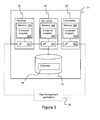
- FIG. 3 is an illustration of a key engine unit 31 illustrating how this may be implemented.
- the key engine unit again includes a receiver 32, Security Association control module 34 and transmitter 35.
- Each of the receiver 32, SA control module 34 and transmitter 35 includes a processing unit 321, 341, 351.
- Each processing unit is associated with a computer program product in the form of a memory 322, 342, 352, e.g. one or more ROM, harddisk, flash memory or EEPROM.
- the memory 322 associated with the receiver 32 comprises a computer program 323 which can be run by the processing unit 321 to control the receipt of PF_KEY messages from key management applications in the network.
- the key engine unit also comprises a storage medium 33 on which Security Associations are stored in a SADB 36 separated into domains.
- the storage medium 33 could again be e.g. a RAM, ROM, hard disk, flash memory or EEPROM, or distributed over several processors in the same way as described above with reference to Figure 2 .
- the memory 342 associated with the SA control module comprises a computer program 343 which can be run by the processing unit 341, as a result of which the processing unit 343 recognises a sadb_x_domain extension header in incoming PF_KEY messages and ensures that they are applied to Security Associations stored in the correct domain in the SADB 36.
- the memory 352 associated with the receiver 35 comprises a computer program 353 which can be run by the processing unit 351 to control the transmission of messages back towards the key management applications 29.
- each processing unit 321, 341, 351 may comprise one or more individual processors. It will further be appreciated that the processing units 321, 341, 351 are shown as separate entities in Figure 3 to assist understanding, but may be provided as part of a single entity or set of entities providing processing capabilities to the receiver, SA control and/or transmitter. Similarly, the memories 322, 342, 352 may be discrete memories or memory spaces associated with separate processors or may be part of a larger entity. The computer programs 323, 343, 353 may be separate entities, or may be constituent parts of the same computer program, which may be run by separate processors or the same processor.
- key management applications 29 can insert a Security Association into the SADB by sending a SADB_ADD message to a key engine unit 21, 31.
- the SADB_UPDATE message allows key management applications to update the stored Security Associations.
- Each Security Association must be assigned to a domain ID, which is an attribute of the stored Security Association structure.
- the default value of the domain ID is the common domain ID.
- the domain ID attribute can be set during the insertion (SADB_ADD) or during the update (SADB_UPDATE) operation by using the sadb_x_domain extension header. If the DOMAIN_ALL domain ID is set within the sadb_x_domain extension header of a SADB_ADD or SADB_UPDATE message, the key engine unit 21, 31 returns an error and the message is not processed.
- a placeholder for a Security Association can be allocated using the SADB_GETSPI PF_KEY message.
- the SADB_GETSPI message always allocates a Security Association with the domain ID set to common domain ID. This can be changed later on using the SADB_UPDATE message.
- the SADB_FLUSH message can be used for deleting all entries in the SADB.
- a key management application 29 can delete only those entries that belong to a specific domain.
- extension header is not part of the message, or the specified domain ID is the common domain ID, the operation will be performed on the common domain.
- the SADB_DUMP message can be used for dumping all entries in the SADB. It is mainly used for testing or debugging reasons and applications must not depend on this message for basic operation.
- sadb_x_domain extension header By inserting the sadb_x_domain extension header into the SADB_DUMP PF_KEY message, key management applications 29 have the possibility of dumping only those entries that belong to a specific domain.
- extension header is not part of the message, or the specified domain ID equals to the common domain ID, the operation will be performed on the common domain.
- the method described above extends the SADB management capabilities of the PF_KEY API by allowing the assignment of Security Associations to different domains and by supporting the dumping and flushing of the Security Associations belonging to a specific domain.
- the legacy key management applications do not need to be modified.
- the applications that are capable of utilizing the functions provided by this method can be co-located with the legacy applications.
Landscapes
- Engineering & Computer Science (AREA)
- Computer Hardware Design (AREA)
- Computer Security & Cryptography (AREA)
- Computing Systems (AREA)
- General Engineering & Computer Science (AREA)
- Computer Networks & Wireless Communication (AREA)
- Signal Processing (AREA)
- Data Exchanges In Wide-Area Networks (AREA)
- Small-Scale Networks (AREA)
Claims (16)
- Unité de moteur de gestion de clés destinée à gérer des associations de sécurité IPsec dans un réseau IP, comprenant :un récepteur destiné à recevoir un message «PF_KEY» en provenance d'une application de gestion de clés dans le réseau ;un support de stockage destiné à stocker des associations de sécurité dans une base de données d'associations de sécurité, la base de données étant partitionnée en des domaines individuels ;un émetteur destiné à envoyer un message de réponse à l'application de gestion de clés ; etune commande d'association de sécurité, fonctionnellement connectée au récepteur, à l'émetteur et au support de stockage, destinée à déterminer si le message «PF_KEY» reçu contient un en-tête d'extension de domaine et, le cas échéant, à utiliser l'en-tête d'extension de domaine en vue d'identifier un domaine dans la base de données d'associations de sécurité et d'appliquer des instructions contenues dans le message «PF_KEY» au domaine identifié.
- Unité de moteur de gestion de clés selon la revendication 1, dans laquelle la base de données d'associations de sécurité comprend un domaine commun et, si l'en-tête d'extension de domaine est absent du message «PF_KEY» reçu, la commande d'association de sécurité est agencée de manière à appliquer les instructions contenues dans le message «PF_KEY» au domaine commun.
- Unité de moteur de gestion de clés selon la revendication 1 ou 2, dans laquelle :le message «PF_KEY» reçu est un message «SADB_ADD» ou «SADB_UPDATE» comprenant une association de sécurité nouvelle ou mise à jour ;la commande d'association de sécurité est agencée de manière à stocker l'association de sécurité nouvelle ou mise à jour dans le domaine de la base de données d'associations de sécurité identifié dans l'en-tête d'extension de domaine, ou dans le domaine commun si l'en-tête d'extension de domaine est absent du message «PF_KEY».
- Unité de moteur de gestion de clés selon la revendication 3, dans laquelle, si l'en-tête d'extension de domaine dans le message «PF_KEY» comprend un identifiant de domaine indiquant la totalité des domaines dans la base de données d'associations de sécurité, alors la commande d'association de sécurité est agencée de manière à inviter l'émetteur à renvoyer un message d'erreur vers l'application de gestion de clés sans stocker l'association de sécurité dans la base de données d'associations de sécurité.
- Unité de moteur de gestion de clés selon la revendication 1 ou 2, dans laquelle :le message «PF_KEY» reçu est un message «SADB_FLUSH» ; etla commande d'association de sécurité est agencée de manière à supprimer la totalité des associations de sécurité dans le domaine de la base de données d'associations de sécurité identifié dans l'en-tête d'extension de domaine, ou dans le domaine commun si l'en-tête d'extension de domaine est absent du message «PF_KEY».
- Unité de moteur de gestion de clés selon la revendication 1 ou 2, dans laquelle :le message «PF_KEY» reçu est un message «SADB_DUMP» ; etla commande d'association de sécurité est agencée de manière à amener l'émetteur à envoyer, vers l'application de gestion de clés, la totalité des associations de sécurité dans le domaine de la base de données d'associations de sécurité identifié dans l'en-tête d'extension de domaine, ou dans le domaine commun si l'en-tête d'extension de domaine est absent du message «PF_KEY».
- Unité de moteur de gestion de clés selon la revendication 5 ou 6, dans laquelle, si l'en-tête d'extension de domaine dans le message «PF_KEY» contient un identifiant de domaine indiquant la totalité des domaines dans la base de données d'associations de sécurité, alors la commande d'association de sécurité est agencée de manière à mettre en oeuvre l'instruction contenue dans le message « PF_KEY » pour la totalité des domaines dans la base de données d'associations de sécurité.
- Unité de moteur de gestion de clés selon l'une quelconque des revendications précédentes, dans laquelle chaque domaine dans la base de données d'associations de sécurité est utilisé en vue de stocker les associations de sécurité pour une unique application de gestion de clés.
- Procédé de gestion d'associations de sécurité IPsec dans une base de données d'associations de sécurité maintenue par une unité de moteur de gestion de clés dans un réseau IP, le procédé consistant à :au niveau de l'unité de moteur de gestion de clés, recevoir un message «PF_KEY» en provenance d'une application de gestion de clés dans le réseau, le message «PF_KEY» comprenant des instructions destinées à l'unité de moteur de gestion de clés, et un en-tête d'extension de domaine identifiant un domaine au sein de la base de données d'associations de sécurité ;mettre en oeuvre les instructions contenues dans le message «PF_KEY» pour des associations de sécurité dans le domaine de la base de données d'associations de sécurité indiqué par l'en-tête d'extension de domaine.
- Procédé selon la revendication 9, dans lequel :le message «PF_KEY» est un message «SADB_ADD» ou «SADB_UPDATE» incluant une association de sécurité nouvelle ou mise à jour ; etl'association de sécurité est insérée dans la base de données dans le domaine indiqué par l'en-tête d'extension de domaine.
- Procédé selon la revendication 9, dans lequel :le message «PF_KEY» est un message «SADB_FLUSH» ou «SADB_DUMP» ;toutes les associations de sécurité contenues dans le domaine indiqué par l'en-tête d'extension de domaine sont supprimées ou renvoyées à l'application de gestion de clés.
- Procédé selon la revendication 11, dans lequel :l'en-tête d'extension de domaine comprend un identifiant indiquant la totalité des domaines de la base de données d'associations de sécurité ; ettoutes les associations de sécurité dans la base de données d'associations de sécurité sont supprimées ou renvoyées à l'application de gestion de clés.
- Procédé selon l'une quelconque des revendications 9 à 12, consistant en outre à :au niveau de l'application de gestion de clés, insérer l'en-tête d'extension de domaine dans le message «PF_KEY».
- Programme informatique, comprenant du code lisible par ordinateur qui, lorsqu'il est exécuté sur une unité de moteur de gestion de clés, amène l'unité de moteur de gestion de clés à opérer à la manière d'une unité de moteur de gestion de clés selon l'une quelconque des revendications 1 à 8.
- Programme informatique, comprenant du code lisible par ordinateur qui, lorsqu'il est exécuté par une unité de moteur de gestion de clés, amène l'unité de moteur de gestion de clés à mettre en oeuvre un procédé selon l'une quelconque des revendications 9 à 12.
- Produit-programme informatique comprenant un support lisible par ordinateur et un programme informatique selon la revendication 14 ou 15, dans lequel le programme informatique est stocké sur le support lisible par ordinateur.
Applications Claiming Priority (1)
| Application Number | Priority Date | Filing Date | Title |
|---|---|---|---|
| PCT/EP2009/064904 WO2011057658A1 (fr) | 2009-11-10 | 2009-11-10 | Gestion d'association de sécurité |
Publications (2)
| Publication Number | Publication Date |
|---|---|
| EP2499799A1 EP2499799A1 (fr) | 2012-09-19 |
| EP2499799B1 true EP2499799B1 (fr) | 2014-03-12 |
Family
ID=42536369
Family Applications (1)
| Application Number | Title | Priority Date | Filing Date |
|---|---|---|---|
| EP09752170.2A Not-in-force EP2499799B1 (fr) | 2009-11-10 | 2009-11-10 | Gestion d'association de sécurité |
Country Status (4)
| Country | Link |
|---|---|
| US (1) | US8892884B2 (fr) |
| EP (1) | EP2499799B1 (fr) |
| IN (1) | IN2012DN01834A (fr) |
| WO (1) | WO2011057658A1 (fr) |
Families Citing this family (3)
| Publication number | Priority date | Publication date | Assignee | Title |
|---|---|---|---|---|
| US8261345B2 (en) | 2006-10-23 | 2012-09-04 | Endeavors Technologies, Inc. | Rule-based application access management |
| US8892738B2 (en) | 2007-11-07 | 2014-11-18 | Numecent Holdings, Inc. | Deriving component statistics for a stream enabled application |
| US9517410B2 (en) | 2011-04-28 | 2016-12-13 | Numecent Holdings, Inc. | Adaptive application streaming in cloud gaming |
Family Cites Families (8)
| Publication number | Priority date | Publication date | Assignee | Title |
|---|---|---|---|---|
| US5983350A (en) * | 1996-09-18 | 1999-11-09 | Secure Computing Corporation | Secure firewall supporting different levels of authentication based on address or encryption status |
| US6928553B2 (en) * | 2001-09-18 | 2005-08-09 | Aastra Technologies Limited | Providing internet protocol (IP) security |
| US7369657B2 (en) * | 2002-11-14 | 2008-05-06 | Broadcom Corporation | Cryptography accelerator application program interface |
| DE112004000817D2 (de) * | 2003-03-04 | 2006-01-19 | Lukas Wunner | Verfahren, System und Speichermedium zum Eintragen von Datennetzwerkerreichbarkeitsinformation |
| JP3859667B2 (ja) * | 2004-10-26 | 2006-12-20 | 株式会社日立製作所 | データ通信方法およびシステム |
| CN1838590B (zh) * | 2005-03-21 | 2011-01-19 | 松下电器产业株式会社 | 在会话起始协议信号过程提供因特网密钥交换的方法及系统 |
| US8175271B2 (en) * | 2007-03-30 | 2012-05-08 | Oracle America, Inc. | Method and system for security protocol partitioning and virtualization |
| US8650618B2 (en) * | 2009-07-22 | 2014-02-11 | Cisco Technology, Inc. | Integrating service insertion architecture and virtual private network |
-
2009
- 2009-11-10 US US13/505,644 patent/US8892884B2/en not_active Expired - Fee Related
- 2009-11-10 IN IN1834DEN2012 patent/IN2012DN01834A/en unknown
- 2009-11-10 WO PCT/EP2009/064904 patent/WO2011057658A1/fr not_active Ceased
- 2009-11-10 EP EP09752170.2A patent/EP2499799B1/fr not_active Not-in-force
Also Published As
| Publication number | Publication date |
|---|---|
| EP2499799A1 (fr) | 2012-09-19 |
| WO2011057658A1 (fr) | 2011-05-19 |
| US8892884B2 (en) | 2014-11-18 |
| IN2012DN01834A (fr) | 2015-06-05 |
| US20120303955A1 (en) | 2012-11-29 |
Similar Documents
| Publication | Publication Date | Title |
|---|---|---|
| US7003662B2 (en) | System and method for dynamically determining CRL locations and access methods | |
| CN111787025B (zh) | 加解密处理方法、装置、系统以及数据保护网关 | |
| US6938155B2 (en) | System and method for multiple virtual private network authentication schemes | |
| US7194619B2 (en) | Remotely booting devices in a dense server environment without manually installing authentication parameters on the devices to be booted | |
| McDonald et al. | PF_KEY key management API, version 2 | |
| CN103649966B (zh) | 基于内容名称的网络装置和保护内容的方法 | |
| US20170374025A1 (en) | Internet protocol security (ipsec) interface configuration and management | |
| EP4287550A1 (fr) | Procédé de traitement de paquets, dispositif d´extrémité de client, dispositif d´extrémité de serveur et support lisible par ordinateur | |
| US12120028B1 (en) | Secure data routing with channel resiliency | |
| US10516652B1 (en) | Security association management | |
| JP2005117246A (ja) | パケット判定装置 | |
| CN111726368A (zh) | 一种基于SRv6的域间源地址验证的方法 | |
| EP3442195A1 (fr) | Procédé et dispositif d'analyse d'un paquet | |
| EP2874376A1 (fr) | Procédé et système de synchronisation d'informations entre des passerelles de mémorisation de nuage et passerelle de mémorisation de nuage | |
| EP4038824A1 (fr) | Réutilisation d'association de sécurité pour connexions multiples | |
| US20020178240A1 (en) | System and method for selectively confirming digital certificates in a virtual private network | |
| JP2005287034A (ja) | テンプレートを使用したインターネットプロトコルトンネリング | |
| CN115943603B (zh) | 区块链增强路由授权 | |
| CN115567208B (zh) | 网络会话数据流细粒度透明加解密方法、网关、管控平台及系统 | |
| JP2008228273A (ja) | データストリームのセキュリティを確保するための方法 | |
| RU2412480C2 (ru) | Система и способ установления того, что сервер и корреспондент имеют согласованную защищенную почту | |
| EP2499799B1 (fr) | Gestion d'association de sécurité | |
| CN113347198A (zh) | Arp报文处理方法、装置、网络设备及存储介质 | |
| JP4916270B2 (ja) | 情報処理装置、通信方法およびプログラム | |
| CN109769004B (zh) | 基于保留格式加密的匿名通信方法、设备及系统 |
Legal Events
| Date | Code | Title | Description |
|---|---|---|---|
| PUAI | Public reference made under article 153(3) epc to a published international application that has entered the european phase |
Free format text: ORIGINAL CODE: 0009012 |
|
| 17P | Request for examination filed |
Effective date: 20120502 |
|
| AK | Designated contracting states |
Kind code of ref document: A1 Designated state(s): AT BE BG CH CY CZ DE DK EE ES FI FR GB GR HR HU IE IS IT LI LT LU LV MC MK MT NL NO PL PT RO SE SI SK SM TR |
|
| RIN1 | Information on inventor provided before grant (corrected) |
Inventor name: TOEMOER, PETER Inventor name: SZABO, GERGELY |
|
| DAX | Request for extension of the european patent (deleted) | ||
| GRAP | Despatch of communication of intention to grant a patent |
Free format text: ORIGINAL CODE: EPIDOSNIGR1 |
|
| INTG | Intention to grant announced |
Effective date: 20131023 |
|
| GRAS | Grant fee paid |
Free format text: ORIGINAL CODE: EPIDOSNIGR3 |
|
| GRAA | (expected) grant |
Free format text: ORIGINAL CODE: 0009210 |
|
| AK | Designated contracting states |
Kind code of ref document: B1 Designated state(s): AT BE BG CH CY CZ DE DK EE ES FI FR GB GR HR HU IE IS IT LI LT LU LV MC MK MT NL NO PL PT RO SE SI SK SM TR |
|
| REG | Reference to a national code |
Ref country code: GB Ref legal event code: FG4D |
|
| REG | Reference to a national code |
Ref country code: CH Ref legal event code: EP |
|
| REG | Reference to a national code |
Ref country code: AT Ref legal event code: REF Ref document number: 656933 Country of ref document: AT Kind code of ref document: T Effective date: 20140315 |
|
| REG | Reference to a national code |
Ref country code: IE Ref legal event code: FG4D |
|
| REG | Reference to a national code |
Ref country code: DE Ref legal event code: R096 Ref document number: 602009022429 Country of ref document: DE Effective date: 20140424 |
|
| REG | Reference to a national code |
Ref country code: NL Ref legal event code: T3 |
|
| PG25 | Lapsed in a contracting state [announced via postgrant information from national office to epo] |
Ref country code: NO Free format text: LAPSE BECAUSE OF FAILURE TO SUBMIT A TRANSLATION OF THE DESCRIPTION OR TO PAY THE FEE WITHIN THE PRESCRIBED TIME-LIMIT Effective date: 20140612 Ref country code: LT Free format text: LAPSE BECAUSE OF FAILURE TO SUBMIT A TRANSLATION OF THE DESCRIPTION OR TO PAY THE FEE WITHIN THE PRESCRIBED TIME-LIMIT Effective date: 20140312 |
|
| REG | Reference to a national code |
Ref country code: AT Ref legal event code: MK05 Ref document number: 656933 Country of ref document: AT Kind code of ref document: T Effective date: 20140312 |
|
| REG | Reference to a national code |
Ref country code: LT Ref legal event code: MG4D |
|
| PG25 | Lapsed in a contracting state [announced via postgrant information from national office to epo] |
Ref country code: SE Free format text: LAPSE BECAUSE OF FAILURE TO SUBMIT A TRANSLATION OF THE DESCRIPTION OR TO PAY THE FEE WITHIN THE PRESCRIBED TIME-LIMIT Effective date: 20140312 Ref country code: FI Free format text: LAPSE BECAUSE OF FAILURE TO SUBMIT A TRANSLATION OF THE DESCRIPTION OR TO PAY THE FEE WITHIN THE PRESCRIBED TIME-LIMIT Effective date: 20140312 Ref country code: CY Free format text: LAPSE BECAUSE OF FAILURE TO SUBMIT A TRANSLATION OF THE DESCRIPTION OR TO PAY THE FEE WITHIN THE PRESCRIBED TIME-LIMIT Effective date: 20140312 |
|
| PG25 | Lapsed in a contracting state [announced via postgrant information from national office to epo] |
Ref country code: LV Free format text: LAPSE BECAUSE OF FAILURE TO SUBMIT A TRANSLATION OF THE DESCRIPTION OR TO PAY THE FEE WITHIN THE PRESCRIBED TIME-LIMIT Effective date: 20140312 Ref country code: HR Free format text: LAPSE BECAUSE OF FAILURE TO SUBMIT A TRANSLATION OF THE DESCRIPTION OR TO PAY THE FEE WITHIN THE PRESCRIBED TIME-LIMIT Effective date: 20140312 |
|
| PG25 | Lapsed in a contracting state [announced via postgrant information from national office to epo] |
Ref country code: EE Free format text: LAPSE BECAUSE OF FAILURE TO SUBMIT A TRANSLATION OF THE DESCRIPTION OR TO PAY THE FEE WITHIN THE PRESCRIBED TIME-LIMIT Effective date: 20140312 Ref country code: CZ Free format text: LAPSE BECAUSE OF FAILURE TO SUBMIT A TRANSLATION OF THE DESCRIPTION OR TO PAY THE FEE WITHIN THE PRESCRIBED TIME-LIMIT Effective date: 20140312 Ref country code: IS Free format text: LAPSE BECAUSE OF FAILURE TO SUBMIT A TRANSLATION OF THE DESCRIPTION OR TO PAY THE FEE WITHIN THE PRESCRIBED TIME-LIMIT Effective date: 20140712 Ref country code: BE Free format text: LAPSE BECAUSE OF FAILURE TO SUBMIT A TRANSLATION OF THE DESCRIPTION OR TO PAY THE FEE WITHIN THE PRESCRIBED TIME-LIMIT Effective date: 20140312 Ref country code: BG Free format text: LAPSE BECAUSE OF FAILURE TO SUBMIT A TRANSLATION OF THE DESCRIPTION OR TO PAY THE FEE WITHIN THE PRESCRIBED TIME-LIMIT Effective date: 20140612 Ref country code: RO Free format text: LAPSE BECAUSE OF FAILURE TO SUBMIT A TRANSLATION OF THE DESCRIPTION OR TO PAY THE FEE WITHIN THE PRESCRIBED TIME-LIMIT Effective date: 20140312 |
|
| PG25 | Lapsed in a contracting state [announced via postgrant information from national office to epo] |
Ref country code: PL Free format text: LAPSE BECAUSE OF FAILURE TO SUBMIT A TRANSLATION OF THE DESCRIPTION OR TO PAY THE FEE WITHIN THE PRESCRIBED TIME-LIMIT Effective date: 20140312 Ref country code: AT Free format text: LAPSE BECAUSE OF FAILURE TO SUBMIT A TRANSLATION OF THE DESCRIPTION OR TO PAY THE FEE WITHIN THE PRESCRIBED TIME-LIMIT Effective date: 20140312 Ref country code: ES Free format text: LAPSE BECAUSE OF FAILURE TO SUBMIT A TRANSLATION OF THE DESCRIPTION OR TO PAY THE FEE WITHIN THE PRESCRIBED TIME-LIMIT Effective date: 20140312 Ref country code: SK Free format text: LAPSE BECAUSE OF FAILURE TO SUBMIT A TRANSLATION OF THE DESCRIPTION OR TO PAY THE FEE WITHIN THE PRESCRIBED TIME-LIMIT Effective date: 20140312 |
|
| REG | Reference to a national code |
Ref country code: DE Ref legal event code: R097 Ref document number: 602009022429 Country of ref document: DE |
|
| PG25 | Lapsed in a contracting state [announced via postgrant information from national office to epo] |
Ref country code: PT Free format text: LAPSE BECAUSE OF FAILURE TO SUBMIT A TRANSLATION OF THE DESCRIPTION OR TO PAY THE FEE WITHIN THE PRESCRIBED TIME-LIMIT Effective date: 20140714 |
|
| PLBE | No opposition filed within time limit |
Free format text: ORIGINAL CODE: 0009261 |
|
| STAA | Information on the status of an ep patent application or granted ep patent |
Free format text: STATUS: NO OPPOSITION FILED WITHIN TIME LIMIT |
|
| PG25 | Lapsed in a contracting state [announced via postgrant information from national office to epo] |
Ref country code: DK Free format text: LAPSE BECAUSE OF FAILURE TO SUBMIT A TRANSLATION OF THE DESCRIPTION OR TO PAY THE FEE WITHIN THE PRESCRIBED TIME-LIMIT Effective date: 20140312 |
|
| 26N | No opposition filed |
Effective date: 20141215 |
|
| REG | Reference to a national code |
Ref country code: DE Ref legal event code: R097 Ref document number: 602009022429 Country of ref document: DE Effective date: 20141215 |
|
| PG25 | Lapsed in a contracting state [announced via postgrant information from national office to epo] |
Ref country code: IT Free format text: LAPSE BECAUSE OF FAILURE TO SUBMIT A TRANSLATION OF THE DESCRIPTION OR TO PAY THE FEE WITHIN THE PRESCRIBED TIME-LIMIT Effective date: 20140312 |
|
| PG25 | Lapsed in a contracting state [announced via postgrant information from national office to epo] |
Ref country code: LU Free format text: LAPSE BECAUSE OF FAILURE TO SUBMIT A TRANSLATION OF THE DESCRIPTION OR TO PAY THE FEE WITHIN THE PRESCRIBED TIME-LIMIT Effective date: 20141110 Ref country code: MC Free format text: LAPSE BECAUSE OF FAILURE TO SUBMIT A TRANSLATION OF THE DESCRIPTION OR TO PAY THE FEE WITHIN THE PRESCRIBED TIME-LIMIT Effective date: 20140312 |
|
| REG | Reference to a national code |
Ref country code: CH Ref legal event code: PL |
|
| PG25 | Lapsed in a contracting state [announced via postgrant information from national office to epo] |
Ref country code: LI Free format text: LAPSE BECAUSE OF NON-PAYMENT OF DUE FEES Effective date: 20141130 Ref country code: CH Free format text: LAPSE BECAUSE OF NON-PAYMENT OF DUE FEES Effective date: 20141130 Ref country code: SI Free format text: LAPSE BECAUSE OF FAILURE TO SUBMIT A TRANSLATION OF THE DESCRIPTION OR TO PAY THE FEE WITHIN THE PRESCRIBED TIME-LIMIT Effective date: 20140312 |
|
| REG | Reference to a national code |
Ref country code: IE Ref legal event code: MM4A |
|
| REG | Reference to a national code |
Ref country code: FR Ref legal event code: ST Effective date: 20150731 |
|
| PG25 | Lapsed in a contracting state [announced via postgrant information from national office to epo] |
Ref country code: IE Free format text: LAPSE BECAUSE OF NON-PAYMENT OF DUE FEES Effective date: 20141110 |
|
| PG25 | Lapsed in a contracting state [announced via postgrant information from national office to epo] |
Ref country code: FR Free format text: LAPSE BECAUSE OF NON-PAYMENT OF DUE FEES Effective date: 20141201 |
|
| PG25 | Lapsed in a contracting state [announced via postgrant information from national office to epo] |
Ref country code: SM Free format text: LAPSE BECAUSE OF FAILURE TO SUBMIT A TRANSLATION OF THE DESCRIPTION OR TO PAY THE FEE WITHIN THE PRESCRIBED TIME-LIMIT Effective date: 20140312 |
|
| PG25 | Lapsed in a contracting state [announced via postgrant information from national office to epo] |
Ref country code: GR Free format text: LAPSE BECAUSE OF FAILURE TO SUBMIT A TRANSLATION OF THE DESCRIPTION OR TO PAY THE FEE WITHIN THE PRESCRIBED TIME-LIMIT Effective date: 20140613 |
|
| PG25 | Lapsed in a contracting state [announced via postgrant information from national office to epo] |
Ref country code: HU Free format text: LAPSE BECAUSE OF FAILURE TO SUBMIT A TRANSLATION OF THE DESCRIPTION OR TO PAY THE FEE WITHIN THE PRESCRIBED TIME-LIMIT; INVALID AB INITIO Effective date: 20091110 Ref country code: MT Free format text: LAPSE BECAUSE OF FAILURE TO SUBMIT A TRANSLATION OF THE DESCRIPTION OR TO PAY THE FEE WITHIN THE PRESCRIBED TIME-LIMIT Effective date: 20140312 Ref country code: TR Free format text: LAPSE BECAUSE OF FAILURE TO SUBMIT A TRANSLATION OF THE DESCRIPTION OR TO PAY THE FEE WITHIN THE PRESCRIBED TIME-LIMIT Effective date: 20140312 |
|
| PGFP | Annual fee paid to national office [announced via postgrant information from national office to epo] |
Ref country code: DE Payment date: 20171129 Year of fee payment: 9 Ref country code: NL Payment date: 20171126 Year of fee payment: 9 |
|
| PGFP | Annual fee paid to national office [announced via postgrant information from national office to epo] |
Ref country code: GB Payment date: 20171127 Year of fee payment: 9 |
|
| PG25 | Lapsed in a contracting state [announced via postgrant information from national office to epo] |
Ref country code: MK Free format text: LAPSE BECAUSE OF FAILURE TO SUBMIT A TRANSLATION OF THE DESCRIPTION OR TO PAY THE FEE WITHIN THE PRESCRIBED TIME-LIMIT Effective date: 20140312 |
|
| REG | Reference to a national code |
Ref country code: DE Ref legal event code: R119 Ref document number: 602009022429 Country of ref document: DE |
|
| REG | Reference to a national code |
Ref country code: NL Ref legal event code: MM Effective date: 20181201 |
|
| GBPC | Gb: european patent ceased through non-payment of renewal fee |
Effective date: 20181110 |
|
| PG25 | Lapsed in a contracting state [announced via postgrant information from national office to epo] |
Ref country code: NL Free format text: LAPSE BECAUSE OF NON-PAYMENT OF DUE FEES Effective date: 20181201 |
|
| PG25 | Lapsed in a contracting state [announced via postgrant information from national office to epo] |
Ref country code: DE Free format text: LAPSE BECAUSE OF NON-PAYMENT OF DUE FEES Effective date: 20190601 |
|
| PG25 | Lapsed in a contracting state [announced via postgrant information from national office to epo] |
Ref country code: GB Free format text: LAPSE BECAUSE OF NON-PAYMENT OF DUE FEES Effective date: 20181110 |