EP2500376A1 - Antistatische oder elektrisch leitfähige Polyurethane - Google Patents
Antistatische oder elektrisch leitfähige Polyurethane Download PDFInfo
- Publication number
- EP2500376A1 EP2500376A1 EP11158663A EP11158663A EP2500376A1 EP 2500376 A1 EP2500376 A1 EP 2500376A1 EP 11158663 A EP11158663 A EP 11158663A EP 11158663 A EP11158663 A EP 11158663A EP 2500376 A1 EP2500376 A1 EP 2500376A1
- Authority
- EP
- European Patent Office
- Prior art keywords
- methylimidazolium
- polyurethane
- ethyl
- antistatic
- carbon nanotubes
- Prior art date
- Legal status (The legal status is an assumption and is not a legal conclusion. Google has not performed a legal analysis and makes no representation as to the accuracy of the status listed.)
- Ceased
Links
- 239000004814 polyurethane Substances 0.000 title claims abstract description 129
- 229920002635 polyurethane Polymers 0.000 title claims abstract description 127
- OKTJSMMVPCPJKN-UHFFFAOYSA-N Carbon Chemical compound [C] OKTJSMMVPCPJKN-UHFFFAOYSA-N 0.000 claims abstract description 100
- 239000002041 carbon nanotube Substances 0.000 claims abstract description 77
- 229910021393 carbon nanotube Inorganic materials 0.000 claims abstract description 75
- 239000002608 ionic liquid Substances 0.000 claims abstract description 59
- 239000004433 Thermoplastic polyurethane Substances 0.000 claims abstract description 37
- 229920002803 thermoplastic polyurethane Polymers 0.000 claims abstract description 37
- 239000003054 catalyst Substances 0.000 claims abstract description 33
- 238000004519 manufacturing process Methods 0.000 claims abstract description 30
- 150000001875 compounds Chemical class 0.000 claims abstract description 27
- 239000005056 polyisocyanate Substances 0.000 claims abstract description 19
- 229920001228 polyisocyanate Polymers 0.000 claims abstract description 19
- 239000000654 additive Substances 0.000 claims abstract description 16
- 239000004970 Chain extender Substances 0.000 claims abstract description 15
- 125000004435 hydrogen atom Chemical group [H]* 0.000 claims abstract description 14
- 239000012141 concentrate Substances 0.000 claims abstract description 11
- 239000003431 cross linking reagent Substances 0.000 claims abstract description 6
- 239000011541 reaction mixture Substances 0.000 claims abstract description 6
- 238000000034 method Methods 0.000 claims description 43
- -1 1-ethyl-3-methylimidazolium tetrafluoroborate Chemical compound 0.000 claims description 40
- 239000000203 mixture Substances 0.000 claims description 29
- 230000008569 process Effects 0.000 claims description 20
- 238000005266 casting Methods 0.000 claims description 16
- 229920001971 elastomer Polymers 0.000 claims description 11
- 229920005989 resin Polymers 0.000 claims description 11
- 239000011347 resin Substances 0.000 claims description 11
- 239000000806 elastomer Substances 0.000 claims description 10
- 239000002048 multi walled nanotube Substances 0.000 claims description 9
- VASPYXGQVWPGAB-UHFFFAOYSA-M 1-ethyl-3-methylimidazol-3-ium;thiocyanate Chemical compound [S-]C#N.CCN1C=C[N+](C)=C1 VASPYXGQVWPGAB-UHFFFAOYSA-M 0.000 claims description 5
- 238000000576 coating method Methods 0.000 claims description 5
- 239000007788 liquid Substances 0.000 claims description 5
- 238000000465 moulding Methods 0.000 claims description 5
- VRFOKYHDLYBVAL-UHFFFAOYSA-M 1-ethyl-3-methylimidazol-3-ium;ethyl sulfate Chemical compound CCOS([O-])(=O)=O.CCN1C=C[N+](C)=C1 VRFOKYHDLYBVAL-UHFFFAOYSA-M 0.000 claims description 4
- MKHFCTXNDRMIDR-UHFFFAOYSA-N cyanoiminomethylideneazanide;1-ethyl-3-methylimidazol-3-ium Chemical compound [N-]=C=NC#N.CCN1C=C[N+](C)=C1 MKHFCTXNDRMIDR-UHFFFAOYSA-N 0.000 claims description 4
- 239000003380 propellant Substances 0.000 claims description 3
- VWFZFKKEKWMXIA-UHFFFAOYSA-M 1-butyl-3-methylimidazol-3-ium;4-methylbenzenesulfonate Chemical compound CCCC[N+]=1C=CN(C)C=1.CC1=CC=C(S([O-])(=O)=O)C=C1 VWFZFKKEKWMXIA-UHFFFAOYSA-M 0.000 claims description 2
- BSKSXTBYXTZWFI-UHFFFAOYSA-M 1-butyl-3-methylimidazol-3-ium;acetate Chemical compound CC([O-])=O.CCCC[N+]=1C=CN(C)C=1 BSKSXTBYXTZWFI-UHFFFAOYSA-M 0.000 claims description 2
- KYCQOKLOSUBEJK-UHFFFAOYSA-M 1-butyl-3-methylimidazol-3-ium;bromide Chemical compound [Br-].CCCCN1C=C[N+](C)=C1 KYCQOKLOSUBEJK-UHFFFAOYSA-M 0.000 claims description 2
- FHDQNOXQSTVAIC-UHFFFAOYSA-M 1-butyl-3-methylimidazol-3-ium;chloride Chemical compound [Cl-].CCCCN1C=C[N+](C)=C1 FHDQNOXQSTVAIC-UHFFFAOYSA-M 0.000 claims description 2
- ICIVTHOGIQHZRY-UHFFFAOYSA-N 1-butyl-3-methylimidazol-3-ium;cyanoiminomethylideneazanide Chemical compound [N-]=C=NC#N.CCCCN1C=C[N+](C)=C1 ICIVTHOGIQHZRY-UHFFFAOYSA-N 0.000 claims description 2
- FSUAYRLKFSKOJG-UHFFFAOYSA-M 1-butyl-3-methylimidazol-3-ium;dimethyl phosphate Chemical compound COP([O-])(=O)OC.CCCC[N+]=1C=CN(C)C=1 FSUAYRLKFSKOJG-UHFFFAOYSA-M 0.000 claims description 2
- PUHVBRXUKOGSBC-UHFFFAOYSA-M 1-butyl-3-methylimidazol-3-ium;methanesulfonate Chemical compound CS([O-])(=O)=O.CCCC[N+]=1C=CN(C)C=1 PUHVBRXUKOGSBC-UHFFFAOYSA-M 0.000 claims description 2
- MEMNKNZDROKJHP-UHFFFAOYSA-M 1-butyl-3-methylimidazol-3-ium;methyl sulfate Chemical compound COS([O-])(=O)=O.CCCCN1C=C[N+](C)=C1 MEMNKNZDROKJHP-UHFFFAOYSA-M 0.000 claims description 2
- SIXHYMZEOJSYQH-UHFFFAOYSA-M 1-butyl-3-methylimidazol-3-ium;thiocyanate Chemical compound [S-]C#N.CCCCN1C=C[N+](C)=C1 SIXHYMZEOJSYQH-UHFFFAOYSA-M 0.000 claims description 2
- FRZPYEHDSAQGAS-UHFFFAOYSA-M 1-butyl-3-methylimidazol-3-ium;trifluoromethanesulfonate Chemical compound [O-]S(=O)(=O)C(F)(F)F.CCCC[N+]=1C=CN(C)C=1 FRZPYEHDSAQGAS-UHFFFAOYSA-M 0.000 claims description 2
- HXMUPILCYSJMLQ-UHFFFAOYSA-M 1-ethyl-3-methylimidazol-3-ium;4-methylbenzenesulfonate Chemical compound CC[N+]=1C=CN(C)C=1.CC1=CC=C(S([O-])(=O)=O)C=C1 HXMUPILCYSJMLQ-UHFFFAOYSA-M 0.000 claims description 2
- XIYUIMLQTKODPS-UHFFFAOYSA-M 1-ethyl-3-methylimidazol-3-ium;acetate Chemical compound CC([O-])=O.CC[N+]=1C=CN(C)C=1 XIYUIMLQTKODPS-UHFFFAOYSA-M 0.000 claims description 2
- GWQYPLXGJIXMMV-UHFFFAOYSA-M 1-ethyl-3-methylimidazol-3-ium;bromide Chemical compound [Br-].CCN1C=C[N+](C)=C1 GWQYPLXGJIXMMV-UHFFFAOYSA-M 0.000 claims description 2
- ZPTRYWVRCNOTAS-UHFFFAOYSA-M 1-ethyl-3-methylimidazol-3-ium;trifluoromethanesulfonate Chemical compound CC[N+]=1C=CN(C)C=1.[O-]S(=O)(=O)C(F)(F)F ZPTRYWVRCNOTAS-UHFFFAOYSA-M 0.000 claims description 2
- BMQZYMYBQZGEEY-UHFFFAOYSA-M 1-ethyl-3-methylimidazolium chloride Chemical compound [Cl-].CCN1C=C[N+](C)=C1 BMQZYMYBQZGEEY-UHFFFAOYSA-M 0.000 claims description 2
- INDFXCHYORWHLQ-UHFFFAOYSA-N bis(trifluoromethylsulfonyl)azanide;1-butyl-3-methylimidazol-3-ium Chemical compound CCCCN1C=C[N+](C)=C1.FC(F)(F)S(=O)(=O)[N-]S(=O)(=O)C(F)(F)F INDFXCHYORWHLQ-UHFFFAOYSA-N 0.000 claims description 2
- LRESCJAINPKJTO-UHFFFAOYSA-N bis(trifluoromethylsulfonyl)azanide;1-ethyl-3-methylimidazol-3-ium Chemical compound CCN1C=C[N+](C)=C1.FC(F)(F)S(=O)(=O)[N-]S(=O)(=O)C(F)(F)F LRESCJAINPKJTO-UHFFFAOYSA-N 0.000 claims description 2
- HQWOEDCLDNFWEV-UHFFFAOYSA-M diethyl phosphate;1-ethyl-3-methylimidazol-3-ium Chemical compound CC[N+]=1C=CN(C)C=1.CCOP([O-])(=O)OCC HQWOEDCLDNFWEV-UHFFFAOYSA-M 0.000 claims description 2
- 230000001413 cellular effect Effects 0.000 claims 1
- 239000004604 Blowing Agent Substances 0.000 abstract description 9
- 238000002156 mixing Methods 0.000 abstract description 3
- 239000006185 dispersion Substances 0.000 description 36
- 229920005862 polyol Polymers 0.000 description 33
- 150000003077 polyols Chemical class 0.000 description 33
- 229920005830 Polyurethane Foam Polymers 0.000 description 23
- 239000011496 polyurethane foam Substances 0.000 description 23
- KWYUFKZDYYNOTN-UHFFFAOYSA-M Potassium hydroxide Chemical compound [OH-].[K+] KWYUFKZDYYNOTN-UHFFFAOYSA-M 0.000 description 21
- 229910052751 metal Inorganic materials 0.000 description 18
- 239000002184 metal Substances 0.000 description 18
- 238000002360 preparation method Methods 0.000 description 17
- 150000001450 anions Chemical class 0.000 description 16
- 239000006260 foam Substances 0.000 description 16
- WERYXYBDKMZEQL-UHFFFAOYSA-N butane-1,4-diol Chemical compound OCCCCO WERYXYBDKMZEQL-UHFFFAOYSA-N 0.000 description 15
- 229910052799 carbon Inorganic materials 0.000 description 15
- 150000001768 cations Chemical class 0.000 description 15
- 239000007858 starting material Substances 0.000 description 14
- UPMLOUAZCHDJJD-UHFFFAOYSA-N 4,4'-Diphenylmethane Diisocyanate Chemical compound C1=CC(N=C=O)=CC=C1CC1=CC=C(N=C=O)C=C1 UPMLOUAZCHDJJD-UHFFFAOYSA-N 0.000 description 13
- 125000004432 carbon atom Chemical group C* 0.000 description 13
- 229920000642 polymer Polymers 0.000 description 13
- MTHSVFCYNBDYFN-UHFFFAOYSA-N diethylene glycol Chemical compound OCCOCCO MTHSVFCYNBDYFN-UHFFFAOYSA-N 0.000 description 10
- 238000012360 testing method Methods 0.000 description 10
- 125000002887 hydroxy group Chemical group [H]O* 0.000 description 9
- 229910052757 nitrogen Inorganic materials 0.000 description 9
- 239000004721 Polyphenylene oxide Substances 0.000 description 8
- 125000004433 nitrogen atom Chemical group N* 0.000 description 8
- 229920000570 polyether Polymers 0.000 description 8
- 229920000909 polytetrahydrofuran Polymers 0.000 description 8
- BTBUEUYNUDRHOZ-UHFFFAOYSA-N Borate Chemical compound [O-]B([O-])[O-] BTBUEUYNUDRHOZ-UHFFFAOYSA-N 0.000 description 7
- 102100023116 Sodium/nucleoside cotransporter 1 Human genes 0.000 description 7
- WNLRTRBMVRJNCN-UHFFFAOYSA-N adipic acid Chemical compound OC(=O)CCCCC(O)=O WNLRTRBMVRJNCN-UHFFFAOYSA-N 0.000 description 7
- 230000015572 biosynthetic process Effects 0.000 description 7
- 238000005229 chemical vapour deposition Methods 0.000 description 7
- 239000002270 dispersing agent Substances 0.000 description 7
- 239000012948 isocyanate Substances 0.000 description 7
- 150000002513 isocyanates Chemical class 0.000 description 7
- 239000000047 product Substances 0.000 description 7
- UHOVQNZJYSORNB-UHFFFAOYSA-N Benzene Chemical compound C1=CC=CC=C1 UHOVQNZJYSORNB-UHFFFAOYSA-N 0.000 description 6
- LYCAIKOWRPUZTN-UHFFFAOYSA-N Ethylene glycol Chemical compound OCCO LYCAIKOWRPUZTN-UHFFFAOYSA-N 0.000 description 6
- PEDCQBHIVMGVHV-UHFFFAOYSA-N Glycerine Chemical compound OCC(O)CO PEDCQBHIVMGVHV-UHFFFAOYSA-N 0.000 description 6
- ZMANZCXQSJIPKH-UHFFFAOYSA-N Triethylamine Chemical compound CCN(CC)CC ZMANZCXQSJIPKH-UHFFFAOYSA-N 0.000 description 6
- 125000001931 aliphatic group Chemical group 0.000 description 6
- 230000003197 catalytic effect Effects 0.000 description 6
- 239000010439 graphite Substances 0.000 description 6
- 229910002804 graphite Inorganic materials 0.000 description 6
- 238000001746 injection moulding Methods 0.000 description 6
- 150000003839 salts Chemical class 0.000 description 6
- 239000007983 Tris buffer Substances 0.000 description 5
- 239000011230 binding agent Substances 0.000 description 5
- 238000006243 chemical reaction Methods 0.000 description 5
- SZXQTJUDPRGNJN-UHFFFAOYSA-N dipropylene glycol Chemical compound OCCCOCCCO SZXQTJUDPRGNJN-UHFFFAOYSA-N 0.000 description 5
- 230000000694 effects Effects 0.000 description 5
- 239000007789 gas Substances 0.000 description 5
- 229930195733 hydrocarbon Natural products 0.000 description 5
- 150000002430 hydrocarbons Chemical group 0.000 description 5
- 239000000463 material Substances 0.000 description 5
- 150000002739 metals Chemical class 0.000 description 5
- 239000002071 nanotube Substances 0.000 description 5
- HEMHJVSKTPXQMS-UHFFFAOYSA-M sodium hydroxide Inorganic materials [OH-].[Na+] HEMHJVSKTPXQMS-UHFFFAOYSA-M 0.000 description 5
- 239000000126 substance Substances 0.000 description 5
- 150000005846 sugar alcohols Polymers 0.000 description 5
- 101100494773 Caenorhabditis elegans ctl-2 gene Proteins 0.000 description 4
- 101100112369 Fasciola hepatica Cat-1 gene Proteins 0.000 description 4
- 101000685663 Homo sapiens Sodium/nucleoside cotransporter 1 Proteins 0.000 description 4
- 101100005271 Neurospora crassa (strain ATCC 24698 / 74-OR23-1A / CBS 708.71 / DSM 1257 / FGSC 987) cat-1 gene Proteins 0.000 description 4
- GOOHAUXETOMSMM-UHFFFAOYSA-N Propylene oxide Chemical compound CC1CO1 GOOHAUXETOMSMM-UHFFFAOYSA-N 0.000 description 4
- WQDUMFSSJAZKTM-UHFFFAOYSA-N Sodium methoxide Chemical compound [Na+].[O-]C WQDUMFSSJAZKTM-UHFFFAOYSA-N 0.000 description 4
- 102100021541 Sodium/nucleoside cotransporter 2 Human genes 0.000 description 4
- 125000002947 alkylene group Chemical group 0.000 description 4
- 125000003118 aryl group Chemical group 0.000 description 4
- 239000011324 bead Substances 0.000 description 4
- 238000000151 deposition Methods 0.000 description 4
- 230000008021 deposition Effects 0.000 description 4
- 150000001991 dicarboxylic acids Chemical class 0.000 description 4
- 239000011521 glass Substances 0.000 description 4
- XEEYBQQBJWHFJM-UHFFFAOYSA-N iron Substances [Fe] XEEYBQQBJWHFJM-UHFFFAOYSA-N 0.000 description 4
- 239000002245 particle Substances 0.000 description 4
- 239000011734 sodium Substances 0.000 description 4
- 230000017260 vegetative to reproductive phase transition of meristem Effects 0.000 description 4
- KIWBPDUYBMNFTB-UHFFFAOYSA-N Ethyl hydrogen sulfate Chemical compound CCOS(O)(=O)=O KIWBPDUYBMNFTB-UHFFFAOYSA-N 0.000 description 3
- 239000005057 Hexamethylene diisocyanate Substances 0.000 description 3
- 239000002841 Lewis acid Substances 0.000 description 3
- 101710123675 Sodium/nucleoside cotransporter 1 Proteins 0.000 description 3
- 101710123669 Sodium/nucleoside cotransporter 2 Proteins 0.000 description 3
- CZMRCDWAGMRECN-UGDNZRGBSA-N Sucrose Chemical compound O[C@H]1[C@H](O)[C@@H](CO)O[C@@]1(CO)O[C@@H]1[C@H](O)[C@@H](O)[C@H](O)[C@@H](CO)O1 CZMRCDWAGMRECN-UGDNZRGBSA-N 0.000 description 3
- 229930006000 Sucrose Natural products 0.000 description 3
- WYURNTSHIVDZCO-UHFFFAOYSA-N Tetrahydrofuran Chemical compound C1CCOC1 WYURNTSHIVDZCO-UHFFFAOYSA-N 0.000 description 3
- ZMZDMBWJUHKJPS-UHFFFAOYSA-M Thiocyanate anion Chemical compound [S-]C#N ZMZDMBWJUHKJPS-UHFFFAOYSA-M 0.000 description 3
- 229910021536 Zeolite Inorganic materials 0.000 description 3
- 239000002253 acid Substances 0.000 description 3
- 239000001361 adipic acid Substances 0.000 description 3
- 235000011037 adipic acid Nutrition 0.000 description 3
- 150000001412 amines Chemical class 0.000 description 3
- 239000006229 carbon black Substances 0.000 description 3
- 235000019241 carbon black Nutrition 0.000 description 3
- 150000001735 carboxylic acids Chemical class 0.000 description 3
- 239000003795 chemical substances by application Substances 0.000 description 3
- 238000007906 compression Methods 0.000 description 3
- 230000006835 compression Effects 0.000 description 3
- 238000013016 damping Methods 0.000 description 3
- HNPSIPDUKPIQMN-UHFFFAOYSA-N dioxosilane;oxo(oxoalumanyloxy)alumane Chemical compound O=[Si]=O.O=[Al]O[Al]=O HNPSIPDUKPIQMN-UHFFFAOYSA-N 0.000 description 3
- 239000000835 fiber Substances 0.000 description 3
- 238000000227 grinding Methods 0.000 description 3
- RRAMGCGOFNQTLD-UHFFFAOYSA-N hexamethylene diisocyanate Chemical compound O=C=NCCCCCCN=C=O RRAMGCGOFNQTLD-UHFFFAOYSA-N 0.000 description 3
- XXMIOPMDWAUFGU-UHFFFAOYSA-N hexane-1,6-diol Chemical compound OCCCCCCO XXMIOPMDWAUFGU-UHFFFAOYSA-N 0.000 description 3
- ZMZDMBWJUHKJPS-UHFFFAOYSA-N hydrogen thiocyanate Natural products SC#N ZMZDMBWJUHKJPS-UHFFFAOYSA-N 0.000 description 3
- RAXXELZNTBOGNW-UHFFFAOYSA-N imidazole Natural products C1=CNC=N1 RAXXELZNTBOGNW-UHFFFAOYSA-N 0.000 description 3
- 229910052742 iron Inorganic materials 0.000 description 3
- 150000007517 lewis acids Chemical class 0.000 description 3
- 238000002844 melting Methods 0.000 description 3
- 230000008018 melting Effects 0.000 description 3
- VNWKTOKETHGBQD-UHFFFAOYSA-N methane Chemical compound C VNWKTOKETHGBQD-UHFFFAOYSA-N 0.000 description 3
- WXZMFSXDPGVJKK-UHFFFAOYSA-N pentaerythritol Chemical compound OCC(CO)(CO)CO WXZMFSXDPGVJKK-UHFFFAOYSA-N 0.000 description 3
- 229920000515 polycarbonate Polymers 0.000 description 3
- 239000004417 polycarbonate Substances 0.000 description 3
- 229920005906 polyester polyol Polymers 0.000 description 3
- 229920006324 polyoxymethylene Polymers 0.000 description 3
- 238000005956 quaternization reaction Methods 0.000 description 3
- 239000002109 single walled nanotube Substances 0.000 description 3
- 238000003756 stirring Methods 0.000 description 3
- 125000001424 substituent group Chemical group 0.000 description 3
- 239000005720 sucrose Substances 0.000 description 3
- 229920001169 thermoplastic Polymers 0.000 description 3
- 239000004416 thermosoftening plastic Substances 0.000 description 3
- IMNIMPAHZVJRPE-UHFFFAOYSA-N triethylenediamine Chemical compound C1CN2CCN1CC2 IMNIMPAHZVJRPE-UHFFFAOYSA-N 0.000 description 3
- JFZKOODUSFUFIZ-UHFFFAOYSA-N trifluoro phosphate Chemical compound FOP(=O)(OF)OF JFZKOODUSFUFIZ-UHFFFAOYSA-N 0.000 description 3
- 239000010457 zeolite Substances 0.000 description 3
- DNIAPMSPPWPWGF-VKHMYHEASA-N (+)-propylene glycol Chemical compound C[C@H](O)CO DNIAPMSPPWPWGF-VKHMYHEASA-N 0.000 description 2
- GIWQSPITLQVMSG-UHFFFAOYSA-N 1,2-dimethylimidazole Chemical compound CC1=NC=CN1C GIWQSPITLQVMSG-UHFFFAOYSA-N 0.000 description 2
- YPFDHNVEDLHUCE-UHFFFAOYSA-N 1,3-propanediol Substances OCCCO YPFDHNVEDLHUCE-UHFFFAOYSA-N 0.000 description 2
- IXLWEDFOKSJYBD-UHFFFAOYSA-M 1-ethyl-3-methylimidazol-3-ium;methanesulfonate Chemical compound CS([O-])(=O)=O.CC[N+]=1C=CN(C)C=1 IXLWEDFOKSJYBD-UHFFFAOYSA-M 0.000 description 2
- RTBFRGCFXZNCOE-UHFFFAOYSA-N 1-methylsulfonylpiperidin-4-one Chemical compound CS(=O)(=O)N1CCC(=O)CC1 RTBFRGCFXZNCOE-UHFFFAOYSA-N 0.000 description 2
- OVSKIKFHRZPJSS-UHFFFAOYSA-N 2,4-D Chemical compound OC(=O)COC1=CC=C(Cl)C=C1Cl OVSKIKFHRZPJSS-UHFFFAOYSA-N 0.000 description 2
- HZAXFHJVJLSVMW-UHFFFAOYSA-N 2-Aminoethan-1-ol Chemical compound NCCO HZAXFHJVJLSVMW-UHFFFAOYSA-N 0.000 description 2
- OHKOAJUTRVTYSW-UHFFFAOYSA-N 2-[(2-aminophenyl)methyl]aniline Chemical compound NC1=CC=CC=C1CC1=CC=CC=C1N OHKOAJUTRVTYSW-UHFFFAOYSA-N 0.000 description 2
- LCZVSXRMYJUNFX-UHFFFAOYSA-N 2-[2-(2-hydroxypropoxy)propoxy]propan-1-ol Chemical compound CC(O)COC(C)COC(C)CO LCZVSXRMYJUNFX-UHFFFAOYSA-N 0.000 description 2
- 241000234282 Allium Species 0.000 description 2
- 235000002732 Allium cepa var. cepa Nutrition 0.000 description 2
- QGZKDVFQNNGYKY-UHFFFAOYSA-N Ammonia Chemical compound N QGZKDVFQNNGYKY-UHFFFAOYSA-N 0.000 description 2
- CPELXLSAUQHCOX-UHFFFAOYSA-M Bromide Chemical compound [Br-] CPELXLSAUQHCOX-UHFFFAOYSA-M 0.000 description 2
- KAKZBPTYRLMSJV-UHFFFAOYSA-N Butadiene Chemical compound C=CC=C KAKZBPTYRLMSJV-UHFFFAOYSA-N 0.000 description 2
- 229920000049 Carbon (fiber) Polymers 0.000 description 2
- RTZKZFJDLAIYFH-UHFFFAOYSA-N Diethyl ether Chemical compound CCOCC RTZKZFJDLAIYFH-UHFFFAOYSA-N 0.000 description 2
- 229920006347 Elastollan Polymers 0.000 description 2
- DGAQECJNVWCQMB-PUAWFVPOSA-M Ilexoside XXIX Chemical compound C[C@@H]1CC[C@@]2(CC[C@@]3(C(=CC[C@H]4[C@]3(CC[C@@H]5[C@@]4(CC[C@@H](C5(C)C)OS(=O)(=O)[O-])C)C)[C@@H]2[C@]1(C)O)C)C(=O)O[C@H]6[C@@H]([C@H]([C@@H]([C@H](O6)CO)O)O)O.[Na+] DGAQECJNVWCQMB-PUAWFVPOSA-M 0.000 description 2
- 108010002352 Interleukin-1 Proteins 0.000 description 2
- UEEJHVSXFDXPFK-UHFFFAOYSA-N N-dimethylaminoethanol Chemical compound CN(C)CCO UEEJHVSXFDXPFK-UHFFFAOYSA-N 0.000 description 2
- AKNUHUCEWALCOI-UHFFFAOYSA-N N-ethyldiethanolamine Chemical compound OCCN(CC)CCO AKNUHUCEWALCOI-UHFFFAOYSA-N 0.000 description 2
- KDYFGRWQOYBRFD-UHFFFAOYSA-N Succinic acid Natural products OC(=O)CCC(O)=O KDYFGRWQOYBRFD-UHFFFAOYSA-N 0.000 description 2
- NINIDFKCEFEMDL-UHFFFAOYSA-N Sulfur Chemical compound [S] NINIDFKCEFEMDL-UHFFFAOYSA-N 0.000 description 2
- KKEYFWRCBNTPAC-UHFFFAOYSA-N Terephthalic acid Chemical compound OC(=O)C1=CC=C(C(O)=O)C=C1 KKEYFWRCBNTPAC-UHFFFAOYSA-N 0.000 description 2
- GSEJCLTVZPLZKY-UHFFFAOYSA-N Triethanolamine Chemical compound OCCN(CCO)CCO GSEJCLTVZPLZKY-UHFFFAOYSA-N 0.000 description 2
- ZJCCRDAZUWHFQH-UHFFFAOYSA-N Trimethylolpropane Chemical compound CCC(CO)(CO)CO ZJCCRDAZUWHFQH-UHFFFAOYSA-N 0.000 description 2
- 230000000996 additive effect Effects 0.000 description 2
- 229910052783 alkali metal Inorganic materials 0.000 description 2
- 150000008044 alkali metal hydroxides Chemical class 0.000 description 2
- 150000001340 alkali metals Chemical class 0.000 description 2
- JFCQEDHGNNZCLN-UHFFFAOYSA-N anhydrous glutaric acid Natural products OC(=O)CCCC(O)=O JFCQEDHGNNZCLN-UHFFFAOYSA-N 0.000 description 2
- 239000004917 carbon fiber Substances 0.000 description 2
- 208000012839 conversion disease Diseases 0.000 description 2
- VNXDRVGEKWGXAU-UHFFFAOYSA-N cyanocyanamide;1-ethyl-3-methyl-2h-imidazole Chemical compound N#CNC#N.CCN1CN(C)C=C1 VNXDRVGEKWGXAU-UHFFFAOYSA-N 0.000 description 2
- 229960002887 deanol Drugs 0.000 description 2
- 150000004985 diamines Chemical class 0.000 description 2
- 150000001990 dicarboxylic acid derivatives Chemical class 0.000 description 2
- UCQFCFPECQILOL-UHFFFAOYSA-N diethyl hydrogen phosphate Chemical compound CCOP(O)(=O)OCC UCQFCFPECQILOL-UHFFFAOYSA-N 0.000 description 2
- 239000012972 dimethylethanolamine Substances 0.000 description 2
- 239000000428 dust Substances 0.000 description 2
- 238000007786 electrostatic charging Methods 0.000 description 2
- 239000003995 emulsifying agent Substances 0.000 description 2
- CEIPQQODRKXDSB-UHFFFAOYSA-N ethyl 3-(6-hydroxynaphthalen-2-yl)-1H-indazole-5-carboximidate dihydrochloride Chemical compound Cl.Cl.C1=C(O)C=CC2=CC(C3=NNC4=CC=C(C=C43)C(=N)OCC)=CC=C21 CEIPQQODRKXDSB-UHFFFAOYSA-N 0.000 description 2
- 238000001125 extrusion Methods 0.000 description 2
- 239000008187 granular material Substances 0.000 description 2
- ZRALSGWEFCBTJO-UHFFFAOYSA-O guanidinium Chemical compound NC(N)=[NH2+] ZRALSGWEFCBTJO-UHFFFAOYSA-O 0.000 description 2
- 150000004820 halides Chemical class 0.000 description 2
- NAQMVNRVTILPCV-UHFFFAOYSA-N hexane-1,6-diamine Chemical compound NCCCCCCN NAQMVNRVTILPCV-UHFFFAOYSA-N 0.000 description 2
- XMBWDFGMSWQBCA-UHFFFAOYSA-N hydrogen iodide Chemical compound I XMBWDFGMSWQBCA-UHFFFAOYSA-N 0.000 description 2
- QQVIHTHCMHWDBS-UHFFFAOYSA-N isophthalic acid Chemical compound OC(=O)C1=CC=CC(C(O)=O)=C1 QQVIHTHCMHWDBS-UHFFFAOYSA-N 0.000 description 2
- 238000000608 laser ablation Methods 0.000 description 2
- 229910052748 manganese Inorganic materials 0.000 description 2
- 239000011159 matrix material Substances 0.000 description 2
- 238000005259 measurement Methods 0.000 description 2
- 150000002736 metal compounds Chemical class 0.000 description 2
- CRVGTESFCCXCTH-UHFFFAOYSA-N methyl diethanolamine Chemical group OCCN(C)CCO CRVGTESFCCXCTH-UHFFFAOYSA-N 0.000 description 2
- JZMJDSHXVKJFKW-UHFFFAOYSA-M methyl sulfate(1-) Chemical compound COS([O-])(=O)=O JZMJDSHXVKJFKW-UHFFFAOYSA-M 0.000 description 2
- 230000004048 modification Effects 0.000 description 2
- 238000012986 modification Methods 0.000 description 2
- 229910052750 molybdenum Inorganic materials 0.000 description 2
- 229910052759 nickel Inorganic materials 0.000 description 2
- BDJRBEYXGGNYIS-UHFFFAOYSA-N nonanedioic acid Chemical compound OC(=O)CCCCCCCC(O)=O BDJRBEYXGGNYIS-UHFFFAOYSA-N 0.000 description 2
- 239000001301 oxygen Substances 0.000 description 2
- 229910052760 oxygen Inorganic materials 0.000 description 2
- NFHFRUOZVGFOOS-UHFFFAOYSA-N palladium;triphenylphosphane Chemical compound [Pd].C1=CC=CC=C1P(C=1C=CC=CC=1)C1=CC=CC=C1.C1=CC=CC=C1P(C=1C=CC=CC=1)C1=CC=CC=C1.C1=CC=CC=C1P(C=1C=CC=CC=1)C1=CC=CC=C1.C1=CC=CC=C1P(C=1C=CC=CC=1)C1=CC=CC=C1 NFHFRUOZVGFOOS-UHFFFAOYSA-N 0.000 description 2
- XNGIFLGASWRNHJ-UHFFFAOYSA-N phthalic acid Chemical compound OC(=O)C1=CC=CC=C1C(O)=O XNGIFLGASWRNHJ-UHFFFAOYSA-N 0.000 description 2
- 229920003023 plastic Polymers 0.000 description 2
- 239000004033 plastic Substances 0.000 description 2
- 229920000768 polyamine Polymers 0.000 description 2
- 229920006149 polyester-amide block copolymer Polymers 0.000 description 2
- 229920002959 polymer blend Polymers 0.000 description 2
- 229920000166 polytrimethylene carbonate Polymers 0.000 description 2
- WQKGAJDYBZOFSR-UHFFFAOYSA-N potassium;propan-2-olate Chemical compound [K+].CC(C)[O-] WQKGAJDYBZOFSR-UHFFFAOYSA-N 0.000 description 2
- 239000000843 powder Substances 0.000 description 2
- 239000000376 reactant Substances 0.000 description 2
- CXMXRPHRNRROMY-UHFFFAOYSA-N sebacic acid Chemical compound OC(=O)CCCCCCCCC(O)=O CXMXRPHRNRROMY-UHFFFAOYSA-N 0.000 description 2
- 239000007787 solid Substances 0.000 description 2
- 239000000243 solution Substances 0.000 description 2
- 239000002904 solvent Substances 0.000 description 2
- 230000003068 static effect Effects 0.000 description 2
- TYFQFVWCELRYAO-UHFFFAOYSA-N suberic acid Chemical compound OC(=O)CCCCCCC(O)=O TYFQFVWCELRYAO-UHFFFAOYSA-N 0.000 description 2
- 229910052717 sulfur Inorganic materials 0.000 description 2
- 239000011593 sulfur Substances 0.000 description 2
- 238000003786 synthesis reaction Methods 0.000 description 2
- 150000003512 tertiary amines Chemical class 0.000 description 2
- WGTYBPLFGIVFAS-UHFFFAOYSA-M tetramethylammonium hydroxide Chemical compound [OH-].C[N+](C)(C)C WGTYBPLFGIVFAS-UHFFFAOYSA-M 0.000 description 2
- RUELTTOHQODFPA-UHFFFAOYSA-N toluene 2,6-diisocyanate Chemical compound CC1=C(N=C=O)C=CC=C1N=C=O RUELTTOHQODFPA-UHFFFAOYSA-N 0.000 description 2
- JOXIMZWYDAKGHI-UHFFFAOYSA-N toluene-4-sulfonic acid Chemical compound CC1=CC=C(S(O)(=O)=O)C=C1 JOXIMZWYDAKGHI-UHFFFAOYSA-N 0.000 description 2
- IMFACGCPASFAPR-UHFFFAOYSA-N tributylamine Chemical compound CCCCN(CCCC)CCCC IMFACGCPASFAPR-UHFFFAOYSA-N 0.000 description 2
- GETQZCLCWQTVFV-UHFFFAOYSA-N trimethylamine Chemical compound CN(C)C GETQZCLCWQTVFV-UHFFFAOYSA-N 0.000 description 2
- XFNJVJPLKCPIBV-UHFFFAOYSA-N trimethylenediamine Chemical class NCCCN XFNJVJPLKCPIBV-UHFFFAOYSA-N 0.000 description 2
- XLYOFNOQVPJJNP-UHFFFAOYSA-N water Substances O XLYOFNOQVPJJNP-UHFFFAOYSA-N 0.000 description 2
- ZBBLRPRYYSJUCZ-GRHBHMESSA-L (z)-but-2-enedioate;dibutyltin(2+) Chemical compound [O-]C(=O)\C=C/C([O-])=O.CCCC[Sn+2]CCCC ZBBLRPRYYSJUCZ-GRHBHMESSA-L 0.000 description 1
- KCUGPPHNMASOTE-UHFFFAOYSA-N 1,2,3-trimethylimidazol-1-ium Chemical compound CC=1N(C)C=C[N+]=1C KCUGPPHNMASOTE-UHFFFAOYSA-N 0.000 description 1
- MXLZUALXSYVAIV-UHFFFAOYSA-N 1,2-dimethyl-3-propylimidazol-1-ium Chemical compound CCCN1C=C[N+](C)=C1C MXLZUALXSYVAIV-UHFFFAOYSA-N 0.000 description 1
- ZFDWWDZLRKHULH-UHFFFAOYSA-N 1,2-dimethyl-5,6-dihydro-4h-pyrimidine Chemical compound CN1CCCN=C1C ZFDWWDZLRKHULH-UHFFFAOYSA-N 0.000 description 1
- UMZDENILBZKMFY-UHFFFAOYSA-N 1,2-dimethylpyridin-1-ium Chemical compound CC1=CC=CC=[N+]1C UMZDENILBZKMFY-UHFFFAOYSA-N 0.000 description 1
- GEYOCULIXLDCMW-UHFFFAOYSA-N 1,2-phenylenediamine Chemical compound NC1=CC=CC=C1N GEYOCULIXLDCMW-UHFFFAOYSA-N 0.000 description 1
- NOBVKAMFUBMCCA-UHFFFAOYSA-N 1,3,4,5-tetramethylimidazol-1-ium Chemical compound CC1=C(C)[N+](C)=CN1C NOBVKAMFUBMCCA-UHFFFAOYSA-N 0.000 description 1
- CDIWYWUGTVLWJM-UHFFFAOYSA-N 1,3,4-trimethylimidazol-1-ium Chemical compound CC1=C[N+](C)=CN1C CDIWYWUGTVLWJM-UHFFFAOYSA-N 0.000 description 1
- FCQPNTOQFPJCMF-UHFFFAOYSA-N 1,3-bis[3-(dimethylamino)propyl]urea Chemical compound CN(C)CCCNC(=O)NCCCN(C)C FCQPNTOQFPJCMF-UHFFFAOYSA-N 0.000 description 1
- PCHXZXKMYCGVFA-UHFFFAOYSA-N 1,3-diazetidine-2,4-dione Chemical compound O=C1NC(=O)N1 PCHXZXKMYCGVFA-UHFFFAOYSA-N 0.000 description 1
- CLHRGZGPVVFEAO-UHFFFAOYSA-N 1,3-dibutyl-2-methylimidazol-1-ium Chemical compound CCCCN1C=C[N+](CCCC)=C1C CLHRGZGPVVFEAO-UHFFFAOYSA-N 0.000 description 1
- NWXVIUBYBJUOAY-UHFFFAOYSA-N 1,3-dibutylimidazol-1-ium Chemical compound CCCCN1C=C[N+](CCCC)=C1 NWXVIUBYBJUOAY-UHFFFAOYSA-N 0.000 description 1
- HVVRUQBMAZRKPJ-UHFFFAOYSA-N 1,3-dimethylimidazolium Chemical compound CN1C=C[N+](C)=C1 HVVRUQBMAZRKPJ-UHFFFAOYSA-N 0.000 description 1
- OVBFMUAFNIIQAL-UHFFFAOYSA-N 1,4-diisocyanatobutane Chemical compound O=C=NCCCCN=C=O OVBFMUAFNIIQAL-UHFFFAOYSA-N 0.000 description 1
- RXYPXQSKLGGKOL-UHFFFAOYSA-N 1,4-dimethylpiperazine Chemical compound CN1CCN(C)CC1 RXYPXQSKLGGKOL-UHFFFAOYSA-N 0.000 description 1
- HQNBJNDMPLEUDS-UHFFFAOYSA-N 1,5-dimethylimidazole Chemical compound CC1=CN=CN1C HQNBJNDMPLEUDS-UHFFFAOYSA-N 0.000 description 1
- VXNZUUAINFGPBY-UHFFFAOYSA-N 1-Butene Chemical compound CCC=C VXNZUUAINFGPBY-UHFFFAOYSA-N 0.000 description 1
- COSSPXYCRNRXRX-UHFFFAOYSA-N 1-benzyl-3-methylimidazol-3-ium Chemical compound C1=[N+](C)C=CN1CC1=CC=CC=C1 COSSPXYCRNRXRX-UHFFFAOYSA-N 0.000 description 1
- XUAXVBUVQVRIIQ-UHFFFAOYSA-N 1-butyl-2,3-dimethylimidazol-3-ium Chemical compound CCCCN1C=C[N+](C)=C1C XUAXVBUVQVRIIQ-UHFFFAOYSA-N 0.000 description 1
- RIDWYWYHKGNNOF-UHFFFAOYSA-N 1-butyl-3,4,5-trimethylimidazol-3-ium Chemical compound CCCCN1C=[N+](C)C(C)=C1C RIDWYWYHKGNNOF-UHFFFAOYSA-N 0.000 description 1
- UMQMCSRLXDCRNQ-UHFFFAOYSA-N 1-butyl-3,4-dimethylimidazol-1-ium Chemical compound CCCC[N+]=1C=C(C)N(C)C=1 UMQMCSRLXDCRNQ-UHFFFAOYSA-N 0.000 description 1
- JYARJXBHOOZQQD-UHFFFAOYSA-N 1-butyl-3-ethylimidazol-1-ium Chemical compound CCCC[N+]=1C=CN(CC)C=1 JYARJXBHOOZQQD-UHFFFAOYSA-N 0.000 description 1
- IQQRAVYLUAZUGX-UHFFFAOYSA-N 1-butyl-3-methylimidazolium Chemical compound CCCCN1C=C[N+](C)=C1 IQQRAVYLUAZUGX-UHFFFAOYSA-N 0.000 description 1
- LDVVBLGHGCHZBJ-UHFFFAOYSA-N 1-decyl-3-methylimidazolium Chemical compound CCCCCCCCCCN1C=C[N+](C)=C1 LDVVBLGHGCHZBJ-UHFFFAOYSA-N 0.000 description 1
- ILQHIGIKULUQFQ-UHFFFAOYSA-N 1-dodecyl-3-methylimidazolium Chemical compound CCCCCCCCCCCCN1C=C[N+](C)=C1 ILQHIGIKULUQFQ-UHFFFAOYSA-N 0.000 description 1
- IRGDPGYNHSIIJJ-UHFFFAOYSA-N 1-ethyl-2,3-dimethylimidazol-3-ium Chemical compound CCN1C=C[N+](C)=C1C IRGDPGYNHSIIJJ-UHFFFAOYSA-N 0.000 description 1
- XDZAFZVZTAGZHI-UHFFFAOYSA-N 1-ethyl-3-methyl-1,2-dihydroimidazol-1-ium;ethyl sulfate Chemical compound CCOS([O-])(=O)=O.CC[NH+]1CN(C)C=C1 XDZAFZVZTAGZHI-UHFFFAOYSA-N 0.000 description 1
- NJMWOUFKYKNWDW-UHFFFAOYSA-N 1-ethyl-3-methylimidazolium Chemical compound CCN1C=C[N+](C)=C1 NJMWOUFKYKNWDW-UHFFFAOYSA-N 0.000 description 1
- OAFYUGJKLQQHEK-UHFFFAOYSA-N 1-hexadecyl-2,3-dimethylimidazol-3-ium Chemical compound CCCCCCCCCCCCCCCCN1C=C[N+](C)=C1C OAFYUGJKLQQHEK-UHFFFAOYSA-N 0.000 description 1
- DCLKMMFVIGOXQN-UHFFFAOYSA-N 1-hexadecyl-3-methylimidazol-3-ium Chemical compound CCCCCCCCCCCCCCCCN1C=C[N+](C)=C1 DCLKMMFVIGOXQN-UHFFFAOYSA-N 0.000 description 1
- SWWLEHMBKPSRSI-UHFFFAOYSA-N 1-hexyl-2,3-dimethylimidazol-3-ium Chemical compound CCCCCCN1C=C[N+](C)=C1C SWWLEHMBKPSRSI-UHFFFAOYSA-N 0.000 description 1
- RVEJOWGVUQQIIZ-UHFFFAOYSA-N 1-hexyl-3-methylimidazolium Chemical compound CCCCCCN1C=C[N+](C)=C1 RVEJOWGVUQQIIZ-UHFFFAOYSA-N 0.000 description 1
- OORRFNAAUXNLIG-UHFFFAOYSA-N 1-methyl-3-(1-phenylpropyl)imidazol-1-ium Chemical compound C1=CN(C)C=[N+]1C(CC)C1=CC=CC=C1 OORRFNAAUXNLIG-UHFFFAOYSA-N 0.000 description 1
- LSFWFJFDPRFPBK-UHFFFAOYSA-N 1-methyl-3-pentylimidazol-1-ium Chemical compound CCCCCN1C=C[N+](C)=C1 LSFWFJFDPRFPBK-UHFFFAOYSA-N 0.000 description 1
- BMKLRPQTYXVGNK-UHFFFAOYSA-N 1-methyl-3-tetradecylimidazol-1-ium Chemical compound CCCCCCCCCCCCCCN1C=C[N+](C)=C1 BMKLRPQTYXVGNK-UHFFFAOYSA-N 0.000 description 1
- MCTWTZJPVLRJOU-UHFFFAOYSA-O 1-methylimidazole Chemical compound CN1C=C[NH+]=C1 MCTWTZJPVLRJOU-UHFFFAOYSA-O 0.000 description 1
- GEEGPFGTMRWCID-UHFFFAOYSA-N 1-n,1-n,1-n',1-n'-tetramethylbutane-1,1-diamine Chemical compound CCCC(N(C)C)N(C)C GEEGPFGTMRWCID-UHFFFAOYSA-N 0.000 description 1
- VILCJCGEZXAXTO-UHFFFAOYSA-N 2,2,2-tetramine Chemical class NCCNCCNCCN VILCJCGEZXAXTO-UHFFFAOYSA-N 0.000 description 1
- IRXPXBIZOBAGTM-UHFFFAOYSA-N 2,3-didodecylbenzenesulfonic acid Chemical compound CCCCCCCCCCCCC1=CC=CC(S(O)(=O)=O)=C1CCCCCCCCCCCC IRXPXBIZOBAGTM-UHFFFAOYSA-N 0.000 description 1
- GIWQSPITLQVMSG-UHFFFAOYSA-O 2,3-dimethylimidazolium ion Chemical compound CC1=[NH+]C=CN1C GIWQSPITLQVMSG-UHFFFAOYSA-O 0.000 description 1
- PQXKWPLDPFFDJP-UHFFFAOYSA-N 2,3-dimethyloxirane Chemical compound CC1OC1C PQXKWPLDPFFDJP-UHFFFAOYSA-N 0.000 description 1
- RLYCRLGLCUXUPO-UHFFFAOYSA-N 2,6-diaminotoluene Chemical compound CC1=C(N)C=CC=C1N RLYCRLGLCUXUPO-UHFFFAOYSA-N 0.000 description 1
- MIJDSYMOBYNHOT-UHFFFAOYSA-N 2-(ethylamino)ethanol Chemical compound CCNCCO MIJDSYMOBYNHOT-UHFFFAOYSA-N 0.000 description 1
- WTPYFJNYAMXZJG-UHFFFAOYSA-N 2-[4-(2-hydroxyethoxy)phenoxy]ethanol Chemical compound OCCOC1=CC=C(OCCO)C=C1 WTPYFJNYAMXZJG-UHFFFAOYSA-N 0.000 description 1
- FZZMTSNZRBFGGU-UHFFFAOYSA-N 2-chloro-7-fluoroquinazolin-4-amine Chemical compound FC1=CC=C2C(N)=NC(Cl)=NC2=C1 FZZMTSNZRBFGGU-UHFFFAOYSA-N 0.000 description 1
- UAZLASMTBCLJKO-UHFFFAOYSA-N 2-decylbenzenesulfonic acid Chemical compound CCCCCCCCCCC1=CC=CC=C1S(O)(=O)=O UAZLASMTBCLJKO-UHFFFAOYSA-N 0.000 description 1
- LJNQGWIMQCKPSH-UHFFFAOYSA-N 2-ethyl-1,1,3,3-tetramethylguanidine Chemical compound CCN=C(N(C)C)N(C)C LJNQGWIMQCKPSH-UHFFFAOYSA-N 0.000 description 1
- KACBWSJPLBIMGN-UHFFFAOYSA-N 2-ethyl-1,5-dimethylimidazole Chemical compound CCC1=NC=C(C)N1C KACBWSJPLBIMGN-UHFFFAOYSA-N 0.000 description 1
- UINDRJHZBAGQFD-UHFFFAOYSA-O 2-ethyl-3-methyl-1h-imidazol-3-ium Chemical compound CCC1=[NH+]C=CN1C UINDRJHZBAGQFD-UHFFFAOYSA-O 0.000 description 1
- MCMFEZDRQOJKMN-UHFFFAOYSA-O 3-butyl-1h-imidazol-3-ium Chemical compound CCCCN1C=C[NH+]=C1 MCMFEZDRQOJKMN-UHFFFAOYSA-O 0.000 description 1
- FWEIDDZCICNFFR-UHFFFAOYSA-O 3-butyl-2-ethyl-1h-imidazol-3-ium Chemical compound CCCCN1C=C[NH+]=C1CC FWEIDDZCICNFFR-UHFFFAOYSA-O 0.000 description 1
- BXKLAIZZZVWDLP-UHFFFAOYSA-O 3-butyl-2-ethyl-4-methyl-1h-imidazol-3-ium Chemical compound CCCCN1C(C)=C[NH+]=C1CC BXKLAIZZZVWDLP-UHFFFAOYSA-O 0.000 description 1
- WHLZPGRDRYCVRQ-UHFFFAOYSA-O 3-butyl-2-methyl-1h-imidazol-3-ium Chemical compound CCCCN1C=C[NH+]=C1C WHLZPGRDRYCVRQ-UHFFFAOYSA-O 0.000 description 1
- AEMJJEJBDDKEPC-UHFFFAOYSA-O 3-butyl-5-methyl-1h-imidazol-3-ium Chemical compound CCCC[N+]1=CNC(C)=C1 AEMJJEJBDDKEPC-UHFFFAOYSA-O 0.000 description 1
- WXMVWUBWIHZLMQ-UHFFFAOYSA-N 3-methyl-1-octylimidazolium Chemical compound CCCCCCCCN1C=C[N+](C)=C1 WXMVWUBWIHZLMQ-UHFFFAOYSA-N 0.000 description 1
- BRKHZWFIIVVNTA-UHFFFAOYSA-N 4-cyclohexylmorpholine Chemical compound C1CCCCC1N1CCOCC1 BRKHZWFIIVVNTA-UHFFFAOYSA-N 0.000 description 1
- CNPURSDMOWDNOQ-UHFFFAOYSA-N 4-methoxy-7h-pyrrolo[2,3-d]pyrimidin-2-amine Chemical compound COC1=NC(N)=NC2=C1C=CN2 CNPURSDMOWDNOQ-UHFFFAOYSA-N 0.000 description 1
- QTBSBXVTEAMEQO-UHFFFAOYSA-M Acetate Chemical compound CC([O-])=O QTBSBXVTEAMEQO-UHFFFAOYSA-M 0.000 description 1
- BVKZGUZCCUSVTD-UHFFFAOYSA-M Bicarbonate Chemical compound OC([O-])=O BVKZGUZCCUSVTD-UHFFFAOYSA-M 0.000 description 1
- LSNNMFCWUKXFEE-UHFFFAOYSA-M Bisulfite Chemical compound OS([O-])=O LSNNMFCWUKXFEE-UHFFFAOYSA-M 0.000 description 1
- KZMGYPLQYOPHEL-UHFFFAOYSA-N Boron trifluoride etherate Chemical compound FB(F)F.CCOCC KZMGYPLQYOPHEL-UHFFFAOYSA-N 0.000 description 1
- 101100313653 Caenorhabditis elegans kat-1 gene Proteins 0.000 description 1
- OKTJSMMVPCPJKN-NJFSPNSNSA-N Carbon-14 Chemical compound [14C] OKTJSMMVPCPJKN-NJFSPNSNSA-N 0.000 description 1
- BVKZGUZCCUSVTD-UHFFFAOYSA-L Carbonate Chemical compound [O-]C([O-])=O BVKZGUZCCUSVTD-UHFFFAOYSA-L 0.000 description 1
- 239000004971 Cross linker Substances 0.000 description 1
- FBPFZTCFMRRESA-FSIIMWSLSA-N D-Glucitol Natural products OC[C@H](O)[C@H](O)[C@@H](O)[C@H](O)CO FBPFZTCFMRRESA-FSIIMWSLSA-N 0.000 description 1
- FBPFZTCFMRRESA-JGWLITMVSA-N D-glucitol Chemical compound OC[C@H](O)[C@@H](O)[C@H](O)[C@H](O)CO FBPFZTCFMRRESA-JGWLITMVSA-N 0.000 description 1
- RPNUMPOLZDHAAY-UHFFFAOYSA-N Diethylenetriamine Chemical class NCCNCCN RPNUMPOLZDHAAY-UHFFFAOYSA-N 0.000 description 1
- 241000196324 Embryophyta Species 0.000 description 1
- OTMSDBZUPAUEDD-UHFFFAOYSA-N Ethane Chemical compound CC OTMSDBZUPAUEDD-UHFFFAOYSA-N 0.000 description 1
- LFQSCWFLJHTTHZ-UHFFFAOYSA-N Ethanol Chemical compound CCO LFQSCWFLJHTTHZ-UHFFFAOYSA-N 0.000 description 1
- VGGSQFUCUMXWEO-UHFFFAOYSA-N Ethene Chemical compound C=C VGGSQFUCUMXWEO-UHFFFAOYSA-N 0.000 description 1
- 239000005977 Ethylene Substances 0.000 description 1
- IAYPIBMASNFSPL-UHFFFAOYSA-N Ethylene oxide Chemical compound C1CO1 IAYPIBMASNFSPL-UHFFFAOYSA-N 0.000 description 1
- PIICEJLVQHRZGT-UHFFFAOYSA-N Ethylenediamine Chemical class NCCN PIICEJLVQHRZGT-UHFFFAOYSA-N 0.000 description 1
- KRHYYFGTRYWZRS-UHFFFAOYSA-M Fluoride anion Chemical compound [F-] KRHYYFGTRYWZRS-UHFFFAOYSA-M 0.000 description 1
- 101000821827 Homo sapiens Sodium/nucleoside cotransporter 2 Proteins 0.000 description 1
- UFHFLCQGNIYNRP-UHFFFAOYSA-N Hydrogen Chemical compound [H][H] UFHFLCQGNIYNRP-UHFFFAOYSA-N 0.000 description 1
- RAXXELZNTBOGNW-UHFFFAOYSA-O Imidazolium Chemical compound C1=C[NH+]=CN1 RAXXELZNTBOGNW-UHFFFAOYSA-O 0.000 description 1
- AFVFQIVMOAPDHO-UHFFFAOYSA-M Methanesulfonate Chemical compound CS([O-])(=O)=O AFVFQIVMOAPDHO-UHFFFAOYSA-M 0.000 description 1
- AFVFQIVMOAPDHO-UHFFFAOYSA-N Methanesulfonic acid Chemical compound CS(O)(=O)=O AFVFQIVMOAPDHO-UHFFFAOYSA-N 0.000 description 1
- KWYHDKDOAIKMQN-UHFFFAOYSA-N N,N,N',N'-tetramethylethylenediamine Chemical compound CN(C)CCN(C)C KWYHDKDOAIKMQN-UHFFFAOYSA-N 0.000 description 1
- SVYKKECYCPFKGB-UHFFFAOYSA-N N,N-dimethylcyclohexylamine Chemical compound CN(C)C1CCCCC1 SVYKKECYCPFKGB-UHFFFAOYSA-N 0.000 description 1
- OPKOKAMJFNKNAS-UHFFFAOYSA-N N-methylethanolamine Chemical group CNCCO OPKOKAMJFNKNAS-UHFFFAOYSA-N 0.000 description 1
- 229910002651 NO3 Inorganic materials 0.000 description 1
- NHNBFGGVMKEFGY-UHFFFAOYSA-N Nitrate Chemical compound [O-][N+]([O-])=O NHNBFGGVMKEFGY-UHFFFAOYSA-N 0.000 description 1
- IOVCWXUNBOPUCH-UHFFFAOYSA-M Nitrite anion Chemical compound [O-]N=O IOVCWXUNBOPUCH-UHFFFAOYSA-M 0.000 description 1
- 229910019142 PO4 Inorganic materials 0.000 description 1
- 229930040373 Paraformaldehyde Natural products 0.000 description 1
- ALQSHHUCVQOPAS-UHFFFAOYSA-N Pentane-1,5-diol Chemical compound OCCCCCO ALQSHHUCVQOPAS-UHFFFAOYSA-N 0.000 description 1
- NBIIXXVUZAFLBC-UHFFFAOYSA-L Phosphate ion(2-) Chemical compound OP([O-])([O-])=O NBIIXXVUZAFLBC-UHFFFAOYSA-L 0.000 description 1
- OAICVXFJPJFONN-UHFFFAOYSA-N Phosphorus Chemical compound [P] OAICVXFJPJFONN-UHFFFAOYSA-N 0.000 description 1
- 239000004952 Polyamide Substances 0.000 description 1
- 239000004698 Polyethylene Substances 0.000 description 1
- 239000004743 Polypropylene Substances 0.000 description 1
- DUFKCOQISQKSAV-UHFFFAOYSA-N Polypropylene glycol (m w 1,200-3,000) Chemical compound CC(O)COC(C)CO DUFKCOQISQKSAV-UHFFFAOYSA-N 0.000 description 1
- 239000004793 Polystyrene Substances 0.000 description 1
- ZLMJMSJWJFRBEC-UHFFFAOYSA-N Potassium Chemical compound [K] ZLMJMSJWJFRBEC-UHFFFAOYSA-N 0.000 description 1
- DNIAPMSPPWPWGF-UHFFFAOYSA-N Propylene glycol Chemical compound CC(O)CO DNIAPMSPPWPWGF-UHFFFAOYSA-N 0.000 description 1
- WTKZEGDFNFYCGP-UHFFFAOYSA-N Pyrazole Chemical class C=1C=NNC=1 WTKZEGDFNFYCGP-UHFFFAOYSA-N 0.000 description 1
- AWMVMTVKBNGEAK-UHFFFAOYSA-N Styrene oxide Chemical compound C1OC1C1=CC=CC=C1 AWMVMTVKBNGEAK-UHFFFAOYSA-N 0.000 description 1
- LSNNMFCWUKXFEE-UHFFFAOYSA-N Sulfurous acid Chemical compound OS(O)=O LSNNMFCWUKXFEE-UHFFFAOYSA-N 0.000 description 1
- DTQVDTLACAAQTR-UHFFFAOYSA-M Trifluoroacetate Chemical compound [O-]C(=O)C(F)(F)F DTQVDTLACAAQTR-UHFFFAOYSA-M 0.000 description 1
- SLINHMUFWFWBMU-UHFFFAOYSA-N Triisopropanolamine Chemical compound CC(O)CN(CC(C)O)CC(C)O SLINHMUFWFWBMU-UHFFFAOYSA-N 0.000 description 1
- ISKQADXMHQSTHK-UHFFFAOYSA-N [4-(aminomethyl)phenyl]methanamine Chemical compound NCC1=CC=C(CN)C=C1 ISKQADXMHQSTHK-UHFFFAOYSA-N 0.000 description 1
- STSSBAPKNFQORT-UHFFFAOYSA-N [PH2](OC(C(F)(F)F)(F)F)=O Chemical compound [PH2](OC(C(F)(F)F)(F)F)=O STSSBAPKNFQORT-UHFFFAOYSA-N 0.000 description 1
- CQQXCSFSYHAZOO-UHFFFAOYSA-L [acetyloxy(dioctyl)stannyl] acetate Chemical compound CCCCCCCC[Sn](OC(C)=O)(OC(C)=O)CCCCCCCC CQQXCSFSYHAZOO-UHFFFAOYSA-L 0.000 description 1
- UKLDJPRMSDWDSL-UHFFFAOYSA-L [dibutyl(dodecanoyloxy)stannyl] dodecanoate Chemical compound CCCCCCCCCCCC(=O)O[Sn](CCCC)(CCCC)OC(=O)CCCCCCCCCCC UKLDJPRMSDWDSL-UHFFFAOYSA-L 0.000 description 1
- 238000005299 abrasion Methods 0.000 description 1
- 150000001241 acetals Chemical class 0.000 description 1
- 150000007513 acids Chemical class 0.000 description 1
- 150000001252 acrylic acid derivatives Chemical class 0.000 description 1
- 229920002877 acrylic styrene acrylonitrile Polymers 0.000 description 1
- 229920000122 acrylonitrile butadiene styrene Polymers 0.000 description 1
- 239000004676 acrylonitrile butadiene styrene Substances 0.000 description 1
- 230000009471 action Effects 0.000 description 1
- 239000013543 active substance Substances 0.000 description 1
- 150000001298 alcohols Chemical class 0.000 description 1
- 150000001335 aliphatic alkanes Chemical class 0.000 description 1
- 150000001447 alkali salts Chemical class 0.000 description 1
- 230000002152 alkylating effect Effects 0.000 description 1
- 230000029936 alkylation Effects 0.000 description 1
- 238000005804 alkylation reaction Methods 0.000 description 1
- HSFWRNGVRCDJHI-UHFFFAOYSA-N alpha-acetylene Natural products C#C HSFWRNGVRCDJHI-UHFFFAOYSA-N 0.000 description 1
- 150000001409 amidines Chemical class 0.000 description 1
- 229910021529 ammonia Inorganic materials 0.000 description 1
- 229910003481 amorphous carbon Inorganic materials 0.000 description 1
- 150000008064 anhydrides Chemical class 0.000 description 1
- 238000010539 anionic addition polymerization reaction Methods 0.000 description 1
- VMPVEPPRYRXYNP-UHFFFAOYSA-I antimony(5+);pentachloride Chemical compound Cl[Sb](Cl)(Cl)(Cl)Cl VMPVEPPRYRXYNP-UHFFFAOYSA-I 0.000 description 1
- 150000004945 aromatic hydrocarbons Chemical class 0.000 description 1
- 239000012298 atmosphere Substances 0.000 description 1
- QVGXLLKOCUKJST-UHFFFAOYSA-N atomic oxygen Chemical compound [O] QVGXLLKOCUKJST-UHFFFAOYSA-N 0.000 description 1
- 239000000022 bacteriostatic agent Substances 0.000 description 1
- 230000008901 benefit Effects 0.000 description 1
- BNQRPLGZFADFGA-UHFFFAOYSA-N benzyl(triphenyl)phosphanium Chemical compound C=1C=CC=CC=1[P+](C=1C=CC=CC=1)(C=1C=CC=CC=1)CC1=CC=CC=C1 BNQRPLGZFADFGA-UHFFFAOYSA-N 0.000 description 1
- HIFVAOIJYDXIJG-UHFFFAOYSA-N benzylbenzene;isocyanic acid Chemical class N=C=O.N=C=O.C=1C=CC=CC=1CC1=CC=CC=C1 HIFVAOIJYDXIJG-UHFFFAOYSA-N 0.000 description 1
- QUXFOKCUIZCKGS-UHFFFAOYSA-M bis(2,4,4-trimethylpentyl)phosphinate Chemical compound CC(C)(C)CC(C)CP([O-])(=O)CC(C)CC(C)(C)C QUXFOKCUIZCKGS-UHFFFAOYSA-M 0.000 description 1
- NUMHJBONQMZPBW-UHFFFAOYSA-K bis(2-ethylhexanoyloxy)bismuthanyl 2-ethylhexanoate Chemical compound [Bi+3].CCCCC(CC)C([O-])=O.CCCCC(CC)C([O-])=O.CCCCC(CC)C([O-])=O NUMHJBONQMZPBW-UHFFFAOYSA-K 0.000 description 1
- FCPMOQKUPRKDAN-UHFFFAOYSA-N bis(dimethylamino)methylidene-dimethylazanium Chemical compound CN(C)C(N(C)C)=[N+](C)C FCPMOQKUPRKDAN-UHFFFAOYSA-N 0.000 description 1
- 229910052797 bismuth Inorganic materials 0.000 description 1
- FNYKAWJEEWSNEH-UHFFFAOYSA-K bismuth;3,3,5,5-tetramethylhexanoate Chemical compound [Bi+3].CC(C)(C)CC(C)(C)CC([O-])=O.CC(C)(C)CC(C)(C)CC([O-])=O.CC(C)(C)CC(C)(C)CC([O-])=O FNYKAWJEEWSNEH-UHFFFAOYSA-K 0.000 description 1
- ZZUFUNZTPNRBID-UHFFFAOYSA-K bismuth;octanoate Chemical compound [Bi+3].CCCCCCCC([O-])=O.CCCCCCCC([O-])=O.CCCCCCCC([O-])=O ZZUFUNZTPNRBID-UHFFFAOYSA-K 0.000 description 1
- 238000004061 bleaching Methods 0.000 description 1
- 239000001273 butane Substances 0.000 description 1
- GZSSFSARCMSPPW-UHFFFAOYSA-N butane-2,2-diol Chemical compound CCC(C)(O)O GZSSFSARCMSPPW-UHFFFAOYSA-N 0.000 description 1
- KDYFGRWQOYBRFD-NUQCWPJISA-N butanedioic acid Chemical compound O[14C](=O)CC[14C](O)=O KDYFGRWQOYBRFD-NUQCWPJISA-N 0.000 description 1
- IAQRGUVFOMOMEM-UHFFFAOYSA-N butene Natural products CC=CC IAQRGUVFOMOMEM-UHFFFAOYSA-N 0.000 description 1
- 239000006227 byproduct Substances 0.000 description 1
- 230000015556 catabolic process Effects 0.000 description 1
- 238000003421 catalytic decomposition reaction Methods 0.000 description 1
- 238000010538 cationic polymerization reaction Methods 0.000 description 1
- 239000000919 ceramic Substances 0.000 description 1
- 239000002666 chemical blowing agent Substances 0.000 description 1
- 239000003153 chemical reaction reagent Substances 0.000 description 1
- 239000011248 coating agent Substances 0.000 description 1
- 239000000084 colloidal system Substances 0.000 description 1
- 239000002131 composite material Substances 0.000 description 1
- 239000002482 conductive additive Substances 0.000 description 1
- 239000004020 conductor Substances 0.000 description 1
- 238000010276 construction Methods 0.000 description 1
- 238000007796 conventional method Methods 0.000 description 1
- 229910052802 copper Inorganic materials 0.000 description 1
- YSRSBDQINUMTIF-UHFFFAOYSA-N decane-1,2-diol Chemical compound CCCCCCCCC(O)CO YSRSBDQINUMTIF-UHFFFAOYSA-N 0.000 description 1
- 230000002950 deficient Effects 0.000 description 1
- 238000006731 degradation reaction Methods 0.000 description 1
- 230000006866 deterioration Effects 0.000 description 1
- JQZRVMZHTADUSY-UHFFFAOYSA-L di(octanoyloxy)tin Chemical compound [Sn+2].CCCCCCCC([O-])=O.CCCCCCCC([O-])=O JQZRVMZHTADUSY-UHFFFAOYSA-L 0.000 description 1
- PNOXNTGLSKTMQO-UHFFFAOYSA-L diacetyloxytin Chemical compound CC(=O)O[Sn]OC(C)=O PNOXNTGLSKTMQO-UHFFFAOYSA-L 0.000 description 1
- 125000004985 dialkyl amino alkyl group Chemical group 0.000 description 1
- 239000012975 dibutyltin dilaurate Substances 0.000 description 1
- ZBCBWPMODOFKDW-UHFFFAOYSA-N diethanolamine Chemical compound OCCNCCO ZBCBWPMODOFKDW-UHFFFAOYSA-N 0.000 description 1
- NBIIXXVUZAFLBC-UHFFFAOYSA-M dihydrogenphosphate Chemical compound OP(O)([O-])=O NBIIXXVUZAFLBC-UHFFFAOYSA-M 0.000 description 1
- XXBDWLFCJWSEKW-UHFFFAOYSA-N dimethylbenzylamine Chemical compound CN(C)CC1=CC=CC=C1 XXBDWLFCJWSEKW-UHFFFAOYSA-N 0.000 description 1
- 239000012971 dimethylpiperazine Substances 0.000 description 1
- 150000002009 diols Chemical class 0.000 description 1
- 239000002612 dispersion medium Substances 0.000 description 1
- 238000009826 distribution Methods 0.000 description 1
- PYBNTRWJKQJDRE-UHFFFAOYSA-L dodecanoate;tin(2+) Chemical compound [Sn+2].CCCCCCCCCCCC([O-])=O.CCCCCCCCCCCC([O-])=O PYBNTRWJKQJDRE-UHFFFAOYSA-L 0.000 description 1
- YRIUSKIDOIARQF-UHFFFAOYSA-N dodecyl benzenesulfonate Chemical compound CCCCCCCCCCCCOS(=O)(=O)C1=CC=CC=C1 YRIUSKIDOIARQF-UHFFFAOYSA-N 0.000 description 1
- 239000000975 dye Substances 0.000 description 1
- 208000001848 dysentery Diseases 0.000 description 1
- 239000006263 elastomeric foam Substances 0.000 description 1
- 238000010891 electric arc Methods 0.000 description 1
- 230000032050 esterification Effects 0.000 description 1
- 238000005886 esterification reaction Methods 0.000 description 1
- 150000002148 esters Chemical class 0.000 description 1
- CCIVGXIOQKPBKL-UHFFFAOYSA-M ethanesulfonate Chemical compound CCS([O-])(=O)=O CCIVGXIOQKPBKL-UHFFFAOYSA-M 0.000 description 1
- 150000002170 ethers Chemical class 0.000 description 1
- 125000005677 ethinylene group Chemical group [*:2]C#C[*:1] 0.000 description 1
- PLONEVHFXDFSLA-UHFFFAOYSA-N ethyl hexanoate;tin(2+) Chemical compound [Sn+2].CCCCCC(=O)OCC PLONEVHFXDFSLA-UHFFFAOYSA-N 0.000 description 1
- 238000004880 explosion Methods 0.000 description 1
- 239000002360 explosive Substances 0.000 description 1
- 239000000945 filler Substances 0.000 description 1
- 239000003063 flame retardant Substances 0.000 description 1
- 239000004872 foam stabilizing agent Substances 0.000 description 1
- 239000011888 foil Substances 0.000 description 1
- 238000009472 formulation Methods 0.000 description 1
- 230000001408 fungistatic effect Effects 0.000 description 1
- 150000002334 glycols Chemical class 0.000 description 1
- 239000007770 graphite material Substances 0.000 description 1
- 150000008282 halocarbons Chemical class 0.000 description 1
- 125000006343 heptafluoro propyl group Chemical group 0.000 description 1
- 125000005842 heteroatom Chemical group 0.000 description 1
- 239000007970 homogeneous dispersion Substances 0.000 description 1
- 239000001257 hydrogen Substances 0.000 description 1
- 229910052739 hydrogen Inorganic materials 0.000 description 1
- 229940079826 hydrogen sulfite Drugs 0.000 description 1
- QAOWNCQODCNURD-UHFFFAOYSA-M hydrogensulfate Chemical compound OS([O-])(=O)=O QAOWNCQODCNURD-UHFFFAOYSA-M 0.000 description 1
- 230000007062 hydrolysis Effects 0.000 description 1
- 238000006460 hydrolysis reaction Methods 0.000 description 1
- 230000006872 improvement Effects 0.000 description 1
- 239000012535 impurity Substances 0.000 description 1
- 238000011065 in-situ storage Methods 0.000 description 1
- 230000001939 inductive effect Effects 0.000 description 1
- 238000009434 installation Methods 0.000 description 1
- 230000003993 interaction Effects 0.000 description 1
- 150000002500 ions Chemical class 0.000 description 1
- IQPQWNKOIGAROB-UHFFFAOYSA-N isocyanate group Chemical group [N-]=C=O IQPQWNKOIGAROB-UHFFFAOYSA-N 0.000 description 1
- ZFSLODLOARCGLH-UHFFFAOYSA-N isocyanuric acid Chemical group OC1=NC(O)=NC(O)=N1 ZFSLODLOARCGLH-UHFFFAOYSA-N 0.000 description 1
- NIMLQBUJDJZYEJ-UHFFFAOYSA-N isophorone diisocyanate Chemical compound CC1(C)CC(N=C=O)CC(C)(CN=C=O)C1 NIMLQBUJDJZYEJ-UHFFFAOYSA-N 0.000 description 1
- 150000002576 ketones Chemical class 0.000 description 1
- 150000004668 long chain fatty acids Chemical class 0.000 description 1
- 239000002609 medium Substances 0.000 description 1
- 229910001507 metal halide Inorganic materials 0.000 description 1
- 150000005309 metal halides Chemical class 0.000 description 1
- 229910044991 metal oxide Inorganic materials 0.000 description 1
- 150000004706 metal oxides Chemical class 0.000 description 1
- MVHMOITUWIHVKU-UHFFFAOYSA-N methyl(2-methylpropyl)phosphane Chemical compound CPCC(C)C MVHMOITUWIHVKU-UHFFFAOYSA-N 0.000 description 1
- 238000000386 microscopy Methods 0.000 description 1
- 239000004005 microsphere Substances 0.000 description 1
- TXXWBTOATXBWDR-UHFFFAOYSA-N n,n,n',n'-tetramethylhexane-1,6-diamine Chemical compound CN(C)CCCCCCN(C)C TXXWBTOATXBWDR-UHFFFAOYSA-N 0.000 description 1
- IJDNQMDRQITEOD-UHFFFAOYSA-N n-butane Chemical compound CCCC IJDNQMDRQITEOD-UHFFFAOYSA-N 0.000 description 1
- OFBQJSOFQDEBGM-UHFFFAOYSA-N n-pentane Natural products CCCCC OFBQJSOFQDEBGM-UHFFFAOYSA-N 0.000 description 1
- 230000007935 neutral effect Effects 0.000 description 1
- IJGRMHOSHXDMSA-UHFFFAOYSA-N nitrogen Substances N#N IJGRMHOSHXDMSA-UHFFFAOYSA-N 0.000 description 1
- 125000005246 nonafluorobutyl group Chemical group FC(F)(F)C(F)(F)C(F)(F)C(F)(F)* 0.000 description 1
- 239000000615 nonconductor Substances 0.000 description 1
- AHHWIHXENZJRFG-UHFFFAOYSA-N oxetane Chemical compound C1COC1 AHHWIHXENZJRFG-UHFFFAOYSA-N 0.000 description 1
- 125000004430 oxygen atom Chemical group O* 0.000 description 1
- 125000006340 pentafluoro ethyl group Chemical group FC(F)(F)C(F)(F)* 0.000 description 1
- UKODFQOELJFMII-UHFFFAOYSA-N pentamethyldiethylenetriamine Chemical compound CN(C)CCN(C)CCN(C)C UKODFQOELJFMII-UHFFFAOYSA-N 0.000 description 1
- 229960004624 perflexane Drugs 0.000 description 1
- ZJIJAJXFLBMLCK-UHFFFAOYSA-N perfluorohexane Chemical compound FC(F)(F)C(F)(F)C(F)(F)C(F)(F)C(F)(F)C(F)(F)F ZJIJAJXFLBMLCK-UHFFFAOYSA-N 0.000 description 1
- NBIIXXVUZAFLBC-UHFFFAOYSA-K phosphate Chemical compound [O-]P([O-])([O-])=O NBIIXXVUZAFLBC-UHFFFAOYSA-K 0.000 description 1
- 239000010452 phosphate Substances 0.000 description 1
- XYFCBTPGUUZFHI-UHFFFAOYSA-O phosphonium Chemical compound [PH4+] XYFCBTPGUUZFHI-UHFFFAOYSA-O 0.000 description 1
- 125000004437 phosphorous atom Chemical group 0.000 description 1
- 229910052698 phosphorus Inorganic materials 0.000 description 1
- 239000011574 phosphorus Substances 0.000 description 1
- 239000000049 pigment Substances 0.000 description 1
- 229920001200 poly(ethylene-vinyl acetate) Polymers 0.000 description 1
- 229920002239 polyacrylonitrile Polymers 0.000 description 1
- 229920002647 polyamide Polymers 0.000 description 1
- 229920001707 polybutylene terephthalate Polymers 0.000 description 1
- 229920000728 polyester Polymers 0.000 description 1
- 229920000573 polyethylene Polymers 0.000 description 1
- 229920000139 polyethylene terephthalate Polymers 0.000 description 1
- 229920001155 polypropylene Polymers 0.000 description 1
- 229920001451 polypropylene glycol Polymers 0.000 description 1
- 229920002223 polystyrene Polymers 0.000 description 1
- 229920006295 polythiol Polymers 0.000 description 1
- 239000011527 polyurethane coating Substances 0.000 description 1
- 229920000915 polyvinyl chloride Polymers 0.000 description 1
- 239000004800 polyvinyl chloride Substances 0.000 description 1
- 229910052700 potassium Inorganic materials 0.000 description 1
- 239000011591 potassium Substances 0.000 description 1
- 238000012545 processing Methods 0.000 description 1
- KIDHWZJUCRJVML-UHFFFAOYSA-N putrescine Chemical compound NCCCCN KIDHWZJUCRJVML-UHFFFAOYSA-N 0.000 description 1
- ADRDEXBBJTUCND-UHFFFAOYSA-N pyrrolizidine Chemical compound C1CCN2CCCC21 ADRDEXBBJTUCND-UHFFFAOYSA-N 0.000 description 1
- 125000001453 quaternary ammonium group Chemical group 0.000 description 1
- 150000003242 quaternary ammonium salts Chemical class 0.000 description 1
- 239000002994 raw material Substances 0.000 description 1
- 239000005060 rubber Substances 0.000 description 1
- 239000004576 sand Substances 0.000 description 1
- 238000010517 secondary reaction Methods 0.000 description 1
- 238000007493 shaping process Methods 0.000 description 1
- 229910052708 sodium Inorganic materials 0.000 description 1
- 239000000600 sorbitol Substances 0.000 description 1
- 238000005118 spray pyrolysis Methods 0.000 description 1
- 238000005507 spraying Methods 0.000 description 1
- 229920000638 styrene acrylonitrile Polymers 0.000 description 1
- 125000001273 sulfonato group Chemical group [O-]S(*)(=O)=O 0.000 description 1
- 239000004094 surface-active agent Substances 0.000 description 1
- 150000005622 tetraalkylammonium hydroxides Chemical class 0.000 description 1
- BJQWBACJIAKDTJ-UHFFFAOYSA-N tetrabutylphosphanium Chemical compound CCCC[P+](CCCC)(CCCC)CCCC BJQWBACJIAKDTJ-UHFFFAOYSA-N 0.000 description 1
- YLQBMQCUIZJEEH-UHFFFAOYSA-N tetrahydrofuran Natural products C=1C=COC=1 YLQBMQCUIZJEEH-UHFFFAOYSA-N 0.000 description 1
- 229920001187 thermosetting polymer Polymers 0.000 description 1
- 229910052718 tin Inorganic materials 0.000 description 1
- 150000003606 tin compounds Chemical class 0.000 description 1
- IUTCEZPPWBHGIX-UHFFFAOYSA-N tin(2+) Chemical class [Sn+2] IUTCEZPPWBHGIX-UHFFFAOYSA-N 0.000 description 1
- ITMCEJHCFYSIIV-UHFFFAOYSA-N triflic acid Chemical compound OS(=O)(=O)C(F)(F)F ITMCEJHCFYSIIV-UHFFFAOYSA-N 0.000 description 1
- 125000002023 trifluoromethyl group Chemical group FC(F)(F)* 0.000 description 1
- 125000001889 triflyl group Chemical group FC(F)(F)S(*)(=O)=O 0.000 description 1
- PYVOHVLEZJMINC-UHFFFAOYSA-N trihexyl(tetradecyl)phosphanium Chemical compound CCCCCCCCCCCCCC[P+](CCCCCC)(CCCCCC)CCCCCC PYVOHVLEZJMINC-UHFFFAOYSA-N 0.000 description 1
- 150000004072 triols Chemical class 0.000 description 1
- 238000002604 ultrasonography Methods 0.000 description 1
- AVWRKZWQTYIKIY-UHFFFAOYSA-N urea-1-carboxylic acid Chemical compound NC(=O)NC(O)=O AVWRKZWQTYIKIY-UHFFFAOYSA-N 0.000 description 1
- 229910052720 vanadium Inorganic materials 0.000 description 1
- 238000007740 vapor deposition Methods 0.000 description 1
Classifications
-
- B—PERFORMING OPERATIONS; TRANSPORTING
- B82—NANOTECHNOLOGY
- B82Y—SPECIFIC USES OR APPLICATIONS OF NANOSTRUCTURES; MEASUREMENT OR ANALYSIS OF NANOSTRUCTURES; MANUFACTURE OR TREATMENT OF NANOSTRUCTURES
- B82Y30/00—Nanotechnology for materials or surface science, e.g. nanocomposites
-
- C—CHEMISTRY; METALLURGY
- C08—ORGANIC MACROMOLECULAR COMPOUNDS; THEIR PREPARATION OR CHEMICAL WORKING-UP; COMPOSITIONS BASED THEREON
- C08G—MACROMOLECULAR COMPOUNDS OBTAINED OTHERWISE THAN BY REACTIONS ONLY INVOLVING UNSATURATED CARBON-TO-CARBON BONDS
- C08G18/00—Polymeric products of isocyanates or isothiocyanates
- C08G18/06—Polymeric products of isocyanates or isothiocyanates with compounds having active hydrogen
- C08G18/28—Polymeric products of isocyanates or isothiocyanates with compounds having active hydrogen characterised by the compounds used containing active hydrogen
- C08G18/40—High-molecular-weight compounds
- C08G18/42—Polycondensates having carboxylic or carbonic ester groups in the main chain
- C08G18/4236—Polycondensates having carboxylic or carbonic ester groups in the main chain containing only aliphatic groups
- C08G18/4238—Polycondensates having carboxylic or carbonic ester groups in the main chain containing only aliphatic groups derived from dicarboxylic acids and dialcohols
-
- C—CHEMISTRY; METALLURGY
- C08—ORGANIC MACROMOLECULAR COMPOUNDS; THEIR PREPARATION OR CHEMICAL WORKING-UP; COMPOSITIONS BASED THEREON
- C08G—MACROMOLECULAR COMPOUNDS OBTAINED OTHERWISE THAN BY REACTIONS ONLY INVOLVING UNSATURATED CARBON-TO-CARBON BONDS
- C08G18/00—Polymeric products of isocyanates or isothiocyanates
- C08G18/06—Polymeric products of isocyanates or isothiocyanates with compounds having active hydrogen
- C08G18/28—Polymeric products of isocyanates or isothiocyanates with compounds having active hydrogen characterised by the compounds used containing active hydrogen
- C08G18/40—High-molecular-weight compounds
- C08G18/48—Polyethers
- C08G18/4829—Polyethers containing at least three hydroxy groups
-
- C—CHEMISTRY; METALLURGY
- C08—ORGANIC MACROMOLECULAR COMPOUNDS; THEIR PREPARATION OR CHEMICAL WORKING-UP; COMPOSITIONS BASED THEREON
- C08G—MACROMOLECULAR COMPOUNDS OBTAINED OTHERWISE THAN BY REACTIONS ONLY INVOLVING UNSATURATED CARBON-TO-CARBON BONDS
- C08G18/00—Polymeric products of isocyanates or isothiocyanates
- C08G18/06—Polymeric products of isocyanates or isothiocyanates with compounds having active hydrogen
- C08G18/28—Polymeric products of isocyanates or isothiocyanates with compounds having active hydrogen characterised by the compounds used containing active hydrogen
- C08G18/40—High-molecular-weight compounds
- C08G18/48—Polyethers
- C08G18/4854—Polyethers containing oxyalkylene groups having four carbon atoms in the alkylene group
-
- C—CHEMISTRY; METALLURGY
- C08—ORGANIC MACROMOLECULAR COMPOUNDS; THEIR PREPARATION OR CHEMICAL WORKING-UP; COMPOSITIONS BASED THEREON
- C08G—MACROMOLECULAR COMPOUNDS OBTAINED OTHERWISE THAN BY REACTIONS ONLY INVOLVING UNSATURATED CARBON-TO-CARBON BONDS
- C08G18/00—Polymeric products of isocyanates or isothiocyanates
- C08G18/06—Polymeric products of isocyanates or isothiocyanates with compounds having active hydrogen
- C08G18/28—Polymeric products of isocyanates or isothiocyanates with compounds having active hydrogen characterised by the compounds used containing active hydrogen
- C08G18/65—Low-molecular-weight compounds having active hydrogen with high-molecular-weight compounds having active hydrogen
- C08G18/66—Compounds of groups C08G18/42, C08G18/48, or C08G18/52
- C08G18/6633—Compounds of group C08G18/42
- C08G18/6637—Compounds of group C08G18/42 with compounds of group C08G18/32 or polyamines of C08G18/38
- C08G18/664—Compounds of group C08G18/42 with compounds of group C08G18/32 or polyamines of C08G18/38 with compounds of group C08G18/3203
-
- C—CHEMISTRY; METALLURGY
- C08—ORGANIC MACROMOLECULAR COMPOUNDS; THEIR PREPARATION OR CHEMICAL WORKING-UP; COMPOSITIONS BASED THEREON
- C08G—MACROMOLECULAR COMPOUNDS OBTAINED OTHERWISE THAN BY REACTIONS ONLY INVOLVING UNSATURATED CARBON-TO-CARBON BONDS
- C08G18/00—Polymeric products of isocyanates or isothiocyanates
- C08G18/06—Polymeric products of isocyanates or isothiocyanates with compounds having active hydrogen
- C08G18/28—Polymeric products of isocyanates or isothiocyanates with compounds having active hydrogen characterised by the compounds used containing active hydrogen
- C08G18/65—Low-molecular-weight compounds having active hydrogen with high-molecular-weight compounds having active hydrogen
- C08G18/66—Compounds of groups C08G18/42, C08G18/48, or C08G18/52
- C08G18/6666—Compounds of group C08G18/48 or C08G18/52
- C08G18/667—Compounds of group C08G18/48 or C08G18/52 with compounds of group C08G18/32 or polyamines of C08G18/38
- C08G18/6674—Compounds of group C08G18/48 or C08G18/52 with compounds of group C08G18/32 or polyamines of C08G18/38 with compounds of group C08G18/3203
-
- C—CHEMISTRY; METALLURGY
- C08—ORGANIC MACROMOLECULAR COMPOUNDS; THEIR PREPARATION OR CHEMICAL WORKING-UP; COMPOSITIONS BASED THEREON
- C08G—MACROMOLECULAR COMPOUNDS OBTAINED OTHERWISE THAN BY REACTIONS ONLY INVOLVING UNSATURATED CARBON-TO-CARBON BONDS
- C08G18/00—Polymeric products of isocyanates or isothiocyanates
- C08G18/06—Polymeric products of isocyanates or isothiocyanates with compounds having active hydrogen
- C08G18/70—Polymeric products of isocyanates or isothiocyanates with compounds having active hydrogen characterised by the isocyanates or isothiocyanates used
- C08G18/72—Polyisocyanates or polyisothiocyanates
- C08G18/74—Polyisocyanates or polyisothiocyanates cyclic
- C08G18/76—Polyisocyanates or polyisothiocyanates cyclic aromatic
- C08G18/7657—Polyisocyanates or polyisothiocyanates cyclic aromatic containing two or more aromatic rings
- C08G18/7664—Polyisocyanates or polyisothiocyanates cyclic aromatic containing two or more aromatic rings containing alkylene polyphenyl groups
- C08G18/7671—Polyisocyanates or polyisothiocyanates cyclic aromatic containing two or more aromatic rings containing alkylene polyphenyl groups containing only one alkylene bisphenyl group
-
- C—CHEMISTRY; METALLURGY
- C08—ORGANIC MACROMOLECULAR COMPOUNDS; THEIR PREPARATION OR CHEMICAL WORKING-UP; COMPOSITIONS BASED THEREON
- C08K—Use of inorganic or non-macromolecular organic substances as compounding ingredients
- C08K3/00—Use of inorganic substances as compounding ingredients
- C08K3/02—Elements
- C08K3/04—Carbon
- C08K3/041—Carbon nanotubes
-
- C—CHEMISTRY; METALLURGY
- C08—ORGANIC MACROMOLECULAR COMPOUNDS; THEIR PREPARATION OR CHEMICAL WORKING-UP; COMPOSITIONS BASED THEREON
- C08K—Use of inorganic or non-macromolecular organic substances as compounding ingredients
- C08K5/00—Use of organic ingredients
- C08K5/16—Nitrogen-containing compounds
- C08K5/34—Heterocyclic compounds having nitrogen in the ring
- C08K5/3442—Heterocyclic compounds having nitrogen in the ring having two nitrogen atoms in the ring
- C08K5/3445—Five-membered rings
-
- C—CHEMISTRY; METALLURGY
- C09—DYES; PAINTS; POLISHES; NATURAL RESINS; ADHESIVES; COMPOSITIONS NOT OTHERWISE PROVIDED FOR; APPLICATIONS OF MATERIALS NOT OTHERWISE PROVIDED FOR
- C09D—COATING COMPOSITIONS, e.g. PAINTS, VARNISHES OR LACQUERS; FILLING PASTES; CHEMICAL PAINT OR INK REMOVERS; INKS; CORRECTING FLUIDS; WOODSTAINS; PASTES OR SOLIDS FOR COLOURING OR PRINTING; USE OF MATERIALS THEREFOR
- C09D5/00—Coating compositions, e.g. paints, varnishes or lacquers, characterised by their physical nature or the effects produced; Filling pastes
- C09D5/24—Electrically-conducting paints
-
- C—CHEMISTRY; METALLURGY
- C09—DYES; PAINTS; POLISHES; NATURAL RESINS; ADHESIVES; COMPOSITIONS NOT OTHERWISE PROVIDED FOR; APPLICATIONS OF MATERIALS NOT OTHERWISE PROVIDED FOR
- C09D—COATING COMPOSITIONS, e.g. PAINTS, VARNISHES OR LACQUERS; FILLING PASTES; CHEMICAL PAINT OR INK REMOVERS; INKS; CORRECTING FLUIDS; WOODSTAINS; PASTES OR SOLIDS FOR COLOURING OR PRINTING; USE OF MATERIALS THEREFOR
- C09D7/00—Features of coating compositions, not provided for in group C09D5/00; Processes for incorporating ingredients in coating compositions
- C09D7/40—Additives
- C09D7/66—Additives characterised by particle size
- C09D7/67—Particle size smaller than 100 nm
-
- C—CHEMISTRY; METALLURGY
- C08—ORGANIC MACROMOLECULAR COMPOUNDS; THEIR PREPARATION OR CHEMICAL WORKING-UP; COMPOSITIONS BASED THEREON
- C08G—MACROMOLECULAR COMPOUNDS OBTAINED OTHERWISE THAN BY REACTIONS ONLY INVOLVING UNSATURATED CARBON-TO-CARBON BONDS
- C08G2410/00—Soles
-
- C—CHEMISTRY; METALLURGY
- C08—ORGANIC MACROMOLECULAR COMPOUNDS; THEIR PREPARATION OR CHEMICAL WORKING-UP; COMPOSITIONS BASED THEREON
- C08K—Use of inorganic or non-macromolecular organic substances as compounding ingredients
- C08K2201/00—Specific properties of additives
- C08K2201/011—Nanostructured additives
-
- C—CHEMISTRY; METALLURGY
- C08—ORGANIC MACROMOLECULAR COMPOUNDS; THEIR PREPARATION OR CHEMICAL WORKING-UP; COMPOSITIONS BASED THEREON
- C08K—Use of inorganic or non-macromolecular organic substances as compounding ingredients
- C08K2201/00—Specific properties of additives
- C08K2201/017—Additives being an antistatic agent
-
- C—CHEMISTRY; METALLURGY
- C08—ORGANIC MACROMOLECULAR COMPOUNDS; THEIR PREPARATION OR CHEMICAL WORKING-UP; COMPOSITIONS BASED THEREON
- C08K—Use of inorganic or non-macromolecular organic substances as compounding ingredients
- C08K5/00—Use of organic ingredients
- C08K5/0008—Organic ingredients according to more than one of the "one dot" groups of C08K5/01 - C08K5/59
- C08K5/0075—Antistatics
Definitions
- the present invention relates to antistatic or electrically conductive polyurethanes containing carbon nanotubes and ionic liquids. Furthermore, the present invention relates to a process for the preparation of these polyurethanes and their use for the preparation of e.g. Rollers, films, floor coverings, coatings, sheets, moldings, profiles, rollers, wheels, hoses, linings in automobiles, gaskets, straps, cable sheathing, fibers, cable plugs, bellows, damping elements, electrically heatable moldings, and shoe soles.
- Static charges can occur on or through such isolated objects or persons, and are often undesirable, harmful, and sometimes dangerous. For example, in some medical applications or in the manufacture of electronic components, it may be necessary to operate in a dust reduced atmosphere. Electrostatic charges of persons or objects, however, lead to an increase in the adhesion of dust particles to these persons or objects, which may then lead to complications in these cases. Furthermore, electrostatic charging can lead to sudden discharges, which may damage electronic components, for example. In potentially explosive atmospheres, electrostatic discharge can even cause explosions. Therefore, an attempt is made to reduce the risk of electrostatic charging by grounding.
- the electrical non-conductors are polymers. Since these polymers can usually not be replaced by conductive materials, it is attempted to increase the conductivity of the polymers by the addition of additives and thus to ground the objects or materials concerned.
- Antistatic additives and antistatic polymers are known. For example, in DE 3531660 antistatic polyurethane shoe soles described. The antistatic effect is achieved by 0.01 to 0.3 wt .-% chemically bonded sulfonate groups. The achieved volume resistances are ⁇ 10 8 ⁇ cm.
- EP 1134268 The use of different quaternary ammonium salts to increase the conductivity of polymers is in EP 1134268 described. These are modifications of commercially available antistatics such as Catafor F® or Catafor PU® from Rhodia. Thus volume resistances of approx. 10 7 ⁇ cm are achieved. The examples EP 1134268 allow a clear dependence of the volume resistivity on the humidity.
- WO 2010/020367 describes the use of carbon nanotubes to improve the conductivity of polyurethanes.
- carbon nanotubes are dispersed in the isocyanate-reactive component or the isocyanate component before both components are converted to the polyurethane.
- the problem with the use of carbon nanotubes, however, is that the viscosity of the dispersion is quite high with an effective content of carbon nanotubes.
- EP 2038337 and WO 2009/010502 describes the use of ionic liquids to improve conductivity in polyurethanes.
- volume resistances in the order of 10 7 ⁇ cm are achieved.
- the use of larger amounts of ionic liquids usually leads to blooming of the additive from the finished parts.
- a disadvantage of the prior art is the partially still very high volume resistivity of such a polymer of 10 6 ⁇ cm and more and the dependence of the volume resistances on the humidity. This can lead to static charges despite conductive additives.
- Another disadvantage of the antistatic additives proposed in the prior art is their partially deficient permanent action, which increases in certain cases after only a few days, the volume resistivity of the polymers. Also, some additives that improve the conductivity of the polymers, especially at higher temperatures, may favor the molecular weight degradation of the polymers, resulting in a deterioration of the mechanical properties.
- This object is achieved by antistatic or electrically conductive polyurethanes containing carbon nanotubes and ionic liquids.
- electrically conductive polyurethane is understood as meaning a polyurethane having a volume resistivity of up to 10 4 ohm.cm and an antistatic polyurethane is understood as meaning a polyurethane having a volume resistivity of greater than 10 4 to 10 11 ohm.cm.
- the volume resistance is determined according to ISO 3915.
- Polyurethane in the context of the invention comprises all known polyisocyanate polyaddition products. These include, in particular, compact polyisocyanate polyaddition products, such as duromers, polyurethane casting resins or thermoplastic polyurethanes, and foams based on polyisocyanate polyaddition products, such as flexible foams, semi-rigid foams, rigid foams or integral foams, and polyurethane coatings and binders. Furthermore, polyurethanes in the context of the invention are to be understood as meaning polymer blends containing polyurethanes and further polymers, as well as foams made from these polymer blends.
- compact polyurethanes or integral polyurethane foams more preferably compact polyurethanes, more preferably polyurethane casting resins, polyurethane cast elastomers and thermoplastic polyurethanes, and most preferably polyurethane casting resins, also referred to as polyurethane duromers, and polyurethane cast elastomers are used.
- a compact polyurethane or a solid polyurethane is to be understood as meaning a solid which is essentially free of gas inclusions.
- "essentially free of gas inclusions” means that the polyurethane is preferably less than 20% by volume, more preferably less than 10% by volume, in particular less than 5% by volume and very particularly less than 2% by volume.
- the density is preferably greater than 900 g / cm 3 , particularly preferably greater than 950 g / cm 3 and in particular greater than 1000 g / cm 3 .
- thermoplastic polyurethanes are understood as meaning compact polyurethanes which exhibit thermoplastic properties. It is understood by thermoplastic properties that the thermoplastic polyurethane is repeatedly melted when heated and thereby shows plastic flow. Further details on thermoplastic polyurethanes according to the invention can be found in “ Kunststoffhandbuch, Volume 7, Polyurethane “, Carl Hanser Verlag, 3rd edition 1993, Chapter 8.2 , Polyurethane casting resins are understood as meaning compact polyurethanes obtained by mixing the raw materials and then casting the reaction mixture into molds.
- the casting resins are poured out and distributed, for example by doctoring. Alternatively, these systems can be applied by spraying.
- polyurethane foams are understood as meaning foams according to DIN 7726.
- polyurethane flexible foams according to the invention have a compressive stress at 10% compression or compressive strength according to DIN 53 421 / DIN EN ISO 604 of 15 kPa and less, preferably 1 to 14 kPa and especially 4 to 14 kPa.
- Polyurethane semi-rigid foams according to the invention have a compressive stress at 10% compression according to DIN 53 421 / DIN EN ISO 604 of greater than 15 to less than 80 kPa.
- rigid polyurethane foams according to the invention and flexible polyurethane foams have an open-cell content of preferably greater than 85%, particularly preferably greater than 90%. Further details on flexible polyurethane foams and semi-rigid polyurethane foams according to the invention can be found in " Kunststoffhandbuch, Volume 7, Polyurethane ", Carl Hanser Verlag, 3rd Edition 1993, Chapter 5 ,
- the rigid polyurethane foams according to the invention have a compressive stress at 10% compression of greater than or equal to 80 kPa, preferably greater than or equal to 150 kPa, particularly preferably greater than or equal to 180 kPa. Furthermore, the rigid polyurethane foam according to DIN ISO 4590 has a closed cell density of greater than 85%, preferably greater than 90%. Further details on polyurethane rigid foams according to the invention can be found in " Kunststoffhandbuch, volume 7, polyurethanes ", Carl Hanser Verlag, 3rd edition 1993, chapter 6 ,
- polyurethane elastomeric foams are to be understood as meaning polyurethane foams according to DIN 7726 which, after a short deformation of 50% of the thickness according to DIN 53 577, have no permanent deformation over 2% of its initial thickness after 10 minutes.
- This may be a rigid polyurethane foam, a semi-rigid polyurethane foam or a flexible polyurethane foam.
- Polyurethane integral foams are polyurethane foams according to DIN 7726 with a marginal zone which, due to the shaping process, has a higher density than the core.
- the total raw density averaged over the core and the edge zone is preferably above 100 g / l.
- integral polyurethane foams in the sense of the invention may be rigid polyurethane foams, semi-rigid polyurethane foams or flexible polyurethane foams. Further details of polyurethane integral skin foams according to the invention can be found in " Kunststoffhandbuch, Volume 7, Polyurethane ", Carl Hanser Verlag, 3rd edition 1993, Chapter 7 ,
- Polyurethane binders include binders for rubber granules, for rigid polyurethane foam and for inorganic products. Such binders are for example " Kunststoffhandbuch, volume 7, Polyurethane ", Carl Hanser Verlag, 3rd edition 1993, chapter 12 described.
- Ionic liquids are well known, widely described and commercially available.
- ionic liquids which are useful for improving the conductivity of polyurethanes EP 2038337 described.
- These are ionic liquids salts of the general formula (I) in which n is 1, 2, 3 or 4, [A] + is a quaternary ammonium cation, an oxonium cation, a sulfonium cation or a phosphonium cation, and [Y] n- is a one, two or more -, tri- or tetravalent anion stands;
- the ionic liquids used in the present invention have a melting point of in a range of -50 ° C to 150 ° C, more preferably in the range of -20 ° C to below 100 ° C and further more preferably of -20 ° C below 80 ° C.
- the melting point of the ionic liquid is particularly preferably below 50 ° C.
- ionic liquids according to the invention are liquid at room temperature. At room temperature liquid ionic liquids are easy to process and have an excellent antistatic effect.
- Compounds which are suitable for forming the cation [A] + of ionic liquids are, for example, from DE 102 02 838 A1 known.
- oxygen, phosphorus, Sulfur or in particular nitrogen atoms for example at least one nitrogen atom, preferably 1-10 nitrogen atoms, more preferably 1-5, most preferably 1-3 and especially 1-2 nitrogen atoms.
- other heteroatoms such as oxygen, sulfur or phosphorus atoms may be included.
- the nitrogen atom is a suitable carrier of the positive charge in the cation of the ionic liquid from which, in equilibrium, a proton or an alkyl radical can then be transferred to the anion to produce an electrically neutral molecule.
- the positive charge may also be delocalized in a mesomeric system.
- a cation can first be generated by quaternization on the nitrogen atom of, for example, an amine or nitrogen heterocycle.
- the quaternization can be carried out by alkylation of the nitrogen atom.
- salts with different anions are obtained.
- this can be done in a further synthesis step.
- the halide can be reacted with a Lewis acid to form a complex anion from halide and Lewis acid.
- replacement of a halide ion with the desired anion is possible. This can be done by adding a metal salt to precipitate the metal halide formed, via an ion exchanger, or by displacing the halide ion with a strong acid (to release the hydrohalic acid). Suitable methods are, for example, in Angew. Chem. 2000, 112, p. 3926-3945 and the literature cited therein.
- anions in principle, all anions can be used. Preferred anions are for example in EP 2038337 described.
- ionic liquid in the sense of the invention, substances with a soft cation and / or a soft anion are preferably used.
- cations and / or anions are well stabilized, for example by inductive and / or mesomeric effects.
- Cations preferably have electron-donating substituents.
- the cation contains only electron-donating substituents.
- the anion preferably has electron-withdrawing substituents.
- imidazolium, guanidinium or pyrazolium derivatives, in particular immidazolium derivatives are preferred.
- ionic liquids according to the invention have cations selected from the group consisting of 1,2,3-trimethylimidazolium, 1,3,4,5-tetramethylimidazolium, 1,3,4-dimethylimidazolium, 1,3,4-trimethylimidazolium, 1 , 3-dibutyl-2-methylimidazolium, 1,3-dibutylimidazolium, 1,2-dimethylimidazolium, 1,3-dimethylimidazolium, 1-benzyl-3-methylimidazolium, 1-butyl-2,3-dimethylimidazolium, 1-butyl-2 ethyl 5-methylimidazolium, 1-butyl-2-ethylimidazolium, 1-butyl-2-methylimidazolium, 1-butyl-3,4,5-trimethyl
- the anions are preferably selected from the group comprising acetate, bis (2,4,4-trimethylpentyl) phosphinate, bis (malonato) borate, bis (oxalato) borate, bis (pentafluoroethyl) phosphinate, bis (phtalato) for the process according to the invention.
- borate bis (salicylato) borate, bis (trifluoromethanesulfonyl) imidate, bis (trifluoromethyl) imidate, borate, bromide, bromoaluminates, carbonate, chloroaluminates, decylbenzenesulfonate, dichlorocuprate, dicyanamide, didecylbenzenesulfonate, didodecylbenzenesulfonate, diethylphosphate, dihydrogenphosphate, dodecylbenzenesulphonate, ethylsulfate, ethylsulfonate, Fluoride, hexafluorophosphate, hydrogencarbonate, hydrogenphosphate, hydrogensulfate, hydrogensulfite, iodide, methylsulfate, methylsulfonate, nitrate, nitrite, phosphate, sulfite, tetracyano borate, tetrafluo
- Particularly preferred anions are hexafluorophosphate, tetrafluoroborate, thiocyanate and dicyanamide, ethylsulfate, diethylphosphate, methylsulfate, bromide, iodide, p-toluenesulfonate and methanesulfonate, in particular based on ethylsulfate, thiocyanate or dicyanamide.
- Preferred ionic liquids in the context of the invention are 1-ethyl-3-methylimidazolium chloride, 1-butyl-3-methylimidazolium chloride, 1-ethyl-3-methylimidazoliummethylsulfonate, 1-butyl-3-methylimidazoliummethylsulfonate, 1-ethyl-3-methylimidazoliumethylsulfate, 1 Butyl 3-methylimidazolium methylsulfate, 1-ethyl-3-methylimidazolium diethyl phosphate, 1-ethyl-3-methylimidazolium dicyanamide, 1-ethyl-3-methylimidazolium acetate, 1-butyl-3-methylimidazolium acetate, 1-ethyl-3-methylimidazolium thiocyanate, 1-butyl 3-methylimidazolium thiocyanate, 1-ethyl-3-methylimidazolium tetrafluoroborate, 1-buty
- ionic liquids in the context of the invention 1-ethyl-3-methylimidazoliumethylsulfat, 1-ethyl-3-methylimidazoliumdicyanamid, 1-ethyl-3-methylimidazoliumthiocyanat used.
- 1-ethyl-3-methylimidazolium ethylsulfate or 1-ethyl-3-methylimidazolium dicyanamide are used as ionic liquids.
- the ionic liquid in the antistatic or conductive polyurethane of the present invention is in an amount of 0.001 to 10% by weight, more preferably 0.01 to 5% by weight, still more preferably 0.1 to 3% by weight, particularly preferably 0.1 to 2% by weight in particular from 0.1 to 1 percent by weight, based in each case on the total weight of the antistatic or conductive polyurethane.
- the ionic liquid is preferably not covalently bound to the polymer chain of the antistatic polymer.
- the ionic liquids used can be used individually or in the form of mixtures.
- Carbon nanotubes which are contained in the antistatic or electrically conductive polyurethane according to the invention are preferably present as finely divided as possible.
- Carbon nanotubes also referred to as carbon nanotubes or CNTs, are understood in the prior art to be mainly cylindrical carbon tubes with a diameter of between 3 and 100 nm and a length which is a multiple of the diameter. These tubes consist of one or more layers of ordered carbon atoms and have a different nucleus in morphology.
- These carbon nanotubes are also referred to as "carbon fibrils” or “hollow carbon fibers", for example.
- Carbon nanotubes have long been known in the literature. Although lijima (publication: S. lijima, Nature 354, 56-58, 1991 ) is generally referred to as the discoverer of nanotubes, these materials, especially fibrous graphite materials with multiple graphite layers, since the 70s and early 80s known. Tates and Baker ( GB 1 469 930 A1, 1977 and EP 56004 A2 ) described for the first time the deposition of very fine fibrous carbon from the catalytic decomposition of hydrocarbons. However, the carbon filaments made from short-chain hydrocarbons are no longer characterized in terms of their diameter.
- Typical structures of these carbon nanotubes are those of the cylinder type. In cylindrical structures, a distinction is made between single-walled carbon nanotubes and multi-walled cylindrical carbon nanotubes. Common methods for their preparation are for. For example, arc discharge, laser ablation, chemical vapor deposition (CVD), and chemical vapor deposition (CCVD).
- CVD chemical vapor deposition
- CCVD chemical vapor deposition
- carbon tubes which consist of two or more graphite layers and are rolled up and nested into a seamlessly closed cylinder.
- chiral and achiral arrangements of the carbon atoms relative to the longitudinal axis of the carbon fiber are possible.
- Carbon nanotubes according to the invention are all single-walled or multi-walled carbon nanotubes of the cylinder type, scroll type or onion-like structure. Preference is given to using multi-walled carbon nanotubes of the cylinder type, scroll type or mixtures thereof.
- Carbon nanotubes having a ratio of length to outer diameter of greater than 5, preferably greater than 100, are particularly preferably used.
- the carbon nanotubes to be used which may be present as agglomerates, in the non-agglomerated form preferably have an average outside diameter of 1 to 100 nm, preferably 2 to 80 nm, particularly preferably 3 to 60 nm and in particular 4 to 50 nm.
- carbon nanotubes of the scroll type with only one continuous or interrupted graphite layer
- carbon nanotube structures which consist of several graphite layers, which are combined into a stack and rolled up (multiscroll type).
- This carbon nanotube structure is similar to the simple scroll type carbon nanotubes as the structure of multi-walled cylindrical monocarbon nanotubes (cylindrical MWNT) to the structure of single-walled cylindrical carbon nanotubes (cylindrical SWNT).
- the methods known today for producing carbon nanotubes include arc, laser ablation and catalytic processes. In many of these processes, carbon black, amorphous carbon and high diameter fibers are formed as by-products. In the catalytic process, a distinction can be made between the deposition of supported catalyst particles and the deposition of in-situ formed metal centers with diameters in the nanometer range (so-called flow processes).
- CCVD Catalytic Carbon Vapor Deposition
- carbon donors acetylene, methane, ethane, ethylene, butane, butene, butadiene, benzene and other carbon-containing reactants . Therefore, carbon nanotubes obtainable from catalytic processes are preferably used.
- the catalysts usually include metals, metal oxides or decomposable or reducible metal components.
- the metals mentioned for the catalyst are Fe, Mo, Ni, V, Mn, Sn, Co, Cu and other subgroup elements.
- the individual metals usually have a tendency to promote the formation of carbon nanotubes, according to the prior art, high yields and low levels of amorphous carbons are advantageously achieved with those metal catalysts based on a combination of the above-mentioned metals. Carbon nanotubes obtainable using mixed catalysts are therefore preferred.
- catalyst systems for producing carbon nanotubes are based on combinations of metals or metal compounds containing two or more elements from the group consisting of Fe, Co, Mn, Mo and Ni.
- carbon nanotubes and the properties of the formed tubes are known to depend complexly on the metal component used as a catalyst or a combination of several metal components, the optionally used catalyst support material, and the catalyst-support interaction, the reactant gas and partial pressure, an admixture of hydrogen or other gases, the reaction temperature and the residence time or the reactor used.
- a particularly preferred method for the production of carbon nanotubes is made of WO 2006/050903 A2 .
- EP 1401763 EP 1594802 .
- carbon nanotubes of various structures are produced, which can be taken from the process predominantly as carbon nanotube powder.
- WO 86/03455 A1 describes the production of carbon filaments having a cylindrical structure with a constant diameter of 3.5 to 70 nm, an aspect ratio (length to diameter ratio) greater than 100 and a core region.
- These fibrils consist of many continuous layers of ordered carbon atoms arranged concentrically around the cylindrical axis of the fibrils.
- These cylindrical nanotubes were prepared by a CVD process from carbonaceous compounds using metal-containing particles at a temperature of between 850 ° C and 1200 ° C.
- multi-walled carbon nanotubes in the form of nested seamless cylindrical nanotubes or in the form of the described Today, scroll or onion structures are commercially available in larger quantities, predominantly using catalytic processes. These processes usually show a higher yield than, for example, the arc processes and are now typically carried out on the kg scale (a few hundred kilos / day worldwide).
- the multi-walled carbon nanotubes produced in this way are generally much cheaper than the single-walled nanotubes.
- multiwalled carbon nanotubes A preferred example of such multi-walled carbon nanotubes is Nanocyl® 7000 from Nanocyl SA, Belgium.
- the content of carbon nanotubes in the antistatic or electrically conductive polyurethane of the present invention is preferably in the range of 0.01 to 15% by weight, more preferably 0.05 to 7% by weight, still more preferably 0.1 to 5% by weight .-%, particularly preferably from 0.1 to 3 wt .-% and in particular from 0.1 to 1 wt .-%, based on the total weight of the antistatic or conductive polyurethane.
- polyisocyanates having compounds having at least two isocyanate-reactive hydrogen atoms and a molecular weight of at least 350 g / mol (b), carbon nanotubes (c), ionic liquid (i.e. ), optionally low molecular weight chain extenders and / or crosslinking agents (e), optionally catalysts (f), optionally blowing agents (g) and optionally other additives (h) are mixed to form a reaction mixture and converted to antistatic or electrically conductive polyurethane.
- a reaction conversion based on the isocyanate groups, of less than 90% of a reaction mixture and at a reaction conversion of greater than 90% to a polyurethane.
- the polyisocyanate component (a) used for the preparation of the antistatic or electrically conductive polyurethanes according to the invention comprise all polyisocyanates known for the preparation of polyurethanes. These include the known from the prior art aliphatic, cycloaliphatic and aromatic di- or polyfunctional isocyanates and any mixtures thereof.
- Examples are 2,2'-, 2,4'- and 4,4'-diphenylmethane diisocyanate, the mixtures of monomeric diphenylmethane diisocyanates and higher nuclear homologues of diphenylmethane diisocyanate (polymer-MDI), isophorone diisocyanate (IPDI) or its oligomers, 2,4- or 2,6-tolylene diisocyanate (TDI) or mixtures thereof, tetramethylene diisocyanate or its oligomers, hexamethylene diisocyanate (HDI) or its oligomers, naphthylene diisocyanate (NDI) or mixtures thereof.
- polymer-MDI diphenylmethane diisocyanate
- IPDI isophorone diisocyanate
- TDI 2,4- or 2,6-tolylene diisocyanate
- HDI hexamethylene diisocyanate
- NDI naphthylene
- 4,4'-MDI polymeric MDI and / or HDI.
- the particularly preferred 4,4'-MDI may contain minor amounts, up to about 10% by weight, of uretdione, allophanate or uretonimine modified polyisocyanates.
- Other possible isocyanates are, for example in the " Kunststoffhandbuch, volume 7, Polyurethane ", Carl Hanser Verlag, 3rd edition 1993, chapter 3.2 and 3.3.2 specified.
- the polyisocyanate component (a) can be used in the form of polyisocyanate prepolymers. These polyisocyanate prepolymers are obtainable by the polyisocyanates (component (a-1)) described above in excess, for example at temperatures of 30 to 100 ° C, preferably at about 80 ° C, with polyols (component (a-2)), to the prepolymer be implemented.
- Polyols (a-2) are known to the person skilled in the art and described, for example, in US Pat. Kunststoffhandbuch, 7, Polyurethane ", Carl Hanser-Verlag, 3rd edition 1993, chapter 3.1 , Thus, for example, the polyols used can also be the polyols described below under (b).
- reaction to Polyisocyanatprepolymer still chain extenders (a-3) may be added.
- all chain extenders described under component (e) can be used.
- Suitable chain extenders (a-3) for the prepolymer are di- or trihydric alcohols, for example dipropylene glycol and / or tripropylene glycol, or the adducts of dipropylene glycol and / or tripropylene glycol with alkylene oxides, preferably propylene oxide.
- all compounds known for polyurethane preparation having at least two reactive hydrogen atoms and a molecular weight of at least 350 g / mol can be used. These have, for example, a functionality of 2 to 8 and a molecular weight of 400 to 12,000.
- polyether polyamines and / or polyols selected from the group of polyether polyols, polyester polyols or mixtures thereof can be used.
- the polyols which are preferably used are polyetherols and / or polyesterols having molecular weights of between 400 and 12,000, preferably 450 to 6,000, in particular 500 to less than 3,000, and preferably an average functionality of 2 to 6, preferably 2 to 4, particularly preferably 2 to 3, in particular 2.
- the polyetherols which can be used according to the invention are prepared by known processes. For example, they can be prepared by anionic polymerization with alkali metal hydroxides such. For example, sodium or potassium hydroxide or alkali metal such as. As sodium methylate, sodium or potassium or potassium isopropoxide as catalysts and with the addition of at least one starter molecule having 2 to 8, preferably 2 to 6, reactive hydrogen atoms, or by cationic polymerization with Lewis acids such as antimony pentachloride, boron fluoride etherate, inter alia, or bleaching earth be prepared as catalysts.
- alkali metal hydroxides such as sodium or potassium hydroxide or alkali metal such as.
- sodium or potassium hydroxide or alkali metal such as sodium methylate
- sodium or potassium or potassium isopropoxide As sodium methylate, sodium or potassium or potassium isopropoxide as catalysts and with the addition of at least one starter molecule having 2 to 8, preferably 2 to 6, reactive hydrogen atoms, or by
- polyether polyols can be prepared by Doppelmetallcyanidkatalyse of one or more alkylene oxides having 2 to 4 carbon atoms in the alkylene radical.
- Tertiary amines can also be used as a catalisator be, for example, triethylamine, tributylamine, trimethylamine, dimethylethanolamine, imidazole or dimethylcyclohexylamine.
- monofunctional starters can also be incorporated into the polyether structure.
- Suitable alkylene oxides are, for example, tetrahydrofuran, 1,3-propylene oxide, 1,2- or 2,3-butylene oxide, styrene oxide and preferably ethylene oxide and 1,2-propylene oxide.
- the alkylene oxides can be used individually, alternately in succession or as mixtures.
- Suitable starter molecules are, for example: water, aliphatic and aromatic, optionally N-mono-, N, N- and N, N'-dialkyl-substituted diamines having 1 to 4 carbon atoms in the alkyl radical, such as optionally mono- and dialkyl-substituted ethylenediamine, diethylenetriamine, triethylenetetramine , 1,3-propylenediamine, 1,3- or 1,4-butylenediamine, 1,2-, 1,3-, 1,4-, 1,5- and 1,6-hexamethylenediamine, phenylenediamine, 2,3 , 2,4- and 2,6-toluenediamine (TDA) and 4,4'-, 2,4'- and 2,2'-diaminodiphenylmethane (MDA) and polymeric MDA.
- TDA 2,4- and 2,2'-diaminodiphenylmethane
- MDA 2,2'-diaminodiphenyl
- alkanolamines such as.
- ethanolamine N-methyl and N-ethyl ethanolamine
- dialkanolamines such as diethanolamine, N-methyl and N-ethyldiethanolamine
- trialkanolamines such as.
- triethanolamine triethanolamine
- polyhydric alcohols such as ethanediol, 1,2- and 2,3-propanediol, diethylene glycol, dipropylene glycol, 1,4-butanediol, 1,6-hexanediol, glycerol, trimethylolpropane; Pentaerythritol, sorbitol and sucrose, and mixtures thereof.
- Poly-THF polyols Polyetherol polytetrahydrofuran
- the number average molecular weight of the polytetrahydrofuran is usually 550 to 4000 g / mol, preferably 750 to 3000 g / mol, particularly preferably 800 to 2500 g / mol.
- the polyether polyols may be used singly or in the form of mixtures.
- Polyesterols are prepared, for example, from alkanedicarboxylic acids and polyhydric alcohols, polythioetherpolyols, polyesteramides, hydroxyl-containing polyacetals and / or hydroxyl-containing aliphatic polycarbonates, preferably in the presence of an esterification catalyst.
- Other possible polyols are, for example, in “ Kunststoffhandbuch, volume 7, Polyurethane ", Carl Hanser Verlag, 3rd edition 1993, chapter 3.1 specified.
- the polyesterols preferably used may be prepared, for example, from dicarboxylic acids having 2 to 12 carbon atoms, preferably 4 to 6 carbon atoms, and polyhydric alcohols.
- Suitable dicarboxylic acids are, for example: aliphatic dicarboxylic acids, such as succinic acid, glutaric acid, adipic acid, suberic acid, azelaic acid and sebacic acid, and aromatic dicarboxylic acids, such as phthalic acid, isophthalic acid and terephthalic acid.
- the dicarboxylic acids can be used individually or as mixtures, for example in the form of an amber, glutaric and adipic acid mixture.
- dicarboxylic acids for the preparation of the polyesterols, it may optionally be advantageous, instead of the dicarboxylic acids, to use the corresponding dicarboxylic acid derivatives, such as dicarboxylic acid esters having 1 to 4 carbon atoms in the alcohol radical, Use dicarboxylic anhydrides or dicarboxylic acid chlorides.
- dicarboxylic anhydrides or dicarboxylic acid chlorides are examples of polyhydric alcohols, such as ethylene glycol, diethylene glycol, 1,4-butanediol, 1,5-pentanediol, 1,6-hexanediol, 1, 2-decanediol, 2,2-butanediol.
- the polyhydric alcohols can be used alone or, if appropriate, in mixtures with one another.
- polyether polyamines and / or further polyols selected from the group of polythioether polyols, polyesteramides, hydroxyl-containing polyacetals and hydroxyl-containing aliphatic polycarbonates and acrylates or mixtures of at least two of the stated polyols.
- carbon nanotubes (c) it is possible to use all known carbon nanotubes, such as the carbon nanotubes described above. More preferably multiwalled carbon nanotubes (multi wall CNTs) are used as carbon nanotubes.
- the content of carbon nanotubes (c) based on the total weight of the components (a) to (h) is preferably in the range of 0.01 to 15 wt%, more preferably 0.05 to 7 wt%, even more preferably from 0.1 to 5 wt .-%, particularly preferably from 0.1 to 3 wt .-% and in particular from 0.1 to 1 wt .-%.
- the carbon nanotubes used (c) In order for the carbon nanotubes used (c) to increase the conductivity of the polyurethane as effectively as possible, they must be present as finely dispersed as possible. This is usually done by dispersing in a dispersant. In this case, a very fine distribution is achieved when the dispersion is carried out using the largest possible Scheer specification, for example in a stirred reactor at a power density of greater than 10 2 to 10 14 kW / m 3 , preferably 10 3 to 10 13 kw / m 3 .
- the dispersants used may be conventional solvents inert to the carbon nanotubes.
- the dispersants used are preferably liquid compounds of components a) to h), for example a), b) or e), and mixtures containing one or more of these compounds.
- Particularly preferred dispersants are the compounds having at least two isocyanate-reactive hydrogen atoms and a molecular weight of at least 350 g / mol (b) and mixtures comprising these compounds (b) wholly or partially and optionally one or more of components (c) to ( h) used.
- polyisocyanates (a) are used as dispersants.
- a further dispersant such as a conventional solvent, and / or an emulsifier can be used.
- the dispersion medium used is a part or all of the component (b), if appropriate in a mixture with further components (c) to (h).
- the dispersion is obtained by exposing the carbon nanotubes to (c) the compounds having at least two to isocyanates reactive hydrogen atoms and a molecular weight of at least 350 g / mol (b) and ionic liquids (d) are initially introduced and dispersed together.
- the dispersion can, for example, in mechanical dispersing, preferably in dispersing machines with high local energy densities, eg 10 to 3000 kW / m 3 , with grinding media, such as stirred ball mills, sand mills, Netsch mills, colloid mills, bead mills, Dyno mills, planetary ball mills and Kesselmühlen and Reibwalzen or Henschel mixers are performed.
- grinding media are preferably spherical grinding media into consideration, which may be, for example, glass, ceramic, metal, hard abrasion resistant plastic such as polyamide, and whose diameter is between 0.2 to 8, preferably 0.4 to 5 mm.
- Finely divided dispersions of carbon nanotubes in the dispersant can also be prepared with the aid of ultraturraxes or ultrasound mixers.
- Such mixers and mixing methods are described, for example, in " Formulation technique, Hans Mollet, Arnold Grubenmann, Wiley-VCH, 2000, especially in chapter 5.3.2 ,
- the above-defined ionic liquids are used to prepare the antistatic or conductive polyurethanes according to the invention.
- the proportion of the ionic liquid (d) is preferably from 0.001 to 10% by weight, more preferably from 0.01 to 5% by weight, even more preferably from 0.1 to 3% by weight, particularly preferably from 0.1 to 2% by weight and in particular from 0, 1 to 1 percent by weight, based in each case on the total weight of components (a) to (h).
- a chain extender may be used, for example, to modify mechanical properties such as hardness.
- Chain extenders and / or crosslinkers (e) have at least two isocyanate-reactive hydrogen atoms and a molecular weight of less than 350 g / mol.
- chain extenders (e) are generally known aliphatic, araliphatic, aromatic and / or cycloaliphatic compounds having a molecular weight of 50 to 349, preferably 2-functional compounds used, for example diamines and / or alkanediols having 2 to 10 carbon atoms in the alkylene radical, in particular 1,3-propanediol, 1,4-butanediol, 1,6-hexanediol, hydroquinone bis (2-hydroxyethyl) ether and / or di-, tri-, tetra-, penta-, hexa-, hepta-, octa- Nona and / or Dekaalkylenglykole having 3 to 8 carbon atoms, preferably corresponding oligo- and / or polypropylene glycols, wherein mixtures of the chain extenders can be used.
- 2-functional compounds used for example diamines and / or alkanediols
- the weight ratio of the higher molecular weight compound with isocyanate-reactive hydrogen atoms (b) to chain extenders (e) may be 0.5: 1 to 20: 1, preferably 1.5: 1 to 13: 1, wherein a higher proportion of chain extenders to a harder product leads.
- Further possible low molecular weight chain extenders and / or crosslinking agents are, for example, " Kunststoffhandbuch, volume 7, Polyurethane ", Carl Hanser Verlag, 3rd edition 1993, chapter 3.2 and 3.3.2 specified.
- the said chain extenders and / or crosslinking agents (e) may be used singly or as mixtures of the same or different types of compounds and are usually used in amounts of from 1 to 40% by weight, based on the total weight of components (a), (b) and (e) used.
- catalysts (f) it is possible to use all catalysts customary for polyurethane production. Such catalysts are described, for example, in US Pat. Kunststoffhandbuch, volume 7, Polyurethane ", Carl Hanser Verlag, 3rd edition 1993, chapter 3.4.1 described.
- organic metal compounds preferably organic tin compounds, such as tin (II) salts of organic carboxylic acids, for example tin (II) acetate, tin (II) octoate, tin (II) ethyl hexanoate and tin ( II) laurate and the dialkyltin (IV) salts of organic carboxylic acids, for example dibutyltin diacetate, dibutyltin dilaurate, dibutyltin maleate and dioctyltin diacetate, and bismuth carboxylates such as bismuth (III) neodecanoate, bismuth 2-ethylhexanoate and bismuth octanoate or mixtures.
- organic tin compounds such as tin (II) salts of organic carboxylic acids, for example tin (II) acetate, tin (II) octoate, tin
- catalysts are strongly basic amine catalysts.
- amidines such as 2,3-dimethyl-3,4,5,6-tetrahydropyrimidine
- tertiary amines such as triethylamine, tributylamine, dimethylbenzylamine, N-methyl-, N-ethyl-, N-cyclohexylmorpholine, N, N, N ', N'-tetramethylethylenediamine, N, N, N', N'-tetramethylbutanediamine, N, N, N ', N'-tetramethylhexanediamine, pentamethyldiethylenetriamine, tetramethyldiaminoethyl ether, bis (dimethylaminopropyl) urea, Dimethylpiperazine, 1,2-dimethylimidazole, 1-azabicyclo- (3,3,0) -octane and preferably 1,4-diazabicyclo- (2,2,2) -
- tris- (dialkylaminoalkyl) -s-hexahydrotriazine preferably tris (N, N-dimethylaminopropyl) -s-hexahydrotriazine, tetraalkylammonium hydroxides, such as tetramethylammonium hydroxide, alkali metal hydroxides, such as sodium hydroxide, and alkali metal such as sodium methylate and potassium isopropylate, as well as alkali salts of long-chain fatty acids having 10 to 20 carbon atoms and optionally pendant hydroxyl groups.
- the catalysts (f) can be used, for example, in a concentration of 0.001 to 5 wt .-%, in particular 0.05 to 2 wt .-% as a catalyst or catalyst combination, based on the weight of component (b).
- blowing agents (g) are used when the antistatic or conductive polyurethane is to be present as a polyurethane foam.
- blowing agents can be used. These may include chemical and / or physical blowing agents.
- propellants are described, for example, in US Pat. Kunststoffhandbuch, volume 7, Polyurethane ", Carl Hanser Verlag, 3rd edition 1993, chapter 3.4.5 described.
- Chemical Blowing agents are compounds which form gaseous products by reaction with isocyanate. Examples of such propellants are water or carboxylic acids.
- physical blowing agents are meant compounds which are dissolved or emulsified in the starting materials of polyurethane production and evaporate under the conditions of polyurethane formation.
- These are, for example, hydrocarbons, halogenated hydrocarbons and other compounds, for example perfluorinated alkanes, such as perfluorohexane, chlorofluorocarbons, and ethers, esters, ketones and / or acetals.
- microspheres containing physical blowing agent may also be added in one embodiment.
- auxiliaries and / or additives (h) can furthermore be used.
- all known for the production of polyurethanes auxiliaries and additives can be used. Mention may be made, for example, of surface-active substances, foam stabilizers, cell regulators, release agents, fillers, dyes, pigments, flame retardants, hydrolysis protectants, fungistatic and bacteriostatic substances. Such substances are for example in " Kunststoffhandbuch, volume 7, Polyurethane ", Carl Hanser Verlag, 3rd edition 1993, chapter 3.4.4 and 3.4.6 to 3.4.11 called.
- auxiliaries and / or additives (h) also other antistatic additives can be used.
- known antistatic additives such as Catafor F® or Catafor PU® from Rhodia or carbon black can be mentioned.
- polyurethanes contain at least partially bound isocyanurate groups
- a ratio of 1: 1 corresponds to an isocyanate index of 100.
- the specific starting substances (a) to (f) for the preparation of antistatic or conductive polyurethanes of the invention differ quantitatively and qualitatively only slightly from the starting materials customarily used for the preparation of these polyurethanes, for example when a conventional polyurethane casting resin, thermoplastic polyurethane, a conventional Flexible polyurethane foam, semi-rigid polyurethane foam, rigid polyurethane foam or integral polyurethane foam is to be produced.
- Preparation and starting materials for the production of a polyurethane casting resin are described for example in DE 3528597 , Preparation and starting materials for the production of a thermoplastic polyurethane, for example in WO 2009/010502 , Production and the educts for the production of a soft foam in PCT / EP2005 / 010124 and EP 1529792 , Preparation and the educts for the production of a semi-rigid foam in the " Kunststoffhandbuch, Volume 7, Polyurethane ", Carl Hanser Verlag, 3rd edition 1993, Chapter 5.4 , Production and the educts for the production of a rigid foam in PCT / EP2005 / 010955 and preparation and the educts for producing an integral foam in EP 364854 .
- thermoplastic polyurethanes in addition to the process described in the first embodiment for preparing the antistatic or conductive polyurethanes according to the invention, in the case of thermoplastic polyurethanes, the ionic liquid (d) and / or the carbon nanotubes (c) can also be dispersed directly in the thermoplastic polyurethane in a second embodiment.
- a thermoplastic polyurethane is prepared in the usual way using conventional starting materials.
- one of the components (c) or (d) may already be contained in the thermoplastic polyurethane by addition to the starting compounds.
- the production of thermoplastic polyurethane is for example in WO 2009/010502 described.
- the ionic liquid (d) and / or the carbon nanotubes (c) are dispersed, wherein in the case where only ionic liquid (d) or carbon nanotubes (c) are dispersed in the TPU, the missing substance is already included in the TPU.
- the dispersion takes place in an extruder at temperatures above the melting point of the thermoplastic polyurethane without the addition of further auxiliaries.
- the carbon nanotubes (c) and the ionic liquid (d) are dispersed together in an extruder in thermoplastic polyurethane.
- the carbon nanotubes (c) and / or the ionic liquid (d) can also be used in the form of a concentrate based on thermoplastic polyurethane in this embodiment.
- components (c) and (d) may each be contained separately or together in a concentrate.
- the matrix for components (c) and (d) is thermoplastic polyurethane.
- the concentrate contains thermoplastic polyurethane, 5 to 30 wt .-% carbon nanotubes and 5 to 20 wt .-% ionic liquid, wherein the content of thermoplastic polyurethane, based on the total weight of the concentrate, at least 60 wt .-%.
- the concentrate is also preferably obtained by extruding the appropriate amount of carbon nanotube (c) and / or ionic liquid (d).
- thermoplastic polyurethane which is usually present as granules or in powder form
- processing of the inventively prepared antistatic or pastable thermoplastic polyurethane is carried out by conventional methods, such as. Injection molding or extrusion.
- injection molding and extrusion articles may also be made of compounds containing the antistatic or conductive thermoplastic polyurethane of the invention prepared and at least one other thermoplastic, especially a polyethylene, polypropylene, polyester, polyether, polystyrene, polycarbonate, PVC, ABS, ASA, SAN, polyacrylonitrile, EVA, PBT, PET, polyoxymethylene.
- the antistatic or conductive polyurethanes according to the invention are preferably used for the production of supporting or damping elements, such as rolls, foils, floor coverings, coatings, plates, moldings, profiles, rollers, wheels, hoses, casings in automobiles, automotive interior parts, such as floor mats, steering wheels and armrests , Floor coverings and floor mats for office and work areas, gaskets, straps, cable sheathing, fibers, cable connectors, electronic components, bellows, damping elements, operating room mattresses, armrests for chairs, and shoe soles.
- Another major advantage of the conductive or antistatic polyurethanes according to the invention is their electrical heatability. For example, a current can flow through the installation of an electrical voltage, which causes the polyurethane to heat up quickly. This effect could for example be used for electrically heated moldings, such as heated steering wheels in the automotive sector.
- the following dispersions were mixed with a ball mill from Ruhr plant Getzmann - prepared was being dispersed until a homogeneous dispersion was obtained. (Dispermat AE08-C1 ® APS-system). The dispersing quality was checked by microscopy. The dispersible glass beads had a diameter of 1.25 to 1.65 mm. The glass beads and the polyol were each pre-tempered before dispersing to 80 ° C and carried out the dispersion at 80 ° C. After dispersion, the glass beads were filtered off.
- Dispersions prepared are given in Table 1: Table 1: Polyol 1 [g] Polyol 2 [g] Polyol 3 [g] CNT 1 [g] CNT 2 [g] IL 1 [g] Dispersion 1 1393 7 Dispersion 2 1393 7 Dispersion 3 1379 7 14 Dispersion 4 1649 17 34 Dispersion 5 1393 7 Dispersion 6 1632 17 51 Dispersion 7 2115 11.3
- Example 2 The procedure was analogous to Example 2, wherein 190.58 g of polyol 1 and 3.24 g of IL 1 were used. At this concentration, the ionic liquid blooms out of the casting elastomer. Therefore, no electrical properties were measured.
- Example 3 The procedure was analogous to Example 3, wherein instead of 3.24 g of IL1 3.24 g IL2 were used. At this concentration of ionic liquid, blooming of the casting elastomer is observed. Therefore, no electrical properties were measured.
- Dispersion 5 To 124.85 g of Dispersion 5 was added 15.91 g of 1,4-butanediol, 0.25 g of Cat 1 and 7.49 g of K-Ca-Na zeolite paste. The resulting mixture was mixed in a high speed mixer for 1 minute and then left at 60 ° C for 30 minutes.
- Example 10 The procedure was analogous to Example 10, wherein instead of 124.85 g of dispersion 5 122.98 g of polyol 2 and 1.87 g IL1 were used.
- Example 13 The procedure was analogous to Example 13, wherein instead of 124.26 g of dispersion 7 123.32 g of polyol 3 and 1.28 g of IL 1 and instead of 121.2 g of polymer-MDI 120.9 g of polymer-MDI (Lupranat® M 20S) was used.
- Example 13 The procedure was analogous to Example 13, wherein instead of 124.26 g of dispersion 7 122.04 g of polyol 3 and 3.8 g of IL 1 and instead of 121.2 g of polymeric MDI 119.6 g of polymeric MDI (Lupranat® M 20S) was used. At this concentration, the ionic liquid blooms out of the casting elastomer. Therefore, no electrical properties were measured.
- Example 13 The procedure was analogous to Example 13, wherein instead of 124.26 g of dispersion 7 123.6 g of dispersion 7 and 1.28 g of IL1, and instead of 121.2 g of polymer-MDI 120.5 g of polymer-MDI (Lupranat® M 20S ) was used.
- Table 2 shows in summary the content of ionic liquid and carbon nanotubes in the polyurethanes of Examples 1 to 16 and the results of volume resistance measurement (DuWi) according to ISO 3915.
- Table 2 example CNT1 CNT2 IL-1 IL2 DuWi [ ⁇ cm] [Wt .-%] [Wt .-%] [Wt .-%] [Wt .-%] 1 0.32 - - - 1,0x10 6 2 - - 0.65 - 9,5x10 7 3 - - 1.1 - finished flowering 4 0.32 - 0.65 - 3,1x10 4 5 - - - 0.65 3,0x10 7 6 - - 1.1 finished flowering 7 0.32 - - 0.65 7,0x10 3 8th - 0.32 - - 4,2x10 7 9 - 0.32 0.65 - 3,0x10 5 10 0.21 - - - 7,8x10 4 11 - - 0.62 - 3,5x10 8 12 0.
- the concentrations given in Table 2 are the percentages by weight, based on the total polyurethane matrix.
- Table 2 shows that the volume resistance can be significantly reduced by combination of carbon nanotubes and ionic liquid over each of the sole use of these additives.
- Elastollan 1185 A10 is a polyurethane composed of polytetrahydrofuran with molecular weight 1000 and 1,4-butanediol as diol components and MDI as isocyanate component and has a hardness of 85 Shore A.
- TPU concentrate containing 15% by weight of IL1 was obtained. 6.7 parts by weight of this TPU concentrate and 93.3 parts by weight of Elatstollan® 1185 A10 from BASF were mixed and processed on a commercial injection molding machine to 2 mm thick test plates. Subsequently, specimens were punched out of the test plates and the volume resistivity determined in accordance with ISO 3915 of the test specimens.
- Table 3 shows in summary the content of ionic liquid and carbon nanotubes in the polyurethanes of Examples 17 to 20 and the results of volume resistance measurement (DuWi) according to ISO 3915.
- Table 3 example CNT1 [%] IL-1 [%] DuWi [ ⁇ cm] 17 3.0 - 9,5x10 2 18 - 1.0 3,4x10 8 19 - 3.0 finished flowering 20 2.8 1.0 2,9x10 1
- Table 3 The concentrations in Table 3 are given as weight percentages, based on the total TPU.
- Table 3 shows that the volume resistance can be significantly reduced by combination of carbon nanotubes and ionic liquid over each of the sole use of these additives.
Landscapes
- Chemical & Material Sciences (AREA)
- Organic Chemistry (AREA)
- Polymers & Plastics (AREA)
- Medicinal Chemistry (AREA)
- Chemical Kinetics & Catalysis (AREA)
- Health & Medical Sciences (AREA)
- Engineering & Computer Science (AREA)
- Nanotechnology (AREA)
- Materials Engineering (AREA)
- Life Sciences & Earth Sciences (AREA)
- Wood Science & Technology (AREA)
- Physics & Mathematics (AREA)
- Crystallography & Structural Chemistry (AREA)
- General Physics & Mathematics (AREA)
- Condensed Matter Physics & Semiconductors (AREA)
- Composite Materials (AREA)
- Polyurethanes Or Polyureas (AREA)
Abstract
Die vorliegende Erfindung betrifft Polyurethane, enthaltend Kohlenstoff Nanoröhrchen und ionische Flüssigkeiten. Weiter betrifft die vorliegende Erfindung ein Verfahren zur Herstellung dieser Polyurethane sowie deren Verwendung zur Herstellung von Folien, Schläuchen, Walzen, Riemen, Formteilen, beheizbare Formteilen, Beschichtungen oder Schuhsohlen.
Description
- Die vorliegende Erfindung betrifft antistatische oder elektrisch leitfähige Polyurethane, enthaltend Kohlenstoff Nanoröhrchen und ionische Flüssigkeiten. Weiter betrifft die vorliegende Erfindung ein Verfahren zur Herstellung dieser Polyurethane sowie deren Verwendung zur Herstellung von z.B. Rollen, Folien, Fußbodenbelägen, Beschichtungen, Platten, Formteilen, Profile, Walzen, Rädern, Schläuchen, Verkleidungen in Automobilen, Dichtungen, Riemen, Kabelummantelungen, Fasern, Kabelsteckern, Faltenbälgen, Dämpfungselementen, elektrisch beheizbaren Formteilen, und Schuhsohlen.
- Statische Aufladungen können an elektrischen Nichtleitern oder an durch solche isolierten Gegenständen oder Personen auftreten und sind häufig unerwünscht, schädlich und teilweise gefährlich. So kann es beispielsweise bei manchen medizinischen Anwendungen oder bei der Herstellung von elektronischen Bauteilen erforderlich sein, in staubreduzierter Atmosphäre zu arbeiten. Elektrostatische Aufladungen von Personen oder Gegenständen aber führen dazu, dass an diesen Personen oder Gegenständen vermehrt Staubpartikel anhaften, welche dann in diesen Fällen zu Komplikationen führen können. Weiter kann es im Rahmen von elektrostatischen Aufladungen zu schlagartigen Entladungen kommen, wodurch beispielsweise elektronische Bauteile beschädigt werden können. In explosionsgefährdenden Bereichen können elektrostatische Entladungen sogar Explosionen verursachen. Daher wird versucht, durch Erdung die Gefahr einer elektrostatischen Aufladung zu verringern.
- In vielen Fällen handelt es sich bei den elektrischen Nichtleitern um Polymere. Da diese Polymere meist nicht durch leitende Materialien ersetzt werden können, wird versucht die Leitfähigkeit der Polymere durch die Zugabe von Additiven zu erhöhen und so die betreffenden Gegenstände oder Materialien zu erden.
- Antistatische Additive und antistatische Polymere sind bekannt. Beispielsweise werden in
DE 3531660 antistatische Polyurethanschuhsohlen beschrieben. Die antistatische Wirkung wird durch 0,01 bis 0.3 Gew.-% chemisch gebundene Sulfonat-Gruppen erreicht. Die erreichten Durchgangswiderstände betragen <108 Ωcm. - Weiter werden in
EP 270 009 - Der Einsatz unterschiedlicher quarternärer Ammoniumsalze zur Erhöhung der Leitfähigkeit von Polymeren wird in
EP 1134268 beschrieben. Es handelt sich dabei um Modifikationen handelsüblicher Antistatika wie Catafor F® oder Catafor PU® der Firma Rhodia. So werden Durchgangswiderstände von ca. 107 Ωcm erreicht. Die Beispiele ausEP 1134268 lassen eine deutliche Abhängigkeit des Durchgangswiderstandes von der Luftfeuchte erkennen. -
DE 3528597 beschreibt den Einsatz von Rußen als Leitfähigkeitsverbesserer. Es werden Durchgangswiderstände von 107 Ωcm erreicht. Nachteilig sind hierbei die verringerte mechanische Eigenschaften bei Einsatz größerer Mengen. -
WO 2010/020367 beschreibt die Verwendung von Kohlenstoff Nanoröhrchen zur Verbesserung der Leitfähigkeit von Polyurethanen. Dazu werden Kohlenstoff Nanoröhrchen in der mit Isocyanaten reaktiven Komponente oder der Isocyanatkomponente dispergiert, bevor beide Komponenten zu dem Polyurethan umgesetzt werden. Problematisch bei der Verwendung von Kohlenstoff Nanoröhrchen ist aber, dass die Viskosität der Dispersion bei einem effektiven Gehalt von Kohlenstoff Nanoröhrchen recht hoch ist. -
EP 2038337 undWO 2009/010502 beschreibt die Verwendung von ionischen Flüssigkeiten zur Verbesserung der Leitfähigkeit in Polyurethanen. Hier werden Durchgangswiderstände in der Größenordnung von 107 Ωcm erreicht. Weiter führt die Verwendung von größeren Mengen ionischer Flüssigkeiten meist zu Ausblühen des Additivs aus den fertigen Teilen. - Ein Nachteil des Stands der Technik ist der teilweise immer noch sehr hohe Durchgangswiderstand eines solchen Polymers von 106 Ωcm und mehr und die Abhängigkeit der Durchgangswiderstände von der Luftfeuchtigkeit. Dadurch kann es trotz leitfähiger Zusätze zu statischen Aufladungen kommen.
- Ein weiterer Nachteil der im Stand der Technik vorgeschlagenen antistatischen Additive ist deren teilweise mangelhafte Dauerwirkung, wodurch sich in bestimmten Fällen bereits nach wenigen Tagen der Durchgangswiderstand der Polymere erhöht. Auch können manche, die Leitfähigkeit der Polymere verbesserde Additive, insbesondere bei höheren Temperaturen, den Molekulargewichtsabbau der Polymere begünstigen, was zu einer Verschlechterung der mechanischen Eigenschaften führt.
- Aufgabe der Erfindung war es daher, antistatische oder elektrisch leitfähige, Polyurethane zu liefern, deren Ausgangskomponenten technisch einfach zu den Polyurethanen verarbeitet werden könen, die einen geringen Durchgangswiderstand aufweisen und die oben geschilderten Nachteile nicht aufweisen.
- Diese Aufgabe wird gelöst durch antistatische oder elektrisch leitfähige Polyurethane, die Kohlenstoff Nanoröhrchen und ionische Flüssigkeiten enthalten.
- Dabei wird unter elektrisch leitfähigem Polyurethan ein Polyurethan mit einem Durchgangswiderstand von bis 104 Ohm·cm verstanden und unter einem antistatischen Polyurethan ein Polyurethan mit einem Durchgangswiderstand von größer 104 bis 1011 Ohm·cm verstanden. Dabei wird der Durchgangswiderstand gemäß ISO 3915 bestimmt.
- Polyurethan im Sinn der Erfindung umfasst alle bekannten Polyisocyanat-Polyadditionsprodukte. Diese umfassen insbesondere kompakte Polyisocyanat-Polyadditionsprodukte, wie Duromere, Polyurethan-Gießharze oder thermoplastische Polyurethane, und Schaumstoffe auf Basis von Polyisocyanat-Polyadditionsprodukten, wie Weichschaumstoffe, Halbhartschaumstoffe, Hartschaumstoffe oder Integralschaumstoffe sowie Polyurethanbeschichtungen und Bindemittel. Weiter sind unter Polyurethanen im Sinn der Erfindung Polymerblends, enthaltend Polyurethane und weitere Polymere, sowie Schaumstoffe aus diesen Polymerblends zu verstehen. Vorzugsweise werden kompakte Polyurethane oder Polyurethanintegralschaumstoffe, mehr bevorzugt kompakte Polyurethane, besonders bevorzugt Polyurethan-Gießharze, Polyurethan-Gießelastomere und thermoplastische Polyurethane, und ganz besonders bevorzugt Polyurethan-Gießharze, auch als Polyurethan-Duromere bezeichnet, und Polyurethan-Gießelastomere eingesetzt.
- Eine Übersicht über Polyurethane, ihre Eigenschaften und Anwendungen wird beispielsweise im "Kunstoffhandbuch, Band 7, Polyurethane" (Carl-Hanser-Verlag, 3. Auflage 1993) gegeben.
- Im Rahmen der Erfindung soll unter einem kompakten Polyurethan bzw. einem massiven Polyurethan, ein im wesentlichen von Gaseinschlüssen freier Festkörper verstanden werden. Dabei bedeutet "im Wesentlichen frei von Gaseinschlüssen", dass das Polyurethan vorzugsweise weniger als 20 Vol.-%, besonders bevorzugt weniger als 10 Vol.-%, insbesondere weniger als 5 Vol.-% und ganz besonders weniger als 2 Vol.-% Gaseinschlüsse aufweist. Dabei ist die Dichte vorzugsweise größer als 900 g/cm3, besonders bevorzugt größer 950 g/cm3 und insbesondere größer als 1000 g/cm3. Weitere Details zu erfindungsgemäßen kompakten Polyurethanen finden sich im "Kunststoffhandbuch, Band 7, Polyurethane", Carl Hanser Verlag, 3. Auflage 1993, Kapitel 8. Unter thermoplastischen Polyurethanen werden kompakte Polyurethane verstanden, die thermoplastische Eigenschaften zeigen. Dabei versteht man unter thermoplastischen Eigenschaften, dass das thermoplastische Polyurethan bei Erwärmen wiederholt aufschmelzbar ist und dabei plastisches Fließen zeigt. Weitere Details zu erfindungsgemäßen thermoplastischen Polyurethanen finden sich im "Kunststoffhandbuch, Band 7, Polyurethane", Carl Hanser Verlag, 3. Auflage 1993, Kapitel 8.2. Unter Polyurethan-Gießharzen werden kompakten Polyurethane verstanden, die durch vermischen der Rohstoffe und anschließendem Gießen der Reaktionsmischung in Formen erhalten werden. Zum Beschichten größerer Flächen werden die Gießharze ausgegossen und beispielsweise durch Rakeln verteilt. Alternativ können diese Systeme durch Sprühen aufgebracht werden. Dabei unterscheidet man zwischen nicht oder wenig chemisch vernetzten Gießelastomeren und hochvernetzten Duromeren oder Gießharzen. Weitere Details zu Polyurethan-Gießelastomeren und Polyurethan-Gießharzen finden sich im "Kunststoffhandbuch, Band 7, Polyurethane", Carl Hanser Verlag, 3. Auflage 1993, Kapitel 8.1.1 und 8.1.2
- Im Rahmen der Erfindung werden unter Polyurethan-Schaumstoffen Schaumstoffe gemäß DIN 7726 verstanden. Dabei weisen erfindungsgemäße Polyurethan-Weichschaumstoffe eine Druckspannung bei 10 % Stauchung bzw. Druckfestigkeit nach DIN 53 421 / DIN EN ISO 604 von 15 kPa und kleiner, vorzugsweise 1 bis 14 kPa und insbesondere 4 bis 14 kPa auf. Erfindungsgemäße Polyurethan-Halbhartschaumstoffe weisen eine Druckspannung bei 10 % Stauchung nach DIN 53 421 / DIN EN ISO 604 von größer 15 bis kleiner 80 kPa auf. Erfindungsgemäße Polyurethan-Halbhartschaumstoffe und Polyurethan-Weichschaumstoffe verfügen nach DIN ISO 4590 über eine Offenzelligkeit von vorzugsweise größer 85 %, besonders bevorzugt größer 90 %. Weitere Details zu erfindungsgemäßen Polyurethan-Weichschaumstoffen und Polyurethan-Halbhartschaumstoffen finden sich im "Kunststoffhandbuch, Band 7, Polyurethane", Carl Hanser Verlag, 3. Auflage 1993, Kapitel 5.
- Die erfindungsgemäßen Polyurethan-Hartschaumstoffe weisen eine Druckspannung bei 10 % Stauchung von größer gleich 80 kPa, bevorzugt größer gleich 150 kPa, besonders bevorzugt größer gleich 180 kPa auf. Weiterhin verfügt der Polyurethan-Hartschaumstoff nach DIN ISO 4590 über eine Geschlossenzelligkeit von größer 85%, bevorzugt größer 90 %. Weitere Details zu erfindungsgemäßen Polyurethan-Hartschaumstoffen finden sich im "Kunststoffhandbuch, Band 7, Polyurethane", Carl Hanser Verlag, 3. Auflage 1993, Kapitel 6.
- Unter elastomeren Polyurethan-Schaumstoffen sind im Rahmen dieser Erfindung Polyurethan-Schaumstoffe nach DIN 7726 zu verstehen, die nach kurzzeitiger Verformung um 50 % der Dicke nach DIN 53 577 nach 10 Minuten keine bleibende Verformung über 2 % seiner Ausgangsdicke aufweisen. Dabei kann es sich um einen Polyurethan-Hartschaumstoff, einen Polyurethan-Halbhartschaumstoff oder einen Polyurethan-Weichschaumstoff handeln.
- Bei Polyurethan-Integralschaumstoffen handelt es sich um Polyurethan-Schaumstoffe nach DIN 7726 mit einer Randzone, die bedingt durch den Formgebungsprozess eine höhere Dichte als der Kern aufweisen. Die über den Kern und die Randzone gemittelte Gesamtrohdichte liegt dabei vorzugsweise über 100 g/L. Auch bei Polyurethan-Integralschaumstoffen im Sinn der Erfindung kann es sich um Polyurethan-Hartschaumstoffe, Polyurethan-Halbhartschaumstoffe oder Polyurethan-Weichschaumstoffe handeln. Weitere Details zu erfindungsgemäßen Polyurethan-Integralschaumstoffen finden sich im "Kunststoffhandbuch, Band 7, Polyurethane", Carl Hanser Verlag, 3. Auflage 1993, Kapitel 7.
- Polyurethanbindemittel umfassen Bindemittel für Gummigranulat, für Polyurethanhartschaumabfälle und für anorganische Produkte. Solche Bindemittel sind beispielsweise im "Kunststoffhandbuch, Band 7, Polyurethane", Carl Hanser Verlag, 3. Auflage 1993, Kapitel 12 beschrieben.
- Ionische Flüssigkeiten sind allgemein bekannt, vielfach beschrieben und kommerziell erhältlich. So werden beispielsweise ionische Flüssigkeiten, die sich zur Verbesserung der Leitfähigkeit von Polyurethanen eignen, in
EP 2038337 beschrieben. Dabei handelt es sich bei ionischen Flüssigkeiten um Salze der allgemeinen Formel (I)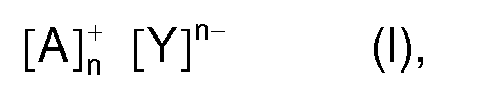
-
[A1]+[A2]+ [Y]n- (IIa), wobei n = 2; [A1]+[A2]+[A3]+ [Y]n- (IIb), wobei n = 3; oder [A1]+[A2]+[A3]+[A4]+ [Y]n- (IIc), wobei n = 4 und -
[A1]+[A2]+[A3]+[M1]+ [Y]n- (IIIa), wobei n = 4; [A1]+[A2]+[M1]+[M2]+ [Y]n- (IIIb), wobei n = 4; [A1]+[M']+[M2]+[M3]+ [Y]n- (IIIc), wobei n = 4; [A1]+[A2]+[M1]+ [Y]n- (IIId), wobei n = 3; [A1]+[M1]+[M2]+ [Y]n- (IIIe), wobei n = 3; [A1]+[M1]+ [Y]n- (IIIf), wobei n = 2; [A1]+[A2]+[M4]2+ [Y]n- (IIIg), wobei n = 4; [A1]+[M1]+[M4]2+ [Y]n- (IIIh), wobei n = 4; [A1]+[M5]3+ [Y]n- (IIIi), wobei n = 4; oder [A1]+[M4]2+ [Y]n- (IIIj), wobei n = 3 und - Die im Rahmen der vorliegenden Erfindung eingesetzten ionischen Flüssigkeiten besitzen einen Schmelzpunkt von in einem Bereich von -50°C bis 150°C, mehr bevorzugt im Bereich von -20°C bis unter 100 °C und weiterhin mehr bevorzugt von -20 °C bis unter 80 °C. Besonders bevorzugt ist der Schmelzpunkt der ionischen Flüssigkeit unter 50 °C, insbesondere sind erfindungsgemäße ionische Flüssigkeiten bei Raumtemperatur flüssig. Bei Raumtemperatur flüssige Ionische Flüssigkeiten sind leicht verarbeitbar und haben eine ausgezeichnete antistatische Wirkung.
- Verbindungen, die sich zur Bildung des Kations [A]+ von ionischen Flüssigkeiten eignen, sind z.B. aus
DE 102 02 838 A1 bekannt. So können solche Verbindungen Sauerstoff-, Phosphor-, Schwefel- oder insbesondere Stickstoffatome enthalten, beispielsweise mindestens ein Stickstoffatom, bevorzugt 1-10 Stickstoffatome, besonders bevorzugt 1-5, ganz besonders bevorzugt 1-3 und insbesondere 1-2 Stickstoffatome. Gegebenenfalls können auch weitere Heteroatome wie Sauerstoff-, Schwefel- oder Phosphoratome enthalten sein. Das Stickstoffatom ist ein geeigneter Träger der positiven Ladung im Kation der ionischen Flüssigkeit, von dem im Gleichgewicht dann ein Proton bzw. ein Alkylrest auf das Anion übergehen kann, um ein elektrisch neutrales Molekül zu erzeugen. Die Positive Ladung kann auch in einem mesomeren System delokalisiert sein. - Für den Fall, dass das Stickstoffatom der Träger der positiven Ladung im Kation der ionischen Flüssigkeit ist, kann bei der Synthese der ionischen Flüssigkeiten zunächst durch Quaternisierung am Stickstoffatom etwa eines Amins oder Stickstoff-Heterocyclus' ein Kation erzeugt werden. Die Quaternisierung kann durch Alkylierung des Stickstoffatoms erfolgen. Je nach verwendetem Alkylierungsreagens werden Salze mit unterschiedlichen Anionen erhalten. In Fällen, in denen es nicht möglich ist, das gewünschte Anion bereits bei der Quaternisierung zu bilden, kann dies in einem weiteren Syntheseschritt erfolgen. Ausgehend beispielsweise von einem Ammoniumhalogenid kann das Halogenid mit einer Lewissäure umgesetzt werden, wobei aus Halogenid und Lewissäure ein komplexes Anion gebildet wird. Alternativ dazu ist der Austausch eines Halogenidions gegen das gewünschte Anion möglich. Dies kann durch Zugabe eines Metallsalzes unter Ausfällung des gebildeten Metallhalogenids, über einen Ionenaustauscher oder durch Verdrängung des Halogenidions durch eine starke Säure (unter Freisetzung der Halogenwasserstoffsäure) geschehen. Geeignete Verfahren sind beispielsweise in Angew. Chem. 2000, 112, S. 3926 - 3945 und der darin zitierten Literatur beschrieben.
- Als Anionen sind prinzipiell alle Anionen einsetzbar. Bevorzugt einsetzbare Anionen sind beispielsweise in
EP 2038337 beschrieben. - Als Ionische Flüssigkeit im Sinn der Erfindung werden vorzugsweise Substanzen mit einem weichen Kation und/oder einem weichen Anion eingesetzt. Das bedeutet, dass Kationen und/oder Anionen gut stabilisiert sind, beispielsweise durch induktive und/oder mesomere Effekte. Kationen weisen dabei bevorzugt elektronenschiebende Substituenten auf. Vorzugsweise enthält das Kation ausschließlich elektronenschiebende Substituenten. Das Anionen weist vorzugsweise elektronenziehende Substituenten auf. Dabei wird besonders bevorzugt eine ionische Flüssigkeit eingesetzt, bei der die Ladung des Kations, des Anions oder des Kations und des Anions durch mesomere Effekte delokalisiert ist. Als Kationen sind daher Imidazolium-, Guanidinium- oder Pyrazoliumderivate, insbesondere Immidazoliumderivate, bevorzugt. Besonders bevorzugt weisen erfindungsgemäße ionische Flüssigkeiten Kationen auf, ausgewählt aus der Gruppe, enthaltend 1,2,3-Trimethylimidazolium, 1,3,4,5-Tetramethylimidazolium, 1,3,4-Dimethylimidazolium, 1,3,4-Trimethylimidazolium, 1,3-Dibutyl-2-methylimidazolium, 1,3-Dibutylimidazolium, 1,2-Dimethylimidazolium, 1,3-Dimethylimidazolium, 1-Benzyl-3-methylimidazolium, 1-Butyl-2,3-dimethylimidazolium, 1-Butyl-2-ethyl-5-methylimidazolium, 1-Butyl-2-ethylimidazolium, 1-Butyl-2-methylimidazolium, 1-Butyl-3,4,5-trimethylimidazolium, 1-Butyl-3,4-dimethylimidazolium, 1-Butyl-3-ethylimidazolium, 1-Butyl-3-methylimidazolium, 1-Butyl-4-methylimidazolium, 1-Butylimidazolium, 1-Decyl-3-methylimidazolium, 1-Dodecyl-3-methylimidazolium, 1-Ethyl-2,3-dimethylimidazolium, 1-Ethyl-3-methylimidazolium, 1-Hexadecyl-2,3-dimethylimidazolium, 1-Hexadecyl-3-methylimidazolium, 1-Hexyl-2,3-dimethylimidazolium, 1-Hexyl-3-methylimidazolium, 1-Methyl-2-ethylimidazolium, 1-Methyl-3-octylimidazolium, 1-Methylimidazolium, 1-Pentyl-3-methylimidazolium, 1-Phenylpropyl-3-methylimidazolium, 1-Propyl-2,3-dimethylimidazolium, 1-Tetradecyl-3-methylimidazolium, 2,3-Dimethylimidazolium, 2-Ethyl-3,4-dimethylimidazolium, 3,4-Dimethylimidazolium, 1,2-Dimethylpyridinium, Guanidinium, Hexamethylguanidinium, N,N,N',N'-Tetramethyl-N"-ethylguanidinium, N-Pentamethyl-N-isopropylguanidinium, N-Pentamethyl-N-propylguanidinium, Benzyltriphenylphosphonium, Tetrabutylphosphonium, Trihexyl(tetradecyl)phosphonium und Tri-isobutyl(methyl)phosphonium.
- Die Anionen werden für das erfindungsgemäße Verfahren vorzugsweise ausgewählt aus der Gruppe, enthaltend Acetat, Bis(2,4,4-trimethylpentyl)phosphinat, Bis(malonato)borat, Bis(oxalato)borat, Bis(pentafluoroethyl)phosphinat, Bis(phtalato)borat, Bis(salicylato)borat, Bis(trifluoromethansulfonyl)imidat, Bis(trifluoromethyl)imidat, Borat, Bromid, Bromoaluminate, Carbonat, Chloroaluminate, Decylbenzolsulfonat, Dichlorocuprat, Dicyanamid, Didecylbenzolsulfonat, Didodecylbenzolsulfonat, Diethylphosphat, Dihydrogenphosphat, Dodecylbenzolsulfonat, Ethylsulfat, Ethylsulfonat, Fluorid, Hexafluorophosphat, Hydrogencarbonat, Hydrogenphosphat, Hydrogensulfat, Hydrogensulfit, Iodid, Methylsulfat, Methylsulfonat, Nitrat, Nitrit, Phosphat, Sulfit, Tetracyanoborat, Tetrafluoroborat, Tetrakis(hydrogensulfato)borat, Tetrakis(methylsulfonato)borat, Thiocyanat, Tosylat, Trichlorozinkat, Trifluoroacetat, Trifluoromethylsulfonat, Tris(heptafluoropropyl)trifluorophosphat, Tris(nonafluorobutyl)trifluorophosphat, Tris(pentafluoroethyl)trifluorophosphat, Tris(pentafluoroethylsulfonyl)trifluorophosphat.
- Besonders bevorzugte Anionen sind Hexafluorphosphat, Tetrafluorborat, Thiocyanat und Dicyanamid, Ethylsulfat, Diethylphosphat, Methylsulfat, Bromid, Jodid, p-Toluolsulfonat und Methansulfonat, insbesondere auf Basis von Ethylsulfat, Thiocyanat oder Dicyanamid.
- Vorzugsweise werden als Ionische Flüssigkeiten im Sinn der Erfindung 1-Ethyl-3-methylimidazoliumchlorid, 1- Butyl-3-methylimidazoliumchlorid, 1-Ethyl-3-methylimidazoliummethylsulfonat, 1-Butyl-3-methylimidazoliummethylsulfonat, 1-Ethyl-3-methylimidazoliumethylsulfat, 1- Butyl-3-methylimidazoliummethylsulfat, 1- Ethyl-3-methylimidazoliumdiethylphosphat, 1-Ethyl-3-methylimidazoliumdicyanamid, 1-Ethyl-3-methylimidazoliumacetat, 1-Butyl-3-methylimidazoliumacetat, 1-Ethyl-3-methylimidazoliumthiocyanat, 1- Butyl-3-methylimidazoliumthiocyanat, 1-Ethyl-3-methylimidazoliumtetrafluoroborat, 1-Butyl-3-methylimidazoliumtetrafluoroborat, 1-Ethyl-3-methylimidazoliumtrifluormethansulfonat, 1-Butyl-3-methylimidazoliumtrifluormethansulfonat, 1-Ethyl-3-methylimidazoliumbis(trifluormethansulfonyl)imid, 1-Butyl-3-methylimidazoliumbis(trifluormethansulfonyl)imid, 1-Ethyl-3-methylimidazoliumhexafluorophosphat, 1-Ethyl-3-methylimidazoliumbromid, 1-Ethyl-3-methylimidazolium-p-toluolsulfonat sowie, 1- Butyl-3-methylimidazoliumdicyanamid, 1- Butyl-3-methylimidazoliumdimethylphosphat, 1- Butyl-3-methylimidazoliumbromid, 1- Butyl-3-methylimidazolium-p-toluolsulfonat, und 1-Butyl-3-methylimidazoliumhexafluorophosphat verwendet.
- Besonders bevorzugt werden als Ionische Flüssigkeiten im Sinn der Erfindung 1-Ethyl-3-methylimidazoliummethylsulfonat, 1-Ethyl-3-methylimidazoliumethylsulfat, 1-Ethyl-3-methylimidazoliumdicyanamid, 1-Ethyl-3-methylimidazoliumthiocyanat, 1-Ethyl-3-methylimidazoliumtetrafluoroborat verwendet.
- Ganz besonders bevorzugt werden als Ionische Flüssigkeiten im Sinn der Erfindung 1-Ethyl-3-methylimidazoliumethylsulfat, 1-Ethyl-3-methylimidazoliumdicyanamid, 1-Ethyl-3-methylimidazoliumthiocyanat, verwendet. Insbesondere werden als ionische Flüssigkeiten 1-Ethyl-3-methylimidazoliumethylsulfat oder 1-Ethyl-3-methylimidazoliumdicyanamid verwendet.
- Vorzugsweise ist die ionische Flüssigkeit im erfindungsgemäßen antistatischen oder leitfähigen Polyurethan in einer Menge von 0,001 bis 10 Gewichtsprozent, mehr bevorzugt von 0,01 bis 5 Gewichtsprozent noch mehr bevorzugt von 0,1 bis 3 Gewichtsprozent, besonders bevorzugt von 0,1 bis 2 Gewichtsprozent und insbesondere von 0,1 bis 1 Gewichtsprozent, jeweils bezogen auf das Gesamtgewicht des antistatischen oder leitfähigen Polyurethans, enthalten. Die ionische Flüssigkeit ist dabei vorzugsweise nicht kovalent an die Polymerkette des antistatischen Polymers gebunden. Dabei können die eingesetzten ionischen Flüssigkeiten einzeln oder in Form von Mischungen verwendet werden.
- Kohlenstoff Nanoröhrchen, die im erfindungsgemäßen antistatischen oder elektrisch leitfähigen Polyurethan enthalten sind, liegen vorzugsweise möglichst fein verteilt vor. Unter Kohlenstoff Nanoröhrchen, auch als Carbo Nanotubes oder CNT bezeichnet, werden nach dem Stand der Technik hauptsächlich zylinderförmige Kohlenstoffröhren mit einem Durchmesser zwischen 3 und 100 nm und einer Länge, die ein Vielfaches des Durchmessers beträgt, verstanden. Diese Röhrchen bestehen aus einer oder mehreren Lagen geordneter Kohlenstoffatome und weisen einen in der Morphologie unterschiedlichen Kern auf. Diese Kohlenstoff Nanoröhrchen werden beispielsweise auch als "carbon fibrils" oder "hollow carbon fibres" bezeichnet.
- In der Fachliteratur sind Kohlenstoff Nanoröhrchen seit langem bekannt. Obwohl lijima (Publikation: S. lijima, Nature 354, 56-58, 1991) allgemein als Entdecker der Nanoröhrchen bezeichnet wird, sind diese Materialien, insbesondere faserförmige Graphitmaterialien mit mehreren Graphitschichten, schon seit den 70er bzw. frühen 80er Jahren bekannt. Tates und Baker (
GB 1 469 930 A1 , 1977 EP 56004 A2 - Übliche Strukturen dieser Kohlenstoff Nanoröhrchen sind solche vom Zylinder Typ. Bei den zylindrischen Strukturen unterscheidet man zwischen den einwandigen Kohlenstoff Nanoröhrchen (Single Wall Carbon Nano Tubes) und den mehrwandigen zylindrischen Kohlenstoff Nanoröhrchen (Multi Wall Carbon Nano Tubes). Gängige Verfahren zu ihrer Herstellung sind z. B. Lichtbogenverfahren (arc discharge), Laser Ablation (laser ablation), Chemische Abscheidung aus der Dampfphase (CVD-process) und Katalytisch Chemische Abscheidung aus der Dampfphase (CCVD-process).
- Aus lijima, Nature 354, 1991, 56-8 ist die Bildung von Kohlenstoffröhrchen im Lichtbogenverfahren bekannt, die aus zwei oder mehr Graphitlagen bestehen und zu einem nahtlos geschlossen Zylinder aufgerollt und ineinander geschachtelt sind. Abhängig vom Aufrollvektor sind chirale und achirale Anordnungen der Kohlenstoffatome im Verhältnis zu der Längsachse der Kohlenstofffaser möglich.
- Strukturen von Kohlenstoffröhrchen, bei denen eine einzelne zusammenhängende Graphitlagen (sogenannter scroll type) oder unterbrochene Graphitlagen (sogenannter onion type) die Basis für den Aufbau der Nanoröhre ist, wurden erstmals von Bacon et al., J. Appl. Phys. 34, 1960, 283-90 , beschrieben. Die Struktur wird als Scroll Type bezeichnet. Später wurden entsprechende Strukturen auch von Zhou et al., Science, 263, 1994, 1744-47 und von Lavin et al., Carbon 40, 2002, 1123-30 gefunden.
- Kohlenstoff Nanoröhrchen im Sinne der Erfindung sind alle einwandigen oder mehrwandigen Kohlenstoff Nanoröhrchen vom Zylinder-Typ, Scroll-Typ oder mit zwiebelartiger Struktur. Bevorzugt sind mehrwandige Kohlenstoff-Nanoröhrchen vom Zylinder-Typ, Scroll-Typ oder deren Mischungen einzusetzen.
- Besonders bevorzugt werden Kohlenstoffnanoröhrchen mit einem Verhältnis von Länge zu Aussendurchmesser von größer 5, bevorzugt größer 100 verwendet.
- Die einzusetzenden Kohlenstoff Nanoröhrchen, die als Agglomerate vorliegen können, weisen in der nicht agglomerierten Form vorzugsweise einen mittleren äußeren Durchmesser von 1 bis 100 nm, bevorzugt 2 bis 80 nm, besonders bevorzugt 3 bis 60 nm und insbesondere 4 bis 50 nm auf.
- Neben den Kohlenstoff Nanoröhrchen vom Scroll-Typ mit nur einer durchgehenden oder unterbrochenen Graphitlage gibt es auch Kohlenstoff Nanoröhrchen -Strukturen, die aus mehreren Graphitlagen bestehen, welche zu einem Stapel zusammengefasst und aufgerollt vorliegen (Multiscroll-Typ). Diese Kohlenstoff Nanoröhrchen -Struktur verhält sich zu den Kohlenstoff Nanoröhrchen vom einfachen Scroll-Typ vergleichsweise wie die Struktur mehrwandiger zylindrischer Monokohlenstoff Nanoröhrchen (cylindrical MWNT) zur Struktur der einwandigen zylindrischen Kohlenstoff Nanoröhrchen (cylindrical SWNT).
- Die heute bekannten Methoden zur Herstellung von Kohlenstoff Nanoröhrchen umfassen Lichtbogen-, Laserablations- und katalytische Verfahren. Bei vielen dieser Verfahren werden Russ, amorpher Kohlenstoff und Fasern mit hohem Durchmesser als Nebenprodukte gebildet. Bei den katalytischen Verfahren kann zwischen der Abscheidung an geträgerten Katalysatorpartikeln und der Abscheidung an in-situ gebildeten Metallzentren mit Durchmessern im Nanometerbereich (sogenannte Flow-Verfahren) unterschieden werden. Bei der Herstellung über die katalytische Abscheidung von Kohlenstoff aus bei Reaktionsbedingungen gasförmigen Kohlenwasserstoffen (im Folgenden CCVD; Catalytic Carbon Vapour Deposition) werden als mögliche Kohlenstoffspender Acetylen, Methan, Ethan, Ethylen, Butan, Buten, Butadien, Benzol und weitere, Kohlenstoff enthaltende Edukte genannt. Bevorzugt werden daher Kohlenstoff Nanoröhrchen erhältlich aus katalytischen Verfahren, eingesetzt.
- Die Katalysatoren beinhalten in der Regel Metalle, Metalloxide oder zersetzbare bzw. reduzierbare Metallkomponenten. Beispielsweise sind im Stand der Technik als Metalle für den Katalysator Fe, Mo, Ni, V, Mn, Sn, Co, Cu und weitere Nebengruppenelemente genannt. Die einzelnen Metalle haben meist zwar eine Tendenz, die Bildung von Kohlenstoff Nanoröhrchen zu unterstützen, allerdings werden laut Stand der Technik hohe Ausbeuten und geringe Anteile amorpher Kohlenstoffe vorteilhaft mit solchen Metallkatalysatoren erreicht, die auf einer Kombination der oben genannten Metalle basieren. Kohlenstoff Nanoröhrchen, erhältlich unter Verwendung von Mischkatalysatoren, sind folglich bevorzugt einzusetzen.
- Besonders vorteilhafte Katalysatorsysteme zur Herstellung von Kohlenstoff Nanoröhrchen basieren auf Kombinationen von Metallen oder Metallverbindungen, die zwei oder mehr Elemente aus der Gruppe, bestehend aus Fe, Co, Mn, Mo und Ni, enthalten.
- Die Bildung von Kohlenstoff Nanoröhrchen und die Eigenschaften der gebildeten Röhrchen hängen erfahrungsgemäß in komplexer Weise von der als Katalysator verwendeten Metallkomponente oder einer Kombination mehrerer Metallkomponenten, dem gegebenenfalls verwendeten Katalysatorträgermaterial und der Wechselwirkung zwischen Katalysator und Träger, dem Eduktgas und -partialdruck, einer Beimischung von Wasserstoff oder weiteren Gasen, der Reaktionstemperatur und der Verweilzeit bzw. dem verwendeten Reaktor ab.
- Ein besonders bevorzugt einzusetzendes Verfahren zur Herstellung von Kohlenstoff Nanoröhrchen ist aus
WO 2006/050903 A2 ,EP 1401763 ,EP 1594802 ,EP 1827680 undWO 2007033438 bekannt. - In den genannten unterschiedlichen Verfahren unter Einsatz verschiedener Katalysatorsysteme werden Kohlenstoff Nanoröhrchen verschiedener Strukturen hergestellt, die aus dem Prozess überwiegend als Kohlenstoff Nanoröhrchen Pulver entnommen werden können.
- Die Herstellung von Kohlenstoff Nanoröhrchen mit Durchmessern kleiner 100 nm ist erstmals in
EP-B 205 556 -
WO 86/03455 A1 - Aus der
WO 2007/093337 A2 ist ein Verfahren zur Herstellung eines Katalysators bekannt geworden, der für die Herstellung von konventionellen Kohlenstoff Nanoröhrchen mit zylindrischer Struktur geeignet ist. Bei Verwendung dieses Katalysators in einem Festbett werden von zylindrischen Kohlenstoff Nanoröhrchen mit einem Durchmesser im Bereich von 5 bis 30 nm in hohen Ausbeuten gewonnen. - Ein völlig anderer Weg zur Herstellung zylindrischer Kohlenstoff Nanoröhrchen wurde von O-berlin, Endo und Koyam beschrieben (Carbon 14, 1976, 133). Dabei werden aromatische Kohlenwasserstoffe, z. B. Benzen, an einem Metallkatalysator umgesetzt. Die entstandenen Kohlenstoffröhren zeigen einen gut definierten, graphitischen hohlen Kern, der ungefähr den Durchmesser des Katalysatorpartikels hat, auf dem sich weiterer weniger graphitisch geordneter Kohlenstoff befindet. Die gesamte Röhre kann durch Behandlung bei hoher Temperatur (2500 °C bis 3000 °C) graphitisiert werden
- Die meisten der oben genannten Verfahren (mit Lichtbogen, Sprühpyrolyse bzw. CVD) werden heute zur Herstellung von Kohlenstoff Nanoröhrchen genutzt. Die Herstellung einwandiger zylindrischer Kohlenstoff Nanoröhrchen ist jedoch apparativ sehr aufwendig und verläuft nach den bekannten Verfahren mit sehr geringer Bildungsgeschwindigkeit und oft auch mit vielen Nebenreaktionen, die zu einem hohen Anteil an unerwünschten Verunreinigungen führen, d. h. die Ausbeute solcher Verfahren ist vergleichsweise gering. Deshalb ist die Herstellung derartiger Kohlenstoff Nanoröhrchen auch heute noch technisch extrem aufwendig. Daher werden einwandige, zylindrische Kohlenstoff-Nanoröhrchen heute vor allem für hoch spezialisierte Anwendungen in geringen Mengen zum Einsatz. Ihre Anwendung ist für die vorliegende Erfindung denkbar, aber aufgrund der derzeitigen Gegebenheiten weniger bevorzugt als die Anwendung von mehrwandigen Kohlenstoff Nanoröhrchen vom Zylinder- oder Scroll-Typ.
- Die Herstellung von mehrwandigen Kohlenstoff Nanoröhrchen, in Form von ineinander geschachtelten nahtlosen zylindrischen Nanoröhrchen oder auch in Form der beschriebenen Scroll- oder Onion-Strukturen erfolgt heute kommerziell in größeren Mengen überwiegend unter Verwendung katalytischer Verfahren. Diese Verfahren zeigen üblicherweise eine höhere Ausbeute als beispielsweise die Lichtbogenverfahren und werden heute typischerweise im kg-Maßstab (einige hundert Kilo/Tag weltweit) durchgeführt. Die so hergestellten mehrwandigen-Kohlenstoff Nanoröhrchen sind in der Regel um einiges kostengünstiger als die einwandigen Nanoröhrchen.
- Besonders bevorzugt werden mehrwandingen Kohlenstoffnanoröhrchen eingesetzt. Ein bevorzugtes Beispiel für solche mehrwandigen Kohlenstoffnanoröhrchen ist Nanocyl® 7000 der Firma Nanocyl SA, Belgien.
- Der Gehalt an Kohlenstoff Nanoröhrchen im erfindungsgemäßen antistatischen oder elektrisch leitfähige Polyurethan liegt vorzugsweise im Bereich von 0,01 bis 15 Gew.-%, mehr bevorzugt von 0,05 bis 7 Gew.-%, noch mehr bevorzugt von 0,1 bis 5 Gew.-%, besonders bevorzugt von 0,1 bis 3 Gew.-% und inbesondere von 0,1 bis 1 Gew.-%, bezogen auf das Gesamtgewicht des antistatischen oder leitfähigen Polyurethans enthalten.
- Zur Herstellung der erfindungsgemäßen antistatischen oder elektrisch leitfähigen Polyurethane werden in einer ersten Ausführungsform Polyisocyanate (a) mit Verbindungen mit mindestens zwei gegenüber Isocyanaten reaktiven Wasserstoffatomen und einem Molekulargewicht von mindestens 350 g/mol (b), Kohlenstoff Nanoröhrchen (c), ionische Flüssigkeit (d), gegebenenfalls niedermolekularen Kettenverlängerungsmitteln und/oder Vernetzungsmitteln (e), gegebenenfalls Katalysatoren (f), gegebenenfalls Treibmitteln (g) und gegebenenfalls sonstigen Zusatzstoffen (h) zu einer Reaktionsmischung vermischt und zum antistatischen oder elektrisch leitfähigen Polyurethan umsetzt. Dabei handelt es sich im Rahmen der Erfindung bei einem Reaktionsumsatz, bezogen auf die Isocyanatgruppen, von kleiner 90 % von einer Reaktionsmischung und bei einem Reaktionsumsatz von größer 90 % um ein Polyurethan.
- Die zur Herstellung der erfindungsgemäßen antistatischen oder elektrisch leitfähige Polyurethane verwendete Polyisocyanatkomponente (a) umfassen alle zur Herstellung von Polyurethanen bekannten Polyisocyanate. Diese umfassen die aus dem Stand der Technik bekannten aliphatischen, cycloaliphatischen und aromatischen zwei- oder mehrwertigen Isocyanate sowie beliebige Mischungen daraus. Beispiele sind 2,2'-, 2,4'- und 4,4'-Diphenylmethandiisocyanat, die Mischungen aus monomeren Diphenylmethandiisocyanaten und höherkernigen Homologen des Diphenylmethandiisocyanats (Polymer-MDI), Isophorondiisocyanat (IPDI) oder dessen Oligomere, 2,4- oder 2,6-Toluylendiisocyanat (TDI) oder deren Mischungen, Tetramethylendiisocyanat oder dessen Oligomere, Hexamethylendiisocyanat (HDI) oder dessen Oligomere, Naphtylendiisocyanat (NDI) oder Mischungen daraus.
- Bevorzugt wird 4,4'-MDI, Polymer-MDI und/oder HDI verwendet. Das besonders bevorzugt verwendete 4,4'-MDI kann geringe Mengen, bis etwa 10 Gew.-%, uretdion-, allophanat- oder uretoniminmodifizierte Polyisocyanate enthalten. Weitere mögliche Isocyanate sind beispielsweise im "Kunststoffhandbuch, Band 7, Polyurethane", Carl Hanser Verlag, 3. Auflage 1993, Kapitel 3.2 und 3.3.2 angegeben.
- Die Polyisocyanatkomponente (a) kann in Form von Polyisocyanatprepolymeren eingesetzt werden. Diese Polyisocyanatprepolymere sind erhältlich, indem vorstehend beschriebene Polyisocyanate (Bestandteil (a-1)) im Überschuss, beispielsweise bei Temperaturen von 30 bis 100 °C, bevorzugt bei etwa 80 °C, mit Polyolen (Bestandteil (a-2)), zum Prepolymer umgesetzt werden.
- Polyole (a-2) sind dem Fachmann bekannt und beispielsweise beschrieben im "Kunststoffhandbuch, 7, Polyurethane", Carl Hanser-Verlag, 3. Auflage 1993, Kapitel 3.1. So können beispielsweise als Polyole auch die nachfolgend unter (b) beschriebenen Polyole eingesetzt werden.
- Gegebenenfalls können der Umsetzung zum Polyisocyanatprepolymer noch Kettenverlängerungsmittel (a-3) zugegeben werden. So können beispielsweise alle unter Komponente (e) beschriebenen Kettenverlängerungsmittel eingesetzt werden. Als Kettenverlängerungsmittel (a-3) für das Prepolymer sind zwei- oder dreiwertige Alkohole, beispielsweise Dipropylenglykol und/oder Tripropylenglykol, oder die Addukte von Dipropylenglykol und/oder Tripropylenglykol mit Alkylenoxiden, bevorzugt Propylenoxid, besonders geeignet.
- Als Verbindungen mit mindestens zwei gegenüber Isocyanaten reaktiven Wasserstoffatomen (b) und einem Molekulargewicht von mindestens 350 g/mol können alle zur Polyurethanherstellung bekannten Verbindungen mit mindestens zwei reaktiven Wasserstoffatomen und einem Molekulargewicht von mindestens 350 g/mol eingesetzt werden. Diese weisen beispielsweise eine Funktionalität von 2 bis 8 und einem Molekulargewicht von 400 bis 12000 auf. So können beispielsweise Polyetherpolyamine und/oder Polyole, ausgewählt aus der Gruppe der Polyetherpolyole, Polyesterpolyole oder Mischungen daraus, verwendet werden.
- Die bevorzugt zur Anwendung kommenden Polyole sind Polyetherole und/oder Polyesterole mit Molekulargewichten zwischen 400 und 12000, bevorzugt 450 bis 6000, insbesondere 500 bis weniger als 3000, und bevorzugt einer mittleren Funktionalität von 2 bis 6, bevorzugt 2 bis 4, besonders bevorzugt 2 bis 3, insbesondere 2.
- Die erfindungsgemäß verwendbaren Polyetherole, werden nach bekannten Verfahren hergestellt. Beispielsweise können sie durch anionische Polymerisation mit Alkalihydroxiden, wie z. B. Natrium- oder Kalium- hydroxid oder Alkalialkoholaten, wie z. B. Natriummethylat, Natrium- oder Kaliumethylat oder Kaliumisopropylat als Katalysatoren und unter Zusatz mindestens eines Startermoleküls, das 2 bis 8, vorzugsweise 2 bis 6, reaktive Wasserstoffatome aufweist, oder durch kationische Polymerisation mit Lewissäuren, wie Antimonpentachlorid, Borfluorid-Etherat u. a., oder Bleicherde als Katalysatoren hergestellt werden. Ebenso können Polyetherpolyole durch Doppelmetallcyanidkatalyse aus einem oder mehreren Alkylenoxiden mit 2 bis 4 Kohlenstoffatomen im Alkylenrest hergestellt werden. Auch tertiäre Amine können als Katalisator eingesetzt werden, beispilsweise Triethylamin, Tributylamin, Trimethylamin, Dimethylethanolamin, Imidazol oder Dimethylcyclohexylamin. Für spezielle Einsatzzwecke können auch monofunktionelle Starter in den Polyetheraufbau eingebunden werden.
- Geeignete Alkylenoxide sind beispielsweise Tetrahydrofuran, 1,3-Propylenoxid, 1,2- bzw. 2,3-Butylenoxid, Styroloxid und vorzugsweise Ethylenoxid und 1,2-Propylenoxid. Die Alkylenoxide können einzeln, alternierend nacheinander oder als Mischungen verwendet werden.
- Als Startermoleküle kommen beispielsweise in Betracht: Wasser, aliphatische und aromatische, gegebenenfalls N-mono-, N,N- und N,N'-dialkylsubstituierte Diamine mit 1 bis 4 Kohlenstoffatomen im Alkylrest, wie gegebenenfalls mono- und dialkylsubstituiertes Ethylendiamin, Diethylentriamin, Triethylentetramin, 1,3-Propylendiamin, 1,3- bzw. 1,4-Butylendiamin, 1,2-, 1,3-, 1,4-, 1,5- und 1,6-Hexamethylendiamin, Phenylendiamin, 2,3-, 2,4- und 2,6-Toluylendiamin (TDA) und 4,4'-, 2,4'- und 2,2'-Diaminodiphenylmethan (MDA) und polymerisches MDA. Als Startermoleküle kommen ferner in Betracht: Alkanolamine, wie z. B. Ethanolamin, N-Methyl- und N-Ethylethanolamin, Dialkanolamine, wie z. B. Diethanolamin, N-Methyl- und N-Ethyldiethanolamin, Trialkanolamine, wie z. B. Triethanolamin, und Ammoniak. Vorzugsweise verwendet werden mehrwertige Alkohole, wie Ethandiol, 1,2- und 2,3-Propandiol, Diethylenglykol, Dipropylenglykol, 1,4-Butandiol, 1,6-Hexandiol, Glycerin, Trimethylolpropan; Pentaerythrit, Sorbitol und Saccharose, und Mischungen davon.
- Als Polyetherol kann weiterhin Polytetrahydrofuran (Poly-THF-Polyole) eingesetzt werden. Dabei beträgt das zahlenmittlere Molekulargewicht des Polytetrahydrofurans üblicherweise 550 bis 4000 g/mol, bevorzugt 750 bis 3000 g/mol, besonders bevorzugt 800 bis 2500 g/mol.
- Die Polyetherpolyole können einzeln oder in Form von Mischungen verwendet werden.
- Polyesterole werden z.B. hergestellt aus Alkandicarbonsäuren und mehrwertigen Alkoholen, Polythioetherpolyolen, Polyesteramiden, hydroxylgruppenhaltigen Polyacetalen und/oder hydroxylgruppenhaltigen aliphatischen Polycarbonaten, vorzugsweise in Gegenwart eines Versterungskatalysators. Weitere mögliche Polyole sind beispielsweise im "Kunststoffhandbuch, Band 7, Polyurethane", Carl Hanser Verlag, 3. Auflage 1993, Kapitel 3.1 angegeben.
- Die bevorzugt zur Anwendung kommenden Polyesterole können beispielsweise aus Dicarbonsäuren mit 2 bis 12 Kohlenstoffatomen, vorzugsweise 4 bis 6 Kohlenstoffatomen, und mehrwertigen Alkoholen hergestellt werden. Als Dicarbonsäuren kommen beispielsweise in Betracht: aliphatische Dicarbonsäuren, wie Bernsteinsäure, Glutarsäure, Adipinsäure, Korksäure, Azelainsäure und Sebacinsäure und aromatische Dicarbonsäuren, wie Phthalsäure, Isophthalsäure und Terephthalsäure. Die Dicarbonsäuren können einzeln oder als Gemische, z.B. in Form einer Bernstein-, Glutar- und Adipinsäuremischung, verwendet werden. Zur Herstellung der Polyesterole kann es gegebenenfalls vorteilhaft sein, anstelle der Dicarbonsäuren die entsprechenden Dicarbonsäurederivate, wie Dicarbonsäureester mit 1 bis 4 Kohlenstoffatomen im Alkoholrest, Dicarbonsäureanhydride oder Dicarbonsäurechloride zu verwenden. Beispiele für mehrwertige Alkohole sind Glykole mit 2 bis 10, vorzugsweise 2 bis 6 Kohlenstoffatomen, wie Ethylenglykol, Diethylenglykol, Butandiol-1,4, Pentandiol-1,5, Hexandiol-1,6, Decandiol-1,10, 2,2-Dimethylpropandiol-1,3, Propandiol-1,3 und Dipropylenglykol, Triole mit 3 bis 6 Kohlenstoffatomen, wie z.B. Glycerin und Trimethylolpropan und als höherwertiger Alkohol Pentaerythrit. Je nach den gewünschten Eigenschaften können die mehrwertigen Alkohole allein oder gegebenenfalls in Mischungen untereinander verwendet werden.
- Als Polyole können beispielsweise auch Polyetherpolyamine und/oder weitere Polyole, ausgewählt aus der Gruppe der Polythioetherpolyole, Polyesteramide, hydroxylgruppenhaltigen Polyacetalen und hydroxylgruppenhaltigen aliphatischen Polycarbonaten und Acrylaten oder Mischungen aus mindestens zwei der genannten Polyole verwendet werden.
- Als Kohlenstoff Nanoröhrchen (c) können alle bekannten Kohlenstoff-Nanoröhrchen, wie die oben beschriebenen Kohlenstoff-Nanoröhrchen, eingesetzt werden. Besonders bevorzugt werden mehrwandingen Kohlenstoffnanoröhrchen (multi wall CNTs) als Kohlenstoffnanoröhrchen eingesetzt. Der Gehalt an Kohlenstoff Nanoröhrchen (c), bezogen auf das Gesamtgewicht der Komponenten (a) bis (h) liegt vorzugsweise im Bereich von 0,01 bis 15 Gew.-%, mehr bevorzugt von 0,05 bis 7 Gew.-%, noch mehr bevorzugt von 0,1 bis 5 Gew.-%, besonders bevorzugt von 0,1 bis 3 Gew.-% und inbesondere von 0,1 bis 1 Gew.-%.
- Damit die eingesetzten Kohlenstoff Nanoröhrchen (c) die Leitfähigkeit des Polyurethans möglichst effektiv erhöhen, müssen diese möglichst fein verteilt vorliegen. Dies erfolgt üblicherweise durch dispergieren in einem Dispergiermittel. Dabei wird eine möglichst feine Verteilung erreicht, wenn das Dispergieren unter Einsatz möglichst großer Scheerkräfte erfolgt, beispielsweise in einem Rührreaktor bei einer Leistungsdichte von größer 102 bis 1014 kW/m3, bevorzugt 103 bis 1013 kw/m3. Als Dispersionsmittel können übliche, gegenüber den Kohlenstoff Nanoröhrchen inerte Lösungsmittel dienen. Vorzugsweise werden als Dispergiermittel flüssige Verbindungen der Komponenten a) bis h), beispielsweise a), b) oder e) und Mischungen, enthaltend eine oder mehrere dieser Verbindungen eingesetzt. Besonders bevorzugt werden als Dispersionsmittel die Verbindungen mit mindestens zwei gegenüber Isocyanaten reaktiven Wasserstoffatomen und einem Molekulargewicht von mindestens 350 g/mol (b) sowie Mischungen, enthaltend diese Verbindungen (b) ganz oder teilweise und gegebenenfalls eine oder mehrere der Komponenten (c) bis (h) eingesetzt. Weiter ist es auch möglich, dass Polyisocyanate (a) als Dispergiermittel eingesetzt werden. Gegebenenfalls kann neben diesen Komponenten auch ein weiteres Dispersionsmittel, wie beispielsweise ein übliches Lösungsmittel, und/oder ein Emulgator eingesetzt werden. Dabei können als Emulgatoren übliche amphiphile Moleküle, beispielsweise Tenside, eingesetzt werden. Vorzugsweise wird als Dispersionsmittel ein Teil oder der gesamte Anteil der Komponente (b), gegebenenfalls in Mischung mit weiteren Komponenten (c) bis (h) eingesetzt. Besonders bevorzugt wird die Dispersion erhalten, indem man die Kohlenstoff Nanoröhrchen (c) die Verbindungen mit mindestens zwei gegenüber Isocyanaten reaktiven Wasserstoffatomen und einem Molekulargewicht von mindestens 350 g/mol (b) und ionische Flüssigkeiten (d) vorlegt und gemeinsam dispergiert.
- Die Dispergierung kann beispielsweise in mechanischen Dispergiervorrichtungen, vorzugsweise in Dispergiermaschinen mit hohen örtlichen Energiedichten, z.B. 10 bis 3000 kW/m3, mit Mahlkörpern, wie z.B. Rührwerkskugelmühlen, Sandmühlen, Netsch-Mühlen, Kolloidmühlen, Perl-Mühlen, Dyno-Mühlen, Planetenkugelmühlen und Kesselmühlen sowie Reibwalzen oder Henschel-Mischern durchgeführt werden. Als Mahlkörper kommen vorzugsweise kugelförmige Mahlkörper in Betracht, die beispielsweise aus Glas, Keramik, Metall, hartem abriebfestem Kunststoff z.B. Polyamid, sein können und deren Durchmesser zwischen 0,2 bis 8, vorzugsweise 0,4 bis 5 mm beträgt. Feinteilige Dispersionen von Kohlenstoff Nanoröhrchen im Dispergiermittel können auch mit Hilfe von Ultraturraxen oder Ultraschallmischern hergestellt werden. Solche Mischer und Mischverfahren sind beispielsweise beschrieben in "Formulierungstechnik, Hans Mollet, Arnold Grubenmann, Wiley-VCH, 2000, insbesondere Im Kapitel 5.3.2.
- Als ionische Flüssigkeit (d) werden zur Herstellung der erfindungsgemäßen antistatischen oder leitfähigen Polyurethane die oben definierten ionischen Flüssigkeiten eingesetzt. Dabei beträgt der Anteil der ionischen Flüssigkeit (d) vorzugsweise 0,001 bis 10 Gewichtsprozent, mehr bevorzugt von 0,01 bis 5 Gewichtsprozent noch mehr bevorzugt von 0,1 bis 3 Gewichtsprozent, besonders bevorzugt von 0,1 bis 2 Gewichtsprozent und insbesondere von 0,1 bis 1 Gewichtsprozent, jeweils bezogen auf das Gesamtgewicht der Komponenten (a) bis (h).
- Bei der Herstellung eines erfindungsgemäßen antistatischen oder leitfähigen Polyurethans kann ein Kettenverlängerungsmittel (e) beispielsweise zur Modifizierung der mechanischen Eigenschaften, wie der Härte, eingesetzt werden. Dabei weisen Kettenverlängerungsmittel und/oder Vernetzungsmittel (e) mindestens zwei gegenüber Isocyanaten reaktive Wasserstoffatome und einem Molekulargewicht von kleiner 350 g/mol auf. Als Kettenverlängerer (e) werden allgemein bekannte aliphatische, araliphatische, aromatische und/oder cycloaliphatische Verbindungen mit einem Molekulargewicht von 50 bis 349, bevorzugt 2-funktionelle Verbindungen, eingesetzt, beispielsweise Diamine und/oder Alkandiole mit 2 bis 10 C-Atomen im Alkylenrest, insbesondere 1,3-Propandiol, Butandiol-1,4, Hexandiol-1,6, Hydroquinone bis(2-hydroxyethyl)ether und/oder Di-, Tri-, Tetra-, Penta-, Hexa-, Hepta-, Okta-, Nona- und/oder Dekaalkylenglykole mit 3 bis 8 Kohlenstoffatomen, bevorzugt entsprechende Oligo- und/oder Polypropylenglykole, wobei auch Mischungen der Kettenverlängerer eingesetzt werden können. Das Gewichtsverhältnis der höhermolekularen Verbindung mit gegenüber Isocyanaten reaktiven Wasserstoffatomen (b) zu Kettenverlängerer (e), kann 0,5 : 1 bis 20 : 1, vorzugsweise 1,5 : 1 bis 13 : 1 betragen , wobei ein höherer Anteil an Kettenverlängerer zu einem härteren Produkt führt. Weitere mögliche niedermolekulare Kettenverlängerungsmittel und/oder Vernetzungsmittel sind beispielsweise im "Kunststoffhandbuch, Band 7, Polyurethane", Carl Hanser Verlag, 3. Auflage 1993, Kapitel 3.2 und 3.3.2 angegeben.
- Die genannten Kettenverlängerungsmittel und/oder Vernetzungsmittel (e) können einzeln oder als Mischungen von gleichen oder verschiedenen Verbindungsarten verwendet werden und werden üblicherweise in Mengen von 1 bis 40 Gew.-%, bezogen auf das Gesamtgewicht der Komponenten (a), (b) und (e), eingesetzt.
- Als Katalysatoren (f) können alle zur Polyurethanherstellung üblichen Katalysatoren eingesetzt werden. Solche Katalysatoren werden beispielsweise im "Kunststoffhandbuch, Band 7, Polyurethane", Carl Hanser Verlag, 3. Auflage 1993, Kapitel 3.4.1 beschrieben. Dabei kommen beispielsweise organische Metallverbindungen, vorzugsweise organische Zinnverbindungen, wie Zinn-(II)-salze von organischen Carbonsäuren, z.B. Zinn-(II)-acetat, Zinn-(II)-octoat, Zinn-(II)-ethylhexanoat und Zinn-(II)-laurat und die Dialkylzinn-(IV)-salze von organischen Carbonsäuren, z.B. Dibutylzinndiacetat, Dibutylzinndilaurat, Dibutylzinnmaleat und Dioctylzinndiacetat, sowie Bismutcarboxylate, wie Bismut(III)-neodecanoat, Bismut-2-etyhlhexanoat und Bismutoctanoat oder Mischungen in Betracht. Weitere mögliche Katalysatoren sind stark basische Aminkatalysatoren. Beispiele hierfür sind Amidine, wie 2,3-Dimethyl-3,4,5,6-tetrahydropyrimidin, tertiäre Amine, wie Triethylamin, Tributylamin, Dimethylbenzylamin, N-Methyl-, N-Ethyl-,N-Cyclohexylmorpholin, N,N,N',N'-Tetramethylethylendiamin, N,N,N',N'-Tetramethyl-butandiamin, N,N,N',N'-Tetramethyl-hexandiamin, Pentamethyl-diethylentriamin, Tetramethyldiaminoethylether, Bis-(dimethylaminopropyl)-harnstoff, Dimethylpiperazin, 1,2-Dimethylimidazol, 1-Aza-bicyclo-(3,3,0)-octan und vorzugsweise 1,4-Diaza-bicyclo-(2,2,2)-octan und Alkanolaminverbindungen, wie Triethanolamin, Triisopropanolamin, N-Methyl- und N-Ethyldiethanolamin und Dimethylethanolamin. Die Katalysatoren können einzeln oder als Mischungen verwendet werden. Gegebenenfalls werden als Katalysatoren (f) Mischungen aus Metallkatalysatoren und basischen Aminkatalysatoren verwendet.
- Insbesondere bei Verwendung eines größeren Polyisocyanatüberschusses kommen als Katalysatoren ferner in Betracht: Tris-(dialkylaminoalkyl)-s-hexahydrotriazine, vorzugsweise Tris-(N,N-dimethylaminopropyl)-s-hexahydrotriazin, Tetraalkylammoniumhydroxide, wie Tetramethylammoniumhydroxid, Alkalihydroxide, wie Natriumhydroxid, und Alkalialkoholate, wie Natriummethylat und Kaliumisopropylat, sowie Alkalisalze von langkettigen Fettsäuren mit 10 bis 20 C-Atomen und gegebenenfalls seitenständigen Hydroxylgruppen.
- Die Katalysatoren (f) können beispielsweise in einer Konzentration von 0,001 bis 5 Gew.-%, insbesondere 0,05 bis 2 Gew.-% als Katalysator bzw. Katalysatorkombination, bezogen auf das Gewicht der Komponente (b) eingesetzt werden.
- Ferner werden bei der Herstellung erfindungsgemäßer antistatischer oder elektrisch leitfähiger Polyurethane Treibmittel (g) eingesetzt, wenn das antistatische oder leitfähige Polyurethan als Polyurethan-Schaumstoff vorliegen soll. Dabei können alle zur Herstellung von Polyurethanen bekannten Treibmittel eingesetzt werden. Diese können chemische und/oder physikalische Treibmittel enthalten. Solche Treibmittel werden beispielsweise im "Kunststoffhandbuch, Band 7, Polyurethane", Carl Hanser Verlag, 3. Auflage 1993, Kapitel 3.4.5 beschrieben. Unter chemischen Treibmitteln werden dabei Verbindungen verstanden, die durch Reaktion mit Isocyanat gasförmige Produkte bilden. Beispiele für solche Treibmittel sind Wasser oder Carbonsäuren. Unter physikalischen Treibmitteln werden dabei Verbindungen verstanden, die in den Einsatzstoffen der Polyurethan-Herstellung gelöst oder emulgiert sind und unter den Bedingungen der Polyurethanbildung verdampfen. Dabei handelt es sich beispielsweise um Kohlenwasserstoffe, halogenierte Kohlenwasserstoffe und andere Verbindungen, wie zum Beispiel perfluorierte Alkane, wie Perfluorhexan, Fluorchlorkohlenwasserstoffe, und Ether, Ester, Ketone und/oder Acetale.
- Als weiteres Treibmittel können in einer Ausführungsform auch Mikrokugeln, die physikalisches Treibmittel enthalten, zugegeben werden.
- Bei der Herstellung erfindungsgemäßer Verbundstoffe können weiter noch Hilfsmittel und/oder Zusatzstoffe (h) eingesetzt werden. Dabei können alle zur Herstellung von Polyurethanen bekannten Hilfs- und Zusatzstoffe verwendet werden. Genannt seien beispielsweise oberflächenaktive Substanzen, Schaumstabilisatoren, Zellregler, Trennmittel, Füllstoffe, Farbstoffe, Pigmente, Flammschutzmittel, Hydrolyseschutzmittel, fungistatische und bakteriostatisch wirkende Substanzen. Solche Substanzen sind beispielsweise in "Kunststoffhandbuch, Band 7, Polyurethane", Carl Hanser Verlag, 3. Auflage 1993, Kapitel 3.4.4 und 3.4.6 bis 3.4.11 genannt. Weiter können als Hilfsmittel und/oder Zusatzstoffe (h) auch weitere antistatischen Additiven eingesetzt werden. Hier können beispielsweise bekannte antistatischen Additiven, wie Catafor F® oder Catafor PU® der FirmaRhodia oder Ruß genannt werden.
- Im Allgemeinen werden bei der Herstellung des erfindungsgemäßen antistatischen oder elektrisch leitfähigen Polyurethans die Polyisocyanate (a), die Verbindungen mit mindestens zwei gegenüber Isocyanaten reaktiven Wasserstoffatomen und einem Molekulargewicht von mindestens 350 g/mol (b) und gegebenenfalls die Kettenverlängerungs- und/oder Vernetzungsmittel (e) in solchen Mengen zur Umsetzung gebracht, dass das Äquivalenz-Verhältnis von NCO-Gruppen der Polyisocyanate (a) zur Summe der reaktiven Wasserstoffatome der Komponenten (b), (e) und gegebenenfalls (g) und (h) 0,1 bis 1,5:1, vorzugsweise 0,70 bis 1,4:1 beträgt. Falls die Polyurethane zumindest teilweise Isocyanuratgruppen gebunden enthalten, wird üblicherweise ein Verhältnis von NCO-Gruppen der Polyisocyanate (a) zur Summe der reaktiven Wasserstoffatome der Komponente (b), (e) und gegebenenfalls (g) und (h) von 1,5 bis 20:1, vorzugsweise 1,5 bis 8:1 verwendet. Ein Verhältnis von 1:1 entspricht dabei einem Isocyanatindex von 100.
- Die speziellen Ausgangssubstanzen (a) bis (f) für die Herstellung von erfindungsgemäßen antistatischen oder leitfähigen Polyurethanen unterscheiden sich jeweils quantitativ und qualitativ nur geringfügig von den üblicherweise für die Herstellung dieser Polyurethane eingesetzten Ausgangsstoffe, beispielsweise wenn ein übliches Polyurethan Gießharz, thermoplastisches Polyurethan, ein üblicher Polyurethanweichschaumstoff, Polyurethanhalbhartschaumstoff, Polyurethanhartschaumstoff oder Polyurethanintegralschaumstoff hergestellt werden soll.
- Dabei ist dem Fachmann bekannt, welche Variationen durchgeführt werden müssen, um die genannten Polyurethane zu erhalten. So werden beispielsweise für die Herstellung von kompakten Polyurethanen, wie Polyurethan Gießharzen oder thermoplastischen Polyurethanen, keine Treibmittel eingesetzt. Weiter lässt sich beispielsweise über die Funktionalität und die Kettenlänge der Verbindungen (b) sowie durch die Art und Menge der Verbindungen (e) die Elastizität und Härte des erfindungsgemäßen Polyurethans variieren. Solche Modifikationen sind dem Fachmann bekannt.
- Herstellung sowie Edukte für die Herstellung eines Polyurethan Gießharzes sind beispielsweise beschrieben in
DE 3528597 , Herstellung sowie Edukte für die Herstellung eines thermoplastischen Polyurethans beispielsweise inWO 2009/010502 , Herstellung sowie die Edukte für die Herstellung eines Weichschaums inPCT/EP2005/010124 EP 1529792 , Herstellung sowie die Edukte für die Herstellung eines Halbhartschaums im "Kunststoffhandbuch, Band 7, Polyurethane", Carl Hanser Verlag, 3. Auflage 1993, Kapitel 5.4, Herstellung sowie die Edukte für die Herstellung eines Hartschaumstoffs inPCT/EP2005/010955 EP 364854 US 5506275 oderEP 897402 - Neben dem in der ersten Ausführungsform beschriebenen Verfahren zur Herstellung der erfindungsgemäßen antistatischen oder leitfähigen Polyurethane kann im Fall von thermoplastischen Polyurethanen auch die ionische Flüssigkeit (d) und/oder die Kohlenstoff Nanoröhrchen (c) in einer zweiten Ausführungsform direkt im thermoplastischen Polyurethan dispergiert werden. Dazu wird ein thermoplastisches Polyurethan auf üblichem Weg unter Verwendung üblicher Ausgangsmaterialien hergestellt. Gegebenenfalls kann eine der Komponenten (c) oder (d) bereits durch Zugabe zu den Ausgangsverbindungen in dem thermoplastischen Polyurethan enthalten sein. Die Herstellung von thermoplastischem Polyurethan ist beispielsweise in
WO 2009/010502 beschrieben. Zu einem solchen thermoplastischen Polyurethan werden in dieser zweiten Ausführungsform die ionische Flüssigkeit (d) und/oder die Kohlenstoff Nanoröhrchen (c) dispergiert, wobei für den Fall, dass nur ionische Flüssigkeit (d) oder Kohlenstoffnanoröhrchen (c) im TPU dispergiert werden, die fehlende Substanz bereits im TPU enthalten ist. Vorzugsweise erfolgt das Dispergieren in einem Extruder bei Temperaturen oberhalb des Schmelzpunkts des thermoplastischen Polyurethans ohne Zugabe weiterer Hilfsmittel. Besonders bevorzugt werden die Kohlenstoff Nanoröhrchen (c) und die ionische Flüssigkeit (d) gemeinsam in einem Extruder in thermoplastischem Polyurethan dispergiert. - Dabei können in dieser Ausführungsform auch die Kohlenstoff Nanoröhrchen (c) und/oder die ionische Flüssigkeit (d) in Form eines Konzentrats auf Basis von thermoplastischem Polyurethan eingesetzt werden. So können die Komponenten (c) und (d) jeweils getrennt oder gemeinsam in einem Konzentrat enthalten sein. Als Matrix für die Komponenten (c) und (d) dient dabei thermoplastisches Polyurethan. Vorzugsweise enthält das Konzentrat thermoplastisches Polyurethan, 5 bis 30 Gew.-% Kohlenstoff Nanoröhrchen und 5 bis 20 Gew.-% ionische Flüssigkeit, wobei der Gehalt an thermoplastischem Polyurethan, bezogen auf das Gesamtgewicht des Konzentrats, mindestens 60 Gew.-% beträgt. Das Konzentrat wird vorzugsweise auch durch extrudieren der entsprechenden Menge an Kohlenstoff-Nanoröhrchen (c) und/oder ionischer Flüssigkeit (d) erhalten.
- Die Verarbeitung des erfindungsgemäß hergestellten antistatischen oder letfähigen thermoplastischen Polyurethans, das üblicherweise als Granulat oder in Pulverform vorliegt, erfolgt nach üblichen Verfahren, wie z.B. Spritzguss oder Extrusion. Derartige Spritzguss- und Extrusionsartikel können auch aus Compounds, enthaltend das erfindungsgemäße hergestellten antistatische oder leitfähige thermoplastische Polyurethan und mindestens einen weiteren thermoplastischen Kunstoff, besonders ein Polyethylen, Polypropylen, Polyester, Polyether, Polystyrol, Polycarbonat, PVC, ABS, ASA, SAN, Polyacrylnitril, EVA, PBT, PET, Polyoxymetylen, bestehen.
- Die erfindungsgemäßen antistatischen oder leitfähigen Polyurethane werden vorzugsweise zur Herstellung von tragenden oder dämpfenden Elementen eingesetzt, wie Rollen, Folien, Fußbodenbelägen, Beschichtungen, Platten, Formteilen, Profilen, Walzen, Rädern, Schläuchen, Verkleidungen in Automobilen, Automobilinnenteilen, wie Fußmatten, Lenkräder und Armstützen, Bodenbelägen und Bodenmatten für Büro- und Arbeitsbereiche, Dichtungen, Riemen, Kabelummantelungen, Fasern, Kabelsteckern, elektronischen Bauteilen, Faltenbälgen, Dämpfungselementen, Matratzen für den Operationsbereich, Armlehnen für Stühle, und Schuhsohlen. Ein weiterer großer Vorteil der erfindungsgemäßen leitfähigen oder antistatischen Polyurethane ist deren elektrische Beheizbarkeit. So kann durch Anlagen einer elektrischen Spannung ein Strom fließen, wodurch sich das Polyurethan schnell erwärmt. Dieser Effekt könnte beispielsweise für elektrisch beheizbare Formteile, wie beheizbare Lenkräder im Automobilbereich, Anwendung finden.
- Schließlich kann durch Einsatz von Polyurethanen, enthaltend eine ionische Flüssigkeit und Kohlenstoff Nanoröhrchen eine deutliche Verbesserung der Leitfähigkeit gegenüber der Verwendung von ausschließlich Kohlenstoff Nanoröhrchen oder ausschließlich ionischen Flüssigkeiten als Leitfähigkeitsverbesserer erreicht werden.
- Die vorteilhaften Eigenschaften der erfindungsgemäßen antistatischen oder leitfähigen Polyurethane sollen in den folgenden Beispielen verdeutlicht werden.
- Ausgangskomponenten:
- Polyol 1: Polyesterpolyol mit Hydroxylzahl von 55 mg KOH/g, Molekulargewicht 2040 g/mol, Funktionalität 2, hergestellt durch Umsetzung von Adipinsäure, Monoethylenglycol und 1,4-Butandiol.
- Polyol 2: PolyTHF® 1000 (Firma BASF SE), Polytetrahydrofuran mit Hydroxylzahl von 112 mg KOH/g, Molekulargewicht 1000 g/mol, Funktionalität 2
- Polyol 3: Polyetherpolyol mit Hydroxylzahl von 403 mg KOH/g, basierend auf Propylenoxid und Mischung aus Sucrose, Pentaerythrit und Diethylenglycol als Starter
- CNT 1: Nanocyl® NC7000; carbon nanotubes, Hersteller Nanocyl SA, Belgien
- CNT 2: Baytubes® C 150 HP; carbon nanotubes, Hersteller Bayer MaterialScience AG
- IL 1: 1-Ethyl-3-Methylimidazol-Ethylsulfat
- IL 2: 1-Ethyl-3-Methylimidazol-Dicyanamid
- Kat 1: 33 Gew.-%-ige Lösung von 1,4-Diazabicyclo[2.2.2]octane in Dipropylenglycol
- Die folgenden Dispersionen wurden mit einer Ruhrwerkskugelmühle der Fa. Getzmann (DISPERMAT® AE08-C1 - APS-system) hergestellt, wobei solange dispergiert wurde, bis eine homogene Dispersion erhalten wurde. Die Dispergierqualität wurde mittels Mikroskopie überprüft. Die zum dispergieren verwendeten Glasperlen hatten einen Durchmesser von 1,25 bis 1,65 mm. Die Glasperlen und das Polyol wurden vor dem Dispergieren jeweils auf 80°C vortemperiert und das Dispergieren bei 80 °C durchgeführt. Nach der Dispergierung wurden die Glasperlen abfiltriert. Die hergestellten Dispersionen sind in Tabelle 1 angegeben:
Tabelle 1: Polyol 1 [g] Polyol 2 [g] Polyol 3 [g] CNT 1 [g] CNT 2 [g] IL 1 [g] Dispersion 1 1393 7 Dispersion 2 1393 7 Dispersion 3 1379 7 14 Dispersion 4 1649 17 34 Dispersion 5 1393 7 Dispersion 6 1632 17 51 Dispersion 7 2115 11,3 - Zu 193,82 g Dispersion 1 wurden 9,95 g 1,4-Butandiol, 0,32 g Kat 1 und 12,11 g K-Ca-Na-Zeolith-Paste zugegeben. Das erhaltene Gemisch wurde in einem Hochgeschwindigkeitsmischer 1 Minute lang gemischt und dann 30 Minuten bei 75°C belassen. 83,8 g eines handelsüblichen MDI-Prepolymers für flexible Elastomere mit einer NCO-Gehalt von 22,9% (Lupranat® MP 102) wurden mit einer Temperatur von 60°C zugegeben und nach 1 minütigem Rühren in einem Hochgeschwindigkeitsmischer in eine offene Form gegossen, reagieren gelassen und bei 60 °C zu einer Platte mit den Abmessungen 200x150x6 mm ausgehärtet. Das erhaltene Material wurde bei 60 °C 24 Stunden lang getempert. Der spezifische Durchgangswiderstand gemäß ISO 3915 wurde an einem Probekörper gemäß ISO 3915 aus dem inneren Teil der Platte bestimmt.
- Es wurde analog zu Beispiel 1 verfahren, wobei anstelle von 193,82 g Dispersion 1 191,88 g Polyol 1 und 1,95 g IL 1 eingesetzt wurden.
- Es wurde analog zu Beispiel 2 verfahren, wobei 190,58 g Polyol 1 und 3,24 g IL 1 eingesetzt wurden. Bei dieser Konzentration blüht die ionische Flüssigkeit aus dem Gießelastomer aus. Daher wurden keine elektrischen Eigenschaften gemessen.
- Es wurde analog zu Beispiel 1 verfahren, wobei anstelle von 193,82 g Dispersion 1 193,82 g Dispersion 3 eingesetzt wurden.
- Es wurde analog zu Beispiel 2 verfahren, wobei anstelle von 1,95 g IL 1 1,95 g IL2 eingesetzt wurden.
- Es wurde analog zu Beispiel 3 verfahren, wobei anstelle von 3,24 g IL1 3,24 g IL2 eingesetzt wurden. Bei dieser Konzentration an ionischer Flüssigkeit ist ein Ausblühen des Gießelastomers zu beobachten. Daher wurden keine elektrischen Eigenschaften gemessen.
- Es wurde analog zu Beispiel 1 verfahren, wobei anstelle von 193,82g Dispersion 1 191,88 g Dispersion 1 und 1,95g IL2 eingesetzt wurde.
- Es wurde analog zu Beispiel 1 verfahren, wobei anstelle von Dispersion 1 Dispersion 2 eingesetzt wurde.
- Es wurde analog zu Beispiel 1 verfahren, wobei anstelle von 193,82 g Dispersion 1 96,91 g Dispersion 4 und 96,91 g Polyol 1 eingesetzt wurden.
- Zu 124,85 g Dispersion 5 wurden 15,91 g 1,4-Butandiol, 0,25 g Kat 1 und 7,49 g K-Ca-Na-Zeolith-Paste zugegeben. Das erhaltene Gemisch wurde in einem Hochgeschwindigkeitsmischer 1 Minute lang gemischt und dann 30 Minuten bei 60°C belassen. 151,5 g eines MDI-Prepolymers für flexible Elastomere mit einer NCO-Gehalt von 18,2% auf Basis von 4,4'-MDI, carbodiimid modifiziertem 4,4'-MDI und Polytetrahydrofuran mit Hydroxylzahl von 56 mgKOH/g wurden bei einer Temperatur von 45°C zugegeben und nach 1 minütigem Rühren in einem Hochgeschwindigkeitsmischer in eine offene Form gegossen, reagieren gelassen und bei 90 °C zu einer Platte mit den Abmessungen 200x150x6 mm ausgehärtet. Das erhaltene Material wurde bei 90 °C 36 Stunden lang getempert. Der spezifische Durchgangswiderstand gemäß ISO 3915 wurde an einem Probekörper aus dem innerenTeil der Platte bestimmt.
- Es wurde analog zu Beispiel 10 verfahren, wobei anstelle von 124,85 g Dispersion 5 122,98 g Polyol 2 und 1,87 g IL1 eingesetzt wurden.
- Es wurde analog zu Beispiel 10 verfahren, wobei anstelle von 124,85 g Dispersion 5 62,42 g Dispersion 6 und 62,42 g Polyol 2 eingesetzt wurden.
- Zu 124,26 g Dispersion 7 wurden 0,13 g Kat 1 und 4,5 g K-Ca-Na-Zeolith-Paste zugegeben. Das erhaltene Gemisch wurde in einem Hochgeschwindigkeitsmischer 1 Minute lang gemischt und dann 30 Minuten bei 75°C belassen. 121,2 g von Polymer-MDI mit einem NCO-Gehalt von 31,5% (Lupranat® M 20S) wurden bei einer Temperatur von 45°C zugegeben und nach 1 minütigem Rühren in einem Hochgeschwindigkeitsmischer in eine offene Form gegossen, reagieren lassen und bei 70 °C zu einer Platte mit den Abmessungen 300x200x2 mm ausgehärtet. Aus dieser Platte wurde ein Probekörper ausgestanzt und der spezifische Durchgangswiderstand gemäß ISO 3915 bestimmt.
- Es wurde analog zu Beispiel 13 verfahren, wobei anstelle von 124,26 g Dispersion 7 123,32 g Polyol 3 und 1,28 g IL 1 und anstelle von 121,2 g Polymer-MDI 120,9 g Polymer-MDI (Lupranat® M 20S) eingesetzt wurde.
- Es wurde analog zu Beispiel 13 verfahren, wobei anstelle von 124,26 g Dispersion 7 122,04 g Polyol 3 und 3,8 g IL 1 und anstelle von 121,2 g Polymer-MDI 119,6 g Polymer-MDI (Lupranat® M 20S) eingesetzt wurde. Bei dieser Konzentration blüht die ionische Flüssigkeit aus dem Gießelastomer aus. Daher wurden keine elektrischen Eigenschaften gemessen.
- Es wurde analog zu Beispiel 13 verfahren, wobei anstelle von 124,26g Dispersion 7 123,6 g Dispersion 7 und 1,28g IL1, und anstelle von 121,2 g Polymer-MDI 120,5 g Polymer-MDI (Lupranat® M 20S) eingesetzt wurde.
- Tabelle 2 zeigt zusammenfassend den Gehalt an ionischer Flüssigkeit und Kohlenstoff Nanoröhrchen in den Polyurethanen der Beispiele 1 bis 16 sowie die Ergebnisse der Durchgangswiderstandsmessung (DuWi) nach ISO 3915.
Tabelle 2: Beispiel CNT1 CNT2 IL1 IL2 DuWi [Ωcm] [Gew.-%] [Gew.-%] [Gew.-%] [Gew.-%] 1 0,32 - - - 1,0x10⁶ 2 - - 0,65 - 9,5x10⁷ 3 - - 1,1 - ausgeblüht 4 0,32 - 0,65 - 3,1x10⁴ 5 - - - 0,65 3,0x10⁷ 6 - - - 1,1 ausgeblüht 7 0,32 - - 0,65 7,0x10³ 8 - 0,32 - - 4,2x10⁷ 9 - 0,32 0,65 - 3,0x10⁵ 10 0,21 - - - 7,8x10⁴ 11 - - 0,62 - 3,5x10⁸ 12 0,21 - 0,62 - 2,1x10⁴ 13 0,26 - - - 2,8x10⁴ 14 - - 0,51 - 1,3x10¹⁵ 15 - - 1,52 - ausgeblüht 16 0,26 - 0,51 - 1,8x10³ - Die angegebenen Konzentrationen in Tabelle 2 sind die Gewichtsprozente, bezogen auf die gesamte Polyurethanmatrix. Dabei zeigt Tabelle 2, dass der Durchgangswiderstand durch Kombination von Kohlenstoff-Nanoröhrchen und ionischer Flüssigkeit gegenüber jeweils dem alleinigen Einsatz dieser Additive deutlich gesenkt werden kann.
- In den nachfolgend beschriebenen Beispielen wurde thermoplastisches Polyurethan (TPU) Elastollan 1185 A10 verwendet. Elastollan 1185 A10 ist ein Polyurethan, aufgebaut aus Polytetrahydrofuran mit Molgewicht 1000 und 1,4-Butandiol als Diolkomponenten und MDI als Isocyanatkomponente und weist eine Härte von 85 Shore A auf.
- 97 Gewichtsteile Elatstollan® 1185 A10 der Firma BASF und 3 Gewichtsteile CNT1 wurden mit einem Zweiwellenextruder extrudiert, granuliert und auf einer handelsüblichen Spritzgussmaschine zu 2 mm dicken Prüfplatten verarbeitet. Anschließend wurden Prüfkörper aus den Prüfplatten ausgestanzt und der spezifische Durchgangswiderstand gemäß ISO 3915 der Prüfkörper bestimmt.
- Durch Zugabe von 15 Gew.-% IL1 zu den üblichen Komponenten zur Herstellung von TPU in einem Reaktionsextruder wurde ein TPU-Konzentrat erhalten, das 15 Gew.-% IL1 enthält. 6,7 Gew.-Teile dieses TPU-Konzentrats und 93,3 Gew.-Teile Elatstollan® 1185 A10 der Firma BASF, wurden gemischt und auf einer handelsüblichen Spritzgussmaschine zu 2 mm dicken Prüfplatten verarbeitet. Anschließend wurden Prüfkörper aus den Prüfplatten ausgestanzt und der spezifische Durchgangswiderstand gemäß ISO 3915 der Prüfkörper bestimmt.
- 80 Gew.-Teile Elatstollan® 1185 A10 der Firma BASF und 20 Gew.-Teile eines 15 Gew.-% IL1 enthaltenden Konzentrats auf Basis von thermoplastischem Polyurethan gemäß Beispiel 18 wurden gemischt und auf einer handelsüblichen Spritzgussmaschine zu 2 mm dicken Prüfplatten verarbeitet. Bei dieser Konzentration an ionischer Flüssigkeit ist am fertigen Produkt ein Ausblühen der ionischen Flüssigkeit aus dem TPU zu beobachten. Daher wurden keine Durchgangswiderstände gemessen.
- 97 Gew.-Teile Elatstollan® 1185 A10 der Firma BASF und 3 Gew.-Teile CNT1 wurden in einem Zweiwellenextruder extrudiert und granuliert. 93,3 Gew.-Teile der so erhaltene Mischung werden dann mit 6,7 Gew.-Teilen des 15 Gew.-% IL1 enthaltenden Konzentrats auf Basis von thermoplastischem Polyurethan gemäß Beispiel 18 auf einer handelsüblichen Spritzgussmaschine zu 2 mm dicken Prüfplatten verarbeitet. Anschließend wurden Prüfkörper aus den Prüfplatten ausgestanzt und der spezifische Durchgangswiderstand gemäß ISO 3915 der Prüfkörper bestimmt.
- Tabelle 3 zeigt zusammenfassend den Gehalt an ionischer Flüssigkeit und Kohlenstoff Nanoröhrchen in den Polyurethanen der Beispiele 17 bis 20 sowie die Ergebnisse der Durchgangswiderstandsmessung (DuWi) nach ISO 3915.
Tabelle 3: Beispiel CNT1 [%] IL1[%] DuWi [Ωcm] 17 3,0 - 9,5x10² 18 - 1,0 3,4x10⁸ 19 - 3,0 ausgeblüht 20 2,8 1,0 2,9x101 - Die Konzentrationen in Tabelle 3 sind als Gewichtsprozent, bezogen auf das gesamte TPU, angegeben. Dabei zeigt Tabelle 3, dass der Durchgangswiderstand durch Kombination von Kohlenstoff-Nanoröhrchen und ionischer Flüssigkeit gegenüber jeweils dem alleinigen Einsatz dieser Additive deutlich gesenkt werden kann.
Claims (15)
- Antistatisches oder leitfähiges Polyurethan, enthaltend Kohlenstoff Nanoröhrchen und ionische Flüssigkeit.
- Antistatisches oder leitfähiges Polyurethan nach Anspruch 1, dadurch gekennzeichnet, dass der Gehalt der ionische Flüssigkeit 0,01 bis 10 Gew.-% und der Gehalt an Kohlenstoff Nanoröhrchen 0,01 bis 15 Gew.-%, jeweils bezogen auf das Gesamtgewicht des Polyurethans, beträgt.
- Antistatisches oder leitfähiges Polyurethan nach Anspruch 1 oder 2, dadurch gekennzeichnet, dass die ionische Flüssigkeit ausgewählt ist aus der Gruppe, bestehend aus 1-Ethyl-3-methylimidazoliumchlorid, 1- Butyl-3-methylimidazoliumchlorid, 1-Ethyl-3-methylimidazoliummethylsulfonat, 1-Butyl-3-methylimidazoliummethansulfonat, 1-Ethyl-3-methylimidazoliumethylsulfat, 1- Butyl-3-methylimidazoliummethylsulfat, 1- Ethyl-3-methylimidazoliumdiethylphosphat, 1- Butyl-3-methylimidazoliumdimethylphosphat, 1-Ethyl-3-methylimidazoliumdicyanamid, 1- Butyl-3-methylimidazoliumdicyanamid, 1-Ethyl-3-methylimidazoliumacetat, 1-Butyl-3-methylimidazoliumacetat, 1-Ethyl-3-methylimidazoliumthiocyanat, 1- Butyl-3-methylimidazoliumthiocyanat, 1-Ethyl-3-methylimidazoliumtetrafluoroborat, 1-Butyl-3-methylimidazoliumtetrafluoroborat, 1-Ethyl-3-methylimidazoliumtrifluormethansulfonat, 1-Butyl-3-methylimidazoliumtrifluormethansulfonat, 1-Ethyl-3-methylimidazoliumbis(trifluormethansulfonyl)imid, 1-Butyl-3-methylimidazoliumbis(trifluormethansulfonyl)imid, 1-Ethyl-3-methylimidazoliumhexafluorophosphat, 1-Butyl-3-methylimidazoliumhexafluorophosphat, 1-Ethyl-3-methylimidazoliumbromid, 1- Butyl-3-methylimidazoliumbromid, 1-Ethyl-3-methylimidazolium-p-toluolsulfonatund 1- Butyl-3-methylimidazolium-p-toluolsulfonat.
- Antistatisches oder leitfähiges Polyurethan nach einem der Ansprüche 1 bis 3, dadurch gekennzeichnet, dass die ionische Flüssigkeit ausgewählt ist aus der Gruppe, bestehend aus 1-Ethyl-3-methylimidazoliummethylsulfonat, 1-Ethyl-3-methylimidazoliumethylsulfat, 1-Ethyl-3-methylimidazoliumdicyanamid, 1-Ethyl-3-methylimidazoliumthiocyanat, 1-Ethyl-3-methylimidazoliumtetrafluoroborat.
- Antistatisches oder leitfähiges Polyurethan nach einem der Ansprüche 1 bis 4, dadurch gekennzeichnet, dass die Kohlenstoff Nanoröhrchen als mehrwandige Kohlenstoff Nanoröhrchen vorliegen.
- Antistatisches oder leitfähiges Polyurethan nach einem der Ansprüche 1 bis 5, dadurch gekennzeichnet, dass das Polyurethan ein kompaktes Polyurethan ist.
- Antistatisches oder leitfähiges Polyurethan nach Anspruch 6, dadurch gekennzeichnet, dass das Polyurethan ein thermoplastisches Polyurethan ist.
- Antistatisches oder leitfähiges Polyurethan nach Anspruch 6, dadurch gekennzeichnet, dass das Polyurethan ein Polyurethan-Gießharze oder ein Polyurethan-Gießelastomer ist.
- Antistatisches oder leitfähiges Polyurethan nach Anspruch 1 bis 5, dadurch gekennzeichnet, dass das Polyurethan ein zelliges Polyurethan ist.
- Verwendung von antistatischem oder leitfähigem Polyurethan, erhältlich nach dem Verfahren gemäß einem Anspruche 1 bis 9, zur Herstellung von Folien, Schläuchen, Walzen, Riemen, Formteilen, beheizbare Formteilen, Beschichtungen oder Schuhsohlen.
- Verfahren zur Herstellung eines antistatischem oder leitfähigem Polyurethan nach einem der Ansprüche 1 bis 10, wobei mana) Polyisocyanate mitb) Verbindungen mit mindestens zwei gegenüber Isocyanaten reaktiven Wasserstoffatomen und einem Molekulargewicht von mindestens 350 g/mol,c) Kohlenstoff Nanoröhrchend) ionische Flüssigkeit,e) gegebenenfalls niedermolekularen Kettenverlängerungsmitteln und/oder Vernetzungsmitteln,f) Katalysatoreng) gegebenenfalls Treibmitteln undh) gegebenenfalls sonstigen Zusatzstoffen,
zu einer Reaktionsmischung vermischt und diese zum Polyurethan umsetzt. - Verfahren nach Anspruch 11, dadurch gekennzeichnet, dass die Kohlenstoff Nanoröhrchen vor dem Herstellen der Reaktionsmischung in einer Flüssigkeit dispergiert vorliegen.
- Verfahren nach Anspruch 12, dadurch gekennzeichnet, dass die Flüssigkeit die Verbindungen mit mindestens zwei gegenüber Isocyanaten reaktiven Wasserstoffatomen und einem Molekulargewicht von mindestens 350 g/mol (b) oder die Polyisocyanate (a) oder in Mischungen, die mindestens die Komponenten (a) oder mindestens die Komponente (b) enthalten, dispergiert werden.
- Verfahren zur Herstellung von antistatischem oder leitfähigem Polyurethan nach Anspruch 7, wobei man Kohlenstoff Nanoröhrchen (c) und/oder ionische Flüssigkeiten (d) in einem thermoplastischen Polyurethan dispergiert.
- Konzentrat, enthaltend Thermoplastischen Polyurethan, 5 bis 30 Gew.-% Kohlenstoff Nanoröhrchen und 5 bis 20 Gew.-% ionische Flüssigkeit.
Priority Applications (2)
| Application Number | Priority Date | Filing Date | Title |
|---|---|---|---|
| EP11158663A EP2500376A1 (de) | 2011-03-17 | 2011-03-17 | Antistatische oder elektrisch leitfähige Polyurethane |
| DE102012203994.5A DE102012203994B4 (de) | 2011-03-17 | 2012-03-14 | Antistatisches oder elektrisch leitfähiges, zelliges Polyurethan, dessen Verwendung und Verfahren zu dessen Herstellung |
Applications Claiming Priority (1)
| Application Number | Priority Date | Filing Date | Title |
|---|---|---|---|
| EP11158663A EP2500376A1 (de) | 2011-03-17 | 2011-03-17 | Antistatische oder elektrisch leitfähige Polyurethane |
Publications (1)
| Publication Number | Publication Date |
|---|---|
| EP2500376A1 true EP2500376A1 (de) | 2012-09-19 |
Family
ID=44343155
Family Applications (1)
| Application Number | Title | Priority Date | Filing Date |
|---|---|---|---|
| EP11158663A Ceased EP2500376A1 (de) | 2011-03-17 | 2011-03-17 | Antistatische oder elektrisch leitfähige Polyurethane |
Country Status (2)
| Country | Link |
|---|---|
| EP (1) | EP2500376A1 (de) |
| DE (1) | DE102012203994B4 (de) |
Cited By (14)
| Publication number | Priority date | Publication date | Assignee | Title |
|---|---|---|---|---|
| CN103642384A (zh) * | 2013-12-06 | 2014-03-19 | 苏州贤聚科技有限公司 | 一种本征型防静电硬化膜及其制备方法 |
| WO2014198752A1 (de) * | 2013-06-14 | 2014-12-18 | Basf Se | Beheizbare formkörper aus elektrisch leitfähigem thermoplastischem polyurethan |
| WO2015055631A1 (de) * | 2013-10-15 | 2015-04-23 | Basf Se | Leitfähiges thermoplastisches polyurethan |
| EP2937380A1 (de) | 2014-04-25 | 2015-10-28 | ContiTech AG | Polymermischung |
| CN108822757A (zh) * | 2018-05-30 | 2018-11-16 | 宁波科莱恩新材料科技有限公司 | 一种发泡体材料用低粘pet保护膜 |
| CN111187447A (zh) * | 2020-02-10 | 2020-05-22 | 上海大学 | 聚氨酯用抗静电剂、聚氨酯复合材料及其制备方法 |
| CN114133726A (zh) * | 2021-12-09 | 2022-03-04 | 万华化学集团股份有限公司 | 一种导电聚氨酯弹性体组合物及其制备方法和应用 |
| CN114989431A (zh) * | 2014-04-09 | 2022-09-02 | 提克纳有限责任公司 | 抗静电聚合物组合物 |
| CN115028987A (zh) * | 2022-05-17 | 2022-09-09 | 湖北三江航天江河化工科技有限公司 | 可喷涂聚氨酯耐烧蚀材料配方及制备方法和应用 |
| CN115584191A (zh) * | 2021-12-23 | 2023-01-10 | 佛山市新量子环保材料有限公司 | 一种聚氨酯基聚合物及其制备方法和应用、一种水性led光固化面漆涂料 |
| CN116063645A (zh) * | 2023-01-07 | 2023-05-05 | 西北工业大学 | 一种后功能化策略快速制备功能性聚氨酯的方法 |
| CN118638441A (zh) * | 2024-06-17 | 2024-09-13 | 江西铜业技术研究院有限公司 | 一种聚氨酯导电添加剂的制备及应用和使用方法 |
| CN119101277A (zh) * | 2024-09-29 | 2024-12-10 | 四川大学 | 一种选择性发泡多层柔性复合材料及其制备方法和应用 |
| CN120399160A (zh) * | 2025-07-04 | 2025-08-01 | 电子科技大学 | 一种聚氨酯基聚离子弹性体及其制备方法与传感应用 |
Families Citing this family (2)
| Publication number | Priority date | Publication date | Assignee | Title |
|---|---|---|---|---|
| CN108660534B (zh) * | 2018-04-28 | 2020-07-31 | 武汉天鸣集团有限公司 | 一种抗静电纺织品用硅烷偶联剂改性纳米棒材料的制备方法与用途 |
| RU2756754C1 (ru) * | 2020-12-04 | 2021-10-05 | МСД Текнолоджис С.а р.л. | Способ получения электропроводящего полиуретанового композиционного материала и материал |
Citations (24)
| Publication number | Priority date | Publication date | Assignee | Title |
|---|---|---|---|---|
| GB1469930A (en) | 1974-10-11 | 1977-04-06 | Atomic Energy Authority Uk | Carbon filaments |
| EP0056004A2 (de) | 1981-01-05 | 1982-07-14 | Exxon Research And Engineering Company | Herstellung von Kohlenstoffasern in der Gegenwart von Eisenmonoxid |
| DE3528597A1 (de) | 1984-08-18 | 1986-02-27 | Elastogran GmbH, 2844 Lemförde | Antistatische, gegebenenfalls zellige polyurethan-giesselastomere, verfahren zu deren herstellung und deren verwendung |
| WO1986003455A1 (en) | 1984-12-06 | 1986-06-19 | Hyperion Catalysis International, Inc. | Carbon fibrils, method for producing same, and compositions containing same |
| DE3531660A1 (de) | 1985-09-05 | 1987-03-12 | Bayer Ag | Formkunststoffe auf polyurethanbasis, ein verfahren zu ihrer herstellung und deren verwendung als schuhsohlen |
| EP0270009A2 (de) | 1986-12-05 | 1988-06-08 | The Dow Chemical Company | Antistatische Polyurethanschuhsohlen-Zusammensetzungen und Verfahren zu ihrer Herstellung |
| EP0364854A2 (de) | 1988-10-15 | 1990-04-25 | BASF Aktiengesellschaft | Verfahren zur Herstellung von Formkörpern mit einer verdichteten Randzone und einem zelligen Kern, vorzugsweise Schuhsohlen |
| US5506275A (en) | 1995-05-15 | 1996-04-09 | Basf Corporation | 1,1,1,2-tetrafluoroethane as a blowing agent in integral skin polyurethane shoe soles |
| EP0897402A1 (de) | 1996-05-08 | 1999-02-24 | Basf Aktiengesellschaft | Verfahren zur herstellung von elastischen polyurethan-formkörpern mit kompakter oberfläche und zelligem kern |
| EP1134268A1 (de) | 2000-03-14 | 2001-09-19 | Kao Corporation | Antistatische Zusammensetzung |
| DE10202838A1 (de) | 2002-01-24 | 2003-08-07 | Basf Ag | Verfahren zur Abtrennung von Säuren aus chemischen Reaktionsgemischen mit Hilfe von ionischen Flüssigkeiten |
| EP1401763A1 (de) | 2001-07-03 | 2004-03-31 | Facultés Universitaires Notre-Dame de la Paix | Katalysatorträger und hierauf hergestellte kohlenstoffnanoröhren |
| EP1529792A1 (de) | 2003-11-10 | 2005-05-11 | Basf Aktiengesellschaft | Verfahren zur Herstellung von Polyurethan-Weichschaumstoffen |
| JP2005220316A (ja) * | 2004-02-09 | 2005-08-18 | Tokai Rubber Ind Ltd | 電子写真機器用導電性組成物およびその製法、ならびにそれを用いた電子写真機器用導電性部材 |
| EP1594802A1 (de) | 2003-02-05 | 2005-11-16 | Université de Liège | Verfahren und vorrichtung zur herstellung von kohlenstoffnanoröhren |
| US20060100326A1 (en) * | 2002-12-19 | 2006-05-11 | Nipppon Chemical Industrial Co., Ltd | Antistatic agents for resins, antistatic resin compositions, and molding of antistatic resins |
| WO2006050903A2 (de) | 2004-11-13 | 2006-05-18 | Bayer Materialscience Ag | Katalysator zur herstellung von kohlenstoffnanoröhrchen durch zersetzung von gasförmigen kohlenstoffverbindungen an einem heterogenen katalysator |
| WO2007033438A1 (en) | 2005-09-20 | 2007-03-29 | Nanocyl S.A. | Catalyst system for a multi -walled carbon nanotube production process |
| WO2007093337A2 (de) | 2006-02-16 | 2007-08-23 | Bayer Materialscience Ag | Verfahren zur kontinuierlichen herstellung von katalysatoren |
| EP1827680A1 (de) | 2004-12-23 | 2007-09-05 | Nanocyl S.A. | Verfahren zur synthetisierung eines trägerkatalysators zur herstellung von karbonnanoröhrchen |
| WO2009010502A1 (de) | 2007-07-17 | 2009-01-22 | Basf Se | Thermoplastisches polyurethan mit antistatischen eigenschaften |
| EP2038337A2 (de) | 2006-07-11 | 2009-03-25 | Evonik Goldschmidt GmbH | Verwendung von ionischen flüssigkeiten oder lösungen aus metallsalzen in ionischen flüssigkeiten als antistatika für kunststoffe |
| WO2009102077A1 (ja) * | 2008-02-11 | 2009-08-20 | The University Of Tokyo | カーボンナノチューブゴム組成物、配線、導電性ペースト、電子回路およびその製造方法 |
| WO2010020367A2 (de) | 2008-08-20 | 2010-02-25 | Bayer Materialscience Ag | Antistatische oder elektrisch leitfähige polyurethane und ein verfahren zu deren herstellung |
Family Cites Families (3)
| Publication number | Priority date | Publication date | Assignee | Title |
|---|---|---|---|---|
| DE102004047524A1 (de) | 2004-09-28 | 2006-03-30 | Basf Ag | Verfahren zur Herstellung von Polyurethan-Weichschaumstoffen |
| DE102004051102A1 (de) | 2004-10-19 | 2006-04-27 | Basf Ag | Verfahren zur Herstellung von Polyurethan-Hartschaumstoffen |
| JP4936405B2 (ja) | 2009-03-30 | 2012-05-23 | 独立行政法人国立高等専門学校機構 | ポリウレタンエラストマー・アクチュエータ |
-
2011
- 2011-03-17 EP EP11158663A patent/EP2500376A1/de not_active Ceased
-
2012
- 2012-03-14 DE DE102012203994.5A patent/DE102012203994B4/de not_active Expired - Fee Related
Patent Citations (25)
| Publication number | Priority date | Publication date | Assignee | Title |
|---|---|---|---|---|
| GB1469930A (en) | 1974-10-11 | 1977-04-06 | Atomic Energy Authority Uk | Carbon filaments |
| EP0056004A2 (de) | 1981-01-05 | 1982-07-14 | Exxon Research And Engineering Company | Herstellung von Kohlenstoffasern in der Gegenwart von Eisenmonoxid |
| DE3528597A1 (de) | 1984-08-18 | 1986-02-27 | Elastogran GmbH, 2844 Lemförde | Antistatische, gegebenenfalls zellige polyurethan-giesselastomere, verfahren zu deren herstellung und deren verwendung |
| WO1986003455A1 (en) | 1984-12-06 | 1986-06-19 | Hyperion Catalysis International, Inc. | Carbon fibrils, method for producing same, and compositions containing same |
| EP0205556B1 (de) | 1984-12-06 | 1995-05-10 | Hyperion Catalysis International, Inc. | Kohlenstoffibrillen, deren herstellung und zusammensetzungen die diese enthalten |
| DE3531660A1 (de) | 1985-09-05 | 1987-03-12 | Bayer Ag | Formkunststoffe auf polyurethanbasis, ein verfahren zu ihrer herstellung und deren verwendung als schuhsohlen |
| EP0270009A2 (de) | 1986-12-05 | 1988-06-08 | The Dow Chemical Company | Antistatische Polyurethanschuhsohlen-Zusammensetzungen und Verfahren zu ihrer Herstellung |
| EP0364854A2 (de) | 1988-10-15 | 1990-04-25 | BASF Aktiengesellschaft | Verfahren zur Herstellung von Formkörpern mit einer verdichteten Randzone und einem zelligen Kern, vorzugsweise Schuhsohlen |
| US5506275A (en) | 1995-05-15 | 1996-04-09 | Basf Corporation | 1,1,1,2-tetrafluoroethane as a blowing agent in integral skin polyurethane shoe soles |
| EP0897402A1 (de) | 1996-05-08 | 1999-02-24 | Basf Aktiengesellschaft | Verfahren zur herstellung von elastischen polyurethan-formkörpern mit kompakter oberfläche und zelligem kern |
| EP1134268A1 (de) | 2000-03-14 | 2001-09-19 | Kao Corporation | Antistatische Zusammensetzung |
| EP1401763A1 (de) | 2001-07-03 | 2004-03-31 | Facultés Universitaires Notre-Dame de la Paix | Katalysatorträger und hierauf hergestellte kohlenstoffnanoröhren |
| DE10202838A1 (de) | 2002-01-24 | 2003-08-07 | Basf Ag | Verfahren zur Abtrennung von Säuren aus chemischen Reaktionsgemischen mit Hilfe von ionischen Flüssigkeiten |
| US20060100326A1 (en) * | 2002-12-19 | 2006-05-11 | Nipppon Chemical Industrial Co., Ltd | Antistatic agents for resins, antistatic resin compositions, and molding of antistatic resins |
| EP1594802A1 (de) | 2003-02-05 | 2005-11-16 | Université de Liège | Verfahren und vorrichtung zur herstellung von kohlenstoffnanoröhren |
| EP1529792A1 (de) | 2003-11-10 | 2005-05-11 | Basf Aktiengesellschaft | Verfahren zur Herstellung von Polyurethan-Weichschaumstoffen |
| JP2005220316A (ja) * | 2004-02-09 | 2005-08-18 | Tokai Rubber Ind Ltd | 電子写真機器用導電性組成物およびその製法、ならびにそれを用いた電子写真機器用導電性部材 |
| WO2006050903A2 (de) | 2004-11-13 | 2006-05-18 | Bayer Materialscience Ag | Katalysator zur herstellung von kohlenstoffnanoröhrchen durch zersetzung von gasförmigen kohlenstoffverbindungen an einem heterogenen katalysator |
| EP1827680A1 (de) | 2004-12-23 | 2007-09-05 | Nanocyl S.A. | Verfahren zur synthetisierung eines trägerkatalysators zur herstellung von karbonnanoröhrchen |
| WO2007033438A1 (en) | 2005-09-20 | 2007-03-29 | Nanocyl S.A. | Catalyst system for a multi -walled carbon nanotube production process |
| WO2007093337A2 (de) | 2006-02-16 | 2007-08-23 | Bayer Materialscience Ag | Verfahren zur kontinuierlichen herstellung von katalysatoren |
| EP2038337A2 (de) | 2006-07-11 | 2009-03-25 | Evonik Goldschmidt GmbH | Verwendung von ionischen flüssigkeiten oder lösungen aus metallsalzen in ionischen flüssigkeiten als antistatika für kunststoffe |
| WO2009010502A1 (de) | 2007-07-17 | 2009-01-22 | Basf Se | Thermoplastisches polyurethan mit antistatischen eigenschaften |
| WO2009102077A1 (ja) * | 2008-02-11 | 2009-08-20 | The University Of Tokyo | カーボンナノチューブゴム組成物、配線、導電性ペースト、電子回路およびその製造方法 |
| WO2010020367A2 (de) | 2008-08-20 | 2010-02-25 | Bayer Materialscience Ag | Antistatische oder elektrisch leitfähige polyurethane und ein verfahren zu deren herstellung |
Non-Patent Citations (12)
| Title |
|---|
| "Polyurethane", 1993, CARL HANSER VERLAG, article "Kunststoffhandbuch" |
| "Polyurethane", 1993, CARL-HANSER-VERLAG, article "Kunstoffhandbuch" |
| "Polyurethane", vol. 7, 1993, CARL HANSER VERLAG |
| "Polyurethane", vol. 7, 1993, CARL HANSER VERLAG, article "Kunststoffhandbuch" |
| "Polyurethane", vol. 7, 1993, CARL HANSER-VERLAG, article "Kunststoffhandbuch" |
| ANGEW. CHEM., vol. 112, 2000, pages 3926 - 3945 |
| BACON ET AL., J. APPL. PHYS., vol. 34, 1960, pages 283 - 90 |
| HANS MOLLET; ARNOLD GRUBENMANN: "Formulierungstechnik", 2000, WILEY-VCH |
| LAVIN ET AL., CARBON, vol. 40, 2002, pages 1123 - 30 |
| LIJIMA, NATURE, vol. 354, 1991, pages 56 - 8 |
| S. LIJIMA, NATURE, vol. 354, 1991, pages 56 - 58 |
| ZHOU ET AL., SCIENCE, vol. 263, 1994, pages 1744 - 47 |
Cited By (21)
| Publication number | Priority date | Publication date | Assignee | Title |
|---|---|---|---|---|
| WO2014198752A1 (de) * | 2013-06-14 | 2014-12-18 | Basf Se | Beheizbare formkörper aus elektrisch leitfähigem thermoplastischem polyurethan |
| CN105722915A (zh) * | 2013-06-14 | 2016-06-29 | 巴斯夫欧洲公司 | 由导电热塑性聚氨酯制备的可加热的成型制品 |
| WO2015055631A1 (de) * | 2013-10-15 | 2015-04-23 | Basf Se | Leitfähiges thermoplastisches polyurethan |
| US10692624B2 (en) | 2013-10-15 | 2020-06-23 | Basf Se | Conductive thermoplastic polyurethane |
| CN103642384B (zh) * | 2013-12-06 | 2016-06-29 | 苏州贤聚科技股份有限公司 | 一种本征型防静电硬化膜及其制备方法 |
| CN103642384A (zh) * | 2013-12-06 | 2014-03-19 | 苏州贤聚科技有限公司 | 一种本征型防静电硬化膜及其制备方法 |
| CN114989431A (zh) * | 2014-04-09 | 2022-09-02 | 提克纳有限责任公司 | 抗静电聚合物组合物 |
| EP2937380A1 (de) | 2014-04-25 | 2015-10-28 | ContiTech AG | Polymermischung |
| CN108822757A (zh) * | 2018-05-30 | 2018-11-16 | 宁波科莱恩新材料科技有限公司 | 一种发泡体材料用低粘pet保护膜 |
| CN108822757B (zh) * | 2018-05-30 | 2021-05-07 | 宁波科莱恩新材料科技有限公司 | 一种发泡体材料用低粘pet保护膜 |
| CN111187447A (zh) * | 2020-02-10 | 2020-05-22 | 上海大学 | 聚氨酯用抗静电剂、聚氨酯复合材料及其制备方法 |
| CN114133726A (zh) * | 2021-12-09 | 2022-03-04 | 万华化学集团股份有限公司 | 一种导电聚氨酯弹性体组合物及其制备方法和应用 |
| CN115584191A (zh) * | 2021-12-23 | 2023-01-10 | 佛山市新量子环保材料有限公司 | 一种聚氨酯基聚合物及其制备方法和应用、一种水性led光固化面漆涂料 |
| CN115028987A (zh) * | 2022-05-17 | 2022-09-09 | 湖北三江航天江河化工科技有限公司 | 可喷涂聚氨酯耐烧蚀材料配方及制备方法和应用 |
| CN115028987B (zh) * | 2022-05-17 | 2023-05-02 | 湖北三江航天江河化工科技有限公司 | 可喷涂聚氨酯耐烧蚀材料配方及制备方法和应用 |
| CN116063645A (zh) * | 2023-01-07 | 2023-05-05 | 西北工业大学 | 一种后功能化策略快速制备功能性聚氨酯的方法 |
| CN118638441A (zh) * | 2024-06-17 | 2024-09-13 | 江西铜业技术研究院有限公司 | 一种聚氨酯导电添加剂的制备及应用和使用方法 |
| CN118638441B (zh) * | 2024-06-17 | 2025-10-31 | 江西铜业技术研究院有限公司 | 一种聚氨酯导电添加剂的制备及应用和使用方法 |
| CN119101277A (zh) * | 2024-09-29 | 2024-12-10 | 四川大学 | 一种选择性发泡多层柔性复合材料及其制备方法和应用 |
| CN119101277B (zh) * | 2024-09-29 | 2026-03-03 | 四川大学 | 一种选择性发泡多层柔性复合材料及其制备方法和应用 |
| CN120399160A (zh) * | 2025-07-04 | 2025-08-01 | 电子科技大学 | 一种聚氨酯基聚离子弹性体及其制备方法与传感应用 |
Also Published As
| Publication number | Publication date |
|---|---|
| DE102012203994A1 (de) | 2012-09-20 |
| DE102012203994B4 (de) | 2023-11-02 |
Similar Documents
| Publication | Publication Date | Title |
|---|---|---|
| DE102012203994B4 (de) | Antistatisches oder elektrisch leitfähiges, zelliges Polyurethan, dessen Verwendung und Verfahren zu dessen Herstellung | |
| EP2315810B1 (de) | Antistatische oder elektrisch leitfähige polyurethane und ein verfahren zu deren herstellung | |
| EP2935388B1 (de) | Hydrolysebeständige polyurethanformkörper aus polyesterpolyurethan | |
| EP2614118B1 (de) | Siliciumdioxid-dispersionen | |
| EP3149064B1 (de) | Kompakte elastomerformteile auf basis von polyurethan | |
| EP2239290A1 (de) | Hydroxygruppen umfassende Kohlenstoffnanoröhren, Verfahren zu deren Herstellung und diese Kohlenstoffnanoröhren umfassende Polyurethanpolymere | |
| EP3183282B1 (de) | Polyestermodifizierte polybutadienole zur herstellung von polyurethan-elastomeren und thermoplastischen polyurethanen | |
| EP2900719B1 (de) | Polyurethan- und polyisocyanurat-hartschaumstoffe auf basis von fettsäuremodifizierten polyetherpolyolen | |
| EP2897933B1 (de) | Verfahren zur herstellung von diisocyanaten durch phosgenierung von diaminsuspensionen | |
| EP3077438B1 (de) | Polyurethane mit reduzierter aldehydemission | |
| DE102011079791A1 (de) | Additivzusammensetzung, einsetzbar zur Steuerung der Schaumeigenschaften bei der Herstellung von Polyurethanweichschäumen, die Polyole auf Basis nachwachsender Rohstoffe enthalten | |
| WO2007141171A1 (de) | Verbundmaterialien auf basis von polyurethanen mit verbesserter haftung | |
| DE3636604A1 (de) | Verfahren zur herstellung von polyurethanformkoerpern | |
| WO2017207687A1 (de) | Polyurethane mit reduzierter aldehydemission | |
| EP3064532A1 (de) | Herstellung poröser Polyurethanschichten | |
| WO2011086049A1 (de) | Verfahren zur herstellung von hydroxyalkylestergruppen aufweisenden kohlenstoffnanoröhren und diese kohlenstoffnanoröhren aufweisende werkstoffe und dispersionen | |
| EP3303430B1 (de) | Polyurethane mit reduzierter aldehydemission | |
| EP2855573B1 (de) | Neuartige carbodiimid-haltige zusammensetzungen, ein verfahren zu deren herstellung und deren verwendung | |
| EP2215138A1 (de) | Polyurethanintegralschaumstoffe enthaltend cyclohexandicarbonsäuredialkylester als internes trennmittel | |
| DE102012222381A1 (de) | Katalysatorkombination zur Herstellung von Polyurethanschaumstoffformkörpern | |
| EP2580263B1 (de) | Polyurethanintegralschaumstoffe mit guter dimensionsstabilität | |
| DE3531660A1 (de) | Formkunststoffe auf polyurethanbasis, ein verfahren zu ihrer herstellung und deren verwendung als schuhsohlen | |
| EP1571167B1 (de) | Verfahren zur Herstellung von Hartschaumstoffen auf Isocyanatbasis | |
| EP2799459A1 (de) | Polyurethane enthaltend Halogenverbindungen | |
| EP2744841A2 (de) | Verfahren zur herstellung von polyurethan-hartschaumstoffen |
Legal Events
| Date | Code | Title | Description |
|---|---|---|---|
| PUAI | Public reference made under article 153(3) epc to a published international application that has entered the european phase |
Free format text: ORIGINAL CODE: 0009012 |
|
| AK | Designated contracting states |
Kind code of ref document: A1 Designated state(s): AL AT BE BG CH CY CZ DE DK EE ES FI FR GB GR HR HU IE IS IT LI LT LU LV MC MK MT NL NO PL PT RO RS SE SI SK SM TR |
|
| AX | Request for extension of the european patent |
Extension state: BA ME |
|
| STAA | Information on the status of an ep patent application or granted ep patent |
Free format text: STATUS: THE APPLICATION HAS BEEN REFUSED |
|
| 18R | Application refused |
Effective date: 20130221 |