EP2500398B1 - Connexion à complexe métallique phosphorescente, composant émettant un rayonnement présentant une connexion à complexe métallique phosphorescente et procédé de fabrication d'une connexion à complexe métallique phosphorescente - Google Patents
Connexion à complexe métallique phosphorescente, composant émettant un rayonnement présentant une connexion à complexe métallique phosphorescente et procédé de fabrication d'une connexion à complexe métallique phosphorescente Download PDFInfo
- Publication number
- EP2500398B1 EP2500398B1 EP12171044.6A EP12171044A EP2500398B1 EP 2500398 B1 EP2500398 B1 EP 2500398B1 EP 12171044 A EP12171044 A EP 12171044A EP 2500398 B1 EP2500398 B1 EP 2500398B1
- Authority
- EP
- European Patent Office
- Prior art keywords
- fully
- alkyl radicals
- ligand
- central atom
- aromatics
- Prior art date
- Legal status (The legal status is an assumption and is not a legal conclusion. Google has not performed a legal analysis and makes no representation as to the accuracy of the status listed.)
- Not-in-force
Links
- 0 CCCC*C(*1)=*C(*)=*(*)[C@](*)C1(*)N Chemical compound CCCC*C(*1)=*C(*)=*(*)[C@](*)C1(*)N 0.000 description 3
- YXFVVABEGXRONW-UHFFFAOYSA-N Cc1ccccc1 Chemical compound Cc1ccccc1 YXFVVABEGXRONW-UHFFFAOYSA-N 0.000 description 1
Images




Classifications
-
- C—CHEMISTRY; METALLURGY
- C09—DYES; PAINTS; POLISHES; NATURAL RESINS; ADHESIVES; COMPOSITIONS NOT OTHERWISE PROVIDED FOR; APPLICATIONS OF MATERIALS NOT OTHERWISE PROVIDED FOR
- C09K—MATERIALS FOR MISCELLANEOUS APPLICATIONS, NOT PROVIDED FOR ELSEWHERE
- C09K11/00—Luminescent materials, e.g. electroluminescent or chemiluminescent
- C09K11/06—Luminescent materials, e.g. electroluminescent or chemiluminescent containing organic luminescent materials
-
- C—CHEMISTRY; METALLURGY
- C07—ORGANIC CHEMISTRY
- C07F—ACYCLIC, CARBOCYCLIC OR HETEROCYCLIC COMPOUNDS CONTAINING ELEMENTS OTHER THAN CARBON, HYDROGEN, HALOGEN, OXYGEN, NITROGEN, SULFUR, SELENIUM OR TELLURIUM
- C07F15/00—Compounds containing elements of Groups 8, 9, 10 or 18 of the Periodic Table
- C07F15/0006—Compounds containing elements of Groups 8, 9, 10 or 18 of the Periodic Table compounds of the platinum group
- C07F15/0033—Iridium compounds
-
- C—CHEMISTRY; METALLURGY
- C09—DYES; PAINTS; POLISHES; NATURAL RESINS; ADHESIVES; COMPOSITIONS NOT OTHERWISE PROVIDED FOR; APPLICATIONS OF MATERIALS NOT OTHERWISE PROVIDED FOR
- C09B—ORGANIC DYES OR CLOSELY-RELATED COMPOUNDS FOR PRODUCING DYES, e.g. PIGMENTS; MORDANTS; LAKES
- C09B55/00—Azomethine dyes
- C09B55/009—Azomethine dyes, the C-atom of the group -C=N- being part of a ring (Image)
-
- C—CHEMISTRY; METALLURGY
- C09—DYES; PAINTS; POLISHES; NATURAL RESINS; ADHESIVES; COMPOSITIONS NOT OTHERWISE PROVIDED FOR; APPLICATIONS OF MATERIALS NOT OTHERWISE PROVIDED FOR
- C09B—ORGANIC DYES OR CLOSELY-RELATED COMPOUNDS FOR PRODUCING DYES, e.g. PIGMENTS; MORDANTS; LAKES
- C09B57/00—Other synthetic dyes of known constitution
-
- C—CHEMISTRY; METALLURGY
- C09—DYES; PAINTS; POLISHES; NATURAL RESINS; ADHESIVES; COMPOSITIONS NOT OTHERWISE PROVIDED FOR; APPLICATIONS OF MATERIALS NOT OTHERWISE PROVIDED FOR
- C09B—ORGANIC DYES OR CLOSELY-RELATED COMPOUNDS FOR PRODUCING DYES, e.g. PIGMENTS; MORDANTS; LAKES
- C09B57/00—Other synthetic dyes of known constitution
- C09B57/007—Squaraine dyes
-
- C—CHEMISTRY; METALLURGY
- C09—DYES; PAINTS; POLISHES; NATURAL RESINS; ADHESIVES; COMPOSITIONS NOT OTHERWISE PROVIDED FOR; APPLICATIONS OF MATERIALS NOT OTHERWISE PROVIDED FOR
- C09B—ORGANIC DYES OR CLOSELY-RELATED COMPOUNDS FOR PRODUCING DYES, e.g. PIGMENTS; MORDANTS; LAKES
- C09B57/00—Other synthetic dyes of known constitution
- C09B57/10—Metal complexes of organic compounds not being dyes in uncomplexed form
-
- H—ELECTRICITY
- H10—SEMICONDUCTOR DEVICES; ELECTRIC SOLID-STATE DEVICES NOT OTHERWISE PROVIDED FOR
- H10K—ORGANIC ELECTRIC SOLID-STATE DEVICES
- H10K85/00—Organic materials used in the body or electrodes of devices covered by this subclass
- H10K85/30—Coordination compounds
- H10K85/341—Transition metal complexes, e.g. Ru(II)polypyridine complexes
-
- H—ELECTRICITY
- H10—SEMICONDUCTOR DEVICES; ELECTRIC SOLID-STATE DEVICES NOT OTHERWISE PROVIDED FOR
- H10K—ORGANIC ELECTRIC SOLID-STATE DEVICES
- H10K85/00—Organic materials used in the body or electrodes of devices covered by this subclass
- H10K85/30—Coordination compounds
- H10K85/341—Transition metal complexes, e.g. Ru(II)polypyridine complexes
- H10K85/342—Transition metal complexes, e.g. Ru(II)polypyridine complexes comprising iridium
-
- H—ELECTRICITY
- H10—SEMICONDUCTOR DEVICES; ELECTRIC SOLID-STATE DEVICES NOT OTHERWISE PROVIDED FOR
- H10K—ORGANIC ELECTRIC SOLID-STATE DEVICES
- H10K85/00—Organic materials used in the body or electrodes of devices covered by this subclass
- H10K85/30—Coordination compounds
- H10K85/341—Transition metal complexes, e.g. Ru(II)polypyridine complexes
- H10K85/344—Transition metal complexes, e.g. Ru(II)polypyridine complexes comprising ruthenium
-
- H—ELECTRICITY
- H10—SEMICONDUCTOR DEVICES; ELECTRIC SOLID-STATE DEVICES NOT OTHERWISE PROVIDED FOR
- H10K—ORGANIC ELECTRIC SOLID-STATE DEVICES
- H10K85/00—Organic materials used in the body or electrodes of devices covered by this subclass
- H10K85/30—Coordination compounds
- H10K85/341—Transition metal complexes, e.g. Ru(II)polypyridine complexes
- H10K85/346—Transition metal complexes, e.g. Ru(II)polypyridine complexes comprising platinum
-
- C—CHEMISTRY; METALLURGY
- C09—DYES; PAINTS; POLISHES; NATURAL RESINS; ADHESIVES; COMPOSITIONS NOT OTHERWISE PROVIDED FOR; APPLICATIONS OF MATERIALS NOT OTHERWISE PROVIDED FOR
- C09K—MATERIALS FOR MISCELLANEOUS APPLICATIONS, NOT PROVIDED FOR ELSEWHERE
- C09K2211/00—Chemical nature of organic luminescent or tenebrescent compounds
- C09K2211/10—Non-macromolecular compounds
- C09K2211/1003—Carbocyclic compounds
- C09K2211/1007—Non-condensed systems
-
- C—CHEMISTRY; METALLURGY
- C09—DYES; PAINTS; POLISHES; NATURAL RESINS; ADHESIVES; COMPOSITIONS NOT OTHERWISE PROVIDED FOR; APPLICATIONS OF MATERIALS NOT OTHERWISE PROVIDED FOR
- C09K—MATERIALS FOR MISCELLANEOUS APPLICATIONS, NOT PROVIDED FOR ELSEWHERE
- C09K2211/00—Chemical nature of organic luminescent or tenebrescent compounds
- C09K2211/10—Non-macromolecular compounds
- C09K2211/1018—Heterocyclic compounds
- C09K2211/1022—Heterocyclic compounds bridged by heteroatoms, e.g. N, P, Si or B
-
- C—CHEMISTRY; METALLURGY
- C09—DYES; PAINTS; POLISHES; NATURAL RESINS; ADHESIVES; COMPOSITIONS NOT OTHERWISE PROVIDED FOR; APPLICATIONS OF MATERIALS NOT OTHERWISE PROVIDED FOR
- C09K—MATERIALS FOR MISCELLANEOUS APPLICATIONS, NOT PROVIDED FOR ELSEWHERE
- C09K2211/00—Chemical nature of organic luminescent or tenebrescent compounds
- C09K2211/10—Non-macromolecular compounds
- C09K2211/1018—Heterocyclic compounds
- C09K2211/1025—Heterocyclic compounds characterised by ligands
- C09K2211/1029—Heterocyclic compounds characterised by ligands containing one nitrogen atom as the heteroatom
-
- C—CHEMISTRY; METALLURGY
- C09—DYES; PAINTS; POLISHES; NATURAL RESINS; ADHESIVES; COMPOSITIONS NOT OTHERWISE PROVIDED FOR; APPLICATIONS OF MATERIALS NOT OTHERWISE PROVIDED FOR
- C09K—MATERIALS FOR MISCELLANEOUS APPLICATIONS, NOT PROVIDED FOR ELSEWHERE
- C09K2211/00—Chemical nature of organic luminescent or tenebrescent compounds
- C09K2211/10—Non-macromolecular compounds
- C09K2211/1018—Heterocyclic compounds
- C09K2211/1025—Heterocyclic compounds characterised by ligands
- C09K2211/1029—Heterocyclic compounds characterised by ligands containing one nitrogen atom as the heteroatom
- C09K2211/1037—Heterocyclic compounds characterised by ligands containing one nitrogen atom as the heteroatom with sulfur
-
- C—CHEMISTRY; METALLURGY
- C09—DYES; PAINTS; POLISHES; NATURAL RESINS; ADHESIVES; COMPOSITIONS NOT OTHERWISE PROVIDED FOR; APPLICATIONS OF MATERIALS NOT OTHERWISE PROVIDED FOR
- C09K—MATERIALS FOR MISCELLANEOUS APPLICATIONS, NOT PROVIDED FOR ELSEWHERE
- C09K2211/00—Chemical nature of organic luminescent or tenebrescent compounds
- C09K2211/10—Non-macromolecular compounds
- C09K2211/1018—Heterocyclic compounds
- C09K2211/1025—Heterocyclic compounds characterised by ligands
- C09K2211/1044—Heterocyclic compounds characterised by ligands containing two nitrogen atoms as heteroatoms
-
- C—CHEMISTRY; METALLURGY
- C09—DYES; PAINTS; POLISHES; NATURAL RESINS; ADHESIVES; COMPOSITIONS NOT OTHERWISE PROVIDED FOR; APPLICATIONS OF MATERIALS NOT OTHERWISE PROVIDED FOR
- C09K—MATERIALS FOR MISCELLANEOUS APPLICATIONS, NOT PROVIDED FOR ELSEWHERE
- C09K2211/00—Chemical nature of organic luminescent or tenebrescent compounds
- C09K2211/10—Non-macromolecular compounds
- C09K2211/1018—Heterocyclic compounds
- C09K2211/1025—Heterocyclic compounds characterised by ligands
- C09K2211/1059—Heterocyclic compounds characterised by ligands containing three nitrogen atoms as heteroatoms
-
- C—CHEMISTRY; METALLURGY
- C09—DYES; PAINTS; POLISHES; NATURAL RESINS; ADHESIVES; COMPOSITIONS NOT OTHERWISE PROVIDED FOR; APPLICATIONS OF MATERIALS NOT OTHERWISE PROVIDED FOR
- C09K—MATERIALS FOR MISCELLANEOUS APPLICATIONS, NOT PROVIDED FOR ELSEWHERE
- C09K2211/00—Chemical nature of organic luminescent or tenebrescent compounds
- C09K2211/18—Metal complexes
- C09K2211/185—Metal complexes of the platinum group, i.e. Os, Ir, Pt, Ru, Rh or Pd
-
- H—ELECTRICITY
- H10—SEMICONDUCTOR DEVICES; ELECTRIC SOLID-STATE DEVICES NOT OTHERWISE PROVIDED FOR
- H10K—ORGANIC ELECTRIC SOLID-STATE DEVICES
- H10K2101/00—Properties of the organic materials covered by group H10K85/00
- H10K2101/10—Triplet emission
-
- H—ELECTRICITY
- H10—SEMICONDUCTOR DEVICES; ELECTRIC SOLID-STATE DEVICES NOT OTHERWISE PROVIDED FOR
- H10K—ORGANIC ELECTRIC SOLID-STATE DEVICES
- H10K50/00—Organic light-emitting devices
- H10K50/10—OLEDs or polymer light-emitting diodes [PLED]
- H10K50/11—OLEDs or polymer light-emitting diodes [PLED] characterised by the electroluminescent [EL] layers
Definitions
- the invention relates to a phosphorescent metal complex compound, a radiation-emitting component comprising the phosphorescent metal complex compound, and a method for producing the phosphorescent metal complex compound.
- OLEDs organic light-emitting diodes
- JP 2007/084635 A describes metal complexes with tridentate or polydentate carbene ligands.
- the object of the invention is to provide a novel phosphorescent compound which can emit colored, for example, deep blue, light blue, blue-green or green light and is stable.
- a further object is to provide a radiation-emitting component which has such a phosphorescent compound having.
- the preparation of a phosphorescent compound is a further object of the invention.
- a phosphorescent metal complex compound comprising at least one metallic central atom M and at least one ligand coordinated by the metallic central atom M, wherein the one metallic central atom M and the ligand form a six-membered metallacyclic ring.
- a stable complex compound is provided which can emit colored light, for example in the deep blue, light blue, blue-green or green range.
- the metal acyclic ring may comprise at least two heteroatoms. Furthermore, the central atom of the metallacyclic ring is coordinated or bonded to at least one atom of the ligand having a free electron pair, for example to an N atom or to the C atom of a carbene.
- the ligand forming a six-membered metal-acyclic ring with the metallic central atom M can have a tautomerizable unit in the uncoordinated state.
- the tautomerizable moiety may extend through one or more, for example two, ring systems comprising the ligand.
- the ligand may have mesomerism, causing delocalization of the electrons in the six-membered metallacyclic ring.
- Formulas 1 and 2 show examples of tautomerizable ligands. By charge redistribution, the alternating charge distribution changes while a substituent (H) the methylene group (formula 1) or the NH group (formula 2) to an N atom of an aromatic ring changes.
- R 1 and R 2 can be chosen freely in this example.
- the tautomerizable units in the ligands allow coordination to a metal center atom M to form a six-membered metal-cyclic ring, thereby cleaving off a proton of the ligand.
- the metallic central atom M may be selected from a group comprising Ir, Pt, Au, Re, Rh, Ru, Os, Pd, Ag, Zn, Al and lanthanides, for example Eu.
- the group may further comprise metals or transition metals of atomic number> 35.
- Formula 3 shows only the ligand (s) that form, with the central atom, a six-membered metallacyclic ring.
- the number of all ligands may be so high that the central atom has a coordination sphere in which the 18-electron rule is satisfied for the central atom.
- Substituted is understood here and below as meaning that the respective groups have one or more substituents, where the substituents can be chosen freely and are selected, for example, from a group comprising H, halogens and alkyl radicals.
- Alkyl radicals can here and below include, for example, one to 20 carbon atoms.
- R 1 , R 2 , R y , R 4 and R 5 are given in formula 4, wherein in each case basic structures are shown, which in turn may have substituents.
- the bond of this Exemplary R 1 , R 2 , R y , R 4 and R 5 to the ligands can be carried out at any binding site of the body.
- radicals shown in the formulas 3 and 5 may be 5 additionally coordinated to the metal central atom M, R 1 and / or R. This will stabilize the connection even further.
- the ligand (s) on the central atom M may have an acceptor effect and thus lead to shorter wavelengths of emitted light of the compound. An emission of colored, for example deep blue, light blue, blue-green or green light is thus made possible.
- R 1 and R 2 , R 2 and R y , R y and R 4 , R 4 and R 5 may be bridged together.
- the bridges can occur independently of each other.
- Formula 6 schematically shows bridging B1, B2, B3 and B4 on the ligand.
- R 6 and R 12 electron-withdrawing substituents can be used, the are selected from a group comprising CN, F, 4-pyridyl, triazyl, 2-pyrimidyl, 5-pyrimidyl, 2-oxazole, 4-oxazole, 2-thiazolyl, 4-thiazole, trifluoromethyl and hexafluoroisopropylidene.
- R 11 and R 15 electron-withdrawing substituents 2- may be used then, for example, selected from the group consisting of CN, F, 4-pyridyl, triazyl, 2-pyrimidyl, 5-pyrimidyl, 2-oxazole, 4-oxazole, Thiazolyl, 4-thiazole, trifluoromethyl and hexafluoroisopropylidene.
- R 11 and R 12 , R 12 and R 3 , R 3 and R 14 , R 14 and R y , R y and R 8 , R 15 and R 6 , R 6 and R 7 or R 7 and R 8 can continue to form - independently of each other - further bridging. This allows condensed systems to be provided in the ligand.
- such condensed systems may have a structural formula not according to formulas 8a, 8b and 8c wherein each of the positions X 1 to X 12 may independently be N or CR and R is selected from H, straight chain alkyl, branched alkyl, fused alkyl , cyclic alkyl radicals, fully or partially substituted unbranched alkyl radicals, fully or partially substituted branched alkyl radicals, fully or partially substituted condensed alkyl radicals, fully or partially substituted cyclic alkyl radicals, alkoxy groups, amines, amides, esters, carbonates, aromatics, fully or partially substituted aromatics, fused aromatics, fully or partially substituted fused aromatics, heterocycles, fully or partially substituted heterocycles, fused heterocycles, fully or partially substituted heterocycles, F and CN.
- R can be different for each X.
- other ligands may also be present in the compound which form a six-membered metallacyclic ring with the central atom.
- Formulas 9a-d show examples of compounds in which fused oxazole rings are present.
- Formulas 9 e through g show examples of higher condensed systems.
- the radicals R 5 and R 6 in the compounds according to the formulas 9a to 9d may hereby be completed independently of H, unbranched alkyl radicals, branched alkyl radicals, fused alkyl radicals, cyclic alkyl radicals, fully or partially substituted unbranched alkyl radicals, fully or partially substituted branched alkyl radicals or partially substituted condensed alkyl radicals, fully or partially substituted cyclic alkyl radicals, alkoxy groups, amines, amides, esters, carbonates, aromatics, fully or partially substituted aromatics, fused aromatics, wholly or partially substituted condensed aromatics, heterocycles, fully or partially substituted heterocycles, fused heterocycles, fully or partially substituted heterocycles, F and
- R 11 and R 15 are electron-withdrawing substituents 2- may be used then, for example, selected from the group consisting of CN, F, 4-pyridyl, triazyl, 2-pyrimidyl, 5-pyrimidyl, 2-oxazole, 4-oxazole, Thiazolyl, 4-thiazole, trifluoromethyl and hexafluoroisopropylidene.
- symmetric ligands are obtained.
- the radicals R 11 and R 12 and / or R 15 and R 6 can furthermore be bridged with one another, which leads to a further increase in the stability of the compound.
- Both the compounds according to formula 10 and also according to the formulas 7 to 9 have an azadiketon shame or Diketon shame structure which contributes to the stability of the ligand and the colored emission with, for example, deep blue, light blue, blue-green or green emission color of the compound.
- a radiation-emitting component which comprises a substrate, at least one lower, first electrode layer on the substrate, at least one organic emitting layer on the first electrode layer, and an upper, second electrode layer, wherein in the emitting layer in a matrix at least one Embedded metal complex compound in which at least one central atom M is involved in at least one six-membered metal cycle.
- the substrate and the first electrode layer can be transparent and the central atom M can be coordinated to at least one ligand, wherein the central atom and the ligand are selected according to the above-mentioned embodiments.
- the ligand of the metal complex compound may comprise a carbene ligand.
- the carbene ligand is coordinated to the central atom via a carbon atom and a heteroatom, so that the carbene structural unit is involved in the six-membered metal-acyclic ring.
- the compound according to formula 12 has a high stability and durability. Furthermore, such a compound can emit radiation of a wavelength which is in the visible range and gives, for example, deep blue, light blue, blue-green or green light. Furthermore, the polarity in such a compound is reversed as compared to five-membered metal cyclic compounds because the heteroatom, e.g. B. an N-atom, anionic and the atom Z, for example C, is incorporated neutral in the six-membered metal cycle.
- the heteroatom e.g. B. an N-atom, anionic and the atom Z, for example C
- the two radicals R 1 and R 5 in formula 12 may additionally be coordinated to the central atom M. Furthermore, at least one of R 1 and R 2 , R 2 and R 3 , R 3 and R y , R y and R 4 and R 4 and R 5 may be bridged together. A schematic bridging of the radicals is shown in formula 13. The individual bridges B 45 , B 23 , B 4y and B 3y may be present independently of each other.
- R 1 and R 2 , R 2 and R 3 , R 5 and R 4 , R 4 and R y , R 15 and R 6 , R 6 and R 7 , R 7 and R 8 , R 8 and R y or R y and R 3 can be bridged independently of one another.
- R 7 may be electron withdrawing and selected from CN, F, 4-pyridyl, triazyl, 2-pyrimidyl, 5-pyrimidyl, 2-oxazoyl, 4-oxazoyl, 2-thiazolyl, 4-thiazolyl, trifluoromethyl, or hexafluoroisporpylidene.
- Examples of condensed systems in the ligand are shown in Formulas 15 and 16.
- CR or N where R may be different for each X and R and R, for each X 1 to X 6 are used there are 25 independently selected from H, unbranched Alkyl radicals, branched alkyl radicals, condensed alkyl radicals, cyclic alkyl radicals, fully or partially substituted unbranched alkyl radicals, fully or partially substituted branched alkyl radicals, fully or partially substituted condensed alkyl radicals, fully or partially substituted cyclic alkyl radicals, alkoxy groups, amines, amides, esters, carbonates, aromatics , fully or partially substituted aromatics, fused aromatics, fully or partially substituted fused aromatics, heterocycles, fully or partially substituted heterocycles,
- Formula 15a shows compounds with six-membered annelated systems in the carbene ligand.
- Formula 15b shows five-membered annelATOR systems on the example of oxazole derivatives in the carbene ligand.
- Formula 16a shows examples of higher condensed systems. For clarity, only one ligand coordinated to the central atom is shown in formulas 15 and 16a. However, depending on the choice of the central atom, several ligands may also be present.
- a compound with carbene ligand having an electron-withdrawing structure is shown in Formula 16b, wherein X 1 , X 2 , Y, n, R 1 , R 2 and R 3 are analogous to the compound in Formula 14 (wherein X 1 and X 2 corresponding to the X 5 , X 6 and X 7 shown there) can be selected.
- a radiation-emitting component which comprises a substrate, at least one lower, first electrode layer, at least one organic emitting layer and above it at least one upper, second electrode layer, wherein at least one metal complex is embedded in the emitting layer in a matrix which at least has a metallic central atom M, which is part of a six-membered metal-cyclic ring, wherein at least one carbene ligand is directly involved in the metal-cyclic ring.
- the substrate and the first electrode layer may be transparent.
- the tautomerizable unit may have the structural unit -C (H, R) - or -N (H) - and connect an electron-deficient and an electron-rich aromatic.
- electrospray-deficient and “electron-rich” are used to denote an aromatic ring system by substituents and / or substitution of C atoms forming part of the Ring systems are to be modified by heteroatoms such that they have compared to the unsubstituted or non-replaced systems, such as benzene, a low (electron-poor) or increased (electron-rich) electron density in the ring system.
- Such a compound is oxidation and reduction stable by the special selection of the ligand and thus has a long life.
- the aromatic ring may be selected from a structural formula selected from a group comprising structural formulas according to formula 18.
- X X 'and is selected from N, O, P, As or Sb
- Z 1 , Z 2 , Z 3 and Z 4 are - independently of one another - divalent or trivalent and selected from CR
- N when Z 1 , Z 2 , Z 3 and Z 4 are trivalent and selected from O, S, NR, Se if Z 1 , Z 2 , Z 3 and Z 4 are double-ended
- R for each Z is independently selected from H, straight chain alkyl radicals, branched alkyl radicals, fused alkyl radicals, cyclic alkyl radicals, fully or partially substituted straight chain alkyl radicals, fully or partially substituted branched alkyl radicals or partially substituted condensed alkyl radicals, fully or partially substituted cyclic alkyl radicals, alkoxy groups, amines, amides, esters, carbonates, aromatics, fully
- a five-membered and a six-membered ring in the ligand can be achieved, for example, by the combination of a five-membered and a six-membered ring in the ligand.
- Five-membered aromatic systems such as pyrroles, imidazoles, furans, thiophenes, dithiols and thiazoles are electron rich and readily available.
- electron-rich are non-heterocyclic six-membered aromatic rings substituted with substituents such as alkoxy or amine groups. Electron-rich systems can be suitable as hole conductors.
- Electron-deficient systems which may be suitable as electron conductors are, for example, six-membered heterocyclic aromatic systems such as pyridine, pyrimidine or pyrazine. Benzene derivatives or five-membered aromatic systems can become electron-deficient by fluorination or nitration.
- tautomerizable unit such as the structural units -C- (H, R) - or -N (H)
- stable, tautomerizable ligands are obtained, which, with the elimination of a proton to a metallic central atom M to form a stable coordinate to a six-membered metal-cyclic ring.
- This compound is stable to reduction and oxidation because of the particular ligand, since both high hole concentration and high electron concentration can be compensated for by the ligand.
- Formula 19 shows schematically the tautomerization of an exemplary ligand in which Ir is chosen as the tautomerizable unit -C (H, R) - and as the metallic central atom M to which the ligand is coordinated.
- formula 19 is for two different combinations of electron-deficient and electron-rich aromatics in the ligand, (formula 19a: combination of pyridine and imidazole, formula 19b: combination of pyrimidine and oxazole) the various Possibilities of tautomerization shown.
- the tautomerized ligand coordinates to the central atom, which here includes, for example, Ir, with cleavage of the proton and formation of the metal complex compound shown in Formula 19 in the two mesomeric forms (lower structures in Formulas 19a and b).
- R 4 and R y and / or R y and R 2 of the structure shown in Formula 17 may also be bridged.
- the bridges can occur independently of each other.
- Each R of the electron-deficient and electron-rich aromatic rings may be different and independently of each other from H, unbranched alkyl radicals, branched alkyl radicals, fused alkyl radicals, cyclic alkyl radicals, fully or partially substituted unbranched alkyl radicals, fully or partially substituted branched alkyl radicals, fully or partially substituted condensed alkyl radicals, fully or partially substituted cyclic alkyl radicals, alkoxy groups, amines, amides, esters, carbonates, aromatics, fully or partially substituted aromatics, fused aromatics, fully or partially substituted fused aromatics, heterocycles, fully or partially substituted heterocycles, fused heterocycles , fully or partially substituted heterocycles, F and CN.
- R may be electron donating and include an amine or an alkoxy group.
- Five-membered aromatic rings which are electron-deficient can have a little stabilizing effect on the metal complex compound and five-membered aromatic rings which are electron-rich, have a stabilizing effect.
- Formula 21 exemplifies the tautomerization of a six-membered aromatic ring that is part of a ligand may be, wherein for X, Y, Z 1 , Z 2 , Z 3 and Z 4, the definitions for the structural formulas of the formula 18 apply analogously.
- Each R may be, independently and independently of each other, complete of H, straight chain alkyl, branched alkyl, fused alkyl, cyclic alkyl, fully or partially substituted straight chain alkyl, fully or partially substituted branched alkyl, fully or partially substituted fused alkyl or partially substituted cyclic alkyl radicals, alkoxy groups, amines, amides, esters, carbonates, aromatics, fully or partially substituted aromatics, fused aromatics, fully or partially substituted fused aromatics, heterocycles, fully or partially substituted heterocycles, fused heterocycles, fully or partially substituted heterocycles , F and CN are selected.
- R can electron withdrawing and include CN, F, 4-pyridyl, triazyl, 2-pyrimidyl, 5-pyrimidyl, 2-oxazyl, 4-oxazyl, 2-thiazolyl, 4-thiazolyl, trifluoromethyl and hexafluoroisopropylidene.
- Six-membered aromatic rings which are electron-deficient can have a stabilizing effect on the metal complex compound.
- a radiation-emitting component comprises a substrate, at least one lower, first electrode layer on the substrate, at least one organic emitting layer on the first electrode layer and at least one upper, second electrode layer above it, wherein at least in the emissive layer in a matrix a metal complex compound is incorporated in which at least one metallic central atom is involved in at least one metallazyklischen ring comprising a tautomerizable unit, which is connected via the tautomerizable unit, which may comprise H-CR or NH, at least one electron-deficient and an electron-rich aromatic.
- the substrate and the first electrode layer may be transparent.
- the phosphorescent metal complex compound is polynuclear and has at least two metallic central atoms. At least one central atom thereof forms a six-membered metal-cyclic ring having at least one ligand according to the above-mentioned embodiments.
- Such a connection has a high Stability and one of the distance of the central atoms to each other dependent adjustability of the emission wavelength.
- the emission wavelength can be in the colored, for example, light blue, deep blue, blue-green or green range.
- the distance of the central atoms from each other is sterically controllable by the choice of ligands.
- Two or more identical or different central atoms can be selected. For example, four Au atoms coordinated by ligands can form squares with the corners of the square formed by the ligands.
- the compound may further comprise at least two central metallic atoms M, which are coordinated to each other via a metal-metal interaction or interconnected.
- the two central atoms can furthermore be connected to one another via at least one bridging ligand. There is thus no direct bond between the two central atoms.
- the bonding scheme shown in Scheme 1 represents the bonding relationships between two central atoms according to the molecular orbital theory. On the left, the molecular orbitals to be occupied and, on the right, the associated bond can be seen. Looking first as an example, the dimeric chromium (II) acetate Cr 2 (OOCH 3 ) 4 , resulting from the two chromium atoms in each case 6 electrons, of the four acetate ligands each 2x2 electrons, a total of 28 electrons. In order for the chromium atoms to be able to fulfill the 18-electron rule in each case, ie to achieve a configuration with 18 outer electrons in total (36 electrons in total), they form a fourfold bond with one another. This is a ⁇ 2 ⁇ 4 ⁇ 2 configuration.
- a binuclear metal complex compound is considered.
- phenylpyridine-Pt- ( ⁇ -pyrazole) 2-Pt-phenylpyridine is used as an exemplary compound.
- 2x10 electrons from the two Pt atoms 2x4 electrons from the pyrazole ligands and 2x4 electrons from the phenylpyridine ligands, a total of 36 electrons, before.
- the 18-electron rule is already fulfilled for both Pt atoms and there is a ⁇ 2 ⁇ 4 ⁇ * 2 ⁇ * 4 ⁇ * 2 configuration and thus formally no bond between the two Pt atoms, since the bonding and unbinding nonbinding orbitals.
- the two Pt atoms have a distance of 3 angstroms, which is due to a significant interaction between the two Pt atoms.
- the hole and electron transport can be decoupled from each other.
- the hole transport can take place in the non-bonding ⁇ * orbital, while the electron transport takes place in the ⁇ * orbital of the ligand.
- the hole transport which corresponds to an oxidation, formally produces a bond order of 0.5, which stabilizes the compound.
- the electron transport which corresponds to a reduction, can be stabilized by the six-membered metal-acyclic ring.
- Ligands that can form a six-membered ring with the metallic central atom are bidentate ligands that coordinate to the central atom with two bonding atoms.
- the two bonding atoms have a 1.5-position to each other.
- Bridging ligands bridging two central atoms are also bidentate ligands, each coordinating one atom of bonding to one central atom.
- the bonding atoms of the bridging ligands have a 1,2-or a 1,3-position to one another.
- the at least one bridging ligand may be selected from a group comprising guanidine derivatives and pyrazole derivatives.
- the bridging ligands may for example be selected from 1,3,4,6,7,8-hexahydro-2H-pyrimido [1,2-a] pyrimidine (hpp) and pyrazole.
- hpp 1,3,4,6,7,8-hexahydro-2H-pyrimido [1,2-a] pyrimidine
- hpp 1,3,4,6,7,8-hexahydro-2H-pyrimido [1,2-a] pyrimidine
- hpp 1,3,4,6,7,8-hexahydro-2H-pyrimido [1,2-a] pyrimidine
- hpp 1,3,4,6,7,8-hexahydro-2H-pyrimido [1,2-a] pyrimidine
- hpp 1,3,4,6,7,8-hexahydro-2H-pyrimido [1,2-a]
- Formula 22 shows an hpp bridging ligand, which also indicates the delocalized electron between the three N atoms. Hpp bridging ligands, which coordinate to two central atoms, always have a delocalized electron as in formula 22. In the formulas shown below, which include hpp-bridging ligands, this is analogous, even if for clarity the hpp ligand with a double bond or without double bond is shown and the delocalized electron is not indicated.
- a polynuclear metal complex compound has bridging ligands, it can enhance the phosphorescence of the compound.
- a compound with hpp as the bridging ligand exhibits increased phosphorescence compared to metal complex compounds that do not have bridging ligands or that do not have six-membered metal-cyclic rings with ligands.
- the bridging ligands can furthermore be formed from the radicals R 1 and / or R 5 of the structures of the formulas 3, 5, 12, 13 and 17 of the ligands.
- the polynuclear phosphorus metal complex compound has at least two central metallic atoms to which are coordinated ligands which form with a central atom a five-membered metal azyclic ring, the central atoms being linked together by bridging ligands.
- the bridging ligands may include, for example, guanidine derivatives or pyrazole derivatives. These compounds can emit light of a color selected, for example, from deep blue, light blue, blue-green and green. Furthermore, these compounds have a high stability.
- a radiation-emitting device comprising a substrate, a first electrode layer on the substrate, at least one organic emitting layer on the first electrode layer, and a second electrode layer on the organic emitting layer.
- the organic emissive Layer comprises a phosphorescent metal complex compound according to the above statements.
- On as used above means that the layers are arranged one on top of the other. However, other layers may also be present between the layers mentioned.
- electron or hole transport layers for example, electron or hole transport layers, electron- or hole-blocking layers, electron or hole injection layers or else a plurality of organic emitting layers may be present in the device.
- the metal complex compound may be present in a matrix material. Thereby, the concentration of emitting material in the matrix material and the intensity of the emitted radiation can be adjusted.
- the device may emit light of a color selected from a group comprising deep blue, light blue, blue-green, and green.
- This provides a radiation-emitting component which, for example, emits blue light.
- the component can also emit light of further colors. If the component comprises further emitting layers which emit light of other colors, a white light-emitting component can be provided in combination with the deep blue, light blue, blue-green or green-emitting layer.
- the component may comprise a transparent substrate and a transparent first electrode layer or may have a transparent second electrode layer or a transparent substrate, a transparent first and a transparent second electrode layer. Depending on it is a bottom-emitting, top emitting or double-emitting device.
- the radiation-emitting component may be, for example, an organic light-emitting diode (OLED).
- OLED organic light-emitting diode
- the device may comprise at least two electrodes with an organic semiconductor material therebetween, wherein the semiconductor material comprises blue phosphorescent organic transition metal complexes of heavy elements of the 8th subgroup of types A and B , in which
- Metal M in the octahedral complexes A is iridium, rhodium or rhenium; in the square complexes B , platinum is the central atom; the remaining variables can independently be nitrogen or carbon, in the case of Carbon is the free valence saturated by hydrogen or another substituent.
- Suitable substituents are alkyl, cyano or aromatic and / or heteroaromatic groups, but especially those which form a fused aromatic and / or heteroaromatic cyclic substituent between each two variables.
- the ligand structures can also be regarded as symmetrical polymethines, the octahedral complexes can not be distinguished into mer. And fac. Complexes.
- the square platinum complexes also have polymethine-like ligands.
- these novel phosphorescent semiconductor materials can cover, for example, the entire blue emitting spectral range.
- the semiconductor materials have high chemical, thermal and photostability.
- the semiconductor materials can be prepared by the following reaction scheme:
- the polymethine Azaaromat is heated with the respective metal salts (preferably chlorides) or with the acetylacetonate complexes of the respective metals in boiling polar solvents, preferably in the presence of an auxiliary base such as sodium carbonate in stoichiometric ratios and inert gas atmosphere for 10-20h at reflux.
- the respective metal salts preferably chlorides
- the acetylacetonate complexes of the respective metals in boiling polar solvents, preferably in the presence of an auxiliary base such as sodium carbonate in stoichiometric ratios and inert gas atmosphere for 10-20h at reflux.
- the central atomic compound of a metallic central atom can be dissolved in degassed, hot water, cooled and crystallized as a fine suspension.
- the cooling can be done with vigorous stirring.
- the hot water may have a temperature of 80 ° C to 100 ° C and the solution of water and central atom compound to a temperature of 20 ° C to 30 ° C are cooled.
- the fine suspension precipitates.
- a coarse-grained central atomic compound can be made into a fine-grained central atomic compound and, in addition, oxygen radicals can be removed from the central atomic compound.
- the central atomic compound may be a salt and the replacement ligands may be halogen ions.
- the salt of the metallic central atom may, for example, be potassium tetrachloroplatinate K 2 PtCl 4 .
- K 2 PtCl 4 potassium tetrachloroplatinate
- a first solvent which is miscible with polar and nonpolar solvents can be selected. This may be, for example, ethoxyethanol.
- the ligand is dissolved in the first solvent and is tautomerizable. When the ligand coordinates to the central atom, a proton is split off from the ligand. The result is a metal complex compound in which the ligand has mesomerism, as shown for example in formula 19.
- a mononuclear metal complex compound can be formed.
- the mixture of dissolved ligand and the central atomic compound can be heated to form the metal complex compound.
- This metal complex compound has at least one ligand which forms a six-membered metal-cyclic complex with the central atom, as shown in Formula 3, for example.
- the stoichiometric ratio can be amount of substance Ligang amount of substance Central atom compound the relationship Number of ligands coordinated to the central atom 1 correspond.
- the relationship amount of substance Ligang amount of substance Central atom compound for example 2: 1.
- the transition complex compound formed in process step B1) can have at least two metallic central atoms, on each of which at least one ligand is coordinated in a six-membered metal-cyclic ring and which are bridged together via at least one exchange ligand of the central atom compound.
- Such a transition complex compound may have, for example, a structure according to formula 23.
- Hal denotes the exchange ligand, for example, a halogen ion, which may be, for example, Cl, serving as a bridging ligand between two central atoms M.
- Hal can also be any further easily exchangeable ligand, for example trifluoromethanesulfonate, CO or acetylacetonate.
- the meanings of M, X, Y and R 1 to R 4 are analogous to those listed for formula 3 meanings.
- the stoichiometric ratio amount of substance Ligang amount of substance Central atom compound in process step B1) can the ratio Number of in the U ⁇ ⁇ transition complex to a central atom coordinated ligand 1 correspond. This ratio can be, for example, 1: 1.
- the number of ligands used the number of ligands coordinated to a central atom, so that the central atom is saturated, if additionally at least one exchange ligand coordinated to the central atom.
- two central atoms M are bridged by two halogen ions Hal and still have each a ligand with which they form a six-membered metal-cyclic ring.
- basic solvents or solvents to which a base is added can be selected as the second and third solvents.
- the base for example NaH or carbonates NaOR can be added, wherein R comprises an organic radical.
- the second solvent may comprise dichloromethane and the third solvent may be dichloromethane in which sodium methylate is dissolved or forms a suspension with the sodium methoxide.
- Other suitable second and / or third solvents are sodium bicarbonate and triethylamine, as well as alcoholates and halogenated hydrocarbons.
- the basic third solvent in which the accessory ligand is dissolved can cause deprotonation of the additional ligand, thus allowing coordination of the additional ligand to the central atom.
- the dissolved transition complex compound and the dissolved auxiliary ligand can be cooled and mixed and this mixture stirred at room temperature.
- the solutions may be cooled to a temperature of -70 ° C. and the mixture stirred, for example, for 48 hours.
- a stoichiometric ratio amount of substance administratligand amount of substance U ⁇ ⁇ bergangskomplex is replaced by additional ligands.
- an additional ligand can be selected which forms a five-membered or six-membered metallacyclic ring with the central atom.
- a mononuclear connection can be made.
- Other ligands which can form six-membered metallacyclic rings with the central atom for example with a structure according to formula 3, can also be used.
- Examples of ligands which form five-membered metallacyclic rings with the central atom are phenylpyridine derivatives, arylimidazole derivatives or arylcarbene derivatives.
- a mononuclear metal complex compound can be formed in process step B3) which has at least one ligand with which the central atom forms a six-membered metal-cyclic ring.
- a mononuclear metal complex compound may have, for example, a structure according to formula 3.
- a bridging ligand can be selected as additional ligand.
- a polynuclear compound can be prepared in which central atoms are interconnected by bridging ligands.
- a bridging ligand is selected from guanidine derivatives or pyrazole derivatives.
- Guanidine derivatives can be prepared, for example, by a production process as described in US Pat Dalton Trans., 2006, 4623-4631 are disclosed. This production method is hereby incorporated by reference.
- a bridging ligand is, for example, a bidentate ligand with two bonding atoms in the 1,2- or 1,3-position to each other stand. The formation of a six- or five-membered ring with a central atom is therefore not possible. Thus, the formation of, for example, dimeric metal complex compounds is favored.
- a polynuclear metal complex compound comprising at least one ligand with which a central atom forms a six-membered metal-cyclic ring and in which at least two central atoms each have at least one Bridge ligands are bridged together.
- a polynuclear metal complex compound comprising at least one ligand with which a central atom forms a six-membered metal-cyclic ring and in which at least two central atoms each have at least one Bridge ligands are bridged together.
- the process steps A), B), B1), B2) and B3) can be carried out in an inert atmosphere, for example in an argon or nitrogen atmosphere.
- Scheme 2 shows a synthetic route for mono- and polynuclear metal complex compounds according to the method outlined above.
- the stoichiometric ratios are not given in Scheme 2, as they may vary depending on the desired product, as stated above.
- the central atomic compound in Scheme 2 is exemplified by a salt of a metallic central atom which has halogen ions Hal as exchange ligands.
- halogen ions instead of halogen ions, it is also possible to use easily exchangeable ligands, for example acetylacetonate, trifluoromethanesulphonate or CO.
- the salt I of a metallic central atom M has, by way of example, four halogen ions Hal, but the number of halogen ions coordinated at the central atom M can vary depending on the binding of the central atom M. Likewise, the ratio to the counterion K can vary.
- the salt I is reacted in a first synthesis step with a ligand II.
- a transition complex compound III is formed in process step B1), which here comprises two central atoms M each having one ligand, the two central atoms being connected to one another via two halogen ions.
- a mononuclear metal complex compound VI is formed in process step B3).
- ligand II is selected as such a ligand, but it is also possible to select a ligand other than ligand II.
- Scheme 2 exemplifies a central atom M to which two ligands coordinate, as seen in structure III and V.
- the mononuclear metal complex compound VI can furthermore be formed directly from the salt I and the ligand II in process step B) if the stoichiometric ratio between salt and ligand is adapted accordingly (dashed arrow).
- a polynuclear metal complex compound V is formed in process step B3).
- an hpp ligand is selected as the bridging ligand, and any other bridging ligand can be used analogously.
- the polynuclear metal complex compound in this example has two central atoms M, each with one ligand, which are connected to each other via two bridging ligands.
- a ligand which forms a five-membered metal-acyclic ring with the central atom can be selected in process step B1).
- a transition complex compound is made comprising central atoms, to each of which at least one ligand is coordinated, which forms a five-membered metal-cyclic ring with the central atom.
- This transition complex compound can be reacted in step B2) with an additional ligand which is a bridging ligand.
- process step B3 a polynuclear compound is obtained which has at least one bridging ligand and forms five-membered metal-cyclic rings with the ligands.
- Examples of compounds having a carbene ligand are shown in Formula 24.
- an additional ligand such as a picolinate anion, phenylpyridine and 2-phenylimidazole, is then present.
- Formula 26 shows examples of a binuclear compound having Pt as central atoms and 1,3,4,6,7,8-hexahydro-2H-pyrimido [1,2-a] pyrimidine (a) and pyrazole (b) as bridging ligands, wherein is selected from R, straight-chain alkyl radicals, branched alkyl radicals, condensed alkyl radicals, cyclic alkyl radicals, fully or partially substituted unbranched alkyl radicals, fully or partially substituted branched alkyl radicals, fully or partially substituted condensed alkyl radicals, fully or partially substituted cyclic alkyl radicals, alkoxy groups, amines, amides, esters, carbonates, aromatics, fully or partially substituted aromatics, fused aromatics, fully or partially substituted fused aromatics, heterocycles, fully or partially substituted heterocycles, fused heterocycles, fully or partially substituted Heterocycles, F and CN.
- R straight-
- Formula 27 exemplifies compounds having Ir as central atoms, 1,3,4,6,7,8-hexahydro-2H-pyrimido [1,2-a] pyrimidine (a) and pyrazole (b) as bridging ligands, with either two bridging ligands and each Ir may have two ligands or four bridging ligands and one Ir at each Ir.
- R can be selected analogously to formula 26.
- formulas 26a and 27a may also have as bridging ligands NCN units which are integrated into a 5-membered, 6-membered or 7-membered ring or which are substituted without ring formation.
- FIG. 1 shows the schematic side view of a radiation-emitting device.
- a first electrode layer 2 which is, for example, transparent and made of ITO (indium tin oxide), is arranged on a substrate 1 which is made of glass, for example.
- a hole injection layer 3 is arranged, on which in turn a hole transport layer 4 is arranged.
- an organic active layer On the hole transporting layer 4, an organic active layer, the organic emissive layer 5, on which a hole blocking layer 6, an electron transporting layer 7 and an electron injection layer 8 are arranged, is disposed.
- a second electrode layer 9 for example a metal electrode, is arranged.
- the second electrode layer 9 may be formed in a transparent manner and the light may leave the component via both or only via the second electrode layer.
- the emission layer 5 comprises metal complex compounds according to the abovementioned embodiments, which may be incorporated in a matrix.
- FIG. 2 a comparison of photoluminescence spectra of two metal complex compounds with a six-membered metal azyclic ring is shown, which differs from the affinity of the ligand for the central atom ((phenylpyridyl) 2 Ir (dipyridylamine) and (phenylpyridyl) 2 Ir (acety lacetonat)). Plotted is the wavelength ⁇ in nm against the relative intensity I rel . It can be seen that through the introduction of the more nucleophilic aza-analog 1,3-diketone 2,2-dipyridylamine ligand results in a shift of the emitted light to smaller wavelengths by about 10 nm.
- the width of the spectra is generated by the heteroleptic nature of the complexes, the five-membered metal cycles emit above 500 nm, the increasing influence of the more affinitive six-membered metal-cyclic component (2,2-dipyridylamine) intensifies the emission of blue light (wavelengths below 500 nm).
- (Phenylpyridyl) 2 Ir (dipyridylamine) can be prepared from (phenylpyridyl) 2 Ir (acetylacetonate), for example, by heating (phenylpyridyl) 2 Ir (acetylacetonate) with the equivalent amount of dipyridylamine in ethoxyethanol for 1 to 2 minutes until the orange Color impression changes to yellow. The product is filtered off with suction after cooling and washed with methanol. This reaction takes place with a yield of 95%.
- the reaction shows that the formation of a six-membered metallacyclic ring with a tautomerizable unit of the ligand, which forms an aza-analogous 1,3-diketonate complex with the central atom, is energetically favored due to the increased nucleophilicity.
- Compounds 1 and 2 show the synthesis of a transition complex compound, choosing ligands that form five-membered metal-acyclic rings with the central atom.
- Compound 3 shows an example of a metal complex compound which forms a six-membered metallacyclic ring with the ligand.
- Compound 4 shows a mononuclear metal complex compound in which the central atom with the ligands forms six-membered metallacyclic rings.
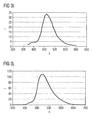
- the FIGS. 3a, b . c and d show photoluminescence spectra of this compound in various dilutions. With increasing dilution, the emission maximum shifts from about 398 nm to 345 nm.
- Compound 5 shows a mononuclear metal complex compound in which the central atom with the ligands forms five-membered metallacyclic rings.
- FIG. 3e the photoluminescence spectrum of compound 6 is shown, with an emission maximum at 488 nm and 522 nm.
- FIG. 3f the photoluminescence spectrum of compound 7 is shown, with an emission maximum at 470 nm and 501 nm.
- FIG. 3g the photoluminescence spectrum of compound 8 is shown, with an emission maximum at 498 nm and 531 nm.
- FIG. 3h the photoluminescence spectrum of compound 9 is shown with an emission maximum at 473 nm and 501 nm.
- FIG. 3i the photoluminescence spectrum of compound 10 is shown with an emission maximum at 463 nm.
- FIG. 3j the photoluminescence spectrum of compound 11 is shown, with an emission maximum at 524 nm.
- metal complex compounds according to formula 28 can furthermore be prepared.
- trisdipyridylimine iridium-III (Formula 29).
- This can be prepared, for example, as follows: Dipyridylamine and iridium acetylacetonate are introduced in stoichiometric ratio in glycol and heated under inert fumigation for 12 h at reflux. Subsequently, the reaction mixture is mixed with water and the Ir derivative extracted by means of chloroform. The chloroform phase is concentrated and then the product is precipitated by the addition of methanol.
- FIG. 4a shows the absorption spectrum (absorption A versus wavelength ⁇ in nm) of tris-dipyridyliminiridium-III. To recognize is a double peak around 300nm.
- FIG. 4b shows the PL emission spectrum (intensity I versus wavelength ⁇ in nm) of the tris-dipyridylimine-iridium-III complex. To recognize is a single peak at about 430nm.
- a metal complex compound is tris-di-1,2,4-benzotriazin-3-yl-methine-iridium-III (Formula 30), which can be prepared as follows: dibenzo-1,2,4-triazine-3 -yl-methane and Iridiumacetylacetonat be submitted in stoichiometric ratio in glycol and heated under inert fumigation for 15h at reflux. Subsequently, the reaction mixture is mixed with water and the Ir derivative extracted by means of chloroform. The chloroform phase is concentrated and then the product is precipitated by the addition of methanol.
- FIG. 5a shows the absorption spectrum (absorption A versus wavelength ⁇ in nm) of tris-di-1,2,4-benzotriazin-3-yl-methy-iridium-III. Evident is a peak at about 280 nm.
- FIG. 5b Finally, a PL emission spectrum (intensity I versus wavelength ⁇ in nm) of the tris-di-1,2,4-benzotriazin-3-yl-methine-iridium-III complex shows a peak at about 420 nm.
- FIGS. 1 to 5 shown embodiments and the embodiments can be varied as desired. It should also be noted that the invention is not limited to the examples, but allows other embodiments not listed here.
Landscapes
- Chemical & Material Sciences (AREA)
- Organic Chemistry (AREA)
- Engineering & Computer Science (AREA)
- Materials Engineering (AREA)
- Crystallography & Structural Chemistry (AREA)
- Inorganic Chemistry (AREA)
- Electroluminescent Light Sources (AREA)
- Plural Heterocyclic Compounds (AREA)
- Nitrogen Condensed Heterocyclic Rings (AREA)
- Pyridine Compounds (AREA)
Claims (9)
- Composé de complexe métallique phosphorescent, qui comprend au moins un atome métallique central M et au moins un ligand bidenté coordonné par l'atome métallique central M,- l'un atome métallique central M et le ligand bidenté formant un cycle métallacyclique à six éléments,- le ligand bidenté qui forme un cycle métallacyclique à six éléments avec l'atome métallique central comprenant à l'état non coordonné une unité tautomérisable, et- l'atome métallique central M étant choisi dans un groupe qui comprend Ir, Pt, Au, Re, Rh, Ru, Os, Pd, Ag, Zn, Al et les lanthanides,dans laquelle :
le composé présentant la formule structurale n = 1 à 3,Y = C-H, N, P, As, Sb, C-Ry, Si-Ry, Ge-Ry,X = N, O, P, As, Sb,Z = C, Si, Ge,X5, X6, X7 et X8 représentent, indépendamment les uns des autres, C-R ou, lorsque R15, R6, R7 ou R8 comprennent une paire d'électrons libres, N,
R, R1, R2, R3, Ry, R15 R6, R7 et R8 représentent, indépendamment les uns des autres, H, des radicaux alkyle non ramifiés, des radicaux alkyle ramifiés, des radicaux alkyle condensés, des radicaux alkyle cycliques, des radicaux alkyle non ramifiés substitués en totalité ou en partie, des radicaux alkyle ramifiés substitués en totalité ou en partie, des radicaux alkyle condensés substitués en totalité ou en partie, des radicaux alkyle cycliques substitués en totalité ou en partie,
des groupes alcoxy, des amines, des amides, des esters, des carbonates, des groupes aromatiques, des groupes aromatiques substitués en totalité ou en partie, des groupes aromatiques condensés, des groupes aromatiques condensés substitués en totalité ou en partie, des hétérocycles, des hétérocycles substitués en totalité ou en partie, des hétérocycles condensés, F et CN. - Composé selon la revendication précédente, dans lequel le ligand est un ligand carbène.
- Composé selon la revendication précédente, dans lequel au moins un parmi R1 et R2, R2 et R3, R15 et R6, R6 et R7, R7 et R8, R8 et Ry ou Ry et R3 sont pontés l'un avec l'autre.
- Composé selon la revendication 1, dans lequel l'unité tautomérisable comprend une unité structurale choisie parmi - C(H,R)- ou -N(H)-, et relie un groupe aromatique pauvre en électrons et un groupe aromatique riche en électrons.
- Composé selon la revendication précédente, qui est polynucléaire et comprend au moins deux atomes métalliques centraux M.
- Composé selon la revendication précédente, dans lequel les au moins deux atomes métalliques centraux M sont reliés l'un avec l'autre par une interaction métal-métal.
- Composé selon l'une des revendications 5 ou 6, dans lequel les au moins deux atomes métalliques centraux M sont reliés par au moins un ligand de pontage additionnel.
- Composant émettant un rayonnement, comprenant :- un substrat,- une première couche d'électrode sur le substrat,- au moins une couche émettrice organique sur la première couche d'électrode et- une seconde couche d'électrode sur la couche émettrice organique,
la couche émettrice organique comprenant un composé de complexe métallique phosphorescent, le composé de complexe métallique phosphorescent comprenant au moins un atome métallique central M et au moins un ligand bidenté coordonné par l'atome métallique central M,- l'un atome métallique central M et le ligand bidenté formant un cycle métallacyclique à six éléments,- le ligand bidenté qui forme un cycle métallacyclique à six éléments avec l'atome métallique central comprenant à l'état non coordonné une unité tautomérisable, et- l'atome métallique central M étant choisi dans un groupe qui comprend Ir, Pt, Au, Re, Rh, Ru, Os, Pd, Ag, Zn, Al et les lanthanides,dans laquelle :
le composé présentant la formule structurale n = 1 à 3,Y = C-H, N, P, As, Sb, C-Ry, Si-Ry, Ge-Ry,X = N, O, P, As, Sb,Z = C, Si, Ge,R1, R2, R3, Ry, R4 et R5 représentent, indépendamment les uns des autres, H, des radicaux alkyle non ramifiés, des radicaux alkyle ramifiés, des radicaux alkyle condensés, des radicaux alkyle cycliques, des radicaux alkyle non ramifiés substitués en totalité ou en partie, des radicaux alkyle ramifiés substitués en totalité ou en partie, des radicaux alkyle condensés substitués en totalité ou en partie, des radicaux alkyle cycliques substitués en totalité ou en partie, des groupes alcoxy, des amines, des amides, des esters, des carbonates, des groupes aromatiques, des groupes aromatiques substitués en totalité ou en partie, des groupes aromatiques condensés, des groupes aromatiques condensés substitués en totalité ou en partie, des hétérocycles, des hétérocycles substitués en totalité ou en partie, des hétérocycles condensés, F et CN.
 - Procédé de fabrication d'un composé de complexe métallique phosphorescent selon les revendications 1 à 7, comprenant les étapes de procédé suivantes :A) la préparation d'un composé d'atome central d'un atome métallique central, qui comprend un ligand d'échange coordonné à l'atome central,B) le mélange du composé d'atome central et d'un ligand dissous dans un premier solvant en un rapport stoechiométrique pour former le composé de complexe métallique,le ligand d'échange étant remplacé par le ligand et le ligand comprenant une unité tautomérisable et formant avec l'atome central un cycle métallacyclique à six éléments par clivage d'un proton.
Applications Claiming Priority (7)
| Application Number | Priority Date | Filing Date | Title |
|---|---|---|---|
| DE102007023554 | 2007-05-21 | ||
| DE102007023749A DE102007023749B8 (de) | 2007-05-22 | 2007-05-22 | Organisches selbst emittierendes elektronisches Bauelement |
| DE102008004471 | 2008-01-15 | ||
| DE102008006113 | 2008-01-25 | ||
| DE102008006573 | 2008-01-29 | ||
| DE102008015940 | 2008-03-27 | ||
| EP08758108A EP2167608B1 (fr) | 2007-05-21 | 2008-05-20 | Complexe métallique phosphorescent, composant émettant un rayonnement et présentant un complexe métallique phosphorescent et procédé pour produire un complexe métallique phosphorescent |
Related Parent Applications (3)
| Application Number | Title | Priority Date | Filing Date |
|---|---|---|---|
| EP08758108A Division EP2167608B1 (fr) | 2007-05-21 | 2008-05-20 | Complexe métallique phosphorescent, composant émettant un rayonnement et présentant un complexe métallique phosphorescent et procédé pour produire un complexe métallique phosphorescent |
| EP08758108A Division-Into EP2167608B1 (fr) | 2007-05-21 | 2008-05-20 | Complexe métallique phosphorescent, composant émettant un rayonnement et présentant un complexe métallique phosphorescent et procédé pour produire un complexe métallique phosphorescent |
| EP08758108.8 Division | 2008-05-20 |
Publications (3)
| Publication Number | Publication Date |
|---|---|
| EP2500398A2 EP2500398A2 (fr) | 2012-09-19 |
| EP2500398A3 EP2500398A3 (fr) | 2012-10-03 |
| EP2500398B1 true EP2500398B1 (fr) | 2014-08-20 |
Family
ID=39735246
Family Applications (2)
| Application Number | Title | Priority Date | Filing Date |
|---|---|---|---|
| EP12171044.6A Not-in-force EP2500398B1 (fr) | 2007-05-21 | 2008-05-20 | Connexion à complexe métallique phosphorescente, composant émettant un rayonnement présentant une connexion à complexe métallique phosphorescente et procédé de fabrication d'une connexion à complexe métallique phosphorescente |
| EP08758108A Not-in-force EP2167608B1 (fr) | 2007-05-21 | 2008-05-20 | Complexe métallique phosphorescent, composant émettant un rayonnement et présentant un complexe métallique phosphorescent et procédé pour produire un complexe métallique phosphorescent |
Family Applications After (1)
| Application Number | Title | Priority Date | Filing Date |
|---|---|---|---|
| EP08758108A Not-in-force EP2167608B1 (fr) | 2007-05-21 | 2008-05-20 | Complexe métallique phosphorescent, composant émettant un rayonnement et présentant un complexe métallique phosphorescent et procédé pour produire un complexe métallique phosphorescent |
Country Status (7)
| Country | Link |
|---|---|
| US (2) | US8734962B2 (fr) |
| EP (2) | EP2500398B1 (fr) |
| JP (2) | JP5546450B2 (fr) |
| KR (2) | KR20100017887A (fr) |
| CN (2) | CN101903492B (fr) |
| TW (1) | TWI378985B (fr) |
| WO (1) | WO2008141637A2 (fr) |
Families Citing this family (25)
| Publication number | Priority date | Publication date | Assignee | Title |
|---|---|---|---|---|
| CN102317405A (zh) * | 2008-07-16 | 2012-01-11 | 索尔维公司 | 包括多核络合物的发光材料 |
| CN102227438B (zh) | 2008-11-28 | 2014-06-25 | 独立行政法人理化学研究所 | 新型的化合物及其利用 |
| DE102009031683A1 (de) * | 2009-07-03 | 2011-03-24 | Siemens Aktiengesellschaft | Phophoreszente Metallkomplexverbindung, Verfahren zur Herstellung dazu und strahlungsemittierendes Bauelement |
| US9108998B2 (en) | 2009-10-14 | 2015-08-18 | Basf Se | Dinuclear platinum-carbene complexes and the use thereof in OLEDs |
| DE102010005634A1 (de) * | 2010-01-25 | 2011-07-28 | Siemens Aktiengesellschaft, 80333 | Neuartige Verwendung des Guanidinium-Kations und lichtemittierendes Bauelement |
| WO2012116231A2 (fr) * | 2011-02-23 | 2012-08-30 | Universal Display Corporation | Nouveaux complexes de platine tétradentelés |
| DE102014114224A1 (de) * | 2014-09-30 | 2016-03-31 | Osram Oled Gmbh | Organisches elektronisches Bauteil, Verwendung eines Zinkkomplexes als p-Dotierungsmittel für organische elektronische Matrixmaterialien |
| WO2016079169A1 (fr) * | 2014-11-18 | 2016-05-26 | Basf Se | Complexes de pt-carbène ou de pd-carbène destinés à être utilisés dans des diodes électroluminescentes organiques |
| US9741956B2 (en) | 2014-11-25 | 2017-08-22 | Industrial Technology Research Institute | Organic light-emitting diode apparatus |
| TWI637654B (zh) * | 2014-11-25 | 2018-10-01 | 財團法人工業技術研究院 | 有機發光二極體照明模組與裝置 |
| US10636978B2 (en) * | 2014-12-30 | 2020-04-28 | Universal Display Corporation | Organic electroluminescent materials and devices |
| US10818853B2 (en) * | 2015-06-04 | 2020-10-27 | University Of Southern California | Organic electroluminescent materials and devices |
| DE102015116389A1 (de) * | 2015-09-28 | 2017-03-30 | Osram Oled Gmbh | Organisches elektronisches Bauteil mit Ladungsträgergenerationsschicht und Verwendung eines Zinkkomplexes als p-Dotierstoff in Ladungsträgergenerationsschichten |
| US10876047B2 (en) * | 2015-12-16 | 2020-12-29 | R-Display & Lighting LLC | Phosphorescent emitting compositions |
| US12389791B2 (en) | 2017-09-21 | 2025-08-12 | Universal Display Corporation | Organic electroluminescent materials and devices |
| KR102670223B1 (ko) * | 2017-09-21 | 2024-05-28 | 유니버셜 디스플레이 코포레이션 | 유기 전계발광 재료 및 디바이스 |
| US10586935B2 (en) | 2017-12-04 | 2020-03-10 | R-Display & Lighting, Llc | Bridged bis(azinyl)amine phosphorescent emitting compositions |
| US12144244B2 (en) * | 2019-09-10 | 2024-11-12 | Universal Display Corporation | Organic electroluminescent materials and devices |
| US11932660B2 (en) | 2020-01-29 | 2024-03-19 | Universal Display Corporation | Organic electroluminescent materials and devices |
| CN111675718B (zh) * | 2020-06-16 | 2021-12-21 | 武汉天马微电子有限公司 | 一种化合物及包含其的有机发光器件、显示面板和显示装置 |
| JP2024507253A (ja) | 2021-02-19 | 2024-02-16 | スドー バイオサイエンシーズ リミテッド | Tyk2阻害剤およびその使用 |
| CA3207819A1 (fr) | 2021-02-19 | 2022-08-25 | Anjali Pandey | Inhibiteurs de tyk2 et leurs utilisations |
| JP2024508794A (ja) | 2021-02-19 | 2024-02-28 | スドー バイオサイエンシーズ リミテッド | Tyk2阻害剤およびその使用 |
| CN113105509B (zh) * | 2021-04-02 | 2022-06-21 | 西安交通大学 | 基于缺电子功能基团的配合物磷光材料 |
| CN118878589B (zh) * | 2024-07-12 | 2025-09-05 | 广西民族大学 | 一种异核双金属Pd-Pt二聚物及其制备方法和应用、有机发光二极管 |
Family Cites Families (37)
| Publication number | Priority date | Publication date | Assignee | Title |
|---|---|---|---|---|
| US227979A (en) * | 1880-05-25 | Said jenkins assig-nob to said kiddee | ||
| GB8509531D0 (en) | 1985-04-13 | 1985-05-15 | Bp Chem Int Ltd | Preparation of guanidines |
| JP3808175B2 (ja) | 1996-06-28 | 2006-08-09 | 三井化学株式会社 | キノリン誘導体とその用途 |
| US6407242B1 (en) * | 1996-06-28 | 2002-06-18 | Mitsui Chemicals, Inc. | Quinoline derivative and use of same |
| JPH11116569A (ja) | 1997-10-09 | 1999-04-27 | Mitsui Chem Inc | キノリン誘導体の製造方法 |
| JPH11158185A (ja) | 1997-12-01 | 1999-06-15 | Mitsui Chem Inc | キノリン誘導体の製造方法 |
| JP3835783B2 (ja) * | 1998-06-18 | 2006-10-18 | 富士写真フイルム株式会社 | 有機エレクトロルミネツセンス素子材料およびそれを使用した有機エレクトロルミネツセンス素子 |
| US6830828B2 (en) | 1998-09-14 | 2004-12-14 | The Trustees Of Princeton University | Organometallic complexes as phosphorescent emitters in organic LEDs |
| JP2000229966A (ja) | 1999-02-09 | 2000-08-22 | Fuji Photo Film Co Ltd | アゾール誘導体とその用途 |
| US7001536B2 (en) | 1999-03-23 | 2006-02-21 | The Trustees Of Princeton University | Organometallic complexes as phosphorescent emitters in organic LEDs |
| US6420057B1 (en) | 1999-07-05 | 2002-07-16 | Konica Corporation | Organic electroluminescent element |
| JP4310077B2 (ja) * | 2001-06-19 | 2009-08-05 | キヤノン株式会社 | 金属配位化合物及び有機発光素子 |
| EP1394171A1 (fr) * | 2002-08-09 | 2004-03-03 | Bayer Aktiengesellschaft | Complexes métalliques multi-nucléaires en tant qu'emetteur de phosphorescence dans un ensemble de couches electroluminescentes |
| JP3963811B2 (ja) * | 2002-09-30 | 2007-08-22 | 富士フイルム株式会社 | 有機電界発光素子 |
| DE10338550A1 (de) | 2003-08-19 | 2005-03-31 | Basf Ag | Übergangsmetallkomplexe mit Carbenliganden als Emitter für organische Licht-emittierende Dioden (OLEDs) |
| CN1878851A (zh) * | 2003-11-13 | 2006-12-13 | 皇家飞利浦电子股份有限公司 | 来自双核、三核、寡核、和/或多核金属配合物的电致发光化合物 |
| DE10358665A1 (de) | 2003-12-12 | 2005-07-07 | Basf Ag | Verwendung von Platin(II)-Komplexen als lumineszierende Materialien in organischen Licht-emittierenden Dioden (OLEDs) |
| KR100773524B1 (ko) * | 2003-12-24 | 2007-11-07 | 삼성에스디아이 주식회사 | 이핵 유기 금속 착물 및 이를 이용한 유기 전계 발광 소자 |
| DE102004010954A1 (de) | 2004-03-03 | 2005-10-06 | Novaled Gmbh | Verwendung eines Metallkomplexes als n-Dotand für ein organisches halbleitendes Matrixmaterial, organisches Halbleitermaterial und elektronisches Bauteil |
| JP4595116B2 (ja) * | 2004-03-17 | 2010-12-08 | 独立行政法人産業技術総合研究所 | イリジウム錯体およびこれを用いた発光材料 |
| WO2005097942A1 (fr) | 2004-03-31 | 2005-10-20 | Konica Minolta Holdings, Inc. | Matériau de dispositif électroluminescent organique, dispositif électroluminescent organique, écran et dispositif d'éclairage |
| JP5045100B2 (ja) | 2004-03-31 | 2012-10-10 | コニカミノルタホールディングス株式会社 | 有機エレクトロルミネッセンス素子材料及び有機エレクトロルミネッセンス素子 |
| US7582365B2 (en) * | 2005-01-10 | 2009-09-01 | Universal Display Corporation | Reversibly reducible metal complexes as electron transporting materials for OLEDs |
| WO2005113704A2 (fr) * | 2004-05-18 | 2005-12-01 | The University Of Southern California | Composes luminescents a ligands carbene |
| WO2006008976A1 (fr) | 2004-07-16 | 2006-01-26 | Konica Minolta Holdings, Inc. | Élément organique électroluminescent émetteur de lumière blanche, appareil d'affichage et appareil d'éclairage |
| EP1786242B1 (fr) | 2004-08-05 | 2014-08-27 | Konica Minolta Holdings, Inc. | Dispositif électroluminescent organique, appareil d'affichage et appareil d'éclairage |
| JP2006140182A (ja) | 2004-11-10 | 2006-06-01 | Fuji Photo Film Co Ltd | 有機電界発光素子 |
| US7754346B2 (en) * | 2004-11-10 | 2010-07-13 | Fujifilm Corporation | Organic electroluminescent device |
| JP2006228936A (ja) * | 2005-02-17 | 2006-08-31 | Fuji Photo Film Co Ltd | 有機電界発光素子 |
| JP5125502B2 (ja) | 2005-03-16 | 2013-01-23 | コニカミノルタホールディングス株式会社 | 有機エレクトロルミネッセンス素子材料、有機エレクトロルミネッセンス素子 |
| TWI282250B (en) | 2005-04-21 | 2007-06-01 | Au Optronics Corp | Light emission material and organic electroluminescent device using the same |
| US7507486B2 (en) | 2005-08-31 | 2009-03-24 | Eastman Kodak Company | Organic phosphorescent light emitting device |
| JP2007084635A (ja) * | 2005-09-21 | 2007-04-05 | Konica Minolta Holdings Inc | 有機エレクトロルミネッセンス素子用材料、有機エレクトロルミネッセンス素子、表示装置及び照明装置 |
| EP1804309B1 (fr) | 2005-12-23 | 2008-07-23 | Novaled AG | Dispositif électronique avec une structure en couches de nature organique |
| WO2007071450A1 (fr) | 2005-12-23 | 2007-06-28 | Novaled Ag | Dispositif electronique a structure en couche faite de couches organiques |
| US7598381B2 (en) * | 2006-09-11 | 2009-10-06 | The Trustees Of Princeton University | Near-infrared emitting organic compounds and organic devices using the same |
| DE102007012794B3 (de) | 2007-03-16 | 2008-06-19 | Novaled Ag | Pyrido[3,2-h]chinazoline und/oder deren 5,6-Dihydroderivate, deren Herstellungsverfahren und diese enthaltendes dotiertes organisches Halbleitermaterial |
-
2008
- 2008-05-20 KR KR1020097026628A patent/KR20100017887A/ko not_active Abandoned
- 2008-05-20 CN CN200880025525.3A patent/CN101903492B/zh not_active Expired - Fee Related
- 2008-05-20 US US12/601,520 patent/US8734962B2/en active Active
- 2008-05-20 JP JP2010508700A patent/JP5546450B2/ja not_active Expired - Fee Related
- 2008-05-20 EP EP12171044.6A patent/EP2500398B1/fr not_active Not-in-force
- 2008-05-20 WO PCT/DE2008/000868 patent/WO2008141637A2/fr not_active Ceased
- 2008-05-20 EP EP08758108A patent/EP2167608B1/fr not_active Not-in-force
- 2008-05-20 KR KR1020167033633A patent/KR20160145194A/ko not_active Ceased
- 2008-05-20 CN CN201410389275.9A patent/CN104250269B/zh not_active Expired - Fee Related
- 2008-05-21 TW TW097118642A patent/TWI378985B/zh not_active IP Right Cessation
-
2014
- 2014-03-14 US US14/211,190 patent/US9966544B2/en active Active
- 2014-03-17 JP JP2014053623A patent/JP2014156466A/ja active Pending
Also Published As
| Publication number | Publication date |
|---|---|
| TW200904945A (en) | 2009-02-01 |
| US20140210339A1 (en) | 2014-07-31 |
| TWI378985B (en) | 2012-12-11 |
| KR20100017887A (ko) | 2010-02-16 |
| CN101903492A (zh) | 2010-12-01 |
| EP2500398A3 (fr) | 2012-10-03 |
| JP2010527944A (ja) | 2010-08-19 |
| CN104250269A (zh) | 2014-12-31 |
| US8734962B2 (en) | 2014-05-27 |
| CN104250269B (zh) | 2018-01-05 |
| EP2500398A2 (fr) | 2012-09-19 |
| US20100213824A1 (en) | 2010-08-26 |
| JP2014156466A (ja) | 2014-08-28 |
| CN101903492B (zh) | 2014-09-03 |
| KR20160145194A (ko) | 2016-12-19 |
| WO2008141637A2 (fr) | 2008-11-27 |
| JP5546450B2 (ja) | 2014-07-09 |
| US9966544B2 (en) | 2018-05-08 |
| WO2008141637A3 (fr) | 2009-04-16 |
| EP2167608B1 (fr) | 2012-10-03 |
| EP2167608A2 (fr) | 2010-03-31 |
Similar Documents
| Publication | Publication Date | Title |
|---|---|---|
| EP2167608B1 (fr) | Complexe métallique phosphorescent, composant émettant un rayonnement et présentant un complexe métallique phosphorescent et procédé pour produire un complexe métallique phosphorescent | |
| EP2205615B1 (fr) | Complexes de métaux de transition à ligands carbéniques pontés et leur utilisation dans des oled | |
| DE112011101663B4 (de) | Azaborinverbindungen als Hostmaterialien und Dotiermittel für Pholeds | |
| DE102020205833B4 (de) | Organisches lumineszierendes Material, das einen 3-Deuterium-substituierten Isochinolinliganden beinhaltet | |
| EP2134807B1 (fr) | Triphénylène complexes d'iridium et leur utilisation dans des oleds | |
| EP2203461B1 (fr) | Complexes de métaux de transition avec des ligands carbène pontés, et leur utilisation dans des diodes électroluminescentes organiques (oled) | |
| EP1678190B1 (fr) | Complexes metalliques a ligands bipodes | |
| EP3216797B1 (fr) | Complexe de carbène/platine dinucléaire et son utilisation dans des delo | |
| EP1819717B1 (fr) | Utilisation de complexes metal de transition- carbene dans des diodes electroluminescentes organiques (del organiques) | |
| EP2307430B1 (fr) | Composé complexe métallique phosphorescent, procédé de fabrication associé et composant émetteur de rayonnement | |
| EP2718394B1 (fr) | Composé complexe métallique phosphorescent, procédé de fabrication associé et composant émetteur de rayonnement | |
| DE102007031261A1 (de) | Lumineszierende Metallkomplexe mit sperrigen Hilfsliganden | |
| EP2935292A1 (fr) | Complexes métalliques | |
| WO2014094960A1 (fr) | Complexes métalliques | |
| DE112011101983T5 (de) | OLED mit verzögerter Fluoreszenz | |
| WO2005086251A2 (fr) | Utilisation d'un complexe metallique comme dopant n d'un materiau matrice semi-conducteur organique et composant electronique, ainsi que dopant et ligand, et son procede de production | |
| DE102013019465A1 (de) | Organische elektrolumineszenzvorrichtung mit verzögerter fluoreszenz | |
| EP2190945B1 (fr) | Composant organique à émission de rayonnement | |
| Seth et al. | Cyclometalated mono and dinuclear rhodium (III) and iridium (III) complexes with imidazolyl phenanthrolines: Synthesis and, photophysical and electrochemical characterization | |
| EP3132475B1 (fr) | Complexes métalliques comme matériaux émetteurs | |
| DE102013200085B4 (de) | Hocheffiziente phosphoreszierende Materialien | |
| WO2014108430A1 (fr) | Fluorescence activée thermiquement et capture de singulets avec des complexes métalliques rigides pour des dispositifs optoélectroniques | |
| DE102012108129A1 (de) | Neue Platin(II)komplexe als Triplett-Emitter für OLED Anwendungen |
Legal Events
| Date | Code | Title | Description |
|---|---|---|---|
| PUAL | Search report despatched |
Free format text: ORIGINAL CODE: 0009013 |
|
| PUAI | Public reference made under article 153(3) epc to a published international application that has entered the european phase |
Free format text: ORIGINAL CODE: 0009012 |
|
| AC | Divisional application: reference to earlier application |
Ref document number: 2167608 Country of ref document: EP Kind code of ref document: P |
|
| AK | Designated contracting states |
Kind code of ref document: A2 Designated state(s): AT BE BG CH CY CZ DE DK EE ES FI FR GB GR HR HU IE IS IT LI LT LU LV MC MT NL NO PL PT RO SE SI SK TR |
|
| AK | Designated contracting states |
Kind code of ref document: A3 Designated state(s): AT BE BG CH CY CZ DE DK EE ES FI FR GB GR HR HU IE IS IT LI LT LU LV MC MT NL NO PL PT RO SE SI SK TR |
|
| RIC1 | Information provided on ipc code assigned before grant |
Ipc: H01L 51/50 20060101ALN20120827BHEP Ipc: C07F 15/00 20060101ALI20120827BHEP Ipc: C09K 11/06 20060101AFI20120827BHEP Ipc: H01L 51/00 20060101ALI20120827BHEP |
|
| RIN1 | Information on inventor provided before grant (corrected) |
Inventor name: MALTENBERGER, ANNA Inventor name: ADLER, JUERGEN Inventor name: KANITZ, ANDREAS, DR. Inventor name: SCHMID, GUENTER, DR. Inventor name: FREYDENZON, OKSANA |
|
| 17P | Request for examination filed |
Effective date: 20130215 |
|
| 17Q | First examination report despatched |
Effective date: 20130603 |
|
| GRAP | Despatch of communication of intention to grant a patent |
Free format text: ORIGINAL CODE: EPIDOSNIGR1 |
|
| RIC1 | Information provided on ipc code assigned before grant |
Ipc: C09B 57/10 20060101ALI20131120BHEP Ipc: H01L 51/00 20060101ALI20131120BHEP Ipc: C09B 57/00 20060101ALI20131120BHEP Ipc: C07F 15/00 20060101ALI20131120BHEP Ipc: C09B 55/00 20060101ALI20131120BHEP Ipc: C09K 11/06 20060101AFI20131120BHEP Ipc: H01L 51/50 20060101ALN20131120BHEP |
|
| INTG | Intention to grant announced |
Effective date: 20131206 |
|
| GRAP | Despatch of communication of intention to grant a patent |
Free format text: ORIGINAL CODE: EPIDOSNIGR1 |
|
| RIC1 | Information provided on ipc code assigned before grant |
Ipc: C09K 11/06 20060101AFI20140411BHEP Ipc: C09B 55/00 20060101ALI20140411BHEP Ipc: H01L 51/00 20060101ALI20140411BHEP Ipc: C09B 57/00 20060101ALI20140411BHEP Ipc: C09B 57/10 20060101ALI20140411BHEP Ipc: H01L 51/50 20060101ALN20140411BHEP Ipc: C07F 15/00 20060101ALI20140411BHEP |
|
| INTG | Intention to grant announced |
Effective date: 20140508 |
|
| GRAS | Grant fee paid |
Free format text: ORIGINAL CODE: EPIDOSNIGR3 |
|
| GRAA | (expected) grant |
Free format text: ORIGINAL CODE: 0009210 |
|
| AC | Divisional application: reference to earlier application |
Ref document number: 2167608 Country of ref document: EP Kind code of ref document: P |
|
| AK | Designated contracting states |
Kind code of ref document: B1 Designated state(s): AT BE BG CH CY CZ DE DK EE ES FI FR GB GR HR HU IE IS IT LI LT LU LV MC MT NL NO PL PT RO SE SI SK TR |
|
| REG | Reference to a national code |
Ref country code: GB Ref legal event code: FG4D Free format text: NOT ENGLISH |
|
| REG | Reference to a national code |
Ref country code: CH Ref legal event code: EP |
|
| REG | Reference to a national code |
Ref country code: AT Ref legal event code: REF Ref document number: 683486 Country of ref document: AT Kind code of ref document: T Effective date: 20140915 |
|
| REG | Reference to a national code |
Ref country code: IE Ref legal event code: FG4D Free format text: LANGUAGE OF EP DOCUMENT: GERMAN |
|
| REG | Reference to a national code |
Ref country code: DE Ref legal event code: R096 Ref document number: 502008012141 Country of ref document: DE Effective date: 20141002 |
|
| RAP2 | Party data changed (patent owner data changed or rights of a patent transferred) |
Owner name: OSRAM OLED GMBH |
|
| REG | Reference to a national code |
Ref country code: DE Ref legal event code: R081 Ref document number: 502008012141 Country of ref document: DE Owner name: OSRAM OLED GMBH, DE Free format text: FORMER OWNER: OSRAM OPTO SEMICONDUCTORS GMBH, 93055 REGENSBURG, DE Effective date: 20141125 |
|
| REG | Reference to a national code |
Ref country code: NL Ref legal event code: VDEP Effective date: 20140820 |
|
| REG | Reference to a national code |
Ref country code: LT Ref legal event code: MG4D |
|
| PG25 | Lapsed in a contracting state [announced via postgrant information from national office to epo] |
Ref country code: SE Free format text: LAPSE BECAUSE OF FAILURE TO SUBMIT A TRANSLATION OF THE DESCRIPTION OR TO PAY THE FEE WITHIN THE PRESCRIBED TIME-LIMIT Effective date: 20140820 Ref country code: NO Free format text: LAPSE BECAUSE OF FAILURE TO SUBMIT A TRANSLATION OF THE DESCRIPTION OR TO PAY THE FEE WITHIN THE PRESCRIBED TIME-LIMIT Effective date: 20141120 Ref country code: ES Free format text: LAPSE BECAUSE OF FAILURE TO SUBMIT A TRANSLATION OF THE DESCRIPTION OR TO PAY THE FEE WITHIN THE PRESCRIBED TIME-LIMIT Effective date: 20140820 Ref country code: PT Free format text: LAPSE BECAUSE OF FAILURE TO SUBMIT A TRANSLATION OF THE DESCRIPTION OR TO PAY THE FEE WITHIN THE PRESCRIBED TIME-LIMIT Effective date: 20141222 Ref country code: BG Free format text: LAPSE BECAUSE OF FAILURE TO SUBMIT A TRANSLATION OF THE DESCRIPTION OR TO PAY THE FEE WITHIN THE PRESCRIBED TIME-LIMIT Effective date: 20141120 Ref country code: FI Free format text: LAPSE BECAUSE OF FAILURE TO SUBMIT A TRANSLATION OF THE DESCRIPTION OR TO PAY THE FEE WITHIN THE PRESCRIBED TIME-LIMIT Effective date: 20140820 Ref country code: LT Free format text: LAPSE BECAUSE OF FAILURE TO SUBMIT A TRANSLATION OF THE DESCRIPTION OR TO PAY THE FEE WITHIN THE PRESCRIBED TIME-LIMIT Effective date: 20140820 Ref country code: GR Free format text: LAPSE BECAUSE OF FAILURE TO SUBMIT A TRANSLATION OF THE DESCRIPTION OR TO PAY THE FEE WITHIN THE PRESCRIBED TIME-LIMIT Effective date: 20141121 |
|
| PG25 | Lapsed in a contracting state [announced via postgrant information from national office to epo] |
Ref country code: IS Free format text: LAPSE BECAUSE OF FAILURE TO SUBMIT A TRANSLATION OF THE DESCRIPTION OR TO PAY THE FEE WITHIN THE PRESCRIBED TIME-LIMIT Effective date: 20141220 Ref country code: LV Free format text: LAPSE BECAUSE OF FAILURE TO SUBMIT A TRANSLATION OF THE DESCRIPTION OR TO PAY THE FEE WITHIN THE PRESCRIBED TIME-LIMIT Effective date: 20140820 Ref country code: HR Free format text: LAPSE BECAUSE OF FAILURE TO SUBMIT A TRANSLATION OF THE DESCRIPTION OR TO PAY THE FEE WITHIN THE PRESCRIBED TIME-LIMIT Effective date: 20140820 |
|
| PG25 | Lapsed in a contracting state [announced via postgrant information from national office to epo] |
Ref country code: NL Free format text: LAPSE BECAUSE OF FAILURE TO SUBMIT A TRANSLATION OF THE DESCRIPTION OR TO PAY THE FEE WITHIN THE PRESCRIBED TIME-LIMIT Effective date: 20140820 |
|
| PG25 | Lapsed in a contracting state [announced via postgrant information from national office to epo] |
Ref country code: RO Free format text: LAPSE BECAUSE OF FAILURE TO SUBMIT A TRANSLATION OF THE DESCRIPTION OR TO PAY THE FEE WITHIN THE PRESCRIBED TIME-LIMIT Effective date: 20140820 Ref country code: CZ Free format text: LAPSE BECAUSE OF FAILURE TO SUBMIT A TRANSLATION OF THE DESCRIPTION OR TO PAY THE FEE WITHIN THE PRESCRIBED TIME-LIMIT Effective date: 20140820 Ref country code: DK Free format text: LAPSE BECAUSE OF FAILURE TO SUBMIT A TRANSLATION OF THE DESCRIPTION OR TO PAY THE FEE WITHIN THE PRESCRIBED TIME-LIMIT Effective date: 20140820 Ref country code: IT Free format text: LAPSE BECAUSE OF FAILURE TO SUBMIT A TRANSLATION OF THE DESCRIPTION OR TO PAY THE FEE WITHIN THE PRESCRIBED TIME-LIMIT Effective date: 20140820 Ref country code: EE Free format text: LAPSE BECAUSE OF FAILURE TO SUBMIT A TRANSLATION OF THE DESCRIPTION OR TO PAY THE FEE WITHIN THE PRESCRIBED TIME-LIMIT Effective date: 20140820 Ref country code: SK Free format text: LAPSE BECAUSE OF FAILURE TO SUBMIT A TRANSLATION OF THE DESCRIPTION OR TO PAY THE FEE WITHIN THE PRESCRIBED TIME-LIMIT Effective date: 20140820 |
|
| REG | Reference to a national code |
Ref country code: DE Ref legal event code: R097 Ref document number: 502008012141 Country of ref document: DE Ref country code: FR Ref legal event code: PLFP Year of fee payment: 8 |
|
| PG25 | Lapsed in a contracting state [announced via postgrant information from national office to epo] |
Ref country code: PL Free format text: LAPSE BECAUSE OF FAILURE TO SUBMIT A TRANSLATION OF THE DESCRIPTION OR TO PAY THE FEE WITHIN THE PRESCRIBED TIME-LIMIT Effective date: 20140820 |
|
| PLBE | No opposition filed within time limit |
Free format text: ORIGINAL CODE: 0009261 |
|
| STAA | Information on the status of an ep patent application or granted ep patent |
Free format text: STATUS: NO OPPOSITION FILED WITHIN TIME LIMIT |
|
| 26N | No opposition filed |
Effective date: 20150521 |
|
| PG25 | Lapsed in a contracting state [announced via postgrant information from national office to epo] |
Ref country code: SI Free format text: LAPSE BECAUSE OF FAILURE TO SUBMIT A TRANSLATION OF THE DESCRIPTION OR TO PAY THE FEE WITHIN THE PRESCRIBED TIME-LIMIT Effective date: 20140820 |
|
| REG | Reference to a national code |
Ref country code: CH Ref legal event code: PL |
|
| PG25 | Lapsed in a contracting state [announced via postgrant information from national office to epo] |
Ref country code: LI Free format text: LAPSE BECAUSE OF NON-PAYMENT OF DUE FEES Effective date: 20150531 Ref country code: CH Free format text: LAPSE BECAUSE OF NON-PAYMENT OF DUE FEES Effective date: 20150531 Ref country code: MC Free format text: LAPSE BECAUSE OF FAILURE TO SUBMIT A TRANSLATION OF THE DESCRIPTION OR TO PAY THE FEE WITHIN THE PRESCRIBED TIME-LIMIT Effective date: 20140820 Ref country code: LU Free format text: LAPSE BECAUSE OF FAILURE TO SUBMIT A TRANSLATION OF THE DESCRIPTION OR TO PAY THE FEE WITHIN THE PRESCRIBED TIME-LIMIT Effective date: 20150520 |
|
| REG | Reference to a national code |
Ref country code: IE Ref legal event code: MM4A |
|
| PG25 | Lapsed in a contracting state [announced via postgrant information from national office to epo] |
Ref country code: IE Free format text: LAPSE BECAUSE OF NON-PAYMENT OF DUE FEES Effective date: 20150520 |
|
| REG | Reference to a national code |
Ref country code: FR Ref legal event code: PLFP Year of fee payment: 9 |
|
| REG | Reference to a national code |
Ref country code: AT Ref legal event code: MM01 Ref document number: 683486 Country of ref document: AT Kind code of ref document: T Effective date: 20150520 |
|
| PG25 | Lapsed in a contracting state [announced via postgrant information from national office to epo] |
Ref country code: AT Free format text: LAPSE BECAUSE OF NON-PAYMENT OF DUE FEES Effective date: 20150520 |
|
| PG25 | Lapsed in a contracting state [announced via postgrant information from national office to epo] |
Ref country code: MT Free format text: LAPSE BECAUSE OF FAILURE TO SUBMIT A TRANSLATION OF THE DESCRIPTION OR TO PAY THE FEE WITHIN THE PRESCRIBED TIME-LIMIT Effective date: 20140820 |
|
| REG | Reference to a national code |
Ref country code: GB Ref legal event code: 732E Free format text: REGISTERED BETWEEN 20170105 AND 20170111 |
|
| REG | Reference to a national code |
Ref country code: FR Ref legal event code: PLFP Year of fee payment: 10 |
|
| PG25 | Lapsed in a contracting state [announced via postgrant information from national office to epo] |
Ref country code: HU Free format text: LAPSE BECAUSE OF FAILURE TO SUBMIT A TRANSLATION OF THE DESCRIPTION OR TO PAY THE FEE WITHIN THE PRESCRIBED TIME-LIMIT; INVALID AB INITIO Effective date: 20080520 |
|
| PG25 | Lapsed in a contracting state [announced via postgrant information from national office to epo] |
Ref country code: CY Free format text: LAPSE BECAUSE OF FAILURE TO SUBMIT A TRANSLATION OF THE DESCRIPTION OR TO PAY THE FEE WITHIN THE PRESCRIBED TIME-LIMIT Effective date: 20140820 |
|
| PG25 | Lapsed in a contracting state [announced via postgrant information from national office to epo] |
Ref country code: BE Free format text: LAPSE BECAUSE OF NON-PAYMENT OF DUE FEES Effective date: 20150531 |
|
| PGFP | Annual fee paid to national office [announced via postgrant information from national office to epo] |
Ref country code: GB Payment date: 20170519 Year of fee payment: 10 Ref country code: FR Payment date: 20170523 Year of fee payment: 10 |
|
| PG25 | Lapsed in a contracting state [announced via postgrant information from national office to epo] |
Ref country code: TR Free format text: LAPSE BECAUSE OF FAILURE TO SUBMIT A TRANSLATION OF THE DESCRIPTION OR TO PAY THE FEE WITHIN THE PRESCRIBED TIME-LIMIT Effective date: 20140820 |
|
| GBPC | Gb: european patent ceased through non-payment of renewal fee |
Effective date: 20180520 |
|
| PG25 | Lapsed in a contracting state [announced via postgrant information from national office to epo] |
Ref country code: GB Free format text: LAPSE BECAUSE OF NON-PAYMENT OF DUE FEES Effective date: 20180520 Ref country code: FR Free format text: LAPSE BECAUSE OF NON-PAYMENT OF DUE FEES Effective date: 20180531 |
|
| PGFP | Annual fee paid to national office [announced via postgrant information from national office to epo] |
Ref country code: DE Payment date: 20220524 Year of fee payment: 15 |
|
| REG | Reference to a national code |
Ref country code: DE Ref legal event code: R119 Ref document number: 502008012141 Country of ref document: DE |
|
| PG25 | Lapsed in a contracting state [announced via postgrant information from national office to epo] |
Ref country code: DE Free format text: LAPSE BECAUSE OF NON-PAYMENT OF DUE FEES Effective date: 20231201 |