EP2500788A1 - Procédé de traitement d'alertes dans un réseau de communication d'une installation d'automatisation industrielle - Google Patents
Procédé de traitement d'alertes dans un réseau de communication d'une installation d'automatisation industrielle Download PDFInfo
- Publication number
- EP2500788A1 EP2500788A1 EP11158177A EP11158177A EP2500788A1 EP 2500788 A1 EP2500788 A1 EP 2500788A1 EP 11158177 A EP11158177 A EP 11158177A EP 11158177 A EP11158177 A EP 11158177A EP 2500788 A1 EP2500788 A1 EP 2500788A1
- Authority
- EP
- European Patent Office
- Prior art keywords
- communication network
- network
- protocol
- alarm
- alarms
- Prior art date
- Legal status (The legal status is an assumption and is not a legal conclusion. Google has not performed a legal analysis and makes no representation as to the accuracy of the status listed.)
- Withdrawn
Links
Images
Classifications
-
- G—PHYSICS
- G05—CONTROLLING; REGULATING
- G05B—CONTROL OR REGULATING SYSTEMS IN GENERAL; FUNCTIONAL ELEMENTS OF SUCH SYSTEMS; MONITORING OR TESTING ARRANGEMENTS FOR SUCH SYSTEMS OR ELEMENTS
- G05B19/00—Program-control systems
- G05B19/02—Program-control systems electric
- G05B19/04—Program control other than numerical control, i.e. in sequence controllers or logic controllers
- G05B19/042—Program control other than numerical control, i.e. in sequence controllers or logic controllers using digital processors
- G05B19/0428—Safety, monitoring
-
- H—ELECTRICITY
- H04—ELECTRIC COMMUNICATION TECHNIQUE
- H04L—TRANSMISSION OF DIGITAL INFORMATION, e.g. TELEGRAPHIC COMMUNICATION
- H04L41/00—Arrangements for maintenance, administration or management of data switching networks, e.g. of packet switching networks
- H04L41/02—Standardisation; Integration
- H04L41/0226—Mapping or translating multiple network management protocols
-
- H—ELECTRICITY
- H04—ELECTRIC COMMUNICATION TECHNIQUE
- H04L—TRANSMISSION OF DIGITAL INFORMATION, e.g. TELEGRAPHIC COMMUNICATION
- H04L41/00—Arrangements for maintenance, administration or management of data switching networks, e.g. of packet switching networks
- H04L41/06—Management of faults, events, alarms or notifications
-
- H—ELECTRICITY
- H04—ELECTRIC COMMUNICATION TECHNIQUE
- H04L—TRANSMISSION OF DIGITAL INFORMATION, e.g. TELEGRAPHIC COMMUNICATION
- H04L67/00—Network arrangements or protocols for supporting network services or applications
- H04L67/01—Protocols
- H04L67/12—Protocols specially adapted for proprietary or special-purpose networking environments, e.g. medical networks, sensor networks, networks in vehicles or remote metering networks
-
- H—ELECTRICITY
- H04—ELECTRIC COMMUNICATION TECHNIQUE
- H04L—TRANSMISSION OF DIGITAL INFORMATION, e.g. TELEGRAPHIC COMMUNICATION
- H04L67/00—Network arrangements or protocols for supporting network services or applications
- H04L67/50—Network services
- H04L67/56—Provisioning of proxy services
- H04L67/565—Conversion or adaptation of application format or content
-
- H—ELECTRICITY
- H04—ELECTRIC COMMUNICATION TECHNIQUE
- H04L—TRANSMISSION OF DIGITAL INFORMATION, e.g. TELEGRAPHIC COMMUNICATION
- H04L69/00—Network arrangements, protocols or services independent of the application payload and not provided for in the other groups of this subclass
- H04L69/08—Protocols for interworking; Protocol conversion
-
- H—ELECTRICITY
- H04—ELECTRIC COMMUNICATION TECHNIQUE
- H04L—TRANSMISSION OF DIGITAL INFORMATION, e.g. TELEGRAPHIC COMMUNICATION
- H04L69/00—Network arrangements, protocols or services independent of the application payload and not provided for in the other groups of this subclass
- H04L69/40—Network arrangements, protocols or services independent of the application payload and not provided for in the other groups of this subclass for recovering from a failure of a protocol instance or entity, e.g. service redundancy protocols, protocol state redundancy or protocol service redirection
Definitions
- the invention relates to a method for processing messages in a communication network of an industrial automation system.
- Process alarms are faults that occur within the framework of the automation process carried out by the automation system. Such alarms may be forwarded to and processed by a reporting system (e.g., a control room) of the Industrial Ethernet communications network.
- a reporting system e.g., a control room
- network alarms are based on disturbances in the communication network, which are not caused by the automation process. The above reporting system is not designed to handle such failures or network events.
- the object of the invention is therefore to provide a method for processing messages in a communication network of an industrial Automation system to create, which allows the processing of network alarms.
- the communication network uses a first Ethernet-based protocol for communication in industrial automation, i. a protocol based on "Industrial Ethernet" is used.
- a protocol based on "Industrial Ethernet” is used.
- PROFINET the above-mentioned PROFINET standard is used.
- data exchange takes place between a number of field devices involved in an automation process and a control device assigned to the number of field devices, which controls the automation process.
- field device is well-known in automation technology and includes, in particular, devices which directly influence the automation process (for example, sensors or actuators) and devices which are responsible for communication adapted to the automation process (such as real-time capable Ethernet switches).
- the controller is preferably a memory-programmed controller, which is also referred to as PLC.
- the method according to the invention is thus based on a decentralized network infrastructure in which known field devices are connected to a control unit which controls the automation process of the field devices.
- a control unit which controls the automation process of the field devices.
- more control devices are provided with appropriately connected field devices in the rule.
- the method according to the invention can be applied to the exchange of data between each such control device and connected field devices.
- step a) of the method according to the invention in case of a detected by a field device disturbance in the automation system, an alarm based on the first protocol from the field device to the field device associated with the control device, the alarm is classified as a network alarm when he through a fault is caused in the communication network.
- the alarm is already classified by the first protocol in its transmission as a network alarm. It is also possible that the classification of the alarm as a network alarm is made only by the control unit upon receipt of the alarm.
- step b) of the method according to the invention the control unit converts the alarm classified as a network alarm into a message of a second protocol provided for managing the communication network and sends this converted message to a network management station in the communication network for further processing.
- the method according to the invention is characterized in that in addition to the first protocol based on Industrial Ethernet, a second network management protocol is suitably used, for which a suitable network management station is defined, which can process information from network alarms.
- a translation or conversion function is integrated in the corresponding control unit in order to convert the network alarms into suitable messages of the second network management protocol.
- This translation or implementation varies depending on the first or second protocol used, but is for a person skilled in the knowledge of the corresponding protocols in the context of expert action.
- the alarm transmitted in step a) is classified as a process alarm if it is caused by a fault in the automation process carried out by the field devices, in which case the control device receives a as a process alarm classified alarm to a diagnostic station (eg a control room) in the communication network forwards.
- a diagnostic station eg a control room
- the alarms relating to the automation process can be suitably processed.
- the alarm can already be classified by the first protocol as a process alarm during its transmission. It is also possible that the alarm is only classified as a process alarm when it is received in the control unit.
- the first protocol used is preferably the PROFINET protocol.
- PROFINET protocol encompasses the transmission mechanisms defined in the PROFINET standard and the protocols used for this, which i.a. include the Ethernet protocol. In this standard it is also known to classify alarms in the categories “process alarm” or “network alarm” (also referred to as communication alarm).
- PROFINET IO is used, which supports the decentralized connection of field devices to a control unit. In the context of PROFINET IO, the field devices are referred to as so-called IO devices and the control devices as so-called IO controllers.
- a known per se protocol can be used.
- a protocol is used in the application layer (layer 7 of the OSI reference model).
- the network alarm is converted into a so-called SNMP trap, which is forwarded by the corresponding control unit to a network management station in the form of a so-called SNMP management station.
- other protocols such as the syslog protocol, can be used as the second protocol.
- Procedure converted message then a syslog message.
- the network alarms issued in the method according to the invention are preferably transmitted in the case of disturbances with regard to the transmission quality in the communication network and / or disturbances with respect to neighborhood relationships in the communication network.
- network alarms are also used in safety-critical disturbances in the communication network, as described e.g. in an attack by unauthorized third parties on the network may occur.
- the corresponding network management station can be expanded by security functionalities and in particular also assume the function of a so-called security event manager.
- the invention further relates to a communication network for an industrial automation system with one or more field devices and one or more control devices, wherein the communication network uses a first Ethernet-based protocol for communication in industrial automation and wherein during operation of the communication network, a data exchange takes place between a number of field devices involved in an automation process and a control device associated with the number of field devices, which controls the automation process.
- the communication network is designed such that in the event of a detected by a field device fault in the automation system an alarm based on the first protocol of the field device and the field device associated control device is transmitted, the alarm is classified as a network alarm, if he caused by a fault in the communication network.
- the alarm can in turn already be classified by the first protocol as a network alarm during its transmission.
- the classification can be made only by the controller that receives the alarm.
- the control unit converts the alarm classified as network alarm into a Notification of a second, intended for the management of the communication network protocol and sends the message to a network management station in the communication network for further processing.
- the communication network is preferably designed such that it comprises corresponding means with which one or more of the variants of the method according to the invention described above can be carried out.
- the invention further relates to a control device for use in the communication network according to the invention described above.
- the control unit in this case comprises a converter for converting alarms classified as network alarms, which are based on the first protocol, messages in the second protocol, wherein the control unit is further configured such that it forwards the converted messages to a network management station in the communication network during operation ,
- Corresponding features of the preferred variants of the method according to the invention relating to the control unit can optionally be integrated into this control unit.
- the control unit is designed such that it does not convert received process alarms, but forwards them directly to a diagnostic station in the communication network.
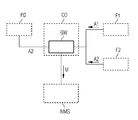
- FIG. 1 shows a schematic representation of a communication network in which a variant of the method according to the invention is performed.
- PROFINET a distributed periphery in the form of designated as IO devices field devices to a field devices associated control unit in the form of an IO controller is connected.
- PROFINET and PROFINET IO are standards known from industrial automation, which take into account the special requirements in the field of automation technology, such as real-time capability, safety-related communication and diagnostics capability. Since PROFINET is known per se, a detailed description of this standard is omitted. In contrast to the field bus Profibus, which is also known from the prior art, in PROFINET the physical separation between field bus and network level is no longer possible.
- FIG. 1 shows a schematic representation of a section of a PROFINET network, which as decentralized periphery comprises the two field devices or IO devices F1 and F2 to which a control device or IO controller CO is assigned.
- the control unit takes over the corresponding control of the field devices as part of the automation process carried out by the field devices.
- Field devices can include any IO devices usually used in automation systems, such as the SIMATIC ET200 device from SIEMENS AG.
- the field devices carry out a predetermined automation process, such as a process in the context of a production by.
- a field device may include, for example, an actuator for carrying out a process step (eg, a valve) or a sensor for detecting corresponding measured variables during the automation process. The field device is thus directly related to the automation process.
- the IO controller can represent any controller known from the prior art, such as the SIMATIC S7-400 from SIEMENS AG with the communications processor CP443-1. In general, the controller is a programmable controller. In the network of Fig. 1 is shown as a further component, a process diagnostic unit PD, which is implemented as a control room in the automation system. This control room is used to process the process alarms described below.
- a process diagnostic unit PD which is implemented as a control room in the automation system. This control room is used to process the process alarms described below.
- MIBs Management Information Base
- MIBs represent the description files of the individual components.
- Process alarms are messages that are caused by the automation process performed by the field devices.
- a process alarm can be output by a sensor, for example, if a limit temperature in the automation system is exceeded.
- a network or diagnostic alarm relates to faults in the communication network and is output in particular when a fault occurs within a field device or in connection with the connection between the field devices, such as a line interruption between the two field devices F1 and F2.
- Network alarms may also include so-called security events.
- the network management station also takes over the Task of a so-called SIEM station (Security Information and Event Management SIEM).
- the communication network described here is characterized in that the controller CO shown in Fig. 1 comprises a gateway GW, which processes the alarms depending on whether they are network alarms or process alarms.
- FIG. 1 shows a scenario in which the field device F1 sends a network alarm A1 to the control device CO, whereas the network device F2 sends a process alarm A2 to the control device CO.
- the gateway GW works for the process alarm as a switch, i. It forwards the process alarm A2 to the control room PD without further processing.
- the network alarm A1 is not forwarded, but translated in the gateway GW in the above-mentioned SNMP trap M, which is then forwarded to the SNMP management station.
- the embodiment of the inventive method just described has the advantage that the implementation of network alarms in SNMP traps directs the network disturbances based thereon to a network management station which is designed to process such disturbances.
- network alarms have been sent to the control room, in which appropriate further processing of the alarms is not possible, since the control room in the communication network of the automation system is designed only for disturbances in the context of the automation process and does not provide suitable processing of disturbances in the context of network communication.
Landscapes
- Engineering & Computer Science (AREA)
- Computer Networks & Wireless Communication (AREA)
- Signal Processing (AREA)
- Computer Security & Cryptography (AREA)
- Health & Medical Sciences (AREA)
- Computing Systems (AREA)
- General Health & Medical Sciences (AREA)
- Medical Informatics (AREA)
- Physics & Mathematics (AREA)
- General Physics & Mathematics (AREA)
- Automation & Control Theory (AREA)
- Maintenance And Management Of Digital Transmission (AREA)
Priority Applications (1)
| Application Number | Priority Date | Filing Date | Title |
|---|---|---|---|
| EP11158177A EP2500788A1 (fr) | 2011-03-15 | 2011-03-15 | Procédé de traitement d'alertes dans un réseau de communication d'une installation d'automatisation industrielle |
Applications Claiming Priority (1)
| Application Number | Priority Date | Filing Date | Title |
|---|---|---|---|
| EP11158177A EP2500788A1 (fr) | 2011-03-15 | 2011-03-15 | Procédé de traitement d'alertes dans un réseau de communication d'une installation d'automatisation industrielle |
Publications (1)
| Publication Number | Publication Date |
|---|---|
| EP2500788A1 true EP2500788A1 (fr) | 2012-09-19 |
Family
ID=44317917
Family Applications (1)
| Application Number | Title | Priority Date | Filing Date |
|---|---|---|---|
| EP11158177A Withdrawn EP2500788A1 (fr) | 2011-03-15 | 2011-03-15 | Procédé de traitement d'alertes dans un réseau de communication d'une installation d'automatisation industrielle |
Country Status (1)
| Country | Link |
|---|---|
| EP (1) | EP2500788A1 (fr) |
Cited By (2)
| Publication number | Priority date | Publication date | Assignee | Title |
|---|---|---|---|---|
| CN113741360A (zh) * | 2021-08-09 | 2021-12-03 | 北京和利时控制技术有限公司 | 一种工业控制网关、系统、控制方法和存储介质 |
| EP4113233A1 (fr) * | 2021-06-28 | 2023-01-04 | Rockwell Automation Technologies, Inc. | Système proxy pour messages de journal de système |
Citations (2)
| Publication number | Priority date | Publication date | Assignee | Title |
|---|---|---|---|---|
| US20040210664A1 (en) * | 2003-04-17 | 2004-10-21 | Schneider Automation Inc. | System and method for transmitting data |
| US7634555B1 (en) * | 2003-05-16 | 2009-12-15 | Johnson Controls Technology Company | Building automation system devices |
-
2011
- 2011-03-15 EP EP11158177A patent/EP2500788A1/fr not_active Withdrawn
Patent Citations (2)
| Publication number | Priority date | Publication date | Assignee | Title |
|---|---|---|---|---|
| US20040210664A1 (en) * | 2003-04-17 | 2004-10-21 | Schneider Automation Inc. | System and method for transmitting data |
| US7634555B1 (en) * | 2003-05-16 | 2009-12-15 | Johnson Controls Technology Company | Building automation system devices |
Cited By (5)
| Publication number | Priority date | Publication date | Assignee | Title |
|---|---|---|---|---|
| EP4113233A1 (fr) * | 2021-06-28 | 2023-01-04 | Rockwell Automation Technologies, Inc. | Système proxy pour messages de journal de système |
| CN115604368A (zh) * | 2021-06-28 | 2023-01-13 | 罗克韦尔自动化技术公司(Us) | 用于系统日志消息的代理系统 |
| US11853040B2 (en) | 2021-06-28 | 2023-12-26 | Rockwell Automation Technologies, Inc. | Proxy system for system log messages |
| CN113741360A (zh) * | 2021-08-09 | 2021-12-03 | 北京和利时控制技术有限公司 | 一种工业控制网关、系统、控制方法和存储介质 |
| CN113741360B (zh) * | 2021-08-09 | 2023-09-29 | 北京和利时控制技术有限公司 | 一种工业控制网关、系统、控制方法和存储介质 |
Similar Documents
| Publication | Publication Date | Title |
|---|---|---|
| EP3353610B2 (fr) | Unité de liaison, système de surveillance et procédé permettant de faire fonctionner un système d'automatisation | |
| EP1919132B1 (fr) | Procédé et dispositif de diagnostic pour un système de bus de terrain | |
| EP2302472B1 (fr) | Système de contrôle de processus critiques pour la sécurité | |
| DE102011107321A1 (de) | System und Verfahren zur Parametrierung von Feldgeräten eines Automatisierungs- oder Steuerungssystems | |
| EP3560150B1 (fr) | Surveillance de la transmission de données dans un système d'accès à des appareils sur une base client serveur | |
| EP4062591B1 (fr) | Procédé de surveillance de la communication sur un bus de communication, dispositif électronique pour connexion à un bus de communication ainsi que dispositif de surveillance central pour connexion à un bus de communication | |
| DE112016003908T5 (de) | Kommunikationsvorrichtung | |
| DE102008046156A1 (de) | Verfahren zur diagnostischen Überwachung | |
| EP4427101A1 (fr) | Procédé et système permettant de fournir des applications de commande prioritaires | |
| EP2509265B1 (fr) | Appareil de protection d'accès pour un réseau d'automatisation | |
| EP2338091A1 (fr) | Procédé pour l'adaptation dynamique d'un système de diagnostic | |
| WO2015161871A1 (fr) | Procédé et dispositif pour le diagnostic de perturbations de transmission dans un réseau selon le standard opc ua | |
| EP3470939B1 (fr) | Procédé et système de surveillance de l'intégrité de sécurité d'une fonction de sécurité fournie par un système de sécurité | |
| EP2500788A1 (fr) | Procédé de traitement d'alertes dans un réseau de communication d'une installation d'automatisation industrielle | |
| DE102013211406A1 (de) | Kommunikationsgerät zur Verbindung eines Feldgeräts eines industriellen Automatisierungssystems mit einer ausfallgesicherten Steuerungseinheit und industrielles Automatisierungssystem | |
| WO2013075895A1 (fr) | Procédé de communication redondante entre un terminal d'utilisateur et un serveur de système de gestion | |
| EP1690390B1 (fr) | Procede de transmission de donnees via un bus de donnees, et systeme et passerelle permettant la mise en oeuvre dudit procede | |
| EP3208674A1 (fr) | Système de réseau et procédé de transmission de données dans un système de réseau | |
| EP3729737B1 (fr) | Composant de bus de terrain comprenant un élément de réglage pour la configuration de la transmission de données à un nuage | |
| EP3699705A1 (fr) | Procédé de surveillance d'un réseau de communication industriel, système de sécurité, réseau de communication industriel, programme informatique et support lisible par ordinateur | |
| EP3226484A1 (fr) | Procede destine a la transmission de donnees dans un reseau de communication d'un systeme d'automatisation industriel et appareil de communication | |
| EP2950176A1 (fr) | Procédé et composants d'automatisation destinés à la génération d'une information de changement d'état | |
| WO2010026011A1 (fr) | Procédé de fonctionnement d'un appareil pour l'automatisation de processus | |
| DE102009014620A1 (de) | Adressabhängige Sicherheitscodefolgen für sichere Eingangsslaves bei AS-Interface | |
| DE102008059487A1 (de) | Verfahren zur Generierung von Parametrierungsdaten für ein Kommunikations-Schutzsystem eines Kommunikationsnetzes in einer Automatisierungsanlage |
Legal Events
| Date | Code | Title | Description |
|---|---|---|---|
| PUAI | Public reference made under article 153(3) epc to a published international application that has entered the european phase |
Free format text: ORIGINAL CODE: 0009012 |
|
| AK | Designated contracting states |
Kind code of ref document: A1 Designated state(s): AL AT BE BG CH CY CZ DE DK EE ES FI FR GB GR HR HU IE IS IT LI LT LU LV MC MK MT NL NO PL PT RO RS SE SI SK SM TR |
|
| AX | Request for extension of the european patent |
Extension state: BA ME |
|
| RAP1 | Party data changed (applicant data changed or rights of an application transferred) |
Owner name: SIEMENS AKTIENGESELLSCHAFT |
|
| STAA | Information on the status of an ep patent application or granted ep patent |
Free format text: STATUS: THE APPLICATION IS DEEMED TO BE WITHDRAWN |
|
| 18D | Application deemed to be withdrawn |
Effective date: 20130320 |