EP2500996B1 - Vorrichtungsverbinder und Verfahren zu dessen Herstellung - Google Patents
Vorrichtungsverbinder und Verfahren zu dessen Herstellung Download PDFInfo
- Publication number
- EP2500996B1 EP2500996B1 EP12001109.3A EP12001109A EP2500996B1 EP 2500996 B1 EP2500996 B1 EP 2500996B1 EP 12001109 A EP12001109 A EP 12001109A EP 2500996 B1 EP2500996 B1 EP 2500996B1
- Authority
- EP
- European Patent Office
- Prior art keywords
- plate
- opening
- metal plate
- side sliding
- connector housing
- Prior art date
- Legal status (The legal status is an assumption and is not a legal conclusion. Google has not performed a legal analysis and makes no representation as to the accuracy of the status listed.)
- Not-in-force
Links
Images








Classifications
-
- H—ELECTRICITY
- H01—ELECTRIC ELEMENTS
- H01R—ELECTRICALLY-CONDUCTIVE CONNECTIONS; STRUCTURAL ASSOCIATIONS OF A PLURALITY OF MUTUALLY-INSULATED ELECTRICAL CONNECTING ELEMENTS; COUPLING DEVICES; CURRENT COLLECTORS
- H01R43/00—Apparatus or processes specially adapted for manufacturing, assembling, maintaining, or repairing of line connectors or current collectors or for joining electric conductors
- H01R43/20—Apparatus or processes specially adapted for manufacturing, assembling, maintaining, or repairing of line connectors or current collectors or for joining electric conductors for assembling or disassembling contact members with insulating base, case or sleeve
- H01R43/24—Assembling by moulding on contact members
-
- B—PERFORMING OPERATIONS; TRANSPORTING
- B29—WORKING OF PLASTICS; WORKING OF SUBSTANCES IN A PLASTIC STATE IN GENERAL
- B29C—SHAPING OR JOINING OF PLASTICS; SHAPING OF MATERIAL IN A PLASTIC STATE, NOT OTHERWISE PROVIDED FOR; AFTER-TREATMENT OF THE SHAPED PRODUCTS, e.g. REPAIRING
- B29C45/00—Injection moulding, i.e. forcing the required volume of moulding material through a nozzle into a closed mould; Apparatus therefor
- B29C45/16—Making multilayered or multicoloured articles
- B29C45/1671—Making multilayered or multicoloured articles with an insert
-
- H—ELECTRICITY
- H01—ELECTRIC ELEMENTS
- H01R—ELECTRICALLY-CONDUCTIVE CONNECTIONS; STRUCTURAL ASSOCIATIONS OF A PLURALITY OF MUTUALLY-INSULATED ELECTRICAL CONNECTING ELEMENTS; COUPLING DEVICES; CURRENT COLLECTORS
- H01R13/00—Details of coupling devices of the kinds covered by groups H01R12/70 or H01R24/00 - H01R33/00
- H01R13/40—Securing contact members in or to a base or case; Insulating of contact members
- H01R13/405—Securing in non-demountable manner, e.g. moulding, riveting
-
- H—ELECTRICITY
- H01—ELECTRIC ELEMENTS
- H01R—ELECTRICALLY-CONDUCTIVE CONNECTIONS; STRUCTURAL ASSOCIATIONS OF A PLURALITY OF MUTUALLY-INSULATED ELECTRICAL CONNECTING ELEMENTS; COUPLING DEVICES; CURRENT COLLECTORS
- H01R43/00—Apparatus or processes specially adapted for manufacturing, assembling, maintaining, or repairing of line connectors or current collectors or for joining electric conductors
- H01R43/18—Apparatus or processes specially adapted for manufacturing, assembling, maintaining, or repairing of line connectors or current collectors or for joining electric conductors for manufacturing bases or cases for contact members
-
- B—PERFORMING OPERATIONS; TRANSPORTING
- B29—WORKING OF PLASTICS; WORKING OF SUBSTANCES IN A PLASTIC STATE IN GENERAL
- B29C—SHAPING OR JOINING OF PLASTICS; SHAPING OF MATERIAL IN A PLASTIC STATE, NOT OTHERWISE PROVIDED FOR; AFTER-TREATMENT OF THE SHAPED PRODUCTS, e.g. REPAIRING
- B29C45/00—Injection moulding, i.e. forcing the required volume of moulding material through a nozzle into a closed mould; Apparatus therefor
- B29C45/14—Injection moulding, i.e. forcing the required volume of moulding material through a nozzle into a closed mould; Apparatus therefor incorporating preformed parts or layers, e.g. injection moulding around inserts or for coating articles
- B29C2045/1486—Details, accessories and auxiliary operations
- B29C2045/14893—Preventing defects relating to shrinkage of inserts or coating material
-
- B—PERFORMING OPERATIONS; TRANSPORTING
- B29—WORKING OF PLASTICS; WORKING OF SUBSTANCES IN A PLASTIC STATE IN GENERAL
- B29C—SHAPING OR JOINING OF PLASTICS; SHAPING OF MATERIAL IN A PLASTIC STATE, NOT OTHERWISE PROVIDED FOR; AFTER-TREATMENT OF THE SHAPED PRODUCTS, e.g. REPAIRING
- B29C45/00—Injection moulding, i.e. forcing the required volume of moulding material through a nozzle into a closed mould; Apparatus therefor
- B29C45/14—Injection moulding, i.e. forcing the required volume of moulding material through a nozzle into a closed mould; Apparatus therefor incorporating preformed parts or layers, e.g. injection moulding around inserts or for coating articles
- B29C45/14639—Injection moulding, i.e. forcing the required volume of moulding material through a nozzle into a closed mould; Apparatus therefor incorporating preformed parts or layers, e.g. injection moulding around inserts or for coating articles for obtaining an insulating effect, e.g. for electrical components
-
- H—ELECTRICITY
- H01—ELECTRIC ELEMENTS
- H01R—ELECTRICALLY-CONDUCTIVE CONNECTIONS; STRUCTURAL ASSOCIATIONS OF A PLURALITY OF MUTUALLY-INSULATED ELECTRICAL CONNECTING ELEMENTS; COUPLING DEVICES; CURRENT COLLECTORS
- H01R13/00—Details of coupling devices of the kinds covered by groups H01R12/70 or H01R24/00 - H01R33/00
- H01R13/73—Means for mounting coupling parts to apparatus or structures, e.g. to a wall
- H01R13/74—Means for mounting coupling parts in openings of a panel
-
- H—ELECTRICITY
- H01—ELECTRIC ELEMENTS
- H01R—ELECTRICALLY-CONDUCTIVE CONNECTIONS; STRUCTURAL ASSOCIATIONS OF A PLURALITY OF MUTUALLY-INSULATED ELECTRICAL CONNECTING ELEMENTS; COUPLING DEVICES; CURRENT COLLECTORS
- H01R2201/00—Connectors or connections adapted for particular applications
- H01R2201/26—Connectors or connections adapted for particular applications for vehicles
Definitions
- US application No. US 2002/0016100 A1 discloses a connector supporting structure including a female connector, fixed to an instrumental panel, and a male connector.
- a cam lever is rotatably supported by the male connector hosing.
- On the lateral side of the male connector housing protective cover parts are formed. When fitting the female connector to the male connector, the protective cover parts prevent the cam lever from being broken.
- US application No. US 006076258 A2 discloses a method for insert molding, comprising assembling an insert to a holder, setting the assembled insert and holder inside a metal mold and casting resin into the metal mold.
- the present invention relates to a device connector according to claim 1 to be attached to a case of a device and to a method of producing it.
- a device such as a motor is housed in a metal case in an electric vehicle or a hybrid vehicle, and a device connector such as a terminal block is attached and fixed to such a case.
- This device connector is connected to a wire-side connector provided on an end of a wire connected to a device such as an inverter.
- a connector disclosed in Japanese Unexamined Patent Publication No. 2009-32500 is known as such a device connector.
- This includes terminal fittings, a connector housing made of synthetic resin and a metal plate made of aluminum die cast.
- the metal plate is generally formed with an opening, through which the terminal fittings are to be inserted, and these terminal fittings are held in the connector housing while being inserted through the opening.
- metal and synthetic resin have very different coefficients of thermal expansion and, hence, the connector housing shrinks more than the metal plate in a cooling process after molding. Accordingly, to suppress the shrinkage of the connector housing in the cooling process, it is thought to forcibly prevent the shrinkage of the synthetic resin from the outer peripheral edge toward the opening of the metal plate by forming the connector housing with a flange which bulge out to cover up to an outer peripheral portion of the metal plate and embossing the surface of the metal plate so that this flange does not slip relative to the metal plate.
- the present invention was completed in view of the above situation and an object thereof is to improve production of a device connector.
- a device connector to be attached to a case of a device comprising: a metal plate made of a metal plate material as a base material, formed with an opening penetrating in a plate thickness direction of the plate material and to be attached and fixed to the case of the device; a connector housing made of synthetic resin and fixed to the metal plate; and at least one terminal fitting held in the connector housing while penetrating through the opening; wherein: the connector housing includes a fixing portion which at least partly covers an opening edge portion of the opening while exposing an outer peripheral edge portion of the metal plate; and the fixing portion includes a one-side sliding portion slidable relative to one surface side of the metal plate, an other-side sliding portion slidable relative to the other surface side of the metal plate and a coupling portion substantially arranged in the opening and coupling the one-side sliding portion and the other-side sliding portion.
- the plate is a metal plate made of a metal plate material as a base material.
- a device connector to be attached to a case of a device, comprising a metal plate made of a metal plate material as a base material, formed with an opening penetrating in a plate thickness direction of the plate material and to be attached and fixed to the case of the device; a connector housing made of synthetic resin and fixed to the metal plate by molding ; and a terminal fitting held in the connector housing while penetrating through the opening; wherein the connector housing includes a fixing portion which covers an opening edge portion of the opening while exposing an outer peripheral edge portion of the metal plate; and the fixing portion includes a one-side sliding portion slidable relative to one surface side of the metal plate, an other-side sliding portion slidable relative to the other surface side of the metal plate and a coupling portion arranged in the opening and coupling the one-side sliding portion and the other-side sliding portion.
- the one-side sliding portion and the other-side sliding portion move together via the coupling portion, there is no likelihood that the metal plate is warped due to independent sliding movements of the one-side sliding portion and the other-side sliding portion.
- crack formation in the synthetic resin in the opening and the synthetic resin covering the surfaces of the metal plate can be prevented and production cost of the device connector can be suppressed by using the metal plate.
- a clearance is be formed between the coupling portion and the inner surface of the opening substantially facing the coupling portion in a state where the molded connector housing is cooled to a normal temperature.
- the synthetic resin shrinks more than the metal and the one-side sliding portion and the other-side sliding portion slide relative to the metal plate in the cooling process after molding, with the result that the clearance is formed between the coupling portion and the inner surface of the opening at a normal temperature.
- the synthetic resin expands so that the coupling portion approaches the inner surface of the opening within the range of the clearance at the time of heating from a low-temperature state to a high-temperature state (state higher than a normal temperature), for example, in a thermal shock test. Therefore, there is no likelihood that the coupling portion receives stress from the inner surface of the opening to form a crack.
- the present invention is preferably embodied to have the following constructions.
- a seal-mounting portion made of synthetic resin at least partly may be circumferentially provided on a part of a surface of the (particularly metal) plate, which will face the case of the device, radially outward of the fixing portion; and the case of the device and the seal-mounting portion may be fixed in a sealed state via a packing (particularly via an annular packing).
- a plurality of annular lips may be provided on a sealing surface of the packing to the seal-mounting portion.
- Plating may be applied to the surfaces of the metal plate.
- One of the one-side sliding portion and the other-side sliding portion may be formed to project more outward than the other of the one-side sliding portion and the other-side sliding portion.
- the terminal fitting may be in the form of a conductive plate including a terminal main portion, a wire-side fastening portion provided at one end of the terminal main portion, particularly extending at an angle different from 0° or 180°, preferably substantially perpendicular to the terminal main portion, and a device-side fastening portion provided at another end of the terminal main portion.
- the connector housing may comprise a first connecting portion to be connected to a connector and a second connecting portion being arranged in the opening and to be connected with the device.
- a thick portion having a thick resin layer may be formed from a portion of the first connecting portion to a portion of the second connecting portion.
- the terminal fitting may be arranged to penetrate through the opening of the plate in the thick portion.
- a method of producing a device connector to be attached to a case of a device comprising:
- the present invention is preferably embodied to have the following constructions.
- the secondary molding resin may shrink toward the opening in a cooling process after secondary molding, whereby the clearance is formed between an inner surface of the opening and the coupling portion.
- a seal-mounting portion made of synthetic resin at least partly may be circumferentially provided on a part of a surface of the plate, which will face the case of the device, radially outward of the fixing portion.
- the plate may be a metal plate and plating may be applied to the surfaces of the metal plate.
- FIGS. 1 to 11 A first particular embodiment of the present invention is described with reference to FIGS. 1 to 11 .
- a terminal block to be attached to a metal motor case (not shown) housing a motor (as an example of a "device") inside is illustrated as an example of a device connector.
- this terminal block includes a metal plate 30 to be attached and fixed to the motor case, a connector housing 50 molded to be integral to the metal plate 30, and one or more (e.g. three) conductive plates (as an example of a "terminal fitting") 10 held or housed in the connector housing 50 particularly while penetrating through the metal plate 30 in a plate thickness direction TD.
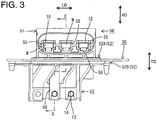
- a vertical direction VD is a vertical direction in FIG. 3
- a lateral direction LD is a lateral direction in FIG. 3
- forward and backward directions FBD are lateral directions in FIG. 7 with a shown left side referred to as a front side.
- One or more one ends (first ends) of the conductive plates 10 are to be connected (particularly bolt-fastened) to one or more, particularly a plurality of device-side busbars (not shown) provided in or at the motor case for electrical connection.
- a power supply device for supplying power such as an inverter
- one or more, particularly a plurality of wires are arranged to extend toward the motor case and a wire-side connector (not shown) is provided at end portions of these one or more wires.
- One or more wire-side terminals (not shown) connected to respective wire ends are provided in this wire-side connector, and these one or more wire-side terminals are connected (particularly bolt-fastened) to the one or more other ends of the respective conductive plates 10 for electrical connection.
- Each conductive plate 10 is formed by, after a conductive (particularly metal) plate with good electrical conductivity is punched or cut into a specified (predetermined or predeterminable) shape particularly by a press, performing a specified (predetermined or predeterminable) bending process on the punched or cut conductive (metal) plate as shown in FIG. 7 .
- the conductive plate 10 includes a terminal main portion 11 constituting a main part of the conductive plate 10, a wire-side fastening portion 12 extending laterally or forward from the lateral or upper end of the terminal main portion 11, and a device-side fastening portion 13 provided at a lower end portion of the terminal main portion 11.
- the terminal main portion 11 particularly is formed to be longer than the wire-side fastening portion 12.
- the plurality of (e.g. three) conductive plates 10 particularly are arranged substantially side by side in the lateral direction LD. Further, the terminal main portions 11 particularly are slightly cranked in the lateral direction LD at intermediate positions as shown by broken line in FIG. 3 .
- the wire-side fastening portions 12 and the device-side fastening portions 13 are each formed with a bolt insertion hole 14 through which a fastening bolt (not shown) at least partly is insertable.
- the terminal main portion 11 of the conductive plate 10 (particularly arranged in the center or intermediate position out of the three conductive plates 10) substantially extends in the vertical direction VD and/or is substantially flat as shown in FIG. 7 .
- the lateral terminal main portions 11, 11 (particularly of the both conductive plates located at the opposite left and right sides out of the three conductive plates 10) include each a facing portion bent forward to face the wire-side fastening portion 12 at an intermediate part (particularly a substantially vertically central part) of the terminal main portion 11 although not shown, and the front end of this facing portion is bent downward particularly substantially at the same position as the front end of the wire-side fastening portion 12.
- the metal plate 30 particularly is made of a metal flat plate material as a base material and includes an opening 31 formed to penetrate in a plate thickness direction TD of the plate material.
- the connector housing 50 particularly includes a small connector portion 59 molded to be integral to the metal plate 30 and arranged to penetrate through the opening 31 in the vertical direction VD, a wire-side fitting portion 51 arranged above (one side) the metal plate 30, a (particularly substantially plate-like) flange 52 arranged at or corresponding to the height position of the metal plate 30 and bulging out sideways (in a plane direction of the metal plate 30), and a device-side fitting portion 53 arranged below (other side) the metal plate 30.
- the flange 52 particularly corresponds to a "fixing portion”.
- the wire-side fitting portion 51 particularly substantially is in the form of a box long in the lateral direction and includes a front end opening 51A (as a particular first opening) which is open in one direction (e.g. forward) and an upper end opening 51B (as a particular second opening) which is open in another direction (e.g. upward).
- the wire-side connector is at least partly fittable or insertable into the wire-side fitting portion 51 through the front end opening 51A of the wire-side fitting portion 51.
- one or more (e.g. three) nut accommodating portions 55 are formed (particularly substantially side by side in the lateral direction LD) in the wire-side fitting portion 51. These one or more (e.g. three) nut accommodating portions 55 are respectively open to two sides such as forward and upward. Further, all the (three) nut accommodating portion(s) 55 is/are arranged to substantially face (particularly forward) through the front or first end opening 51A and substantially face (particularly upward) through the upper or second end opening 51B.
- One or more nuts N press-fitted through the front end opening 51A from front particularly are so accommodated in the nut accommodating portions 55 that the axis lines of the nuts N are aligned with the vertical direction VD.
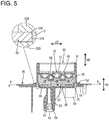
- the wire-side fastening portions 12 of the conductive plates 10 are arranged to close the upper end openings of the nut accommodating portions 55 as shown in FIGS. 3 and 4 . Further, as shown in FIG. 7 , each conductive plate 10 is arranged to penetrate through the opening 31 in the vertical direction VD and so held in the connector housing 50 that the wire-side fastening portion 12 is substantially arranged around the bolt insertion hole 14 and at least partly exposed forward and/or upward in the wire-side fitting portion 51 and, on the other hand, the device-side fastening portion 13 is substantially arranged around the bolt insertion hole 14 and at least partly exposed backward at the lower end portion of the device-side fitting portion 53.
- Each wire-side fastening portion 12 is at least partly exposed to the outside through the upper end opening 51B of the wire-side fitting portion 51. That is, the upper end opening 51B of the wire-side fitting portion 51 particularly is or may be used as a service hole used to at least partly insert a tool or the like for a bolt fastening operation.
- the wire-side terminal is substantially placed on the wire-side fastening portion 12 and the tool is inserted inside through the upper end opening 51B to threadably engage the fastening bolt with the nut N, whereby the conductive plate 10 and the wire-side terminal are electrically connected.
- a service cover (not shown) is mounted on or to the upper end opening 51B of the wire-side fitting portion 51 after bolt fastening, thereby closing the upper end opening 51B.
- An escaping recess 56 for allowing a leading end part of the fastening bolt penetrating through the nut N to escape when the fastening bolt is fastened to the nut N is provided below each nut accommodating portion 55.
- the escaping recess 56 particularly is formed to be narrower than the nut accommodating portion 55 in the lateral direction LD and integrally or unitarily formed with the nut accommodating portion 55 by a slide die.
- a metal shielding shell 70 at least partly covering the wire-side fitting portion 51 except the rear surface is mounted on the wire-side fitting portion 51.
- This shielding shell 70 is formed by, after a conductive (particularly metal) plate with good electrical conductivity is punched or cut into a specified (predetermined or predeterminable) shape by a press, performing a specified (predetermined or predeterminable) bending process on the punched or cut conductive (metal) plate.
- the shielding shell 70 includes a (particularly braided) fixing portion 71 having a laterally long cylindrical shape, and a fixing piece 72 for fixing the shielding shell 70 to the metal plate 30 and electrically connecting the shielding shell 70 and the motor case by being fastened to the motor case together with the metal plate 30.
- the braided fixing portion 71 particularly is such that a braided wire provided to collectively cover shielded conductive paths of the wire-side connector is connected to a connection portion, particularly crimped against a crimp ring as the connection portion.
- the flange 52 is formed to at least partly cover an opening edge portion of the opening 31 over at least part of the circumference, particularly the substantially entire circumference, while exposing an outer peripheral edge portion of the metal plate 30.
- This flange 52 is composed of or comprises a wire-side flange 52A which at least partly covers a side of the wire-side fitting portion 51 of the opening edge portion of the opening 31, a device-side flange 52B which at least partly covers a side of the device-side fitting portion 52 thereof, and a coupling portion 52C (particularly arranged substantially along the inner circumferential surface of the opening 31 and) coupling the both flanges 52A, 52B.
- the wire-side flange 52A and the device-side flange 52B sandwich the metal plate 30 in the plate thickness direction TD, and the coupling portion 52C particularly is held in contact with the inner peripheral surface of the opening 31, whereby the connector housing 50 is fixed or made integral to the metal plate 30.
- the wire-side flange 52A of the flange 52 particularly is shaped to extend in the lateral direction LD and/or backward direction.
- the device-side flange 52B is formed to (particularly substantially entirely) cover a surface of the metal plate 30 at the side of the device-side fitting portion 53.
- the wire-side flange 52A particularly corresponds to a "one-side sliding portion”
- the device-side flange 52B particularly corresponds to an "other-side sliding portion”.
- the opening 31 particularly has a substantially trapezoidal shape. Further, the facing portions of the conductive plates 10 at the lateral (left and/or right) side(s) and/or the terminal main portion 11 of the (particularly central) conductive plate 10 are arranged in the opening 31. On the other hand, a thick portion 57 having a thick resin layer is formed particularly from a lower end portion of the wire-side fitting portion 51 to an upper end portion of the device-side fitting portion 53 as shown in FIG. 7 . That is, the one or more (e.g. three) conductive plates 10 having a complicated shape are arranged to penetrate through the opening 31 of the metal plate 30 in this thick portion 57.
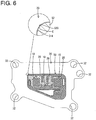
- one or more, particularly a plurality of mounting holes 32 are formed in the outer peripheral edge portion of the metal plate 30.
- One or more fixing bolts or rivets (not shown) are to be at least partly inserted through these mounting holes 32 and fastened to the motor case, whereby the terminal block can be attached and fixed to the motor case.
- the device-side fitting portion 53 is housed into the motor case when the terminal block is fixed to the motor case. Further, as shown in FIG. 1 , one or more (e.g. three) nut accommodating portions 58 are formed in the device-side fitting portion 53. Specifically, out of these nut accommodating portions 58, the nut accommodating portion 58 located in the center or at an intermediate position is arranged behind the other nut accommodating portions 58. In the nut accommodating portions 58 of the device-side fitting portion 53, the fastening bolts are threadably engaged with respective nuts N to electrically connect the conductive plates 10 and the device-side busbars similar to the nut accommodating portions 55 of the wire-side fitting portion 51. In this way, the wire-side terminals and the device-side busbars are electrically connected using the conductive plates 10 as intermediate terminals.
- the fastening bolts are threadably engaged with respective nuts N to electrically connect the conductive plates 10 and the device-side busbars similar to the nut accommodating portions 55 of the wire-side fitting portion 51. In this
- the device-side flange 52B of the flange 52 is formed to bulge out sideways or laterally (along a direction parallel to a plane of the metal plate 30) more than the wire-side flange 52A.
- a packing mounting groove 54 into which a (particularly substantially ring-shaped) packing 80 is to be mounted substantially is circumferentially formed in a part (corresponding to a particular "seal-mounting portion") of the device-side flange 52B bulging out from the wire-side flange 52A.
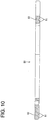
- the packing 80 is made of a resilient material such as rubber and includes one or more (e.g. two) annular lips 81 on a sealing surface to the packing mounting groove 54 as shown in FIGS. 8 to 10 .
- a surface of the packing 80 opposite to the one with the (particularly both) annular lip(s) 81 serves as a surface sealing portion 82 to be surface sealed to the motor case.
- the motor case and the device-side flange 52B are fixed in a sealed manner via the packing 80 by fixing (particularly bolt-fastening) the metal plate 30 to the motor case. Since a sealing structure for the device-side flange 52B is formed by the (both) annular lip(s) 81 in this way, a pressing force required to press the annular lips 81 for a sealing purpose can be small. Accordingly, it is not necessary to ensure strength particularly by increasing the thickness of the metal plate 30 and sufficient sealing performance can be obtained with a smaller pressing force than in the case of using a metal plate made of aluminum die cast.
- the flange 52 in this embodiment is slidable relative to the metal plate 30.
- the wire-side flange 52A is slidable relative to the upper surface of the metal plate 30, and the device-side flange 52B is slidable relative to the lower surface of the metal plate 30.
- the wire-side flange 52A and the device-side flange 52B are coupled to each other by the coupling portion 52C.
- This coupling portion 52C is arranged to substantially face an inner surface 31A of the opening 31.
- a clearance C particularly is set between the coupling portion 52C and the inner surface 31A of the opening 31.
- This clearance C particularly is formed since synthetic resin shrinks more than metal in a cooling process after molding when the metal plate 30 and the connector housing 50 are integrally formed. That is, the clearance C is not formed when molten resin is injected, but is formed when synthetic resin in the opening 31 shrinks while the wire-side flange 52A, the device-side flange 52B and the coupling portion 52C slip toward the opening 31.
- the metal plate material as a base material may be used as it is without applying plating. Further, no process such as embossing is performed on the metal plate 30 except at the opening 31. Thus, the synthetic resin can slide on the surfaces of the metal plate 30 by expansion by heating or shrinkage by cooling.
- one or more conductive plates 10 are set in a primary molding die (not shown), the die is clamped and primary molding resin is injected to form one or more (e.g. three) types of cores 20.
- these one or more (e.g. three) types of cores 20 are set in a secondary molding die (not shown), the die is clamped and secondary molding resin is injected to form the terminal block.
- the secondary molding resin particularly shrinks toward the opening 31 in a cooling process after secondary molding, whereby the clearance C is formed between the inner surface 31A of the opening 31 and the coupling portion 52C. Since the secondary molding resin shrinks while slipping on the surfaces of the metal plate 30 in this cooling process, there is no likelihood that stress is accumulated in the secondary molding resin to form a crack.
- the thermal shock test is a cold shock test which gives a thermal shock to the terminal block by repeating a low-temperature state (state lower than a normal temperature) and a high-temperature state (state higher than a normal temperature).
- synthetic resin expands, whereby the wire-side flange 52A slides on the upper surface of the metal plate 30 and the device-side flange 52B slides on the lower surface of the metal plate 30.
- this causes the coupling portion 52C to approach the inner surface 31A of the opening 31 to decrease or fill up the clearance C, a situation is not reached where the coupling portion 52C receives stress from the inner surface 31A of the opening 31 to form a crack.
- the synthetic resin shrinks, whereby the wire-side flange 52A slides on the upper surface of the metal plate 30 and the device-side flange 52B slides on the lower surface of the metal plate 30. Further, the coupling portion 52C moves toward the opening 31 to form or increase the clearance C to the inner surface 31A of the opening 31. Note that the coupling portion 52C couples the wire-side flange 52A and the device-side flange 52B so that the both flanges 52A, 52B particularly slide in tandem or at the same time. This prevents a situation where a sliding distance of the wire-side flange 52A and that of the device-side flange 52B differ and the metal plate 30 is warped.
- the flange 52 is slidable relative to the metal plate 30 in this embodiment, crack formation in the synthetic resin can be prevented. Further, since the wire-side flange 52A and the device-side flange 52B particularly are coupled by the coupling portion 52C, the both flanges 52A, 52B can slide in tandem and the warping of the metal plate 30 and the like can be prevented. Further, since the clearance C particularly is provided between the inner surface 31A of the opening 31 and the coupling portion 52C in a normal-temperature state, crack formation due to stress received by the coupling portion 52C from the inner surface 31A of the opening 31 in the high-temperature state of the thermal shock test can be prevented.
- the one or more annular lips 81 of the packing 80 are pressed by the device-side flange 52B and the metal plate 30 in the packing mounting groove 54, wherefore the annular lips 81 can be pressed with a small pressing force and sufficient sealing performance can be obtained.
- a terminal block is provided to be attached to case of a device such as a motor case.
- the terminal block includes a metal plate 30 made of a metal plate material as a base material, formed with an opening 31 penetrating in a plate thickness direction TD of the plate material and to be attached and fixed to the motor case; a connector housing 50 made of synthetic resin and fixed to the metal plate 30; and conductive plates 10 held in the connector housing 50 while penetrating through the opening 30.
- the connector housing 50 includes a flange 52 which covers an opening edge portion of the opening 31 while exposing an outer peripheral edge portion of the metal plate 30.
- the flange 52 includes a wire-side flange 52A slidable or movable relative to the upper surface of the metal plate 30, a device-side flange 52B slidable or movable relative to the lower surface of the metal plate 30 and a coupling portion 52C arranged in the opening 31 and at least partly coupling the both flanges 52A, 52B.
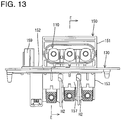
- FIGS. 12 to 15 Constructions of this embodiment corresponding to the first embodiment are identified by reference numerals which are the reference numerals of the first embodiment plus 100 and constructions, functions and effects similar to those of the first embodiment are not repeatedly described. The following description is centered on constructions different from the first embodiment.
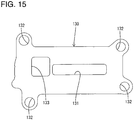
- a small opening 133 through which only a small connector portion 159 at least partly is vertically inserted is formed in a metal plate 130 of this embodiment in addition to an opening 131 as openings through which a connector housing 150 is vertically inserted. That is, a wire-side fitting portion 151 and a device-side fitting portion 153 are arranged in the opening 131 and the small connector portion 159 is arranged in the small opening 133.
- the metal plate 130 particularly has a somewhat laterally long rectangular shape and mounting holes 132 are formed at four corners thereof.
- the connector housing 150 is not formed in two processes, i.e. primary molding and secondary molding unlike in the first embodiment, and is formed in one process by setting conductive plates 110 in a lower die of a molding die, clamping the molding die and injecting molten resin.
- the vertically extending conductive plates 110 are insert-molded in the connector housing 150, and wire-side fastening portions 112 vertically extend in flush with terminal main portions 111.
- a thick portion 157 particularly is formed with one or more mold removal holes H1 which communicate with escaping recesses 156 and vertically extend.
- a pair of mold removal holes H1 are provided in correspondence with upper and lower escaping recesses 156. These mold removal holes H1 prevent the formation of voids in the thick portion 157.
- the thick portion 157 is formed with one or more, particularly a plurality of mold removal holes H2 with an open front side. The formation of voids in the thick portion 157 is also prevented by these mold removal holes H2.
- the small connector portion 159 and the wire-side fitting portion 151, and the small connector portion 159 and the device-side fitting portion 153 are respectively coupled to each other via a common flange 152.
- the flange 152 is slidable relative to the metal plate 130. Accordingly, crack formation caused by a temperature variation in a cooling process after the molding of the connector housing 150 and a thermal shock test can be prevented.
Landscapes
- Engineering & Computer Science (AREA)
- Manufacturing & Machinery (AREA)
- Mechanical Engineering (AREA)
- Connector Housings Or Holding Contact Members (AREA)
- Motor Or Generator Frames (AREA)
- Connections By Means Of Piercing Elements, Nuts, Or Screws (AREA)
- Connections Arranged To Contact A Plurality Of Conductors (AREA)
Claims (13)
- Ein Vorrichtungsverbinder, der an einem Vorrichtungsgehäuse anzubringen ist, und der Folgendes umfasst:eine Platte (30; 130), die aus einem Plattenmaterial als Basismaterial besteht und die mit einer in eine Richtung der Plattendicke (TD) des Plattenmaterials eindringenden Öffnung (31; 131) gebildet wird, und die an das Gehäuse der Vorrichtung anzubringen und zu befestigen ist;ein Verbindergehäuse (50; 150), das aus Kunstharz hergestellt wird und an der Platte (30; 130) befestigt ist, wobei das Verbindergehäuse (50; 150) durch Formen an der Platte (30; 130) befestigt ist; undmindestens ein Anschlusspassstück (10; 110), das beim Eindringen durch die Öffnung (31; 131) im Verbindergehäuse (50; 150) gehalten wird;wobei:das Verbindergehäuse (50; 150) einen Befestigungsabschnitt (52; 152) beinhaltet, der zumindest teilweise einen Öffnungsraridbereich der Öffnung (31; 131) abdeckt, während er einen äußeren Umfangs-Randbereich der Platte (30; 130) freilässt; und wobeider Befestigungsabschnitt (52; 152) Folgendes beinhaltet: einen einseitigen Gleitabschnitt (52A; 152A), der in Bezug auf eine Oberflächenseite der Platte (30; 130) gleitfähig ist, und einen anders-seitigen Gleitabschnitt (52B; 152B) beinhaltet, der in Bezug auf die andere Oberflächenseite der Platte (30; 130) gleitfähig ist, und einen Kopplungsabschnitt (52C; 152C), der im Wesentlichen in der Öffnung (31; 131) angeordnet ist und den einseitigen Gleitabschnitt (52A; 152A) und den anders-seitigen Gleitabschnitt (52B; 152B) koppelt, dadurch gekennzeichnet, dass:die Platte (30; 130) eine Metallplatte (30; 130) ist, die aus einem Metallplatten-Material als Basismaterial besteht, und dadurch, dass:ein Zwischenraum (C) zwischen dem Kopplungsabschnitt (52C; 152C) und der inneren Fläche der Öffnung (31; 131), die dem Kopplungsabschnitt (52C; 152C) zugewandt ist, in einem Zustand gebildet wird, in dem das geformte Verbindergehäuse (50; 150) auf eine normale Temperatur gekühlt wird.
- Ein Vorrichtungsverbinder nach Anspruch 1, wobei ein Dichtungsmontageabschnitt (54), der zumindest teilweise aus Kunstharz besteht, im Umfangsbereich auf einem Teil einer Fläche der Platte (30; 130) bereitgestellt wird, der dem Gehäuse der Vorrichtung zugewandt sein wird, radial außerhalb des Befestigungsabschnitts (52; 152); und wobei
das Gehäuse der Vorrichtung und der Dichtungsmontageabschnitt (54) in einem versiegelten Zustand mittels einer Dichtung (packing) (80; 180) befestigt werden. - Ein Vorrichtungsverbinder nach Anspruch 2, wobei eine Vielzahl an ringförmigen Lippen (81; 181) auf einer Abdichtfläche der Dichtung (80; 180) für den Dichtungsmontageabschnitt (54) bereitgestellt werden.
- Ein Vorrichtungsverbinder nach irgendeinem der vorhergehenden Ansprüche, wobei eine Plattierung auf die Oberflächen der Metallplatte (30; 130) aufgebracht wird.
- Ein Vorrichtungsverbinder nach irgendeinem der vorhergehenden Ansprüche, wobei einer unter den Folgenden: der einseitige Gleitabschnitt (52A; 152A) und der anders-seitige Gleitabschnitt (52B; 152B) gebildet wird, um weiter vorzustehen als der andere unter den Folgenden: der einseitige Gleitabschnitt (52A; 152A) und der anders-seitige Gleitabschnitt (52B; 152B).
- Ein Vorrichtungsverbinder nach irgendeinem der vorhergehenden Ansprüche, wobei das Anschlusspassstück (10; 110) die Form einer leitfähigen Platte (10; 110) aufweist, das Folgendes beinhaltet: einen Anschlusshauptabschnitt (11), einen drahtseitigen Befestigungsabschnitt (12), der an einem Ende des Anschlusshauptabschnitts (11) bereitgestellt wird und der insbesondere unter einem von 0° und 180° unterschiedlichen Winkel verläuft und der vorzugsweise im Wesentlichen senkrecht zum Anschlusshauptabschnitt (11) ist, und einen vorrichtungsseitigen Befestigungsabschnitt (13), der an einem anderen Ende des Anschlusshauptabschnitts (11) bereitgestellt wird.
- Ein Vorrichtungsverbinder nach irgendeinem der vorhergehenden Ansprüche, wobei das Verbindergehäuse (50; 150) einen ersten Verbindungsabschnitt (51; 151) umfasst, der mit einem Verbinder zu verbinden ist, und einen zweiten Verbindungsabschnitt (53; 153), der in der Öffnung (31; 131) angeordnet ist und mit der Vorrichtung zu verbinden ist.
- Ein Vorrichtungsverbinder nach Anspruch 7, wobei ein dicker Abschnitt (57; 157), der eine dicke Kunstharzschicht aufweist, ausgehend von einem Abschnitt des ersten Verbindungsabschnitts (51; 151) zu einem Abschnitt des zweiten Verbindungsabschnitts (53; 153) gebildet wird.
- Ein Vorrichtungsverbinder nach Anspruch 8, wobei das Anschlusspassstück (10; 110) angeordnet ist, um durch die Öffnung (31; 131) der Platte (30; 130) in den dicken Abschnitt (57; 157) einzudringen.
- Ein Verfahren zur Herstellung eines Vorrichtungsverbinders, der an einem Vorrichtungsgehäuse anzubringen ist, wobei das Verfahren Folgendes umfasst:setzen von mindestens einem Anschlusspassstück (10; 110) in eine primäre Gießform,einspannen der Gießform undeinspritzen von primärem Gießharz, um zumindest einen Kerntyp (20) zu bilden;dannsetzen einer aus einem Plattenmaterial als Basismaterial bestehenden Platte (30; 130), die mit einer in eine Richtung der Plattendicke (TD) des Plattenmaterials eindringenden Öffnung (31; 131) gebildet wird, und den zumindest teilweise in der Öffnung (31; 131) angeordneten, gebildeten Kern (20) in eine sekundäre Gießform,einspannen der Gießform undeinspritzen von sekundärem Gießharz, um ein aus Kunstharz bestehendes und an der Platte (30; 130) befestigtes Verbindergehäuse (50; 150) zu bilden, wobei das Verbindergehäuse (50; 150) gebildet wird, um einen Befestigungsabschnitt (52; 152) zu beinhalten, der zumindest teilweise einen Öffnungsrandbereich der Öffnung (31; 131) abdeckt, während er einen äußeren Umfangs-Randbereich der Platte (30; 130) freilässt; und wobei der Befestigungsabschnitt (52; 152) gebildet wird, um Folgendes zu beinhalten: einen einseitigen Gleitabschnitt (52A; 152A), der in Bezug auf eine Oberflächenseite der Platte (30; 130) gleitfähig ist, und einen anders-seitigen Gleitabschnitt (52B; 152B), der in Bezug auf die andere Oberflächenseite der Platte (30; 130) gleitfähig ist, und einen Kopplungsabschnitt (52C; 152C), der im Wesentlichen in der Öffnung (31; 131) angeordnet ist und den einseitigen Gleitabschnitt (52A; 152A) und den anders-seitigen Gleitabschnitt (52B; 152B) koppelt.
- Ein Verfahren nach Anspruch 10, wobei das sekundäre Gießharz in einem Kühlungsprozess nach dem sekundären Formen zur Öffnung (31; 131) hin schrumpft, wobei der Zwischenraum (C) zwischen einer inneren Fläche (31A; 131A) der Öffnung (31; 131) und dem Kopplungsabschnitt (52C; 152C) gebildet wird.
- Ein Verfahren nach Anspruch 10 oder 11, wobei ein Dichtungsmontageabschnitt (54), der zumindest teilweise aus Kunstharz besteht, im Umfangsbereich auf einem Teil einer Fläche der Platte (30; 130) bereitgestellt wird, der dem Gehäuse der Vorrichtung zugewandt sein wird, radial außerhalb des Befestigungsabschnitts (52; 152).
- Ein Verfahren nach irgendeinem der vorhergehenden Ansprüche 10 bis 12, wobei die Platte (30; 130) eine Metallplatte (30; 130) ist und wobei eine Plattierung auf die Oberflächen der Metallplatte (30; 130) aufgebracht wird.
Applications Claiming Priority (1)
| Application Number | Priority Date | Filing Date | Title |
|---|---|---|---|
| JP2011056334A JP5641345B2 (ja) | 2011-03-15 | 2011-03-15 | 機器用コネクタ |
Publications (2)
| Publication Number | Publication Date |
|---|---|
| EP2500996A1 EP2500996A1 (de) | 2012-09-19 |
| EP2500996B1 true EP2500996B1 (de) | 2017-08-30 |
Family
ID=45929376
Family Applications (1)
| Application Number | Title | Priority Date | Filing Date |
|---|---|---|---|
| EP12001109.3A Not-in-force EP2500996B1 (de) | 2011-03-15 | 2012-02-20 | Vorrichtungsverbinder und Verfahren zu dessen Herstellung |
Country Status (4)
| Country | Link |
|---|---|
| US (1) | US8771010B2 (de) |
| EP (1) | EP2500996B1 (de) |
| JP (1) | JP5641345B2 (de) |
| CN (1) | CN102738670B (de) |
Families Citing this family (21)
| Publication number | Priority date | Publication date | Assignee | Title |
|---|---|---|---|---|
| JP5626047B2 (ja) * | 2011-03-15 | 2014-11-19 | 住友電装株式会社 | 機器用コネクタ |
| JP5569442B2 (ja) * | 2011-03-15 | 2014-08-13 | 住友電装株式会社 | 機器用コネクタ |
| JP5751875B2 (ja) * | 2011-03-22 | 2015-07-22 | 矢崎総業株式会社 | シールドコネクタ |
| US9308877B2 (en) * | 2011-03-31 | 2016-04-12 | Toyota Jidosha Kabushiki Kaisha | Power control unit |
| JP6155057B2 (ja) * | 2013-03-08 | 2017-06-28 | Kyb株式会社 | バスバーユニット製造方法及びバスバーユニット |
| JP2015095354A (ja) * | 2013-11-12 | 2015-05-18 | 住友電装株式会社 | 機器用コネクタ及びその製造方法 |
| JP6194272B2 (ja) * | 2014-04-01 | 2017-09-06 | 本田技研工業株式会社 | モータ構造体 |
| JP6536431B2 (ja) * | 2016-02-29 | 2019-07-03 | 住友電装株式会社 | 樹脂成形品 |
| CN109075519B (zh) * | 2016-04-19 | 2020-06-26 | 三菱电机株式会社 | 连接器装置的制造方法 |
| WO2019230518A1 (ja) * | 2018-05-28 | 2019-12-05 | 住友電装株式会社 | コネクタ組立体 |
| DE102018218163A1 (de) * | 2018-10-24 | 2020-04-30 | Zf Friedrichshafen Ag | Schnittstellenmodul, Wechselrichter und Fahrzeug |
| US11171440B2 (en) * | 2019-03-20 | 2021-11-09 | Aptiv Technologies Limited | Backing plate for mounting and sealing an electrical connector to an intermediate surface |
| DE102020126962B4 (de) * | 2020-01-21 | 2026-01-29 | Hanon Systems | Anordnung zum Steckverbinden elektrischer Anschlüsse und Vorrichtung zum Antreiben eines Verdichters mit der Anordnung |
| DE102020201418A1 (de) | 2020-02-05 | 2021-08-05 | Volkswagen Aktiengesellschaft | Elektrisches Kontaktiermodul, Kraftfahrzeug und Verfahren zur Herstellung eines elektrischen Kontaktiermoduls |
| JP7396156B2 (ja) * | 2020-03-26 | 2023-12-12 | 住友電装株式会社 | 端子台 |
| JP6955047B2 (ja) * | 2020-03-31 | 2021-10-27 | 本田技研工業株式会社 | 電力制御ユニット |
| CN112103691A (zh) * | 2020-10-09 | 2020-12-18 | 江苏万聚电气有限公司 | 一种电源接线装置 |
| JP2022111645A (ja) * | 2021-01-20 | 2022-08-01 | 住友電装株式会社 | 端子台及び端子台ユニット |
| FR3124661A1 (fr) * | 2021-06-29 | 2022-12-30 | Valeo Equipements Electriques Moteur | Ensemble pour former un interconnecteur étanche |
| JP7512992B2 (ja) * | 2021-10-27 | 2024-07-09 | 住友電装株式会社 | コネクタ |
| CN118659154B (zh) * | 2024-08-19 | 2025-02-07 | 河南正铂建筑工程有限公司 | 一种安全防开路的电气连接件 |
Family Cites Families (18)
| Publication number | Priority date | Publication date | Assignee | Title |
|---|---|---|---|---|
| JPS5773256A (en) * | 1980-10-22 | 1982-05-07 | Aisin Warner Ltd | Sealing wire terminal |
| JPH0416394Y2 (de) * | 1985-01-18 | 1992-04-13 | ||
| US4647129A (en) * | 1985-12-20 | 1987-03-03 | Amp Incorporated | Electrical connector |
| JP3075445B2 (ja) * | 1992-11-04 | 2000-08-14 | 矢崎総業株式会社 | パネルに対するコネクタの取付方法及び取付構造 |
| JPH0742018U (ja) * | 1993-12-28 | 1995-07-21 | 矢崎総業株式会社 | 機器直付け型防水コネクタ |
| US5511990A (en) * | 1994-11-14 | 1996-04-30 | General Motors Corporation | Electrical interface connector assembly |
| CH689853A5 (de) * | 1995-06-28 | 1999-12-15 | Schurter Ag | Elektrotechnisches Bauteil. |
| JP3339300B2 (ja) * | 1996-04-23 | 2002-10-28 | 矢崎総業株式会社 | コネクタの製造方法 |
| US5775944A (en) * | 1996-08-19 | 1998-07-07 | General Motors Corporation | Sealed connector-to-body interface |
| CN1194478A (zh) * | 1997-03-26 | 1998-09-30 | 惠特克公司 | 连接器 |
| JP3687717B2 (ja) * | 1998-02-18 | 2005-08-24 | 矢崎総業株式会社 | 可動コネクタの接続構造 |
| JP3425541B2 (ja) * | 1999-08-23 | 2003-07-14 | 株式会社オートネットワーク技術研究所 | シールドコネクタ |
| JP2002042960A (ja) * | 2000-07-25 | 2002-02-08 | Yazaki Corp | コネクタ支持機構 |
| JP2002124329A (ja) * | 2000-10-13 | 2002-04-26 | Auto Network Gijutsu Kenkyusho:Kk | 基板実装型コネクタ |
| DE10352768B4 (de) * | 2002-11-19 | 2008-07-10 | Sumitomo Wiring Systems, Ltd., Yokkaichi | Verbinder und Verbinderanordnung |
| JP4015590B2 (ja) * | 2003-06-04 | 2007-11-28 | 住友電装株式会社 | ケースのシール構造、及びその組付方法 |
| JP5194609B2 (ja) | 2007-07-26 | 2013-05-08 | 住友電装株式会社 | 機器用コネクタ |
| JP5233959B2 (ja) * | 2009-11-05 | 2013-07-10 | 住友電装株式会社 | 機器用コネクタ |
-
2011
- 2011-03-15 JP JP2011056334A patent/JP5641345B2/ja not_active Expired - Fee Related
-
2012
- 2012-02-20 EP EP12001109.3A patent/EP2500996B1/de not_active Not-in-force
- 2012-03-06 US US13/412,883 patent/US8771010B2/en active Active
- 2012-03-14 CN CN201210066854.0A patent/CN102738670B/zh not_active Expired - Fee Related
Non-Patent Citations (1)
| Title |
|---|
| None * |
Also Published As
| Publication number | Publication date |
|---|---|
| US8771010B2 (en) | 2014-07-08 |
| US20120238134A1 (en) | 2012-09-20 |
| JP2012195065A (ja) | 2012-10-11 |
| EP2500996A1 (de) | 2012-09-19 |
| JP5641345B2 (ja) | 2014-12-17 |
| CN102738670A (zh) | 2012-10-17 |
| CN102738670B (zh) | 2015-04-22 |
Similar Documents
| Publication | Publication Date | Title |
|---|---|---|
| EP2500996B1 (de) | Vorrichtungsverbinder und Verfahren zu dessen Herstellung | |
| EP2500995B1 (de) | Herstellungsverfahren für einen Verbinder | |
| EP2500997B1 (de) | Verbinder und Verfahren zu dessen Herstellung | |
| EP2500985B1 (de) | Vorrichtungsverbinder und Herstellungsverfahren dafür | |
| EP2500991B1 (de) | Montagestruktur für Abschirmeinheit und Montageverfahren dafür | |
| JP5741344B2 (ja) | コネクタ | |
| US11217930B2 (en) | Seal cover | |
| EP2573875B1 (de) | Steckverbinder und Verfahren zum Zusammenbau dieses Steckverbinders | |
| KR101022874B1 (ko) | 다중 요철 구조의 연결부를 구비한 커넥터 및, 커넥터와 일괄형 편조차폐선의 결합방법 | |
| JP2013089436A (ja) | 導電路 | |
| JP2014099424A (ja) | コネクタ | |
| US20200412049A1 (en) | Connector | |
| US20250192486A1 (en) | Preassembled wire and method for preassembling a wire | |
| CN207818971U (zh) | 连接器 | |
| CN109301674A (zh) | 用于制造导电轨复合体的方法和注塑系统 |
Legal Events
| Date | Code | Title | Description |
|---|---|---|---|
| PUAI | Public reference made under article 153(3) epc to a published international application that has entered the european phase |
Free format text: ORIGINAL CODE: 0009012 |
|
| AK | Designated contracting states |
Kind code of ref document: A1 Designated state(s): AL AT BE BG CH CY CZ DE DK EE ES FI FR GB GR HR HU IE IS IT LI LT LU LV MC MK MT NL NO PL PT RO RS SE SI SK SM TR |
|
| AX | Request for extension of the european patent |
Extension state: BA ME |
|
| 17P | Request for examination filed |
Effective date: 20130307 |
|
| 17Q | First examination report despatched |
Effective date: 20150608 |
|
| GRAP | Despatch of communication of intention to grant a patent |
Free format text: ORIGINAL CODE: EPIDOSNIGR1 |
|
| RIC1 | Information provided on ipc code assigned before grant |
Ipc: B29C 45/14 20060101ALI20170316BHEP Ipc: H01R 43/24 20060101AFI20170316BHEP Ipc: B29C 45/16 20060101ALI20170316BHEP Ipc: H01R 43/18 20060101ALI20170316BHEP Ipc: H01R 13/405 20060101ALI20170316BHEP Ipc: H01R 13/74 20060101ALN20170316BHEP |
|
| RIC1 | Information provided on ipc code assigned before grant |
Ipc: H01R 43/18 20060101ALI20170323BHEP Ipc: B29C 45/14 20060101ALI20170323BHEP Ipc: H01R 13/405 20060101ALI20170323BHEP Ipc: B29C 45/16 20060101ALI20170323BHEP Ipc: H01R 43/24 20060101AFI20170323BHEP Ipc: H01R 13/74 20060101ALN20170323BHEP |
|
| INTG | Intention to grant announced |
Effective date: 20170413 |
|
| GRAS | Grant fee paid |
Free format text: ORIGINAL CODE: EPIDOSNIGR3 |
|
| GRAA | (expected) grant |
Free format text: ORIGINAL CODE: 0009210 |
|
| AK | Designated contracting states |
Kind code of ref document: B1 Designated state(s): AL AT BE BG CH CY CZ DE DK EE ES FI FR GB GR HR HU IE IS IT LI LT LU LV MC MK MT NL NO PL PT RO RS SE SI SK SM TR |
|
| REG | Reference to a national code |
Ref country code: GB Ref legal event code: FG4D |
|
| REG | Reference to a national code |
Ref country code: CH Ref legal event code: EP |
|
| REG | Reference to a national code |
Ref country code: AT Ref legal event code: REF Ref document number: 924475 Country of ref document: AT Kind code of ref document: T Effective date: 20170915 |
|
| REG | Reference to a national code |
Ref country code: IE Ref legal event code: FG4D |
|
| REG | Reference to a national code |
Ref country code: DE Ref legal event code: R096 Ref document number: 602012036506 Country of ref document: DE |
|
| REG | Reference to a national code |
Ref country code: NL Ref legal event code: MP Effective date: 20170830 |
|
| REG | Reference to a national code |
Ref country code: LT Ref legal event code: MG4D |
|
| REG | Reference to a national code |
Ref country code: AT Ref legal event code: MK05 Ref document number: 924475 Country of ref document: AT Kind code of ref document: T Effective date: 20170830 |
|
| PG25 | Lapsed in a contracting state [announced via postgrant information from national office to epo] |
Ref country code: NO Free format text: LAPSE BECAUSE OF FAILURE TO SUBMIT A TRANSLATION OF THE DESCRIPTION OR TO PAY THE FEE WITHIN THE PRESCRIBED TIME-LIMIT Effective date: 20171130 Ref country code: LT Free format text: LAPSE BECAUSE OF FAILURE TO SUBMIT A TRANSLATION OF THE DESCRIPTION OR TO PAY THE FEE WITHIN THE PRESCRIBED TIME-LIMIT Effective date: 20170830 Ref country code: FI Free format text: LAPSE BECAUSE OF FAILURE TO SUBMIT A TRANSLATION OF THE DESCRIPTION OR TO PAY THE FEE WITHIN THE PRESCRIBED TIME-LIMIT Effective date: 20170830 Ref country code: AT Free format text: LAPSE BECAUSE OF FAILURE TO SUBMIT A TRANSLATION OF THE DESCRIPTION OR TO PAY THE FEE WITHIN THE PRESCRIBED TIME-LIMIT Effective date: 20170830 Ref country code: HR Free format text: LAPSE BECAUSE OF FAILURE TO SUBMIT A TRANSLATION OF THE DESCRIPTION OR TO PAY THE FEE WITHIN THE PRESCRIBED TIME-LIMIT Effective date: 20170830 Ref country code: SE Free format text: LAPSE BECAUSE OF FAILURE TO SUBMIT A TRANSLATION OF THE DESCRIPTION OR TO PAY THE FEE WITHIN THE PRESCRIBED TIME-LIMIT Effective date: 20170830 |
|
| PG25 | Lapsed in a contracting state [announced via postgrant information from national office to epo] |
Ref country code: GR Free format text: LAPSE BECAUSE OF FAILURE TO SUBMIT A TRANSLATION OF THE DESCRIPTION OR TO PAY THE FEE WITHIN THE PRESCRIBED TIME-LIMIT Effective date: 20171201 Ref country code: ES Free format text: LAPSE BECAUSE OF FAILURE TO SUBMIT A TRANSLATION OF THE DESCRIPTION OR TO PAY THE FEE WITHIN THE PRESCRIBED TIME-LIMIT Effective date: 20170830 Ref country code: LV Free format text: LAPSE BECAUSE OF FAILURE TO SUBMIT A TRANSLATION OF THE DESCRIPTION OR TO PAY THE FEE WITHIN THE PRESCRIBED TIME-LIMIT Effective date: 20170830 Ref country code: BG Free format text: LAPSE BECAUSE OF FAILURE TO SUBMIT A TRANSLATION OF THE DESCRIPTION OR TO PAY THE FEE WITHIN THE PRESCRIBED TIME-LIMIT Effective date: 20171130 Ref country code: RS Free format text: LAPSE BECAUSE OF FAILURE TO SUBMIT A TRANSLATION OF THE DESCRIPTION OR TO PAY THE FEE WITHIN THE PRESCRIBED TIME-LIMIT Effective date: 20170830 Ref country code: IS Free format text: LAPSE BECAUSE OF FAILURE TO SUBMIT A TRANSLATION OF THE DESCRIPTION OR TO PAY THE FEE WITHIN THE PRESCRIBED TIME-LIMIT Effective date: 20171230 |
|
| PG25 | Lapsed in a contracting state [announced via postgrant information from national office to epo] |
Ref country code: NL Free format text: LAPSE BECAUSE OF FAILURE TO SUBMIT A TRANSLATION OF THE DESCRIPTION OR TO PAY THE FEE WITHIN THE PRESCRIBED TIME-LIMIT Effective date: 20170830 |
|
| PG25 | Lapsed in a contracting state [announced via postgrant information from national office to epo] |
Ref country code: CZ Free format text: LAPSE BECAUSE OF FAILURE TO SUBMIT A TRANSLATION OF THE DESCRIPTION OR TO PAY THE FEE WITHIN THE PRESCRIBED TIME-LIMIT Effective date: 20170830 Ref country code: PL Free format text: LAPSE BECAUSE OF FAILURE TO SUBMIT A TRANSLATION OF THE DESCRIPTION OR TO PAY THE FEE WITHIN THE PRESCRIBED TIME-LIMIT Effective date: 20170830 Ref country code: RO Free format text: LAPSE BECAUSE OF FAILURE TO SUBMIT A TRANSLATION OF THE DESCRIPTION OR TO PAY THE FEE WITHIN THE PRESCRIBED TIME-LIMIT Effective date: 20170830 Ref country code: DK Free format text: LAPSE BECAUSE OF FAILURE TO SUBMIT A TRANSLATION OF THE DESCRIPTION OR TO PAY THE FEE WITHIN THE PRESCRIBED TIME-LIMIT Effective date: 20170830 |
|
| PG25 | Lapsed in a contracting state [announced via postgrant information from national office to epo] |
Ref country code: SM Free format text: LAPSE BECAUSE OF FAILURE TO SUBMIT A TRANSLATION OF THE DESCRIPTION OR TO PAY THE FEE WITHIN THE PRESCRIBED TIME-LIMIT Effective date: 20170830 Ref country code: EE Free format text: LAPSE BECAUSE OF FAILURE TO SUBMIT A TRANSLATION OF THE DESCRIPTION OR TO PAY THE FEE WITHIN THE PRESCRIBED TIME-LIMIT Effective date: 20170830 Ref country code: IT Free format text: LAPSE BECAUSE OF FAILURE TO SUBMIT A TRANSLATION OF THE DESCRIPTION OR TO PAY THE FEE WITHIN THE PRESCRIBED TIME-LIMIT Effective date: 20170830 Ref country code: SK Free format text: LAPSE BECAUSE OF FAILURE TO SUBMIT A TRANSLATION OF THE DESCRIPTION OR TO PAY THE FEE WITHIN THE PRESCRIBED TIME-LIMIT Effective date: 20170830 |
|
| REG | Reference to a national code |
Ref country code: DE Ref legal event code: R097 Ref document number: 602012036506 Country of ref document: DE |
|
| PLBE | No opposition filed within time limit |
Free format text: ORIGINAL CODE: 0009261 |
|
| STAA | Information on the status of an ep patent application or granted ep patent |
Free format text: STATUS: NO OPPOSITION FILED WITHIN TIME LIMIT |
|
| 26N | No opposition filed |
Effective date: 20180531 |
|
| PG25 | Lapsed in a contracting state [announced via postgrant information from national office to epo] |
Ref country code: SI Free format text: LAPSE BECAUSE OF FAILURE TO SUBMIT A TRANSLATION OF THE DESCRIPTION OR TO PAY THE FEE WITHIN THE PRESCRIBED TIME-LIMIT Effective date: 20170830 |
|
| REG | Reference to a national code |
Ref country code: CH Ref legal event code: PL |
|
| PG25 | Lapsed in a contracting state [announced via postgrant information from national office to epo] |
Ref country code: MC Free format text: LAPSE BECAUSE OF FAILURE TO SUBMIT A TRANSLATION OF THE DESCRIPTION OR TO PAY THE FEE WITHIN THE PRESCRIBED TIME-LIMIT Effective date: 20170830 |
|
| GBPC | Gb: european patent ceased through non-payment of renewal fee |
Effective date: 20180220 |
|
| REG | Reference to a national code |
Ref country code: IE Ref legal event code: MM4A |
|
| REG | Reference to a national code |
Ref country code: BE Ref legal event code: MM Effective date: 20180228 |
|
| PG25 | Lapsed in a contracting state [announced via postgrant information from national office to epo] |
Ref country code: LI Free format text: LAPSE BECAUSE OF NON-PAYMENT OF DUE FEES Effective date: 20180228 Ref country code: LU Free format text: LAPSE BECAUSE OF NON-PAYMENT OF DUE FEES Effective date: 20180220 Ref country code: CH Free format text: LAPSE BECAUSE OF NON-PAYMENT OF DUE FEES Effective date: 20180228 |
|
| REG | Reference to a national code |
Ref country code: FR Ref legal event code: ST Effective date: 20181031 |
|
| PG25 | Lapsed in a contracting state [announced via postgrant information from national office to epo] |
Ref country code: IE Free format text: LAPSE BECAUSE OF NON-PAYMENT OF DUE FEES Effective date: 20180220 |
|
| PG25 | Lapsed in a contracting state [announced via postgrant information from national office to epo] |
Ref country code: FR Free format text: LAPSE BECAUSE OF NON-PAYMENT OF DUE FEES Effective date: 20180228 Ref country code: BE Free format text: LAPSE BECAUSE OF NON-PAYMENT OF DUE FEES Effective date: 20180228 Ref country code: GB Free format text: LAPSE BECAUSE OF NON-PAYMENT OF DUE FEES Effective date: 20180220 |
|
| REG | Reference to a national code |
Ref country code: DE Ref legal event code: R084 Ref document number: 602012036506 Country of ref document: DE |
|
| PG25 | Lapsed in a contracting state [announced via postgrant information from national office to epo] |
Ref country code: MT Free format text: LAPSE BECAUSE OF NON-PAYMENT OF DUE FEES Effective date: 20180220 |
|
| PG25 | Lapsed in a contracting state [announced via postgrant information from national office to epo] |
Ref country code: TR Free format text: LAPSE BECAUSE OF FAILURE TO SUBMIT A TRANSLATION OF THE DESCRIPTION OR TO PAY THE FEE WITHIN THE PRESCRIBED TIME-LIMIT Effective date: 20170830 |
|
| PG25 | Lapsed in a contracting state [announced via postgrant information from national office to epo] |
Ref country code: HU Free format text: LAPSE BECAUSE OF FAILURE TO SUBMIT A TRANSLATION OF THE DESCRIPTION OR TO PAY THE FEE WITHIN THE PRESCRIBED TIME-LIMIT; INVALID AB INITIO Effective date: 20120220 Ref country code: PT Free format text: LAPSE BECAUSE OF FAILURE TO SUBMIT A TRANSLATION OF THE DESCRIPTION OR TO PAY THE FEE WITHIN THE PRESCRIBED TIME-LIMIT Effective date: 20170830 |
|
| PG25 | Lapsed in a contracting state [announced via postgrant information from national office to epo] |
Ref country code: MK Free format text: LAPSE BECAUSE OF NON-PAYMENT OF DUE FEES Effective date: 20170830 Ref country code: CY Free format text: LAPSE BECAUSE OF FAILURE TO SUBMIT A TRANSLATION OF THE DESCRIPTION OR TO PAY THE FEE WITHIN THE PRESCRIBED TIME-LIMIT Effective date: 20170830 |
|
| PG25 | Lapsed in a contracting state [announced via postgrant information from national office to epo] |
Ref country code: AL Free format text: LAPSE BECAUSE OF FAILURE TO SUBMIT A TRANSLATION OF THE DESCRIPTION OR TO PAY THE FEE WITHIN THE PRESCRIBED TIME-LIMIT Effective date: 20170830 |
|
| P01 | Opt-out of the competence of the unified patent court (upc) registered |
Effective date: 20230517 |
|
| PGFP | Annual fee paid to national office [announced via postgrant information from national office to epo] |
Ref country code: DE Payment date: 20231228 Year of fee payment: 13 |
|
| REG | Reference to a national code |
Ref country code: DE Ref legal event code: R119 Ref document number: 602012036506 Country of ref document: DE |
|
| PG25 | Lapsed in a contracting state [announced via postgrant information from national office to epo] |
Ref country code: DE Free format text: LAPSE BECAUSE OF NON-PAYMENT OF DUE FEES Effective date: 20250902 |