EP2501833B1 - Alliage nickel-titane-élément de terre rare et son procede de traitement - Google Patents
Alliage nickel-titane-élément de terre rare et son procede de traitement Download PDFInfo
- Publication number
- EP2501833B1 EP2501833B1 EP10778816.8A EP10778816A EP2501833B1 EP 2501833 B1 EP2501833 B1 EP 2501833B1 EP 10778816 A EP10778816 A EP 10778816A EP 2501833 B1 EP2501833 B1 EP 2501833B1
- Authority
- EP
- European Patent Office
- Prior art keywords
- alloy
- nickel
- titanium
- rare earth
- temperature
- Prior art date
- Legal status (The legal status is an assumption and is not a legal conclusion. Google has not performed a legal analysis and makes no representation as to the accuracy of the status listed.)
- Active
Links
Images
















Classifications
-
- C—CHEMISTRY; METALLURGY
- C22—METALLURGY; FERROUS OR NON-FERROUS ALLOYS; TREATMENT OF ALLOYS OR NON-FERROUS METALS
- C22C—ALLOYS
- C22C14/00—Alloys based on titanium
-
- C—CHEMISTRY; METALLURGY
- C22—METALLURGY; FERROUS OR NON-FERROUS ALLOYS; TREATMENT OF ALLOYS OR NON-FERROUS METALS
- C22C—ALLOYS
- C22C19/00—Alloys based on nickel or cobalt
- C22C19/007—Alloys based on nickel or cobalt with a light metal (alkali metal Li, Na, K, Rb, Cs; earth alkali metal Be, Mg, Ca, Sr, Ba, Al Ga, Ge, Ti) or B, Si, Zr, Hf, Sc, Y, lanthanides, actinides, as the next major constituent
-
- C—CHEMISTRY; METALLURGY
- C22—METALLURGY; FERROUS OR NON-FERROUS ALLOYS; TREATMENT OF ALLOYS OR NON-FERROUS METALS
- C22C—ALLOYS
- C22C19/00—Alloys based on nickel or cobalt
- C22C19/03—Alloys based on nickel or cobalt based on nickel
-
- C—CHEMISTRY; METALLURGY
- C22—METALLURGY; FERROUS OR NON-FERROUS ALLOYS; TREATMENT OF ALLOYS OR NON-FERROUS METALS
- C22C—ALLOYS
- C22C30/00—Alloys containing less than 50% by weight of each constituent
-
- C—CHEMISTRY; METALLURGY
- C22—METALLURGY; FERROUS OR NON-FERROUS ALLOYS; TREATMENT OF ALLOYS OR NON-FERROUS METALS
- C22F—CHANGING THE PHYSICAL STRUCTURE OF NON-FERROUS METALS AND NON-FERROUS ALLOYS
- C22F1/00—Changing the physical structure of non-ferrous metals or alloys by heat treatment or by hot or cold working
- C22F1/006—Resulting in heat recoverable alloys with a memory effect
-
- C—CHEMISTRY; METALLURGY
- C22—METALLURGY; FERROUS OR NON-FERROUS ALLOYS; TREATMENT OF ALLOYS OR NON-FERROUS METALS
- C22F—CHANGING THE PHYSICAL STRUCTURE OF NON-FERROUS METALS AND NON-FERROUS ALLOYS
- C22F1/00—Changing the physical structure of non-ferrous metals or alloys by heat treatment or by hot or cold working
- C22F1/10—Changing the physical structure of non-ferrous metals or alloys by heat treatment or by hot or cold working of nickel or cobalt or alloys based thereon
-
- C—CHEMISTRY; METALLURGY
- C22—METALLURGY; FERROUS OR NON-FERROUS ALLOYS; TREATMENT OF ALLOYS OR NON-FERROUS METALS
- C22F—CHANGING THE PHYSICAL STRUCTURE OF NON-FERROUS METALS AND NON-FERROUS ALLOYS
- C22F1/00—Changing the physical structure of non-ferrous metals or alloys by heat treatment or by hot or cold working
- C22F1/16—Changing the physical structure of non-ferrous metals or alloys by heat treatment or by hot or cold working of other metals or alloys based thereon
-
- C—CHEMISTRY; METALLURGY
- C22—METALLURGY; FERROUS OR NON-FERROUS ALLOYS; TREATMENT OF ALLOYS OR NON-FERROUS METALS
- C22F—CHANGING THE PHYSICAL STRUCTURE OF NON-FERROUS METALS AND NON-FERROUS ALLOYS
- C22F1/00—Changing the physical structure of non-ferrous metals or alloys by heat treatment or by hot or cold working
- C22F1/16—Changing the physical structure of non-ferrous metals or alloys by heat treatment or by hot or cold working of other metals or alloys based thereon
- C22F1/18—High-melting or refractory metals or alloys based thereon
- C22F1/183—High-melting or refractory metals or alloys based thereon of titanium or alloys based thereon
Definitions
- the present disclosure relates generally to nickel-titanium alloys and more particularly to nickel-titanium-rare earth alloys with enhanced workability.
- Nickel-titanium alloys are commonly used for the manufacture of intraluminal biomedical devices, such as self-expandable stents, stent grafts, embolic protection filters, and stone extraction baskets. Such devices may exploit the superelastic or shape memory behavior of equiatomic or near-equiatomic nickel-titanium alloys, which are commonly referred to as Nitinol.
- Nickel-titanium medical devices may be made viewable from outside the body using non invasive imaging techniques, such as x-ray fluoroscopy, by the use of radiopaque markers or coatings on the devices.
- radiopaque markers or coatings on the devices For example, gold markers attached to one or both ends of a stent may guide the positioning of the device and delineate its length during an x-ray procedure.
- a medical device may be plated, clad or otherwise coated with gold or another heavy metal to create a radiopaque surface or outer layer.
- a heavy metal cylinder may be included within the lumen of a stent to produce a radiopaque core.
- US 2008 053577 describes a nickel-titanium alloy comprising nickel, titanium, and at least one rare-earth element.
- Ni-Ti-RE nickel-titanium-rare earth
- B Boron
- Boron may enhance the ductility of the alloy.
- the Ni-Ti-RE alloy also preferably exhibits superelastic or shape memory behavior. A method of processing such an alloy also is disclosed.
- Martensite start temperature (M s ) is the temperature at which a phase transformation to martensite begins upon cooling for a shape memory material exhibiting a martensitic phase transformation.
- Martensite finish temperature (M f ) is the temperature at which the phase transformation to martensite concludes upon cooling.
- Austenite start temperature (A s ) is the temperature at which a phase transformation to austenite begins upon heating for a shape memory material exhibiting an austenitic phase transformation.
- Austenite finish temperature (A f ) is the temperature at which the phase transformation to austenite concludes upon heating.
- R'-phase start temperature (R' s ) is the temperature at which a phase transformation to R-phase begins upon heating for shape memory material exhibiting an R-phase transformation.
- R'-phase finish temperature (R' f ) is the temperature at which the phase transformation to R-phase concludes upon heating.
- R-phase start temperature (R s ) is the temperature at which a phase transformation to R-phase begins upon cooling for a shape memory material exhibiting an R-phase transformation.
- R-phase finish temperature (R f ) is the temperature at which the phase transformation to R-phase concludes upon cooling.
- Radiopacity is a measure of the capacity of a material or object to absorb incident electromagnetic radiation, such as x-ray radiation.
- a radiopaque material preferentially absorbs incident x-rays and tends to show high radiation contrast and good visibility in x-ray images.
- a material that is not radiopaque tends to transmit incident x-rays and may not be readily visible in x-ray images.
- a linear absorption coefficient ( ⁇ ) of a material may be a good indicator of its capacity for absorbing x-ray radiation, and thus its radiopacity.
- a cumulative linear absorption coefficient which is defined and described in detail below, may be taken as representative of the radiopacity of a material.
- workability refers to the ease with which an alloy may be formed to have a different shape and/or dimensions, where the forming is carried out by a method such as rolling, forging, extrusion, etc.
- spheroidization refers to the formation of a plurality of discrete second phase particles ("spheroids") in an alloy.
- spheroids discrete second phase particles
- the spheroids need not be spherical in shape, and as used here, the term spheroids includes particles of any shape.
- rare-earth rich second phase refers to a second phase constituent of a nickel-titanium-rare earth alloy, where the second phase constituent includes the rare earth element.
- near-equiatomic binary nickel-titanium alloy refers to a two-component alloy including from 45 at.% to 55 at.% nickel and the balance titanium.
- a nickel-titanium alloy comprising nickel, titanium, and at least one rare earth element.
- the nickel-titanium alloy optionally comprises at least one additional alloying element that may provide desired characteristics of the alloy depending on the desired use.
- the nickel-titanium alloy preferably has improved radiopacity compared to previous nickel-titanium alloys. Accordingly, a medical device comprising the nickel-titanium alloy may have better visibility during non-invasive imaging procedures such as x-ray fluoroscopy.
- the nickel-titanium alloy preferably has superelastic or shape memory properties that are advantageous for medical devices, as will be discussed below.
- the one or more rare earth elements of the nickel-titanium alloy are chosen from the lanthanide series and/or the actinide series of the periodic table, which include La, Ce, Pr, Nd, Pm, Sm, Eu, Gd, Tb, Dy, Ho, Er, Tm, Yb, Lu, Ac, Th, Pa, and U.
- Yttrium (Y) and scandium (Sc) are sometimes referred to as rare earth elements although they are not elements of the lanthanide or actinide series.
- the rare earth (RE) element is selected from the group consisting of La, Pr, Nd, Pm, Sm, Eu, Gd, Tb, Dy, Ho, Er, Tm, Yb, and Lu.
- the rare earth element occupies a ternary position in terms of concentration in the alloy.
- the amount of the rare earth element is preferably less than the respective amounts of nickel and titanium, but greater than the amount of any additional alloying elements that may be present in the alloy.
- An exemplary composition range for the alloy is shown schematically in Figure 1 .
- the nickel-titanium alloy includes at least 1.5% at least one rare earth element. Preferably, the nickel-titanium alloy comprises at least about 2.5 at.% at least one rare earth element. It may be desirable that the nickel-titanium alloy comprises at least about 5 at.% at least one rare earth element.
- the nickel-titanium alloy comprises no more than 15 at.% at least one rare earth element.
- the nickel-titanium alloy comprises no more than about 12.5 at.% at least one rare earth element.
- the nickel-titanium alloy comprises no more than about 10 at.% at least one rare earth element.
- the nickel-titanium alloy comprises no more than about 7.5 at.% at least one rare earth element.
- the nickel-titanium alloy comprises no more than about 5.0 at.% at least one rare earth element.
- the nickel-titanium alloy comprises from 2.5 at.% to 7.5 at.% at least one rare earth element. Most preferably, the nickel-titanium alloy comprises from about 2.5 at.% to about 5.0 at.% at least one rare earth element.
- the nickel-titanium alloy may comprise 3.0 at.%, 3.25 at.%, 3.5 at.%, 3.75 at.% or 4 at.% at least one rare earth element.
- the nickel-titanium alloy comprises at least about 36.5 at.% nickel. More preferably, the nickel-titanium alloy comprises at least about 39 at.% nickel. Even more preferably, the nickel-titanium alloy comprises at least about 44 at.% nickel.
- the nickel-titanium alloy comprises no more than about 60 at.% nickel. More preferably, the nickel-titanium alloy comprises no more than about 55 at.% nickel. The nickel-titanium alloy may comprise 50 at.% nickel.
- the nickel-titanium alloy comprises at least 34 at.% titanium.
- the nickel-titanium alloy comprises at least about 36.5 at.% titanium. More preferably, the nickel-titanium alloy comprises at least about 39 at.% titanium. Still more preferably, the nickel-titanium alloy comprises at least about 44 at.% titanium.
- the nickel-titanium alloy comprises no more than 60 at.% titanium. Preferably, the nickel-titanium alloy comprises no more than about 55 at.% titanium. More preferably, the nickel-titanium alloy comprises no more than about 50 at.% titanium.
- the nickel-titanium alloy comprises from 36.5 at.% to 55 at.% nickel, from 36.5 at.% to 55 at.% titanium, and from 2.5 at.% to 12.5 at.% at least one rare earth element.
- the nickel-titanium alloy comprises from 39 at.% to 55 at.% nickel, from about 39 at.% to 55 at.% titanium, and from 5 at.% to 10 at.% at least one rare earth element.
- the nickel-titanium alloy optionally contains one or more additional alloying elements, such as transition metals or other metals.
- additional alloying elements such as transition metals or other metals.
- One or more of Al, Cr, Mn, Fe, Co, Cu, Zn, Ga, Ge, Zr, Nb, Mo, Tc, Ru, Rh, Pd, Ag, Cd, In, Sn, Sb, Hf, Ta, W, Re, Os, Ir, Pt, Au, Hg, Tl, Pb, Bi, Po, V, and Mischmetal may be included as the additional alloying element (AAE).
- the nickel-titanium alloy comprises no more than 14.9 at. % AAE.
- the nickel-titanium alloy comprises no more than about 9.9 at.% AAE.
- the nickel-titanium alloy comprises no more than about 7.4 at.% AAE. Even more preferably, the nickel-titanium alloy comprises no more than about 4.9 at.% AAE. Most preferably, the nickel-titanium alloy comprises no more than about 1.9 at.% AAE. According to one preferred embodiment, the nickel-titanium alloy includes at least about 0.1 at.% AAE.
- the additional alloying element has a lower concentration in the nickel-titanium alloy than the rare earth element when the one or more additional alloying elements are selected from the group consisting of Ir, Pt, Au, Re, W, Pd, Rh, Ta, Ag, Ru, Hf, Os, Zr, Nb, and Mo.
- a equiatomic or near-equiatomic binary nickel-titanium alloys may exhibit superelastic or shape memory behavior. Such alloys are commonly referred to as Nitinol or Nitinol alloys. Slightly nickel-rich Nitinol alloys including, for example, 51 at.% Ni and 49 at.% Ti, are known to be useful for medical devices which are austenitic at body temperature. Specifically, alloys including 50.6 - 50.8 at. % Ni and 49.2 - 49.4 at.% Ti are considered to be medical grade Nitinol alloys.
- the nickel-titanium alloy of the present disclosure may include about 51 at.% Ni, 34 at.% Ti, and 15 at.% RE, according to one preferred embodiment.
- the nickel-titanium alloy preferably includes about 51 at.% Ni, 34 at.% Ti, (15-x) at.% RE, and about x at.% AAE, where 0 ⁇ x ⁇ 14.9.
- the rare earth element is in the ternary position in the alloy and 0 ⁇ x ⁇ 7.4. According to these examples, the rare earth element substitutes for titanium.
- the rare earth element may substitute for nickel, or may substitute for both nickel and titanium.
- the nickel-titanium alloy of the present disclosure comprises about 51 at.% Ni, about 36.5 at.% Ti, and about 12.5 at.% RE.
- the nickel-titanium alloy preferably includes about 51 at.% Ni, about 36.5 at.% Ti, about (12.5-x) at.% RE, and about x at.% AAE, where 0 ⁇ x ⁇ 12.4.
- the rare earth element is in the ternary position in the alloy and 0 ⁇ x ⁇ 6.2. According to these examples, the rare earth element substitutes for titanium. Alternatively, the rare earth element may substitute for nickel, or may substitute for both nickel and titanium.
- the nickel-titanium alloy of the present disclosure comprises about 51 at.% Ni, about 39 at.% Ti, and about 10 at.% RE.
- the nickel-titanium alloy preferably includes about 51 at.% Ni, about 39 at.% Ti, about (10-x) at.% RE, and about x at.% AAE, where 0 ⁇ x ⁇ 9.9.
- the rare earth element is in the ternary position in the alloy and 0 ⁇ x ⁇ 4.9.
- the rare earth element substitutes for titanium.
- the rare earth element may substitute for nickel, or may substitute for both nickel and titanium.
- the nickel-titanium alloy comprises about 51 at.% Ni, about 41.5 at.% Ti, and about 7.5 at.% RE.
- the nickel-titanium alloy preferably includes about 51 at.% Ni, about 41.5 at.% Ti, about (7.5-x) at.% RE, and about x at.% AAE, where 0 ⁇ x ⁇ 7.4.
- the rare earth element is in the ternary position in the alloy and 0 ⁇ x ⁇ 3.7. According to these examples, the rare earth element substitutes for titanium. Alternatively, the rare earth element may substitute for nickel, or may substitute for both nickel and titanium.
- the nickel-titanium alloy comprises about 51 at.% Ni, about 44 at.% Ti, and about 5.0 at.% RE.
- the nickel-titanium alloy includes about 51 at.% Ni, about 44 at.% Ti, about (5.0-x) at.% RE, and about x at.% AAE, where 0 ⁇ x ⁇ 4.9.
- the rare earth element is in the ternary position in the alloy and 0 ⁇ x ⁇ 2.4. According to these examples, the rare earth element substitutes for titanium. Alternatively, the rare earth element may substitute for nickel, or may substitute for both nickel and titanium.
- the nickel-titanium alloy comprises about 51 at.% Ni, about 46.5 at.% Ti, and about 2.5 at.% RE.
- the nickel-titanium alloy includes about 51 at.% Ni, about 46.5 at.% Ti, about (2.5-x) at.% RE, and about x at.% AAE, where 0 ⁇ x ⁇ 2.4.
- the rare earth element is in the ternary position in the alloy and 0 ⁇ x ⁇ 1.2. According to these examples, the rare earth element substitutes for titanium. Alternatively, the rare earth element may substitute for nickel, or may substitute for both nickel and titanium.
- the nickel-titanium alloy may include about 50 at.% Ni, (50- y-x ) at.% Ti, y at.% RE, and x at.% AAE, where x is no more than about 15 and y is no more than about 14.9, as described previously.
- the nickel-titanium alloy may include about 52 at.% Ni, (48- y-x ) at.% Ti, y at.% RE, and x at.% AAE, with x and y having the bounds described above.
- the alloy may include about 53 at.% Ni, (47- y-x ) at.% Ti, y at.% RE, and x at.% AAE.
- the alloy may include about 54 at.% Ni, (46- y-x ) at.% Ti, y at.% RE, and x at.% AAE, or 55 at.% Ni, (45- y-x ) at.% Ti, y at.% RE, and x at.% AAE.
- the alloy may include about or 56 at.% Ni, (44- y-x ) at.% Ti, y at.% RE, and x at.% AAE.
- y is equal to (4-x), and x has the exemplary values shown in Table 1 below.
- Erbium is a preferred rare earth element. It is believed that Er is less likely to cause cracking or brittleness of the nickel-titanium alloy at increasing rare earth concentrations than other rare earth elements.
- Chromium (Cr) is a preferred additional alloying element (AAE). It is believed that increasing concentrations of chromium are effective for suppressing the austenitic phase transformation temperatures of the alloy to near body temperature, as further discussed below.
- Nickel-rich alloys also are known to have suppressed transformation temperatures. Accordingly, compiled in Table 2 below are several preferred Ni-Ti alloy compositions that include Er and Cr, along with increasing concentrations of nickel.
- RE rare earth element
- Fe iron
- up to about 10 at.% Fe may be suitable for addition to the Ni-Ti-RE alloy.
- up to about 3 at.% Fe, or up to about 1 at.% Fe may be advantageous for addition to the alloy.
- Tables 3-8 do not include boron (and therefore without the addition of boron would fall outside the scope of claim 1), the examples are useful for understanding embodiments of the invention.
- Table 3 Exemplary Alloy Compositions Including Er and Pd (at. %) Ni 50 Ti 46 Er 4 Ni 50 Ti 46 Er 3.5 Pd 0.5 Ni 50 Ti 46 Er 3 Pd 1 Ni 50 Ti 46 Er 2.5 Pd 1 .
- the nickel-titanium alloy when Pd is included as the additional alloying element (AAE), the nickel-titanium alloy includes less than about 6 at.% RE; for example, the nickel-titanium alloy may include from about 2 at.% RE to about 6 at.% RE, from about 2 at.% RE to about 3.5 at.% RE, or from about 3 at.% RE to about 6 at.% RE, where the amount of palladium ranges from about 0.5 at.% Pd to about 5 at.% Pd, from about 0.5 at.% Pd to about 2 at.% Pd, or from about 1 at.% Pd to about 5 at.% Pd.
- the overall ductility of the Ni-Ti-RE alloy may be improved by the addition of very small amounts of boron (B), up to about 0.1 at.%.
- B boron
- Ni-Ti-RE-B alloys Due to the improvement in workability obtained with boron additions combined with the enhanced radiopacity provided by the rare earth alloying element, a family of preferred Ni-Ti-RE-B alloys has been identified by a series of experiments, which are discussed in greater detail in Example 3, wherein erbium is employed as the rare earth alloying element. However, any of the alloy compositions discussed in the present disclosure may benefit from small additions of boron, such as from about 0.001 at.% to about 0.1 at.%.
- the Ni-Ti-RE-B alloy may include nickel at a concentration of from 35 at.% to 65 at.%, a rare earth element at a concentration of from 1.5 at.% to 15 at.%, boron at a concentration of from 0.001 at % to 0.1 at.%, and the balance titanium.
- the concentration of nickel in the Ni-Ti-RE-B alloy also may lie in the range of from 45 at.% to 55 at.%. For example, the concentration of nickel may be about 50 at.%.
- the concentration of the rare earth element also may lie in one or more of the following ranges: from 1.5 at.% to 12 at.%, from 3 at.% to 7.5 at.%, or from 4.5 at.% to 6 at.%.
- the rare earth element is erbium.
- the concentration of boron may lie in one or more of the following ranges: from 0.005 at.% to 0.1 at.%; from 0.01 at.% to 0.1 at.%, or from 0.01 at.% to 0.05 at.%.
- the concentration of boron is about 35 ppm (approximately 0.02 at.%), according to one embodiment.
- the alloy may further include an additional alloying element (AAE) in an amount up to about 5 at.%, such as in the range of from 1 at.% to 5 at.%.
- the nickel-titanium alloy may include from 50 at. % Ni to about 51 at.% Ni, from about 3 at.% Er to about 6 at.% Er, from about 1 at.% Pd to 5 at.% Pd, and from 5 ppm to 500 ppm of boron.
- a concentration of boron of from 10 ppm to 100 ppm, or from 20 ppm to 50 ppm, also may be suitable for the nickel-titanium alloy.
- a preferred ternary alloy composition comprising boron includes about 51 at.% Ni, about 4 at.% Er, about 3 at.% Pd, and about 35 ppm B.
- Another preferred composition includes about 51 at.% Ni, about 3 at.% Er, about 2 at.% Pd, and about 35 ppm B.
- non-metal elemental additions such as, for example, C, H, N, or O
- C, H, N, or O also may be present in the nickel-titanium alloy, although non-metallic elements are generally not included in the summation of alloying elements used to specify the composition of the alloy.
- the amounts of C, O, and N are consistent with the American Society of Testing and Materials (ASTM) standard F2063, so as to avoid forming a high number density of and/or large-size carbide, oxide, nitride or complex carbonitride particles. This may result in a better electropolished surface and better fatigue life of the nickel-titanium alloy.
- H is preferably controlled per ASTM standard F2063 to minimize hydrogen embrittlement of the alloy. The aforementioned ASTM standards are hereby incorporated by reference.
- the nickel-titanium alloy has a phase structure that depends on the composition and processing history of the alloy.
- the rare earth element may form a solid solution with nickel and/or titanium.
- the rare earth element also may form one or more binary intermetallic compound phases with nickel and/or with titanium.
- the rare earth element may combine with nickel in specific proportions and/or with titanium in specific proportions.
- it is believed that most of the rare earth elements set forth as preferred ternary alloying additions will substitute for titanium and form one or more intermetallic compound phases with nickel, such as, for example, NiRE, Ni 2 RE, Ni 3 RE 2 or Ni 3 RE 7 .
- the rare earth element may substitute for nickel and combine with titanium to form a solid solution or a compound such as Ti x RE y .
- the nickel-titanium alloy also may include one or more other intermetallic compound phases of nickel and titanium, such as NiTi, Ni 3 Ti and/or NiTi 2 , depending on the composition and heat treatment.
- the rare earth addition may form a ternary intermetallic compound phase with both nickel and titanium atoms, such as Ni x Ti y RE z .
- Some exemplary phases in various Ni-Ti-RE alloys are identified below in Table 9.
- the additional alloying elements may form intermetallic compound phases with nickel, titanium, and/or the rare earth element.
- Table 9 do not include boron (and therefore without the addition of boron would fall outside the scope of claim 1), the examples are useful for understanding embodiments of the invention. Table 9.
- the phase structure of the nickel-titanium alloy may be determined by experimental and/or computational methods. For example, diffraction methods, such as x-ray diffraction, neutron diffraction, and/or electron diffraction, may be employed. Alternatively, the CALPHAD method (CALculation of PHAse Diagrams) may be employed. Implementation of the CALPHAD method is discussed in " Thermodynamic Modeling of Multicomponent Phase Equilibria," JOM 49, 12 (1997) 14-19 , which is hereby incorporated by reference. A number of commercially available software programs may be used to carry out the CALPHAD method, including, for example, ChemSage, MTDATA and Thermo-Calc.
- Thermo-Calc program uses a combination of pre-existing published data on elements and data provided by the user in order to calculate phase diagrams.
- the program includes some pre-existing data for NiTi, while data and thermodynamic equations for rare earth systems obtained from the scientific literature may have to be provided.
- a ternary phase diagram can be constructed from these two sets of information. The process involves entering the known phase data, adding additional phases unknown to the program, and manipulating the interactions between the elements and phases. A set of equations derived from these manipulations may then be applied to invariant points or features of the phase diagram which are known or expected, and the program calculates the diagram from the given data, optimizing the given parameters to fit.
- Ab initio superstructure calculations may be used to determine the energetics of the substitution mechanisms, that is, whether the rare earth element is substituting for nickel or titanium. These calculations also reveal the effect of the rare earth substitution on the mechanical properties of the energetically favorable configurations.
- semi-empirical interatomic potentials may be fit to the ab initio data and to available experimental data to describe the alloys. For example, these potential models may be utilized to predict and describe the dynamic behaviour of the nickel-titanium alloys, e.g ., the dependence of phase stability on temperature and pressure (stress), which may be indicative of the M f and A f temperatures.
- the effect of the rare earth alloying element on various properties of the nickel-titanium alloy including radiopacity, transformation temperatures (M f , M s , R' s , R' f , R s , R f , A s , A f ), and mechanical properties, may be considered.
- the linear absorption coefficient ⁇ is proportional to the density p of the material, and thus the quantity ⁇ ⁇ is a material constant known as the mass absorption coefficient and expressed in units of cm 2 g- 1 .
- Linear absorption coefficients ⁇ were calculated for several rare earth elements and also for platinum for comparison. The results are shown in Figure 2 .
- Figure 3 the linear absorption coefficients ⁇ are shown normalized with respect to the linear absorption coefficient of platinum ⁇ Pt .
- the figures indicate that the absorption of the rare earth elements tends to peak in the photon energy range of about 40 to 80 keV, with some rare earth elements exceeding the absorption of platinum in this region.
- Linear absorption coefficients also were calculated for several Ni-Ti-RE alloy compositions, as will be described below. The calculations were carried out under simulated x-ray conditions in order to evaluate the potential for rare earth alloying additions to improve the radiopacity of nickel-titanium medical devices.
- a x-ray source or tube may be disposed in opposition to a patient with at least one filter placed between the source and the patient.
- a diagnostic x-ray tube typically has a built-in aluminum filter of about 2.5 mm in thickness per Food and Drug Administration (FDA) regulations, and additional filters may be used to achieve further filtering of the emitted x-ray beam.
- the x-ray photons may be generated when electrons from a tungsten filament are accelerated by a tube voltage and bombard a W or W/Re anode within the x-ray tube.
- the tube voltage is in the range of from about 50 kVp to about 150 kVp.
- the x-rays generated by the bombardment may pass through a beryllium window and through the one or more filters disposed between the source and the patient.
- the x-rays also experience a filtering or attenuation effect when passing through air and through tissues of the patient.
- the x-ray beam emitted from the x-ray tube is not monochromatic, but rather includes a distribution of photons over a range of energies.
- the x-ray photons have a maximum energy corresponding to the tube voltage.
- the maximum energy of the x-ray beam is 70 keV.
- the x-ray beam has a peak intensity (maximum number of photons) at an energy corresponding to about one-third of the maximum photon energy. The peak intensity may be shifted to higher energies, however, by the use of one or more filters.
- the peak intensity of the x-ray beam may be shifted to about 45 keV from about 35 keV by including a 0.2 mm copper filter in addition to a 2.5 mm aluminum filter between the x-ray source and the patient.
- the peak intensity of the x-ray beam may be shifted to about 50 keV.
- the one or more filters may cause a shift of between 5 keV and 30 keV in the peak intensity of the radiation passing through the filter.
- Radiopaque materials absorb incident x-rays over a given energy range and tend to show high contrast and good visibility in x-ray images.
- the magnitude of the linear absorption coefficient of a material may be a good indicator of its capacity for absorbing x-ray radiation, and thus its radiopacity.
- XMuDat is a computer program for the presentation and calculation of various photon interaction coefficients for materials of dosimetric interest. Data for mass attenuation-, mass energy transfer- and mass energy absorption coefficients in a photon energy range of 1 keV to 50 MeV are available. For calculation the program uses photon interaction coefficients collected from J M. Boone, A E. Chavez; Medical Physics 23, 12 (1996) 1997-2005 .
- the variables A Ni , A Ti , and A RE represent elemental mass absorption coefficients, which are equivalent to ⁇ ⁇ for each element.
- the variables M Ti , M Ni , and M RE represent the molecular weight of each element and a, b, and c are atomic percentages of each element in the alloy. It was assumed in estimating the atomic percentages that the rare earth element substituted for titanium. This assumption was made based on the closer proximity of the rare earth elements to titanium than to nickel in the periodic table. Since the radiopacity of nickel is comparable to the radiopacity of titanium in the energy range of interest for diagnostic x-ray procedures, the specifics of the substitution are believed to be less important than the atomic percentage of the rare earth element in the Ni-Ti-RE alloy.
- the linear absorption coefficient ⁇ alloy was calculated as the product of A alloy and the density ⁇ alloy of the alloy.
- the density ⁇ alloy was calculated using the same rule of mixtures approach as above.
- a cumulative linear absorption coefficient ⁇ alloy C was calculated for each alloy composition to take into account the polychromatic nature of the x-ray beam.
- photon probability distributions were calculated.
- Cumulative linear absorption coefficients ⁇ alloy C were obtained for various tube voltages and filtration levels by multiplying the values of ⁇ alloy determined above by the respective photon probability at a given energy and then summing the values over the entire energy spectrum.
- the resulting values of ⁇ alloy C , or radiopacity are shown in graphical form in Figures 5-8 for various Ni-Ti-RE alloy compositions in atomic percent (at. %), tube voltages and filtration schemes. Calculated data also are presented for Ni-Ti-Pt, Ni-Ti-Pd, and Ni-Ti-W alloys for comparison.
- R rel ⁇ alloy C ⁇ NiTi C .
- a slightly nickel-rich composition of 50.6 at.% Ni was assumed in calculating ⁇ NiTi C for binary Nitinol. Using this approach, it is possible to compare the radiopacity of the Ni-Ti-RE alloys to the radiopacity of a near-equiatomic binary Ni-Ti alloy.
- the relative radiopacity values R rel are shown in graphical form in Figures 9-12 for various Ni-Ti-RE alloy compositions in atomic percent (at. %), tube voltages and filtration schemes (e.g., unfiltered, Al filter, Cu filter, or CDRH phantom, which is described later and shown in Figure 20 ). Calculated data also are presented for Ni-Ti-Pt, Ni-Ti-Pd, and Ni-Ti-W alloys for comparison.
- the calculated data in Figures 9-12 show that the radiopacity of the Ni-Ti-RE alloys is greater than that of a near-equiatomic binary nickel-titanium alloy.
- the Ni-Ti-RE alloys have a cumulative absorption coefficient ⁇ alloy C (radiopacity) ranging from greater than about 1 to about 3.2 times that of a near-equiatomic binary nickel-titanium alloy when exposed to radiation having an energy in the range of from 15 keV to 125 keV. This is shown, for example, in Figure 12 , which corresponds to a tube voltage of 125 kVp.
- Ni-Ti-RE alloys have a cumulative absorption coefficient ⁇ alloy C (radiopacity) ranging from greater than about 1 to about 2.7 times that of a near-equiatomic binary nickel-titanium alloy when exposed to radiation having an energy in the range of from 15 keV to 80 keV, as shown, for example, in Figure 11A , which corresponds to a tube voltage of 80 kVp.
- ⁇ alloy C radiation absorption coefficient
- Ni-Ti-RE alloys have a cumulative absorption coefficient ⁇ alloy C (radiopacity) ranging from greater than about 1 to about 2.5 times that of a near-equiatomic binary nickel-titanium alloy when exposed to radiation having an energy in the range of from 15 keV to 70 keV, as shown, for example, in Figure 10 , which corresponds to a tube voltage of 70 kVp.
- ⁇ alloy C radiation absorption coefficient
- the radiopacity may be increased in a cumulative manner consistent with the radiopacity of the individual alloying elements.
- the nickel-titanium alloy has a radiopacity in the range of from greater than about 1 to about 8 times that of a near-equiatomic binary nickel-titanium alloy (i.e., the relative radiopacity R rel is in the range of from about 1 to about 8) when exposed to radiation having an energy in the range of from 15 keV to 150 keV.
- the radiopacity of the nickel-titanium alloy also may be in the range of from greater than about 1 to about 8 times that of a near-equiatomic binary nickel-titanium alloy when the alloys are exposed to radiation in the range of from 15 keV to 125 keV.
- the radiopacity may be in the range of from greater than about 1 to about 8 times that of a near-equiatomic binary nickel-titanium alloy when the alloys are exposed to radiation in the range of from 15 keV to 80 keV, from 15 keV to 70 keV, or from 15 keV to 60 keV.
- the nickel-titanium alloy has a radiopacity in the range of from about 1.2 to about 8 times that of a near-equiatomic binary nickel-titanium alloy (i.e., the relative radiopacity R rel is in the range of from about 1.2 to about 8) when exposed to radiation having an energy in the range of from 15 keV to 150 keV.
- the radiopacity of the nickel-titanium alloy also may be in the range of from about 1.2 to about 8 times that of a near-equiatomic binary nickel-titanium alloy when the alloys are exposed to radiation in the range of from 15 keV to 125 keV.
- the radiopacity may be in the range of from about 1.2 to about 8 times that of a near-equiatomic binary nickel-titanium alloy when the alloys are exposed to radiation in the range of from 15 keV to 80 keV, from 15 keV to 70 keV, or from 15 keV to 60 keV.
- the nickel-titanium alloy has a radiopacity in the range of from about 1.2 to about 5 times that of a near-equiatomic binary nickel-titanium alloy (i.e., the relative radiopacity R rel is in the range of from about 1.2 to about 5) when exposed to radiation having an energy in the range of from 15 keV to 150 keV.
- the radiopacity of the nickel-titanium alloy also may be in the range of from about 1.2 to about 5 times that of a near-equiatomic binary nickel-titanium alloy when the alloys are exposed to radiation in the range of from 15 keV to 125 keV.
- the radiopacity may be in the range of from about 1.2 to about 5 times that of a near-equiatomic binary nickel-titanium alloy when the alloys are exposed to radiation in the range of from 15 keV to 80 keV, from 15 keV to 70 keV, or from 15 keV to 60 keV.
- the radiopacity of the nickel-titanium alloy is in the range of from about 1.5 to about 5 times greater than that of a near-equiatomic binary nickel-titanium alloy when the alloys are exposed to radiation having an energy within any of the above-mentioned ranges (i.e., from 15 keV to 150 keV, from 15 keV to 125 keV, from 15 keV to 80 keV, from 15 keV to 70 keV, or from 15 keV to 60 keV).
- the nickel-titanium alloy has a radiopacity in the range of from greater than about 1 to about 8 times that of a near-equiatomic binary nickel-titanium alloy when exposed to radiation having a peak intensity at an energy in the range of from 30 keV to 60 keV. It also is preferable that the radiopacity of the nickel-titanium alloy is in the range of from greater than about 1 to about 8 times that of a near-equiatomic binary nickel-titanium alloy when exposed to radiation having a peak intensity at an energy in the range of from 35 keV to 55 keV, or from 40 keV to 50 keV.
- the nickel-titanium alloy has a radiopacity in the range of from greater than about 1.2 to about 5 times that of a near-equiatomic binary nickel-titanium alloy when exposed to radiation having a peak intensity at an energy in the range of from 30 keV to 60 keV. It also is preferable that the radiopacity of the nickel-titanium alloy is in the range of from greater than about 1.2 to about 5 times that of a near-equiatomic binary nickel-titanium alloy when exposed to radiation having a peak intensity at an energy in the range of from 35 keV to 55 keV, or from 40 keV to 50 keV.
- the radiopacity of the Ni-Ti-RE alloys is comparable to or better than that of Ni-Ti-Pd at a tube voltage in the range of from 70 kVp to 125 kVp, depending on the filter selection.
- Figures 9-12 correspond to tube voltages of 40 kVp, 70 kVp, 80 kVp, and 125 kVp, respectively.
- a nickel-titanium alloy including 7.5 at.% Nd has a relative radiopacity R rel of approximately 1.9 when a 2.5 mm Al filter and 0.3 mm Cu filter are used, whereas a nickel-titanium alloy including 7.5 at.% Pd has a relative radiopacity R rel of about 1.7 under the same conditions.
- the radiopacity of the Ni-Ti-RE alloys is comparable to or better than that of Ni-Ti-Pd at a tube voltage in the range of from 60 kVp to 150 kVp.
- the radiopacity of the Ni-Ti-RE alloys increases at higher concentrations of the rare earth alloying addition.
- the maximum radiopacity (largest value of ⁇ rel C ) for each alloy composition is achieved at the highest rare earth element concentration (15 at.%) considered in the calculations.
- Table 11 Composition of Specimens Examined in CF Mode Static Images Designation in Graphs Composition Pt Ni-Ti-7.5 at.% Pt Comp 3 Ni-Ti-4.5 at.% Er + 35 ppm B Comp 4 Ni-Ti-6 at.% Er + 35 ppm B Comp 8 50.50 Ni-44.50 Ti-3.00 Er-2.00 Pd (at.%) Comp 9 50.25 Ni-44.50 Ti-3.00 Er-2.00 Pd-0.25 Cr (at.%) Comp 10 50.75 Ni-45.00 Ti-2.25 Er-2.00 Pd (at.%) Comp 11 50.50 Ni-45.00 Ti-2.25 Er-2.00 Pd-0.25 Cr (at.%) SS1 Ni-Ti-7.5 at.% Er SS2 Ni-Ti-10 at.% Er SS3 Ni-Ti-12.5 at.% Er SS4 Ni
- a doctor When viewing x-ray images on a screen or printout, a doctor sees the different regions of darkness and brightness in a gray scale defined by the Hounsfield Scale, which defines air at a value of -1000 and water at a value of 0, with denser materials having a higher value.
- the actual performance of a material is based on its attenuation, which depends on both the material and its thickness. Its brightness on-screen is determined by how much of the on-coming x-rays it blocks: the more photons blocked, the brighter it appears. Thus, the brightness a doctor sees will depend on how many photons are shined on the sample (the incident intensity or photon flux).
- samples of the same thickness and material may not exhibit the same brightness if they are in areas of different photon flux.
- a way to obtain an objective measure of their visibility is to benchmark each sample against the photon flux it is receiving, determined by the background around it.
- T is the same. What varies is I 0 , the photon flux, measured from the brightness of the background, and I 1 , the brightness of the sample. Thus, T is found by dividing I 1 by I 0 , and will be the same regardless of position.
- the brightness of samples in x-ray images are measured on a scale from -1024 (total darkness) to +3056 (total brightness) on the Hounsfield scale. These are adjusted to fraction of possible photon flux: -1024 becomes 1 (total darkness on an x-ray image means all photons get through), and +3056 becomes 0 (total brightness means all photons are stopped).
- two samples of the same material and thickness are in the same picture, but in different regions.
- One has a brightness of 2356 and a background of 1656, which is a difference of 700.
- the other has a brightness of 2156 and a background of 1256, which is a difference of 900.
- the improved radiopacity achieved at high concentrations of rare earth elements preferably may be balanced against the effects of high concentrations of alloying elements on the superelastic and mechanical properties of the nickel-titanium alloy.
- the nickel-titanium alloy exhibits superelastic or shape memory behavior. That is, the nickel-titanium alloy undergoes a reversible phase transformation that allows it to "remember” and return to a previous shape or configuration.
- the nickel-titanium alloy transforms between a lower temperature phase (martensite) and a higher temperature phase (austenite).
- Austenite is characteristically the stronger phase, and martensite may be deformed up to a recoverable strain of about 8%.
- Strain introduced in the alloy in the martensitic phase to achieve a shape change may be substantially recovered upon completion of a reverse phase transformation to austenite, allowing the alloy to return to a previous shape.
- the strain recovery may be driven by the application and removal of stress (superelastic effect) and/or by a change in temperature (shape memory effect).
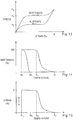
- the stress-strain diagram in Figure 13 illustrates the superelastic effect for an exemplary nickel-titanium alloy at a temperature above the austenitic final temperature (A f ) of the alloy.
- a stress ⁇ a an alloy in a first configuration begins to transform from austenite to martensite as a result of the formation of stress-induced martensite.
- the martensitic phase of the alloy can accommodate several percent strain at a nearly constant stress.
- ⁇ b which corresponds to 8% strain in this example, the martensitic transformation is complete and the alloy has been deformed to a second configuration.
- the martensite begins to transform back to austenite and the alloy recovers the strain at a lower plateau stress of ⁇ c .
- the nickel-titanium alloy thus returns to the first configuration.
- Figure 14 shows a typical transformation temperature curve for an exemplary nickel-titanium shape memory alloy, where the y-axis represents the amount of martensite in the alloy and the x-axis represents temperature.
- the nickel-titanium alloy At or above a temperature of A f , the nickel-titanium alloy has a fully austenitic structure. Following the arrows, the alloy may be cooled to a temperature of M s , at which point the transformation to the martensitic phase begins. Further cooling leads to an increase in the percentage of martensite in the material, ultimately leading to a fully martensitic structure at a temperature of M f , as shown in Figure 14 .
- the fully martensitic structure attained at a temperature of M f may be strained from a first configuration to a second configuration (as shown by the stress symbol ⁇ ).
- the alloy may accommodate several percent recoverable strain (8% in this example).
- the temperature of the alloy is increased.
- the nickel-titanium alloy may be warmed to a temperature of A s , at which point the alloy begins to transform to the austenitic phase.
- the transformation to austenite progresses and the alloy gradually recovers the first configuration.
- the material has completed the return transformation to the austenitic phase (0% martensite) and has fully recovered the 8% strain.
- the nickel-titanium alloy may include an intermediate temperature R-phase in addition to the higher temperature austenitic phase and the lower temperature martensitic phase.
- the R-phase may appear prior to martensite upon cooling from austenite.
- the R-phase may appear prior to austenite upon heating from martensite. Whether or not the nickel-titanium alloy includes the R-phase depends on the composition and processing history of the alloy.
- a nickel-titanium alloy that provides a substantial amount of recoverable strain (i.e., an elastic strain of at least about 0.5%) upon the removal of a deforming stress may be referred to as a superelastic alloy, whether or not the behavior is driven by phase transformations between martensite and austenite.
- a recoverable strain of about 0.75% may be obtained by stress- and/or temperature-induced phase transformations between austenite and the R-phase ( Using Nitinol Alloys, Johnson Mathey, San Jose, CA (2004) p. 17 ).
- the nickel-titanium alloy of the present disclosure provides a recoverable strain in the range of from about 0.5% to about 10%. More preferably, the recoverable strain is in the range of from about 2% to about 10%. Even more preferably, the recoverable strain is in the range of from about 3% to about 10%. Most preferably, the recoverable strain is in the range of from about 5% to about 10%.
- the medical device includes at least one component comprising the nickel-titanium alloy described herein.
- the component may be formed in whole or in part of the nickel-titanium alloy from wire, tubing, ribbon, button, bar, disk, sheet, foil, or another cast or worked shape.
- the component has a composite structure in which one or more portions of the structure are formed of the Ni-Ti-RE alloy, and one or more portions of the structure are formed of a different material.
- the component may include distinct constituents, such as layers, cladding, filaments, strands, cables, particles, fibers, and/or phases, where one or more of the constituents are formed from the Ni-Ti-RE alloy, and one or more are formed from the different material.
- the different material may be a near-equiatomic binary nickel-titanium alloy, according to one embodiment, or a material including one or more elements selected from the group consisting of: Al, Cr, Mn, Fe, Co, Cu, Zn, Ga, Ge, Tc, Cd, In, Sn, Sb, Hg, TI, Pb, Bi, Po, V, Ir, Pt, Au, Re, W, Pd, Rh, Ta, Ag, Ru, Hf, Os, Zr, Nb, and Mo.
- Such a composite structure may provide a component having improved radiopacity and optimized superelastic and/or mechanical properties compared to a monolithic component.
- the component including the nickel-titanium alloy described herein may include at least one wire.
- the wire may have a composite structure including, for example, a core layer and one or more outer layers disposed about the core layer.
- one or more of the layers are formed of the Ni-Ti-RE alloy.
- One or more of the layers may be formed of a different material.
- the different material may be a binary nickel-titanium alloy or a material including one or more of the elements mentioned above.
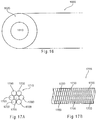
- the wire 1600 may include a core layer 1610 made of the Ni-Ti-RE alloy and an outer layer 1620 made of a near-equiatomic binary nickel-titanium alloy.
- the core layer 1610 may be made of the near-equiatomic binary nickel-titanium alloy and the outer layer 1620 may be made of the Ni-Ti-RE alloy.
- the wire 1600 may be formed by, for example, drawing or extruding a preform including multiple coaxial layers to form the composite structure.
- the wire 1600 may be formed by coating one or more layers on a core layer by plating or another deposition technique.
- the component may include two, three, four, five, six, or more wires, according to one embodiment, where each wire is made in whole or in part of the nickel-titanium alloy of the present disclosure. It also is contemplated that one or more of the wires may be made in whole or in part of a different material, such as a near-equiatomic binary nickel-titanium alloy or a radiopaque metal.
- the component may include a plurality of wire strands 1700 in a twisted configuration 1710 (e.g., a cable) or a plurality of wire strands 1700 in a braided configuration 1720, where one or more of the strands are made of the Ni-Ti-RE alloy and one or more of the strands are made of a near-equiatomic binary nickel-titanium alloy.
- the component comprises a tube or "cannula," to use terminology common in the medical device community.
- the cannula may have a composite structure.
- the cannula may be formed from a multilayered tube.
- the cannula 1800 may include one or more coaxial layers 1810 of Ni-Ti-RE and one or more coaxial layers 1820, 1830 of another material, such as a binary nickel-titanium alloy or a radiopaque metal.
- the multilayered tube may be formed by drawing or extruding coaxial tubing. Alternatively, the multilayered tube may be prepared from a clad sheet that has been formed into a tube.
- the component comprises another cast or worked shape, such as a ribbon, button, bar, rivet, sphere, disk, sheet, or foil.
- an insertable or implantable medical device such as, for example, a stent, a stent graft, a wire guide, a radiopaque marker or marker band, a torqueable catheter, an introducer sheath, an orthodontic arch wire, or a manipulation, retrieval, or occlusive device such as a grasper, a snare, a basket (e.g., stone extraction or manipulation basket), a vascular plug, or an embolic protection filter.
- the device is a stent. All or a portion of the stent may be made of the nickel-titanium alloy.
- the stent may further include a graft material attached thereto.
- the stent is a self-expanding stent.
- balloon-expandable stents also may benefit from the Ni-Ti-RE alloy of the present disclosure.
- the stent may be formed from one or more wires or cut (e.g., laser cut) from a tube (cannula) using techniques known in the art.
- the cannula may have a composite structure as described above.
- the stent 1900 may have a wire structure including one or more wires.
- a portion of the wire structure may be formed of Ni-Ti-RE and a portion of the wire structure may be formed of a different material, such as a binary nickel-titanium alloy.
- the one or more wires of such a stent may be formed as described above.
- the stent may further include a therapeutic surface coating comprising a drug such as, for example, paclitaxel.
- the therapeutic surface coating may help to prevent, for example, re-stenosis and the build-up of minerals at the treatment site.
- the device is a radiopaque marker or marker band ("marker") that provides high x-ray contrast.
- a radiopaque marker may be more readily bonded to a nickel-titanium medical device than radiopaque markers formed of other materials (e.g., Pt or Au) due to the similarity between Ni-Ti-RE and binary nickel-titanium.
- Ni-Ti-RE radiopaque markers may better resist galvanic corrosion than other materials when used with nickel-titanium based devices.
- the superelastic properties of a Ni-Ti-RE radiopaque marker may aid in attaching the marker to a catheter, stent, wire guide or other medical device.
- the marker may be designed to fully expand or contract at or above a temperature corresponding to A f of the Ni-Ti-RE alloy to facilitate the securing of the marker to the device.
- a Ni-Ti-RE marker band may shrink to fit around a catheter, or a Ni-Ti-RE marker may expand to fit securely within an eyelet of a stent.
- Ni-Ti-RE radiopaque markers may be formed by mechanical working techniques known in the art, such as swaging, and marker bands may be cut from thin-walled Ni-Ti-RE tubes.
- the method includes delivering a medical device having at least one component made according to the appending claims to a site in a patient.
- the rare earth element is selected from the group consisting of La, Pr, Nd, Pm, Sm, Eu, Gd, Tb, Dy, Ho, Er, Tm, Yb, Lu, Ac, Th, Pa, and U.
- the patient is then preferably exposed to radiation having an energy in the range of from 15 keV to 125 keV to image the medical device. More preferably, the energy is in the range of from 15 keV to 80 keV for imaging. Even more preferably, the energy is in the range of from 15 keV to 70 keV, or from 15 keV to 60 keV, for imaging. It is also preferred that the radiation has a peak intensity at an energy in the range of from 30 keV to 60 keV. More preferably, the radiation has a peak intensity at an energy in the range of from 35 keV to 55 keV. Even more preferably, the radiation has a peak intensity at an energy in the range of from 40 keV to 50 keV.
- the patient may be situated in opposition to an x-ray source with at least one filter disposed between the x-ray source and the patient.
- the filter may be an aluminum filter (e.g., a 2.5 mm aluminum filter) and/or a copper filter (e.g., a 0.1 mm copper filter, 0.2 mm copper filter, or a 0.3 mm copper filter), for example.
- the x-ray source preferably operates at a voltage ("tube voltage") in the range of from 60 kVp to 150 kVp.
- the method includes providing a medical device including at least one component comprising the nickel-titanium alloy.
- the medical device e.g., a stent, stent graft, retrieval device, or an embolic protection filter
- the medical device may then be inserted into a patient and then delivered to a treatment site in the patient. When positioned at the treatment site, the device may be deployed.
- the superelastic and/or the shape memory effect may be used to deliver and deploy the medical device.
- the device may be maintained in a delivery configuration by a constraining member.
- a constraining member e.g ., the delivery sheath
- the constraining member e.g ., the delivery sheath
- the martensite transforms to austenite and the medical device may reach (recover) its deployed configuration.
- the self-expandable stent may expand from the compressed diameter to an expanded diameter and come into contact with the vessel wall.
- the radiopacity of the alloy aids in positioning the device in the desired location in the body passageway during delivery and deployment.
- the nickel-titanium alloy has an austenite finish temperature (A f ) which is less than or equal to human body temperature (37°C) so that removal of the constraining member is sufficient to trigger the transformation to the austenitic phase.
- a f may be in the range of from about -15°C to about 37°C. Even more preferably, the A f may be in the range of from about -15°C to about 20°C.
- An austenite start temperature (A s ) of the nickel-titanium alloy is preferably in the range of from about -25°C to about 20°C, according to one embodiment.
- the shape memory effect may be utilized to deliver and deploy the medical device comprising the nickel-titanium alloy.
- a change in temperature instead of an applied (removed) stress may control the transformation from martensite to austenite.
- the stent of the previous example may be deployed by heating instead of retraction of a delivery sheath.
- the nickel-titanium alloy has an austenite finish temperature (A f ) which is less than or equal to body temperature (37°C).
- a f austenite finish temperature
- the medical device is maintained at a temperature of less than A f , and preferably less than A s , prior to and during delivery of the device into the body, thereby maintaining a martensitic structure of the nickel-titanium alloy.
- the device transforms to the austenitic structure and thus deploys when warmed up to about body temperature. Cooling of the device during delivery is desirable to prevent the martensitic structure from prematurely transforming to austenite. As the device is being advanced in the body, the cooling may entail keeping the device at a temperature below A s by, for example, flushing a cold fluid through the device or through a delivery system of the device.
- the nickel-titanium alloy has a value of A f of at least about 27°C, although an A f of less than about 27°C also is possible. Even more preferably, the nickel-titanium alloy has a value of A f of at least about 32°C. It also is preferred that A f is no higher than about 37°C.
- the A f of the nickel-titanium alloy is greater than body temperature (37°C) but below a temperature that may be damaging to nearby tissue.
- the A f is at least about 38°C. It also is preferred that the A f is no higher than about 58°C. More preferably, the A f is no higher than about 50°C.
- the medical device is advanced through the body to the treatment site without the need for cooling or a constraining member to maintain a martensitic structure. When the device is in place at the treatment site, the device is warmed up to a temperature of A f or higher to transform the martensite to austenite, and the device deploys to the deployed configuration.
- the heating may entail, for example, flushing a warm fluid through the medical device or the delivery system for the device.
- the heating is halted and the device remains in the body passageway in the deployed configuration.
- the nickel-titanium alloy may be chosen such that M f , and preferably M s , are below body temperature. Since austenite is stronger than martensite, it is preferable to retain the austenitic phase of the nickel-titanium alloy when the medical device is deployed. If the martensitic finish temperature (M f ) and the martensitic start temperature (M s ) are not below body temperature, it may be necessary to continuously heat the device during deployment to prevent an unwanted phase transformation to martensite.
- the transformation temperatures of the present nickel-titanium alloys may be adjusted as desired by controlling the composition and processing of the alloys.
- the transformation temperatures are sensitive to small changes in the ratio of nickel to titanium and to the presence of rare earth or other alloying elements.
- the A f of stoichiometric NiTi alloys - those having exactly a one-to-one proportion of nickel atoms to titanium atoms - is generally above 100°C, while the A f of a slightly off-stoichiometric alloy including an excess of nickel (e.g., from about 50.6 to about 50.8 at.% Ni) is generally around 0°C.
- Increasing the proportion of nickel to titanium in the alloy therefore, provides a means of reducing the A f to the desired level.
- rare earth or other alloying elements also can provide an increase or decrease in the transformation temperatures or alter the magnitude of the temperature hysteresis.
- concentration, type, and/or combination of rare earth alloying elements A f and the other transformation temperatures can be fine-tuned to within the desired temperature range.
- one or more additional alloying elements can be included in combination with the one or more rare earth alloying elements to obtain the desired transformation temperatures.
- additions of chromium, palladium, cobalt and/or iron may be effective in reducing A f .
- Additions of vanadium and/or cobalt may be effective in reducing M s . Copper is useful for eliminating the R-phase.
- DSC differential scanning calorimetry
- Bend and free recovery tests may be carried out in accordance with the ASTM standard F2082-03 entitled "Standard Test Method for Determination of Transformation Temperature of Nickel-Titanium Shape Memory Alloys by Bend and Free Recovery," which is hereby incorporated by reference.
- Electrical resistivity measurements also are known in the art for determining the phase transformation temperatures of metals and alloys. Such measurements may be carried out by heating and cooling the alloy of interest while recording voltage using a four-probe constant current technique, for example. Using electrical resistivity measurements, it is possible to characterize phase transformations occurring in the nickel-titanium alloy as a function of applied stress as well as temperature.
- the nickel-titanium alloy is biocompatible. When introduced into a patient, a biocompatible material or device will not cause an adverse reaction or response in a majority of the patients.
- the biocompatibility of the nickel-titanium alloy may be assessed according to American Society for Testing and Materials (ASTM) standards F748-04 entitled “Standard Practice for Selecting Generic Biological Test Methods for Materials and Devices," F813-01 entitled “Standard Practice for Direct Contact Cell Culture Evaluation of Materials for Medical Devices,” and/or F895-84 entitled “Standard Test Method for Agar Diffusion Cell Culture Screening for Cytotoxicity.” Additionally, the International Standards Organization (ISO) Standard No. 10993 and/or the U.S.
- a melt having the composition as defined in claim 1 is formed and then cooled into a solid (e.g. , an ingot).
- High purity raw materials e.g. , Ti > 99.7 wt.% purity and Ni > 99.99 wt.% purity
- VIM vacuum induction melting
- VAR vacuum consumable arc melting
- electron beam melting may be employed to form the melt.
- Remelting is generally desirable to obtain satisfactory microstructural homogeneity in the ingot.
- successive VAR processes or a VIM/VAR double melting process may be employed.
- the ingot may then be hot worked into a first shape (e.g., bar, rod, tube hollow, or plate) by, for example, extruding, hot rolling, or forging.
- Hot working is generally employed to refine the cast structure of the ingot and to improve mechanical properties.
- the hot working is generally carried out at temperatures in the range of from about 700°C to about 950°C, and may require multiple hot working and reheating cycles.
- the reheating may be carried out over an eight hour period, for example.
- the ingot undergoes a minimum deformation of about 90% during hot working in order to homogenize the as-cast, dendritic microstructure.
- a solution heat treatment that involves soaking the ingot at an elevated temperature for a given time duration, followed by quenching.
- the solution heat treatment may aid in homogenizing the microstructure of the alloy and may be carried out at a temperature in the range of from about 750°C to about 1150°C, for example.
- the solution heat treatment is carried out at a temperature in the range of from about 750°C to about 875°C, as discussed further below.
- the first shape (e.g. , bar, rod, tube, or plate) may then be cold worked into a component by cold drawing or cold rolling, for example.
- the cold working typically involves several passes in combination with interpass annealing treatments at temperatures in the range of from about 600°C to about 800°C.
- the interpass annealing treatments soften the material through recrystallization and growth of the austenite grains between cold work passes, where 30-40% deformation is typically imparted. In some cases, the cold work imparted may range from about 30-50%.
- a polycrystalline diamond die with a molybdenum disulphide or other suitable lubricant may be employed in order to reduce the drawing stress.
- Machining operations such as, for example, drilling, cylindrical centerless grinding, or laser cutting also may be employed to fabricate the component.
- Other operations such as wire braiding or winding, also may be carried out.
- a heat treatment is employed to impart a "memory" of a desired final shape and to optimize the shape memory/superelastic and mechanical properties of the component. This is generally referred to as "heat setting.”
- the number, duration and the temperature of the heat setting treatments may alter the transformation temperatures.
- heat set temperatures of 350°C to 550°C are appropriate to set the final shape and optimize the shape memory/superelastic and mechanical properties.
- the heat setting involves annealing the component while constrained in a final shape at a temperature in the range of from about 350°C to about 550°C. More preferably, heat setting or annealing temperatures in the range of from 450°C to 550°C are appropriate.
- the heat setting treatments described above may cause nickel-rich precipitates to form, thereby reducing the nickel content of the matrix and causing the transformation temperatures to increase.
- the precipitates also may improve the tensile strength of the nickel-titanium alloy. Precipifiation of these nickel-rich particles may be desirable so as to obtain a thermoelastic martensitic phase transformation from austenite.
- the inventors have developed an improved method of homogenizing the nickel-titanium-rare earth alloys that leads to better workability.
- the homogenization heat treatment is carried out after melting and casting of the alloy, but generally prior to further processing of the alloy, as described above.
- the development of the improved method was motivated by interdendritic cracking and failure that may occur during mechanical working of the Ni-Ti-RE alloys when the microstructure includes an interdendritic cellular network of rare earth-rich intermetallic phases.
- An objective of the homogenization heat treatment is to avoid formation of and/or break up the interdendritic cellular network to improve the workability and mechanical properties of the alloy.
- the method entails heat treating a nickel-titanium-rare earth alloy at a homogenization temperature below a critical temperature for a time duration sufficient for spheroidization of one or more rare earth-rich second phases to occur, where spheroidization refers to the formation of a plurality of discrete particles or precipitates in the alloy. These particles, which may be referred to as spheroids, impart better properties (e.g., ductility and workability) to the alloy than does a brittle interdendritic cellular network.
- the spheroids are preferably fine in size and well-dispersed, although they need not be spherical.
- the critical temperature is the incipient melting temperature of the rare earth-rich second phase. Incipient melting refers to melting of the second phase prior to melting of the matrix of the alloy.
- Differential thermal analysis (DTA) may be employed to determine the incipient melting temperature of the RE-rich second phase for a given alloy system. In the case of Ni-Ti-Er alloys, the incipient melting temperature has been found to be about 925°C. A similar effect can be seen for Ni-Ti-7.5 at.% Gd, which suggests that the process is applicable to Ni-Ti-RE systems in general.
- Table 12 provides values for the incipient melting temperature of the RE-rich second phase in several Ni-Ti-RE alloy systems.
- the values for the Ni-Ti-Er, Ni-Ti-Gd, and Ni-Ti-Nd systems are based on DTA measurements of alloys including 7.5 at.% Er, Gd, or Nd, and the Ni-Ti-Dy values are based on a phase diagram analysis.
- the homogenization temperature ranges set forth in the table are expected to be suitable for Ni-Ti-RE alloys over a range of RE concentrations, for example, from about 2.5 at.% RE to about 12.5 at.% RE, or from 5 at.% RE to about 10 at.% RE.
- homogenization temperature ranges set forth also may be suitable for hot working of the respective alloys, as discussed further below.
- examples of Table 12 do not include boron (and therefore without the addition of boron would fall outside the scope of claim 1), the examples are useful for understanding embodiments of the invention. Table 12.
- the spheroidization of the RE-rich phase(s) becomes more favorable as the temperature difference between the homogenization temperature and the incipient melting temperature increases.
- the beneficial effect of homogenization at a lower temperature may be counteracted by the problem that, at too low of a temperature, solid state diffusion may become extremely slow and the spheroidization may not work.
- the inventors believe that homogenization at a temperature in the range of about 750°C to about 875°C may be advantageous for Ni-Ti-Er alloys, based on heat treatment experiments that are described below.
- the temperature of homogenization is a key factor in breaking down the cellular network of RE-rich phases.
- the spheroidization does not occur instantaneously, but rather over a suitable time duration.
- the time duration for homogenization is from about 24 h to about 72 h.
- the alloy that undergoes the homogenization heat treatment may include nickel at a concentration of from about 40 at.% to about 60 at.%, a rare earth element at a concentration of from about 1.5 at.% to about 12 at.%, with the balance of the alloy being titanium. Any of the rare earth elements (RE) mentioned previously may be employed in the homogenized alloy, which also may include from about 3 at.% RE to about 7.5 at.% RE, or from about 4.5 at.% RE to about 6 at.% RE.
- the alloy further includes boron at a concentration of from 0.001 at % to 0.1 at.%.
- the rare earth element is erbium and the concentration of erbium is from 3 at.% to 7.5 at.%.
- the homogenized alloy may include nickel at a concentration of from 45 at.% to 55 at.%, erbium at a concentration of from about 4.5 at.% to about 6 at.%, boron at a concentration of from 0.001 at.% to 0.1 at.%, with the balance being titanium.
- the critical temperature is about 925°C
- the homogenization temperature may be between about 750°C and about 875°C.
- suitable homogenization temperature ranges for other exemplary alloys systems are provided in Table 12.
- the homogenization heat treatment is typically carried out in an inert gas (e.g ., Ar, He, N 2 ), vacuum, or reducing atmosphere. If the heat treatment is carried out in air, the alloy is generally canned in a Cu-Ni tube, packed in silica or glass beads, or encapsulated in a quartz tube. The method may further entail furnace cooling the alloy after the homogenization heat treatment. Alternatively, the alloy may be water quenched after homogenizing.
- an inert gas e.g ., Ar, He, N 2
- pressure may be applied to the alloy while at the homogenization temperature; that is, the alloy may be hot worked during the homogenization heat treatment.
- the alloy may be hot worked after homogenizing at a temperature below the critical temperature.
- the hot working temperature preferably does not exceed the incipient melting temperature, and may be within the homogenization temperature range.
- the method also may include applying an electric field to the alloy during homogenization and/or hot working to enhance solid state migration.
- the alloy also may undergo thermal cycling to assist in the spheroidization or refinement of the Er-rich second phase.
- the thermal cycling may be carried out between temperatures above and below the critical temperature.
- the alloy may be cycled between temperatures of ⁇ 50°C with respect to the critical temperature (e.g. , the incipient melting temperature).
- the alloy may be cycled between temperatures that are below the critical temperature.
- the alloy may be heated to a temperature above 500°C but below 925°C, cooled, and cycled back to a temperature in this range, as discussed further below. After the hot working step, the alloy may be cold worked to achieve at least a 30% reduction in dimension without cracking of the alloy.
- the nickel-titanium alloys of the present disclosure have an ultimate tensile strength of at least about 1350 MPa.
- the ultimate tensile strength (or tensile strength) of a material corresponds to the maximum engineering stress that can be sustained by the material in tension without fracture.
- Engineering stress is defined as F A 0 , where F represents tensile force and A 0 represents the original cross-sectional area of the specimen prior to application of the force.
- Tensile testing of the alloys is preferably carried out in accordance with American Society of Testing and Materials (ASTM) standards F2063, "Standard Specification for Wrought Nickel-Titanium Shape Memory Alloys for Medical Devices and Surgical Implants" and/or F2516 "Standard Test Method for Tension Testing of Nickel-Titanium Superelastic Materials,” which are hereby incorporated by reference.
- ASTM American Society of Testing and Materials
- Ingots of several rare-earth doped nickel-titanium alloys were produced using vacuum induction melting (VIM). Specifically, Ni-Ti-Er, Ni-Ti-La, Ni-Ti-Gd, and Ni-Ti-Nd, each containing 7.5 at.% rare earth element, were melted. A Ni-Ti-7.5 at.% Pt ingot and a binary nickel-titanium alloy also were produced by VIM for comparison. The ingots of 2.25 inches in diameter and 3 inches in height were rolled to form plates. Each of the Ni-Ti-X plates showed some interdendritic cracking as a consequence of rolling, although the Er-doped nickel-titanium alloy seemed to withstand rolling the best.
- VIM vacuum induction melting
- Ni-Ti-Er 1320 236 60 Balance 32.04 20.12 Ni-Ti-La 760 307 8 Balance 33.17 17.30 Ni-Ti-La 33 2130 23 Balance 33.17 17.30 Ni-Ti-Gd 380 149 6 Balance 32.43 19.15 Ni-Ti-Nd 140 124 4 Balance 32.95 17.85 Ni-Ti-Pt 720 270 12 Balance 31.00 22.71 Ni-Ti 980 254 15 Balance Wash chemistry -
- the surfaces of the as-cast specimens were polished to prepare the samples for conventional Brinell hardness tests. Such tests involve pressing a spherical indenter of a specified diameter under a known load into the surface of the specimen, and measuring the diameter (d) of the indentation after the test. A Brinell hardness number (BHN) may then be obtained by dividing the load used, in kilograms, by the actual surface area of the indentation, in square millimeters. Brinell hardness numbers obtained from hardness tests on polished, as-cast specimens are presented in Table 14 below. A steel ball of 1.68 mm in diameter was pushed into the surface of each specimen with a 30 kg force for a dwell time of 10 seconds.
- BBN Brinell hardness number
- the microstructures of the hot worked specimens were investigated using a scanning electron microscope (SEM) equipped with an energy dispersive x-ray spectrometer (EDS).
- SEM scanning electron microscope
- EDS energy dispersive x-ray spectrometer
- the SEM allowed regions of the alloys to be viewed at high magnifications and the EDS provided localized chemical information. Used together, the tools showed that the rare earth elements tended to segregate to the grain boundaries of the Ni-Ti-RE specimens.
- the alloy microstructure showed a dendritic form and included oxide and carbide precipitates. It is believed that compositional nonuniformity may inhibit shape memory phase transformations near human body temperature. Indeed, DSC experiments conducted by heating and cooling the specimens over temperatures ranging from -150°C to 80°C revealed no phase transformations.
- a homogenization heat treatment at a temperature in excess of 850°C, or in the range of from about 700°C to about 900°C and for a longer time duration (e.g., 2-3 days) may be advantageous for improving the compositional homogeneity of the Ni-Ti-RE ingots and obtaining a suitable phase structure for shape memory behavior around body temperature.
- the experiments were carried out using the CDRH phantom in fluoroscopic mode and static mode.
- the intensity of the radiation transmitted through each specimen and the background intensity were measured at various tube voltages.
- Values of x-ray contrast were obtained by subtracting the radiation transmitted through the specimen from the background intensity at each voltage.
- the x-ray contrast values were then normalized by the x-ray contrast obtained for the binary Ni-Ti sample to obtain relative x-ray contrast values for each specimen, as shown in Tables 15 and 16.
- each ternary alloy showed an improvement in radiopacity relative to the binary Nitinol alloy.
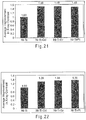
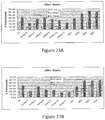
- Table 15 shows the relative x-ray contrast values of the alloys as determined using the CDRH phantom at various voltages in fluoroscopic mode, and Figure 21 shows the average value of relative x-ray contrast for each alloy over the range of voltages used.
- the Ni-Ti-Gd alloy exhibited the highest x-ray contrast, with an average relative x-ray contrast of 1.50 for the voltage range of 40-110 kV.
- the Ni-Ti-Er alloy showed an average relative x-ray contrast of 1.48 for the same voltage range, while the Ni-Ti-Pt alloy exhibited an average relative x-ray contrast of 1.45.
- Table 15 shows the relative x-ray contrast values of the alloys as determined using the CDRH phantom at various voltages in fluoroscopic mode
- Figure 21 shows the average value of relative x-ray contrast for each alloy over the range of voltages used.
- Table 16 shows the relative x-ray contrast values of the alloys as determined using the CDRH phantom at several voltages in static mode, and Figure 22 shows the average value of relative x-ray contrast for each alloy over the range of voltages used.
- the Ni-Ti-Pt alloy exhibited the highest x-ray contrast under these conditions, with an average relative x-ray contrast of 1.35 for the voltage range of 60-100 kV.
- the Ni-Ti-Er alloy showed an average relative x-ray contrast of 1.34 for the same voltage range, while the Ni-Ti-Gd alloy exhibited an average x-ray contrast of 1.29. Table 16.
- the x-ray contrast of a Ni-Ti-RE alloy is in the range of from greater than 1 to about 2 times that of a near-equiatomic binary nickel-titanium alloy when the alloys are exposed to radiation having an energy in the range of from 40 keV to 110 keV. More preferably, the x-ray contrast of the Ni-Ti-RE alloy is in the range of from about 1.2 to about 1.9 times that of the near-equiatomic binary nickel-titanium alloy when the alloys are exposed to radiation having an energy in the range of from 40 keV to 110 keV.
- Rare-earth (RE) rich intermetallic phases are prone to interdendritic segregation and the consequent formation of an interdendritic cellular network.
- the presence of this cellular network may lead to interdendritic cracking and failure.
- Figure 24A shows interdendritic segregation of an Er-rich second phase in the as-cast structure of a NiTi-4.5 at.% Er alloy.
- a similar network forms in NiTi-7.5 at.% Er ingots and persists even after a homogenization treatment at 925°C, as shown in Figure 24B .
- Interdendritic segregation of this second phase makes RE-doped Ni-Ti alloys prone to interdendritic failure during mechanical working, such as cold rolling.
- Figure 24C shows a fractured sample of NiTi-4.5 at.% Er that was homogenized at 1000°C for 7 days.
- the inventors have identified suitable heat treatment parameters to break down and/or avoid formation of the cellular interdendritic network of rare earth-rich second phase.
- the heat treatment process creates spherical and nearly spherical precipitates of RE-Ni and RE-Ni 2 compositions, as shown in Figure 24D , which is a micrograph of a NiTi-4.5 at.% Er alloy that was homogenized at 900°C for 3 days.
- the inventors believe that Ni-Ti-RE alloys homogenized as described here may be able to withstand conventional hot and cold working procedures with intermittent heat treatments.
- Figures 25A-25F show the DSC/DTA response of: (A) a binary NiTi alloy heated to 1390°C; (B) incipient melting of NiEr phases in a NiTi-7.5 at.% Er alloy heated to 1390°C; (C) incipient melting of NiEr phases when the NiTi-7.5 at.%Er alloy is homogenized at 925°C for 24 hours and subsequently solidified; (D) a NiTi-7.5 at.%Er alloy homogenized at 900°C for 72 hours to avoid incipient melting; (E) same as (D) but homogenized at 875°C for 24 hours and (F) 825°C for 24 hours.
- the inventors have discovered that homogenization at temperatures below 925°C may avoid incipient melting in Ni-Ti-Er alloys.
- the critical temperature has been found to be 925°C.
- Figures 28A to 28H show (A) the as-cast alloy microstructure and the microstructures after (B) heat treatment at 925°C for one day; (C) heat treatment at 900°C for one day; (D) heat treatment at 900°C for three days; (E) heat treatment at 875°C for one day (center); (F) heat treatment at 875°C for one day (edge); (G) heat treatment at 825°C for one day (center); and (H) heat treatment at 825°C for one day (edge).
- Refinement of the RE-rich phases in the form of fine precipitates may be achieved by heating the alloy to a temperature beyond the incipient melting zone (e.g ., 925°C in the case of Ni-Ti-Er) so that the alloy reaches the liquid/solid (conventionally known as the L+S) region of the quasi-binary equilibrium system of NiTi, NiEr and/or Ni 2 Er.
- the alloy may be held at that temperature for a predetermined time followed by rapid cooling in air, water, brine or oil. This treatment can be repeated several times to achieve finer precipitates.
- the alloy may be thermally cycled about the critical temperature (incipient melting temperature) to enhance the refinement of the RE-rich phases.
- the thermal cycling may be carried out between temperatures of about ⁇ 50°C with respect to the critical temperature (e.g., incipient melting temperature of second phase).
- the critical temperature e.g., incipient melting temperature of second phase.
- the thermal cycling may be conducted between about 875°C and about 975°C. This process may promote diffusion of erbium back into the NiTi matrix as well as enhance the precipitation of finer (Ni,Er) particles.
- the thermal cycling also may be effectively carried out at temperatures of about ⁇ 25°C with respect to the critical temperature, or about ⁇ 75°C with respect to the critical temperature.
- a quick repeat heating cycle of between about 750°C and about 850°C in the case of Ni-Ti-Er alloys may cause enough micro-movement in (Ni,Er)-rich phases that they will spread again, thus making further working possible.
- Solid state diffusion to promote spheroidization may be enhanced by the application of pressure while keeping the ingot at an elevated temperature that may be within the homogenization temperature range.
- pressure can be applied by the means of conventional hot working methods (e.g. rolling, extrusion, swaging, or forging). This approach may substantially reduce the holding time at the homogenization temperature.
- Hot forging of a homogenized alloy at 800°C resulted in an alloy including a fine Er network with no apparent large agglomerates.
- the Ni-Ti-RE alloy is maintained at a temperature below the critical temperature for any hot working operations.
- Further enhancement of solid state migration can be achieved by the application of an electric field during the application of pressure to cause a flow of the broken masses of RE-rich phase(s) in the direction of the applied field.
- the electric field can be used as a means of heating the alloy to the required temperatures, as is done with spark plasma sintering, for example.
- the rate of directional migration may be such that the surface energy is unfavorable for spheroidization; however, the alloy treated as described above may still be amenable to further working due to the broken nature of the RE-rich network.
- Ni-Ti-Er alloys buttons of the following compositions were melted with and without boron and evaluated for workability. Table 18. Ni-Ti-Er-B Alloys Tested Alloy Ni (at.%) Er (at.%) B (ppm) Ti (at.%) Comp. 1 50 1.5 35 Balance Comp. 2 50 3 35 Balance Comp. 3 50 4.5 35 Balance Comp. 4 50 6 35 Balance
- composition 3 exhibited a Vicker's hardness of 166 as compared to the Vicker's hardness of 230 or greater for binary Nitinol.
- Hardness data for various Ni-Ti-Er alloys as a function of Er, Pd, Cr and B additions are shown in Figures 29 and 30 , respectively, for as-cast alloys and for alloys homogenized at 850°C for three days.
- Ni-Ti-RE nickel-titanium-rare earth alloy that exhibits enhanced radiopacity compared to binary Ni-Ti and improved ductility over previous Ni-Ti-RE alloys
- Boron may be added to Ni-Ti-RE alloys to enhance the ductility, and the rare earth element is preferably erbium.
- a method of making a Ni-Ti-RE alloy with improved workability and radiopacity has also been described.
- the Ni-Ti-RE alloy preferably exhibits superelastic or shape memory behavior, and may be employed for medical devices and other applications, such as actuators and sealing plugs.
Landscapes
- Chemical & Material Sciences (AREA)
- Mechanical Engineering (AREA)
- Organic Chemistry (AREA)
- Metallurgy (AREA)
- Engineering & Computer Science (AREA)
- Materials Engineering (AREA)
- Crystallography & Structural Chemistry (AREA)
- Physics & Mathematics (AREA)
- Thermal Sciences (AREA)
- Materials For Medical Uses (AREA)
- Superconductors And Manufacturing Methods Therefor (AREA)
- Powder Metallurgy (AREA)
- Manufacture And Refinement Of Metals (AREA)
Claims (18)
- Alliage nickel-titane-terre rare comprenant :du nickel à une concentration de 35 % at. à 65 % at. ;un élément terre rare à une concentration de 1,5 % at. à 15 % at. ;du bore à une concentration de 0,001 % at. jusqu'à 0,1 % at. ; etdu titane à une concentration de 34 % at. à 60 % at. ;l'alliage comprenant facultativement pas plus de 14,9 % at. d'un ou plusieurs éléments d'alliage additionnels choisis dans le groupe de Al, Cr, Mn, Fe, Co, Cu, Zn, Ga, Ge, Zr, Nb, Mo, Tc, Ru, Rh, Pd, Ag, Cd, In, Sn, Sb, Hf, Ta, W, Re, Os, Ir, Pt, Au, Hg, Tl, Pb, Bi, Po, V et le mischmétal.
- Alliage de la revendication 1, dans lequel l'élément terre rare est choisi dans le groupe constitué de : La, Pr, Nd, Pm, Sm, Eu, Gd, Tb, Dy, Ho, Er, Tm, Yb et Lu.
- Alliage de la revendication 2, dans lequel l'élément terre rare est Er.
- Alliage de l'une quelconque des revendications précédentes, dans lequel la concentration de l'élément terre rare est au moins l'une de 1,5 % at. à 12 % at., de 3 % at. à 7,5 % at., et de 4,5 % at. à 6 % at.
- Alliage de l'une quelconque des revendications précédentes, dans lequel la concentration de bore est au moins l'une de 0,005 % at. à 0,1 % at., et de 0,01 % at. à 0,05 % at.
- Alliage de la revendication 1, dans lequel la concentration de bore est de 35 ppm.
- Alliage de l'une quelconque des revendications précédentes, dans lequel la concentration de nickel est de 45 % at. à 55 % at.
- Alliage de l'une quelconque des revendications précédentes ayant une température Af d'au moins l'un de 35 °C ou moins, de manière à présenter une superélasticité à température corporelle, ou 10 °C ou moins.
- Alliage de la revendication 1, comprenant :du nickel à une concentration de 45 % at. à 55 % at. ;de l'erbium à une concentration de 4,5 % at. à 6 % at. ;du bore à une concentration de 0,005 % at. à 0,1 % at. ;le complément étant du titane, l'alliage ayant une radio-opacité supérieure à celle d'un alliage nickel-titane binaire.
- Procédé de traitement d'un alliage nickel-titane-terre rare, le procédé comprenant :la fourniture d'un alliage nickel-titane-terre rare selon la revendication 1 ;le chauffage de l'alliage nickel-titane-terre rare dans une plage de température d'homogénéisation au-dessous d'une première température, la première température étant une température de début de fusion de la deuxième phase riche en terre rare ; etla formation de sphéroïdes d'une deuxième phase riche en terre rare dans l'alliage nickel-titane-terre rare dans la plage de température d'homogénéisation.
- Procédé de la revendication 10, dans lequel la première température est de 925 °C ; et/ou dans lequel la plage de température d'homogénéisation est de 750 °C à 875 °C ; et/ou
dans lequel la formation de sphéroïdes comprend le maintien de l'alliage nickel-titane-terre rare dans la plage de température d'homogénéisation pendant une durée de 24 h à 72 h ; et/ou
dans lequel l'élément terre rare est choisi dans le groupe constitué de : La, Pr, Nd, Pm, Sm, Eu, Gd, Tb, Dy, Ho, Er, Tm, Yb, et Lu, l'élément terre rare étant de préférence l'erbium ; et/ou
dans lequel la concentration de l'élément terre rare est de 3 % at. à 7,5 % at. - Procédé de l'une quelconque des revendications 10 et 11, le procédé comprenant en outre :le cyclage thermique de l'alliage nickel-titane-terre rare, facultativement après la formation des sphéroïdes, dans lequel le cyclage thermique comprend facultativement le cyclage de l'alliage nickel-titane-terre rare entre des températures au-dessus et au-dessous de la première température, dans lequel, de préférence, les températures ne diffèrent pas de plus de 50 °C de la première température, ou entre les températures au-dessous de la première température, dans lequel, de préférence, au moins une des températures est dans la plage de température d'homogénéisation ; et/oule travail à chaud de l'alliage, où, facultativement, le travail à chaud comprend l'application d'une pression à l'alliage pendant le chauffage, dans lequel, facultativement, le travail à chaud comprend l'application d'une pression à l'alliage après le chauffage, la pression étant appliquée à une température au-dessous de la première température, et dans lequel, facultativement, la température à laquelle la pression est appliquée est dans la plage de température d'homogénéisation température ; et/ou l'application d'un champ électrique à l'alliage, où, facultativement, le champ électrique est appliqué pendant le travail à chaud ; et/oula trempe à l'eau de l'alliage après le chauffage ; et/oule refroidissement au four de l'alliage après le chauffage ; et/oule travail à froid de l'alliage pour obtenir une réduction d'au moins 30 % d'une dimension sans fissuration de l'alliage.
- Procédé de la revendication 10, dans lequel l'alliage comprend du nickel à une concentration de 45 % at. à 55 % at. ; de l'erbium à une concentration de 4,5 % at. à 6 % at. ; du bore à une concentration de 0,005 % at. à 0,1 % at. ; le complément étant du titane, l'alliage ayant une radio-opacité supérieure à celle d'un alliage nickel-titane binaire.
- Dispositif médical comprenant au moins un composant comprenant l'alliage nickel-titane-terre rare selon l'une quelconque des revendications 1 à 9.
- Dispositif médical selon la revendication 14 dans lequel l'au moins un composant comprend :au moins un fil métallique, où, facultativement, l'au moins un fil métallique a une structure composite comprenant une couche d'âme et une ou plusieurs couches externes disposées autour de la couche d'âme, et dans lequel une ou plusieurs des couches sont formées de l'alliage nickel-titane ;une canule, la canule comprenant facultativement une structure composite comprenant une ou plusieurs couches coaxiales de l'alliage nickel-titane ; et/ou au moins l'un d'un stent et d'un marqueur radio-opaque ou une bande de marqueur qui produit un contraste élevé aux rayons X.
- Alliage de la revendication 1, comprenant en outre du fer à une concentration allant jusqu'à 3 % at.
- Alliage de la revendication 16, dans lequel le fer est présent à une concentration allant jusqu'à 1 % at.
- Alliage de la revendication 17, dans lequel le fer est présent à une concentration de 0,1 % at. à 1 % at.
Applications Claiming Priority (2)
| Application Number | Priority Date | Filing Date | Title |
|---|---|---|---|
| GB0920123.7A GB2475340B (en) | 2009-11-17 | 2009-11-17 | Nickel-titanium alloy and method of processing the alloy |
| PCT/US2010/056687 WO2011062863A1 (fr) | 2009-11-17 | 2010-11-15 | Alliage nickel-titane-terre rare et procédé de traitement de l'alliage |
Publications (3)
| Publication Number | Publication Date |
|---|---|
| EP2501833A1 EP2501833A1 (fr) | 2012-09-26 |
| EP2501833B1 true EP2501833B1 (fr) | 2017-01-04 |
| EP2501833B8 EP2501833B8 (fr) | 2019-07-10 |
Family
ID=41509516
Family Applications (1)
| Application Number | Title | Priority Date | Filing Date |
|---|---|---|---|
| EP10778816.8A Active EP2501833B8 (fr) | 2009-11-17 | 2010-11-15 | Alliage nickel-titane-élément de terre rare et son procede de traitement |
Country Status (5)
| Country | Link |
|---|---|
| US (2) | US8440031B2 (fr) |
| EP (1) | EP2501833B8 (fr) |
| JP (2) | JP6050117B2 (fr) |
| GB (1) | GB2475340B (fr) |
| WO (1) | WO2011062863A1 (fr) |
Families Citing this family (16)
| Publication number | Priority date | Publication date | Assignee | Title |
|---|---|---|---|---|
| DK2059619T3 (da) | 2006-09-06 | 2011-02-21 | Cook Inc | Nikkel-titan-legering omfattende et sjældent jordmetal |
| EP2496724B1 (fr) | 2009-11-02 | 2016-09-28 | SAES Smart Materials | Produits semi-finis en ni-ti et procédés correspondants |
| GB2475340B (en) | 2009-11-17 | 2013-03-27 | Univ Limerick | Nickel-titanium alloy and method of processing the alloy |
| US8475711B2 (en) * | 2010-08-12 | 2013-07-02 | Ati Properties, Inc. | Processing of nickel-titanium alloys |
| GB2495772B (en) | 2011-10-21 | 2014-02-12 | Univ Limerick | Method of forming a sintered nickel-titanium-rare earth (Ni-Ti-RE) alloy |
| US9212409B2 (en) * | 2012-01-18 | 2015-12-15 | Cook Medical Technologies Llc | Mixture of powders for preparing a sintered nickel-titanium-rare earth metal (Ni-Ti-RE) alloy |
| CN104662200A (zh) * | 2012-05-16 | 2015-05-27 | Gkn航空公司 | 在基底上施加钛合金的方法 |
| US9345573B2 (en) | 2012-05-30 | 2016-05-24 | Neovasc Tiara Inc. | Methods and apparatus for loading a prosthesis onto a delivery system |
| US9551049B2 (en) * | 2012-08-28 | 2017-01-24 | United Technologies Corporation | High elastic modulus shafts and method of manufacture |
| US9279171B2 (en) | 2013-03-15 | 2016-03-08 | Ati Properties, Inc. | Thermo-mechanical processing of nickel-titanium alloys |
| JP6898098B2 (ja) * | 2013-09-06 | 2021-07-07 | オルムコ コーポレイション | 歯列矯正器具並びに当該器具の作製方法及び使用方法 |
| JP7156950B2 (ja) | 2016-04-20 | 2022-10-19 | フォート ウェイン メタルズ リサーチ プロダクツ,エルエルシー | 酸化物介在物が低減されたニッケル-チタン-イットリウム合金ワイヤー |
| EP3295969A1 (fr) | 2016-09-20 | 2018-03-21 | Cook Medical Technologies LLC | Fil composite radio-opaque pour des applications médicales et procédé de fabrication d'un fil composite radio-opaque |
| JP2018175127A (ja) * | 2017-04-07 | 2018-11-15 | 東海電気株式会社 | 体内管導入物用マーカー及び体内管導入物,並びにそれらの製造方法 |
| CN114054744B (zh) * | 2021-11-19 | 2022-11-01 | 吉林大学 | 一种改善激光选区熔化NiTi合金力学性能的方法 |
| CN116748534A (zh) * | 2023-05-15 | 2023-09-15 | 浙江大学高端装备研究院 | 一种针对增材制造镍钛形状记忆合金的热处理生磁方法 |
Family Cites Families (61)
| Publication number | Priority date | Publication date | Assignee | Title |
|---|---|---|---|---|
| JPS4866521A (fr) | 1971-12-15 | 1973-09-12 | ||
| JPS4936516A (fr) * | 1972-08-08 | 1974-04-04 | ||
| JPS5392317A (en) * | 1977-01-25 | 1978-08-14 | Agency Of Ind Science & Technol | Hydrogen storing tib1-xax alloy |
| JPS58157935A (ja) * | 1982-03-13 | 1983-09-20 | Hitachi Metals Ltd | 形状記憶合金 |
| JPH076047B2 (ja) | 1982-12-07 | 1995-01-25 | 住友電気工業株式会社 | 形状記憶合金材の製造方法 |
| JPS61210142A (ja) | 1985-03-14 | 1986-09-18 | Mitsui Eng & Shipbuild Co Ltd | 耐衝撃性に優れたNiTi合金及びその製造方法 |
| JPS61295349A (ja) * | 1985-06-24 | 1986-12-26 | Hitachi Metals Ltd | 加工性の優れたTi−Ni系形状記憶合金 |
| JPS627839A (ja) | 1985-07-03 | 1987-01-14 | Sumitomo Electric Ind Ltd | NiTi系合金の製造方法 |
| DE69007841T2 (de) | 1989-04-28 | 1994-08-11 | Terumo Corp | Schnell betriebsbereiter Führungsdraht für Katheter unter Anwendung einer Memory-Legierung mit Pseudoelastizität. |
| JPH03150333A (ja) * | 1989-11-02 | 1991-06-26 | Hitachi Metals Ltd | 形状記憶合金およびその製造方法 |
| JPH0683726B2 (ja) | 1990-10-12 | 1994-10-26 | 日本精線株式会社 | カテーテル用ガイドワイヤ |
| US6165292A (en) | 1990-12-18 | 2000-12-26 | Advanced Cardiovascular Systems, Inc. | Superelastic guiding member |
| US6682608B2 (en) | 1990-12-18 | 2004-01-27 | Advanced Cardiovascular Systems, Inc. | Superelastic guiding member |
| US5341818A (en) | 1992-12-22 | 1994-08-30 | Advanced Cardiovascular Systems, Inc. | Guidewire with superelastic distal portion |
| US6497709B1 (en) | 1992-03-31 | 2002-12-24 | Boston Scientific Corporation | Metal medical device |
| US5636641A (en) | 1994-07-25 | 1997-06-10 | Advanced Cardiovascular Systems, Inc. | High strength member for intracorporeal use |
| JP3452335B2 (ja) * | 1994-08-19 | 2003-09-29 | 関東特殊製鋼株式会社 | NiTi基合金 |
| JP3859741B2 (ja) | 1994-08-31 | 2006-12-20 | 株式会社三共 | 遊技機 |
| EP0709482B1 (fr) | 1994-10-28 | 1999-07-28 | Kazuhiro Otsuka | Procédé de fabrication d'alliages à mémoire de forme ayant une température de transformation élevée |
| US5951793A (en) | 1995-07-12 | 1999-09-14 | The Furukawa Electric Co., Ltd. | Ni-Ti-Pd superelastic alloy material, its manufacturing method, and orthodontic archwire made of this alloy material |
| ATE208437T1 (de) | 1995-08-31 | 2001-11-15 | Santoku Metal Ind | Wasserstoffabsorbierende seltene-erden metall/nickel basislegierung, herstellungsverfahren und negative elektrode für nickel-wasserstoff-sekundär-batterie |
| JP3009623B2 (ja) | 1996-03-22 | 2000-02-14 | 古河電気工業株式会社 | 眼鏡フレームとその製造方法及び形状調整方法 |
| US5927345A (en) | 1996-04-30 | 1999-07-27 | Target Therapeutics, Inc. | Super-elastic alloy braid structure |
| US6312454B1 (en) | 1996-06-13 | 2001-11-06 | Nitinol Devices & Components | Stent assembly |
| JPH108168A (ja) * | 1996-06-24 | 1998-01-13 | Daido Steel Co Ltd | 加工性の改善されたNi−Ti−Zr(Hf)系形状記憶合金 |
| US6312455B2 (en) | 1997-04-25 | 2001-11-06 | Nitinol Devices & Components | Stent |
| US6399886B1 (en) | 1997-05-02 | 2002-06-04 | General Science & Technology Corp. | Multifilament drawn radiopaque high elastic cables and methods of making the same |
| US6557993B2 (en) | 1998-07-20 | 2003-05-06 | Optigen S.R.L. | Eyeglasses and parts thereof made with specially processed NiTi shape memory alloy |
| US6325824B2 (en) | 1998-07-22 | 2001-12-04 | Advanced Cardiovascular Systems, Inc. | Crush resistant stent |
| US6375458B1 (en) | 1999-05-17 | 2002-04-23 | Memry Corporation | Medical instruments and devices and parts thereof using shape memory alloys |
| US6352515B1 (en) | 1999-12-13 | 2002-03-05 | Advanced Cardiovascular Systems, Inc. | NiTi alloyed guidewires |
| US7250058B1 (en) | 2000-03-24 | 2007-07-31 | Abbott Cardiovascular Systems Inc. | Radiopaque intraluminal stent |
| US6706053B1 (en) | 2000-04-28 | 2004-03-16 | Advanced Cardiovascular Systems, Inc. | Nitinol alloy design for sheath deployable and re-sheathable vascular devices |
| US6572646B1 (en) | 2000-06-02 | 2003-06-03 | Advanced Cardiovascular Systems, Inc. | Curved nitinol stent for extremely tortuous anatomy |
| US6626937B1 (en) | 2000-11-14 | 2003-09-30 | Advanced Cardiovascular Systems, Inc. | Austenitic nitinol medical devices |
| US20060086440A1 (en) | 2000-12-27 | 2006-04-27 | Boylan John F | Nitinol alloy design for improved mechanical stability and broader superelastic operating window |
| US7128757B2 (en) | 2000-12-27 | 2006-10-31 | Advanced Cardiovascular, Inc. | Radiopaque and MRI compatible nitinol alloys for medical devices |
| US6855161B2 (en) | 2000-12-27 | 2005-02-15 | Advanced Cardiovascular Systems, Inc. | Radiopaque nitinol alloys for medical devices |
| US6569194B1 (en) | 2000-12-28 | 2003-05-27 | Advanced Cardiovascular Systems, Inc. | Thermoelastic and superelastic Ni-Ti-W alloy |
| US6884234B2 (en) | 2001-11-01 | 2005-04-26 | Cardio Exodus Partners | Foldable and remotely imageable balloon |
| JP2005508229A (ja) | 2001-11-05 | 2005-03-31 | メンリー コーポレイション | 加工硬化擬弾性ガイドワイヤ |
| AU2003262373A1 (en) | 2002-04-19 | 2003-11-03 | Salviac Limited | A medical device |
| US6830638B2 (en) | 2002-05-24 | 2004-12-14 | Advanced Cardiovascular Systems, Inc. | Medical devices configured from deep drawn nickel-titanium alloys and nickel-titanium clad alloys and method of making the same |
| JP2006501926A (ja) | 2002-10-04 | 2006-01-19 | アドバンスド、カーディオバスキュラー、システムズ、インコーポレーテッド | 医療機器用の放射線不透過性ニチノール合金 |
| US20040143317A1 (en) | 2003-01-17 | 2004-07-22 | Stinson Jonathan S. | Medical devices |
| US7192496B2 (en) | 2003-05-01 | 2007-03-20 | Ati Properties, Inc. | Methods of processing nickel-titanium alloys |
| US7942892B2 (en) | 2003-05-01 | 2011-05-17 | Abbott Cardiovascular Systems Inc. | Radiopaque nitinol embolic protection frame |
| US20040236409A1 (en) | 2003-05-20 | 2004-11-25 | Pelton Alan R. | Radiopacity intraluminal medical device |
| US20050131522A1 (en) | 2003-12-10 | 2005-06-16 | Stinson Jonathan S. | Medical devices and methods of making the same |
| JP4351560B2 (ja) | 2004-03-05 | 2009-10-28 | Necトーキン株式会社 | バルーン拡張超弾性ステント |
| US7344560B2 (en) | 2004-10-08 | 2008-03-18 | Boston Scientific Scimed, Inc. | Medical devices and methods of making the same |
| WO2006053270A2 (fr) | 2004-11-10 | 2006-05-18 | Boston Scientific Limited | Endoprothese vasculaire atraumatique a force de deploiement reduite, procede de fabrication de cette derniere et procede et appareil de deploiement et de positionnement de l'endoprothese vasculaire |
| ATE435616T1 (de) | 2004-12-15 | 2009-07-15 | Cook Urological Inc | Röntgendichte manipulationsvorrichtungen |
| US7641983B2 (en) | 2005-04-04 | 2010-01-05 | Boston Scientific Scimed, Inc. | Medical devices including composites |
| DK2059619T3 (da) * | 2006-09-06 | 2011-02-21 | Cook Inc | Nikkel-titan-legering omfattende et sjældent jordmetal |
| RU2333986C1 (ru) * | 2006-12-12 | 2008-09-20 | Юлия Алексеевна Щепочкина | Сплав |
| US8398789B2 (en) | 2007-11-30 | 2013-03-19 | Abbott Laboratories | Fatigue-resistant nickel-titanium alloys and medical devices using same |
| US8888835B2 (en) | 2008-04-23 | 2014-11-18 | Cook Medical Technologies Llc | Method of loading a medical device into a delivery system |
| CN101314826B (zh) | 2008-07-18 | 2010-06-23 | 北京航空航天大学 | 一种钛镍铝稀土高温合金材料及其制备方法 |
| GB2475340B (en) | 2009-11-17 | 2013-03-27 | Univ Limerick | Nickel-titanium alloy and method of processing the alloy |
| GB2495772B (en) | 2011-10-21 | 2014-02-12 | Univ Limerick | Method of forming a sintered nickel-titanium-rare earth (Ni-Ti-RE) alloy |
-
2009
- 2009-11-17 GB GB0920123.7A patent/GB2475340B/en active Active
-
2010
- 2010-11-15 JP JP2012539961A patent/JP6050117B2/ja active Active
- 2010-11-15 EP EP10778816.8A patent/EP2501833B8/fr active Active
- 2010-11-15 WO PCT/US2010/056687 patent/WO2011062863A1/fr not_active Ceased
- 2010-11-15 US US12/946,291 patent/US8440031B2/en active Active
-
2013
- 2013-04-16 US US13/863,760 patent/US9074274B2/en active Active
-
2016
- 2016-08-19 JP JP2016161248A patent/JP6746431B2/ja active Active
Non-Patent Citations (1)
| Title |
|---|
| None * |
Also Published As
| Publication number | Publication date |
|---|---|
| US20130284326A1 (en) | 2013-10-31 |
| EP2501833B8 (fr) | 2019-07-10 |
| GB2475340A (en) | 2011-05-18 |
| JP2013510955A (ja) | 2013-03-28 |
| GB0920123D0 (en) | 2009-12-30 |
| US20110114230A1 (en) | 2011-05-19 |
| US9074274B2 (en) | 2015-07-07 |
| US8440031B2 (en) | 2013-05-14 |
| JP6746431B2 (ja) | 2020-08-26 |
| GB2475340B (en) | 2013-03-27 |
| JP2017014623A (ja) | 2017-01-19 |
| WO2011062863A1 (fr) | 2011-05-26 |
| JP6050117B2 (ja) | 2016-12-21 |
| EP2501833A1 (fr) | 2012-09-26 |
Similar Documents
| Publication | Publication Date | Title |
|---|---|---|
| EP2501833B1 (fr) | Alliage nickel-titane-élément de terre rare et son procede de traitement | |
| EP2059619B1 (fr) | Alliage nickel-titane incluant un élément de terre rare | |
| US11001910B2 (en) | Fatigue strength of shape memory alloy tubing and medical devices made therefrom | |
| US8398789B2 (en) | Fatigue-resistant nickel-titanium alloys and medical devices using same | |
| CA2884552C (fr) | Traitement thermomecanique d'alliages de nickel-titane | |
| Gao et al. | Effect of grain size on the recovery strain in a new Ti–20Zr–12Nb–2Sn superelastic alloy | |
| EP3023508B1 (fr) | Élément expansé comprenant un matériau en alliage de cu-al-mn et présentant des propriétés supérieures de résistance à la corrosion sous contrainte, et son utilisation | |
| US20180161121A1 (en) | Radiopaque composite wire for medical applications and method of making a radiopaque composite wire | |
| EP3295969A1 (fr) | Fil composite radio-opaque pour des applications médicales et procédé de fabrication d'un fil composite radio-opaque | |
| O’Brien et al. | Initial exploration of Ti–Ta, Ti–Ta–Ir and Ti–Ir alloys: candidate materials for coronary stents | |
| EP3040429A1 (fr) | Alliage superélastique | |
| JP4477297B2 (ja) | Ti−Mo基合金ばね材 | |
| JP7669067B2 (ja) | Co基超弾性合金材、Co基超弾性合金材からなる板材及び線材、Co基超弾性合金材の製造方法、ステント、ガイドワイヤならびに人工股関節 | |
| US20070131317A1 (en) | Nickel-titanium alloy with a non-alloyed dispersion and methods of making same | |
| MÁLEK et al. | The influence of Zr on microstructure of beta-titanium alloys |
Legal Events
| Date | Code | Title | Description |
|---|---|---|---|
| PUAI | Public reference made under article 153(3) epc to a published international application that has entered the european phase |
Free format text: ORIGINAL CODE: 0009012 |
|
| 17P | Request for examination filed |
Effective date: 20120424 |
|
| AK | Designated contracting states |
Kind code of ref document: A1 Designated state(s): AL AT BE BG CH CY CZ DE DK EE ES FI FR GB GR HR HU IE IS IT LI LT LU LV MC MK MT NL NO PL PT RO RS SE SI SK SM TR |
|
| DAX | Request for extension of the european patent (deleted) | ||
| 17Q | First examination report despatched |
Effective date: 20150305 |
|
| GRAP | Despatch of communication of intention to grant a patent |
Free format text: ORIGINAL CODE: EPIDOSNIGR1 |
|
| INTG | Intention to grant announced |
Effective date: 20160322 |
|
| GRAJ | Information related to disapproval of communication of intention to grant by the applicant or resumption of examination proceedings by the epo deleted |
Free format text: ORIGINAL CODE: EPIDOSDIGR1 |
|
| INTC | Intention to grant announced (deleted) | ||
| GRAR | Information related to intention to grant a patent recorded |
Free format text: ORIGINAL CODE: EPIDOSNIGR71 |
|
| GRAS | Grant fee paid |
Free format text: ORIGINAL CODE: EPIDOSNIGR3 |
|
| STAA | Information on the status of an ep patent application or granted ep patent |
Free format text: STATUS: GRANT OF PATENT IS INTENDED |
|
| GRAA | (expected) grant |
Free format text: ORIGINAL CODE: 0009210 |
|
| STAA | Information on the status of an ep patent application or granted ep patent |
Free format text: STATUS: THE PATENT HAS BEEN GRANTED |
|
| INTG | Intention to grant announced |
Effective date: 20161124 |
|
| AK | Designated contracting states |
Kind code of ref document: B1 Designated state(s): AL AT BE BG CH CY CZ DE DK EE ES FI FR GB GR HR HU IE IS IT LI LT LU LV MC MK MT NL NO PL PT RO RS SE SI SK SM TR |
|
| REG | Reference to a national code |
Ref country code: GB Ref legal event code: FG4D |
|
| REG | Reference to a national code |
Ref country code: CH Ref legal event code: EP |
|
| REG | Reference to a national code |
Ref country code: AT Ref legal event code: REF Ref document number: 859326 Country of ref document: AT Kind code of ref document: T Effective date: 20170115 |
|
| REG | Reference to a national code |
Ref country code: IE Ref legal event code: FG4D |
|
| REG | Reference to a national code |
Ref country code: DE Ref legal event code: R096 Ref document number: 602010039353 Country of ref document: DE |
|
| REG | Reference to a national code |
Ref country code: LT Ref legal event code: MG4D Ref country code: NL Ref legal event code: MP Effective date: 20170104 |
|
| REG | Reference to a national code |
Ref country code: AT Ref legal event code: MK05 Ref document number: 859326 Country of ref document: AT Kind code of ref document: T Effective date: 20170104 |
|
| PG25 | Lapsed in a contracting state [announced via postgrant information from national office to epo] |
Ref country code: NL Free format text: LAPSE BECAUSE OF FAILURE TO SUBMIT A TRANSLATION OF THE DESCRIPTION OR TO PAY THE FEE WITHIN THE PRESCRIBED TIME-LIMIT Effective date: 20170104 |
|
| PG25 | Lapsed in a contracting state [announced via postgrant information from national office to epo] |
Ref country code: NO Free format text: LAPSE BECAUSE OF FAILURE TO SUBMIT A TRANSLATION OF THE DESCRIPTION OR TO PAY THE FEE WITHIN THE PRESCRIBED TIME-LIMIT Effective date: 20170404 Ref country code: HR Free format text: LAPSE BECAUSE OF FAILURE TO SUBMIT A TRANSLATION OF THE DESCRIPTION OR TO PAY THE FEE WITHIN THE PRESCRIBED TIME-LIMIT Effective date: 20170104 Ref country code: LT Free format text: LAPSE BECAUSE OF FAILURE TO SUBMIT A TRANSLATION OF THE DESCRIPTION OR TO PAY THE FEE WITHIN THE PRESCRIBED TIME-LIMIT Effective date: 20170104 Ref country code: GR Free format text: LAPSE BECAUSE OF FAILURE TO SUBMIT A TRANSLATION OF THE DESCRIPTION OR TO PAY THE FEE WITHIN THE PRESCRIBED TIME-LIMIT Effective date: 20170405 Ref country code: IS Free format text: LAPSE BECAUSE OF FAILURE TO SUBMIT A TRANSLATION OF THE DESCRIPTION OR TO PAY THE FEE WITHIN THE PRESCRIBED TIME-LIMIT Effective date: 20170504 Ref country code: FI Free format text: LAPSE BECAUSE OF FAILURE TO SUBMIT A TRANSLATION OF THE DESCRIPTION OR TO PAY THE FEE WITHIN THE PRESCRIBED TIME-LIMIT Effective date: 20170104 |
|
| PG25 | Lapsed in a contracting state [announced via postgrant information from national office to epo] |
Ref country code: LV Free format text: LAPSE BECAUSE OF FAILURE TO SUBMIT A TRANSLATION OF THE DESCRIPTION OR TO PAY THE FEE WITHIN THE PRESCRIBED TIME-LIMIT Effective date: 20170104 Ref country code: RS Free format text: LAPSE BECAUSE OF FAILURE TO SUBMIT A TRANSLATION OF THE DESCRIPTION OR TO PAY THE FEE WITHIN THE PRESCRIBED TIME-LIMIT Effective date: 20170104 Ref country code: AT Free format text: LAPSE BECAUSE OF FAILURE TO SUBMIT A TRANSLATION OF THE DESCRIPTION OR TO PAY THE FEE WITHIN THE PRESCRIBED TIME-LIMIT Effective date: 20170104 Ref country code: PT Free format text: LAPSE BECAUSE OF FAILURE TO SUBMIT A TRANSLATION OF THE DESCRIPTION OR TO PAY THE FEE WITHIN THE PRESCRIBED TIME-LIMIT Effective date: 20170504 Ref country code: SE Free format text: LAPSE BECAUSE OF FAILURE TO SUBMIT A TRANSLATION OF THE DESCRIPTION OR TO PAY THE FEE WITHIN THE PRESCRIBED TIME-LIMIT Effective date: 20170104 Ref country code: BG Free format text: LAPSE BECAUSE OF FAILURE TO SUBMIT A TRANSLATION OF THE DESCRIPTION OR TO PAY THE FEE WITHIN THE PRESCRIBED TIME-LIMIT Effective date: 20170404 Ref country code: PL Free format text: LAPSE BECAUSE OF FAILURE TO SUBMIT A TRANSLATION OF THE DESCRIPTION OR TO PAY THE FEE WITHIN THE PRESCRIBED TIME-LIMIT Effective date: 20170104 Ref country code: ES Free format text: LAPSE BECAUSE OF FAILURE TO SUBMIT A TRANSLATION OF THE DESCRIPTION OR TO PAY THE FEE WITHIN THE PRESCRIBED TIME-LIMIT Effective date: 20170104 |
|
| REG | Reference to a national code |
Ref country code: DE Ref legal event code: R097 Ref document number: 602010039353 Country of ref document: DE |
|
| PG25 | Lapsed in a contracting state [announced via postgrant information from national office to epo] |
Ref country code: CZ Free format text: LAPSE BECAUSE OF FAILURE TO SUBMIT A TRANSLATION OF THE DESCRIPTION OR TO PAY THE FEE WITHIN THE PRESCRIBED TIME-LIMIT Effective date: 20170104 Ref country code: EE Free format text: LAPSE BECAUSE OF FAILURE TO SUBMIT A TRANSLATION OF THE DESCRIPTION OR TO PAY THE FEE WITHIN THE PRESCRIBED TIME-LIMIT Effective date: 20170104 Ref country code: IT Free format text: LAPSE BECAUSE OF FAILURE TO SUBMIT A TRANSLATION OF THE DESCRIPTION OR TO PAY THE FEE WITHIN THE PRESCRIBED TIME-LIMIT Effective date: 20170104 Ref country code: RO Free format text: LAPSE BECAUSE OF FAILURE TO SUBMIT A TRANSLATION OF THE DESCRIPTION OR TO PAY THE FEE WITHIN THE PRESCRIBED TIME-LIMIT Effective date: 20170104 Ref country code: SK Free format text: LAPSE BECAUSE OF FAILURE TO SUBMIT A TRANSLATION OF THE DESCRIPTION OR TO PAY THE FEE WITHIN THE PRESCRIBED TIME-LIMIT Effective date: 20170104 |
|
| PLBE | No opposition filed within time limit |
Free format text: ORIGINAL CODE: 0009261 |
|
| STAA | Information on the status of an ep patent application or granted ep patent |
Free format text: STATUS: NO OPPOSITION FILED WITHIN TIME LIMIT |
|
| PG25 | Lapsed in a contracting state [announced via postgrant information from national office to epo] |
Ref country code: SM Free format text: LAPSE BECAUSE OF FAILURE TO SUBMIT A TRANSLATION OF THE DESCRIPTION OR TO PAY THE FEE WITHIN THE PRESCRIBED TIME-LIMIT Effective date: 20170104 Ref country code: DK Free format text: LAPSE BECAUSE OF FAILURE TO SUBMIT A TRANSLATION OF THE DESCRIPTION OR TO PAY THE FEE WITHIN THE PRESCRIBED TIME-LIMIT Effective date: 20170104 |
|
| 26N | No opposition filed |
Effective date: 20171005 |
|
| PG25 | Lapsed in a contracting state [announced via postgrant information from national office to epo] |
Ref country code: SI Free format text: LAPSE BECAUSE OF FAILURE TO SUBMIT A TRANSLATION OF THE DESCRIPTION OR TO PAY THE FEE WITHIN THE PRESCRIBED TIME-LIMIT Effective date: 20170104 |
|
| PG25 | Lapsed in a contracting state [announced via postgrant information from national office to epo] |
Ref country code: MC Free format text: LAPSE BECAUSE OF FAILURE TO SUBMIT A TRANSLATION OF THE DESCRIPTION OR TO PAY THE FEE WITHIN THE PRESCRIBED TIME-LIMIT Effective date: 20170104 |
|
| PG25 | Lapsed in a contracting state [announced via postgrant information from national office to epo] |
Ref country code: CH Free format text: LAPSE BECAUSE OF NON-PAYMENT OF DUE FEES Effective date: 20171130 Ref country code: LI Free format text: LAPSE BECAUSE OF NON-PAYMENT OF DUE FEES Effective date: 20171130 |
|
| PG25 | Lapsed in a contracting state [announced via postgrant information from national office to epo] |
Ref country code: LU Free format text: LAPSE BECAUSE OF NON-PAYMENT OF DUE FEES Effective date: 20171115 |
|
| REG | Reference to a national code |
Ref country code: FR Ref legal event code: ST Effective date: 20180731 Ref country code: BE Ref legal event code: MM Effective date: 20171130 |
|
| PG25 | Lapsed in a contracting state [announced via postgrant information from national office to epo] |
Ref country code: MT Free format text: LAPSE BECAUSE OF NON-PAYMENT OF DUE FEES Effective date: 20171115 |
|
| PG25 | Lapsed in a contracting state [announced via postgrant information from national office to epo] |
Ref country code: FR Free format text: LAPSE BECAUSE OF NON-PAYMENT OF DUE FEES Effective date: 20171130 |
|
| PG25 | Lapsed in a contracting state [announced via postgrant information from national office to epo] |
Ref country code: BE Free format text: LAPSE BECAUSE OF NON-PAYMENT OF DUE FEES Effective date: 20171130 |
|
| PG25 | Lapsed in a contracting state [announced via postgrant information from national office to epo] |
Ref country code: HU Free format text: LAPSE BECAUSE OF FAILURE TO SUBMIT A TRANSLATION OF THE DESCRIPTION OR TO PAY THE FEE WITHIN THE PRESCRIBED TIME-LIMIT; INVALID AB INITIO Effective date: 20101115 |
|
| GRAT | Correction requested after decision to grant or after decision to maintain patent in amended form |
Free format text: ORIGINAL CODE: EPIDOSNCDEC |
|
| PLAA | Information modified related to event that no opposition was filed |
Free format text: ORIGINAL CODE: 0009299DELT |
|
| PLBE | No opposition filed within time limit |
Free format text: ORIGINAL CODE: 0009261 |
|
| R26N | No opposition filed (corrected) |
Effective date: 20171005 |
|
| RIN2 | Information on inventor provided after grant (corrected) |
Inventor name: TIERNAN, PETER Inventor name: O'DONOGHUE, LISA Inventor name: GANDHI, ABBASI A. Inventor name: BUTLER, JAMES Inventor name: CARLSON, JAMES M. Inventor name: SYED, TOFAIL ANSAR MD. |
|
| PG25 | Lapsed in a contracting state [announced via postgrant information from national office to epo] |
Ref country code: CY Free format text: LAPSE BECAUSE OF NON-PAYMENT OF DUE FEES Effective date: 20170104 |
|
| PG25 | Lapsed in a contracting state [announced via postgrant information from national office to epo] |
Ref country code: MK Free format text: LAPSE BECAUSE OF FAILURE TO SUBMIT A TRANSLATION OF THE DESCRIPTION OR TO PAY THE FEE WITHIN THE PRESCRIBED TIME-LIMIT Effective date: 20170104 |
|
| PG25 | Lapsed in a contracting state [announced via postgrant information from national office to epo] |
Ref country code: TR Free format text: LAPSE BECAUSE OF FAILURE TO SUBMIT A TRANSLATION OF THE DESCRIPTION OR TO PAY THE FEE WITHIN THE PRESCRIBED TIME-LIMIT Effective date: 20170104 |
|
| PG25 | Lapsed in a contracting state [announced via postgrant information from national office to epo] |
Ref country code: AL Free format text: LAPSE BECAUSE OF FAILURE TO SUBMIT A TRANSLATION OF THE DESCRIPTION OR TO PAY THE FEE WITHIN THE PRESCRIBED TIME-LIMIT Effective date: 20170104 |
|
| P01 | Opt-out of the competence of the unified patent court (upc) registered |
Effective date: 20230615 |
|
| PGFP | Annual fee paid to national office [announced via postgrant information from national office to epo] |
Ref country code: DE Payment date: 20251126 Year of fee payment: 16 |
|
| PGFP | Annual fee paid to national office [announced via postgrant information from national office to epo] |
Ref country code: GB Payment date: 20251125 Year of fee payment: 16 |
|
| PGFP | Annual fee paid to national office [announced via postgrant information from national office to epo] |
Ref country code: IE Payment date: 20251118 Year of fee payment: 16 |