EP2502930B1 - Procédé et compositions permettant de détecter la neurotoxine botulique - Google Patents
Procédé et compositions permettant de détecter la neurotoxine botulique Download PDFInfo
- Publication number
- EP2502930B1 EP2502930B1 EP12166003.9A EP12166003A EP2502930B1 EP 2502930 B1 EP2502930 B1 EP 2502930B1 EP 12166003 A EP12166003 A EP 12166003A EP 2502930 B1 EP2502930 B1 EP 2502930B1
- Authority
- EP
- European Patent Office
- Prior art keywords
- cfp
- yfp
- snap
- bont
- fret
- Prior art date
- Legal status (The legal status is an assumption and is not a legal conclusion. Google has not performed a legal analysis and makes no representation as to the accuracy of the status listed.)
- Expired - Lifetime
Links
Images




Classifications
-
- G—PHYSICS
- G01—MEASURING; TESTING
- G01N—INVESTIGATING OR ANALYSING MATERIALS BY DETERMINING THEIR CHEMICAL OR PHYSICAL PROPERTIES
- G01N33/00—Investigating or analysing materials by specific methods not covered by groups G01N1/00 - G01N31/00
- G01N33/48—Biological material, e.g. blood, urine; Haemocytometers
- G01N33/50—Chemical analysis of biological material, e.g. blood, urine; Testing involving biospecific ligand binding methods; Immunological testing
- G01N33/53—Immunoassay; Biospecific binding assay; Materials therefor
- G01N33/573—Immunoassay; Biospecific binding assay; Materials therefor for enzymes or isoenzymes
-
- A—HUMAN NECESSITIES
- A61—MEDICAL OR VETERINARY SCIENCE; HYGIENE
- A61P—SPECIFIC THERAPEUTIC ACTIVITY OF CHEMICAL COMPOUNDS OR MEDICINAL PREPARATIONS
- A61P25/00—Drugs for disorders of the nervous system
-
- A—HUMAN NECESSITIES
- A61—MEDICAL OR VETERINARY SCIENCE; HYGIENE
- A61P—SPECIFIC THERAPEUTIC ACTIVITY OF CHEMICAL COMPOUNDS OR MEDICINAL PREPARATIONS
- A61P31/00—Antiinfectives, i.e. antibiotics, antiseptics, chemotherapeutics
- A61P31/04—Antibacterial agents
-
- A—HUMAN NECESSITIES
- A61—MEDICAL OR VETERINARY SCIENCE; HYGIENE
- A61P—SPECIFIC THERAPEUTIC ACTIVITY OF CHEMICAL COMPOUNDS OR MEDICINAL PREPARATIONS
- A61P39/00—General protective or antinoxious agents
- A61P39/02—Antidotes
-
- A—HUMAN NECESSITIES
- A61—MEDICAL OR VETERINARY SCIENCE; HYGIENE
- A61P—SPECIFIC THERAPEUTIC ACTIVITY OF CHEMICAL COMPOUNDS OR MEDICINAL PREPARATIONS
- A61P43/00—Drugs for specific purposes, not provided for in groups A61P1/00-A61P41/00
-
- C—CHEMISTRY; METALLURGY
- C07—ORGANIC CHEMISTRY
- C07K—PEPTIDES
- C07K14/00—Peptides having more than 20 amino acids; Gastrins; Somatostatins; Melanotropins; Derivatives thereof
- C07K14/435—Peptides having more than 20 amino acids; Gastrins; Somatostatins; Melanotropins; Derivatives thereof from animals; from humans
-
- C—CHEMISTRY; METALLURGY
- C07—ORGANIC CHEMISTRY
- C07K—PEPTIDES
- C07K14/00—Peptides having more than 20 amino acids; Gastrins; Somatostatins; Melanotropins; Derivatives thereof
- C07K14/435—Peptides having more than 20 amino acids; Gastrins; Somatostatins; Melanotropins; Derivatives thereof from animals; from humans
- C07K14/43504—Peptides having more than 20 amino acids; Gastrins; Somatostatins; Melanotropins; Derivatives thereof from animals; from humans from invertebrates
- C07K14/43595—Peptides having more than 20 amino acids; Gastrins; Somatostatins; Melanotropins; Derivatives thereof from animals; from humans from invertebrates from coelenteratae, e.g. medusae
-
- C—CHEMISTRY; METALLURGY
- C07—ORGANIC CHEMISTRY
- C07K—PEPTIDES
- C07K14/00—Peptides having more than 20 amino acids; Gastrins; Somatostatins; Melanotropins; Derivatives thereof
- C07K14/435—Peptides having more than 20 amino acids; Gastrins; Somatostatins; Melanotropins; Derivatives thereof from animals; from humans
- C07K14/705—Receptors; Cell surface antigens; Cell surface determinants
-
- C—CHEMISTRY; METALLURGY
- C12—BIOCHEMISTRY; BEER; SPIRITS; WINE; VINEGAR; MICROBIOLOGY; ENZYMOLOGY; MUTATION OR GENETIC ENGINEERING
- C12Y—ENZYMES
- C12Y304/00—Hydrolases acting on peptide bonds, i.e. peptidases (3.4)
- C12Y304/24—Metalloendopeptidases (3.4.24)
- C12Y304/24069—Bontoxilysin (3.4.24.69), i.e. botulinum neurotoxin
-
- G—PHYSICS
- G01—MEASURING; TESTING
- G01N—INVESTIGATING OR ANALYSING MATERIALS BY DETERMINING THEIR CHEMICAL OR PHYSICAL PROPERTIES
- G01N33/00—Investigating or analysing materials by specific methods not covered by groups G01N1/00 - G01N31/00
- G01N33/48—Biological material, e.g. blood, urine; Haemocytometers
- G01N33/50—Chemical analysis of biological material, e.g. blood, urine; Testing involving biospecific ligand binding methods; Immunological testing
- G01N33/53—Immunoassay; Biospecific binding assay; Materials therefor
- G01N33/536—Immunoassay; Biospecific binding assay; Materials therefor with immune complex formed in liquid phase
- G01N33/542—Immunoassay; Biospecific binding assay; Materials therefor with immune complex formed in liquid phase with steric inhibition or signal modification, e.g. fluorescent quenching
-
- G—PHYSICS
- G01—MEASURING; TESTING
- G01N—INVESTIGATING OR ANALYSING MATERIALS BY DETERMINING THEIR CHEMICAL OR PHYSICAL PROPERTIES
- G01N33/00—Investigating or analysing materials by specific methods not covered by groups G01N1/00 - G01N31/00
- G01N33/48—Biological material, e.g. blood, urine; Haemocytometers
- G01N33/50—Chemical analysis of biological material, e.g. blood, urine; Testing involving biospecific ligand binding methods; Immunological testing
- G01N33/53—Immunoassay; Biospecific binding assay; Materials therefor
- G01N33/569—Immunoassay; Biospecific binding assay; Materials therefor for microorganisms, e.g. protozoa, bacteria, viruses
- G01N33/56911—Bacteria
-
- C—CHEMISTRY; METALLURGY
- C07—ORGANIC CHEMISTRY
- C07K—PEPTIDES
- C07K2319/00—Fusion polypeptide
- C07K2319/50—Fusion polypeptide containing protease site
-
- C—CHEMISTRY; METALLURGY
- C07—ORGANIC CHEMISTRY
- C07K—PEPTIDES
- C07K2319/00—Fusion polypeptide
- C07K2319/60—Fusion polypeptide containing spectroscopic/fluorescent detection, e.g. green fluorescent protein [GFP]
-
- G—PHYSICS
- G01—MEASURING; TESTING
- G01N—INVESTIGATING OR ANALYSING MATERIALS BY DETERMINING THEIR CHEMICAL OR PHYSICAL PROPERTIES
- G01N2333/00—Assays involving biological materials from specific organisms or of a specific nature
- G01N2333/195—Assays involving biological materials from specific organisms or of a specific nature from bacteria
- G01N2333/33—Assays involving biological materials from specific organisms or of a specific nature from bacteria from Clostridium (G)
-
- G—PHYSICS
- G01—MEASURING; TESTING
- G01N—INVESTIGATING OR ANALYSING MATERIALS BY DETERMINING THEIR CHEMICAL OR PHYSICAL PROPERTIES
- G01N2333/00—Assays involving biological materials from specific organisms or of a specific nature
- G01N2333/90—Enzymes; Proenzymes
- G01N2333/914—Hydrolases (3)
- G01N2333/948—Hydrolases (3) acting on peptide bonds (3.4)
- G01N2333/95—Proteinases, i.e. endopeptidases (3.4.21-3.4.99)
- G01N2333/952—Proteinases, i.e. endopeptidases (3.4.21-3.4.99) derived from bacteria
-
- Y—GENERAL TAGGING OF NEW TECHNOLOGICAL DEVELOPMENTS; GENERAL TAGGING OF CROSS-SECTIONAL TECHNOLOGIES SPANNING OVER SEVERAL SECTIONS OF THE IPC; TECHNICAL SUBJECTS COVERED BY FORMER USPC CROSS-REFERENCE ART COLLECTIONS [XRACs] AND DIGESTS
- Y02—TECHNOLOGIES OR APPLICATIONS FOR MITIGATION OR ADAPTATION AGAINST CLIMATE CHANGE
- Y02A—TECHNOLOGIES FOR ADAPTATION TO CLIMATE CHANGE
- Y02A50/00—TECHNOLOGIES FOR ADAPTATION TO CLIMATE CHANGE in human health protection, e.g. against extreme weather
- Y02A50/30—Against vector-borne diseases, e.g. mosquito-borne, fly-borne, tick-borne or waterborne diseases whose impact is exacerbated by climate change
Definitions
- Botulinum neurotoxins are produced by Clostridium botulinum and are the most potent toxins known. These toxins are a well- recognized source of food poisoning, often resulting in serious harm or even death of the victims.
- the light chain is translocated from endosomal vesicle lumen into cytosol, and acts as a zinc dependent protease to cleave proteins that mediate vesicle-target membrane fusion ("substrate proteins"). Cleavage of SNARE proteins blocks vesicle fusion with plasma membrane and abolishes neurotransmitter release at neuromuscular junction.
- BoNT substrate proteins include plasma membrane protein syntaxin, peripheral membrane protein SNAP-25, and a vesicle membrane protein synaptobrevin (Syb). These proteins are collectively referred to as the SNARE (soluble N-ethylmaleimide-sensitive factor attachment protein receptor) proteins.
- SNARE soluble N-ethylmaleimide-sensitive factor attachment protein receptor
- syntaxin and SNAP-25 usually reside on the target membrane and are thus referred to as t-SNAREs, while synaptobrevin is found exclusively with synaptic vesicles within the synapse and is called V ⁇ SNARE.
- V ⁇ SNARE synaptobrevin
- BoNT/A, E, and C 1 cleave SNAP-25, BoNT/B, D, F, G cleave synaptobrevin (Syb), at single but different sites.
- BoNT/C also cleaves syntaxin in addition to SNAP-25.
- Botulinum neurotoxins are listed as a bioterror threat due to their extreme potency and the lack of immunity in the population. Because of there is paralytic effect, low dose of botulinum neurotoxin has also been used effectively to treat certain muscle dysfunctions and other related diseases in recent years.
- Fluorescence resonance energy transfer (FRET) peptide substrates for assessing the protease activity of botulinum toxin A are described in US 6504006 and US 2003/077685 .
- Assays for determining botulinum toxin activity using synaptobrevin as a substrate are described in Anne et al, Analytical Biochemistry Academic press inc, New York, Vol 297, no 2, 15 April 2001, pgs. 253-261 .
- FRET Fluorescence resonance energy transfer
- US 2003/143650 discloses a molecular construct comprising multiple units of short toxin cleavage sites derived from a single SNARE polypeptide or from multiple SNARE polypeptides and sequence encoding a green fluorescent protein. There remains a need for an improved FRET based construct and assay for detecting botulinum toxin.
- the present invention provides a molecular construct capable of fluorescent resonance energy transfer (FRET), the construct comprising (1) a linker peptide, (2) a donor fluorophore moiety and an acceptor fluorophore moiety comprising donor-acceptor pair for FRET, and (3) a plasma membrane-targeting domain that targets the construct to the plasma membrane of a cell, wherein the linker peptide comprises a fragment of SNAP-25 that is cleavable by a botulinum neurotoxin to be detected, wherein the plasma membrane-targeting domain contains the palmitoylation sites of (residues 83-120) fused to the N-terminus of a CFP-SNAP-25 (141-206)-YFP sensor wherein the construct is targeted to a plasma membrane, and wherein emission spectrum of the donor fluorophore moiety is detectably different from the excitation spectrum of the acceptor fluorophore moiety.
- FRET fluorescent resonance energy transfer
- the linker peptide is a full-length molecule of SNAP-25.
- the present invention further provides an isolated polynucleotide molecule encoding a construct described above.
- Also disclosed herein is a method for detecting a botulinum neurotoxin, the method comprising a) providing a construct of Claim 1, b) exposing the construct to a sample suspected of containing a botulinum neurotoxin under a condition under which the Botulinum neurotoxin cleaves the protein substrate or a fragment thereof, and c) detecting spatial separation of the fluorescence signals of the donor and acceptor fluorophore moieties, wherein the donor fluorophore moiety comprises a yellow fluorescent protein (YFP) and the acceptor fluorophore moiety comprises a cyan fluorescent protein (CFP), wherein occurrence of spatial separation indicates the presence of botulinum neurotoxin in the sample.
- YFP yellow fluorescent protein
- CFP cyan fluorescent protein
- the plasma membrane is inside a live cell
- the linker peptide is SNAP-25(83-120) linked to CFP-SNAP-25(141-206)-YFP, and wherein detection of CFP fluorescence but not YFP fluorescence indicates the existence of presence of botulinum neurotoxin in the sample.
- Fluorescent Resonance Energy Transfer is a tool which allows the assessment of the distance between one molecule and another (e.g. a protein or nucleic acid) or between two positions on the same molecule. FRET is now widely known in the art (for a review, see Matyus, (1992) J. Photochem. Photobiol. B: Biol., 12:323 ). FRET is a radiationless process in which energy is transferred from an excited donor molecule to an acceptor molecule. Radiationless energy transfer is the quantum-mechanical process by which the energy of the excited state of one fluorophore is transferred without actual photon emission to a second fluorophore.
- a fluorophore absorbs light energy at a characteristic wavelength. This wavelength is also known as the excitation wavelength. The energy absorbed by a fluorochrome is subsequently released through various pathways, one being emission of photons to produce fluorescence. The wavelength of light being emitted is known as the emission wavelength and is an inherent characteristic of a particular fluorophore. In FRET, that energy is released at the emission wavelength of the second fluorophore.
- the first fluorophore is generally termed the donor (D) and has an excited state of higher energy than that of the second fluorophore, termed the acceptor (A).
- An essential feature of the process is that the emission spectrum of the donor overlap with the excitation spectrum of the acceptor, and that the donor and acceptor be sufficiently close.
- the distance between D and A must be sufficiently small to allow the radiationless transfer of energy between the fluorophores. Because the rate of energy transfer is inversely proportional to the sixth power of the distance between the donor and acceptor, the energy transfer efficiency is extremely sensitive to distance changes. Energy transfer is said to occur with detectable efficiency in the 1-10 nm distance range, but is typically 4-6 nm for optimal results.
- the distance range over which radiationless energy transfer is effective depends on many other factors as well, including the fluorescence quantum efficiency of the donor, the extinction coefficient of the acceptor, the degree of overlap of their respective spectra, the refractive index of the medium, and the relative orientation of the transition moments of the two fluorophores.
- the present invention provides a construct ("FRET construct”) as defined herein which comprises a fluorophore FRET donor and an acceptor linked by linker peptide ("substrate peptide”) that is cleavable by a corresponding BoNT.
- FRET construct a construct
- substrate peptide an acceptor linked by linker peptide
- the linker peptide is cleaved, thereby leading to a decrease in energy transfer and increased emission of light by the donor fluorophore.
- the proteolysis activity of the toxin cap be monitored and quantitated in real-time.
- Fluorescent donor and corresponding acceptor moieties are generally chosen for (a) high efficiency Forster energy transfer; (b) a large final Stokes shift (>100 nm); (c) shift of the emission as far as possible into the red portion of the visible spectrum (>600 nm); and (d) shift of the emission to a higher wavelength than the Raman water fluorescent emission produced by excitation at the donor excitation wavelength.
- a donor fluorescent moiety can be chosen that has its excitation maximum near a laser line (for example, Helium-Cadmium 442 nm or Argon 488 nm), a high extinction coefficient, a high quantum yield, and a good overlap of its fluorescent emission with the excitation spectrum of the corresponding acceptor fluorescent moiety.
- a corresponding acceptor fluorescent moiety can be chosen that has a high extinction coefficient, a high quantum yield, a good overlap of its excitation with the emission of the donor fluorescent moiety, and emission in the red part of the visible spectrum (>600 nm).
- fluorophore molecules are suitable for FRET.
- fluorescent proteins are used as fluorophores.
- Representative donor fluorescent moieties that can be used with various acceptor fluorescent moieties in FRET technology include fluorescein, Lucifer Yellow, B-phycoerythrin, 9-acridineisothiocyanate, Lucifer Yellow VS, 4-acetamido-4'-isothio-cyanatostilbene-2,2'-disulfonic acid, 7-diethylamino-3-(4'-isothiocyanatophenyl)-4-methylcoumarin, succinimdyl 1-pyrenebutyrate, and 4-acetamido ⁇ 4'-isothiocyanatostilbene-2-,2'-disulfonic acid derivatives.
- acceptor fluorescent moieties depending upon the donor fluorescent moiety used, include LC-Red 640, LC-Red 705, Cy5, Cy5.5, Lissamine rhodamine B sulfonyl chloride, tetramethyl rhodamine isothiocyanate, rhodamine x isothiocyanate, erythrosine isothiocyanate, fluorescein, diethylenetriamine pentaacetate or other chelates of Lanthanide ions (e.g., Europium, or Terbium).
- Donor and acceptor fluorescent moieties can be obtained, for example, from Molecular Probes (Junction City, Oreg.) or Sigma Chemical Co. (St. Louis, MO).
- Table 1 lists others examples of chemical fluorophores suitable for use in the invention, along with their excitation and emission wavelengths.
- Certain naturally occurring amino acids are fluorescent.
- Amino acids may also be derivatized, e.g. by linking a fluorescent group onto an amino acid (such as linking AEDANS to a Cys), to create a fluorophore pair for FRET.
- the AEDANS-Cys pair is commonly used to detect protein conformational change and interactions.
- Some other forms fluorescence groups have also been used to modify amino acids and to generate FRET within the protein fragments (e.g. 2.4-dinitrophenyl-lysine with S-(N-[4-methyl-7- dimethylamino-coumarin-3-yl]-carboxamidomethyl)-cysteine).
- GFP Green Fluorescent Protein
- P4 [383/447], P4-3 [381/445], W7 (433(453)1475(501)], W2 [432(453)/408], S65T [489/511], P4-1 [504(396)/480], S65A [471/504], S65C [479/507), S65L [484/510], Y66F [360/442], Y66W [458/480], I0c [513/527], W1B [432(453)/476(503)], Emerald [4
- Red fluorescent proteins such as DsRed (Clontech) having an excitation maximum of 558 nm and an emission maximum of 583 can also be used. This list is not exhaustive of fluorescent proteins known in the art; additional examples are found in the Genbank and SwissPro public databases.
- GFP is a 27-30 KD protein, and can be fused with another protein, e.g. the target protein, and the fusion protein can be engineered to be expressed in a host cell, such as those of E. coli.
- GFP and its various mutants are capable of generating fluorescence in live cells and tissues.
- the mutation forms of GFP has slight amino acid differences within their fluorescence region which result in shifted spectrum. More mutations of GFP are expected to be created in the future to have distinct spectra.
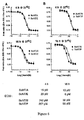
- BFP-YFP, BFP-CFP, CFP-YFP, GFP-DsRed are commonly used as FRET donor-acceptor pairs to detect protein-protein interactions. These pairs are also suitable to detect protease cleavage of the linker region that links the pair.
- the EC50 for BoNT/A and E after 4 hour incubation with CFP-SNAP-YFP are as low as 15-20 pM (1-2 ng/ml), when measured with a widely used microplate spectrofluorometer (Spectra Max Gemini, Molecular Device).
- EC50 for BoNT/B and F are about 200-250 pM, and the sensitivity can be enhanced by increasing incubation time.
- SNARE proteins from many species are suitable as substrate proteins for BoNT toxins, because these proteins are known to be conserved at the amino acid level.
- BoNT toxin is known to cleave a specific peptide bond between two specific amino acids within the toxin cleavage site.
- Table 3 lists the amino acid pairs for each BoNT toxin. These pairs of amino acid sequence, however, are not sufficient for toxin; recognition and cleavage.
- BoNT/A cleaves SNAP-25 at Q(197)-R(198) of the rat SNAP-25 sequence (GenBank accession No: NP_112253), but not Q(15)-R(16).
- the recognition site rather, the toxins are believed to recognize the tertiary, rather than the primary, structure of their target protein.
- Table 4 illustrates the relationship between linker-peptide length and toxin cleavage rate.
- the full- length rat syb II protein (GenBank No: NP_036795) has 116 amino acids, of which amino acid 1-94 at the amino terminus is the cytoplasmic domain and the rest is the transmembrane domain.
- Table 1 makes clear, within certain limit, a shorter fragment is cleaved by the toxin at a slower rate (data from Foran et al., Biochemistry 33:15365,1994 ).
- tetanus neurotoxin requires a longer fragment (33-94) for optimum cleavage than BoNT/B (55-94).
- a fragment consisting of 60-94 has been used in several studies including several peptide- based toxin assay methods (Schmidt et al., 2003, supra, and Schmidt et al., 2001, Analytical Biochemistry, 296: 130-137 ).
- BoNT/A the 141-206 fragment of SNAP-25 is required for retaining most of the toxin sensitivity ( Washbourne et al., 1997, FEBS Letters, 418:1 ). There are also other reports that a shorter peptide, amino acids 187-203 of SNAP25, is sufficient to be cleaved by BoNT/A (, 2001).
- the minimum site for BoNT/A is : Glu-Ala-Asn-Gln-Arg-Ala-Thr-Lys (SEQ ID NO: 1). BoNT/A cleave Gln-Arg. Table 4.
- BoNT/C cleaves both SNAP25 and Syntaxin, and is believed to cleave at a very slow rate if the substrate is in solution.
- Native SNAP25 and Syntaxin that reside on the cell membrane are cleaved most efficiently by BoNT/C.
- the minimum cleavage sequence for SNAP25 is : Ala-Asn-Gln-Arg-Ala-Thr-Lys-Met (SEQ ID NO: 3), where cleavage occurs between Arg-Ala; for Syntaxin, the minimum cleavage sequence is Asp-Thr-Lys-Lys-Ala-Val-Lys-Phe (SEQ ID NO: 4), and cleavage occurs at Lys-Ala.
- BoNT/E requires a minimum sequence of: Gln-Ile-Asp-Arg-Ile-Met-Glu- Lys (SEQ ID NO: 5), and cleaves between Arg-IIe.
- BoNT/F cleaves Gln-Lys. Schmidt et al. (Analytical Biochemistry, 296:130-137 (2001 )) reported that a 37-75 fragment of syb II retains most of toxin sensitivity, and the minimum sequence is : Glu-Arg-Asp-Gin-Lys-Leu-Ser-Glu (SEQ ID NO: 6).
- a FRET construct may be produced via the expression of recombinant nucleic acid molecules comprising an in-frame fusion of sequences encoding such a polypeptide and a fluorescent protein label either in vitro (e.g., using a cell-free transcription/translation system, or instead using cultured cells transformed or transfected using methods well known in the art).
- Suitable cells for producing the FRET construct may be a bacterial, fungal, plant, or an animal cell.
- the FRET construct may also be produced in vivo, for example in a transgenic plant, or in a transgenic animal including, but not limited to, insects, amphibians, and mammals.
- a recombinant nucleic acid molecule of use in the invention may be constructed and expressed by molecular methods well known in the art, and may additionally comprise sequences including, but not limited to, those which encode a tag (e.g., a histidine tag) to enable easy purification, a linker, a secretion signal, a nuclear localization signal or other primary sequence signal capable of targeting the construct to a particular cellular location, if it is so desired.
- a tag e.g., a histidine tag
- FRET ratio changes and degrees of cleavage may be correlated, for example for a certain spectrofluorometer using a method such as HPLC assay in order to correlate the unit of kinetic constant from the FRET ratio to substrate concentration.
- Cell-based high-throughput screening assays have the potential to reveal not only agents that can block proteolytic activity of the toxins, but also agents that can block other steps in the action of the toxin such as binding to its cellular receptor(s), light chain translocation across endosomal membranes and light chain refolding in the cytosol after translocation.
- the cell may be of a type in which the respective BoNT exhibits its toxic activities.
- the cells preferably displays suitable cell surface receptors, or otherwise allow the toxin to be translocated into the cell sufficiently efficiently, and allow the toxin to cleave the suitable substrate polypeptide.
- suitable cell surface receptors include primary cultured neurons (cortical neuron, hippocampal neuron, spinal cord motor neuron, etc); PC12 cells or derived PC12 cell lines; primary cultured chromaphin cells; several cultured neuroblastoma cell lines, such as murine cholinergic Neuro 2a cell line, human adrenergic SK-N-SH cell line, and NS-26 cell line. See e.g. Foster and Stringer (1999), Genetic Regulatory Elements Introduced Into Neural Stem and Progenitor Cell Populations, Brain Pathology 9: 547-567 .
- the coding region for the substrate-FRET polypeptide is under the control of a suitable promoter.
- suitable promoters are known and readily available in the art. Such promoters can be inducible or constitutive.
- a constitutive promoter may be selected to direct the expression of the desired polypeptide of the present invention.
- Such an expression construct may provide additional advantages since it circumvents the need to culture the expression hosts on a medium containing an inducing substrate. Examples of suitable promoters would be LTR, SV40 and CMV in mammalian systems; E.
- coli lac or trp in bacterial systems
- baculovirus polyhedron promoter (polh) in insect systems and other promoters that are known to control expression in eukaryotic and prokaryotic cells or their viruses.
- strong constitutive and/or inducible promoters which are preferred for use in fungal expression hosts are those which are obtainable from the fungal genes for xylanase (xlnA), phytase, ATP-synthetase, subunit 9 (oliC), triose phosphate isomerase (tpi), alcohol dehydrogenase (AdhA), ⁇ -amylase (amy), amyloglucosidase (AG-from the glaA gene), acetamidase (amdS) and glyceraldehyde-3-phosphate dehydrogenase (gpd) promoters.
- strong yeast promoters are those obtainable from the genes for alcohol dehydrogenase, lactase, 3-phosphoglycerate kinase and triosephosphate isomerase.
- strong bacterial promoters include SP02 promoters as well as promoters from extracellular protease genes.
- Hybrid promoters may also be used to improve inducible regulation of the expression construct.
- the promoter can additionally include features to ensure or to increase expression in a suitable host.
- the features can be conserved regions such as a Pribnow Box or a TATA box.
- the promoter may even contain other sequences to affect (such as to maintain, enhance or decrease) the levels of expression of the nucleotide sequence of the present invention.
- suitable other sequences include the Shl-intron or an ADH intron.
- Other sequences include inducible elements--such as temperature, chemical, light or stress inducible elements.
- suitable elements to enhance transcription or translation may be present.
- An example of the latter element is the TMV 5' signal sequence (see Sleat, 1987, Gene 217: 217-225 ; and Dawson, 1993, Plant Mol. Biol. 23: 97 ).
- the expression vector may also contain sequences which act on the promoter to amplify expression.
- the SV40, CMV, and polyoma cis- acting elements (enhancer) and a selectable marker can provide a phenotypic trait for selection (e.g. dihydrofolate reductase or neomycin resistance for mammalian cells or amplicillin/tetracyclin resistance for E. coli). Selection of the appropriate vector containing the appropriate promoter and selection marker is well within the level of those skilled in the art.
- the coding region for the substrate-FRET polypeptide may be under the control of an inducible promoter.
- an inducible promoter allows for suitable control of the concentration of the reporter in the cell, therefore the measurement of changes in FRET signals are greatly facilitated.
- FRET reporter can be controlled using the Tet-on & Tet-off system (BD Biosciences, San Jose, CA). Under the control of this promoter, gene expression can be regulated in a precise, reversible and quantitative manner. Briefly, for Tet-on system, the transcription of downstream gene only happens when doxycycline is present in the culture medium. After the transcription for a certain period of time, we can change culture medium to deplete doxycycline, thus, stop the synthesis of new FRET reporter proteins. Therefore, there is no background from newly synthesized FRET proteins, and we may be able to see a faster change after toxin treatment.
- Fluorescent analysis can be carried out using, for example, a photon counting epifluorescent microscope system (containing the appropriate dichroic mirror and filters for monitoring fluorescent emission at the particular range), a photon counting photomultiplier system or a fluorometer.
- Excitation to initiate energy transfer can be carried out with an argon ion laser, a high intensity mercury (Hg) arc lamp, a fiber optic light source, or other high intensity light source appropriately filtered for excitation in the desired range.
- excitation/detection means can be augmented by the incorporation of photomultiplier means to enhance detection sensitivity.
- the two photon cross correlation method may be used to achieve the detection on a single-molecule scale (see e.g. Kohl et al., Proc. Nat'l. Acad. Sci., 99:12161, 2002 ).
- a number of parameters of fluorescence output may be measured. They include: 1) measuring fluorescence emitted at the emission wavelength of the acceptor (A) and donor (D) and determining the extent of energy transfer by the ratio of their emission amplitudes; 2) measuring the fluorescence lifetime of D; 3) measuring the rate of photobleaching of D; 4) measuring the anisotropy of D and/or A; or 5) measuring the Stokes shift monomer/excimer fluorescence. See e.g. Mochizuki et al., (2001) "Spatio-temporal images of grow-factor-induced activation of Ras and Rap1.” Nature 411:1065-1068 , Sato et al. (2002) “Fluorescent indicators for imaging protein phosphorylation in single living cells.” Nat Biotechnol 20:287-294 .
- YFP cDNA (Clontech) was inserted into the pECFP-C1 vector (Clontech) using EcoRI and BamHI site to generate pECFP-YFP vector.
- cDNA encoding amino acid 33-94 of rat syb II was amplified using PCR and into pECFP-YFP vector using XhoI and EcoRI sites, which are between CFP and YFP gene, to generate CFP-SybII-YFP (also referred to as CFP-Syb (33-94)-YFP) construct that can be used to transfect cells.
- CFP-SNAP-25-YFP (also referred to as CFP-SNAP-25 (141-206)-YFP) was built using the same method, but using residues 141-206 of SNAP-25.
- a construct (CFP-SNAP25FL-YFP) with full-length rat SNAP-25B as the linker was also made.
- CFP-SybII-YFP gene and CFP-SNAP-25-YFP gene from pECFP-YFP vector into a pTrc-his (Invitrogen) vector using NheI and BamHI sites.
- SNAP-25(83-120)-CFP-SNAP-25(141-206)-YFP were built by first inserting the cDNA fragment that encoding the residues 83-120 of SNAP-25 into the XhoI/EcoRI sites of pEYFP-Nl(Clontech), and then subcloning CFP-SNAP-25(141-206) cDNA into downstream sites using EcoRI /BamHI.
- YFP-Syb(FL)-CFP was built by first inserting a full length Syb II cDNA into pECFP-C1 vectors at EcoRI and BamHI sites, and then inserting a full length YFP cDNA into the upstream at XhoI and EcoRI sites.
- YFP-Syb(33-116)-CFP was built by replacing full-length Syb in YFP-Syb(FL)-CFP construct via EcoRI/BamHI sites. All cDNA fragments were generated via PCR.
- Protein purification and fluorescence spectra acquisition His 6 -tagged CFP-SybII-YFP and CFP-SNAP-25-YFP proteins were purified as described ( Chapman et al., A novel function for the second C2 domain of synaptotagmin. Ca2+-triggered dimerization. J. Biol. Chem. 271, 5844-5849 (1996 )). Proteins were dialyzed using HEPES buffer (50 mM HEPES, pH 7.1) overnight. 300 nM protein was put into a cuvette in a total volume of 500 ⁇ l HEPES buffer that contains 2 mM DTT and 10 ⁇ M ZnCl 2 . The emission spectra from 450 nM to 550 nM was collected using a PTIQM-1 fluorometer. The excitation wavelength is 434 nM, which is the optimal excitation wavelength for CFP.
- BoNT/A, B, E or F was incubated with 2 mM DTT and 10 ⁇ M ZnCl 2 for 30 min at 37°C to reduce the toxin light chain from the heavy chain.
- 10 nM BoNT/A, E, or 50 nM BoNT/B, F were added into the cuvette that contains 300 nM corresponding FRET sensors.
- the emission spectra were collected as described above, at certain time intervals after adding toxins (e.g. 0, 2, 5, 10, 30, 60, 90 min).
- FRET sensor protein For experiments using a spectrofluorometer, 300 nM FRET sensor protein were prepared in a 100 ⁇ l volume per well in a 96-well plate. Various concentrations of BoNTs were added into each well, and samples were excited at 434 nM. The emission spectra of YFP channel (527 nM), and CFP channel (470 nM) were collected for 90 min at 30 sec interval. The FRET ratio is determined by the ratio between YFP channel and CFP channel for each data point.
- DNA constructs pECFP-SNAP25-YFP were used to transfect PC12 cells using electroporation (Bio-Rad). Cells were passed 24 hrs. after the transfection, and 50 nM BoNT/A were added into the culture medium. After incubation for 72 hours with toxin, the fluorescence images of cells that express FRET sensor were collected using a Nikon TE-300 microscope.
- CFP channel CFP excitation filter (436 /10 nm), JP4 beamsplitter, CFP emission filter: (470 /30 nm);
- FRET channel CFP excitation filter (436 /10 nm), JP4 beamsplitter, YFP emission filter (535/30 nm).
- the background (the areas that contain no cells) was subtracted from each image, and the fluorescence intensities of CFP channel and FRET channel of each cell were compared using MetaMorph software.
- the FRET ratio is determined by the intensity ratio between FRET channel and CFP channel as previous described. Control cells were not treated with toxins but were analyzed in an identical manner.
- Live cell imaging and FRET analysis PC12 cells were transfected with various cDNA constructs indicated in the Figure legends via electroporation (Bio-Rad, CA). The fluorescence images were collected using a Nikon TE-300 microscope with a 100X oil-immersed objective. CFP/YFP FRET in live cells was quantified using an established method with the three-filter set method ( Gordon et al., Quantitative fluorescence resonance energy transfer measurements using fluorescence microscopy. Biophys J. 74, 2702-2713 (1998 ); Sorkin et al., Interaction of EGF receptor and grb2 in living cells visualized by fluorescence resonance energy transfer (FRET) microscopy. Curr. Biol. 10, 1395-1398 (2000 )).
- FRET fluorescence resonance energy transfer
- CFP filter excitation, 436/10 nm; emission, 470/30 nm
- FRET filter excitation, 436/10 nm; emission, 535/30 nm
- YFP filter excitation, 500/20 run, emission, 535/30 nm.
- a JP4 beam splitter Set ID 86000, Chroma Inc. VT was used. All images were acquired with exact the same settings (4x4 Binning, 200 ms exposure time).
- PC12 cells transfected with CFP or YFP alone were first tested in order to obtain the crosstalk value for these filter sets.
- the FRET filter channel exhibits about 56-64% of bleed-through for CFP, and about 24% for YFP. There is virtually no crosstalk for YFP while using the CFP filter, or for CFP while using the YFP filter, which greatly simplified the FRET calculations.
- corrected FRET FRET - (CFP x 0.60) - (YFP x 0.24), where FRET, CFP and YFP correspond to fluorescence intensity of images acquired through FRET, CFP and YFP filter sets, respectively.
- the average fraction of bleed-through coming from CFP and YFP fluorescence are 0.6 and 0.24, respectively, when acquiring image through the FRET filter set. Because toxin cleavage of the CFP-SNAP25FL-YFP sensor resulted in the membrane dissociation of YFP fragment, which was degraded in the cytosol ( Fig. 7c, e ), the FRET ratio used in our data analysis is calculated as normalizing "corrected FRET" value to only the CFP fluorescence intensity (corrected FRET/CFP). We note that the CFP intensity in these calculations was an underestimate due to donor quenching if FRET occurred.
- holotoxins were added to the cell culture media for various time, and cells were then analyzed as described above. Control cells were transfected with toxin sensors but not treated with toxins, and they were analyzed in an identical manner.
- Example 1 Bio-sensors based on CFP-YFP FRET pair and botulinum neurotoxin protease activity
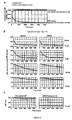
- CFP and YFP protein are connected via syb II or SNAP-25 fragment, denoted as CFP-SybII-YFP and CFP-SNAP-25-YFP, respectively ( Fig. 1A ).
- Short fragments of toxin substrates were used instead of the full-length protein to optimize the CFP-YFP energy transfer efficiency, which falls exponentially as the distance increases.
- the cleavage efficiency by BoNTs decreases significantly as the target protein fragments get too short.
- the FRET assay is depicted in Fig 1B .
- the CFP-SybII-YFP and CFP-SNAP-25-YFP chimera protein When excited at 434 nM (optimal excitation wavelength for CFP), the CFP-SybII-YFP and CFP-SNAP-25-YFP chimera protein would elicit YFP fluorescence emission because of the FRET between CFP-YFP pair.
- Botulinum neurotoxins can recognize and cleave the short substrate fragments between CFP and YFP, and FRET signal will be abolished after CFP and YFP are separated. Because these chimera proteins can be expressed in living cells, they are also denoted as "bio-sensor" for botulinum neurotoxins.
- Example 2 Monitoring the cleavage of bio-sensor proteins by botulinum neurotoxins in vitro
- cleavage of chimera protein is specific, since mixing BoNT/B and F with CFP-SNAP-25-YFP, or mixing BoNT/A and E with CFP ⁇ SybII-YFP did not result in any change in FRET ratio or substrate cleavage (data not shown).
- Example 3 Monitoring botulinum neurotoxin protease activity in real time using a microplate spectrofluorometer
- this method still provides the easiest way to compare toxin cleavage kinetics among multiple samples when these samples were prepared and scanned simultaneously - it is particularly useful for high throughput screening toxin inhibitors because it would provide information about how the inhibitor affects toxin enzymatic activities.
- the unit for each kinetic parameter would be the FRET ratio instead of substrates concentration in these cases.
- the sensitivity of this FRET based assay is determined by incubating various concentrations of toxins with fixed amount of their target bio-sensor proteins for certain period of time.
- the FRET ratio is recorded using a microplate spectra-fluorometer, and plotted against toxin concentration.
- this method has similar sensitivities for BoNT/A and E after 4 hours incubation (EC50 for BoNT/A is 15 pM, and for BoNT/E is 20 pM, upper panel), and incubation for 16 hours slightly increased the detection sensitivity ( Fig. 5A , lower panel).
- the sensitivities for BoNT/B and F are close to each other, but are about 10 times lower than BoNT/A and E with 4 hours incubation ( Fig.
- EC50 is 242 pM for BoNT/B, and 207 pM for BoNT/F). Extension of the incubation period to 16 hours increased the ability to detect BoNT/B and BoNT/F activity by 8-fold and 2-fold, respectively.
- CFP-YFP based bio-sensor assay not only can be used to detect botulinum neurotoxin in vitro, but also can be used in live cells.
- PC 12 cells were transfected with CFP-SNAP-25-YFP.
- PC12 cell is a neuroendocrine cell line that is able to take up BoNT/A and E.
- Transfected cells were incubated with BoNT/A-(50 nM) for 72 hours, and the FRET ratio of cells that express CFP-SNAP25-YFP were recorded using a epi-fluorescence microscope equipped with special filter sets for CFP-YFP FRET detection.
- the FRET ratio is calculated as the ratio between the fluorescence intensity of the images from the same cell collected using two filter sets, one for CFP (excitation 437 nm/emission 470 nm), and another for FRET (excitation 437 nm/emission 535 nm).
- CFP excitation 437 nm/emission 470 nm
- FRET excitation 437 nm/emission 535 nm
- a PC12 cell line was recently created that expresses both synaptotagmin II, a receptor for BoNT/B, and CFP-SybII-YFP bio-sensor. These cells were used to detect BoNT/B action in live cells. As shown in Fig. 6B , BoNT/B (30 nM) treatment for 72 hours significantly decreased FRET ratio of the bio-sensor proteins expressed in cells (p ⁇ 2.1E-10). We note that there were still large number of cells that do not appear to change FRET ratio for both bio- sensor proteins. There are several possible explanations. First, the toxin/bio- sensor protein ratio may be too low in these cells, thus, the significant cleavage of bio-sensor proteins may require a longer incubation time. Second, these cells may have high level of protein synthesis activity, thus new bio-sensor protein was synthesis quickly to replace cleavage products. Nevertheless, these experiments demonstrate the feasibility to adopt this FRET based assay in living cells and neurons.
- CFP-Syb(33-94)-YFP sensor could be used to assay BoNT/B activity in cells.
- a PC12 cell line that expresses synaptotagmin II, which mediates BoNT/B entry into cells ( Dong et al. Synaptotagmins I and II mediate entry of botulinum neurotoxin B into cells. J. Cell Biol. 162, 1293-1303 (2003 )).
- transfected CFP-Syb(33-94)-YFP is a soluble protein present throughout the cells.
- BoNT/B (50 nM, 96 hr) treatment only slightly decreased the FRET ratio ( Fig. 9a , lower panel), indicating that the cleavage of this sensor is also inefficient in cells.
- YFP-Syb(FL)-CFP Cleavage of YFP-Syb(FL)-CFP sensor would generate two fragments, including a N-terminal portion tagged with YFP, which would be released into the cytosol, and a short C-terminal portion tagged with CFP that is restricted inside vesicles.
- toxin activity would result in the redistribution of YFP fluorescence in cells.
- YFP- Syb(FL)-CFP proved to be an efficient toxin sensor in cells.
- treatment with BoNT/B resulted in the dissociation of YFP from the vesicles and its redistribution into the cytosol.
- toxins may favor binding to vesicular membranes in cells, thus increasing the chance to encounter Syb localized on vesicles.
- the presence of the transmembrane domain may be critical for maintaining a proper conformational state of Syb that is required for efficient cleavage.
- SNAP-25 and Syb II as the linkers provided excellent optical reporters that can mirror endogenous substrate cleavage in living cells. These two reporters should be able to detect all seven botulinum neurotoxins and tetanus neurotoxin (TeNT).
- TeNT botulinum neurotoxins and tetanus neurotoxin
- the substrate linker sequence can be readily modified to achieve specific detection for individual BoNTs or TeNT by changing the length or mutating other toxin cleavage or recognition sites.
- These toxin biosensors should enable the cell-based screening of toxin inhibitors, and the study of toxin substrate recognition and cleavage in cells.
Landscapes
- Health & Medical Sciences (AREA)
- Life Sciences & Earth Sciences (AREA)
- Chemical & Material Sciences (AREA)
- Immunology (AREA)
- Engineering & Computer Science (AREA)
- Organic Chemistry (AREA)
- General Health & Medical Sciences (AREA)
- Molecular Biology (AREA)
- Medicinal Chemistry (AREA)
- Biochemistry (AREA)
- Biomedical Technology (AREA)
- Urology & Nephrology (AREA)
- Hematology (AREA)
- Toxicology (AREA)
- Cell Biology (AREA)
- Genetics & Genomics (AREA)
- Zoology (AREA)
- Gastroenterology & Hepatology (AREA)
- Proteomics, Peptides & Aminoacids (AREA)
- Biophysics (AREA)
- Physics & Mathematics (AREA)
- Pathology (AREA)
- General Physics & Mathematics (AREA)
- Analytical Chemistry (AREA)
- Food Science & Technology (AREA)
- Microbiology (AREA)
- Biotechnology (AREA)
- Tropical Medicine & Parasitology (AREA)
- Bioinformatics & Cheminformatics (AREA)
- General Chemical & Material Sciences (AREA)
- Nuclear Medicine, Radiotherapy & Molecular Imaging (AREA)
- Chemical Kinetics & Catalysis (AREA)
- Public Health (AREA)
- Veterinary Medicine (AREA)
- Animal Behavior & Ethology (AREA)
- Pharmacology & Pharmacy (AREA)
- Virology (AREA)
- General Engineering & Computer Science (AREA)
- Wood Science & Technology (AREA)
- Neurosurgery (AREA)
Claims (5)
- Construction moléculaire permettant un transfert d'énergie par résonance fluorescente (FRET), la construction comprenant (1) un peptide de liaison, (2) un groupement fluorophore donneur et un groupement fluorophore accepteur comprenant la paire donneur-accepteur pour FRET, et (3) un domaine de ciblage de la membrane plasmique qui cible la construction sur la membrane plasmique d'une cellule, où le peptide de liaison comprend un fragment de SNAP-25 qui est clivable par une neurotoxine botulinique à détecter, où le domaine de ciblage de la membrane plasmique contient les sites de palmitylation de résidus de SNAP-25 83-12) fusionnés à la terminaison N d'un capteur CFP-SNAP-25 (141-206)-YFP où la construction est ciblée sur une membrane plasmique, et où le spectre d'émission du groupement fluorophore donneur est différent de façon décelable du spectre d'excitation du groupement fluorophore accepteur.
- Construction selon la revendication 1, où le peptide de liaison est une molécule de pleine longueur de SNAP- 25.
- Molécule polynucléotidique codant la construction selon la revendication 1.
- Procédé de détection d'une neurotoxine botulinique, le procédé comprenant,a) la fourniture d'une construction selon la revendication 1,b) l'exposition de la construction à un échantillon suspecté de contenir une neurotoxine botulinique dans une condition en vertu de laquelle la neurotoxine botulinique clive le substrat protéique ou un fragment de celle-ci, etc) la détection de la séparation spatiale des signaux de fluorescence du groupement fluorophore donneur et du groupement fluorophore accepteur, où le groupement fluorophore donneur comprend une protéine fluorescente jaune (YFP) et le groupement fluorophore accepteur comprend une protéine fluorescente cyan (CFP), où l'occurrence de la séparation spatiale indique la présence de neurotoxine botulinique dans l'échantillon.
- Procédé selon la revendication 4, où la membrane plasmique est à l'intérieur d'une cellule vivante, où le peptide de liaison est SNAP-25(83-120) lié à CFP-SNAP-25(141-206)-YFP, et où la détection de la fluorescence CFP mais non de la fluorescence YFP indique la présence de neurotoxine botulinique dans l'échantillon.
Applications Claiming Priority (4)
| Application Number | Priority Date | Filing Date | Title |
|---|---|---|---|
| US53064503P | 2003-12-19 | 2003-12-19 | |
| US57925404P | 2004-06-15 | 2004-06-15 | |
| EP11075012.2A EP2332959B1 (fr) | 2003-12-19 | 2004-12-20 | Procédé et compositions permettant de détecter la neurotoxine botulique |
| EP04821358A EP1751284A4 (fr) | 2003-12-19 | 2004-12-20 | Methode et compositions permettant de detecter la neurotoxine botulique |
Related Parent Applications (5)
| Application Number | Title | Priority Date | Filing Date |
|---|---|---|---|
| EP11075012.2A Division EP2332959B1 (fr) | 2003-12-19 | 2004-12-20 | Procédé et compositions permettant de détecter la neurotoxine botulique |
| EP11075012.2A Division-Into EP2332959B1 (fr) | 2003-12-19 | 2004-12-20 | Procédé et compositions permettant de détecter la neurotoxine botulique |
| EP04821358.1 Division | 2004-12-20 | ||
| EP04821358A Division EP1751284A4 (fr) | 2003-12-19 | 2004-12-20 | Methode et compositions permettant de detecter la neurotoxine botulique |
| EP11075012.2 Division | 2011-01-26 |
Publications (3)
| Publication Number | Publication Date |
|---|---|
| EP2502930A2 EP2502930A2 (fr) | 2012-09-26 |
| EP2502930A3 EP2502930A3 (fr) | 2012-10-10 |
| EP2502930B1 true EP2502930B1 (fr) | 2016-06-29 |
Family
ID=34864464
Family Applications (3)
| Application Number | Title | Priority Date | Filing Date |
|---|---|---|---|
| EP12166003.9A Expired - Lifetime EP2502930B1 (fr) | 2003-12-19 | 2004-12-20 | Procédé et compositions permettant de détecter la neurotoxine botulique |
| EP11075012.2A Expired - Lifetime EP2332959B1 (fr) | 2003-12-19 | 2004-12-20 | Procédé et compositions permettant de détecter la neurotoxine botulique |
| EP04821358A Ceased EP1751284A4 (fr) | 2003-12-19 | 2004-12-20 | Methode et compositions permettant de detecter la neurotoxine botulique |
Family Applications After (2)
| Application Number | Title | Priority Date | Filing Date |
|---|---|---|---|
| EP11075012.2A Expired - Lifetime EP2332959B1 (fr) | 2003-12-19 | 2004-12-20 | Procédé et compositions permettant de détecter la neurotoxine botulique |
| EP04821358A Ceased EP1751284A4 (fr) | 2003-12-19 | 2004-12-20 | Methode et compositions permettant de detecter la neurotoxine botulique |
Country Status (6)
| Country | Link |
|---|---|
| US (4) | US8137924B2 (fr) |
| EP (3) | EP2502930B1 (fr) |
| JP (1) | JP5178009B2 (fr) |
| CA (1) | CA2550401C (fr) |
| IL (1) | IL176382A0 (fr) |
| WO (1) | WO2005076785A2 (fr) |
Families Citing this family (50)
| Publication number | Priority date | Publication date | Assignee | Title |
|---|---|---|---|---|
| US8022172B2 (en) | 2001-08-28 | 2011-09-20 | Allergan, Inc. | Luminescence resonance energy transfer (LRET) assays for clostridial toxin activity |
| US7332567B2 (en) | 2001-08-28 | 2008-02-19 | Allergan, Inc. | Fret protease assays for clostridial toxins |
| US7374896B2 (en) * | 2001-08-28 | 2008-05-20 | Allergan, Inc. | GFP-SNAP25 fluorescence release assay for botulinum neurotoxin protease activity |
| CA2504532C (fr) * | 2002-10-31 | 2014-09-16 | Wisconsin Alumni Research Foundation | Recepteurs de la neurotoxine botulique b et utilisation desdits recepteurs |
| US8137924B2 (en) | 2003-12-19 | 2012-03-20 | Wisconsin Alumni Research Foundation | Method and compositions for detecting botulinum neurotoxin |
| US7399607B2 (en) | 2004-09-22 | 2008-07-15 | Allergan, Inc. | Fluorescence polarization assays for determining clostridial toxin activity |
| DE602006014812D1 (de) | 2005-04-05 | 2010-07-22 | Allergan Inc | Lostridientoxinaktivität |
| ES2351942T3 (es) * | 2005-04-05 | 2011-02-14 | Allergan Inc | Analisis de la actividad de una toxina clostridial. |
| ES2369558T3 (es) | 2005-09-19 | 2011-12-01 | Allergan, Inc. | Toxinas clostridiales y toxinas clostridiales activables. |
| ATE555387T1 (de) * | 2005-10-12 | 2012-05-15 | Allergan Inc | Tests der molekularen oder subzellulären nähe unter verwendung von depolarisierung nach resonanzenergietransfer (daret) |
| WO2008026852A1 (fr) | 2006-08-31 | 2008-03-06 | Forhumantech Co., Ltd. | Polypeptide de fusion permettant d'inhiber la sécrétion de neurotransmetteurs et procédé de transfert de celui-ci |
| KR101226604B1 (ko) * | 2007-09-14 | 2013-01-28 | 바이오센티넬, 인코포레이티드 | 절단 서열 및 스페이서를 이용한 공명 에너지 전달 분석 |
| PL2271670T3 (pl) * | 2008-03-14 | 2015-05-29 | Allergan Inc | Testy aktywności serotypu A toksyny botulinowej oparte na immunologii |
| US8246931B1 (en) * | 2008-07-23 | 2012-08-21 | The United States Of America, As Represented By The Secretary Of Agriculture | Development of a quail embryo model for the detection of botulinum toxin |
| ES2770033T3 (es) * | 2009-03-13 | 2020-06-30 | Allergan Inc | Ensayos de actividad de endopeptidasa redirigida basados en inmunología |
| KR101818777B1 (ko) * | 2009-04-27 | 2018-01-15 | 메르츠 파마 게엠베하 운트 코. 카가아 | 신경독 폴리펩티드의 양 및 이들의 촉매 활성 및 단백질 분해 활성의 결정수단 및 방법 |
| US10246492B2 (en) | 2009-10-16 | 2019-04-02 | Biomadison, Inc. | Botulinum assay with synaptobrevin substrate moiety |
| EP2488868B1 (fr) * | 2009-10-16 | 2016-03-30 | BioMadison, Inc. | Analyse par transfert d'énergie de résonance utilisant, comme substrat, une fraction de synaptobrévine |
| KR20120115976A (ko) * | 2009-12-07 | 2012-10-19 | 시냅틱 리서치, 엘엘씨 | 프로테아제 활성 저해제의 동정 방법 및 프로테아제 활성의 존재 분석 방법 |
| KR20130111954A (ko) * | 2010-06-11 | 2013-10-11 | 시냅틱 리서치, 엘엘씨 | N-단부 지배 프로테아제 활성 표시 방법 및 이의 용도 |
| AU2012228407B2 (en) | 2011-03-11 | 2016-10-13 | Merz Pharma Gmbh & Co. Kgaa | Method for the determination of botulinum neurotoxin biological activity |
| US10908146B2 (en) | 2011-06-01 | 2021-02-02 | Biomadison, Inc. | Compositions and methods for improving sensitivity in cell based assays |
| US11325954B2 (en) | 2011-06-01 | 2022-05-10 | Biomadison, Inc. | Compositions and methods for stability testing of botulinum toxin |
| US12422428B2 (en) | 2011-06-01 | 2025-09-23 | Biomadison, Inc. | Compositions and methods for cell-based assays |
| US9303285B2 (en) | 2012-01-04 | 2016-04-05 | Biomadison, Inc. | Methods and compounds for increasing sensitivity of botulinum assays |
| KR101910490B1 (ko) * | 2011-06-01 | 2018-10-22 | 바이오메디슨, 인코퍼레이티드 | 비-fret 보툴리눔 검정법 |
| US20140287433A1 (en) * | 2011-07-19 | 2014-09-25 | ETH Zürich | Means and methods for determining clostridial neurotoxins |
| HUE037509T2 (hu) | 2011-09-29 | 2018-09-28 | Cellsnap Llc | Készítmények és eljárások toxigenicitás meghatározására |
| KR102168506B1 (ko) * | 2012-01-04 | 2020-10-21 | 바이오메디슨, 인코퍼레이티드 | 보툴리눔 분석 감도를 증진시키기 위한 방법 및 화합물 |
| US20150044709A1 (en) * | 2012-03-07 | 2015-02-12 | Merz Pharma Gmbh & Co Kgaa | Means and methods for determining neurotoxin activity based on a modified luciferase |
| KR20150087321A (ko) * | 2012-11-21 | 2015-07-29 | 메르츠 파마 게엠베하 운트 코. 카가아 | 보툴리눔 신경독소 생물학적 활성의 결정을 위한 수단 및 방법 |
| GB2512691B (en) * | 2012-12-03 | 2016-06-29 | Src Inc | Real-time assay for the detection of botulinum toxin |
| US8962340B2 (en) | 2012-12-03 | 2015-02-24 | Src, Inc. | Real-time assay for the detection of botulinum toxin |
| GB2514825B (en) * | 2013-06-06 | 2017-11-08 | Bangor Univ | Sensors |
| PL3014267T3 (pl) | 2013-06-28 | 2019-05-31 | Merz Pharma Gmbh & Co Kgaa | Środki i sposoby określania aktywności biologicznej polipeptydów neurotoksyny w komórkach |
| LT3030905T (lt) | 2013-08-09 | 2018-01-25 | Biomadison, Inc. | Padidinto jautrumo botulino toksino tyrimas |
| LT3060677T (lt) * | 2013-10-25 | 2018-08-27 | Biomadison, Inc. | Fermentų tyrimo su dublikuotais fluoroforais būdas |
| US10408837B2 (en) * | 2013-12-09 | 2019-09-10 | The United States Of America, As Represented By The Secretary, Department Of Health & Human Services | Peptide substrates recognizable by type E botulinum neurotoxin |
| CA2968284C (fr) * | 2014-11-21 | 2023-11-14 | Merz Pharma Gmbh & Co. Kgaa | Methodes de determination des activites biologiques de polypeptides de neurotoxine |
| US11242515B2 (en) * | 2016-05-16 | 2022-02-08 | President And Fellows Of Harvard College | Method for purification and activation of botulinum neurotoxin |
| CA3024297A1 (fr) | 2016-05-16 | 2017-11-23 | Biomadison, Inc. | Essai ameliore avec un fragment a base de synaptobrevine |
| US12019066B2 (en) | 2016-05-16 | 2024-06-25 | Biomadison, Inc. | Assay with synaptobrevin based moiety |
| EP3481852B1 (fr) * | 2016-07-08 | 2022-12-07 | Children's Medical Center Corporation | Nouvelle neurotoxine botulique et ses dérivés |
| US12607633B2 (en) | 2016-11-25 | 2026-04-21 | The Government Of The United States Of America, As Represented By The Secretary Of The Navy | Methods and compositions for the detection of host protein cleavage by group IV viral proteases |
| KR102040982B1 (ko) * | 2017-05-29 | 2019-11-06 | 바이오위더스 주식회사 | 고용해성 녹색형광 단백질과 보툴리늄 독소 단백질의 융합단백질 구성을 통한 재조합 보툴리늄 독소 단백질의 대량생산 기술 |
| CN113008842B (zh) * | 2019-12-20 | 2022-05-24 | 中国科学院物理研究所 | 观察活细胞细胞膜表面及附近生物大分子的荧光成像方法 |
| EP4537850A1 (fr) * | 2022-06-10 | 2025-04-16 | Medytox Inc. | Composition pour stabiliser la neurotoxine botulique, formulation de neurotoxine botulique la contenant, et polypeptides destinés à être utilisés dans celle-ci |
| GB202213479D0 (en) | 2022-09-14 | 2022-10-26 | Ipsen Biopharm Ltd | Cell-free clostridial neurotoxin assays |
| GB202320108D0 (en) * | 2023-12-28 | 2024-02-14 | Ipsen Biopharm Ltd | Biosensor |
| CN119530166B (zh) * | 2024-12-02 | 2026-04-07 | 兰州大学 | 一种基于fret的a型和e型肉毒毒素检测细胞传感器及其应用 |
Family Cites Families (14)
| Publication number | Priority date | Publication date | Assignee | Title |
|---|---|---|---|---|
| US627129A (en) | 1899-06-20 | Collar-edge-ironing machine | ||
| US6803188B1 (en) | 1996-01-31 | 2004-10-12 | The Regents Of The University Of California | Tandem fluorescent protein constructs |
| US5965699A (en) | 1996-11-06 | 1999-10-12 | The United States Of America As Represented By The Secretary Of The Army | Assay for the proteolytic activity of serotype a from clostridium botulinum |
| US6330062B1 (en) | 1999-04-30 | 2001-12-11 | Wisconsin Alumni Research Foundation | Fourier transform surface plasmon resonance adsorption sensor instrument |
| US6524580B1 (en) * | 2000-02-15 | 2003-02-25 | Allergan Sales, Inc. | Method for treating thyroid disorders |
| EP1419390B1 (fr) * | 2000-09-25 | 2007-11-14 | U.S. Medical Research Institute of Infectious Diseases | Tests de detection rapide des activites proteolytiques des neurotoxines clostridiales |
| US7332567B2 (en) * | 2001-08-28 | 2008-02-19 | Allergan, Inc. | Fret protease assays for clostridial toxins |
| US20080064054A1 (en) * | 2001-08-28 | 2008-03-13 | Ester Fernandez-Salas | Fluorescence resonance energy transfer (fret) assays for clostridial toxin activity |
| US8022172B2 (en) * | 2001-08-28 | 2011-09-20 | Allergan, Inc. | Luminescence resonance energy transfer (LRET) assays for clostridial toxin activity |
| US7208285B2 (en) * | 2001-08-28 | 2007-04-24 | Allergan, Inc. | Fret protease assays for botulinum serotype A/E toxins |
| US7374896B2 (en) * | 2001-08-28 | 2008-05-20 | Allergan, Inc. | GFP-SNAP25 fluorescence release assay for botulinum neurotoxin protease activity |
| US6504006B1 (en) | 2001-10-12 | 2003-01-07 | Nancy Rose Shine | Substrate peptides and assays for detecting and measuring proteolytic activity of serotype A neurotoxin from clostridium botulinum |
| US7183066B2 (en) * | 2002-09-27 | 2007-02-27 | Allergan, Inc. | Cell-based fluorescence resonance energy transfer (FRET) assays for clostridial toxins |
| US8137924B2 (en) | 2003-12-19 | 2012-03-20 | Wisconsin Alumni Research Foundation | Method and compositions for detecting botulinum neurotoxin |
-
2004
- 2004-12-20 US US11/014,845 patent/US8137924B2/en active Active
- 2004-12-20 EP EP12166003.9A patent/EP2502930B1/fr not_active Expired - Lifetime
- 2004-12-20 EP EP11075012.2A patent/EP2332959B1/fr not_active Expired - Lifetime
- 2004-12-20 WO PCT/US2004/042366 patent/WO2005076785A2/fr not_active Ceased
- 2004-12-20 CA CA2550401A patent/CA2550401C/fr not_active Expired - Lifetime
- 2004-12-20 EP EP04821358A patent/EP1751284A4/fr not_active Ceased
- 2004-12-20 JP JP2006545459A patent/JP5178009B2/ja not_active Expired - Lifetime
-
2006
- 2006-06-18 IL IL176382A patent/IL176382A0/en active IP Right Grant
-
2012
- 2012-02-23 US US13/403,603 patent/US8999649B2/en not_active Expired - Lifetime
-
2015
- 2015-02-18 US US14/624,775 patent/US20150253326A1/en not_active Abandoned
-
2016
- 2016-07-11 US US15/206,946 patent/US20160356776A1/en not_active Abandoned
Also Published As
| Publication number | Publication date |
|---|---|
| IL176382A0 (en) | 2008-04-13 |
| WO2005076785A3 (fr) | 2009-03-19 |
| WO2005076785A2 (fr) | 2005-08-25 |
| EP2332959A2 (fr) | 2011-06-15 |
| US8137924B2 (en) | 2012-03-20 |
| US20160356776A1 (en) | 2016-12-08 |
| US20120220490A1 (en) | 2012-08-30 |
| JP5178009B2 (ja) | 2013-04-10 |
| CA2550401A1 (fr) | 2005-08-25 |
| US20060134722A1 (en) | 2006-06-22 |
| EP2502930A2 (fr) | 2012-09-26 |
| US8999649B2 (en) | 2015-04-07 |
| EP1751284A4 (fr) | 2010-01-13 |
| EP2332959B1 (fr) | 2014-11-26 |
| CA2550401C (fr) | 2015-12-08 |
| JP2007520211A (ja) | 2007-07-26 |
| EP2502930A3 (fr) | 2012-10-10 |
| EP1751284A2 (fr) | 2007-02-14 |
| EP2332959A3 (fr) | 2011-10-05 |
| US20150253326A1 (en) | 2015-09-10 |
Similar Documents
| Publication | Publication Date | Title |
|---|---|---|
| EP2502930B1 (fr) | Procédé et compositions permettant de détecter la neurotoxine botulique | |
| US10526637B2 (en) | Compositions and methods for improved neurotoxin assays | |
| EP2715355B1 (fr) | Dosage botulique sans fret | |
| HK1194143B (en) | Non-fret botulinum assay |
Legal Events
| Date | Code | Title | Description |
|---|---|---|---|
| PUAL | Search report despatched |
Free format text: ORIGINAL CODE: 0009013 |
|
| PUAI | Public reference made under article 153(3) epc to a published international application that has entered the european phase |
Free format text: ORIGINAL CODE: 0009012 |
|
| AC | Divisional application: reference to earlier application |
Ref document number: 2332959 Country of ref document: EP Kind code of ref document: P Ref document number: 1751284 Country of ref document: EP Kind code of ref document: P |
|
| AK | Designated contracting states |
Kind code of ref document: A2 Designated state(s): AT BE BG CH CY CZ DE DK EE ES FI FR GB GR HU IE IS IT LI LT LU MC NL PL PT RO SE SI SK TR |
|
| AK | Designated contracting states |
Kind code of ref document: A3 Designated state(s): AT BE BG CH CY CZ DE DK EE ES FI FR GB GR HU IE IS IT LI LT LU MC NL PL PT RO SE SI SK TR |
|
| RIC1 | Information provided on ipc code assigned before grant |
Ipc: C07K 14/705 20060101ALI20120831BHEP Ipc: G01N 33/569 20060101ALI20120831BHEP Ipc: G01N 33/542 20060101ALI20120831BHEP Ipc: C07K 14/435 20060101ALI20120831BHEP Ipc: G01N 33/58 20060101ALI20120831BHEP Ipc: C07H 21/04 20060101AFI20120831BHEP Ipc: C12N 1/20 20060101ALI20120831BHEP Ipc: C12Q 1/37 20060101ALI20120831BHEP Ipc: C12P 21/06 20060101ALI20120831BHEP |
|
| 17P | Request for examination filed |
Effective date: 20130410 |
|
| 17Q | First examination report despatched |
Effective date: 20131021 |
|
| GRAP | Despatch of communication of intention to grant a patent |
Free format text: ORIGINAL CODE: EPIDOSNIGR1 |
|
| INTG | Intention to grant announced |
Effective date: 20160316 |
|
| GRAS | Grant fee paid |
Free format text: ORIGINAL CODE: EPIDOSNIGR3 |
|
| GRAA | (expected) grant |
Free format text: ORIGINAL CODE: 0009210 |
|
| AC | Divisional application: reference to earlier application |
Ref document number: 2332959 Country of ref document: EP Kind code of ref document: P Ref document number: 1751284 Country of ref document: EP Kind code of ref document: P |
|
| AK | Designated contracting states |
Kind code of ref document: B1 Designated state(s): AT BE BG CH CY CZ DE DK EE ES FI FR GB GR HU IE IS IT LI LT LU MC NL PL PT RO SE SI SK TR |
|
| REG | Reference to a national code |
Ref country code: GB Ref legal event code: FG4D |
|
| REG | Reference to a national code |
Ref country code: CH Ref legal event code: EP |
|
| REG | Reference to a national code |
Ref country code: AT Ref legal event code: REF Ref document number: 809025 Country of ref document: AT Kind code of ref document: T Effective date: 20160715 |
|
| REG | Reference to a national code |
Ref country code: IE Ref legal event code: FG4D |
|
| REG | Reference to a national code |
Ref country code: DE Ref legal event code: R096 Ref document number: 602004049529 Country of ref document: DE |
|
| REG | Reference to a national code |
Ref country code: LT Ref legal event code: MG4D |
|
| PG25 | Lapsed in a contracting state [announced via postgrant information from national office to epo] |
Ref country code: LT Free format text: LAPSE BECAUSE OF FAILURE TO SUBMIT A TRANSLATION OF THE DESCRIPTION OR TO PAY THE FEE WITHIN THE PRESCRIBED TIME-LIMIT Effective date: 20160629 Ref country code: FI Free format text: LAPSE BECAUSE OF FAILURE TO SUBMIT A TRANSLATION OF THE DESCRIPTION OR TO PAY THE FEE WITHIN THE PRESCRIBED TIME-LIMIT Effective date: 20160629 |
|
| REG | Reference to a national code |
Ref country code: NL Ref legal event code: MP Effective date: 20160629 |
|
| REG | Reference to a national code |
Ref country code: FR Ref legal event code: PLFP Year of fee payment: 13 |
|
| PG25 | Lapsed in a contracting state [announced via postgrant information from national office to epo] |
Ref country code: GR Free format text: LAPSE BECAUSE OF FAILURE TO SUBMIT A TRANSLATION OF THE DESCRIPTION OR TO PAY THE FEE WITHIN THE PRESCRIBED TIME-LIMIT Effective date: 20160930 Ref country code: SE Free format text: LAPSE BECAUSE OF FAILURE TO SUBMIT A TRANSLATION OF THE DESCRIPTION OR TO PAY THE FEE WITHIN THE PRESCRIBED TIME-LIMIT Effective date: 20160629 Ref country code: NL Free format text: LAPSE BECAUSE OF FAILURE TO SUBMIT A TRANSLATION OF THE DESCRIPTION OR TO PAY THE FEE WITHIN THE PRESCRIBED TIME-LIMIT Effective date: 20160629 |
|
| REG | Reference to a national code |
Ref country code: AT Ref legal event code: MK05 Ref document number: 809025 Country of ref document: AT Kind code of ref document: T Effective date: 20160629 |
|
| PG25 | Lapsed in a contracting state [announced via postgrant information from national office to epo] |
Ref country code: EE Free format text: LAPSE BECAUSE OF FAILURE TO SUBMIT A TRANSLATION OF THE DESCRIPTION OR TO PAY THE FEE WITHIN THE PRESCRIBED TIME-LIMIT Effective date: 20160629 Ref country code: IS Free format text: LAPSE BECAUSE OF FAILURE TO SUBMIT A TRANSLATION OF THE DESCRIPTION OR TO PAY THE FEE WITHIN THE PRESCRIBED TIME-LIMIT Effective date: 20161029 Ref country code: SK Free format text: LAPSE BECAUSE OF FAILURE TO SUBMIT A TRANSLATION OF THE DESCRIPTION OR TO PAY THE FEE WITHIN THE PRESCRIBED TIME-LIMIT Effective date: 20160629 Ref country code: RO Free format text: LAPSE BECAUSE OF FAILURE TO SUBMIT A TRANSLATION OF THE DESCRIPTION OR TO PAY THE FEE WITHIN THE PRESCRIBED TIME-LIMIT Effective date: 20160629 Ref country code: IT Free format text: LAPSE BECAUSE OF FAILURE TO SUBMIT A TRANSLATION OF THE DESCRIPTION OR TO PAY THE FEE WITHIN THE PRESCRIBED TIME-LIMIT Effective date: 20160629 Ref country code: CZ Free format text: LAPSE BECAUSE OF FAILURE TO SUBMIT A TRANSLATION OF THE DESCRIPTION OR TO PAY THE FEE WITHIN THE PRESCRIBED TIME-LIMIT Effective date: 20160629 |
|
| PG25 | Lapsed in a contracting state [announced via postgrant information from national office to epo] |
Ref country code: PT Free format text: LAPSE BECAUSE OF FAILURE TO SUBMIT A TRANSLATION OF THE DESCRIPTION OR TO PAY THE FEE WITHIN THE PRESCRIBED TIME-LIMIT Effective date: 20161031 Ref country code: ES Free format text: LAPSE BECAUSE OF FAILURE TO SUBMIT A TRANSLATION OF THE DESCRIPTION OR TO PAY THE FEE WITHIN THE PRESCRIBED TIME-LIMIT Effective date: 20160629 Ref country code: PL Free format text: LAPSE BECAUSE OF FAILURE TO SUBMIT A TRANSLATION OF THE DESCRIPTION OR TO PAY THE FEE WITHIN THE PRESCRIBED TIME-LIMIT Effective date: 20160629 Ref country code: AT Free format text: LAPSE BECAUSE OF FAILURE TO SUBMIT A TRANSLATION OF THE DESCRIPTION OR TO PAY THE FEE WITHIN THE PRESCRIBED TIME-LIMIT Effective date: 20160629 Ref country code: BE Free format text: LAPSE BECAUSE OF FAILURE TO SUBMIT A TRANSLATION OF THE DESCRIPTION OR TO PAY THE FEE WITHIN THE PRESCRIBED TIME-LIMIT Effective date: 20160629 |
|
| REG | Reference to a national code |
Ref country code: DE Ref legal event code: R097 Ref document number: 602004049529 Country of ref document: DE |
|
| PLBE | No opposition filed within time limit |
Free format text: ORIGINAL CODE: 0009261 |
|
| STAA | Information on the status of an ep patent application or granted ep patent |
Free format text: STATUS: NO OPPOSITION FILED WITHIN TIME LIMIT |
|
| PG25 | Lapsed in a contracting state [announced via postgrant information from national office to epo] |
Ref country code: DK Free format text: LAPSE BECAUSE OF FAILURE TO SUBMIT A TRANSLATION OF THE DESCRIPTION OR TO PAY THE FEE WITHIN THE PRESCRIBED TIME-LIMIT Effective date: 20160629 |
|
| 26N | No opposition filed |
Effective date: 20170330 |
|
| REG | Reference to a national code |
Ref country code: CH Ref legal event code: PL |
|
| PG25 | Lapsed in a contracting state [announced via postgrant information from national office to epo] |
Ref country code: SI Free format text: LAPSE BECAUSE OF FAILURE TO SUBMIT A TRANSLATION OF THE DESCRIPTION OR TO PAY THE FEE WITHIN THE PRESCRIBED TIME-LIMIT Effective date: 20160629 Ref country code: BG Free format text: LAPSE BECAUSE OF FAILURE TO SUBMIT A TRANSLATION OF THE DESCRIPTION OR TO PAY THE FEE WITHIN THE PRESCRIBED TIME-LIMIT Effective date: 20160929 |
|
| PG25 | Lapsed in a contracting state [announced via postgrant information from national office to epo] |
Ref country code: MC Free format text: LAPSE BECAUSE OF FAILURE TO SUBMIT A TRANSLATION OF THE DESCRIPTION OR TO PAY THE FEE WITHIN THE PRESCRIBED TIME-LIMIT Effective date: 20160629 |
|
| REG | Reference to a national code |
Ref country code: IE Ref legal event code: MM4A |
|
| PG25 | Lapsed in a contracting state [announced via postgrant information from national office to epo] |
Ref country code: LU Free format text: LAPSE BECAUSE OF NON-PAYMENT OF DUE FEES Effective date: 20161220 Ref country code: CH Free format text: LAPSE BECAUSE OF NON-PAYMENT OF DUE FEES Effective date: 20161231 Ref country code: LI Free format text: LAPSE BECAUSE OF NON-PAYMENT OF DUE FEES Effective date: 20161231 |
|
| REG | Reference to a national code |
Ref country code: FR Ref legal event code: PLFP Year of fee payment: 14 |
|
| PG25 | Lapsed in a contracting state [announced via postgrant information from national office to epo] |
Ref country code: IE Free format text: LAPSE BECAUSE OF NON-PAYMENT OF DUE FEES Effective date: 20161220 |
|
| PG25 | Lapsed in a contracting state [announced via postgrant information from national office to epo] |
Ref country code: CY Free format text: LAPSE BECAUSE OF FAILURE TO SUBMIT A TRANSLATION OF THE DESCRIPTION OR TO PAY THE FEE WITHIN THE PRESCRIBED TIME-LIMIT Effective date: 20160629 Ref country code: HU Free format text: LAPSE BECAUSE OF FAILURE TO SUBMIT A TRANSLATION OF THE DESCRIPTION OR TO PAY THE FEE WITHIN THE PRESCRIBED TIME-LIMIT; INVALID AB INITIO Effective date: 20041220 |
|
| PG25 | Lapsed in a contracting state [announced via postgrant information from national office to epo] |
Ref country code: TR Free format text: LAPSE BECAUSE OF FAILURE TO SUBMIT A TRANSLATION OF THE DESCRIPTION OR TO PAY THE FEE WITHIN THE PRESCRIBED TIME-LIMIT Effective date: 20160629 |
|
| PGFP | Annual fee paid to national office [announced via postgrant information from national office to epo] |
Ref country code: GB Payment date: 20221103 Year of fee payment: 19 Ref country code: FR Payment date: 20221110 Year of fee payment: 19 Ref country code: DE Payment date: 20221102 Year of fee payment: 19 |
|
| P01 | Opt-out of the competence of the unified patent court (upc) registered |
Effective date: 20230425 |
|
| REG | Reference to a national code |
Ref country code: DE Ref legal event code: R119 Ref document number: 602004049529 Country of ref document: DE |
|
| GBPC | Gb: european patent ceased through non-payment of renewal fee |
Effective date: 20231220 |
|
| PG25 | Lapsed in a contracting state [announced via postgrant information from national office to epo] |
Ref country code: DE Free format text: LAPSE BECAUSE OF NON-PAYMENT OF DUE FEES Effective date: 20240702 |
|
| PG25 | Lapsed in a contracting state [announced via postgrant information from national office to epo] |
Ref country code: GB Free format text: LAPSE BECAUSE OF NON-PAYMENT OF DUE FEES Effective date: 20231220 |
|
| PG25 | Lapsed in a contracting state [announced via postgrant information from national office to epo] |
Ref country code: FR Free format text: LAPSE BECAUSE OF NON-PAYMENT OF DUE FEES Effective date: 20231231 |
|
| PG25 | Lapsed in a contracting state [announced via postgrant information from national office to epo] |
Ref country code: GB Free format text: LAPSE BECAUSE OF NON-PAYMENT OF DUE FEES Effective date: 20231220 Ref country code: FR Free format text: LAPSE BECAUSE OF NON-PAYMENT OF DUE FEES Effective date: 20231231 Ref country code: DE Free format text: LAPSE BECAUSE OF NON-PAYMENT OF DUE FEES Effective date: 20240702 |