EP2502982A1 - Vorrichtung zur Wiederherstellung einer entnommenen Probe - Google Patents
Vorrichtung zur Wiederherstellung einer entnommenen Probe Download PDFInfo
- Publication number
- EP2502982A1 EP2502982A1 EP11159197A EP11159197A EP2502982A1 EP 2502982 A1 EP2502982 A1 EP 2502982A1 EP 11159197 A EP11159197 A EP 11159197A EP 11159197 A EP11159197 A EP 11159197A EP 2502982 A1 EP2502982 A1 EP 2502982A1
- Authority
- EP
- European Patent Office
- Prior art keywords
- collection device
- specimen
- drive mechanism
- motor
- recovery
- Prior art date
- Legal status (The legal status is an assumption and is not a legal conclusion. Google has not performed a legal analysis and makes no representation as to the accuracy of the status listed.)
- Withdrawn
Links
- 238000011084 recovery Methods 0.000 title claims abstract description 51
- 230000007246 mechanism Effects 0.000 claims abstract description 71
- 238000000034 method Methods 0.000 claims abstract description 17
- 230000033001 locomotion Effects 0.000 claims abstract description 14
- 239000002250 absorbent Substances 0.000 claims description 48
- 230000002745 absorbent Effects 0.000 claims description 48
- 230000001681 protective effect Effects 0.000 claims description 5
- 229920000742 Cotton Polymers 0.000 claims description 4
- 239000000835 fiber Substances 0.000 claims description 3
- 229920000728 polyester Polymers 0.000 claims description 3
- 241000894006 Bacteria Species 0.000 claims description 2
- 241000700605 Viruses Species 0.000 claims description 2
- 239000000463 material Substances 0.000 abstract description 6
- 238000003745 diagnosis Methods 0.000 abstract description 4
- 238000002360 preparation method Methods 0.000 abstract description 4
- 238000012546 transfer Methods 0.000 description 12
- 230000000694 effects Effects 0.000 description 11
- 239000006194 liquid suspension Substances 0.000 description 11
- 239000007788 liquid Substances 0.000 description 7
- 238000003860 storage Methods 0.000 description 6
- 238000011109 contamination Methods 0.000 description 5
- 230000008878 coupling Effects 0.000 description 5
- 238000010168 coupling process Methods 0.000 description 5
- 238000005859 coupling reaction Methods 0.000 description 5
- 238000003780 insertion Methods 0.000 description 5
- 230000037431 insertion Effects 0.000 description 5
- 239000012139 lysis buffer Substances 0.000 description 5
- 238000007789 sealing Methods 0.000 description 5
- 230000005540 biological transmission Effects 0.000 description 4
- 238000001746 injection moulding Methods 0.000 description 4
- 230000009089 cytolysis Effects 0.000 description 3
- 229920001296 polysiloxane Polymers 0.000 description 3
- 238000012545 processing Methods 0.000 description 3
- 230000003196 chaotropic effect Effects 0.000 description 2
- 230000002708 enhancing effect Effects 0.000 description 2
- 239000002609 medium Substances 0.000 description 2
- 244000005700 microbiome Species 0.000 description 2
- 235000015097 nutrients Nutrition 0.000 description 2
- 230000008569 process Effects 0.000 description 2
- 230000000717 retained effect Effects 0.000 description 2
- 239000000126 substance Substances 0.000 description 2
- 239000000725 suspension Substances 0.000 description 2
- 239000006163 transport media Substances 0.000 description 2
- 230000002411 adverse Effects 0.000 description 1
- 230000000881 depressing effect Effects 0.000 description 1
- 238000011143 downstream manufacturing Methods 0.000 description 1
- 239000003814 drug Substances 0.000 description 1
- 239000001963 growth medium Substances 0.000 description 1
- 239000006193 liquid solution Substances 0.000 description 1
- 239000006166 lysate Substances 0.000 description 1
- 238000004519 manufacturing process Methods 0.000 description 1
- 238000007790 scraping Methods 0.000 description 1
- 230000035945 sensitivity Effects 0.000 description 1
- 239000002594 sorbent Substances 0.000 description 1
- 238000012360 testing method Methods 0.000 description 1
- 230000009466 transformation Effects 0.000 description 1
- 238000002604 ultrasonography Methods 0.000 description 1
Images

Classifications
-
- G—PHYSICS
- G01—MEASURING; TESTING
- G01N—INVESTIGATING OR ANALYSING MATERIALS BY DETERMINING THEIR CHEMICAL OR PHYSICAL PROPERTIES
- G01N1/00—Sampling; Preparing specimens for investigation
- G01N1/02—Devices for withdrawing samples
-
- G—PHYSICS
- G01—MEASURING; TESTING
- G01N—INVESTIGATING OR ANALYSING MATERIALS BY DETERMINING THEIR CHEMICAL OR PHYSICAL PROPERTIES
- G01N1/00—Sampling; Preparing specimens for investigation
- G01N1/02—Devices for withdrawing samples
- G01N2001/028—Sampling from a surface, swabbing, vaporising
Definitions
- the present invention relates to preparation of specimen or samples for analysis or diagnosis, and more particularly, to a device and method for recovery of a specimen/sample from a collecting material.
- the range of collected specimen include samples of bacteria, viruses and DNA/RNA which for example can be taken from a cavity (oral, nasal, ocular, rectal, vaginal etc.) of a person.
- samples are taken by means of swabs with cotton, fibre or polyester pads and the obtained specimen are transferred and released to a liquid for subsequent analysis or diagnosis.
- the transfer of the collected specimen for example contained in an absorbent head of a swab, to a liquid can be implemented by mechanical (vortex, ultrasound) or chemical means.
- Document US 4,789,639 discloses a liquid recovery device which transfers a sample to a liquid by wringing a cotton swab on a pad.
- the transfer and recovery of the specimen can be adversely affected.
- An object of this invention is to provide an improved device and method for collecting and recovering specimen for analysis or diagnosis.
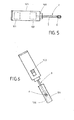
- the device includes a collection device and a drive mechanism operatively coupled to the collection device.
- the collection device is adapted to carry out a rotary and/or translatory motion by means of the operatively coupled drive mechanism.
- the present invention allows an easier and standardized recovery of most of the collected specimen which otherwise would be retained by the collection device.
- the drive mechanism enables the release of the collected specimen by rotating and/or moving the collection device in a translatory motion whereby the collected specimen is released from the collection device, preferably into a receptacle.
- This enables the direct transfer of a collected specimen into a receptacle for analysis improving the preparation procedure and reducing contamination risks.
- the integrity of the recovered sample can thus be enhanced leading to more accurate analysis of the collected specimen.
- the recovery device is useful for recovering and transferring a specimen without requiring additional equipment. After transfer of the specimen, the recovery device along with the collection device can be safely disposed of.
- the preferred collection device comprises an absorbent head or tip for collecting a specimen, for example in form of a cotton, fibre or polyester pad and a stem or shaft for easily handling the collection device.
- the collection device may be provided as a swab which is readily available and a standardized means for collecting a specimen or sample.
- the drive mechanism for rotatory and/or translatory motion of the collection device may be constructed for mechanical actuation. This allows a simple arrangement without the need for electric power.
- the drive mechanism may reciprocate the collection device to enable the release of the collected specimen.
- a reciprocating stroke may consist of a forward and subsequent backwards movement of the collection device.
- the collection device may be rotated preferably concurrent with the reciprocating movement to accomplish a release effect.
- the drive mechanism carries out a defined stroke and/or revolution of the collection device when actuated.
- the defined stroke and/or revolution of the collection device enables the release of the collected specimen in a standardized manner, thereby enhancing reproducibility.
- the preferred manual actuation is implemented by a push button operatively coupled to the drive mechanism.
- the push button facilitates the easy usage of the recovery device, especially with only one hand.
- a specimen is obtained with the collection device, preferably with the absorbent head of the collection device.
- the drive mechanism operatively coupled to the collection device is actuated whereby the collection device carries out a rotatory and/or translatory motion.
- the collected specimen in the collection device is released by said motion and preferably received in a receptacle which may be utilized for downstream processing and analysis.
- the receptacle may be a usual sorbent tube containing an appropriate liquid like a universal transport medium (UTM; Copan Inc. Italy), a culture medium or a nutrient medium.
- the liquid comprises a lysis buffer which may be PCR compatible or chaotropic.
- the collection device is removably attached to the drive mechanism.
- the removable attachment may be implemented by a fastening means such as a screw thread or a push fit fitting.
- the collection device can be removed from the drive mechanism to collect a specimen with the collection device. Afterwards, the collection device is reattached to the drive mechanism for further processing.
- the process of collecting a specimen is improved. Further, an easy disposal of the used collection device is enabled, allowing a fast replacement of the collection device.
- the recovery device further comprises a housing for enclosing the collection device.
- the housing improves the protection of the collection device and a collected specimen. After collecting a specimen with the collection device and inserting the collection device into the housing, the collected specimen can be safely transported and handled.
- the housing may comprise a cap or cover.
- the cap or cover is provided adjacent to the absorbent head of the collection device.
- the cap may be arranged to enclose the absorbent head of the collection device.
- the cap may be provided adjacent to the absorbent head. In this manner, the cap can be easily removed to allow a collection of a specimen or a release of the collected specimen. In use, a specimen may be taken after removing the cap.
- the collected specimen can then be handled and transported with the reattached cover. Afterwards, to release the collected specimen the cover can be removed allowing the release of the collected specimen, for example into a receptacle.
- the cap or cover further prevents contamination by hermetically sealing the collection device in the housing. In addition, by providing the cap or cover adjacent to the absorbent head of the collection device the collection of specimen is also facilitated.
- the recovery device further comprises a holder for the collection device which can be removably attached to the housing.
- the holder may comprise the collection device in a fixed manner and may be attached on one end of the housing.
- the holder may feature a fastening means such as a screw thread or a push fit fitting.
- the holder along with the collection is removed from the housing to collect a specimen with the collection device.
- the holder is reattached to the housing for storage, transport and eventually for release of the collected specimen.
- the holder for the collection device enables easy specimen collecting by removing the collection device from the housing.
- the holder and the collection device can be manufactured as disposable parts allowing a safe and sanitary disposal.
- the collection device is fixed to the drive mechanism.
- the collection device and the drive mechanism may be constructed as fixed parts or integrated components.
- the collection device fixed to the drive mechanism may be constructed as a disposable component, thereby enabling a safe and sanitary disposal of the used collection device, preferably along with the used recovery device.
- a contact surface for releasing the collected specimen is provided.
- the contact surface may be arranged in the housing enclosing the collection device. By actuating the drive mechanism the collection device is manipulated and brought into contact with the contact surface. The contact surface causes the collection device, especially the absorbent head, to be wiped off thereby releasing the collected specimen.
- the contact surface is preferably provided in a housing which encloses the collection device.
- the contact surface may be located adjacent to the absorbent head of the collection device.
- the transfer and recovery of a collected specimen can be accomplished in a protected manner. Further, the housing prevents contamination of the specimen during recovery and also during storage or transport of a collected specimen.
- the drive mechanism and the respective stroke for releasing the collected specimen can be optimized. It is thereby possible to release the collected specimen with a short and efficient stroke of the drive mechanism.
- the contact surface may be implemented by at least one sheet or plate aligned to release the collected specimen from the collection device.
- a sheet or plate may be formed to generate a circumferential contact between contact surface and absorbent head when the drive mechanism is actuated.
- a sheet or plate allows the transfer of a collected specimen by a simple wiping effect.
- a generally circumferential contact between contact surface and absorbent head optimizes the contact area thereby improving the release of a collected specimen.
- the contact surface is implemented as a structured surface.
- the structured surface may comprise channels, grooves or recesses in the surface.
- the recesses are aligned perpendicular to the axis of the collection device to increase the release effect.
- the structured surface may be formed with a changing gap in between.
- the gap of the structured surface may be adapted to the dimensions of the absorbent head.
- the structured surface may be manufactured from a flexible material such as silicone thereby improving the wipe-off effect of the contact surface.
- the contact surface is implemented as a lamellar structure.
- a lamellar structure may comprise several structural elements formed for wiping off.
- the wiping elements are preferably made from a flexible material such as silicone to enable a flexible wipe-off effect.
- the edges of the wiping elements generating the contact to the absorbent head are preferably rounded.
- the rounded edges of the lamellar structure guarantee that the absorbent head of the collection device is not damaged by the wiping elements.
- the edge of the wiping elements may feature a sharper edge to facilitate a stronger wipe-off effect, e.g. by scraping.
- the contact surface is manufactured by injection moulding.
- the injection moulding facilitates an easy-to-fabricate contact surface.
- the housing may also be formed by injection moulding. It is further advantageous to form housing and/or contact surface by 2-shot injection moulding thereby enabling a fast manufacturing of the contact surface in conjunction with the housing.
- the contact surface may be provided in form of an insertion member, particularly an inner sleeve or cartridge.
- the insertion member may be removably fixed to the housing to allow a replacement.
- the insertion member is arranged at the end of the housing enclosing the absorbent head of the collection device. The insertion member thus enables an easy removal and replacement of the insertion element along with the contact surface.
- the drive mechanism is driven by a motor such as a battery-powered or line-powered motor.
- the motor enables a convenient release of the collected specimen without manual actuation.
- the drive mechanism may comprise a coupling means for coupling a motor to the drive mechanism of the collection device.
- the coupling of the drive mechanism may be implemented by a sleeve, muff, clamp or flange coupling. By providing a coupling means the drive mechanism can be easily connected to a separate motor.
- the drive mechanism and the collection device may be constructed as a disposable part. After recovery of the collected specimen the used collection device with the drive mechanism may be disposed of, thus enabling a sanitary disposal of the used collection device.
- the drive mechanism may comprise a transmission means for connecting a separate motor to the drive mechanism of the collection device.
- the transmission means may be implemented by a gearbox or clutch.
- the drive mechanism can be driven by a separate motor in a flexible manner.
- the transmission allows the transformation of speed and torque thereby enabling an efficient actuation of the drive mechanism with the coupled collection device.
- a recovery device with a collection device and a housing comprising a cap or cover is provided.
- the cap is removably attached to the housing.
- the cap is preferably arranged adjacent to the absorbent head of the collection device.
- This embodiment is particularly useful and advantageously employed when the collection of a specimen and the recovery of the specimen are carried out separately, for example, in different locations.
- the cap can easily be removed to collect a specimen.
- the cap mounted on the housing and enclosing the absorbent head ensures the safe storage, transport and handling of a collected specimen. Afterwards, the collected specimen can be easily recovered by removing the cap from the housing.
- the recovery of the specimen utilizes a contact surface according to the above described embodiments.
- the cap or cover may contain a fastening means such as a screw thread or a push fit fitting to enable a removable attachment to the housing. In this manner, the cap can easily be removed for collecting a specimen or releasing the collected specimen, for example into a receiving receptacle.
- the cap may comprise sealing means such as a sealing element or rubber gasket, for hermetically sealing the collected specimen inside the housing. The sealing means guarantees a safe handling and transport of the collected specimen reducing the risk of desiccation and contamination.
- a recovery device with a collection device and a drive mechanism wherein the drive mechanism further comprises a motor. Additionally, alternatively, said drive mechanism may be operatively coupled to a motor.
- the motor is preferably supplied by a battery or a power supply.
- This embodiment allows easier recovery of most of the collected specimen which otherwise would be retained, for example by an absorbent head of the collection device.
- the rotation by a motor enables a faster and efficient release and recovery of the collected specimen in a standardized manner.
- the recovered specimen can for example be directly received in a receptacle.
- the integrity of the recovered sample can thus be improved leading to more accurate analysis of the collected specimen.
- the recovery device is useful for recovering and transferring a specimen without requiring additional equipment.
- the specimen may be directly transferred to a receptacle for further analysis. After transfer of the specimen, the collection device may be removed from the recovery device thereby enabling a safe and sanitary disposal of the used collection device.
- the collection device and preferably a stem of the collection device is removably fixed to the drive mechanism.
- the drive mechanism may be operatively coupled to a motor.
- the attached collection device may already contain a collected specimen or such a specimen may be taken using the collection device.
- the collection device and particularly the absorbent head containing the collected specimen is immersed in a receptacle which may further contain a liquid suspension.
- the motor coupled to the drive mechanism may be actuated by a switch thereby rotating the collection device. In this manner, the collected specimen is released from the absorbent head and transferred for example into a receptacle. Afterwards the collection device may be removed or ejected from the drive mechanism holding the collection device to allow a safe and sanitary disposal.
- the motor is supplied by a battery which may be arranged in a housing along with the motor. Additionally, alternatively the motor may be line-powered by a common power socket.
- the battery enables a portable usage of the recovery device facilitating a ubiquitous application without requiring additional test apparatuses.
- the possibility to connect the recovery device to a common power socket enables easy recharging of the batteries and the stationary usage of the device.
- the motor is adapted for vibrating.
- the preferred motor may be a vibration motor combining rotation and vibration.
- the motor may be adapted to implement either manipulation separately.
- the vibration causes the collection device along with the absorbent head to shake and vibrate correspondingly, thereby improving the release of the collected specimen from the collection device.
- a control circuit is provided to control the operation of the motor.
- the control circuit may control the speed, rotation, torque and/or time of the motor operation.
- a user may for example set a desired operation time for releasing the specimen from the collection device whereby the motor is controlled accordingly.
- the operation of the motor in a standardized and controlled manner facilitates a precise control of the recovery and transfer procedure.
- an adjustable electronic for the motor may be provided to control speed, rotation, torque and/or time of the motor. This also enables the operation of the motor in a controlled manner thus enabling a standardized transfer procedure.
- the reproducibility of the release/recovery process can be enhanced by the motor controller and/or the adjustable electronic.
- a release mechanism for ejecting the collection device is provided.
- the release mechanism may be actuated mechanically by a button or lever.
- the collection device may be fixed to the drive mechanism or a holder of the drive mechanism.
- the release mechanism enables the ejection of the collection device without the need to handle the collection device directly.
- a user may actuate the release mechanism which ejects the used collection device from the drive mechanism or respectively a holder of the drive mechanism. As the collection device does not need to be handled during its release, a safe and sanitary disposal is enabled.
- the recovery device comprises a protective cover.
- the preferred protective cover may be provided at an end of the housing or on the collection device.
- the protective cover may be formed as part of the housing or may be installed separately.
- the protective cover provides protection for the user, for example against back splash, while transferring the collected specimen. Conversely, the receptacle receiving the specimen can also be protected from contamination during the recovery procedure.
- a receptacle for receiving the collected specimen may contain a liquid suspension.
- the liquid suspension may be adapted for the storage and/or transport of the collected specimen, for example a universal transport medium (UTM).
- UDM universal transport medium
- the liquid suspension may be a culture or nutrient medium which can support the growth of microorganisms or cells.
- the use of a liquid suspension generally improves the release of the collected specimen.
- the transport, storage and/or growth of certain microorganisms/cells can be enhanced, particularly during the release of the collected specimen. By combining any of the effects of the utilized suspension with the recovery process, the overall process steps can also be reduced.
- the liquid suspension is a lysis buffer which may be PCR compatible or chaotropic.
- the lysis buffer may be chosen depending on the analysis for which the lysate will be used for.
- the drive mechanism and/or motor can be utilized to manipulate the collection device thereby enabling a centrifuge process.
- the recovery step and the centrifuge step can thus be combined reducing the overall process steps.
- the usage of a lysis buffer is particularly useful and advantageously employed in any system in which the sample has to be recovered and subsequently processed via lysis. A separate pipetting of the recovered specimen can be omitted and the lysis can be directly carried out for example in a receptacle, thereby enabling a fast sample processing and preparation for downstream analysis.
Landscapes
- Physics & Mathematics (AREA)
- Health & Medical Sciences (AREA)
- Life Sciences & Earth Sciences (AREA)
- Chemical & Material Sciences (AREA)
- Analytical Chemistry (AREA)
- Biochemistry (AREA)
- General Health & Medical Sciences (AREA)
- General Physics & Mathematics (AREA)
- Immunology (AREA)
- Pathology (AREA)
- Sampling And Sample Adjustment (AREA)
Priority Applications (1)
| Application Number | Priority Date | Filing Date | Title |
|---|---|---|---|
| EP11159197A EP2502982A1 (de) | 2011-03-22 | 2011-03-22 | Vorrichtung zur Wiederherstellung einer entnommenen Probe |
Applications Claiming Priority (1)
| Application Number | Priority Date | Filing Date | Title |
|---|---|---|---|
| EP11159197A EP2502982A1 (de) | 2011-03-22 | 2011-03-22 | Vorrichtung zur Wiederherstellung einer entnommenen Probe |
Publications (1)
| Publication Number | Publication Date |
|---|---|
| EP2502982A1 true EP2502982A1 (de) | 2012-09-26 |
Family
ID=44063615
Family Applications (1)
| Application Number | Title | Priority Date | Filing Date |
|---|---|---|---|
| EP11159197A Withdrawn EP2502982A1 (de) | 2011-03-22 | 2011-03-22 | Vorrichtung zur Wiederherstellung einer entnommenen Probe |
Country Status (1)
| Country | Link |
|---|---|
| EP (1) | EP2502982A1 (de) |
Cited By (1)
| Publication number | Priority date | Publication date | Assignee | Title |
|---|---|---|---|---|
| WO2021206984A1 (en) * | 2020-04-09 | 2021-10-14 | Kent State University | Oral sample collection or delivery device and methods |
Citations (6)
| Publication number | Priority date | Publication date | Assignee | Title |
|---|---|---|---|---|
| EP0008808A1 (de) * | 1978-09-13 | 1980-03-19 | Reuter, Adolf, Ing. (grad.) | Verfahren und Vorrichtung zur Keimzahlbestimmung an Oberflächen |
| EP0240469A2 (de) * | 1986-03-03 | 1987-10-07 | Antonmassimo Galluccio | Automatische Zahnbürste |
| US4789639A (en) | 1987-01-02 | 1988-12-06 | Becton, Dickinson And Company | Liquid recovery device |
| US20070249961A1 (en) * | 2006-02-17 | 2007-10-25 | Morrison Allan D | Biological sample collection device |
| US20090030341A1 (en) * | 2007-07-27 | 2009-01-29 | 3M Innovative Properties Company | Sample release system |
| CN101856291A (zh) * | 2010-05-31 | 2010-10-13 | 张正平 | 一种休闲电动掏耳器 |
-
2011
- 2011-03-22 EP EP11159197A patent/EP2502982A1/de not_active Withdrawn
Patent Citations (6)
| Publication number | Priority date | Publication date | Assignee | Title |
|---|---|---|---|---|
| EP0008808A1 (de) * | 1978-09-13 | 1980-03-19 | Reuter, Adolf, Ing. (grad.) | Verfahren und Vorrichtung zur Keimzahlbestimmung an Oberflächen |
| EP0240469A2 (de) * | 1986-03-03 | 1987-10-07 | Antonmassimo Galluccio | Automatische Zahnbürste |
| US4789639A (en) | 1987-01-02 | 1988-12-06 | Becton, Dickinson And Company | Liquid recovery device |
| US20070249961A1 (en) * | 2006-02-17 | 2007-10-25 | Morrison Allan D | Biological sample collection device |
| US20090030341A1 (en) * | 2007-07-27 | 2009-01-29 | 3M Innovative Properties Company | Sample release system |
| CN101856291A (zh) * | 2010-05-31 | 2010-10-13 | 张正平 | 一种休闲电动掏耳器 |
Cited By (1)
| Publication number | Priority date | Publication date | Assignee | Title |
|---|---|---|---|---|
| WO2021206984A1 (en) * | 2020-04-09 | 2021-10-14 | Kent State University | Oral sample collection or delivery device and methods |
Similar Documents
| Publication | Publication Date | Title |
|---|---|---|
| US7238520B2 (en) | PCR sample preparation holder and method | |
| US9689780B2 (en) | Apparatus and methods for aliquotting frozen samples | |
| US20050252820A1 (en) | Sampling kits, devices and uses thereof | |
| EP2741675B1 (de) | Vorrichtung zur entnahme von biologischen proben und entsprechendes verfahren | |
| CN109082422B (zh) | 一种全自动pcr核酸提取检测装置 | |
| US20080058676A1 (en) | Retractable segmented bio-molecular collector swab system | |
| US9039636B2 (en) | Devices and methods for enhanced cellular sample transfer | |
| JP2011500056A (ja) | サンプル生成装置および分析器 | |
| CN219044930U (zh) | 核酸提取装置 | |
| EP3989839B1 (de) | Vorrichtung zur probenahme | |
| US20190343494A1 (en) | Automated cell collection and smearing | |
| EP1893740A1 (de) | Vorrichtung zur entnahme, zum sammeln und zum transport biologischer proben | |
| JP6576489B2 (ja) | 微生物及び遺伝子の捕集方法、並びに、その抽出方法 | |
| JP5691108B2 (ja) | 破砕キット、破砕装置および破砕物の集積方法 | |
| US9606031B2 (en) | Systems and methods for transfer and processing of biological samples | |
| US20150007671A1 (en) | Forensic collection device | |
| EP2510881A1 (de) | Vorrichtung und Verfahren zur Gewinnung einer entnommenen Probe | |
| CN213924790U (zh) | Dna检材保存和获取装置 | |
| JP4795765B2 (ja) | 試料処理装置 | |
| EP4688269A1 (de) | Probenfläschchen-verbrauchsmaterial für zytopathologie | |
| WO2026074068A1 (en) | Integration of a scrape sample into a cartridge system | |
| JP2026043955A (ja) | サンプル採集器具およびそれを用いるサンプル採集装置 | |
| CN110918149A (zh) | 离心管 | |
| WO2007146895A2 (en) | Mini-tray for slide processing |
Legal Events
| Date | Code | Title | Description |
|---|---|---|---|
| PUAI | Public reference made under article 153(3) epc to a published international application that has entered the european phase |
Free format text: ORIGINAL CODE: 0009012 |
|
| AK | Designated contracting states |
Kind code of ref document: A1 Designated state(s): AL AT BE BG CH CY CZ DE DK EE ES FI FR GB GR HR HU IE IS IT LI LT LU LV MC MK MT NL NO PL PT RO RS SE SI SK SM TR |
|
| AX | Request for extension of the european patent |
Extension state: BA ME |
|
| STAA | Information on the status of an ep patent application or granted ep patent |
Free format text: STATUS: THE APPLICATION HAS BEEN WITHDRAWN |
|
| 18W | Application withdrawn |
Effective date: 20121025 |