EP2505059A1 - Antimikrobielle Ausrüstung von Kunststoffen und textilen Oberflächen - Google Patents
Antimikrobielle Ausrüstung von Kunststoffen und textilen Oberflächen Download PDFInfo
- Publication number
- EP2505059A1 EP2505059A1 EP12159024A EP12159024A EP2505059A1 EP 2505059 A1 EP2505059 A1 EP 2505059A1 EP 12159024 A EP12159024 A EP 12159024A EP 12159024 A EP12159024 A EP 12159024A EP 2505059 A1 EP2505059 A1 EP 2505059A1
- Authority
- EP
- European Patent Office
- Prior art keywords
- antimicrobial
- amino group
- silver
- polymer structure
- plastics
- Prior art date
- Legal status (The legal status is an assumption and is not a legal conclusion. Google has not performed a legal analysis and makes no representation as to the accuracy of the status listed.)
- Withdrawn
Links
- 230000000845 anti-microbial effect Effects 0.000 title claims abstract description 27
- 239000004033 plastic Substances 0.000 title claims abstract description 6
- 229920003023 plastic Polymers 0.000 title claims abstract description 6
- 239000004753 textile Substances 0.000 title claims abstract description 5
- 229920000642 polymer Polymers 0.000 claims abstract description 18
- 125000003277 amino group Chemical group 0.000 claims abstract description 17
- 229940124530 sulfonamide Drugs 0.000 claims abstract description 16
- 125000001424 substituent group Chemical group 0.000 claims abstract description 13
- 230000015572 biosynthetic process Effects 0.000 claims abstract description 5
- 150000003839 salts Chemical class 0.000 claims abstract description 5
- 125000003178 carboxy group Chemical group [H]OC(*)=O 0.000 claims abstract description 4
- 239000012948 isocyanate Substances 0.000 claims description 3
- 150000002513 isocyanates Chemical class 0.000 claims description 3
- IAYPIBMASNFSPL-UHFFFAOYSA-N Ethylene oxide Chemical compound C1CO1 IAYPIBMASNFSPL-UHFFFAOYSA-N 0.000 claims description 2
- 150000007945 N-acyl ureas Chemical class 0.000 claims description 2
- 150000001408 amides Chemical class 0.000 claims description 2
- -1 silver ions Chemical class 0.000 description 16
- 229910052709 silver Inorganic materials 0.000 description 11
- 239000004332 silver Substances 0.000 description 11
- 150000003456 sulfonamides Chemical class 0.000 description 11
- GGCZERPQGJTIQP-UHFFFAOYSA-N sodium;9,10-dioxoanthracene-2-sulfonic acid Chemical compound [Na+].C1=CC=C2C(=O)C3=CC(S(=O)(=O)O)=CC=C3C(=O)C2=C1 GGCZERPQGJTIQP-UHFFFAOYSA-N 0.000 description 9
- 239000000284 extract Substances 0.000 description 8
- BQCADISMDOOEFD-UHFFFAOYSA-N Silver Chemical compound [Ag] BQCADISMDOOEFD-UHFFFAOYSA-N 0.000 description 5
- 239000000523 sample Substances 0.000 description 5
- 241000588724 Escherichia coli Species 0.000 description 4
- 238000011534 incubation Methods 0.000 description 4
- PEDCQBHIVMGVHV-UHFFFAOYSA-N Glycerine Chemical compound OCC(O)CO PEDCQBHIVMGVHV-UHFFFAOYSA-N 0.000 description 3
- 230000001580 bacterial effect Effects 0.000 description 3
- 244000052616 bacterial pathogen Species 0.000 description 3
- 239000012496 blank sample Substances 0.000 description 3
- 238000010348 incorporation Methods 0.000 description 3
- 235000015097 nutrients Nutrition 0.000 description 3
- 230000009467 reduction Effects 0.000 description 3
- UEJSSZHHYBHCEL-UHFFFAOYSA-N silver(1+) sulfadiazinate Chemical compound [Ag+].C1=CC(N)=CC=C1S(=O)(=O)[N-]C1=NC=CC=N1 UEJSSZHHYBHCEL-UHFFFAOYSA-N 0.000 description 3
- UPMLOUAZCHDJJD-UHFFFAOYSA-N 4,4'-Diphenylmethane Diisocyanate Chemical compound C1=CC(N=C=O)=CC=C1CC1=CC=C(N=C=O)C=C1 UPMLOUAZCHDJJD-UHFFFAOYSA-N 0.000 description 2
- PFPSOZSOSPOAPX-UHFFFAOYSA-N 7-(7-oxoazepane-2-carbonyl)azepan-2-one Chemical compound C1CCCC(=O)NC1C(=O)C1CCCCC(=O)N1 PFPSOZSOSPOAPX-UHFFFAOYSA-N 0.000 description 2
- 241000894006 Bacteria Species 0.000 description 2
- 229920002292 Nylon 6 Polymers 0.000 description 2
- 239000004952 Polyamide Substances 0.000 description 2
- 239000004698 Polyethylene Substances 0.000 description 2
- NHUHCSRWZMLRLA-UHFFFAOYSA-N Sulfisoxazole Chemical compound CC1=NOC(NS(=O)(=O)C=2C=CC(N)=CC=2)=C1C NHUHCSRWZMLRLA-UHFFFAOYSA-N 0.000 description 2
- 229910021536 Zeolite Inorganic materials 0.000 description 2
- 238000007792 addition Methods 0.000 description 2
- 239000004599 antimicrobial Substances 0.000 description 2
- 238000000576 coating method Methods 0.000 description 2
- 229920001577 copolymer Polymers 0.000 description 2
- HNPSIPDUKPIQMN-UHFFFAOYSA-N dioxosilane;oxo(oxoalumanyloxy)alumane Chemical compound O=[Si]=O.O=[Al]O[Al]=O HNPSIPDUKPIQMN-UHFFFAOYSA-N 0.000 description 2
- 238000001035 drying Methods 0.000 description 2
- 230000000694 effects Effects 0.000 description 2
- 239000003822 epoxy resin Substances 0.000 description 2
- 239000004744 fabric Substances 0.000 description 2
- LNEPOXFFQSENCJ-UHFFFAOYSA-N haloperidol Chemical compound C1CC(O)(C=2C=CC(Cl)=CC=2)CCN1CCCC(=O)C1=CC=C(F)C=C1 LNEPOXFFQSENCJ-UHFFFAOYSA-N 0.000 description 2
- 238000000034 method Methods 0.000 description 2
- 230000000813 microbial effect Effects 0.000 description 2
- 229920002454 poly(glycidyl methacrylate) polymer Polymers 0.000 description 2
- 229920002647 polyamide Polymers 0.000 description 2
- 229920000647 polyepoxide Polymers 0.000 description 2
- 229920000728 polyester Polymers 0.000 description 2
- 229920000573 polyethylene Polymers 0.000 description 2
- 229920000139 polyethylene terephthalate Polymers 0.000 description 2
- 239000005020 polyethylene terephthalate Substances 0.000 description 2
- 150000003378 silver Chemical class 0.000 description 2
- SQGYOTSLMSWVJD-UHFFFAOYSA-N silver(1+) nitrate Chemical compound [Ag+].[O-]N(=O)=O SQGYOTSLMSWVJD-UHFFFAOYSA-N 0.000 description 2
- SEEPANYCNGTZFQ-UHFFFAOYSA-N sulfadiazine Chemical compound C1=CC(N)=CC=C1S(=O)(=O)NC1=NC=CC=N1 SEEPANYCNGTZFQ-UHFFFAOYSA-N 0.000 description 2
- 229960004306 sulfadiazine Drugs 0.000 description 2
- 229960000654 sulfafurazole Drugs 0.000 description 2
- 239000000725 suspension Substances 0.000 description 2
- XLYOFNOQVPJJNP-UHFFFAOYSA-N water Substances O XLYOFNOQVPJJNP-UHFFFAOYSA-N 0.000 description 2
- 239000010457 zeolite Substances 0.000 description 2
- NFDXQGNDWIPXQL-UHFFFAOYSA-N 1-cyclooctyldiazocane Chemical compound C1CCCCCCC1N1NCCCCCC1 NFDXQGNDWIPXQL-UHFFFAOYSA-N 0.000 description 1
- DGUJJOYLOCXENZ-UHFFFAOYSA-N 4-[2-[4-(oxiran-2-ylmethoxy)phenyl]propan-2-yl]phenol Chemical compound C=1C=C(OCC2OC2)C=CC=1C(C)(C)C1=CC=C(O)C=C1 DGUJJOYLOCXENZ-UHFFFAOYSA-N 0.000 description 1
- JBKVHLHDHHXQEQ-UHFFFAOYSA-N Caprolactam Natural products O=C1CCCCCN1 JBKVHLHDHHXQEQ-UHFFFAOYSA-N 0.000 description 1
- 239000004970 Chain extender Substances 0.000 description 1
- 102000004190 Enzymes Human genes 0.000 description 1
- 108090000790 Enzymes Proteins 0.000 description 1
- 239000004593 Epoxy Substances 0.000 description 1
- VGGSQFUCUMXWEO-UHFFFAOYSA-N Ethene Chemical compound C=C VGGSQFUCUMXWEO-UHFFFAOYSA-N 0.000 description 1
- 239000005977 Ethylene Substances 0.000 description 1
- DGAQECJNVWCQMB-PUAWFVPOSA-M Ilexoside XXIX Chemical compound C[C@@H]1CC[C@@]2(CC[C@@]3(C(=CC[C@H]4[C@]3(CC[C@@H]5[C@@]4(CC[C@@H](C5(C)C)OS(=O)(=O)[O-])C)C)[C@@H]2[C@]1(C)O)C)C(=O)O[C@H]6[C@@H]([C@H]([C@@H]([C@H](O6)CO)O)O)O.[Na+] DGAQECJNVWCQMB-PUAWFVPOSA-M 0.000 description 1
- 206010061217 Infestation Diseases 0.000 description 1
- SVYKKECYCPFKGB-UHFFFAOYSA-N N,N-dimethylcyclohexylamine Chemical compound CN(C)C1CCCCC1 SVYKKECYCPFKGB-UHFFFAOYSA-N 0.000 description 1
- 239000004743 Polypropylene Substances 0.000 description 1
- 229920005830 Polyurethane Foam Polymers 0.000 description 1
- 241000191967 Staphylococcus aureus Species 0.000 description 1
- 239000000654 additive Substances 0.000 description 1
- 150000004645 aluminates Chemical class 0.000 description 1
- 239000007864 aqueous solution Substances 0.000 description 1
- 230000008901 benefit Effects 0.000 description 1
- 230000003115 biocidal effect Effects 0.000 description 1
- 230000000903 blocking effect Effects 0.000 description 1
- 238000005266 casting Methods 0.000 description 1
- 239000003054 catalyst Substances 0.000 description 1
- 210000004027 cell Anatomy 0.000 description 1
- 210000000170 cell membrane Anatomy 0.000 description 1
- 239000003795 chemical substances by application Substances 0.000 description 1
- 150000001875 compounds Chemical class 0.000 description 1
- 230000000249 desinfective effect Effects 0.000 description 1
- 239000012973 diazabicyclooctane Substances 0.000 description 1
- GYZLOYUZLJXAJU-UHFFFAOYSA-N diglycidyl ether Chemical compound C1OC1COCC1CO1 GYZLOYUZLJXAJU-UHFFFAOYSA-N 0.000 description 1
- 238000001914 filtration Methods 0.000 description 1
- 239000006260 foam Substances 0.000 description 1
- 239000004088 foaming agent Substances 0.000 description 1
- 239000011521 glass Substances 0.000 description 1
- 125000003055 glycidyl group Chemical group C(C1CO1)* 0.000 description 1
- 239000008187 granular material Substances 0.000 description 1
- 230000010354 integration Effects 0.000 description 1
- 230000004060 metabolic process Effects 0.000 description 1
- 230000003641 microbiacidal effect Effects 0.000 description 1
- 244000005700 microbiome Species 0.000 description 1
- 239000000178 monomer Substances 0.000 description 1
- 150000002924 oxiranes Chemical class 0.000 description 1
- 239000002245 particle Substances 0.000 description 1
- 229920000058 polyacrylate Polymers 0.000 description 1
- 239000004848 polyfunctional curative Substances 0.000 description 1
- 229920000098 polyolefin Polymers 0.000 description 1
- 229920001155 polypropylene Polymers 0.000 description 1
- 229920001451 polypropylene glycol Polymers 0.000 description 1
- 229920005629 polypropylene homopolymer Polymers 0.000 description 1
- 229920001296 polysiloxane Polymers 0.000 description 1
- 229920002635 polyurethane Polymers 0.000 description 1
- 239000004814 polyurethane Substances 0.000 description 1
- 239000011496 polyurethane foam Substances 0.000 description 1
- 230000001376 precipitating effect Effects 0.000 description 1
- 230000008569 process Effects 0.000 description 1
- QQONPFPTGQHPMA-UHFFFAOYSA-N propylene Natural products CC=C QQONPFPTGQHPMA-UHFFFAOYSA-N 0.000 description 1
- 125000004805 propylene group Chemical group [H]C([H])([H])C([H])([*:1])C([H])([H])[*:2] 0.000 description 1
- 102000004169 proteins and genes Human genes 0.000 description 1
- 108090000623 proteins and genes Proteins 0.000 description 1
- 230000009257 reactivity Effects 0.000 description 1
- 239000013074 reference sample Substances 0.000 description 1
- 239000011347 resin Substances 0.000 description 1
- 229920005989 resin Polymers 0.000 description 1
- 230000000717 retained effect Effects 0.000 description 1
- 150000004760 silicates Chemical class 0.000 description 1
- 229940100890 silver compound Drugs 0.000 description 1
- 150000003379 silver compounds Chemical class 0.000 description 1
- 229910001961 silver nitrate Inorganic materials 0.000 description 1
- 229960003600 silver sulfadiazine Drugs 0.000 description 1
- YPNVIBVEFVRZPJ-UHFFFAOYSA-L silver sulfate Chemical compound [Ag+].[Ag+].[O-]S([O-])(=O)=O YPNVIBVEFVRZPJ-UHFFFAOYSA-L 0.000 description 1
- 229910000367 silver sulfate Inorganic materials 0.000 description 1
- LBOKOYXTYACSQA-UHFFFAOYSA-N silver;(4-aminophenyl)sulfonyl-(1,3-thiazol-2-yl)azanide Chemical class [Ag+].C1=CC(N)=CC=C1S(=O)(=O)[N-]C1=NC=CS1 LBOKOYXTYACSQA-UHFFFAOYSA-N 0.000 description 1
- 229910052708 sodium Inorganic materials 0.000 description 1
- 239000011734 sodium Substances 0.000 description 1
- 239000003381 stabilizer Substances 0.000 description 1
- 239000000126 substance Substances 0.000 description 1
- 239000000758 substrate Substances 0.000 description 1
- 229960002673 sulfacetamide Drugs 0.000 description 1
- SKIVFJLNDNKQPD-UHFFFAOYSA-N sulfacetamide Chemical compound CC(=O)NS(=O)(=O)C1=CC=C(N)C=C1 SKIVFJLNDNKQPD-UHFFFAOYSA-N 0.000 description 1
- 229960005404 sulfamethoxazole Drugs 0.000 description 1
- GPTONYMQFTZPKC-UHFFFAOYSA-N sulfamethoxydiazine Chemical compound N1=CC(OC)=CN=C1NS(=O)(=O)C1=CC=C(N)C=C1 GPTONYMQFTZPKC-UHFFFAOYSA-N 0.000 description 1
- KJVQYDYPDFFJMP-UHFFFAOYSA-N sulfamethylthiazole Chemical compound CC1=CSC(NS(=O)(=O)C=2C=CC(N)=CC=2)=N1 KJVQYDYPDFFJMP-UHFFFAOYSA-N 0.000 description 1
- 229950005939 sulfamethylthiazole Drugs 0.000 description 1
- GECHUMIMRBOMGK-UHFFFAOYSA-N sulfapyridine Chemical compound C1=CC(N)=CC=C1S(=O)(=O)NC1=CC=CC=N1 GECHUMIMRBOMGK-UHFFFAOYSA-N 0.000 description 1
- 229960002211 sulfapyridine Drugs 0.000 description 1
- 229960001544 sulfathiazole Drugs 0.000 description 1
- JNMRHUJNCSQMMB-UHFFFAOYSA-N sulfathiazole Chemical compound C1=CC(N)=CC=C1S(=O)(=O)NC1=NC=CS1 JNMRHUJNCSQMMB-UHFFFAOYSA-N 0.000 description 1
- JLKIGFTWXXRPMT-UHFFFAOYSA-N sulphamethoxazole Chemical compound O1C(C)=CC(NS(=O)(=O)C=2C=CC(N)=CC=2)=N1 JLKIGFTWXXRPMT-UHFFFAOYSA-N 0.000 description 1
- FAGUFWYHJQFNRV-UHFFFAOYSA-N tetraethylenepentamine Chemical compound NCCNCCNCCNCCN FAGUFWYHJQFNRV-UHFFFAOYSA-N 0.000 description 1
- 150000003573 thiols Chemical group 0.000 description 1
- DVKJHBMWWAPEIU-UHFFFAOYSA-N toluene 2,4-diisocyanate Chemical compound CC1=CC=C(N=C=O)C=C1N=C=O DVKJHBMWWAPEIU-UHFFFAOYSA-N 0.000 description 1
- 229910021642 ultra pure water Inorganic materials 0.000 description 1
- 239000012498 ultrapure water Substances 0.000 description 1
- 235000021122 unsaturated fatty acids Nutrition 0.000 description 1
- 150000004670 unsaturated fatty acids Chemical class 0.000 description 1
- 238000005406 washing Methods 0.000 description 1
Classifications
-
- A—HUMAN NECESSITIES
- A01—AGRICULTURE; FORESTRY; ANIMAL HUSBANDRY; HUNTING; TRAPPING; FISHING
- A01N—PRESERVATION OF BODIES OF HUMANS OR ANIMALS OR PLANTS OR PARTS THEREOF; BIOCIDES, e.g. AS DISINFECTANTS, AS PESTICIDES OR AS HERBICIDES; PEST REPELLANTS OR ATTRACTANTS; PLANT GROWTH REGULATORS
- A01N59/00—Biocides, pest repellants or attractants, or plant growth regulators containing elements or inorganic compounds
- A01N59/16—Heavy metals; Compounds thereof
-
- A—HUMAN NECESSITIES
- A01—AGRICULTURE; FORESTRY; ANIMAL HUSBANDRY; HUNTING; TRAPPING; FISHING
- A01N—PRESERVATION OF BODIES OF HUMANS OR ANIMALS OR PLANTS OR PARTS THEREOF; BIOCIDES, e.g. AS DISINFECTANTS, AS PESTICIDES OR AS HERBICIDES; PEST REPELLANTS OR ATTRACTANTS; PLANT GROWTH REGULATORS
- A01N43/00—Biocides, pest repellants or attractants, or plant growth regulators containing heterocyclic compounds
- A01N43/48—Biocides, pest repellants or attractants, or plant growth regulators containing heterocyclic compounds having rings with two nitrogen atoms as the only ring hetero atoms
- A01N43/54—1,3-Diazines; Hydrogenated 1,3-diazines
Definitions
- the invention relates to an antimicrobial finish of sulfonamide silver salt-based plastics and textile surfaces with an amino group in the 4'-position.
- the antimicrobial effect of substrates containing silver is known.
- commodities are protected against microbial infestation with the aid of silver zeolite, silver glass and other complex silver-containing silicates and aluminates, because the released silver ions intervene in a number of ways in the metabolism of microorganisms, inter alia blocking vital enzymes, a charge balance on the cell membranes takes place and thiol end groups are bound in proteins.
- a disadvantage is the limited effectiveness due to the steady release of silver ions.
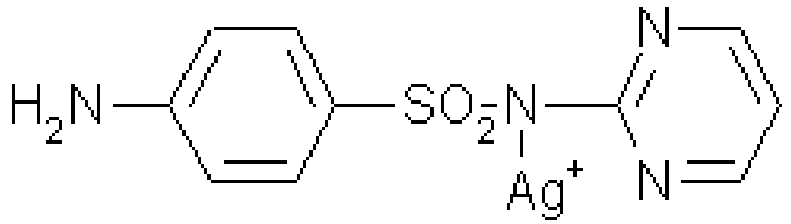
- silver sulfadiazine ie the silver salt of 2-Sulfanilamidopyrimidins
- these agents are unsuitable for the antimicrobial finish of articles of daily use because of the constant presence of sulfonamides. It has namely, that the release of the silver ions from sulfonamide salts from the insoluble salt produces the readily soluble sulfonamide.
- the invention is therefore based on the object to use the good antimicrobial effect of sulfonamite silver salts for the equipment of plastics and textile surfaces, without having to fear the release of sulfonamide.
- the invention solves this problem by virtue of the fact that the amino group is covalently bound into a polymer structure by means of a substituent which reacts with the amino group by addition and which excludes salt formation by a carboxy group.
- Suitable substituents are different compounds depending on the field of use.
- the amino group may be replaced by a polymeric oxirane in the form of an alkanolamine be integrated into the polymer structure.
- polyolefins, polyacrylates, epoxy resins, polyesters and polyamides can be antimicrobially finished.
- polymeric oxiranes copolymers of glycidyl esters of unsaturated fatty acids with olefinically unsaturated Co monomers, such as co-polyglycidyl methacrylate / ethylene or co-polyglycidyl methacrylate / propylene, and glycidyl ether-based epoxy resins can be used to advantage.
- polymeric isocyanates are suitable for the antimicrobial finish of polyurethanes R-NCO as a substituent, with the help of the amino group in the form of ureides is integrated into the polymer structure.
- suitable substituents are isocyanates, such as are commercially available in Plyurethanchemie, z.
- toluene diisocyanate diphenylmethane diisocyanate u. like.
- the amino group of the sulfonamide silver salt reacts with a bis-acyl caprolactam as a substituent to an amide, this results in an advantageous integration of the amino group in the polymer structure of a polyester or a polyamide.
- Substituents of this type are preferably chain extenders, such as carbonyl-bis-caprolactam or 1,3-phenylene-bis- (2-oxazoline-2).
- the invention is not limited to sulfadiazine as the sulfonamide parent. Very good results can also be achieved with other sulfonamide silver salts such as sulfapyridine, sulfamethoxazole, sulfathiazole, sulfaisoxazole, sulfathiadiazoles, sulfacetamide, sulfamethylpyrimidine.
- the silver salts of the sulfonamides are formed by precipitating an aqueous solution of sulfonamide sodium with the stoichiometric amount of a soluble silver salt, preferably silver nitrate and silver sulfate.
- the silver salt is ground to a particle size of about 10 microns. This ensures good dispersibility and solubility and thus good reactivity in the polymer melt, which leads to improved antimicrobial effectiveness, so that the amount of expensive silver compounds used can be kept small.
- silver salt amounts of 0.05 to 0.1 wt.%, The extents can be found.
- the additions of reactive components in the polymer melt required for covalent bonding are required in at least a stoichiometric amount. Preferably, however, the additives are added in a proportion of at least 10% above the stoichiometric amount.
- the soft foam obtained had a density of 38.5 kg / m 3 .
- Examples 5 and 6 are of particular importance for the antimicrobial finishing of coatings and fabrics, because the conventional equipment, for example with a silver zeolite, has a comparatively low effect and the incorporation of granular materials impairs the elastic properties of these coatings and fabrics.
- the polymers of Examples 1 to 6 were subjected to an efficacy test of the equipment against test bacteria Escherichia coli DSM 787 and Staphylococcus aureus DSM 346.
- the test for antimicrobial activity was carried out in accordance with JIS Z 2801: 2000.
- the ineffective reference sample (blank sample) was a drug-free plastic sample.
- test specimens were soaked with 5 ml of bacterial suspension containing the selected test germs in a suitable nutrient medium in a known amount.
- the inoculated swatches were sealed in Centrifuge tubes (humidity> 90%) stored at a temperature of 23 ° C for 24 hours. After incubation, the bacterial suspension was again extracted from the samples under sterile conditions. From the extracts obtained, the number of living germs (bacteria) was determined and compared to the original germ count before incubation.
- the extracts were diluted in various stages, applied to suitable nutrient media and incubated at 35 ° C for two days. After incubation, the count of bacterial colonies grown on the nutrient media was calculated and, based on this, the calculation of the living bacteria present in the extracts.
- the comparison of the counts determined in the extracts of the antimicrobially finished polymers and the germ count found in the extract of the blank sample shows the effectiveness of the equipment. If the germ count determined in the sample extracts is significantly lower than in the extract of the blank sample, microbial death occurs during incubation of the inoculated polymer sample as a result of the antimicrobial finish.
- the samples were subjected to a wash-out process, namely the samples were covered in a ratio of 1:10 with ultrapure water, allowed to stand for one minute and then squeezed out. This procedure was repeated three times before drying the samples in a drying oven at 40 ° C. The washed dry samples were also subjected to the described test for antimicrobial efficacy.
Landscapes
- Life Sciences & Earth Sciences (AREA)
- General Health & Medical Sciences (AREA)
- Agronomy & Crop Science (AREA)
- Pest Control & Pesticides (AREA)
- Plant Pathology (AREA)
- Health & Medical Sciences (AREA)
- Engineering & Computer Science (AREA)
- Dentistry (AREA)
- Wood Science & Technology (AREA)
- Zoology (AREA)
- Environmental Sciences (AREA)
- Inorganic Chemistry (AREA)
- Chemical & Material Sciences (AREA)
- Agricultural Chemicals And Associated Chemicals (AREA)
Abstract
Description
- Die Erfindung bezieht sich auf eine antimikrobielle Ausrüstung von Kunststoffen und textilen Oberflächen auf der Basis von Sulfonamid-Silbersalzen mit einer Aminogruppe in der 4'-Stellung.
- Die antimikrobielle Wirkung von Substraten, die Silber enthalten, ist bekannt. So werden beispielsweise Gebrauchsgegenstände mit Hilfe von Silberzeolith, Silberglas und anderen komplexen silberhaltigen Silikaten und Aluminaten gegen einen mikrobiellen Befall geschützt, weil die freigesetzten Silberionen in mehrfacher Form in den Stoffwechsel von Mikroorganismen eingreifen, wobei unter anderem lebenswichtige Enzyme blockiert werden, ein Ladungsausgleich an den Zellmembranen stattfindet und Thiol-Endgruppen in Proteinen gebunden werden. Nachteilig ist allerdings die begrenzte Wirksamkeit aufgrund der stetigen Freisetzung von Silberionen.
- Zur Desinfektionsausrüstung von Verbandstoffen ist es darüber hinaus bekannt, Silbersulfadiazin, also das Silbersalz des 2-Sulfanilamidopyrimidins,
- Der Erfindung liegt somit die Aufgabe zugrunde, die gute antimikrobielle Wirkung von Sulfonamit-Silbersalzen für die Ausrüstung von Kunststoffen und textilen Oberflächen zu nützen, ohne das Freisetzen von Sulfonamid befürchten zu müssen.
- Ausgehend von einer antimikrobiellen Ausrüstung der eingangs geschilderten Art löst die Erfindung die gestellte Aufgabe dadurch, dass die Aminogruppe mit Hilfe eines mit der Aminogruppe durch Addition reagierenden, eine Salzbildung durch eine Carboxygruppe ausschließenden Substituenten in eine Polymerstruktur kovalent eingebunden ist.
- Durch die kovalente Einbindung der Aminogruppe in eine Polymerstruktur wird die Freisetzung von Silberionen und damit das Entstehen von "freiem" Sulfonamid unterbunden, ohne die antimikrobielle Wirkung zu gefährden, weil ja die Wirkung der Silberionen wegen ihrer Einbindung in die Polymerstruktur über die Aminogruppe auf Dauer erhalten bleibt. Es dürfen jedoch keine Substituenten eingesetzt werden, die eine reine Salzbildung durch eine Carboxygruppe im Polymer nach sich ziehen. Solche Substitutenten führen nämlich zu einer Freisetzung des Sulfonamids, was ja unterbunden werden soll.
- Als Substituenten eignen sich je nach dem Einsatzgebiet unterschiedliche Verbindungen. So kann beispielsweise die Aminogruppe durch ein polymeres Oxiran


- Für die antimikrobielle Ausrüstung von Polyurethanen eignen sich insbesondere polymere Isocyanate
R—NCO als Substituent, mit deren Hilfe die Aminogruppe in Form von Ureiden

- Reagiert die Aminogruppe des Sulfonamid-Silbersalzes mit einem Bis-Acylcaprolactam


- Die Erfindung ist selbstverständlich nicht auf Sulfadiazin als Sulfonamidgrundkörper beschränkt. Sehr gute Ergebnisse können auch mit anderen Sulfonamid-Silbersalzen wie Sulfapyridin, Sulfamethoxazol, Sulfathiazol, Sulfaisoxazol, Sulfathiadiazolen, Sulfacetamid, Sulfamethylpyrimidin, erzielt werden. Die Silbersalze der Sulfonamide werden durch Fällen einer wässrigen Lösung von Sulfonamidnatrium mit der stöchiometrischen Menge eines löslichen Silbersalzes, bevorzugt Silbernitrat und Silbersulfat, gebildet. Nach einer Filtration wird reichlich mit Wasser gewaschen, getrocknet und das Silbersalz bis zu einer Korngröße von etwa 10 µm gemahlen. Damit werden eine gute Dispergierbarkeit und Lösbarkeit und damit eine gute Reaktionsfreudigkeit in der Polymerschmelze gewährleistet, was zu einer verbesserten antimikrobiellen Wirksamkeit führt, sodass die eingesetzte Menge an teuren Silberverbindungen klein gehalten werden kann. Üblicherweise kann mit Silbersalzmengen von 0,05 bis 0,1 Gew.% das Auslangen gefunden werden. Die zur kovalenten Bindung erforderlichen Zusätze der reaktiven Komponenten in der Polymerschmelze werden in einer zumindest stöchiometrischen Menge erforderlich. Bevorzugt werden die Zusätze aber in einem um mindestens 10 % über der stöchiometrischen Menge liegenden Anteil zugegeben.
- In den folgenden Ausführungsbeispielen werden die jeweiligen Anteile der Sulfonamid-Silbersalze und der für die antimikrobiell auszurüstenden Polymere eingesetzten Substituenten in Gew.% oder in g angegeben.
- 91,00 % Polypropylen-Homopolymer MFI 0,23
- 0,05 % Sulfadiazin-Silbersalz
- 8,95 % Polypropylen-Maleinsäureanhydrid gepfropft (MSA-Gehalt 2 Gew.%), ca. 15 % stöchiometrischer Überschuss
- 99 % HD-Polyethylen
- 0,1 % Sulfathiazol-Silbersalz
- 0,9 % Polyethylen-Methacrylsäureglyzidylester-Copolymer mit 8 Gew.% Glyzidylesteranteil, ca. 50 % stöchiometrischer Überschuss.
- 85 % Poly(Bis-phenol A-Glyzidylether) Molekulargewicht > 1200 14,7 % Tetraethylenpentamin als Härter
- 0,2 % Diazabicyclooktan als Beschleuniger
- 0,1 % 5-Methoxysulfadiazin-Silbersalz
- 100 g Polypropylenglykol auf Glyzerinbasis mit OH-Zahl 2800
- 2 g Silikonzellstabilisator
- 1,5 g Dimethylcyclohexylamin als Katalysator
- 3,4 g Wasser als Schäumungsmittel
- 0,15 g Sulfamethylthiazol-Silbersalz
- 66 g Diphenylmethandiisocyanat, ca. 6 % stöchiometrischer Überschuss.
- Der erhaltene Weichschaum wies ein Raumgewicht von 38,5 kg/m3 auf.
- 100 g Polyethylenterephtalat
- 0,08 g Sulfadiazin-Silbersalz
- 0,1 g Carbonyl-bis-caprolactam, ca. 22 % stöchiometrischer Überschuss.
- 100 g Polyamid 6
- 0,12 g Sulfaisoxazol-Silbersalz
- 0,10 g 1,3-Phenylen-bis-(2-oxazolin-2), ca. 30 % stöchiometrischer Überschuss.
- Die Beispiele 5 und 6 sind insbesondere für die antimikrobielle Ausrüstung von Überzügen und Stoffen von besonderer Bedeutung, weil die herkömmliche Ausrüstung beispielsweise mit einem Silberzeolith eine vergleichsweise geringe Wirkung zeigt und durch die Einlagerung von körnigen Stoffen die elastischen Eigenschaften dieser Überzüge und Stoffe beeinträchtigt.
- Die Polymere der Beispiele 1 bis 6 wurden einer Wirksamkeitsprüfung der Ausrüstung gegen Testkeime Escherichia coli DSM 787 und Staphylococcus aureus DSM 346 unterworfen. Die Prüfung hinsichtlich der antimikrobiellen Aktivität erfolgte gemäß JIS Z 2801: 2000. Als unwirksame Referenzprobe (Nullprobe) diente eine wirkstofffreie Kunststoffprobe.
- In einem ersten Schritt wurden die Probekörper mit 5 ml Bakteriensuspension getränkt, die die ausgewählten Testkeime in einem geeigneten Nährmedium in bekannter Menge enthielt. Die beimpften Stoffproben wurden in verschlossenen Zentriefugenröhrchen (Luftfeuchtigkeit > 90 %) bei einer Temperatur von 23 °C für 24 Stunden gelagert. Nach der Inkubation wurde die Bakteriensuspension unter sterilen Bedingungen wieder aus den Proben extrahiert. Aus den gewonnen Extrakten wurde die Anzahl der lebenden Keime (Bakterien) ermittelt und der ursprünglichen Keimzahl vor der Inkubation gegenübergestellt.
- Für die Bestimmung der Anzahl der lebenden Keime in den Extrakten wurden die Extrakte in verschiedenen Stufen verdünnt, auf geeignete Nährböden aufgebracht und bei 35 °C für zwei Tage inkubiert. Nach der Inkubation erfolgte die Auszählung der auf den Nährböden gewachsenen Bakterienkollonien und darauf basierend die Berechnung der in den Extrakten vorhandenen lebenden Keime.
- Die Gegenüberstellung der in den Extrakten aus den antimikrobiell ausgerüsteten Polymeren ermittelten Keimzahlen und der im Extrakt der Nullprobe gefundenen Keimzahl zeigt die Wirksamkeit der Ausrüstung. Ist die in den Probenextrakten ermittelte Keimzahl deutlich geringer als im Extrakt der Nullprobe, so kommt es infolge der antimikrobiellen Ausrüstung zum Absterben von Keimen während der Inkubation der beimpften Polymerprobe.
- Zur Überprüfung der Eluierbarkeit der in den Proben eingearbeiteten Ausrüstungen wurden die Proben einem Auswaschprozess unterworfen, und zwar wurden die Proben im Verhältnis 1 : 10 mit Reinstwasser überschichtet, für eine Minute stehen gelassen und danach ausgepresst. Dieser Vorgang wurde dreimal wiederholt, bevor die Proben im Trockenschrank bei 40 °C getrocknet wurden. Die ausgewaschenen, trockenen Proben wurden ebenfalls dem beschriebenen Test auf antimikrobielle Wirksamkeit unterzogen.
- Die Versuchsergebnisse sind in der nachstehenden Tabelle zusammengefasst, wobei der in bekannter Weise aus den Versuchsergebnissen errechnete Wert R der antimikrobiellen Aktivität angegeben wird. Bei einem Reduktionsfaktor R > 2 liegt eine deutliche antimikrobielle Wirkung vor.
Ausgangskeimzahl KBE Keimzahl nach 24 h Reduktionsfaktor R S. aureus E. coli S. aureus E. coli S. aureus E. coli Nullprobe 1,8 x 10⁵ 2,0 x 10⁵ 2,0 x 10⁵ 1,8 x 10⁵ Beispiel 1 1,8 x 10⁵ 2,0 x 10⁵ 1,0 x 101 1,0 x 101 >4,3 >4,3 Beispiel 2 1,8 x 10⁵ 2,0 x 10⁵ 2,0 x 101 1,0 x 101 4,0 4,3 Beispiel 3 1,8 x 10⁵ 2,0 x 10⁵ 1,0 x 101 1,0 x 101 >4,3 >4,3 Beispiel 4 1,8 x 10⁵ 2,0 x 10⁵ 1,2 x 101 1,0 x 101 >4,3 >4,3 Beispiel 5 1,8 x 10⁵ 2,0 x 10⁵ 1,4 x 101 1,1 x 101 >4,2 >4,2 Beispiel 6 1,8 x 10⁵ 2,0 x 10⁵ 1,0 x 101 1,0 x 101 >4,3 >4,3 Nach dem Auswaschen Ausgangskeimzahl KBE Keimzahl nach 24 h Reduktionsfaktor R Nullprobe 1,8 x 10⁵ 2,0 x 10⁵ 2,0 x 10⁵ 1,5 x 10⁵ Beispiel 1 1,8 x 10⁵ 2,0 x 10⁵ 4,5 x 101 1,0 x 101 >4,3 >4,2 Beispiel 2 1,8 x 10⁵ 2,0 x 10⁵ 7,0 x 101 1,0 x 101 >4,3 >4,2 Beispiel 3 1,8 x 10⁵ 2,0 x 10⁵ 1,5 x 101 1,0 x 101 >4,3 >4,2 Beispiel 4 1,8 x 10⁵ 2,0 x 10⁵ 1,5 x 101 1,0 x 101 >4,3 >4,2 Beispiel 5 1,8 x 10⁵ 2,0 x 10⁵ 1,3 x 101 1,1 x 101 >4,3 >4,2 Beispiel 6 1,8 x 10⁵ 2,0 x 10⁵ 1,4 x 101 1,0 x 101 >4,3 >4,2
Claims (4)
- Antimikrobielle Ausrüstung von Kunststoffen und textilen Oberflächen auf der Basis von Sulfonamid-Silbersalzen mit einer Aminogruppe in der 4'-Stellung, dadurch gekennzeichnet, dass die Aminogruppe mit Hilfe eines mit der Aminogruppe durch Addition reagierenden, eine Salzbildung durch eine Carboxygruppe ausschließenden Substituenten in eine Polymerstruktur kovalent eingebunden ist.
- Antimikrobielle Ausrüstung nach Anspruch 1, dadurch gekennzeichnet, dass die Aminogruppe durch ein polymeres Oxiran als Substituent in Form eines Alkanolamins in die Polymerstruktur eingebunden ist.
- Antimikrobielle Ausrüstung nach Anspruch 1, dadurch gekennzeichnet, dass die Aminogruppe durch ein polymeres Isocyanat als Substituent in Form eines Ureids in die Polymerstruktur eingebunden ist.
- Antimikrobielle Ausrüstung nach Anspruch 1, dadurch gekennzeichnet, dass die Aminogruppe durch ein Bis-Acylcaprolactam als Substituent in Form eines Amids in die Polymerstruktur eingebunden ist.
Applications Claiming Priority (1)
| Application Number | Priority Date | Filing Date | Title |
|---|---|---|---|
| AT4562011A AT511235B1 (de) | 2011-03-31 | 2011-03-31 | Antimikrobielle ausrüstung von kunststoffen und textilen oberflächen |
Publications (1)
| Publication Number | Publication Date |
|---|---|
| EP2505059A1 true EP2505059A1 (de) | 2012-10-03 |
Family
ID=45855505
Family Applications (1)
| Application Number | Title | Priority Date | Filing Date |
|---|---|---|---|
| EP12159024A Withdrawn EP2505059A1 (de) | 2011-03-31 | 2012-03-12 | Antimikrobielle Ausrüstung von Kunststoffen und textilen Oberflächen |
Country Status (2)
| Country | Link |
|---|---|
| EP (1) | EP2505059A1 (de) |
| AT (1) | AT511235B1 (de) |
Cited By (1)
| Publication number | Priority date | Publication date | Assignee | Title |
|---|---|---|---|---|
| WO2016077857A1 (de) | 2014-11-20 | 2016-05-26 | Wenatex Forschung - Entwicklung - Produktion Gmbh | Antimikrobielles mittel zum biociden ausrüsten von polymeren |
Citations (3)
| Publication number | Priority date | Publication date | Assignee | Title |
|---|---|---|---|---|
| WO2003002618A1 (en) * | 2001-06-29 | 2003-01-09 | Dow Global Technologies Inc. | Water-absorbent carboxyl-containing polymers with low monomer content |
| WO2006098729A1 (en) * | 2005-03-11 | 2006-09-21 | Smart Anti-Microbial Solutions, Llc | Polymer-based antimicrobial agents, methods of making said agents, and products incorporating said agents |
| WO2010077985A1 (en) * | 2008-12-16 | 2010-07-08 | Board Of Regents, The University Of Texas System | In situ formation of nanoparticles in resins |
Family Cites Families (1)
| Publication number | Priority date | Publication date | Assignee | Title |
|---|---|---|---|---|
| US6905711B1 (en) * | 2002-05-02 | 2005-06-14 | Smart Anti-Microbial Solutions, Llc | Antimicrobial agents, products incorporating said agents and methods of making products incorporating antimicrobial agents |
-
2011
- 2011-03-31 AT AT4562011A patent/AT511235B1/de not_active IP Right Cessation
-
2012
- 2012-03-12 EP EP12159024A patent/EP2505059A1/de not_active Withdrawn
Patent Citations (3)
| Publication number | Priority date | Publication date | Assignee | Title |
|---|---|---|---|---|
| WO2003002618A1 (en) * | 2001-06-29 | 2003-01-09 | Dow Global Technologies Inc. | Water-absorbent carboxyl-containing polymers with low monomer content |
| WO2006098729A1 (en) * | 2005-03-11 | 2006-09-21 | Smart Anti-Microbial Solutions, Llc | Polymer-based antimicrobial agents, methods of making said agents, and products incorporating said agents |
| WO2010077985A1 (en) * | 2008-12-16 | 2010-07-08 | Board Of Regents, The University Of Texas System | In situ formation of nanoparticles in resins |
Cited By (1)
| Publication number | Priority date | Publication date | Assignee | Title |
|---|---|---|---|---|
| WO2016077857A1 (de) | 2014-11-20 | 2016-05-26 | Wenatex Forschung - Entwicklung - Produktion Gmbh | Antimikrobielles mittel zum biociden ausrüsten von polymeren |
Also Published As
| Publication number | Publication date |
|---|---|
| AT511235A1 (de) | 2012-10-15 |
| AT511235B1 (de) | 2013-01-15 |
Similar Documents
| Publication | Publication Date | Title |
|---|---|---|
| DE60001728T2 (de) | Infektionsresistente polymere, ihre herstellung und verwendungen | |
| DE3784455T2 (de) | Antibiotisches zeolith. | |
| DE69403358T2 (de) | Quaternäre Ammoniumgruppen-enthaltende antimikrobielle Polymere, Zusammensetzungen auf Basis dieser Polymere und Monomere für ihre Herstellung | |
| CN101374607A (zh) | 用于防止微生物附着的非浸提表面活性的膜组合物 | |
| EP0286009A2 (de) | Wässrige biozide kationische Kunststoffdispersionen und deren Verwendung als fungizide, bakterizide und algizide Ausrüstungsmittel | |
| EP2420521B1 (de) | Verbundstoff aus einem Polyadditonspolymer | |
| DE102012103064A1 (de) | Verbundmaterial mit einem Trägermaterial und einem antimikrobiell wirksamen Agens | |
| DE2728106A1 (de) | Mikrobiozides produkt | |
| AT511386A1 (de) | Kontaktbiozid | |
| WO2002087750A1 (de) | Verfahren zur herstellung von gecoateten nanopartikeln | |
| WO2006047800A1 (de) | Biozid, insbesondere fungizid wirkendes mittel | |
| EP0296441A2 (de) | Verwendung von unlöslichen, polyfunktionellen quartären Ammoniumverbindungen zur adsorptiven Bindung von Mikroorganismen | |
| DE2647915B2 (de) | Mischung mit antimikrobieller oder pestizider Wirkung | |
| DE69125018T2 (de) | Antimikrobielle hydrogele | |
| EP2000031A1 (de) | Polyurethan-Werkstoff mit einer bioziden Ausrüstung | |
| DE1806115A1 (de) | Verfahren zur Verhinderung von Blutgerinnung an Oberflaechen von kuenstlichen Gegenstaenden | |
| DE69807800T2 (de) | Nicht zytotoxische medizinische Artikel aus Polyurethan | |
| DE4404404A1 (de) | Acroleinpolymer | |
| DE69126520T2 (de) | Antimikrobielle Zusammensetzung mit einer Hitze- und Witterungsbeständigkeit | |
| AT511235B1 (de) | Antimikrobielle ausrüstung von kunststoffen und textilen oberflächen | |
| EP2819711B1 (de) | Antiseptische wundauflage | |
| EP0027582B1 (de) | Verfahren zur Herstellung von Polyvinylpyrrolidon-Jod | |
| EP3587456B1 (de) | Verfahren zur herstellung eines antibakteriellen chitosanhaltigen polymers für medizinische zwecke, insbesondere für die wundbehandlung | |
| CN111363270A (zh) | 一种广谱抗病毒杀菌塑料及用途 | |
| DE102008036520A1 (de) | Hydrogel-bildendes Polymer mit antibakterieller Wirkung |
Legal Events
| Date | Code | Title | Description |
|---|---|---|---|
| PUAI | Public reference made under article 153(3) epc to a published international application that has entered the european phase |
Free format text: ORIGINAL CODE: 0009012 |
|
| AK | Designated contracting states |
Kind code of ref document: A1 Designated state(s): AL AT BE BG CH CY CZ DE DK EE ES FI FR GB GR HR HU IE IS IT LI LT LU LV MC MK MT NL NO PL PT RO RS SE SI SK SM TR |
|
| AX | Request for extension of the european patent |
Extension state: BA ME |
|
| 17P | Request for examination filed |
Effective date: 20130311 |
|
| RAP1 | Party data changed (applicant data changed or rights of an application transferred) |
Owner name: RAMETSTEINER, KARL |
|
| 17Q | First examination report despatched |
Effective date: 20131113 |
|
| STAA | Information on the status of an ep patent application or granted ep patent |
Free format text: STATUS: THE APPLICATION HAS BEEN WITHDRAWN |
|
| 18W | Application withdrawn |
Effective date: 20140305 |