EP2505505A2 - Procédé et dispositif de stérilisation de moyens d'emballage - Google Patents
Procédé et dispositif de stérilisation de moyens d'emballage Download PDFInfo
- Publication number
- EP2505505A2 EP2505505A2 EP12160405A EP12160405A EP2505505A2 EP 2505505 A2 EP2505505 A2 EP 2505505A2 EP 12160405 A EP12160405 A EP 12160405A EP 12160405 A EP12160405 A EP 12160405A EP 2505505 A2 EP2505505 A2 EP 2505505A2
- Authority
- EP
- European Patent Office
- Prior art keywords
- packaging means
- packaging
- flowable medium
- plastic
- plastic preform
- Prior art date
- Legal status (The legal status is an assumption and is not a legal conclusion. Google has not performed a legal analysis and makes no representation as to the accuracy of the status listed.)
- Withdrawn
Links
Images


Classifications
-
- A—HUMAN NECESSITIES
- A61—MEDICAL OR VETERINARY SCIENCE; HYGIENE
- A61L—METHODS OR APPARATUS FOR STERILISING MATERIALS OR OBJECTS IN GENERAL; DISINFECTION, STERILISATION OR DEODORISATION OF AIR; CHEMICAL ASPECTS OF BANDAGES, DRESSINGS, ABSORBENT PADS OR SURGICAL ARTICLES; MATERIALS FOR BANDAGES, DRESSINGS, ABSORBENT PADS OR SURGICAL ARTICLES
- A61L2/00—Disinfection or sterilisation of materials or objects, in general; Accessories therefor
- A61L2/02—Disinfection or sterilisation of materials or objects, in general; Accessories therefor using physical processes
- A61L2/08—Radiation
- A61L2/10—Ultraviolet [UV] radiation
-
- B—PERFORMING OPERATIONS; TRANSPORTING
- B65—CONVEYING; PACKING; STORING; HANDLING THIN OR FILAMENTARY MATERIAL
- B65B—MACHINES, APPARATUS OR DEVICES FOR, OR METHODS OF, PACKAGING ARTICLES OR MATERIALS; UNPACKING
- B65B55/00—Preserving, protecting or purifying packages or package contents in association with packaging
- B65B55/02—Sterilising, e.g. of complete packages
- B65B55/04—Sterilising wrappers or receptacles prior to, or during, packaging
- B65B55/08—Sterilising wrappers or receptacles prior to, or during, packaging by irradiation
-
- B—PERFORMING OPERATIONS; TRANSPORTING
- B65—CONVEYING; PACKING; STORING; HANDLING THIN OR FILAMENTARY MATERIAL
- B65B—MACHINES, APPARATUS OR DEVICES FOR, OR METHODS OF, PACKAGING ARTICLES OR MATERIALS; UNPACKING
- B65B65/00—Details peculiar to packaging machines and not otherwise provided for; Arrangements of such details
- B65B65/003—Packaging lines, e.g. general layout
-
- A—HUMAN NECESSITIES
- A61—MEDICAL OR VETERINARY SCIENCE; HYGIENE
- A61L—METHODS OR APPARATUS FOR STERILISING MATERIALS OR OBJECTS IN GENERAL; DISINFECTION, STERILISATION OR DEODORISATION OF AIR; CHEMICAL ASPECTS OF BANDAGES, DRESSINGS, ABSORBENT PADS OR SURGICAL ARTICLES; MATERIALS FOR BANDAGES, DRESSINGS, ABSORBENT PADS OR SURGICAL ARTICLES
- A61L2/00—Disinfection or sterilisation of materials or objects, in general; Accessories therefor
- A61L2/02—Disinfection or sterilisation of materials or objects, in general; Accessories therefor using physical processes
- A61L2/08—Radiation
- A61L2/088—Radiation using photocatalysts or photosensitisers
-
- A—HUMAN NECESSITIES
- A61—MEDICAL OR VETERINARY SCIENCE; HYGIENE
- A61L—METHODS OR APPARATUS FOR STERILISING MATERIALS OR OBJECTS IN GENERAL; DISINFECTION, STERILISATION OR DEODORISATION OF AIR; CHEMICAL ASPECTS OF BANDAGES, DRESSINGS, ABSORBENT PADS OR SURGICAL ARTICLES; MATERIALS FOR BANDAGES, DRESSINGS, ABSORBENT PADS OR SURGICAL ARTICLES
- A61L2103/00—Materials or objects being the target of disinfection or sterilisation
- A61L2103/23—Containers other than laboratory or medical, e.g. bottles or mail
Definitions
- the present invention relates to a method and apparatus for sterilizing packaging materials.
- packaging materials such as glass or plastic containers, packaging films, container closures and the like
- a variety of sterilization methods are known from the prior art.
- peracetic acid or H 2 O 2 for sterilization.
- ultraviolet light or X-rays to the packaging means and the like.
- wet sterilization is used in the peracetic acid or dry sterilization with the use of H 2 O 2
- this is aggressive media, which are relatively difficult to treat and therefore require a complex machine technology.
- the energy consumption is relatively high and the drinking water cycle is loaded with chemicals.
- the container is subjected to electron radiation and generated within the container ozone by the conversion of atmospheric oxygen.
- This ozone is kept in the closed container for a sufficient period of time to sterilize it.
- the DE 697 35 141 T2 also describes a method of sterilizing a container wherein the container is subjected to electron beam radiation and ozone is generated within the container by the conversion of atmospheric oxygen.
- the packaging means are transported by a transport device and at least a portion of the packaging means is acted upon by an impingement device with a flowable medium.
- the flowable medium is preferably a photosensitizer present in solution (preferably in water).
- the medium applied to the area is exposed to irradiation with electromagnetic radiation in order to activate or generate singlet oxygen, this singlet oxygen serving to sterilize the packaging means.
- the flowable medium may contain oxygen, but preferably the oxygen used from the environment.
- the flowable medium is a liquid.
- a photodynamic process is triggered by the application of the electromagnetic radiation.
- An essential mechanism in photodynamics is the absorption of light in dye molecules, which are also referred to as photosensitizers, as well as the subsequent possible processes.
- the absorbed light in this photosensitizer can be converted into heat or released again as fluorescent light.
- crucial part of the absorbed light energy can be transferred to the surrounding oxygen, which forms a highly reactive oxygen species.
- the singlet oxygen generated in this way can irreparably damage the cell walls of bacteria and other microorganisms and thus kill them. Which of the three named processes dominates can be controlled by the appropriate choice of the photosensitizer and the light dosimetry.
- the machine technology can be simplified by the procedure according to the invention and, if necessary, be dispensed with the use of chemicals.
- the sterilization process can be initiated by the irradiation only immediately before an actual filling process of containers, whereby a procedural as well as machine-technically complex sterile zone can be reduced.
- Another advantageous use of a photostable dye solution is the repeatable sterilization of machines or machine parts. This is necessary above all for the maintenance of the sterile zone.
- the loading of the packaging means is in particular a wetting of the respective surface areas, but also immersion of the packaging means in a bath of the flowable medium is possible. If necessary, the immersion bath treatment can be supported by the use of ultrasound. In addition, it is also possible that the said areas are sprayed with the flowable medium.
- the entire inner surface of a packaging material to be sterilized is wetted or the flowable medium is distributed over the entire inner surface.
- this wetting is maintained during the entire following process and in particular during the irradiation.
- the wetting during the entire process also remains substantially constant.
- the flowable medium is preferably modified in such a way that it adheres better to the surfaces of the packaging means or to the microorganisms. Therefore, it may be advantageous to adjust or alter the flowability and wettability of the flowable medium.
- the said regions of the packaging means are at least partially an inner wall thereof.
- those regions of the packaging means or plastic preform are subjected to the flowable medium, which in a later closed state of the packaging means come into contact with the substance present in this packaging means, in particular the beverage contained in this packaging means.
- the packaging material is charged with the flowable medium during transport and / or the singlet oxygen is generated or activated during the transport of the packaging material.
- the said region of the packaging means is first charged with the flowable medium and then activated only after a certain time (exposure time) of the singlet oxygen by the irradiation (esp. Electromagnetic irradiation and particularly preferably light in the visible wavelength range).
- the medium also remains after the activation or irradiation for a predetermined period of time on the area of the packaging means in order to achieve an efficient killing of bacteria and germs.
- a reduction rate of the microorganisms is achieved in a range of 5 log levels (ie by a factor of 10,000), this being especially true for those areas of the packaging means which are later treated with the product, e.g. to come into contact with a drink.
- the flowable medium, d. H. a photosensitizer to spray into the packaging means, such as a bottle, the plastic preform, a can or other particular rotationally symmetrical pressure-stable and non-pressure-stable hollow body.
- the principle of rinsing known in the art can be used.
- the dye the photosensitizer
- the container is kept upside down or hanging.
- the internally and / or externally wetted body or the packaging material is then irradiated with radiation and in particular with light of a certain wavelength and thus sterilized.
- the irradiation device can also be a laser-based irradiation device.
- lasers with a fixed or tunable wavelength can be used.
- flash lamps, high-energy lamps, high-pressure lamps, LEDs, combinations thereof and the like can find application.
- the flowable medium advantageously contains a dye.
- the medium is a dye or a dye solution.
- the flowable medium is preferably a substance, and in particular a dye, which is capable of producing the photodynamic effect.
- the dye contains luminescent or reflective particles, which project the light required for activating or exciting also into hard-to-reach areas with, for example, undercut edges.
- the reflection particles ensure that the color layer diffusely reflects. If a ray of light hits it, it will be reflected in all free spatial directions. This advantageously makes it possible to reach even hidden sides of a machine or the inner shoulder surface of a bottle.
- the luminescence method fluorescence or phosphorescence
- molecules / particles that luminesce are added to the dye. If these are illuminated, they themselves start to glow in an undirected way and thus carry the light into hidden areas.
- the excitation wavelength of the luminescent molecules / particles is lower than that of the dyes in order to hit the excitation wavelength of the dyes during emission.
- the exposure time can be increased even by brief excitation (afterglow), and thus photodynamic processes can take even longer. This also allows angled structures to be achieved economically without great illumination.
- the loading of the packaging means takes place before and / or during and / or immediately after a heating of the packaging means.
- the packaging material is a plastic preform
- these are converted into plastic containers by means of a blow molding machine or stretch blow molding machine.
- the plastic preforms are usually heated with a heating device, such as an infrared or microwave oven. It is proposed that, for example, before or during this heating process, at least partially at the same time, the loading of the packaging medium with the flowable medium and optionally also the activation of the singlet oxygen takes place.
- the residence time in the oven can be used to sterilize the preforms previously charged with the medium.
- the radiation in the heating process is used to activate the sterilization process and maintain it until it is filled with sterile material. It would also be possible for the flowable medium to be heated in a targeted manner by the heating device (before or after the irradiation) in order, for example, to evaporate. In addition, it would also be possible that the flowable medium between a heater and a stretch blow molding machine is applied to the (inner) wall of the plastic preform.
- the flowable medium is supplied to the packaging means via a feed line and / or at least one nozzle.
- similar processes are known, with which, for example, H 2 O 2 or peracetic acid or the like is applied to the inner wall of plastic preforms.
- packaging means in particular plastic preforms
- the packaging means in particular plastic preforms
- the flowable medium is advantageously adapted to the microorganisms to be killed.
- the microorganisms that are to be killed by the method described herein are largely Gram-positive, i.e. negatively charged.
- a positive dye is preferably used for these microorganisms.
- oxygen can be added to the process in a targeted manner and under controlled conditions. It is also beneficial to use a light source with a large wavelength range for combining the photodynamic sterilization and sterilization by UV light.
- the photosensitizers remain due to their suitability for food (non-toxic effect) on / in the packaging material and if these are photostable, i.
- the loading and sterilization of the packaging material in a continuous process in particular on a rotary machine.
- the packaging means are at least partially guided along a circular path and are acted upon during this transport on this circular path with the flowable medium and particularly preferably with the electromagnetic radiation.
- the loading device moves at least in sections with the packaging material to be sterilized, such as a plastic preform.
- the irradiation device could move at least in sections with the packaging means.
- a plurality of loading devices and preferably also irradiation devices could be arranged on a carrier wheel and holding devices for holding the plastic preforms on the same carrier wheel.
- a control device can furthermore be provided, which causes the plastic preform to be initially charged with the flowable medium in each such sterilization station and then, after a predetermined period of time, to use the irradiation of the applied regions.
- At least one parameter of the flowable medium is monitored, in particular before its application on the packaging means. For example, it is possible that a temperature of the flowable medium is determined. It would also be possible to carry out flow and concentration measurements (in particular inline). Also fill height measurements can be made (eg when using a dip bath.
- a consumption of the flowable medium is determined, in particular in order to allow conclusions about sufficiently wetted packaging pieces. It would also be possible to determine characteristic data for the irradiation, such as radiant energy or radiant power. In this way, an irradiation dose can be determined.
- the present invention further relates to an apparatus for sterilizing packaging means and in particular plastic preforms.
- this device has a transport device, which transports the packaging material along a predetermined transport path, and an admission device, which acts on at least one region of the packaging means with a flowable medium.
- the device furthermore has an irradiation device which exposes the region of the packaging means, which is exposed to the flowable medium, to electromagnetic radiation for generating singlet oxygen.
- the irradiation device has at least one and preferably a multiplicity of light-emitting diodes.
- a flashlamp or high-energy lamp it would also be possible for a flashlamp or high-energy lamp to serve as the light source (additionally or alternatively).
- the packaging means is a plastic preform
- the radiation source it would be possible for the radiation source to be arranged outside the plastic preform and to receive it from the outside, ie. H. through its wall to activate the singlet oxygen illuminated.
- the light source it would also be possible for the light source to be introduced into the interior of the plastic preform.
- the irradiation device it would also be possible for the irradiation device to irradiate the plastic preforms or their inner walls from the mouth. Also could be introduced into the plastic preform reflector elements and illuminated from the outside.
- the transport device transports the plastic preforms along a circular path.
- plastic preforms it would also be possible for plastic preforms to be moved or transported along their longitudinal direction.
- a heating device such as a microwave heating device, and also to be sterilized during this process. It would be wrong
- the transport of plastic preforms along an at least partially rectilinear path possible.
- the transport device has holding means for holding the packaging means, and the loading device and / or the irradiation device are preferably also integrated in this holding means.
- the holding means is preferably such a holding means which contacts the plastic preform on an inner wall.
- the holding means may be a mandrel which engages in an opening of the plastic preform.
- the said loading means can be arranged, for example, in the form of nozzles or openings.
- the irradiation device which may be, for example, light-emitting diodes, may be integrated in this holding means.
- the holding means preferably engages in an opening of the packaging means.
- the device has a plurality of such holding means and these are particularly preferably arranged equidistant from each other.
- the area at which the holding means contacts the plastic preform is advantageously minimized.
- openings are also integrated in the holding means in order to pressurize the Kunststofftoffvorformling also in the contacted areas with the flowable medium.
- the device has a heating device for heating the packaging means and in particular the plastic preform.
- this heating device may be a microwave-based heating device.
- said device in the transport direction of the packaging means downstream of a stretch blow molding machine.
- the plastic preform is rotated with respect to its longitudinal axis and with respect to the loading device.
- the loading device emits the flowable medium only in a (in particular oblique) direction.
- reflectors for example mirrored surfaces.
- the plastic preform it would also be possible for the plastic preform to be guided obliquely along a circular path. In this way, it is possible that caused by the centrifugal force, the flowable medium passes faster within the plastic preform down and thus the entire inner surface of the plastic preform is wetted with the flowable medium.
- an irradiation device is provided which rotates with respect to the plastic preform so as to be irradiated in its circumferential direction from all sides.
- a light strip arranged outside the plastic preform could also be arranged, which turns towards the plastic preform.
- the device has a clean room. It is thus possible that the packaging means, such as plastic preforms, are already guided through such a clean room or sterile room during the application of the flowable medium and preferably also during the irradiation. In this way, the sterility of the plastic preform can be improved. However, it would also be possible for such a clean room to be connected directly to the device described here, so that the sterilized plastic preforms can reach the said clean room directly.
- the irradiation device emits light in the visible wavelength range.
- the device according to the invention is arranged in an aseptic block, in particular in combination with a subsequently positioned aseptic stretch blow molding machine.
- the plastic preform has a small surface compared with the manufactured container, which has to be sterilized. In this way, the effort when spraying the dye solution is lower. Furthermore, the plastic preforms in comparison to the finished blown container on a simpler geometry and in particular have little or no undercuts. This is particularly advantageous when applying the dye (for example by spraying) but also when applied with radiation.
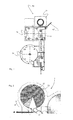
- Fig. 1 shows a plant 50 for treating containers.
- the reference numeral 52 refers to a feeding device, which transfers the plastic preforms to a heater or a furnace 51.
- This heating device 51 may be a microwave oven within which the containers or plastic preforms are transported along a circular path and heated in resonators.
- IR heating elements which may also be designed as heating cavities for the individual heating of the plastic preforms.
- This heating device 51 is followed by a stretch blow molding machine 54, within which the plastic preforms are heated to plastic containers. Subsequently, the containers are filled with a filling machine 56 and transported away.
- the device 1 according to the invention preferably serves for sterilizing plastic preforms.
- the plastic preforms it would be possible for the plastic preforms to be sterilized during transport in the feeder 52, but preferably the plastic preforms are sterilized during heating in the heater 51.
- the plastic preforms are guided in a sterile room or clean room 62 and are both heated within this clean room, as well as formed into plastic containers.
- the sterilization can, as mentioned above, however, it would also be possible, for example, to carry out the sterilization device 1 as a separate module, which can be supplemented, for example, in the case of existing installations.
- the system 50 may have further sterilization units, for example for sterilizing the outer surfaces of the plastic preforms and the like.
- Fig. 2 schematically shows the flow of a sterilization process according to the invention.
- the plastic preforms can enter into the sterilization system 1 and, in the region of section II, be exposed to the flowable medium and then be irradiated.
- the reference symbol P indicates the transport path of the plastic preforms.
- Section III the now activated flowable medium can act on the plastic preforms and in Section IV, the treated plastic preforms can leak out of the machine again. It would also be possible, as mentioned above, to heat the plastic preforms, especially in sections II and III. It would be possible that a plurality of (only one schematically shown) sterilization stations 30 is disposed on a rotatable support 20.
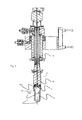
- Fig. 3 shows a treatment unit for treating the plastic preforms.
- a plastic preform 10 which is arranged on a holding mandrel designated in its entirety by 12.
- the reference numeral 4 refers to a loading device, which acts on the interior of the plastic preform 10 and in particular its inner wall 10a with a flowable means.
- Reference numeral 10b denotes an opening of the plastic preform.
- the holding means or the holding mandrel 12 can have irradiation devices 6 which specifically apply light to the inner wall 10a of the plastic preform 10 so as to activate the flowable medium or to produce the singlet oxygen.
- the reference numeral 16 denotes a supply line through which the flowable medium can be transported to the applying means 4.
- This feeder is arranged here in the interior of the retaining mandrel 12.
- Reference numeral 18 denotes a moving unit which serves to move the plastic preforms.
- this movement unit 18 allows a lifting and lowering movement to introduce the plastic preform 10 along its longitudinal axis L, for example, from above into the resonator of a heating device and also to pull it out again.
- the movement device 18 can also serve to rotate the plastic preform 10 - in particular during its heating - with respect to its longitudinal axis L.
- the loading device 4 in this case carries the flowable medium substantially over the entire inner surface of the plastic preform. After irradiation with the irradiation device, the flowable medium can develop its sterilizing effect and sterilize the inner wall 10a of the plastic preform.
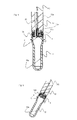
- Fig. 4 shows an enlarged view of in Fig. 3 shown device. Again, recognizes the holding means 12, where the plastic preform 10 is held over its thread 10b again.
- This inner gripper creates a "shadow" or a surface through its concern on the inner surface, which may not be achieved by the radiation or the impingement.
- the preform or the container can also be kept and transported on the outside. It would also be possible to make the inner gripper transparent, so that at least the radiation passes through it. The loading could already take place before this (transparent) inner gripper takes over the plastic preform.
- a discharge channel 22 can be seen, via which the removal of a particular gaseous medium is possible. If the flowable medium penetrates into the plastic preform 10 via the loading device 4, it displaces in this way, in particular air or sterile air within the plastic preform, which then via the discharge line 22 can be dissipated. It would also be possible to carry out the holding means 12 in two parts, for example with a non-rotatable region 12a and a region 12b which rotates relative thereto. In this way it would be possible to rotate the plastic preform 10 while the loading device 4 is held against rotation. In this way, can be wetted by the rotation of the plastic preform in the circumferential direction, the inner wall 10a of the plastic preform with the flowable medium.
- the loading device 4 or the nozzle could be supplied with the sterilization medium via inlets and / or outlets and / or to suck it out of the plastic preform 10 in order to sterilize it, in particular on the inner surface 10d of the plastic preform 10 by additional heating To develop effect.
- Fig. 5 shows a further illustration of a device according to the invention. It can be seen that here the plastic preform 10 is inclined. This embodiment is particularly advantageous when the plastic preform is moved along a circular path. On the one hand, in this way better deformation of the heated plastic preform can be prevented, and on the other hand, this design also allows a more favorable wetting of the entire inner surface 10a of the plastic preform. Again, it would be possible to rotate the plastic preform also with respect to its longitudinal axis, so that in this way an even more favorable distribution of the sterilization medium on the inner wall of the plastic preform is achieved.
- Fig. 6a to 6d show four other possible ways to sterilize packaging.
- the in Fig. 6a shown variant which is used in particular for sterilizing already manufactured containers 10, can be used on the existing principle of rinsers (rinsers).
- the dye is sprayed and distributed in the plastic container 10 held by the holding means 14. The distribution can be done for example as a dispersion or solution.
- the packaging means or here container 10 also present overhead or hanging.
- the container wetted inside and / or outside is subsequently irradiated here by the irradiation device 6 with light of a certain wavelength and thus sterilized. Subsequently, another rinsing process can take place.
- the irradiation device 6 can be arranged here completely around the container around, but it would also be possible that the container 10 rotates with respect to its longitudinal axis L.
- Fig. 6b shown variant is particularly suitable for film-like packaging means 10.
- the packaging material is passed through a container 44, in which the flowable medium is located.
- a plurality of rollers 46 is provided, around which the packaging means 10 extends.
- the packaging means is also irradiated with the stationary here arranged irradiation device 6. This procedure could also find application for granules or closures.
- a conveyor system 50 which has a multiplicity of screws and / or guides in a closed system in order to convey the packaging means.
- the irradiation device (not shown) can also be designed to be sealed off from the actual conveyor system 50 here.
- the packaging means 10 may be, in particular, container closures. These can be transported, for example, with their inside upwards and thereby acted upon next to the flowable medium and then irradiated with the irradiation device.
- Fig. 6d shows a further procedure for irradiating plastic preforms.
- a plurality of nozzle blocks 62 is provided, by means of which the plastic preform 10 is acted upon by the flowable medium on its outer wall.
- irradiation devices may also be provided here, which activate the flowable medium on the outer wall of the plastic preform.
- Fig. 7 shows a further embodiment of a sterilization of plastic preforms 10.
- a rod-like body 70 is provided, which is inserted into the interior of the plastic preforms 10. It would be possible that the rod-like body moves along its longitudinal direction, but it would also be possible that the plastic preform is moved.
- both the loading devices 4 in the form of openings are provided here, as well as the irradiation devices 6, which can be cast as LEDs in this rod-like body 70, for example, or otherwise integrated in them (by screwing, fitting seats and the like). could be.
- the loading devices 4 and the irradiation devices 6 could be arranged here completely around the rod-like body 70, but it would also be possible for them to point only in one direction, and for the rod-like body 70 to be in the longitudinal direction L of FIG Plastic preform 10 rotates.
- rod-like body 70 it would also be possible for the rod-like body 70 to be held against rotation and, conversely, for the plastic preform to rotate.
- the rod-like body could for example be made of a plastic, which would be particularly advantageous for applications in connection with microwave-based heaters.
- Irradiation facilities 6 may be provided.
- the reference numeral 72 roughly indicates a drive for the rod-like body, which serves here for retracting the rod-like body in the plastic preforms and, if necessary. Can also cause a rotational movement of the rod-like body 70.
- a wetting of the plastic preforms could also be such that they are first completely immersed in a bath with the flowable medium and thus filled with this and then emptied again, in particular by turning the plastic preforms again.
- the flowable medium may act on the inner wall of the plastic preforms for a predetermined time, and then they may be irradiated (inside or outside) to produce singlet oxygen.
- the oxygen can come from the ambient air, but it would also be possible to add additional oxygen.
- the plastic preforms be passed by irradiation facilities and preferably also rotate about its longitudinal axis.
Landscapes
- Health & Medical Sciences (AREA)
- General Health & Medical Sciences (AREA)
- Mechanical Engineering (AREA)
- Engineering & Computer Science (AREA)
- Veterinary Medicine (AREA)
- Public Health (AREA)
- Animal Behavior & Ethology (AREA)
- Life Sciences & Earth Sciences (AREA)
- Epidemiology (AREA)
- Toxicology (AREA)
- Apparatus For Disinfection Or Sterilisation (AREA)
- Food Preservation Except Freezing, Refrigeration, And Drying (AREA)
- Blow-Moulding Or Thermoforming Of Plastics Or The Like (AREA)
Applications Claiming Priority (1)
| Application Number | Priority Date | Filing Date | Title |
|---|---|---|---|
| DE102011015344A DE102011015344A1 (de) | 2011-03-28 | 2011-03-28 | Verfahren und Vorrichtung zum Sterilisieren von Verpackungsmitteln |
Publications (2)
| Publication Number | Publication Date |
|---|---|
| EP2505505A2 true EP2505505A2 (fr) | 2012-10-03 |
| EP2505505A3 EP2505505A3 (fr) | 2013-02-27 |
Family
ID=45936847
Family Applications (1)
| Application Number | Title | Priority Date | Filing Date |
|---|---|---|---|
| EP12160405A Withdrawn EP2505505A3 (fr) | 2011-03-28 | 2012-03-20 | Procédé et dispositif de stérilisation de moyens d'emballage |
Country Status (4)
| Country | Link |
|---|---|
| US (1) | US20120294760A1 (fr) |
| EP (1) | EP2505505A3 (fr) |
| CN (1) | CN103086021A (fr) |
| DE (1) | DE102011015344A1 (fr) |
Cited By (5)
| Publication number | Priority date | Publication date | Assignee | Title |
|---|---|---|---|---|
| WO2013092879A1 (fr) * | 2011-12-21 | 2013-06-27 | Sidel Participations | Ensemble constitué d'un dispositif de décontamination et d'au moins une préforme, installation et procédé de fabrication d'un récipient stérile |
| EP2848263A3 (fr) * | 2013-09-11 | 2015-08-05 | Krones AG | Dispositif de stérilisation des parisons de plastique à la stérilisation intérieure et externe simultanée |
| EP2959782A3 (fr) * | 2014-06-24 | 2016-04-06 | Krones AG | Systeme d'equilibrage des temperatures avec nettoyage du liquide de processus |
| WO2018100119A1 (fr) * | 2016-11-30 | 2018-06-07 | Sig Technology Ag | Procédé et machine de remplissage pour le remplissage d'emballages ouverts d'un côté incluant une trajectoire de traitement s'écartant de la direction de transport |
| DE102017102157A1 (de) | 2017-02-03 | 2018-08-09 | Krones Ag | Vorrichtung und Verfahren zum Spülen von Kunststoffvorformlingen |
Families Citing this family (12)
| Publication number | Priority date | Publication date | Assignee | Title |
|---|---|---|---|---|
| IT1402423B1 (it) * | 2010-06-11 | 2013-09-04 | Gea Procomac Spa | Dispositivo di formatura di un recipiente ottenuto da una preforma in materiale plastico, metodo di formatura e macchina di formatura |
| DE102013013589A1 (de) * | 2013-08-19 | 2015-02-19 | Khs Corpoplast Gmbh | Vorrichtung und Verfahren zur Herstellung steriler Behälter |
| DE102014116632B4 (de) * | 2013-11-15 | 2017-05-11 | Seoul Viosys Co., Ltd. | Ladevorrichtung für ein Mobilgerät und Mehrstationsladevorrichtung, die diese verwendet |
| WO2016079726A1 (fr) * | 2014-11-20 | 2016-05-26 | Z5 Global Group Limited | Production d'oxydants |
| DE102015012939A1 (de) * | 2015-10-01 | 2017-04-06 | Kocher-Plastik Maschinenbau Gmbh | Verfahren zur Reduzierung der mikrobiologischen Belastung von Behältererzeugnissen |
| JP2018177263A (ja) | 2017-04-07 | 2018-11-15 | 大日本印刷株式会社 | 無菌充填方法及び無菌充填機 |
| CN108387075B (zh) * | 2018-04-14 | 2023-05-16 | 国药集团冯了性(佛山)药材饮片有限公司 | 一种中药材烘干灭菌装置 |
| FR3098406B1 (fr) * | 2019-07-11 | 2022-12-16 | Sidel Participations | Procédé de décontamination d'une préforme au moyen d'espèces réactives obtenues par mélange d'un agent précurseur et d'un plasma |
| US12433964B2 (en) * | 2020-05-07 | 2025-10-07 | Purdue Research Foundation | Antiviral and antibacterial disinfection aero-solution using edible food dyes |
| US20220152251A1 (en) * | 2020-11-19 | 2022-05-19 | Mi2 Holdings LLC | Non-Aqueous PS/ICP Systems And Application To Surfaces |
| DE102023105388B3 (de) | 2023-03-06 | 2024-05-29 | Multivac Sepp Haggenmüller Se & Co. Kg | Herstellen einer Verpackung aus einer photodynamischen Materialbahn |
| JP7790641B2 (ja) * | 2023-12-28 | 2025-12-23 | 東洋製罐株式会社 | 無菌充填方法および無菌充填システム |
Citations (3)
| Publication number | Priority date | Publication date | Assignee | Title |
|---|---|---|---|---|
| DE69715399T2 (de) | 1996-03-27 | 2003-06-18 | Tetra Laval Holdings & Finance S.A., Pully | Verfahren und vorrichtung zum sterilisieren von nahrungsmittelbehältern |
| DE69735141T2 (de) | 1996-10-14 | 2006-08-03 | Tetra Laval Holdings & Finance S.A. | Verfahren zur sterilisation von geschlossenen behältern |
| DE602004011056T2 (de) | 2003-06-19 | 2008-04-10 | Tetra Laval Holdings & Finance S.A. | Verfahren und vorrichtung zur bestrahlung mittels elektronenstrahlen |
Family Cites Families (22)
| Publication number | Priority date | Publication date | Assignee | Title |
|---|---|---|---|---|
| US3924998A (en) * | 1972-08-17 | 1975-12-09 | Beloit Corp | Blow molding apparatus having side discharge of finished articles |
| JPS6311163A (ja) * | 1986-03-24 | 1988-01-18 | 雪印乳業株式会社 | 殺菌方法及び装置 |
| BR9306903A (pt) * | 1992-08-14 | 1998-12-08 | American Sterilizer Co | Processo de descontaminação de alimentos |
| CA2200988A1 (fr) * | 1994-09-27 | 1996-04-04 | Richard Little | Appareil de nettoyage |
| SE507282C2 (sv) * | 1995-08-11 | 1998-05-04 | Tetra Laval Holdings & Finance | Sätt att sterilisera fyllfärdiga förpackningar samt användning av en elektronkanon vid sättet |
| US6692694B1 (en) * | 1998-11-09 | 2004-02-17 | Clean Earth Technologies, Llc | Method and apparatus for photosensitized ultraviolet decontamination of surfaces and aerosol clouds |
| US6447718B1 (en) * | 1999-11-10 | 2002-09-10 | Stephen Douglas Carter | Apparatus and associated method for decontaminating contaminated matter with ultrasonic transient cavitation |
| US6551346B2 (en) * | 2000-05-17 | 2003-04-22 | Kent Crossley | Method and apparatus to prevent infections |
| US20020015662A1 (en) * | 2000-06-15 | 2002-02-07 | Hlavinka Dennis J. | Inactivation of contaminants using photosensitizers and pulsed light |
| DE10048153A1 (de) * | 2000-09-28 | 2002-04-25 | Natural Energy Solutions Ag | Vorrichtung zur Erzeugung von Singulett-Sauerstoff |
| DE10112971A1 (de) * | 2001-03-14 | 2002-09-19 | Ruediger Haaga Gmbh | Vorrichtung zum Sterilisieren von zu befüllenden Behältern |
| DE10146594A1 (de) * | 2001-09-21 | 2003-04-10 | Solvay Interox Gmbh | Stabilisiertes Wasserstoffperoxid |
| FR2838076B1 (fr) * | 2002-04-04 | 2005-03-04 | Sidel Sa | Procede et installation pour la decontamination des cols de preformes |
| US6737645B2 (en) * | 2002-08-30 | 2004-05-18 | Tropicana Products, Inc. | Method for qualifying bottle rinser |
| DE102006026278A1 (de) * | 2006-06-02 | 2007-12-06 | Khs Ag | Verfahren sowie Vorrichtung zum Behandeln von Flaschen oder dergleichen Behälter mit einem Behandlungsmedium |
| DE102006036763A1 (de) * | 2006-08-05 | 2008-02-07 | Khs Ag | Vorrichtung und Verfahren zur Sterilisation von Behältern |
| JP4881721B2 (ja) * | 2006-12-28 | 2012-02-22 | 株式会社日本Aeパワーシステムズ | 殺菌用電子線照射装置の無菌維持方法及びその装置 |
| DE102007017938C5 (de) * | 2007-04-13 | 2017-09-21 | Khs Gmbh | Behälterherstellungsvorrichtung und Herstellverfahren für Formkörper |
| DE102008020755A1 (de) * | 2008-04-18 | 2009-10-22 | Fraunhofer-Gesellschaft zur Förderung der angewandten Forschung e.V. | Luft-, Wasser- und Oberflächenreinigung unter Nutzung des photodynamischen Effektes |
| CN101585503A (zh) * | 2009-03-24 | 2009-11-25 | 江苏星A包装机械集团有限公司 | 定量灌装阀 |
| DE202009010813U1 (de) * | 2009-08-12 | 2009-12-24 | Krones Ag | Strahlenbehandlung im Ringkanal |
| US8621824B2 (en) * | 2009-09-29 | 2014-01-07 | American Sterilizer Company | Bottle decontamination system |
-
2011
- 2011-03-28 DE DE102011015344A patent/DE102011015344A1/de not_active Withdrawn
-
2012
- 2012-03-16 US US13/422,999 patent/US20120294760A1/en not_active Abandoned
- 2012-03-20 EP EP12160405A patent/EP2505505A3/fr not_active Withdrawn
- 2012-03-28 CN CN2012100868320A patent/CN103086021A/zh active Pending
Patent Citations (3)
| Publication number | Priority date | Publication date | Assignee | Title |
|---|---|---|---|---|
| DE69715399T2 (de) | 1996-03-27 | 2003-06-18 | Tetra Laval Holdings & Finance S.A., Pully | Verfahren und vorrichtung zum sterilisieren von nahrungsmittelbehältern |
| DE69735141T2 (de) | 1996-10-14 | 2006-08-03 | Tetra Laval Holdings & Finance S.A. | Verfahren zur sterilisation von geschlossenen behältern |
| DE602004011056T2 (de) | 2003-06-19 | 2008-04-10 | Tetra Laval Holdings & Finance S.A. | Verfahren und vorrichtung zur bestrahlung mittels elektronenstrahlen |
Cited By (8)
| Publication number | Priority date | Publication date | Assignee | Title |
|---|---|---|---|---|
| WO2013092879A1 (fr) * | 2011-12-21 | 2013-06-27 | Sidel Participations | Ensemble constitué d'un dispositif de décontamination et d'au moins une préforme, installation et procédé de fabrication d'un récipient stérile |
| US9889216B2 (en) | 2011-12-21 | 2018-02-13 | Sidel Participations | Assembly consisting of a decontamination device and at least one preform, facility and method for producing a sterile container |
| EP2848263A3 (fr) * | 2013-09-11 | 2015-08-05 | Krones AG | Dispositif de stérilisation des parisons de plastique à la stérilisation intérieure et externe simultanée |
| EP2959782A3 (fr) * | 2014-06-24 | 2016-04-06 | Krones AG | Systeme d'equilibrage des temperatures avec nettoyage du liquide de processus |
| US9957181B2 (en) | 2014-06-24 | 2018-05-01 | Krones Ag | Pasteurization system with purification of the process liquid |
| EP2959782B1 (fr) | 2014-06-24 | 2018-10-24 | Krones AG | Systeme d'equilibrage des temperatures avec nettoyage du liquide de processus |
| WO2018100119A1 (fr) * | 2016-11-30 | 2018-06-07 | Sig Technology Ag | Procédé et machine de remplissage pour le remplissage d'emballages ouverts d'un côté incluant une trajectoire de traitement s'écartant de la direction de transport |
| DE102017102157A1 (de) | 2017-02-03 | 2018-08-09 | Krones Ag | Vorrichtung und Verfahren zum Spülen von Kunststoffvorformlingen |
Also Published As
| Publication number | Publication date |
|---|---|
| DE102011015344A1 (de) | 2012-10-04 |
| US20120294760A1 (en) | 2012-11-22 |
| CN103086021A (zh) | 2013-05-08 |
| EP2505505A3 (fr) | 2013-02-27 |
Similar Documents
| Publication | Publication Date | Title |
|---|---|---|
| EP2505505A2 (fr) | Procédé et dispositif de stérilisation de moyens d'emballage | |
| EP2138298B1 (fr) | Dispositif et procédé de fabrication de récipients en plastique | |
| EP2371397B1 (fr) | Dispositif de stérilisation de récipients | |
| EP2161202B1 (fr) | Stérilisation par rayonnement d'électrons pour récipients | |
| EP2431058B1 (fr) | Unité de stérilisation aseptisée pour une salle blanche | |
| DE102008007428B4 (de) | Verfahren sowie Vorrichtung zum Sterilisieren von Packmitteln | |
| EP2275214B1 (fr) | Dispositif de traitement de récipients par stérilisation de support | |
| EP2331148B1 (fr) | Dispositif de stérilisation de fermetures | |
| EP2724731B1 (fr) | Dispositif de stérilisation extérieure des conteneurs plastiques | |
| EP2895421B1 (fr) | Dispositif et procédé de stérilisation de bouchons de récipients | |
| EP2731631B1 (fr) | Procédé et dispositif de production de récipients pour boissons remplis de liquides | |
| DE102010044244A1 (de) | Verfahren sowie Vorrichtung zum Behandeln von Behältern | |
| DE102011012342A1 (de) | Verfahren und Vorrichtung zur Sterilisation von Behältnissen | |
| WO2015024640A1 (fr) | Dispositif et procédé permettant de produire des contenants stériles | |
| DE102006026278A1 (de) | Verfahren sowie Vorrichtung zum Behandeln von Flaschen oder dergleichen Behälter mit einem Behandlungsmedium | |
| DE102013109584A1 (de) | Verfahren und Vorrichtung zum Sterilisieren von Behältnissen mit Reinigung eines Strahlaustrittsfensters | |
| DE102024119333A1 (de) | Verfahren und Vorrichtung zur Sterilisation von Behältertransportmitteln | |
| DE102024103567A1 (de) | Verfahren und Vorrichtung zur Sterilisation von Behältern | |
| EP4650145A1 (fr) | Procédé et dispositif de stérilisation de récipients | |
| EP4647237A2 (fr) | Dispositif de stérilisation d'ébauches en plastique et procédé associé | |
| DE102023121242A1 (de) | Vorformling, Behälter hergestellt aus einem Vorformling, separates Behälterteil, Anlage zum Herstellen und/oder Behandeln derjenigen und Verfahren zum Sterilisieren |
Legal Events
| Date | Code | Title | Description |
|---|---|---|---|
| PUAI | Public reference made under article 153(3) epc to a published international application that has entered the european phase |
Free format text: ORIGINAL CODE: 0009012 |
|
| AK | Designated contracting states |
Kind code of ref document: A2 Designated state(s): AL AT BE BG CH CY CZ DE DK EE ES FI FR GB GR HR HU IE IS IT LI LT LU LV MC MK MT NL NO PL PT RO RS SE SI SK SM TR |
|
| AX | Request for extension of the european patent |
Extension state: BA ME |
|
| PUAL | Search report despatched |
Free format text: ORIGINAL CODE: 0009013 |
|
| AK | Designated contracting states |
Kind code of ref document: A3 Designated state(s): AL AT BE BG CH CY CZ DE DK EE ES FI FR GB GR HR HU IE IS IT LI LT LU LV MC MK MT NL NO PL PT RO RS SE SI SK SM TR |
|
| AX | Request for extension of the european patent |
Extension state: BA ME |
|
| RIC1 | Information provided on ipc code assigned before grant |
Ipc: B65B 55/08 20060101AFI20130121BHEP Ipc: A61L 2/10 20060101ALI20130121BHEP Ipc: A61L 2/18 20060101ALI20130121BHEP Ipc: B65B 65/00 20060101ALI20130121BHEP Ipc: A61L 2/08 20060101ALI20130121BHEP |
|
| 17P | Request for examination filed |
Effective date: 20130823 |
|
| RBV | Designated contracting states (corrected) |
Designated state(s): AL AT BE BG CH CY CZ DE DK EE ES FI FR GB GR HR HU IE IS IT LI LT LU LV MC MK MT NL NO PL PT RO RS SE SI SK SM TR |
|
| 17Q | First examination report despatched |
Effective date: 20131022 |
|
| GRAP | Despatch of communication of intention to grant a patent |
Free format text: ORIGINAL CODE: EPIDOSNIGR1 |
|
| INTG | Intention to grant announced |
Effective date: 20150310 |
|
| STAA | Information on the status of an ep patent application or granted ep patent |
Free format text: STATUS: THE APPLICATION IS DEEMED TO BE WITHDRAWN |
|
| 18D | Application deemed to be withdrawn |
Effective date: 20150721 |