EP2506594A1 - Émetteur-récepteur pour relayer des informations multimédias à partir d'un serveur de contrôle des informations multimédias à un dispositif de présentation - Google Patents
Émetteur-récepteur pour relayer des informations multimédias à partir d'un serveur de contrôle des informations multimédias à un dispositif de présentation Download PDFInfo
- Publication number
- EP2506594A1 EP2506594A1 EP12161827A EP12161827A EP2506594A1 EP 2506594 A1 EP2506594 A1 EP 2506594A1 EP 12161827 A EP12161827 A EP 12161827A EP 12161827 A EP12161827 A EP 12161827A EP 2506594 A1 EP2506594 A1 EP 2506594A1
- Authority
- EP
- European Patent Office
- Prior art keywords
- media
- transceiver
- information
- control server
- presenting
- Prior art date
- Legal status (The legal status is an assumption and is not a legal conclusion. Google has not performed a legal analysis and makes no representation as to the accuracy of the status listed.)
- Withdrawn
Links
Images

Classifications
-
- H—ELECTRICITY
- H04—ELECTRIC COMMUNICATION TECHNIQUE
- H04N—PICTORIAL COMMUNICATION, e.g. TELEVISION
- H04N21/00—Selective content distribution, e.g. interactive television or video on demand [VOD]
- H04N21/40—Client devices specifically adapted for the reception of or interaction with content, e.g. set-top-box [STB]; Operations thereof
- H04N21/41—Structure of client; Structure of client peripherals
- H04N21/418—External card to be used in combination with the client device, e.g. for conditional access
- H04N21/4183—External card to be used in combination with the client device, e.g. for conditional access providing its own processing capabilities, e.g. external module for video decoding
-
- H—ELECTRICITY
- H04—ELECTRIC COMMUNICATION TECHNIQUE
- H04N—PICTORIAL COMMUNICATION, e.g. TELEVISION
- H04N21/00—Selective content distribution, e.g. interactive television or video on demand [VOD]
- H04N21/20—Servers specifically adapted for the distribution of content, e.g. VOD servers; Operations thereof
- H04N21/25—Management operations performed by the server for facilitating the content distribution or administrating data related to end-users or client devices, e.g. end-user or client device authentication, learning user preferences for recommending movies
- H04N21/262—Content or additional data distribution scheduling, e.g. sending additional data at off-peak times, updating software modules, calculating the carousel transmission frequency, delaying a video stream transmission, generating play-lists
- H04N21/26291—Content or additional data distribution scheduling, e.g. sending additional data at off-peak times, updating software modules, calculating the carousel transmission frequency, delaying a video stream transmission, generating play-lists for providing content or additional data updates, e.g. updating software modules, stored at the client
-
- H—ELECTRICITY
- H04—ELECTRIC COMMUNICATION TECHNIQUE
- H04N—PICTORIAL COMMUNICATION, e.g. TELEVISION
- H04N21/00—Selective content distribution, e.g. interactive television or video on demand [VOD]
- H04N21/40—Client devices specifically adapted for the reception of or interaction with content, e.g. set-top-box [STB]; Operations thereof
- H04N21/41—Structure of client; Structure of client peripherals
- H04N21/414—Specialised client platforms, e.g. receiver in car or embedded in a mobile appliance
- H04N21/41415—Specialised client platforms, e.g. receiver in car or embedded in a mobile appliance involving a public display, viewable by several users in a public space outside their home, e.g. movie theatre, information kiosk
-
- H—ELECTRICITY
- H04—ELECTRIC COMMUNICATION TECHNIQUE
- H04N—PICTORIAL COMMUNICATION, e.g. TELEVISION
- H04N21/00—Selective content distribution, e.g. interactive television or video on demand [VOD]
- H04N21/40—Client devices specifically adapted for the reception of or interaction with content, e.g. set-top-box [STB]; Operations thereof
- H04N21/41—Structure of client; Structure of client peripherals
- H04N21/418—External card to be used in combination with the client device, e.g. for conditional access
- H04N21/4184—External card to be used in combination with the client device, e.g. for conditional access providing storage capabilities, e.g. memory stick
-
- H—ELECTRICITY
- H04—ELECTRIC COMMUNICATION TECHNIQUE
- H04N—PICTORIAL COMMUNICATION, e.g. TELEVISION
- H04N21/00—Selective content distribution, e.g. interactive television or video on demand [VOD]
- H04N21/40—Client devices specifically adapted for the reception of or interaction with content, e.g. set-top-box [STB]; Operations thereof
- H04N21/43—Processing of content or additional data, e.g. demultiplexing additional data from a digital video stream; Elementary client operations, e.g. monitoring of home network or synchronising decoder's clock; Client middleware
- H04N21/436—Interfacing a local distribution network, e.g. communicating with another STB or one or more peripheral devices inside the home
- H04N21/4363—Adapting the video stream to a specific local network, e.g. a Bluetooth® network
- H04N21/43637—Adapting the video stream to a specific local network, e.g. a Bluetooth® network involving a wireless protocol, e.g. Bluetooth®, RF or wireless LAN [IEEE 802.11]
-
- H—ELECTRICITY
- H04—ELECTRIC COMMUNICATION TECHNIQUE
- H04N—PICTORIAL COMMUNICATION, e.g. TELEVISION
- H04N21/00—Selective content distribution, e.g. interactive television or video on demand [VOD]
- H04N21/60—Network structure or processes for video distribution between server and client or between remote clients; Control signalling between clients, server and network components; Transmission of management data between server and client, e.g. sending from server to client commands for recording incoming content stream; Communication details between server and client
- H04N21/61—Network physical structure; Signal processing
- H04N21/6106—Network physical structure; Signal processing specially adapted to the downstream path of the transmission network
- H04N21/6131—Network physical structure; Signal processing specially adapted to the downstream path of the transmission network involving transmission via a mobile phone network
Definitions
- the present invention relates to relaying and playing media.
- the invention especially relates to an arrangement, a device, a method and a software product arranged for relaying and playing media.
- So-called info screens have been taken into use to a greater extent, by means of which desired information may be relayed to an audience.
- the screens are usually placed in such public spaces, where people move and the media to be presented thus reaches as large an amount of audience as possible.
- the media to be presented may be of several sorts - most often the purpose is to distribute news, guides, notices and advertisements. Most used screens for distributing media are among others LCD and plasma screens and video projectors.
- media screens has increased to such an extent that it has been sensible to design arrangements, by means of which media may be brought to said screens as cost-effectively as possible.
- Such arrangements have turned out to be especially advantageous, where media may be delivered to the screen via a remote connection, advantageously with an Internet-based connection.
- Such arrangements usually consist of a server, which a user of the arrangement operates, and a media player, which downloads the material to be presented from the server and relays it to the used screen.
- the server is usually a common PC, where an application related to media control functions for example on a Linux or Windows operating system.
- the user may upload the presentations to the server from anywhere for example via a www browser.
- the media player is a device, which is connected to the screen, and via which the media may be presented on the screen.
- the connection of the media player to the Internet is most often implemented with a fixed connection, whereby the cost may turn out to be a threshold factor.
- the media player is connected to the screen or a corresponding playing device.
- a USB-based (Universal Serial Bus) memory stick may for example be utilised in this arrangement, with which memory stick the media to be presented may be delivered to the media screen.
- the media screen automatically identifies a memory stick connected to a USB port and plays the images and videos stored on the memory stick on the screen according to predetermined instructions.
- a problem with such an arrangement is however that it is not cost-effective, especially because the media presentation cannot be controlled by remote use. In practice this means that if it is for example desired to change the content of the presentation, it requires the user's presence, making the arrangement slow and difficult to use.
- a further problem with the approach in question is that different manufacturers' thoughts regarding the properties of the media player as a part of the screen element may vary, with the consequence that the media supplier and arrangement operator may need to modify the media to be presented and the method for supplying the media for each screen type. This means numerous technical and economic challenges.
- a typical media transceiver according to the invention for relaying media information from a media control server to a device intended for presenting media comprises first connection means for connecting the media transceiver to the device intended for presenting media, second connection means for connecting the media transceiver wirelessly to a data network, where the media control server is situated, means for receiving media information from the media control server, and memory means for storing the media information.
- a typical media transceiver according to the invention further comprises means for preventing data transfer between the memory means and the device intended for presenting media, when media information is being stored in the memory means.
- the data transfer between the memory means and the device intended for presenting media is prevented by detaching the memory means for the duration of the storing of media information for example by software, or by means of one or more controllable switches, from the device intended for presenting media.
- the media transceiver When the first connection means are so-called wired connection means, by which a wired connection is provided between the media transceiver and the device intended for presenting media, the media transceiver according to the invention does not need to be physically detached from the device intended for presenting media in order to change the media information contained in the media transceiver.
- the media transceiver may via the first connection means be connected to the screen element or a corresponding means for playing media.
- the media transceiver comprises means for establishing a wireless connection to an external network, such as the Internet.
- Such means for establishing a wireless connection may for example be means for establishing a WLAN (Wireless Local Area Network) connection or for establishing a 3G (3rd Generation) connection to a mobile network.
- WLAN Wireless Local Area Network
- 3G 3rd Generation
- the means for preventing data transfer are arranged to set the first connection means in an inactive state, when media information is being stored in the memory means.
- the first connection means are set in an inactive state for the duration of the time when media information received via the second connection means is stored in the memory means.
- the device intended for presenting media cannot be used to read media information stored in the memory means of the media transceiver.
- the first connection means are returned to an active state, whereby the device intended for presenting media can read media information stored in the memory means.
- the first connection means may be set in an inactive state for example by controlling the state of one or more pins of the first connection means, for example with one or more switches.
- the first connection means (105a) are a USB connection.
- the media transceiver is meant to be connected to the USB port of a device intended for presenting media.
- the connection means of a media transceiver provided with a USB connection may be set in an inactive state by arranging the pins of the USB connector into a state, where the device intended for presenting media does not recognise the media transceiver connected to the USB port, whereby the device thinks that no device is connected to the USB port.
- One or more of the pins of the USB connector may for example be set in a so-called floating state.
- electric current is brought into the media transceiver via said USB connection.
- the media transceiver is simulated as a USB memory to the device intended for presenting media.
- the media transceiver is provided with means, by means of which it is possible to retrieve the media to be presented to the media transceiver's own memory via a wireless connection and to further simulate the media transceiver as a USB memory to the device, to which it is connected.
- the device thus functions like an adapter between the screen's own media player and the media control server.
- the device intended for presenting media identifies the media transceiver connected to the USB port, when the first connection means of the media transceiver are in an active state or when they are changed from the inactive state to the active state.
- the device intended for presenting media is arranged to start playing the media information stored in the media transceiver immediately after the media transceiver has been identified or a certain time after the identification.
- the first connection means are means for establishing a wireless connection to at least one device intended for presenting media.
- a Bluetooth or ZigBee connection may be used for establishing the wireless connection.
- the first connection means are arranged to convey electric current to the media transceiver.
- the media transceiver comprises a power source.
- the media transceiver may be arranged to function with the electric current obtainable via the first connection means or with a power source in the media transceiver. It is also possible that the electric current obtainable via the first connection means functions as the main power source for the media transceiver, and the power source situated in the media transceiver, such as a chargeable battery, which may be charged with the electric current obtainable via the connection means, functions as a backup power source. If the first connection means are set in an inactive state so that electric current cannot be transferred via the first connection means, the media transceiver must have a power source, which gives the necessary electric current during the time when media information is being stored in the media transceiver.
- the media transceiver comprises means for retrieving and receiving administration data related to the presenting of media from the media control server according to a predetermined schedule.
- the media transceiver is provided with means, by means of which the media transceiver at predetermined time intervals makes contact with the server to check, if there is new media to be presented to be downloaded and/or if instructions related to the presenting of some certain media information have been stored on the server.
- the media transceiver comprises means for interpreting the received media information.
- the received media information may contain a message, which contains information for example regarding new media to be downloaded on the server, the media type, the target screens of the media and/or the manner of publishing the media, such as time.
- a typical arrangement according to the invention for relaying media information from a media control server to a device intended for presenting media comprises a media transceiver according to the invention connected between the media control server and the device intended for presenting media, forming a means for receiving media information from the media control server, a means for storing the media information and a means for at least partly relaying the received and stored media information to the device intended for presenting media.
- the arrangement according to the invention is arranged to relay media from a centralised administration system to media transceivers connected to presenting devices, such as screens, which media transceivers comprise means for receiving, storing and relaying media to be presented on the screen.
- the media transceiver is arranged to retrieve media information from the media server according to a predetermined schedule.
- media information and/or information related to the presenting thereof is in the arrangement retrieved from the media control server.
- This information retrieval is advantageously arranged according to a predetermined schedule.
- the arrangement according to another embodiment of the invention comprises means for indexing and interpreting the media to be relayed, so that the media information may be stored and presented in the arrangement in a desired manner.
- the media transceiver is connected detachably to the device intended for presenting media.
- the connecting is according to one embodiment made via a USB connection.
- a media transceiver is connected via first connection means to the device intended for presenting media, media information stored in memory means is played in the device intended for presenting media, the media transceiver is wirelessly connected via second connection means to the media control server, media information arranged on the media control server is sent to the media transceiver, the media information sent from the media control server is received via the second connection means, and the received media information is stored in the memory means.
- data transfer between the memory means and the device intended for presenting media is prevented, when media information is being stored in the memory means.
- the data transfer between the memory means and the device intended for presenting media is prevented by setting the first connection means in an inactive state for the duration of the time when media information is being stored in the memory means.
- media information is retrieved from the media control server according to a predetermined schedule.
- instructions for at least partly presenting the received and stored media information are retrieved from the media control server according to a predetermined schedule.
- the media information to be presented is relayed from the media control arrangement to the media transceivers, in which the media to be presented is stored and which are arranged to publish the media information in a manner previously planned.
- a file system of the memory means is mounted on the device intended for presenting media with software, when it is desired to activate/start the media presentation.
- the file system of the memory means is unmounted from the device intended for presenting media with software.
- the memory of the memory means is wirelessly updated.
- the file system may be mounted on a software/microprocessor responsible for the updating as the file system thereof. After the updating the file system may be unmounted from the microprocessor and again mounted on the device intended for presenting media.
- a computer program product is arranged to implement the steps of the method according to the invention.
- An advantage of the invention is primarily that the media transceiver, the arrangement, the method and/or the computer program product according to the invention may be used to cost-effectively deliver media remotely to desired presenting means, such as screens.
- the size of the device according to the invention is small, enabling utilisation of the media transceiver in space-critical targets.
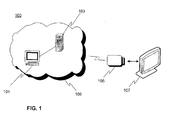
- Figure 1 shows one exemplary arrangement 100, which arrangement 100 is arranged to relay media from a centralised administration arrangement to media transceivers 105 connected to devices intended for presenting media, such as screens 107.
- One arrangement according to the invention comprises a centralised media control server 103, by means of which media information, its publication and at least partly also the devices to which the media to be published is brought, are administrated.
- Media information here means at least media to be published, but when necessary also other information related to media to be published, such as data related to publication administration.
- An operator administrates the media server 103 for example from his own work station 101.
- the media control server 103 may be used to control media transceivers 105 comprised in the arrangement and thus media presented on the screens 107 connected to the media transceivers 105.
- the media control server 103 may also be used to administrate media intended for the screens 107 and, if necessary, matters related to media distribution, such as matters related to media storage, publication time and/or location. This may be done for example so that instructions related to the publication of the media are included in the media information to be delivered to the media transceiver 105. Alternatively this may be done for example so that the media transceiver 105 regularly establishes a connection to the media control server 103 to check if instructions regarding the publication of the media have been stored there.
- the media control server 103 and the work station 101 are advantageously situated in a data network 109, such as the Internet. As is shown in Figure 1 , in the arrangement 100 according to the invention contact is made from the data network 109 to the media transceivers 105 in a wireless manner.
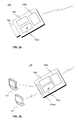
- FIG. 2a shows a media transceiver 105 according to one embodiment of the invention.
- the media transceiver 105 comprises first connection means 1 05a for connecting the media transceiver 105 for example to a screen 107, where the media to be published is meant to be presented.
- the first connection means 105a of the media transceiver 105 form a first interface for connecting the media transceiver 105 to a screen.
- Such connection means 105a are for example a USB (Universal Serial Bus) connection, an HDMI (High Definition Multimedia Interface) connection or a VGA (Video Graphics Array) connection.
- a wireless short-range network connection such as a Bluetooth or ZigBee connection, may be utilised as the media transceiver's 105 interface to the screen 107.
- Electric current is advantageously brought to the media transceiver 105 according to the invention via said first connection means 105a.
- An advantage with such a solution is that the media transceiver 105 does not need its own power source. This further enables the use of a media transceiver according to the invention in space-critical locations.
- the media transceiver according to the invention further comprises second connection means 105b for establishing a wireless connection to a data network 109, such as the Internet.
- second means 105b for establishing a wireless connection may for example be means for establishing a WLAN (Wireless Local Area Network) connection or for establishing a 3G (3rd Generation) connection to a mobile network, via which a connection to a data network 109 is obtained.
- the media transceiver 105 advantageously also comprises means, by means of which a secured connection, such as for example a HTTPS (Hypertext Transfer Protocol Secure) connection and/or a VPN (Virtual Private Network) connection, may be established between the media transceiver and the server.
- a secured connection such as for example a HTTPS (Hypertext Transfer Protocol Secure) connection and/or a VPN (Virtual Private Network) connection
- HTTPS Hypertext Transfer Protocol Secure
- VPN Virtual Private Network
- the media transceiver 105 comprises memory means 105c for storing the media to be presented.
- memory means are for example a reprogrammable flash memory, which is suitable especially due to its small size and slight power consumption for the media transceiver 105 according to the invention.
- software solutions related to the function of the media transceiver 105 may be stored in the memory means 105c, such as software components related to control and distribution of media. With their aid media may for example be received, identified and distributed in a desired and predetermined manner.
- Said software solutions are brought into operation by executing them in a processor unit 105d situated in the media transceiver 105, which may also have memory elements for storing for example an operating system.
- the processor unit 105d is among others arranged to control the operation of the first connection means 105a, so that the first connection means 1 05a are set in an inactive state for the duration of the time when media information is being stored in the memory means 105c.
- Figure 2 shows only the elements which are essential for the invention.
- the media transceiver 105 according to the invention may also comprise other component and/or software solutions in order to achieve the desired functionality.
- the media transceiver 105 is provided with a solution, for example with software, by means of which downloading of media from the server to the memory means 105c of the media transceiver 105 is achieved according to predetermined criteria.
- criteria may for example be matters related to time, location or the media itself.
- Media is for example advantageously downloaded at night to the media transceiver 105, when the utilisation degree of the data communications networks is lower. Such matters naturally depend on the use purpose of the media being distributed.
- the media transceiver 105 may be simulated as a USB memory to the device to which it is connected. The device thus functions like an adapter between the screen 107 and the media control server 103.
- the media transceiver 105 is arranged to establish a connection at predetermined time intervals to the media control server 103 to check if there is new media to be presented to be downloaded into the memory of the media transceiver 105 and further presented.
- said media transceiver 105 establishes a connection at predetermined time intervals to check if instructions have been stored on the media control server 103 related to the publication of some specific media, which is in some cases already stored in the media transceiver.
- the media transceiver 105 comprises means for interpreting a message coming from the media control server 103.
- the received message may for example comprise information about new media to be downloaded on the media control server 103, the media type, the target screens of the media and/or the manner of publication of the media, such as the time.
- the media transceiver 105 is arranged to combine the information in the message with the downloaded media.
- the media to be downloaded comprises information related to the media to be presented. Such information may for example relate to the manner of publication of the message and/or the publication time.
- FIG. 2b shows a media transceiver 105 according to one embodiment of the invention, which media transceiver otherwise comprises the same elements and functionalities as the media transceiver 105 in Figure 2a , but the first connection means 105a in Figure 2a are replaced with connection means 105aa, by means of which media may be relayed from the media transceiver 105 to several screens 107 simultaneously.
- This is especially advantageously achieved by using a short-range wireless connection, such as a Bluetooth or ZigBee connection.
- the processor unit 105d is arranged to control the operation of the first connection means 1 05aa, so that the first connection means 105aa are set in an inactive state for the duration of the time when media information is being stored in the memory means 105c.
- This embodiment makes the invention especially plausible in the economic sense, because in this way the number of needed media transceivers 105 can be decreased.
- Figure 3 shows a method according to the invention.
- media information stored on the media control server 103 is delivered to the media transceiver 105. This is done via a wireless connection.
- the received media information is stored in the media transceiver 105.
- the first connection means 105a, 1 05aa are in an inactive state.
- the first connection means 105a, 1 05aa are set in an active state and at least part of the stored media is played in a desired player, such as a screen 107, as controlled by the media transceiver 105. This means that at least the actual media intended to be played is played without information related to the administration of the media.
- the media and/or information related to the media is interpreted in the media transceiver 105.
- administration data related to the publication of the media such as publication instructions, which may for example be information related to the manner and/or time of presentation, is analysed in the media transceiver 105.
- publication instructions which may for example be information related to the manner and/or time of presentation
- Such information may be delivered to the media transceiver with a separate message, which is however linked to the actual media to be presented for example with the aid of some identifier.
- Such information may be delivered in a header field of the actual media.
- the interpretation of the media may be done for example immediately as the media information is received or alternatively only after it is stored in the memory means 105c of the media transceiver 105.
- the encryption of the received media information is decrypted in the media transceiver 105 either directly when receiving the media information or alternatively after it is stored.
- instructions for at least partly presenting the received and stored media information are retrieved from the media control server 103.
- the retrieval of the instructions is done according to a predetermined schedule.
- the media transceiver 105 is provided with means, advantageously with software, which enable a media player to retrieve media information on its own initiative.
- a computer program product according to the invention is arranged to carry out the steps of the method according to the invention when it is run in a processor unit 1 05d of the media transceiver 105.
- the media transceiver 105 comprises a small 32-bit microprocessor 105d, a memory 105c and a WLAN module 105b.
- the media transceiver 105 has a simple operating system and software implemented with C language.
- the media transceiver 105 is capable of communicating via the WLAN network and further via the Internet with other devices connected to the network. In this case the communication occurs with the media control server 103.
- the software of the device supports http and HTTPS protocols for communication and data transfer.
- the protocols of the media transceiver 105 and the media control server 103 are arranged to function together.
- the media transceiver has a ROM type memory for storing presentation material. The presentation material thus remains in the memory for example if a power outage occurs.
- the processor unit 105d has traditional components, such as a RAM memory.
- the media transceiver 105 also has IO functions typical for a USB memory.
Landscapes
- Engineering & Computer Science (AREA)
- Multimedia (AREA)
- Signal Processing (AREA)
- Computer Networks & Wireless Communication (AREA)
- Databases & Information Systems (AREA)
- Information Transfer Between Computers (AREA)
Applications Claiming Priority (1)
| Application Number | Priority Date | Filing Date | Title |
|---|---|---|---|
| FI20115293A FI20115293A0 (fi) | 2011-03-28 | 2011-03-28 | Välitin mediainformaation välittämiseksi ja toistamiseksi, järjestelmä, menetelmä ja tietokoneohjelmatuote |
Publications (1)
| Publication Number | Publication Date |
|---|---|
| EP2506594A1 true EP2506594A1 (fr) | 2012-10-03 |
Family
ID=43806502
Family Applications (1)
| Application Number | Title | Priority Date | Filing Date |
|---|---|---|---|
| EP12161827A Withdrawn EP2506594A1 (fr) | 2011-03-28 | 2012-03-28 | Émetteur-récepteur pour relayer des informations multimédias à partir d'un serveur de contrôle des informations multimédias à un dispositif de présentation |
Country Status (2)
| Country | Link |
|---|---|
| EP (1) | EP2506594A1 (fr) |
| FI (1) | FI20115293A0 (fr) |
Cited By (1)
| Publication number | Priority date | Publication date | Assignee | Title |
|---|---|---|---|---|
| WO2015145470A1 (fr) * | 2014-03-27 | 2015-10-01 | Cloudproject Generation Srl | Système informatique miniaturisé |
Citations (3)
| Publication number | Priority date | Publication date | Assignee | Title |
|---|---|---|---|---|
| US6405278B1 (en) * | 1999-05-20 | 2002-06-11 | Hewlett-Packard Company | Method for enabling flash memory storage products for wireless communication |
| EP1465420A2 (fr) * | 2003-04-03 | 2004-10-06 | Eastman Kodak Company | Dispositif d'emmagasinage compact sans fil. |
| US20060265725A1 (en) * | 2005-05-20 | 2006-11-23 | Barnes Adam K | Presentation of allocated media on a display device |
-
2011
- 2011-03-28 FI FI20115293A patent/FI20115293A0/fi not_active Application Discontinuation
-
2012
- 2012-03-28 EP EP12161827A patent/EP2506594A1/fr not_active Withdrawn
Patent Citations (3)
| Publication number | Priority date | Publication date | Assignee | Title |
|---|---|---|---|---|
| US6405278B1 (en) * | 1999-05-20 | 2002-06-11 | Hewlett-Packard Company | Method for enabling flash memory storage products for wireless communication |
| EP1465420A2 (fr) * | 2003-04-03 | 2004-10-06 | Eastman Kodak Company | Dispositif d'emmagasinage compact sans fil. |
| US20060265725A1 (en) * | 2005-05-20 | 2006-11-23 | Barnes Adam K | Presentation of allocated media on a display device |
Cited By (1)
| Publication number | Priority date | Publication date | Assignee | Title |
|---|---|---|---|---|
| WO2015145470A1 (fr) * | 2014-03-27 | 2015-10-01 | Cloudproject Generation Srl | Système informatique miniaturisé |
Also Published As
| Publication number | Publication date |
|---|---|
| FI20115293A0 (fi) | 2011-03-28 |
Similar Documents
| Publication | Publication Date | Title |
|---|---|---|
| CN202276368U (zh) | 一种基于网络的多媒体广告发布系统及多媒体广告发布终端 | |
| US9055128B2 (en) | Information processing device | |
| US10838613B2 (en) | Consumer electronic entertainment and display system | |
| JP7018110B1 (ja) | モバイル機器ドック | |
| CN105978766A (zh) | 使用移动终端对电器设备进行操控的设备、系统和方法 | |
| US8452834B2 (en) | Information processing apparatus, program, and information processing system | |
| EP3468176A1 (fr) | Dispositif de traitement d'informations portable et système de reproduction de données multimédias | |
| WO2007050886A3 (fr) | Diffusion de contenu publicitaire pour un dispositif de divertissement | |
| US20210044853A1 (en) | Consumer electronic entertainment and display system | |
| CN104980326A (zh) | 一种终端设备之间分享应用内容的方法及装置 | |
| US20140337454A1 (en) | Information processing system and content download method | |
| CN103377021A (zh) | 屏幕组合显示系统及方法 | |
| US20090319063A1 (en) | Splittable portable media player as remote control | |
| KR20140023105A (ko) | 옥외 광고 및 컨텐츠 재생을 위한 다중 어플리케이션이 구비된 스마트 디지털 사이니지 단말 및 그 방법 | |
| US20200245380A1 (en) | Systems and methods for controlling media content in a multi-user and mulit-device environment using a wireless communication device | |
| EP2506594A1 (fr) | Émetteur-récepteur pour relayer des informations multimédias à partir d'un serveur de contrôle des informations multimédias à un dispositif de présentation | |
| US20160127504A1 (en) | Information processing device, information processing system, program, and computer readable recording medium | |
| CN108184210B (zh) | 一种基于多网融合的多模智能无线通信系统及其实现方法 | |
| CN203164956U (zh) | 一种交互式移动设备内容提供终端 | |
| CN103970583A (zh) | 移动设备内容提供终端 | |
| CN201458446U (zh) | 电梯用远程影音播放控制系统 | |
| TW201535259A (zh) | 應用程式配送系統、通信終端、記憶裝置、程式及應用程式配送方法 | |
| KR101850072B1 (ko) | 스마트 미러 디바이스 프레임 버퍼를 이용한 원격 관리 시스템 | |
| US20120011452A1 (en) | Method of portable electronic device support in display unit | |
| CN113037796A (zh) | 无固定lP位址的远端网路装置非即时传送资料方法 |
Legal Events
| Date | Code | Title | Description |
|---|---|---|---|
| PUAI | Public reference made under article 153(3) epc to a published international application that has entered the european phase |
Free format text: ORIGINAL CODE: 0009012 |
|
| AK | Designated contracting states |
Kind code of ref document: A1 Designated state(s): AL AT BE BG CH CY CZ DE DK EE ES FI FR GB GR HR HU IE IS IT LI LT LU LV MC MK MT NL NO PL PT RO RS SE SI SK SM TR |
|
| AX | Request for extension of the european patent |
Extension state: BA ME |
|
| STAA | Information on the status of an ep patent application or granted ep patent |
Free format text: STATUS: THE APPLICATION IS DEEMED TO BE WITHDRAWN |
|
| 18D | Application deemed to be withdrawn |
Effective date: 20130404 |