EP2509143A2 - Précurseur de matière active d'anode et matière active pour batterie au lithium rechargeable comprenant du carbone nanofibreux creux et procédé de production correspondant - Google Patents
Précurseur de matière active d'anode et matière active pour batterie au lithium rechargeable comprenant du carbone nanofibreux creux et procédé de production correspondant Download PDFInfo
- Publication number
- EP2509143A2 EP2509143A2 EP10834806A EP10834806A EP2509143A2 EP 2509143 A2 EP2509143 A2 EP 2509143A2 EP 10834806 A EP10834806 A EP 10834806A EP 10834806 A EP10834806 A EP 10834806A EP 2509143 A2 EP2509143 A2 EP 2509143A2
- Authority
- EP
- European Patent Office
- Prior art keywords
- active material
- anode active
- carbon
- composite
- material precursor
- Prior art date
- Legal status (The legal status is an assumption and is not a legal conclusion. Google has not performed a legal analysis and makes no representation as to the accuracy of the status listed.)
- Withdrawn
Links
- OKTJSMMVPCPJKN-UHFFFAOYSA-N Carbon Chemical compound [C] OKTJSMMVPCPJKN-UHFFFAOYSA-N 0.000 title claims abstract description 105
- 229910052799 carbon Inorganic materials 0.000 title claims abstract description 103
- 239000002243 precursor Substances 0.000 title claims abstract description 69
- 229910052744 lithium Inorganic materials 0.000 title claims abstract description 49
- WHXSMMKQMYFTQS-UHFFFAOYSA-N Lithium Chemical compound [Li] WHXSMMKQMYFTQS-UHFFFAOYSA-N 0.000 title claims abstract description 47
- 238000004519 manufacturing process Methods 0.000 title claims abstract description 26
- 239000006183 anode active material Substances 0.000 title claims abstract 47
- 239000011149 active material Substances 0.000 title abstract description 5
- 239000002131 composite material Substances 0.000 claims abstract description 112
- 239000000126 substance Substances 0.000 claims abstract description 48
- 229910019142 PO4 Inorganic materials 0.000 claims abstract description 19
- 239000002905 metal composite material Substances 0.000 claims abstract description 15
- 229910001386 lithium phosphate Inorganic materials 0.000 claims abstract description 8
- TWQULNDIKKJZPH-UHFFFAOYSA-K trilithium;phosphate Chemical compound [Li+].[Li+].[Li+].[O-]P([O-])([O-])=O TWQULNDIKKJZPH-UHFFFAOYSA-K 0.000 claims abstract description 8
- 239000010450 olivine Substances 0.000 claims abstract 4
- 229910052609 olivine Inorganic materials 0.000 claims abstract 4
- 239000006185 dispersion Substances 0.000 claims description 45
- 238000000034 method Methods 0.000 claims description 34
- 229910052751 metal Inorganic materials 0.000 claims description 29
- KRKNYBCHXYNGOX-UHFFFAOYSA-N citric acid Chemical compound OC(=O)CC(O)(C(O)=O)CC(O)=O KRKNYBCHXYNGOX-UHFFFAOYSA-N 0.000 claims description 27
- 239000002245 particle Substances 0.000 claims description 22
- 229910052742 iron Inorganic materials 0.000 claims description 18
- 229910052748 manganese Inorganic materials 0.000 claims description 18
- 239000000243 solution Substances 0.000 claims description 18
- 229910052782 aluminium Inorganic materials 0.000 claims description 17
- 229910052796 boron Inorganic materials 0.000 claims description 16
- 229910052804 chromium Inorganic materials 0.000 claims description 16
- 229910052802 copper Inorganic materials 0.000 claims description 16
- 229910052733 gallium Inorganic materials 0.000 claims description 16
- 229910052749 magnesium Inorganic materials 0.000 claims description 16
- 229910052750 molybdenum Inorganic materials 0.000 claims description 16
- 229910052759 nickel Inorganic materials 0.000 claims description 16
- 229910052758 niobium Inorganic materials 0.000 claims description 16
- 229910052719 titanium Inorganic materials 0.000 claims description 16
- 229910052720 vanadium Inorganic materials 0.000 claims description 16
- 229910052725 zinc Inorganic materials 0.000 claims description 16
- 229910003002 lithium salt Inorganic materials 0.000 claims description 15
- 159000000002 lithium salts Chemical class 0.000 claims description 15
- 239000011261 inert gas Substances 0.000 claims description 14
- 239000002184 metal Substances 0.000 claims description 14
- 239000012298 atmosphere Substances 0.000 claims description 13
- 238000006243 chemical reaction Methods 0.000 claims description 13
- 239000000203 mixture Substances 0.000 claims description 13
- 238000001354 calcination Methods 0.000 claims description 12
- NBIIXXVUZAFLBC-UHFFFAOYSA-K phosphate Chemical compound [O-]P([O-])([O-])=O NBIIXXVUZAFLBC-UHFFFAOYSA-K 0.000 claims description 11
- 239000010452 phosphate Substances 0.000 claims description 11
- 150000003839 salts Chemical class 0.000 claims description 10
- CZMRCDWAGMRECN-UGDNZRGBSA-N Sucrose Chemical compound O[C@H]1[C@H](O)[C@@H](CO)O[C@@]1(CO)O[C@@H]1[C@H](O)[C@@H](O)[C@H](O)[C@@H](CO)O1 CZMRCDWAGMRECN-UGDNZRGBSA-N 0.000 claims description 9
- 229930006000 Sucrose Natural products 0.000 claims description 9
- 239000005720 sucrose Substances 0.000 claims description 9
- 229910015818 MPO4 Inorganic materials 0.000 claims description 8
- 239000013078 crystal Substances 0.000 claims description 8
- 239000002994 raw material Substances 0.000 claims description 8
- 239000002244 precipitate Substances 0.000 claims description 7
- 238000005507 spraying Methods 0.000 claims description 7
- 238000003756 stirring Methods 0.000 claims description 7
- 239000007864 aqueous solution Substances 0.000 claims description 6
- 238000001035 drying Methods 0.000 claims description 6
- 239000002048 multi walled nanotube Substances 0.000 claims description 6
- 239000002109 single walled nanotube Substances 0.000 claims description 6
- 239000011163 secondary particle Substances 0.000 claims description 5
- 239000007921 spray Substances 0.000 claims description 5
- 238000001132 ultrasonic dispersion Methods 0.000 claims description 5
- 239000011363 dried mixture Substances 0.000 claims description 4
- 239000011164 primary particle Substances 0.000 claims description 4
- 229920002472 Starch Polymers 0.000 claims description 3
- 229920001542 oligosaccharide Polymers 0.000 claims description 3
- 150000002482 oligosaccharides Chemical class 0.000 claims description 3
- 238000001556 precipitation Methods 0.000 claims description 3
- 238000005393 sonoluminescence Methods 0.000 claims description 3
- 239000008107 starch Substances 0.000 claims description 3
- 235000019698 starch Nutrition 0.000 claims description 3
- 238000003801 milling Methods 0.000 claims description 2
- 239000010405 anode material Substances 0.000 abstract 2
- 239000006182 cathode active material Substances 0.000 description 131
- GELKBWJHTRAYNV-UHFFFAOYSA-K lithium iron phosphate Chemical compound [Li+].[Fe+2].[O-]P([O-])([O-])=O GELKBWJHTRAYNV-UHFFFAOYSA-K 0.000 description 22
- 229910001463 metal phosphate Inorganic materials 0.000 description 20
- XEEYBQQBJWHFJM-UHFFFAOYSA-N Iron Chemical compound [Fe] XEEYBQQBJWHFJM-UHFFFAOYSA-N 0.000 description 16
- 229910000000 metal hydroxide Inorganic materials 0.000 description 14
- 150000004692 metal hydroxides Chemical group 0.000 description 14
- 239000011572 manganese Substances 0.000 description 13
- 150000004677 hydrates Chemical class 0.000 description 12
- PXHVJJICTQNCMI-UHFFFAOYSA-N nickel Substances [Ni] PXHVJJICTQNCMI-UHFFFAOYSA-N 0.000 description 11
- 239000011651 chromium Substances 0.000 description 10
- 235000021317 phosphate Nutrition 0.000 description 10
- HEMHJVSKTPXQMS-UHFFFAOYSA-M Sodium hydroxide Chemical compound [OH-].[Na+] HEMHJVSKTPXQMS-UHFFFAOYSA-M 0.000 description 9
- XKRFYHLGVUSROY-UHFFFAOYSA-N Argon Chemical compound [Ar] XKRFYHLGVUSROY-UHFFFAOYSA-N 0.000 description 8
- WMFOQBRAJBCJND-UHFFFAOYSA-M Lithium hydroxide Chemical compound [Li+].[OH-] WMFOQBRAJBCJND-UHFFFAOYSA-M 0.000 description 7
- 230000000052 comparative effect Effects 0.000 description 7
- 238000011156 evaluation Methods 0.000 description 7
- 238000012360 testing method Methods 0.000 description 6
- 239000007789 gas Substances 0.000 description 5
- 238000002156 mixing Methods 0.000 description 5
- 229910052786 argon Inorganic materials 0.000 description 4
- 238000007599 discharging Methods 0.000 description 4
- SNKMVYBWZDHJHE-UHFFFAOYSA-M lithium;dihydrogen phosphate Chemical compound [Li+].OP(O)([O-])=O SNKMVYBWZDHJHE-UHFFFAOYSA-M 0.000 description 4
- 239000012266 salt solution Substances 0.000 description 4
- IJGRMHOSHXDMSA-UHFFFAOYSA-N Atomic nitrogen Chemical compound N#N IJGRMHOSHXDMSA-UHFFFAOYSA-N 0.000 description 3
- KWYUFKZDYYNOTN-UHFFFAOYSA-M Potassium hydroxide Chemical compound [OH-].[K+] KWYUFKZDYYNOTN-UHFFFAOYSA-M 0.000 description 3
- 230000003247 decreasing effect Effects 0.000 description 3
- 238000010586 diagram Methods 0.000 description 3
- 229910001873 dinitrogen Inorganic materials 0.000 description 3
- 230000000694 effects Effects 0.000 description 3
- 229910000625 lithium cobalt oxide Inorganic materials 0.000 description 3
- ILXAVRFGLBYNEJ-UHFFFAOYSA-K lithium;manganese(2+);phosphate Chemical compound [Li+].[Mn+2].[O-]P([O-])([O-])=O ILXAVRFGLBYNEJ-UHFFFAOYSA-K 0.000 description 3
- CJYZTOPVWURGAI-UHFFFAOYSA-N lithium;manganese;manganese(3+);oxygen(2-) Chemical compound [Li+].[O-2].[O-2].[O-2].[O-2].[Mn].[Mn+3] CJYZTOPVWURGAI-UHFFFAOYSA-N 0.000 description 3
- BFZPBUKRYWOWDV-UHFFFAOYSA-N lithium;oxido(oxo)cobalt Chemical compound [Li+].[O-][Co]=O BFZPBUKRYWOWDV-UHFFFAOYSA-N 0.000 description 3
- 239000000463 material Substances 0.000 description 3
- 238000003921 particle size analysis Methods 0.000 description 3
- TWHXWYVOWJCXSI-UHFFFAOYSA-N phosphoric acid;hydrate Chemical compound O.OP(O)(O)=O TWHXWYVOWJCXSI-UHFFFAOYSA-N 0.000 description 3
- 239000002002 slurry Substances 0.000 description 3
- 239000001488 sodium phosphate Substances 0.000 description 3
- 238000005406 washing Methods 0.000 description 3
- QTBSBXVTEAMEQO-UHFFFAOYSA-M Acetate Chemical compound CC([O-])=O QTBSBXVTEAMEQO-UHFFFAOYSA-M 0.000 description 2
- BVKZGUZCCUSVTD-UHFFFAOYSA-L Carbonate Chemical compound [O-]C([O-])=O BVKZGUZCCUSVTD-UHFFFAOYSA-L 0.000 description 2
- 229910002651 NO3 Inorganic materials 0.000 description 2
- NHNBFGGVMKEFGY-UHFFFAOYSA-N Nitrate Chemical compound [O-][N+]([O-])=O NHNBFGGVMKEFGY-UHFFFAOYSA-N 0.000 description 2
- QAOWNCQODCNURD-UHFFFAOYSA-L Sulfate Chemical compound [O-]S([O-])(=O)=O QAOWNCQODCNURD-UHFFFAOYSA-L 0.000 description 2
- YRKCREAYFQTBPV-UHFFFAOYSA-N acetylacetone Chemical compound CC(=O)CC(C)=O YRKCREAYFQTBPV-UHFFFAOYSA-N 0.000 description 2
- 239000003637 basic solution Substances 0.000 description 2
- 239000010406 cathode material Substances 0.000 description 2
- 230000001186 cumulative effect Effects 0.000 description 2
- 238000007580 dry-mixing Methods 0.000 description 2
- XLYOFNOQVPJJNP-UHFFFAOYSA-M hydroxide Chemical compound [OH-] XLYOFNOQVPJJNP-UHFFFAOYSA-M 0.000 description 2
- IPJKJLXEVHOKSE-UHFFFAOYSA-L manganese dihydroxide Chemical compound [OH-].[OH-].[Mn+2] IPJKJLXEVHOKSE-UHFFFAOYSA-L 0.000 description 2
- WPBNNNQJVZRUHP-UHFFFAOYSA-L manganese(2+);methyl n-[[2-(methoxycarbonylcarbamothioylamino)phenyl]carbamothioyl]carbamate;n-[2-(sulfidocarbothioylamino)ethyl]carbamodithioate Chemical compound [Mn+2].[S-]C(=S)NCCNC([S-])=S.COC(=O)NC(=S)NC1=CC=CC=C1NC(=S)NC(=O)OC WPBNNNQJVZRUHP-UHFFFAOYSA-L 0.000 description 2
- 229910000158 manganese(II) phosphate Inorganic materials 0.000 description 2
- 229910000357 manganese(II) sulfate Inorganic materials 0.000 description 2
- 229910000403 monosodium phosphate Inorganic materials 0.000 description 2
- 235000019799 monosodium phosphate Nutrition 0.000 description 2
- 239000012299 nitrogen atmosphere Substances 0.000 description 2
- 238000002360 preparation method Methods 0.000 description 2
- 239000000376 reactant Substances 0.000 description 2
- 239000011734 sodium Substances 0.000 description 2
- AJPJDKMHJJGVTQ-UHFFFAOYSA-M sodium dihydrogen phosphate Chemical compound [Na+].OP(O)([O-])=O AJPJDKMHJJGVTQ-UHFFFAOYSA-M 0.000 description 2
- XLYOFNOQVPJJNP-UHFFFAOYSA-N water Substances O XLYOFNOQVPJJNP-UHFFFAOYSA-N 0.000 description 2
- POILWHVDKZOXJZ-ARJAWSKDSA-M (z)-4-oxopent-2-en-2-olate Chemical compound C\C([O-])=C\C(C)=O POILWHVDKZOXJZ-ARJAWSKDSA-M 0.000 description 1
- LLYXJBROWQDVMI-UHFFFAOYSA-N 2-chloro-4-nitrotoluene Chemical compound CC1=CC=C([N+]([O-])=O)C=C1Cl LLYXJBROWQDVMI-UHFFFAOYSA-N 0.000 description 1
- NIXOWILDQLNWCW-UHFFFAOYSA-M Acrylate Chemical compound [O-]C(=O)C=C NIXOWILDQLNWCW-UHFFFAOYSA-M 0.000 description 1
- QGZKDVFQNNGYKY-UHFFFAOYSA-O Ammonium Chemical compound [NH4+] QGZKDVFQNNGYKY-UHFFFAOYSA-O 0.000 description 1
- VHUUQVKOLVNVRT-UHFFFAOYSA-N Ammonium hydroxide Chemical compound [NH4+].[OH-] VHUUQVKOLVNVRT-UHFFFAOYSA-N 0.000 description 1
- 229920000049 Carbon (fiber) Polymers 0.000 description 1
- KRKNYBCHXYNGOX-UHFFFAOYSA-K Citrate Chemical compound [O-]C(=O)CC(O)(CC([O-])=O)C([O-])=O KRKNYBCHXYNGOX-UHFFFAOYSA-K 0.000 description 1
- 239000005696 Diammonium phosphate Substances 0.000 description 1
- BDAGIHXWWSANSR-UHFFFAOYSA-M Formate Chemical compound [O-]C=O BDAGIHXWWSANSR-UHFFFAOYSA-M 0.000 description 1
- 229910052493 LiFePO4 Inorganic materials 0.000 description 1
- 229910014063 LiNi1-xCoxO2 Inorganic materials 0.000 description 1
- 229910014402 LiNi1—xCoxO2 Inorganic materials 0.000 description 1
- 229910001290 LiPF6 Inorganic materials 0.000 description 1
- HBBGRARXTFLTSG-UHFFFAOYSA-N Lithium ion Chemical compound [Li+] HBBGRARXTFLTSG-UHFFFAOYSA-N 0.000 description 1
- 229910016607 LixFe1-yMyPO4 Inorganic materials 0.000 description 1
- 229910016628 LixFe1−yMyPO4 Inorganic materials 0.000 description 1
- PWHULOQIROXLJO-UHFFFAOYSA-N Manganese Chemical compound [Mn] PWHULOQIROXLJO-UHFFFAOYSA-N 0.000 description 1
- 229910018058 Ni-Co-Al Inorganic materials 0.000 description 1
- 229910018060 Ni-Co-Mn Inorganic materials 0.000 description 1
- 229910018144 Ni—Co—Al Inorganic materials 0.000 description 1
- 229910018209 Ni—Co—Mn Inorganic materials 0.000 description 1
- MUBZPKHOEPUJKR-UHFFFAOYSA-N Oxalic acid Chemical compound OC(=O)C(O)=O MUBZPKHOEPUJKR-UHFFFAOYSA-N 0.000 description 1
- UCKMPCXJQFINFW-UHFFFAOYSA-N Sulphide Chemical compound [S-2] UCKMPCXJQFINFW-UHFFFAOYSA-N 0.000 description 1
- QSNQXZYQEIKDPU-UHFFFAOYSA-N [Li].[Fe] Chemical compound [Li].[Fe] QSNQXZYQEIKDPU-UHFFFAOYSA-N 0.000 description 1
- 238000010521 absorption reaction Methods 0.000 description 1
- 150000004703 alkoxides Chemical class 0.000 description 1
- XAGFODPZIPBFFR-UHFFFAOYSA-N aluminium Chemical compound [Al] XAGFODPZIPBFFR-UHFFFAOYSA-N 0.000 description 1
- 239000000908 ammonium hydroxide Substances 0.000 description 1
- 239000011230 binding agent Substances 0.000 description 1
- 238000007664 blowing Methods 0.000 description 1
- 239000001506 calcium phosphate Substances 0.000 description 1
- 229910000389 calcium phosphate Inorganic materials 0.000 description 1
- 235000011010 calcium phosphates Nutrition 0.000 description 1
- 238000004364 calculation method Methods 0.000 description 1
- 239000006229 carbon black Substances 0.000 description 1
- 239000004917 carbon fiber Substances 0.000 description 1
- 239000002134 carbon nanofiber Substances 0.000 description 1
- 239000002041 carbon nanotube Substances 0.000 description 1
- 229910021393 carbon nanotube Inorganic materials 0.000 description 1
- 230000001413 cellular effect Effects 0.000 description 1
- 239000011248 coating agent Substances 0.000 description 1
- 238000000576 coating method Methods 0.000 description 1
- 150000001875 compounds Chemical class 0.000 description 1
- 239000004020 conductor Substances 0.000 description 1
- 230000007547 defect Effects 0.000 description 1
- MNNHAPBLZZVQHP-UHFFFAOYSA-N diammonium hydrogen phosphate Chemical compound [NH4+].[NH4+].OP([O-])([O-])=O MNNHAPBLZZVQHP-UHFFFAOYSA-N 0.000 description 1
- 229910000388 diammonium phosphate Inorganic materials 0.000 description 1
- 235000019838 diammonium phosphate Nutrition 0.000 description 1
- 238000009826 distribution Methods 0.000 description 1
- 239000003792 electrolyte Substances 0.000 description 1
- 125000000524 functional group Chemical group 0.000 description 1
- 150000004820 halides Chemical class 0.000 description 1
- BHEPBYXIRTUNPN-UHFFFAOYSA-N hydridophosphorus(.) (triplet) Chemical compound [PH] BHEPBYXIRTUNPN-UHFFFAOYSA-N 0.000 description 1
- 150000004679 hydroxides Chemical class 0.000 description 1
- 239000007788 liquid Substances 0.000 description 1
- XGZVUEUWXADBQD-UHFFFAOYSA-L lithium carbonate Chemical compound [Li+].[Li+].[O-]C([O-])=O XGZVUEUWXADBQD-UHFFFAOYSA-L 0.000 description 1
- 229910052808 lithium carbonate Inorganic materials 0.000 description 1
- 229910001416 lithium ion Inorganic materials 0.000 description 1
- VROAXDSNYPAOBJ-UHFFFAOYSA-N lithium;oxido(oxo)nickel Chemical compound [Li+].[O-][Ni]=O VROAXDSNYPAOBJ-UHFFFAOYSA-N 0.000 description 1
- URIIGZKXFBNRAU-UHFFFAOYSA-N lithium;oxonickel Chemical compound [Li].[Ni]=O URIIGZKXFBNRAU-UHFFFAOYSA-N 0.000 description 1
- 238000012423 maintenance Methods 0.000 description 1
- -1 manganese cations Chemical class 0.000 description 1
- VNWKTOKETHGBQD-UHFFFAOYSA-N methane Chemical class C VNWKTOKETHGBQD-UHFFFAOYSA-N 0.000 description 1
- VLTRZXGMWDSKGL-UHFFFAOYSA-M perchlorate Inorganic materials [O-]Cl(=O)(=O)=O VLTRZXGMWDSKGL-UHFFFAOYSA-M 0.000 description 1
- VLTRZXGMWDSKGL-UHFFFAOYSA-N perchloric acid Chemical compound OCl(=O)(=O)=O VLTRZXGMWDSKGL-UHFFFAOYSA-N 0.000 description 1
- 150000003013 phosphoric acid derivatives Chemical class 0.000 description 1
- XNGIFLGASWRNHJ-UHFFFAOYSA-L phthalate(2-) Chemical compound [O-]C(=O)C1=CC=CC=C1C([O-])=O XNGIFLGASWRNHJ-UHFFFAOYSA-L 0.000 description 1
- 238000011160 research Methods 0.000 description 1
- 238000010079 rubber tapping Methods 0.000 description 1
- 238000000926 separation method Methods 0.000 description 1
- FQENQNTWSFEDLI-UHFFFAOYSA-J sodium diphosphate Chemical compound [Na+].[Na+].[Na+].[Na+].[O-]P([O-])(=O)OP([O-])([O-])=O FQENQNTWSFEDLI-UHFFFAOYSA-J 0.000 description 1
- 229910000162 sodium phosphate Inorganic materials 0.000 description 1
- 235000011008 sodium phosphates Nutrition 0.000 description 1
- 235000019830 sodium polyphosphate Nutrition 0.000 description 1
- 229940048086 sodium pyrophosphate Drugs 0.000 description 1
- 229910052596 spinel Inorganic materials 0.000 description 1
- 239000011029 spinel Substances 0.000 description 1
- 235000019818 tetrasodium diphosphate Nutrition 0.000 description 1
- 239000001577 tetrasodium phosphonato phosphate Substances 0.000 description 1
- 239000010409 thin film Substances 0.000 description 1
- QORWJWZARLRLPR-UHFFFAOYSA-H tricalcium bis(phosphate) Chemical compound [Ca+2].[Ca+2].[Ca+2].[O-]P([O-])([O-])=O.[O-]P([O-])([O-])=O QORWJWZARLRLPR-UHFFFAOYSA-H 0.000 description 1
- RYFMWSXOAZQYPI-UHFFFAOYSA-K trisodium phosphate Chemical compound [Na+].[Na+].[Na+].[O-]P([O-])([O-])=O RYFMWSXOAZQYPI-UHFFFAOYSA-K 0.000 description 1
- 229910000406 trisodium phosphate Inorganic materials 0.000 description 1
- 238000005303 weighing Methods 0.000 description 1
Images


Classifications
-
- H—ELECTRICITY
- H01—ELECTRIC ELEMENTS
- H01M—PROCESSES OR MEANS, e.g. BATTERIES, FOR THE DIRECT CONVERSION OF CHEMICAL ENERGY INTO ELECTRICAL ENERGY
- H01M4/00—Electrodes
- H01M4/02—Electrodes composed of, or comprising, active material
- H01M4/36—Selection of substances as active materials, active masses, active liquids
- H01M4/58—Selection of substances as active materials, active masses, active liquids of inorganic compounds other than oxides or hydroxides, e.g. sulfides, selenides, tellurides, halogenides or LiCoFy; of polyanionic structures, e.g. phosphates, silicates or borates
- H01M4/583—Carbonaceous material, e.g. graphite-intercalation compounds or CFx
- H01M4/587—Carbonaceous material, e.g. graphite-intercalation compounds or CFx for inserting or intercalating light metals
-
- H—ELECTRICITY
- H01—ELECTRIC ELEMENTS
- H01M—PROCESSES OR MEANS, e.g. BATTERIES, FOR THE DIRECT CONVERSION OF CHEMICAL ENERGY INTO ELECTRICAL ENERGY
- H01M4/00—Electrodes
- H01M4/02—Electrodes composed of, or comprising, active material
- H01M4/13—Electrodes for accumulators with non-aqueous electrolyte, e.g. for lithium-accumulators; Processes of manufacture thereof
- H01M4/136—Electrodes based on inorganic compounds other than oxides or hydroxides, e.g. sulfides, selenides, tellurides, halogenides or LiCoFy
-
- H—ELECTRICITY
- H01—ELECTRIC ELEMENTS
- H01M—PROCESSES OR MEANS, e.g. BATTERIES, FOR THE DIRECT CONVERSION OF CHEMICAL ENERGY INTO ELECTRICAL ENERGY
- H01M4/00—Electrodes
- H01M4/02—Electrodes composed of, or comprising, active material
- H01M4/36—Selection of substances as active materials, active masses, active liquids
- H01M4/58—Selection of substances as active materials, active masses, active liquids of inorganic compounds other than oxides or hydroxides, e.g. sulfides, selenides, tellurides, halogenides or LiCoFy; of polyanionic structures, e.g. phosphates, silicates or borates
- H01M4/5825—Oxygenated metallic salts or polyanionic structures, e.g. borates, phosphates, silicates, olivines
-
- H—ELECTRICITY
- H01—ELECTRIC ELEMENTS
- H01M—PROCESSES OR MEANS, e.g. BATTERIES, FOR THE DIRECT CONVERSION OF CHEMICAL ENERGY INTO ELECTRICAL ENERGY
- H01M4/00—Electrodes
- H01M4/02—Electrodes composed of, or comprising, active material
- H01M4/62—Selection of inactive substances as ingredients for active masses, e.g. binders, fillers
- H01M4/624—Electric conductive fillers
- H01M4/625—Carbon or graphite
-
- H—ELECTRICITY
- H01—ELECTRIC ELEMENTS
- H01M—PROCESSES OR MEANS, e.g. BATTERIES, FOR THE DIRECT CONVERSION OF CHEMICAL ENERGY INTO ELECTRICAL ENERGY
- H01M10/00—Secondary cells; Manufacture thereof
- H01M10/05—Accumulators with non-aqueous electrolyte
- H01M10/052—Li-accumulators
- H01M10/0525—Rocking-chair batteries, i.e. batteries with lithium insertion or intercalation in both electrodes; Lithium-ion batteries
-
- Y—GENERAL TAGGING OF NEW TECHNOLOGICAL DEVELOPMENTS; GENERAL TAGGING OF CROSS-SECTIONAL TECHNOLOGIES SPANNING OVER SEVERAL SECTIONS OF THE IPC; TECHNICAL SUBJECTS COVERED BY FORMER USPC CROSS-REFERENCE ART COLLECTIONS [XRACs] AND DIGESTS
- Y02—TECHNOLOGIES OR APPLICATIONS FOR MITIGATION OR ADAPTATION AGAINST CLIMATE CHANGE
- Y02E—REDUCTION OF GREENHOUSE GAS [GHG] EMISSIONS, RELATED TO ENERGY GENERATION, TRANSMISSION OR DISTRIBUTION
- Y02E60/00—Enabling technologies; Technologies with a potential or indirect contribution to GHG emissions mitigation
- Y02E60/10—Energy storage using batteries
Definitions
- the present invention relates to a cathode active material precursor and a cathode active material for a rechargeable lithium battery comprising hollow nanofibrous carbon, and production method thereof, and more specifically, to a cathode active material precursor and a cathode active material for a rechargeable lithium battery comprising hollow nanofibrous carbon which can dramatically improve electric conductivity that is a shortcoming of the olivine-type lithium iron phosphate since cathode active material of an olivine-type lithium iron phosphate is charged outside or inside the hollow nanofibrous carbon and which can secure high energy density suitable for high-capacity batteries since the cathode active material is also charged inside the hollow nanofibrous carbon without wasting any space of the carbon, and production method thereof.
- Lithium cobalt oxide LiCoO 2
- lithium nickel oxide LiNiO 2
- lithium metal composite oxide LiNi 1-x Co x O 2 (0 ⁇ x ⁇ 1), Li(Ni-Co-Mn)O 2 , Li(Ni-Co-Al)O 2 and others) are used as cathode active material for a rechargeable lithium battery.
- the cathode active material such as lithium cobalt oxide, lithium nickel oxide or lithium metal composite oxide is excellent in basic properties of batteries
- the cathode active material is not sufficient in terms of thermal stability, overcharge safety and other properties. Therefore, the cathode active material has drawbacks that a safety device is additionally required to improve these properties, and the price of the active material itself is expensive.
- the lithium manganese oxide (LiMn 2 O 4 ) has a fatal defect of bad lifecycle performance due to structural change called Jahn-Teller distortion caused by trivalent manganese cations.
- the lithium manganese oxide (LiMn 2 O 4 ) does not sufficiently satisfy needs for high energy density due to low electric capacity. Accordingly, Olivine-type lithium iron phosphate and lithium manganese phosphate make it difficult to expect superior battery properties due to considerably low electric conductivity, and they do not sufficiently satisfy needs for high capacity either due to low operating potential.
- Korean Patent Publication No. 10-2009-0053192 discloses an olivine-type lithium iron phosphate comprising manganese or iron alone, or composite metal. Specifically, this patent document suggests a method of improving electric conductivity of the cathode active material by growing nanofibrous carbon (carbon nanotubes or carbon nanofibers) having an oxygen-comprising functional group bonded to the surface of a cathode active material or a cathode active material.
- nanofibrous carbon carbon nanotubes or carbon nanofibers
- a process of growing nanofibrous carbon on the surface of active material is additionally required to result in lower productivity, and the cathode active material makes it difficult to expect improvement of energy density for application to high-capacity batteries.
- an object of the present invention is to provide a method of producing a cathode active material precursor for a rechargeable lithium battery having improved electric conductivity, energy density, stability and safety, and cycle life characteristics, and the cathode active material precursor for a rechargeable lithium battery produced by the same.
- Another object of the present invention is to provide a method of producing a cathode active material for a rechargeable lithium battery having the above-mentioned properties, and the cathode active material for a rechargeable lithium battery produced by the same.
- the present invention provides a composite cathode active material precursor for a rechargeable lithium battery comprising: hollow nanofibrous carbon; and a cathode active material precursor bonded to the skeleton of the hollow nanofibrous carbon, wherein the cathode active material precursor comprising a metal composite represented by the following formula 1-1 or formula 1-2.
- M represents one or more metal elements selected from the group consisting of Mn, Cr, Fe, Co, Ni, Cu, V, Mo, Ti, Zn, Al, Ga, Mg, B and Nb
- a represents a number of 1 to 3
- b represents a number of 1 to 2
- c represents a number of 2 to 6
- n represents a number of 0 to 10.
- the cathode active material precursor is joined inside or outside the skeleton of the hollow nanofibrous carbon, and the hollow nanofibrous carbon is single-walled carbon nanotubes or multi-walled carbon nanotubes.
- the hollow nanofibrous carbon has a diameter of 1 to 200 nm
- the metal composite is a crystal of which primary particles have an average particle diameter of 10 to 500 nm and of which secondary particles have an average particle diameter of 1 to 20 ⁇ m.
- a composite cathode active material precursor comprising: hollow nanofibrous carbon; and a cathode active material bonded to the skeleton of the hollow nanofibrous carbon, wherein the cathode active material is represented by the following formula 2, and the cathode active material comprises a carbon substance.
- M represents one or more metal elements selected from the group consisting of Mn, Cr, Fe, Co, Ni, Cu, V, Mo, Ti, Zn, Al, Ga, Mg, B and Nb, and d represents a number of 0.5 to 1.5.
- the cathode active material is an olivine-type lithium iron phosphate surrounded by a carbon substance, and the hollow nanofibrous carbon is single-walled carbon nanotubes or multi-walled carbon nanotubes.
- the hollow nanofibrous carbon has a diameter of 1 to 200 nm, and the carbon substance is one or more selected from the group consisting of sucrose, citric acid, starch, oligosaccharide, and pitch.
- the present invention provides a production method of a composite cathode active material precursor for a rechargeable lithium battery comprising the steps of: (a) uniformly dispersing hollow nanofibrous carbon into an aqueous solution of metal salt comprising metal M of a metal composite of the following Formula 1-1 or Formula 1-2 to prepare a dispersion; (b) continuously flowing the dispersion and spraying an aqueous phosphate solution into a flow of the dispersion to form a metal composite precipitate of the following Formula 1-1 or Formula 1-2 represented by the following Chemical Formula 1, and flowing a solution comprising the precipitate into a reactor; (c) stirring a reaction system in the reactor or vibrating ultrasonic waves in the reaction system using Sonochemistry, thereby allowing the metal composite to be precipitated inside and outside the skeleton of the hollow nanofibrous carbon to form a cathode active material precursor; and (d) separating the cathode active material precursor to recover, wash, and dry the cathode active material precursor
- M represents one or more metal elements selected from the group consisting of Mn, Cr, Fe, Co, Ni, Cu, V, Mo, Ti, Zn, Al, Ga, Mg, B and Nb
- a represents a number of 1 to 3
- b represents a number of 1 to 2
- c represents a number of 2 to 6
- n represents a number of 0 to 10.
- the ultrasonic vibration is conducted at the multibubble sonoluminescence (MBSL) condition.
- MBSL multibubble sonoluminescence
- the present invention provides a production method of a composite cathode active material comprising the steps of: (e) titrating a lithium salt and an aqueous carbon substance solution into an aqueous dispersion of the cathode active material precursor produced by the above-mentioned method to stir and mix those raw materials; (f) drying the mixture; and (g) calcining the dried mixture in an inert gas atmosphere to obtain a composite cathode active material, wherein the composite cathode active material comprises hollow nanofibrous carbon, and a cathode active material bonded to the skeleton of the hollow nanofibrous carbon, and the cathode active material is represented by the following formula 2.
- M represents one or more metal elements selected from the group consisting of Mn, Cr, Fe, Co, Ni, Cu, V, Mo, Ti, Zn, Al, Ga, Mg, B and Nb, and d represents a number of 0.5 to 1.5.
- the cathode active material is an olivine-type lithium iron phosphate which comprises a carbon substance or which is surrounded by the carbon substance.
- the present invention provides a production method of a composite cathode active material further comprising the steps of: (e) milling a lithium salt and a cathode active material precursor produced by the above-mentioned method to mix those raw materials; and (f) calcining the mixture in an inert gas atmosphere to obtain a composite cathode active material, wherein the composite cathode active material comprises hollow nanofibrous carbon, and a cathode active material bonded to the skeleton of the hollow nanofibrous carbon, and the cathode active material is represented by the following Chemical Formula 2.
- M represents one or more metal elements selected from the group consisting of Mn, Cr, Fe, Co, Ni, Cu, V, Mo, Ti, Zn, Al, Ga, Mg, B and Nb, and d represents a number of 0.5 to 1.5.
- the hollow nanofibrous carbon in the dispersion of the step (a) has a content of 0.1 to 10 weight% based on the total weight of the dispersion, and the hollow nanofibrous carbon is dispersed using a ultrasonic dispersion method or a high-pressure dispersion method in the step of preparing the dispersion of the step (a).
- step (b) is conducted in a method of spraying the aqueous phosphate solution into the dispersion using a spray nozzle while flowing the dispersion continuously and slowly using a metering pump, and the step (c) includes precipitation reaction of the crystal which is performed in a temperature range of 5 to 70 °C under an inert gas atmosphere.
- the calcinations is performed in a temperature range of 400 to 800 °C under an inert gas atmosphere.
- a composite cathode active material for a rechargeable lithium battery according to the present invention includes a carbon substance or is surrounded by the carbon substance, has conductivity, and also includes an olivine-type lithium iron phosphate as a cathode active material filled outside or inside hollow nanofibrous carbon. Therefore, the composite cathode active material for a rechargeable lithium battery can substantially improve electric conductivity that is a drawback of conventional olivine-type lithium iron phosphate, and can secure high energy density suitable for high-capacity batteries since the cathode active material is also filled inside the hollow nanofibrous carbon without wasting any space of the hollow nanofibrous carbon.
- the rechargeable lithium battery produced using a composite cathode active material for a rechargeable lithium battery of the present invention can improve cycle life characteristics of the batteries and improve stability and safety while maintaining basic electrical properties of the batteries. Furthermore, a production method of a composite cathode active material for a rechargeable lithium battery of the present invention is capable of producing a composite cathode active material having the above-mentioned properties at superior reproducibility and productivity.
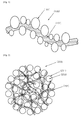
- Fig. 1 is a partial mimetic diagram of a composite cathode active material precursor for a rechargeable lithium battery according to an aspect of the present invention.
- Fig. 2 is a mimetic diagram which mimetic diagrammatically illustrates the cross-section of a composite cathode active material for a rechargeable lithium battery according to an aspect of the present invention.
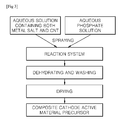
- Fig. 3 is a flow chart for explaining up to the step of producing the composite cathode active material precursor in a production method of a composite cathode active material for a rechargeable lithium battery according to other aspect of the present invention.
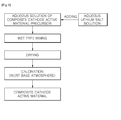
- Fig. 4 is a flow chart for explaining the step of producing the composite cathode active material through the wet mixing process using the composite cathode active material precursor in a production method of a composite cathode active material for a rechargeable lithium battery according to other aspect of the present invention.
- Fig. 5 is a flow chart for explaining the step of producing the composite cathode active material through the dry mixing process using the composite cathode active material precursor in a production method of a composite cathode active material for a rechargeable lithium battery according to other aspect of the present invention.
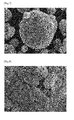
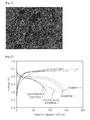
- Fig. 6 to Fig. 11 are images of particles of a composite cathode active material according to the present invention measured by FE-SEM (Field Emission-Scanning Electron Microscope).
- Fig. 12 is a graph showing evaluation results of test examples of the present invention for battery evaluation.
- Fig. 1 illustrates mimetic diagrammatically the cross-section of a composite cathode active material precursor for a rechargeable lithium battery or a composite cathode active material for a rechargeable lithium battery according to an aspect of the present invention.
- the composite cathode active material precursor 100 comprises: hollow nanofibrous carbon 101; and a cathode active material precursor 102 located in a state that the cathode active material precursor is joined inside and outside the skeleton of the hollow nanofibrous carbon 101.
- the cathode active material is metal phosphate of the formula 1-1 of the following Chemical Formula 1, a metal phosphate composite or hydrates thereof as a metal composite, or is metal hydroxide of the formula 1-2 of the following Chemical Formula 1, a metal hydroxide composite or hydrates thereof as a metal composite.
- M represents one or more metal elements selected from the group consisting of Mn, Cr, Fe, Co, Ni, Cu, V, Mo, Ti, Zn, Al, Ga, Mg, B and Nb
- a represents a number of 1 to 3
- b represents a number of 1 to 2
- c represents a number of 2 to 6
- n represents a number of 0 to 10.
- the hollow nanofibrous carbon 101 may be single-walled carbon nanotubes or multi-walled carbon nanotubes.
- the hollow nanofibrous carbon 101 has a diameter of 1 to 200 nm preferably, 1 to 100 nm more preferably, and 1 to 50 nm most preferably. Since the surface area of the olivine-type lithium iron phosphate is decreased if the hollow nanofibrous carbon has a diameter of exceeding 200 nm, effects of the olivine-type lithium iron phosphate are greatly lowered compared to when the same quantity of other compound as the olivine-type lithium iron phosphate is used.
- Secondary particles of the olivine-type lithium iron phosphate have an increased diameter.
- Primary particles of the metal phosphate, metal phosphate composite or hydrates thereof may have an average particle diameter of 10 to 500 nm, and secondary particles of the metal phosphate, metal phosphate composite or hydrates thereof may have an average particle diameter of 1 to 20 ⁇ m.
- Fig. 1 illustrates a composite cathode active material 100 for a rechargeable lithium battery
- the composite cathode active material 100 comprises: hollow nanofibrous carbon 101; and a cathode active material 102 located inside and outside the skeleton of the hollow nanofibrous carbon 101.
- the cathode active material 102 is an olivine-type lithium iron phosphate represented by the following Chemical Formula 2.
- the hollow nanofibrous carbon may be single-walled carbon nanotubes or multi-walled carbon nanotubes.
- the hollow nanofibrous carbon may have a diameter of 1 to 200 nm.
- Fig. 2 is a mimetic diagram which mimetic diagrammatically illustrates the cross-section of a composite cathode active material for a rechargeable lithium battery according to an aspect of the present invention.
- a composite cathode active material 200 produced according to the present invention may comprise a carbon substance 201, or may include: a cathode active material and hollow nanofibrous carbon 202 which are surrounded by the carbon substance 201; and the cathode active material 203 located inside or outside the skeleton of the hollow nanofibrous carbon 202, wherein the cathode active material 203 is an olivine-type lithium iron phosphate represented by the following Chemical Formula 2.
- Fig. 3 is a flow chart for explaining up to the step of producing the composite cathode active material precursor in a production method of a composite cathode active material for a rechargeable lithium battery according to other aspect of the present invention.
- hollow nanofibrous carbon is uniformly dispersed into an aqueous metal salt solution comprising metal M to prepare a dispersion, wherein M represents one or more metal elements selected from the group consisting of Mn, Cr, Fe, Co, Ni, Cu, V, Mo, Ti, Zn, Al, Ga, Mg, B and Nb.
- M represents one or more metal elements selected from the group consisting of Mn, Cr, Fe, Co, Ni, Cu, V, Mo, Ti, Zn, Al, Ga, Mg, B and Nb.
- Applicable metal salt forms selected from the group consisting of acetate, nitrate, sulfate, carbonate, citrate, phthalate, perchlorate, acetylacetonate, acrylate, formate, oxalate, halide, oxyhalide, boride, sulfide, alkoxide, ammonium, acetylacetone, and combinations thereof are preferably used, and the metal salt forms are not particularly limited if they are industrially available.
- the hollow nanofibrous carbon has a content range of 0.1 to 10 weight% based on the total weight of the dispersion.
- the content of the hollow nanofibrous carbon may be preferably 0.1 to 5 weight%, more preferably 0.1 to 3 weight%.
- the hollow nanofibrous carbon may be dispersed using an ultrasonic dispersion method or a high-pressure dispersion method. Subsequently, precipitates of metal phosphate, composite metal phosphate or hydrates thereof represented by formula 1-1 of Chemical Formula 1 are formed, or precipitates of metal hydroxide, composite metal hydroxide or hydrates thereof represented by formula 1-2 of Chemical Formula 1 are formed by spraying an aqueous phosphate solution into a flow of the dispersion using, for example, a spray nozzle while continuously flowing the dispersion. Then, a solution comprising the precipitates is flown into a reactor.
- M represents one or more metal elements selected from the group consisting of Mn, Cr, Fe, Co, Ni, Cu, V, Mo, Ti, Zn, Al, Ga, Mg, B and Nb
- a represents a number of 1 to 3
- b represents a number of 1 to 2
- c represents a number of 2 to 6
- n represents a number of 0 to 10.
- Phosphate for preparing metal phosphate, composite metal phosphate or hydrates thereof represented by formula 1-1 of Chemical Formula 1 is added in an amount of 40 to 80% based on the total weight of metal salts in the dispersion.
- the phosphate is added in an amount according to the stoichiometric ratio.
- Examples of phosphate may include diammonium phosphate, sodium phosphate, monosodium phosphate, sodium pyrophosphate, sodium polyphosphate, calcium phosphate, and others. Although monosodium phosphate is more preferable from the viewpoint of the environmentally friendly process, industrially available phosphates are not particularly limited.
- a basic aqueous solution for preparing metal hydroxide, composite metal hydroxide or hydrates thereof represented by formula 1-2 of Chemical Formula 1 is added in an amount of 15 to 70% based on the total weight of metal salts in the dispersion.
- the basic aqueous solution is added in an amount according to the Stoichiometric ratio.
- hydroxide may include sodium hydroxide, ammonium hydroxide, potassium hydroxide, and others. Although sodium hydroxide is more preferable, industrially available hydroxides are not particularly limited.
- An operation of continuously flowing the dispersion may be carried out using, for example, a metering pump, and an operation of spraying an aqueous phosphate solution or aqueous basic solution into a flow of the dispersion may be performed by a method of spraying the aqueous phosphate solution or aqueous basic solution into the dispersion using, for example, a spray nozzle.
- a reaction system is sufficiently stirred to a low speed in the reactor or ultrasonic waves are vibrated in the reaction system using Sonochemistry so that crystals of the metal phosphate, composite metal phosphate or hydrates thereof, or metal hydroxide, composite metal hydroxide or hydrates thereof are precipitated inside as well as outside the skeleton of the hollow nanofibrous carbon and bonded to the skeleton of the carbon as referred to Fig. 1 .
- MBSL multibubble sonoluminescence
- an inert gas selected from the group consisting of nitrogen gas, argon gas, and a combination thereof into the reactor.
- the size of particles of prepared metal phosphate, composite metal phosphate hydrate, metal hydroxide, or composite metal hydroxide can be decreased, and tap density of the particles can be further increased by injecting the nitrogen gas and/or argon gas into the reactor.
- a cathode active material precursor of a structure illustrated in Fig. 1 is formed.
- a composite cathode active material precursor for a rechargeable lithium battery according to one aspect of the present invention is obtained by conducting solid-liquid separation of the cathode active material precursor using an ordinary method, and recovering and washing the separated cathode active material precursor.
- the washing process is preferably performed by sufficiently washing the cathode active material precursor with water until the precipitated crystals of metal phosphate, composite metal phosphate hydrate, metal hydroxide, or composite metal hydroxide have a content of 1 weight% or less, preferably 0.8 weight% or less, and more preferably 0.5 weight% or less.
- Primary particles of the obtained composite cathode active material precursor have an average particle diameter of 500 nm, preferably 200 nm, and more preferably 10 to 100 nm, and secondary particles of the composite cathode active material precursor have an average particle diameter of 1 to 20 microns, preferably 1 to 10 microns, and more preferably 1 to 5 microns in the state that crystals of metal phosphate or composite metal phosphate hydrate are commonly existed inside and outside hollow nanofibrous carbon.
- the particles are preferably formed in a spherical shape.
- Fig. 4 is a flow chart for explaining the step of producing the composite cathode active material through the wet mixing process using the composite cathode active material precursor in a production method of a composite cathode active material for a rechargeable lithium battery according to other aspect of the present invention.
- the aqueous lithium salt solution is mixed with the aqueous dispersion by stirring the aqueous lithium salt solution and the aqueous dispersion after titrating an aqueous lithium salt solution into an aqueous dispersion of a cathode active material precursor obtained by uniformly dispersing the composite cathode active material precursor obtained by the above-described method into water.
- Types of lithium salts suitable for preparing an olivine-type lithium iron phosphate of the Chemical Formula 2 using metal phosphate, composite metal phosphate or hydrates thereof represented by the Formula 1-1 of the Chemical Formula 1 may include acetate, nitrate, sulfate, carbonate, hydroxide, and phosphate such as lithium phosphate (Li 3 PO 4 ), and the lithium salts are not particularly limited if they are industrially available. Furthermore, carbonaceous raw material is added in an aqueous dispersion of the cathode active material precursor to further increase electric conductivity of the composite cathode material.
- lithium hydroxide As a lithium salt in the wet process, and to use lithium carbonate or lithium phosphate as the lithium salt in the dry process.
- Suitable types of lithium salts suitable for preparing an olivine-type lithium iron phosphate of the Chemical Formula 2 using metal hydroxide, composite metal hydroxide or hydrates thereof represented by the Formula 1-2 of the Chemical Formula 1 may include lithium dihydrogen phosphate (LiH 2 PO 4 ) and lithium phosphate, and the lithium salts are not particularly limited if they are industrially available.
- carbonaceous raw materials are added in an aqueous dispersion of the cathode active material precursor to further increase electric conductivity of the composite cathode material.
- Suitable types of carbonaceous raw materials in the composite cathode active material may include sucrose, citric acid, oligosaccharide, starch and pitch, and the carbonaceous raw materials are not particularly limited if they are industrially available.
- a composite cathode active material according to one aspect of the present invention having a structure illustrated in Fig. 1 and Fig. 2 is obtained by drying the mixture and calcining the dried mixture in an inert gas atmosphere. Calcination is performed in a temperature range of 400 to 800 °C under an inert gas atmosphere.
- the obtained composite cathode active material 200 comprises a carbon substance 201, or includes: a cathode active material and hollow nanofibrous carbon 202 which are surrounded by the carbon substance 201; and the cathode active material 203 located inside or outside the skeleton of the hollow nanofibrous carbon 202, wherein the cathode active material 203 is an olivine-type lithium iron phosphate represented by the following Chemical Formula 2.
- M represents one or more metal elements selected from the group consisting of Mn, Cr, Fe, Co, Ni, Cu, V, Mo, Ti, Zn, Al, Ga, Mg, B and Nb, and d represents a number of 0.5 to 1.5.
- the cathode active material located inside or outside the carbon skeleton means a cathode active material precipitated and joined inside and outside a carbon substance such as carbon fibers.
- Fig. 5 is a flow chart for explaining the step of producing the composite cathode active material through the dry mixing process using the composite cathode active material precursor in a production method of a composite cathode active material for a rechargeable lithium battery according to other aspect of the present invention.
- a composite cathode active material according to one aspect of the present invention having a structure illustrated in Fig. 1 is obtained by calcining the dried mixture in an inert gas atmosphere.
- Calcination for obtaining an olivine-type lithium iron phosphate suitable for a cathode active material for a high-capacity rechargeable lithium battery may be performed in a temperature range of 400 to 800 °C, preferably 500 to 700 °C, under an inert gas atmosphere since the composite cathode active material can be structured in a preferable structure while suppressing growth of the particle diameter of the composite cathode active material.
- the inert gas atmosphere inside a calcinations furnace may be formed by blowing gas selected from the group consisting of nitrogen gas, argon gas, and a combination thereof into the calcinations furnace.
- the production method of a composite cathode active material for a rechargeable lithium battery of the present invention is capable of producing a composite cathode active material having the above-mentioned properties at superior reproducibility and productivity.
- a rechargeable lithium battery of the present invention is a rechargeable lithium battery in which the cathode comprises the composite cathode active material according to the present invention in a lithium battery including an anode and a cathode enabling absorption and release of lithium ions, a separator interposed between the anode and cathode, and an electrolyte.
- the reaction system was sufficiently stirred to a low speed within the reactor or ultrasonic waves were vibrated in the reaction system using Sonochemistry for 1 hour after adding 0.1M LiOH, 0.05M LiH 2 PO 4 , sucrose and an aqueous citric acid solution comprising LiMnPO 4 , citric acid and sucrose at a ratio of 1:0.3:0.05 in an aqueous Mn 3 (PO 4 ) 2 solution that is the Na-removed salt and stirring the mixture.
- a circulation type constant temperature oven was used to maintain temperature inside the reactor to 30 °C, control the operation frequency and intensity to 200 kHz and 300 W respectively, and constantly pressurize pressure inside the reactor to 3 atm.
- Argon gas was used inside the reactor.
- the reactant was dried at 150 °C in the spray dryer after the reaction. After drying the reactant, the resulting material was calcined at 700 °C for 24 hours in a nitrogen atmosphere.
- the reaction system was sufficiently stirred to a low speed within the reactor or ultrasonic waves were vibrated in the reaction system using Sonochemistry for 1 hour after adding 0.1M LiOH, 0.05M LiH2PO4, sucrose and an aqueous citric acid solution comprising LiMnPO4, citric acid and sucrose at a ratio of 1:0.3:0.05 in an aqueous Mn(OH) 2 solution that is the Na-removed salt and stirring the mixture.
- the subsequent process is performed in the same manner as in the example 1.
- the cathode active material precursor produced in the example 1 was used, and lithium salt and carbon black were mixed and ball-milled.
- the mixed composite cathode active material was calcined at 750 °C for 24 hours in a nitrogen atmosphere.
- the cathode active material precursor was produced in the same method as in the example 1 except that sucrose and citric acid were not included in the example 1.
- the cathode active material precursor was produced in the same method as in the example 1 except that sucrose, citric acid and CNT were not included in the example 1.
- a process of observing the shape of particles of the composite cathode active material produced in the examples was performed by FE-SEM (Field Emission-Scanning Electron Microscope), and the observation resulting images were shown in Fig. 6 to Fig. 11 .
- the foregoing composite cathode active material is effectively precipitated and bonded to the skeleton of the hollow nanofibrous carbon. That is, it can be seen that CNT is well dispersed into particles of the composite cathode active material, and the particles have an average particle size of about 10 microns as shown in the images.
- Particle size analysis of materials was conducted using a laser diffraction particle size analyzer.
- the samples of the corresponding particle sizes were designated as d10, d50, and d90 respectively after particle sizes of samples were confirmed at points at which cumulative volumes reached 10%, 50% and 90% respectively from the results of cumulative particle size distributions.
- the results of the particle size analysis were shown in the following Table 1.
- Example 1 d10 5.0 1.5 d50 9.4 d90 13.3
- Example 2 d10 4.9 1.6 d50 9.4 d90 13.3
- Comparative Example 1 d10 4.9 1.8 d50 12.0 d90 19.5
- Comparative Example 2 d10 6.0 1.9 d50 11.6 d90 21.1
- Tap densities were calculated by injecting 50 g of materials into cylinders and measuring volumes of the cylinders after conducting 2,000 times of tapping, and the calculation results were shown in the table 1. It can be seen that the tap densities are decreased such that a carbon substance and CNT are included in the composite cathode active material. However, performances of the batteries were increased in the evaluation of batteries when the carbon substance and CNT are included in the composite cathode active material. Electrical conductivity, a problem of manganese, is thought to be improved to obtain good results in the battery evaluation.
- Electrode plate were manufactured by drying the coated slurry at 120 °C for 8 hours after preparing a slurry from the mixture and coating an aluminum thin film with the slurry. The manufactured electrode plates were pressed. Li metal was used as an anode, 2030-type coin cells were produced, and electrodes were used after producing it by dissolving IM-LiPF6 into EC-DEC to the volume ratio of 1:1. Charging and discharging were carried out at the charging condition of 4.4 V and discharging condition of 3.0 V. Charging and discharging were conducted at 0.1 C in order to confirm the initial capacity, and cycle characteristics were checked by 0.5 C charging and 1 C discharging.
- Fig. 12 is evaluation results of the present test.
- a cathode active material of the present invention in which an active material precursor is bonded to the skeleton of hollow nanofibrous carbon has higher capacity efficiency than those of comparative examples 1 and 2. That is, results of Fig. 12 show that cathode active materials in which a carbon substance and CNT are not included do not have good specific discharge capacities, and composite cathode active materials in which both the carbon substance and CNT are included have very good specific discharge capacities. Such results experimentally prove that the carbon substance and CNT improve electrical conductivity.
Landscapes
- Chemical & Material Sciences (AREA)
- Chemical Kinetics & Catalysis (AREA)
- Electrochemistry (AREA)
- General Chemical & Material Sciences (AREA)
- Inorganic Chemistry (AREA)
- Engineering & Computer Science (AREA)
- Materials Engineering (AREA)
- Crystallography & Structural Chemistry (AREA)
- Battery Electrode And Active Subsutance (AREA)
- Carbon And Carbon Compounds (AREA)
Applications Claiming Priority (2)
| Application Number | Priority Date | Filing Date | Title |
|---|---|---|---|
| KR20090119919 | 2009-12-04 | ||
| PCT/KR2010/008674 WO2011068391A2 (fr) | 2009-12-04 | 2010-12-06 | Précurseur de matière active d'anode et matière active pour batterie au lithium rechargeable comprenant du carbone nanofibreux creux et procédé de production correspondant |
Publications (2)
| Publication Number | Publication Date |
|---|---|
| EP2509143A2 true EP2509143A2 (fr) | 2012-10-10 |
| EP2509143A4 EP2509143A4 (fr) | 2015-09-02 |
Family
ID=44115441
Family Applications (1)
| Application Number | Title | Priority Date | Filing Date |
|---|---|---|---|
| EP10834806.1A Withdrawn EP2509143A4 (fr) | 2009-12-04 | 2010-12-06 | Précurseur de matière active d'anode et matière active pour batterie au lithium rechargeable comprenant du carbone nanofibreux creux et procédé de production correspondant |
Country Status (6)
| Country | Link |
|---|---|
| US (1) | US20120241666A1 (fr) |
| EP (1) | EP2509143A4 (fr) |
| JP (1) | JP5623544B2 (fr) |
| KR (1) | KR101193077B1 (fr) |
| CN (1) | CN102668194B (fr) |
| WO (1) | WO2011068391A2 (fr) |
Cited By (2)
| Publication number | Priority date | Publication date | Assignee | Title |
|---|---|---|---|---|
| WO2014063244A1 (fr) | 2012-10-22 | 2014-05-01 | HYDRO-QUéBEC | Procédé de fabrication d'un matériau d'électrode pour une batterie secondaire au lithium-ion et batterie au lithium-ion faisant appel à ce matériau d'électrode |
| CN114400322A (zh) * | 2022-02-21 | 2022-04-26 | 远景动力技术(江苏)有限公司 | 正极活性材料、电化学装置和电子设备 |
Families Citing this family (32)
| Publication number | Priority date | Publication date | Assignee | Title |
|---|---|---|---|---|
| US8808909B2 (en) * | 2011-06-23 | 2014-08-19 | Melecular Rebar Design, LLC | Lithium ion batteries using discrete carbon nanotubes, methods for production thereof and products obtained therefrom |
| US9065136B2 (en) * | 2011-09-14 | 2015-06-23 | Samsung Sdi Co., Ltd. | Positive electrode for rechargeable lithium battery, method of preparing the same, and rechargeable lithium battery including the same |
| KR101515678B1 (ko) * | 2011-12-07 | 2015-04-28 | 주식회사 엘지화학 | 출력특성이 향상된 복합 양극 활물질 및 이를 포함하는 이차전지 |
| KR101355185B1 (ko) * | 2011-12-19 | 2014-01-28 | (주)이엠티 | 리튬 이차 전지용 양극 활물질의 전구체 제조 장치 |
| CA2776205A1 (fr) * | 2012-05-08 | 2013-11-08 | Hydro-Quebec | Batterie secondaire lithium-ion et son procede de production |
| KR101951323B1 (ko) | 2012-09-24 | 2019-02-22 | 삼성전자주식회사 | 복합음극활물질, 이를 포함하는 음극 및 리튬전지, 및 이의 제조 방법 |
| KR101482026B1 (ko) * | 2013-01-09 | 2015-01-13 | 한화케미칼 주식회사 | 전극합제, 그의 제조방법 및 그를 포함하는 전극 |
| WO2014134969A1 (fr) * | 2013-03-04 | 2014-09-12 | 中国科学院苏州纳米技术与纳米仿生研究所 | Matériau composite poreux de phosphate de lithium au manganèse-carbone, procédé de préparation et application associée |
| CN103928658B (zh) * | 2013-12-30 | 2016-06-29 | 福建省诺希新材料科技有限公司 | 一种石墨烯/硅复合阳极材料的制备方法及制品 |
| WO2016031099A1 (fr) * | 2014-08-27 | 2016-03-03 | 株式会社豊田自動織機 | Procédé de production de matériau de silicium revêtu de carbone |
| US10547056B2 (en) | 2015-09-30 | 2020-01-28 | Umicore | Precursors for lithium transition metal oxide cathode materials for rechargeable batteries |
| US11171324B2 (en) | 2016-03-15 | 2021-11-09 | Honda Motor Co., Ltd. | System and method of producing a composite product |
| US11383213B2 (en) | 2016-03-15 | 2022-07-12 | Honda Motor Co., Ltd. | System and method of producing a composite product |
| JP6443589B2 (ja) * | 2016-12-26 | 2018-12-26 | 住友金属鉱山株式会社 | 非水系電解質二次電池用正極活物質前駆体 |
| US11081684B2 (en) | 2017-05-24 | 2021-08-03 | Honda Motor Co., Ltd. | Production of carbon nanotube modified battery electrode powders via single step dispersion |
| US20190036102A1 (en) | 2017-07-31 | 2019-01-31 | Honda Motor Co., Ltd. | Continuous production of binder and collector-less self-standing electrodes for li-ion batteries by using carbon nanotubes as an additive |
| US10658651B2 (en) * | 2017-07-31 | 2020-05-19 | Honda Motor Co., Ltd. | Self standing electrodes and methods for making thereof |
| US11201318B2 (en) | 2017-09-15 | 2021-12-14 | Honda Motor Co., Ltd. | Method for battery tab attachment to a self-standing electrode |
| US11121358B2 (en) | 2017-09-15 | 2021-09-14 | Honda Motor Co., Ltd. | Method for embedding a battery tab attachment in a self-standing electrode without current collector or binder |
| CN107723849A (zh) * | 2017-10-31 | 2018-02-23 | 西北工业大学 | 一种高比表面杂化碳纳米纤维的制备方法 |
| WO2020065832A1 (fr) * | 2018-09-27 | 2020-04-02 | 株式会社村田製作所 | Substance électroconductrice, électrode positive et batterie secondaire |
| US11535517B2 (en) | 2019-01-24 | 2022-12-27 | Honda Motor Co., Ltd. | Method of making self-standing electrodes supported by carbon nanostructured filaments |
| US12381275B2 (en) | 2019-01-30 | 2025-08-05 | Honda Motor Co., Ltd. | Stretchable and flexible lithium ion battery |
| US12142771B2 (en) | 2019-01-30 | 2024-11-12 | Honda Motor Co., Ltd. | Flexible battery as an integration platform for wearable sensors and processing/transmitting devices |
| US11352258B2 (en) | 2019-03-04 | 2022-06-07 | Honda Motor Co., Ltd. | Multifunctional conductive wire and method of making |
| US11325833B2 (en) | 2019-03-04 | 2022-05-10 | Honda Motor Co., Ltd. | Composite yarn and method of making a carbon nanotube composite yarn |
| US11539042B2 (en) | 2019-07-19 | 2022-12-27 | Honda Motor Co., Ltd. | Flexible packaging with embedded electrode and method of making |
| EP4485599A3 (fr) * | 2019-10-04 | 2025-03-26 | LG Energy Solution, Ltd. | Électrode et batterie secondaire la comprenant |
| CN111088562B (zh) * | 2019-12-24 | 2021-07-23 | 北京化工大学 | 一种复合微纳中空纤维材料及其制备方法和应用 |
| CN116779855A (zh) | 2022-03-09 | 2023-09-19 | 通用汽车环球科技运作有限责任公司 | 用于在干法工艺中形成电池组电极的组合物的活性材料组分及形成电极的方法 |
| CN116332235B (zh) * | 2022-12-02 | 2025-09-09 | 佳木斯大学 | 一种MnO2NTs/CNFs的制备方法和应用 |
| CN116495801B (zh) * | 2023-04-28 | 2023-09-19 | 广东工业大学 | 一种中空球形的硫空位氧掺杂高熵硫化物纳米酶及其制备方法与poct应用 |
Family Cites Families (55)
| Publication number | Priority date | Publication date | Assignee | Title |
|---|---|---|---|---|
| GB1322722A (en) * | 1969-06-12 | 1973-07-11 | Ici Ltd | Complex aluminium phosphates |
| US6737120B1 (en) * | 1999-03-04 | 2004-05-18 | Honeywell International Inc. | Oxidation-protective coatings for carbon-carbon components |
| US20020009622A1 (en) * | 1999-08-03 | 2002-01-24 | Goodson David M. | Sprayable phosphate cementitious coatings and a method and apparatus for the production thereof |
| US6455159B1 (en) * | 2000-02-18 | 2002-09-24 | Honeywell International Inc. | Oxidation protection for carbon/carbon composites and graphites |
| JP2002048174A (ja) * | 2000-08-01 | 2002-02-15 | Nisshinbo Ind Inc | 摩擦部材及びその製造方法 |
| JP3997702B2 (ja) | 2000-10-06 | 2007-10-24 | ソニー株式会社 | 非水電解質二次電池 |
| KR20040047780A (ko) * | 2001-07-27 | 2004-06-05 | 메사추세츠 인스티튜트 오브 테크놀로지 | 베터리 구조, 자기 조직화 구조 및 관련 방법 |
| US6617072B2 (en) * | 2001-11-27 | 2003-09-09 | Ovonic Battery Company, Inc. | Positive active electrode composition with graphite additive |
| EP1547973A4 (fr) * | 2002-09-05 | 2008-07-30 | Nat Inst Of Advanced Ind Scien | Poudre fine de carbone enrobee d'oxyde metallique, de nitrure de metal ou de carbure metallique, procede de production correspondant et supercondensateur et accumulateur utilisant cette poudre fine de carbone |
| AU2003300048A1 (en) * | 2002-12-31 | 2004-07-29 | Northern Illinois University | Metal-coated carbon surfaces for use in fuel cells |
| US8449739B2 (en) * | 2002-12-31 | 2013-05-28 | Northern Illinois University | Metal-coated carbon surfaces for use in fuel cells |
| EP1652247A4 (fr) * | 2003-07-28 | 2009-08-19 | Showa Denko Kk | Electrode haute densite et batterie utilisant ladite electrode |
| JP4641375B2 (ja) * | 2003-10-20 | 2011-03-02 | 日立マクセル株式会社 | オリビン型リン酸リチウムと炭素材料との複合体の製造方法 |
| EP1786052B1 (fr) * | 2004-08-18 | 2012-09-19 | Central Research Institute of Electric Power Industry | Batterie électrolytique organique et procédé de fabrication de feuille d"électrode positive pour une utilisation dans celle-ci |
| JP4784085B2 (ja) * | 2004-12-10 | 2011-09-28 | 新神戸電機株式会社 | リチウム二次電池用正極材料とその製造法及びリチウム二次電池 |
| CN100399608C (zh) * | 2005-06-28 | 2008-07-02 | 中国科学院物理研究所 | 一种橄榄石碳绒球复合材料及其用途 |
| US7939201B2 (en) | 2005-08-08 | 2011-05-10 | A123 Systems, Inc. | Nanoscale ion storage materials including co-existing phases or solid solutions |
| KR100796687B1 (ko) * | 2005-11-30 | 2008-01-21 | 삼성에스디아이 주식회사 | 리튬 이차 전지용 활물질, 이의 제조방법 및 이를 포함하는 리튬 이차 전지 |
| JP2007207699A (ja) * | 2006-02-06 | 2007-08-16 | Matsushita Electric Ind Co Ltd | 非水電解液二次電池 |
| US8133616B2 (en) | 2006-02-14 | 2012-03-13 | Dow Global Technologies Llc | Lithium manganese phosphate positive material for lithium secondary battery |
| FR2898885B1 (fr) * | 2006-03-27 | 2008-05-30 | Commissariat Energie Atomique | Compose a base de disphosphate de titane et de carbone, procede de preparation et utilisation comme materiau actif d'une electrode pour accumulateur au lithium. |
| JP5366193B2 (ja) * | 2006-06-05 | 2013-12-11 | 国立大学法人東北大学 | 高機能複合材料およびその製造方法 |
| US20080075939A1 (en) * | 2006-09-25 | 2008-03-27 | Samsung Electronics Co., Ltd. | Method for preparing layered nanostructures and layered nanostructures prepared thereby |
| CN100567143C (zh) * | 2006-09-27 | 2009-12-09 | 比亚迪股份有限公司 | 一种锂离子二次电池正极活性物质磷酸铁锂的制备方法 |
| KR100786850B1 (ko) * | 2006-11-21 | 2007-12-20 | 삼성에스디아이 주식회사 | 리튬 이차 전지용 양극 및 이를 포함하는 리튬 이차 전지 |
| US8518604B2 (en) * | 2007-02-02 | 2013-08-27 | Rutgers, The State University Of New Jersey | Metal fluoride and phosphate nanocomposites as electrode materials |
| CN101682025B (zh) * | 2007-03-29 | 2016-05-18 | 三菱麻铁里亚尔株式会社 | 正极形成材料、其材料和制造方法及锂离子二次电池 |
| KR20080090655A (ko) * | 2007-04-05 | 2008-10-09 | 삼성에스디아이 주식회사 | 리튬 이차 전지용 전극 및 이를 포함하는 리튬 이차 전지 |
| KR100889622B1 (ko) * | 2007-10-29 | 2009-03-20 | 대정이엠(주) | 안전성이 우수한 리튬 이차전지용 양극 활물질 및 그제조방법과 이를 포함하는 리튬 이차전지 |
| US20090117020A1 (en) * | 2007-11-05 | 2009-05-07 | Board Of Regents, The University Of Texas System | Rapid microwave-solvothermal synthesis and surface modification of nanostructured phospho-olivine cathodes for lithium ion batteries |
| KR100913178B1 (ko) | 2007-11-22 | 2009-08-19 | 삼성에스디아이 주식회사 | 리튬 이차 전지용 활물질 및 이를 포함하는 리튬 이차 전지 |
| US8276695B2 (en) * | 2007-12-25 | 2012-10-02 | Byd Co. Ltd. | Battery electrode sheet |
| KR101071336B1 (ko) * | 2008-03-25 | 2011-10-07 | 주식회사 에너세라믹 | 리튬 전지용 올리빈형 양극 활물질 전구체, 및 이의 제조 방법 |
| JP5319947B2 (ja) * | 2008-03-25 | 2013-10-16 | 株式会社東芝 | 非水電解質電池 |
| CN101582302B (zh) * | 2008-05-14 | 2011-12-21 | 清华大学 | 碳纳米管/导电聚合物复合材料 |
| CN101442126B (zh) * | 2008-08-01 | 2010-07-07 | 上海华实纳米材料有限公司 | 一种碳纳米管键接磷酸亚铁锂复合电极材料及其制备方法 |
| CA2741042C (fr) * | 2008-10-22 | 2014-07-22 | Sanghoon Choy | Phosphate de fer lithie de structure olivine et son procede de preparation |
| KR101050438B1 (ko) * | 2008-11-10 | 2011-07-19 | 주식회사 코캄 | 안전성이 우수한 리튬 이차전지용 양극 활물질 및 그 제조방법과 이를 포함하는 리튬 이차전지 |
| US9093693B2 (en) * | 2009-01-13 | 2015-07-28 | Samsung Electronics Co., Ltd. | Process for producing nano graphene reinforced composite particles for lithium battery electrodes |
| CN102388489B (zh) * | 2009-04-01 | 2014-11-26 | 西开普大学 | 制备碳复合材料的方法 |
| FR2944149B1 (fr) * | 2009-04-06 | 2011-04-29 | Centre Nat Rech Scient | Electrode composite. |
| CN101533904B (zh) * | 2009-04-24 | 2012-05-30 | 长沙理工大学 | 磷酸铁锂/纳米碳复合正极材料的制备方法 |
| JP5527671B2 (ja) * | 2009-07-14 | 2014-06-18 | 川崎重工業株式会社 | ファイバー電池及びその製造方法、ファイバー電極及びファイバー電池の製造設備 |
| US20110111279A1 (en) * | 2009-11-09 | 2011-05-12 | Florida State University Research Foundation Inc. | Binder-free nanocomposite material and method of manufacture |
| US8431189B2 (en) * | 2009-12-22 | 2013-04-30 | Korea University Research And Business Foundation | Carbon nanotube-nanofiber composite structure |
| US8962188B2 (en) * | 2010-01-07 | 2015-02-24 | Nanotek Instruments, Inc. | Anode compositions for lithium secondary batteries |
| KR101250587B1 (ko) * | 2010-04-20 | 2013-04-03 | 연세대학교 산학협력단 | 전이금속 산화물/탄소나노튜브 복합체 제조 방법 및 그 복합체 |
| US20130126794A1 (en) * | 2010-07-08 | 2013-05-23 | Industry Foundation Of Chonnam National University | Carbon nanofiber containing metal oxide or intermetallic compound, preparation method thereof, and lithium secondary battery using same |
| US8691441B2 (en) * | 2010-09-07 | 2014-04-08 | Nanotek Instruments, Inc. | Graphene-enhanced cathode materials for lithium batteries |
| JP5309264B2 (ja) * | 2010-09-27 | 2013-10-09 | 日本化学工業株式会社 | リン酸バナジウムリチウム炭素複合体の製造方法 |
| US20120264020A1 (en) * | 2010-10-07 | 2012-10-18 | Applied Sciences, Inc. | Method of depositing silicon on carbon nanomaterials |
| KR101113976B1 (ko) * | 2010-10-27 | 2012-03-13 | 한국과학기술연구원 | 자기조립된 전극 활물질-탄소 나노튜브 복합체와 그 제조 방법 및 이를 포함하는 이차전지 |
| US20130004657A1 (en) * | 2011-01-13 | 2013-01-03 | CNano Technology Limited | Enhanced Electrode Composition For Li ion Battery |
| CN103503206B (zh) * | 2011-04-22 | 2016-03-02 | 昭和电工株式会社 | 锂二次电池用正极活性物质的制造方法 |
| US9065136B2 (en) * | 2011-09-14 | 2015-06-23 | Samsung Sdi Co., Ltd. | Positive electrode for rechargeable lithium battery, method of preparing the same, and rechargeable lithium battery including the same |
-
2010
- 2010-12-06 KR KR1020100123539A patent/KR101193077B1/ko not_active Expired - Fee Related
- 2010-12-06 US US13/513,257 patent/US20120241666A1/en not_active Abandoned
- 2010-12-06 JP JP2012541955A patent/JP5623544B2/ja not_active Expired - Fee Related
- 2010-12-06 WO PCT/KR2010/008674 patent/WO2011068391A2/fr not_active Ceased
- 2010-12-06 EP EP10834806.1A patent/EP2509143A4/fr not_active Withdrawn
- 2010-12-06 CN CN201080058647.XA patent/CN102668194B/zh not_active Expired - Fee Related
Non-Patent Citations (1)
| Title |
|---|
| See references of WO2011068391A2 * |
Cited By (8)
| Publication number | Priority date | Publication date | Assignee | Title |
|---|---|---|---|---|
| WO2014063244A1 (fr) | 2012-10-22 | 2014-05-01 | HYDRO-QUéBEC | Procédé de fabrication d'un matériau d'électrode pour une batterie secondaire au lithium-ion et batterie au lithium-ion faisant appel à ce matériau d'électrode |
| EP2909879B1 (fr) * | 2012-10-22 | 2020-12-02 | Hydro-Québec | Procédé de fabrication d'un matériau d'électrode pour une batterie secondaire au lithium-ion et batterie au lithium-ion faisant appel à ce matériau d'électrode |
| EP3826087A1 (fr) * | 2012-10-22 | 2021-05-26 | Hydro-Québec | Procédé de production d'un matériau d'électrode positive pour batterie secondaire au lithium-ion et batterie au lithium-ion utilisant un tel matériau d'électrode |
| US11545668B2 (en) | 2012-10-22 | 2023-01-03 | Hydro-Quebec | Method of producing electrode material for lithium-ion secondary battery and lithium-ion battery using such electrode material |
| US12068484B2 (en) | 2012-10-22 | 2024-08-20 | HYDRO-QUéBEC | Method of producing electrode material for lithium-ion secondary battery and lithium-ion battery using such electrode material |
| US12368168B2 (en) | 2012-10-22 | 2025-07-22 | HYDRO-QUéBEC | Method of producing electrode material for lithium-ion secondary battery and lithium-ion battery using such electrode material |
| CN114400322A (zh) * | 2022-02-21 | 2022-04-26 | 远景动力技术(江苏)有限公司 | 正极活性材料、电化学装置和电子设备 |
| CN114400322B (zh) * | 2022-02-21 | 2024-05-14 | 远景动力技术(江苏)有限公司 | 正极活性材料、电化学装置和电子设备 |
Also Published As
| Publication number | Publication date |
|---|---|
| US20120241666A1 (en) | 2012-09-27 |
| JP5623544B2 (ja) | 2014-11-12 |
| CN102668194A (zh) | 2012-09-12 |
| WO2011068391A2 (fr) | 2011-06-09 |
| EP2509143A4 (fr) | 2015-09-02 |
| WO2011068391A9 (fr) | 2011-09-01 |
| CN102668194B (zh) | 2015-05-20 |
| JP2013513204A (ja) | 2013-04-18 |
| WO2011068391A3 (fr) | 2011-11-03 |
| KR20110063388A (ko) | 2011-06-10 |
| KR101193077B1 (ko) | 2012-10-22 |
Similar Documents
| Publication | Publication Date | Title |
|---|---|---|
| EP2509143A2 (fr) | Précurseur de matière active d'anode et matière active pour batterie au lithium rechargeable comprenant du carbone nanofibreux creux et procédé de production correspondant | |
| JP5429980B2 (ja) | 炭素−オリビン型リン酸マンガン鉄リチウム複合体の製造方法、およびリチウムイオン電池用正極材料 | |
| JP5656012B2 (ja) | 非水電解質二次電池用正極活物質粒子粉末及びその製造方法、並びに非水電解質二次電池 | |
| KR101970909B1 (ko) | 리튬 복합 화합물 입자 분말 및 그의 제조 방법, 비수전해질 이차 전지 | |
| CN103562136B (zh) | 镍复合氢氧化物粒子和非水电解质二次电池 | |
| CN101595581B (zh) | 非水电解质二次电池用Li-Ni复合氧化物颗粒粉末及其制造方法、非水电解质二次电池 | |
| CN101268572B (zh) | 制造正极活性材料的方法和使用其的非水电解质电池 | |
| Yu et al. | Hierarchically structured lithium-rich layered oxide with exposed active {010} planes as high-rate-capability cathode for lithium-ion batteries | |
| JP5165515B2 (ja) | リチウムイオン二次電池 | |
| CN108602689A (zh) | 制备二次电池用正极活性材料的方法和由此制备的二次电池用正极活性材料 | |
| JP7607776B2 (ja) | リチウム二次電池用正極活物質、その製造方法、それを含む正極及びリチウム二次電池 | |
| KR20120132485A (ko) | 정극 활성 물질 전구체 입자 분말 및 정극 활성 물질 입자 분말, 및 비수전해질 이차 전지 | |
| KR20130081228A (ko) | 리튬 복합 화합물 입자 분말 및 그의 제조 방법, 및 비수전해질 이차 전지 | |
| EP3694034B1 (fr) | Couche d'anode et batterie entièrement à semi-conducteur | |
| JP2009301813A (ja) | 炭素−オリビン型リン酸鉄リチウム複合体の製造方法、およびリチウムイオン電池用正極材料 | |
| KR102739049B1 (ko) | 리튬 이차전지용 양극 활물질의 제조 방법 및 이에 의하여 제조된 양극 활물질 | |
| JP7654979B2 (ja) | 二次電池電極用活物質およびそれを用いた二次電池 | |
| CN110098383B (zh) | 正极材料及其制备方法、电池正极以及锂离子电池 | |
| CN104781957B (zh) | 电极材料的制造方法、电极材料及具备该电极材料的蓄电装置 | |
| JP2012036048A (ja) | リン酸バナジウムリチウム炭素複合体の製造方法 | |
| EP2505552A1 (fr) | Procédé pour la production de composé d'acide phosphorique, et procédé pour la production d'une batterie secondaire | |
| Cao et al. | Preparation of Li 3 V 2 (PO 4) 3 as cathode material for aqueous zinc ion batteries by a hydrothermal assisted sol–gel method and its properties | |
| US20150064559A1 (en) | Electrode-active material, lithium-ion battery, method for detecting discharge state of electrode-active material, and method for manufacturing electrode-active material | |
| KR102866889B1 (ko) | 복합 황산제1철 나트륨 양극재, 이의 제조 방법 및 응용 | |
| JP2012054077A (ja) | 二次電池用活物質及び二次電池用活物質の製造方法、並びに、それを用いた二次電池 |
Legal Events
| Date | Code | Title | Description |
|---|---|---|---|
| PUAI | Public reference made under article 153(3) epc to a published international application that has entered the european phase |
Free format text: ORIGINAL CODE: 0009012 |
|
| 17P | Request for examination filed |
Effective date: 20120704 |
|
| AK | Designated contracting states |
Kind code of ref document: A2 Designated state(s): AL AT BE BG CH CY CZ DE DK EE ES FI FR GB GR HR HU IE IS IT LI LT LU LV MC MK MT NL NO PL PT RO RS SE SI SK SM TR |
|
| AX | Request for extension of the european patent |
Extension state: BA ME |
|
| A4 | Supplementary search report drawn up and despatched |
Effective date: 20150805 |
|
| RIC1 | Information provided on ipc code assigned before grant |
Ipc: H01M 4/62 20060101ALI20150730BHEP Ipc: H01M 4/505 20100101ALI20150730BHEP Ipc: H01M 4/58 20100101ALI20150730BHEP Ipc: H01M 4/525 20100101ALI20150730BHEP Ipc: H01M 4/583 20100101AFI20150730BHEP Ipc: H01M 10/0525 20100101ALI20150730BHEP Ipc: H01M 4/587 20100101ALI20150730BHEP Ipc: H01M 4/136 20100101ALI20150730BHEP |
|
| STAA | Information on the status of an ep patent application or granted ep patent |
Free format text: STATUS: THE APPLICATION HAS BEEN WITHDRAWN |
|
| 18W | Application withdrawn |
Effective date: 20160225 |