EP2509342A2 - Appareil et procédés pour distribuer et stocker l'accès électronique - Google Patents
Appareil et procédés pour distribuer et stocker l'accès électronique Download PDFInfo
- Publication number
- EP2509342A2 EP2509342A2 EP12163450A EP12163450A EP2509342A2 EP 2509342 A2 EP2509342 A2 EP 2509342A2 EP 12163450 A EP12163450 A EP 12163450A EP 12163450 A EP12163450 A EP 12163450A EP 2509342 A2 EP2509342 A2 EP 2509342A2
- Authority
- EP
- European Patent Office
- Prior art keywords
- access control
- esim
- encrypted
- control client
- appliance
- Prior art date
- Legal status (The legal status is an assumption and is not a legal conclusion. Google has not performed a legal analysis and makes no representation as to the accuracy of the status listed.)
- Withdrawn
Links
- 238000000034 method Methods 0.000 title claims abstract description 39
- 230000004044 response Effects 0.000 claims description 20
- 238000004891 communication Methods 0.000 claims description 18
- 230000002085 persistent effect Effects 0.000 abstract description 23
- 238000011084 recovery Methods 0.000 abstract description 6
- 230000000694 effects Effects 0.000 abstract description 2
- 238000012546 transfer Methods 0.000 description 20
- 230000004913 activation Effects 0.000 description 10
- 238000010586 diagram Methods 0.000 description 8
- 230000001413 cellular effect Effects 0.000 description 7
- 230000008569 process Effects 0.000 description 4
- 238000004846 x-ray emission Methods 0.000 description 4
- 230000008901 benefit Effects 0.000 description 3
- 238000012545 processing Methods 0.000 description 3
- 238000013475 authorization Methods 0.000 description 2
- 230000001427 coherent effect Effects 0.000 description 2
- 238000010276 construction Methods 0.000 description 2
- 238000005516 engineering process Methods 0.000 description 2
- 238000002955 isolation Methods 0.000 description 2
- 238000007726 management method Methods 0.000 description 2
- 238000011160 research Methods 0.000 description 2
- 230000003068 static effect Effects 0.000 description 2
- 208000000044 Amnesia Diseases 0.000 description 1
- 208000026139 Memory disease Diseases 0.000 description 1
- 238000004364 calculation method Methods 0.000 description 1
- 230000008859 change Effects 0.000 description 1
- 238000010367 cloning Methods 0.000 description 1
- 230000006378 damage Effects 0.000 description 1
- 230000003292 diminished effect Effects 0.000 description 1
- 239000003822 epoxy resin Substances 0.000 description 1
- 230000008676 import Effects 0.000 description 1
- 230000000873 masking effect Effects 0.000 description 1
- 230000007246 mechanism Effects 0.000 description 1
- 230000006984 memory degeneration Effects 0.000 description 1
- 208000023060 memory loss Diseases 0.000 description 1
- 230000000737 periodic effect Effects 0.000 description 1
- 229920000647 polyepoxide Polymers 0.000 description 1
- 230000001737 promoting effect Effects 0.000 description 1
- 229920005989 resin Polymers 0.000 description 1
- 239000011347 resin Substances 0.000 description 1
- 238000006467 substitution reaction Methods 0.000 description 1
- 239000000758 substrate Substances 0.000 description 1
- 230000009466 transformation Effects 0.000 description 1
Images


Classifications
-
- H—ELECTRICITY
- H04—ELECTRIC COMMUNICATION TECHNIQUE
- H04L—TRANSMISSION OF DIGITAL INFORMATION, e.g. TELEGRAPHIC COMMUNICATION
- H04L9/00—Cryptographic mechanisms or cryptographic arrangements for secret or secure communications; Network security protocols
-
- H—ELECTRICITY
- H04—ELECTRIC COMMUNICATION TECHNIQUE
- H04L—TRANSMISSION OF DIGITAL INFORMATION, e.g. TELEGRAPHIC COMMUNICATION
- H04L63/00—Network architectures or network communication protocols for network security
- H04L63/10—Network architectures or network communication protocols for network security for controlling access to devices or network resources
-
- H—ELECTRICITY
- H04—ELECTRIC COMMUNICATION TECHNIQUE
- H04W—WIRELESS COMMUNICATION NETWORKS
- H04W8/00—Network data management
- H04W8/26—Network addressing or numbering for mobility support
- H04W8/265—Network addressing or numbering for mobility support for initial activation of new user
-
- H—ELECTRICITY
- H04—ELECTRIC COMMUNICATION TECHNIQUE
- H04L—TRANSMISSION OF DIGITAL INFORMATION, e.g. TELEGRAPHIC COMMUNICATION
- H04L12/00—Data switching networks
- H04L12/28—Data switching networks characterised by path configuration, e.g. LAN [Local Area Networks] or WAN [Wide Area Networks]
- H04L12/40—Bus networks
- H04L12/407—Bus networks with decentralised control
- H04L12/417—Bus networks with decentralised control with deterministic access, e.g. token passing
-
- H—ELECTRICITY
- H04—ELECTRIC COMMUNICATION TECHNIQUE
- H04L—TRANSMISSION OF DIGITAL INFORMATION, e.g. TELEGRAPHIC COMMUNICATION
- H04L9/00—Cryptographic mechanisms or cryptographic arrangements for secret or secure communications; Network security protocols
- H04L9/08—Key distribution or management, e.g. generation, sharing or updating, of cryptographic keys or passwords
- H04L9/0861—Generation of secret information including derivation or calculation of cryptographic keys or passwords
- H04L9/0866—Generation of secret information including derivation or calculation of cryptographic keys or passwords involving user or device identifiers, e.g. serial number, physical or biometrical information, DNA, hand-signature or measurable physical characteristics
-
- H—ELECTRICITY
- H04—ELECTRIC COMMUNICATION TECHNIQUE
- H04L—TRANSMISSION OF DIGITAL INFORMATION, e.g. TELEGRAPHIC COMMUNICATION
- H04L9/00—Cryptographic mechanisms or cryptographic arrangements for secret or secure communications; Network security protocols
- H04L9/30—Public key, i.e. encryption algorithm being computationally infeasible to invert or user's encryption keys not requiring secrecy
-
- H—ELECTRICITY
- H04—ELECTRIC COMMUNICATION TECHNIQUE
- H04L—TRANSMISSION OF DIGITAL INFORMATION, e.g. TELEGRAPHIC COMMUNICATION
- H04L9/00—Cryptographic mechanisms or cryptographic arrangements for secret or secure communications; Network security protocols
- H04L9/32—Cryptographic mechanisms or cryptographic arrangements for secret or secure communications; Network security protocols including means for verifying the identity or authority of a user of the system or for message authentication, e.g. authorization, entity authentication, data integrity or data verification, non-repudiation, key authentication or verification of credentials
-
- H—ELECTRICITY
- H04—ELECTRIC COMMUNICATION TECHNIQUE
- H04W—WIRELESS COMMUNICATION NETWORKS
- H04W12/00—Security arrangements; Authentication; Protecting privacy or anonymity
- H04W12/30—Security of mobile devices; Security of mobile applications
- H04W12/35—Protecting application or service provisioning, e.g. securing SIM application provisioning
-
- H—ELECTRICITY
- H04—ELECTRIC COMMUNICATION TECHNIQUE
- H04W—WIRELESS COMMUNICATION NETWORKS
- H04W12/00—Security arrangements; Authentication; Protecting privacy or anonymity
- H04W12/40—Security arrangements using identity modules
- H04W12/48—Security arrangements using identity modules using secure binding, e.g. securely binding identity modules to devices, services or applications
-
- H—ELECTRICITY
- H04—ELECTRIC COMMUNICATION TECHNIQUE
- H04W—WIRELESS COMMUNICATION NETWORKS
- H04W4/00—Services specially adapted for wireless communication networks; Facilities therefor
- H04W4/60—Subscription-based services using application servers or record carriers, e.g. SIM application toolkits
-
- H—ELECTRICITY
- H04—ELECTRIC COMMUNICATION TECHNIQUE
- H04L—TRANSMISSION OF DIGITAL INFORMATION, e.g. TELEGRAPHIC COMMUNICATION
- H04L2209/00—Additional information or applications relating to cryptographic mechanisms or cryptographic arrangements for secret or secure communication H04L9/00
- H04L2209/24—Key scheduling, i.e. generating round keys or sub-keys for block encryption
-
- H—ELECTRICITY
- H04—ELECTRIC COMMUNICATION TECHNIQUE
- H04L—TRANSMISSION OF DIGITAL INFORMATION, e.g. TELEGRAPHIC COMMUNICATION
- H04L63/00—Network architectures or network communication protocols for network security
- H04L63/04—Network architectures or network communication protocols for network security for providing a confidential data exchange among entities communicating through data packet networks
- H04L63/0428—Network architectures or network communication protocols for network security for providing a confidential data exchange among entities communicating through data packet networks wherein the data content is protected, e.g. by encrypting or encapsulating the payload
-
- H—ELECTRICITY
- H04—ELECTRIC COMMUNICATION TECHNIQUE
- H04L—TRANSMISSION OF DIGITAL INFORMATION, e.g. TELEGRAPHIC COMMUNICATION
- H04L63/00—Network architectures or network communication protocols for network security
- H04L63/06—Network architectures or network communication protocols for network security for supporting key management in a packet data network
- H04L63/062—Network architectures or network communication protocols for network security for supporting key management in a packet data network for key distribution, e.g. centrally by trusted party
-
- H—ELECTRICITY
- H04—ELECTRIC COMMUNICATION TECHNIQUE
- H04L—TRANSMISSION OF DIGITAL INFORMATION, e.g. TELEGRAPHIC COMMUNICATION
- H04L63/00—Network architectures or network communication protocols for network security
- H04L63/08—Network architectures or network communication protocols for network security for authentication of entities
- H04L63/0853—Network architectures or network communication protocols for network security for authentication of entities using an additional device, e.g. smartcard, SIM or a different communication terminal
-
- H—ELECTRICITY
- H04—ELECTRIC COMMUNICATION TECHNIQUE
- H04W—WIRELESS COMMUNICATION NETWORKS
- H04W12/00—Security arrangements; Authentication; Protecting privacy or anonymity
- H04W12/02—Protecting privacy or anonymity, e.g. protecting personally identifiable information [PII]
-
- H—ELECTRICITY
- H04—ELECTRIC COMMUNICATION TECHNIQUE
- H04W—WIRELESS COMMUNICATION NETWORKS
- H04W12/00—Security arrangements; Authentication; Protecting privacy or anonymity
- H04W12/06—Authentication
-
- H—ELECTRICITY
- H04—ELECTRIC COMMUNICATION TECHNIQUE
- H04W—WIRELESS COMMUNICATION NETWORKS
- H04W4/00—Services specially adapted for wireless communication networks; Facilities therefor
- H04W4/02—Services making use of location information
Definitions
- the present invention relates generally to the field of communications systems, and more particularly in one exemplary aspect to efficiently distribute and store virtual access control clients within a network.
- Access control is required for secure communication in most prior art wireless radio communication systems.
- one simple access control scheme might include: (i) verifying the identity of a communicating party, and (ii) granting a level of access commensurate with the verified identity.
- access control is governed by an access control client, referred to as a Universal Subscriber Identity Module (USIM) executing on a physical Universal Integrated Circuit Card (UICC).
- USIM Universal Subscriber Identity Module
- UICC Universal Integrated Circuit Card
- access control client refers generally to a logical entity, either embodied within hardware or software, suited for controlling access of a first device to a network.
- access control clients include the aforementioned USIM, CDMA Subscriber Identification Modules (CSIM), IP Multimedia Services Identity Module (ISIM), Subscriber Identity Modules (SIM), Removable User Identity Modules (RUIM), etc.
- the USIM (or more generally "SIM”) performs the well known Authentication and Key Agreement (AKA) procedure, which verifies and decrypts the applicable data and programs to ensure secure initialization.
- AKA Authentication and Key Agreement
- the USIM must both (i) successfully answer a remote challenge to prove its identity to the network operator, and (ii) issue a challenge to verify the identity of the network.
- SIM Subscriber Identity
- ICC Integrated Circuit Card
- SIM card Integrated Circuit Card
- Virtualized SIM operation can reduce device size, increase device functionality, and provide greater flexibility.
- SIM cards are manufactured and guaranteed by a trusted SIM vendor. These traditional SIM cards execute a single secure version of software that has been permanently "burned" to the SIM card. Once burned, the card cannot be tampered with (without also destroying the SIM card). Distribution of these cards is a simple process of shipping the cards to distribution centers, retail outlets, and/or customers.
- virtualized SIMs can be readily copied, multiplied, etc. Since each SIM represents a contracted for amount of access to finite network resources, illicit use of a virtualized SIM can greatly impact network operation and user experience. Accordingly, new distribution infrastructures are required for virtualized SIM delivery. Ideally, such new distribution infrastructures must (i) enforce SIM conservation, (ii) prevent excessive network traffic (also termed "bottle necking"), and (iii) offer reasonable disaster recovery capabilities.
- the present invention addresses the foregoing needs by providing, inter alia, apparatus and methods for efficiently distributing virtual access control clients within a network as set forth in the appended claims.
- Optional features are presented in the description which follows.
- a method for efficiently distributing access control clients includes: tracking one or more access control clients within a secure repository; encrypting an access control client uniquely for a target device; transmitting the encrypted access control client to one or more distribution locations, and removing the access control client from the secure repository.
- the one or more distribution locations does not modify the encrypted access control client, and the target device is configured to download only a single encrypted access control client from only a single distribution location.
- a method for efficiently distributing access control clients includes storing an encrypted access control client at one or more distribution locations, and responsive to a request for the stored encrypted access control client, delivering the encrypted access control client; and responsive to the encrypted access control client being successfully delivered from any of the one or more distribution locations, deactivating the stored encrypted access control client.
- the one or more distribution locations do not modify the encrypted access control client, and the encrypted access control client is configured for a unique target device.
- the encrypted access control client may delivered in an uncontrolled fashion, with each stored encrypted access control client being associated with metadata.
- Metadata can include e.g., access control client identifying information, access control client issuer information, access control client account information, and/or access control client status information.
- metadata is provided in response to a request for metadata associated with a specific access control client.
- an appliance for efficiently distributing access control clients includes: a signing appliance, the signing appliance configured to track one or more access control clients; a security module, the security module configured to uniquely encrypt an eSIM for a target device; a processor; and a storage device in data communication with the processor.
- the storage device includes computer-executable instructions that are configured to, when executed by the processor: responsive to a request for a tracked access control client from the target device, uniquely encrypt the requested access control client; transmit the encrypted access control client to one or more distribution locations, and update the signing appliance.
- the one or more distribution locations do not modify the encrypted access control client
- the target device is configured to download only a single encrypted access control client from only a single distribution location
- the appliance may additionally include secure storage for one or more locally stored encrypted access control clients.
- the one or more locally stored access control clients are encrypted uniquely for the appliance.
- the security module is additionally configured to decrypt eSIMs that are uniquely encrypted for the appliance.
- the one or more access control clients include electronic Subscriber Identity Modules (eSIMs), and the one or more distribution locations include eSIM depots.
- eSIMs electronic Subscriber Identity Modules
- the one or more distribution locations include eSIM depots.
- a depot for efficiently distributing access control clients includes: a network interface for communication with a network; a processor; and a storage device in data communication with the processor.
- the storage device includes computer-executable instructions that are configured to, when executed by the processor: store an access control client that has been encrypted for a target device; responsive to a request for the stored encrypted access control client received from a requester device, deliver the encrypted access control client to the requester device; and responsive to the encrypted access control client being successfully delivered to the target device, delete the stored encrypted access control client.
- the storage device is configured to store metadata associated with each access control client.
- the computer-executable instructions are additionally configured to, responsive to a request for metadata associated with a specific access control client, provide the requested metadata.
- the present invention provides, inter alia, methods and apparatus for efficiently distributing and storing access control clients within a network.
- an electronic Subscriber Identity Module (eSIM) distribution network infrastructure is described which enforces eSIM uniqueness and conservation, and distributes network traffic to prevent "bottle necking" congestion. Additionally, one disclosed embodiment of the distribution network provides disaster recovery capabilities.
- eSIM electronic Subscriber Identity Module
- the exemplary network embodiment of the infrastructure for eSIM distribution includes three (3) logical entities: a number of eUICC appliances (or an "appliance cluster"), a number of eSIM depots, and persistent storage.
- Each eUICC appliance is further divided into a signing appliance, a security module, and secure storage.
- the secure storage is composed of volatile memory (such as Random Access Memory (RAM), Static RAM (SRAM), Dynamic RAM (DRAM)).
- the eUICC appliance enforces eSIM uniqueness and conservation within the network infrastructure. Specifically, the signing appliance tracks one or more distributed eSIMs, and the issued challenges and/or known statuses associated therewith. The signing appliance instructs the security module to perform encryption and decryption of eSIMs that the signing appliance has received, or that the signing appliance will transmit. The signing applicance can also securely store eSIMs within the secure storage of the eUICC appliance. Thus, in one aspect of the present invention, the eUICC appliance ensures that each eSIM is accounted for (while stored at the eUICC appliance), and that each eSIM is delivered specifically encrypted for a destination device.
- the eSIM depot provides a distribution channel to prevent network "bottle-necking"; specifically, multiple eSIM depots can retain the same encrypted copy of an eSIM that has not yet been delivered to the destination eUICC. For example, the encrypted combination of eSIM, eUICC, and challenge can be cached in the eSIM depot for subsequent delivery.
- a device can retrieve the eSIM from any of the eSIM depots; even if one eSIM depot is unavailable, the device can retrieve the eSIM from any of the alternate eSIM depots. Once the device has received the eSIM, the device can decrypt and activate the eSIM.
- the system is further configured such that the device can only import a copy from any of the eSIM depots once; the other copies stored at the other eSIM depots are removed, deleted, or rendered inactive thereafter.
- the device itself may enforce this restriction, or the eSIM depots may maintain synchronization communication, such as via an internal synchronization communication.
- the various devices may, in some embodiments, additionally periodically back up their contents to a persistent storage.
- the persistent storage stores backup data that has been encrypted with a key specific to the device. In the event of a disaster, the persistent storage can provide its backup data, when provided with the appropriate key.
- the persistent storage is composed of non-volatile memory (such as Flash, Hard Disk Drives (HDD), etc).
- SIMs Subscriber Identity Modules
- subscriber identity module e.g., eSIM
- subscriber identity module e.g., eSIM
- identity of a single individual i.e., the invention may be practiced on behalf of a group of individuals such as a family, or intangible or fictitious entity such as an enterprise
- any tangible "module” equipment or hardware e.g., any tangible "module” equipment or hardware.
- user equipment includes a mobile device and a Universal Subscriber Identity Module (USIM).
- USIM is a logical software entity that is stored and executed from a physical Universal Integrated Circuit Card (UICC).
- UICC Universal Integrated Circuit Card
- a variety of information is stored in the USIM such as subscriber information, as well as the keys and algorithms used for authentication with the network operator in order to obtain wireless network services.
- the USIM software is based on the Java Card TM programming language. Java Card is a subset of the Java TM programming language that has been modified for embedded "card” type devices (such as the aforementioned UICC).
- UICCs are programmed with a USIM prior to subscriber distribution; the pre-programming or "personalization" is specific to each network operator. For example, before deployment, the USIM is associated with an International Mobile Subscriber Identify (IMSI), a unique Integrated Circuit Card Identifier (ICC-ID) and a specific authentication key (K). The network operator stores the association in a registry contained within the network's Authentication Center (AuC). After personalization the UICC can be distributed to subscribers.
- IMSI International Mobile Subscriber Identify
- ICC-ID unique Integrated Circuit Card Identifier
- K specific authentication key
- the network operator stores the association in a registry contained within the network's Authentication Center (AuC). After personalization the UICC can be distributed to subscribers.
- AuC Authentication Center
- AKA Authentication and Key Agreement
- the UE acquires the International Mobile Subscriber Identify (IMSI) from the USIM.
- IMSI International Mobile Subscriber Identify
- the UE passes the IMSI to the Serving Network (SN) of the network operator or the visited core network.
- the SN forwards the authentication request to the AuC of the Home Network (HN).
- the HN compares the received IMSI with the AuC's registry and obtains the appropriate K.
- the HN generates a random number (RAND) and signs it with K using an algorithm to create the expected response (XRES).
- RAND random number
- XRES expected response
- the HN further generates a Cipher Key (CK) and an Integrity Key (IK) for use in cipher and integrity protection as well as an Authentication Token (AUTN) using various algorithms.
- the HN sends an authentication vector, consisting of the RAND, XRES, CK, and AUTN to the SN.
- the SN stores the authentication vector only for use in a one-time authentication process.
- the SN passes the RAND and AUTN to the UE.
- the USIM verifies if the received AUTN is valid. If so, the UE uses the received RAND to compute its own response (RES) using the stored K and the same algorithm that generated the XRES. The UE passes the RES back to the SN. The SN compares the XRES to the received RES and if they match, the SN authorizes the UE to use the operator's wireless network services.
- RES own response
- SIM cards have at least two (2) distinct and desirable properties: (i) SIM cards provide cryptographically secured storage for SIM data (e.g., account information, encryption keys, etc.), and (ii) SIM cards cannot be easily cloned.
- SIM data e.g., account information, encryption keys, etc.
- a prior art SIM card includes a processor and memory formed in a Universal Integrated Circuit Card (UICC).
- the SIM card may be filled with epoxy resin to prevent external probing of data signals on the UICC.
- Other tamper-proof structures may be included in the UICC if desired (e.g., shielding layers, masking layers, etc.)
- the SIM card has a secure interface to the processor, and the processor has an internal interface to the memory.
- the UICC receives power from the external device, which enables the processor to execute code from the memory component.
- the memory component itself is not directly accessible (i.e., internal filesystems are hidden from the user), and must be accessed via the processor.
- the processor accepts a limited number of commands.
- Each of the commands is only conditionally accessible.
- Access conditions are constrained to the execution of commands to prevent unauthorized access.
- Access conditions may or may not be hierarchical e.g., authorization for one level may not automatically grant authorization for another level.
- one set of access conditions may include: (i) always accessible, (ii) never accessible, (iii) accessible to a first account, (iv) accessible to a second account, etc.
- Conditional access is granted only after successful completion of an appropriate security protocol. Common methods for verifying identity may include a password or Personal Identification Number (PIN), challenge of a shared secret, etc.
- PIN Personal Identification Number
- Conditional access, limited command set, and protected memory space ensure that the information stored within the SIM card is secure from external access. Cloning a SIM card would entail construction of a physical card, and construction of the internal filesystem and data. The combination of these features renders the physical SIM card impervious to practical forgery attempts.
- the terms “conservation”, “conserve” and “conserved”, as used herein refer without limitation to an element (either physical or virtual), that cannot be trivially multiplied or diminished. For example, a conserved eSIM cannot be copied or replicated during normal operation.
- the term "uniqueness" as applied to an element refers without limitation to the property whereby the element is the one and only element having a particular property and/or characteristic. For instance, a unique eSIM cannot have a duplicate eSIM.
- security generally refers and without limitation to protection of the data and/or software.
- access control data security ensures that the data and/or software associated with an access control client is protected from theft, misuse, corruption, publication and/or tampering, by unauthorized activities, and/or malicious third parties.
- SIM data e.g., subscriber specific information, etc.
- various portions of SIM data are unique to subscribers, and should be carefully guarded from malicious third parties.
- each SIM represents a contracted for amount of access to finite network resources; thus, duplication, destruction, and/or reclamation of SIMs must be managed to prevent over and/or under utilization of network resources, as well as subrogation of service provider fees or revenue.
- Incipient solutions for SIM operation emulate an UICC as a virtual or electronic entity such as e.g., a software application, hereafter referred to as an Electronic Universal Integrated Circuit Card (eUICC).
- eUICC Electronic Universal Integrated Circuit Card
- the eUICC is capable of storing and managing one or more SIM elements, referred hereafter as Electronic Subscriber Identity Modules (eSIM).
- eSIM Electronic Subscriber Identity Modules
- new network infrastructures are required which are specifically adapted to handle the various requirements of eSIM distribution and operation to eUICCs.
- such solutions should ideally have capabilities for: (i) enforcement of conservation for virtualized eSIMs, (ii) distributed operation, and (iii) disaster recovery.
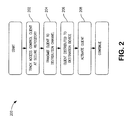
- FIG. 2 a generalized method 200 for efficiently distributing virtual access control clients within a network is disclosed.
- one or more access control clients are stored and tracked within secure repositories.
- the secure repository includes one or more of a tracking database, a security module for encrypting and decrypting access control clients based at least in part on information derived from the tracking database, and secure storage for access control clients.
- the tracking database includes information indicative of access control client distribution, and access control client transaction data.
- the transaction data includes a listing of deployed eSIMs, and the challenges issued, and/or unique identifiers used, etc.
- a secure protocol between transferring devices ensures that every eSIM of the distributed eSIM population is only transferred among trusted devices.
- the secure protocol may ensure that only encrypted eSIMs are distributed to devices which are not trusted.
- the trusted protocol is based on a challenge/response protocol.
- the trusted protocol is based on an exchange of a digital security certificate signed by a mutually trusted third party.
- the secure repository ensures that access control clients are only transferred between devices that conform to a standard trusted relationship.
- the trusted relationship further specifies that when a first device successfully transfers an access control client, the first device deletes, deactivates or otherwise renders its copy unusable. In this manner, the access control client can remain unique and conserved throughout transfer.
- the tracking database additionally tracks access control client qualities including for example: (i) access control clients which have been distributed to customers, (ii) access control clients which have not yet been distributed (awaiting activation), (iii) activated access control clients, (iv) deactivated access control clients, (v) access control clients awaiting activation, (vi) access control clients assigned to a device, (vii) access control clients assigned to an account, and (viii) access control clients available for assignment.
- the tracking database may track states such as for example: (i) current state, (ii) expected state, (iii) previous state, (iv) last known state, and (v) initial state. Common examples of a state variable include, but are not limited to, a counter value, an encrypted value, a challenge variable, a response variable, etc.
- a challenge variable is an input cryptographic vector, which can be manipulated, transformed, and/or calculated to generate a response vector.
- the manipulation, transformation, and/or calculation is a secret protected by the access control client of the device.
- a counter-based unique identifier uses a unique counter value as a secret that is protected by the access control client of the device.
- Common other types of states may be based on a large and pseudorandom state machine, such as for example, a Linear Feedback Shift Register (LFSR) based state machine or other such mechanism.
- LFSR Linear Feedback Shift Register
- the security module is in one embodiment configured to encrypt or decrypt access control clients based at least in part on instructions from the tracking database.
- the security module is configured to encrypt access control clients for delivery to the desired destination device.
- all transferred eSIMs must be encrypted (i.e., eSIMs cannot be transferred to any device in their unencrypted form).
- the security module is configured to decrypt access control clients received from user devices. In one variant, described in greater detail within U.S. Provisional Patent Application Serial Nos.
- each device is given unique device keys and endorsement certificates which can be used to provide updates and/or eSIMs to the user equipment in the "field".
- the user equipment can trust an encrypted eSIM delivered with the device key, and the security module can trust information encrypted with the device's key.
- the security module is further configured to decrypt an eSIM for SIM application execution.
- a user device can decrypt an eSIM for use.
- the eSIM application generally encompasses access control clients such as the aforementioned USIM, CSIM, ISIM, SIM, RUIM, etc. It is further understood that each eSIM can be associated with a user account, thus an "eSIM" may broadly encompass multiple access control clients (e.g., a user may have a USIM and a SIM associated with the same eSIM account).
- the security module may encrypt an eSIM for itself.
- a security module may encrypt an eSIM for itself, and store the encrypted eSIM to persistent storage for later use.
- security module encryption scheme may be based on an asymmetric key pair; or alternately, the security module encryption scheme may use a symmetric key pair.
- a public/private key pair is based on a secret private key, and a publishable public key.
- Public/private key schemes are considered “asymmetric", as the key used to encrypt and decrypt are different, and thus the encrypter and decrypter do not share the same key.
- "symmetric" key schemes utilize the same key (or trivially transformed keys) for both encryption and decryption.
- Rivest, Shamir and Adleman (RSA) algorithm is one type of public/private key pair cryptography that is commonly used within the related arts, but it will be recognized that the present invention is in no way limited to the RSA algorithm (or for that matter asymmetric or symmetric key pairs).
- Public/private cryptography schemes can be used to encrypt a message, and/or generate signatures. Specifically, a message can be encrypted with a private key, and decrypted with the public key, thereby assuring that the message has not been altered in transit. Similarly, a signature generated with the private key can be verified with the public key, assuring that the entity generating the signature is legitimate. In both uses, the private key is kept hidden, and the public key is freely distributed.
- the secure storage is volatile computer-readable media that is configured to store access control client data and files.
- the secure storage is a shared memory containing encrypted access control clients that is coupled to both the tracking databases and security modules. Shared memory access implementations allow both the tracking databases and security modules to operate on a coherent database (e.g., no requirement for synchronizing data between disparate memory pools). Volatile memory requires power to retain memory contents; which can be desirable for certain implementations because removing volatile memory will erase the memory (further improving security). Volatile memory is also generally faster than equivalent non-volatile memory.
- the secure storage enables multiple devices access to the same pool of access control clients.
- the secure storage may not be physically coupled between the tracking databases and security modules, but may be accessible via a network.
- the secure storage may not even be logically shared.
- remote databases may locally cache portions of the access control client data and files, and periodically synchronize between one another to ensure that all devices are in agreement.
- the secure storage may also be physically and/or logically protected.
- the secure storage may be protected within a Hardware Security Module (HSM), where the HSM is configured to destroy itself if forcibly opened/accessed.
- HSM Hardware Security Module
- the tracking database, security modules, and secure storage will typically be protected within a trusted boundary.
- Trust boundaries include both physical boundaries (e.g., physical isolation, etc.), and/or logical boundaries (e.g., encrypted communication, etc.).
- logical entities tracking database, security modules, and secure storage
- these logical entities are primarily described as coherent or unitary entities, it is appreciated that in most network infrastructures, these logical entities will be composed of multiple discrete apparatus (which may even be geographically disparate) operating in tandem.
- the tracking database is a community of multiple discrete database apparatus that execute tracking database software, and communicate among one another to maintain data synchronization.
- the logical security modules can be composed of multiple discrete security modules; in one such variant, the security modules are entirely directed by the tracking database and do not synchronize with one another.
- a distribution location is an access control client depot that is configured to store encrypted access control clients for distribution to their respective destinations. Since the access control clients are encrypted and cannot be used by devices other than the destination device, multiple depots can be loaded with copies of the encrypted access control clients.
- the encrypted access control clients are stored such that access control clients can be delivered in an uncontrolled fashion (i.e., each of the depots does not need to synchronize its transactions with the other depots, or notify a network centralized entity).
- Each of the copies is encrypted for the destination device, where the destination device is a trusted device.
- the destination device is configured to download the encrypted access control client only once. Once the access control client has been downloaded, the other copies of the access control client are "stale" and can be removed, deleted, or rendered inactive thereafter. Malicious third parties cannot decrypt the access control client, nor activate an encrypted copy (stale or otherwise).
- the secure repositories may provide access control clients to the one or more distribution locations in bulk.
- a SIM vendor may provide a large number of eSIMs in large lots (e.g., thousands of eSIMs at a time).
- the secure repository may provide one eSIM at a time; for example, in some embodiments, a user may "park" their unused eSIMs within an eSIM depot, either temporarily (such as to transfer to another device), or for longer term storage.
- Various embodiments of the present invention additionally include the addition of metadata that is associated to each access control client stored within the distribution locations.
- the metadata is securely stored, but can be accessed by the distribution apparatus to facilitate inventory management.
- an eSIM depot may encrypt metadata with its own key (as opposed to a key specific to an eSIM, or destination device), such that the eSIM depot can properly identify an encrypted eSIM.
- metadata may include, but are not limited to: identifying information, issuer information, network information, account information, status information, etc.
- the metadata can be further queried and/or accessed by external entities.
- an eUICC appliance may need to periodically check or update eSIM depot metadata (e.g., to determine inventory, identify stale information, etc.).
- eSIM depot metadata e.g., to determine inventory, identify stale information, etc.
- a mobile device user can request information on parked eSIMs, etc. located at a particular eSIM depot.
- the requested access control client is distributed from at least one of the distribution locations to a destination device. Due to the flexibility of distribution models, many different schemes are envisioned, and will be recognized by those of ordinary skill when provided the present disclosure. The following subsections describe several eSIM distribution schemes that are illustrative of the broad variety of schemes suitable for operation in accordance with various aspects of the present invention.
- a eSIM depot delivers an eSIM in response to initial request originating from a user device.
- Pull delivery is the simplest delivery scheme; a user can request eSIMs from any of a number of eSIM depots at the user's desire.
- the eSIM depot initiates the delivery of an eSIM (or notification thereof) to a user device.
- Push delivery is a more complex delivery scheme, since some coordination between eSIM depots may be required to prevent pushing multiple redundant copies of an eSIM to a single device.
- push and pull delivery schemes can be combined; for example, a user can request an eSIM, the eSIM depot may indicate that it is currently unable to fulfill the request. At a later point, the eSIM depot can push an eSIM to the user. In another such example, an eSIM depot may push an eSIM notification to a user, where the notification is valid for a time period (e.g., a promotional offer, trial period, etc.). If the user is interested in the eSIM, the user can subsequently pull an eSIM from the eSIM depot.
- a time period e.g., a promotional offer, trial period, etc.
- an eSIM depot may reserve a specific eSIM for a particular user. For example, where a new customer purchases a device from an online store, the store may identify one or more eSIMs which are reserved for the customer's purchased device. In some cases, the store may ship the device to the customer, and provide the reserved eSIMs to the eSIM depots. When the customer first operates their newly purchased device, the device contacts the eSIM depots to request the reserved eSIMs. Other variations on such reservation-based eSIM delivery are described in greater detail within U.S. Provisional Patent Application Serial No. 61/408,504 filed on October 29, 2010 and entitled "ACCESS DATA PROVISIONING SERVICE", incorporated by reference in its entirety.
- the eSIM depot may also serve as a storage location for unused eSIMs.
- a customer may park their own eSIM when not in use at an eSIM depot; at a later point, the customer may retrieve their eSIM (on their device, or on a different device), and reinstate operation.
- the customer will additionally encrypt the eSIM prior to parking the eSIM within the eSIM depot; for example, the customer encrypts the eSIM for their current device such that only their current device can reinstate the eSIM.
- their current device may encrypt the eSIM with, for example: a generic key, their own key (which would necessitate decryption and reencryption at a later point), etc.
- the eSIM depot can facilitate postponed delivery, such as the type described in U.S. Provisional Patent Application Serial No. 61/354,653 filed on June 14, 2010 and entitled “METHODS FOR PROVISIONING SUBSCRIBER IDENTITY DATA IN A WIRELESS NETWORK", and U.S. Patent Application Serial Nos. 12/952,089 filed on November 22, 2010 and entitled “APPARATUS AND METHODS FOR PROVISIONING SUBSCRIBER IDENTITY DATA IN A WIRELESS NETWORK", and 12/353,227 (now published as U.S.
- a mobile device is manufactured at a device factory and delivered to the user without an eSIM.
- the user's mobile device requests an eSIM from the eSIM depot.
- the eSIM depot determines an appropriate eSIM for the mobile device based (e.g., on one or more criteria including, but not limited to: a desired Mobile Network Operator (MNO), a desired service plan, a device specific restriction, user input, etc.).
- MNO Mobile Network Operator
- a mobile device is purchased by a user at a sales kiosk or outlet, where the sales kiosk assigns the mobile device an eSIM type, but does not program an eSIM into the device.
- the user takes the mobile device home and downloads a new eSIM from the eSIM depot. Once downloaded, the mobile device can activate the eSIM.
- the destination device activates the delivered access control client.
- activation of the delivered access control client is performed between the destination device and an activation service, such as an Authentication Center (AuC) or similar entity of a Mobile Network Operator (MNO).
- AuC Authentication Center
- MNO Mobile Network Operator
- the mobile device requests activation from an activation service.
- the activation service verifies the eSIM (e.g., with a cryptographic challenge and response transaction, etc.), and if successful, activates the eSIM.
- the illustrated system 300 is composed of several logical entities, including: (i) a number of eUICC appliances 302, (ii) a number eSIM depots 304, and (iii) associated persistent backup storage 306, each of which are now described in greater detail.
- the eUICC appliance(s) 302 of FIG. 3 is/are responsible for ensuring that the current population of eSIMs remains both unique and conserved. Specifically, the eUICC appliances must ensure that only one (1) unique eSIM is available for use at any time; i.e., no two (2) eUICC appliances have the same eSIM. Each time an eSIM is transferred between eUICC appliances, the transferring eUICC appliance deletes, deactivates or otherwise renders its copy unusable, such that only the transferred eUICC is active.
- eUICC appliance functionality is embodied as an appliance "cluster", which is an array of eUICC appliances that have been logically joined.
- eUICC appliances can communicate with other eUICC appliances, eSIM depots 304, and eUICCs of mobile devices.
- it may be useful to enforce communication between eUICC appliances only via eSIM depots 304 i.e., the eSIM depots are the sole intermediaries for transfer, eUICC appliances cannot transfer eSIMs directly).
- Such limitations may help reduce the likelihood of a race condition during transfers.
- the eUICC appliances may have a brief moment of overlap when an eSIM exists in two appliances, and could be accidentally duplicated if the transaction is interrupted unexpectedly.
- the transmitting eUICC appliance can delete its eSIM before the destination eUICC appliance receives the encrypted eSIM.
- the eUICC 302 appliance is subdivided into three (3) logical entities: (i) a signing appliance 312, (ii) a security storage 314, and (iii) secure module 316.
- a signing appliance 312 may consolidate the logical entities within a single apparatus, or alternately may implement the entities within multiple apparatus operating within a trusted boundary.
- the security module is implemented as a separate hardened module with a dedicated processor and execution code base.
- the security module is implemented within a larger logical entity (e.g., including the signing appliance and security storage) that is implemented within a secure processor.
- multiple security modules are connected to servers running other logical entities; e.g., a distributed signing entity application, etc.
- logical entities e.g., a distributed signing entity application, etc.
- Common implementations of trust boundaries include both physical boundaries (e.g., physical isolation, etc.), and/or logical boundaries (e.g., encrypted communication, etc.)
- the aforementioned entities may be further duplicated to offer desirable redundancy, load capacity, etc.
- the signing appliance 312 is responsible for tracking the population of eSIMs, transaction data associated therewith (e.g., challenges issued, unique identifiers used, etc.).
- the signing appliance tracks the eSIM (e.g., Integrated Circuit Card ID (ICCID)), and the last issued challenge and/or unique transaction identifier(s).
- the last issued challenge and/or unique transaction identifier(s) are for pending transfers where the eSIM has not been imported (or exported) yet.
- the transactional data is no longer needed, and can be deleted.
- the security module 316 is configured to encrypt or decrypt eSIMs.
- the security module is instructed to encrypt or decrypt eSIMs for transfer by the signing appliance.
- the eSIMs are encrypted using an encryption key specific to the destination eUICC of the device (such as the eUICC public key, and/or secure session key).
- the security module can decrypt a received encrypted eSIM from a device, and store the decrypted eSIM within the secure storage.
- received encrypted eSIMs are decrypted with the security modules private key (the security module's public key is distributed to the originating device).
- the signing appliance is coupled to secure storage 314 for storing data and files.
- the secure storage may be physically and/or logically protected.
- the stored eSIMs may be encrypted within a Hardware Security Module (HSM), where the HSM is configured to destroy itself if forcibly opened/accessed.
- HSM Hardware Security Module
- the secure storage stores encrypted data and files, such as encrypted eSIMs, and/or periodic backup data.
- the secure storage may add additional internal layers of encryption/securitization.
- encrypted data and files can be backed up and duplicated to less physically secure or physically insecure persistent storage (the storage medium may be on generic computer media).
- the eSIM depot 304 provides a distributed interface for eSIM distribution. Multiple eSIM depots can store encrypted eSIMs and deliver encrypted eSIMs to devices to prevent excessive network traffic ("bottle necking") to any single network entity.
- eSIM depots 304 generate and respond to requests for eSIMs from other eSIM depots, eUICC appliances 302 and/or eUICCs of devices.
- eSIM depots additionally respond to requests and updates to metadata that is associated with each eSIM. While metadata does not have any impact on network security, metadata is used to identify and characterize otherwise encrypted eSIMs. Thus, changes to metadata in this implementation can only be performed by trusted authorities which have been authenticated and/or authorized to modify metadata.
- the eSIM metadata may include for example: the eSIM Integrate Circuit Card ID (ICCID), eSIM vendor, Mobile Network Operator, subscriber account information (if any), and the current status of the eSIM (e.g., active, inactive, reserved, parked, etc.).
- ICCID eSIM Integrate Circuit Card ID
- eSIM vendor eSIM vendor
- Mobile Network Operator eSIM vendor
- subscriber account information if any
- the current status of the eSIM e.g., active, inactive, reserved, parked, etc.
- the eSIMs stored at the eSIM depot 304 are typically encrypted for the destination device.
- the destination device can request the encrypted eSIM from any of the eSIM depots.
- the eSIM depot delivers the encrypted eSIM to the destination device, and notifies the other eSIM depots of delivery.
- the other eSIM depots can destroy their encrypted eSIM copies at their leisure (e.g., to free storage space, etc.).
- multiple versions of the encrypted eSIM may be distributed to eSIM depots. Since eSIM depots 304 do not verify state information and do not modify the contents of the encrypted eSIM, the same eSIM can be stored at multiple eSIM depots. However, the eSIMs are encrypted for a destination device (which will only activate one copy of the eSIM).
- the eUICC appliances 302 or eSIM depots 304 are further coupled to external persistent storage 306 to assist in disaster recovery and/or archival services.
- Persistent storage may not be necessary in some implementations (e.g., where the eUICC appliance's internal storage is used for backup information, etc.).
- persistent storage is the only non-volatile storage for the system.
- some network architectures may be restricted such that eSIMs are only unencrypted to volatile memory for use; this has the benefit of, inter alia, adding an additional layer of protection in that if power to the volatile memory is lost (whether intentionally or otherwise), the unencrypted contents thereof will be lost as well.
- eSIMs are stored in an encrypted form within a non-volatile memory for persistent storage, distribution, etc.
- persistent storage 302 is periodically written with a uniquely encrypted BLOB (Binary Large Object); the BLOB contains the eUICC appliance states, challenges, etc. and any other data necessary to recreate the current eUICC database.
- the BLOB can only be decrypted with the eUICC appliance security key. If, at a later point, the eUICC appliance 302 has an irrecoverable failure, the eUICC appliance can return to a previously stored BLOB.
- the BLOB is exported to external storage, and does not need to be securely stored (the contents are encrypted); for example, the BLOB may be stored in a geographically remote location such as a warehouse, etc.
- the eSIM depot periodically stores its BLOBs to the persistent storage.
- the eSIM depot may additionally encrypt metadata associated with the BLOB, thus enabling full state recovery in the event of for example a memory loss.
- FIG. 4 illustrates one exemplary ladder diagram illustrating a typical lifecycle of an eSIM.
- the eSIM is provided by an eSIM vendor to an eSIM depot 304.
- eSIMs can be delivered via network transfer, or in some cases, physically delivered e.g., in a rackamount mass storage device, computer-readable media, etc.
- the delivered eSIMs are either delivered encrypted for the destination eUICC appliance 302, or delivered with encryption information such that the eUICC appliances can decrypt the eSIMs (e.g., a session key, a shared manufacturer specific key, etc.)
- the eUICC appliance cluster (an array of eUICC appliances 302) retrieves the eSIMs from the eSIM depot 304, and allocates each eSIM to an eUICC appliance for storage. For each eSIM, the signing appliance 312 is notified of an allocated eSIM and records the eSIM identifiers, and associated transaction data.
- the security module 316 stores the eSIM to the secure storage 314. In some cases, the eSIM is encrypted for the eUICC appliance, and stored in encrypted format.
- a mobile device 402 requests an eSIM from the eSIM depot 304.
- the request includes the mobile device's eUICC public encryption key and a challenge.
- the request is forwarded to the eUICC appliance 302.
- the eUICC appliance verifies the challenge, and generates the proper response.
- the eSIM appliance selects an appropriate encrypted eSIM from storage, decrypts the eSIM using its own private key, and reencrypts the eSIM for the mobile with the challenge response, using the mobile device's eUICC public encryption key.
- the eUICC appliance transfers the newly encrypted BLOB to any of the number of eSIM depots, and updates its internal records.
- any of the eSIM depots 304 can notify the mobile device 402 that an eSIM is available for retrieval. Responsively, the mobile device downloads the encrypted BLOB from the nearest eSIM depot, and decrypts the BLOB. If the challenge response is valid, the mobile device activates the decrypted eSIM. In some embodiments the eSIM depot can notify the eUICC appliance of successful delivery. Unused copies stored at the eSIM depots and the copy stored at the eSIM appliance can be deleted after successful delivery. Since each request for an eSIM includes a different challenge, the copies are stale and cannot be "replayed" for subsequent requests.
- FIG. 5 illustrates one exemplary embodiment of a eUICC appliance 302 in accordance with the present invention.
- the eUICC appliance may include a stand-alone entity, or be incorporated with other network entities.
- the eUICC appliance 302 generally includes a network interface 502 for interfacing with the communications network, a processor 504, and one or more storage apparatus 508.
- the network interface is shown connecting to the MNO infrastructure, so as to provide access to other eUICC appliances, and direct or indirect access to one or more mobile devices, although other configurations and functionalities may be substituted.
- the eUICC appliance is capable of: (i) establishing communications with another eUICC (either a eUICC appliance or client device), (ii) securely storing an eSIM, (iii) retrieving a securely stored eSIM, (iv) encrypting an eSIM for delivery to another specific eUICC, and (v) sending multiple eSIMs to/from an eSIM depot.
- the eUICC appliance 302 includes at least a signing entity 312 running on the processor 504.
- the signing entity 312 processes requests that include: (i) a request to store an eSIM, (ii) a request to transfer a currently stored eSIM.
- the signing entity is also responsible for verifying requests to ensure that communication is received from another entity authorized to make such a request.
- the signing entity 312 verifies requests by executing challenge and response security exchanges.
- the challenge/response security protocol is configured to verify requests made by an unknown third party, based on appropriate generation of challenges and/or responses.
- the secure element can verify a digital certificate signed by a trusted authority.
- the signing entity 312 is further configured to manage the available eSIMs. As illustrated in FIG. 5 , the signing entity may provide information e.g., relating to the particular eSIM, the devices authorized to use the eSIM, the current state of the eSIM, and/or the current status of the eSIM ("available", "not available", “stale”, etc.). Additional information may be maintained as well.
- the signing entity is configured to update or change information stored in the secure storage 314.
- the secure storage 314 is adapted to store an array of access control clients.
- an eUICC appliance stores an array of securely encrypted eSIMs to volatile storage. Volatile memory requires power to retain memory contents; common examples of volatile memory include Random Access Memory (RAM), Static RAM (SRAM), Dynamic RAM (DRAM), etc.
- RAM Random Access Memory
- SRAM Static RAM
- DRAM Dynamic RAM
- Each eSIM includes a small file system that includes computer readable instructions (the eSIM program) and associated data (e.g., cipher keys, integrity keys, etc.).
- each eSIM is additionally associated with transaction data (e.g., challenges issued, unique identifiers used, etc.)
- the security module 316 is configured in one variant to encrypt or decrypt access control clients based at least in part on instructions from the signing entity 312.
- the security module has a unique set of device specific encryption keys.
- the encryption keys include for example a public key, and a private key.
- the security module can decrypt an eSIM encrypted with its public key, using its private key. Additionally, the security module can encrypt an eSIM with another devices public key.
- the signing appliance retrieves the current state of the requested eSIM. This information can be used to determine if the requested eSIM can be provided. This validity check can be performed at the eUICC appliance, or occur at yet other locations; e.g., by comparing the state at another entity (such as an eSIM depot) to the last known state at the eUICC appliance.
- the signing appliance instructs the security module 316 to encrypt the associated eSIM.
- the security module encrypts the eSIM for the destination device (e.g., a client device, another eUICC appliance 302, etc.).
- the destination device e.g., a client device, another eUICC appliance 302, etc.
- each encrypted eSIM is further encrypted with a unique identifier, challenge, or challenge response.
- the eSIM can be purged from the eUICC appliance inventory.
- the signing appliance instructs the security module 316 to decrypt the associated eSIM for secure storage, and updates its associated transaction data.
- FIG. 6 illustrates one exemplary embodiment of an eSIM depot 304 in accordance with the present invention.
- the eSIM depot 304 may be implemented as a stand-alone entity, or be incorporated with other network entities (e.g., an eUICC appliance 302, etc.).
- the eSIM depot 304 generally includes a network interface 602 for interfacing with the communications network, a processor 604, and a storage apparatus 608.
- the eSIM depot 304 is capable of: (i) inventory management of eSIMs (e.g., via associated metadata), (ii) responding to requests for encrypted eSIMs (e.g., from other eSIM depots, and/or eUICC appliances 302), (iii) managing subscriber requests for eSIMs.
- the eSIM when an eSIM is stored at an eSIM depot 304 by a user, the eSIM may be stored with an intended destination (e.g., to facilitate transfer to another device), or parked indefinitely. In either case, the eSIM depot can provide the eSIM to the eUICC appliance for secure storage and for subsequent encryption for the destination device.
- an intended destination e.g., to facilitate transfer to another device
- the eSIM depot can provide the eSIM to the eUICC appliance for secure storage and for subsequent encryption for the destination device.
- the storage apparatus 608 is adapted to store an array of encrypted access control clients.
- the eSIM depot stores an array of encrypted eSIMs as Binary Large Objects (BLOBs) within non-volatile memory.
- BLOBs Binary Large Objects
- non-volatile memory include, without limitation, flash, Hard Disk Drive, Read Only Memory (ROM), etc.
- each BLOB is further associated with metadata that identifies the contents of the BLOB.
- the metadata may contain: identifying information, issuer information, network information, account information, status information, etc.
- exemplary user apparatus 700 in accordance with various aspects of the present invention is illustrated.
- the exemplary UE apparatus of FIG. 7 is a wireless device with a processor subsystem 702 such as a digital signal processor, microprocessor, field-programmable gate array, or plurality of processing components mounted on one or more substrates.
- the processing subsystem may also include an internal cache memory.
- the processing subsystem is in communication with a memory subsystem 704 including memory which may for example, include SRAM, flash, and/or SDRAM components.
- the memory subsystem may implement one or a more of DMA type hardware, so as to facilitate data accesses as is well known in the art.
- the memory subsystem contains computer-executable instructions which are executable by the processor subsystem.
- the device can include of one or more wireless interfaces 706 adapted to connect to one or more wireless networks.
- the multiple wireless interfaces may support different radio technologies such as GSM, CDMA, UMTS, LTE/LTE-A, WiMAX, WLAN, Bluetooth, etc. by implementing the appropriate antenna and modem subsystems.
- the user interface subsystem 708 includes any number of well-known I/O including, without limitation: a keypad, touch screen (e.g., multi-touch interface), LCD display, backlight, speaker, and/or microphone. However, it is recognized that in certain applications, one or more of these components may be obviated.
- PCMCIA card-type client embodiments may lack a user interface (as they could piggyback onto the user interface of the host device to which they are physically and/or electrically coupled).
- the device includes a secure element 710 which contains and operates the eUICC application.
- the eUICC is capable of storing and accessing a plurality of access control clients to be used for authentication with a network operator.
- the secure element includes a secure processor executing software stored in a secure media.
- the secure media is inaccessible to all other components (other than the secure processor).
- the secure element may be further hardened to prevent tampering (e.g., encased in resin) as previously described.
- the secure element 710 is capable of receiving and storing one or more access control clients.
- the secure element stores an array or plurality of eSIMs associated with a user (e.g., one for work, one for personal, several for roaming access, etc.), and/or according to another logical scheme or relationship (e.g., one for each of multiple members of a family or business entity, one for each of personal and work use for the members of the family, and so forth).
- Each eSIM includes a small file system including computer readable instructions (the eSIM program), and associated data (e.g., cipher keys, integrity keys, etc.)
- the secure element is further adapted to enable transfer of eSIMs to and/or from the mobile device.
- the mobile device provides a GUI-based acknowledgement to initiate transfer of an eSIM.
- the mobile device sends a request for activation to an activation service.
- the mobile device can use the eSIM for standard Authentication and Key Agreement (AKA) exchanges.
- AKA Authentication and Key Agreement
- FIG. 8 illustrates one exemplary embodiment of persistent storage 306 in accordance with the present invention.
- the persistent storage may be implemented as a stand-alone entity, or be incorporated with other network entities (e.g., an eUICC appliance 302, eSIM depot 304, etc.).
- the persistent storage generally includes an interface 804, and a storage apparatus 802.
- the persistent storage is adapted to store an array of encrypted access control clients, and associated states to non-volatile storage.
- the persistent storage stores an array of encrypted eSIMs and associated metadata as Binary Large Objects (BLOBs).
- BLOBs Binary Large Objects
- Each BLOB may be uniquely encrypted by the storing device's key (e.g., the eUICC appliance, eSIM depot, etc.)
Landscapes
- Engineering & Computer Science (AREA)
- Computer Networks & Wireless Communication (AREA)
- Signal Processing (AREA)
- Computer Security & Cryptography (AREA)
- Computing Systems (AREA)
- Databases & Information Systems (AREA)
- Theoretical Computer Science (AREA)
- Computer Hardware Design (AREA)
- General Engineering & Computer Science (AREA)
- Storage Device Security (AREA)
- Telephonic Communication Services (AREA)
- Mobile Radio Communication Systems (AREA)
- Stored Programmes (AREA)
- Data Exchanges In Wide-Area Networks (AREA)
- Information Transfer Between Computers (AREA)
Applications Claiming Priority (2)
| Application Number | Priority Date | Filing Date | Title |
|---|---|---|---|
| US201161472115P | 2011-04-05 | 2011-04-05 | |
| US13/095,716 US8707022B2 (en) | 2011-04-05 | 2011-04-27 | Apparatus and methods for distributing and storing electronic access clients |
Publications (2)
| Publication Number | Publication Date |
|---|---|
| EP2509342A2 true EP2509342A2 (fr) | 2012-10-10 |
| EP2509342A3 EP2509342A3 (fr) | 2013-01-09 |
Family
ID=45976175
Family Applications (1)
| Application Number | Title | Priority Date | Filing Date |
|---|---|---|---|
| EP12163450A Withdrawn EP2509342A3 (fr) | 2011-04-05 | 2012-04-05 | Appareil et procédés pour distribuer et stocker l'accès électronique |
Country Status (9)
| Country | Link |
|---|---|
| US (2) | US8707022B2 (fr) |
| EP (1) | EP2509342A3 (fr) |
| JP (2) | JP5612018B2 (fr) |
| KR (2) | KR101484367B1 (fr) |
| AU (1) | AU2012201946B2 (fr) |
| BR (1) | BR102012007800B1 (fr) |
| MX (1) | MX2012003953A (fr) |
| TW (2) | TWI498015B (fr) |
| WO (1) | WO2012138780A2 (fr) |
Cited By (7)
| Publication number | Priority date | Publication date | Assignee | Title |
|---|---|---|---|---|
| WO2012149219A3 (fr) * | 2011-04-26 | 2012-12-27 | Apple Inc. | Appareil et procédés de distribution de clients d'accès électroniques |
| US8555067B2 (en) | 2010-10-28 | 2013-10-08 | Apple Inc. | Methods and apparatus for delivering electronic identification components over a wireless network |
| US9450759B2 (en) | 2011-04-05 | 2016-09-20 | Apple Inc. | Apparatus and methods for controlling distribution of electronic access clients |
| EP3324660A4 (fr) * | 2015-08-21 | 2018-07-04 | Huawei Technologies Co., Ltd. | Procédé et appareil de commande de communication, terminal et plateforme de réseau |
| EP3629610A4 (fr) * | 2017-06-14 | 2020-07-01 | Huawei Technologies Co., Ltd. | Procédé et appareil de gestion de fichier de configuration de carte de circuit intégré universelle intégrée (euicc) |
| CN113158201A (zh) * | 2021-02-26 | 2021-07-23 | 云码智能(海南)科技有限公司 | 信息的安全备份方法及装置 |
| DE102016201360B4 (de) | 2015-02-23 | 2021-12-02 | Apple Inc. | VERFAHREN UND VORRICHTUNG ZUM AUSWÄHLEN VON BOOTSTRAP ESIMs |
Families Citing this family (48)
| Publication number | Priority date | Publication date | Assignee | Title |
|---|---|---|---|---|
| US8856511B2 (en) * | 2006-12-14 | 2014-10-07 | Blackberry Limited | System and method for wiping and disabling a removed device |
| US9009475B2 (en) * | 2011-04-05 | 2015-04-14 | Apple Inc. | Apparatus and methods for storing electronic access clients |
| US10271213B2 (en) | 2011-05-06 | 2019-04-23 | Apple Inc. | Methods and apparatus for providing management capabilities for access control clients |
| US8762742B2 (en) * | 2011-05-16 | 2014-06-24 | Broadcom Corporation | Security architecture for using host memory in the design of a secure element |
| MX342702B (es) * | 2012-02-14 | 2016-10-10 | Apple Inc | Metodos y aparato para distribucion a gran escala de clientes de acceso electronico. |
| US9235406B2 (en) | 2012-04-24 | 2016-01-12 | Apple Inc. | Methods and apparatus for user identity module update without service interruption |
| KR102093757B1 (ko) * | 2012-05-24 | 2020-03-26 | 삼성전자 주식회사 | eUICC 환경에서 SIM 프로파일을 제공하는 방법 및 장치 |
| US8983543B2 (en) | 2012-09-12 | 2015-03-17 | Li Li | Methods and apparatus for managing data within a secure element |
| DE102012020987A1 (de) * | 2012-10-25 | 2014-04-30 | Giesecke & Devrient Gmbh | Verfahren zum sicheren Verwalten von Teilnehmeridentitätsdaten |
| US20140141746A1 (en) * | 2012-11-20 | 2014-05-22 | Khiam Yong Tan | Subscriber identity systems, servers, methods for controlling a subscriber identity system, and methods for controlling a server |
| JP5992632B2 (ja) | 2012-11-21 | 2016-09-14 | アップル インコーポレイテッド | アクセス制御を管理するためのポリシーベース技法 |
| US20150012863A1 (en) * | 2012-12-28 | 2015-01-08 | Panasonic Intellectual Property Corporation Of America | Control method |
| US9906254B2 (en) | 2013-02-11 | 2018-02-27 | Apple Inc. | Facilitating multiple subscriber identity support in a wireless device |
| TWI492093B (zh) * | 2013-04-18 | 2015-07-11 | Newtype Software Systems Co Ltd | 檔案加/解密方法及使用加/解密檔案之電子裝置 |
| US9100175B2 (en) | 2013-11-19 | 2015-08-04 | M2M And Iot Technologies, Llc | Embedded universal integrated circuit card supporting two-factor authentication |
| US9350550B2 (en) | 2013-09-10 | 2016-05-24 | M2M And Iot Technologies, Llc | Power management and security for wireless modules in “machine-to-machine” communications |
| US10129242B2 (en) | 2013-09-16 | 2018-11-13 | Airwatch Llc | Multi-persona devices and management |
| US10498530B2 (en) | 2013-09-27 | 2019-12-03 | Network-1 Technologies, Inc. | Secure PKI communications for “machine-to-machine” modules, including key derivation by modules and authenticating public keys |
| US10700856B2 (en) | 2013-11-19 | 2020-06-30 | Network-1 Technologies, Inc. | Key derivation for a module using an embedded universal integrated circuit card |
| KR102218693B1 (ko) * | 2014-01-02 | 2021-02-22 | 삼성전자주식회사 | 복수의 심 정보 처리 방법 및 그 전자 장치 |
| US9510186B2 (en) * | 2014-04-04 | 2016-11-29 | Apple Inc. | Tamper prevention for electronic subscriber identity module (eSIM) type parameters |
| US9730072B2 (en) * | 2014-05-23 | 2017-08-08 | Apple Inc. | Electronic subscriber identity module provisioning |
| WO2015184064A1 (fr) * | 2014-05-30 | 2015-12-03 | Apple Inc. | Stockage sécurisé d'un module électronique d'identité d'abonné sur un dispositif de communications sans fil |
| KR102160597B1 (ko) * | 2014-07-17 | 2020-09-28 | 삼성전자 주식회사 | eUICC의 프로파일 설치 방법 및 장치 |
| US10462185B2 (en) * | 2014-09-05 | 2019-10-29 | Sequitur Labs, Inc. | Policy-managed secure code execution and messaging for computing devices and computing device security |
| US10516990B2 (en) | 2014-09-17 | 2019-12-24 | Simless, Inc. | Apparatuses, methods and systems for implementing a trusted subscription management platform |
| US11172352B2 (en) | 2014-09-17 | 2021-11-09 | Gigsky, Inc. | Apparatuses, methods, and systems for configuring a trusted java card virtual machine using biometric information |
| EP3228104B1 (fr) | 2014-09-17 | 2020-08-26 | Simless, Inc. | Appareils, procédés et systèmes pour implémentation d'une plate-forme de gestion d'abonnements de confiance |
| EP3010264A1 (fr) * | 2014-10-16 | 2016-04-20 | Gemalto Sa | Procédé de gestion d'abonnements par un serveur de provisionnement |
| US10123191B2 (en) | 2014-10-31 | 2018-11-06 | At&T Intellectual Property I, L.P. | Device operational profiles |
| US9825758B2 (en) * | 2014-12-02 | 2017-11-21 | Microsoft Technology Licensing, Llc | Secure computer evaluation of k-nearest neighbor models |
| US9787647B2 (en) | 2014-12-02 | 2017-10-10 | Microsoft Technology Licensing, Llc | Secure computer evaluation of decision trees |
| US9853977B1 (en) | 2015-01-26 | 2017-12-26 | Winklevoss Ip, Llc | System, method, and program product for processing secure transactions within a cloud computing system |
| US10785645B2 (en) * | 2015-02-23 | 2020-09-22 | Apple Inc. | Techniques for dynamically supporting different authentication algorithms |
| US12108488B2 (en) | 2015-05-16 | 2024-10-01 | Gigsky, Inc. | Apparatuses, methods and systems for virtualizing a reprogrammable universal integrated circuit chip |
| EP3374923B1 (fr) | 2015-05-22 | 2021-08-25 | Huawei Device Co., Ltd. | Unité cryptographique pour opérations d'infrastructure à clé publique (pki) |
| US10142819B2 (en) * | 2015-07-29 | 2018-11-27 | Blackberry Limited | Establishing machine type communications |
| US9843885B2 (en) * | 2015-08-12 | 2017-12-12 | Apple Inc. | Methods, procedures and framework to provision an eSIM and make it multi-SIM capable using primary account information |
| US10277587B2 (en) * | 2015-10-08 | 2019-04-30 | Apple Inc. | Instantiation of multiple electronic subscriber identity module (eSIM) instances |
| SG10201609129SA (en) | 2015-11-02 | 2017-06-29 | Apple Inc | Apparatus and methods for electronic subscriber identity module (esim) installation notification |
| KR102621499B1 (ko) * | 2015-11-13 | 2024-01-09 | 삼성전자주식회사 | 단말의 eUICC(embedded universal integrated circuit card)에 프로파일을 다운로드하는 방법 및 장치 |
| US9430337B1 (en) | 2016-01-07 | 2016-08-30 | International Business Machines Corporation | Disaster recovery as a dynamic service |
| KR102468974B1 (ko) | 2016-03-21 | 2022-11-22 | 삼성전자주식회사 | 전자 장치 및 전자 장치의 제어 방법 |
| CN112106050B (zh) | 2018-03-27 | 2024-07-19 | 维萨国际服务协会 | 用于授权电器设备以及向电器设备提供令牌的系统和方法 |
| US11129014B2 (en) * | 2019-03-08 | 2021-09-21 | Apple Inc. | Methods and apparatus to manage inactive electronic subscriber identity modules |
| US11810105B2 (en) | 2019-06-20 | 2023-11-07 | Visa International Service Association | System and method for authorizing and provisioning a token to an appliance |
| US11172350B1 (en) * | 2020-06-15 | 2021-11-09 | Apple Inc. | Subscription activation for mobile wireless devices |
| CN117527447B (zh) * | 2024-01-05 | 2024-03-22 | 厦门身份宝网络科技有限公司 | 一种多方安全计算的秘密共享方法和系统 |
Citations (1)
| Publication number | Priority date | Publication date | Assignee | Title |
|---|---|---|---|---|
| US20090181662A1 (en) | 2007-09-01 | 2009-07-16 | David Fleischman | Postponed Carrier Configuration |
Family Cites Families (97)
| Publication number | Priority date | Publication date | Assignee | Title |
|---|---|---|---|---|
| US8145701B2 (en) * | 1996-06-28 | 2012-03-27 | Jordaan Consulting Ltd. Iii, Llc | Methods and systems for providing storage of a data file over a computer network |
| US6799155B1 (en) * | 1998-12-11 | 2004-09-28 | Allied Signal Inc. | Replacement of externally mounted user interface modules with software emulation of user interface module functions in embedded processor applications |
| US6873609B1 (en) * | 1999-11-02 | 2005-03-29 | Ipwireless, Inc. | Use of internet WEB technology for wireless internet access |
| US7991697B2 (en) * | 2002-12-16 | 2011-08-02 | Irdeto Usa, Inc. | Method and system to digitally sign and deliver content in a geographically controlled manner via a network |
| US7062279B2 (en) * | 2000-06-22 | 2006-06-13 | Openwave Systems Inc. | Anonymous positioning of a wireless unit for data network location-based services |
| US6372974B1 (en) | 2001-01-16 | 2002-04-16 | Intel Corporation | Method and apparatus for sharing music content between devices |
| WO2002093811A2 (fr) * | 2001-05-16 | 2002-11-21 | Adjungo Networks Ltd. | Acces a des reseau plmn pour dispositifs non plmn et a des fonctions apparaissant dans des interfaces generalement entre reseaux plmn et non plmn |
| FR2826212B1 (fr) * | 2001-06-15 | 2004-11-19 | Gemplus Card Int | Procede de chargement a distance d'une cle de cryptage dans un poste d'un reseau de telecommunication |
| DE10215861B4 (de) | 2002-01-31 | 2005-11-24 | Condat Aktiengesellschaft | Verfahren zum Betreiben von Endgeräten in einem Mobilfunk-Übertragungssystem mit Mehrfachzugriff |
| JP2003281392A (ja) | 2002-03-20 | 2003-10-03 | Japan Telecom Co Ltd | コンテンツ配信方法 |
| US7900054B2 (en) * | 2002-03-25 | 2011-03-01 | Intel Corporation | Security protocols for processor-based systems |
| US20030212616A1 (en) | 2002-05-09 | 2003-11-13 | Casabyte, Inc. | Method, apparatus and article to remotely associate wireless communications devices with subscriber identities and/or proxy wireless communications devices |
| JP2004015547A (ja) * | 2002-06-07 | 2004-01-15 | Canon Inc | 画像暗号化装置、画像暗号化方法、復号装置、復号方法、プログラム、記憶媒体 |
| TW576063B (en) * | 2002-07-10 | 2004-02-11 | Benq Corp | Device and method for securing information associated with a subscriber in a communication apparatus |
| FI117586B (fi) * | 2002-08-02 | 2006-11-30 | Nokia Corp | Menetelmä SIM-toiminteen järjestämiseksi digitaaliseen langattomaan päätelaitteeseen sekä vastaava päätelaite ja palvelin |
| JP2004180155A (ja) * | 2002-11-28 | 2004-06-24 | Ntt Docomo Inc | 通信制御装置、ファイアウォール装置、通信制御システム、及び、データ通信方法 |
| GB2396472A (en) * | 2002-12-18 | 2004-06-23 | Ncr Int Inc | System for cash withdrawal |
| US7801820B2 (en) * | 2003-01-13 | 2010-09-21 | Sony Corporation | Real-time delivery of license for previously stored encrypted content |
| US7379548B2 (en) * | 2003-01-31 | 2008-05-27 | Nds Limited | Virtual smart card device, method and system |
| WO2004086676A1 (fr) * | 2003-03-19 | 2004-10-07 | Way Systems, Inc. | Systeme et procede de transactions mobiles a l'aide du protocole independant du support |
| WO2004105421A2 (fr) | 2003-05-22 | 2004-12-02 | Axalto Sa | Procede de remplacement et d'activation a distance d'une carte sim |
| US7590837B2 (en) * | 2003-08-23 | 2009-09-15 | Softex Incorporated | Electronic device security and tracking system and method |
| US7162408B2 (en) * | 2003-12-15 | 2007-01-09 | Microsoft Corporation | Subscriber identification module (SIM) emulator |
| US20050176465A1 (en) | 2004-02-09 | 2005-08-11 | Ixi Mobile (R&D) Ltd. | Automatic mobile device configuration system and method in a mobile communication network |
| KR101254209B1 (ko) * | 2004-03-22 | 2013-04-23 | 삼성전자주식회사 | 디바이스와 휴대용 저장장치간에 권리 객체를 이동,복사하는 방법 및 장치 |
| US20050250468A1 (en) * | 2004-05-09 | 2005-11-10 | Wei Lu | Open wireless architecture for fourth generation mobile communications |
| FR2871020B1 (fr) * | 2004-05-27 | 2006-07-07 | Radiotelephone Sfr | Procede et systeme de duplication securisee des informations d'une carte sim vers au moins un objet communicant |
| US7624072B2 (en) * | 2004-06-15 | 2009-11-24 | Lipsky Scott E | Method and system for securely distributing content |
| US8265282B2 (en) * | 2004-08-13 | 2012-09-11 | Telecom Italia S.P.A. | Method of and system for secure management of data stored on electronic tags |
| US20060048232A1 (en) * | 2004-08-26 | 2006-03-02 | International Business Machines Corporation | Controlling with rights objects delivery of broadcast encryption content for a network cluster from a content server outside the cluster |
| SE528103C2 (sv) | 2004-08-31 | 2006-09-05 | Smarttrust Ab | Förfarande och system för kontrollering av apparatidentitet |
| US7644272B2 (en) * | 2004-10-22 | 2010-01-05 | Broadcom Corporation | Systems and methods for providing security to different functions |
| KR100606069B1 (ko) * | 2004-10-25 | 2006-07-28 | 삼성전자주식회사 | Gsm/gprs용 복합 단말기에서 신뢰성 있는데이터베이스 관리 방법 및 그 복합 단말기 |
| US7856249B2 (en) * | 2004-11-08 | 2010-12-21 | Sony Ericsson Mobile Communications Ab | Combined mass storage and subscriber identity module providing information security and apparatus for use therewith |
| US20060190999A1 (en) * | 2004-11-22 | 2006-08-24 | David Chen | Method and apparatus for two-way transmission of medical data |
| CA2608705A1 (fr) * | 2005-05-17 | 2006-11-23 | Telcordia Technologies, Inc. | Point de service virtuel securise pour reseaux sans fil de troisieme generation |
| KR100652125B1 (ko) * | 2005-06-03 | 2006-12-01 | 삼성전자주식회사 | 서비스 제공자, 단말기 및 사용자 식별 모듈 간을총괄적으로 인증하여 관리할 수 있도록 하는 상호 인증방법 및 이를 이용한 시스템과 단말 장치 |
| US7526662B2 (en) * | 2005-09-02 | 2009-04-28 | Motorola, Inc. | Method and apparatus for secure module restoration |
| US20070153768A1 (en) * | 2005-12-30 | 2007-07-05 | Balakumar Jagadesan | Apparatus and method for cordless internet protocol |
| GB2450046B (en) | 2006-03-29 | 2011-03-09 | Kt Freetel Co Ltd | Digital device and method for providing additional service by using the same |
| EP1916598A1 (fr) * | 2006-10-23 | 2008-04-30 | Nagravision S.A. | Méthode de chargement et de gestion d'une application dans un équipement mobile |
| JP2009009545A (ja) * | 2007-01-31 | 2009-01-15 | Hewlett-Packard Development Co Lp | データ処理システム及び方法 |
| US7769693B2 (en) | 2007-03-30 | 2010-08-03 | Cisco Technology, Inc. | Mechanism for secure rehosting of licenses |
| US8345869B2 (en) | 2007-04-11 | 2013-01-01 | The Directv Group, Inc. | Method and apparatus for file sharing of missing content between a group of user devices in a peer-to-peer network |
| US8712474B2 (en) * | 2007-04-20 | 2014-04-29 | Telefonaktiebolaget L M Ericsson (Publ) | Secure soft SIM credential transfer |
| US8064597B2 (en) * | 2007-04-20 | 2011-11-22 | Telefonaktiebolaget Lm Ericsson (Publ) | Method and system for mobile device credentialing |
| US8140439B2 (en) | 2007-04-25 | 2012-03-20 | General Instrument Corporation | Method and apparatus for enabling digital rights management in file transfers |
| US8331989B2 (en) * | 2007-06-15 | 2012-12-11 | Intel Corporation | Field programming of a mobile station with subscriber identification and related information |
| US20090069049A1 (en) | 2007-09-12 | 2009-03-12 | Devicefidelity, Inc. | Interfacing transaction cards with host devices |
| US20090125996A1 (en) * | 2007-09-19 | 2009-05-14 | Interdigital Patent Holdings, Inc. | Virtual subscriber identity module |
| DE102007044905A1 (de) * | 2007-09-19 | 2009-04-09 | InterDigital Patent Holdings, Inc., Wilmington | Verfahren und Vorrichtung zur Ermöglichung einer Dienstnutzung und Feststellung der Teilnehmeridentität in Kommunikationsnetzen mittels softwarebasierten Zugangsberechtigungsausweisen (vSIM) |
| US8280986B2 (en) * | 2007-11-23 | 2012-10-02 | Lg Electronics Inc. | Mobile terminal and associated storage devices having web servers, and method for controlling the same |
| FI122163B (fi) | 2007-11-27 | 2011-09-15 | Teliasonera Ab | Verkkopääsyautentikointi |
| US8675872B2 (en) * | 2007-11-28 | 2014-03-18 | Echostar Technologies L.L.C. | Secure content distribution apparatus, systems, and methods |
| US8200736B2 (en) * | 2007-12-24 | 2012-06-12 | Qualcomm Incorporated | Virtual SIM card for mobile handsets |
| US8516133B2 (en) | 2008-02-07 | 2013-08-20 | Telefonaktiebolaget Lm Ericsson (Publ) | Method and system for mobile device credentialing |
| US8561130B2 (en) | 2008-02-19 | 2013-10-15 | Sandisk Technologies Inc. | Personal license server and methods for use thereof |
| US8553883B2 (en) * | 2008-02-22 | 2013-10-08 | Telefonaktiebolaget L M Ericsson (Publ) | Method and apparatus for managing subscription credentials in a wireless communication device |
| PL2263359T3 (pl) * | 2008-03-31 | 2015-03-31 | Orange | Sposób dostępu i przesyłania danych związanych z aplikacją zainstalowaną w module zabezpieczenia, skojarzonym z terminalem ruchomym, skojarzony moduł zabezpieczenia, serwer zarządzania i system |
| DE102008025792A1 (de) * | 2008-05-29 | 2009-12-17 | T-Mobile International Ag | Personalisierung einer SIM mittels einer eindeutigen, personlisierten MasterSIM |
| WO2010027765A2 (fr) | 2008-08-25 | 2010-03-11 | Interdigital Patent Holdings, Inc. | Carte universelle de circuit intégré possédant la fonctionnalité d’un module d’identité d’abonné virtuel |
| US8578153B2 (en) * | 2008-10-28 | 2013-11-05 | Telefonaktiebolaget L M Ericsson (Publ) | Method and arrangement for provisioning and managing a device |
| US8275415B2 (en) | 2009-02-13 | 2012-09-25 | At&T Intellectual Property I, Lp | Systems and methods for multi-device wireless SIM management |
| US8328104B2 (en) * | 2009-03-30 | 2012-12-11 | Condel International Technologies Inc. | Storage device management systems and methods |
| US8214645B2 (en) | 2009-04-08 | 2012-07-03 | Research In Motion Limited | Systems, devices, and methods for securely transmitting a security parameter to a computing device |
| JP5452821B2 (ja) * | 2009-05-04 | 2014-03-26 | ブラックベリー リミテッド | デバイス間のメディアおよび/またはメディア移転を実装するためのシステムおよび方法 |
| US9734496B2 (en) | 2009-05-29 | 2017-08-15 | Paypal, Inc. | Trusted remote attestation agent (TRAA) |
| JP5265452B2 (ja) * | 2009-06-01 | 2013-08-14 | 日本電信電話株式会社 | アプリケーション利用システム、アプリケーション利用方法 |
| US8606232B2 (en) * | 2009-06-08 | 2013-12-10 | Qualcomm Incorporated | Method and system for performing multi-stage virtual SIM provisioning and setup on mobile devices |
| US8639245B2 (en) * | 2009-06-08 | 2014-01-28 | Qualcomm Incorporated | Method and apparatus for updating rules governing the switching of virtual SIM service contracts |
| US8811969B2 (en) | 2009-06-08 | 2014-08-19 | Qualcomm Incorporated | Virtual SIM card for mobile handsets |
| US8634828B2 (en) * | 2009-06-08 | 2014-01-21 | Qualcomm Incorporated | Method and apparatus for switching virtual SIM service contracts based upon a user profile |
| US8649789B2 (en) * | 2009-06-08 | 2014-02-11 | Qualcomm Incorporated | Method and apparatus for switching virtual SIM service contracts when roaming |
| US20100311402A1 (en) * | 2009-06-08 | 2010-12-09 | Prasanna Srinivasan | Method and apparatus for performing soft switch of virtual sim service contracts |
| US8676180B2 (en) * | 2009-07-29 | 2014-03-18 | Qualcomm Incorporated | Virtual SIM monitoring mode for mobile handsets |
| JP5061166B2 (ja) * | 2009-09-04 | 2012-10-31 | Kii株式会社 | データ同期システムおよびデータ同期方法 |
| US20110131421A1 (en) * | 2009-12-02 | 2011-06-02 | Fabrice Jogand-Coulomb | Method for installing an application on a sim card |
| US8560633B2 (en) * | 2010-01-11 | 2013-10-15 | Tangome, Inc. | Communicating in a peer-to-peer computer environment |
| SG186338A1 (en) * | 2010-06-23 | 2013-01-30 | Polar Wireless Corp | Method and system for routing communications |
| EP2410777B1 (fr) | 2010-07-21 | 2016-10-26 | Apple Inc. | Appareil de distribution de module d'accès virtuel et procédé |
| WO2012023213A1 (fr) * | 2010-08-16 | 2012-02-23 | Telefonaktiebolaget L M Ericsson (Publ) | Serveur de médiation, procédé de commande associé, dispositif de communication, procédé de commande associé, système de communication et programme informatique |
| US8726403B2 (en) * | 2010-09-02 | 2014-05-13 | Verizon Patent And Licensing Inc. | Secure video content provisioning using digital rights management |
| DK2437529T3 (da) * | 2010-10-01 | 2013-02-25 | Ericsson Telefon Ab L M | Teknik til styring af målinger for flere abonnementer i en mobilterminal |
| US8924715B2 (en) | 2010-10-28 | 2014-12-30 | Stephan V. Schell | Methods and apparatus for storage and execution of access control clients |
| US8555067B2 (en) | 2010-10-28 | 2013-10-08 | Apple Inc. | Methods and apparatus for delivering electronic identification components over a wireless network |
| US8532706B2 (en) * | 2010-10-30 | 2013-09-10 | Palm, Inc. | Techniques to manage a subscriber identity module for a mobile wireless device |
| CN102457606A (zh) * | 2010-11-02 | 2012-05-16 | 鸿富锦精密工业(深圳)有限公司 | 手机及其防盗方法 |
| TWI468943B (zh) * | 2010-11-03 | 2015-01-11 | Apple Inc | 用於從故障裝置之存取資料復原的方法及設備 |
| US9100393B2 (en) * | 2010-11-04 | 2015-08-04 | Apple Inc. | Simulacrum of physical security device and methods |
| WO2012071556A2 (fr) * | 2010-11-24 | 2012-05-31 | Frode Van Der Laak | Appareils, systèmes et procédés destinés à une carte sim programmable utilisant des informations communiquées par voie aérienne |
| EP2461613A1 (fr) * | 2010-12-06 | 2012-06-06 | Gemalto SA | Procédés et système pour la manipulation de données d'une UICC |
| US20120151022A1 (en) * | 2010-12-10 | 2012-06-14 | Symbol Technologies, Inc. | System and method for rapid staging of a mobile device |
| EP2469897B1 (fr) * | 2010-12-22 | 2012-10-24 | Telefonaktiebolaget LM Ericsson (publ) | Technique pour gérer les états d'activité de plusieurs abonnements dans un dispositif de terminal |
| US8863256B1 (en) * | 2011-01-14 | 2014-10-14 | Cisco Technology, Inc. | System and method for enabling secure transactions using flexible identity management in a vehicular environment |
| WO2012104477A1 (fr) * | 2011-01-31 | 2012-08-09 | Nokia Corporation | Déploiement de modules d'identité d'abonné |
| US9009475B2 (en) * | 2011-04-05 | 2015-04-14 | Apple Inc. | Apparatus and methods for storing electronic access clients |
| JP5741172B2 (ja) * | 2011-04-19 | 2015-07-01 | ソニー株式会社 | 情報処理装置、通信システムおよび情報処理方法 |
-
2011
- 2011-04-27 US US13/095,716 patent/US8707022B2/en active Active
-
2012
- 2012-04-02 MX MX2012003953A patent/MX2012003953A/es active IP Right Grant
- 2012-04-02 TW TW103122256A patent/TWI498015B/zh not_active IP Right Cessation
- 2012-04-02 TW TW101111724A patent/TWI451773B/zh not_active IP Right Cessation
- 2012-04-04 WO PCT/US2012/032198 patent/WO2012138780A2/fr not_active Ceased
- 2012-04-04 AU AU2012201946A patent/AU2012201946B2/en not_active Ceased
- 2012-04-04 BR BR102012007800-7A patent/BR102012007800B1/pt not_active IP Right Cessation
- 2012-04-05 EP EP12163450A patent/EP2509342A3/fr not_active Withdrawn
- 2012-04-05 JP JP2012098171A patent/JP5612018B2/ja not_active Expired - Fee Related
- 2012-04-05 KR KR20120035498A patent/KR101484367B1/ko not_active Expired - Fee Related
-
2014
- 2014-04-21 US US14/257,971 patent/US9438600B2/en not_active Expired - Fee Related
- 2014-08-14 KR KR1020140106320A patent/KR101613792B1/ko not_active Expired - Fee Related
- 2014-09-03 JP JP2014178722A patent/JP6073269B2/ja not_active Expired - Fee Related
Patent Citations (1)
| Publication number | Priority date | Publication date | Assignee | Title |
|---|---|---|---|---|
| US20090181662A1 (en) | 2007-09-01 | 2009-07-16 | David Fleischman | Postponed Carrier Configuration |
Cited By (13)
| Publication number | Priority date | Publication date | Assignee | Title |
|---|---|---|---|---|
| US8555067B2 (en) | 2010-10-28 | 2013-10-08 | Apple Inc. | Methods and apparatus for delivering electronic identification components over a wireless network |
| US9877194B2 (en) | 2010-10-28 | 2018-01-23 | Apple Inc. | Methods and apparatus for delivering electronic identification components over a wireless network |
| US10206106B2 (en) | 2010-10-28 | 2019-02-12 | Apple Inc. | Methods and apparatus for delivering electronic identification components over a wireless network |
| US9450759B2 (en) | 2011-04-05 | 2016-09-20 | Apple Inc. | Apparatus and methods for controlling distribution of electronic access clients |
| US9788209B2 (en) | 2011-04-05 | 2017-10-10 | Apple Inc. | Apparatus and methods for controlling distribution of electronic access clients |
| US8887257B2 (en) | 2011-04-26 | 2014-11-11 | David T. Haggerty | Electronic access client distribution apparatus and methods |
| WO2012149219A3 (fr) * | 2011-04-26 | 2012-12-27 | Apple Inc. | Appareil et procédés de distribution de clients d'accès électroniques |
| DE102016201360B4 (de) | 2015-02-23 | 2021-12-02 | Apple Inc. | VERFAHREN UND VORRICHTUNG ZUM AUSWÄHLEN VON BOOTSTRAP ESIMs |
| EP3324660A4 (fr) * | 2015-08-21 | 2018-07-04 | Huawei Technologies Co., Ltd. | Procédé et appareil de commande de communication, terminal et plateforme de réseau |
| US10462647B2 (en) | 2015-08-21 | 2019-10-29 | Huawei Technologies Co., Ltd. | Communication control method and apparatus, terminal, and network platform |
| EP3629610A4 (fr) * | 2017-06-14 | 2020-07-01 | Huawei Technologies Co., Ltd. | Procédé et appareil de gestion de fichier de configuration de carte de circuit intégré universelle intégrée (euicc) |
| US10911939B2 (en) | 2017-06-14 | 2021-02-02 | Huawei Technologies Co., Ltd. | Embedded universal integrated circuit card profile management method and apparatus |
| CN113158201A (zh) * | 2021-02-26 | 2021-07-23 | 云码智能(海南)科技有限公司 | 信息的安全备份方法及装置 |
Also Published As
| Publication number | Publication date |
|---|---|
| BR102012007800B1 (pt) | 2022-02-01 |
| TWI498015B (zh) | 2015-08-21 |
| TW201507495A (zh) | 2015-02-16 |
| JP5612018B2 (ja) | 2014-10-22 |
| BR102012007800A2 (pt) | 2015-08-11 |
| KR101484367B1 (ko) | 2015-01-28 |
| AU2012201946A1 (en) | 2012-10-25 |
| US8707022B2 (en) | 2014-04-22 |
| KR20140103892A (ko) | 2014-08-27 |
| TW201251483A (en) | 2012-12-16 |
| KR20120113686A (ko) | 2012-10-15 |
| MX2012003953A (es) | 2012-10-24 |
| TWI451773B (zh) | 2014-09-01 |
| AU2012201946B2 (en) | 2014-08-28 |
| JP2012221511A (ja) | 2012-11-12 |
| US20140298018A1 (en) | 2014-10-02 |
| KR101613792B1 (ko) | 2016-04-19 |
| WO2012138780A2 (fr) | 2012-10-11 |
| WO2012138780A3 (fr) | 2014-05-01 |
| US20120260086A1 (en) | 2012-10-11 |
| JP6073269B2 (ja) | 2017-02-01 |
| JP2015046166A (ja) | 2015-03-12 |
| EP2509342A3 (fr) | 2013-01-09 |
| US9438600B2 (en) | 2016-09-06 |
Similar Documents
| Publication | Publication Date | Title |
|---|---|---|
| US9438600B2 (en) | Apparatus and methods for distributing and storing electronic access clients | |
| US8887257B2 (en) | Electronic access client distribution apparatus and methods | |
| US9009475B2 (en) | Apparatus and methods for storing electronic access clients | |
| US20120108204A1 (en) | Management systems for multiple access control entities | |
| HK1177573A (en) | Apparatus and methods for distributing and storing electronic access | |
| AU2014203692B2 (en) | Apparatus and methods for storing electronic access clients | |
| HK1186619A (en) | Management systems for multiple access control entities | |
| HK1186619B (en) | Management systems for multiple access control entities |
Legal Events
| Date | Code | Title | Description |
|---|---|---|---|
| PUAI | Public reference made under article 153(3) epc to a published international application that has entered the european phase |
Free format text: ORIGINAL CODE: 0009012 |
|
| 17P | Request for examination filed |
Effective date: 20120405 |
|
| AK | Designated contracting states |
Kind code of ref document: A2 Designated state(s): AL AT BE BG CH CY CZ DE DK EE ES FI FR GB GR HR HU IE IS IT LI LT LU LV MC MK MT NL NO PL PT RO RS SE SI SK SM TR |
|
| AX | Request for extension of the european patent |
Extension state: BA ME |
|
| PUAL | Search report despatched |
Free format text: ORIGINAL CODE: 0009013 |
|
| AK | Designated contracting states |
Kind code of ref document: A3 Designated state(s): AL AT BE BG CH CY CZ DE DK EE ES FI FR GB GR HR HU IE IS IT LI LT LU LV MC MK MT NL NO PL PT RO RS SE SI SK SM TR |
|
| AX | Request for extension of the european patent |
Extension state: BA ME |
|
| RIC1 | Information provided on ipc code assigned before grant |
Ipc: H04W 4/00 20090101AFI20121204BHEP |
|
| RIC1 | Information provided on ipc code assigned before grant |
Ipc: H04W 4/00 20090101AFI20121218BHEP |
|
| REG | Reference to a national code |
Ref country code: HK Ref legal event code: DE Ref document number: 1177573 Country of ref document: HK |
|
| 17Q | First examination report despatched |
Effective date: 20130730 |
|
| STAA | Information on the status of an ep patent application or granted ep patent |
Free format text: STATUS: EXAMINATION IS IN PROGRESS |
|
| RAP1 | Party data changed (applicant data changed or rights of an application transferred) |
Owner name: APPLE INC. |
|
| GRAP | Despatch of communication of intention to grant a patent |
Free format text: ORIGINAL CODE: EPIDOSNIGR1 |
|
| STAA | Information on the status of an ep patent application or granted ep patent |
Free format text: STATUS: GRANT OF PATENT IS INTENDED |
|
| RIC1 | Information provided on ipc code assigned before grant |
Ipc: H04W 4/60 20180101ALI20190313BHEP Ipc: H04W 12/02 20090101ALI20190313BHEP Ipc: H04L 9/30 20060101ALI20190313BHEP Ipc: H04W 8/26 20090101ALI20190313BHEP Ipc: H04W 4/06 20090101ALI20190313BHEP Ipc: H04L 29/06 20060101AFI20190313BHEP Ipc: H04W 4/02 20180101ALI20190313BHEP Ipc: H04W 12/06 20090101ALI20190313BHEP |
|
| INTG | Intention to grant announced |
Effective date: 20190401 |
|
| STAA | Information on the status of an ep patent application or granted ep patent |
Free format text: STATUS: THE APPLICATION IS DEEMED TO BE WITHDRAWN |
|
| 18D | Application deemed to be withdrawn |
Effective date: 20190813 |
|
| REG | Reference to a national code |
Ref country code: HK Ref legal event code: WD Ref document number: 1177573 Country of ref document: HK |