EP2510064B1 - Verfahren und systeme zur verkürzung der öffnungszeit und der trocknungszeit von latexbindemitteln und wässrigen beschichtungen - Google Patents
Verfahren und systeme zur verkürzung der öffnungszeit und der trocknungszeit von latexbindemitteln und wässrigen beschichtungen Download PDFInfo
- Publication number
- EP2510064B1 EP2510064B1 EP10836300.3A EP10836300A EP2510064B1 EP 2510064 B1 EP2510064 B1 EP 2510064B1 EP 10836300 A EP10836300 A EP 10836300A EP 2510064 B1 EP2510064 B1 EP 2510064B1
- Authority
- EP
- European Patent Office
- Prior art keywords
- open time
- latex
- coating composition
- polymer
- group
- Prior art date
- Legal status (The legal status is an assumption and is not a legal conclusion. Google has not performed a legal analysis and makes no representation as to the accuracy of the status listed.)
- Active
Links
Images
Classifications
-
- C—CHEMISTRY; METALLURGY
- C09—DYES; PAINTS; POLISHES; NATURAL RESINS; ADHESIVES; COMPOSITIONS NOT OTHERWISE PROVIDED FOR; APPLICATIONS OF MATERIALS NOT OTHERWISE PROVIDED FOR
- C09F—NATURAL RESINS; FRENCH POLISH; DRYING-OILS; OIL DRYING AGENTS, i.e. SICCATIVES; TURPENTINE
- C09F9/00—Compounds to be used as driers, i.e. siccatives
-
- C—CHEMISTRY; METALLURGY
- C08—ORGANIC MACROMOLECULAR COMPOUNDS; THEIR PREPARATION OR CHEMICAL WORKING-UP; COMPOSITIONS BASED THEREON
- C08K—Use of inorganic or non-macromolecular organic substances as compounding ingredients
- C08K5/00—Use of organic ingredients
- C08K5/0008—Organic ingredients according to more than one of the "one dot" groups of C08K5/01 - C08K5/59
-
- C—CHEMISTRY; METALLURGY
- C07—ORGANIC CHEMISTRY
- C07C—ACYCLIC OR CARBOCYCLIC COMPOUNDS
- C07C43/00—Ethers; Compounds having groups, groups or groups
- C07C43/02—Ethers
- C07C43/20—Ethers having an ether-oxygen atom bound to a carbon atom of a six-membered aromatic ring
-
- C—CHEMISTRY; METALLURGY
- C09—DYES; PAINTS; POLISHES; NATURAL RESINS; ADHESIVES; COMPOSITIONS NOT OTHERWISE PROVIDED FOR; APPLICATIONS OF MATERIALS NOT OTHERWISE PROVIDED FOR
- C09D—COATING COMPOSITIONS, e.g. PAINTS, VARNISHES OR LACQUERS; FILLING PASTES; CHEMICAL PAINT OR INK REMOVERS; INKS; CORRECTING FLUIDS; WOODSTAINS; PASTES OR SOLIDS FOR COLOURING OR PRINTING; USE OF MATERIALS THEREFOR
- C09D119/00—Coating compositions based on rubbers, not provided for in groups C09D107/00 - C09D117/00
- C09D119/02—Latex
-
- C—CHEMISTRY; METALLURGY
- C09—DYES; PAINTS; POLISHES; NATURAL RESINS; ADHESIVES; COMPOSITIONS NOT OTHERWISE PROVIDED FOR; APPLICATIONS OF MATERIALS NOT OTHERWISE PROVIDED FOR
- C09D—COATING COMPOSITIONS, e.g. PAINTS, VARNISHES OR LACQUERS; FILLING PASTES; CHEMICAL PAINT OR INK REMOVERS; INKS; CORRECTING FLUIDS; WOODSTAINS; PASTES OR SOLIDS FOR COLOURING OR PRINTING; USE OF MATERIALS THEREFOR
- C09D5/00—Coating compositions, e.g. paints, varnishes or lacquers, characterised by their physical nature or the effects produced; Filling pastes
- C09D5/02—Emulsion paints including aerosols
- C09D5/024—Emulsion paints including aerosols characterised by the additives
-
- C—CHEMISTRY; METALLURGY
- C09—DYES; PAINTS; POLISHES; NATURAL RESINS; ADHESIVES; COMPOSITIONS NOT OTHERWISE PROVIDED FOR; APPLICATIONS OF MATERIALS NOT OTHERWISE PROVIDED FOR
- C09D—COATING COMPOSITIONS, e.g. PAINTS, VARNISHES OR LACQUERS; FILLING PASTES; CHEMICAL PAINT OR INK REMOVERS; INKS; CORRECTING FLUIDS; WOODSTAINS; PASTES OR SOLIDS FOR COLOURING OR PRINTING; USE OF MATERIALS THEREFOR
- C09D7/00—Features of coating compositions, not provided for in group C09D5/00; Processes for incorporating ingredients in coating compositions
- C09D7/40—Additives
- C09D7/60—Additives non-macromolecular
- C09D7/63—Additives non-macromolecular organic
-
- C—CHEMISTRY; METALLURGY
- C08—ORGANIC MACROMOLECULAR COMPOUNDS; THEIR PREPARATION OR CHEMICAL WORKING-UP; COMPOSITIONS BASED THEREON
- C08K—Use of inorganic or non-macromolecular organic substances as compounding ingredients
- C08K5/00—Use of organic ingredients
- C08K5/04—Oxygen-containing compounds
- C08K5/06—Ethers; Acetals; Ketals; Ortho-esters
Definitions
- the present invention relates to the use of a particular family of alkoxylated compounds as claimed, e.g. alkoxylated tristyrylphenol and alkoxylated tributylphenol, for improving open time characteristics of aqueous coating compositions such as paint and paper coating compositions.
- aqueous coating compositions such as paint and paper coating compositions.
- the present invention relates to the use of certain surface active alkoxylated compound additives as claimed to improve open time and drying time characteristics of aqueous latex dispersions, aqueous latex binders and aqueous coatings.
- VOC Volatile Organic Compounds
- open time of the paints is defined as a period of time that the wet paint remains workable after it has been applied to a substrate and allow corrections such as rebrushing or rolling without resulting in any surface defects.
- Wet edge time refers to the time when a painter applies fresh paint to a wet painted area and the fresh paint can merge in without resulting in visible lap in the dried coating films.
- Open time of waterborne or aqueous-based latex paints has been a major challenge compared to solvent-based paints because of fast evaporation of water in the aqueous-based paints.
- the open time of solvent-borne coatings and paints which typically contain the organic solvents such as toluene or xylene, is about 30 to 45 minutes.
- ethylene glycol or glycol ethers or other high VOC solvents
- ethylene glycol or glycol ethers or other high VOC solvents
- the use of glycols in aqueous coating formulations has various advantages to aqueous products, e.g., by increasing open time / wet edge time, providing freeze thaw stability, aiding polymer coalescence, and improving flow and leveling.
- Latex binder manufactures are thus forced to develop low VOC binders to meet the requirements of paints and coatings industry, yet at the same time meeting or exceeding coating performance standards set in the industry.
- US 2009/0186968 discloses latex polymers and an aqueous coating compositions having freeze-thaw stability, open time, stain resistance, low temperature film formation, foam resistance, block resistance, adhesion, water sensitivity and a low-VOC content. More specifically, the use of alkoxylated compounds for improving freeze-thaw stability and open time of aquesous coating compositions is disclosed.
- WO 2009/088778 discloses alkylene oxide-capped secondary alcohol alkoxylates useful as surfactants.
- WO 2009/020907 discloses fluorinated non-ionic surfactants and their use in lowering surface tension and imparting surface effects.
- WO 2009/020906 discloses mixed fluoroalkyl-alkyl surfactants , in particular, those containing a pertluoroalkyl group and hydrocarbon group connected by a hydrophilic moiety.
- US 2006/0128846 discloses an aqueous dispersion of poly(acetal-polyether) and its use in protective coatings.
- WO 02/077090 discloses an acrylic elastomer composition, a textile-elastomer composite made therewith and a method of making the same.
- US 6,608,131 discloses a formulation for sealing the edge of a wood-based panel comprising a butylacrylate latex, a solution of a wax in oil, a surfactant and water.
- US 3, 714, 100 discloses an aqueous latex of a vinyl ester polymer which can form crosslinkable films upon the addition of a curing agent.
- the present invention relates to the use of a particular family of alkoxylated compounds with bulky hydrophobic groups as claimed, e.g., alkoxylated tristyrylphenols or alkoxylated tributylphenols, for improving open time characteristics, as well as other properties such as freeze-thaw stability, drying time, low temperature film formation, stain resistance, film gloss, dispersibility, hiding and scrub resistance, foam resistance, block resistance, adhesion and water sensitivity, among others, of latex binders, resins, glues, adhesives, inks, sealants, cement compositions, coatings, which include but is not limited to paints.
- alkoxylated tristyrylphenols or alkoxylated tributylphenols for improving open time characteristics, as well as other properties such as freeze-thaw stability, drying time, low temperature film formation, stain resistance, film gloss, dispersibility, hiding and scrub resistance, foam resistance, block resistance, adhesion and water sensitivity, among others, of latex
- the present invention in part stabilizes the latex particles using steric effects of larger hydrophobic groups to form a protective layer on the surfaces of soft latex particles.
- the large hydrophobic groups adsorbed or grafted onto the latex particles or co-polymerized into the latex particles prevent these latex particles from approaching the surfaces of other soft latex particles and increase the distance of separation between soft latex particles.
- the alkylene, e.g., ethylene oxide units from the surfactant of the alkoxylated compounds chains also form a layer which interacts with the aqueous medium.
- aqueous coating compositions e.g. latex paints, latex dispersion
- an alkoxylated compound as claimed can be produced having open time characteristics with the addition of little or no high VOC solvents such as glycol.
- the alkoxylated compounds as claimed can be employed in a number of ways for improving open time characteristics, as well as drying time characteristics, of latex binders, paints and coatings.
- the present invention may employ a surface active alkoxylated compound as an additive to latex polymer-containing formulations such as coatings, including but not limited to paints; as well as an additive for adhesives, including but not limited to pressure sensitive adhesives; glues; resins; sealants; inks, including but not limited to UV inks, conventional inks, hybrid inks, and water-based inks; and the like.
- the present invention utilises at least one latex polymer.
- the at least one latex polymer is derived from at least one first monomer and at least one polymerizable reactive alkoxylated second monomer having the structural formula IA: wherein R1, R2 and R3 are independently selected from: a C 1 -C 18 alkyl, hydroxyalkyl, cycloalkyl, aryl or aralkyl, -H, tert-butyl, butyl, isobutyl, wherein X is a divalent hydrocarbon radical selected from linear or branched alkylene radicals having from 2 to 8 carbon atoms; wherein n is an integer of from 1 to 100, wherein R comprises an ethylenically unsaturated group.
- R can be acrylate, C 1 -C 6 alkyl acrylate, allyl, vinyl, maleate, itaconate or fumarate.
- R can also be selected from acrylo, methacrylo, acrylamido, methacrylamido, diallylamino, allyl ether, vinyl ether, ⁇ -alkenyl, maleimido, styrenyl, and/or ⁇ -alkyl styrenyl groups.
- the present invention utilizes a latex polymer derived from at least one first monomer and at least one second monomer having the structural formula IB: wherein n is an integer of from 1 to 100, and R 4 is selected from H and C 1 -C 6 alkyl. In one embodiment, n is an integer of from 3 to 80, typically, 4 to 60, and more typically from 8 to 60.
- the at least one first monomer can, in one embodiment, comprise at least one acrylic monomer selected from the group consisting of acrylic acid, acrylic acid esters, methacrylic acid, and methacrylic acid esters.
- the latex polymer can be derived from one or more monomers selected from styrene, alpha-methyl styrene, vinyl chloride, acrylonitrile, methacrylonitrile, ureido methacrylate, vinyl acetate, vinyl esters of branched tertiary monocarboxylic acids, itaconic acid, crotonic acid, maleic acid, fumaric acid, ethylene, or C 4 -C 8 conjugated dienes.
- the composition of the present invention is freeze-thaw stable with improved open time, wet edge time and drying time characteristics and the polymer has a glass transition temperature (Tg) of between -20°C and 50°C. In one embodiment the Tg is between -15°C and 30°C. In one embodiment the Tg is between -15°C and 20°C. In one embodiment the Tg is between -10°C and 10°C. In one embodiment the Tg is between -10°C and 0°C.
- Tg glass transition temperature
- the polymer has a mean particle size (sometimes referred to as mean particle diameter, D 50 ) of less than 200 nm, in another embodiment a mean particle size of less than 190 nm, and in yet another embodiment a mean particle size of less than 175 nm.
- the polymer has a D 50 of less than 150 nm.
- the polymer has a D 50 of less than 100 nm.
- the present invention is a coating composition comprising: (a) at least one latex polymer; (b) water and (c) at least one an open time additive present in an amount effective to increase the open time of the coating composition to greater than 4 minutes; wherein the open time additive is a blend of:
- latex coating composition can contain other additive/ingredients including but not limited to biocides, surfactants, pigments, dispersants, etc., and others which would be known to a person skilled in the art.
- the latex coating composition contains an open time additive in an amount effective to lengthen the open time of the composition to greater than 4 minutes, typically greater than 6 minutes.
- improved open time characteristics means that the open time of a coating or adhesive is made greater than 4 minutes.
- improved open time characteristics means that the open time of a coating or adhesive is made greater than 6 minutes.
- improved open time characteristics means that the open time of a coating or adhesive is made greater than 8 minutes.
- improved open time characteristics means that the open time of a coating or adhesive is made greater than 10 minutes.
- improved open time characteristics means that the open time of a coating or adhesive is made greater than 12 minutes.
- the effective amount of the additive is greater than 1 % by weight of the polymer, typically in an amount greater than 1.6% by weight of the polymer.
- the latex coating composition contains an open time additive in an amount greater than 2% by weight of the polymer, typically in an amount greater than 4% by weight of the polymer.
- the latex coating composition contains an open time additive in an amount greater than 7.5% by weight of the polymer, typically in an amount greater than 8% by weight of the polymer.
- the latex coating composition contains an open time additive in an amount greater than 10% by weight of the polymer.
- the latex coating composition contains an open additive in an amount greater than 20% by weight of the polymer.
- the latex coating composition contains an open time additive in an amount between 1.6% and 7.5% by weight of the polymer.
- the aforementioned latex coating composition has improved open time characteristics where the latex polymer has a glass transition temperature (Tg) of between -20°C and 50°C, typically between -10°C and 10°C, more typically between -10°C and 0°C.
- Tg glass transition temperature
- a latex polymer in the aforementioned latex coating has a mean particle size of less than 200 nm, in another embodiment D 50 is less than 190 nm, in another embodiment D 50 is less than 175 nm, in yet another embodiment D 50 is less than 150 nm, and in a further embodiment D 50 is less than 100 nm.
- a method of preparing a latex polymer comprises copolymerizing (1) at least one first monomer with (2) at least one second monomer, the second monomer a polymerizable reactive tristyrylphenol having the structural formula IA:
- a method of preparing latex polymer having improved open time characteristics and/or drying time characteristics when utilized in a coating or adhesive composition comprises copolymerizing (1) at least one latex monomer with (2) at least one polymerizable reactive tristyrylphenol having the structural formula IB: wherein n is an integer of from 1 to 100, and R 4 is selected from H and C 1 -C 10 alkyl, typically C 1 -C 6 alkyl.
- an aqueous dispersion of the polymer is has an open time of greater than 4 minutes, typically greater than 6 minutes, more typically greater than 8 minutes, where the polymer comprises a glass transition temperature (Tg) of between -20°C and 50°C, more typically between -15°C and 40°C, most typically between -10°C and 0°C.
- Tg glass transition temperature
- the polymer utilized in one or more of the above-referenced methods comprises a mean particle size of less than 200 nm, more typically a mean particle size of less than 190 nm, and most typically a mean particle size of less than 175 nm.
- a method of preparing latex polymer which imparts improved open time characteristics when utilized in a coating or adhesive composition comprises copolymerizing (1) at least one first monomer with (2) at least one second monomer having the structural formula IB: wherein n is in the range of 1-100, R 4 is selected from the group consisting of H and C 1 -C 8 alkyl, and wherein the polymer has a glass transition temperature (Tg) of between -20°C and 50°C and a mean particle size of less than 200 nm, or a Tg of between -10°C and 10°C and a mean particle size of less than 200 nm, or a Tg of between -5°C and 0°C and a mean particle size of less than 200 nm, or a Tg of between -20°C and 12°C and a mean particle size of less than 190 nm, or a Tg of between -10°C and 10°C and a mean particle size of less than 190 nm, or a Tg of between
- the at least one latex polymer in the latex coating composition comprises a glass transition temperature (Tg) of between -20°C and 12°C, typically between -10°C and 10°C, more typically between -10°C and 0°C.
- Tg glass transition temperature
- the at least one latex polymer in the latex coating composition comprises has a mean particle size of less than 200 nm, typically less than 190 nm, and more typically less than 175 nm.
- the latex coating composition is characterized by an open time of greater than 4 minutes, an open time of greater than 6 minutes or an open time of greater than 12 minutes.
- the present invention is a coating composition selected from low or zero VOC paint, adhesives, including but not limited to pressure sensitive adhesives, resins, sealants, inks, including but not limited to UV inks, conventional inks, hybrid inks, and water-based inks, and any combination thereof.
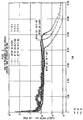
- FIG. 1 is a chart illustrating the open time measurement of a latex using Multispeckle Diffusing - Wave Spectroscopy (MS-DWS).
- the present invention relates to the use of a particular family of alkoxylated compounds as claimed, e.g., alkoxylated tristyrylphenols and alkoxylated tributylphenols, provided with an ethylene oxide chain for improving open time of latex binders, paints, adhesives and the like.
- This family of alkoxylated compounds can improve other properties as well, for example, wet edge, stain resistance, open time, film gloss, dispersibility, hiding and scrub resistance, low temperature film formation, foam resistance, block resistance, adhesion and water sensitivity, among others.
- alkyl means a saturated hydrocarbon radical, which may be straight, branched or cyclic, such as, for example, methyl, ethyl, n-propyl, iso-propyl, n-butyl, sec-butyl, t-butyl, pentyl, n-hexyl, cyclohexyl.
- cycloalkyl means a saturated hydrocarbon radical that includes one or more cyclic alkyl rings, such as, for example, cyclopentyl, cyclooctyl, and adamantanyl.
- hydroxyalkyl means an alkyl radical, more typically an alkyl radical, that is substituted with a hydroxyl groups, such as for example, hydroxymethyl, hydroxyethyl, hydroxypropyl, and hydroxydecyl.
- alkylene means a bivalent acyclic saturated hydrocarbon radical, including but not limited to methylene, polymethylene, and alkyl substituted polymethylene radicals, such as, for example, dimethylene, tetramethylene, and 2-methyltrimethylene.
- alkenyl means an unsaturated straight chain, branched chain, or cyclic hydrocarbon radical that contains one or more carbon-carbon double bonds, such as, for example, ethenyl, 1-propenyl, 2-propenyl.
- aryl means a monovalent unsaturated hydrocarbon radical containing one or more six-membered carbon rings in which the unsaturation may be represented by three conjugated double bonds, which may be substituted one or more of carbons of the ring with hydroxy, alkyl, alkenyl, halo, haloalkyl, or amino, such as, for example, phenoxy, phenyl, methylphenyl, dimethylphenyl, trimethylphenyl, chlorophenyl, trichloromethylphenyl, aminophenyl.
- aralkyl means an alkyl group substituted with one or more aryl groups, such as, for example, phenylmethyl, phenylethyl, triphenylmethyl.
- ethylenic unsaturation means a terminal (that is, e.g., ⁇ , ⁇ ) carbon-carbon double bond.
- the present invention uses latex polymers and latex dispersions having low-VOC content and improved open time properties compared to conventional aqueous coating compositions.
- Such latex polymers can include at least one latex polymer copolymerized or blended with a particular family of alkoxylated compounds.
- the latex has a Tg of less than 20° C, more typically less than 15°C, still more typically less than 5°C. More typically, the latex has a Tg in the range of from -20°C to 12°C, more typically from -10°C to 10°C, more typically in the range from -10°C to 0°C.
- the latex polymer has a weight average molecular weight of from 1,000 to 5,000,000, typically 5,000 to 2,000,000. In another embodiment, the latex polymer has a weight average molecular weight of from 10,000 to 250,000.
- the large hydrophobic groups adsorbed or grafted onto the latex particles or co-polymerized into the latex particles prevent these latex particles from approaching the surfaces of other latex particles and increase the distance of separation between latex particles. It is believed that in the water evaporation process, steric repulsion may prevent the latex particles packing which are driven by the capillary forces. This in turn improves the open time of aqueous coatings.
- the method of incorporating hydrophilic moiety into or onto latex particles of waterborne coatings and paints can keep water molecules between the latex particles and the interactions between hydrophilic moiety and water retain the water for a longer period time.
- the method of adding the open time additive of the present invention to aqueous coatings can generate a hydrophobic monolayer at the air-water interface that can prevent the evaporation of water from the aqueous systems.
- the present invention provides aqueous compositions, for example, aqueous coating compositions, as well as adhesives, including but not limited to pressure sensitive adhesives, glues, resins, sealants, inks, including but not limited to UV inks, conventional inks, hybrid inks, and water-based inks having excellent open time, as well as wet edge properties and drying time properties compared to conventional compositions.
- the aqueous compositions of the invention are aqueous polymer dispersions which include at least one latex polymer copolymerized or blended with a particular family of alkoxylated compounds as claimed, e.g., alkoxylated tristyrylphenol.
- the latex polymer is present in such aqueous compositions or paints from 15% to 40% by weight of the composition for semigloss and from 5% to up to 75%, typically 5% to 50% by weight of the composition for flat paint. Paints or other aqueous coatings of the present invention typically further include at least one pigment. Other aqueous coatings of the present invention such as adhesives typically do not need a pigment.
- alkoxylated compounds as claimed can be employed in a number of ways for improving open time and wet edge of latex binders, paints, adhesives, including but not limited to pressure sensitive adhesives, glues, resins, sealants, inks, including but not limited to UV inks, conventional inks, hybrid inks, and water-based inks.
- adhesives including but not limited to pressure sensitive adhesives, glues, resins, sealants, inks, including but not limited to UV inks, conventional inks, hybrid inks, and water-based inks.
- the present invention employs surface active alkoxylated compounds as an additive to an aqueous dispersion of latex polymer or copolymer.
- polymerizable reactive alkoxylated (second) monomer of the following formula IA can be copolymerized (with a first monomer) into the backbone of the latex polymer.
- R includes acrylate, or C 1 -C 6 alkyl acrylate, e.g., methacrylate, allyl, vinyl, maleate, itaconate or fumarate, typically R is acrylate or methacrylate.
- Suitable polymerizable functional groups R include, for example, acrylo, methacrylo, acrylamido, methacrylamido, diallylamino, allyl ether, vinyl ether, ⁇ -alkenyl, maleimido, styrenyl, and ⁇ -alkyl styrenyl groups.
- the monomer has the formula IB: wherein, R, R 1 , R 2 , R 3 , X and n are as defined for the structure of formula IA.
- the aromatic ring shown in structural formula IB may be saturated.
- such a saturated monomer may be made by saturating a form of the monomer wherein H is in the R position and then replacing the H in the R position with one of the other above-listed R groups.
- At least one monomer can be copolymerized with a second monomer having structure IB-1:
- R 1 , R 2 and R 3 are independently selected from:
- R can be acrylate, C 1 -C 6 alkyl acrylate, allyl, vinyl, maleate, itaconate or fumarate. In one embodiment, R is at least one of acrylo, methacrylo, acrylamido, methacrylamido, diallylamino, allyl ether, vinyl ether, ⁇ -alkenyl, maleimido, styrenyl, and/or ⁇ -alkyl styrenyl groups.
- the second monomer is an ethoxylated tributylphenol.
- the monomer is an ethoxylated tristyrylphenol.
- the polymerizable reactive ethoxylated tristyrylphenols have the structural formula IC and the polymerizable reactive ethoxylated tributylphenols have the structural formula IC-1, respectively, as follows:
- the reactive polymerizable ethoxylated tristyrylphenol monomer has a tristyrylphenol portion, an alkylene oxide portion and a reactive substituted or unsubstituted acrylic end group for polymerization.
- the reactive polymerizable ethoxylated tributylphenol monomer has a tributylphenol portion, an alkylene oxide portion and a reactive substituted or unsubstituted acrylic end group for polymerization.
- the ethylene oxide group shown in structural formula IC or IC-1 may be replaced with the above discussed -(OX)- group to form an alkoxylated tristyrylphenol or tributylphenol, respectively, and the -C(O)-CHR 4 CH 2 end group may be replaced by allyl, vinyl, maleate, itaconate or fumarate.
- Tristyrylphenol ethoxylates for other uses, are disclosed by US patent number 6,146,570 , published PCT patent application number WO 98/012921 and WO 98/045212 , incorporated herein by reference.
- aromatic rings of the styryl groups in Formula IC may be saturated.
- the latex polymer is made from a mixture wherein the reactive tristyrylphenol or tributylphenol monomer is 1 to 20 parts per 100 parts by weight of monomers used to form the copolymer, more typically 2 to 15, 2 to 8, or 2 to 6 parts per 100 parts by weight of monomers used to form the copolymer.
- both the reactive polymerizable alkoxylated monomer of formula IC and IC-1 are utilized and copolymerized into the backbone of a latex polymer.
- these other monomers from which latex polymers used in the aqueous coating composition are termed latex monomers.
- these other latex monomers comprise at least one acrylic monomer selected from the group consisting of acrylic acid, acrylic acid esters, methacrylic acid, and methacrylic acid esters.
- the other monomers for making the latex polymer can optionally be selected from one or more monomers selected from the group consisting of styrene, ⁇ -methyl styrene, vinyl chloride, acrylonitrile, methacrylonitrile, ureido methacrylate, vinyl acetate, vinyl esters of branched tertiary monocarboxylic acids (e.g. vinyl esters commercially available under the mark VEOVA from Shell Chemical Company or sold as EXXAR Neo Vinyl Esters by ExxonMobil Chemical Company), itaconic acid, crotonic acid, maleic acid, fumaric acid, and ethylene.
- monomers selected from the group consisting of styrene, ⁇ -methyl styrene, vinyl chloride, acrylonitrile, methacrylonitrile, ureido methacrylate, vinyl acetate, vinyl esters of branched tertiary monocarboxylic acids (e.g. vinyl esters commercially available
- the monomers include one or more monomers selected from the group consisting of n-butyl acrylate, methyl methacrylate, styrene and 2-ethylhexyl acrylate.
- the latex polymer is typically selected from the group consisting of pure acrylics (comprising acrylic acid, methacrylic acid, an acrylate ester, and/or a methacrylate ester as the main monomers); styrene acrylics (comprising styrene and acrylic acid, methacrylic acid, an acrylate ester, and/or a methacrylate ester as the main monomers); vinyl acrylics (comprising vinyl acetate and acrylic acid, methacrylic acid, an acrylate ester, and/or a methacrylate ester as the main monomers); and acrylated ethylene vinyl acetate copolymers (comprising ethylene, vinyl acetate and acrylic acid, methacrylic acid, an acrylate ester, and/or a methacrylate ester as the main monomers).
- the monomers can also include other main monomers such as acrylamide and acrylonitrile, and one or more functional monomers such as itaconic acid and ureido methacrylate, as would be readily understood by those skilled in the art.
- the latex polymer is a pure acrylic such as a butyl acrylate/methyl methacrylate copolymer derived from monomers including butyl acrylate and methyl methacrylate.
- the reactive polymerizable alkoxylated monomer of formula IA, IB, IC and/or IC-1 are utilized and copolymerized with one of the monomers listed under "other monomers" into the backbone of a latex polymer under reaction conditions.
- the reactive polymerizable alkoxylated monomer of formula IA, IB, IC and/or IC-1 are utilized and copolymerized with two or more of the monomers listed under "other monomers" into the backbone of a latex polymer under reaction conditions.
- one or more reactive polymerizable alkoxylated monomers of formula IA, IB, IC and/or IC-1 are utilized and copolymerized with one or more of the monomers listed under "other monomers" into the backbone of a latex polymer under reaction conditions.
- the latex polymer dispersion typically includes from 30 to 75% solids and a mean latex particle size of from 70 to 650 nm.
- the polymer of the present invention has a mean particle size of less than 400nm, typically a mean particle size of less than 200 nm, more typically a mean particle size of less than 190 nm, and most typically a mean particle size of less than 175 nm.
- the polymer has a mean particle size of from 75 nm to 400 nm.
- the latex polymer is typically present in the aqueous coating composition in an amount from 5 to 60 percent by weight, and more typically from 8 to 40 percent by weight (i.e. the weight percentage of the dry latex polymer based on the total weight of the coating composition).
- the resulting aqueous coating composition containing the polymer has improved open time characteristics without having to add open time additives, or adding small amounts of solvents, as described above. Therefore, aqueous coating compositions can be produced that possess lower VOC levels than conventional aqueous coating compositions and thus that are more environmentally desirable.
- the resulting latex polymer may be incorporated into an aqueous coating composition along with an emulsion surfactant as described below and/or the open time additive of the present invention as described below.
- the addition of the open time additive has little or no effect on the VOC levels of the aqueous coating composition, and, thus, aqueous coating compositions can be produced in that possess lower VOC levels than conventional aqueous coating compositions.
- the latex coating composition contains an open time additive as described herein in an amount greater than 1.3% by weight of the polymer.
- the latex coating composition contains a open time additive as described herein in an amount greater than 1.6% by weight of the polymer.
- the latex coating composition contains an open time additive as described herein in an amount greater than 2% by weight of the polymer. In another embodiment, the latex coating composition contains an open time additive as described herein in an amount greater than 4% by weight of the polymer. In another embodiment, the latex coating composition contains an open time additive as described herein in an amount greater than 7.5% by weight of the polymer. In another embodiment, the latex coating composition contains an open time additive as described herein in an amount greater than 8% by weight of the polymer. In another embodiment, the latex coating composition contains an open time additive in an amount between 1.6% and 7.5% by weight of the polymer. In another embodiment, the latex coating composition contains an open time additive in an amount between 1.6% and 45% by weight of the polymer, typically between 1.6% and 35% by weight of the polymer.
- the polymer is characterized by improved open time characteristics, and can have a Tg of between -20°C and 12°C and a mean particle size of less than 200 nm, or a Tg of between -10°C and 10°C and a mean particle size of less than 200 nm, or a Tg of between -10°C and 0°C and a mean particle size of less than 200 nm, or a Tg of between -20°C and 12°C and a mean particle size of less than 190 nm, or a Tg of between -10°C and 10°C and a mean particle size of less than 190 nm, or a Tg of between -10°C and 0°C and a mean particle size of less than 190 nm, or a Tg of between -20°C and 12°C and a mean particle size of less than 175 nm, or a Tg of between -10°C and 10°C and a mean particle size of less than 175
- the latex polymer including the reactive polymerizable alkoxylated monomer of formula IA, IB or IC can be used in combination with other ionic or non-ionic type of surfactants that are either polymerizable or non-polymerizable, in the aqueous coating composition.
- the polymer latex binder can be prepared using emulsion polymerization by feeding the monomers used to form the latex binder to a reactor in the presence of at least one initiator and the at least one reactive polymerizable alkoxylated monomer of formula IA, IB, IC or IC-1 and polymerizing the monomers to produce the latex binder.
- the monomers fed to a reactor to prepare the polymer latex binder typically include at least one acrylic monomer selected from the group consisting of acrylic acid, acrylic acid esters, methacrylic acid, and methacrylic acid esters.
- the monomers can include styrene, vinyl acetate, or ethylene.
- the monomers can also include one or more monomers selected from the group consisting of styrene, [alpha]-methyl styrene, vinyl chloride, acrylonitrile, methacrylonitrile, ureido methacrylate, vinyl acetate, vinyl esters of branched tertiary monocarboxylic acids, itaconic acid, crotonic acid, maleic acid, fumaric acid, and ethylene. It is also possible to include C4-C8 conjugated dienes such as 1,3-butadiene, isoprene or chloroprene.
- the monomers include one or more monomers selected from the group consisting of n-butyl acrylate, methyl methacrylate, styrene and 2-ethylhexyl acrylate.
- the initiator can be any initiator known in the art for use in emulsion polymerization such as ammonium or potassium persulfate, or a redox system that typically includes an oxidant and a reducing agent. Commonly used redox initiation systems are described e.g., by A. S. Sarac in Progress in Polymer Science 24(1999), 1149-1204 .
- the polymer latex binder can be produced by first preparing an initiator solution comprising the initiator and water.
- a monomer pre-emulsion is also prepared comprising at least a portion of the monomers to be used to form the latex polymer, one or more surfactants (emulsifiers), water, and additional additives such as NaOH.
- the one or more surfactants in the monomer pre-emulsion include any of the reactive polymerizable alkoxylated monomers of the present invention.
- the initiator solution and monomer pre-emulsion are then continuously added to the reactor over a predetermined period of time (e.g. 1.5-5 hours) to cause polymerization of the monomers and to thereby produce the latex polymer.
- the initiator solution is added to the reactor prior to adding the monomer pre-emulsion.
- a seed latex such as a polystyrene seed latex can be added to the reactor.
- water, one or more surfactants, and any monomers not provided in the monomer pre-emulsion can be added to the reactor prior to adding the initiator and adding the monomer pre-emulsion.
- the reactor is operated at an elevated temperature at least until all the monomers are fed to produce the polymer latex binder. Once the polymer latex binder is prepared, it is typically chemically stripped thereby decreasing its residual monomer content.
- a peroxide e.g. t-butylhydroperoxide
- a reducing agent e.g. sodium acetone bisulfite
- another redox pair such as those described by A. S. Sarac in Progress in Polymer Science 24(1999), 1149-1204
- the pH of the latex binder can then be adjusted and a biocide or other additives added after the chemical stripping step.
- the aqueous coating composition is a stable fluid that can be applied to a wide variety of materials such as, for example, paper, wood, concrete, metal, glass, ceramics, plastics, plaster, and roofing substrates such as asphaltic coatings, roofing felts, foamed polyurethane insulation; or to previously painted, primed, undercoated, worn, or weathered substrates.
- the aqueous coating composition can be applied to the materials by a variety of techniques well known in the art such as, for example, brush, rollers, mops, air-assisted or airless spray, electrostatic spray, and the like.
- Latex Polymer Compositions Comprising Surface Active (emulsifier) Compound
- a surface active compound of structural formula IIA can be used as an emulsifier during the emulsion polymerization reaction used to make latex polymer.
- R 5 is selected from a quaternary ammonium ion:
- n is an integer of from 4 to 80. In one embodiment, n is an integer of from 4 to 60. In one embodiment n is an integer of from 4 to 50. In one embodiment, n is an integer of from 8 to 50.
- the alkoxylated surface active compound has the formula IIB: wherein, R, R 1 , R 2 , R 3 , X and n are as defined for the structure of formula IIA. If desired, the aromatic ring shown in structural formula IIB may be saturated.
- a surface active alkoxylated tristyrylphenol e.g., ethoxylated tristyrylphenol
- a surface active alkoxylated tributylphenol e.g., ethoxylated tributylphenol
- emulsifier used as an emulsifier during the emulsion polymerization reaction used to make latex polymer.
- the surface active ethoxylated tristyrylphenols have the structural formula IIC and the surface active ethoxylated tributylphenols have the structural formula IIC-1, respectively, as follows: wherein, n is an integer of from 1 to 100 for example, 4 to 60 or 8 to 25, wherein R 5 is -OH, -OCH 3 , -OC 2 H 5 , -OC 3 H 7 , -OC 4 H 9 , -OC 5 H 11 , -OC 6 H 13 , -Cl, -Br,-CN, Phosphonate (-PO 3 - M + ), Phosphate (PO 4 - M + ), Sulfate (SO 4 - M + ), Sulfonate (SO 3 - M + ), carboxylate (COO - M + ), a nonionic group, a C 1 -C 12 alkyl, hydroxyalkyl, cycloalkyl, aryl or aralkyl, or
- R 5 is selected from a quaternary ammonium ion:
- n is an integer of from 4 to 80. In one embodiment, n is an integer of from 4 to 60. In one embodiment, n is an integer of from 10 to 50. In one embodiment, n is an integer of from 10 to 25.
- the latex polymer is made from a mixture wherein the surface active emulsifier is utilized.
- the emulsifier is added in an amount greater than 1.3% by weight of the polymer or monomers used to form the latex polymer, in an amount greater than 1.6% by weight of the polymer or monomers used to form the latex polymer, typically in an amount greater than 2% by weight of the polymer or monomers used to form the latex polymer, more typically in an amount greater than 4% by weight of the polymer or monomers used to form the latex polymer, and most typically in an amount greater than 7.5% by weight of the polymer or monomers used to form the latex polymer.
- the latex coating composition contains an emulsifier in an amount greater than 8% by weight of the polymer or monomers used to form the latex polymer, or greater than 10% by weight of the polymer or monomers.
- the emulsifier is added is between 1.6% and 7.5% by weight of the polymer or monomers used to form the latex polymer.
- emulsifier added is between 1.6% and 45% by weight of the polymer or monomers used to form the latex polymer, typically between 1.6% and 35% by weight of the polymer or monomers used to form the latex polymer
- the ethylene oxide repeating units of the ethylene oxide chain of formula IIC or IIC-1 may be replace by the above-described -(OX)- group to form alkoxylated tristyrylphenol or alkoxylated tributylphenol.
- the polymer latex binder can be produced by first preparing an initiator solution comprising the initiator and water.
- a monomer pre-emulsion is also prepared comprising at least a portion of the monomers to be used to form the latex polymer, one or more surfactants (emulsifiers), water, and additional additives such as NaOH.
- the one or more surfactants in the monomer pre-emulsion include the surface active alkoxylated compound of the invention.
- the alkoxylated compound is employed as an emulsifier to form a blend rather than as a reactant which copolymerizes with the other monomers which form the polymer latex binder.
- the initiator solution and monomer pre-emulsion are then continuously added to the reactor over a predetermined period of time (e.g. 1.5-5 hours) to cause polymerization of the monomers and to thereby produce the latex polymer.
- a predetermined period of time e.g. 1.5-5 hours
- the initiator solution is added to the reactor prior to adding the monomer pre-emulsion.
- a seed latex such as a polystyrene seed latex can be added to the reactor.
- water, one or more surfactants, and any monomers not provided in the monomer pre-emulsion can be added to the reactor prior to adding the initiator and adding the monomer pre-emulsion.
- the reactor is operated at an elevated temperature at least until all the monomers are fed to produce the polymer latex binder.
- the polymer latex binder is typically chemically stripped thereby decreasing its residual monomer content.
- it is chemically stripped by continuously adding an oxidant such as a peroxide (e.g. t-butylhydroperoxide) and a reducing agent (e.g. sodium acetone bisulfite), or another redox pair such as those described by A. S. Sarac in Progress in Polymer Science 24(1999), 1149-1204 , to the latex binder at an elevated temperature and for a predetermined period of time (e.g. 0.5 hours).
- the pH of the latex binder can then be adjusted and a biocide or other additives added after the chemical stripping step.
- the incorporation of the surface active alkoxylated compound surfactant (emulsifier) in the emulsion polymerization reaction mixture enables the coating composition to have a lower VOC content while extending or lengthening the open time of the aqueous coating composition to a period greater than 4 minutes, typically greater than about 6 minutes, more typically greater than 8 minutes.
- the above-described surface active alkoxylated compound of structural formula IIA, IIB, IIC or IIC-1 (sometimes referred to as the open time additive or wet edge additive) can be used as an open time additive to coatings including but not limited to architectural or industrial paint; adhesives, including but not limited to pressure sensitive adhesives; glues; resins; sealants; inks, including but not limited to UV inks, conventional inks, hybrid inks, and water-based inks.
- the above-described surface active alkoxylated compound of structural formula IIA, IIB, IIC or IIC-1 can be used as an open time additive to an already formed aqueous dispersion of latex polymer.
- the open time additive can be added any point in the production of the composition, including but not limited to during the emulsification step, during formulation, etc. It is also understood that the open time additive can be post-added to the coatings including but not limited to architectural or industrial paint; adhesives, including but not limited to pressure sensitive adhesives; glues; resins; sealants; inks, including but not limited to UV inks, conventional inks, hybrid inks, and water-based inks; as well as to a concentrate thereof.
- the above-described surface active alkoxylated compound of structural formula IIA, IIB, IIC or IIC-1 can be used as a drying time additive to coatings including but not limited to architectural or industrial paint; adhesives, including but not limited to pressure sensitive adhesives; glues; resins; sealants; inks, including but not limited to UV inks, conventional inks, hybrid inks, and water-based inks.
- adhesives including but not limited to pressure sensitive adhesives
- glues including but not limited to glues; resins; sealants
- inks including but not limited to UV inks, conventional inks, hybrid inks, and water-based inks.
- the above-described surface active alkoxylated compound of structural formula IIA, IIB, IIC or IIC-1 can be used as an drying time additive to an already formed aqueous dispersion of latex polymer.
- drying time additive can be added any point in the production of the aqueous coating composition, including but not limited to during the emulsification step, during formulation, etc. It is also understood that the drying time additive can be post-added to the coatings including but not limited to architectural or industrial paint; adhesives, including but not limited to pressure sensitive adhesives; glues; resins; sealants; inks, including but not limited to UV inks, conventional inks, hybrid inks, and water-based inks; as well as to a concentrate thereof.
- aqueous composition comprising the surface active alkoxylated compound.
- the surface active alkoxylated compound is employed as an additive to an already formed aqueous latex dispersion, the resulting composition has alkoxylated compound additive in an amount of about 1 to 10, Typically 2 to 8 or 2 to 6, parts per 100 parts by weight of monomers used to form the latex polymer.
- the open time additive used in the present invention comprises a blend of:
- the present invention further includes a method of preparing a latex binder composition, comprising adding the blend of surface active alkoxylated compound surfactants as described above to an aqueous dispersion of a latex polymer to produce the latex binder.
- the at least one pigment and other additives can then be mixed with the resulting latex binder to produce the aqueous coating composition in any appropriate order.
- the addition of the blend of surface active alkoxylated compound surfactants as described above to the latex polymer forms a mixture having a lower VOC content.
- the invention is a method of adding the blend of the above-described surface active compound during formulation of paint or aqueous coating composition to (1) increase open time, (2) decrease drying time, or (3) both increase open time and decrease drying time.
- Formulation is the stage at which additives are added to a base aqueous latex polymer dispersion to make it into final product such as a paint or coating.
- the present invention is method for increasing open time for a low VOC coating composition comprising adding to the composition an effective amount of an open time additive, wherein the open time additive is a blend of:
- the resulting composition has alkoxylated compound additive typically in an amount greater than 1.3% by weight of the polymer or monomers used to form the latex polymer, more typically in an amount greater than 1.6% by weight of the polymer or monomers used to form the latex polymer, yet more typically in an amount greater than 2% by weight of the polymer or monomers used to form the latex polymer, even more typically in an amount greater than 4% by weight of the polymer or monomers used to form the latex polymer, and most typically in an amount greater than 7.5% by weight of the polymer or monomers used to form the latex polymer.
- the latex coating composition contains the blend of surface active alkoxylated compound in an amount between 1.6% and 7.5% by weight of the polymer or monomers used to form the latex polymer. In another embodiment, the latex coating composition contains the blend of surface active alkoxylated compound in an amount between 1.6% and 45% by weight of the polymer or monomers used to form the latex polymer, typically between 1.6% and 35%. Pigment is a typical additive, for example, added during formulation of paint from raw aqueous latex polymer dispersion.
- the aqueous coating compositions of the present invention have improved open time properties where the open time additive is present in the aqueous coating composition in the amounts by weight of the polymer as described above, where the polymer can have a Tg of between -20°C and 12°C and a mean particle size of less than 200 nm, or a Tg of between -10°C and 10°C and a mean particle size of less than 200 nm, or a Tg of between -10°C and 0°C and a mean particle size of less than 200 nm, or a Tg of between -20°C and 12°C and a mean particle size of less than 190 nm, or a Tg of between -10°C and 10°C and a mean particle size of less than 190 nm, or a Tg of between -10°C and 0°C and a mean particle size of less than 190 nm, or a Tg of between -20°C and 12°C and a mean particle size of less than 1
- the mean particle size is typically between 75 nm to 400 nm.
- the aqueous coating composition of the present invention has an open time of greater than 4 minutes in one embodiment, an open time of greater than 6 minutes in another embodiment, an open time of greater than 8 minutes in another embodiment, an open time of greater than 10 minutes in yet another embodiment, an open time of greater than 12 minutes in a further embodiment, and/or an open time of greater than 14 minutes in yet a further embodiment.
- the present invention further includes a method of preparing a paint or aqueous coating composition, comprising adding the blend of surface active alkoxylated compound as described above during formulation of paint or aqueous coating composition comprising at least one pigment and other additives to produce the final paint or aqueous coating composition.
- the addition of the blend of surface active alkoxylated compound surfactant (emulsifier) during formulation of paint or aqueous coating composition forms a coating composition having a lower VOC content while imparting improved open time properties to the aqueous coating composition.
- the aqueous coating compositions of the invention include at least one latex polymer derived from at least one monomer, for example acrylic monomers and/or the other above-described latex monomers.
- the aqueous coating compositions of the invention include less than 2 % by weight and typically less than 1.0% by weight of anti-freeze agents based on the total weight of the aqueous coating composition. More typically, the aqueous coating compositions are substantially free of anti-freeze agents.
- the aqueous coating composition typically includes at least one pigment.
- pigment as used herein includes non-film-forming solids such as pigments, extenders, and fillers.
- the at least one pigment is typically selected from the group consisting of TiO2 (in both anastase and rutile forms), clay (aluminum silicate), CaCO3 (in both ground and precipitated forms), aluminum oxide, silicon dioxide, magnesium oxide, talc (magnesium silicate), barytes (barium sulfate), zinc oxide, zinc sulfite, sodium oxide, potassium oxide and mixtures thereof.
- Suitable mixtures include blends of metal oxides such as those sold under the marks MINEX (oxides of silicon, aluminum, sodium and potassium commercially available from Unimin Specialty Minerals), CELITES (aluminum oxide and silicon dioxide commercially available from Celite Company), ATOMITES (commercially available from English China Clay International), and ATTAGELS (commercially available from Engelhard).
- the at least one pigment includes TiO2, CaCO3 or clay.
- the mean particle sizes of the pigments range from 0.01 to 50 microns.
- the TiO2 particles used in the aqueous coating composition typically have a mean particle size of from 0.15 to 0.40 microns.
- the pigment can be added to the aqueous coating composition as a powder or in slurry form.
- the pigment is typically present in the aqueous coating composition in an amount from 5 to 50 percent by weight, more typically from 10 to 40 percent by weight.
- the coating composition can optionally contain additives such as one or more film-forming aids or coalescing agents.
- Suitable firm-forming aids or coalescing agents include plasticizers and drying retarders such as high boiling point polar solvents.
- Other conventional coating additives such as, for example, dispersants, additional surfactants (i.e. wetting agents), rheology modifiers, defoamers, thickeners, biocides, mildewcides, colorants such as colored pigments and dyes, waxes, perfumes, co-solvents, and the like, can also be used in accordance with the invention.
- non-ionic and/or ionic (e.g. anionic or cationic) surfactants can be used to produce the polymer latex.
- These additives are typically present in the aqueous coating composition in an amount from 0 to 15% by weight, more typically from 1 to 10% by weight based on the total weight of the coating composition.
- the aqueous coating composition in some embodiments can include less than 2.0% of VOC agents based on the total weight of the aqueous coating composition.
- VOC agents include ethylene glycol, diethylene glycol, propylene glycol, glycerol (1,2,3-trihydroxypropane), ethanol, methanol, 1-methoxy-2-propanol, 2-amino-2-methyl-1-propanol, and FTS-365 (a freeze-thaw stabilizer from Inovachem Specialty Chemicals). More typically, the aqueous coating composition includes less than 1.0% or is substantially free (e.g. includes less than 0.1 %) of anti-freeze agents. Accordingly, the aqueous coating composition of the invention typically has a VOC level of less than about 100 g/L and more typically less than or equal to about 50 g/L.
- aqueous coating compositions of the invention can be subjected to freeze-thaw cycles using ASTM method D2243-82 or ASTM D2243-95 without coagulation.
- the balance of the aqueous coating composition of the invention is water. Although much of the water is present in the polymer latex dispersion and in other components of the aqueous coating composition, water is generally also added separately to the aqueous coating composition. Typically, the aqueous coating composition includes from 10% to 85% by weight and more typically from 35% to 80% by weight water. Stated differently, the total solids content of the aqueous coating composition is typically from 15% to 90%, more typically, from 20% to 65%.
- the coating compositions are typically formulated such that the dried coatings comprise at least 10% by volume of dry polymer solids, and additionally 5 to 90% by volume of non-polymeric solids in the form of pigments.
- the dried coatings can also include additives such as plasticizers, dispersants, surfactants, rheology modifiers, defoamers, thickeners, biocides, mildewcides, colorants, waxes, and the like, that do not evaporate upon drying of the coating composition.
- the aqueous coating composition is a latex paint composition
- a latex paint composition comprising at least one latex polymer derived from at least one acrylic monomer selected from the group consisting of acrylic acid, acrylic acid esters, methacrylic acid, and methacrylic acid esters and an open time additive of claim 1; at least one pigment and water.
- the at least one latex polymer can be a pure acrylic, a styrene acrylic, a vinyl acrylic or an acrylated ethylene vinyl acetate copolymer.
- the latex polymer is in the form of a latex polymer dispersion.
- the additives discussed above can be added in any suitable order to the latex polymer, the pigment, or combinations thereof, to provide these additives in the aqueous coating composition.
- the aqueous coating composition typically has a pH of from 7 to 10.
- a chart shows the open time measurement of a latex sample using multispeckle Diffusing - Wave Spectroscopy (MS-DWS).
- MS-DWS chart also illustrates drying time characteristics.
- the MS-DWS applies the HorusTM method, which is an optical measurement of the scatterers motion inside a sample enabling a more accurate measurement of working time properties. More specifically, a laser light illuminates the coating sample. If the sample contains scattering material (e.g., latex particles) the photons are scattered by these objects bearing a different refractive index than the bulk. The scattered light is detected by a camera which captures an image called a "speckle" image.
- scattering material e.g., latex particles
- the chart shows the sample profile in 3 stages:
- T1 which is the end of stage 1 typically corresponds to the open time (time where the paint is still workable), where a higher T1 time correlates to longer open time.
- the latex sample without any additive (of the present invention) has a T1 time of 7.85s, where the latex sample with 2% additive and 4% additive shows a T1 time of 11.0s and 21.5s, respectively.
- an increasing amount of additive correlates to an increasing open time, which is desirable in paint and coating formulations.
- the fluidity factor decreases sharply, which typically indicates a drastic reduction of the average motion speed of the scatterers inside the sample, indicating that the sample is in the drying phase.
- the beginning of stage 3 occurs at and after about 20 minutes, indicated by the sharp curve in the fluidity factor line.
- T2 correlates to drying time, where a shorter T2 time corresponds to the sample drying faster relative to a longer T2 time.
- the T2 time of the latex sample with 4% additive is about 20 minutes
- the T2 time of the latex sample with 2% additive is about 23 minutes
- the latex sample with no additive is about 24 minutes.
- an increasing amount of additive correlates to a decreasing drying time, which is desirable in paint and coating formulations. This is also is unexpected as one would expect to have an increase in drying time as the open time is increased through use of the additive(s) of the present invention.
- the present invention may employ surface active alkoxylated compounds as an additive to an aqueous dispersion of latex polymer or copolymer.
- Open time is generally understood to be the interval, after the paint is applied, during which it can be blended with additional painted regions. Open time refers to the amount of time a newly-applied layer of paint remains workable before brush strokes and other signs of manipulation become visible in dried films.
- the method for measuring Open Time is generally as follows: a 10 mils film is drawn down on a piece of black scrub test paper. The paint film is then cross-hatched in two-inch intervals with the eraser end of a pencil.
- the first cross hatch then brushed over in one direction 15 times; this is then repeated in two-minute intervals for each successive cross-hatch. After 24 hrs, the dry films are examined for the earliest times at which traces of cross-hatch at discernable. This is performed under constant humidity, room temp. It is desirable for paint formulations to have an open time of greater than 4 minutes, typically, greater than 6 minutes.
- the amount of reagent varied from about 2.5 grams surfactant to about 4.25 grams surfactant per 256 grams of paint.
- Table 1 Reagent (Nonionic Surfactants) starting viscosity (KU) open time (minutes) sample Control TSP - EO #1 89.9 > 14 4 TSP - EO#2 85 > 14 4 TSP - EO#3 82 14 2 to 4 TSP - EO#4 81.2 > 14 4 TSP - EO#5 89.9 4 2
- Table 2 Reagent (Anionic Surfactants) starting viscosity (KU) open time (minutes) sample Control TSP -EO Sulfate TEA salt 83.3 14 2 to 4 TSP-EO Sulfate Ammonium Salt 83.5 8 to 10 2 TSP -EO Sulfate Potassium Salt 1 86.4 8 to 12 2 TSP - EO-PO 83.5 >14 4
- Example 3 the measuring of open time is similar to that used in Examples 1-2.
- a blend of an anionic TSP Ethoxylate surfactant and a non-ionic TSP Ethoxylate surfactant was post-added to commercial zero and low VOC paints.
- the open time was measured using ASTM standard method (WK 13360).
- Tables 3 and 4 illustrate the effect of a blend of (i) one or more TSP Ethoxylate nonionic surfactants with (ii) one or more TSP Ethoxylate anionic surfactants, on open time of Zero VOC Paints and Low VOC Paints, respectively.
- Table 3 Effects of TSP Ethoxylate Surfactants on Open Time of Zero VOC Paints.
- blends #1, #2, #3, #4 and #5 each show a blend of an anionic TSP surfactant and a nonionic TSP surfactant with the non-ionic surfactant having ethylene oxide (eo) groups or units ranging from about 9 to about 90.
- Table 2 Effects of TSP Ethoxylate Surfactants on Open Time of Low VOC Paints Blending Surfactants White Base (10.0lbs/100 gals) Open Time, minutes Control Trial TSP-EO anionic /TSP - EO nonionic #1 256 + 2.78 6.0 14.0 TSP-EO anionic /TSP - EO nonionic #2 256 + 3.13 4.0 12.0 TSP-EO anionic /TSP - EO nonionic #3 256 + 3.13 4.0 12.0 TSP-EO anionic /TSP - EO nonionic #4 256 + 3.13 4.0 12.0 TSP-EO anionic /TSP - EO nonionic #5 256 + 3.13 6.0 12.0
- Table 4 shows #1, #2, #3, #4 and #5 being blends of an anionic TSP surfactant and a nonionic TSP surfactant with the non-ionic surfactant having ethylene oxide (eo) groups or units ranging from about 9 to about 90.
- anionic TSP surfactant and a nonionic TSP surfactant with the non-ionic surfactant having ethylene oxide (eo) groups or units ranging from about 9 to about 90.
Landscapes
- Chemical & Material Sciences (AREA)
- Organic Chemistry (AREA)
- Engineering & Computer Science (AREA)
- Life Sciences & Earth Sciences (AREA)
- Materials Engineering (AREA)
- Wood Science & Technology (AREA)
- Dispersion Chemistry (AREA)
- Health & Medical Sciences (AREA)
- Chemical Kinetics & Catalysis (AREA)
- Medicinal Chemistry (AREA)
- Polymers & Plastics (AREA)
- Paints Or Removers (AREA)
- Addition Polymer Or Copolymer, Post-Treatments, Or Chemical Modifications (AREA)
- Adhesives Or Adhesive Processes (AREA)
- Compositions Of Macromolecular Compounds (AREA)
Claims (6)
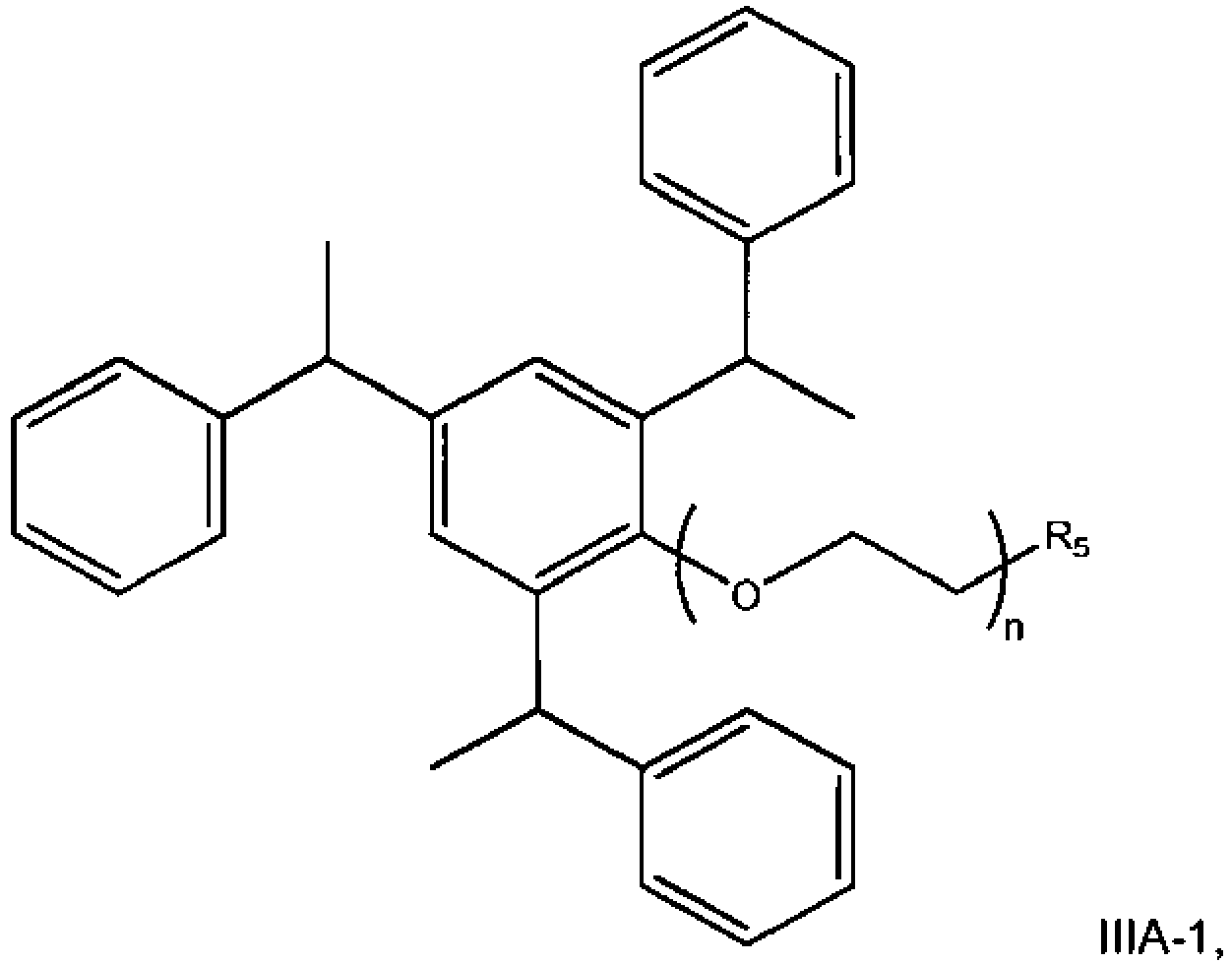
- Beschichtungszusammensetzung, umfassend:(a) wenigstens ein Latexpolymer;(b) Wasser; und(c) ein Offenzeitadditiv, das in einer Menge vorhanden ist, die eine Verlängerung der Offenzeit der Beschichtungszusammensetzung auf mehr als 4 Minuten bewirkt;wobei das Offenzeitadditiv eine Mischung ist aus:(i) wenigstens einem nichtionischen Tensid der Strukturformel:
 (ii) wenigstens einem anionischen Tensid der Strukturformel:

- Beschichtungszusammensetzung nach Anspruch 1, wobei die Beschichtungszusammensetzung ausgewählt ist aus der Gruppe bestehend aus einer VOC-armen oder -freien Farbe, einem Klebstoff, einem Haftkleber, einem Harz, einem Dichtmittel, einer Tinte und einer Kombination davon.
- Beschichtungszusammensetzung nach Anspruch 1, wobei das Offenzeitadditiv in einer Menge von mehr als 1 Gew.-% der Zusammensetzung vorhanden ist.
- Beschichtungszusammensetzung nach Anspruch 1, wobei das Polymer eine Glasübergangstemperatur (Tg) von zwischen -10 °C und 0 °C aufweist.
- Beschichtungszusammensetzung nach Anspruch 1, wobei die Beschichtungszusammensetzung durch eine Offenzeit von mehr als 10 Minuten gekennzeichnet ist.
- Verfahren zum Verlängern der Offenzeit einer VOC-armen Beschichtungszusammensetzung, bei dem man der Zusammensetzung eine wirksame Menge eines Offenzeitadditivs zusetzt, wobei das Offenzeitadditiv eine Mischung ist aus:(i) wenigstens einem nichtionischen Tensid der Strukturformel:

 (i) wenigstens einem anionischen Tensid der Strukturformel:

Applications Claiming Priority (2)
| Application Number | Priority Date | Filing Date | Title |
|---|---|---|---|
| US28405509P | 2009-12-11 | 2009-12-11 | |
| PCT/US2010/001085 WO2011071510A1 (en) | 2009-12-11 | 2010-04-13 | Methods and systems for improving open time and drying time of latex binders and aqueous coatings |
Publications (3)
| Publication Number | Publication Date |
|---|---|
| EP2510064A1 EP2510064A1 (de) | 2012-10-17 |
| EP2510064A4 EP2510064A4 (de) | 2013-05-01 |
| EP2510064B1 true EP2510064B1 (de) | 2016-06-15 |
Family
ID=44143652
Family Applications (1)
| Application Number | Title | Priority Date | Filing Date |
|---|---|---|---|
| EP10836300.3A Active EP2510064B1 (de) | 2009-12-11 | 2010-04-13 | Verfahren und systeme zur verkürzung der öffnungszeit und der trocknungszeit von latexbindemitteln und wässrigen beschichtungen |
Country Status (13)
| Country | Link |
|---|---|
| US (1) | US8304479B2 (de) |
| EP (1) | EP2510064B1 (de) |
| JP (1) | JP2013513691A (de) |
| KR (1) | KR20120135195A (de) |
| CN (1) | CN102652163B (de) |
| AU (1) | AU2010328689B2 (de) |
| BR (1) | BR112012014037A2 (de) |
| CA (1) | CA2783810C (de) |
| EA (1) | EA201290220A1 (de) |
| MX (1) | MX2012006638A (de) |
| SA (1) | SA110310655B1 (de) |
| SG (1) | SG181500A1 (de) |
| WO (1) | WO2011071510A1 (de) |
Cited By (1)
| Publication number | Priority date | Publication date | Assignee | Title |
|---|---|---|---|---|
| WO2024200254A1 (en) * | 2023-03-24 | 2024-10-03 | Byk-Chemie Gmbh | Composition comprising an associative thickener |
Families Citing this family (23)
| Publication number | Priority date | Publication date | Assignee | Title |
|---|---|---|---|---|
| WO2012169478A1 (ja) * | 2011-06-10 | 2012-12-13 | 住友化学株式会社 | 水性エマルション、塗膜の形成方法及び塗膜 |
| KR101991078B1 (ko) * | 2011-10-21 | 2019-06-19 | 에톡스 케미칼즈 엘엘씨 | 냉동-해동 안정한 에멀전 폴리머용 신규한 반응성 계면 활성제 및 그 코팅 |
| FR2982263B1 (fr) | 2011-11-04 | 2015-03-27 | Coatex Sas | Epaississant acrylique associatif contenant des polyglycerols et son utilisation pour augmenter le temps ouvert de films minces ou epais. |
| US9644108B2 (en) | 2012-03-10 | 2017-05-09 | Ethox Chemicals, Llc | Additives to improve open-time and freeze-thaw characteristics of water-based paints and coatings |
| EP3293229B1 (de) | 2012-03-10 | 2019-07-03 | Ethox Chemicals, LLC | Additive zur verbesserung der offenzeit- und einfrier/auftau-eigenschaften von wasserbasierten farben und lacken |
| CN104470995B (zh) * | 2012-05-07 | 2017-11-21 | 罗地亚管理公司 | 掺有一种或更多种抗菌生物表面活性剂的水性涂料和油漆、及其使用方法 |
| EP2906639B1 (de) * | 2012-10-11 | 2019-09-18 | Basf Se | Tenside für wässrige beschichtungen |
| EP3105285B1 (de) * | 2014-02-12 | 2018-12-12 | Stepan Company | Tristyrylphenolalkoxylatsulfosuccinate |
| US10273376B2 (en) | 2014-07-30 | 2019-04-30 | Hewlett-Packard Development Company, L.P. | Ink composition and pre-treatment fixing fluid |
| WO2016101094A1 (en) * | 2014-12-22 | 2016-06-30 | Rhodia Operations | Use of an alkoxylated compound for reducing combining of coating particles on a substrate and the method thereof |
| CA2960100C (en) | 2016-03-28 | 2025-10-14 | Dow Global Technologies Llc | AQUEOUS COMPOSITIONS CONTAINING POLYALCOXYLATE SALTS INTENDED FOR IMPROVING OPEN TIME |
| CA2960249A1 (en) | 2016-03-28 | 2017-09-28 | Dow Global Technologies Llc | Aqueous compositions having polyalkoxylates for improved open time |
| EP3272823A1 (de) * | 2016-07-19 | 2018-01-24 | ALLNEX AUSTRIA GmbH | Sikkativzusammensetzungen für alkydharze |
| US11117164B2 (en) | 2016-08-10 | 2021-09-14 | Swimc Llc | Edge build and edge blister performance of coil coatings |
| AU2018203616B2 (en) | 2017-06-13 | 2024-02-15 | Dow Global Technologies Llc | Cidyl ether alkoxylate block copolymers |
| AU2018203941B2 (en) * | 2017-06-27 | 2024-04-18 | Dow Global Technologies Llc | Glycidyl ether alkoxylate block copolymers |
| WO2019120183A1 (en) * | 2017-12-22 | 2019-06-27 | Rhodia Operations | Method for improving scrub resistance of coatings |
| EP3722377A1 (de) | 2019-04-09 | 2020-10-14 | Clariant International Ltd | Additive zur verlängerung der offenen zeit von wässrigen dispersionsfarben und lacken |
| EP3722376A1 (de) | 2019-04-09 | 2020-10-14 | Clariant International Ltd | Additive zur verbesserung der offenen zeit von wässrigen dispersionsfarben und lacken |
| US11673997B2 (en) * | 2019-07-31 | 2023-06-13 | Covestro Llc | Work time to walk-on time ratio by adding a phenolic catalyst to polyaspartic flooring formulations |
| CN114599695B (zh) * | 2020-04-16 | 2024-03-08 | 瓦克化学股份公司 | 水基聚合物分散体的应用 |
| US20230357583A1 (en) * | 2020-09-14 | 2023-11-09 | Rochelle Bradford | Open Time Additive |
| CN116438266B (zh) * | 2020-09-14 | 2025-07-25 | 阿萨达股份公司 | 开放时间添加剂 |
Family Cites Families (55)
| Publication number | Priority date | Publication date | Assignee | Title |
|---|---|---|---|---|
| US3714100A (en) | 1970-09-03 | 1973-01-30 | Union Oil Co | Crosslinkable vinyl acetate latices |
| DE3346676A1 (de) | 1983-02-17 | 1984-08-23 | Hoechst Ag, 6230 Frankfurt | Tributylphenol-ethersulfonate, deren verwendung und verfahren zur herstellung von ethersulfonaten |
| US4647610A (en) | 1985-06-28 | 1987-03-03 | Rohm And Haas Company | Aqueous polymer compositions containing surface-active evaporation suppressants |
| IT1219699B (it) | 1988-05-27 | 1990-05-24 | Geronazzo Spa | Agente tensio attivo a base di (fenil 1 etil) fenoli poliossialchilenati,suo procedimento di preparazione e suo impiego per ottenere soluzioni concentrate emulsionabili di sostanze attive |
| US5610215A (en) | 1990-04-03 | 1997-03-11 | Gregory A. Konrad | Aqueous emulsion-based coating compositions |
| US5399617A (en) | 1990-06-13 | 1995-03-21 | National Starch And Chemical Investment Holding Corporation | Thermoplastic, aqueous latex paints having improved wet adhesion and freeze-thaw stability |
| CA2059663C (en) | 1990-06-29 | 1996-11-12 | David Bertland Farmer | Emulsion polymerisation |
| US5211747A (en) * | 1991-05-16 | 1993-05-18 | Xerox Corporation | Ink jet ink compositions containing desizing agents |
| US5221496A (en) | 1992-06-02 | 1993-06-22 | Basf Corp. | Aqueous prewash stain remover compositions with efficacy on tenacious oily stains |
| US5340394A (en) | 1992-07-23 | 1994-08-23 | The Glidden Company | Zero voc tinting concentrates for decorative paints |
| US5270380A (en) | 1992-10-13 | 1993-12-14 | Rohm And Haas Company | Method for extending the open time of an aqueous coating composition |
| US5874495A (en) | 1994-10-03 | 1999-02-23 | Rhodia Inc. | Polymers useful as PH responsive thickeners and monomers therefor |
| US5906962A (en) | 1994-12-22 | 1999-05-25 | Rhodia Inc. | Non-aqueous suspension concentrates of highly water-soluble solids |
| US5610225A (en) | 1995-05-03 | 1997-03-11 | National Starch And Chemical Investment Holding Corporation | Latex paints which are free of volatile coalescents and freeze-thaw additives |
| US5719244A (en) | 1995-06-05 | 1998-02-17 | National Starch And Chemical Investment Holding Corporation | Latex binders and coatings containing polymers derived from polymerizable saccharide monomers |
| US5874498A (en) | 1996-03-11 | 1999-02-23 | Air Products And Chemicals, Inc. | Vinyl acetate emulsions for high scrub paints |
| WO1998012921A1 (en) | 1996-09-25 | 1998-04-02 | Rhodia Inc. | Spontaneously water dispersible carrier for pesticides |
| US5939514A (en) | 1996-09-26 | 1999-08-17 | Rohm And Haas Company | Coating composition having extended storage stability and method for producing wear resistant coatings therefrom |
| WO1998045212A1 (en) | 1997-04-04 | 1998-10-15 | Rhodia Rare Earths Inc. | CERIUM OXIDES, ZIRCONIUM OXIDES, Ce/Zr MIXED OXIDES AND Ce/Zr SOLID SOLUTIONS HAVING IMPROVED THERMAL STABILITY AND OXYGEN STORAGE CAPACITY |
| CN1297370A (zh) | 1998-02-18 | 2001-05-30 | 宝洁公司 | 用于结构化非水液体组合物的表面活性剂 |
| US6146570A (en) | 1998-03-20 | 2000-11-14 | Rhodia Inc. | Process for producing extruded hydrocolloid granules |
| GB9807649D0 (en) | 1998-04-14 | 1998-06-10 | Reckitt & Colman Inc | Improvements in or relating organic compositions |
| GB2336369B (en) | 1998-04-14 | 2002-06-19 | Reckitt & Colman Inc | Improvements in or relating to organic compositions |
| GB2368592B (en) | 1998-04-14 | 2002-09-18 | Reckitt Benckiser Inc | Aqueous disinfecting and cleaning compositions |
| GB2336370B (en) | 1998-04-14 | 2002-09-04 | Reckitt & Colman Inc | Improvements in or relating to organic compositions |
| FR2781806B1 (fr) | 1998-07-30 | 2000-10-13 | Rhodia Chimie Sa | Poudres redispersables dans l'eau de polymeres filmogenes prepares a partir de monomeres a insaturation ethylenique |
| GB9907269D0 (en) | 1999-03-30 | 1999-05-26 | Zeneca Ltd | Aqueous fungicide dispersion |
| US6218455B1 (en) | 1999-05-19 | 2001-04-17 | Air Products Polymers, L.P. | Vinyl acetate/ethylene paint latices stabilized with urethane linked poly(ethylene glycols) and polyoxyethylene-polyoxyalkylene glycols |
| FR2796074A1 (fr) | 1999-07-07 | 2001-01-12 | Rhodia Chimie Sa | Poudres redispersables dans l'eau de polymeres filmogenes prepares a partir de monomeres a insaturation ethylenique et contenant des polyphenols |
| CA2314394C (en) | 1999-07-20 | 2007-06-05 | Weyerhaeuser Company | Edge sealant formulation for wood-based panels |
| JP3320698B2 (ja) | 1999-12-09 | 2002-09-03 | 大日本塗料株式会社 | 水性塗料組成物 |
| US6465605B2 (en) | 2000-02-16 | 2002-10-15 | Cognis Corporation | Branched polymeric surfactant reaction products, methods for their preparation, and uses therefor |
| US7238645B1 (en) | 2000-09-18 | 2007-07-03 | Syngenta Crop Protection, Inc. | Pesticide formulations containing phosphate ester surfactant and alkoxylated lignosulfonate |
| GB0025210D0 (en) | 2000-10-14 | 2000-11-29 | Avecia Bv | Polymer compositions |
| US20020142688A1 (en) | 2001-03-27 | 2002-10-03 | Vogt Kirkland W. | Acrylic elastomer composition, a textile-elastomer composite made therewith, and method of making the same |
| AU2002305199B2 (en) | 2001-04-19 | 2007-11-01 | W.F. Taylor Llc | Low emissions one part adhesive |
| JP2004530751A (ja) | 2001-05-04 | 2004-10-07 | ローディア インコーポレイティド | ブロック共重合体を界面活性剤として用いるラテックス製造プロセス |
| US6933415B2 (en) | 2002-06-06 | 2005-08-23 | Basf Ag | Low-VOC aqueous coating compositions with excellent freeze-thaw stability |
| TW200413283A (en) | 2002-08-27 | 2004-08-01 | Asahi Chemical Ind | Novel composition containing acyl group |
| US6946509B2 (en) | 2002-09-20 | 2005-09-20 | Resolution Specialty Materials Llc | Acrylate-functional alkyd resins having improved dry time |
| US20040102568A1 (en) | 2002-11-22 | 2004-05-27 | Bridgewater Brian Michael | Aqueous coating composition |
| US7619017B2 (en) | 2003-05-19 | 2009-11-17 | Wacker Chemical Corporation | Polymer emulsions resistant to biodeterioration |
| US7531591B2 (en) | 2004-12-09 | 2009-05-12 | Hercules Incorporated | Aqueous dispersion of poly(acetal-polyether) and its use in protective coatings |
| US20090143502A1 (en) | 2005-07-11 | 2009-06-04 | Wood Coatings Research Group, Inc. | Aqueous dispersions utilizing carboxyalkyl cellulose esters and water reducible polymers |
| EP1976809B9 (de) | 2006-01-31 | 2010-10-27 | Valspar Sourcing, Inc. | Beschichtungssystem für zementverbundartikel |
| WO2007117512A1 (en) | 2006-04-03 | 2007-10-18 | Stepan Company | Substituted alkoxylated phenols and branched sulfates for use in emulsion polymer latexes |
| WO2008006058A2 (en) | 2006-07-06 | 2008-01-10 | Stepan Company | Alkyl lactyllactate solvent compositions |
| US20080058473A1 (en) | 2006-08-31 | 2008-03-06 | Yakov Freidzon | Latex for low VOC paint having improved block resistance, open time and water-softening resistance |
| US8119717B2 (en) | 2006-11-21 | 2012-02-21 | Basf Corporation | Coating composition having a low volatile organic compound content |
| US7737307B2 (en) * | 2007-08-06 | 2010-06-15 | E. I. Du Pont De Nemours And Company | Fluorinated nonionic surfactants |
| US7728163B2 (en) | 2007-08-06 | 2010-06-01 | E.I. Du Pont De Nemours And Company | Mixed fluoroalkyl-alkyl surfactants |
| WO2009088778A1 (en) | 2008-01-11 | 2009-07-16 | Dow Global Technologies Inc. | Alkylene oxide-capped secondary alcohol alkoxylates useful as surfactants |
| US9388323B2 (en) | 2008-01-18 | 2016-07-12 | Rhodia Operations | Latex binders, aqueous coatings and paints having freeze-thaw ability and methods for using same |
| EP2703434B1 (de) * | 2008-01-18 | 2015-09-16 | Rhodia Operations | Latexbinder, wässrige Beschichtungen und Lacke mit Einfrier-Auftau-Stabilität und Verwendungsverfahren dafür |
| TWI524844B (zh) | 2008-05-12 | 2016-03-11 | 先正達合夥公司 | 除害組成物 |
-
2010
- 2010-04-13 EP EP10836300.3A patent/EP2510064B1/de active Active
- 2010-04-13 CN CN201080056169.9A patent/CN102652163B/zh active Active
- 2010-04-13 JP JP2012543079A patent/JP2013513691A/ja not_active Ceased
- 2010-04-13 BR BR112012014037-0A patent/BR112012014037A2/pt not_active Application Discontinuation
- 2010-04-13 EA EA201290220A patent/EA201290220A1/ru unknown
- 2010-04-13 WO PCT/US2010/001085 patent/WO2011071510A1/en not_active Ceased
- 2010-04-13 KR KR1020127015137A patent/KR20120135195A/ko not_active Withdrawn
- 2010-04-13 MX MX2012006638A patent/MX2012006638A/es unknown
- 2010-04-13 SG SG2012040911A patent/SG181500A1/en unknown
- 2010-04-13 CA CA2783810A patent/CA2783810C/en active Active
- 2010-04-13 AU AU2010328689A patent/AU2010328689B2/en not_active Expired - Fee Related
- 2010-04-13 US US12/798,832 patent/US8304479B2/en active Active
- 2010-08-17 SA SA110310655A patent/SA110310655B1/ar unknown
Cited By (1)
| Publication number | Priority date | Publication date | Assignee | Title |
|---|---|---|---|---|
| WO2024200254A1 (en) * | 2023-03-24 | 2024-10-03 | Byk-Chemie Gmbh | Composition comprising an associative thickener |
Also Published As
| Publication number | Publication date |
|---|---|
| US20110144248A1 (en) | 2011-06-16 |
| JP2013513691A (ja) | 2013-04-22 |
| WO2011071510A1 (en) | 2011-06-16 |
| SA110310655B1 (ar) | 2014-06-25 |
| EP2510064A1 (de) | 2012-10-17 |
| EP2510064A4 (de) | 2013-05-01 |
| MX2012006638A (es) | 2013-01-14 |
| CN102652163A (zh) | 2012-08-29 |
| SG181500A1 (en) | 2012-07-30 |
| AU2010328689A1 (en) | 2012-06-14 |
| US8304479B2 (en) | 2012-11-06 |
| EA201290220A1 (ru) | 2013-01-30 |
| AU2010328689B2 (en) | 2014-07-31 |
| CA2783810A1 (en) | 2011-06-16 |
| CN102652163B (zh) | 2015-07-15 |
| CA2783810C (en) | 2017-06-13 |
| BR112012014037A2 (pt) | 2020-08-25 |
| KR20120135195A (ko) | 2012-12-12 |
Similar Documents
| Publication | Publication Date | Title |
|---|---|---|
| US8304479B2 (en) | Methods and systems for improving open time and drying time of latex binders and aqueous coatings | |
| EP3480241B1 (de) | Latexbinder, wässrige beschichtungen und lacke mit einfrier-auftau-stabilität und verfahren zur verwendung davon | |
| US9388323B2 (en) | Latex binders, aqueous coatings and paints having freeze-thaw ability and methods for using same | |
| US20150133604A1 (en) | Latex binders, aqueous coatings and paints having freeze-thaw stability and methods for using same | |
| WO2016101094A1 (en) | Use of an alkoxylated compound for reducing combining of coating particles on a substrate and the method thereof | |
| KR20240115295A (ko) | 습식 스크럽 저항성 및 동결 해동 안정성이 개선된 수성 코팅 조성물 | |
| WO2019120183A1 (en) | Method for improving scrub resistance of coatings | |
| AU2013200757A1 (en) | Latex binders, aqueous coatings and paints having freeze-thaw stability and methods for using same | |
| EP4720143A1 (de) | Latexpolymerdispersion und daraus hergestellte wässrige beschichtungszusammensetzung |
Legal Events
| Date | Code | Title | Description |
|---|---|---|---|
| PUAI | Public reference made under article 153(3) epc to a published international application that has entered the european phase |
Free format text: ORIGINAL CODE: 0009012 |
|
| 17P | Request for examination filed |
Effective date: 20120621 |
|
| AK | Designated contracting states |
Kind code of ref document: A1 Designated state(s): AT BE BG CH CY CZ DE DK EE ES FI FR GB GR HR HU IE IS IT LI LT LU LV MC MK MT NL NO PL PT RO SE SI SK SM TR |
|
| DAX | Request for extension of the european patent (deleted) | ||
| A4 | Supplementary search report drawn up and despatched |
Effective date: 20130404 |
|
| RIC1 | Information provided on ipc code assigned before grant |
Ipc: C09F 9/00 20060101AFI20130327BHEP Ipc: C07C 43/20 20060101ALI20130327BHEP |
|
| 17Q | First examination report despatched |
Effective date: 20131128 |
|
| GRAP | Despatch of communication of intention to grant a patent |
Free format text: ORIGINAL CODE: EPIDOSNIGR1 |
|
| INTG | Intention to grant announced |
Effective date: 20160219 |
|
| GRAS | Grant fee paid |
Free format text: ORIGINAL CODE: EPIDOSNIGR3 |
|
| GRAA | (expected) grant |
Free format text: ORIGINAL CODE: 0009210 |
|
| AK | Designated contracting states |
Kind code of ref document: B1 Designated state(s): AT BE BG CH CY CZ DE DK EE ES FI FR GB GR HR HU IE IS IT LI LT LU LV MC MK MT NL NO PL PT RO SE SI SK SM TR |
|
| REG | Reference to a national code |
Ref country code: CH Ref legal event code: EP Ref country code: GB Ref legal event code: FG4D |
|
| REG | Reference to a national code |
Ref country code: IE Ref legal event code: FG4D |
|
| REG | Reference to a national code |
Ref country code: AT Ref legal event code: REF Ref document number: 806515 Country of ref document: AT Kind code of ref document: T Effective date: 20160715 |
|
| REG | Reference to a national code |
Ref country code: DE Ref legal event code: R096 Ref document number: 602010034114 Country of ref document: DE |
|
| REG | Reference to a national code |
Ref country code: LT Ref legal event code: MG4D |
|
| REG | Reference to a national code |
Ref country code: NL Ref legal event code: MP Effective date: 20160615 |
|
| PG25 | Lapsed in a contracting state [announced via postgrant information from national office to epo] |
Ref country code: LT Free format text: LAPSE BECAUSE OF FAILURE TO SUBMIT A TRANSLATION OF THE DESCRIPTION OR TO PAY THE FEE WITHIN THE PRESCRIBED TIME-LIMIT Effective date: 20160615 Ref country code: FI Free format text: LAPSE BECAUSE OF FAILURE TO SUBMIT A TRANSLATION OF THE DESCRIPTION OR TO PAY THE FEE WITHIN THE PRESCRIBED TIME-LIMIT Effective date: 20160615 Ref country code: NO Free format text: LAPSE BECAUSE OF FAILURE TO SUBMIT A TRANSLATION OF THE DESCRIPTION OR TO PAY THE FEE WITHIN THE PRESCRIBED TIME-LIMIT Effective date: 20160915 |
|
| REG | Reference to a national code |
Ref country code: AT Ref legal event code: MK05 Ref document number: 806515 Country of ref document: AT Kind code of ref document: T Effective date: 20160615 |
|
| PG25 | Lapsed in a contracting state [announced via postgrant information from national office to epo] |
Ref country code: HR Free format text: LAPSE BECAUSE OF FAILURE TO SUBMIT A TRANSLATION OF THE DESCRIPTION OR TO PAY THE FEE WITHIN THE PRESCRIBED TIME-LIMIT Effective date: 20160615 Ref country code: GR Free format text: LAPSE BECAUSE OF FAILURE TO SUBMIT A TRANSLATION OF THE DESCRIPTION OR TO PAY THE FEE WITHIN THE PRESCRIBED TIME-LIMIT Effective date: 20160916 Ref country code: NL Free format text: LAPSE BECAUSE OF FAILURE TO SUBMIT A TRANSLATION OF THE DESCRIPTION OR TO PAY THE FEE WITHIN THE PRESCRIBED TIME-LIMIT Effective date: 20160615 Ref country code: SE Free format text: LAPSE BECAUSE OF FAILURE TO SUBMIT A TRANSLATION OF THE DESCRIPTION OR TO PAY THE FEE WITHIN THE PRESCRIBED TIME-LIMIT Effective date: 20160615 Ref country code: LV Free format text: LAPSE BECAUSE OF FAILURE TO SUBMIT A TRANSLATION OF THE DESCRIPTION OR TO PAY THE FEE WITHIN THE PRESCRIBED TIME-LIMIT Effective date: 20160615 |
|
| PG25 | Lapsed in a contracting state [announced via postgrant information from national office to epo] |
Ref country code: IS Free format text: LAPSE BECAUSE OF FAILURE TO SUBMIT A TRANSLATION OF THE DESCRIPTION OR TO PAY THE FEE WITHIN THE PRESCRIBED TIME-LIMIT Effective date: 20161015 Ref country code: IT Free format text: LAPSE BECAUSE OF FAILURE TO SUBMIT A TRANSLATION OF THE DESCRIPTION OR TO PAY THE FEE WITHIN THE PRESCRIBED TIME-LIMIT Effective date: 20160615 Ref country code: RO Free format text: LAPSE BECAUSE OF FAILURE TO SUBMIT A TRANSLATION OF THE DESCRIPTION OR TO PAY THE FEE WITHIN THE PRESCRIBED TIME-LIMIT Effective date: 20160615 Ref country code: EE Free format text: LAPSE BECAUSE OF FAILURE TO SUBMIT A TRANSLATION OF THE DESCRIPTION OR TO PAY THE FEE WITHIN THE PRESCRIBED TIME-LIMIT Effective date: 20160615 Ref country code: SK Free format text: LAPSE BECAUSE OF FAILURE TO SUBMIT A TRANSLATION OF THE DESCRIPTION OR TO PAY THE FEE WITHIN THE PRESCRIBED TIME-LIMIT Effective date: 20160615 Ref country code: CZ Free format text: LAPSE BECAUSE OF FAILURE TO SUBMIT A TRANSLATION OF THE DESCRIPTION OR TO PAY THE FEE WITHIN THE PRESCRIBED TIME-LIMIT Effective date: 20160615 |
|
| PG25 | Lapsed in a contracting state [announced via postgrant information from national office to epo] |
Ref country code: BE Free format text: LAPSE BECAUSE OF FAILURE TO SUBMIT A TRANSLATION OF THE DESCRIPTION OR TO PAY THE FEE WITHIN THE PRESCRIBED TIME-LIMIT Effective date: 20160615 Ref country code: PT Free format text: LAPSE BECAUSE OF FAILURE TO SUBMIT A TRANSLATION OF THE DESCRIPTION OR TO PAY THE FEE WITHIN THE PRESCRIBED TIME-LIMIT Effective date: 20161017 Ref country code: SM Free format text: LAPSE BECAUSE OF FAILURE TO SUBMIT A TRANSLATION OF THE DESCRIPTION OR TO PAY THE FEE WITHIN THE PRESCRIBED TIME-LIMIT Effective date: 20160615 Ref country code: ES Free format text: LAPSE BECAUSE OF FAILURE TO SUBMIT A TRANSLATION OF THE DESCRIPTION OR TO PAY THE FEE WITHIN THE PRESCRIBED TIME-LIMIT Effective date: 20160615 Ref country code: AT Free format text: LAPSE BECAUSE OF FAILURE TO SUBMIT A TRANSLATION OF THE DESCRIPTION OR TO PAY THE FEE WITHIN THE PRESCRIBED TIME-LIMIT Effective date: 20160615 Ref country code: PL Free format text: LAPSE BECAUSE OF FAILURE TO SUBMIT A TRANSLATION OF THE DESCRIPTION OR TO PAY THE FEE WITHIN THE PRESCRIBED TIME-LIMIT Effective date: 20160615 |
|
| REG | Reference to a national code |
Ref country code: FR Ref legal event code: PLFP Year of fee payment: 8 |
|
| REG | Reference to a national code |
Ref country code: DE Ref legal event code: R097 Ref document number: 602010034114 Country of ref document: DE |
|
| PLBE | No opposition filed within time limit |
Free format text: ORIGINAL CODE: 0009261 |
|
| STAA | Information on the status of an ep patent application or granted ep patent |
Free format text: STATUS: NO OPPOSITION FILED WITHIN TIME LIMIT |
|
| 26N | No opposition filed |
Effective date: 20170316 |
|
| PG25 | Lapsed in a contracting state [announced via postgrant information from national office to epo] |
Ref country code: DK Free format text: LAPSE BECAUSE OF FAILURE TO SUBMIT A TRANSLATION OF THE DESCRIPTION OR TO PAY THE FEE WITHIN THE PRESCRIBED TIME-LIMIT Effective date: 20160615 |
|
| PGFP | Annual fee paid to national office [announced via postgrant information from national office to epo] |
Ref country code: BE Payment date: 20170313 Year of fee payment: 8 |
|
| PGFP | Annual fee paid to national office [announced via postgrant information from national office to epo] |
Ref country code: NL Payment date: 20170412 Year of fee payment: 8 |
|
| PGFP | Annual fee paid to national office [announced via postgrant information from national office to epo] |
Ref country code: IE Payment date: 20170410 Year of fee payment: 8 |
|
| PG25 | Lapsed in a contracting state [announced via postgrant information from national office to epo] |
Ref country code: SI Free format text: LAPSE BECAUSE OF FAILURE TO SUBMIT A TRANSLATION OF THE DESCRIPTION OR TO PAY THE FEE WITHIN THE PRESCRIBED TIME-LIMIT Effective date: 20160615 |
|
| REG | Reference to a national code |
Ref country code: CH Ref legal event code: PL |
|
| PG25 | Lapsed in a contracting state [announced via postgrant information from national office to epo] |
Ref country code: MC Free format text: LAPSE BECAUSE OF FAILURE TO SUBMIT A TRANSLATION OF THE DESCRIPTION OR TO PAY THE FEE WITHIN THE PRESCRIBED TIME-LIMIT Effective date: 20160615 |
|
| PG25 | Lapsed in a contracting state [announced via postgrant information from national office to epo] |
Ref country code: CH Free format text: LAPSE BECAUSE OF NON-PAYMENT OF DUE FEES Effective date: 20170430 Ref country code: LU Free format text: LAPSE BECAUSE OF NON-PAYMENT OF DUE FEES Effective date: 20170413 Ref country code: LI Free format text: LAPSE BECAUSE OF NON-PAYMENT OF DUE FEES Effective date: 20170430 |
|
| REG | Reference to a national code |
Ref country code: FR Ref legal event code: PLFP Year of fee payment: 9 |
|
| PG25 | Lapsed in a contracting state [announced via postgrant information from national office to epo] |
Ref country code: MT Free format text: LAPSE BECAUSE OF NON-PAYMENT OF DUE FEES Effective date: 20170413 |
|
| REG | Reference to a national code |
Ref country code: IE Ref legal event code: MM4A |
|
| PG25 | Lapsed in a contracting state [announced via postgrant information from national office to epo] |
Ref country code: IE Free format text: LAPSE BECAUSE OF NON-PAYMENT OF DUE FEES Effective date: 20180413 |
|
| PG25 | Lapsed in a contracting state [announced via postgrant information from national office to epo] |
Ref country code: HU Free format text: LAPSE BECAUSE OF FAILURE TO SUBMIT A TRANSLATION OF THE DESCRIPTION OR TO PAY THE FEE WITHIN THE PRESCRIBED TIME-LIMIT; INVALID AB INITIO Effective date: 20100413 |
|
| PG25 | Lapsed in a contracting state [announced via postgrant information from national office to epo] |
Ref country code: BG Free format text: LAPSE BECAUSE OF FAILURE TO SUBMIT A TRANSLATION OF THE DESCRIPTION OR TO PAY THE FEE WITHIN THE PRESCRIBED TIME-LIMIT Effective date: 20160615 |
|
| PG25 | Lapsed in a contracting state [announced via postgrant information from national office to epo] |
Ref country code: CY Free format text: LAPSE BECAUSE OF NON-PAYMENT OF DUE FEES Effective date: 20160615 |
|
| PG25 | Lapsed in a contracting state [announced via postgrant information from national office to epo] |
Ref country code: MK Free format text: LAPSE BECAUSE OF FAILURE TO SUBMIT A TRANSLATION OF THE DESCRIPTION OR TO PAY THE FEE WITHIN THE PRESCRIBED TIME-LIMIT Effective date: 20160615 |
|
| PG25 | Lapsed in a contracting state [announced via postgrant information from national office to epo] |
Ref country code: TR Free format text: LAPSE BECAUSE OF FAILURE TO SUBMIT A TRANSLATION OF THE DESCRIPTION OR TO PAY THE FEE WITHIN THE PRESCRIBED TIME-LIMIT Effective date: 20160615 |
|
| P01 | Opt-out of the competence of the unified patent court (upc) registered |
Effective date: 20230624 |
|
| REG | Reference to a national code |
Ref country code: GB Ref legal event code: 732E Free format text: REGISTERED BETWEEN 20240222 AND 20240228 |
|
| REG | Reference to a national code |
Ref country code: DE Ref legal event code: R082 Ref document number: 602010034114 Country of ref document: DE Ref country code: DE Ref legal event code: R081 Ref document number: 602010034114 Country of ref document: DE Owner name: SPECIALTY OPERATIONS FRANCE, FR Free format text: FORMER OWNER: RHODIA OPERATIONS, AUBERVILLIERS, FR |
|
| PGFP | Annual fee paid to national office [announced via postgrant information from national office to epo] |
Ref country code: DE Payment date: 20250305 Year of fee payment: 16 |
|
| PGFP | Annual fee paid to national office [announced via postgrant information from national office to epo] |
Ref country code: GB Payment date: 20260303 Year of fee payment: 17 |
|
| PGFP | Annual fee paid to national office [announced via postgrant information from national office to epo] |
Ref country code: FR Payment date: 20260309 Year of fee payment: 17 |