EP2511739A2 - Verfahren zur Licht-Einstellung - Google Patents
Verfahren zur Licht-Einstellung Download PDFInfo
- Publication number
- EP2511739A2 EP2511739A2 EP12164069A EP12164069A EP2511739A2 EP 2511739 A2 EP2511739 A2 EP 2511739A2 EP 12164069 A EP12164069 A EP 12164069A EP 12164069 A EP12164069 A EP 12164069A EP 2511739 A2 EP2511739 A2 EP 2511739A2
- Authority
- EP
- European Patent Office
- Prior art keywords
- light
- sensitivity function
- eye sensitivity
- spectrum
- wavelength range
- Prior art date
- Legal status (The legal status is an assumption and is not a legal conclusion. Google has not performed a legal analysis and makes no representation as to the accuracy of the status listed.)
- Withdrawn
Links
- 238000000034 method Methods 0.000 title claims abstract description 25
- 230000035945 sensitivity Effects 0.000 claims abstract description 50
- 238000001228 spectrum Methods 0.000 claims abstract description 32
- OAICVXFJPJFONN-UHFFFAOYSA-N Phosphorus Chemical compound [P] OAICVXFJPJFONN-UHFFFAOYSA-N 0.000 claims abstract description 30
- 238000000411 transmission spectrum Methods 0.000 claims abstract description 15
- 239000000463 material Substances 0.000 claims abstract description 13
- 238000001914 filtration Methods 0.000 claims abstract description 10
- 239000012778 molding material Substances 0.000 claims description 4
- 238000010586 diagram Methods 0.000 description 4
- 238000004519 manufacturing process Methods 0.000 description 4
- 230000001965 increasing effect Effects 0.000 description 3
- 239000002985 plastic film Substances 0.000 description 3
- 229920006255 plastic film Polymers 0.000 description 3
- 229910002601 GaN Inorganic materials 0.000 description 2
- JMASRVWKEDWRBT-UHFFFAOYSA-N Gallium nitride Chemical compound [Ga]#N JMASRVWKEDWRBT-UHFFFAOYSA-N 0.000 description 2
- 238000006243 chemical reaction Methods 0.000 description 2
- 230000002708 enhancing effect Effects 0.000 description 2
- 230000004907 flux Effects 0.000 description 2
- 238000002156 mixing Methods 0.000 description 2
- 238000012986 modification Methods 0.000 description 2
- 230000004048 modification Effects 0.000 description 2
- 239000011540 sensing material Substances 0.000 description 2
- 229910019901 yttrium aluminum garnet Inorganic materials 0.000 description 2
- 238000010521 absorption reaction Methods 0.000 description 1
- FNCIDSNKNZQJTJ-UHFFFAOYSA-N alumane;terbium Chemical compound [AlH3].[Tb] FNCIDSNKNZQJTJ-UHFFFAOYSA-N 0.000 description 1
- RNQKDQAVIXDKAG-UHFFFAOYSA-N aluminum gallium Chemical compound [Al].[Ga] RNQKDQAVIXDKAG-UHFFFAOYSA-N 0.000 description 1
- JNDMLEXHDPKVFC-UHFFFAOYSA-N aluminum;oxygen(2-);yttrium(3+) Chemical compound [O-2].[O-2].[O-2].[Al+3].[Y+3] JNDMLEXHDPKVFC-UHFFFAOYSA-N 0.000 description 1
- 238000013459 approach Methods 0.000 description 1
- 230000002950 deficient Effects 0.000 description 1
- 239000002223 garnet Substances 0.000 description 1
- 229910052738 indium Inorganic materials 0.000 description 1
- APFVFJFRJDLVQX-UHFFFAOYSA-N indium atom Chemical compound [In] APFVFJFRJDLVQX-UHFFFAOYSA-N 0.000 description 1
- 230000002035 prolonged effect Effects 0.000 description 1
- 238000009877 rendering Methods 0.000 description 1
- 230000004936 stimulating effect Effects 0.000 description 1
Images

Classifications
-
- G—PHYSICS
- G02—OPTICS
- G02B—OPTICAL ELEMENTS, SYSTEMS OR APPARATUS
- G02B5/00—Optical elements other than lenses
- G02B5/20—Filters
-
- H—ELECTRICITY
- H01—ELECTRIC ELEMENTS
- H01J—ELECTRIC DISCHARGE TUBES OR DISCHARGE LAMPS
- H01J61/00—Gas-discharge or vapour-discharge lamps
- H01J61/02—Details
- H01J61/38—Devices for influencing the colour or wavelength of the light
- H01J61/40—Devices for influencing the colour or wavelength of the light by light filters; by coloured coatings in or on the envelope
-
- H—ELECTRICITY
- H10—SEMICONDUCTOR DEVICES; ELECTRIC SOLID-STATE DEVICES NOT OTHERWISE PROVIDED FOR
- H10H—INORGANIC LIGHT-EMITTING SEMICONDUCTOR DEVICES HAVING POTENTIAL BARRIERS
- H10H20/00—Individual inorganic light-emitting semiconductor devices having potential barriers, e.g. light-emitting diodes [LED]
- H10H20/80—Constructional details
- H10H20/84—Coatings, e.g. passivation layers or antireflective coatings
-
- H—ELECTRICITY
- H10—SEMICONDUCTOR DEVICES; ELECTRIC SOLID-STATE DEVICES NOT OTHERWISE PROVIDED FOR
- H10H—INORGANIC LIGHT-EMITTING SEMICONDUCTOR DEVICES HAVING POTENTIAL BARRIERS
- H10H20/00—Individual inorganic light-emitting semiconductor devices having potential barriers, e.g. light-emitting diodes [LED]
- H10H20/80—Constructional details
- H10H20/85—Packages
- H10H20/851—Wavelength conversion means
Definitions
- the invention relates in general to a light-tuning method, and more particularly to a light-tuning method capable of filtering out light having a specific wavelength range and increasing light-emitting efficiency.
- Lighting provided by a light-emitting diode is applicable to various types of lighting structures, which are mostly planar lighting devices or tubal lighting devices.
- a light-guide plate is provided for refracting beams from an LED light source coming from a side upwards to generate planar beams. Beams of an LED light source in a tubal lighting device are directly emitted outwards from a light-emitting surface of the LED light source, and a lamp cover of a tubal light device is shaped as a curve to replace a conventional fluorescent tube.
- certain special fluorescent tubes with a specific wavelength have a large driving power and a short lifespan, and thus a high replacement frequency and high costs.
- surfaces of the special fluorescent tubes are enveloped by a special plastic film.
- light having ultraviolet wavelengths is generated such that the special plastic films are aged due to prolonged exposure to the ultraviolet light. Therefore, during a manufacturing process, the aged plastic films are incapable of filtering out wavelengths affecting exposure reaction, resulting in defective light-sensing materials and a degraded manufacturing yield rate.
- light-emitting efficiency of phosphor is often reduced due to partial energy absorption as being filtered by a light filter such that overall brightness of the lighting device is depreciated.
- higher power consumption of the lighting device is required to hence increase production costs.
- thermal energy of the lighting device is also increased to again shorten the lifespan of the lighting device.
- the invention is directed to a light-tuning method, which is capable of filtering out light having a specific wavelength range and selecting phosphor according to a matching degree between a filtered eye sensitivity function and a light-emitting spectrum of the phosphor, thereby obtaining an optimal light-emitting spectrum.
- a light-tuning method is provided.
- a filter material for filtering out unwanted light having a specific wavelength range is first selected.
- the spectrum of the filter material is equivalent to a transmittance spectrum, which may be a high-pass, low-pass or band-pass transmittance spectrum.
- An eye sensitivity function is multiplied by the transmittance spectrum to obtain a filtered eye sensitivity function.
- a wavelength range of the filtered eye sensitivity function is between 450nm and 650nm.
- a phosphor is selected so that between a light-emitting spectrum of the phosphor and the filtered eye sensitivity function is an optimal matching degree.
- a peak wavelength of the filtered spectrum is ⁇ 1
- a peak wavelength of the light-emitting spectrum is ⁇ 2
- is smaller than a half of the FWHM wavelength range of the filtered eye sensitivity function.
- FIG. 1 is a diagram of a wavelength a product of multiplication from T(A) and E( ⁇ ).
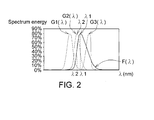
- FIG. 2 is a diagram comparing light-emitting spectra and filtered spectra of phosphors.
- a light-tuning method utilizes an eye sensitivity function as basis for light-tuning to analyze characteristics of a filter material and to select a light-emitting spectrum of a phosphor, so that between the light-emitting spectrum of the selected phosphor and the filtered eye sensitivity function is an optimal matching degree.
- the light-tuning method according to the embodiment is applicable to a light source of a tubal lamp or a planar lamp.
- the light source in the lamp is formed by a material of different components, e.g., a blue light emitting diode (LED) based on indium gallium nitride (InGaN) / gallium nitride (GaN) / aluminum gallium nitride (AlGaN) added with yellow phosphor, so as to allow the blue light to stimulate the yellow phosphor to produce yellow light.
- a green LED is added with a red phosphor, so as to allow the green light to stimulate the red phosphor to produce red light.
- Some common light-blending techniques for producing white light include a blue LED added with yttrium aluminum garnet Y 3 Al 5 O 12 : Ce (YAG) by Nichia, and an blue LED added with terbium aluminum garnet Tb 3 A 15 O 12 :Ce (TAG) by OSRAM or an ultraviolet LED added with red, blue and green phosphors.
- YAG yttrium aluminum garnet
- OSRAM an ultraviolet LED added with red, blue and green phosphors.
- the conventional light-blending techniques are still faced with issues of unsatisfactory light-emitting efficiency and limited choices of phosphors.
- the method includes Steps S10 to S30.
- a filter material is selected.
- the light filter material is for filtering out unwanted light having a specific wavelength range to obtain a transmittance spectrum T(A).
- the filter material is for filtering out light having a wavelength smaller than 500nm.
- the wavelength range of the filtered eye sensitivity function F(A) is between 450nm and 650nm.
- Step S30 according to a full width at half maximum (FWHM) wavelength range of the filtered eye sensitivity function, a phosphor is selected so that between the light-emitting spectrum of the phosphor and the filtered eye sensitivity function is an optimal matching degree.
- FWHM full width at half maximum
- the light having a wavelength range below 550nm in the transmittance spectrum T( ⁇ ) may be filtered out, and only the light having a wavelength range over 550nm can pass through the light filter material.
- the eye sensitivity function E(A) is multiplied by the transmittance spectrum T( ⁇ ) to get a wavelength range from the filtered eye sensitivity function F( ⁇ ).
- the wavelength range is calculated according to the eye sensitivity function.
- an eye sensitivity value is different for different wavelength.
- the peak is approximately at 555nm, and the wavelength range is approximately between 380nm and 780nm. Colored light exceeding the wavelength range is invisible to the eye and hence has an eye sensitivity of almost zero. Therefore, in the filtered eye sensitivity function F(A) obtained from multiplying the eye sensitivity function E(A) with the transmittance spectrum T( ⁇ ) in FIG.
- the wavelength range of approximately between 450nm and 650nm is capable of filtering out ultraviolet light having a wavelength of smaller than 450nm and visible light having a wavelength of greater than 650nm, so that the wavelength range of the filtered eye sensitivity function F(A) is between 450nm and 650nm.
- the wavelength range of the filtered eye sensitivity function F( ⁇ ) is between 500nm and 650nm
- the FWHM wavelength range of the filtered eye sensitivity function F( ⁇ ) is between 550nm and 610nm, i.e., the width of the FWHM wavelength range is about 60nm.
- the FWHM wavelength range of the filtered eye sensitivity function F(A) changes according to different filter materials, and is thus not limited to being between 550nm and 610nm.
- a peak of the filtered eye sensitivity function F(A) is 555nm that is close to a peak of the eye sensitivity function, and the FWHM wavelength range of the filtered eye sensitivity function F(A) is approximately between 505nm and 605nm. That is, the maximum width of the FWHM filtered eye sensitivity function F( ⁇ ) is about 100nm and is greater than the actual wavelength 60nm.
- FIG. 2 shows a diagram comparing light-emitting spectra of phosphors and the filtered eye sensitivity function.
- Step S30 when the selected phosphor is respectively G1( ⁇ ), G2( ⁇ ) and G3( ⁇ ), as observed from FIG. 2 , since the light-emitting spectrum G2( ⁇ ) is closer to the filtered eye sensitivity function F( ⁇ ) than the light-emitting spectra G1( ⁇ ) and G3( ⁇ ), the eye sensitivity value corresponding to the light-emitting spectrum G2( ⁇ ) is larger than the eye sensitivity values corresponding to the light-emitting spectra G1( ⁇ ) and G3( ⁇ ).
- an ideal phosphor is selected and the light-emitting spectrum of the phosphor is also determined to optimize the light flux per unit watt to as high as over 100Lm/W for enhancing the overall brightness of the lighting device.
- the peak wavelength of the filtered spectrum F( ⁇ ) is ⁇ 1, and the peak wavelength of the light-emitting spectrum G2( ⁇ ) is ⁇ 2.
- ⁇ 1/2FWHM the optimized light-emitting spectrum G2( ⁇ ) may be obtained.
- is smaller than 30nm; when the wavelength width of the FWHM wavelength range is 100nm, the absolute value
- the filter material is doped to a molding material or coated on a molding material to form a light filter.
- the phosphor is a yellow phosphor molded in an LED package structure.
- the LED is a blue LED for stimulating the yellow phosphor to produce yellow light
- the spectrum of the produced yellow light blended with blue light is a white light spectrum.
- the wavelength range of the filtered eye sensitivity function ( ⁇ ) is approximately between 500nm and 650nm, and has a peak at around 555nm. Therefore, given that the peak and bandwidth of the light-emitting spectrum of the phosphor are close to the filtered eye sensitivity function, the overall light-emitting efficiency is higher under the same power.
- the light-tuning according to the embodiment is capable of filtering out unwanted light having a specific wavelength range (such as ultraviolet light), so as to prevent exposure reactions of a light-sensing material and thus to increase a manufacturing yield rate.
- colored light having a wavelength range between 450nm and 650nm has an eye sensitivity value greater than colored light in other wavelengths such that the eye senses different intensities for colored light emitted under a same power.
- an ideal phosphor is selected by the light-tuning method according to the embodiment, so that between the light-emitting spectrum of the selected phosphor and the filtered eye sensitivity function is an optimal matching degree for rendering an optimized light-emitting spectrum.
Landscapes
- Physics & Mathematics (AREA)
- General Physics & Mathematics (AREA)
- Optics & Photonics (AREA)
- Led Device Packages (AREA)
- Eye Examination Apparatus (AREA)
- Optical Filters (AREA)
Applications Claiming Priority (1)
| Application Number | Priority Date | Filing Date | Title |
|---|---|---|---|
| TW100113013A TW201242099A (en) | 2011-04-14 | 2011-04-14 | Light-tuning method |
Publications (2)
| Publication Number | Publication Date |
|---|---|
| EP2511739A2 true EP2511739A2 (de) | 2012-10-17 |
| EP2511739A3 EP2511739A3 (de) | 2013-06-05 |
Family
ID=46298220
Family Applications (1)
| Application Number | Title | Priority Date | Filing Date |
|---|---|---|---|
| EP12164069.2A Withdrawn EP2511739A3 (de) | 2011-04-14 | 2012-04-13 | Verfahren zur Licht-Einstellung |
Country Status (4)
| Country | Link |
|---|---|
| US (1) | US20120264239A1 (de) |
| EP (1) | EP2511739A3 (de) |
| CN (1) | CN102734751A (de) |
| TW (1) | TW201242099A (de) |
Families Citing this family (3)
| Publication number | Priority date | Publication date | Assignee | Title |
|---|---|---|---|---|
| WO2014110101A1 (en) * | 2013-01-14 | 2014-07-17 | 3M Innovative Properties Company | Filters to enhance color discrimination for color vision deficient individuals |
| CN105742329A (zh) * | 2016-03-07 | 2016-07-06 | 京东方科技集团股份有限公司 | 显示面板及其制造方法和显示装置 |
| TWI636286B (zh) * | 2017-03-31 | 2018-09-21 | 友達光電股份有限公司 | 顯示裝置 |
Family Cites Families (11)
| Publication number | Priority date | Publication date | Assignee | Title |
|---|---|---|---|---|
| US6229252B1 (en) * | 1999-01-21 | 2001-05-08 | Asahi Glass Company, Limited | Dye combinations for multiple bandpass filters for video displays |
| US7479662B2 (en) * | 2002-08-30 | 2009-01-20 | Lumination Llc | Coated LED with improved efficiency |
| US6744077B2 (en) * | 2002-09-27 | 2004-06-01 | Lumileds Lighting U.S., Llc | Selective filtering of wavelength-converted semiconductor light emitting devices |
| CN1725435B (zh) * | 2005-07-21 | 2010-09-22 | 北京世纪卓克能源技术有限公司 | 道路照明无极灯 |
| TWI287877B (en) * | 2005-12-19 | 2007-10-01 | Univ Nat Taiwan | Human eye like photo detector |
| WO2007125493A2 (en) * | 2006-05-02 | 2007-11-08 | Koninklijke Philips Electronics N.V. | Color-stable phosphor converted led |
| EP2057693A1 (de) * | 2006-08-29 | 2009-05-13 | Osram-Sylvania Inc. | Verstärkte emission aus aus leuchtstoff umgewandelten leds unter verwendung interferometrischer filter |
| JP5171841B2 (ja) * | 2006-11-30 | 2013-03-27 | クリー インコーポレイテッド | 照明デバイス及び照明方法 |
| US8783887B2 (en) * | 2007-10-01 | 2014-07-22 | Intematix Corporation | Color tunable light emitting device |
| DE102008015941A1 (de) * | 2007-12-21 | 2009-06-25 | Osram Opto Semiconductors Gmbh | Beleuchtungseinrichtung |
| US20110012141A1 (en) * | 2009-07-15 | 2011-01-20 | Le Toquin Ronan P | Single-color wavelength-converted light emitting devices |
-
2011
- 2011-04-14 TW TW100113013A patent/TW201242099A/zh unknown
- 2011-05-06 CN CN2011101163924A patent/CN102734751A/zh active Pending
-
2012
- 2012-04-13 US US13/446,196 patent/US20120264239A1/en not_active Abandoned
- 2012-04-13 EP EP12164069.2A patent/EP2511739A3/de not_active Withdrawn
Non-Patent Citations (1)
| Title |
|---|
| None |
Also Published As
| Publication number | Publication date |
|---|---|
| CN102734751A (zh) | 2012-10-17 |
| EP2511739A3 (de) | 2013-06-05 |
| TW201242099A (en) | 2012-10-16 |
| US20120264239A1 (en) | 2012-10-18 |
Similar Documents
| Publication | Publication Date | Title |
|---|---|---|
| Narukawa et al. | White light emitting diodes with super-high luminous efficacy | |
| US7250715B2 (en) | Wavelength converted semiconductor light emitting devices | |
| US7582914B2 (en) | White light emitting diode device | |
| CN104470846B (zh) | 使用各向异性金属纳米粒子而具有增强的发光效率的光变换发光装置 | |
| US20200011508A1 (en) | Method and apparatus to enhance spectral purity of a light source | |
| US20150369988A1 (en) | Backlight module and display device | |
| Chen et al. | Improvement of emission efficiency and color rendering of high-power LED by controlling size of phosphor particles and utilization of different phosphors | |
| US20120217865A1 (en) | Solid state light emitting devices including nonhomogeneous luminophoric particle size layers | |
| US8017961B2 (en) | Light emitting device and phosphor of alkaline earth sulfide therefor | |
| KR20150135935A (ko) | 표시 장치 | |
| JP2009130360A (ja) | 白色発光ダイオードチップおよびその製造方法 | |
| WO2026040982A1 (zh) | 发光二极管芯片组、显示背光模组及照明模组 | |
| CN101949514A (zh) | 一种液晶显示器的背光模块 | |
| EP2511739A2 (de) | Verfahren zur Licht-Einstellung | |
| CN104810357A (zh) | 一种显示器、背光模组及led光源装置 | |
| JP2016181550A (ja) | 発光装置、照明装置及び画像表示装置 | |
| CN104347606B (zh) | 发光二极管封装结构及光源模块 | |
| Su et al. | Performance comparison of polarized white light emitting diodes using wire-grid polarizers with polymeric and glass substrates | |
| US10978622B2 (en) | Nitride phosphor and light emitting device and backlight module employing the nitride phosphor | |
| CN103594608B (zh) | 一种白光led、背光模组及白光led的制作方法 | |
| Chen et al. | The application of Zn 0.8 Cd 0.2 S nanocrystals in white light emitting diodes devices | |
| KR20160018636A (ko) | 표시 장치 | |
| Tran et al. | Excellent color quality of phosphor converted white light emitting diodes with remote phosphor geometry | |
| KR20150055810A (ko) | 청색 광원과 형광체를 이용한 초고연색 백색 발광 조명용 소자 | |
| That et al. | Application of dual-layer phosphor geometries for enhancing the optical properties of white-light LEDs |
Legal Events
| Date | Code | Title | Description |
|---|---|---|---|
| PUAI | Public reference made under article 153(3) epc to a published international application that has entered the european phase |
Free format text: ORIGINAL CODE: 0009012 |
|
| AK | Designated contracting states |
Kind code of ref document: A2 Designated state(s): AL AT BE BG CH CY CZ DE DK EE ES FI FR GB GR HR HU IE IS IT LI LT LU LV MC MK MT NL NO PL PT RO RS SE SI SK SM TR |
|
| AX | Request for extension of the european patent |
Extension state: BA ME |
|
| RIN1 | Information on inventor provided before grant (corrected) |
Inventor name: CAI, PEI-SONG Inventor name: LIN, TZU-PU Inventor name: TIEN, YUN-YI |
|
| PUAL | Search report despatched |
Free format text: ORIGINAL CODE: 0009013 |
|
| AK | Designated contracting states |
Kind code of ref document: A3 Designated state(s): AL AT BE BG CH CY CZ DE DK EE ES FI FR GB GR HR HU IE IS IT LI LT LU LV MC MK MT NL NO PL PT RO RS SE SI SK SM TR |
|
| AX | Request for extension of the european patent |
Extension state: BA ME |
|
| RIC1 | Information provided on ipc code assigned before grant |
Ipc: H01L 33/44 20100101ALI20130429BHEP Ipc: F21V 9/00 20060101ALI20130429BHEP Ipc: G02B 5/20 20060101AFI20130429BHEP Ipc: H01J 61/40 20060101ALI20130429BHEP |
|
| 17P | Request for examination filed |
Effective date: 20131005 |
|
| RBV | Designated contracting states (corrected) |
Designated state(s): AL AT BE BG CH CY CZ DE DK EE ES FI FR GB GR HR HU IE IS IT LI LT LU LV MC MK MT NL NO PL PT RO RS SE SI SK SM TR |
|
| STAA | Information on the status of an ep patent application or granted ep patent |
Free format text: STATUS: THE APPLICATION IS DEEMED TO BE WITHDRAWN |
|
| 18D | Application deemed to be withdrawn |
Effective date: 20151103 |