EP2512176A1 - Procédé de régulation de l'encombrement, centre d'exploitation et de maintenance et station de base - Google Patents
Procédé de régulation de l'encombrement, centre d'exploitation et de maintenance et station de base Download PDFInfo
- Publication number
- EP2512176A1 EP2512176A1 EP10835457A EP10835457A EP2512176A1 EP 2512176 A1 EP2512176 A1 EP 2512176A1 EP 10835457 A EP10835457 A EP 10835457A EP 10835457 A EP10835457 A EP 10835457A EP 2512176 A1 EP2512176 A1 EP 2512176A1
- Authority
- EP
- European Patent Office
- Prior art keywords
- congestion
- cell
- policy
- status report
- control
- Prior art date
- Legal status (The legal status is an assumption and is not a legal conclusion. Google has not performed a legal analysis and makes no representation as to the accuracy of the status listed.)
- Granted
Links
Images



Classifications
-
- H—ELECTRICITY
- H04—ELECTRIC COMMUNICATION TECHNIQUE
- H04W—WIRELESS COMMUNICATION NETWORKS
- H04W28/00—Network traffic management; Network resource management
- H04W28/02—Traffic management, e.g. flow control or congestion control
-
- H—ELECTRICITY
- H04—ELECTRIC COMMUNICATION TECHNIQUE
- H04W—WIRELESS COMMUNICATION NETWORKS
- H04W24/00—Supervisory, monitoring or testing arrangements
- H04W24/08—Testing, supervising or monitoring using real traffic
Definitions
- the present invention relates to the field of communications technologies, and in particular, to a congestion control method, an operations maintenance center device and a base station.
- the prior art mainly provides two solutions for performing congestion control.
- One solution is that: a probe (Probe) point is added after a base station, and the Probe monitors a congestion status of the base station, analyzes user information and service data under the base station, and performs the congestion control.
- the Probe can monitor the congestion status of the base station, it is hard to detect the user information under the base station, and the Probe cannot perform flexible policy control.
- a charging point of the network locates in a core network, and therefore, if the congestion control is performed at the Probe, discarded packets may still be charged in the core network, resulting in charging errors.
- every base station is configured with a Probe, the cost is high.
- a radio network controller (Radio Network Controller; referred to as RNC herein below) performs determination and processing.
- RNC Radio Network Controller
- an RNC may upload service area (Service Area; referred to as SA herein below) information to a core network, so that the RNC can inform of the core network when an SA of a user changes, where generally one cell is configured with one SA.
- SA Service Area
- a core network service GPRS support node (Service GPRS Support Node; referred to as SGSN herein below)/gateway GPRS support node (Gateway GPRS Support Node; referred to as GGSN herein below) may determine which cell the user locates in according to the SA. By accumulating the number of users and traffic of each cell, the cell congestion may be determined roughly, so as to initiate the congestion control. However, if the solution is adopted, the conventional network RNC/SGSN/GGSN requires upgrading; moreover, different base stations and cells have different capacities, so the core network cannot accurately determine, according to the user information, whether the congestion occurs in the base station.
- the performance of the RNC/SGSN/GGSN may be greatly influenced, and therefore, in order to reduce signaling impact on the core network resulted from the RNC, the location (SA) report message of the RNC is generally disabled.
- the conventional congestion control method requires adding extra devices, has a high cost, or has great impact on the network performance.
- Embodiments of the present invention provide a congestion control method, an operations maintenance center device and a base station, so as to implement congestion control for the base station with a low cost and small impact on the network performance through a core network.
- An embodiment of the present invention provides a congestion control method, including:
- An embodiment of the present invention further provides an operations maintenance center device, including:
- An embodiment of the present invention further provides a policy charging and control rule function entity, including:
- An embodiment of the present invention further provides a base station, including:
- the operations maintenance center receives the congestion status report of the base station, and sends the congestion status report to the policy charging and control rule function entity, so that the policy charging and control rule function entity can perform congestion control according to the congestion status report.
- congestion control is implemented in real time, and extra devices are not needed, thereby saving costs. Further, a core network does not need to initiate a function of reporting a user location, and therefore, the impact on network performance is reduced.
- FIG. 1 is a flow chart of an embodiment of a congestion control method of the present invention
- FIG. 2 is a flow chart of another embodiment of a congestion control method of the present invention.
- FIG. 3 is a flow chart of still another embodiment of a congestion control method of the present invention.
- FIG. 4 is a schematic diagram of a congestion control effect in an embodiment of the present invention.
- FIG. 5 is a schematic diagram of congestion control in an embodiment of the present invention, when a user in a cell changes;
- FIG. 6 is a schematic structural diagram of an embodiment of an operations maintenance center device of the present invention.
- FIG. 7 is a schematic structural diagram of an embodiment of a policy charging and control rule function entity of the present invention.
- FIG. 8 is a schematic structural diagram of another embodiment of a policy charging and control rule function entity of the present invention.
- FIG. 9 is a schematic structural diagram of still another embodiment of a policy charging and control rule function entity of the present invention.
- FIG. 10 is a schematic structural diagram of an embodiment of a base station of the present invention.
- FIG. 11 is a schematic structural diagram of an embodiment of a congestion control system of the present invention.
- FIG. 12 is a schematic structural diagram of another embodiment of a congestion control system of the present invention.
- OMC operations Maintenance Center
- the OMC is a network management device, which is independent of a main device of the communication system, and generally does not participate in processing services.
- An embodiment of the present invention provides a congestion control method, in which a congestion status report of a base station is received through the OMC.
- FIG. 1 is a flow chart of an embodiment of a congestion control method of the present invention, and referring to FIG. 1 , the embodiment may include:
- Step 101 The OMC receives a congestion status report of a base station.
- the congestion status report includes a cell identity, a congestion status of a cell corresponding to the cell identity, and a user identity in the cell.
- the congestion status report may include cell identities of multiple cells, and each cell may have one or more user identities.
- the cell identity and user identity in the congestion status report may be carried in the congestion status report in the form of a list or an array; definitely, the embodiment of the present invention is not limited thereto, and the manner of carrying the cell identity and user identity in the congestion status report is not limited in the embodiment of the present invention.
- the cell identity may be a server area identity (Server Area Identity) or cell global identity (Cell Global Identity); the user identity may be an international mobile subscriber identity (International Mobile Subscriber Identity; referred to as IMSI herein below); definitely, the embodiment of the present invention is not limited thereto, the cell identity and user identity may also be other identities, as long as cell identities can identify different cells, and user identities can identify different users.
- server area identity Server Area Identity
- Cell Global Identity cell Global Identity
- IMSI International Mobile Subscriber Identity
- the congestion status may be congestion or no congestion, represented by "0” or “1", for example, "0” represents no congestion, and "1” represents congestion; alternatively, the congestion status may be congestion or no congestion, a congestion degree is distinguished by more than one congestion level, and a congestion level may be represented by a numeral, for example, “0” represents no congestion, “1” represents level 1 congestion, "2” represents level 2 congestion, and a larger numeral which represents a larger congestion level shows that the congestion status of a cell is severer; definitely, the embodiment of the present invention is not limited thereto, congestion or no congestion may also be represented in other manners, as long as whether congestion occurs can be determined; and congestion levels may also be distinguished in other manners, for example, with English letters or other characters, as long as the congestion levels can be distinguished.
- the OMC may receive the congestion status report that is directly reported by the base station; or, the OMC may receive the congestion status report that is reported by the base station through a base station controller, for example, an RNC.
- the base station may report the congestion status report periodically, for example, 10 seconds as a period, the congestion status report is reported every 10 seconds; the base station may also report the congestion status report when a congestion status of a cell in the base station changes, for example, when congestion occurs in a cell, it reports the congestion status report; or, when the congestion status of a cell where congestion occurs is released, it reports the congestion status report.
- Step 102 Send the congestion status report to a policy charging and control rule function entity, so that the policy charging and control rule function entity performs congestion control according to the congestion status report.
- a reporting interface is added between the OMC and the policy charging and control rule function entity, the OMC sends the congestion status report to the policy charging and control rule function entity through the reporting interface, so that the policy charging and control rule function entity may perform congestion control according to the congestion status report.
- the policy charging and control rule function entity performs congestion control according to the congestion status report sent by the OMC, and extra devices are not needed, thereby saving costs. Further, a core network does not need to initiate a function of reporting a user location, and therefore, the impact on network performance is reduced.
- FIG. 2 is a flow chart of another embodiment of a congestion control method of the present invention, and referring to FIG. 2 , the embodiment may include:
- Step 201 A policy charging and control rule function entity receives a congestion status report sent by an OMC.
- the congestion status report includes a cell identity, a congestion status of a cell corresponding to the cell identity, and a user identity in the cell.
- the congestion status report may include cell identities of multiple cells, and each cell may have one or more user identities.
- the cell identity and user identity in the congestion status report may be carried in the congestion status report in the form of a list or an array; definitely, the embodiment of the present invention is not limited thereto, and the manner of carrying the cell identity and user identity in the congestion status report is not limited in the embodiment of the present invention.
- a reporting interface is added between the OMC and the policy charging and control rule function entity, and the policy charging and control rule function entity receives, through the reporting interface, the congestion status report reported by the OMC.
- the cell identity may be a Server Area Identity or Cell Global Identity;
- the user identity may be an IMSI; definitely, the embodiment of the present invention is not limited thereto, the cell identity and user identity may also be other identities, as long as cell identities can identify different cells, and user identities can identify different users.
- the congestion status may be congestion or no congestion, represented by "0” or “1", for example, "0” represents no congestion, and "1” represents congestion; alternatively, the congestion status may be congestion or no congestion, a congestion degree is distinguished by more than one congestion level, and a congestion level may be represented by a numeral, for example, “0” represents no congestion, “1” represents level 1 congestion, "2” represents level 2 congestion, and a larger numeral which represents a larger congestion level shows that the congestion status of a cell is severer; definitely, the embodiment of the present invention is not limited thereto, congestion or no congestion may also be represented in other manners, as long as whether congestion occurs can be determined; and congestion levels may also be distinguished in other manners, for example, with English letters or other characters, as long as the congestion levels can be distinguished.
- Step 202 According to a congestion status in the congestion status report, when congestion occurs in a cell, perform limiting on a user in the cell where congestion occurs.
- the policy charging and control rule function entity may, according to the congestion status in the congestion status report, perform limiting on the user in the cell where congestion occurs.
- the performing limiting on the user in the cell where congestion occurs includes performing traffic limiting or service limiting on the user in the cell where congestion occurs.
- the policy charging and control rule function entity may deliver a congestion control policy to a core network device, so that the core network device may, according to the congestion control policy, reduce quality of service of the user in the cell where congestion occurs.
- the policy charging and control rule function entity may deliver a different congestion control policy according to the congestion level of the cell where congestion occurs. If the congestion level of the cell is high, it indicates that the congestion occurring in the cell is severe, and then the policy charging and control rule function entity may deliver a congestion control policy with a high control degree, so that quality of service of the cell having a high congestion level is greatly reduced as compared with quality of service before congestion occurs.
- the policy charging and control rule function entity may deliver a congestion control policy with a low control degree, so that quality of service of the cell having a low congestion level is slightly reduced as compared with quality of service before congestion occurs.
- the policy charging and control rule function entity may release the limiting on the user in the cell where congestion occurs, including releasing traffic limiting or service limiting on the user in the cell where congestion occurs.
- the policy charging and control rule function entity may deliver a congestion control release policy to the core network device, so that the core network device may, according to the congestion control release policy, adjust quality of service of the user in the cell where congestion occurs, that is, restore the quality of service of the user in the cell where congestion occurs to the quality of service before congestion occurs.
- the policy charging and control rule function entity may deliver the congestion control release policy to the core network device at a fixed time or periodically.
- the fixed-time delivering includes that the policy charging and control rule function entity delivers the congestion control release policy to the core network device at a predetermined time or several predetermined times, or after a predetermined time length after delivering the congestion control policy; the periodical delivering includes that the policy charging and control rule function entity periodically delivers the congestion control release policy to the core network device according to a predetermined period; alternatively, the policy charging and control rule function entity may also, according to the congestion status in the congestion status report sent by the OMC, after the congestion status of the cell where congestion occurs is released, deliver the congestion control release policy to the core network device.
- the policy charging and control rule function entity may configure a validity period of the congestion control policy, and deliver the validity period to the core network device, so that after the validity period expires, the core network device restores the quality of service of the user in the cell where congestion occurs to the quality of service before congestion occurs.
- the core network device can timely release the limiting on the user in the cell where congestion occurs, and can reduce the uncertainty brought by delivering of the policy, for example, the loss of the congestion control release policy results in that the user always cannot use some services.
- the validity period of the congestion control policy may be delivered to the core network device at the same time when the policy charging and control rule function entity delivers the congestion control policy, and it is also possible that after the congestion control policy is delivered, the validity period of the congestion control policy is delivered to the core network device through a single message.
- the manner of delivering the validity period of the congestion control policy is not limited in the embodiment of the present invention.
- the policy charging and control rule function entity can deliver the configured validity period of the congestion control policy to the core network device, and can deliver the congestion control release policy to the core network device after receiving the congestion status report sent by the OMC and determining, according to the congestion status in the congestion status report, that the congestion status in the cell where congestion occurs is released.
- the core network device can configure execution priorities for the two manners, for example, can configure that the execution priority of the congestion control release policy is higher than the execution priority of the validity period of the congestion control policy, and therefore, when the validity period of the congestion control policy does not expire, if the core network device receives the congestion control release policy sent by the policy charging and control rule function entity, because the execution priority of the congestion control release policy is higher than the execution priority of the validity period of the congestion control policy, the core network device may execute the congestion control release policy in priority, and the core network device releases the limiting on the user in the cell where congestion occurs according to the congestion control release policy.
- the policy charging and control rule function entity determines, according to the congestion status in the congestion status report sent by the OMC, that the congestion state of the cell where congestion occurs is released, the policy charging and control rule function entity will still not release the limiting on the user in the cell where congestion occurs, thereby effectively prolonging the frequency of a cycle of cell congestion ⁇ service control ⁇ congestion release ⁇ service restoring ⁇ congestion again.
- the core network device may be a GGSN.
- limiting on the user in the cell where congestion occurs is implemented in real time, the limiting on the user in the cell where congestion occurs can be released, and extra devices are not needed, thereby saving costs. Further, a core network does not need to initiate a function of reporting a user location, and therefore, the impact on network performance is reduced.
- FIG. 3 is a flow chart of still another embodiment of a congestion control method of the present invention, and in this embodiment, a core network device being a GGSN is taken as an example.
- the embodiment may include:
- Step 301 The base station reports a congestion status report to an OMC, the congestion status report includes a cell identity, a congestion status of a cell corresponding to the cell identity, and a user identity in the cell.
- the congestion status report may include cell identities of multiple cells, and each cell may have one or more user identities.
- the cell identity and user identity in the congestion status report may be carried in the congestion status report in the form of a list or an array; definitely, the embodiment of the present invention is not limited thereto, and the manner of carrying the cell identity and user identity in the congestion status report is not limited in the embodiment of the present invention.
- the cell identity may be a Server Area Identity or Cell Global Identity;
- the user identity may be an IMSI; definitely, the embodiment of the present invention is not limited thereto, the cell identity and user identity may also be other identities, as long as cell identities can identify different cells, and user identities can identify different users.
- the congestion status may be congestion or no congestion, represented by "0” or “1", for example, "0” represents no congestion, and "1” represents congestion; alternatively, the congestion status may be congestion or no congestion, a congestion degree is distinguished by more than one congestion level, and a congestion level may be represented by a numeral, for example, “0” represents no congestion, “1” represents level 1 congestion, "2” represents level 2 congestion, and a larger numeral which represents a larger congestion level shows that the congestion status of a cell is severer; definitely, the embodiment of the present invention is not limited thereto, congestion or no congestion may also be represented in other manners, as long as whether congestion occurs can be determined; and congestion levels may also be distinguished in other manners, for example, with English letters or other characters, as long as the congestion levels can be distinguished.
- the base station may report the congestion status report periodically, for example, 10 seconds as a period, the congestion status report is reported every 10 seconds; the base station may also report the congestion status report when a congestion status of the cell in the base station changes, for example, when congestion occurs in a cell, it reports the congestion status report; or, when the congestion status of the cell where congestion occurs is released, it reports the congestion status report.
- the embodiment of the present invention is not limited thereto, according to an actual application scenario, the base station may change from no congestion to congestion, or may change from congestion to no congestion, and may also have more severe congestion or relieved congestion. According to the embodiment of the present invention, the base station can report the congestion status flexibly, thereby performing the corresponding congestion control processing.
- Step 302 Optionally, in some networks, an RNC serves as a proxy of the base station to report the congestion status report to the OMC.
- Step 303 The OMC sends the congestion status report to a policy charging and control rule function (Policy Charging and Control Rule Function; referred to as PCRF herein below) entity.
- Policy Charging and Control Rule Function Policy Charging and Control Rule Function
- a reporting interface is added between the OMC and the PCRF entity, and the OMC sends the congestion status report to the PCRF entity through the reporting interface.
- Step 304 The PCRF entity delivers a congestion control policy to the GGSN according to a congestion status in the congestion status report when congestion occurs in a cell.
- the PCRF entity may adopt a Gx interface to deliver the congestion control policy to the GGSN, and a control object is a user in the cell where congestion occurs.
- a policy charging and control rule function entity may deliver a different congestion control policy according to the congestion level of the cell where congestion occurs. If the congestion level of the cell is high, it indicates that the congestion occurring in the cell is severe, and then the PCRF entity may deliver a congestion control policy with a high control degree, for example, limiting the user in the cell where congestion occurs from using a certain service; and if the congestion level of the cell is low, it indicates that the congestion occurring in the cell is light, and then the PCRF entity may deliver a congestion control policy with a low control degree, for example, not performing service limiting on the user in the cell where congestion occurs, but only performing traffic limiting on the user in the cell where congestion occurs.
- Step 305 The GGSN reduces quality of service (Quality of Service; referred to as QoS herein below).
- QoS Quality of Service
- the GGSN reduces the QoS of the user in the cell where congestion occurs according to the congestion control policy delivered by the PCRF entity.
- the GGSN may limit, according to the congestion control policy, the user in the cell where congestion occurs from using a certain service, for example, the GGSN starts to intercept a point to point (Point to Point; referred to as P2P herein below) service of the user in the cell where congestion occurs, so that the QoS of the cell having a high congestion level is greatly reduced as compared with the QoS before congestion occurs.
- P2P Point to Point
- the GGSN may, according to the congestion control policy, not perform service limiting on the user in the cell where congestion occurs, but only perform traffic limiting on the user in the cell where congestion occurs, for example, the GGSN does not limit the user in the cell where congestion occurs from using the P2P service, but only performs limiting on the rate of using the P2P service by the user in the cell where congestion occurs, so that the rate of using the P2P service by the user in the the cell where congestion occurs does not exceed a preset threshold, and therefore, the QoS of the cell having a low congestion level is slightly reduced as compared with the QoS before congestion occurs.
- Step 306 The PCRF entity sends a congestion control release policy to the GGSN, so as to release the limiting on the user in the cell where congestion occurs.
- the PCRF entity may send the congestion control release policy to the GGSN by adopting the method provided in the step 202 of the embodiment shown in FIG. 2 , which is not repeated herein.
- Step 307 The GGSN restores the QoS.
- the GGSN restores the QoS of the user in the cell where congestion occurs to the QoS before congestion occurs, and releases the traffic limiting or service limiting on the user in the cell where congestion occurs.
- step 301-step 307 are executed again, so as to initiate a new round of cell congestion control.
- the releasing the limiting on the user in the cell where congestion occurs may also adopt the following manner, in which the step 306 and the step 307 are respectively replaced with:
- Step 306' The PCRF entity configures a validity period of the congestion control policy, and delivers the validity period to the GGSN.
- the validity period of the congestion control policy may be delivered to the GGSN at the same time when the PCRF entity delivers the congestion control policy, and it is also possible that, after the congestion control policy is delivered, the validity period of the congestion control policy is delivered to the GGSN through a single message.
- the manner of delivering the validity period of the congestion control policy is not limited in the embodiment of the present invention.
- Step 307' The GGSN sets a timer according to the length of the validity period, and after the time of the timer expires, the GGSN restores the QoS of the user in the cell where congestion occurs to the QoS before congestion occurs, and releases the traffic limiting or service limiting on the user in the cell where congestion occurs.
- the manners of releasing the limiting on the user in the cell where congestion occurs may also be used in a combined manner, and for details, reference can be made to the description of step 202 in the embodiment shown in FIG. 2 , and details are not repeated herein.
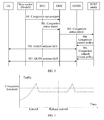
- FIG. 4 is a schematic diagram of the congestion control effect of an embodiment of the present invention.
- the PCRF entity initiates the congestion control, the traffic of the cell is reduced and tends to be stable.
- the congestion control is released, if the traffic of the cell exceeds a congestion threshold again, the PCRF entity will initiate the flow of congestion control again, and the users in the two control are both the users in the cell where congestion occurs.
- FIG. 5 is a schematic diagram of congestion control in an embodiment of the present invention, when a user in a cell changes. Referring to FIG. 5 , the cell has a user 1 and a user 2, the user 2 performs P2P downloading, which causes cell congestion.
- the service limiting module 72 may deliver a congestion control policy to a core network device, so that the core network device may reduce quality of service of a user in the cell where congestion occurs according to the congestion control policy.
- the service limiting module 72 may deliver a different congestion control policy according to the congestion level of the cell where congestion occurs. If the congestion level of the cell is high, it indicates that the congestion occurring in the cell is severe, and then the service limiting module 72 may deliver a congestion control policy with a high control degree, so that the quality of service of the cell having a high congestion level is greatly reduced as compared with the quality of service before congestion occurs.
- the base station implements sending of the congestion status report of the cell in the base station to the operations maintenance center device, so that the operations maintenance center device can send the the congestion status report to the policy charging and control rule function entity.
- the policy charging and control rule function entity performs congestion control according to the congestion status report, thereby implementing congestion control on a cell in real time without the need of adding extra devices, and saving costs.
- a core network does not need to initiate a function of reporting a user location, and therefore, the impact on network performance is reduced.
- the operations maintenance center device 1102 is adapted to receive the congestion status report of the base station 1101, and sends the congestion status report to the policy charging and control rule function entity 1103. Specifically, the operations maintenance center device 1102 may be implemented by the operations maintenance center device in the embodiment of the present invention shown in FIG. 6 .
- the policy charging and control rule function entity 1103 is adapted to receive the congestion status report sent by the operations maintenance center device 1102, and according to the congestion status report, when congestion occurs in a cell, perform limiting on a user in the cell where congestion occurs.
- the policy charging and control rule function entity 1103 may be implemented by the policy charging and control rule function entity in the embodiment of the present invention shown in FIG. 7 , FIG. 8 or FIG. 9 .
- the congestion control system implements congestion control on a cell in real time, and extra devices are not needed, thereby saving costs. Further, a core network does not need to initiate a function of reporting a user location, and therefore, the impact on network performance is reduced.
- the OMC 1202 is adapted to receive the congestion status report of the base station 1201, and send the congestion status report to the PCRF entity.
- the OMC 1202 may be implemented by the operations maintenance center device of the embodiment of the present invention shown in FIG. 6 .
- the congestion control system implements, in real time, limiting on the user in the cell where congestion occurs, and extra devices are not needed, thereby saving costs. Further, a core network does not need to initiate a function of reporting a user location, and therefore, the impact on network performance is reduced.
Landscapes
- Engineering & Computer Science (AREA)
- Computer Networks & Wireless Communication (AREA)
- Signal Processing (AREA)
- Mobile Radio Communication Systems (AREA)
- Telephonic Communication Services (AREA)
Priority Applications (1)
| Application Number | Priority Date | Filing Date | Title |
|---|---|---|---|
| EP18175280.9A EP3461168B1 (fr) | 2009-12-09 | 2010-11-30 | Contrôle de congestion |
Applications Claiming Priority (2)
| Application Number | Priority Date | Filing Date | Title |
|---|---|---|---|
| CN200910253958A CN101711041B (zh) | 2009-12-09 | 2009-12-09 | 拥塞控制方法、操作维护中心设备和基站 |
| PCT/CN2010/079284 WO2011069422A1 (fr) | 2009-12-09 | 2010-11-30 | Procédé de régulation de l'encombrement, centre d'exploitation et de maintenance et station de base |
Related Child Applications (1)
| Application Number | Title | Priority Date | Filing Date |
|---|---|---|---|
| EP18175280.9A Division EP3461168B1 (fr) | 2009-12-09 | 2010-11-30 | Contrôle de congestion |
Publications (3)
| Publication Number | Publication Date |
|---|---|
| EP2512176A1 true EP2512176A1 (fr) | 2012-10-17 |
| EP2512176A4 EP2512176A4 (fr) | 2012-11-21 |
| EP2512176B1 EP2512176B1 (fr) | 2018-06-27 |
Family
ID=42403795
Family Applications (2)
| Application Number | Title | Priority Date | Filing Date |
|---|---|---|---|
| EP18175280.9A Active EP3461168B1 (fr) | 2009-12-09 | 2010-11-30 | Contrôle de congestion |
| EP10835457.2A Active EP2512176B1 (fr) | 2009-12-09 | 2010-11-30 | Procédé de régulation de l'encombrement et centre d'exploitation et de maintenance |
Family Applications Before (1)
| Application Number | Title | Priority Date | Filing Date |
|---|---|---|---|
| EP18175280.9A Active EP3461168B1 (fr) | 2009-12-09 | 2010-11-30 | Contrôle de congestion |
Country Status (4)
| Country | Link |
|---|---|
| EP (2) | EP3461168B1 (fr) |
| CN (1) | CN101711041B (fr) |
| ES (1) | ES2685303T3 (fr) |
| WO (1) | WO2011069422A1 (fr) |
Cited By (15)
| Publication number | Priority date | Publication date | Assignee | Title |
|---|---|---|---|---|
| WO2013186469A1 (fr) * | 2012-06-15 | 2013-12-19 | Orange | Procédé de contrôle de congestion de trafic |
| WO2014065898A1 (fr) * | 2012-10-26 | 2014-05-01 | Intel Corporation | Compte rendu de l'encombrement du plan utilisateur |
| KR20140093458A (ko) * | 2013-01-18 | 2014-07-28 | 삼성전자주식회사 | 무선 통신 시스템에서 트래픽 제어 방법 및 장치 |
| WO2014130092A1 (fr) | 2013-02-22 | 2014-08-28 | Intel IP Corporation | Notification d'encombrement du plan utilisateur (upcon) à l'aide d'un conteneur upcon |
| EP2784991A1 (fr) | 2013-03-28 | 2014-10-01 | NTT DoCoMo, Inc. | Procédé et appareil de réduction de congestion |
| WO2014173575A1 (fr) * | 2013-04-25 | 2014-10-30 | Telefonaktiebolaget L M Ericsson (Publ) | Réduction d'une signalisation de mise à jour de localisation entre des nœuds de réseau d'un réseau de communication mobile |
| WO2014175997A1 (fr) * | 2013-04-26 | 2014-10-30 | Intel IP Corporation | Systèmes et procédés d'utilisation d'un noeud centralisé pour collecter des informations de congestion au niveau d'un plan utilisateur dans ran |
| US8923879B2 (en) | 2010-12-21 | 2014-12-30 | Huawei Technologies Co., Ltd. | Method, apparatus, and system for controlling services |
| WO2015188881A1 (fr) * | 2014-06-13 | 2015-12-17 | Telefonaktiebolaget L M Ericsson (Publ) | Surveillance de l'encombrement d'entités mobiles |
| US9485685B2 (en) | 2014-06-13 | 2016-11-01 | Telefonaktiebolaget Lm Ericsson (Publ) | Congestion monitoring of mobile entities |
| US9596620B2 (en) | 2012-08-22 | 2017-03-14 | Huawei Technologies Co., Ltd. | Congestion processing method, apparatus, and core network |
| WO2017115747A1 (fr) * | 2015-12-28 | 2017-07-06 | Kddi株式会社 | Dispositif de traitement d'informations, procédé de traitement d'informations, et programme |
| JP2017123617A (ja) * | 2016-01-08 | 2017-07-13 | Kddi株式会社 | 情報処理装置、情報処理方法、およびプログラム |
| EP3972332A4 (fr) * | 2019-06-17 | 2022-06-22 | Huawei Technologies Co., Ltd. | Procédé et dispositif de gestion des encombrements |
| EP4064756A1 (fr) * | 2021-03-26 | 2022-09-28 | Nokia Solutions and Networks Oy | Limitation de bande passante dans un réseau d'accès radio |
Families Citing this family (16)
| Publication number | Priority date | Publication date | Assignee | Title |
|---|---|---|---|---|
| CN101711041B (zh) * | 2009-12-09 | 2012-10-17 | 华为技术有限公司 | 拥塞控制方法、操作维护中心设备和基站 |
| CN102300264B (zh) * | 2011-08-22 | 2013-12-04 | 中国电信股份有限公司 | 无线网络的流量控制方法和系统 |
| CN103168497B (zh) * | 2011-10-17 | 2016-03-09 | 华为技术有限公司 | 信令资源过载处理、传输资源过载处理方法和设备及系统 |
| CN102413056B (zh) * | 2011-12-21 | 2014-10-29 | 北京星网锐捷网络技术有限公司 | 网络流量控制方法、装置及出口网关设备 |
| CN104066115A (zh) * | 2013-03-20 | 2014-09-24 | 中兴通讯股份有限公司 | 无线接入网络拥塞管理方法及装置、拥塞策略管理方法及系统 |
| WO2014193475A1 (fr) * | 2013-05-31 | 2014-12-04 | Intel IP Corporation | Formation de faisceaux numériques et analogiques hybrides destinés à de grands réseaux d'antennes |
| WO2015024158A1 (fr) * | 2013-08-19 | 2015-02-26 | 华为技术有限公司 | Procédé et appareil de commande d'accès |
| US9544233B2 (en) * | 2014-04-28 | 2017-01-10 | New Jersey Institute Of Technology | Congestion management for datacenter network |
| CN105376796A (zh) * | 2014-08-26 | 2016-03-02 | 中兴通讯股份有限公司 | 接入网拥塞状态上报、拥塞信息的更新处理方法及装置 |
| CN105472635A (zh) * | 2014-08-26 | 2016-04-06 | 中兴通讯股份有限公司 | 接入网拥塞状态上报、拥塞信息的更新处理方法及装置 |
| CN104320808B (zh) | 2014-10-31 | 2017-11-24 | 华为技术有限公司 | 接入网拥塞控制方法、基站设备及策略及计费规则功能网元 |
| CN105722139B (zh) * | 2014-12-04 | 2018-12-07 | 中国移动通信集团上海有限公司 | 一种基于pcc架构的信令风暴管理方法和装置 |
| CN109996285B (zh) * | 2017-12-29 | 2022-09-06 | 中国移动通信集团四川有限公司 | 网络拥塞控制方法、装置、设备及介质 |
| CN110677544B (zh) * | 2019-08-21 | 2021-06-04 | 中移(杭州)信息技术有限公司 | Pcrf位置脚本更新方法、装置、设备及存储介质 |
| CN114079581B (zh) * | 2020-08-14 | 2023-08-01 | 中国移动通信集团浙江有限公司 | 基于pcc的服务处理方法、系统、计算设备及存储介质 |
| CN116405986A (zh) * | 2022-11-02 | 2023-07-07 | 桔帧科技(江苏)有限公司 | 一种基于策略库的皮飞站接入方法 |
Family Cites Families (11)
| Publication number | Priority date | Publication date | Assignee | Title |
|---|---|---|---|---|
| GB2382266B (en) * | 2001-11-14 | 2004-03-17 | Toshiba Res Europ Ltd | Data transmission system |
| GB2399988B (en) * | 2003-03-28 | 2005-05-25 | Motorola Inc | Communication unit, communication system and method for reducing network congestion therein |
| US7626926B2 (en) * | 2004-12-09 | 2009-12-01 | Airvana, Inc. | Traffic management in a wireless data network |
| CN100466621C (zh) * | 2006-06-27 | 2009-03-04 | 中国移动通信集团公司 | 通信网络中承载接口的接纳控制系统及接纳控制方法 |
| US20080056125A1 (en) * | 2006-09-06 | 2008-03-06 | Nokia Corporation | Congestion control in a wireless network |
| CN101179355B (zh) * | 2006-11-08 | 2010-12-08 | 中兴通讯股份有限公司 | 基站和无线网络控制器之间的流量控制方法 |
| US7953884B2 (en) * | 2006-12-29 | 2011-05-31 | Alcatel-Lucent Usa Inc. | Method and apparatus for overload control and audit in a resource control and management system |
| EP2204017B1 (fr) * | 2007-11-01 | 2012-05-16 | Telefonaktiebolaget L M Ericsson (publ) | Régulation efficace d'un flux dans un rnc |
| US8422373B2 (en) * | 2008-01-17 | 2013-04-16 | Nokia Corporation | Adaptive multi-rate codec bit rate control in a wireless system |
| CN101431420B (zh) * | 2008-11-25 | 2011-07-13 | 中兴通讯股份有限公司 | 策略和计费控制方法和系统 |
| CN101711041B (zh) * | 2009-12-09 | 2012-10-17 | 华为技术有限公司 | 拥塞控制方法、操作维护中心设备和基站 |
-
2009
- 2009-12-09 CN CN200910253958A patent/CN101711041B/zh active Active
-
2010
- 2010-11-30 EP EP18175280.9A patent/EP3461168B1/fr active Active
- 2010-11-30 ES ES10835457.2T patent/ES2685303T3/es active Active
- 2010-11-30 EP EP10835457.2A patent/EP2512176B1/fr active Active
- 2010-11-30 WO PCT/CN2010/079284 patent/WO2011069422A1/fr not_active Ceased
Cited By (33)
| Publication number | Priority date | Publication date | Assignee | Title |
|---|---|---|---|---|
| US9614771B2 (en) | 2010-12-21 | 2017-04-04 | Huawei Technologies Co., Ltd. | Method, apparatus, and system for controlling services |
| US8923879B2 (en) | 2010-12-21 | 2014-12-30 | Huawei Technologies Co., Ltd. | Method, apparatus, and system for controlling services |
| FR2992136A1 (fr) * | 2012-06-15 | 2013-12-20 | France Telecom | Procede de controle de congestion de trafic |
| WO2013186469A1 (fr) * | 2012-06-15 | 2013-12-19 | Orange | Procédé de contrôle de congestion de trafic |
| US9596620B2 (en) | 2012-08-22 | 2017-03-14 | Huawei Technologies Co., Ltd. | Congestion processing method, apparatus, and core network |
| US10314015B2 (en) | 2012-10-26 | 2019-06-04 | Intel Corporation | Reporting of user plan congestion |
| WO2014065898A1 (fr) * | 2012-10-26 | 2014-05-01 | Intel Corporation | Compte rendu de l'encombrement du plan utilisateur |
| KR20140093458A (ko) * | 2013-01-18 | 2014-07-28 | 삼성전자주식회사 | 무선 통신 시스템에서 트래픽 제어 방법 및 장치 |
| EP2757824A3 (fr) * | 2013-01-18 | 2014-10-08 | Samsung Electronics Co., Ltd | Procédé et appareil pour contrôler le trafic sur un système de communication sans fil |
| US10051512B2 (en) | 2013-01-18 | 2018-08-14 | Samsung Electronics Co., Ltd. | Method and apparatus for controlling traffic in wireless communication system |
| WO2014130092A1 (fr) | 2013-02-22 | 2014-08-28 | Intel IP Corporation | Notification d'encombrement du plan utilisateur (upcon) à l'aide d'un conteneur upcon |
| CN105103591A (zh) * | 2013-02-22 | 2015-11-25 | 英特尔Ip公司 | 使用用户平面拥塞(upcon)容器对upcon进行报告 |
| US20150036496A1 (en) * | 2013-02-22 | 2015-02-05 | Chang Hong Shan | Reporting of user plane congestion (upcon) using a upcon container |
| JP2017163601A (ja) * | 2013-02-22 | 2017-09-14 | インテル アイピー コーポレイション | ユーザ・プレーン輻輳(upcon)コンテナを用いたupconのレポーティング |
| EP2959711A4 (fr) * | 2013-02-22 | 2016-11-16 | Intel Ip Corp | Notification d'encombrement du plan utilisateur (upcon) à l'aide d'un conteneur upcon |
| US9560512B2 (en) * | 2013-02-22 | 2017-01-31 | Intel IP Corporation | Reporting of user plane congestion (UPCON) using a UPCON container |
| EP2784991A1 (fr) | 2013-03-28 | 2014-10-01 | NTT DoCoMo, Inc. | Procédé et appareil de réduction de congestion |
| US9185544B2 (en) | 2013-04-25 | 2015-11-10 | Telefonaktiebolaget L M Ericsson (Publ) | Apparatuses and methods for reducing location update signaling between network nodes of a mobile communication network |
| WO2014173575A1 (fr) * | 2013-04-25 | 2014-10-30 | Telefonaktiebolaget L M Ericsson (Publ) | Réduction d'une signalisation de mise à jour de localisation entre des nœuds de réseau d'un réseau de communication mobile |
| WO2014175997A1 (fr) * | 2013-04-26 | 2014-10-30 | Intel IP Corporation | Systèmes et procédés d'utilisation d'un noeud centralisé pour collecter des informations de congestion au niveau d'un plan utilisateur dans ran |
| CN105103648A (zh) * | 2013-04-26 | 2015-11-25 | 英特尔Ip公司 | 使用中央节点来收集ran用户平面拥塞信息的系统和方法 |
| US10638449B2 (en) | 2013-04-26 | 2020-04-28 | Apple Inc. | Systems and methods using a centralized node to collect ran user plane congestion information |
| EP3232708A1 (fr) * | 2014-06-13 | 2017-10-18 | Telefonaktiebolaget LM Ericsson (publ) | Surveillance de signalisation de l'encombrement d'entités mobiles |
| US10009788B2 (en) | 2014-06-13 | 2018-06-26 | Telefonaktiebolaget Lm Ericsson (Publ) | Congestion monitoring of mobile entities |
| WO2015188881A1 (fr) * | 2014-06-13 | 2015-12-17 | Telefonaktiebolaget L M Ericsson (Publ) | Surveillance de l'encombrement d'entités mobiles |
| US9485685B2 (en) | 2014-06-13 | 2016-11-01 | Telefonaktiebolaget Lm Ericsson (Publ) | Congestion monitoring of mobile entities |
| WO2017115747A1 (fr) * | 2015-12-28 | 2017-07-06 | Kddi株式会社 | Dispositif de traitement d'informations, procédé de traitement d'informations, et programme |
| US10667279B2 (en) | 2015-12-28 | 2020-05-26 | Kiddi Corporation | Information processing device, information processing method, and program |
| JP2017123617A (ja) * | 2016-01-08 | 2017-07-13 | Kddi株式会社 | 情報処理装置、情報処理方法、およびプログラム |
| EP3972332A4 (fr) * | 2019-06-17 | 2022-06-22 | Huawei Technologies Co., Ltd. | Procédé et dispositif de gestion des encombrements |
| US12200810B2 (en) | 2019-06-17 | 2025-01-14 | Huawei Technologies Co., Ltd. | Congestion control method and apparatus |
| EP4064756A1 (fr) * | 2021-03-26 | 2022-09-28 | Nokia Solutions and Networks Oy | Limitation de bande passante dans un réseau d'accès radio |
| US11641600B2 (en) | 2021-03-26 | 2023-05-02 | Nokia Solutions And Networks Oy | Bandwidth throttling in a radio access network |
Also Published As
| Publication number | Publication date |
|---|---|
| EP3461168A1 (fr) | 2019-03-27 |
| EP3461168B1 (fr) | 2020-07-01 |
| WO2011069422A1 (fr) | 2011-06-16 |
| CN101711041B (zh) | 2012-10-17 |
| CN101711041A (zh) | 2010-05-19 |
| ES2685303T3 (es) | 2018-10-08 |
| EP2512176B1 (fr) | 2018-06-27 |
| EP2512176A4 (fr) | 2012-11-21 |
Similar Documents
| Publication | Publication Date | Title |
|---|---|---|
| EP3461168B1 (fr) | Contrôle de congestion | |
| US8873753B2 (en) | Analysis of network operation | |
| US8630202B2 (en) | Method and apparatus for controlling buffer status report messaging | |
| CN102573064B (zh) | 空闲模式通知 | |
| US9060294B2 (en) | System and method for throttling downlink data notifications in a network environment | |
| US9391864B2 (en) | Internet service control method, and relevant device and system | |
| US9973395B2 (en) | Intelligent network diagnosis and evaluation via operations, administration, and maintenance (OAM) transport | |
| CN101204077A (zh) | 通信方法 | |
| US20180343347A1 (en) | Charging Method and Apparatus, and System | |
| EP3777461B1 (fr) | Gestion de porteuse dédiée | |
| US10616119B2 (en) | Policy determining method and apparatus | |
| EP2816763B1 (fr) | Procédé, dispositif et système de régulation de l'encombrement | |
| EP2745595B1 (fr) | Procédé et appareil de commande de messagerie de rapport d'état de tampon | |
| ES2710455T3 (es) | Un método y una función de políticas y de reglas de tarificación para controlar la señalización de información de congestión de entidades móviles | |
| US10051063B2 (en) | Mitigating backend signaling overload | |
| Calin et al. | LTE application and congestion performance | |
| WO2018177003A1 (fr) | Procédé de facturation, et dispositif et système associés | |
| WO2011110009A1 (fr) | Procédé et dispositif d'abonnement à un emplacement | |
| GB2572443A (en) | Dedicated bearer management | |
| El Wakiel et al. | VOLTE deployment scenarios: Perspectives and performance assessments | |
| NZ796918B2 (en) | Communication method and apparatus | |
| NZ796918A (en) | Communication method and apparatus | |
| KR20220032913A (ko) | 네트워크노드 장치 및 그 노드 장치에서 수행되는 세션 정보 보고 방법 |
Legal Events
| Date | Code | Title | Description |
|---|---|---|---|
| PUAI | Public reference made under article 153(3) epc to a published international application that has entered the european phase |
Free format text: ORIGINAL CODE: 0009012 |
|
| 17P | Request for examination filed |
Effective date: 20120709 |
|
| AK | Designated contracting states |
Kind code of ref document: A1 Designated state(s): AL AT BE BG CH CY CZ DE DK EE ES FI FR GB GR HR HU IE IS IT LI LT LU LV MC MK MT NL NO PL PT RO RS SE SI SK SM TR |
|
| A4 | Supplementary search report drawn up and despatched |
Effective date: 20121019 |
|
| RIC1 | Information provided on ipc code assigned before grant |
Ipc: H04W 28/02 20090101AFI20121015BHEP |
|
| DAX | Request for extension of the european patent (deleted) | ||
| 17Q | First examination report despatched |
Effective date: 20150601 |
|
| RIC1 | Information provided on ipc code assigned before grant |
Ipc: H04W 24/08 20090101ALN20171128BHEP Ipc: H04W 28/02 20090101AFI20171128BHEP |
|
| GRAP | Despatch of communication of intention to grant a patent |
Free format text: ORIGINAL CODE: EPIDOSNIGR1 |
|
| RIC1 | Information provided on ipc code assigned before grant |
Ipc: H04W 28/02 20090101AFI20171212BHEP Ipc: H04W 24/08 20090101ALN20171212BHEP |
|
| INTG | Intention to grant announced |
Effective date: 20180117 |
|
| GRAS | Grant fee paid |
Free format text: ORIGINAL CODE: EPIDOSNIGR3 |
|
| GRAA | (expected) grant |
Free format text: ORIGINAL CODE: 0009210 |
|
| AK | Designated contracting states |
Kind code of ref document: B1 Designated state(s): AL AT BE BG CH CY CZ DE DK EE ES FI FR GB GR HR HU IE IS IT LI LT LU LV MC MK MT NL NO PL PT RO RS SE SI SK SM TR |
|
| REG | Reference to a national code |
Ref country code: GB Ref legal event code: FG4D |
|
| REG | Reference to a national code |
Ref country code: AT Ref legal event code: REF Ref document number: 1013410 Country of ref document: AT Kind code of ref document: T Effective date: 20180715 |
|
| REG | Reference to a national code |
Ref country code: IE Ref legal event code: FG4D |
|
| REG | Reference to a national code |
Ref country code: DE Ref legal event code: R096 Ref document number: 602010051570 Country of ref document: DE |
|
| REG | Reference to a national code |
Ref country code: ES Ref legal event code: FG2A Ref document number: 2685303 Country of ref document: ES Kind code of ref document: T3 Effective date: 20181008 |
|
| REG | Reference to a national code |
Ref country code: FR Ref legal event code: PLFP Year of fee payment: 9 |
|
| PG25 | Lapsed in a contracting state [announced via postgrant information from national office to epo] |
Ref country code: FI Free format text: LAPSE BECAUSE OF FAILURE TO SUBMIT A TRANSLATION OF THE DESCRIPTION OR TO PAY THE FEE WITHIN THE PRESCRIBED TIME-LIMIT Effective date: 20180627 Ref country code: NO Free format text: LAPSE BECAUSE OF FAILURE TO SUBMIT A TRANSLATION OF THE DESCRIPTION OR TO PAY THE FEE WITHIN THE PRESCRIBED TIME-LIMIT Effective date: 20180927 Ref country code: LT Free format text: LAPSE BECAUSE OF FAILURE TO SUBMIT A TRANSLATION OF THE DESCRIPTION OR TO PAY THE FEE WITHIN THE PRESCRIBED TIME-LIMIT Effective date: 20180627 Ref country code: SE Free format text: LAPSE BECAUSE OF FAILURE TO SUBMIT A TRANSLATION OF THE DESCRIPTION OR TO PAY THE FEE WITHIN THE PRESCRIBED TIME-LIMIT Effective date: 20180627 Ref country code: BG Free format text: LAPSE BECAUSE OF FAILURE TO SUBMIT A TRANSLATION OF THE DESCRIPTION OR TO PAY THE FEE WITHIN THE PRESCRIBED TIME-LIMIT Effective date: 20180927 |
|
| REG | Reference to a national code |
Ref country code: NL Ref legal event code: MP Effective date: 20180627 |
|
| REG | Reference to a national code |
Ref country code: LT Ref legal event code: MG4D |
|
| PG25 | Lapsed in a contracting state [announced via postgrant information from national office to epo] |
Ref country code: LV Free format text: LAPSE BECAUSE OF FAILURE TO SUBMIT A TRANSLATION OF THE DESCRIPTION OR TO PAY THE FEE WITHIN THE PRESCRIBED TIME-LIMIT Effective date: 20180627 Ref country code: RS Free format text: LAPSE BECAUSE OF FAILURE TO SUBMIT A TRANSLATION OF THE DESCRIPTION OR TO PAY THE FEE WITHIN THE PRESCRIBED TIME-LIMIT Effective date: 20180627 Ref country code: GR Free format text: LAPSE BECAUSE OF FAILURE TO SUBMIT A TRANSLATION OF THE DESCRIPTION OR TO PAY THE FEE WITHIN THE PRESCRIBED TIME-LIMIT Effective date: 20180928 Ref country code: HR Free format text: LAPSE BECAUSE OF FAILURE TO SUBMIT A TRANSLATION OF THE DESCRIPTION OR TO PAY THE FEE WITHIN THE PRESCRIBED TIME-LIMIT Effective date: 20180627 |
|
| REG | Reference to a national code |
Ref country code: AT Ref legal event code: MK05 Ref document number: 1013410 Country of ref document: AT Kind code of ref document: T Effective date: 20180627 |
|
| PG25 | Lapsed in a contracting state [announced via postgrant information from national office to epo] |
Ref country code: NL Free format text: LAPSE BECAUSE OF FAILURE TO SUBMIT A TRANSLATION OF THE DESCRIPTION OR TO PAY THE FEE WITHIN THE PRESCRIBED TIME-LIMIT Effective date: 20180627 |
|
| PG25 | Lapsed in a contracting state [announced via postgrant information from national office to epo] |
Ref country code: PL Free format text: LAPSE BECAUSE OF FAILURE TO SUBMIT A TRANSLATION OF THE DESCRIPTION OR TO PAY THE FEE WITHIN THE PRESCRIBED TIME-LIMIT Effective date: 20180627 Ref country code: AT Free format text: LAPSE BECAUSE OF FAILURE TO SUBMIT A TRANSLATION OF THE DESCRIPTION OR TO PAY THE FEE WITHIN THE PRESCRIBED TIME-LIMIT Effective date: 20180627 Ref country code: EE Free format text: LAPSE BECAUSE OF FAILURE TO SUBMIT A TRANSLATION OF THE DESCRIPTION OR TO PAY THE FEE WITHIN THE PRESCRIBED TIME-LIMIT Effective date: 20180627 Ref country code: IS Free format text: LAPSE BECAUSE OF FAILURE TO SUBMIT A TRANSLATION OF THE DESCRIPTION OR TO PAY THE FEE WITHIN THE PRESCRIBED TIME-LIMIT Effective date: 20181027 Ref country code: SK Free format text: LAPSE BECAUSE OF FAILURE TO SUBMIT A TRANSLATION OF THE DESCRIPTION OR TO PAY THE FEE WITHIN THE PRESCRIBED TIME-LIMIT Effective date: 20180627 Ref country code: CZ Free format text: LAPSE BECAUSE OF FAILURE TO SUBMIT A TRANSLATION OF THE DESCRIPTION OR TO PAY THE FEE WITHIN THE PRESCRIBED TIME-LIMIT Effective date: 20180627 Ref country code: RO Free format text: LAPSE BECAUSE OF FAILURE TO SUBMIT A TRANSLATION OF THE DESCRIPTION OR TO PAY THE FEE WITHIN THE PRESCRIBED TIME-LIMIT Effective date: 20180627 |
|
| PG25 | Lapsed in a contracting state [announced via postgrant information from national office to epo] |
Ref country code: SM Free format text: LAPSE BECAUSE OF FAILURE TO SUBMIT A TRANSLATION OF THE DESCRIPTION OR TO PAY THE FEE WITHIN THE PRESCRIBED TIME-LIMIT Effective date: 20180627 Ref country code: IT Free format text: LAPSE BECAUSE OF FAILURE TO SUBMIT A TRANSLATION OF THE DESCRIPTION OR TO PAY THE FEE WITHIN THE PRESCRIBED TIME-LIMIT Effective date: 20180627 |
|
| REG | Reference to a national code |
Ref country code: DE Ref legal event code: R097 Ref document number: 602010051570 Country of ref document: DE |
|
| PLBE | No opposition filed within time limit |
Free format text: ORIGINAL CODE: 0009261 |
|
| STAA | Information on the status of an ep patent application or granted ep patent |
Free format text: STATUS: NO OPPOSITION FILED WITHIN TIME LIMIT |
|
| PG25 | Lapsed in a contracting state [announced via postgrant information from national office to epo] |
Ref country code: DK Free format text: LAPSE BECAUSE OF FAILURE TO SUBMIT A TRANSLATION OF THE DESCRIPTION OR TO PAY THE FEE WITHIN THE PRESCRIBED TIME-LIMIT Effective date: 20180627 |
|
| 26N | No opposition filed |
Effective date: 20190328 |
|
| REG | Reference to a national code |
Ref country code: CH Ref legal event code: PL |
|
| PG25 | Lapsed in a contracting state [announced via postgrant information from national office to epo] |
Ref country code: MC Free format text: LAPSE BECAUSE OF FAILURE TO SUBMIT A TRANSLATION OF THE DESCRIPTION OR TO PAY THE FEE WITHIN THE PRESCRIBED TIME-LIMIT Effective date: 20180627 Ref country code: LU Free format text: LAPSE BECAUSE OF NON-PAYMENT OF DUE FEES Effective date: 20181130 |
|
| REG | Reference to a national code |
Ref country code: BE Ref legal event code: MM Effective date: 20181130 |
|
| REG | Reference to a national code |
Ref country code: IE Ref legal event code: MM4A |
|
| PG25 | Lapsed in a contracting state [announced via postgrant information from national office to epo] |
Ref country code: SI Free format text: LAPSE BECAUSE OF FAILURE TO SUBMIT A TRANSLATION OF THE DESCRIPTION OR TO PAY THE FEE WITHIN THE PRESCRIBED TIME-LIMIT Effective date: 20180627 Ref country code: LI Free format text: LAPSE BECAUSE OF NON-PAYMENT OF DUE FEES Effective date: 20181130 Ref country code: CH Free format text: LAPSE BECAUSE OF NON-PAYMENT OF DUE FEES Effective date: 20181130 |
|
| PG25 | Lapsed in a contracting state [announced via postgrant information from national office to epo] |
Ref country code: IE Free format text: LAPSE BECAUSE OF NON-PAYMENT OF DUE FEES Effective date: 20181130 |
|
| PG25 | Lapsed in a contracting state [announced via postgrant information from national office to epo] |
Ref country code: BE Free format text: LAPSE BECAUSE OF NON-PAYMENT OF DUE FEES Effective date: 20181130 Ref country code: AL Free format text: LAPSE BECAUSE OF FAILURE TO SUBMIT A TRANSLATION OF THE DESCRIPTION OR TO PAY THE FEE WITHIN THE PRESCRIBED TIME-LIMIT Effective date: 20180627 |
|
| PG25 | Lapsed in a contracting state [announced via postgrant information from national office to epo] |
Ref country code: MT Free format text: LAPSE BECAUSE OF NON-PAYMENT OF DUE FEES Effective date: 20181130 |
|
| PG25 | Lapsed in a contracting state [announced via postgrant information from national office to epo] |
Ref country code: PT Free format text: LAPSE BECAUSE OF FAILURE TO SUBMIT A TRANSLATION OF THE DESCRIPTION OR TO PAY THE FEE WITHIN THE PRESCRIBED TIME-LIMIT Effective date: 20180627 |
|
| PG25 | Lapsed in a contracting state [announced via postgrant information from national office to epo] |
Ref country code: MK Free format text: LAPSE BECAUSE OF NON-PAYMENT OF DUE FEES Effective date: 20180627 Ref country code: HU Free format text: LAPSE BECAUSE OF FAILURE TO SUBMIT A TRANSLATION OF THE DESCRIPTION OR TO PAY THE FEE WITHIN THE PRESCRIBED TIME-LIMIT; INVALID AB INITIO Effective date: 20101130 Ref country code: CY Free format text: LAPSE BECAUSE OF FAILURE TO SUBMIT A TRANSLATION OF THE DESCRIPTION OR TO PAY THE FEE WITHIN THE PRESCRIBED TIME-LIMIT Effective date: 20180627 |
|
| P01 | Opt-out of the competence of the unified patent court (upc) registered |
Effective date: 20230524 |
|
| PGFP | Annual fee paid to national office [announced via postgrant information from national office to epo] |
Ref country code: GB Payment date: 20250930 Year of fee payment: 16 |
|
| PGFP | Annual fee paid to national office [announced via postgrant information from national office to epo] |
Ref country code: FR Payment date: 20250930 Year of fee payment: 16 |
|
| PGFP | Annual fee paid to national office [announced via postgrant information from national office to epo] |
Ref country code: DE Payment date: 20250930 Year of fee payment: 16 |
|
| PGFP | Annual fee paid to national office [announced via postgrant information from national office to epo] |
Ref country code: TR Payment date: 20251206 Year of fee payment: 16 |
|
| PGFP | Annual fee paid to national office [announced via postgrant information from national office to epo] |
Ref country code: ES Payment date: 20251210 Year of fee payment: 16 |