EP2513200B1 - Biomatériau - Google Patents
Biomatériau Download PDFInfo
- Publication number
- EP2513200B1 EP2513200B1 EP10801702.1A EP10801702A EP2513200B1 EP 2513200 B1 EP2513200 B1 EP 2513200B1 EP 10801702 A EP10801702 A EP 10801702A EP 2513200 B1 EP2513200 B1 EP 2513200B1
- Authority
- EP
- European Patent Office
- Prior art keywords
- independently
- hydrocarbon chain
- methyl
- foam
- bivalent
- Prior art date
- Legal status (The legal status is an assumption and is not a legal conclusion. Google has not performed a legal analysis and makes no representation as to the accuracy of the status listed.)
- Active
Links
Images


Classifications
-
- C—CHEMISTRY; METALLURGY
- C08—ORGANIC MACROMOLECULAR COMPOUNDS; THEIR PREPARATION OR CHEMICAL WORKING-UP; COMPOSITIONS BASED THEREON
- C08G—MACROMOLECULAR COMPOUNDS OBTAINED OTHERWISE THAN BY REACTIONS ONLY INVOLVING UNSATURATED CARBON-TO-CARBON BONDS
- C08G77/00—Macromolecular compounds obtained by reactions forming a linkage containing silicon with or without sulfur, nitrogen, oxygen or carbon in the main chain of the macromolecule
- C08G77/42—Block-or graft-polymers containing polysiloxane sequences
-
- A—HUMAN NECESSITIES
- A61—MEDICAL OR VETERINARY SCIENCE; HYGIENE
- A61L—METHODS OR APPARATUS FOR STERILISING MATERIALS OR OBJECTS IN GENERAL; DISINFECTION, STERILISATION OR DEODORISATION OF AIR; CHEMICAL ASPECTS OF BANDAGES, DRESSINGS, ABSORBENT PADS OR SURGICAL ARTICLES; MATERIALS FOR BANDAGES, DRESSINGS, ABSORBENT PADS OR SURGICAL ARTICLES
- A61L27/00—Materials for grafts or prostheses or for coating grafts or prostheses
- A61L27/14—Macromolecular materials
- A61L27/18—Macromolecular materials obtained otherwise than by reactions only involving carbon-to-carbon unsaturated bonds
-
- A—HUMAN NECESSITIES
- A61—MEDICAL OR VETERINARY SCIENCE; HYGIENE
- A61L—METHODS OR APPARATUS FOR STERILISING MATERIALS OR OBJECTS IN GENERAL; DISINFECTION, STERILISATION OR DEODORISATION OF AIR; CHEMICAL ASPECTS OF BANDAGES, DRESSINGS, ABSORBENT PADS OR SURGICAL ARTICLES; MATERIALS FOR BANDAGES, DRESSINGS, ABSORBENT PADS OR SURGICAL ARTICLES
- A61L27/00—Materials for grafts or prostheses or for coating grafts or prostheses
- A61L27/28—Materials for coating prostheses
- A61L27/34—Macromolecular materials
-
- A—HUMAN NECESSITIES
- A61—MEDICAL OR VETERINARY SCIENCE; HYGIENE
- A61L—METHODS OR APPARATUS FOR STERILISING MATERIALS OR OBJECTS IN GENERAL; DISINFECTION, STERILISATION OR DEODORISATION OF AIR; CHEMICAL ASPECTS OF BANDAGES, DRESSINGS, ABSORBENT PADS OR SURGICAL ARTICLES; MATERIALS FOR BANDAGES, DRESSINGS, ABSORBENT PADS OR SURGICAL ARTICLES
- A61L29/00—Materials for catheters, medical tubing, cannulae, or endoscopes or for coating catheters
- A61L29/04—Macromolecular materials
- A61L29/06—Macromolecular materials obtained otherwise than by reactions only involving carbon-to-carbon unsaturated bonds
-
- A—HUMAN NECESSITIES
- A61—MEDICAL OR VETERINARY SCIENCE; HYGIENE
- A61L—METHODS OR APPARATUS FOR STERILISING MATERIALS OR OBJECTS IN GENERAL; DISINFECTION, STERILISATION OR DEODORISATION OF AIR; CHEMICAL ASPECTS OF BANDAGES, DRESSINGS, ABSORBENT PADS OR SURGICAL ARTICLES; MATERIALS FOR BANDAGES, DRESSINGS, ABSORBENT PADS OR SURGICAL ARTICLES
- A61L29/00—Materials for catheters, medical tubing, cannulae, or endoscopes or for coating catheters
- A61L29/08—Materials for coatings
- A61L29/085—Macromolecular materials
-
- C—CHEMISTRY; METALLURGY
- C08—ORGANIC MACROMOLECULAR COMPOUNDS; THEIR PREPARATION OR CHEMICAL WORKING-UP; COMPOSITIONS BASED THEREON
- C08G—MACROMOLECULAR COMPOUNDS OBTAINED OTHERWISE THAN BY REACTIONS ONLY INVOLVING UNSATURATED CARBON-TO-CARBON BONDS
- C08G18/00—Polymeric products of isocyanates or isothiocyanates
- C08G18/06—Polymeric products of isocyanates or isothiocyanates with compounds having active hydrogen
- C08G18/08—Processes
- C08G18/10—Prepolymer processes involving reaction of isocyanates or isothiocyanates with compounds having active hydrogen in a first reaction step
-
- C—CHEMISTRY; METALLURGY
- C08—ORGANIC MACROMOLECULAR COMPOUNDS; THEIR PREPARATION OR CHEMICAL WORKING-UP; COMPOSITIONS BASED THEREON
- C08G—MACROMOLECULAR COMPOUNDS OBTAINED OTHERWISE THAN BY REACTIONS ONLY INVOLVING UNSATURATED CARBON-TO-CARBON BONDS
- C08G18/00—Polymeric products of isocyanates or isothiocyanates
- C08G18/06—Polymeric products of isocyanates or isothiocyanates with compounds having active hydrogen
- C08G18/28—Polymeric products of isocyanates or isothiocyanates with compounds having active hydrogen characterised by the compounds used containing active hydrogen
- C08G18/40—High-molecular-weight compounds
- C08G18/61—Polysiloxanes
-
- C—CHEMISTRY; METALLURGY
- C08—ORGANIC MACROMOLECULAR COMPOUNDS; THEIR PREPARATION OR CHEMICAL WORKING-UP; COMPOSITIONS BASED THEREON
- C08G—MACROMOLECULAR COMPOUNDS OBTAINED OTHERWISE THAN BY REACTIONS ONLY INVOLVING UNSATURATED CARBON-TO-CARBON BONDS
- C08G18/00—Polymeric products of isocyanates or isothiocyanates
- C08G18/06—Polymeric products of isocyanates or isothiocyanates with compounds having active hydrogen
- C08G18/28—Polymeric products of isocyanates or isothiocyanates with compounds having active hydrogen characterised by the compounds used containing active hydrogen
- C08G18/67—Unsaturated compounds having active hydrogen
- C08G18/69—Polymers of conjugated dienes
-
- C—CHEMISTRY; METALLURGY
- C08—ORGANIC MACROMOLECULAR COMPOUNDS; THEIR PREPARATION OR CHEMICAL WORKING-UP; COMPOSITIONS BASED THEREON
- C08G—MACROMOLECULAR COMPOUNDS OBTAINED OTHERWISE THAN BY REACTIONS ONLY INVOLVING UNSATURATED CARBON-TO-CARBON BONDS
- C08G77/00—Macromolecular compounds obtained by reactions forming a linkage containing silicon with or without sulfur, nitrogen, oxygen or carbon in the main chain of the macromolecule
- C08G77/42—Block-or graft-polymers containing polysiloxane sequences
- C08G77/458—Block-or graft-polymers containing polysiloxane sequences containing polyurethane sequences
-
- C—CHEMISTRY; METALLURGY
- C08—ORGANIC MACROMOLECULAR COMPOUNDS; THEIR PREPARATION OR CHEMICAL WORKING-UP; COMPOSITIONS BASED THEREON
- C08G—MACROMOLECULAR COMPOUNDS OBTAINED OTHERWISE THAN BY REACTIONS ONLY INVOLVING UNSATURATED CARBON-TO-CARBON BONDS
- C08G2110/00—Foam properties
- C08G2110/0008—Foam properties flexible
Definitions
- the invention relates to biomedical materials and in particular to materials that are mechanically and chemically stable in the harsh environment of the digestive system.
- the present invention provides a biomaterial comprising a provided copolymer as defined and described herein. In certain embodiments, the present invention provides a medical device comprising a provide copolymer as defined and described herein.
- the present invention provides a polyurethane/urea foam comprising a provided copolymer as defined and described herein. In certain embodiments, the present invention provides a biostable viscoelastic foam comprising a provided copolymer as defined and described herein.
- the present invention provides a pre-formed soft segment for a polyurethane / urea foam wherein the soft segment is of formula I as defined and described herein.
- urethane/urea triblock copolymers and associated foams made from alternating blocks of butadiene, siloxane, and alkylether polymers, which are chemically and mechanically stable in the environment of the digestive system.
- the block copolymers may comprise siloxane, alkyl ether and alkylene polymers wherein either all three or two of the blocks are linked via urethane / urea functional groups.
- the present invention provides a multiblock copolymer that is biomimetic and hydrolytically stable in a gastric environment.
- Such multiblock copolymers are triblock copolymers of the formula [polybutadiene][polyalkyl ether][polysiloxane].
- provided multiblock copolymers are of formula I: wherein:
- a provided copolymer comprises alternating blocks of butadiene (B), alkylether (A) and Siloxane (S) that are linked together with urethane/urea linkages.
- a provided copolymer is used for a medical device to be used in the digestive system and other anatomical regions that have high concentrations of enzymes and other degrading species.
- a provided copolymer has low water uptake thus contributing to improved chemical stability.
- provided copolymers are biocompatible. In certain embodiments, a provided copolymer has high elongation, flexibility, chemical and mechanical stability in harsh environments.
- a provided copolymer shows improved performance in terms of water uptake as shown in Figure 2 and chemical stability/biodurability as shown in Figure 1 and Figure 3 .
- compounds of the invention may optionally be substituted with one or more substituents, such as are illustrated generally above, or as exemplified by particular classes, subclasses, and species of the invention.
- substituents such as are illustrated generally above, or as exemplified by particular classes, subclasses, and species of the invention.
- phrase “optionally substituted” is used interchangeably with the phrase “substituted or unsubstituted.”
- substituted refers to the replacement of hydrogen radicals in a given structure with the radical of a specified substituent.
- an optionally substituted group may have a substituent at each substitutable position of the group, and when more than one position in any given structure may be substituted with more than one substituent selected from a specified group, the substituent may be either the same or different at every position.
- Combinations of substituents envisioned by this invention are preferably those that result in the formation of stable or chemically feasible compounds.
- stable refers to compounds that are not substantially altered when subjected to conditions to allow for their production, detection, and preferably their recovery, purification, and use for one or more of the purposes disclosed herein.
- a stable compound or chemically feasible compound is one that is not substantially altered when kept at a temperature of 40°C or less, in the absence of moisture or other chemically reactive conditions, for at least a week.
- aliphatic or "aliphatic group”, as used herein, denotes a hydrocarbon moiety that may be straight-chain (i.e., unbranched), branched, or cyclic (including fused, bridging, and spiro-fused polycyclic) and may be completely saturated or may contain one or more units of unsaturation, but which is not aromatic. Unless otherwise specified, aliphatic groups contain 1-20 carbon atoms. In some embodiments, aliphatic groups contain 1-10 carbon atoms. In other embodiments, aliphatic groups contain 1-8 carbon atoms. In still other embodiments, aliphatic groups contain 1-6 carbon atoms, and in yet other embodiments aliphatic groups contain 1-4 carbon atoms.
- Suitable aliphatic groups include, but are not limited to, linear or branched, alkyl, alkenyl, and alkynyl groups, and hybrids thereof such as (cycloalkyl)alkyl, (cycloalkenyl)alkyl or (cycloalkyl)alkenyl.
- lower alkyl refers to a C 1-4 straight or branched alkyl group.
- exemplary lower alkyl groups are methyl, ethyl, propyl, isopropyl, butyl, isobutyl, and tert-butyl.
- lower haloalkyl refers to a C 1-4 straight or branched alkyl group that is substituted with one or more halogen atoms.
- heteroatom means one or more of oxygen, sulfur, nitrogen, phosphorus, or silicon (including, any oxidized form of nitrogen, sulfur, phosphorus, or silicon; the quaternized form of any basic nitrogen or; a substitutable nitrogen of a heterocyclic ring, for example N (as in 3,4-dihydro-2 H -pyrrolyl), NH (as in pyrrolidinyl) or NR + (as in N-substituted pyrrolidinyl)).
- unsaturated means that a moiety has one or more units of unsaturation.
- bivalent C 1-8 [or C 1.6 ] saturated or unsaturated, straight or branched, hydrocarbon chain refers to bivalent alkylene, alkenylene, and alkynylene chains that are straight or branched as defined herein.
- alkylene refers to a bivalent alkyl group.
- An "alkylene chain” is a polymethylene group, i.e., -(CH 2 ) n -, wherein n is a positive integer, preferably from 1 to 6, from 1 to 4, from 1 to 3, from 1 to 2, or from 2 to 3.
- a substituted alkylene chain is a polymethylene group in which one or more methylene hydrogen atoms are replaced with a substituent. Suitable substituents include those described below for a substituted aliphatic group.
- alkenylene refers to a bivalent alkenyl group.
- a substituted alkenylene chain is a polymethylene group containing at least one double bond in which one or more hydrogen atoms are replaced with a substituent. Suitable substituents include those described below for a substituted aliphatic group.
- halogen means F, Cl, Br, or 1.
- aryl used alone or as part of a larger moiety as in “aralkyl”, “aralkoxy”, or “aryloxyalkyl”, refers to monocyclic or bicyclic ring systems having a total of five to fourteen ring members, wherein at least one ring in the system is aromatic and wherein each ring in the system contains 3 to 7 ring members.
- aryl may be used interchangeably with the term “aryl ring”.
- compounds of the invention may contain "optionally substituted” moieties.
- substituted whether preceded by the term “optionally” or not, means that one or more hydrogens of the designated moiety are replaced with a suitable substituent.
- an “optionally substituted” group may have a suitable substituent at each substitutable position of the group, and when more than one position in any given structure may be substituted with more than one substituent selected from a specified group, the substituent may be either the same or different at every position.
- Combinations of substituents envisioned by this invention are preferably those that result in the formation of stable or chemically feasible compounds.
- stable refers to compounds that are not substantially altered when subjected to conditions to allow for their production, detection, and, in certain embodiments, their recovery, purification, and use for one or more of the purposes disclosed herein.
- Suitable monovalent substituents on R° are independently halogen, -(CH 2 ) 0-2 R • , -(haloR • ), -(CH 2 ) 0-2 OH, -(CH 2 ) 0-2 OR • , -(CH 2 ) 0-2 CH(OR • ) 2 ; -O(haloR • ), -CN, -N 3 , -(CH 2 ) 0-2 C(O)R • , -(CH 2 ) 0-2 C(O)OH, -(CH 2 ) 0-2 C(O)OR • , -(CH 2 ) 0-2 SR • , -(CH 2 ) 0-2 SH, -(CH 2 ) 0-2 NH 2 , -(CH 2 ) 0-2 NHR • , -(CH 2 ) 0-2 NR • 2
- Suitable divalent substituents that are bound to vicinal substitutable carbons of an "optionally substituted” group include: -O(CR * 2 ) 2-3 O-, wherein each independent occurrence of R * is selected from hydrogen, C 1-6 aliphatic which may be substituted as defined below, or an unsubstituted 5-6-membered saturated, partially unsaturated, or aryl ring having 0-4 heteroatoms independently selected from nitrogen, oxygen, or sulfur.
- Suitable substituents on the aliphatic group of R * include halogen, -R • , -(haloR • ), -OH, -OR • , -O(haloR • ), -CN, -C(O)OH, -C(O)OR • , -NH 2 , -NHR • , -NR • 2 , or -NO 2 , wherein each R • is unsubstituted or where preceded by "halo" is substituted only with one or more halogens, and is independently C 1-4 aliphatic, -CH 2 Ph, -O(CH 2 ) 0-1 Ph, or a 5-6-membered saturated, partially unsaturated, or aryl ring having 0-4 heteroatoms independently selected from nitrogen, oxygen, or sulfur.
- Suitable substituents on a substitutable nitrogen of an "optionally substituted" group include -R ⁇ , -NR ⁇ 2 , -C(O)R ⁇ , -C(O)OR ⁇ , -C(O)C(O)R ⁇ , -C(O)CH 2 C(O)R ⁇ , -S(O) 2 R ⁇ , -S(O) 2 NR ⁇ 2 , -C(S)NR ⁇ 2 , -C(NH)NR ⁇ 2 , or -N(R ⁇ )S(O) 2 R ⁇ ; wherein each R ⁇ is independently hydrogen, C 1-6 aliphatic which may be substituted as defined below, unsubstituted -OPh, or an unsubstituted 5-6-membered saturated, partially unsaturated, or aryl ring having 0-4 heteroatoms independently selected from nitrogen, oxygen, or sulfur, or, notwithstanding the definition above, two independent occurrence
- Suitable substituents on the aliphatic group of R ⁇ are independently halogen, -R • , -(haloR • ), -OH, -OR • , -O(haloR • ), -CN, -C(O)OH, -C(O)OR • , -NH 2 , -NHR • , -NR • 2 , or -NO 2 , wherein each R • is unsubstituted or where preceded by "halo" is substituted only with one or more halogens, and is independently C 1-4 aliphatic, -CH 2 Ph, -O(CH 2 ) 0-1 Ph, or a 5-6-membered saturated, partially unsaturated, or aryl ring having 0-4 heteroatoms independently selected from nitrogen, oxygen, or sulfur.
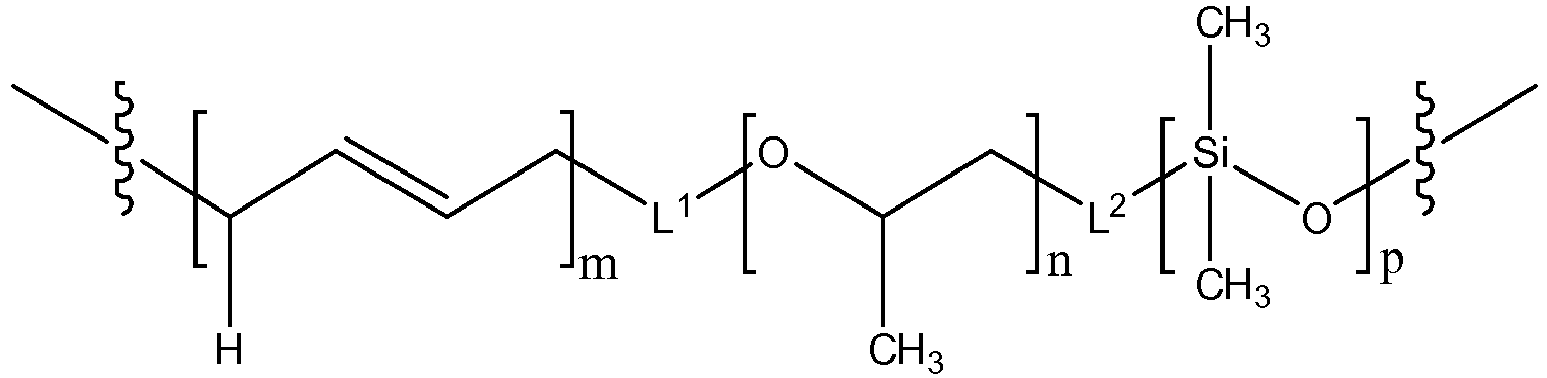
- one embodiment of the present invention provides a triblock copolymer of formula [polybutadiene][polyalkyl ether][polysiloxane].
- a provided triblock copolymer is of formula I: wherein the copolymers are chemically interspersed (bound) between urethane and/or urea linkages (i.e., at the bond designated with ) and wherein each of m, n, p, L 1 , L 2 , R 1 , R 2 , R 3 , and R 4 is as defined and described herein.
- m and p are each independently between 2 and 50 and n is between 2 and 20. In some embodiments, m and p are each independently between 2 and 30 and n is between 2 and 20. In certain embodiments, each of m, n, and p are independently from 8 to 16.
- each of R 1 , R 2 , R 3 , and R 4 is independently selected from one or more of halogen, R, OR, -CO 2 R, a fluorinated hydrocarbon, a polyether, a polyester or a fluoropolymer.
- one or more of R 1 , R 2 , R 3 , R 4 , R 5 and R 6 is -CO 2 R.
- one or more of R 1 , R 2 , R 3 , R 4 , R 5 and R 6 is -CO 2 R wherein each R is independently an optionally substituted C 1-6 aliphatic group.
- R 1 , R 2 , R 3 , and R 4 is -CO 2 R wherein each R is independently an unsubstituted C 1-6 alkyl group.
- R is independently an unsubstituted C 1-6 alkyl group.
- exemplary such groups include methanoic or ethanoic acid as well as methacrylic acid and other acrylic acids.
- R 1 , R 2 , R 3 , and R 4 is independently R. In some embodiments, one or more of R 1 , R 2 , R 3 , and R 4 is an optionally substituted C 1-6 aliphatic group. In certain embodiments, one or more of R 1 , R 2 , R 3 , and R 4 is an optionally substituted C 1-6 alkyl.
- one or more of R 1 , R 2 , R 3 , and R 4 is an optionally substituted group selected from phenyl, 8-10 membered bicyclic aryl, a 4-8 membered monocyclic saturated or partially unsaturated heterocyclic ring having 1-2 heteroatoms independently selected from nitrogen, oxygen, or sulphur, or 5-6 membered monocyclic or 8-10 membered bicyclic heteroaryl group having 1-4 heteroatoms independently selected from nitrogen, oxygen, or sulphur.
- R 1 , R 2 , R 3 , and R 4 groups include methyl, ethyl, propyl, isopropyl, cyclopropyl, butyl, isobutyl, cyclobutyl, phenyl, pyridyl, morpholinyl, pyrrolidinyl, imidazolyl, and cyclohexyl.
- one or more of R 1 , R 2 , R 3 , and R 4 is methyl, ethyl, propyl, or a higher homolog.
- R 2 is methyl, ethyl, propyl, or a higher homolog due to the relative hydrophobicity conferred on the polymer chain. Particularly preferred is R 2 being methyl.
- one or more of R 1 , R 2 , R 3 , and R 4 is independently -OR. In some embodiments, one or more of R 1 , R 2 , R 3 , and R 4 is -OR wherein R is an optionally substituted C 1-6 aliphatic group. In certain embodiments, one or more of R 1 , R 2 , R 3 , and R 4 is - OR wherein R is C 1-6 alkyl.
- R 1 , R 2 , R 3 , and R 4 is-OR wherein R is an optionally substituted group selected from phenyl, 8-10 membered bicyclic aryl, a 4-8 membered monocyclic saturated or partially unsaturated heterocyclic ring having 1-2 heteroatoms independently selected from nitrogen, oxygen, or sulphur, or 5-6 membered monocyclic or 8-10 membered bicyclic heteroaryl group having 1-4 heteroatoms independently selected from nitrogen, oxygen, or sulphur.
- R is an optionally substituted group selected from phenyl, 8-10 membered bicyclic aryl, a 4-8 membered monocyclic saturated or partially unsaturated heterocyclic ring having 1-2 heteroatoms independently selected from nitrogen, oxygen, or sulphur, or 5-6 membered monocyclic or 8-10 membered bicyclic heteroaryl group having 1-4 heteroatoms independently selected from nitrogen, oxygen, or sulphur.
- R 1 , R 2 , R 3 , R 4 , R 5 and R 6 groups include -Omethyl, -Oethyl, -Opropyl, -Oisopropyl, -Ocyclopropyl, -Obutyl, -Oisobutyl, - Ocyclobutyl, -Ophenyl, -Opyridyl, -Omorpholinyl, -Opyrrolidinyl, -Oimidazolyl, and - Ocyclohexyl.
- R 1 , R 2 , R 3 , and R 4 is independently R wherein each R is a C 1-6 aliphatic group substituted with one or more halogens. In some embodiments, each R is C 1-6 aliphatic substituted with one, two, or three halogens. In other embodiments, each R is a perfluorinated C 1-6 aliphatic group. Examples of fluorinated hydrocarbons represented by R 1 , R 2 , R 3 , and R 4 include mono-, di-, tri, or perfluorinated methyl, ethyl, propyl, butyl, or phenyl. In some embodiments, each of R 1 , R 2 , R 3 , and R 4 is trifluoromethyl, trifluoroethyl, or trifluoropropyl.
- one or more of R 1 , R 2 , R 3 , and R 4 is independently a polyether.
- polyethers represented by R 1 , R 2 , R 3 , and R 4 include poly(ethylene oxide), poly(difluoromethyl ethylene oxide), poly(trifluoromethyl ethylene oxide), poly(propylene oxide), poly(difluoromethyl propylene oxide), poly(propylene oxide), poly(trifluoromethyl propylene oxide), poly(butylene oxide), poly(tetramethylene ether glycol), poly(tetrahydrofuran), poly(oxymethylene), poly(ether ketone), poly(etherether ketone) and copolymers thereof.
- one or more of R 1 , R 2 , R 3 , R 4 , R 5 and R 6 is independently a polyester.
- polyesters represented by R 1 , R 2 , R 3 , R 4 , R 5 and R 6 include poly(ethylene terephthalate) (PET), poly(ethylene terephthalate ionomer) (PETI), poly(ethylene naphthalate) (PEN), poly(methylene naphthalate) (PTN), poly(butylene teraphalate) (PBT), poly(butylene naphthalate) (PBN), polycarbonate.
- one or more of R 1 , R 2 , R 3 , R 4 , R 5 and R 6 is independently a fluoropolymer.
- fluoropolymers represented by R 1 , R 2 , R 3 , R 4 , R 5 and R 6 include poly(tetrafluoroethylene), poly(methyl di-fluoroethyl siloxane), poly(methyl tri-fluoroethyl siloxane), poly(phenyl di-fluoroethyl siloxane).
- R 1 , R 2 , R 3 , and R 4 is independently hydrogen, hydroxyl, carboxylic acids such as methanoic or ethanoic acid as well as methacrylic acid and other acrylic acids.
- Alkyl or aryl hydrocarbons such as methyl, ethyl, propyl, butyl, phenyl and ethers thereof.
- Fluorinated hydrocarbons such as mono-, di-, tri, or perfluorinated methyl, ethyl, propyl, butyl, phenyl.
- Polyether such as Poly(ethylene oxide), poly(difluoromethyl ethylene oxide), poly(trifluoromethyl ethylene oxide), poly(propylene oxide), poly(difluoromethyl propylene oxide), poly(propylene oxide), poly(trifluoromethyl propylene oxide), poly(butylene oxide), poly(tetramethylene ether glycol), poly(tetrahydrofuran), poly(oxymethylene), poly(ether ketone), poly(etherether ketone) and copolymers thereof.
- Polyesters such as Poly(ethylene terephthalate) (PET), poly(ethylene terephthalate ionomer) (PETI), poly(ethylene naphthalate) (PEN), poly(methylene naphthalate) (PTN), Poly(Butylene Teraphalate) (PBT), poly(butylene naphthalate) (PBN), polycarbonate and .fluoropolymer such as Poly(tetrafluoroethylene), poly(methyl di-fluoroethyl siloxane), poly(methyl tri-fluoroethyl siloxane), poly(phenyl di-fluoroethyl siloxane).
- R 1 is hydrogen. In some embodiments, R 1 is halogen. In certain embodiments, R 1 is chloro or fluoro. In some embodiments, R 1 is an optionally substituted C 1-6 alkyl. In certain embodiments, R 1 is methyl.
- R 2 is hydrogen. In some embodiments, R 2 is an optionally substituted C 1-6 alkyl. In certain embodiments, R 2 is methyl, ethyl, propyl, or a higher homolog due to the relative hydrophobicity conferred on the polymer chain. Particularly preferred is R 2 being methyl.
- R 3 is an optionally substituted C 1-6 alkyl. In certain embodiments, R 3 is methyl. In certain embodiments, R 3 is -CH 2 CH 2 F. In some embodiments, R 3 is halogen. In certain embodiments, R 3 is fluoro. In some embodiments, R 3 is phenyl.
- R 4 is an optionally substituted C 1-6 alkyl. In certain embodiments, R 4 is methyl. In certain embodiments, R 4 is -CH 2 CH 2 F. In some embodiments, R 4 is halogen. In certain embodiments, R 4 is fluoro. In some embodiments, R 4 is phenyl
- each of L 1 and L 2 is independently a bivalent C 1-20 hydrocarbon chain wherein 1-4 methylene units of the hydrocarbon chain are optionally and independently replaced by -O-, -S-, -NHC(O)O-, -NHC(O)NH-, -N(R)-, -C(O)-, -C(O)N(R)-, - N(R)C(O)-, -SO2-, -SO 2 N(R)-, -N(R)SO 2 -, -OC(O)-, -C(O)O-, or a bivalent cycloalkylene, arylene, heterocyclene, or heteroarylene.
- each of L 1 and L 2 is independently a bivalent C 1-20 alkylene chain. In certain embodiments, each of L 1 and L 2 is independently a bivalent C 1-10 alkylene chain. In certain embodiments, each of L 1 and L 2 is independently a bivalent C 1-6 alkylene chain. In certain embodiments, each of L 1 and L 2 is independently a bivalent C 1-4 alkylene chain. Exemplary such L 1 and L 2 groups include methylene, ethylene, propylene, butylene or higher bivalent alkanes.
- each of L 1 and L 2 is independently a bivalent C 1-20 alkylene chain wherein one methylene unit of the chain is replaced by -O-. In some embodiments, each of L 1 and L 2 is independently a bivalent C 1-10 alkylene chain wherein one methylene unit of the chain is replaced by -O-. In some embodiments, each of L 1 and L 2 is independently a bivalent C 1-6 alkylene chain wherein one methylene unit of the chain is replaced by -O-. In some embodiments, each of L 1 and L 2 is independently a bivalent C 1-4 alkylene chain wherein one methylene unit of the chain is replaced by -O-.
- L 1 and L 2 groups include -OCH 2 -, -OCH 2 CH 2 -, -OCH 2 CH 2 CH 2 -, -OCH 2 CH 2 CH 2 CH 2 -, or higher bivalent alkylene ethers.
- each of L 1 and L 2 is independently a bivalent C 1-20 alkylene chain wherein at least one methylene unit of the chain is replaced by -O- and at least one methylene unit of the chain is replaced by a bivalent arylene. In some embodiments, each of L 1 and L 2 is independently a bivalent C 1-10 alkylene chain wherein at least one methylene unit of the chain is replaced by -O- and at least one methylene unit of the chain is replaced by a bivalent arylene.
- each of L 1 and L 2 is independently a bivalent C 1-6 alkylene chain wherein at least one methylene unit of the chain is replaced by -O- and at least one methylene unit of the chain is replaced by a bivalent arylene. In some embodiments, each of L 1 and L 2 is independently a bivalent C 1-4 alkylene chain wherein at least one methylene unit of the chain is replaced by -O- and at least one methylene unit of the chain is replaced by a bivalent arylene.
- L 1 and L 2 groups include -OCH 2 -phenylene-, -OCH 2 CH 2 -phenylene-, -OCH 2 CH 2 -phenylene-CH 2 -, -OCH 2 CH 2 CH 2 CH 2 --phenylene-, and the like.
- each of L 1 and L 2 is independently a bivalent C 1-20 alkylene chain wherein three methylene units of the chain are replaced by -N(R)C(O)N(R)-, - N(R)C(O)O-, or -OC(O)N(R)-.
- each of L 1 and L 2 is independently a bivalent C 1-10 alkylene chain wherein one methylene unit of the chain is replaced by -O-.
- each of L 1 and L 2 is independently a bivalent C 1-6 alkylene chain wherein one methylene unit of the chain are replaced by -N(R)C(O)N(R)-, -N(R)C(O)O-, or - OC(O)N(R)-.
- each of L 1 and L 2 is independently a bivalent C 1-4 alkylene chain wherein one methylene unit of the chain are replaced by -N(R)C(O)N(R)-, -N(R)C(O)O-, or -OC(O)N(R)-.
- Exemplary such L 1 and L 2 groups include -N(H)C(O)N(H)-, -N(H)C(O)O-, and -OC(O)N(H)-.
- L 1 is a urethane.
- L 2 is -CH 2 CH 2 -.
- R 1 and R 2 is methyl.
- one or both of R 3 and R 4 is independently a C 1-20 hydrocarbon chain wherein 1-4 methylene units of the hydrocarbon chain are optionally and independently substituted by halogen.
- R 3 is a C 1-20 hydrocarbon chain wherein 1-4 methylene units of the hydrocarbon chain are optionally and independently substituted by halogen.
- R 4 is a C 1-20 hydrocarbon chain wherein 1-4 methylene units of the hydrocarbon chain are optionally and independently substituted by halogen.
- R 3 and R 4 are independently a C 1-20 hydrocarbon chain wherein 1-4 methylene units of the hydrocarbon chain are optionally and independently substituted by halogen.
- R 3 and R 4 is independently a C 1-20 hydrocarbon chain.
- R 3 is a C 1-20 hydrocarbon chain.
- R 4 is a C 1-20 hydrocarbon chain.
- R 3 and R 4 are independently a C 1-20 hydrocarbon chain.
- L 1 and L 2 are independently a bivalent C 1-20 hydrocarbon chain wherein 1-4 methylene units of the hydrocarbon chain are optionally and independently replaced by -NHC(O)O- or -NHC(O)NH-.
- L 1 is -NHC(O)O- or -NHC(O)NH-.
- L 2 is a C 1-20 hydrocarbon chain.
- R 1 and R 2 are methyl
- one or both of R 3 and R 4 is independently a C 1-20 hydrocarbon chain wherein 1-4 methylene units of the hydrocarbon chain are optionally and independently substituted by halogen
- L 1 and L 2 are independently a bivalent C 1-20 hydrocarbon chain wherein 1-4 methylene units of the hydrocarbon chain are optionally and independently replaced by -NHC(O)O- or -NHC(O)NH-.
- R 1 and R 2 are methyl, one or both of R 3 and R 4 is independently a C 1-20 hydrocarbon chain wherein 1-4 methylene units of the hydrocarbon chain are optionally and independently substituted by halogen, L 1 is -NHC(O)O- or -NHC(O)NH-, and L 2 is a C 1-20 hydrocarbon chain.
- R 1 and R 2 are methyl, one or both of R 3 and R 4 is independently a C 1-20 hydrocarbon chain, L 1 is -NHC(O)O- or -NHC(O)NH-, and L 2 is a C 1-20 hydrocarbon chain.
- each of m, n, p, L 1 , L 2 , R 1 , R 2 , R 3 , and R 4 is as defined and described herein.
- each of R x and R y is independently -OH, -NH 2 , a protected hydroxyl or a protected amine. In some embodiments, both of R x and R y are -OH. In other embodiments, both of R x and R y are -NH 2 . In some embodiments one of R x and R y is -OH and the other is -NH 2 .
- each of R x and R y is independently a protected hydroxyl or a protected amine.
- protected hydroxyl and protected amine groups are well known to one of skill in the art and include those described in detail in Protecting Groups in Organic Synthesis, T. W. Greene and P. G. M. Wuts, 3rd edition, John Wiley & Sons, 1999 , the entirety of which is incorporated herein by reference.
- Exemplary protected amines include methyl carbamate, ethyl carbamante, 9-fluorenylmethyl carbamate (Fmoc), 9-(2-sulfo)fluorenylmethyl carbamate, 9-(2,7-dibromo)fluoroenylmethyl carbamate, 2,7-di-t-butyl-[9-(10,10-dioxo-10,10,10,10-tetrahydrothioxanthyl)]methyl carbamate (DBD-Tmoc), 4-methoxyphenacyl carbamate (Phenoc), 2,2,2-trichloroethyl carbamate (Troc), 2-trimethylsilylethyl carbamate (Teoc), 2-phenylethyl carbamate (hZ), 1-(1-adamantyl)-1-methylethyl carbamate (Adpoc), 1,1-dimethyl-2-haloethyl carbamate, 1,1-di
- Exemplary hydroxyl protecting groups include methyl, methoxylmethyl (MOM), methylthiomethyl (MTM), t-butylthiomethyl, (phenyldimethylsilyl)methoxymethyl (SMOM), benzyloxymethyl (BOM), p-methoxybenzyloxymethyl (PMBM), (4-methoxyphenoxy)methyl (p-AOM), guaiacolmethyl (GUM), t-butoxymethyl, 4-pentenyloxymethyl (POM), siloxymethyl, 2-methoxyethoxymethyl (MEM), 2,2,2-trichloroethoxymethyl, bis(2-chloroethoxy)methyl, 2-(trimethylsilyl)ethoxymethyl (SEMOR), tetrahydropyranyl (THP), 3-bromotetrahydropyranyl, tetrahydrothiopyranyl, 1-methoxycyclohexyl, 4-methoxytetrahydropyranyl (MTHP), 4-methoxyte
- the protecting groups include methylene acetal, ethylidene acetal, 1-t-butylethylidene ketal, 1-phenylethylidene ketal, (4-methoxyphenyl)ethylidene acetal, 2,2,2-trichloroethylidene acetal, acetonide, cyclopentylidene ketal, cyclohexylidene ketal, cycloheptylidene ketal, benzylidene acetal, p-methoxybenzylidene acetal, 2,4-dimethoxybenzylidene ketal, 3,4-dimethoxybenzylidene acetal, 2-nitrobenzylidene acetal, methoxymethylene acetal, ethoxymethylene acetal, dimethoxymethylene ortho ester, 1-methoxyethylidene ortho ester,
- hydroxyl and amine protecting groups can be such that these groups are removed at the same time (e.g., when both protecting groups are acid labile or base labile).
- such groups can be removed in a step-wise fashion (e.g., when one protecting group is removed first by one set of removal conditions and the other protecting group is removed second by a different set of removal conditions).
- the present invention provides a compound of any of formulae II-a, II-b, II-c, and II-d : wherein each of m, n, p, L 1 , L 2 , R 1 , R 2 , R 3 , and R 4 is as defined and described herein.
- Exemplary triblock copolymers of the present invention include: and wherein each of L 1 , L 2 , m, n, and p is as defined and described herein.
- the present invention provides a polymer foam, comprising:
- the invention further provides a pre-formed soft segment of the formula I as defined above.
- the present invention provides a polyurethane/urea foam comprising a soft segment triblock copolymer of formula I.
- the present invention provides a viscoelastic biostable foam, comprising:
- polyurethanes and/or polyureas comprising a triblock copolymer of the present invention are stable to gastric fluid.
- Such polyurethanes and polyureas prepared using triblock copolymers of the present invention are viscoelastic and stable to gastric fluid.
- a provided viscoelastic material is a foam.
- a provided biostable foam is stable to gastric fluid. In some embodiments, a provided biostable foam is stable to gastric fluid for at least one year. In some embodiments, a provided biostable foam is stable to gastric fluid for at least 3 months, for at least 4 months, for at least 5 months, for at least 6 months, for at least 7 months, for at least 8 months, for at least 9 months, for at least 10 months, for at least 11 months, or for at least one year. Methods for determining stability of a provided biostable foam are known in the art utilizing simulated gastric fluid and include those described in detail in the Exemplification, infra.
- a provided viscoelastic foam comprising a triblock copolymer of the present invention, is characterized in that the foam takes up less than about 30% by weight of water at equilibrium. In certain embodiments, a provided viscoelastic foam takes up less than about 5%, less than about 10%, less than about 15%, less than about 20%, less than about 25%, or less than about 30% by weight of water at equilibrium.
- chemical stability i.e., in gastric fluid and therefore at very low pH
- hyrophobicity i.e., water uptake of less than about 30% by weight
- siloxane polymer that are utilized in, e.g., the manufacture of contact lenses require a water uptake of 50-120%.
- the present invention provides a viscoelastic foam comprising a triblock copolymer of the present invention. It was suprisingly found that a provided foam has a high elongation capacity and the ability to recover very slowly following elongation. Indeed, it was found that a provided viscoelastic foam has an elongation capacity of about 200-1200%. In some embodiments, a provided viscoelastic foam has an elongation capacity of about 500%.
- a provided viscoelastic foam has a tensile strength of about 0.1 to about 1.0 MPa. In certain embodiments, a provided viscoelastic foam has a tensile strength of about 0.25 to about 0.5 MPa.
- a provided viscoelastic foam has a Young's Modulus of about 0.05 to about 1.0 MPa. In certain embodiments, a provided viscoelastic foam has a Young's Modulus of about 0.05 to about 0.5 MPa.
- a foam of varying densities can be prepared.
- a valve having a thinner wall would require a foam having a higher density than a similar valve having a thicker wall in order to result in each valve having a similar physical characteristic (e.g., tensile strength, and the like).
- a provided viscoelastic foam has a density of 0.1 to 1.5 g/cm 3 .
- a provided viscoelastic foam has a density of 0.3 to 1.2 g/cm 3 .
- a provided viscoelastic foam has a density of 0.8 to 0.9 g/cm 3 . In some embodiments, a provided viscoelastic foam has a density of 0.5 to 0.6 g/cm 3 .
- Example 1 Synthesis of a hydroxyl terminated, triblock copolymer based on polybutadiene, polyalkylether and poly(trifluoromethyl siloxane)
- Step 1 synthesis of a fluorosiloxane based triblock copolymer pre-soft-segment:
- silanol terminated poly(trifluoropropyl methyl siloxane) is converted into its dihydride derivative.
- this dihydride derivative is reacted with the allyl terminated poly(propylene glycol).
- Example 2 Preparation of polyurethane foam from the triblock copolymer of example 1:
- the process for preparing the foam was a two-step procedure:
- Example 3 Preparation of a thermoplastic polyurethane from the triblock copolymer of example 1:
- the final product has the formula:
- Example 4 Synthesis of a triblock copolymer based on polybutadiene, polyalkylether and poly(dimethyl siloxane)
- Step 1 Synthesis of a dimethylsiloxane based triblock copolymer pre-soft-segment:
- Example 5 Preparation of a crosslinked water blown foam from the triblock copolymer of example 4:
- the process for preparing the foam was a two-step procedure:
- Example 6 Preparation of a thermoplastic polyurethane from the triblock copolymer of example 4
- the final product has the formula:
- Devices for use in the gastrointestinal system have historically not been made from specifically designed materials. Off the shelf materials used for application in the corrosive environment of the stomach have limited biostability and generally lose their functionality after a short time.
- the foam of the invention can be used for production of a valve of the type described in our US 2007/0198048 , the entire contents of which are incorporated herein by reference. In certain embodiments, the foam of the invention can be used for production of a valve of the type described in our US 2010/0137998 , the entire contents of which are incorporated herein by reference.
- the valve has an open position and a closed position. The valve will have a proximal end and a distal end. The valve material can open from the proximal direction when the action of swallowing (liquid or solid) stretches an oriface by between 100% and 3000% in circumference.
- the open orifice optionally closes non-elastically over a prolonged period of time, thus mimicing the body's natural response.
- the duration taken to close may be between 2 and 15 sec.
- the material can stretch to between 100% - 300% from the distal direction when gas, liquid or solids exceeds a pre-determined force of between 25cmH 2 O and 60cmH 2 O.
- the material absorbs less than 15% of its own mass of water at equilibrium.
- the material loses (leaches) less than 3% of it's own mass at equilibrium in water or alcohol.
- the material loses less than 10% of its tensile strength when immersed in a simulated gastric fluid at pH 1.2 for 30 days.
- the valve material loses less than 25% of its % elongation when immersed in a simulated gastric fluid at pH 1.2 for 30 days.
- thermoplastic material of the invention may be applied to a medical device as a coating or additionally may be extruded into a specific shape.
- a solution of the thermoplastic polyurethane may be applied to a stent or other device, which is held on a PTFE mandrel.
- a continuous coating will be formed through the evaporation of the carrier solvent. This will in turn provide a protective coating to a stent ot other medical device.
- thermoplastic polyurethane By evaporation of the solvent used in the production of the thermoplastic polyurethane a solid polymer suitable for extrusion can be formed.
- the polymer produced in example 2 may be extruded at 190°C with 5Kg of force resulting in a Melt Flow Index (ISO 1133) of 0.475g/10mins.
- ISO 1133 Melt Flow Index
- Such an extrusion could be used to build a catheter or other tubular device.
- the healthy lower esophageal sphincter remains closed until an individual induces relaxation of the muscle by swallowing and thus allowing food to pass in the antegrade direction. Additionally when an individual belches or vomits they generate enough pressure in the stomach in the retrograde direction to overcome the valve. An anti-reflux valve must enable this functionality when placed in the body, thus a simple functional test is carried out to asses performance.
- the test apparatus consists of a 1m high vertical tube to which is connected a peristaltic pump and a fitting that is designed to house the valve to be tested.
- the valve to be tested is placed in a water bath at 37 °C for 30 minutes to allow its temperature to equilibrate. Once the temperature of the valve has equilibrated it is then installed into the housing such that the distal closed end of the valve faces the inside of the test apparatus.
- the pump is then switched on at a rate of 800 ml/min to begin filling the vertical tube.
- the rising column of water exerts a pressure that forces the valve shut initially. As the pressure in the column rises the valve reaches a point where it everts and allows the water to flow through. This point, known as the yield pressure, is then recorded and the test repeated four times.
- the lower oesophagus of a normal patient can be exposed to the acidic contents of the stomach periodically without any adverse side effects.
- patients with gastro esophageal reflux disease experience damage to the mucosa of the lower oesophagus due to increased exposure to the gastric contents.
- Exposure of the lower oesophagus to acidic gastric contents is routinely measured in the clinic using dedicated pH measurement equipment. A typical procedure involves measuring pH over a 24-hour period.
- the levels of acid exposure in pathological reflux disease patients is summarised in Table 3 from six clinical references. See DeMeester TR, Johnson LF, Joseph GJ, et al. Patterns of Gastroesophageal Reflux in Health and Disease Ann. Surg.
Landscapes
- Health & Medical Sciences (AREA)
- Chemical & Material Sciences (AREA)
- Chemical Kinetics & Catalysis (AREA)
- Medicinal Chemistry (AREA)
- Organic Chemistry (AREA)
- Polymers & Plastics (AREA)
- Epidemiology (AREA)
- Life Sciences & Earth Sciences (AREA)
- Animal Behavior & Ethology (AREA)
- General Health & Medical Sciences (AREA)
- Public Health (AREA)
- Veterinary Medicine (AREA)
- Transplantation (AREA)
- Oral & Maxillofacial Surgery (AREA)
- Dermatology (AREA)
- Pharmaceuticals Containing Other Organic And Inorganic Compounds (AREA)
- Polyurethanes Or Polyureas (AREA)
- Materials For Medical Uses (AREA)
- Other Resins Obtained By Reactions Not Involving Carbon-To-Carbon Unsaturated Bonds (AREA)
- Polyesters Or Polycarbonates (AREA)
Claims (18)
- Copolymère tribloc selon la formule I :
 chaquereprésente un point de fixation à une liaison uréthane ou urée ;
 chacun de R1, R2, R3 et R4 est sélectionné indépendamment parmi un ou plusieurs d'un groupe halogène, R, OR, -CO2R, d'un hydrocarbure fluoré, d'un polyéther, d'un polyester ou d'un fluoropolymère ;chaque groupe R est indépendamment un atome d'hydrogène, un groupe aliphatique C1-20 optionnellement substitué, ou un groupe optionnellement substitué sélectionné parmi un groupe phényle, un groupe aryle bicyclique à 8 à 10 chaînons, un cycle hétérocyclique saturé ou partiellement insaturé monocyclique à 4 à 8 chaînons comportant 1 ou 2 hétéroatomes sélectionnés indépendamment parmi un atome d'azote, d'oxygène ou de soufre, ou un groupe hétéroaryle monocyclique à 5 ou 6 chaînons ou bicyclique à 8 à 10 chaînons comportant 1 à 4 hétéroatomes sélectionnés indépendamment parmi un atome d'azote, d'oxygène ou de soufre ;chacun de m, n et p vaut indépendamment 2 à 100 ; etchacun de L1 et L2 est indépendamment une chaîne hydrocarbonée bivalente C1-20, 1 à 4 unités méthylène de la chaîne hydrocarbonée étant optionnellement et indépendamment remplacées par un groupe -O-, -S-, -N(R)C(O)O-, -N(R)C(O)N(R)-, -OC(O)N(R)-, -N(R)-, - C(O)-, -C(O)N(R)-, -N(R)C(O)-, -SO2-, -SO2N(R)-, - N(R)SO2-, -OC(O)-, -C(O)O-, ou un groupe cycloalkylène, arylène, hétérocyclène ou hétéroarylène bivalent,
et dans laquelle L1 est un groupe -NHC(O)O- ou - NHC(O)NH-. - Copolymère selon la revendication 1, dans lequel R1 et R2 sont un groupe méthyle, l'un de R3 et R4 ou à la fois R3 et R4 sont indépendamment une chaîne hydrocarbonée C1-20, 1 à 4 unités méthylène de la chaîne hydrocarbonée étant optionnellement et indépendamment remplacées par un groupe halogène, et L2 est une chaîne hydrocarbonée bivalente C1-20, 1 à 4 unités méthylène de la chaîne hydrocarbonée étant optionnellement et indépendamment remplacées par un groupe -NHC(O)O- ou - NHC(O)NH-.
- Copolymère selon la revendication 1, dans lequel R1 et R2 sont un groupe méthyle, l'un de R3 et R4 ou à la fois R3 et R4 sont indépendamment une chaîne hydrocarbonée C1-20, 1 à 4 unités méthylène de la chaîne hydrocarbonée étant optionnellement et indépendamment remplacées par un groupe halogène, et L2 est une chaîne hydrocarbonée C1-20.
- Copolymère selon la revendication 1, dans lequel R1 et R2 sont un groupe méthyle, l'un de R3 et R4 ou à la fois R3 et R4 sont indépendamment une chaîne hydrocarbonée C1-20, et L2 est une chaîne hydrocarbonée C1-20.
- Copolymère selon la revendication 1, dans lequel m et p valent chacun indépendamment de 2 à 50 et n vaut de 2 à 20.
- Copolymère selon la revendication 1, dans lequel R1 est un atome d'hydrogène ou un groupe méthyle, chloro ou fluoro, et/ou dans lequel R2 est un atome d'hydrogène ou un groupe méthyle, et/ou dans lequel R3 est un groupe méthyle, phényle, fluoro, ou -CH2CH2F, et/ou dans lequel R4 est un groupe méthyle, phényle, fluoro, ou -CH2CH2F.
- Copolymère selon l'une quelconque des revendications précédentes, dans lequel L2 est une chaîne alkylène bivalente C1-20.
- Copolymère selon l'une quelconque des revendications précédentes, dans lequel L2 est un groupe -OCH2-, -OCH2CH2-, -OCH2CH2CH2-, ou -OCH2CH2CH2CH2-.
- Copolymère selon l'une quelconque des revendications précédentes, dans lequel L2 est une chaîne alkylène bivalente C1-6 dans laquelle au moins une unité méthylène de la chaîne est remplacée par un groupe -O- et au moins une unité méthylène de la chaîne est remplacée par un groupe arylène bivalent.
- Copolymère selon la revendication 1, dans lequel L2 est une chaîne hydrocarbonée bivalente C1-20 dans laquelle 1 à 4 unités méthylène de la chaîne hydrocarbonée sont optionnellement et indépendamment remplacées par un groupe -N(H)C(O)N(H)-, -N(H)C(O)O-, ou -OC(O)N(H)-.
- Copolymère selon la revendication 1, dans lequel L1 est un groupe uréthane, et/ou dans lequel L2 est un groupe -CH2CH2-.
- Copolymère selon la revendication 1, sélectionné parmi :

- Mousse biostable viscoélastique comprenant le copolymère tribloc selon l'une quelconque des revendications précédentes.
- Mousse biostable viscoélastique selon la revendication 13, ladite mousse étant stable au fluide gastrique pendant au moins 3 mois, pendant au moins 4 mois, pendant au moins 5 mois, pendant au moins 6 mois, pendant au moins 7 mois, pendant au moins 8 mois, pendant au moins 9 mois, pendant au moins 10 mois, pendant au moins 11 mois, ou pendant au moins un an.
- Mousse biostable viscoélastique selon la revendication 13 ou 14, ladite mousse absorbant moins d'environ 5 %, moins d'environ 10 %, moins d'environ 15 %, moins d'environ 20 %, moins d'environ 25 %, ou moins d'environ 30 % en poids d'eau au point d'équilibre.
- Mousse biostable viscoélastique selon l'une quelconque des revendications 13 à 15, ladite mousse ayant une capacité d'allongement d'environ 200 à 1 200 %.
- Mousse biostable viscoélastique selon l'une quelconque des revendications 13 à 16, ladite mousse ayant une résistance à la traction d'environ 0,1 à environ 1,0 Mpa.
- Mousse biostable viscoélastique selon l'une quelconque des revendications 13 à 17, ladite mousse ayant une densité de 0,1 à 1,5 g/cm3.
Priority Applications (1)
| Application Number | Priority Date | Filing Date | Title |
|---|---|---|---|
| EP18159907.7A EP3360916A1 (fr) | 2009-12-18 | 2010-12-17 | Biomatériau |
Applications Claiming Priority (2)
| Application Number | Priority Date | Filing Date | Title |
|---|---|---|---|
| US28790909P | 2009-12-18 | 2009-12-18 | |
| PCT/IE2010/000073 WO2011073967A1 (fr) | 2009-12-18 | 2010-12-17 | Biomatériau |
Related Child Applications (1)
| Application Number | Title | Priority Date | Filing Date |
|---|---|---|---|
| EP18159907.7A Division EP3360916A1 (fr) | 2009-12-18 | 2010-12-17 | Biomatériau |
Publications (2)
| Publication Number | Publication Date |
|---|---|
| EP2513200A1 EP2513200A1 (fr) | 2012-10-24 |
| EP2513200B1 true EP2513200B1 (fr) | 2018-03-07 |
Family
ID=44151971
Family Applications (2)
| Application Number | Title | Priority Date | Filing Date |
|---|---|---|---|
| EP10801702.1A Active EP2513200B1 (fr) | 2009-12-18 | 2010-12-17 | Biomatériau |
| EP18159907.7A Withdrawn EP3360916A1 (fr) | 2009-12-18 | 2010-12-17 | Biomatériau |
Family Applications After (1)
| Application Number | Title | Priority Date | Filing Date |
|---|---|---|---|
| EP18159907.7A Withdrawn EP3360916A1 (fr) | 2009-12-18 | 2010-12-17 | Biomatériau |
Country Status (9)
| Country | Link |
|---|---|
| US (1) | US8772429B2 (fr) |
| EP (2) | EP2513200B1 (fr) |
| JP (1) | JP5753187B2 (fr) |
| AU (1) | AU2010331818B2 (fr) |
| CA (1) | CA2784126C (fr) |
| DK (1) | DK2513200T3 (fr) |
| ES (1) | ES2671551T3 (fr) |
| PT (1) | PT2513200T (fr) |
| WO (1) | WO2011073967A1 (fr) |
Cited By (16)
| Publication number | Priority date | Publication date | Assignee | Title |
|---|---|---|---|---|
| US10856984B2 (en) | 2017-08-25 | 2020-12-08 | Neovasc Tiara Inc. | Sequentially deployed transcatheter mitral valve prosthesis |
| US10940001B2 (en) | 2012-05-30 | 2021-03-09 | Neovasc Tiara Inc. | Methods and apparatus for loading a prosthesis onto a delivery system |
| US11311376B2 (en) | 2019-06-20 | 2022-04-26 | Neovase Tiara Inc. | Low profile prosthetic mitral valve |
| US11357622B2 (en) | 2016-01-29 | 2022-06-14 | Neovase Tiara Inc. | Prosthetic valve for avoiding obstruction of outflow |
| US11389291B2 (en) | 2013-04-04 | 2022-07-19 | Neovase Tiara Inc. | Methods and apparatus for delivering a prosthetic valve to a beating heart |
| US11413139B2 (en) | 2011-11-23 | 2022-08-16 | Neovasc Tiara Inc. | Sequentially deployed transcatheter mitral valve prosthesis |
| US11419720B2 (en) | 2010-05-05 | 2022-08-23 | Neovasc Tiara Inc. | Transcatheter mitral valve prosthesis |
| US11464631B2 (en) | 2016-11-21 | 2022-10-11 | Neovasc Tiara Inc. | Methods and systems for rapid retraction of a transcatheter heart valve delivery system |
| US11491006B2 (en) | 2019-04-10 | 2022-11-08 | Neovasc Tiara Inc. | Prosthetic valve with natural blood flow |
| US11497602B2 (en) | 2012-02-14 | 2022-11-15 | Neovasc Tiara Inc. | Methods and apparatus for engaging a valve prosthesis with tissue |
| US11602429B2 (en) | 2019-04-01 | 2023-03-14 | Neovasc Tiara Inc. | Controllably deployable prosthetic valve |
| US11737872B2 (en) | 2018-11-08 | 2023-08-29 | Neovasc Tiara Inc. | Ventricular deployment of a transcatheter mitral valve prosthesis |
| US11779742B2 (en) | 2019-05-20 | 2023-10-10 | Neovasc Tiara Inc. | Introducer with hemostasis mechanism |
| US11998447B2 (en) | 2019-03-08 | 2024-06-04 | Neovasc Tiara Inc. | Retrievable prosthesis delivery system |
| US12109111B2 (en) | 2015-12-15 | 2024-10-08 | Neovasc Tiara Inc. | Transseptal delivery system |
| US12611303B2 (en) | 2022-07-21 | 2026-04-28 | Neovasc Tiara Inc. | Transcatheter mitral valve prosthesis |
Families Citing this family (5)
| Publication number | Priority date | Publication date | Assignee | Title |
|---|---|---|---|---|
| WO2011073968A1 (fr) * | 2009-12-18 | 2011-06-23 | Vysera Biomedical Limited | Système d'administration de médicament |
| IE20100789A1 (en) | 2009-12-18 | 2011-08-03 | Vysera Biomedical Ltd | A medical device |
| RU2727037C2 (ru) | 2010-11-03 | 2020-07-17 | Колопласт А/С | Урологическое устройство |
| CN104114128A (zh) | 2011-12-19 | 2014-10-22 | 维斯拉生物医药有限公司 | 内腔假体和胃肠植入装置 |
| CN103087286B (zh) * | 2013-01-07 | 2015-04-01 | 中国科学院过程工程研究所 | 一种水性聚氨酯弹性分散体及其制备方法 |
Family Cites Families (21)
| Publication number | Priority date | Publication date | Assignee | Title |
|---|---|---|---|---|
| DE3011304A1 (de) * | 1980-03-24 | 1981-10-08 | Henkel KGaA, 4000 Düsseldorf | Schaumdaempfungsmittel und dessen verwendung in kunstharz-, lack- und farbdispersionen |
| JPS61257A (ja) * | 1984-06-12 | 1986-01-06 | Takeda Chem Ind Ltd | 揺変性ポリウレタン樹脂組成物 |
| JPS61216A (ja) * | 1983-12-09 | 1986-01-06 | ロジヤ−ス・コ−ポレ−シヨン | 複合ブロツク多元重合体界面活性剤及びこれを使用したポリウレタン発泡体 |
| US5235003A (en) * | 1985-01-04 | 1993-08-10 | Thoratec Laboratories Corporation | Polysiloxane-polylactone block copolymers |
| DE3523311A1 (de) * | 1985-06-29 | 1987-01-02 | Bayer Ag | Neue kautschukpolymere mit blockartiger struktur |
| US5472686A (en) * | 1990-12-28 | 1995-12-05 | Nippon Unicar Company Limited | Cosmetic formulations |
| CA2134087C (fr) * | 1992-04-24 | 2007-07-17 | Robert S. Ward | Copolymeres et pellicule non poreuse, semi-permeable de ce produit et son utilisation pour la permeation de molecules d'une plage de poids moleculaires predetermines |
| ATE175034T1 (de) * | 1993-08-26 | 1999-01-15 | Ciba Geigy Ag | Flüssige strahlungshärtbare zusammensetzung, insbesondere für die stereolithographie |
| US6140452A (en) * | 1994-05-06 | 2000-10-31 | Advanced Bio Surfaces, Inc. | Biomaterial for in situ tissue repair |
| JP3697930B2 (ja) * | 1999-03-25 | 2005-09-21 | 東海ゴム工業株式会社 | ジエン系ゴム組成物 |
| IL133196A0 (en) | 1999-11-29 | 2001-03-19 | Yissum Res Dev Co | Gastroretentive controlled release pharmaceutical dosage forms |
| EP1456269B1 (fr) * | 2001-11-29 | 2016-07-20 | Huntsman International Llc | Polyurethannes viscoelastiques |
| US7687586B2 (en) | 2003-05-21 | 2010-03-30 | Isense Corporation | Biosensor membrane material |
| WO2005060882A1 (fr) * | 2003-12-09 | 2005-07-07 | Gi Dynamics, Inc. | Dispositif s'ancrant dans le tube digestif et son procede d'ancrage |
| DE102004028322A1 (de) * | 2004-06-11 | 2005-12-29 | Wacker-Chemie Gmbh | Verfahren zur Modifizierung faserartiger Substrate mit Siloxancopolymeren |
| US20080027201A1 (en) * | 2004-06-15 | 2008-01-31 | Iskender Yilgor | Segmented urea and siloxane copolymers and their preparation methods |
| EP1968487B1 (fr) | 2005-12-23 | 2019-06-26 | Coloplast A/S | Dispositif medical |
| US7834082B2 (en) * | 2007-01-17 | 2010-11-16 | Bayer Materialscience Llc | Polyether-polysiloxane polyols |
| DK2296581T3 (en) * | 2008-06-20 | 2018-02-26 | Coloplast As | biomaterial |
| WO2009153771A1 (fr) | 2008-06-20 | 2009-12-23 | Vysera Biomedical Limited | Clapet oesophagien |
| WO2011073968A1 (fr) * | 2009-12-18 | 2011-06-23 | Vysera Biomedical Limited | Système d'administration de médicament |
-
2010
- 2010-12-17 CA CA2784126A patent/CA2784126C/fr active Active
- 2010-12-17 JP JP2012543993A patent/JP5753187B2/ja active Active
- 2010-12-17 ES ES10801702.1T patent/ES2671551T3/es active Active
- 2010-12-17 US US12/971,384 patent/US8772429B2/en active Active
- 2010-12-17 EP EP10801702.1A patent/EP2513200B1/fr active Active
- 2010-12-17 PT PT108017021T patent/PT2513200T/pt unknown
- 2010-12-17 DK DK10801702.1T patent/DK2513200T3/en active
- 2010-12-17 WO PCT/IE2010/000073 patent/WO2011073967A1/fr not_active Ceased
- 2010-12-17 EP EP18159907.7A patent/EP3360916A1/fr not_active Withdrawn
- 2010-12-17 AU AU2010331818A patent/AU2010331818B2/en not_active Ceased
Cited By (25)
| Publication number | Priority date | Publication date | Assignee | Title |
|---|---|---|---|---|
| US11419720B2 (en) | 2010-05-05 | 2022-08-23 | Neovasc Tiara Inc. | Transcatheter mitral valve prosthesis |
| US11413139B2 (en) | 2011-11-23 | 2022-08-16 | Neovasc Tiara Inc. | Sequentially deployed transcatheter mitral valve prosthesis |
| US12053369B2 (en) | 2011-11-23 | 2024-08-06 | Neovasc Tiara Inc. | Sequentially deployed transcatheter mitral valve prosthesis |
| US12138159B2 (en) | 2012-02-14 | 2024-11-12 | Neovasc Tiara Inc. | Methods and apparatus for engaging a valve prosthesis with tissue |
| US11497602B2 (en) | 2012-02-14 | 2022-11-15 | Neovasc Tiara Inc. | Methods and apparatus for engaging a valve prosthesis with tissue |
| US11617650B2 (en) | 2012-05-30 | 2023-04-04 | Neovasc Tiara Inc. | Methods and apparatus for loading a prosthesis onto a delivery system |
| US11389294B2 (en) | 2012-05-30 | 2022-07-19 | Neovasc Tiara Inc. | Methods and apparatus for loading a prosthesis onto a delivery system |
| US10940001B2 (en) | 2012-05-30 | 2021-03-09 | Neovasc Tiara Inc. | Methods and apparatus for loading a prosthesis onto a delivery system |
| US11389291B2 (en) | 2013-04-04 | 2022-07-19 | Neovase Tiara Inc. | Methods and apparatus for delivering a prosthetic valve to a beating heart |
| US12109111B2 (en) | 2015-12-15 | 2024-10-08 | Neovasc Tiara Inc. | Transseptal delivery system |
| US12193932B2 (en) | 2016-01-29 | 2025-01-14 | Neovasc Tiara Inc. | Prosthetic valve for avoiding obstruction of outflow |
| US11357622B2 (en) | 2016-01-29 | 2022-06-14 | Neovase Tiara Inc. | Prosthetic valve for avoiding obstruction of outflow |
| US11464631B2 (en) | 2016-11-21 | 2022-10-11 | Neovasc Tiara Inc. | Methods and systems for rapid retraction of a transcatheter heart valve delivery system |
| US12201524B2 (en) | 2016-11-21 | 2025-01-21 | Neovasc Tiara Inc. | Methods and systems for rapid retraction of a transcatheter heart valve delivery system |
| US10856984B2 (en) | 2017-08-25 | 2020-12-08 | Neovasc Tiara Inc. | Sequentially deployed transcatheter mitral valve prosthesis |
| US11793640B2 (en) | 2017-08-25 | 2023-10-24 | Neovasc Tiara Inc. | Sequentially deployed transcatheter mitral valve prosthesis |
| US11737872B2 (en) | 2018-11-08 | 2023-08-29 | Neovasc Tiara Inc. | Ventricular deployment of a transcatheter mitral valve prosthesis |
| US11998447B2 (en) | 2019-03-08 | 2024-06-04 | Neovasc Tiara Inc. | Retrievable prosthesis delivery system |
| US11602429B2 (en) | 2019-04-01 | 2023-03-14 | Neovasc Tiara Inc. | Controllably deployable prosthetic valve |
| US12036117B2 (en) | 2019-04-10 | 2024-07-16 | Neovasc Tiara Inc. | Prosthetic valve with natural blood flow |
| US11491006B2 (en) | 2019-04-10 | 2022-11-08 | Neovasc Tiara Inc. | Prosthetic valve with natural blood flow |
| US11779742B2 (en) | 2019-05-20 | 2023-10-10 | Neovasc Tiara Inc. | Introducer with hemostasis mechanism |
| US11311376B2 (en) | 2019-06-20 | 2022-04-26 | Neovase Tiara Inc. | Low profile prosthetic mitral valve |
| US11931254B2 (en) | 2019-06-20 | 2024-03-19 | Neovasc Tiara Inc. | Low profile prosthetic mitral valve |
| US12611303B2 (en) | 2022-07-21 | 2026-04-28 | Neovasc Tiara Inc. | Transcatheter mitral valve prosthesis |
Also Published As
| Publication number | Publication date |
|---|---|
| AU2010331818A1 (en) | 2012-07-12 |
| DK2513200T3 (en) | 2018-06-14 |
| ES2671551T3 (es) | 2018-06-07 |
| AU2010331818B2 (en) | 2016-02-18 |
| US20110152395A1 (en) | 2011-06-23 |
| WO2011073967A1 (fr) | 2011-06-23 |
| PT2513200T (pt) | 2018-06-11 |
| JP5753187B2 (ja) | 2015-07-22 |
| EP3360916A1 (fr) | 2018-08-15 |
| CA2784126A1 (fr) | 2011-06-23 |
| CA2784126C (fr) | 2018-11-06 |
| EP2513200A1 (fr) | 2012-10-24 |
| US8772429B2 (en) | 2014-07-08 |
| JP2013514426A (ja) | 2013-04-25 |
Similar Documents
| Publication | Publication Date | Title |
|---|---|---|
| EP2513200B1 (fr) | Biomatériau | |
| EP2296581B1 (fr) | Biomatériau | |
| EP2331017B1 (fr) | Clapet oesophagien | |
| EP3308822B1 (fr) | Dispositif urologique | |
| EP2512386B1 (fr) | Dispositif d'implant gastro-intestinal | |
| US20110160836A1 (en) | Valve device | |
| EP3461525B1 (fr) | Dispositif urologique | |
| US20120310138A1 (en) | Gastrointestinal implant device and delivery system therefor | |
| IE20100790A1 (en) | A biomaterial |
Legal Events
| Date | Code | Title | Description |
|---|---|---|---|
| PUAI | Public reference made under article 153(3) epc to a published international application that has entered the european phase |
Free format text: ORIGINAL CODE: 0009012 |
|
| 17P | Request for examination filed |
Effective date: 20120717 |
|
| AK | Designated contracting states |
Kind code of ref document: A1 Designated state(s): AL AT BE BG CH CY CZ DE DK EE ES FI FR GB GR HR HU IE IS IT LI LT LU LV MC MK MT NL NO PL PT RO RS SE SI SK SM TR |
|
| DAX | Request for extension of the european patent (deleted) | ||
| RAP1 | Party data changed (applicant data changed or rights of an application transferred) |
Owner name: COLOPLAST A/S |
|
| 17Q | First examination report despatched |
Effective date: 20160701 |
|
| GRAP | Despatch of communication of intention to grant a patent |
Free format text: ORIGINAL CODE: EPIDOSNIGR1 |
|
| INTG | Intention to grant announced |
Effective date: 20170404 |
|
| GRAS | Grant fee paid |
Free format text: ORIGINAL CODE: EPIDOSNIGR3 |
|
| GRAJ | Information related to disapproval of communication of intention to grant by the applicant or resumption of examination proceedings by the epo deleted |
Free format text: ORIGINAL CODE: EPIDOSDIGR1 |
|
| GRAL | Information related to payment of fee for publishing/printing deleted |
Free format text: ORIGINAL CODE: EPIDOSDIGR3 |
|
| GRAP | Despatch of communication of intention to grant a patent |
Free format text: ORIGINAL CODE: EPIDOSNIGR1 |
|
| INTC | Intention to grant announced (deleted) | ||
| INTG | Intention to grant announced |
Effective date: 20170919 |
|
| GRAA | (expected) grant |
Free format text: ORIGINAL CODE: 0009210 |
|
| AK | Designated contracting states |
Kind code of ref document: B1 Designated state(s): AL AT BE BG CH CY CZ DE DK EE ES FI FR GB GR HR HU IE IS IT LI LT LU LV MC MK MT NL NO PL PT RO RS SE SI SK SM TR |
|
| REG | Reference to a national code |
Ref country code: GB Ref legal event code: FG4D |
|
| REG | Reference to a national code |
Ref country code: CH Ref legal event code: EP Ref country code: AT Ref legal event code: REF Ref document number: 976496 Country of ref document: AT Kind code of ref document: T Effective date: 20180315 |
|
| REG | Reference to a national code |
Ref country code: IE Ref legal event code: FG4D |
|
| REG | Reference to a national code |
Ref country code: DE Ref legal event code: R096 Ref document number: 602010049073 Country of ref document: DE |
|
| REG | Reference to a national code |
Ref country code: ES Ref legal event code: FG2A Ref document number: 2671551 Country of ref document: ES Kind code of ref document: T3 Effective date: 20180607 |
|
| REG | Reference to a national code |
Ref country code: PT Ref legal event code: SC4A Ref document number: 2513200 Country of ref document: PT Date of ref document: 20180611 Kind code of ref document: T Free format text: AVAILABILITY OF NATIONAL TRANSLATION Effective date: 20180604 |
|
| REG | Reference to a national code |
Ref country code: DK Ref legal event code: T3 Effective date: 20180608 |
|
| REG | Reference to a national code |
Ref country code: SE Ref legal event code: TRGR |
|
| REG | Reference to a national code |
Ref country code: NL Ref legal event code: FP |
|
| REG | Reference to a national code |
Ref country code: LT Ref legal event code: MG4D |
|
| PG25 | Lapsed in a contracting state [announced via postgrant information from national office to epo] |
Ref country code: NO Free format text: LAPSE BECAUSE OF FAILURE TO SUBMIT A TRANSLATION OF THE DESCRIPTION OR TO PAY THE FEE WITHIN THE PRESCRIBED TIME-LIMIT Effective date: 20180607 Ref country code: LT Free format text: LAPSE BECAUSE OF FAILURE TO SUBMIT A TRANSLATION OF THE DESCRIPTION OR TO PAY THE FEE WITHIN THE PRESCRIBED TIME-LIMIT Effective date: 20180307 Ref country code: CY Free format text: LAPSE BECAUSE OF FAILURE TO SUBMIT A TRANSLATION OF THE DESCRIPTION OR TO PAY THE FEE WITHIN THE PRESCRIBED TIME-LIMIT Effective date: 20180307 Ref country code: HR Free format text: LAPSE BECAUSE OF FAILURE TO SUBMIT A TRANSLATION OF THE DESCRIPTION OR TO PAY THE FEE WITHIN THE PRESCRIBED TIME-LIMIT Effective date: 20180307 |
|
| PG25 | Lapsed in a contracting state [announced via postgrant information from national office to epo] |
Ref country code: RS Free format text: LAPSE BECAUSE OF FAILURE TO SUBMIT A TRANSLATION OF THE DESCRIPTION OR TO PAY THE FEE WITHIN THE PRESCRIBED TIME-LIMIT Effective date: 20180307 Ref country code: BG Free format text: LAPSE BECAUSE OF FAILURE TO SUBMIT A TRANSLATION OF THE DESCRIPTION OR TO PAY THE FEE WITHIN THE PRESCRIBED TIME-LIMIT Effective date: 20180607 Ref country code: LV Free format text: LAPSE BECAUSE OF FAILURE TO SUBMIT A TRANSLATION OF THE DESCRIPTION OR TO PAY THE FEE WITHIN THE PRESCRIBED TIME-LIMIT Effective date: 20180307 |
|
| REG | Reference to a national code |
Ref country code: FR Ref legal event code: PLFP Year of fee payment: 9 |
|
| PG25 | Lapsed in a contracting state [announced via postgrant information from national office to epo] |
Ref country code: AL Free format text: LAPSE BECAUSE OF FAILURE TO SUBMIT A TRANSLATION OF THE DESCRIPTION OR TO PAY THE FEE WITHIN THE PRESCRIBED TIME-LIMIT Effective date: 20180307 Ref country code: PL Free format text: LAPSE BECAUSE OF FAILURE TO SUBMIT A TRANSLATION OF THE DESCRIPTION OR TO PAY THE FEE WITHIN THE PRESCRIBED TIME-LIMIT Effective date: 20180307 Ref country code: RO Free format text: LAPSE BECAUSE OF FAILURE TO SUBMIT A TRANSLATION OF THE DESCRIPTION OR TO PAY THE FEE WITHIN THE PRESCRIBED TIME-LIMIT Effective date: 20180307 Ref country code: EE Free format text: LAPSE BECAUSE OF FAILURE TO SUBMIT A TRANSLATION OF THE DESCRIPTION OR TO PAY THE FEE WITHIN THE PRESCRIBED TIME-LIMIT Effective date: 20180307 |
|
| PG25 | Lapsed in a contracting state [announced via postgrant information from national office to epo] |
Ref country code: CZ Free format text: LAPSE BECAUSE OF FAILURE TO SUBMIT A TRANSLATION OF THE DESCRIPTION OR TO PAY THE FEE WITHIN THE PRESCRIBED TIME-LIMIT Effective date: 20180307 Ref country code: SK Free format text: LAPSE BECAUSE OF FAILURE TO SUBMIT A TRANSLATION OF THE DESCRIPTION OR TO PAY THE FEE WITHIN THE PRESCRIBED TIME-LIMIT Effective date: 20180307 Ref country code: SM Free format text: LAPSE BECAUSE OF FAILURE TO SUBMIT A TRANSLATION OF THE DESCRIPTION OR TO PAY THE FEE WITHIN THE PRESCRIBED TIME-LIMIT Effective date: 20180307 |
|
| REG | Reference to a national code |
Ref country code: DE Ref legal event code: R097 Ref document number: 602010049073 Country of ref document: DE |
|
| PLBE | No opposition filed within time limit |
Free format text: ORIGINAL CODE: 0009261 |
|
| STAA | Information on the status of an ep patent application or granted ep patent |
Free format text: STATUS: NO OPPOSITION FILED WITHIN TIME LIMIT |
|
| REG | Reference to a national code |
Ref country code: GR Ref legal event code: EP Ref document number: 20180401527 Country of ref document: GR Effective date: 20190109 |
|
| 26N | No opposition filed |
Effective date: 20181210 |
|
| PG25 | Lapsed in a contracting state [announced via postgrant information from national office to epo] |
Ref country code: SI Free format text: LAPSE BECAUSE OF FAILURE TO SUBMIT A TRANSLATION OF THE DESCRIPTION OR TO PAY THE FEE WITHIN THE PRESCRIBED TIME-LIMIT Effective date: 20180307 |
|
| PG25 | Lapsed in a contracting state [announced via postgrant information from national office to epo] |
Ref country code: MC Free format text: LAPSE BECAUSE OF FAILURE TO SUBMIT A TRANSLATION OF THE DESCRIPTION OR TO PAY THE FEE WITHIN THE PRESCRIBED TIME-LIMIT Effective date: 20180307 Ref country code: LU Free format text: LAPSE BECAUSE OF NON-PAYMENT OF DUE FEES Effective date: 20181217 |
|
| REG | Reference to a national code |
Ref country code: AT Ref legal event code: UEP Ref document number: 976496 Country of ref document: AT Kind code of ref document: T Effective date: 20180307 |
|
| PG25 | Lapsed in a contracting state [announced via postgrant information from national office to epo] |
Ref country code: MT Free format text: LAPSE BECAUSE OF NON-PAYMENT OF DUE FEES Effective date: 20181217 |
|
| PG25 | Lapsed in a contracting state [announced via postgrant information from national office to epo] |
Ref country code: TR Free format text: LAPSE BECAUSE OF FAILURE TO SUBMIT A TRANSLATION OF THE DESCRIPTION OR TO PAY THE FEE WITHIN THE PRESCRIBED TIME-LIMIT Effective date: 20180307 |
|
| PG25 | Lapsed in a contracting state [announced via postgrant information from national office to epo] |
Ref country code: HU Free format text: LAPSE BECAUSE OF FAILURE TO SUBMIT A TRANSLATION OF THE DESCRIPTION OR TO PAY THE FEE WITHIN THE PRESCRIBED TIME-LIMIT; INVALID AB INITIO Effective date: 20101217 Ref country code: MK Free format text: LAPSE BECAUSE OF NON-PAYMENT OF DUE FEES Effective date: 20180307 |
|
| PG25 | Lapsed in a contracting state [announced via postgrant information from national office to epo] |
Ref country code: IS Free format text: LAPSE BECAUSE OF FAILURE TO SUBMIT A TRANSLATION OF THE DESCRIPTION OR TO PAY THE FEE WITHIN THE PRESCRIBED TIME-LIMIT Effective date: 20180707 |
|
| PGFP | Annual fee paid to national office [announced via postgrant information from national office to epo] |
Ref country code: SE Payment date: 20221227 Year of fee payment: 13 Ref country code: PT Payment date: 20221205 Year of fee payment: 13 Ref country code: NL Payment date: 20221226 Year of fee payment: 13 Ref country code: FI Payment date: 20221227 Year of fee payment: 13 Ref country code: DK Payment date: 20221227 Year of fee payment: 13 Ref country code: AT Payment date: 20221202 Year of fee payment: 13 |
|
| PGFP | Annual fee paid to national office [announced via postgrant information from national office to epo] |
Ref country code: GR Payment date: 20221229 Year of fee payment: 13 Ref country code: BE Payment date: 20221227 Year of fee payment: 13 |
|
| PGFP | Annual fee paid to national office [announced via postgrant information from national office to epo] |
Ref country code: CH Payment date: 20230109 Year of fee payment: 13 |
|
| P01 | Opt-out of the competence of the unified patent court (upc) registered |
Effective date: 20230524 |
|
| REG | Reference to a national code |
Ref country code: DK Ref legal event code: EBP Effective date: 20231231 |
|
| REG | Reference to a national code |
Ref country code: SE Ref legal event code: EUG |
|
| PG25 | Lapsed in a contracting state [announced via postgrant information from national office to epo] |
Ref country code: FI Free format text: LAPSE BECAUSE OF NON-PAYMENT OF DUE FEES Effective date: 20231217 |
|
| REG | Reference to a national code |
Ref country code: CH Ref legal event code: PL |
|
| PG25 | Lapsed in a contracting state [announced via postgrant information from national office to epo] |
Ref country code: PT Free format text: LAPSE BECAUSE OF NON-PAYMENT OF DUE FEES Effective date: 20240617 |
|
| REG | Reference to a national code |
Ref country code: NL Ref legal event code: MM Effective date: 20240101 |
|
| REG | Reference to a national code |
Ref country code: AT Ref legal event code: MM01 Ref document number: 976496 Country of ref document: AT Kind code of ref document: T Effective date: 20231217 |
|
| REG | Reference to a national code |
Ref country code: BE Ref legal event code: MM Effective date: 20231231 |
|
| PG25 | Lapsed in a contracting state [announced via postgrant information from national office to epo] |
Ref country code: PT Free format text: LAPSE BECAUSE OF NON-PAYMENT OF DUE FEES Effective date: 20240617 |
|
| PG25 | Lapsed in a contracting state [announced via postgrant information from national office to epo] |
Ref country code: NL Free format text: LAPSE BECAUSE OF NON-PAYMENT OF DUE FEES Effective date: 20240101 |
|
| PG25 | Lapsed in a contracting state [announced via postgrant information from national office to epo] |
Ref country code: NL Free format text: LAPSE BECAUSE OF NON-PAYMENT OF DUE FEES Effective date: 20240101 |
|
| PG25 | Lapsed in a contracting state [announced via postgrant information from national office to epo] |
Ref country code: GR Free format text: LAPSE BECAUSE OF NON-PAYMENT OF DUE FEES Effective date: 20240712 |
|
| PG25 | Lapsed in a contracting state [announced via postgrant information from national office to epo] |
Ref country code: BE Free format text: LAPSE BECAUSE OF NON-PAYMENT OF DUE FEES Effective date: 20231231 |
|
| PG25 | Lapsed in a contracting state [announced via postgrant information from national office to epo] |
Ref country code: CH Free format text: LAPSE BECAUSE OF NON-PAYMENT OF DUE FEES Effective date: 20231231 |
|
| PG25 | Lapsed in a contracting state [announced via postgrant information from national office to epo] |
Ref country code: AT Free format text: LAPSE BECAUSE OF NON-PAYMENT OF DUE FEES Effective date: 20231217 |
|
| PG25 | Lapsed in a contracting state [announced via postgrant information from national office to epo] |
Ref country code: GR Free format text: LAPSE BECAUSE OF NON-PAYMENT OF DUE FEES Effective date: 20240712 Ref country code: CH Free format text: LAPSE BECAUSE OF NON-PAYMENT OF DUE FEES Effective date: 20231231 Ref country code: BE Free format text: LAPSE BECAUSE OF NON-PAYMENT OF DUE FEES Effective date: 20231231 Ref country code: AT Free format text: LAPSE BECAUSE OF NON-PAYMENT OF DUE FEES Effective date: 20231217 |
|
| PG25 | Lapsed in a contracting state [announced via postgrant information from national office to epo] |
Ref country code: DK Free format text: LAPSE BECAUSE OF NON-PAYMENT OF DUE FEES Effective date: 20231231 |
|
| PG25 | Lapsed in a contracting state [announced via postgrant information from national office to epo] |
Ref country code: DK Free format text: LAPSE BECAUSE OF NON-PAYMENT OF DUE FEES Effective date: 20231231 |
|
| PG25 | Lapsed in a contracting state [announced via postgrant information from national office to epo] |
Ref country code: SE Free format text: LAPSE BECAUSE OF NON-PAYMENT OF DUE FEES Effective date: 20231218 |
|
| PGFP | Annual fee paid to national office [announced via postgrant information from national office to epo] |
Ref country code: GB Payment date: 20251229 Year of fee payment: 16 |
|
| PGFP | Annual fee paid to national office [announced via postgrant information from national office to epo] |
Ref country code: IT Payment date: 20251219 Year of fee payment: 16 |
|
| PGFP | Annual fee paid to national office [announced via postgrant information from national office to epo] |
Ref country code: FR Payment date: 20251226 Year of fee payment: 16 |
|
| PGFP | Annual fee paid to national office [announced via postgrant information from national office to epo] |
Ref country code: IE Payment date: 20251229 Year of fee payment: 16 |
|
| PGFP | Annual fee paid to national office [announced via postgrant information from national office to epo] |
Ref country code: ES Payment date: 20260102 Year of fee payment: 16 |
|
| PGFP | Annual fee paid to national office [announced via postgrant information from national office to epo] |
Ref country code: DE Payment date: 20251229 Year of fee payment: 16 |